Dirk Eddelbuettel: RcppArmadillo 15.0.2-2 on CRAN: Transition to Armadillo 15

 Armadillo is a powerful
and expressive C++ template library for linear algebra and scientific
computing. It aims towards a good balance between speed and ease of use,
has a syntax deliberately close to Matlab, and is useful for algorithm
development directly in C++, or quick conversion of research code into
production environments. RcppArmadillo
integrates this library with the R environment and language and is
widely used by (currently) 1261 other packages on CRAN, downloaded 41.4 million
times (per the partial logs from the cloud mirrors of CRAN), and the CSDA paper (preprint
/ vignette) by Conrad and myself has been cited 647 times according
to Google Scholar.
This versions updates the 15.0.2-1
release from last week. Following fairly extensive email discussions
with CRAN, we are now
accelerating the transition to Armadillo. When C++14 or newer
is used (which after all is the default since R 4.1.0 released May 2021,
see WRE
Section 1.2.4), or when opted into, the newer Armadillo is selected.
If on the other hand either C++11 is still forced, or the legacy version
is explicitly selected (which currently one package at CRAN does), then
Armadillo 14.6.3 is selected.
Most packages will not see a difference and automatically switch to
the newer Armadillo. However, some packages will see one or two types of
warning. First, if C++11 is still actively selected via for examples
CXX_STD then CRAN will nudge a change to a newer
compilation standard (as they have been doing for some time already).
Preferably the change should be to simply remove the constraint and let
R pick the standard based on its version and compiler availability.
These days that gives us C++17 in most cases; see WRE
Section 1.2.4 for details. (Some packages may need C++14 or C++17 or
C++20 explicitly and can also do so.)
Second, some packages may see a deprecation warning. Up until
Armadillo 14.6.3, the package suppressed these and you can still get
that effect by opting into that version by setting
-DARMA_USE_LEGACY. (However this route will be sunset
eventually too.) But one really should update the code to the
non-deprecated version. In a large number of cases this simply means
switching from using arma::is_finite() (typically called on
a scalar double) to calling std::isfinite().
But there are some other cases, and we will help as needed. If you
maintain a package showing deprecation warnings, and are lost here and
cannot workout the conversion to current coding styles, please open an
issue at the RcppArmadillo repository (i.e. here) or in
your own repository and tag me. I will also reach out to the maintainers
of a smaller set of packages with more than one reverse dependency.
A few small changes have been made internal packaging and
documentation, a small synchronization with upstream for two commits
since the 15.0.2 release, as well as a link to the ldlasb2 repository
and its demonstration
regarding some ill-stated benchmarks done elsewhere.
The detailed changes since the last CRAN release follow.
Courtesy of my CRANberries, there is a diffstat report relative to previous release. More detailed information is on the RcppArmadillo page. Questions, comments etc should go to the rcpp-devel mailing list off the Rcpp R-Forge page.Changes in RcppArmadillo version 15.0.2-2 (2025-09-18)
This post by Dirk Eddelbuettel originated on his Thinking inside the box blog. If you like this or other open-source work I do, you can sponsor me at GitHub.
 With a friendly Canadian hand wave from vacation in Beautiful British
Columbia, and speaking on behalf of the Rcpp Core Team, I am excited to
shared that the (regularly scheduled bi-annual) update to
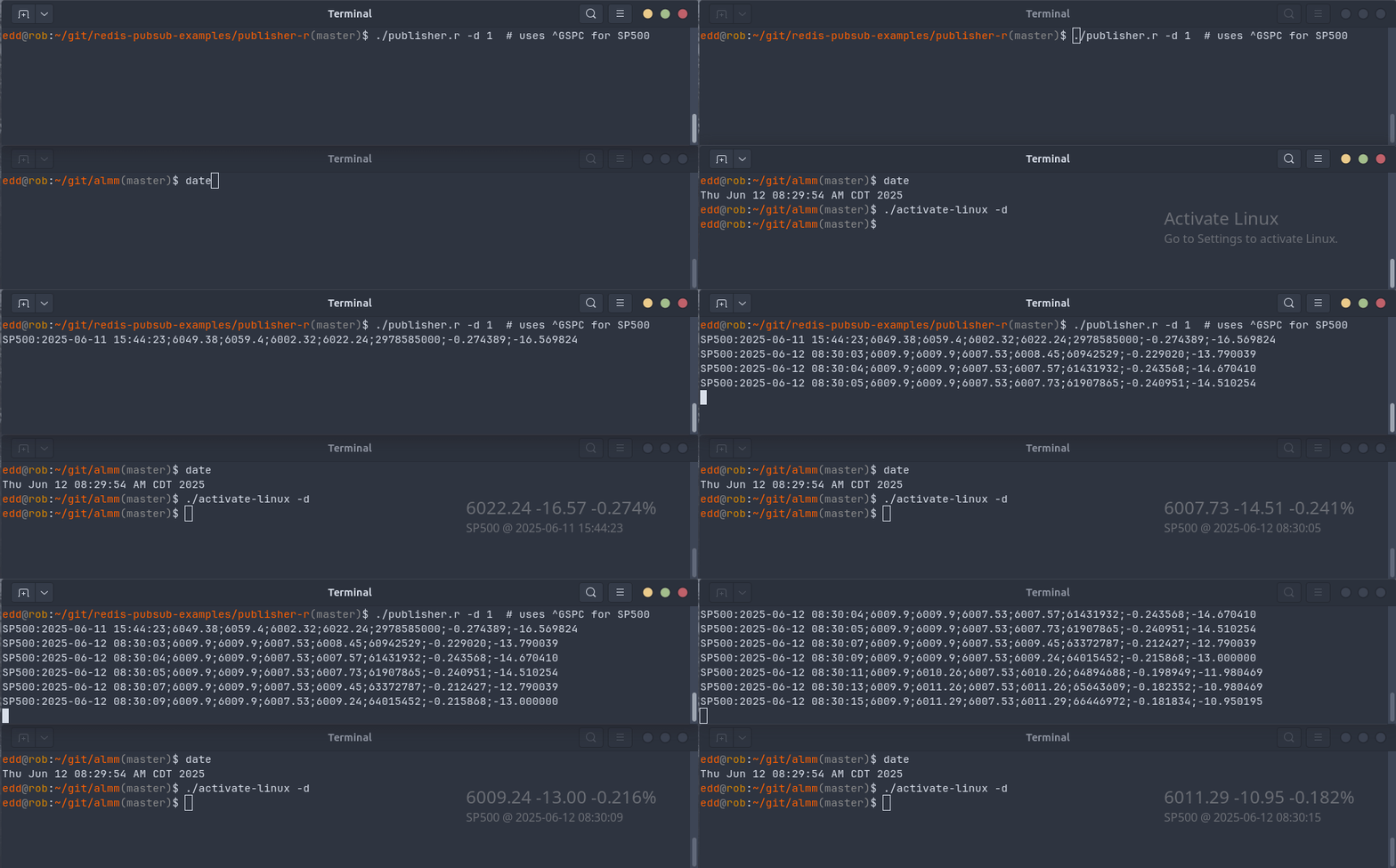 There were two aspects to address. First, the subscription side
needed to be covered in either plain C or C++. That, it turns out, is
very straightforward and there are existing documentation and prior
examples (e.g. at StackOverflow) as well as the ability to have an LLM
generate a quick stanza as I did with Claude. A modified variant is now
in the
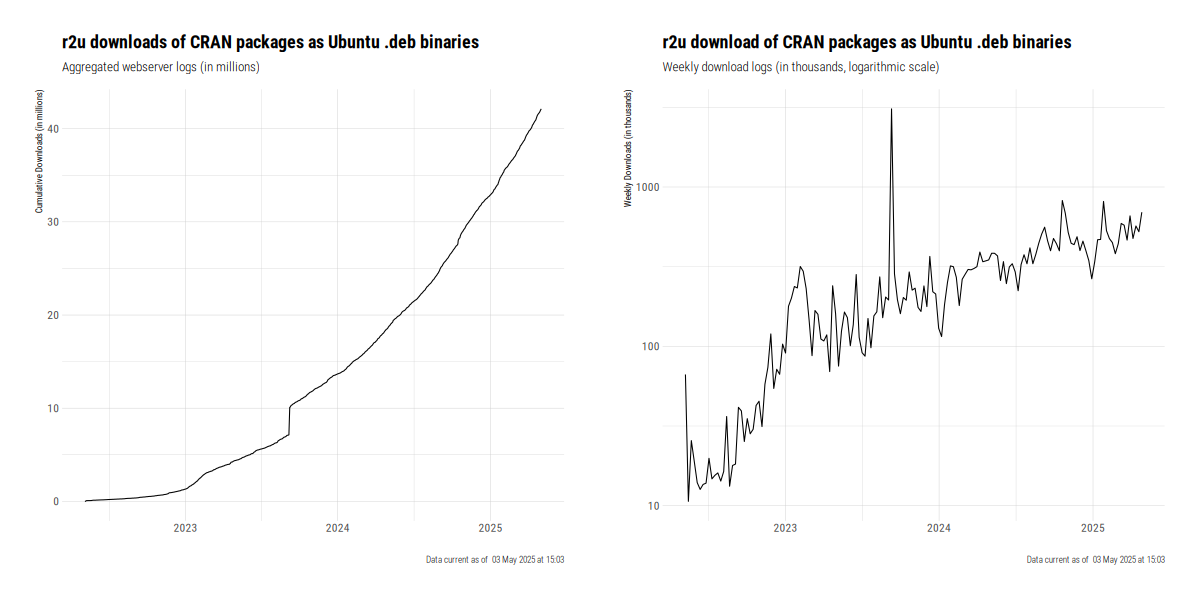 Usage is driven by deployment in continuous integration (as for
example the Ubuntu-use at GitHub makes this both an easy and obvious
choice), cloud computing (as it is easy to spin up Ubuntu instances, it
is as easy to add