Search Results: "Chris Lamb"

24 May 2024

Reproducible Builds (diffoscope): diffoscope 268 released

The diffoscope maintainers are pleased to announce the release of diffoscope version 268. This version includes the following changes:
[ Chris Lamb ]
* Drop apktool from Build-Depends; we can still test our APK code
  via autopkgtests. (Closes: #1071410)
* Fix tests for 7zip version 24.05.
* Add a versioned dependency for at least version 5.4.5 for the xz
  tests; they fail under (at least xz 5.2.8).
  (Closes: reproducible-builds/diffoscope#374)
[ Vagrant Cascadian ]
* Relax Chris' versioned xz test dependency (5.4.5) to also allow
  version 5.4.1.

You find out more by visiting the project homepage.

17 May 2024

Reproducible Builds (diffoscope): diffoscope 267 released

The diffoscope maintainers are pleased to announce the release of diffoscope version 267. This version includes the following changes:
[ Chris Lamb ]
* Include "xz --verbose --verbose" (ie. double --verbose) output, not just
  the single --verbose. (Closes: #1069329)
* Only include "xz --list" output if the xz has no other differences.
You find out more by visiting the project homepage.

14 May 2024

Freexian Collaborators: Monthly report about Debian Long Term Support, April 2024 (by Roberto C. S nchez)

Like each month, have a look at the work funded by Freexian s Debian LTS offering.

Debian LTS contributors In April, 19 contributors have been paid to work on Debian LTS, their reports are available:
  • Abhijith PA did 0.5h (out of 0.0h assigned and 14.0h from previous period), thus carrying over 13.5h to the next month.
  • Adrian Bunk did 35.75h (out of 17.25h assigned and 40.5h from previous period), thus carrying over 22.0h to the next month.
  • Bastien Roucari s did 25.0h (out of 25.0h assigned).
  • Ben Hutchings did 24.0h (out of 9.0h assigned and 15.0h from previous period).
  • Chris Lamb did 18.0h (out of 18.0h assigned).
  • Daniel Leidert did 10.0h (out of 10.0h assigned).
  • Emilio Pozuelo Monfort did 46.0h (out of 12.0h assigned and 34.0h from previous period).
  • Guilhem Moulin did 14.75h (out of 20.0h assigned), thus carrying over 5.25h to the next month.
  • Lee Garrett did 51.25h (out of 0.0h assigned and 60.0h from previous period), thus carrying over 8.75h to the next month.
  • Markus Koschany did 40.0h (out of 40.0h assigned).
  • Ola Lundqvist did 22.5h (out of 19.5h assigned and 4.5h from previous period), thus carrying over 1.5h to the next month.
  • Roberto C. S nchez did 11.0h (out of 9.25h assigned and 2.75h from previous period), thus carrying over 1.0h to the next month.
  • Santiago Ruano Rinc n did 20.0h (out of 20.0h assigned).
  • Sean Whitton did 9.5h (out of 4.5h assigned and 5.5h from previous period), thus carrying over 0.5h to the next month.
  • Stefano Rivera did 1.5h (out of 0.0h assigned and 10.0h from previous period), thus carrying over 8.5h to the next month.
  • Sylvain Beucler did 12.5h (out of 22.75h assigned and 35.0h from previous period), thus carrying over 45.25h to the next month.
  • Thorsten Alteholz did 14.0h (out of 14.0h assigned).
  • Tobias Frost did 10.0h (out of 12.0h assigned), thus carrying over 2.0h to the next month.
  • Utkarsh Gupta did 3.25h (out of 28.5h assigned and 29.25h from previous period), thus carrying over 54.5h to the next month.

Evolution of the situation In April, we have released 28 DLAs. During the month of April, there was one particularly notable security update made in LTS. Guilhem Moulin prepared DLA-3782-1 for util-linux (part of the set of base packages and containing a number of important system utilities) in order to address a possible information disclosure vulnerability. Additionally, several contributors prepared updates for oldstable (bullseye), stable (bookworm), and unstable (sid), including:
  • ruby-rack: prepared for oldstable, stable, and unstable by Adrian Bunk
  • wpa: prepared for oldstable, stable, and unstable by Bastien Roucari s
  • zookeeper: prepared for stable by Bastien Roucari s
  • libjson-smart: prepared for unstable by Bastien Roucari s
  • ansible: prepared for stable and unstable, including autopkgtest fixes to increase future supportability, by Lee Garrett
  • wordpress: prepared for oldstable and stable by Markus Koschany
  • emacs and org-mode: prepared for oldstable and stable by Sean Whitton
  • qtbase-opensource-src: prepared for oldstable and stable by Thorsten Alteholz
  • libjwt: prepared for oldstable by Thorsten Alteholz
  • libmicrohttpd: prepared for oldstable by Thorsten Alteholz
These fixes were in addition to corresponding updates in LTS. Another item to highlight in this month s report is an update to the distro-info-data database by Stefano Rivera. This update ensures that Debian buster systems have the latest available information concerning the end-of-life dates and other related information for all releases of Debian and Ubuntu. As announced on the debian-lts-announce mailing list, it is worth to point out that we are getting close to the end of support of Debian 10 as LTS. After June 30th, no new security updates will be made available on security.debian.org. However, Freexian and its team of paid Debian contributors will continue to maintain Debian 10 going forward for the customers of the Extended LTS offer. If you still have Debian 10 servers to keep secure, it s time to subscribe!

Thanks to our sponsors Sponsors that joined recently are in bold.

10 May 2024

Reproducible Builds: Reproducible Builds in April 2024

Welcome to the April 2024 report from the Reproducible Builds project! In our reports, we attempt to outline what we have been up to over the past month, as well as mentioning some of the important things happening more generally in software supply-chain security. As ever, if you are interested in contributing to the project, please visit our Contribute page on our website. Table of contents:
  1. New backseat-signed tool to validate distributions source inputs
  2. NixOS is not reproducible
  3. Certificate vulnerabilities in F-Droid s fdroidserver
  4. Website updates
  5. Reproducible Builds and Insights from an Independent Verifier for Arch Linux
  6. libntlm now releasing minimal source-only tarballs
  7. Distribution work
  8. Mailing list news
  9. diffoscope
  10. Upstream patches
  11. reprotest
  12. Reproducibility testing framework

New backseat-signed tool to validate distributions source inputs kpcyrd announced a new tool called backseat-signed, after:
I figured out a somewhat straight-forward way to check if a given git archive output is cryptographically claimed to be the source input of a given binary package in either Arch Linux or Debian (or both).
Elaborating more in their announcement post, kpcyrd writes:
I believe this to be the reproducible source tarball thing some people have been asking about. As explained in the README, I believe reproducing autotools-generated tarballs isn t worth everybody s time and instead a distribution that claims to build from source should operate on VCS snapshots instead of tarballs with 25k lines of pre-generated shell-script.
Indeed, many distributions packages already build from VCS snapshots, and this trend is likely to accelerate in response to the xz incident. The announcement led to a lengthy discussion on our mailing list, as well as shorter followup thread from kpcyrd about bootstrapping Autotools projects.

NixOS is not reproducible Morten Linderud posted an post on his blog this month, provocatively titled, NixOS is not reproducible . Although quickly admitting that his title is indeed clickbait , Morten goes on to clarify the precise guarantees and promises that NixOS provides its users. Later in the most, Morten mentions that he was motivated to write the post because:
I have heavily invested my free-time on this topic since 2017, and met some of the accomplishments we have had with Doesn t NixOS solve this? for just as long and I thought it would be of peoples interest to clarify[.]

Certificate vulnerabilities in F-Droid s fdroidserver In early April, Fay Stegerman announced a certificate pinning bypass vulnerability and Proof of Concept (PoC) in the F-Droid fdroidserver tools for managing builds, indexes, updates, and deployments for F-Droid repositories to the oss-security mailing list.
We observed that embedding a v1 (JAR) signature file in an APK with minSdk >= 24 will be ignored by Android/apksigner, which only checks v2/v3 in that case. However, since fdroidserver checks v1 first, regardless of minSdk, and does not verify the signature, it will accept a fake certificate and see an incorrect certificate fingerprint. [ ] We also realised that the above mentioned discrepancy between apksigner and androguard (which fdroidserver uses to extract the v2/v3 certificates) can be abused here as well. [ ]
Later on in the month, Fay followed up with a second post detailing a third vulnerability and a script that could be used to scan for potentially affected .apk files and mentioned that, whilst upstream had acknowledged the vulnerability, they had not yet applied any ameliorating fixes.

Website updates There were a number of improvements made to our website this month, including Chris Lamb updating the archive page to recommend -X and unzipping with TZ=UTC [ ] and adding Maven, Gradle, JDK and Groovy examples to the SOURCE_DATE_EPOCH page [ ]. In addition Jan Zerebecki added a new /contribute/opensuse/ page [ ] and Sertonix fixed the automatic RSS feed detection [ ][ ].

Reproducible Builds and Insights from an Independent Verifier for Arch Linux Joshua Drexel, Esther H nggi and Iy n M ndez Veiga of the School of Computer Science and Information Technology, Hochschule Luzern (HSLU) in Switzerland published a paper this month entitled Reproducible Builds and Insights from an Independent Verifier for Arch Linux. The paper establishes the context as follows:
Supply chain attacks have emerged as a prominent cybersecurity threat in recent years. Reproducible and bootstrappable builds have the potential to reduce such attacks significantly. In combination with independent, exhaustive and periodic source code audits, these measures can effectively eradicate compromises in the building process. In this paper we introduce both concepts, we analyze the achievements over the last ten years and explain the remaining challenges.
What is more, the paper aims to:
contribute to the reproducible builds effort by setting up a rebuilder and verifier instance to test the reproducibility of Arch Linux packages. Using the results from this instance, we uncover an unnoticed and security-relevant packaging issue affecting 16 packages related to Certbot [ ].
A PDF of the paper is available.

libntlm now releasing minimal source-only tarballs Simon Josefsson wrote on his blog this month that, going forward, the libntlm project will now be releasing what they call minimal source-only tarballs :
The XZUtils incident illustrate that tarballs with files that are not included in the git archive offer an opportunity to disguise malicious backdoors. [The] risk of hiding malware is not the only motivation to publish signed minimal source-only tarballs. With pre-generated content in tarballs, there is a risk that GNU/Linux distributions [ship] generated files coming from the tarball into the binary *.deb or *.rpm package file. Typically the person packaging the upstream project never realized that some installed artifacts was not re-built[.]
Simon s post goes into further details how this was achieved, and describes some potential caveats and counters some expected responses as well. A shorter version can be found in the announcement for the 1.8 release of libntlm.

Distribution work In Debian this month, Helmut Grohne filed a bug suggesting the removal of dh-buildinfo, a tool to generate and distribute .buildinfo-like files within binary packages. Note that this is distinct from the .buildinfo generation performed by dpkg-genbuildinfo. By contrast, the entirely optional dh-buildinfo generated a debian/buildinfo file that would be shipped within binary packages as /usr/share/doc/package/buildinfo_$arch.gz. Adrian Bunk recently asked about including source hashes in Debian s .buildinfo files, which prompted Guillem Jover to refresh some old patches to dpkg to make this possible, which revealed some quirks Vagrant Cascadian discovered when testing. In addition, 21 reviews of Debian packages were added, 22 were updated and 16 were removed this month adding to our knowledge about identified issues. A number issue types have been added, such as new random_temporary_filenames_embedded_by_mesonpy and timestamps_added_by_librime toolchain issues. In openSUSE, it was announced that their Factory distribution enabled bit-by-bit reproducible builds for almost all parts of the package. Previously, more parts needed to be ignored when comparing package files, but now only the signature needs to be deleted. In addition, Bernhard M. Wiedemann published theunreproduciblepackage as a proper .rpm package which it allows to better test tools intended to debug reproducibility. Furthermore, it was announced that Bernhard s work on a 100% reproducible openSUSE-based distribution will be funded by NLnet. He also posted another monthly report for his reproducibility work in openSUSE. In GNU Guix, Janneke Nieuwenhuizen submitted a patch set for creating a reproducible source tarball for Guix. That is to say, ensuring that make dist is reproducible when run from Git. [ ] Lastly, in Fedora, a new wiki page was created to propose a change to the distribution. Titled Changes/ReproduciblePackageBuilds , the page summarises itself as a proposal whereby A post-build cleanup is integrated into the RPM build process so that common causes of build irreproducibility in packages are removed, making most of Fedora packages reproducible.

Mailing list news On our mailing list this month:
  • Continuing a thread started in March 2024 about the Arch Linux minimal container now being 100% reproducible, John Gilmore followed up with a post about the practical and philosophical distinctions of local vs. remote storage of the various artifacts needed to build packages.
  • Chris Lamb asked the list which conferences readers are attending these days: After peak Covid and other industry-wide changes, conferences are no longer the must attend events they previously were especially in the area of software supply-chain security. In rough, practical terms, it seems harder to justify conference travel today than it did in mid-2019. The thread generated a number of responses which would be of interest to anyone planning travel in Q3 and Q4 of 2024.
  • James Addison wrote to the list about a quirk in Git related to its core.autocrlf functionality, thus helpfully passing on a slightly off-topic and perhaps not of direct relevance to anyone on the list today note that might still be the kind of issue that is useful to be aware of if-and-when puzzling over unexpected git content / checksum issues (situations that I do expect people on this list encounter from time-to-time) .

diffoscope diffoscope is our in-depth and content-aware diff utility that can locate and diagnose reproducibility issues. This month, Chris Lamb made a number of changes such as uploading versions 263, 264 and 265 to Debian and made the following additional changes:
  • Don t crash on invalid .zip files, even if we encounter their badness halfway through the file and not at the time of their initial opening. [ ]
  • Prevent odt2txt tests from always being skipped due to an (impossibly) new version requirement. [ ]
  • Avoid parens-in-parens in test skipping messages. [ ]
  • Ensure that tests with >=-style version constraints actually print the tool name. [ ]
In addition, Fay Stegerman fixed a crash when there are (invalid) duplicate entries in .zip which was originally reported in Debian bug #1068705). [ ] Fay also added a user-visible note to a diff when there are duplicate entries in ZIP files [ ]. Lastly, Vagrant Cascadian added an external tool pointer for the zipdetails tool under GNU Guix [ ] and proposed updates to diffoscope in Guix as well [ ] which were merged as [264] [265], fixed a regression in test coverage and increased verbosity of the test suite[ ].

Upstream patches The Reproducible Builds project detects, dissects and attempts to fix as many currently-unreproducible packages as possible. We endeavour to send all of our patches upstream where appropriate. This month, we wrote a large number of such patches, including:

reprotest reprotest is our tool for building the same source code twice in different environments and then checking the binaries produced by each build for any differences. This month, reprotest version 0.7.27 was uploaded to Debian unstable) by Vagrant Cascadian who made the following additional changes:
  • Enable specific number of CPUs using --vary=num_cpus.cpus=X. [ ]
  • Consistently use 398 days for time variation, rather than choosing randomly each time. [ ]
  • Disable builds of arch:any packages. [ ]
  • Update the description for the build_path.path option in README.rst. [ ]
  • Update escape sequences for compatibility with Python 3.12. (#1068853). [ ]
  • Remove the generic upstream signing-key [ ] and update the packages signing key with the currently active team members [ ].
  • Update the packaging Standards-Version to 4.7.0. [ ]
In addition, Holger Levsen fixed some spelling errors detected by the spellintian tool [ ] and Vagrant Cascadian updated reprotest in GNU Guix to 0.7.27.

Reproducibility testing framework The Reproducible Builds project operates a comprehensive testing framework running primarily at tests.reproducible-builds.org in order to check packages and other artifacts for reproducibility. In April, an enormous number of changes were made by Holger Levsen:
  • Debian-related changes:
    • Adjust for changed internal IP addresses at Codethink. [ ]
    • Automatically cleanup failed diffoscope user services if there are too many failures. [ ][ ]
    • Configure two new nodes at infomanik.cloud. [ ][ ]
    • Schedule Debian experimental even less. [ ][ ]
  • Breakage detection:
    • Exclude currently building packages from breakage detection. [ ]
    • Be more noisy if diffoscope crashes. [ ]
    • Health check: provide clickable URLs in jenkins job log for failed pkg builds due to diffoscope crashes. [ ]
    • Limit graph to about the last 100 days of breakages only. [ ]
    • Fix all found files with bad permissions. [ ]
    • Prepare dealing with diffoscope timeouts. [ ]
    • Detect more cases of failure to debootstrap base system. [ ]
    • Include timestamps of failed job runs. [ ]
  • Documentation updates:
    • Document how to access arm64 nodes at Codethink. [ ]
    • Document how to use infomaniak.cloud. [ ]
    • Drop notes about long stalled LeMaker HiKey960 boards sponsored by HPE and hosted at ETH. [ ]
    • Mention osuosl4 and osuosl5 and explain their usage. [ ]
    • Mention that some packages are built differently. [ ][ ]
    • Improve language in a comment. [ ]
    • Add more notes how to query resource usage from infomaniak.cloud. [ ]
  • Node maintenance:
    • Add ionos4 and ionos14 to THANKS. [ ][ ][ ][ ][ ]
    • Deprecate Squid on ionos1 and ionos10. [ ]
    • Drop obsolete script to powercycle arm64 architecture nodes. [ ]
    • Update system_health_check for new proxy nodes. [ ]
  • Misc changes:
    • Make the update_jdn.sh script more robust. [ ][ ]
    • Update my SSH public key. [ ]
In addition, Mattia Rizzolo added some new host details. [ ]

If you are interested in contributing to the Reproducible Builds project, please visit our Contribute page on our website. However, you can get in touch with us via:

Reproducible Builds (diffoscope): diffoscope 266 released

The diffoscope maintainers are pleased to announce the release of diffoscope version 266. This version includes the following changes:
[ Chris Lamb ]
* Use "xz --list" to supplement the output when comparing .xz archives;
  essential when some underlying metadata differs. (Closes: #1069329)
* Actually append the xz --list after the container differences, as it
  simplifies tests and the output.
* Add 7zip to <!nocheck> Build-Depends in debian/control.
* Update copyright years.
[ James Addison ]
* Maintain an in-header boolean state to determine whether to drop
  from-file/to-file lines. This fixes an issue where HTML differences were
  being inadvertendly neglected. (Closes: reproducible-builds/diffoscope#372)
You find out more by visiting the project homepage.

19 April 2024

Reproducible Builds (diffoscope): diffoscope 265 released

The diffoscope maintainers are pleased to announce the release of diffoscope version 265. This version includes the following changes:
[ Chris Lamb ]
* Ensure that tests with ">=" version constraints actually print the
  corresponding tool name. (Closes: reproducible-builds/diffoscope#370)
* Prevent odt2txt tests from always being skipped due to an impossibly new
  version requirement. (Closes: reproducible-builds/diffoscope#369)
* Avoid nested parens-in-parens when printing "skipping " messages
  in the testsuite.
You find out more by visiting the project homepage.

12 April 2024

Reproducible Builds (diffoscope): diffoscope 264 released

The diffoscope maintainers are pleased to announce the release of diffoscope version 264. This version includes the following changes:
[ Chris Lamb ]
* Don't crash on invalid zipfiles, even if we encounter 'badness'
  halfway through the file. (Re: #1068705)
[ FC (Fay) Stegerman ]
* Fix a crash when there are (invalid) duplicate entries in .zip files.
  (Closes: #1068705)
* Add note when there are duplicate entries in ZIP files.
  (Closes: reproducible-builds/diffoscope!140)
[ Vagrant Cascadian ]
* Add an external tool reference for GNU Guix for zipdetails.
You find out more by visiting the project homepage.

Freexian Collaborators: Monthly report about Debian Long Term Support, March 2024 (by Roberto C. S nchez)

Like each month, have a look at the work funded by Freexian s Debian LTS offering.

Debian LTS contributors In March, 19 contributors have been paid to work on Debian LTS, their reports are available:
  • Abhijith PA did 0.0h (out of 10.0h assigned and 4.0h from previous period), thus carrying over 14.0h to the next month.
  • Adrian Bunk did 59.5h (out of 47.5h assigned and 52.5h from previous period), thus carrying over 40.5h to the next month.
  • Bastien Roucari s did 22.0h (out of 20.0h assigned and 2.0h from previous period).
  • Ben Hutchings did 9.0h (out of 2.0h assigned and 22.0h from previous period), thus carrying over 15.0h to the next month.
  • Chris Lamb did 18.0h (out of 18.0h assigned).
  • Daniel Leidert did 12.0h (out of 12.0h assigned).
  • Emilio Pozuelo Monfort did 0.0h (out of 3.0h assigned and 57.0h from previous period), thus carrying over 60.0h to the next month.
  • Guilhem Moulin did 22.5h (out of 7.25h assigned and 15.25h from previous period).
  • Holger Levsen did 0.0h (out of 0.5h assigned and 11.5h from previous period), thus carrying over 12.0h to the next month.
  • Lee Garrett did 0.0h (out of 0.0h assigned and 60.0h from previous period), thus carrying over 60.0h to the next month.
  • Markus Koschany did 40.0h (out of 40.0h assigned).
  • Ola Lundqvist did 19.5h (out of 24.0h assigned), thus carrying over 4.5h to the next month.
  • Roberto C. S nchez did 9.25h (out of 3.5h assigned and 8.5h from previous period), thus carrying over 2.75h to the next month.
  • Santiago Ruano Rinc n did 19.0h (out of 16.5h assigned and 2.5h from previous period).
  • Sean Whitton did 4.5h (out of 4.5h assigned and 1.5h from previous period), thus carrying over 1.5h to the next month.
  • Sylvain Beucler did 25.0h (out of 24.5h assigned and 35.5h from previous period), thus carrying over 35.0h to the next month.
  • Thorsten Alteholz did 14.0h (out of 14.0h assigned).
  • Tobias Frost did 12.0h (out of 12.0h assigned).
  • Utkarsh Gupta did 19.5h (out of 0.0h assigned and 48.75h from previous period), thus carrying over 29.25h to the next month.

Evolution of the situation In March, we have released 31 DLAs. Adrian Bunk was responsible for updating gtkwave not only in LTS, but also in unstable, stable, and old-stable as well. This update involved an upload of a new upstream release of gtkwave to each target suite to address 82 separate CVEs. Guilhem Moulin prepared an update of libvirt which was particularly notable, as it fixed multiple vulnerabilities which would lead to denial of service or information disclosure. In addition to the normal security updates, multiple LTS contributors worked at getting various packages updated in more recent Debian releases, including gross for bullseye/bookworm (by Adrian Bunk), imlib2 for bullseye, jetty9 and tomcat9/10 for bullseye/bookworm (by Markus Koschany), samba for bullseye, py7zr for bullseye (by Santiago Ruano Rinc n), cacti for bullseye/bookwork (by Sylvain Beucler), and libmicrohttpd for bullseye (by Thorsten Alteholz). Additionally, Sylvain actively coordinated with cacti upstream concerning an incomplete fix for CVE-2024-29894.

Thanks to our sponsors Sponsors that joined recently are in bold.

11 April 2024

Reproducible Builds: Reproducible Builds in March 2024

Welcome to the March 2024 report from the Reproducible Builds project! In our reports, we attempt to outline what we have been up to over the past month, as well as mentioning some of the important things happening more generally in software supply-chain security. As ever, if you are interested in contributing to the project, please visit our Contribute page on our website. Table of contents:
  1. Arch Linux minimal container userland now 100% reproducible
  2. Validating Debian s build infrastructure after the XZ backdoor
  3. Making Fedora Linux (more) reproducible
  4. Increasing Trust in the Open Source Supply Chain with Reproducible Builds and Functional Package Management
  5. Software and source code identification with GNU Guix and reproducible builds
  6. Two new Rust-based tools for post-processing determinism
  7. Distribution work
  8. Mailing list highlights
  9. Website updates
  10. Delta chat clients now reproducible
  11. diffoscope updates
  12. Upstream patches
  13. Reproducibility testing framework

Arch Linux minimal container userland now 100% reproducible In remarkable news, Reproducible builds developer kpcyrd reported that that the Arch Linux minimal container userland is now 100% reproducible after work by developers dvzv and Foxboron on the one remaining package. This represents a real world , widely-used Linux distribution being reproducible. Their post, which kpcyrd suffixed with the question now what? , continues on to outline some potential next steps, including validating whether the container image itself could be reproduced bit-for-bit. The post, which was itself a followup for an Arch Linux update earlier in the month, generated a significant number of replies.

Validating Debian s build infrastructure after the XZ backdoor From our mailing list this month, Vagrant Cascadian wrote about being asked about trying to perform concrete reproducibility checks for recent Debian security updates, in an attempt to gain some confidence about Debian s build infrastructure given that they performed builds in environments running the high-profile XZ vulnerability. Vagrant reports (with some caveats):
So far, I have not found any reproducibility issues; everything I tested I was able to get to build bit-for-bit identical with what is in the Debian archive.
That is to say, reproducibility testing permitted Vagrant and Debian to claim with some confidence that builds performed when this vulnerable version of XZ was installed were not interfered with.

Making Fedora Linux (more) reproducible In March, Davide Cavalca gave a talk at the 2024 Southern California Linux Expo (aka SCALE 21x) about the ongoing effort to make the Fedora Linux distribution reproducible. Documented in more detail on Fedora s website, the talk touched on topics such as the specifics of implementing reproducible builds in Fedora, the challenges encountered, the current status and what s coming next. (YouTube video)

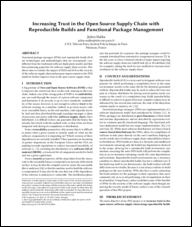
Increasing Trust in the Open Source Supply Chain with Reproducible Builds and Functional Package Management Julien Malka published a brief but interesting paper in the HAL open archive on Increasing Trust in the Open Source Supply Chain with Reproducible Builds and Functional Package Management:
Functional package managers (FPMs) and reproducible builds (R-B) are technologies and methodologies that are conceptually very different from the traditional software deployment model, and that have promising properties for software supply chain security. This thesis aims to evaluate the impact of FPMs and R-B on the security of the software supply chain and propose improvements to the FPM model to further improve trust in the open source supply chain. PDF
Julien s paper poses a number of research questions on how the model of distributions such as GNU Guix and NixOS can be leveraged to further improve the safety of the software supply chain , etc.

Software and source code identification with GNU Guix and reproducible builds In a long line of commendably detailed blog posts, Ludovic Court s, Maxim Cournoyer, Jan Nieuwenhuizen and Simon Tournier have together published two interesting posts on the GNU Guix blog this month. In early March, Ludovic Court s, Maxim Cournoyer, Jan Nieuwenhuizen and Simon Tournier wrote about software and source code identification and how that might be performed using Guix, rhetorically posing the questions: What does it take to identify software ? How can we tell what software is running on a machine to determine, for example, what security vulnerabilities might affect it? Later in the month, Ludovic Court s wrote a solo post describing adventures on the quest for long-term reproducible deployment. Ludovic s post touches on GNU Guix s aim to support time travel , the ability to reliably (and reproducibly) revert to an earlier point in time, employing the iconic image of Harold Lloyd hanging off the clock in Safety Last! (1925) to poetically illustrate both the slapstick nature of current modern technology and the gymnastics required to navigate hazards of our own making.

Two new Rust-based tools for post-processing determinism Zbigniew J drzejewski-Szmek announced add-determinism, a work-in-progress reimplementation of the Reproducible Builds project s own strip-nondeterminism tool in the Rust programming language, intended to be used as a post-processor in RPM-based distributions such as Fedora In addition, Yossi Kreinin published a blog post titled refix: fast, debuggable, reproducible builds that describes a tool that post-processes binaries in such a way that they are still debuggable with gdb, etc.. Yossi post details the motivation and techniques behind the (fast) performance of the tool.

Distribution work In Debian this month, since the testing framework no longer varies the build path, James Addison performed a bulk downgrade of the bug severity for issues filed with a level of normal to a new level of wishlist. In addition, 28 reviews of Debian packages were added, 38 were updated and 23 were removed this month adding to ever-growing knowledge about identified issues. As part of this effort, a number of issue types were updated, including Chris Lamb adding a new ocaml_include_directories toolchain issue [ ] and James Addison adding a new filesystem_order_in_java_jar_manifest_mf_include_resource issue [ ] and updating the random_uuid_in_notebooks_generated_by_nbsphinx to reference a relevant discussion thread [ ]. In addition, Roland Clobus posted his 24th status update of reproducible Debian ISO images. Roland highlights that the images for Debian unstable often cannot be generated due to changes in that distribution related to the 64-bit time_t transition. Lastly, Bernhard M. Wiedemann posted another monthly update for his reproducibility work in openSUSE.

Mailing list highlights Elsewhere on our mailing list this month:

Website updates There were made a number of improvements to our website this month, including:
  • Pol Dellaiera noticed the frequent need to correctly cite the website itself in academic work. To facilitate easier citation across multiple formats, Pol contributed a Citation File Format (CIF) file. As a result, an export in BibTeX format is now available in the Academic Publications section. Pol encourages community contributions to further refine the CITATION.cff file. Pol also added an substantial new section to the buy in page documenting the role of Software Bill of Materials (SBOMs) and ephemeral development environments. [ ][ ]
  • Bernhard M. Wiedemann added a new commandments page to the documentation [ ][ ] and fixed some incorrect YAML elsewhere on the site [ ].
  • Chris Lamb add three recent academic papers to the publications page of the website. [ ]
  • Mattia Rizzolo and Holger Levsen collaborated to add Infomaniak as a sponsor of amd64 virtual machines. [ ][ ][ ]
  • Roland Clobus updated the stable outputs page, dropping version numbers from Python documentation pages [ ] and noting that Python s set data structure is also affected by the PYTHONHASHSEED functionality. [ ]

Delta chat clients now reproducible Delta Chat, an open source messaging application that can work over email, announced this month that the Rust-based core library underlying Delta chat application is now reproducible.

diffoscope diffoscope is our in-depth and content-aware diff utility that can locate and diagnose reproducibility issues. This month, Chris Lamb made a number of changes such as uploading versions 259, 260 and 261 to Debian and made the following additional changes:
  • New features:
    • Add support for the zipdetails tool from the Perl distribution. Thanks to Fay Stegerman and Larry Doolittle et al. for the pointer and thread about this tool. [ ]
  • Bug fixes:
    • Don t identify Redis database dumps as GNU R database files based simply on their filename. [ ]
    • Add a missing call to File.recognizes so we actually perform the filename check for GNU R data files. [ ]
    • Don t crash if we encounter an .rdb file without an equivalent .rdx file. (#1066991)
    • Correctly check for 7z being available and not lz4 when testing 7z. [ ]
    • Prevent a traceback when comparing a contentful .pyc file with an empty one. [ ]
  • Testsuite improvements:
    • Fix .epub tests after supporting the new zipdetails tool. [ ]
    • Don t use parenthesis within test skipping messages, as PyTest adds its own parenthesis. [ ]
    • Factor out Python version checking in test_zip.py. [ ]
    • Skip some Zip-related tests under Python 3.10.14, as a potential regression may have been backported to the 3.10.x series. [ ]
    • Actually test 7z support in the test_7z set of tests, not the lz4 functionality. (Closes: reproducible-builds/diffoscope#359). [ ]
In addition, Fay Stegerman updated diffoscope s monkey patch for supporting the unusual Mozilla ZIP file format after Python s zipfile module changed to detect potentially insecure overlapping entries within .zip files. (#362) Chris Lamb also updated the trydiffoscope command line client, dropping a build-dependency on the deprecated python3-distutils package to fix Debian bug #1065988 [ ], taking a moment to also refresh the packaging to the latest Debian standards [ ]. Finally, Vagrant Cascadian submitted an update for diffoscope version 260 in GNU Guix. [ ]

Upstream patches This month, we wrote a large number of patches, including: Bernhard M. Wiedemann used reproducibility-tooling to detect and fix packages that added changes in their %check section, thus failing when built with the --no-checks option. Only half of all openSUSE packages were tested so far, but a large number of bugs were filed, including ones against caddy, exiv2, gnome-disk-utility, grisbi, gsl, itinerary, kosmindoormap, libQuotient, med-tools, plasma6-disks, pspp, python-pypuppetdb, python-urlextract, rsync, vagrant-libvirt and xsimd. Similarly, Jean-Pierre De Jesus DIAZ employed reproducible builds techniques in order to test a proposed refactor of the ath9k-htc-firmware package. As the change produced bit-for-bit identical binaries to the previously shipped pre-built binaries:
I don t have the hardware to test this firmware, but the build produces the same hashes for the firmware so it s safe to say that the firmware should keep working.

Reproducibility testing framework The Reproducible Builds project operates a comprehensive testing framework running primarily at tests.reproducible-builds.org in order to check packages and other artifacts for reproducibility. In March, an enormous number of changes were made by Holger Levsen:
  • Debian-related changes:
    • Sleep less after a so-called 404 package state has occurred. [ ]
    • Schedule package builds more often. [ ][ ]
    • Regenerate all our HTML indexes every hour, but only every 12h for the released suites. [ ]
    • Create and update unstable and experimental base systems on armhf again. [ ][ ]
    • Don t reschedule so many depwait packages due to the current size of the i386 architecture queue. [ ]
    • Redefine our scheduling thresholds and amounts. [ ]
    • Schedule untested packages with a higher priority, otherwise slow architectures cannot keep up with the experimental distribution growing. [ ]
    • Only create the stats_buildinfo.png graph once per day. [ ][ ]
    • Reproducible Debian dashboard: refactoring, update several more static stats only every 12h. [ ]
    • Document how to use systemctl with new systemd-based services. [ ]
    • Temporarily disable armhf and i386 continuous integration tests in order to get some stability back. [ ]
    • Use the deb.debian.org CDN everywhere. [ ]
    • Remove the rsyslog logging facility on bookworm systems. [ ]
    • Add zst to the list of packages which are false-positive diskspace issues. [ ]
    • Detect failures to bootstrap Debian base systems. [ ]
  • Arch Linux-related changes:
    • Temporarily disable builds because the pacman package manager is broken. [ ][ ]
    • Split reproducible_html_live_status and split the scheduling timing . [ ][ ][ ]
    • Improve handling when database is locked. [ ][ ]
  • Misc changes:
    • Show failed services that require manual cleanup. [ ][ ]
    • Integrate two new Infomaniak nodes. [ ][ ][ ][ ]
    • Improve IRC notifications for artifacts. [ ]
    • Run diffoscope in different systemd slices. [ ]
    • Run the node health check more often, as it can now repair some issues. [ ][ ]
    • Also include the string Bot in the userAgent for Git. (Re: #929013). [ ]
    • Document increased tmpfs size on our OUSL nodes. [ ]
    • Disable memory account for the reproducible_build service. [ ][ ]
    • Allow 10 times as many open files for the Jenkins service. [ ]
    • Set OOMPolicy=continue and OOMScoreAdjust=-1000 for both the Jenkins and the reproducible_build service. [ ]
Mattia Rizzolo also made the following changes:
  • Debian-related changes:
    • Define a systemd slice to group all relevant services. [ ][ ]
    • Add a bunch of quotes in scripts to assuage the shellcheck tool. [ ]
    • Add stats on how many packages have been built today so far. [ ]
    • Instruct systemd-run to handle diffoscope s exit codes specially. [ ]
    • Prefer the pgrep tool over grepping the output of ps. [ ]
    • Re-enable a couple of i386 and armhf architecture builders. [ ][ ]
    • Fix some stylistic issues flagged by the Python flake8 tool. [ ]
    • Cease scheduling Debian unstable and experimental on the armhf architecture due to the time_t transition. [ ]
    • Start a few more i386 & armhf workers. [ ][ ][ ]
    • Temporarly skip pbuilder updates in the unstable distribution, but only on the armhf architecture. [ ]
  • Other changes:
    • Perform some large-scale refactoring on how the systemd service operates. [ ][ ]
    • Move the list of workers into a separate file so it s accessible to a number of scripts. [ ]
    • Refactor the powercycle_x86_nodes.py script to use the new IONOS API and its new Python bindings. [ ]
    • Also fix nph-logwatch after the worker changes. [ ]
    • Do not install the stunnel tool anymore, it shouldn t be needed by anything anymore. [ ]
    • Move temporary directories related to Arch Linux into a single directory for clarity. [ ]
    • Update the arm64 architecture host keys. [ ]
    • Use a common Postfix configuration. [ ]
The following changes were also made by:
  • Jan-Benedict Glaw:
    • Initial work to clean up a messy NetBSD-related script. [ ][ ]
  • Roland Clobus:
    • Show the installer log if the installer fails to build. [ ]
    • Avoid the minus character (i.e. -) in a variable in order to allow for tags in openQA. [ ]
    • Update the schedule of Debian live image builds. [ ]
  • Vagrant Cascadian:
    • Maintenance on the virt* nodes is completed so bring them back online. [ ]
    • Use the fully qualified domain name in configuration. [ ]
Node maintenance was also performed by Holger Levsen, Mattia Rizzolo [ ][ ] and Vagrant Cascadian [ ][ ][ ][ ]

If you are interested in contributing to the Reproducible Builds project, please visit our Contribute page on our website. However, you can get in touch with us via:

5 April 2024

Reproducible Builds (diffoscope): diffoscope 263 released

The diffoscope maintainers are pleased to announce the release of diffoscope version 263. This version includes the following changes:
[ Chris Lamb ]
* Add support for the zipdetails(1) tool included in the Perl distribution.
  Thanks to Larry Doolittle et al. for the pointer to this tool.
* Don't use parenthesis within test "skipping " messages; PyTest adds its own
  parenthesis, so we were ending up with double nested parens.
* Fix the .epub tests after supporting zipdetails(1).
* Update copyright years and debian/tests/control.
[ FC (Fay) Stegerman ]
* Fix MozillaZipContainer's monkeypatch after Python's zipfile module changed
  to detect potentially insecure overlapping entries within .zip files.
  (Closes: reproducible-builds/diffoscope#362)
You find out more by visiting the project homepage.

29 March 2024

Reproducible Builds (diffoscope): diffoscope 262 released

The diffoscope maintainers are pleased to announce the release of diffoscope version 262. This version includes the following changes:
[ Chris Lamb ]
* Factor out Python version checking in test_zip.py. (Re: #362)
* Also skip some zip tests under 3.10.14 as well; a potential regression may
  have been backported to the 3.10.x series. The underlying cause is still to
  be investigated. (Re: #362)
You find out more by visiting the project homepage.

22 March 2024

Reproducible Builds (diffoscope): diffoscope 261 released

The diffoscope maintainers are pleased to announce the release of diffoscope version 261. This version includes the following changes:
[ Chris Lamb ]
* Don't crash if we encounter an .rdb file without an equivalent .rdx file.
  (Closes: #1066991)
* In addition, don't identify Redis database dumps (etc.) as GNU R database
  files based simply on their filename. (Re: #1066991)
* Update copyright years.
You find out more by visiting the project homepage.

14 March 2024

Freexian Collaborators: Monthly report about Debian Long Term Support, February 2024 (by Roberto C. S nchez)

Like each month, have a look at the work funded by Freexian s Debian LTS offering.

Debian LTS contributors In February, 18 contributors have been paid to work on Debian LTS, their reports are available:
  • Abhijith PA did 10.0h (out of 14.0h assigned), thus carrying over 4.0h to the next month.
  • Adrian Bunk did 13.5h (out of 24.25h assigned and 41.75h from previous period), thus carrying over 52.5h to the next month.
  • Bastien Roucari s did 20.0h (out of 20.0h assigned).
  • Ben Hutchings did 2.0h (out of 14.5h assigned and 9.5h from previous period), thus carrying over 22.0h to the next month.
  • Chris Lamb did 18.0h (out of 18.0h assigned).
  • Daniel Leidert did 10.0h (out of 10.0h assigned).
  • Emilio Pozuelo Monfort did 3.0h (out of 28.25h assigned and 31.75h from previous period), thus carrying over 57.0h to the next month.
  • Guilhem Moulin did 7.25h (out of 4.75h assigned and 15.25h from previous period), thus carrying over 12.75h to the next month.
  • Holger Levsen did 0.5h (out of 3.5h assigned and 8.5h from previous period), thus carrying over 11.5h to the next month.
  • Lee Garrett did 0.0h (out of 18.25h assigned and 41.75h from previous period), thus carrying over 60.0h to the next month.
  • Markus Koschany did 40.0h (out of 40.0h assigned).
  • Roberto C. S nchez did 3.5h (out of 8.75h assigned and 3.25h from previous period), thus carrying over 8.5h to the next month.
  • Santiago Ruano Rinc n did 13.5h (out of 13.5h assigned and 2.5h from previous period), thus carrying over 2.5h to the next month.
  • Sean Whitton did 4.5h (out of 0.5h assigned and 5.5h from previous period), thus carrying over 1.5h to the next month.
  • Sylvain Beucler did 24.5h (out of 27.75h assigned and 32.25h from previous period), thus carrying over 35.5h to the next month.
  • Thorsten Alteholz did 14.0h (out of 14.0h assigned).
  • Tobias Frost did 12.0h (out of 12.0h assigned).
  • Utkarsh Gupta did 11.25h (out of 26.75h assigned and 33.25h from previous period), thus carrying over 48.75 to the next month.

Evolution of the situation In February, we have released 17 DLAs. The number of DLAs published during February was a bit lower than usual, as there was much work going on in the area of triaging CVEs (a number of which turned out to not affect Debia buster, and others which ended up being duplicates, or otherwise determined to be invalid). Of the packages which did receive updates, notable were sudo (to fix a privilege management issue), and iwd and wpa (both of which suffered from authentication bypass vulnerabilities). While this has already been already announced in the Freexian blog, we would like to mention here the start of the Long Term Support project for Samba 4.17. You can find all the important details in that post, but we would like to highlight that it is thanks to our LTS sponsors that we are able to fund the work from our partner, Catalyst, towards improving the security support of Samba in Debian 12 (Bookworm).

Thanks to our sponsors Sponsors that joined recently are in bold.

9 March 2024

Reproducible Builds: Reproducible Builds in February 2024

Welcome to the February 2024 report from the Reproducible Builds project! In our reports, we try to outline what we have been up to over the past month as well as mentioning some of the important things happening in software supply-chain security.

Reproducible Builds at FOSDEM 2024 Core Reproducible Builds developer Holger Levsen presented at the main track at FOSDEM on Saturday 3rd February this year in Brussels, Belgium. However, that wasn t the only talk related to Reproducible Builds. However, please see our comprehensive FOSDEM 2024 news post for the full details and links.

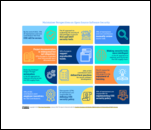
Maintainer Perspectives on Open Source Software Security Bernhard M. Wiedemann spotted that a recent report entitled Maintainer Perspectives on Open Source Software Security written by Stephen Hendrick and Ashwin Ramaswami of the Linux Foundation sports an infographic which mentions that 56% of [polled] projects support reproducible builds .

Mailing list highlights From our mailing list this month:

Distribution work In Debian this month, 5 reviews of Debian packages were added, 22 were updated and 8 were removed this month adding to Debian s knowledge about identified issues. A number of issue types were updated as well. [ ][ ][ ][ ] In addition, Roland Clobus posted his 23rd update of the status of reproducible ISO images on our mailing list. In particular, Roland helpfully summarised that all major desktops build reproducibly with bullseye, bookworm, trixie and sid provided they are built for a second time within the same DAK run (i.e. [within] 6 hours) and that there will likely be further work at a MiniDebCamp in Hamburg. Furthermore, Roland also responded in-depth to a query about a previous report
Fedora developer Zbigniew J drzejewski-Szmek announced a work-in-progress script called fedora-repro-build that attempts to reproduce an existing package within a koji build environment. Although the projects README file lists a number of fields will always or almost always vary and there is a non-zero list of other known issues, this is an excellent first step towards full Fedora reproducibility.
Jelle van der Waa introduced a new linter rule for Arch Linux packages in order to detect cache files leftover by the Sphinx documentation generator which are unreproducible by nature and should not be packaged. At the time of writing, 7 packages in the Arch repository are affected by this.
Elsewhere, Bernhard M. Wiedemann posted another monthly update for his work elsewhere in openSUSE.

diffoscope diffoscope is our in-depth and content-aware diff utility that can locate and diagnose reproducibility issues. This month, Chris Lamb made a number of changes such as uploading versions 256, 257 and 258 to Debian and made the following additional changes:
  • Use a deterministic name instead of trusting gpg s use-embedded-filenames. Many thanks to Daniel Kahn Gillmor dkg@debian.org for reporting this issue and providing feedback. [ ][ ]
  • Don t error-out with a traceback if we encounter struct.unpack-related errors when parsing Python .pyc files. (#1064973). [ ]
  • Don t try and compare rdb_expected_diff on non-GNU systems as %p formatting can vary, especially with respect to MacOS. [ ]
  • Fix compatibility with pytest 8.0. [ ]
  • Temporarily fix support for Python 3.11.8. [ ]
  • Use the 7zip package (over p7zip-full) after a Debian package transition. (#1063559). [ ]
  • Bump the minimum Black source code reformatter requirement to 24.1.1+. [ ]
  • Expand an older changelog entry with a CVE reference. [ ]
  • Make test_zip black clean. [ ]
In addition, James Addison contributed a patch to parse the headers from the diff(1) correctly [ ][ ] thanks! And lastly, Vagrant Cascadian pushed updates in GNU Guix for diffoscope to version 255, 256, and 258, and updated trydiffoscope to 67.0.6.

reprotest reprotest is our tool for building the same source code twice in different environments and then checking the binaries produced by each build for any differences. This month, Vagrant Cascadian made a number of changes, including:
  • Create a (working) proof of concept for enabling a specific number of CPUs. [ ][ ]
  • Consistently use 398 days for time variation rather than choosing randomly and update README.rst to match. [ ][ ]
  • Support a new --vary=build_path.path option. [ ][ ][ ][ ]

Website updates There were made a number of improvements to our website this month, including:

Reproducibility testing framework The Reproducible Builds project operates a comprehensive testing framework (available at tests.reproducible-builds.org) in order to check packages and other artifacts for reproducibility. In February, a number of changes were made by Holger Levsen:
  • Debian-related changes:
    • Temporarily disable upgrading/bootstrapping Debian unstable and experimental as they are currently broken. [ ][ ]
    • Use the 64-bit amd64 kernel on all i386 nodes; no more 686 PAE kernels. [ ]
    • Add an Erlang package set. [ ]
  • Other changes:
    • Grant Jan-Benedict Glaw shell access to the Jenkins node. [ ]
    • Enable debugging for NetBSD reproducibility testing. [ ]
    • Use /usr/bin/du --apparent-size in the Jenkins shell monitor. [ ]
    • Revert reproducible nodes: mark osuosl2 as down . [ ]
    • Thanks again to Codethink, for they have doubled the RAM on our arm64 nodes. [ ]
    • Only set /proc/$pid/oom_score_adj to -1000 if it has not already been done. [ ]
    • Add the opemwrt-target-tegra and jtx task to the list of zombie jobs. [ ][ ]
Vagrant Cascadian also made the following changes:
  • Overhaul the handling of OpenSSH configuration files after updating from Debian bookworm. [ ][ ][ ]
  • Add two new armhf architecture build nodes, virt32z and virt64z, and insert them into the Munin monitoring. [ ][ ] [ ][ ]
In addition, Alexander Couzens updated the OpenWrt configuration in order to replace the tegra target with mpc85xx [ ], Jan-Benedict Glaw updated the NetBSD build script to use a separate $TMPDIR to mitigate out of space issues on a tmpfs-backed /tmp [ ] and Zheng Junjie added a link to the GNU Guix tests [ ]. Lastly, node maintenance was performed by Holger Levsen [ ][ ][ ][ ][ ][ ] and Vagrant Cascadian [ ][ ][ ][ ].

Upstream patches The Reproducible Builds project detects, dissects and attempts to fix as many currently-unreproducible packages as possible. We endeavour to send all of our patches upstream where appropriate. This month, we wrote a large number of such patches, including:

If you are interested in contributing to the Reproducible Builds project, please visit our Contribute page on our website. However, you can get in touch with us via:

8 March 2024

Reproducible Builds (diffoscope): diffoscope 260 released

The diffoscope maintainers are pleased to announce the release of diffoscope version 260. This version includes the following changes:
[ Chris Lamb ]
* Actually test 7z support in the test_7z set of tests, not the lz4
  functionality. (Closes: reproducible-builds/diffoscope#359)
* In addition, correctly check for the 7z binary being available
  (and not lz4) when testing 7z.
* Prevent a traceback when comparing a contentful .pyc file with an
  empty one. (Re: Debian:#1064973)
You find out more by visiting the project homepage.

1 March 2024

Reproducible Builds (diffoscope): diffoscope 259 released

The diffoscope maintainers are pleased to announce the release of diffoscope version 259. This version includes the following changes:
[ Chris Lamb ]
* Don't error-out with a traceback if we encounter "struct.unpack"-related
  errors when parsing .pyc files. (Closes: #1064973)
* Fix compatibility with PyTest 8.0. (Closes: reproducible-builds/diffoscope#365)
* Don't try and compare rdb_expected_diff on non-GNU systems as %p formatting
  can vary. (Re: reproducible-builds/diffoscope#364)
You find out more by visiting the project homepage.

23 February 2024

Reproducible Builds (diffoscope): diffoscope 258 released

The diffoscope maintainers are pleased to announce the release of diffoscope version 258. This version includes the following changes:
[ Chris Lamb ]
* Use the 7zip package (over p7zip-full) after package transition.
  (Closes: #1063559)
* Update debian/tests/control.
[ Vagrant Cascadian ]
* Fix a typo in the package name field (!) within debian/changelog.
You find out more by visiting the project homepage.

12 February 2024

Reproducible Builds (diffoscope): diffoscope 257 released

The diffoscope maintainers are pleased to announce the release of diffoscope version 257. This version includes the following changes:
[ James Addison ]
* Parse the header and hunksize of diffs strictly before parsing the context
  below. (Closes: reproducible-builds/diffoscope#363)
* Reformat code to comply with the latest version of Black (24.1.1).
[ Chris Lamb ]
* Expand the previous changelog entry to include the CVE number that was
  subsequently assigned.
* Bump the miniumum Black requirement to run the "Black clean" test and make
  test_zip.py Black clean.
You find out more by visiting the project homepage.

Freexian Collaborators: Monthly report about Debian Long Term Support, January 2024 (by Roberto C. S nchez)

Like each month, have a look at the work funded by Freexian s Debian LTS offering.

Debian LTS contributors In January, 16 contributors have been paid to work on Debian LTS, their reports are available:
  • Abhijith PA did 14.0h (out of 7.0h assigned and 7.0h from previous period).
  • Bastien Roucari s did 22.0h (out of 16.0h assigned and 6.0h from previous period).
  • Ben Hutchings did 14.5h (out of 8.0h assigned and 16.0h from previous period), thus carrying over 9.5h to the next month.
  • Chris Lamb did 18.0h (out of 18.0h assigned).
  • Daniel Leidert did 10.0h (out of 10.0h assigned).
  • Emilio Pozuelo Monfort did 10.0h (out of 14.75h assigned and 27.0h from previous period), thus carrying over 31.75h to the next month.
  • Guilhem Moulin did 9.75h (out of 25.0h assigned), thus carrying over 15.25h to the next month.
  • Holger Levsen did 3.5h (out of 12.0h assigned), thus carrying over 8.5h to the next month.
  • Markus Koschany did 40.0h (out of 40.0h assigned).
  • Roberto C. S nchez did 8.75h (out of 9.5h assigned and 2.5h from previous period), thus carrying over 3.25h to the next month.
  • Santiago Ruano Rinc n did 13.5h (out of 8.25h assigned and 7.75h from previous period), thus carrying over 2.5h to the next month.
  • Sean Whitton did 0.5h (out of 0.25h assigned and 5.75h from previous period), thus carrying over 5.5h to the next month.
  • Sylvain Beucler did 9.5h (out of 23.25h assigned and 18.5h from previous period), thus carrying over 32.25h to the next month.
  • Thorsten Alteholz did 14.0h (out of 14.0h assigned).
  • Tobias Frost did 12.0h (out of 10.25h assigned and 1.75h from previous period).
  • Utkarsh Gupta did 8.5h (out of 35.75h assigned), thus carrying over 24.75h to the next month.

Evolution of the situation In January, we have released 25 DLAs. A variety of particularly notable packages were updated during January. Among those updates were the Linux kernel (both versions 5.10 and 4.19), mariadb-10.3, openjdk-11, firefox-esr, and thunderbird. In addition to the many other LTS package updates which were released in January, LTS contributors continue their efforts to make impactful contributions both within the Debian community.

Thanks to our sponsors Sponsors that joined recently are in bold.

7 February 2024

Reproducible Builds: Reproducible Builds in January 2024

Welcome to the January 2024 report from the Reproducible Builds project. In these reports we outline the most important things that we have been up to over the past month. If you are interested in contributing to the project, please visit our Contribute page on our website.

How we executed a critical supply chain attack on PyTorch John Stawinski and Adnan Khan published a lengthy blog post detailing how they executed a supply-chain attack against PyTorch, a popular machine learning platform used by titans like Google, Meta, Boeing, and Lockheed Martin :
Our exploit path resulted in the ability to upload malicious PyTorch releases to GitHub, upload releases to [Amazon Web Services], potentially add code to the main repository branch, backdoor PyTorch dependencies the list goes on. In short, it was bad. Quite bad.
The attack pivoted on PyTorch s use of self-hosted runners as well as submitting a pull request to address a trivial typo in the project s README file to gain access to repository secrets and API keys that could subsequently be used for malicious purposes.

New Arch Linux forensic filesystem tool On our mailing list this month, long-time Reproducible Builds developer kpcyrd announced a new tool designed to forensically analyse Arch Linux filesystem images. Called archlinux-userland-fs-cmp, the tool is supposed to be used from a rescue image (any Linux) with an Arch install mounted to, [for example], /mnt. Crucially, however, at no point is any file from the mounted filesystem eval d or otherwise executed. Parsers are written in a memory safe language. More information about the tool can be found on their announcement message, as well as on the tool s homepage. A GIF of the tool in action is also available.

Issues with our SOURCE_DATE_EPOCH code? Chris Lamb started a thread on our mailing list summarising some potential problems with the source code snippet the Reproducible Builds project has been using to parse the SOURCE_DATE_EPOCH environment variable:
I m not 100% sure who originally wrote this code, but it was probably sometime in the ~2015 era, and it must be in a huge number of codebases by now. Anyway, Alejandro Colomar was working on the shadow security tool and pinged me regarding some potential issues with the code. You can see this conversation here.
Chris ends his message with a request that those with intimate or low-level knowledge of time_t, C types, overflows and the various parsing libraries in the C standard library (etc.) contribute with further info.

Distribution updates In Debian this month, Roland Clobus posted another detailed update of the status of reproducible ISO images on our mailing list. In particular, Roland helpfully summarised that all major desktops build reproducibly with bullseye, bookworm, trixie and sid provided they are built for a second time within the same DAK run (i.e. [within] 6 hours) . Additionally 7 of the 8 bookworm images from the official download link build reproducibly at any later time. In addition to this, three reviews of Debian packages were added, 17 were updated and 15 were removed this month adding to our knowledge about identified issues. Elsewhere, Bernhard posted another monthly update for his work elsewhere in openSUSE.

Community updates There were made a number of improvements to our website, including Bernhard M. Wiedemann fixing a number of typos of the term nondeterministic . [ ] and Jan Zerebecki adding a substantial and highly welcome section to our page about SOURCE_DATE_EPOCH to document its interaction with distribution rebuilds. [ ].
diffoscope is our in-depth and content-aware diff utility that can locate and diagnose reproducibility issues. This month, Chris Lamb made a number of changes such as uploading versions 254 and 255 to Debian but focusing on triaging and/or merging code from other contributors. This included adding support for comparing eXtensible ARchive (.XAR/.PKG) files courtesy of Seth Michael Larson [ ][ ], as well considerable work from Vekhir in order to fix compatibility between various and subtle incompatible versions of the progressbar libraries in Python [ ][ ][ ][ ]. Thanks!

Reproducibility testing framework The Reproducible Builds project operates a comprehensive testing framework (available at tests.reproducible-builds.org) in order to check packages and other artifacts for reproducibility. In January, a number of changes were made by Holger Levsen:
  • Debian-related changes:
    • Reduce the number of arm64 architecture workers from 24 to 16. [ ]
    • Use diffoscope from the Debian release being tested again. [ ]
    • Improve the handling when killing unwanted processes [ ][ ][ ] and be more verbose about it, too [ ].
    • Don t mark a job as failed if process marked as to-be-killed is already gone. [ ]
    • Display the architecture of builds that have been running for more than 48 hours. [ ]
    • Reboot arm64 nodes when they hit an OOM (out of memory) state. [ ]
  • Package rescheduling changes:
    • Reduce IRC notifications to 1 when rescheduling due to package status changes. [ ]
    • Correctly set SUDO_USER when rescheduling packages. [ ]
    • Automatically reschedule packages regressing to FTBFS (build failure) or FTBR (build success, but unreproducible). [ ]
  • OpenWrt-related changes:
    • Install the python3-dev and python3-pyelftools packages as they are now needed for the sunxi target. [ ][ ]
    • Also install the libpam0g-dev which is needed by some OpenWrt hardware targets. [ ]
  • Misc:
    • As it s January, set the real_year variable to 2024 [ ] and bump various copyright years as well [ ].
    • Fix a large (!) number of spelling mistakes in various scripts. [ ][ ][ ]
    • Prevent Squid and Systemd processes from being killed by the kernel s OOM killer. [ ]
    • Install the iptables tool everywhere, else our custom rc.local script fails. [ ]
    • Cleanup the /srv/workspace/pbuilder directory on boot. [ ]
    • Automatically restart Squid if it fails. [ ]
    • Limit the execution of chroot-installation jobs to a maximum of 4 concurrent runs. [ ][ ]
Significant amounts of node maintenance was performed by Holger Levsen (eg. [ ][ ][ ][ ][ ][ ][ ] etc.) and Vagrant Cascadian (eg. [ ][ ][ ][ ][ ][ ][ ][ ]). Indeed, Vagrant Cascadian handled an extended power outage for the network running the Debian armhf architecture test infrastructure. This provided the incentive to replace the UPS batteries and consolidate infrastructure to reduce future UPS load. [ ] Elsewhere in our infrastructure, however, Holger Levsen also adjusted the email configuration for @reproducible-builds.org to deal with a new SMTP email attack. [ ]

Upstream patches The Reproducible Builds project tries to detects, dissects and fix as many (currently) unreproducible packages as possible. We endeavour to send all of our patches upstream where appropriate. This month, we wrote a large number of such patches, including: Separate to this, Vagrant Cascadian followed up with the relevant maintainers when reproducibility fixes were not included in newly-uploaded versions of the mm-common package in Debian this was quickly fixed, however. [ ]

If you are interested in contributing to the Reproducible Builds project, please visit our Contribute page on our website. However, you can get in touch with us via:

Next.

Previous.