Benjamin Mako Hill: Science as Dance
 The following selected bibliography showcases only a small portion of
the academics who have demonstrated that while it may take two to
tango, it only takes one to give a scholarly paper a silly cliche
title:
Briganti, G. 2006. It Takes Two to Tango-The CH-53K is arguably the first serious US attempt to open the defense cooperation NATO has been seeking. Rotor and Wing 40(7):60 63.
Coehran, J. 2006. It Takes Two to Tango: Problems with Community Property Ownership of Copyrights and Patents in Texas. Baylor L. Rev. 58:407.
Diamond, M.J. 1984. It takes two to tango: Some thoughts on the neglected importance of the hypnotist in an interactive hypnotherapeutic relationship. American Journal of Clinical Hypnosis 27(1):3 13.
Kraack, A. 1999. It takes two to tango: The place of women in the construction of hegemonic masculinity in a student pub. Masculinities in Aotearoa/New Zealand 153 165.
Lackey, J. 2006. It takes two to tango: beyond reductionism and non-reductionism in the epistemology of testimony. The Epistemology of testimony 160 89.
Miller, C.A. 1998. It takes two to tango: understanding and acquiring symmetrical verbs. Journal of psycholinguistic research 27(3):385 411.
Modiano, N. 1984. It Takes Two to Tango, or Transmission is a Two-Way Street. Anthropology & Education Quarterly 15(4):326 330.
Ott, M.A. 2008. It Takes Two to Tango: Ethical Issues Raised by the Study of Topical Microbicides with Adolescent Dyads. The Journal of adolescent health: official publication of the Society for Adolescent Medicine 42(6):541.
Rubenstein, J.H. 2009. It takes two to tango: dance steps for diagnosing Barrett s esophagus. Respiratory Care Clinics of North America 69(6):1011 1013.
Settersten Jr, R.A. 2009. It takes two to tango: the (un) easy dance between life-course sociology and life-span psychology. Advances in Life Course Research 14(1-2):74 81.
Skaerbaek, E. 2004. It takes two to tango on knowledge production and intersubjectivity. NORA: Nordic Journal of Women's Studies 12(2):93 101.
Spencer, M. 2005. It takes two to tango. Journal of Business Strategy 26(5):62 68.
Vanaerschot, G. 2004. It Takes Two to Tango: On Empathy With Fragile Processes. Psychotherapy: Theory, Research, Practice, Training 41(2):112.
Viskochil, D.H. 2003. It takes two to tango: mast cell and Schwann cell interactions in neurofibromas. Journal of Clinical Investigation 112(12):1791 1792.
Weiner, A. 2001. It Takes Two to Tango:: Information, Metabolism, and the Origins of Life. Cell 105(3):307 308.
Wittman, M.L. 1990. It Takes Two to Tango: Your Simplistic System for Self-survival. Witmark Pub. Co.


 In the



 When
 The Ubuntu website


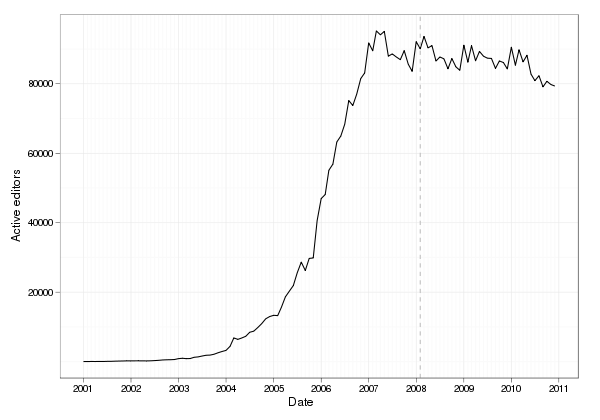 Felipe Ortega, who has provided many of these statistics, has
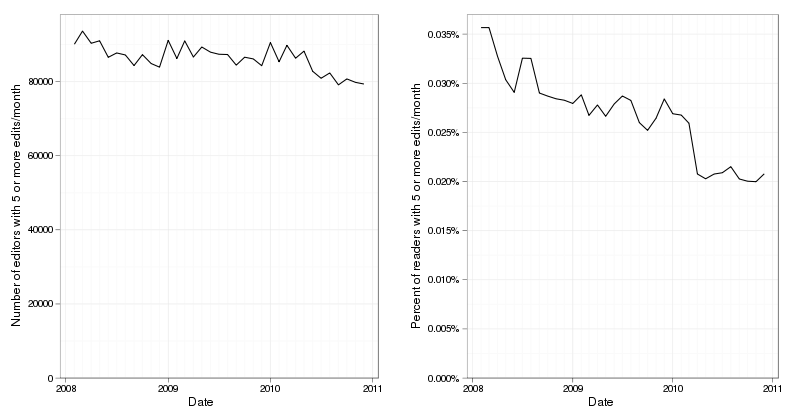 Although the graphs above do not say anything directly about the most
active core contributors to Wikipedia, the fact that Wikipedia is
being maintained by a tiny -- and shrinking -- proportion of its
readership does mean that the idea behind Wikipedia is under threat.
Although none are as big as Wikipedia, there are lots of good
encyclopedias out there. The reason Wikipedia is different,
interesting, and important is because -- unlike all those others --
Wikipedia is the encyclopedia that anyone can edit. Wikipedia is
powerful because it allow its users to transcend their role as
consumers of the information they use to understand the
world. Wikipedia allows users to define the reference works that
define their understanding of the their environment and each other.
But 99.98% of the time, readers do not transcend that role. I think
that's a problem. Worse, that the number is growing.
The Wikimedia Foundation recently ran a major successful effort to
attract donations in its annual fundraiser. Jimmy Wales' smiling mug
is apparently enough in the way of motivation to get something like 1%
of its readers to donate money to support the project. I think that's
very good news. If the Wikimedia community can entice even half of
those people to contribute through an