Search Results: "ag"

21 August 2013

Michal Čihař: Changes in phpMyAdmin support

As usual with our phpMyAdmin team meetings, quite a lot things get decided there and it was no difference this year, when we've met at DebConf 13. We've discussed quite a lot of topics and some had quite interesting outcome. One of already changes is that we're going to consolidate our support efforts on Stack Overflow. We've provided various support channels so far (IRC, mailing list, web forums and support tracker), which have overlapped quite a lot and we simply lack manpower to do all of that properly. So users on IRC mostly get bored and left before somebody got to them. The mailing list received just few mails in a month, so they were almost not used. The web forums worked quite well for answering questions, but nobody was able to find answers there (the forums on SourceForge are quite hard to get properly indexed by Google), so the questions got repeated quite a lot. In the end we've decide to use Stack Overflow as it was anyway already used by lot of our users and concentrating our effort on single channel will even improve this.

Filed under: Debian English phpMyAdmin 2 comments Flattr this!

20 August 2013

Enrico Zini: Random notes from DebConf

Random notes from DebConf Compersion, n: the feeling you get when someone else also takes good care of one of your packages.

Erich Schubert: Google turning evil

I used to be a fan of the Google company. I used to think of this as a future career opportunity, as I've received a number of invitations to apply for a job with them.
But I am no longer a fan.
Recently, the company has in my opinion turned to the "evil" side; they probably became worse than Microsoft ever was and the "do no evil" principle is long gone.
So what has changed? In my perception, Google:
  • Is much more focused on making money now, than making technology happen.
  • Instead of making cool technology, it tries more and more to be a "hipster" thing and following the classic old 80-20 rule: get 80% of the users with 20% of the effort. Think of the GMail changes that received so much hate and the various services it shuts down (Code search, Reader, Googlecode downloads) and how much Google is becoming a walled garden.
  • Google leverages its search market dominance as well as Android to push their products that don't perform as good as desired. Plus for example. There is a lot of things I like about plus. In particular when you use it as a "blog" type of conversation tool instead of a site for sharing your private data, then it's much better than Facebook because of the search function and communities. (And I definitely wouldn't cry if a Facebook successor emerges). But what I hate is how Google tries hard to leverage their Android and YouTube power to force people to Plus. And now they are spreading even further, into TV (ChromeCast) and ISP (Google Fiber) markets.
  • Hangups, oops, Hangouts is another such example. I've been using XMPP for a long time. At some point, Google started operating an XMPP server, and it would actually "federate" with other servers, and it worked quite nicely. But at some point they decided they need to have more "hipster" features, like ponies. Or more likely, they decided that they want all these users to use Plus. So now they are moving it away from an open standard towards a walled garden. But since 90% of my use is XMPP outside of Google, I will instead just move away from them. Worse.
  • Reader. They probably shut this down to support Currents and on the long run move people over to Plus, too. Fortunately here, there now exist a number of good alternatives such as Feedly. But again: Google failed my needs.
  • Maps. Again an example where they moved from "works good" to "hipster crap". The first thing the new maps always greets me with is a gray screen. The new 3D view looks like an earthquake happened, without offering any actual benefit over the classic (and fast) satellite imagery. Worse. In fact my favorite map service right now is an OpenStreetmap offline map.
  • Google Glass is pure hipsterdom crap. I have yet to see an actual use case for it. People use it to show off, and that's about it. If you are serious about photos, you use a DSLR camera with a large objective and sensor. But face it: it's just distraction. If you want productive, it's actually best to turn of all chat and email and focus. Best productivity tip ever: Turn off email notifications. And turn of chat, always-on and Glass, too.
  • Privacy. When privacy-aware US providers actually recommend against anyone trusting their private data to a company with physical ties to the United States, then maybe it's time to look out for services in countries that value freedom higher than spying. I cannot trust Google on keeping my data private.
We are living in worrisome times. The U.S.A., once proud defenders of freedom, have become the most systematic spies in the world, even on their own people. The surveillance in the Eastern Bloc is no match for this machinery built the last decade. Say hello to Nineteen Eighty-Four. Surveillance, in a mixture of multi-state and commercial surveillance has indeed become omnipresent. Wireless sensors in trash cans track your device MACs. Your email is automatically scanned both by the NSA and Google. Your social friendships are tracked by Facebook and your iPhone.
I'm not being paranoid. These things are real, and it can only be explained with a "brainwashing" with both the constantly raised fear of terror (note that you are much more likely to be killed in a traffic accident or by a random gun crazy in the U.S.A. than by terrorists) and the constant advertisement for useless technology such as Google Glass. Why have so many people stopped fighting for their freedom?
So what now? I will look into options to move away stuff from Google (that is mostly, my email -- although I'd really like to see a successor to email finally emerge). Maybe I can find a number of good services located e.g. in Switzerland or Norway (who still seem to hold freedom in high respect - neither the UK nor Germany are an alternative these days). And I hope that some politicians will have the courage to openly discuss whether it may be necessary to break up Google into "Boogles" (Baby-Googles), just as Reagan did with AT&T. But unfortunately, todays politicians are really bad at such decisions, in particular when it might lower their short-run popularity. They are only good at making excuses.

Chris Lamb: Thomas Fuchs on frontend Javascript frameworks in startups

What you end up with is building a layer cake that doesn t add any value and slows down development. Especially when you re starting out and need to stay flexible you don t want to have too much code around and Rails is great for that. But adding a JSON API layer and basically a second application that runs on the client is annihilating this advantage for you.
Source.

19 August 2013

Sylvestre Ledru: Clang 3.3 and Debian

The LLVM toolchain version 3.3 has been released a couple months ago.
Here are now the result of the rebuild of Debian archive using this version of the compiler.
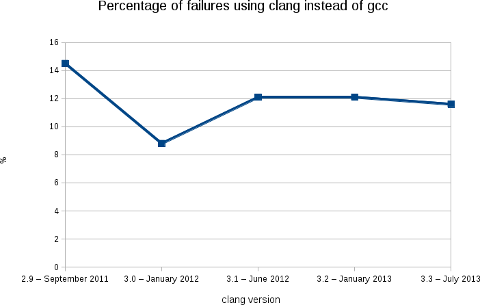
Like the previous releases, we are at a bit less than 12% of packages failing (2188 packages on a total of 18854).
More warnings / errors detections have been added to the software (for example: like this defect of the C++ standard or the detection of unused linker option) causing more build failures, but, in the mean time, we fixed some issues in the Debian packages... As usual, the following image shows clearly the evolution of the build failures over time.
As stated in my blog post for the release 3.2, this rebuilds prove that Clang is ready for production in term of support of the C, C++ and Objective C languages. With the performance results showed by Chandler Carruth from Google at the last Euro LLVM summit (see this video from 5:40), I believe that it is now time to report and fix the bugs in the upstream packages. I also presented this work (video) at the Debconf 13 last week in Vaumarcus (Switzerland) and I will be also presenting this work at the Linux Plumbers Conference, New Orleans. With L o Cavaille (as part of his GSOC) and Paul Tagliamonte, we are also working on providing a better automatic rebuild infrastructure for clang-built packages (and other static analyzers). More in the next few weeks. Finally, I would like to thank folks at AWS for the Debian credit and David Suarez for helping on with the Ruby segfaults.

Dirk Eddelbuettel: Slides from Rcpp talk in Chicago

A couple of days ago, I gave a talk to the Chicago R Users Group which is run ever-so-smoothly by Paul Teetor and Chase Carpenter. The talk provided a brief introduction to Rcpp for R and C++ integration. Slides are now up on my talks / presentations page.

Gunnar Wolf: After Debian's 20th birthday, everybody's life gets back to normality...

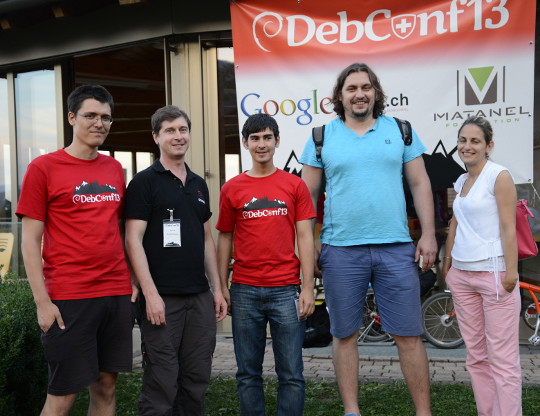
As I slowly read my good friends wishing each other a good trip, telling they got home safely, and the IRC channels form thick drops of a bitter-sweet etheral substance, I cannot help feeling DebConf13 is over For me as well, from the distance. Many friends gave me warm greetings, and without being there, gave me that beautiful feeling of real community that Debian has given me for ten years already, since I met in real-life many of its developers at DebConf3 in Oslo. And yes, I have stated this far too many times I have attended every DebConf since (and worked organizing most of them). This year, over 300 people were gathered in Switzerland to enjoy the always most intense weeks of the year. This year, I was unable to attend due to calendar clashes. Even so, without the stress that organizers have, and thanks to the great work of the always-loved Video Team, I think I was able to be present at more sessions than at in any of the last few years. Oh, and for the readers of this blog who were not there Do you want to follow what was presented? You can download already the videos for all of the recorded presentations (that were, due to the planned coverage and the manageable size of the Video Team, about of the total scheduled sessions). And, as always, I was able to follow many very interesting talks and take part of a couple interesting meetings/BoF sessions. I still have a bit of catchup, partly due to the timezone difference (I was only at one of the sessions during the Swiss morning, at 02:30 local time, the pkg-ruby-extras team BoF). Anyway... Not being there, I surely was an avid consumer of the photos posted in the DebConf13 gallery, and will surely follow it for some more time as some of you upload your pending material. It was clear from the beginning that, no matter what your definition of consensus is, the chosen venue was beautiful. A beautiful place between the lake and the mountains where our sportiest guys had a very good share of morning runs, cycling sessions, competition sports of different types, outright plain fun for attendees of all sizes and all species... But, hey, wait! During a chat in the course of DebConf, a friend told me a bit worried that all this beauty and fun might make our dear and very important sponsors they are paying for a geek vacation, is it so? No, not at all. Not by a long stretch. And just looking at those same galleries makes it clear and obvious. After all, it's widely known that Debian is the operating system for the gurus. Simple: It's impossible to have all those geeks without getting amazing work done, in ways that even seem clich s (this last photo had Joey Hess explaining dpkg format version 3.0 (git) ideas, sketched after waking up at 3AM on the first sketching surface available to him). After all, Debian people are famous for their inclination to use any excuse to open their computers and hack away. We can find Debianers hacking in small spaces and also hacking out in the fields. But this time, people were able to hack indoors while enjoying the nature and hack outdoors under a tree. And, yes, one of the things that makes organizing DebConf worth it is, after eleven months having low-bandwidth meetings over IRC, having the opportunity to plan for the next days face to face, in a relaxed but work-full environment. Anyway, here at home I didn't sit idly just longing over them. How could I? We are just celebrating the Debian Project's 20th anniversary! http://gwolf.org/content/jonathan-host-and-organizer-rancho-electr-nico">Jonathan, a Debian enthusiast, student at my university, and collaborator for several free software-related collectives in Mexico City, invited me to the celebration at Rancho Electr nico (which I recently mentioned in this same blog). While I was unable to stay for the whole celebration, we had a very good time; I talked about some ways on how to contribute to Debian. Although I didn't have much of a presentation prepared for it, I feel it was successful and interesting for the attendees I just hope to start seeing some of them get into any of the ways for helping Debian soon. I also stayed as a listener and ocassional commenter for a talk on the Debian Project's history and goals, and to a presentation on a nifty electronic music programming tool called Supercollider (of course, available in Debian). Now, "regular" life should continue. For some value of "regular".

18 August 2013

Dirk Eddelbuettel: Slides from Rcpp talk in Chicagp

A couple of days ago, I gave a talk to the Chicago R Users Group which is run ever-so-smoothly by Paul Teetor and Chase Carpenter. The talk provided a brief introduction to Rcpp for R and C++ integration. Slides are now up on my talks / presentations page.

Petter Reinholdtsen: Intel 180 SSD disk with Lenovo firmware can not use Intel firmware

Earlier, I reported about my problems using an Intel SSD 520 Series 180 GB disk. Friday I was told by IBM that the original disk should be thrown away. And as there no longer was a problem if I bricked the firmware, I decided today to try to install Intel firmware to replace the Lenovo firmware currently on the disk. I searched the Intel site for firmware, and found issdfut_2.0.4.iso (aka Intel SATA Solid-State Drive Firmware Update Tool) which according to the site should contain the latest firmware for SSD disks. I inserted the broken disk in one of my spare laptops and booted the ISO from a USB stick. The disk was recognized, but the program claimed the newest firmware already were installed and refused to insert any Intel firmware. So no change, and the disk is still unable to handle write load. :( I guess the only way to get them working would be if Lenovo releases new firmware. No idea how likely that is. Anyway, just blogging about this test for completeness. I got a working Samsung disk, and see no point in spending more time on the broken disks.

17 August 2013

Daniel Pocock: DebConf13: breakthroughs in OTP and WebRTC

Saturday, 17 August was a day that saw groundbreaking new work revealed at DebConf13 and may have been a watershed moment in the emergence of WebRTC for the free software community.
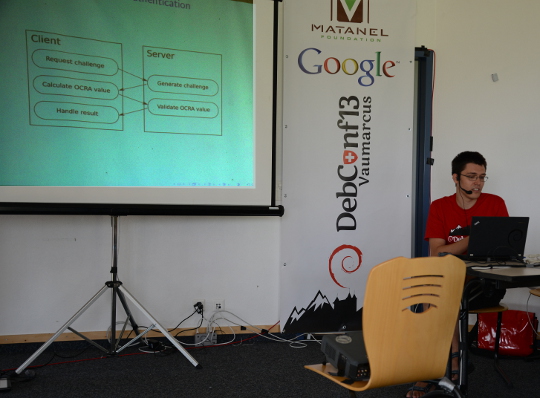
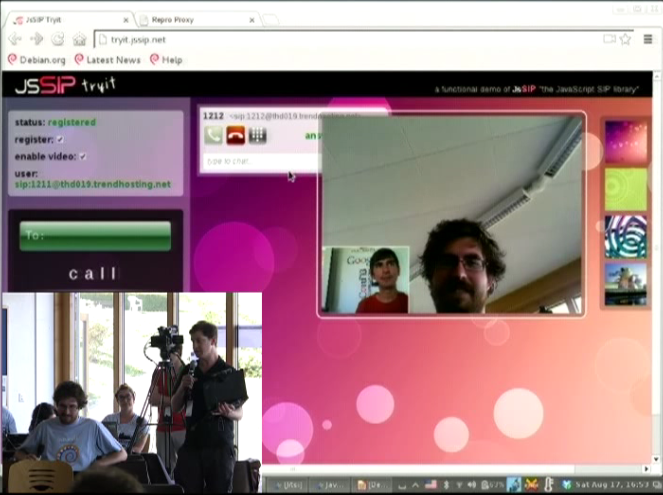
Fabian Gr nbichler, Daniel Pocock, Catalin Constantin Usurelu, Emil Ivov, Yana Stamcheva Advancing the use of One Time Passwords with free software Google Summer of Code (GSoC) student Fabian Gr nbichler has spent the summer enhancing oath-toolkit and dynalogin to support a more diverse range of One Time Password schemes. dynalogin's original 1.0 release supports vanilla HOTP and TOTP authentication schemes. Fabian's work has extended the framework to support the more generic and powerful OCRA approach. To find out about all the benefits this brings, I would strongly encourage you to review his slides and video presentation, with a demo where it is explained thoroughly. While there are existing hardware tokens that support HOTP and TOTP using this open algorithm (Gooze has been kind enough to donate some which were on display), the mutual challenge-response schemes are yet to be widely supported in hardware and this means that Fabian's work is now at the cutting edge of development in this area. WebRTC: premium voice/video chat in modern browsers, no plugin required Another member of Debian's GSoC program, Catalin Constantin Usurelu helped organise and run one of the must-see sessions of DebConf13 (video available). In a demonstration that had all the hallmarks of a magic show, Catalin and I took random members of the audience and invited them to wave a magic wand over their web browsers and effortlessly turn them into Skype-busting softphones. As the grand finale, we took Wookey's blog and showed him how to add a WebRTC "call-me" page in less than 20 seconds, less time than it takes to hand over all your private data to the registration process of those rather uncomfortable alternatives. Anybody else seeking to duplicate this effort is encourage to review options like Drucall for Drupal or just directly use JsSIP Jitsi and the Jitsi Video-bridge The grand-finale of the DebConf13 real-time communications track was our guest speaker, Emil Ivov, founder of the Jitsi softphone project. Jitsi itself has recently been accepted into Debian and is easier than ever before to install and use. Emil's talk (video and slides available) went into some detail about the cutting edge development activities of his team, particularly the new Jitsi Video bridge Subsequent to the talk, we had some out-of-bands discussion about ways to potentially integrate Jitsi Video bridge with the open source dvswitch system used to produce streams and recordings from free software events such as DebConf and FOSDEM. It is hoped that this will provide an additional option for remote participation at free software events of all sizes. Upcoming events Emil and I have been invited to participate in the WebRTC Conference Paris 2013 in December. This will be an excellent opportunity to have further discussion about progress with WebRTC and do more to raise the compelling case for premium quality free software to meet the demanding needs of modern business communications. There are a series of talks for both technical and business-oriented audiences.

Andrew Cater: Debian - 20th birthday

Happy Birthday! Second oldest Linux distribution still going - Slackware is a little older. It's also been the bane of my life / my obsession / fixation and joy for about 15 of those years. I'm pleased and proud to be associated with the Debian Project as a Debian developer: many of my colleagues are at Debconf 13 in Vaumarcus in Switzerland right now but there will be celebrations around the world.

Great distribution: great hardware support on lots of architectures: huge numbers of derivatives - but what makes it is the people, including some of those who have contributed hugely but are sadly no longer with us. Debian is a phenomenal, supportive, family but, as ever, sometimes dysfunctional

Joel Klecker, Chris Rutter, Frans Pop, Adrian von Bidder and all the others - I so wish you'd all been here to see this.

Christian Perrier: More French pages than English pages on Debian web site

As of today, thanks to the tremendous work of the French localization team in Debian, there are more web pages in French than there are in English, on Debian web site. How can this happen? Indeed, the Debian web site is not always made of pages primarily written in English. There are some French, Spanish, Chinese pages. These are not translated into English because.....there is no translation team for English (the debian-l10n-english mailing list more acts as a review board). So, given that French translators nearly translated ALL English web pages and because there are quite a few French pages, we currently have 5802 web pages in French, while there are only 5801 in English. The French Cabal definitely reached its goal: we have the DPL, we have the web site. Toutes vos possessions nous appartiennent d sormais. I'm now preparing a GR in order to turn French into the official communication language in Debian. PS: merci Thomas Vincent qui a largement contribu ce succ s ces derniers jours !

Daniel Leidert: Create a KNOPPIX USB (boot-)stick from a running Linux system

I was recently examining, how to boot a (live) KNOPPIX from an USB stick. It turns out I did not find a manual about how to create a bootable USB stick containing KNOPPIX without burning KNOPPIX to a CD/DVD first?! So this is a short howto without burning anything. I'm showing how to put a KNOPPIX ISO image to an USB stick. I need an ISO image of KNOPPIX, an USB stick and syslinux installed. I've chosen to put the 4GB DVD image KNOPPIX_V7.2.0DVD-2013-06-16-EN.iso onto a 16GB USB stick. The place left on the USB device should be available to the user as NTFS partition. I'll use the term /dev/sdX to refer to the stick (where X is a lowercase character, e.g. /dev/sdb) and completely empty it first (THIS WILL DELETE ALL DATA INCLUDING THE PARTITION TABLE!):
shred -z /dev/sdX
Now after the ISO image has been downloaded, we need to alter it a bit. For this some information about the USB stick is required. The relevant bits heads and sectors/track are highlighted below:

fdisk -l /dev/sdX

Disk /dev/sdX: 16.0 GB, 16008609792 bytes
64 heads, 32 sectors/track, 15267 cylinders, total 31266816 sectors
Units = sectors of 1 * 512 = 512 bytes
Sector size (logical/physical): 512 bytes / 512 bytes
I/O size (minimum/optimal): 512 bytes / 512 bytes
Disk identifier: 0x0000

Device Boot Start End Blocks Id System
Now we change the ISO image for hybrid mode:
isohybrid -o 1 -h 64 -s 32 -e 1 KNOPPIX_V7.2.0DVD-2013-06-16-EN.iso
and copy the ISO image to the USB stick:
cat KNOPPIX_V7.2.0DVD-2013-06-16-EN.iso > /dev/sdX
After the command has succeeded, the partition table will show a bootable "Hidden HPFS/NTFS" partition. Note that you can adjust the partition type by using the -t, --type switch of isohybrid.

fdisk -l /dev/sdX

Disk /dev/sdX: 16.0 GB, 16008609792 bytes
64 heads, 32 sectors/track, 15267 cylinders, total 31266816 sectors
Units = sectors of 1 * 512 = 512 bytes
Sector size (logical/physical): 512 bytes / 512 bytes
I/O size (minimum/optimal): 512 bytes / 512 bytes
Disk identifier: 0x0000

Device Boot Start End Blocks Id System
/dev/sdX * 1 8032255 4016127+ 17 Hidden HPFS/NTFS
Now we can create one or more partitions on the stick for shipping data or $whatever by using fdisk, e.g. create a new primary partition and set the type to HPFS/NTFS/exFAT:

fdisk /dev/sdX

Command (m for help): p

Disk /dev/sdX: 16.0 GB, 16008609792 bytes
64 heads, 32 sectors/track, 15267 cylinders, total 31266816 sectors
Units = sectors of 1 * 512 = 512 bytes
Sector size (logical/physical): 512 bytes / 512 bytes
I/O size (minimum/optimal): 512 bytes / 512 bytes
Disk identifier: 0x12345678

Device Boot Start End Blocks Id System
/dev/sdX * 1 8032255 4016127+ 17 Hidden HPFS/NTFS

Command (m for help): n
Partition type:
p primary (1 primary, 0 extended, 3 free)
e extended
Select (default p): p
Partition number (1-4, default 2): 2
First sector (8032256-31266815, default 8032256):
Using default value 8032256
Last sector, +sectors or +size K,M,G (8032256-31266815, default 31266815):
Using default value 31266815

Command (m for help): t
Partition number (1-4): 2
Hex code (type L to list codes): 7
Changed system type of partition 2 to 7 (HPFS/NTFS/exFAT)

Command (m for help): p

Disk /dev/sdX: 16.0 GB, 16008609792 bytes
64 heads, 32 sectors/track, 15267 cylinders, total 31266816 sectors
Units = sectors of 1 * 512 = 512 bytes
Sector size (logical/physical): 512 bytes / 512 bytes
I/O size (minimum/optimal): 512 bytes / 512 bytes
Disk identifier: 0x12345678

Device Boot Start End Blocks Id System
/dev/sdX1 * 1 8032255 4016127+ 17 Hidden HPFS/NTFS
/dev/sdX2 8032256 31266815 11617280 7 HPFS/NTFS/exFAT

Command (m for help): w

[..]
Run mkfs.ntfs on /dev/sdX2 to create the NTFS file system there. The USB stick is ready now. Connected to the system where one wants to start a live KNOPPIX and chosen to boot this system from USB will result in a running KNOPPIX system.The same should also work for creating a Debian live system USB stick. Thanks to the author of this article.

David Moreno: 11 years in Freenode now

Somehow last year I missed the fact that I've been around Freenode for 10 years. It is more than 11 years now at this point. Oh my! I understand this is nothing compared to the very old wolves in free software, but bear with me on this one :)
19:25  info
19:25 -NickServ(NickServ@services.)- Information on Damog (account Damog):
19:25 -NickServ(NickServ@services.)- Registered : Jun 26 23:45:11 2002 (11 years, 7 weeks, 5 days, 17:39:50 ago)
19:25 -NickServ(NickServ@services.)- Last addr  : ~dm@debian/developer/damog
19:25 -NickServ(NickServ@services.)- vHost      : debian/developer/damog
19:25 -NickServ(NickServ@services.)- Last seen  : now
19:25 -NickServ(NickServ@services.)- Logins from: damog
19:25 -NickServ(NickServ@services.)- Nicks      : Damog
19:25 -NickServ(NickServ@services.)- Email      : damog@damog.net
19:25 -NickServ(NickServ@services.)- *** End of Info ***

Christian Perrier: Bug #720000

Laurent Bigonville reported Debian bug #720000 on Saturday August 17th 2013, against the drizzle package. This bug is already marked pending by Tobias Frost, the package maintainer. Bug #710000 was reported as of May 27th: 2 months and 21 days for 10,000 bugs. For once, this is a rate acceleration which we can probably explain by the release of wheezy and the work strongly resumed by many maintainers for the release of jessie. It is indeed interesting to see that this 720000th bug report happened nearly on Debian's 20th birthday. To make it short, we could then say that Debian had 36,000 bug reports every year in average (which is not exactly true as the BTS records start in 1996). Funnily also, this is the first time since I'm doing this recurrent post every 10,000 bugs that one happens *during* a DebConf, a few hours before DebConf 13 officially ends up.

Steve Kemp: Soon it will be time for something different

This weekend I'm mostly alternating between reading, writing, and trying to avoid death by the plague.[*] I've switched Lumail to using a UTF-8 aware string library, which means we can now handle the obvious case:
--
-- Prove keybindings work.
--
keymap['global'][' '] = 'msg("UTF-8 rocks!")'
Similarly we can stuff input into the buffer:
--
-- Pretend the user typed ":msg ...\n"
--
stuff( ":msg('  is pie')\n" );
This transition was annoying to handle, but wasn't too difficult. There is only one more major update required, according to the development roadmap, which is to double check that UTF-8 output is correct. Otherwise I think I'm almost done. In the sense that I don't see anything obvious missing, barring things that won't ever happen such as mutt-style "tag" support. I've updated the online examples to include some nice code: I can't claim to have many users, so far the development has been carried out by myself and approximately four other people. But that matters not. I genuinely believe this is a good client and it really suits the way that I handle (large volumes of) email: Allowing you to open multiple folders at once means you get a great view into your currently-unread mail, regardless of where procmail has placed it. The overriding feeling having "completed" the client is that Lua rocks. I'm torn between wanting to sleep some more, and wondering what other system/package/tool can be extended by Lua. As epiphanies go my on_idle() update takes some beating.
* - I do not have the black death, but I'm not well.

Lars Wirzenius: Yarn, a scenario testing tool

I write a fair number of Unix command line programs, and I want to have test suites for them. A year and a half ago I wrote a tool to make that easier: cmdtest. However, it turned out to not be a particularly good one, primarily because it doesn't make it easy to write good test code. Tests and test code should be obviously correct, so you don't need a test suite for your test suite. Earlier this year, Daniel and I started a slow, but long discussion about this. We'd talk it over during many a lunch, figuring out what we actually want. We eventually converged on an approach based on for Unix command line programs, and based on Markdown documents. We then wrote that up as a README, and then took another month refining the README before writing any code. The naming discussion only took a week. As a concrete example, here is a real test scenario, from Obnam, for testing its new FUSE plugin:
SCENARIO Browsing backups with FUSE plugin
ASSUMING user is in group fuse
GIVEN a live data directory
AND a 0 byte file called empty
AND a 1 byte file called one
AND a 4096 byte file called 4k
AND a 10485760 byte file called 10meg
AND a hardlink to 4k called 4k-hardlink
AND a symlink to 4k called 4k-symlink
AND a directory called some-dir
AND a symlink to ../4k called some-dir/other-symlink
WHEN live data is backed up
AND repository is fuse mounted
THEN latest generation can be copied correctly from fuse mount
FINALLY unmount repository
Some explanations: Test scenarios like this are obviously not directly executable. We need to provide the code that actually executs each step. For this, yarn provides an IMPLEMENTS section, of which I will show one example: the creation of the files.
IMPLEMENTS GIVEN a (\d+) byte file called (\S+)
dd if=/dev/zero of="$DATADIR/live/$MATCH_2" bs=1 count="$MATCH_1"
(The other IMPLEMENTS sections for that Obnam test scenario are also only about a line of shell. The longest one is four lines, because it has an if statement that I like to format in a fairly verbose way. I'm skipping the others to avoid needless repetition.) The text after the keyword (GIVEN, WHEN, THEN, etc) in the test scenario is a single line of free-form text, which is matched by a regular expression in the IMPLEMENTS section. There must be exactly one matching IMPLEMENTS for each line in a test scenario. The body of IMPLEMENTS is a shell script snippet. Yarn provides a temporary directory for each scenario, and the path to that is given in the DATADIR environment variable. Yarn also cleans up the directory afterwards, unless the user running yarn requests otherwise, so tests that only change things in the temporary directory don't need any FINALLY steps. The above example uses FINALLY to unmount the FUSE filesystem at the end. The regular expressions can capture parts of the text in the scenario step, and these are provided to the shell script using environment variables: MATCH_1 etc. This is a simple, but powerful mechanism for implementing very flexible steps, which also means the number of steps can be kept down. The IMPLEMENTS sections are shared between all test scenarios. This makes it very easy to write new scenarios using already-existing steps, by choosing which ones to use, in which order, and making use of any variability in the steps that their implementations provide. Yarn is a new tool, and I expect it to mature in the coming months. It's included in the cmdtest Debian package, and is already in Debian jessie and unstable, for those who want to try it. (My personal apt repository has a .deb for wheezy as well; backports are welcome). The yarn scenario testing language itself is not set in stone, but Daniel and I both want to be careful about making changes to it. It's all meant to be very simple: an obviously correct testing tool is better than an intricate one. I've used yarn in several of my own little programs now, as has Daniel, and we've used it at work as well. Undoubtedly we'll find bugs in the implementation, and we're still feeling our way to figuring out how to write really excellent scenarios, and how to structure steps with the best possible taste. We'll also start designing a shell library that yarn provides to the IMPLEMENTS sections, for doing things that we find ourselves doing in many projects. It is already clear to me, however, that yarn is oh so much better than cmdtest could ever be. I'm even starting to express ideas for new tools as yarn test documents, so I'm clear what they should do. If and when I ever get to actually implementing the tools, I'll have a test suite for them already. See, for example, first attempts at specifying how a fast file transfer tool, fling, which is to use Linux-only system calls to reach wire speeds over wired LAN, and a tool to recompress compressed files with another compression tool. We hope yarn will prove to be useful for others as well. If you try it, and have suggestions or comments, please e-mail us.

Paul Tagliamonte: debile (formerly debuild.me)

Due to the extremely righteous contributions of Leo and Sylvestre, we ve opted to make the name more generic (and hilarious), to make sure people understand that this will be a more general purpose tool. Cutting edge code is currently living at debile.debian.net - my debuild.me instance will soon follow when I ve got a chance to sit down with it :) Wish I was at DebConf, have a great DC, everyone!

Russ Allbery: WebAuth 4.5.4

WebAuth is the site-wide centralized web authentication system that we use at Stanford. This release is a bug-fix release for the central login server, mostly focused on multifactor authentication but also featuring a wide variety of random bug fixes. Going into this release, I filtered the Apache error logs on all of our production servers for a period of a month and then set out to fix every log anomaly or odd behavior pattern that I detected. The most significant bug fix is to support for requiring non-password session factors. The code handled this entirely incorrectly, resulting in the user being stuck at the password authentication prompt and never able to proceed. It also cleans up several corner cases involving REMOTE_USER authentication to sites that require a Kerberos authenticator (such as for delegated credentials). This release downgrades a mismatch of login credentials and a webkdc-proxy token (single sign-on credentials) to a log warning rather than a fatal error and just discards the non-matching single sign-on credentials. This case ideally shouldn't happen, but sometimes users share devices, and if they hit a site with forced login or session factors, it's easy for this case to arise. WebLogin now retries the WebKDC POST once and ignores SIGPIPE errors to work around problems with signals from the FastCGI process manager. It also rewrites non-ASCII characters in XML from the WebKDC to work around XML validation errors created by non-ASCII characters in Kerberos error messages, pending a better fix on the WebKDC side. Password changes no longer go through the replay detection logic, which should not apply to them. Several error messages in WebLogin are now clearer. The WebKDC now requires that the return URL in a WebAuth request be an absolute URL and not contain any non-ASCII characters. A bug in the way that errors during the authentication process were reported has been fixed and should produce better error output for the user. There are also a few other, more minor bug fixes, particularly to logging and error reporting. You can get the latest release from the official WebAuth distribution site or from my WebAuth distribution pages.

16 August 2013

Sylvain Le Gall: OASIS website updated

Logo OASIS small The OASIS website has not been updated since a while. So I decide to take a shot at making more up to date. This blog post is about the pipeline I have but in place to automatically update the website. It is the first end to end 'continuous deployment' project I have achieved. Among the user visible changes: The OASIS website repository is also on Github. Feel free to fork it and send me pull request if you see any mistake. The website is still using a lot of markdown processed by pandoc. But there are some new technical features: Since I start using quite quite a lot Python, I have decided to use it for this project. It has a lot of nice libraries and it helps me to quickly do something about the website (and provides plenty of idea to create equivalent tools in OCaml). The daily generation: Jenkins I have a Jenkins instance running, so I decided to use it to compile once a day the new website with updated documentation and links. This Jenkins instance also monitor changes of the OASIS source code. So I can do something even more precise: regenerate the website after every OASIS changes. I use the Jenkins instance to also generate a documentation tarball for OASIS manual and API. This helps a lot to be able to display the latest manual and API documentation. This way I can quickly browse the documentation and spot errors early. Another good point about Jenkins, is that it allows to store SSH credential. So I created a build user, with its own SSH key, in the OCaml Forge and I use it to publish the website at the end of the build. Right now Jenkins do the following: Data gathering To build the website I need some data: The OCaml Forge has a nice SOAP API. But one need to be logged in to access it. This is unfortunate, because I just want to access public data. The only way I found to gather my data was to scrape the OCaml Forge. Python has a very nice scraping library for that: beautifulsoup. I use beautifulsoup to parse the HTML downloaded from the Files tab of the OASIS project and extract all the relevant information. I use curl to download the documentation tarball (for released versions) and for the latest development version. Code Template Python has also a very nice library to process template: mako. Using the data I have gathered, I feed them to mako and I process all the .tmpl files in the repository to create matching files. Among the thing that I have transformed into template: Fix documentation and indexing One of the problem of providing access to all versions of the documentation, is that people can end up reading an old version of the documentation. In order to prevent that, I use two different techniques: To prevent search engine to index the file, I have created a robots.txt that list all URL of old documentation. This should be enough to prevent search engine to index the wrong page. To warn the user that he is reading the wrong version, I have added a box "you are not viewing the latest version". This part was tricky but beautifulsoup v4 provide a nice API to edit HTML in place. I just have to find the right CSS selector to define the position where I want to insert my warning box. Code Publish The ultimate goal of the project is the 'continuous deployment'. Rather than picking what version to deploy and do the process by hand, I let Jenkins deploy every version of it. Deploying the website used to be a simple rsync. But for this project I decided to use a fancier method. I spend a few hours deciding what was the best framework to do the automatic deployment. There are two main frameworks around: capistrano (Ruby) and fabric (Python). Fabric is written in Python, so I pick this one because it was a good fit for the project. Fabric biggest feature is to be a SSH wrapper. The fabric script is quite simple and to understand it, you just have to know that local run a local command and run run a command on the target host. The fabfile.py script do the following: Given this new process, the website is updated in 3 minutes automatically after a successful build of OASIS.

Next.

Previous.