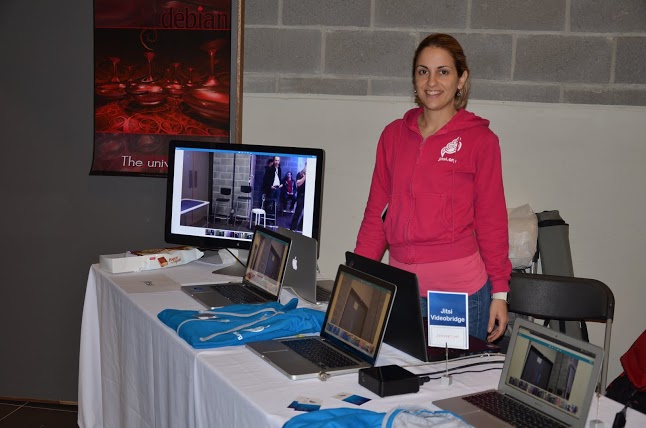
Search Results: "ed"

7 April 2014

Russ Allbery: Review: Fantasy & Science Fiction, September/October 2011

Review: Fantasy & Science Fiction, September/October 2011
Editor: Gordon van Gelder
Issue: Volume 121, No. 3 & 4
ISSN: 1095-8258
Pages: 258
Another review of a magazine that I finished quite some time ago. Apologies for any inaccuracies or lack of depth in the reviews. There wasn't much in Charles de Lint's reviews in this issue that interested me, but Michelle West covers a great selection of books. Two of them (The Wise Man's Fear and The Quantum Thief) are already on my to-read list; the third, The Postmortal, sounded interesting and would go on my list to purchase if I didn't already have so many good books I've not read. Otherwise, this issue is short on non-fiction. The only other essay entry is a film review from Kathi Maio, which is the typical whining about all things film that F&SF publishes. "Rutger and Baby Do Jotenheim" by Esther M. Friesner: Baby is a former pole dancer with a toy poodle named Mister Snickers, which warns you right away that this story is going to involve a few over-the-top caricatures and more use of the word "piddle" than one might ideally want. Rutger is a mythology professor who tolerates her for the standard reasons in this sort of pairing. They're travelling across country to Baby's sister's wedding when their car breaks down in Minnesota, prompting an encounter with frost giants. As you might expect, this is a sort of fractured fairy tale, except based on Norse mythology instead of the more typical Grimm fare. The fun is in watching these two apparent incompetents (but with enough knowledge of mythology to clue in the reader) reproduce the confrontation between Thor and Utgard-Loki. The fight with old age is particularly entertaining. If you've read any of Friesner's other stories, you know what to expect: not much in the way of deeper meaning, but lots of fun playing with stereotypes and an optimistic, funny outcome. Good stuff. (7) "The Man Inside Black Betty" by Sarah Langan: This story comes with a mouthful of a subtitle: "Is Nicholas Wellington the World's Best Hope?" It's also a story that purports to be written by a fictional character, in this case one Saurub Ramesh (with Langan credited as having done "research"). It's told in the style of first-person journalism, relating the thoughts and impressions of Ramesh as he interviews Nicholas Wellington. The topic is Black Betty: a black hole above Long Island Sound. Wellington is a scientific genius and iconoclast with radical theories of black holes that contradict how the government has been attempting to deal with Black Betty, unsuccessfully. The structure here was well-handled, reminding me a lot of a Michael Lewis article during the financial collapse. Langan has a good feel for how journalism of this type mixes personalities, politics, and facts. But it's all setup and no story. We get some world building, and then it's over, with no resolution except pessimism. Meh. (4) "A Borrowed Heart" by Deborah J. Ross: Ross starts with the trappings of urban fantasy transplanted into a Victorian world: supernatural creatures about, a protagonist who is a high-class prostitute, and sex and a sucubus by the second page. It evolves from there into a family drama and an investigation, always giving the reader the impression that a vampire will jump out at any moment. But the ending caught me entirely by surprise and was far more effective due to its departure from the expected path. Well done. (7) "Bright Moment" by Daniel Marcus: The conflict between terraforming and appreciation for the universe as we find it is an old story pattern in science fiction, and Marcus doesn't add much here. I think the story would have been stronger if he'd found a way to write the same plot with a pure appeal to environmental beauty without the typical stakes-raising. But he does sprinkle the story with a few interesting bits, including a pod marriage and a futuristic version of extreme sports as a way of communing with nature. (6) "The Corpse Painter's Masterpiece" by M. Rickert: This is typical of my reaction to a Rickert story: shading a bit too much towards horror for me, a bit too cryptic, well-written but not really my thing. It's about a corpse painter who does the work of an informal mortician, improving the appearance of bodies for their funerals, and the sheriff who brings him all the dead bodies. It takes an odd macabre twist, and I have no idea what to make of the ending. (4) "Aisle 1047" by Jon Armstrong: Armstrong is best known for a couple of novels, Grey and Yarn, which entangle their stories in the future of marketing and commerce. One may be unsurprised, then, that this short story is on similar themes, with the intensity turned up to the parody point. Tiffan3 is a department-store saleswoman, spouting corporate slogans and advertising copy while trying to push customers towards particular products. The story follows the escalation into an all-out brand war, fought with the bubbly short-cut propaganda of a thirty-second commercial. For me, it fell awkwardly between two stools: it's a little too over-the-top and in love with its own bizarre alternate world to be effective satire, but the world is more depressing than funny and the advertising copy is grating. More of a curiosity than a successful story, I think. (5) "Anise" by Chris DeVito: Stories that undermine body integrity and focus on the fascinated horror of violation of physical boundaries aren't generally my thing, so take that into account in this review. Anise's husband died, but that's not as much of a problem as it used to be. Medical science can resurrect people via a sort of permanent, full-body life support system, making them more cyborg than human. "Anise" is about the social consequences of this technology in a world where a growing number of people have a much different relationship with their body than the typical living person today. It's a disturbing story that is deeply concerned with the physical: sex, blood, physical intimacy in various different forms, and a twisted type of psychological abuse. I think fans of horror will like this more than I did, although it's not precisely horror. It looks at the way one's perception of self and others can change by passing through a profound physical transformation. (5) "Spider Hill" by Donald Mead: I liked this story a lot better. It's about witchcraft and farm magic, about family secrets, and a sort of coming-of-age story (for a girl rather than a boy, for once). The main character is resourceful, determined, but also empathetic and aware of the impact of her actions, which made her more fun to read about. I doubt I'll remember this for too long, but when skimming through it again for a review, I had fond memories of it. (6) "Where Have All the Young Men Gone?" by Albert E. Cowdrey: Cowdrey in his paranormal investigation mode, which I like better than his horror mode. For once, the protagonist isn't even a lower-class or backwoods character. Instead, he's a military historian travelling in Austria who runs across a local ghost story. This is a fairly straightforward ghost investigation that follows a familiar path (albeit to an unusual final destination), but Cowdrey is a good story-teller and I liked the protagonist. (7) "Overtaken" by Karl Bunker: This is the sort of story that delivers its moral with the force of a hammer. It's not subtle. But if you're in the right mood for that, it's one of the better stories of its type. It's about a long-journey starship, crew in hibernation, that's overtaken by a far newer and faster mechanized ship from Earth that's attempting to re-establish contact with the old ships. The story is a conversation between the ship AIs. Save this one until you're in the mood for an old-fashioned defense of humanity. (8) "Time and Tide" by Alan Peter Ryan: Another pseudo-horror story, although I think it's better classified as a haunting. A wardrobe recalls a traumatic drowning in the childhood of the protagonist. As these things tend to do in stories like this, reality and memory start blurring and the wardrobe takes on a malevolent role. Not my sort of thing. (3) "What We Found" by Geoff Ryman: Any new Geoff Ryman story is something to celebrate. This is a haunting story on the boundaries between the scientific method and tribal superstition, deeply entangled with the question of how one recovers from national and familial trauma. How can we avoid passing the evils and madness of one generation down to the next? Much of the story is about family trauma, told with Ryman's exceptional grasp of character, but the science is entangled in an ingenious way that I won't spoil. As with Air, this is in no way science fiction. The science here would have fascinating and rather scary implications for our world, but clearly is not how science actually works. But as an insight into politics, and into healing, I found it a startlingly effective metaphor. I loved every bit of this. By far the best story of the issue. (9) Rating: 7 out of 10

Paul Tagliamonte: Photo


6 April 2014

Julien Danjou: Doing A/B testing with Apache httpd

When I started to write the landing page for The Hacker's Guide to Python, I wanted to try new things at the same time. I read about A/B testing a while ago, and I figured it was a good opportunity to test it out. A/B testing If you do not know what A/B testing is about, take a quick look at the Wikipedia page on that subject. Long story short, the idea is to serve two different version of a page to your visitors and check which one is getting the most success. When you found which version is better, you can definitely switch to it. In the case of my book, I used that technique on the pre-launch page where people were able to subscribe to the newsletter. I didn't have a lot of things I wanted to test out on that page, so I just used that approach on the subtitle, being either "Learn everything you need to build a successful Python project" or "It's time you make the most out of Python". Statistically, each version would be served half of the time, so both would get the same number of view. I then would build statistics about which page was attracting the most subscribers. With the results I would be able to switch definitively to that version of the landing page. Technical design My Web site, this Web site, is entirely static and served by Apache httpd. I didn't want to use any dynamic page, language or whatever. Mainly because I didn't want to have something else to install and maintain just for that on my server. It turns out that Apache httpd is powerful enough to implement such a feature. There are different ways to build it, and I'm going to describe my choices here. The first thing to pick is a way to balance the display of the page. You need to find a way so that if you get 100 visitors, around 50 will see the version A of your page, and around 50 will see the version B of the page. You could use a random number generator, pick a random number for each visitor, and decides which page he's going to see. But it turns out that I didn't find a way to do that with Apache httpd at first sight. My second thought was to pick the client IP address. But it's not such a good idea, because if you got visitors from, for example, people behind a company firewall, they are all going to be served the same page, so that kind of kills the statistics. Finally, I picked time based balancing: if you visit the page on a second that is even, you get version A of the page, and if you visit the page on a second that is odd, you get version B. Simple, and so far nothing proves there are more visitors on even than odd seconds, or vice-versa. The next thing is to always serve the same page to a returning visitor. I mean that if the visitor comes back later and get a different version, that's cheating. I decided the system should always serve the same page once a visitor "picked" a version. To do that, it's simple enough, you just have to use cookies to store the page the visitor has been attributed, and then use that cookie if he comes back. Implementation To do that in Apache httpd, I used the powerful mod_rewrite that is shipped with it. I put 2 files in the books directory, named either "the-hacker-guide-to-python-a.html" and "the-hacker-guide-to-python-b.html" that got served when you requested "/books/the-hacker-guide-to-python".
RewriteEngine On
RewriteBase /books

# If there's a cookie called thgtp-pre-version set,
# use its value and serve the page
RewriteCond % HTTP_COOKIE thgtp-pre-version=([^;])
RewriteRule ^the-hacker-guide-to-python$ % REQUEST_FILENAME -%1.html [L]

# No cookie yet and
RewriteCond % HTTP_COOKIE !thgtp-pre-version=([^;]+)
# the number of seconds of the time right now is even
RewriteCond % TIME_SEC [02468]$
# Then serve the page A and store "a" in a cookie
RewriteRule ^the-hacker-guide-to-python$ % REQUEST_FILENAME -a.html [cookie=thgtp-pre-version:a:julien.danjou.info,L]

# No cookie yet and
RewriteCond % HTTP_COOKIE !thgtp-pre-version=([^;]+)
# the number of seconds of the time right now is odd
RewriteCond % TIME_SEC [13579]$
# Then serve the page B and store "b" in a cookie
RewriteRule ^the-hacker-guide-to-python$ % REQUEST_FILENAME -b.html [cookie=thgtp-pre-version:b:julien.danjou.info,L]

With that few lines, it worked flawlessly. Results The results were very good, as it worked perfectly. Combined with Google Analytics, I was able to follow the score of each page. It turns out that testing this particular little piece of content of the page was, as expected, really useless. The final score didn't allow to pick any winner. Which also kind of proves that the system worked perfectly.
But it still was an interesting challenge!

Russ Allbery: control-archive 1.6.1

control-archive is the software that maintains the archive of Usenet control messages and the "canonical" list of newsgroups maintained on ftp.isc.org. There's nothing particularly exciting in this release, but there were some accumulated metadata changes and it had been nearly a year since the previous release. This is one of my few packages that uses a three-part version number, since I figured there would be metadata-only releases and wanted a way to designate those. And then, of course, I almost always made code changes. So this is only the second metadata-only release (which is part of why I did a release now, to be honest). At some point, I still want to rewrite the underlying signature validation code and then redo all the code in this package to match my current coding style and be quite a bit cleaner. But the hours to do projects like that aren't particularly forthcoming at the moment. You can get the latest release from the control-archive distribution page.

Steve Kemp: So that distribution I'm not-building?

The other week I was toying with using GNU stow to build an NFS-share, which would allow remote machines to boot from it. It worked. It worked well. (Standard stuff, PXE booting with an NFS-root.) Then I started wondering about distributions, since in one sense what I'd built was a minimal distribution. On that basis yesterday I started hacking something more minimal: Unfortunately here is where I ran out of patience. Using tcc and the static C library I can compile code. But I can't link it.
$ cat > t.c <>EOF
int main ( int argc, char *argv[] )
 
        printf("OK\n" );
        return 1;
 
EOF
$ /opt/tcc/bin/tcc t.c
tcc: error: file 'crt1.o' not found
tcc: error: file 'crti.o' not found
..
Attempting to fix this up resulted in nothing much better:
$ /opt/tcc/bin/tcc t.c -I/opt/musl/include -L/opt/musl/lib/
And because I don't have a full system I cannot compile t.c to t.o and use ld to link (because I have no ld.) I had a brief flirt with the portable c-compiler, pcc, but didn't get any further with that. I suspect the real solution here is to install gcc onto my host system, with something like --prefix=/opt/gcc, and then rsync that into my (suddenly huge) intramfs image. Then I have all the toys.

Russell Coker: Finding Corrupt Files that cause a Kernel Error

There is a BTRFS bug in kernel 3.13 which is triggered by Kmail and causes Kmail index files to become seriously corrupt. Another bug in BTRFS causes a kernel GPF when an application tries to read such a file, that results in a SEGV being sent to the application. After that the kernel ceases to operate correctly for any files on that filesystem and no command other than reboot -nf (hard reset without flushing write-back caches) can be relied on to work correctly. The second bug should be fixed in Linux 3.14, I m not sure about the first one. In the mean time I have several systems running Kmail on BTRFS which have this problem. (strace tar cf . cat > /dev/null) 2>&1 tail To discover which file is corrupt I run the above command after a reboot. Below is a sample of the typical output of that command which shows that the file named .trash.index is corrupt. After discovering the file name I run reboot -nf and then delete the file (the file can be deleted on a clean system but not after a kernel GPF). Of recent times I ve been doing this about once every 5 days, so on average each Kmail/BTRFS system has been getting disk corruption every two weeks. Fortunately every time the corruption has been on an index file so I don t need to restore from backups. newfstatat(4, ".trash.index", st_mode=S_IFREG 0600, st_size=33, , AT_SYMLINK_NOFOLLOW) = 0
openat(4, ".trash.index", O_RDONLY O_NOCTTY O_NONBLOCK O_NOFOLLOW O_CLOEXEC) = 5
fstat(5, st_mode=S_IFREG 0600, st_size=33, ) = 0
read(5, <unfinished >
+++ killed by SIGSEGV +++

Stefano Zacchiroli: historical overview of debian source code

moar, and moar, and moar debsources stats A while ago I've announced the availability of several stats about Debian source code on http://sources.debian.net. Since then the statistical basis of those stats has increased a lot, and now includes all Debian historical releases, from hamm (July 1998) onward. This allows to appreciate macro-level evolution trends in Free Software, over a period of more than 15 years, through the eyes of a distro that sits at the nice intersection of the eldest, largest, and most reputed distros. To get there I've added support for sticky suites to the plumbing layer of debsources, and then injected historical releases from http://archive.debian.org. The injection process took about a week (without any sort of parallelism, pretty slow disks, and computing sha256 checksums, ctags, and sloccount on all source files) and has been an "interesting" experience. When you go back decades in technology time, bit rot is just around the corner, and I've found my share while injecting archive.d.o into sources.d.n. In both cases the respective maintainers (Guillem and Ganneff, kudos) have been positive about and helpful in improving the situation, despite the low impact of the bugs I've found on the average user. That's quite important for the long-term preservation of digital information in general, and for the perennity of access to Free Software in the specific case of Debian. While we are it, I'm now maintaining a list of bugs affecting sources.d.n but belonging to other packages, in case you fancy helping out but are not a Python hacker. Interestingly enough, quite a bit of those bugs are related to the fact that tools debsources uses (e.g. ctags, sloccount) are also starting to show their age. You might wander why buzz, rex, and bo are still missing from sources.d.n. That's in fact for similar reasons. Before hamm Debian didn't have complete archive coverage in terms of Sources indexes and .dsc files. Given that debsources rely on both to extract source packages, it first needs to grow an additional abstraction layer that can cope with their absence. It's SMOP, and planned. And now let's have fun with ctags bombs. Yours truly,
Stefano Indiana Zacchiroli
(credits: KiBi, #debian-ftp)

Keith Packard: Java-Sound-on-Linux

Java Sound on Linux I m often in the position of having my favorite Java program (AltosUI) unable to make any sounds. Here s a history of the various adventures I ve had. Java and PulseAudio ALSA support When we started playing with Java a few years ago, we discovered that if PulseAudio were enabled, Java wouldn t make any sound. Presumably, that was because the ALSA emulation layer offered by PulseAudio wasn t capable of supporting Java. The fix for that was to make sure pulseaudio would never run. That s harder than it seems; pulseaudio is like the living dead; rising from the grave every time you kill it. As it s nearly impossible to install any desktop applications without gaining a bogus dependency on pulseaudio, the solution that works best is to make sure dpkg never manages to actually install the program with dpkg-divert:

# dpkg-divert --rename /usr/bin/pulseaudio
With this in place, Java was a happy camper for a long time. Java and PulseAudio Native support More recently, Java has apparently gained some native PulseAudio support in some fashion. Of course, I couldn t actually get it to work, even after running the PulseAudio daemon but some kind Debian developer decided that sound should be broken by default for all Java applications and selected the PulseAudio back-end in the Java audio configuration file. Fixing that involved learning about said Java audio configuration file and then applying patch to revert the Debian packaging damage.
$ cat /usr/lib/jvm/java-7-openjdk-amd64/jre/lib/sound.properties
...
#javax.sound.sampled.Clip=org.classpath.icedtea.pulseaudio.PulseAudioMixerProvider
#javax.sound.sampled.Port=org.classpath.icedtea.pulseaudio.PulseAudioMixerProvider
#javax.sound.sampled.SourceDataLine=org.classpath.icedtea.pulseaudio.PulseAudioMixerProvider
#javax.sound.sampled.TargetDataLine=org.classpath.icedtea.pulseaudio.PulseAudioMixerProvider
javax.sound.sampled.Clip=com.sun.media.sound.DirectAudioDeviceProvider
javax.sound.sampled.Port=com.sun.media.sound.PortMixerProvider
javax.sound.sampled.SourceDataLine=com.sun.media.sound.DirectAudioDeviceProvider
javax.sound.sampled.TargetDataLine=com.sun.media.sound.DirectAudioDeviceProvider
You can see the PulseAudio mistakes at the top of that listing, with the corrected native interface settings at the bottom. Java and single-open ALSA drivers It used to be that ALSA drivers could support multiple applications having the device open at the same time. Those with hardware mixing would use that to merge the streams together; those without hardware mixing might do that in the kernel itself. While the latter is probably not a great plan, it did make ALSA a lot more friendly to users. My new laptop is not friendly, and returns EBUSY when you try to open the PCM device more than once. After downloading the jdk and alsa library sources, I figured out that Java was trying to open the PCM device multiple times when using the standard Java sound API in the simplest possible way. I thought I was going to have to fix Java, when I figured out that ALSA provides user-space mixing with the dmix plugin. I enabled that on my machine and now all was well.
$ cat /etc/asound.conf
pcm.!default  
    type plug
    slave.pcm "dmixer"
 
pcm.dmixer   
    type dmix
    ipc_key 1024
    slave  
        pcm "hw:1,0"
        period_time 0
        period_size 1024
        buffer_size 4096
        rate 44100
     
    bindings  
        0 0
        1 1
     
 
ctl.dmixer  
    type hw
    card 1
 
ctl.!default  
    type hw
    card 1
 
As you can see, my sound card is not number 0, it s number 1, so if your card is a different number, you ll have to adapt as necessary.

5 April 2014

Andreas Metzler: exim4 (4.82-6) experimental; urgency=medium

As GMP has been relicensed to LGPLv3+/GPLv2+ build exim against GnuTLS v3.

Mike Hommey:

I started learning japanese calligraphy a few months ago, with no prior experience with a brush and ink. It is an interesting endeavour. For various reasons, I had to skip class for a few weeks, but after the past ten days, I needed some stress relief on paper.

4 April 2014

Daniel Pocock: Best real-time communication (RTC / VoIP) softphone on the Linux desktop?

The Debian community has recently started discussing the way to choose the real-time communications (RTC/VoIP) desktop client for Debian 8 (jessie) users. Debian 7 (wheezy), like Fedora, ships GNOME as the default desktop and the GNOME Empathy client is installed by default with it. Simon McVittie, Empathy package maintainer has provided a comprehensive response to the main discussion points indicating that the Empathy project comes from an Instant Messaging (IM) background (it is extremely easy to setup and use for XMPP chat) but is not a strong candidate for voice and video. Just how to choose an RTC/VoIP client then? One question that is not answered definitively is just who should choose the default RTC client. Some people have strongly argued that the maintainers of individual desktop meta-packages should choose as they see fit. Personally, I don't agree with this viewpoint and it is easy to explain why. Just imagine the maintainers of GNOME choose one RTC application and the maintainers of XFCE choose an alternative and these two RTC applications don't talk to each other. If a GNOME user wants to call an XFCE user, do they have to go to extra effort to get an extra package installed? Do they even have to change their desktop? For power users these questions seem trivial but for many of our friends and family who we would like to contact with free software, it is not amusing. When the goal of the user is to communicate freely and if they are to remain free to choose any of the desktops then a higher-level choice of RTC client (or at least a set of protocols that all default clients must support) becomes essential. Snail mail to the rescue? There are several friends and family I want to be able to call with free software. The only way I could make it accessible to them was to burn self-booting Debian Live desktop DVDs with an RTC client pre-configured. Once again, as a power-user maybe I have the capability to do this - but is this an efficient way to overcome those nasty proprietary RTC clients, burning one DVD at a time and waiting for it to be delivered by snail mail? A billion browsers can't be wrong WebRTC has been in the most recent stable releases of Firefox/Iceweasel and Chrome/Chromium for over a year now. Many users already have these browsers thanks to automatic updates. It is even working well on the mobile versions of these browsers. In principle, WebRTC relies on existing technologies such as the use of RTP as a transport for media streams. For reasons of security and call quality, the WebRTC standard mandates the use of several more recent standards and existing RTC clients simply do not interoperate with WebRTC browsers. It really is time for proponents of free software to decide if they want to sink or swim in this world of changing communications technology. Browsers will not dumb-down to support VoIP softphones that were never really finished in the first place. Comparing Empathy and Jitsi There are several compelling RTC clients to choose from and several of them are now being compared on the Debian wiki. Only Jitsi stands out offering the features needed for a world with a billion WebRTC browser users.
Feature Empathy WebRTC requirement? Comments
Internet Connectivity Establishment (ICE) and TURN (relay) Only for gmail XMPP accounts, and maybe not for much longer For all XMPP users with any standards-based TURN server, soon for SIP too Mandatory Enables effective discovery of NAT/firewall issues and refusal to place a call when there is a risk of one-way-audio. Some legacy softphones support STUN, which is only a subset of ICE/TURN.
AVPF X Mandatory Enables more rapid feedback about degrading network conditions, packet loss, etc to help variable bit rate codecs adapt and maximise call quality. Most legacy VoIP softphones support AVP rather than AVPF.
DTLS-SRTP X Mandatory for Firefox, soon for Chrome too DTLS-based peer-to-peer encryption of the media streams. Most legacy softphones support no encryption at all, some support the original SRTP mechanism based on SDES keys exchanged in the signalling path.
Opus audio codec X Strongly recommended. G.711 can also be used but does not perform well on low bandwidth/unreliable connections Opus is a variable bit rate codec the supercedes codecs like Speex, SILK, iLBC, GSM and CELT. It is the only advanced codec browsers are expected or likely to implement. Most of the legacy softphones support the earlier codec versions (such as GSM) and some are coded in such a way that they can't support any variable bit-rate codec at all.
Retrofitting legacy softphones with all of these features is no walk in the park. Some of them may be able to achieve compliance more easily by simply throwing away their existing media code and rebuilding on top of the WebRTC media stack used by the browsers However, the Jitsi community have already proven that their code can handle all of these requirements by using their media processing libraries to power their JitMeet WebRTC video conferencing server Dreams are great, results are better Several people have spoken out to say they want an RTC client that has good desktop integration (just like Empathy) but I'm yet to see any of them contribute any code to such an effort. Is this type of desktop integration the ultimate priority and stubbornly non-negotiable though? Is it more an example of zealous idealism that may snuff out hope of bringing the optimum communications tools into the hands of users? As for solving all the other problems facing free communications software, the Jitsi community have been at it for more than 10 years. Just have a look at their scorecard on Github to see what I mean. Jitsi lead developer Emil Ivov has a PhD in multimedia and is a regular participant in the IETF, taking on some of the toughest questions, like how to make a world with two protocols (SIP and XMPP) friendly for real users. A serious issue for all Linux distributions Communications technology is one of the most pervasive applications and also one of the least forgiving. Users have limited patience with phones that don't work, as the Australian Russell Crowe demonstrated in his infamous phone-throwing incident. Maximizing the number of possible users is the key factor that makes networks fail or succeed. It is a knife that cuts both ways: as the free software community struggles with this issue, it undermines our credibility on other issues and makes it harder to bring free desktops to our friends, families and workplaces. Do we really want to see the rest of our work in these areas undermined, especially when there is at least one extremely viable option knocking at the door?

Rog rio Brito: The importance of flexible deadlines in MOOCs

I have always thought that having flexible deadlines in MOOCs is important, despite not having used them too much. Until last night, that is. The course in question is Stanford's Statistical Learning and they adopted a policy of letting the students complete all the assignments of the 10 week course until the last day of the course, in March 21. Then, they graciously extended the deadline to April 4. Were it not for such an extension, I would not have completed the course. I sent them a message on the course forums this morning to thank them for this, as this, in my experience, is not so common with MOOCs. I reproduce below the message that I posted on the forums:
Subject: Thank you also for the EXTENSION of the deadlines Dear professors and staff, I would like to thank you (of course) for the course, as many others have already. Despite not liking edX platform too much (preferring the UI of, say, Coursera), your course was an exception, interesting enough (and funny enough) that I sticked to it until the end. But I would like to bring attention here to a point that many may not have appreciated (or, perhaps, not expressed as clearly as I thought that it deserved), namely, the extension of the deadlines (and a uniform deadline for all homeworks). In particular, due to some unfortunate facts of my personal life, I could not work on the course at all in the past few weeks. In fact, I completed units 4, 5, 6, 7, 8, 9, and 10 in the last 3 or 4 days and submitted my last quiz a few hours before today's midnight (at my local time, UTC-0300), and I still got a passing grade(!). Even with my desire to finish the course, this would not have been possible if you had not graciously allowed for the deadline extension. I am sure that I may not be alone here in appreciating this extension (even though I think that I may be many standard deviations from the mean, doing the homework and R programs of 7 weeks in only 4 days). Thank you so very much for everything (including this extension!), Rog rio Brito.

Michael Vogt: apt 1.0

APT 1.0 was released on the 1. April 2014 [0]! The first APT version was announced on the 1. April exactly 16 years ago [1]. The big news for this version is that we included a new apt binary that combines the most commonly used commands from apt-get and apt-cache. The commands are the same as their apt-get/apt-cache counterparts but with slightly different configuration options. Currently the apt binary supports the following commands: Here is what the new progress looks like in 1.0:
apt-progress You can enable/disable the install progress via:
# echo 'Dpkg::Progress-Fancy "1";' > /etc/apt/apt.conf.d/99progressbar
If you have further suggestions or bugreport about APT, get in touch and most importantly, have fun!

Luciano Bello: Private folder in Dropbox

I wanted to have a directory in my Dropbox where every file placed get some sort of encryption. They might be personal pictures (if you know what I mean), finance notes, patent ideas, or the like. I create those files constantly, often with my phone. While I would like to back them up on the cloud, I don t need to access them regularly. The problem is that I don t want my phone to storage them (at least not plain) for obvious reasons. And, on top of this, Android s Dropbox app does not allow to disable synchronization by folder. So, here is the scheme I came up with. Maybe it is also useful for you or you get some idea how to improve it. You will need an always-on-line computer with Dropbox client (for Dropbox synchronization), GnuPG (for cipher the files), and a really nice tool called incron (which monitors a directory and trigger actions). The instructions: That s all, each time you put something in your private folder, incron will cipher it and leave it there.

Mario Lang: Accessible voting graphs

It is that time of the year again, Debian is electing the Project Leader for 2014/15. Whenever a Debian vote is in progress, I find myself rather happy to rediscover that Debian is providing text mode voting graphs. These are quite accessible to me as a braille user. It is rather unusual for me as a blind person to be able to access any graphs on the internet at all. All this has been made possible by gnuplots ability to generate text plots, and Manoj's willingness to implement it during his term as project secretary. Thanks to Gnuplot and Manoj, and thanks to the current secretary for keeping this feature, it is (at least to me) a very nice to have, and actually makes Debian rather unique. I personally don't know of any other major projects which provide text graphs. We are indeed setting a very good example here. It would be nice if other projects would adopt this as well. This is bridging the digital divide for me. For completeness sake I should probably mention that text graphs are not an universal solution for blind users. Those of us who do not use braille will probably have a very hard time extracting any meaningful information from this ASCII character salad. But to a braille user used to reading two dimensional information from the screen, it does actually work rather well. Some solutions from the 90s, when people didn't have graphical terminals readily available everywhere, are still very good accessibility workarounds. I am going to post another article about how I play chess on a computer, with newsgroup-style chessboard diagrams. Now that I think of it, these two topics are very related. There are some rather nifty solutions floating around from the good old text mode days which we need to revive before they finally get forgotten on the internet.

Andrew Pollock: [life] Day 66: Story time, Science Friday, impromptu play date, scootering and the Hawthorne Markets

Zoe slept through last night, which was lovely. We had nothing really planned for today. The Bulimba Library has a story time thing at 10:30am on a Friday. I've never bothered to take Zoe because it would have been too much of a hustle to get her there after her Brazilian Jiu-Jitsu class, particularly by bike. Since today we didn't have a BJJ class, it made getting to story time much easier. So we had a nice lazy start to the day, and then Zoe just wanted to procrastinate anyway, so since we were in no particular rush, I let her play in her room for a bit and I read for a while. We eventually had teeth and hair brushed and biked over to the library. Not having been to the story time thing before, I assumed it was in the kids area, but it turned out it was downstairs in the general purpose room, which we only discovered after story time had started. I'm certainly glad I never busted a gut to get to the library in time for it, because it wasn't anything particularly exciting. They did give all the kids a colouring sheet and there was some colouring and a couple of songs, but really it was nothing to phone home about. I did run into Jacob and his mum Laura from Kindergarten. They live locally, and so I invited them over for lunch and a play date. They had some grocery shopping to do, and I had to go to the pharmacy to get a prescription filled, so we agreed to meet at our place in about an hour. We biked to the pharmacy to get my prescription filled and some more sunscreen for Zoe, and the pharmacist gave her a free Chupa Chups We biked home, and grabbed some balloons from the convenience store next door for our Science Friday activity. I was slightly more organised today, and figured out what I wanted to do in the morning while Zoe was watching TV. We did yeast and sugar and warm water in a bottle with a balloon on top and watched it inflate itself with all the carbon dioxide produced by the yeast eating the sugar. The only problem was the balloons we bought were total rubbish. They'd been on the shelf for too long and they'd all stuck to themselves and either popped when I tried to blow them up or had holes in them. So we marched back to the corner store in our lab coats to get some more, and the store keeper gave Zoe one of the little flashlights she keeps playing with in the bowl at the check out. It was a good day for freebies. We were able to complete our Science Friday activity before Laura and Jacob and his baby brother Ethan came over for lunch. Zoe didn't have a particularly good lunch, I think it was the distraction of having Jacob there as well. After lunch, they couldn't really agree on anything to play. Laura said Jacob just plays out in the yard at Kindergarten the whole day. The one thing they both managed to agree on briefly was bubbles. Ethan was getting tired and needed a nap by about 2pm, so they left. Zoe wanted to ride her scooter, but I had to clean up from lunch and the aftermath of the play date on the balcony first, so she went and played some games on her Nexus 7 while I did that, and then we headed out on the scooter. It was about 2:30pm by this point, and the Hawthorne Markets, which have now moved to a Friday "twilight" thing, were due to start at 4pm, so I figured we could just kill time on the scooter. It's funny how the scooter is now the in thing as of Tuesday. It's sat unused on the balcony for most of the year, but I'm glad she wants to use it now because it guarantees she moves faster than if she were to walk and want to be picked up every 5 minutes. We scootered around to the playground and she played there until about 3:45pm, when we headed around to the markets. We ran into Nicky Noo from the Ooniverse Family Cafe, who we'd met on Tuesday, and she made Zoe another dog balloon and she got her face painted. After that, it was the obligatory jumping castle for a while. It was getting time to get home for Sarah to pick her up, when I dropped the dog balloon on the ground and it popped. That made Zoe very sad. Then the lack of a decent lunch kicked in. Zoe wanted some poffertjes, but they would have taken too long, so I gave her a few of the free samples to tide her over, and we headed home. Sarah was waiting for her when we got home, so we parted ways at that point. I like how the days that have nothing planned often end up as full if not fuller than the days when I do have something planned.

Gunnar Wolf: Mozilla: So our communitary echobox *does* resound with social issues

I woke up to the news that, after a very short tenure, Brendan Eich steps down as the Mozilla CEO. Why? Because of the community outcry. Because some years ago, Eich pubilcly supported (and donated funds) the ban of any kind of marriages in California that were not between a man and a woman. The world has advanced enormously in this regard in the last years/decades, and so many individuals and organizations opposed and announced they would boycott Mozilla that either him or Mozilla could not stand the pressure anymore. So, of course, it's sad the person had to resign. Many people talked about freedom of speech, freedom of harbouring his own personal opinion But when it comes to the rights of minorities, particularly of minorities that have suffered such hard prejudice and abuse as the gay, lesbian and all the other non-orthodox sexual- and gender- orientations, righting a wrong is much more important than preserving an individual's freedom of opinion. Besides, it's not just thinking or talking about something The concrete proposition Eich supported (and eventually made him resign) is about bringing the life of thousands of people to a hellish state of uncertainty, and going back to not having a way for the society to legally recognize their way of being, their love, their lifes. But anyway What prompts me into writing this is that, once again, the Free Software (and related denominations) community has shown that a set of core values, seemingly shared by a very large amount of our own people with no coordination or correlation with what conforms us as a community (and thus, being emergent traits), are strong enough to create a critical mass, to achieve cohesion. And that ours is not just a technical community of people writing software at all layers of the stack, but first and foremost is a group of social activists, committed to making the world better. I will quote from Matthew Garrett's post on this topic, clearly more contundent and thorough that what I'm trying to come up with:

The Mozilla Manifesto discusses individual liberty in the context of use of the internet, not in a wider social context. Brendan's appointment was very much in line with the explicit aims of both the Foundation and the Corporation - whatever his views on marriage equality, nobody has seriously argued about his commitment to improving internet freedom. So, from that perspective, he should have been a fine choice. But that ignores the effect on the wider community. People don't attach themselves to communities merely because of explicitly stated goals - they do so because they feel that the community is aligned with their overall aims. The Mozilla community is one of the most diverse in free software, at least in part because Mozilla's stated goals and behaviour are fairly inspirational. People who identify themselves with other movements backing individual liberties are likely to identify with Mozilla. So, unsurprisingly, there's a large number of socially progressive individuals (LGBT or otherwise) in the Mozilla community, both inside and outside the Corporation. A CEO who's donated money to strip rights from a set of humans will not be trusted by many who believe that all humans should have those rights. It's not just limited to individuals directly affected by his actions - if someone's shown that they're willing to strip rights from another minority for political or religious reasons, what's to stop them attempting to do the same to you? Even if you personally feel safe, do you trust someone who's willing to do that to your friends? In a community that's made up of many who are either LGBT or identify themselves as allies, that loss of trust is inevitably going to cause community discomfort.

3 April 2014

Matthew Garrett: Mozilla and leadership

A post I wrote back in 2012 got linked from a couple of the discussions relating to Brendan Eich being appointed Mozilla CEO. The tldr version is "If members of your community doesn't trust their leader socially, the leader's technical competence is irrelevant". That seems to have played out here.

In terms of background[1]: in 2008, Brendan donated money to the campaign for Proposition 8, a Californian constitutional amendment that expressly defined marriage as being between one man and one woman[2]. Both before and after that he had donated money to a variety of politicians who shared many political positions, including the definition of marriage as being between one man and one woman[3].

Mozilla is an interesting organisation. It consists of the for-profit Mozilla Corporation, which is wholly owned by the non-profit Mozilla Foundation. The Corporation's bylaws require it to work to further the Foundation's goals, and any profit is reinvested in Mozilla. Mozilla developers are employed by the Corporation rather than the Foundation, and as such the CEO is responsible for ensuring that those developers are able to achieve those goals.

The Mozilla Manifesto discusses individual liberty in the context of use of the internet, not in a wider social context. Brendan's appointment was very much in line with the explicit aims of both the Foundation and the Corporation - whatever his views on marriage equality, nobody has seriously argued about his commitment to improving internet freedom. So, from that perspective, he should have been a fine choice.

But that ignores the effect on the wider community. People don't attach themselves to communities merely because of explicitly stated goals - they do so because they feel that the community is aligned with their overall aims. The Mozilla community is one of the most diverse in free software, at least in part because Mozilla's stated goals and behaviour are fairly inspirational. People who identify themselves with other movements backing individual liberties are likely to identify with Mozilla. So, unsurprisingly, there's a large number of socially progressive individuals (LGBT or otherwise) in the Mozilla community, both inside and outside the Corporation.

A CEO who's donated money to strip rights[4] from a set of humans will not be trusted by many who believe that all humans should have those rights. It's not just limited to individuals directly affected by his actions - if someone's shown that they're willing to strip rights from another minority for political or religious reasons, what's to stop them attempting to do the same to you? Even if you personally feel safe, do you trust someone who's willing to do that to your friends? In a community that's made up of many who are either LGBT or identify themselves as allies, that loss of trust is inevitably going to cause community discomfort.

The first role of a leader should be to manage that. Instead, in the first few days of Brendan's leadership, we heard nothing of substance - at best, an apology for pain being caused rather than an apology for the act that caused the pain. And then there was an interview which demonstrated remarkable tone deafness. He made no attempt to alleviate the concerns of the community. There were repeated non-sequiturs about Indonesia. It sounded like he had no idea at all why the community that he was now leading was unhappy.

And, today, he resigned. It's easy to get into hypotheticals - could he have compromised his principles for the sake of Mozilla? Would an initial discussion of the distinction between the goals of members of the Mozilla community and the goals of Mozilla itself have made this more palatable? If the board had known this would happen, would they have made the same choice - and if they didn't know, why not?

But that's not the real point. The point is that the community didn't trust Brendan, and Brendan chose to leave rather than do further harm to the community. Trustworthy leadership is important. Communities should reflect on whether their leadership reflects not only their beliefs, but the beliefs of those that they would like to join the community. Fail to do so and you'll drive them away instead.

[1] For people who've been living under a rock
[2] Proposition 8 itself was a response to an ongoing court case that, at the point of Proposition 8 being proposed, appeared likely to support the overturning of Proposition 22, an earlier Californian ballot measure that legally (rather than constitutionally) defined marriage as being between one man and one woman. Proposition 22 was overturned, and for a few months before Proposition 8 passed, gay marriage was legal in California.
[3] http://www.theguardian.com/technology/2014/apr/02/controversial-mozilla-ceo-made-donations-right-wing-candidates-brendan-eich
[4] Brendan made a donation on October 25th, 2008. This postdates the overturning of Proposition 22, and as such gay marriage was legal in California at the time of this donation. Donating to Proposition 8 at that point was not about supporting the status quo, it was about changing the constitution to forbid something that courts had found was protected by the state constitution.

comment count unavailable comments

Daniel Pocock: LogAnalyzer and rsyslog MongoDB support now in wheezy-backports and Ubuntu

LogAnalyzer is a powerful but simple log file analysis tool. The upstream web site gives an online demo. It is developed in PHP, runs in Apache and has no other dependencies such as databases - it can read directly from the log files. For efficiency, however, it is now trivial to make it work with MongoDB on Debian. Using a database (including MongoDB and SQL backends) also means that severity codes (debug/info/notice/warn/error/...) are retained. These are not available from many log files. The UI can only colour-code and filter the messages by severity if it has a database backend. Package status The packages just entered Debian recently. It has now been migrated to wheezy-backports and Ubuntu so anybody on wheezy or Ubuntu can use it. Quick start with MongoDB The version of rsyslog in Debian wheezy does not support MongoDB output. It is necessary to grab 7.4.8 from backports. Some versions, up to 7.4.4 in backports, had bugs with MongoDB support - if you tried those, please try again now. The backported rsyslog is a drop-in replacement for the standard rsyslog package and for users with a default configuration it is unlikely you will notice any difference. For users who customized the configuration, as always, make a backup before trying the new version.
  • Install all the necessary packages: apt-get install rsyslog-mongodb php5-mongo mongodb-server
  • Add the following to /etc/rsyslog.conf:
    module (load="ommongodb")
    *.* action(type="ommongodb" server="127.0.0.1" db="logs" collection="syslog")
  • Look for the MongoDB settings in /etc/loganalyzer/config.php and uncomment them. Comment out the stuff for disk log access.
  • Restart rsyslog and then browse your logs at http://localhost/loganalyzer

Gunnar Wolf: DrupalCamp Mexico City: April 23-25

We are organizing a DrupalCamp in Mexico City! DrupalCamp Mexico City logo As a Drupal user, I have so far attended two DrupalCamps (one in Guadalajara, Mexico, and one in Guatemala, Guatemala). They are as Free Software conferences usually are great, informal settings where many like-minded users and developers meet and exchange all kinds of contacts, information, and have a good time. Torre de Ingenier a Torre de Ingenier a, UNAM This year, I am a (minor) part of the organizing team. DrupalCamp will be held in Torre de Ingenier a, UNAM Just by Facultad de Ingenier a, where I teach. A modern, beautiful building in Ciudad Universitaria. Talks, tracks So, who is this for? You can go look at the accepted sessions, you will find there is a lot of ground. Starting from the very introduction to how Drupal is structured and some tips on how to work with it (delivered by yours truly), through workflows for specific needs, to strong development-oriented talks. The talks are structured along four tracks: "Training", "Theming", "Development", "Business" and "SymfonyDay". "SymfonyDay"? Yes. Drupal is a fast-evolving Free Software project. Most users are currently using versions 6 and 7, which are as different between each other as day and night... But the upcoming Drupal 8 brings even greater changes. One of the most interesting changes I can see is that Drupal will now be based on a full MVC framework, Symfony. One of the days of our DrupalCamp will be devoted to Symfony (dubbed the Symfony Day). ...And... Again, just look at the list of talks. You will find a great amount of speakers interested in coming here. Not just from Mexico City. Not just from Mexico. Not just from Latin America. I must say I am personally impressed. Sponsors! Of course, as with any volunteer-run conferences: We are still looking for sponsors. We believe being a DrupalCamp sponsor will greatly increase your brand visibility in the community you want to work with. There are still a lot of expenses to cover to make this into all that we want. And surely, you want to be a part of this great project. There are many sponsor levels Surely you can be part of it!

AttachmentSize
drupalcampmx.png57.81 KB
torre_ing.jpg90.22 KB
torre_ing_mini.jpg21.64 KB

Next.

Previous.