On a regular basis, I find myself the odd-man-out when it comes to talking
about how to work with Python on Debian systems. I'm going to write this and
post it so that I might be able to point people at my thoughts without having
to write the same email in response to each thread that pops up.
Turns out I don't fit in with the Debian hardliners (which is to say, the
mindset that pip sucks and shouldn't exist), nor do I fit in with the Python
hardliners (which is to say apt and dpkg are out of date, and neither have
a place on a Development machine).
I think our discourse on this topic has become petty and stupid in general.
Let's all try to step back and drop a bit of the attitude.
pip doesn't suck, and neither does apt.
The truth is, both sides are wrong. As with any subject, the real
answer here is much more nuanced than either side presents it. I'm going to
try and present my opinion on this, in the way that both my Pythonista self
and my Debianite self see the issue. Hopefully I can keep this short, to
the point, and caked with logic.
The case for dpkg (the Debianite in me)
In defense of dpkg and apt, imagine having to install python-gnome2
on all your systems when you install. It'd be hell on earth.
Imagine having a user try to do this. It's insane to assume that
end-users will be using pip for this purpose.
pip is fun and all, but it's also installing 100% untrusted code to your
system (perhaps as root, if you're using pip with sudo for some reason),
and hasn't been reviewed for software freeness, which is something Debian
(and Debian users) take seriously. This isn't even to mention the hell that
pip wreaks on dpkg controlled files / packages.
Try to remember how much of your system running (yes, right now) is running
because of Python or Python modules. Try to imagine how much of a pain in
the ass it'd be if you couldn't boot into GNOME to use nm-applet to connect
to wifi to pip install something. I'm sure even the most extreme pip'er
understands the need for Operating System level package management.
Debian also has a bigger problem scope - we're not maintaining a library
in Debian for kicks, we're maintaining it so that end user applications may
use the library. When we update something like Django, we have to make sure
that we don't break anything using it (although, to be honest, the fact that we
package webapps is an entire rant for later) before we get to update it to the
newest release.
Hell, with a few coffees, I could automate the process of releasing a .deb
with a new upstream release, 100% unattended. I won't, however, since this is
an insane idea. Let's go over a brief list of things I do before uploading a
new package:
Review the entire codebase for simple mistakes.
Review the entire codebase for license issues.
Review the entire codebase for files without source, and track down
(and include source for) any sourceless files (such as pickle
files, etc).
Get to know the upstream, get to know open bugs, write something using
the lib, in case I need to debug later.
Install the package.
Test the package.
Work out any Debian package issues (this is easy).
Now, a brief list of things I do before I update a package:
Review the changes between the last uploaded version (in diff format, if
it's sane, otherwise get the VCS and review), ensure all the above are still
OK.
Review for Debian-local issues (such as how it will upgrade, using
piuparts, and adequate, etc).
Check to make sure it won't break any reverse dependencies.
Review for bugfixes that I might need to bring back to the stable release.
Figure out if I should (or even can) backport the package, if API is
stable.
Review for bugs (upstream or in Debian) that I need to mention in the
debian/changelog.
Clearly, this isn't a quick-and-dirty task. It's not a matter of getting a
package updated (technically), it's a much more detailed process than that.
This is also why Debian is so highly regarded for its technical virtuosity,
and why the
ISS decided to deploy Debian in space,
despite other commercial distros such as Red Hat, or Ubuntu, and
community distros, such as Fedora or Arch.
It's also not Debian's job to package the world in the archive. This is an
insane task, and it's not Debian's place to do it. We introduce libraries
as things need them, not because we wrote some new library that someone
may find slightly useful at some point in the future. maybe.
Upstream developers and language communities (not only Python here) tend to
lose sight of why we're doing this in the first place, which
is our users. This isn't some sort of technical pissing contest to see who can
distribute the software in the best way. Debian-folk always keep end users
as our highest priority.
I quote the
Debian Social Contract, when I say
that Our priorities are our users and free software. No one's trying to
get developers to use dpkg to create software. In fact, as you'll see
below, I actively discourage using system modules for development.
The case for pip (the Pythonista in me)
In defense of pip, the idea that Debian will keep the latest versions of
packages is insane. The idea that we can keep pace with upstream releases is
nuts, and the idea that every upstream release on pypi is ready to ship is
bananas. b-a-n-a-n-a-annas.
As a developer, I don't want to support every release, and I surely don't want
other people depending on some random snapshot.
Often times, I'll put stuff up on pypi as a preview, or to release often, and
solicit feedback without having to give out instructions on using a git
checkout (it's also easier to have them try a version from pypi so I can
cross-ref the git tag to reproduce issues when they file them)
pypi is easy, ubiquitous and works regardless of the platform, which means
less of my development time is spent packaging stuff up for platforms I don't
really care about (Arch, Fedora, OSX, Windows), even though I value
feedback from users on those systems. The effort it takes to release something
is limited to python setup.py sdist upload, and it's in a place (and in a
shape) that anyone can use it without having 10 sets of platform-local
instructions.
Even ignoring all the above, when I'm writing a new app or bit of code,
I want to be sure I'm targeting the latest version of the code I depend on,
so that future changes to API won't hit me as hard. By following
along with my dependencies' development, I can be sure that my code breaks
early, and breaks in development, not production. Upstreams also tend to not
like bug reports against old branches, so ensuring I have the latest code from
pypi means I can properly file bugs.
Lastly, I prefer virtualenv based setups for development, since I'm usually
working on many things at once. This often means version mismatches in
libraries, which brings in API changes (another whole rant here as well).
I don't want to keep installing and uninstalling packages to switch between
the two projects, and using a chroot(8) means a lot of overhead and that it's
disconnected from my development environment / filesystem, so I resort to
virtualenv to isolate my Development environment.
Final notes
I don't want to keep arguing about this. Just accept that the world's a big
place and that there exist use-cases that both apt and pip need to exist
and work in the way they're working now. At the very least, try and understand
there exist smart people on both sides, and no one is trying to screw anyone
over or keep their own little private club to themselves. Hopefully, going
forward, we can make sure that the integration between these two tools gets
better, not worse.
Help make this dream a reality. Contribute to a productive tone, not a
destructive one. In short:
Use pip without sudo always. Don't tell people to use sudo.
Use apt or dpkg when deploying system-wide.
Understand people are going to package, and they will be more concerned
about software using your library then keeping your library up to date.
Understand Debian Developers and package maintainers have to do a lot of
work when updating or sponsoring an upload.
Understand upstream developers can't be bothered to fix every issue
with every release (release early, release often) with some snapshot
you introduced into unstable.
Use pip and virtualenv in development setups, so we can upgrade your
app when we upgrade the lib.
I have just uploaded Lintian 2.5.18 to unstable. While fixing 22 bugs, it only features 5 new tags.
debian-changelog-has-wrong-weekday
debian-rules-missing-good-practice-target-dfsg
empty-udeb-package
file-name-in-PATH-is-not-ASCII
misplaced-extra-member-in-deb
The release also include fixes to some false-positives, such as python:any dependencies triggering python-script-but-no-python-dep, a rewritten README file. We also included a patch to make Lintian accept the Original-Maintainer field by default for non-Debian vendors (even if they do not have a profile and Lintian ends up loading the debian/main profile).
We also added support for running Lintian directly from a git checkout or source tree without setting LINTIAN_ROOT (or passing root). Since that was the primary use-case for root that option has now been deprecated. I also had lintian and lintian-info require the include-dir and [no-]user-dir options as the first if given at all.
I would like to thank Bastien Roucari s, Gaudenz Steinlin, Gunnar Wolf, J r my Bobbio and Lucas Nussbaum for contributing to Lintian and the many who submitted reports or suggestions for improvements. I would also like to thank Brian hugmeir Fraser, who assisted me in identifying and working around a bug in Perl s glob function when run under threads (filed upstream as RT#119897).
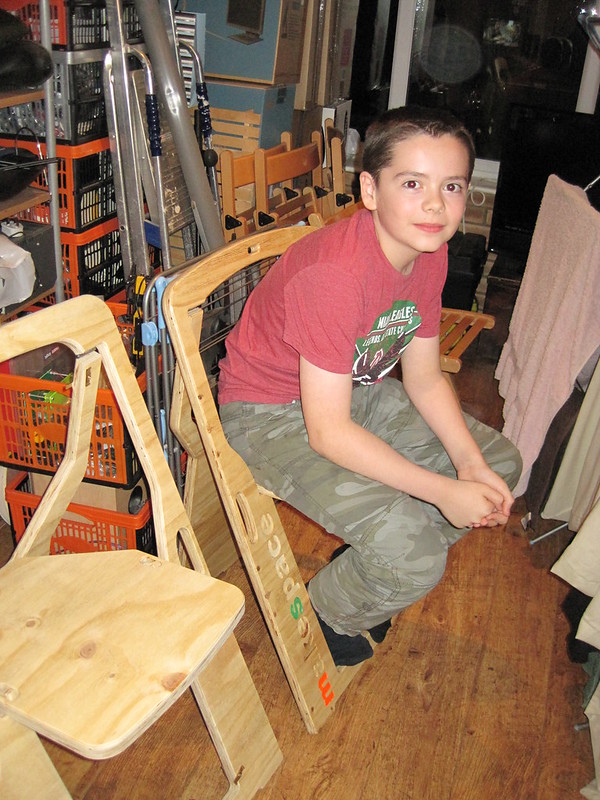
Well at least he should be according to Sartre though I am not entirely convinced the repercussions of my choice to manufacture another folding chair were entirely thought through.
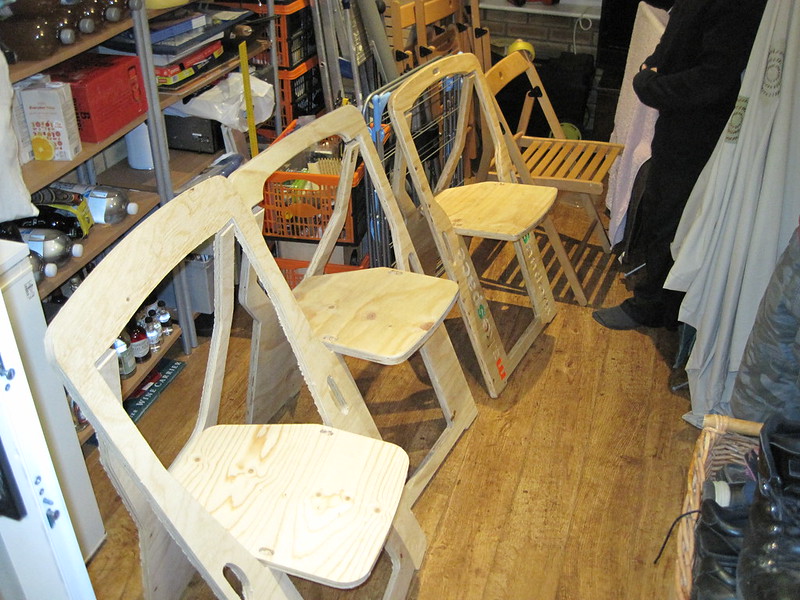
After my most recent posting the urge to do "just one more iteration" became too great and I succumbed. I therefore present version 4 of my folding chair which corrects all the previously discovered issues.
The popliteal height (420mm) and buttock popliteal length (400mm) are both comfortable for a wide selection of people. The seat slopes a few degrees front to back and the back rest no longer comes further forward than the rear of the seat.
There is a small gap above where the seat folds in when flat but that is only an aesthetic issue when being stored.
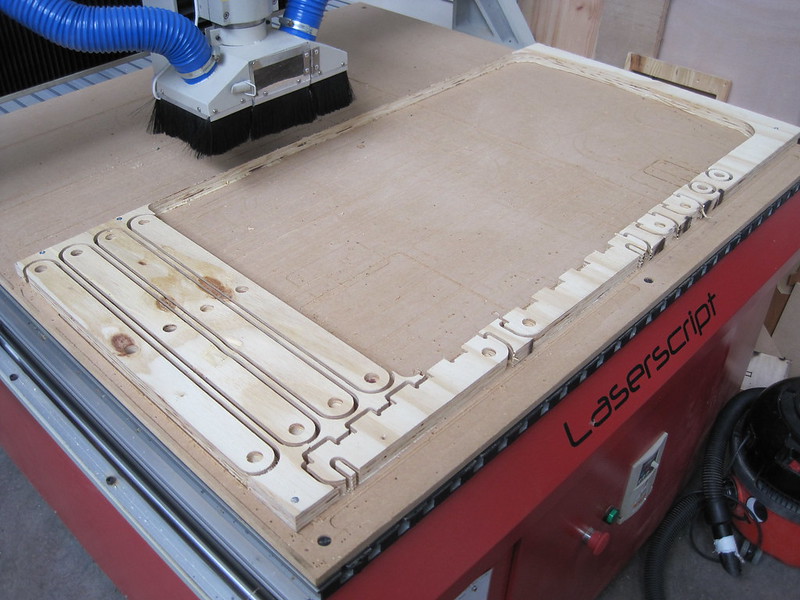
Manufacture wise the design is simple to produce although I really will have to teach our CNC router how to use the round over bit to reduce the finishing steps as currently that takes longer than the CNC operation.
In future if I make more of these I will use this design and, once she is less annoyed at me for making another chair, I am going to consult with my wife on adding some cushioning material to the seat and backrest.
And of course that concludes my furniture making for a while...yeah, right!
there have been comments which have complained about my usage of space on sheets and suggested I waste too much material. That is probably true and in my own defence I have not been working with this machine for very long and am not quite used to what I can "get away with" yet.
I was looking at the sheet after removing the last chair design and had a thought, I had not attempted a side X type folding design and perhaps I could squeeze one into the offcuts? I kinda got carried away, it roughly went:
Measure the available offcut space
Measured the remaining 18mm dowel leftover from my dowel hinge experiments
Found the largest width and height area I could get out of the sheet the CNC router ruined.
Sketched a design
Capture design to a DXF
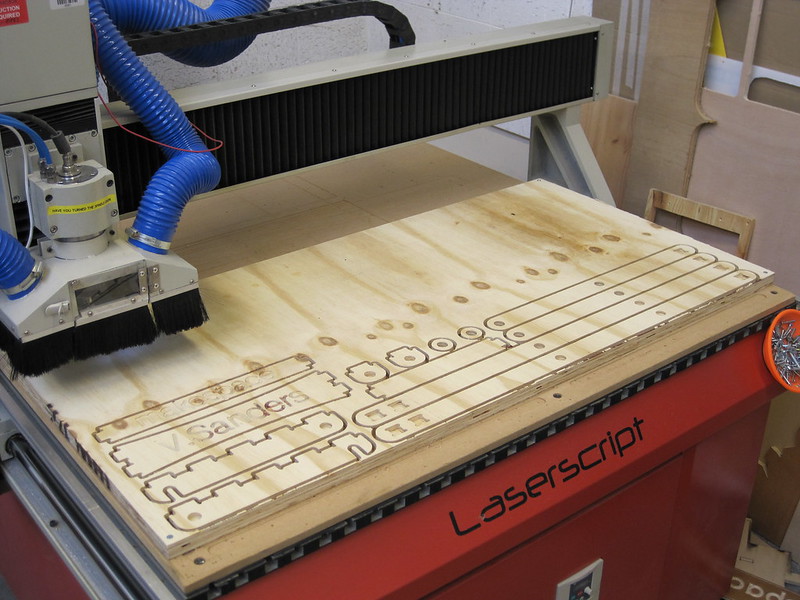
Carefully spread the pieces over the available material in the CAM software
Generate a toolpath.
Cut material
If all of that sounds like and utterly mad way to design a size X stool, you are of course correct, but it worked, and it was a very fast process taking less than four hours from idea to stool.
There are a couple of issues:
the popliteal height is 470mm ( I was aiming at 420 and missed...badly)
It uses a lot of expensive hardwood dowel (1373mm plus cutting width and only way I could get it accurate was to use the disc sander to remove fractions till the length was correct)
I used pockets for the interference seat joints rather than through cuts and discovered that you need to allow tolerance depth (the pegs are 10mm deep and the sockets need to be at least 10.2 not the 10mm I cut)
Dowel joints are great but have a small surface area so friction fit joints work loose.
The seat went together dry fit and Paul tested it for me, however that last issue soon made me realise that this time I was going to have to resort to glue. Yes, sorry, this design needs to be glued to remain stable (I know plywood contains glue...please stop telling me that).
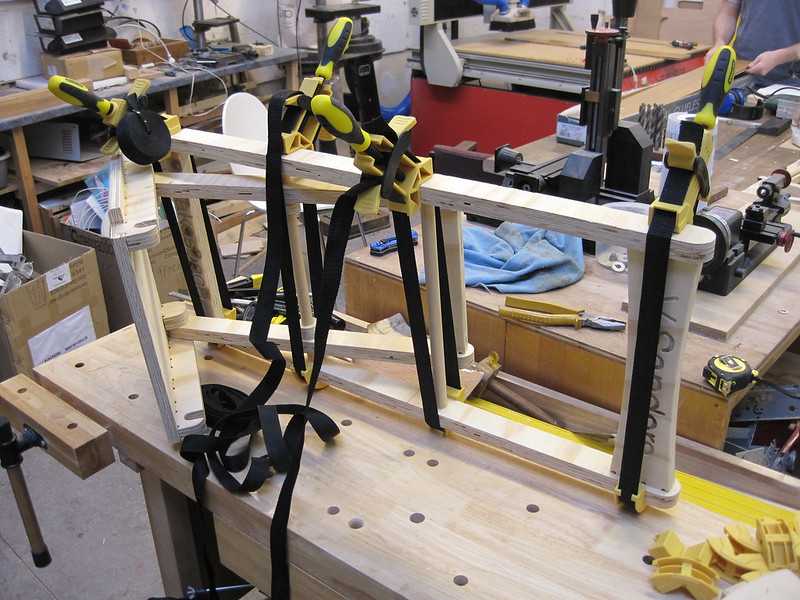
It is pretty simple to put together and aside from needing half the clamps in makespace to hold it in place while the glue dried, I had no trouble.
Though this is definitely not a case of use glue "sparingly" I put generous amounts in all the dowel joints and all the seat slots and got very little ooze so I guess it could have used more.
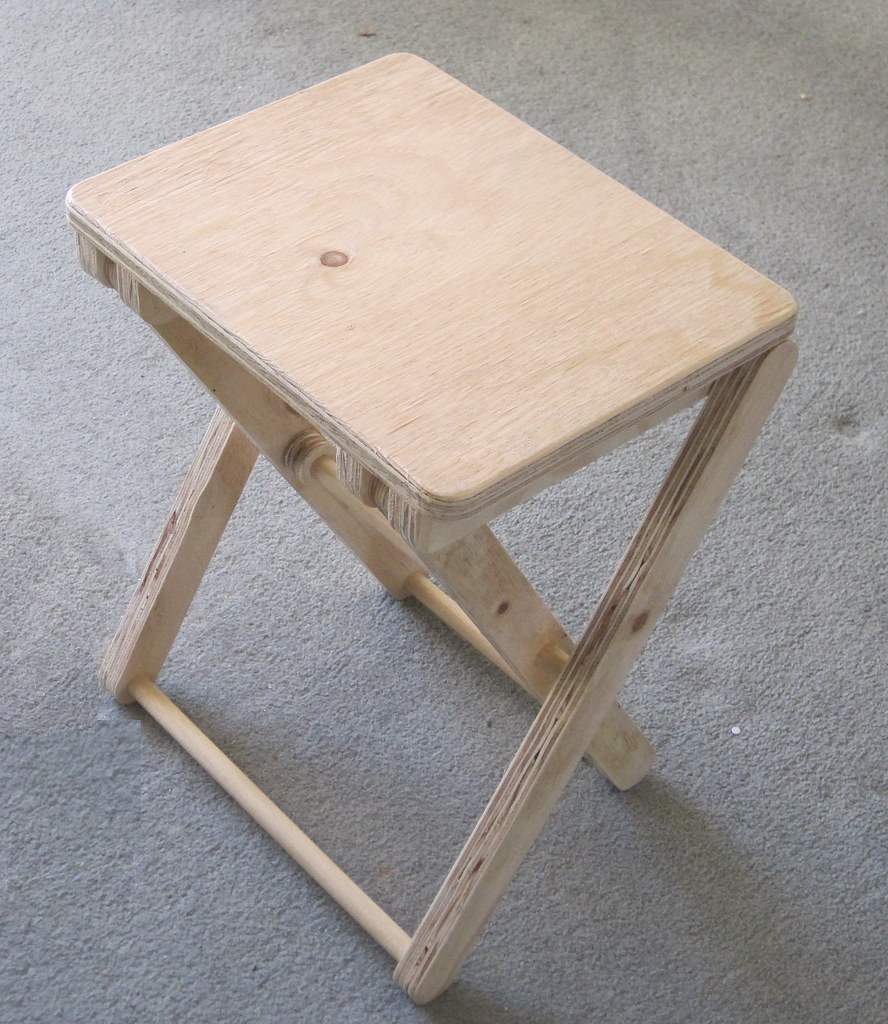
The final varnished stool is pretty robust but folds up nicely the concept of hooking to its own pivot dowel means it stays closed when flat which makes it very portable.
Total cost was an estimated 10.00 ( 4.25 dowel, 2.50 of 24mm ply, 1.75 for 18mm ply, 0.50 tool wear, 1.00 varnish) though the materials in my case could be argued to have cost nothing.
It has been suggested that I could make an entire picnic table and chairs set this way but if I did I would reduce the stool height by 50mm and examine ways to use less dowel.
Or in this case my final (and yes I am going to do something else next) chair design. It is based on the stool, in fact it is the stool design with the outer legs extended and a back rest added.
The modified design reduces the dowel requirements to 775mm but requires a bit more sheet material (cannot get this one entirely from offcuts).
Total cost was an estimated 10.50 ( 2.50 dowel, 4.50 of 24mm ply, 1.75 for 18mm ply, 0.50 tool wear, 1.25 varnish).
Because it is based on the stool design it suffers from the height issue and in addition the back rest is a bit far back to be completely comfortable.
Neither of the side X designs have flaws that interest me enough to follow the iterative approach again to solve them. Both the designs work well enough and rounded out my adventures with folding chairs and indeed furniture for now.
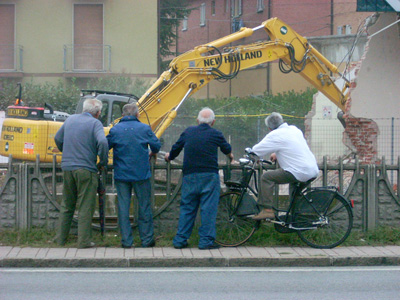
Umarell /uma'r l/ (oo-mah-rell), n; pl. Umarells. People in a community who
offer all sorts of comments to those who are trying to get some work done,
but who are not doing any work themselves.
Etymology and further details
Umarell is a word that entered Italian slang in Bologna and is spreading to
nearby towns, occasionally even across Italy. It comes from the
Bolognese for "cute/odd
little man".
"Umarells" are those people, usually retired men, who spend time watching
construction works, often holding their hands behind their back, occasionally
commenting on what is going on, sometimes trying to tell the workers what to
do.
It's easy to find exampleson theinternet; the word was popularised
by a blog collecting photos, which has even
been published into a book.
With some Italian Debian friends, we realised that umarell is the perfect
word to describe those people in a community, who offer all sorts of comments
to those who are trying to get some work done, but who are not doing any work
themselves.
I think that it is a word that fits perfectly, and since I'm likely going to
use it blissfully anywhere, here is a page that temporarily explains what it
means until the Oxford English Dictionary picks it up.
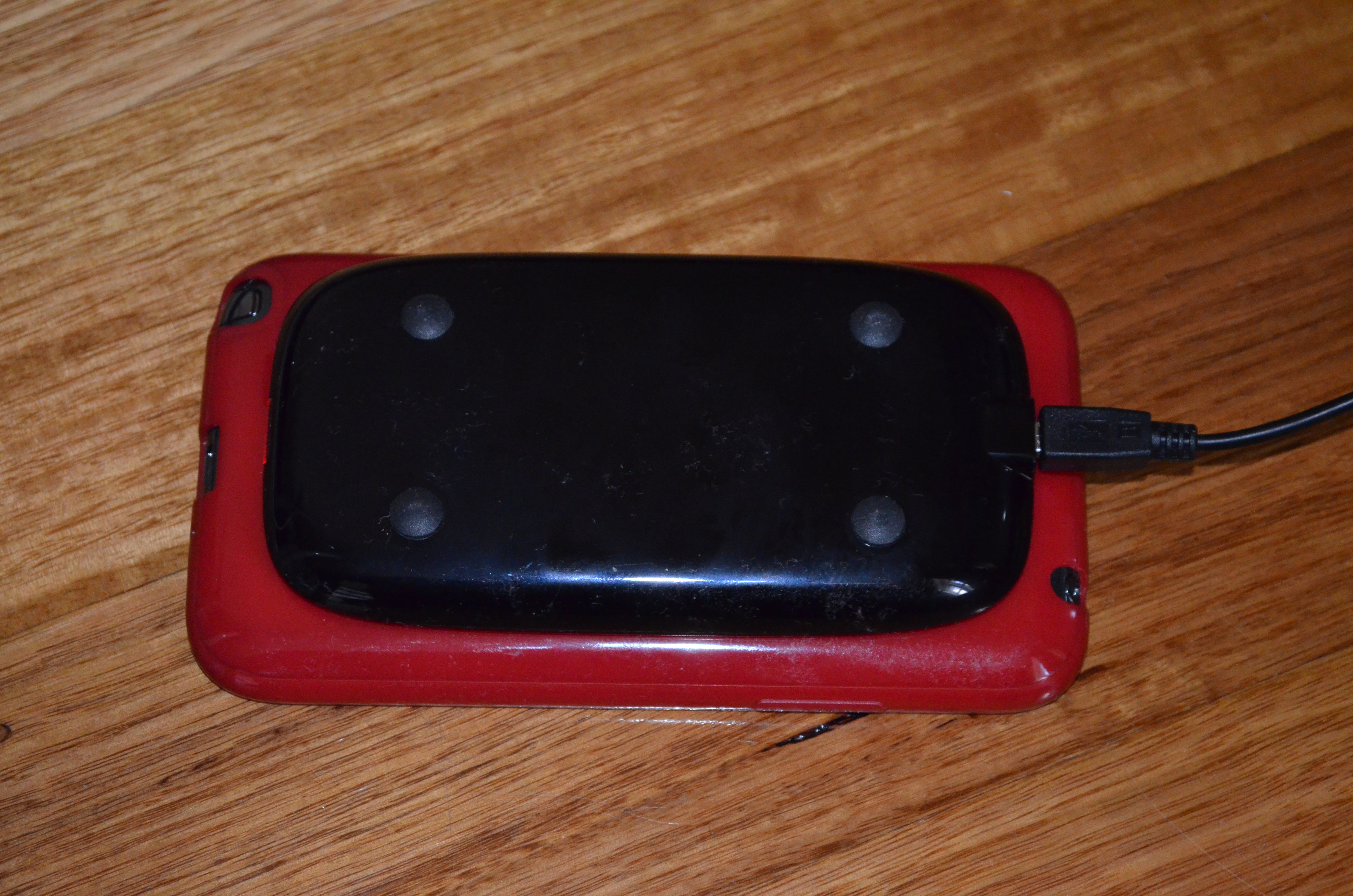
I have just bought a wireless phone charging system based on the Qi Inductive Power Standard. I bought a charging device which connects to a standard micro-USB cable and receivers for the Samsung Galaxy Note 2 and Samsung Galaxy S3 phones I own. Both those phones have contacts in the back of their case that are designed for wireless charging so you can install a charging device inside them. The charging devices make the case fit a little tight, and the charging device is stuck to the phone battery with contact adhesive, this makes it impractical to change the battery on a phone with such a device and makes it a little more difficult to swap out a battery case. One nice feature of the Nexus 4 is that it has Qi charging built in, that saved me $19 and was also more convenient.
I believe that the main advantage of a wireless charger is to avoid the risk of damage to the phone if it s dropped while connected to a USB charger. This allows the phone to be charged in situations where you might need to quickly or regularly unplug it to go somewhere. One example of how I might use it is when working at an office so I could charge my phone while at my desk and then quickly take it with me if I had to go to a meeting (sadly I have worked in many offices where they have so many meetings). Another example is for sysadmin work where I have to frequently visit devices to fix them.
The wireless charging mat that I bought from Kogan connects to a standard micro-USB plug, the good thing about this is that it s easy to find cables and it can take power from any PC. The bad thing about this is that the resistance of the USB cable is a factor that limits the power that a phone can receive, when using wireless charging you have the limit of the cable resistance as well as some power loss from the wireless transmission. After any extended period of charging the charging mat feels warm to the touch and the phone that s been resting on it feels warmer than usual. The warmth is an indication of energy loss which means longer charging times, a longer charging time isn t necessarily a problem as the convenience of wireless charging can allow longer charging times, but if you want to charge your phone in a hurry before you go somewhere then wireless isn t a good choice.
In the past I ve discovered that the battery in a Samsung Galaxy S3 can t be charged if the phone is at 46C [1]. 46C might seem extremely hot to people in some parts of the world (EG northern Europe and Canada) but the temperature in even southern parts of mainland Australia can get that hot and it can be hotter in central and northern parts, so phone temperature can be a real issue. Currently my house is at 21C according to a digital thermometer, the Galaxy S3 and the Note 2 are being charged from USB and report temperatures of 27C and 23C respectively. While the thermometer in my house and those in the phones probably aren t really accurate it seems reasonable to assume that the battery of a relatively idle smart-phone that s being charged will be a few degrees warmer than the ambient temperature. The Qi charger makes things a lot worse as it even feels warm to the touch. So maybe a phone on a Qi charger would be 8 degrees warmer than the ambient temperature or more. That implies that in Australian summer weather a Qi charger won t be useful outside or in any building that lacks air-conditioning. So I think we can give up on the idea of using Qi devices to charge phones at a BBQ.
The final problem I have is that the Qi device is quite small, I took the above picture with my phone face-down because no part of the charger is visible in normal use. With that size I can t just dump a phone like a Note 2 on top of the charging mat and expect it to work. I have to carefully place it so that it balances and so that the wireless receptor inside the phone matches the transmitter in the mat, if the phone isn t placed correctly then the Qi mat won t detect it and won t supply full power to the transmitter.
Conclusion
I m fairly disappointed in this device. The waste heat makes it unsuitable for Australian summer conditions and slows charging. The difficulty of correctly placing the phone reduces the convenience which is one of the major features.
The price was $19 for each charging card for the Note 2 and the S3 and $29 for the charging mat to give a total of $67. I think it s worth the money for me to cover the risk of one of my phones having it s USB port damaged. Using a Qi charger on occasion will decrease the probability of such damage and allow the phone to be used after receiving certain types of damage.
The prices of those phones nowadays are $389 for a Galaxy S3 (Kogan price), $250 for a Nexus 4 (when it was on sale in the Google store), and probably about $500 for a Galaxy Note 2 (last time Kogan offered them). So by paying $67 for Qi charging I believe that I m getting some degree of damage insurance for just over $1100 worth of phones. It seems likely that the Nexus 5 will ship with Qi charging support and that the Galaxy Note 3 will also support an optional Qi charging card (which will probably also be $19 or some similar price) so the charging mat should be useful for a long time.
While I m disappointed I don t regret buying the device. But I would be hesitant to recommend it to other people and definitely wouldn t recommend it to someone who doesn t have a significant interest and investment in smart phones.
I ve been running several Deb-o-Matic instances on several servers since ages. This service, meant to provide a way to automate the build of Debian source packages, has been the starting point for a lot of Italian developers to start packaging, and eventually become Debian or Ubuntu developers. I can t exactly tell how many packages Deb-o-Matic servers have built so far, but it has been the primary build and test environment for at least three Debian Developers since four years.
This service was hosted for free since the beginning, but the good things always come to an end. My provider decided they cannot keep our servers running (its core business is totally unrelated to hosting servers), and asked me to shut them down. I started with the two kfreebsd-* machines, and soon I will shut down i386 and amd64 as well. When all services will be down, I ll take care of removing the debian.net domains I created for them.
Deb-o-Matic development won t stop, but developers who used Deb-o-Matic daily will have to find a different solution to build and test their packages.
Some time ago, I provided an installation report for installing Debian wheezy onto a btrfs RAID1 filesystem.
It is not supported directly from the installer partitioning menu partman, but it is not hard to trick the installer to do it, as described in the bug report.
I believe this may be a worthy release goal for Debian 8 (jessie), but it is not something I can commit to facilitate myself so I am sharing my experience with it for those who may want to volunteer.
Anybody wanting to test it can easily do so with VirtualBox if they don't want to dedicate a real machine to it or if they don't have two real disks in their test machine. My own testing simply involved creating two VirtualBox virtual disks on a single SATA disk.
Procedure
Here is an abbreviated version of the procedure from the installation report linked above.
Run the Debian installer as normal up to the partitioning menu
Use manual partition mode
Create one big btrfs partition on one HDD (either on a raw partition or on an LV)
Designate the partition on one disk as the root FS, designate the partition on the other as unused/unformatted.
Continue through the setup, installing to one disk
After rebooting into Debian, follow these steps to add the other disk into a RAID1
A variation of this procedure is to use a shell while the installer is running to make the RAID1 during the installation and observe whether /etc/fstab is created correctly.
Potential gotchas: is the default fstab sufficient or does it need to be modified after the conversion to RAID1? Does the initframfs need to be regenerated (and potentially modified by hand?) to make it work?
Issues to be discussed / resolved
Mixing BTRFS filesystems with Logical Volume Management - how many permutations should the installer support? What do people expect/need/require?
How to boot if a disk fails? Can grub boot from either?
Warning the user when the FS detects instability or failure in either disk
A client has recently asked for my advice on web editing software. There are lots of programs out there for editing web sites and according to a quick Google search there are free Windows programs to do most things that you would want to do.
The first thing I m wondering about is whether the best option is to just get a Linux PC for web editing. PCs capable of running Linux are almost free nowadays (any system which is too slow for the last couple of Windows versions will do nicely). While some time will have to be spent in learning a new OS someone who uses Linux for such tasks will be able to use fully-featured programs such as the GIMP which are installed as part of the OS. While it is possible to configure a Windows system to run rsync to copy a development site to the production server and to have all the useful tools installed it s much easier to run a few apt-get or yum commands to install the software and then copy some scripts to the user s home directory.
The next issue is whether web editing is the best idea. Sites that are manually edited tend to be very simple, inconsistent, or both. Some sort of CMS seems to be the better option. WordPress is a CMS that I m very familiar with so it s easy for me to install it for a client, while I try and resist the temptation to force my favorite software on clients there is the issue that I can install WordPress quickly which therefore saves money for my client. WordPress is a CMS that supports installing different themes (and has a huge repository of free themes). The content that it manages consists of pages and posts , two arbitrary types of document. Supporting two types of document with a common look and feel and common important data in a side-bar seems to describe the core functionality used by most web sites for small businesses.
Does anyone have any other ideas for ways of solving this problem? Note that it should be reasonably easy to use for someone who hasn t had much experience at doing such things, it shouldn t take much sysadmin time to install or cost to run.
The bashism of this week deals again with tests. How do you compare two strings to tell which one goes before or after the other in the alphabet in a shell script? (also know as lexicographic comparison)
If you are familiar with perl and the relationship between its comparison operators and that of shell scripts, you would probably write the test as follows:
$ test bar '<' foo
$ test foo '>' bar
And yes, that would work, but not with all shells. I'm afraid to tell you that the < and > comparison operators are not required by the POSIX:2001 specification and are, therefore, bashisms.
What does this have to do with perl? well, the shell way is the inverse of the perl way. What? In Perl you test the equality of two numbers with '==', in shell you use '-eq'; in perl the equality of strings is 'eq', in shell it is '='. In shell scripts you can compare two numbers with -gt (test 1 -gt 0) while in perl the equivalent comparison is with > (1 > 0).
So in this case the perl way is "bar lt foo" and based on the above the shell way should be "bar < foo". However, care must be taken when using such operators in shell scripts. Since < and > are used for redirections in shell scripts, one must quote them even when using bash. An alternative is to use the [[ special test function of bash which alters the shell syntax.
This time I didn't write a function to portably (or "somewhat portably") replace such comparisons. Feel free to share your solution in the comments, with bonus points if you come up with a solution without using external commands.
While I suspect that professional speakers have separate presentation
laptops that they use only to give talks, I don't do this often enough to
justify the hassle and cost of a separate machine. However, I do use a
separate user account to present from.
It allows me to focus on my presentation and not stress out about running
into configuration problems or exposing private information. But mostly, I
think it's about removing anything that could be distracting for the
audience.
The great thing of having a separate user for this is that you can do whatever
you want in your normal account and still know that the other account is ready
to go and configured for presenting on a big screen.
Basics
The user account I use when giving talks is called presenter and it has
the same password as my main user account, just to keep things
simple. However, it doesn't need to belong to any of the UNIX groups that my
main user account belongs to.
In terms of configuration, it looks like this:
power management and screen saver are turned off
all sound effects are turned off
window manager set to the default one (as opposed to a weird tiling one)
desktop notifications are turned off
Of course, this user account only has the software I need while
presenting. You won't find an instant messaging, IRC or Twitter client
running on there.
The desktop only has the icons I need for the presentation: slides and
backup videos (in case the network is down and/or prevents me from doing a
live demo).
Web browsers
While I usually have my presentations in PDF format (for maximum
compatibility, you never know when you'll have to borrow someone else's
laptop), I use web browsers (different ones to show that my demos work with
all of them) all the time for demos.
Each browser:
clears everything (cookies, history, cache, etc.) at the end of the session
has the site I want to demo as the homepage
only contains add-ons or extensions I need for the demos
has the minimal number of toolbars and doesn't have any bookmarks
has search suggestions turned off
never asks to remember passwords
Terminal and editors
Some of my demos may feature coding demos and running scripts, which is why
I have my terminal and editor set to:
a large font size
a color scheme with lots of contrast
It's all about making sure that the audience can see everything and follow
along easily.
Also, if you have the sl package installed system-wide, you'll
probably want to put the following in your ~/.bashrc:
alias sl="ls"
alias LS="ls"
Rehearsal
It's very important to rehearse the whole presentation using this
account to make sure that you have everything you need and that you are
comfortable with the configuration (for example, the large font size).
If you have access to a projector or a digital TV, try connecting your
laptop to it. This will ensure that you know how to change the resolution
of the external monitor and to turn mirroring ON and OFF ahead of time
(especially important if you never use the default window manager or desktop
environment). I keep a shortcut to the display settings in the sidebar.
Localization
Another thing I like to do is to set my operating system and browser
locales to the one where I am giving a talk, assuming that it is a western
language I can understand to some extent.
It probably doesn't make a big difference, but I think it's a nice touch and
a few people have commented on this in the past. My theory is that it might
be less distracting to the audience if they are shown the browser UI and
menus they see every day. I'd love to have other people's thoughts on this
point though.
Also, pay attention to the timezone since it could be another source of
distraction as audience members try to guess what timezone your computer is
set to.
Anything else?
If you also use a separate account for your presentations, I'd be curious to
know whether there are other things you've customised. If there's anything I
missed, please leave a comment!
all your ctag (and checksum) are belong to us
A few months after the initial
announcement, here are some news about the sources.d.n service. I've been late
in blogging this, but most of it has been implemented by myself and
Matthieu Caneill during DebConf13, which has been a
great DebConf, totally exceeding my expectations (and they were
already fairly high!).
First, you might have noticed some user-visible
changes:
there is now an advanced
search page, which complements the already existing
regex code search with
the possibility of searching source files by their
sha256, or the ctags defined
therein
on the same topic, when browsing through a package and using
regex search, you'll now search by default within that
package, allowing to focus your searches more easily than before.
(You can easily override this by editing the search box and
removing the package: predicate.)
for the data geeks (or the wannabe host), there are now disk usage
stats (note that they don't include the database size,
though, see below for that)
the website also got a significant facelift, as
part of which we have moved the detailed explanations of what the
service is about out of your way. You now immediately get to the
various browsing options.
On the other hand, under the hood:
to implement ctags and sha256 searches we needed a serious DBMS,
so we switched from SQLite to PostgreSQL.
Again, for the data geek: storing ctags/sha256 for all of
sources.d.n content with decent indexes takes about 37 GB, for
about 160 million rows in the ctags table and 20 million rows in
the checksums one. (Currently filenames are duplicated between the
two tables so, probably, the DB disk size might be reduced
some.)
together with the switch to a serious DBMS, the update logics
has been completely rewritten in Python (from Bash...), and should
now be entirely transactional.
... and given it was going to be Python anyhow, better to enjoy
what it has to offer, no? So there is now a plugin
mechanism that makes it easier to add extra data
extractors, triggering them at each package update. Currently there
are plugins for sha256sum, ctags, and sloccount (even though the
latter is not yet exposed via the web interface). An added benefit
of this is that if you want to deploy debsources elsewhere, you can
easily disable the most time consuming extractors: running ctags
and sha256sum on the fabulous 3 chromium/libreoffice/linux
is not for the faint of disks...
we now receive push updates from the Debian
mirror network, so that you'll get updates on sources.d.n as soon
as a package hits Debian mirrors (+ processing time, which is about
15-20 minutes on the average update run). Many thanks to Simon
Paillard and Adam Lackorzynski for their help in setting this
up.
thanks to a suggestion by kugel we have
adopted Geany's conventions for
filetype detection, and we now take into account both file
extensions and shebang lines (when available)
As you usual, your bug reports (and patches!) are more than
welcome, just check
BUGS before reporting to avoid duplicates.
That's all!
I love to say that Python is a nice subset of Lisp, and I discover that it's
getting even more true as time passes. Recently, I've stumbled upon the
PEP 443 that describes a way to
dispatch generic functions, in a way that looks like what CLOS, the Common
Lisp Object System, provides.
What are generic functions
If you come from the Lisp world, this won't be something new to you. The
Lisp object system provides a really good way to define and handle method
dispatching. It's a base of the Common Lisp object system.
For my own pleasure to see Lisp code in a Python post, I'll show you how
generic methods work in Lisp first.
To begin, let's define a few very simple classes.
(defclasssnare-drum() ())
(defclasscymbal() ())
(defclassstick() ())
(defclassbrushes() ())
This defines a few classes: snare-drum, symbal, stick and brushes,
without any parent class nor attribute. These classes compose a drum kit,
and we can combine them to play sound. So we define a play method that
takes two arguments, and returns a sound (as a string).
(defgenericplay(instrumentaccessory) (:documentation"Play sound with instrument and accessory."))
This only defines a generic method: it has no body, and cannot be called
with any instance yet. At this stage, we only inform the object system that
the method is generic and can be then implemented with various type of
arguments. We'll start by implementing versions of this method that knows
how to play with the snare-drum.
Now we just defined concrete methods with code. They also takes two
arguments: instrument which is an instance of snare-drum and accessory
that is an instance of stick or brushes.
At this stage, you should note the first difference with object system as
built into language like Python: the method isn't tied to any class in
particular. The methods are generic, and any class can implement them, or
not.
Let's try it.
As you see, the function called depends on the class of the arguments. The
object systems dispatch the function calls to the right function for us,
depending on the arguments classes. If we call play with instances that
are not know to the object system, an error will be thrown.
Inheritance is also supported and the equivalent (but more powerful and less
error prone) equivalent of Python's super() is available via
(call-next-method).
In this example, we define the stick and brushes classes as subclass of
the accessory class. The play method defined will return the sound
BIIING! regardless of the accessory instance that is used to play the
cymbal. Except in the case where it's a brushes instance; only the most
precise method is always called. The (call-next-method) function is used
to call the closest parent method, in this case that would be the method
returning _"BIIING!".
Note that CLOS is also able to dispatch on object instances themself by
using the eql specializer.
But if you're really curious about all features CLOS provides, I suggest you
read the
brief guide to CLOS by Jeff Dalton
as a starter.
Python implementation
Python implements a simpler equivalence of this workflow with the
singledispatch function. It will be provided with Python 3.4 as part of
the functools module. Here's a rough equivalence of the above Lisp
program.
@functools.singledispatch defplay(instrument,accessory): raiseNotImplementedError("Cannot play these")
@play.register(SnareDrum) def_(instrument,accessory): ifisinstance(accessory,Stick): return"POC!" ifisinstance(accessory,Brushes): return"SHHHH!" raiseNotImplementedError("Cannot play these")
We define our four classes, and a base play function that raises
NotImplementedError, indicating that by default we don't know what to do.
We can then write specialized version of this function with a first
instrument, the SnareDrum. We then check for the accessory type that we
get, and return the appropriate sound or raise NotImplementedError again
if we don't know what to do with it.
If we run it, it works as expected:
The singledispatch module looks through the classes of the first argument
passed to the play function, and calls the right version of it. The first
defined version of the play function is always run for the object class,
so if our instrument is a class that we did not register for, this base
function will be called.
For whose eager to try and use it, the singledispatch function is
provided Python 2.6 to 3.3 through the Python Package Index.
Limitations
First, as you noticed in the Lisp version, CLOS provides a multiple
dispatcher that can dispatch on the type of any of the argument defined
in the method prototype, not only the first one. Unfortunately, Python
dispatcher is named singledispatch for this good reason: it only knows to
dispatch on the first argument. Guido van Rossum wrote a short article about
the subject that he called
multimethod a
few years ago.
Then, there's no way to call the parent function directly. There's no
equivalent of the (call-next-method) from Lisp nor the super() function
that allows to do that in Python class system. This means you will have to
use various trick to bypass this limitation.
So while I am really glad that Python is going toward that direction, as
it's a really powerful way to enhance an object system, it really lacks a
lot of more advanced features that CLOS provides out of the box.
Though, improving this could be an interesting challenge. Especially to
bring more CLOS power to Hy. :-)
A book I'm writing that will be launched soon, talking about
designing Python applications, state of the art, and various
Python tips.
If you want to be the first to hear about the launch, subscribe
now.
I wanted to use the jqGrid for my admin pages as I liked that look and it matches some of the other screens outside the admin controller. The admin controller, or rather the CrudRestController out of tgext.crud, has a way of exporting results in json format. So surely its a matter of changing the TableBase to use jqGrid in the admin controller and we re done?
Well, no.
First you need to adjust the jsonReader options so that it lines up to the field names that the controller sends and this was one of the first (or last snags). The json output looks like:
Now this is a little odd because of the top-level dictionary that is being used here. Most of the examples have everything that is inside the value_list being returned. In fact adjusting the controller to return only those items in the value_list values works.
To look inside this structure we need to adjust the jsonReader options. jqGrid documentation uses the format toptier>subtier for the XML reader so that was the intial attempt. It was also an intial fail, it doesn t work and you get your very familiar empty grid.
The trick is close to this format, but slightly different for json. You change the options to toptier.subtier . In other words change the greater than symbol to a full stop for json access.
The jqGridWidget now has the following options (amongst others):
There might be a way of saying all entries sit under value_list inside jqGrid, but I couldn t find it. Those options given above do give a working jqGrid on the admin screens.
After years of waiting, Google has finally enabled IPv6 for their
email service Gmail. And a few weeks ago, they updated their policy,
adding one specific rule: reject email from IP addresses with no reverse
name:
% nc -Cv gmail-smtp-in.l.google.com. smtp
Connection to gmail-smtp-in.l.google.com. 25 port [tcp/smtp] succeeded!
220 mx.google.com ESMTP bz2si13656083wjc.108 - gsmtp
HELO boo.example.com
250 mx.google.com at your service
MAIL FROM: <me@example.com>
250 2.1.0 OK bz2si13656083wjc.108 - gsmtp
RCPT TO: <you@gmail.com>
250 2.1.5 OK bz2si13656083wjc.108 - gsmtp
DATA
354  Go ahead bz2si13656083wjc.108 - gsmtp
Subject: Test
From: Me <me@example.com>
To: You <you@gmail.com>
Test.
.
550-5.7.1 [2001:db8:8e3f:43c7::12      16] Our system has detected that this
550-5.7.1 message does not meet IPv6 sending guidelines regarding PTR records
550-5.7.1 and authentication. Please review
550-5.7.1 https://support.google.com/mail/?p=ipv6_authentication_error for more
550 5.7.1 information. bz2si13656083wjc.108 - gsmtp
That sucks
It is not a sane anti-spam measure, because not having a reverse
name tells absolutely nothing about the email emitter or the
message itself: it only indicates that the email emitter has a lame
access provider. Specifically:
spammers can have perfect reverse names;
regular email emitter can have no reverse name because
their access provider suck, and have no way of fixing it
because all access providers suck the same way.
While IPv6 is the future of the Internet, this measure
discourages its use. Yes, providing no reverse names suck, but it is
by no mean the user's fault, and since IPv6 is more complicated to
implement than IPv4, Internet actors must tolerate youth errors or
people will just keep what works, i.e. IPv4.
By the way, I would love to have a perfect Internet access provider,
but that does not exist where I live, and I do not think it exists at all
anywhere. Google, instead of complaining
about lame access providers, you are welcome to offer me a fibre service
with decent upload rate, static IPv4, static IPv6 /64, customizable
reverse DNS for IPv4 and IPv6, and full respect of the network
neutrality. Until then, I am doing the best I can with the least bad
provider available.
Workaround
As I said, their is an easy workaround. Google does not accept my
mail on IPv6? Fine, I will keep using IPv4. Only for Google of course,
no need to punish the whole Internet for Google's damn restrictions.
With Postfix, you can do that this way (thanks to Christian
Skala for his blog post about this problem). In
/etc/postfix/master.fr, enable an IPv4-only SMTP
client service:
smtp4 unix - - - - - smtp -o inet_protocols=ipv4
Then, in /etc/postfix/main.cf, define a transport
map if you do not already use one:
transport_maps = hash:/etc/postfix/transport
Create that transport map
/etc/postfix/transport or complete it:
gmail.com smtp4:
Finally, hash that transport map and have Postfix reload its
configuration:
# postmap /etc/postfix/transport
# service postfix reload
There is now a new wordpress plugin, for testing against my blogspam site/service.
Now time to talk about something else.
This week my partners sister & niece are visiting from Helsinki, so we've both got a few days off work, and we'll be acting like tourists.
Otherwise the job of this week is to find a local photographer to shoot the pair of us. I've shot her many, many, many times, and we also have many nice pictures of me but we have practically zero photos of the pair of us.
I spent a lot of time talking to local volunteers & models, because I like to shoot them, but I know only a couple of photographers.
Still a big city, we're bound to find somebody suitable :)
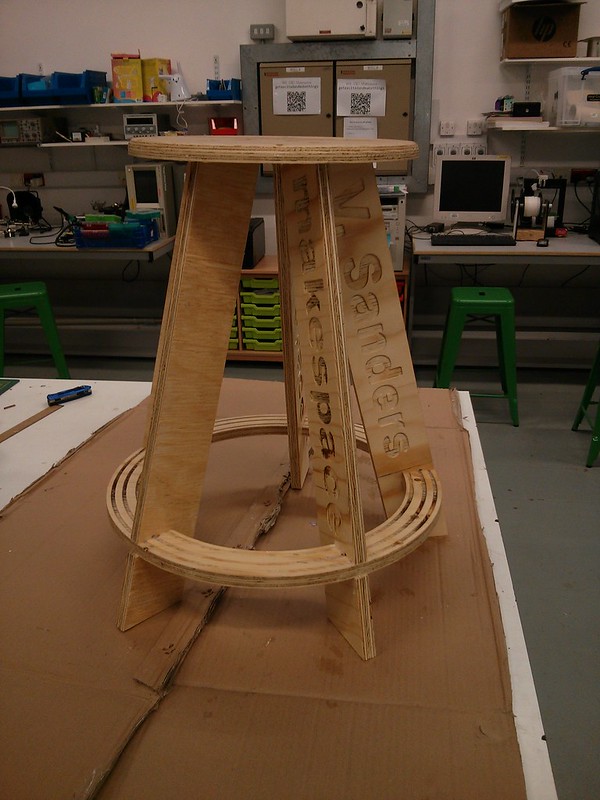
I seem to be adhering to Beckett's approach recently but for some reason, after my previous stool attempts, despite having a functioning design I felt I had to do just one more iteration.
Going back to a previous concept of having five legs instead of three while this did not improve the rotational problems with the 12mm thick material, it did make the design more stable overall and less prone to tipping.
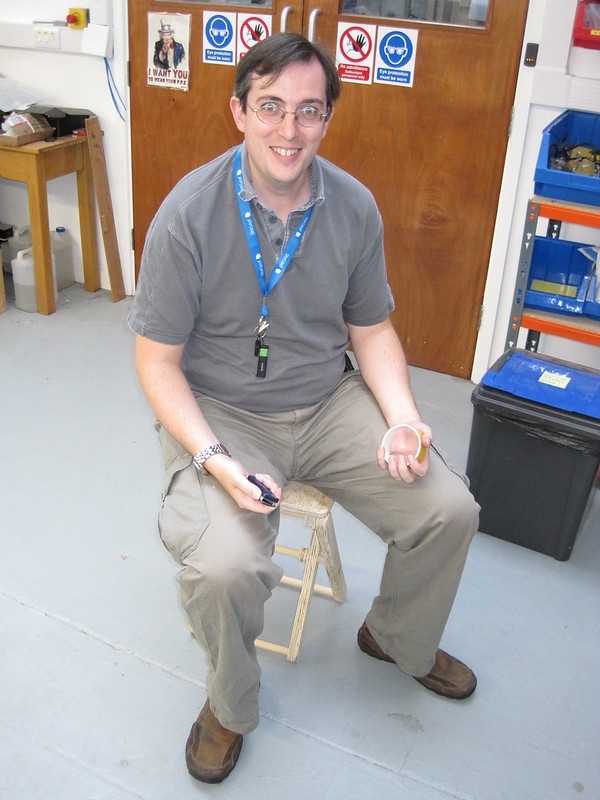
The five legged solution realised in 18mm plywood resulted in my final design for this concept. As my friend Stephen demonstrates the design is pretty solid even for those of us with a more ample frame. There are now a couple of them in use at the space alongside the three legged earlier versions.
I was finally satisfied with the result and thought I was done with furniture making for a while. My adorable wife then came up with a challenge, she wanted a practical foldable chair her requirements were:
Must be robust enough to cope with guests of all sizes
Use as little storage space as possible.
Not ugly.
Inexpensive enough they can be given as gifts.
Things for individual humans to sit on raised off the floor, or chairs as we call them, have been around for a long time. My previous research for the stool indicated that chairs have a long history with examples still surviving from the ancient egyptians. From this I assumed there would be nothing novel in this project and to quote the song it's all been done before
Given this perspective my research started with an image search for "folding chair". The results immediately showed there were two common shapes. Either the chair base was formed with a pair of linked X shapes with the seat across the top, or an A frame style where the seat is across the centre.
My initial thoughts were to replicate the IKEA style A frame design until I noticed that some designs were made from a single sheet of timber with a small number of profile cuts. I searched for pre-existing design files but found none, perhaps I had found something novel to do after all.
Some quick measurements of chairs in shops (and more weird looks, mainly from my family) suggested 900mm is generally the highest a chair ought to stand. I selected a popliteal height of 420mm as a general use compromise which is a bit less than the 430mm of most mass produced chairs. I also decided there should be a front to rear drop across the seat which ought to improve comfort a little.
Material selection was based upon what I had to hand which consisted of a couple of sheets of structural plywood (1220x606x18mm temperate softwood - probably spruce although not specified) which had not become stools yet. Allowing for edge wastage and tool width this gave me a working area from a sheet of 1196x582mm.
I sketched the side view of the chair numbering the three parts. I decided part 1 would be 1000mm total height with top and bottom cross braces 80mm high, assuming the 900mm tall target, the A frame apex would be at 820mm height.
If we assert that the apex is immediately below the top cross brace on part 1 this gives 920mm at which point we have two sides of a right angled triangle (820 and 920) from which we can calculate the top angle is 26 . This also means part 2 will be 840mm long with the same 820 height this gives an angle of 10 .
I did the maths for the seat triangle using the 36 angle and 420mm popliteal height. Having experienced how flexible 18mm plywood was in the face dimension I decided to make the frame sides 50mm wide leaving, after 6mm tool path widths, enough space for a 358mm wide seat .
Once the dimensions were decided the design went pretty quickly producing something that looked similar to the designs I had seen earlier.
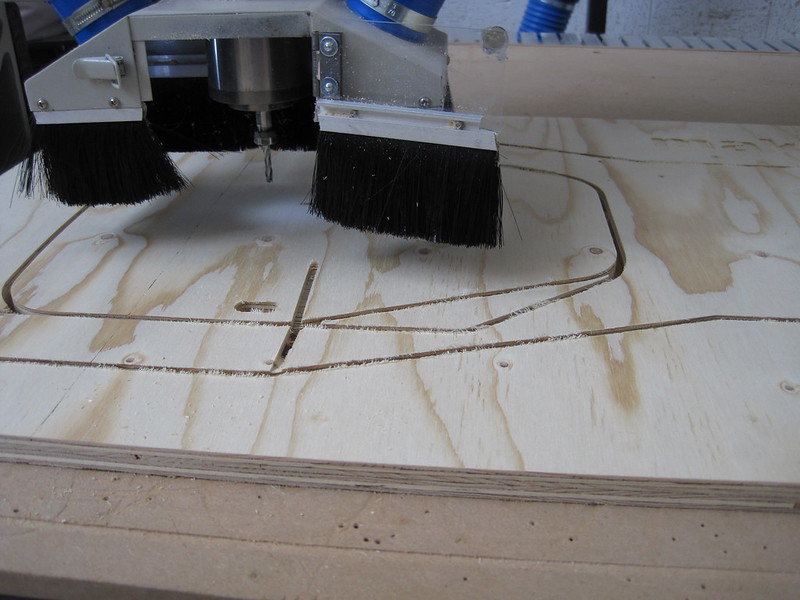
Generating toolpaths for this design proved challenging with the CAM software we had available, mainly because arranging multiple "inner" and "outer" cuts along the same path and having the tabs line up was obviously not an anticipated feature.
Things had been going far too well for me and during the routing operation our machine decided to follow an uncommanded toolpath excursion mid job (it cut a dirty great hole through the middle of my workpiece where I did not want it) ruining the sheet of material.
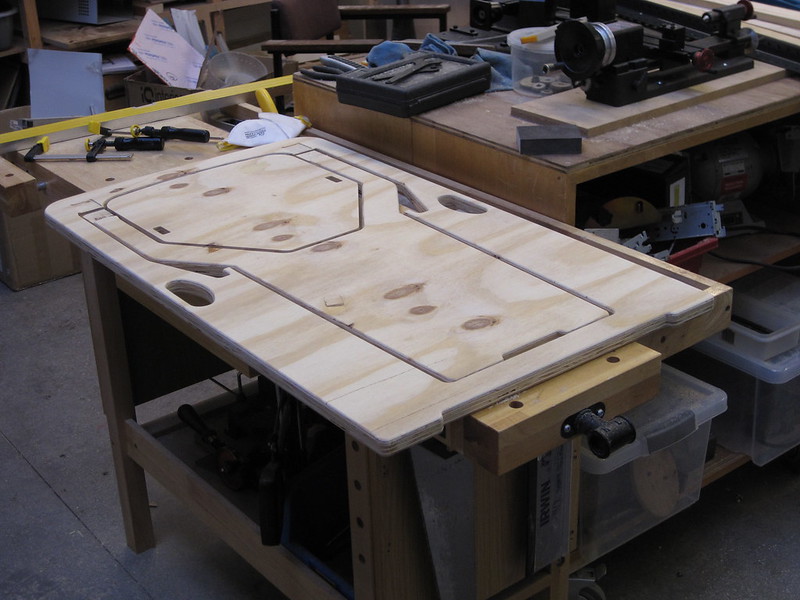
Fortunately, once factory reset and reconfigured, the machine ran the job correctly the second time although we still do not know why it went wrong. The parts were cut free of their tabs and hinges fitted.
The resulting design worked with a couple of problems:
I had made an error in my maths and added when I should have subtracted, as a result the seat slopes back to front which is not very comfortable.
The chair feels very wide and tall.
The front face (part 1) flexes alarmingly between the seat and the ground when subjected to large loads.
So time for a second iteration, this time I selected a thicker plywood to reduce the bend under large loads (OK already, I mean me). After shopping around for several days I discovered that unlike 12mm and 18mm thick plywood 24mm thick is much harder to find at a sensible price especially if you want it cut into 1220x606 sheets from the full 1220x2440.
I eventually physically went to Ridgeons and looked at what they actually had in the warehouse and got a price on a sheet of brazilian elliotis pine structural plywood for 43.96 which they cut for me while I waited. Being physically present also gave me the opportunity to pick a "less bad" sheet from the stack much to the annoyance of the Ridgeons employee for not just taking the top one.
This time I reduced the apex height by 30mm, the length of part 1 by 80mm. I also reduced the frame width by 10mm relying on the increased thickness of the plywood to maintain the strength. In area terms it is actually an increase in material (50mm*17.7mm = 885 against 40mm*22.80 = 912). I also included rebates for the top hinges within the design allowing them to be mounted flush within the sheet width.
The new design was cut (without incident this time) and the edges rounded off. I also added some simple catches to keep the seat and back inline while being transported.
While this version worked I had made a couple of mistakes again. The first was simply a radius versus diameter error on the handles which meant too much material was removed from a high stress area causing increased bending.
The second error was a stupid mistake that where I had worked the latch holes in the seat to the wrong side of my measure line meaning the apex angle was 35.5 not the expected 33.6 which meant the backrest felt "too far forward"
The third version rectified those two errors and improved the seat front curve a little to further reduce the unneeded material in the back rest.
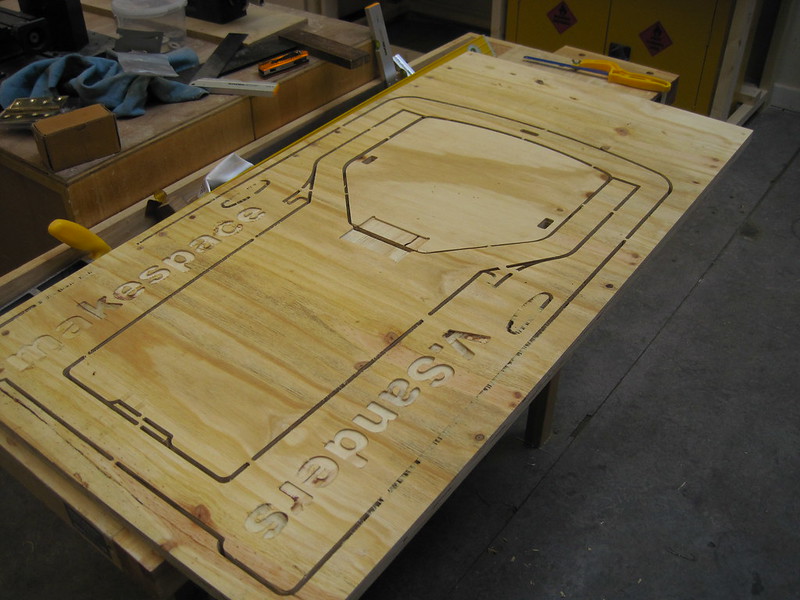
The fabrication of this design was double sided allowing for the seat hinge to be fully rebated and become flush and also adding some text similar to the stools.
This version still suffers from a backrest that is a bit too far forward and my sons complain it makes them sit up too straight. The problem is that the angle of the front face (23.6 ) means that to move the rest back 20mm means the piece needs to extend another 50mm beyond the frame apex which would probably make the chair feel tall again.
I guess this is a compromise that would take another iteration or two to solve, alas my wife has declared a moratorium on more chairs unless I find somewhere to put the failed prototypes other than her conservatory.
One other addition would be a better form of catch for transport. The ones in version 2 work but are ugly, magnets inset into the frame have been suggested but not actually implemented yet.
In conclusion I think I succeeded with the original brief and am pretty pleased with the result. A neatly folding chair that can be stacked simply by having a pile of them and are easy to move and setup.
The price per chair is a little higher than I would like at 22 ( 11 for timber, 5 for hinges and screws , 5 for varnish and 1 for tool wear) plus about 2 hours labour (two sided routing plus roundover takes ages)
Today I link you to a video narrated by the legendary Carl Sagan The Frontier is Everywhere.
Partial quotes:
We were hunters and foragers. The frontier was everywhere. We were bounded only by the earth, and the ocean, and the sky. The open road still softly calls. Our little terraqueous globe as the madhouse of those hundred thousand millions of worlds. We, who cannot even put our own planetary home in order, riven with rivalries and hatreds; are we to venture out into space?
By the time we are ready to settle even the nearest other planetary systems, we will have changed For all our failings, despite our limitations and fallibilities, we humans are capable of greatness How far will our nomadic species have wandered, by the end of the next century, and the next millennium?
Our remote descendants, safely arrayed on many worlds through the solar system, and beyond, will be unified, by their common heritage, by their regard for their home planet, and by the knowledge that, whatever other life may be, the only humans in all the universe, come from Earth.
They will gaze up and strain to find the blue dot in their skies. They will marvel at how vulnerable the repository of all our potential once was, how perilous our infancy, how humble our beginnings, how many rivers we had to cross, before we found our way.
It s a somewhat strange feeling to spend time fixing things that broke
instead of implementing new things, but it s not like I m a creative
guy anyway
buildd.debian.orgwent down,
but
it s now up again
thanks to the relevant admins. The
CGI part mentioned by Philipp
was fun to debug: the CGI worked when called from a shell, but not
from Apache (with an apparently strange DNS resolution error). I
suggested attaching it with strace, and the result was even
stranger: a connection to nscd s socket was attempted but the DNS
resolution through the network wasn t. A closer look revealed the
nsswitch.conf file was read, and its configuration was OK, so
what? Looking at libnss_dns.so.2, one could see the usual
syscalls for library loading: open, read, fstat, mmap oh
wait, mmap failed with ENOMEM (Cannot allocate memory). Tollef
bumped the rlimits on the Apache side,
and that was it.
Linux kernel ABI bump notifications: they were
acting weird
since kernel people resumed uploading -trunk- kernels to
experimental. That was identified a while ago, but since I like
tested bugfixes,
I actually did wait for it to happen; fixed in
r68876.
Of course, d-i s git repository
was updated
to bump the ABI from 3.10-2-* to 3.10-3-* accordingly.
#722939 was reported against
udev-udeb since depending on a deb library isn t a good thing
when you re an udeb binary.
Trying to look into d-i build failures earlier this month,
I thought I managed to reproduce the issue,
but that was just my misunderstanding the way apt works. Long story
short, *InRelease and *Packages files are checked before
they re put under lists/; modifying the contents isn t expected:
the modification time is used to set the If-Modified-Since header
when trying to fetch a new version from the server, and it s OK to
get a 304 Not Modified in that case. As a side effect, that means
the files can be hand-edited, for example because you need to work
around the dependency bug mentioned above, and one will still get
Hit lines for all those files. If something goes wrong, one can
still rm the files and start over, but that looks like a large
hammer. Let s see if the issue can get reproduced (and debugged!)
later on.
For those last two points, the long term plan is:
To check udeb installability automatically to catch such dependency
issues as early as possible.
To keep many more logs, so that one can still read the whole output
a few weeks after the fact, and so that one can compare some logs
to try and spot difference in a semi-automated fashion.
Hopefully getting this done this week (famous last words, eh?).
One of the things that was added to WebAuth when we added support for multifactor authentication was the
ability to talk to an external user information service. We wanted to
keep the details of the multifactor authentication implementation out of
WebAuth itself and encapsulate them in a service that WebAuth calls so
that we could replace it with something else later and so that each site
could do multifactor authentication in their own way. (It looks like
we're going to be using that capability, so I'm very glad we designed it
that way.)
That, however, also means that the same interface used by WebAuth could be
used for other things. This PAM module is the first non-WebAuth use of
that API. It provides the ability to prompt for an OTP code as part of
the PAM authentication stack and then verify that code against the WebAuth
user information service.
This is only the bare beginnings of a full PAM integration with the user
information service, and it doesn't do lots of things that it could. (For
example, do anything with the list of configured factors, show reasonable
error messages if a user doesn't have the right things configured, or even
support the SMS multifactor method that requires a callout to send the SMS
message in advance of the authentication.) But it works, and for any
multifactor method that doesn't require a user interaction beyond a code
entry, it's fairly clean.
This is the first public release, with documentation and a test suite.
(There was an earlier, undocumented internal 0.1 release.) It's too soon
to say whether we'll keep using this in the long run, but we're using it
right now in production and will continue to do so for a little bit at
least. I suspect this will prove a viable long-term approach, with some
possible changes to the way the user information service abstraction layer
works.
You can get the latest version from the
pam-webauth-otp distribution page.
 On a regular basis, I find myself the odd-man-out when it comes to talking
about how to work with Python on Debian systems. I'm going to write this and
post it so that I might be able to point people at my thoughts without having
to write the same email in response to each thread that pops up.
Turns out I don't fit in with the Debian hardliners (which is to say, the
mindset that




 I ve been running several


 While I suspect that professional speakers have separate presentation
laptops that they use only to give talks, I don't do this often enough to
justify the hassle and cost of a separate machine. However, I do use a
separate user account to present from.
It allows me to focus on my presentation and not stress out about running
into configuration problems or exposing private information. But mostly, I
think it's about removing anything that could be distracting for the
audience.
The great thing of having a separate user for this is that you can do whatever
you want in your normal account and still know that the other account is ready
to go and configured for presenting on a big screen.
 I love to say that Python is a nice subset of Lisp, and I discover that it's
getting even more true as time passes. Recently, I've stumbled upon the

 After years of waiting, Google has finally enabled IPv6 for their
email service Gmail. And a few weeks ago, they updated their policy,
adding one specific rule: reject email from IP addresses with no reverse
name:
 There is now a