Search Results: "will"

18 September 2009

Wouter Verhelst: Dear lazyweb,

Since a day or two, I've got myself a nice new monitor. It's positively huge, which makes it useful even alone. There is, however, one little problem. When I call xrandr --output LVDS --right-of VGA, my laptop's display is situated at the top right of the monitor. This is not what I'm after; I'd much rather have it at the bottom right of the monitor, since Hints as to how one should fix this are more than welcome.

MJ Ray: Co-op Sells Boxed Fairtrade T-shirts

I ve done a bit of investigating ethical Free Software T-Shirts here in the past. Even when they re available, it seems a bit odd to buy a fairtrade t-shirt and then get it in plastic wrap and/or on a plastic hanger in a plastic bag. I also wonder about why and how it s fairtrade, a sort of look behind the label desire. Now Boxes of Fairtrade t-shirts are to be trialled in Midcounties Co-op stores - will it succeed and will we start to see more of this sort of packaging for ethical products? A cardboard comeback?

17 September 2009

Anand Kumria: Firefox, Flash, FAIL!

(aside: I have a number of blog posts in draft don't worry they won't spam the various planets but this was timely so I pushed it out first) The most recent version of Firefox 3.x will also prompt you to update your Flash plugin if it is out of date. According to Ken Kovash, the response has been phenomenal. Almost 10,000,000 click through. That is 10,000,000 failures. Like a lot of people, I provide technical support for my Windows using family (and some friends). So I get to see how badly Windows is in the 'update' space. It is pretty common to have: Windows, Anti-virus, Java and one / two other applications (e.g. Google apps, Skype, Yahoo IM, etc.) prompt you with little annoying notification bubbles. Most of them have trained themselves to not look in the bottom right of the screen and to ignore requests to update. Which means that whenever I see a big, important update, like the Firefox one I end up having to remotely take over their machine and do it on their behalf. The user experience was:
  1. Update Firefox.So far, so good.
  2. It prompts and say Flash is out of date.Excellent. Click on link.
  3. Adobe site says "click to upgrade".Great. It also includes, checked by default, a download of McCafe's anti-virus tool something or other.
  4. Realise that pointless download of McCafe is about to happen. Cancel. Uncheck. Download again.Why is Adobe offering me more than just an upgrade of the product I am after? Apparently this is very common in the Windows world (think Safari included with iTunes, etc.)
  5. Adobe figures out I am using Firefox and sends, instead of Flash, a 'Download manager' plugin.It includes instructions on how to enable things so that this plugin is updated by Adobe all the time. I, rather pointlessly, ponder why Flash does not do this itself.
  6. Once installed, you need to restart Firefox. I do so.
  7. This time the "Your Flash is out of date page" does not appear.At this point a normal person would think that they are now secure. Nothing could be further from the truth. Adobe has stupidly decided that first you need to have their update plugin. Then you need to actually do the update. FAIL.
  8. I manually go the the '3.5.3' release note page, where it detects, again, that Flash is out of date.I click through to Adobe's site (again), this time, it figures out that it needs to update Flash. It autoinvokes the autoupdate plugin and does the update.
  9. Prompted to restart Firefox, again. I do so.
  10. Everything is now perfectly fine.
That was a total user experience failure. Not Mozilla's fault but Adobe's. But Mozilla can make a difference in this area. And work around the stupidity of Adobe.
  1. All plugins MUST register a https URL where their version can be checked.
  2. Periodically Firefox does the version checky thing (like with Add-Ons) and ensures they are up to date
That implies that there is a, separate "Your plugins are out of date page" distinct from "You've installed an upgraded version of Firefox"

Daniel Leidert: Green IT - a GSoC topic?

I m back from the conference at Berlin Faktor X - Tag der nat rlichen Ressourcen , a side-conference of the World Resources Forum 2009 in Davos. It was pretty interesting, although the topic is not new. If you don t know it: We are running out of (several) resources. The main topics going through the media are often energy and oil . Well, several metals will become much more problematic much more earlier! So, what is the aim: material-, product- and production-efficiency and recycling/upcycling(/downcycling). One of the topics mentioned at the conference was the IT industry. One of the keywords is green IT - more efficiency through IT, more efficiency by more efficient hardware, better recycling of hardware, . Another point was more efficiency by more efficient software . One of the questions mentioned was how much resources costs a click at google . I think, one can adapt this question to almost every software. We have several software, which is widely used. I ll just mention the apache web-server. Would t it be good to know, that this widely used software won t waste CPU cycles for nothing? So what about a GSoC project checking such often/widely used software for efficiency (besides checking for buffer or heap overflows or NULL pointer dereferences)? Can anybody imagine such a project? What is your opinion?

Lucas Nussbaum: Bootstrapping Centos or Fedora from Debian or Ubuntu

Here are some notes about bootstrapping a Centos or Fedora chroot from Debian. It should also work from Ubuntu with minor changes, but I haven t checked. The following should really be done in a chroot, since some commands will install files in your /etc or elsewhere, ignoring the --installroot passed to yum. The following instructions are for Centos, but replacing all occurences of centos with fedora should work. Update: Jaldhar Vyas pointed me to mach, and Paul Wise to mock. Both packages are available in Debian, but use config files for each release shipped in the package. Unfortunately, both packages are out of date, and don t include Fedora 9 or newer. Also, mock doesn t support Centos.

Anyway, both packages could use a new maintainer. Don t hesitate to jump in!

16 September 2009

Bernd Zeimetz: douf00 - fat free presentations

Now there is yet another package with a weird name in Debian - douf00 - a lightweight, slim and straight forward presentation tool. Written by some guys from a hacking and security team, which is mainly based in Vienna - guess that explains the l33t name (if you're scared now, yes, I've reviewed the code...). At the FrOSCon one of the authors asked me if I'd be willing to package it for Debian.I'm sure you'll love it if you're giving presentations and don't like to mess with Openoffice.org and friends. Below I've cited some parts of the README - make sure you read the linked file if you want to know more, or just install the package and give it a try. Douf00 is a lightweight, slim and straight forward Presentation Tool. It assists novice as well as experienced speakers when giving lectures and business meetings. With its simple presenters Screen that includes current slide - next slide (preview) as well as timers it is designed to assist those of us, that are willing to step up their lectures to the next level. The main reason why we created douf00 is because we (nice name crew) travel to conferences very often. As a matter of fact i always carried my macbook pro to every event. I always loved keynote and how the presenters screen works. Not having to worry about your beamer configuration and presenters screen is really comforting. However since i love to pack small and play big (on it stuff) i really felt we had to do something about it. Given the current situation presenters using linux have to deal with, we decided to simplify it. Of corse as a geek i would love to travel just with my netback saving valuable space in my backpack. In reality i was always caring my heavy macbook pro 15" everywhere just to lecture. Not only is it bad to give a presentation standing behind your machine because your presenters remote doesn't work. It is also highly annoying to always have to fumble around with your graphics card. Given the large verity of tools for creating your slides. (i.e.: powerpoint, open office impress, apple's keynote, latech-beamer,....) We felt there was no room for yet another slide creation tool. Nonetheless i noticed my desire to jump onstage, give a really good presentation without the usual worries. To be honest i use Keynote from apple on my home computer as i find it the most comforting tool to create slides. But now that we have created doufoo i save up on baggage space, and i finally managed to get rid of all the worries beforehand. But what is doufoo? - The perfect choice for every presenter that has more important stuff todo than care about beamer configuration more than once. Its fast, simple and lightweight. We think that caring less about your gear and focusing on the presentation itself is the best way to keep your audience enthusiastic and entertained.

Alastair McKinstry: Planets of the Week: CoRoT-7b and c

[So much for at-least-one-post-a-week : I'm now back online, courtesy of a new router]. In the this week is another announcement from the CoRoT group: CoRoT-7 is the first star (outside our own) known to host two Super-Earths. Two planets of 1.6 and (max.) 21 times Earths' mass, and the smaller one at least is rocky (the outer planet has not been seen in transit, so we can't tell yet). Its not the first Earth-sized planets to be discovered: as my supervisor points out, <http:>PSR 1257+12 holds that record, as well as the one for the first exoplanet to be found. As usual, Exoplanet.eu gives the details: CoRoT-7b has a flurry of papers to its credit already. CoRoT-7b transits its star and is the first Super-Earth with a clear radius measurement. Together with a mass calculated from a radial-velocity measurement by the HARPS spectrometer, they calculate a density of 5.5 g/cm3, and so its shown to be a rocky world. CsoRoT is a hot A-class star, and CoRoT-7b orbits only 2.5 million km from it. Because of this, it is unlikely that it has retained an atmosphere (it'll be way too hot), and is expected to be tidally locked: with one face permanently pointing at the star, one in permanent darkness, the two sides will be both too hot and too cold for life. (Is there a Goldilocks, twilight zone? unlikely: the tidal forces will be too high, and with no atmosphere to moderate matters, there can be little hope for life). Still, while it may not support life, it could help answer important questions, such as how many terrestrial planets are there out there. Most of the planets discovered to date have been gas giants, which are easier to discover. But are there lots of rocky planets hiding between the giants ? One way of answering this might involve the disks from which the planets evolved. One trend we've seen is that (gas giant) planets are more likely to be found around stars with high metallicity (astronomers are strange in calling all elements heavier than helium a metal). But our Sun is strange in being comparatively depleted in 'refractory' elements such as iron or silicon. Is this important for the story of terrestrial planets? Melenendez et al. have a paper on arxiv.org on this topic. They find that most stars similar to our sun found not to have giant planets have elemental abundances similar to our Sun: perhaps they have undiscovered rocky planets instead ? Tags , ,

Adrian von Bidder: Introducing Pony Express

Email on a desktop Unix system is apparently a hard topic. At least, so far nobody seems to have solved it to my satisfaction... That's where the Pony Express comes in: a sensible /usr/bin/sendmail implementation for desktop sysstems: Mercurial repository is available; Pony Express is written in Python 3. I'll not upload a Debian package right now since as far as I've seen Python 3 is not supported by the usual Python helper scripts. Status: Lots of missing features and probably lots of bugs, but I use it from kmail to deliver mail, and the commandline "mail" also works. But that's the extent of the testing it has received so far, and in addition it's also one of the first things I've ever done in Python, so consider yourself warned. Still, feedback and patches welcome. Update: Daniel, no, I can't. I missed msmtp when I looked for a solution after I saw that nullmailer and ssmtp wouldn't do what I wanted. Update: cate / simon: my apt-cache search skills obviously suck, I didn't find esmtp either. Oh, well... I wanted to learn Python anyway, and since Pony Express is basically a frontend to Python's smtp library, it was not that much work. lamson sounds interesting for other projects, I'll have to look at it. From the description it's not what I want here, though. Marius: kmail does its own queueing, so I usually use the send later option and send non-local email from the commandline only while connected. I'll have to think about a non-daemon, non-cron queue style that suits my need (event-triggered from if-up.d perhaps), but as soon as I start to accept mail that I can't immediately get out of the system complexity goes up quite a bit. Developing PX into a full MTA would still be a fun project and I've got a few other ideas that I could incorporate. Not tonight, though ;-)

Filippo Giunchedi: NEW queue goes RSS

I wondered for some time since DC6 about having an RSS feed for packages in the NEW queue, finally I have found some time to put together a python script to generate two RSS feeds, one for packages landing in NEW and one for packages leaving NEW.
Caveats: a package leaving NEW doesn't mean it will hit the archive, it could be rejected. Packages by buildds are included. The feeds are generated once an hour.

as usual, comments/ideas/fixes are welcome: filippo (at) debian (dot) org

Roland Mas: FusionForge 4.7 released

Hot from the oven: FusionForge 4.7 was just released. The release notes follow. If you have local enhancements based on a previous version of GForge, now is the time to port them to the 4.7 codebase and submit them, so they can be merged in time for the next version! Release notes for FusionForge 4.7 This is the first public release of FusionForge. FusionForge is based on GForge, and started as an identical copy, with only a name change to avoid confusion with the proprietary versions of GForge (known as GForge Advanced Server or GForge AS). As such, it benefits from mature code and known-good infrastructure, and builds on it for the future. This 4.7 release is focused on bringing the recent evolutions out to the community in an official stable release. This should provide a solid base as a starting point for community-based development, making it easier for enhancements to be maintained. The FusionForge name was chosen to reflect this: this is a community effort, and we hope to hear about your improvements. Contributing these improvements would make their future long-term maintenance easier for everyone. Major changes since previous versions (of GForge) include: Things to keep in mind when installing: Things to keep in mind when upgrading: For more up-to-date information, please visit http://fusionforge.org/ or http://fusionforge.fusionforge.org/ -- you can even join us on IRC from there! -- The FusionForge development team

Roland Mas: FusionForge news, May 2009

It's been too long since the last blog post about FusionForge, but we haven't sat on our hands and lots of things happened. This is a brief summary: Not bad for a start, eh? But we've also kept true to our promise and started merging lots of things from various local branches and patches. Among what's been committed to trunk so far are the following features, coming from various existing or upcoming instances of GForge/FusionForge. Other great things are afoot, and they'll be described here in due time.

Roland Mas: FusionForge news, June 2009

Quick heads-up about FusionForge. The main news of course is that 4.8 has been released upstream (and uploaded to Debian experimental). We'll keep fixing major bugs on that branch of course, but our focus is now on trunk. We're finding it tedious to deal with legacy code, so one of the goals we have now is to clean up the codebase to bring it more in line with good practice. That's going to take some time, though, because there's lots of code. Some of that code, however, seems unused (it's been broken for some time without anyone complaining), so it's likely that we'll deprecate and/or remove bits of code unless someone steps forward to maintain it (or at least bring it into shape). In particular, we're looking at the MySQL support (which hasn't been maintained for years) and some of the old visual themes which are going to require some work to keep working with some changes we're planning in the way the pages are displayed. This should make maintenance easier for the implementation or integration of new features down the line. Which will be the subject of a future post, when a currently undercover French Forge Cabal actually starts producing concrete results. Watch this space.

Roland Mas: FusionForge news, July 2009

Welcome to this month's FusionForge news batch. I did a presentation of FusionForge at the Libre Software Meeting (Rencontres Mondiales du Logiciel Libre, in French) earlier this month, to explain where we come from and where we hope to go. Many people attended despite the talk being early on the morning following the formal dinner, and the questions showed interest, which is encouraging for the project as a whole. I don't think the talk has been recorded, but the summary and slides are available on the RMLL website. The big news, though, is that I'm currently at the Debian Conference, Debconf, and that I also attended Debcamp before that. Debcamp is a very productive get-together of developers from all across Debian, and I took the opportunity to get help from them. I spent the first few days refactoring some of the code that was duplicated between the CVS and Subversion plugins, and the result is that version control plugins are now much easier to implement. Case in point: I managed to get the attention of a few users of other tools, and since they only had to implement small specific parts, we now have almost complete plugins for Bazaar, Darcs and Git, and Mercurial will probably follow. CPOLD was done too, but mostly as a proof of concept. If you're around, come and see me, we'll finish the support for your favourite tool together. Or even start it (I haven't started on Arch and Monotone for lack of perceived interest, but I'm quite open to these tools too). In both cases, I promise it won't take long. This code currently only lives on a temporary branch based off FusionForge 4.8, but I'll port that to trunk and commit it in the coming weeks.

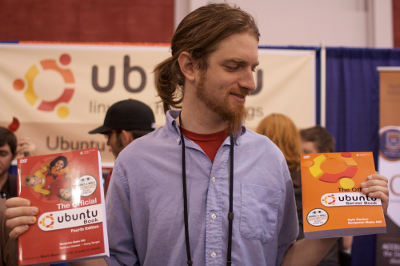
Benjamin Mako Hill: Ubuntu Books

/copyrighteous/images/ubuntu_books_2009.png As I am attempting to focus on writing projects that are more scholarly and academic on the one hand (i.e., work for my day job at MIT) and more geared toward communicating free software principles toward wider audiences on the other (e.g., Revealing Errors), I have little choice but to back away from technical writing. However, this last month has seen the culmination of a bunch of work that I've done previously: two book projects that have been ongoing for the last couple years or more have finally hit the shelves! The first is the fourth edition (!) of the bestselling Official Ubuntu Book. Much to my happiness, the book continues to do extremely well and continues to receive solid reviews. This edition brings the book up to date for Jaunty/9.04 and adds a few pieces here and there. Although I was less active in this update than I have been in the past, Corey Burger continued his great work and Matthew Helmke of Ubuntu Forums fame stepped up to take a leading role. As I plan to retreat into a more purely advisory role for the next edition of this book, I'm thrilled to know that the project will remain in such capable hands. I'm also thrilled that this edition of the book, like all previous editions, is released as a free cultural work under CC BY-SA For years, I have heard people say that although they like the Official Ubuntu Book, it was a little too focused on desktops and on beginners for their tastes. The newly released Official Ubuntu Server Book is designed to address those concerns by providing an expanded guide to more "advanced" topics and is targeted at system administrators trying to get to know Ubuntu. Kyle Rankin planned and produced most of this book but I was thrilled to help poke it in places, chime in during the planning process, and to contribute a few chapters. Kyle is a knowledgeable sysadmin and has done wonderful job with the book. I only wish I could take more credit. The publisher has promised me that, at the very least, my chapters will be distributed under CC BY-SA. Many barriers to the adoption of free software are technical and a good book can, and often does, make a big difference. I enjoy being able to help address that problem. I also truly enjoy technical writing. I find it satisfying to share something I know well with others and it is great to know that I've helped someone with their problems. I'll assure I'll be able to do things here and there, I'll miss technical writing as I attempt "cut back."

Benjamin Mako Hill: Election Season

Two organizations I care deeply about are having elections this month. The first is the Wikimedia Foundation who is electing three community representatives to their board of directors. The second is Ubuntu who will soon be electing a new Community Council. The Wikimedia Foundation is perhaps the most important organization working on issues related to free culture. Wikimedia elections are currently ongoing and will close on August 10th. Editors who have more than 600 edits to their name across all Wikimedia wikis and 50 edits in 2009 made before July 1st are eligible to vote. The vast majority of eligible contributors to Wikimedia projects have not voted in previous elections. Ubuntu will be electing all members in a new --- larger --- Community Council. I have been a member of the council since it was created and I will be standing for election once again --- the last time I plan to do so. Work in setting up the election is being finalized and all Ubuntu Members will be able to vote in the election. Both Wikimedia and Ubuntu are struggling to find the right relationship between the communities who produce most of the value at the heart of their projects and the organizations and leadership structures that try to support and, from time to time, direct it. Ubuntu and Wikimedia are very different. What's at state at these elections is different too. But both elections are are extremely important and at pivotal times in their communities' growth. Both elections will have an important impact on the process of creating new organizational forms. My message in regards to both elections is also the same: If you are eligible to vote, please do. No governance system I've seen has as healthy and close relationship to the community it serves as it should. Wikimedia and Ubuntu are not exceptions. The result is a strange, and unhealthy, relationship between governance systems and the organizations at the heart of our community-driven projects and the communities themselves. We can all do better. There are not enough opportunities for community members to help push this balance in a better direction. These elections are one. I urge everyone who can to vote and to become involved.

Benjamin Mako Hill: Order Without Law

Order Without Law is a fantastic book by Robert Ellickson published in 1991. In a way, the book is an in-depth case study of the irrelevance of law. Subtitled, "how neighbors settle disputes," Ellickson shows how people solve complicated problems in an archetypal area of liability law without knowledge of the law. Ellickson shows that even when people know exactly what the law says, they often ignore it in favor of community norms and, in his examples, models of "neighborliness." Specifically, the book is about how neighbors in northern California settle disputes related to damage caused by roaming cattle, how neighbors construct and share costs of fences, and how, although the law is frequently debated in relation to classifying land as either open or closed to free grazing, the law tends to take a back seat to unwritten norms in the way that problems are actually solved. There is order and a shared understanding of rules in Ellickson's account; it just has very little to do with the law. As part of his description, Ellickson goes into some detail about the types of damage that cattle cause. For example, Ellickson describes how bulls, will often break down barbed wire fences and go on rampages impregnating heifers, eating vast amounts of food, and destroying crops and equipment. When I was on a long bike trip through northern California a few weeks ago, I was sitting under a tree waiting for my cyling partner to catch up. A giant black bull nearby noticed me. Shorting, mooing, and shaking ribbons of slobber from its mouth, it lumbered toward me. Only a rather weak-looking barbed wire fence separated us. All I could think about was Order Without Law.

Isaac Jones: On Not Unleashing AI

I'm psyched: A good friend of mine living in another state just sent me a signed copy of William Gibson's book, Pattern Recognition. The inscription reads "For Sir Isaac: Don't unleash any AI into a network you can't power down; wm gibson" This reference to AI is presumably wrt my job. I've been reading a copy of this book that I got from the library so as to preserve this signed one (that I knew was coming eventually). He also sent me a really minimalist wristwatch that looks like a hairtie. I like it. It's very light and loose fitting, low-profile and probably not highly valuable, so I can use it during while rock climbing and stuff.

Sergio Talens-Oliag: Hugo meets Marc

As promised a photo of the first meeting between Hugo and Marc. Hugo meets Marc With luck this afternoon the whole family will be at home.

Sergio Talens-Oliag: Redmine

I've been using Subversion and Trac for some years now, and I have encouraged its use at work since the last couple of years, with the undesired effect of having to maintain four different Trac installations with different database systems (SQLite3 and PostgreSQL), plugins (more than 15 on the big servers), authentication systems (htpass files, LDAP and a database based system) and tons of projects published (two internal servers have 64 and 16 projects, one of the client system has 33 projects and there is only one single project installation, but it is living at a client's system). Yesterday night, while reading Planet Debian I found a post from John Goerzen about tools to replace Trac, including the option to use Git as the project VCS. In the post he talks about different options, mainly projects that I would categorize as issue tracking systems (mantis, roundup, etc.), but it also talks about Redmine, a project management system implemented using the Ruby on Rails framework that is similar to Trac. As it looked interesting I downloaded, installed and executed an instance in about 15 minutes (I love the systems that support sqlite3 for this quick tests, not having to touch real database servers speeds up simple tests a lot). I played a little bit with the system and I believe that I will spend some more time testing it at work next week, as it looks quite promising; the standard version has almost all the features I'm interested in without the need to install additional plugins and it can do most of the things I was missing from Trac to do lightweight project management. I evaluated ]project-open[ to use it together with Trac for our internal project management tasks, mainly because we miss important features from Trac, like having clean systems to view the tasks of a user in all projects or a clean way to do the project planning using tickets and gantt charts. Of course there are ways to do it, but the plugins I've tried are not as good and simple as I would like. The problem with the use of ]project-open[ is that I don't really like it for us, as it has tons of features that I feel we don't need nor will use and, on a first try, the system seemed difficult to deploy and maintain, probably because my lack of knowledge about OpenACS and TCL. In fact we still don't have ]po[ running at work because I was unable to to integrate the authentication system with our LDAP server on my first tries and have had no time to investigate further since then. The good thing about trying Redmine is that if we don't end up using it at least I can take the most of this opportunity by looking at Ruby on Rails and the Ruby Programming Language, at least from the administration side, as I have never looked at it seriously.

Dann Frazier: RPM Macros

I've been working with RPM macros quite a bit lately, and I've noticed some interesting properties. Though mostly obvious after the fact, they are surpisingly underdocumented. Macros don't seem to deal with floating point values. This works:
%define five 5
%if 0% ?five  <= 5
  %define string A
%else
  %define string B
%endif
While this causes a parse error:
%define five 5.3
%if 0% ?five  <= 5
  %define string A
%else
  %define string B
%endif
Quoting integers makes comparisons lexical. This will evaluate to false:
%define five 5
%if "0% ?five " == "5"
Perhaps the most frustrating one for me was that commented out macros are expanded. This has surprising results if your macro expands to multiple lines. Say my spec file includes the following:
%description
#%foo                                                                           
blah
And foo happens to expand to multiple lines:
%define foo one\
two\
three
My description will end up being:
Description :
two
three
blah

Next.

Previous.