Search Results: "ag"

27 September 2013

Michal Čihař: Spring in Bohemian-Moravian Highlands

After quite some delay, I got to selecting some photos for my gallery. In spring, we've spend few days in Bohemian-Moravian Highlands with Pentax Friends. On the program there was of course taking some pictures and drinking beer or wine :-). You can find some small but nice waterfalls: In villages, there live wild animals: As the weather was not really nice, we had nice opportunity to shoot some pictures in fog: And last but not least, we've spent almost whole day taking pictures in Pilgrimage Church of Saint John of Nepomuk: The trip was really nice, though we could use better weather as most of the morning there were really no nice conditions for taking pictures.

Filed under: English Photography Travelling 0 comments Flattr this!

26 September 2013

Steve Kemp: Random hacking for fun

Recently I've been playing gtetrinet, against the publicly accessible server at tetrinet.debian.net. If you're unfamiliar with the game it is a multi-player variant of Tetris. You clear many lines and your opponents suffer. Want to make them suffer some more? Use the special blocks you acquire. Special blocks? How about shuffling your opponents playing field? Adding new semi-formed rows? etc. All good stuff. There is support for up to six players. To fire a special block at the player in field 1 you press "1". To fire the special block to the player in field 6 press "6". But to fire a block at yourself, to clear your playing field ("nuke") or remove a single line ("clear") you have to know what player-number you are, which will change from day to day, as it is literally a marker for the order you joined the channel in. It seems obvious that there should be a special-case keybinding "fire to self", and indeed there was bug #291844 filed in 2005 saying as much. I've just submitted a functional patch to resolve this, and already my playing is getting better. Join me sometime.

Martin Pitt: How to watch system D-BUS method calls

The current default D-BUS configuration (at least on Ubuntu) disallows monitoring method calls on the system D-BUS (dbus-monitor --system), which makes debugging rather cumbersome; this has worked years ago, but apparently got changed for security reasons. It took me a half an hour to figure out how to enable this for debugging, and as this has annoyingly little Google juice (I didn t find any solution), let s add some. The trick seems to be to set a global policy to be able to eavesdrop any method call after the individual /etc/dbus-1/system.d/*.conf files applied their restrictions, for which there is already a convenient facility. Create a file /etc/dbus-1/system-local.conf with
<?xml version="1.0" encoding="UTF-8" ?>
<!DOCTYPE busconfig PUBLIC
  "-//freedesktop//DTD D-BUS Bus Configuration 1.0//EN"
  "http://www.freedesktop.org/standards/dbus/1.0/busconfig.dtd">
<busconfig>
  <policy user="root">
    <!-- Allow everything to be sent -->
    <allow send_destination="*" eavesdrop="true"/>
    <!-- Allow everything to be received -->
    <allow eavesdrop="true"/>
    <allow send_type="method_call"/>
  </policy>
</busconfig>
Then sudo dbus-monitor --system displays everything. Needless to say that you don t want this file on any production system! Does anyone know an easier way? My first naive stab was to run dbus-monitor as root, but that doesn t make any difference at all. Update: Turns out this is already described in a better way at https://wiki.ubuntu.com/DebuggingDBus. Yay me for not finding that.. I updated above recipe to limit access to root, which is much better indeed.

Niels Thykier: Lintian 2.5.19

Today, I released Lintian 2.5.19. It is mostly a bug-fix release, but it also features a new tag. The new tag, homepage-in-binary-package, is emitted for packages where the source package has no Homepage-field, but one of its binaries do. The problem is that some tools (e.g. the PTS) only processes the data from the .dsc files (or Sources indices from the mirrors) and would in these cases miss the Homepage of the page. We now also carry a work around for a bug in tool, t1disasm, where it ends up in an infinite recursion (i.e. until the C call stack overflows). That issue is filed as #724571. The work around is to prevent Lintian from exiting with a failure (which causes packages to be auto-rejected when uploaded to Debian archive). These problems are currently reduced to a warning on stderr. In other (Lintian related news), the full run was completed yesterday after only 4 days (rather than the 8, I expected). While that is a pleasant surprise, I cannot find any changes in Lintian since the last run that would explain this difference. My current conjecture is that our last pseudo full run (when we added amd64) included more processing since the amd64 packages would not have any pre-collected information. With the follow up run to catch packages uploaded after the full run, Lintian spent a little more than 3 and half days (~86.5 hours) processing about 20700 package groups. This gives an average of about 240 groups an hour (or ~4 a minute). Though, remember these numbers include some data having been pre-collected from previous run on the majority of packages.

25 September 2013

Gunnar Wolf: Is there some old-school programmer available around here?

Is there some old-school programmer available around here?
Just saw this ad today at my Institute's door. Rough translation: Interim programmer sought Requisites: [Yes, this is a joke post. I don't know how anybody is using such an obsolete job description. A job description at least three decades out of date] [Well, yes, I understand it, because I knowhow that particular union works. But I cannot accept it is for real] [...And no, please don't apply for the job. You will be miserable in the unlikely event you are chosen]

Daniel Kahn Gillmor: half a minute for science!

A friend is teaching a class on data analysis. She is building a simple and rough data set for the class to examine, and to spur discussion. You can contribute in half a minute! Here's how:
  1. get a stopwatch or other sort of timer (whatever device you're reading this on probably has such a thing).
  2. start the timer, but don't look at it.
  3. wait for what you think is 30 seconds, and then look at the timer
  4. how many actual seconds elapsed?
The data doesn't need to be particularly high-precision (whole second values are fine). The other data points my friend is looking for are age (in years, again, whole numbers are fine) and gender. You can send me your results by e-mail, (i suspect you can find my address if you're reading this blog). Please put "half a minute for science" in the subject line, and make sure you include: Science thanks you!Tags: science

Jon Dowland: Married

Jon and Sarah
I got married! Sarah and I tied the knot on the 10th August this year. We married in a registry office where we live and had an evening reception on Tynemouth beach. A fantastic time was had by all. We honeymooned in Sorrento, Italy, which was fantastic. We spent one day visiting Pompeii (my fourth visit: about 6 hours on our feet this time, and we walked from one side right to the other); another day in Herculaneum (my second visit); one day visiting the village near where we were staying, where we visited a local food festival and bought the nicest Marmelade I've ever tasted; a few day and evenings in Sorrento town itself; but most of the time we just relaxed, swam, snoozed, read.

Lucas Nussbaum: Software for brainstorm / ideas sharing and voting?

Some time ago, Ubuntu had Ubuntu Brainstorm, a website where non-developers could submit ideas of improvements, and other people could comment and vote on them. I was wondering if there was existing software to deploy a similar service, e.g. as a plugin to popular forum software. I ve found ideascale.com, but relying on the Cloud for that is not acceptable for my planned use. (For clarification: my immediate interest for that is unrelated to Debian work)

Raphael Geissert: A bashism a week: aliases

In a response to my blogpost about bashisms in function names, reader Detlef L pointed out in a comment that aliases allow non-standard characters in their names, contrary to functions. They could then be used to, for example, set an alias of the run-parts(1) command (cf. the blog post).

Aliases indeed allow characters such as commas ( , ) to be used in the alias name. However, aliases are an extension to the POSIX:2001 specification and are therefore bashisms. Moreover, the characters set defined by POSIX does not include dashes.

Last but not least, aliases belong to the list of shell features that are usually "disabled" when the shell is run in non-interactive mode. I.e.


$ bash <<EOF
alias true=false;
if true; then echo alias disabled; else echo alias enabled; fi
EOF

alias disabled
$ bash -i <<EOF # force interactive mode
alias true=false;
if true; then echo alias disabled; else echo alias enabled; fi
EOF

$ alias true=false;
$ if true; then echo alias disabled; else echo alias enabled; fi
alias enabled
$ exit


To add to the fun of different behaviours, other shells always expand aliases.

If you decide to play with aliases you should note one thing: they are only enabled from the line after the definition. E.g. note the difference below

$ dash -c 'alias foo="echo foo"; foo'
dash: foo: not found
$ dash -c 'alias foo="echo foo";
foo'
foo

24 September 2013

Simon Josefsson: BLURB: Software repository metadata convention

As a maintainer of several software packages I often find myself copying text snippets from the README file into different places (savannah, github, freecode, emails, etc). Recently I had a need to generate a list of software packages that included every project s name, brief summary, license and URL. I could have generated that list manually by copying the text from every project s README and COPYING files. However then I would have to maintain my list manually to keep it in sync with all the projects. This easily leads to stale information, so I thought a better approach would be to put the information I needed into each projects source code version control system. The advantage is that the manual work to extract the information may be automated by a script, since the data is in a usable format. I ll explain here how my solution works. To be able to find the information using only the URL to the repository, I needed a filename convention. The filename I chose was BLURB; for the etymology, see Wikipedia s page about Blurb. The data format in the file is similar to normal email headers. An example illustrate the principles well. Below is the BLURB file for one of my projects.
Author: Yubico
Basename: libyubikey
Homepage: http://opensource.yubico.com/yubico-c/
License: BSD-2-Clause
Name: Yubico C low-level Library
Project: yubico-c
Summary: C library for manipulating Yubico YubiKey One-Time Passwords (OTPs)
The format is simple: UTF-8 text with each line starting with a header followed by a colon ( : ), some whitespace, and some content. If a line starts with whitespace, it is a continuation of the previous line s content (trim leading whitespace). The following table describes the fields that I use. I may update this blog post in the future with new fields or improved explanations (for reference, current date is 2013-09-24).
Header Meaning
Project Short identifier for the project (e.g., gcc , emacs )
Name Official name of the project in English
Summary Brief one-line summary of the project s purpose in English
Author Origin of the project
Homepage URL to the project s website
License License keyword, preferrably using one of the SPDX license identifiers
Basename The tarball basename, if different from the project name
Finally some reflection of the solution. After quick design, I thought that I couldn t be the first one with this problem, and I tried to find other similar efforts. I haven t been able to find any standardization effort that have the following properties: The related efforts that I found were SPDX which at first look seemed to offer what I wanted. However on closer examination it failed to deliver on all the requirements above, and appeared to have somewhat different goals. However I found the SPDX license list useful and refer to it. Another effort is Eric S. Raymond s freecode-submit and shipper but its primary focus is to encode information about each release. The design of the BLURB file is clearly influenced by these tools. Another influence has been Debian s specification for machine-readable copyright information. The Free Software Foundation s list of software projects seemed like another candidate, but it doesn t suggest any way to store the information in the upstream project itself. flattr this!

Tanguy Ortolo: Working with XML using standard Unix tools

Like it or not, XML has been used everywhere, even in cases where text-based formats would have been sufficient. Unfortunately, standard tools such as grep, sed or awk are not really adapted to work with XML. Let us take the following example:
<chapter
    xmlns="http://docbook.org/ns/docbook" version="5.0">
    <title>The Debian distribution</title>
    <para>Debian is a free operating system, describing itself as  the
    universal operating system . It is mostly known as a GNU/Linux
    distribution, but it also exist in other variants such as GNU/Hurd
    and GNU/kFreeBSD </para>
</chapter>
PYX and xml2 There are at least two line-oriented alternative formats for XML: This is what our example would like in PYX:
(chapter
Aversion 5.0
-\n
(title
-The Debian distribution
)title
-\n\n
(para
-Debian is a free operating system, describing itself as
- the\n    universal operating system . It is mostly known as a GNU/Linux\n    distribution, but it also exist in other variants such as GNU/Hurd\n    and GNU/kFreeBSD 
)para
-\n
)chapter
And in the xml2 format:
/chapter/@xmlns=http://docbook.org/ns/docbook
/chapter/@version=5.0
/chapter/title=The Debian distribution
/chapter/para=Debian is a free operating system, describing itself as  the
/chapter/para=    universal operating system . It is mostly known as a GNU/Linux
/chapter/para=    distribution, but it also exist in other variants such as GNU/Hurd
/chapter/para=    and GNU/kFreeBSD 
Examples of use We want to extract the DocBook version number. This is not easy to do in a reliable way using the XML directly, but it appears directly with xml2:
$ xml2 < chapter.xml   grep '^/chapter/@version=' \
      cut -d= -f2
5.0
We want to move the title into an info tag, using PYX:
$ xmlstarlet pyx chapter.xml   sed -e '/^(title$/i\
(info
/^)title$/a\
)info'   xmlstarlet p2x
<chapter version="5.0">
    <info><title>The Debian distribution</title></info>
    [ ]
We could go further, adding a keywords entry in that info tag for instance, but you get the idea: when you want to work with XML in a reliable way, try xmlstarlet pyx or xml2.

23 September 2013

Russell Coker: Hive Bluetooth Stereo Speakers

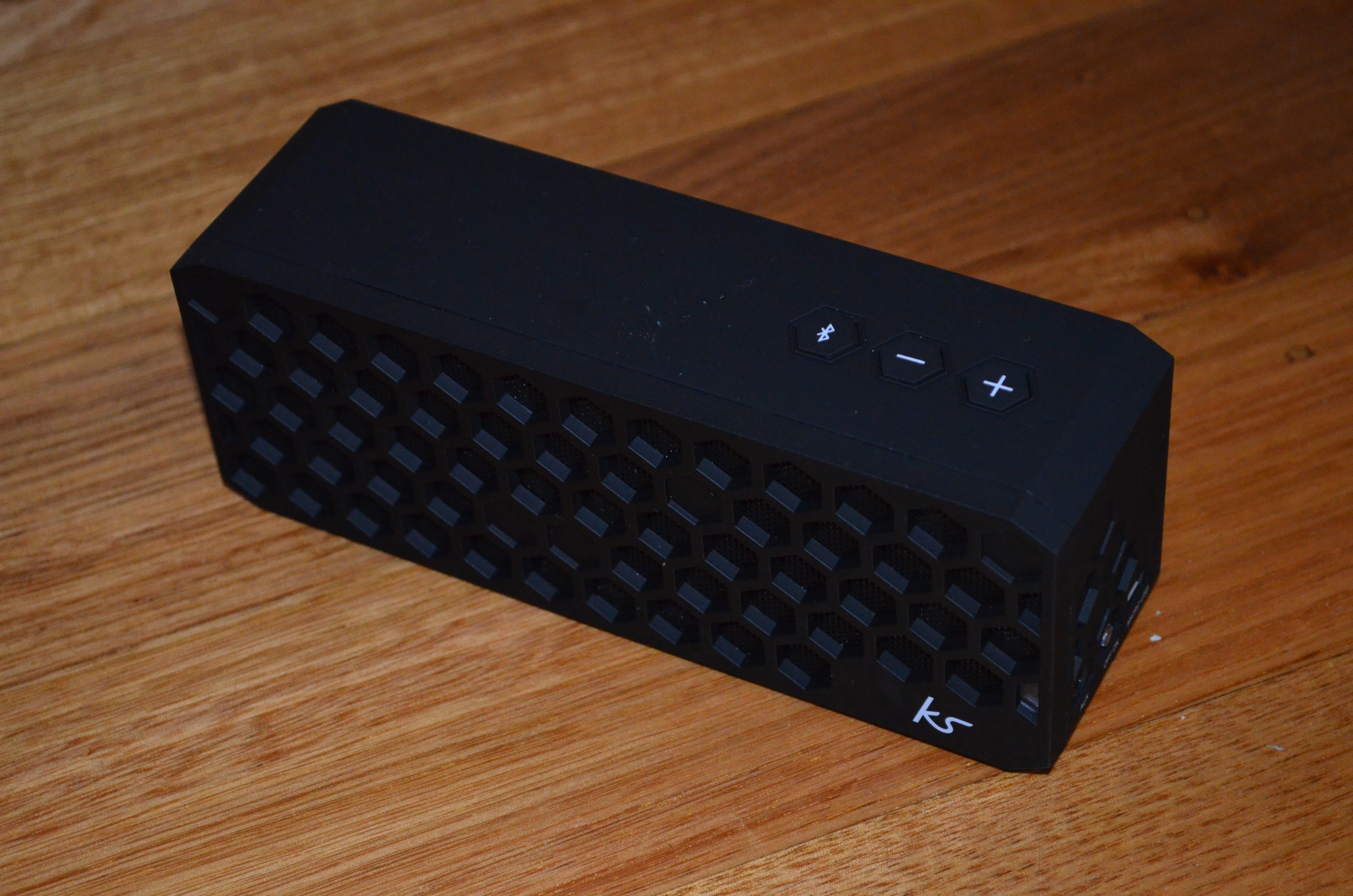
picture of Hive bluetooth speakers I ve just been given a set of Hive Bluetooth speakers by MobileZap (see this link for all their Bluetooth speakers) [1]. The speakers charge by a micro-USB cable so I started charging them in my car immediately after collecting them. To connect them to a phone or other Bluetooth device you just press the Bluetooth button on top and get the phone to be visible and scanning for devices, they identify themselves as Hive , after that they just work. My first test of using them was playing Ingress and the quality of the sound was impressive, I had thought that the Ingress recommendation to use headphones was due to the risk of annoying other people or alerting other players, but the quality of the sound was impressive and the internal speakers of a phone can t do it justice. After getting home I did some tests listening to music. For watching music videos it didn t work so well as the sound was too far removed from the video, but the audio quality was very good. I listened to Vow by Garbage (a good benchmark for stereo sound) and even though the Hive speakers are only 16.5cm wide I could still notice the stereo effect when they were about 1.5m away from me. The audio quality didn t compare well with my Bose QC-15 headphones, but for affordable and portable speakers it was quite good and an obvious improvement over the speakers that are built in to any phone I ve used. According to the Bluetooth Wikipedia page the range of a class 2 device is 10m and the range of a class 3 device is 1m. When my Samsung Galaxy Note 2 is talking to it I get a reliable range of about 5 meters and a mostly working range of 6 or 7 meters (sound randomly drops out and gets choppy). It could be that other phones would support a longer range due to having a higher transmission power (either class 1 or being closer to the limits of class 2) and a more sensitive receiver. But it doesn t seem likely that a 5m range is going to be a problem. Volume and Quality The speakers are rated at 5 Watt, when running at maximum volume (both through the phone volume setting and the volume control on the speakers) the sound is reasonably distortion free, as good as can be expected from playing an MP3 that s not compressed with the highest quality. Sound Meter [2] reports the sound volume as almost 85dB on a Galaxy S3 and as almost 100dB on a Galaxy Note 2, that would be somewhere between the volume of a busy street or alarm clock and the volume of a subway train or blow dryer which seems like a reasonable description, I find it very unpleasant to be within a meter of the speakers at maximum volume. With the typical amount of background noise in my house I can play music on the Hive speakers at one end of my house and hear it clearly at the other end. These speakers are more than capable of supplying the music for any party I d want to host or attend. I m not really into wild parties, but I think that anyone who has a one room party would be more than satisfied with the Hive speakers. Obviously the sound quality of portable speakers in a box that s 16.5cm wide and 6cm high isn t going to equal that of a full size set of speakers, but I think that hardly anyone who attends a party would expect better sound quality than the Hive speakers can provide. The aim of such speakers is to be portable, not really expensive, and to provide good sound quality within those constraints. I think that they meet such aims well. Over the years there have been many occasions when I have used a Thinkpad to provide the music for a party and found it to be quite loud enough. My current Thinkpad is a T420 which can produce 75dB according to my Galaxy S3 or 85dB according to my Galaxy Note 2. So it seems that I only really need about 10dB less than the maximum volume of the Hive speakers. Appearance The designers obviously made an effort on the appearance of the device. They have gone with the Hive concept and used hexagons everywhere. It really looks nice. Unfortunately when I took the photo there was some dust on it which didn t look bad to the eye but caught the camera flash. But with a matte black device there s always the problem of light colored dust. Even with a bit of dust it still looks great as a set of speakers, the dust just detracts from the appearance in photos. Line In One of the features I looked for was an audio line input so I could connect it directly to a non-Bluetooth device. I m assuming that this feature works as it s something that s difficult to stuff up when designing such a product, but I haven t got around to testing it. Once I started using the device I just found that I didn t have a real need for that feature. One thing that it might be useful for is PC desktop speakers that are powered by a USB port on the monitor. Currently I have a bearable (but not great) set of speakers for each PC and I don t need to change anything. But having the option of another set of speakers is very handy in case I suddenly need to make hardware changes. Other People s Reviews When I review a product I generally try and get opinions from random other people if possible. My mother and my mother-in-law were both impressed by the Hive speakers and expressed interest in owning a set. My mother-in-law was particularly interested as she uses her phone to listen to radio stations from outside Australia (I m going to get her onto Aldi for cheap 3G data ASAP so she can listen to Internet radio when travelling). Generally the impression that other people have of this device seems to be very positive. It seems that Bluetooth speakers aren t just a Geek toy. Conclusion While I m very impressed by this product, at this stage I m not sure whether I would pay for this one or something cheaper if I was paying for it. MobileZap offers a range of other products that look appealing at lower price points. It really depends on how much I use it. I ve just got a Makerbot Replicator 3D printer working and I ve found the Hive speakers very useful for the purpose of drowning out it s noise. If I keep doing that sort of thing then I ll get enough use out of the speakers to justify the price.

Daniel Pocock: PostBooks packages available

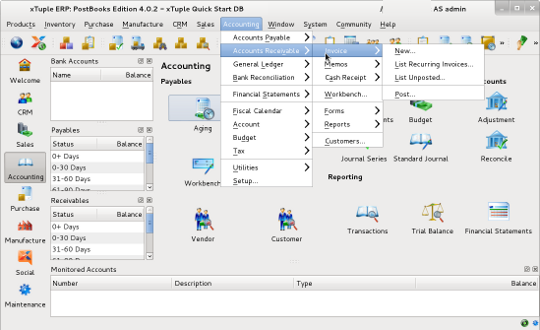
A common theme that comes up in free software evangelism is the question of how to tap into the huge expenditure that small to medium-sized businesses make for off-the-shelf licensed software. It is well known that many small companies are paying over the odds compared to the site-license rates given to big business, so why is it that small businesses are not rushing to adopt free and open source solutions? The answer is not likely to be found by fighting a battle on pricing (even though it is a battle that free software is inherently well prepared for). Rather, the most compelling strategy involves helping businesses find better ways to solve their own problems. A problem that every business encounters in every industry is the maintenance of proper financial records. Up until now, packaged solutions like GnuCash and HomeBank, available in many Linux distributions, have only catered for the smallest businesses and household accounting. At the other end of the spectrum, solutions like Compiere/Adempiere and OpenERP require a level of effort to install and maintain that makes them unsuitable for small users and businesses that don't need their full range of features. OpenERP briefly appeared as a Debian package but subsequently dropped out due to difficulties supporting the package. There is another choice, PostBooks. PostBooks has recently been packaged for Debian and this experience leads me to believe it will be supportable in Fedora and other distributions too. PostBooks, which started off as a commercial product, was re-licensed as an open source solution in 2007. In March 2013, PostBooks was project of the month on Sourceforge. Of particular note,
  • PostBooks has a Qt-based GUI where users of equivalent commercial solutions are likely to feel comfortable very quickly
  • PostBooks does not depend on any dedicated server processes other than a PostgreSQL database
  • Using the quickstart database, it can be set up in less than half a day, making it suitable for many consultants and freelancers who may otherwise use a product having a setup wizard (such as QuickBooks).
  • However, with features like inventory, invoicing, a sophisticated data import GUI (known as CSVImp), a true SQL backend, multi-currency and multiple concurrent users, it scales beyond the use cases that Quickbooks and Sage Accounting are capable of servicing.
  • The company behind PostBooks, xTuple, is well established and offers related services such as training and an annual user conference (which takes place in just a few weeks). Many business users are likely to find this style of support very reassuring and familiar, even if they don't plan to immediately take advantage of these things.
Limitations Two particular limitations caught my attention early when evaluating PostBooks: The developers have acknowledged these limitations and offered to complete these solutions with a crowd-funding campaign dubbed Feature Mob 2.

While everybody likes a free lunch, I personally feel that developers are perfectly entitled to request payment for their work. Having already taken a great leap of faith in open-sourcing a product that had previously been developed in-house, companies like xTuple need to look at new ways to generate revenue. Having looked at some of the prices of equivalent solutions, I felt quite comfortable pledging a similar amount based on four things:
  • it is based on the Kickstarter model, they only keep the money if their funding target is reached and feature implementation goes ahead
  • they are releasing the work as open source
  • the desire to have the option of using a highly capable free software solution that will be around well into the future
  • the probability that this is one piece of software that is likely to create more commercial opportunities for free software developers
Next steps People trying the packages and people who potentially want to package PostBooks for other distributions are very welcome to come and ask questions in the xTuple Debian maintainers packaging list or using the xTuple web forums. Please also feel free to report bugs through the Debian bug tracker.

Gunnar Wolf: This week it was an easy one: On picking free licensing schemes #encirc13

The third lesson of the Arte y cultura en circulaci n: crear y compartir en tiempos digitales course was quite easy, at least for me, as it's one of the topics I've been involved with for a long time: Authors' rights and ways to exercise them. This lesson starts by talking about the paradoxes created in the reality beneath copyright mostly due to the zero-cost-for-perfect-copy reality we live in today, and then goes on to introduce the most widely spread licensing schemes for cultural works nowadays: The Creative Commons licensing schemes. What I felt very interesting is that the lesson tackles the most common issues raised by authors choosing CC licensing: The Non-Commercial and Non-Derivatives restrictions. While authors are usually not very hard to convince about the virtues (and their personal benefit) in CC licensing, it's usually hard for authors to accept and relinquish the "locks" on non-derivability and non-commercial-use. Now, as to the homework: This time, I have to admit it was a no-brainer to me. The homework was to take part of a "Licenciat n": Publish some work under a open or free license (a work of any kind; it can be text, photo, video, etc.; it can be a new or a pre-existing work) and argue as to why did you choose said license. Even the act of writing this blog post means I'm releasing some work. The bottom of my blog reads, All the material found at this site is freely available, and you can use it as you wish, except when the document mentions explicitly different conditions. Yes, this is not a widely known, preexisting licensing scheme, and more or less goes along the lines of CC0 There are some good things I have posted in this blog, some things I am proud about. This post goes more towards the average quality: Not adding anything of great value to the world, just reiterating/reposting what is already said. But I know this blog is syndicated over several different places, and its content might be copied over to other places. I don't need to know or be notified about it. I just care for people to be able to reach back if they want to do it. But, of course, if I'm asked to do a homework, I prefer not to have it so self-referential. What else to license? We are over halfway across the Wiki Loves Monuments contest for 2013. This year I am clearly not as active on it as I was last year, but yesterday I uploaded about 60 photos from our recent trips, from historical monuments in some towns/cities within ~150Km of Mexico City: Puebla, Tlaxcala, Cacaxtla, Toluca, Santiago Tianguistenco. I intend to upload more. Those photos are licensed CC-BY-SA. Why? Mainly, because it is the defaul for the contest. One of the lessons learned working on Debian is that the less the license I choose deviates from what the upstream authors of a larger project prefer, the more useful my work will be. And being Wikimedia a host of many related projects, I prefer to completely abide by their recommendations unless there is a real, strong reason not to do so. Also, I know that at least most the photos I am uploading are not of contest quality (although some are quite nice, but we don't take that long to take a shot, and our camera is probably too basic to get a quality shot, if not by mere chance). I am using the WLM contest as an excuse to categorize and upload my pictures Of course, I'm not including personal photos, but... If I found a building, place or landscape interesting enough to take a photo of, why not make said photo available for whoever needs it, in a canonical, easy to reach media repository (as Wikimedia Commons) is)? And finally, I think it's time to start getting more open and forward-going with a project that I have been giving a lot of work during the past year, a project that has been even eating quite a bit of my Debian time: My upcoming book. While this book is not yet freely licensed (it is freely distributed online, but does not yet have an explicit license, and I mention it on my teaching/project page. Why? Because it still has some figures and data which are not mine, and which I have to re-elaborate to be able to legally license it. But anyway I am writing a book on the subject of Operating Systems, and am basing my teaching on it. The first semester was basically hell for me, as I was working almost full time on it, and needed to allocate some time as well to the rest of my formal work. This second semester has been quite smoother. And there is a very important (to me) initiative to which I (or should I now start saying, we) submitted this work: The LATIn Project: An initiative to collaboratively create quality, freely redistributable text books for the university level, natively in Spanish, for their use in Latin American countries. I was not able to propose this book due to some formalities Projects have to be proposed by professors in participant universities, and UNAM is not one of them. However, I offered this work to people in the Universidad Nacional de Rosario, Argentina, and they managed to push the project forward. Together with people from Universidad Aut noma de Aguascalientes (M xico) and Universidad del Cauca (Colombia), the project was approved by LATIn. And this LATIn project can also be seen as a why do you agree to license your work this way? candidate: I have already written most of what I'd be happy to call a full book. Of course, I do expect my colleagues to chime in with more content, and I expect us to produce a true collaborative project. But as I am not part of the member universities, they will get paid for their contribution And not me. What do I have to gain from this? More than anything else, the circulation of my work. I'm sure that, were I to publish from UNAM, I would have a good projection. I was (am!) thinking of looking for opportunities to present the book to teachers on the subject, as well as to computing engineering/science students, but the most attractive part (for me) for LATIn is that part of the prize will be that the book will be used to base work on for teaching at least during 2014 in the three said universities And of course, my/our work will only start then, as we will have to further circulate the work. Anyway... I expected this post to be small. But as you can see, I am happy with important work perspectives :-)

Ben Hutchings: Linux kernel update for wheezy (3.2.51-1)

The upcoming stable update for Debian (7.2) should have a new Linux kernel version, fixing various bugs. I have uploaded version 3.2.51-1 which is now available in wheezy-proposed-updates. I would appreciate any regression testing people can do before this is released. Also, this fixes one of the causes of lock-ups currently seen with newer Intel GPUs, though we don't know exactly which bug reports were due to this. If you've reported this kind of problem, please test whether this version fixes it. Updated 2013-09-23: KiBi reminded me to link to the page about proposed-updates. And the update is now available for all architectures.

22 September 2013

Russ Allbery: podlators 2.5.2

This is a bug-fix release to my POD translator package, which contains Pod::Man and Pod::Text and is used by Perl core to format POD documentation. This is not, alas, the long-awaited overhaul of UTF-8 handling; that's still coming at some point in the future. The primary changes in this release are various performance patches from Dagfinn Ilmari Manns ker from work on profiling all the Perl core modules. I learned from merging those packages that reversing a long string can make regex replacement operations on the tail faster, even with the time required to reverse the string twice. I'm surprised. This release also wraps the Pod::Simple parse_lines and parse_string_document to set the default output to STDOUT, similar to what was already done with parse_file, since some of the one-liners that people were testing would have produced confusing error messages without this. It fixes handling of POD documents with error sections and no other content, thanks to a bug report by Andreas Koenig. And it fixes typos and other documentation issues, thanks to Andreas, David Steinbrunner, and Brian Gottreu. You can get the latest release from the podlators distribution page.

Matthew Garrett: Implementing UEFI Boot to Zork

One of the earlier examples of students using MIT computer resources to lay the groundwork for a later commercial endeavour, Zork was originally written in a LISP derivative called MDL. This was later tuned into the Zork Implementation Language, a domain specific language that was compiled to target the Z-machine rather than a specific piece of hardware. Combined with machine-specific Z-machine interpreters, this allowed rapid porting of games to a wide range of platforms - the only thing that needed to be rewritten was the interpreter, and that could be reused for any future games running on the same hardware. Infocom were eventually acquired and killed off, but fan interest in their games continued. New Z-machine interpreters were written in order to allow their games (including Zork) to be run on platforms that Infocom had never targetted. One of the best known is Frotz. This has the advantage of being (a) portable and (b) including a "dumb" UI that makes no assumptions about the availablity of any vaguely useful functionality. Like, say, a Curses library. So, Frotz seemed like the natural choice when this happened. But despite having a set of functionality that makes it look much more like an OS than a boot environment, UEFI doesn't actually expose a standard C library. The EFI Application Development Kit solves this particular design decision. Porting Frotz ended up involving far more fixing up of Frotz bugs that tripped up -Werror than anything else. One note, though - make sure you include DevShell in the list of required packages at build time, otherwise file i/o will mysteriously fail. The tying of file i/o to the shell protocol unfortunately means that Frotz can't be directly launched by the firmware. The Boot to Zork images therefore contain a UEFI shell in the standard boot location (\EFI\BOOT\BOOTX64.EFI) which is executed when the firmware attempts to boot the device. The shell then looks for a file called "startup.nsh" in the root directory of the boot device and executes it. Unfortunately this doesn't actually set the shell equivalent of the current device, and so just launching Frotz from startup.nsh fails when Frotz can't open the Zork data file. The solution for this is simple, if ugly - the script walks through the list of devices, looking for one that contains ZORK1.DAT in the root directory. It then changes to that device and launches Frotz. If Frotz exits, it then resets the system. This could be avoided by doing some more work and turning Frotz into a more UEFI-native application. Teaching Frotz to make native UEFI calls would avoid the requirement for the shell protocols, and the firmware provides a mechanism to obtain the path of the currently running executable which would avoid the need to explicitly locate the device. But I'm lazy and this was a "I'm spending the day on a plane" project initially inspired by a Sazerac-fuelled conversation during the UEFI plugfest, not a demonstration of UEFI best practices. UEFI Boot To Zork and the source code to the modified Frotz can be downloaded here.

comment count unavailable comments

Niels Thykier: Lintian 2.5.18.1

Today I had to pleasure of releasing Lintian 2.5.18.1. It is a minor bug fix release on top of Lintian 2.5.18 (which I also released today ). When I was about to deploy the new version of Lintian on lintian.debian.org, I noticed a couple of errors in the log file that smelled of bugs. Indeed, when I investigated them I found two bugs, which were both introduced in Lintian 2.5.17.

Due to another bug in 2.5.17 and the some of the false-positives fixes, we are now doing a full run on lintian.debian.org. After having run for 7 hours, Lintian passed cipux . My rough estimate suggests that it will take 8 days at the current rate. For comparision, when we added amd64, Lintian spent 5 days processing all the new binaries (plus their source and the old binaries built from those source packages).

Of course estimate is rather rough. In particular, I am not sure that the heavy duty groups (e.g. linux and libreoffice) are evenly spread out among the letters of the alphabeth. Anyhow, there will be no updates on lintian.debian.org for the next week or so.


Steve Kemp: Some days you just want to do nothing

Today I finally pushed out a new binary release of my slaughter server-automation tool. (Think "CFEngine-lite", with perl. full documetnation is available. Though nobody ever reads it.) Otherwise the weekend is being quiet; we spent last night mostly drinking vodka, until midnight rolled over, and along with some messing around with a camera ("Wow, your arms are getting bigger!") Today has consisted of a Turkish breakfast, an Indonesian dinner, and an ice-cream based tea. I could write more, but I'm hung-over. A rare thing for me.

Russ Allbery: Review: Throne of the Crescent Moon

Review: Throne of the Crescent Moon, by Saladin Ahmed
Series: Crescent Moon Kingdoms #1
Publisher: DAW
Copyright: January 2013
ISBN: 0-7564-0778-8
Format: Mass market
Pages: 367
Doctor Adoulla Makhslood is the last ghul hunter in Dhamsawaat. He's an old man, and tired, and increasingly uncertain whether he wants to continue putting his life in danger to fight one more fight. But there are no replacements; his young and idealistic dervish apprentice, despite obvious skill, is too inexperienced and uninterested in the knowledge and investigation that makes Adoulla so good at what he does. So, when a young boy shows up on his doorstep, a survivor of a vicious ghul attack, he goes hunting once again. And both finds something much darker and stronger than he expected and meets an unexpected ally: a shape-shifting girl who is herself a survivor of something far worse than ghuls. Throne of the Crescent Moon is a first-novel fantasy that has made quite a splash, including a Hugo nomination (although I thought a win was unlikely, and I was right). One of the more interesting comments I've read about it was the observation by Jo Walton that if it had come out in 1980, it would have been an amazing, unusually wonderful, non-normative book. That it isn't is evidence of the changes in fantasy since then. The field has grown. As you might guess from the publisher's insistence on comparing it with The Arabian Nights, and from the names mentioned above, this book is set in an unspecified Middle Eastern culture and draws heavily from its mythology. It does not contain any western characters; the entire story is native to its region. The same is true of the mythology, which gave it a refreshing originality for me. And while I'm not the best one to judge, the presentation of that setting seemed free of the tint of the exotic. People live here, there are factions and multiple cultures, and the supernatural is a backdrop to most of the city. This would be very unusual decades ago. It's a bit less unusual now, and the story itself is a familiar ensemble fantasy, if refreshingly free of extended map exploration journeys. Ahmed brings together five characters with very different backgrounds and throws their varying talents at a problem. A few of those elements are a bit too familiar: female sexuality as a threat to male power is a world-building element that I could do without, for example. I also found the villain completely inadequate in its unidimensional evil (reinforced with a few more torture scenes than I needed to read), and even the attempted complication felt too predictable to me. Except for one touch of perspective, I'd call Throne of the Crescent Moon a competent, enjoyable, but somewhat forgettable fantasy novel, albeit one that's refreshingly concerned with a city instead of countrysides and travel. That touch is in the age of several of the protagonists. We get sections following several of the main characters in tight third person, but Adoulla is the first protagonist and the focus of much of the book. And Adoulla is neither young nor inexperienced, and is not going through the typical fantasy bildungsroman. He's old, experienced, a bit set in his ways, cranky, cantankerous, and deeply in love with his city. In tone, this shifts the story towards Star Wars as seen through the eyes of Obi-Wan Kenobi instead of Luke Skywalker. And that change I really liked, and would be happy to see become more common in fantasy. There was a bit of a downside for me in three of the five main characters being older. At times, Throne of the Crescent Moon has an elegiac tone, a feeling of life, power, and time slipping away and cultures and ways of life being lost. That's not my favorite thematic element. I tend to find it more depressing than I really want in my reading. But, here, the mature perspective more than makes up for some occasional negativity. I particularly liked how the older characters treated the likely budding young romance, which would have been the center of many books in this genre, with bemused detachment and playful encouragement without giving it more significance than it deserves. There's another romance that ends up being more significant, and which needs the weight of time and well-lived lives to become so. I don't think this book deserves a Hugo, but it is an enjoyable fantasy with some interesting characters and a refreshing perspective and setting. The villain really isn't adequate to the story, there's a bit too much torture for my liking, and I could have done without a few of the tropes, but it's a solid entry in its genre and a pleasant few hours of reading. And despite being advertised as the first of a series, it comes to a satisfying conclusion. Rating: 7 out of 10

Next.

Previous.