Search Results: "zed"

6 February 2017

Daniel Stender: Howto create a Debian 9 preview as Vagrant box with Packer

I ve got some little scripts and a template here to automatically create Vagrant boxes from cutting edge Debian testing daily snapshots (netinstall ISO image) using HashiCorp s Packer. To create Vagrant boxes with these, you first need a running binary of Packer. There is a Debian package available if that s also your working environment, but Packer is going to be introduced into the stable branch with the upcoming Stretch release itself. However, Ubuntu already has it, and some other derivatives, too. And there are prebuild binaries available from the developer s site which run fine out-of-the-box (you just have to put the single binary somewhere into you $PATH, or expand that to find it). The JSON template should run with any Packer which is available for any of the different systems. Vagrant itself isn t needed to build the box with Packer, but Virtualbox is of course needed to pre bake the machine image within a virtual machine. In Debian the base binaries of Virtualbox are in the contrib archive section, so that source might be added to /etc/apt/sources.list, if haven t already. The scripts have been tested to run with 5.1.10, and I haven t seen that any late versions are demanded in particular, but of course heavily outdated versions might not work properly. Packer installs the guest additions ISO file for Virtualbox into the virtual machine (and the shipped provisioning script then builds them inside). For that, the Debian package which ships that (which is in non-free) is recognized if it is installed, and then could be used by Packer. When the ISO isn t available in the places which Packer checks on the host the builder then automatically downloads the corresponding ISO from http://download.virtualbox.org/virtualbox. When the tarball with the scripts is unpacked, just do make create and the process should run through, if Packer and Virtualbox are available. If your environment doesn t have GNU Make nor wget you might want to copy the relevant lines from the Makefile and run it manually. But if it does, just do it like this:
/tmp/debian-testing-vagrantbox$ make create
virtualbox-iso output will be in this color.
==> virtualbox-iso: Downloading or copying Guest additions
    virtualbox-iso: Downloading or copying: file:///usr/share/virtualbox/VBoxGuestAdditions.iso
==> virtualbox-iso: Downloading or copying ISO
    virtualbox-iso: Downloading or copying: http://cdimage.debian.org/cdimage/daily-builds/daily/arch-latest/amd64/iso-cd/debian-testing-amd64-netinst.iso
    virtualbox-iso: Download progress: 10%
 ... 
    virtualbox-iso: Download progress: 96%
==> virtualbox-iso: Starting HTTP server on port 8219
==> virtualbox-iso: Creating virtual machine...
==> virtualbox-iso: Creating hard drive...
==> virtualbox-iso: Creating forwarded port mapping for communicator (SSH, WinRM, etc) (host port 2885)
==> virtualbox-iso: Starting the virtual machine...
==> virtualbox-iso: Waiting 10s for boot...
==> virtualbox-iso: Typing the boot command...
==> virtualbox-iso: Waiting for SSH to become available...
The Virtualbox window then pops up and the build process continues within the virtual machine for a while. You might want to file a Github issue when there s a problem on your machine, please! (please include the tail of your packer.log) The Packer template (debian-testing-vagrant.json) is described in the documentation of the virtualbox-iso builder. A preseeding script for the Debian Installer (preseed.cfg) is also included which gets injected into the virtual build environment during the build process. The creation progress of the Debian base installation could be easily monitored since the Virtualbox window is fully shown during the Packer run (if you loose your mouse pointer by clicking inside that window, do <Right>+<Control> to escape). For good performance, a fast internet connection is needed since a whole base system must be downloaded if that s available the whole automated process very only takes a couple of minutes to complete on a non-SSD machine. When Packer has finished and a fresh box is created (the size is about 690 MB), it then could be used with Vagrant. Just add the new box with:
/tmp/debian-testing-vagrantbox$ vagrant box add stretch-preview debian-testing-vagrant.box
==> box: Box file was not detected as metadata. Adding it directly...
==> box: Adding box 'stretch-preview' (v0) for provider: 
    box: Unpacking necessary files from: file:///tmp/debian-testing-vagrantbox/debian-testing-vagrant.box
==> box: Successfully added box 'stretch-preview' (v0) for 'virtualbox'!
It then could be initialized within a random working directory with:
/tmp/myproject$ vagrant init stretch-preview
A  Vagrantfile  has been placed in this directory. You are now
ready to  vagrant up  your first virtual environment! Please read
the comments in the Vagrantfile as well as documentation on
 vagrantup.com  for more information on using Vagrant.
After that, you could launch the virtual box with:
/tmp/myproject$ vagrant up
Bringing machine 'default' up with 'virtualbox' provider...
==> default: Importing base box 'stretch-preview'...
==> default: Matching MAC address for NAT networking...
==> default: Setting the name of the VM: myproject_default_1486321215067_75270
==> default: Clearing any previously set network interfaces...
==> default: Preparing network interfaces based on configuration...
    default: Adapter 1: nat
==> default: Forwarding ports...
    default: 22 (guest) => 2222 (host) (adapter 1)
==> default: Booting VM...
==> default: Waiting for machine to boot. This may take a few minutes...
    default: SSH address: 127.0.0.1:2222
    default: SSH username: vagrant
    default: SSH auth method: private key
    default: 
    default: Vagrant insecure key detected. Vagrant will automatically replace
    default: this with a newly generated keypair for better security.
    default: 
    default: Inserting generated public key within guest...
    default: Removing insecure key from the guest if it's present...
    default: Key inserted! Disconnecting and reconnecting using new SSH key...
==> default: Machine booted and ready!
==> default: Checking for guest additions in VM...
==> default: Mounting shared folders...
    default: /vagrant => /tmp/myproject
/tmp/myproject$
Then you can SSH into it by doing (touch is used here only to point to the shared folder):
/tmp/myproject$ touch hello!
/tmp/myproject$ vagrant ssh
The programs included with the Debian GNU/Linux system are free software;
the exact distribution terms for each program are described in the
individual files in /usr/share/doc/*/copyright.
Debian GNU/Linux comes with ABSOLUTELY NO WARRANTY, to the extent
permitted by applicable law.
/usr/bin/xauth:  file /home/vagrant/.Xauthority does not exist
vagrant@packer-virtualbox-iso-1486319595:~$ $ cat /etc/debian_version
9.0
vagrant@packer-virtualbox-iso-1486319595:~$ ls /vagrant/
hello!  Vagrantfile
vagrant@packer-virtualbox-iso-1486319595:~$ exit
logout
Connection to 127.0.0.1 closed.
/tmp/myproject$ vagrant halt
==> default: Attempting graceful shutdown of VM...
/tmp/myproject$
If you haven t worked with Vagrant before, maybe this is appealing. The user experience is somehwhat different from working with a chroot. Packer makes it very convenient to keep freshly created boxes for it coming. Have fun!

4 February 2017

Dirk Eddelbuettel: RcppCCTZ 0.2.1

A new minor version 0.2.1, of RcppCCTZ is now on CRAN. It corrects a possible shortcoming and rounding in the conversion from internal representation (in C++11 using int64_t) to the two double values for seconds and nanoseconds handed to R. Two other minor changes are also summarized below. RcppCCTZ uses Rcpp to bring CCTZ to R. CCTZ is a C++ library for translating between absolute and civil times using the rules of a time zone. In fact, it is two libraries. One for dealing with civil time: human-readable dates and times, and one for converting between between absolute and civil times via time zones. The RcppCCTZ page has a few usage examples and details. The changes in this version are summarized here:

Changes in version 0.2.1 (2017-02-04)
  • Conversion from timepoint to two double values now rounds correctly (#14 closing #12, with thanks to Leonardo)
  • The Description was expanded to stress the need for a modern C++11 compiler; g++-4.8 (as on 'trusty' eg in Travis CI) works
  • Travis CI is now driven via run.sh from our fork

We also have a diff to the previous version thanks to CRANberries. More details are at the RcppCCTZ page; code, issue tickets etc at the GitHub repository.

This post by Dirk Eddelbuettel originated on his Thinking inside the box blog. Please report excessive re-aggregation in third-party for-profit settings.

3 February 2017

Benjamin Mako Hill: New Dataset: Five Years of Longitudinal Data from Scratch

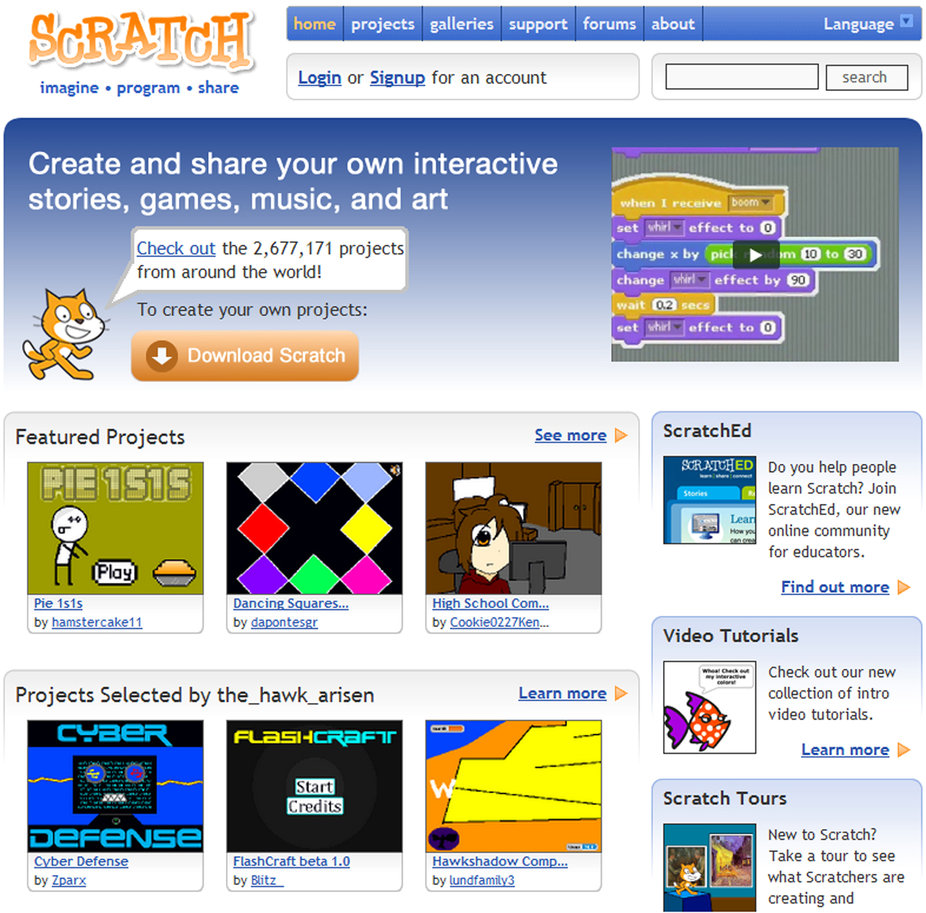
Scratch is a block-based programming language created by the Lifelong Kindergarten Group (LLK) at the MIT Media Lab. Scratch gives kids the power to use programming to create their own interactive animations and computer games. Since 2007, the online community that allows Scratch programmers to share, remix, and socialize around their projects has drawn more than 16 million users who have shared nearly 20 million projects and more than 100 million comments. It is one of the most popular ways for kids to learn programming and among the larger online communities for kids in general.
Front page of the Scratch online community (https://scratch.mit.edu) during the period covered by the dataset.
Since 2010, I have published a series of papers using quantitative data collected from the database behind the Scratch online community. As the source of data for many of my first quantitative and data scientific papers, it s not a major exaggeration to say that I have built my academic career on the dataset. I was able to do this work because I happened to be doing my masters in a research group that shared a physical space ( The Cube ) with LLK and because I was friends with Andr s Monroy-Hern ndez, who started in my masters cohort at the Media Lab. A year or so after we met, Andr s conceived of the Scratch online community and created the first version for his masters thesis project. Because I was at MIT and because I knew the right people, I was able to get added to the IRB protocols and jump through the hoops necessary to get access to the database. Over the years, Andr s and I have heard over and over, in conversation and in reviews of our papers, that we were privileged to have access to such a rich dataset. More than three years ago, Andr s and I began trying to figure out how we might broaden this access. Andr s had the idea of taking advantage of the launch of Scratch 2.0 in 2013 to focus on trying to release the first five years of Scratch 1.x online community data (March 2007 through March 2012) most of the period that the codebase he had written ran the site. After more work than I have put into any single research paper or project, Andr s and I have published a data descriptor in Nature s new journal Scientific Data. This means that the data is now accessible to other researchers. The data includes five years of detailed longitudinal data organized in 32 tables with information drawn from more than 1 million Scratch users, nearly 2 million Scratch projects, more than 10 million comments, more than 30 million visits to Scratch projects, and much more. The dataset includes metadata on user behavior as well the full source code for every project. Alongside the data is the source code for all of the software that ran the website and that users used to create the projects as well as the code used to produce the dataset we ve released. Releasing the dataset was a complicated process. First, we had navigate important ethical concerns about the the impact that a release of any data might have on Scratch s users. Toward that end, we worked closely with the Scratch team and the the ethics board at MIT to design a protocol for the release that balanced these risks with the benefit of a release. The most important features of our approach in this regard is that the dataset we re releasing is limited to only public data. Although the data is public, we understand that computational access to data is different in important ways to access via a browser or API. As a result, we re requiring anybody interested in the data to tell us who they are and agree to a detailed usage agreement. The Scratch team will vet these applicants. Although we re worried that this creates a barrier to access, we think this approach strikes a reasonable balance. Beyond the the social and ethical issues, creating the dataset was an enormous task. Andr s and I spent Sunday afternoons over much of the last three years going column-by-column through the MySQL database that ran Scratch. We looked through the source code and the version control system to figure out how the data was created. We spent an enormous amount of time trying to figure out which columns and rows were public. Most of our work went into creating detailed codebooks and documentation that we hope makes the process of using this data much easier for others (the data descriptor is just a brief overview of what s available). Serializing some of the larger tables took days of computer time. In this process, we had a huge amount of help from many others including an enormous amount of time and support from Mitch Resnick, Natalie Rusk, Sayamindu Dasgupta, and Benjamin Berg at MIT as well as from many other on the Scratch Team. We also had an enormous amount of feedback from a group of a couple dozen researchers who tested the release as well as others who helped us work through through the technical, social, and ethical challenges. The National Science Foundation funded both my work on the project and the creation of Scratch itself. Because access to data has been limited, there has been less research on Scratch than the importance of the system warrants. We hope our work will change this. We can imagine studies using the dataset by scholars in communication, computer science, education, sociology, network science, and beyond. We re hoping that by opening up this dataset to others, scholars with different interests, different questions, and in different fields can benefit in the way that Andr s and I have. I suspect that there are other careers waiting to be made with this dataset and I m excited by the prospect of watching those careers develop. You can find out more about the dataset, and how to apply for access, by reading the data descriptor on Nature s website.

Pau Garcia i Quiles: Almost at FOSDEM. Video volunteers?

I am boarding my flight to Brussels to attend FOSDEM. The Desktops DevRoom will be a blast again this year. While I have been in charge of it for 6? years already, the last two (since my twins) were born I had organized remotely and local duties were carried on by the Desktops DevRoom team (thank you Christophe Fergeau, Philippe Caseiro and others!). I am anxious at meeting old friends again. I will be at the beer event today. Video streaming will be available thanks to the Video Team. If you want to help, please contact us in the desktops-devroom@lists.fosdem.org mailing list, or directly at the devroom. Also, this year will be the first for me using the job corner to recruit: my company (everis) is recruiting globally for many open positions. Drop us a mail at fosdem@everis.com with your CV, desired position and location (we have direct presence in 13 countries and indirect in 40 countries) and I will make sure it reaches the right inbox.

2 February 2017

intrigeri: First Tails beta release based on Stretch

Today, I have released the first beta for Tails 3.0, that will be the first version of Tails based on Debian 9 (Stretch). Our automated test suite pretends it works pretty well and matches our safety expectations. I'm inclined to trust it. But as we learned after porting Tails to Squeeze, Wheezy and Jessie: quick, exploratory testing of pre-releases will not identify all the remaining regressions. So this time I'm trying to change this narrative a bit. I have committed to provide security updates for the 3.0~ series, just like we do for stable versions of Tails. This was the only missing bit to make me feel comfortable asking my fellow Tails contributors to upgrade to Tails 3.0~beta1 for their daily usage. I hope this helps us release a great Tails 3.0 on June 13 and a better Debian Stretch too: the more early users of Tails based on Stretch, the more chances they identify a few annoying regressions in Stretch before it's called stable :) For details, see the official announcement. Next step: FOSDEM. And then, back to organizing an event that aims at improving both social and technical aspects of Debian (to be announced in about a week, stay tuned); because the way we get organized and how power is distributed matter.

31 January 2017

Enrico Zini: Links for February 2017

On Progress and Historical Change [archive]
Is progress inevitable? Is it natural? Is it fragile? Is it possible? Is it a problematic concept in the first place? Many people are reexamining these kinds of questions as 2016 draws to a close, so I thought this would be a good moment to share the sort-of zoomed out discussions the subject that historians like myself are always having.
A projection of the ISS live feed as a night light [archive]
I always wanted the ISS live feed as a "night light" / ambiance to fall asleep to on my ceiling how to build a "night light" that is actually a small video projector projecting the ISS live feed
Vatican Climate Forest [archive]
The Vatican Climate Forest, to be located in the B kk National Park, Hungary, was donated to the Vatican City by a carbon offsetting company. The forest is to be sized to offset the carbon emissions generated by the Vatican during 2007. The Vatican's acceptance of the offer, at a ceremony on July 5, 2007, was reported as being "purely symbolic", and a way to encourage Catholics to do more to safeguard the planet. No trees have been planted under the project and the carbon offsets have not materialised. I'm fascinated by how purely symbolic "purely symbolic" can be.

Rapha&#235;l Hertzog: My Free Software Activities in January 2017

My monthly report covers a large part of what I have been doing in the free software world. I write it for my donors (thanks to them!) but also for the wider Debian community because it can give ideas to newcomers and it s one of the best ways to find volunteers to work with me on projects that matter to me. Debian LTS I was allocated 10 hours to work on security updates for Debian 7 Wheezy. During this time I did the following: Debian packaging With the deep freeze approaching, I made some last-minute updates: Misc work Sponsorship. I sponsored a new asciidoc upload demoting a dependency into a recommends (#850301). I sponsored a new upstream version of dolibarr. Discussions. I seconded quite a few changes prepared by Russ Allbery on debian-policy. I helped Scott Kitterman with #849584 about a misunderstanding of how the postfix service files are supposed to work. I discussed in #849913 about a regression in building of cross-compilers, and made a patch to avoid the problem. In the end, Guillem developed a better fix. Bugs. I investigated #850236 where a django test failed during the first week after each leap year. I filed #853224 on desktop-base about multiple small problems in the maintainer scripts. Thanks See you next month for a new summary of my activities.

No comment Liked this article? Click here. My blog is Flattr-enabled.

Benjamin Mako Hill: Supporting children in doing data science

As children use digital media to learn and socialize, others are collecting and analyzing data about these activities. In school and at play, these children find that they are the subjects of data science. As believers in the power of data analysis, we believe that this approach falls short of data science s potential to promote innovation, learning, and power. Motivated by this fact, we have been working over the last three years as part of a team at the MIT Media Lab and the University of Washington to design and build a system that attempts to support an alternative vision: children as data scientists. The system we have built is described in a new paper Scratch Community Blocks: Supporting Children as Data Scientists that will be published in the proceedings of CHI 2017. Our system is built on top of Scratch, a visual, block-based programming language designed for children and youth. Scratch is also an online community with over 15 million registered members who share their Scratch projects, remix each others work, have conversations, provide feedback, bookmark or love projects they like, follow other users, and more. Over the last decade, researchers including us have used the Scratch online community s database to study the youth using Scratch. With Scratch Community Blocks, we attempt to put the power to programmatically analyze these data into the hands of the users themselves. To do so, our new system adds a set of new programming primitives (blocks) to Scratch so that users can access public data from the Scratch website from inside Scratch. Blocks in the new system gives users access to project and user metadata, information about social interaction, and data about what types of code are used in projects. The full palette of blocks to access different categories of data is shown below.

Project metadata
User metadata
Site-wide statistics
The new blocks allow users to programmatically access, filter, and analyze data about their own participation in the community. For example, with the simple script below, we can find whether we have followers in Scratch who report themselves to be from Spain, and what their usernames are.
Simple demonstration of Scratch Community Blocks
In designing the system, we had two primary motivations. First, we wanted to support avenues through which children can engage in curiosity-driven, creative explorations of public Scratch data. Second, we wanted to foster self-reflection with data. As children looked back upon their own participation and coding activity in Scratch through the project they and their peers made, we wanted them to reflect on their own behavior and learning in ways that shaped their future behavior and promoted exploration. After designing and building the system over 2014 and 2015, we invited a group of active Scratch users to beta test the system in early 2016. Over four months, 700 users created more than 1,600 projects. The diversity and depth of users creativity with the new blocks surprised us. Children created projects that gave the viewer of the project a personalized doughnut-chart visualization of their coding vocabulary on Scratch, rendered the viewer s number of followers as scoops of ice-cream on a cone, attempted to find whether love-its for projects are more common on Scratch than favorites , and told users how talkative they were by counting the cumulative string-length of project titles and descriptions. We found that children, rather than making canonical visualizations such as pie-charts or bar-graphs, frequently made information representations that spoke to their own identities and aesthetic sensibilities. A 13-year-old girl had made a virtual doll dress-up game where the player s ability to buy virtual clothes and accessories for the doll was determined by the level of their activity in the Scratch community. When we asked about her motivation for making such a project, she said:
I was trying to think of something that somebody hadn t done yet, and I didn t see that. And also I really like to do art on Scratch and that was a good opportunity to use that and mix the two [art and data] together.
We also found at least some evidence that the system supported self-reflection with data. For example, after seeing a project that showed its viewers a visualization of their past coding vocabulary, a 15-year-old realized that he does not do much programming with the pen-related primitives in Scratch, and wrote in a comment, epic! looks like we need to use more pen blocks. :D.
Doughnut visualization
Ice-cream visualization
Data-driven doll dress up
Additionally, we noted that that as children made and interacted with projects made with Scratch Community Blocks, they started to critically think about the implications of data collection and analysis. These conversations are the subject of another paper (also being published in CHI 2017). In a 1971 article called Teaching Children to be Mathematicians vs. Teaching About Mathematics , Seymour Papert argued for the need for children doing mathematics vs. learning about it. He showed how Logo, the programming language he was developing at that time with his colleagues, could offer children a space to use and engage with mathematical ideas in creative and personally motivated ways. This, he argued, enabled children to go beyond knowing about mathematics to doing mathematics, as a mathematician would. Scratch Community Blocks has not yet been launched for all Scratch users and has several important limitations we discuss in the paper. That said, we feel that the projects created by children in our the beta test demonstrate the real potential for children to do data science, and not just know about it, provide data for it, and to have their behavior nudged and shaped by it.
This blog post and the paper it describes are collaborative work with Sayamindu Dasgupta. We have also received support and feedback from members of the Scratch team at MIT (especially Mitch Resnick and Natalie Rusk), as well as from Hal Abelson. Financial support came from the US National Science Foundation. The paper itself is open access so anyone can read the entire paper here. This blog post was also posted on Sayamindu Dasgupta s blog, on the Community Data Science Collective blog, and in several other places.

Elizabeth Ferdman: 8 Week Progress Update for PGP Clean Room

During the last few weeks, I learned about internationalization in bash and did a lot of refactoring/decomposing of the UI code, making the code a lot more DRY. Internationalization This intro to Internationalization in Bash from the Linux Journal and this Slackware doc put me on the road to internationalizing the UI code I had written thus far. Instead of hardcoding strings into the whiptail commands, like this:
PRIMARY_UID=$(whiptail --inputbox "$PRIMARY_UID_TEXT_EN" 8 78 --title "$PRIMARY_UID_TITLE_EN" 3>&1 1>&2 2>&3)
I set up a Message Catalog in a Portable Object file for English: en.po. The .po file contains msgid-msgstr key-value pairs:
msgid "EXPIRY_TEXT"
msgstr ""
"Please specify how long the key should be valid.\n"
"\t   0 = key does not expire\n"
"\t <n> = key expires in n days\n"
"\t<n>w = key expires in n weeks\n"
"\t<n>m = key expires in n months\n"
"\t<n>y = key expires in n years"
msgid "PRIMARY_UID_TITLE"
msgstr "Primary UID"
To make these .po files usable in a script, use the Linux utility msgfmt to turn .po files into Message Object files:
mkdir -p $HOME/project/locale/en_US/LC_MESSAGES/
msgfmt -o $HOME/project/locale/en_US/LC_MESSAGES/ui-strings.mo po/en.po
Now that we have a Message Object file, we can access the key value pairs in a script using the gettext command. Pass the name of the msgid as a string to get back the localized natural language string:
whiptail_yesno()  	
	whiptail --yesno "$(gettext $1)" $DIMENS --title "$(gettext $2)"
	return $?
if whiptail_yesno "ENCR_SUBKEY_YESNO_TEXT" "ENCR_SUBKEY_YESNO_TITLE"; then
...
In order for this to work, though, it s important to export some environmental variables before running gettext. Mine look like:
export TEXTDOMAINDIR=$HOME/gpg-helper-scripts/locale
export TEXTDOMAIN=ui-strings
export LANG=en_US.UTF-8
Refactoring/Reorganizing
gpg-helper-scripts/
  gpg/
       create_keys.sh
       add_uids.py
  whiptail/
       main_menu.sh
       gen_keys.sh
       smartcard_init.sh
       whiptail_helper.sh
  po/
       en.po
  locale/
       en_US/LC_MESSAGES/ui-strings.mo
  details/
       gpg-algos
       smartcard-workflow
  init.sh
  README.md
While setting up whiptail functions I learned that one does not simply return values in bash. With the help of another Linux Journal article, I came up with:
whiptail_password()  
	__resultvar=$1	
	result=$(whiptail --passwordbox "$(gettext $2)" $DIMENS --title "$(gettext $3)" 3>&1 1>&2 2>&3)
	eval $__resultvar="'$result'"
 
to store user input as variables while keeping the code DRY. I also looked a little bit at Google s Shell Style Guide, gave my files better names and organized the directory structure. GPG I was curious about the correct abbreviations, key lengths and usages for all of the gpg2.1.16 supported algorithms so I created a reference in details/gpg-algos that will come in handy for validating the user s input for different types of keys. Moving Forward Now that the code is much more readable, I can think more about the UI and the options that I want to include:
Lots more options could be added here.. Let me know your ideas. Thanks for reading!

30 January 2017

Marc 'Zugschlus' Haber: openssh authorized_keys "restrict" option lessens worries

Starting with OpenSSH 7.2, a new restrict option for authorized_keys lines has become available. It sets all available restrictions that the current OpenSSH version can do (like no-agent-forwarding, no-x11-forwarding etc). One can individually turn on those features again by corresponding new options. This saves one from sorrows when a new capability of OpenSSH is introduced through an update which is enabled by default, since one has to remember that restricted authorized_keys lines are in unse and then to manually add the restrictions. On the downside, Debian jessie and CentOS 7 don t have a recent enough OpenSSH. So we ll have to continue worrying about new features being inadvertendly enabled for a while. P.S.: Yes, I haven t blogged about Linux and Debian in English in a while.

29 January 2017

Sam Hartman: Network Audio Visualization: Network Modeling

Previously, I wrote about my project to create an audio depiction of network traffic. In this second post, I explore how I model aspects of the network that will be captured in the audio representation. Before getting started, I'll pass along a link. This is not the first time someone has tried to put sound to packets flying through the ether: I was pointed at Peep. I haven't looked at Peep, but will do so after I finish my own write up. Not being an academic, I feel no obligation to compare and contrast my work to others:-)
I started with an idea of what I'd like to hear. One of my motivations was to explore some automated updates we run at work. So, I was hoping to capture the initial DNS and ARP traffic as the update discovered the systems it would contact. Then I was hoping to capture the ssh and other traffic of the actual update.
To Packet or Stream
One of the simplest things to do would simply be to model network packets. For DNS I chose that approach. I was dubious that a packet-based model would capture the aspects of TCP streams I typically care about. I care about the source and destination (both address and port) of course. However I also care about how much traffic is being carried over the stream and the condition of the stream. Are there retransmits? Are there a bunch of unanswered SYNs? But I don't care about the actual distribution of packets. Also, a busy TCP stream can generate thousands of packets a second. I doubted my ability to distinguish thousands of sounds a second at all, especially while trying to convey enough information to carry stream characteristics like overall traffic volume.
So, for TCP, I decided to model some characteristics of streams rather than individual packets.
For DNS, I decided to represent individual requests/replies.
I came up with something clever for ARPP. There, I model the request/reply as an outstanding request. A lot of unanswered ARPs can be a sign of a scan or a significant problem. The mornful sound of a TCP stream trailing off into an unanswered ARP as the cache times out on a broken network is certainly something I'd like to capture. So, I track when an ARP request is sent and when/if it is answered.
Sound or Music
I saw two approaches. First, I could use some sound to represent streams. As an example, a running diesel engine could make a great representation of a stream. The engine speed could represent overall traffic flow. There are many opportunities for detuning the engine to represent various problems that can happen with a stream. Perhaps using stereo separation and slightly different fundamental frequencies I could even represent a couple of streams and still be able to track them.
However, at least with me as a listener, that's not going to scale to a busy network. The other option I saw was to try and create melodic music with various musical phrases modified as conditions within the stream or network changed. That seemed a lot harder to do, but humans are good at listening to complicated music.
I ended up deciding that at least for the TCP streams, I was going to try and produce something more musical than sound. I was nervous: I kept having visions of a performance of "Peter and the Wolf" with different instruments representing all the characters that somehow went dreadfully wrong.
As an aside, the decision to approach music rather than sound depended heavily on what I was trying to capture. If I'm modeling more holistic properties of a system--for example, total network traffic without splitting into streams--I think parameterized sounds would be a better approach.
The decision to approach things musically affected the rest of the modeling. Somehow I was going to need to figure out notes to play. I'd already rejected the idea of modeling packets, so I wouldn't simply be able to play notes when a packet arrived.
Energy Decay
As I played with various options, I realized that the critical challenge would be figuring out how to focus the listener's attention on the important aspects of what was going on. Clutter was the great enemy. My job would be figuring out how to spend sound wisely. When something interesting happened, that part of the model should get more focus--more of the listener's energy.
Soon I found myself thinking a lot about managing the energy of network streams. I imagined streams getting energy when something happened, and spending that energy to convey that interesting event to the listener. Energy needed to accumulate fast enough that even low-traffic streams could be noticed. Energy needed to be spent fast enough that old events were not taking listener focus from new, interesting things going on. However, if the energy were spent slow enough, then network events could be smoothed out to give a better picture of the stream rather than individual packets.
This concept of managing some decaying quantity and managing the rate of decay proved useful at multiple levels of the model.
Two Layer Model
I started with a python script that parses tcpdump output. It associates a packet with a stream and batches packets together to avoid overloading other parts of the system.
The output of this script are stream events. Events include a source and destination address, a stream ID, traffic in each direction, and any special events on the stream.
For DNS, the script just outputs packet events. For ARP, the script outputs request start, reply, and timeout events. There's some initial support for UDP, but so far that doesn't make sound.
Right now, FINs are modeled, but SYNs and the interesting TCP conditions aren't directly modeled. If you get retransmissions you'll notice because packet flow will decrease. However, I'd love to explicitly sound retransmissions. I also think a window filling as an application fails to read is important. I imagine either narrowing a band-pass filter to clamp the audio bandwidth available to a stream with a full window. Or perhaps taking it the other direction and adding an echo.
The next layer down tracks the energy of each stream. But that, and how I map energy into music, is the topic of the next post.

Elena 'valhalla' Grandi: One Liberated Laptop

One Liberated Laptop

Immagine/fotohttp://social.gl-como.it/photos/valhalla/image/5a480cd2d5842101fc8975d927d030f3

After many days of failed attempts, yesterday @Diego Roversi finally managed to setup SPI on the BeagleBone White , and that means that today at our home it was Laptop Liberation Day!

We took the spare X200, opened it, found the point we were on in the tutorial installing libreboot on x200 https://libreboot.org/docs/install/x200_external.html, connected all of the proper cables on the clip and did some reading tests of the original bios.

Immagine/fotohttp://social.gl-como.it/photos/valhalla/image/77e61745d9c43833b7c0a4a919d17222

While the tutorial mentioned a very conservative setting (512kHz), just for fun we tried to read it at different speed and all results up to 16384 kHz were equal, with the first failure at 32784 kHz, so we settled on using 8192 kHz.

Then it was time to customize our libreboot image with the right MAC address, and that's when we realized that the sheet of paper where we had written it down the last time had been put in a safe place somewhere

Luckily we also had taken a picture, and that was easier to find, so we checked the keyboard map , followed the instructions to customize the image https://libreboot.org/docs/hcl/gm45_remove_me.html#ich9gen, flashed the chip, partially reassembled the laptop, started it up and a black screen, some fan noise and nothing else.

We tried to reflash the chip (nothing was changed), tried the us keyboard image, in case it was the better tested one (same results) and reflashed the original bios, just to check that the laptop was still working (it was).

It was lunchtime, so we stopped our attempts. As soon as we started eating, however, we realized that this laptop came with 3GB of RAM, and that surely meant "no matching pairs of RAM", so just after lunch we reflashed the first image, removed one dimm, rebooted and finally saw a gnu-hugging penguin!

We then tried booting some random live usb key https://tails.boum.org/ we had around (failed the first time, worked the second and further one with no changes), and then proceeded to install Debian.

Running the installer required some attempts and a bit of duckduckgoing: parsing the isolinux / grub configurations from the libreboot menu didn't work, but in the end it was as easy as going to the command line and running:


linux (usb0)/install.amd/vmlinuz
initrd (usb0)/install.amd/initrd.gz
boot


From there on, it was the usual debian installation and a well know environment, and there were no surprises. I've noticed that grub-coreboot is not installed (grub-pc is) and I want to investigate a bit, but rebooting worked out of the box with no issue.

Next step will be liberating my own X200 laptop, and then if you are around the @Gruppo Linux Como area and need a 16 pin clip let us know and we may bring everything to one of the LUG meetings

yes, white, and most of the instructions on the interwebz talk about the black, which is extremely similar to the white except where it isn't

wait? there are keyboard maps? doesn't everybody just use the us one regardless of what is printed on the keys? Do I *live* with somebody who doesn't? :D

the breadboard in the picture is only there for the power supply, the chip on it is a cheap SPI flash used to test SPI on the bone without risking the laptop :)

disclaimer: it worked for us. it may not work on *your* laptop. it may brick it. it may invoke a tentacled monster, it may bind your firstborn son to a life of servitude to some supernatural being. Whatever happens, it's not our fault.

(edit: added tags)

#coreboot #libreboot

26 January 2017

John Goerzen: What is happening to America?

I still remember vividly my first visit to Europe, back in 2010. I had just barely gotten off a plane in Hamburg and on to a bus to Lubeck, and struck up a conversation with a friendly, well-educated German classical musician next to me. We soon started to discuss politics and religion. Over the course of the conversation, in response to his questions, I explained I had twice voted against George W. Bush, that I opposed the war in Iraq for many reasons, that I did thought there was an ethical imperative to work to defeat climate change, that I viewed health care as an important ethical and religious issue, that I thought evolution was well-established, and that I am a Christian. Finally, without any hint of insult intended, and rather a lot of surprise written all over his face, he said: Wow. You re an American, and a Christian, and you re so . normal! This, it seems to me, has a lot to do with Trump. Ouch It felt like a punch to the gut. The day after the election, having known that a man that appeared to stand for everything that honorable people are against won the election, like people all around the world, I was trying to make sense of how could this happen? As I ve watched since, as he stacks government with wealthy cronies with records nearly as colorful as his own, it is easy to feel even more depressed. Based on how Trump spoke and acted, it would be easy to conclude that the deplorables won the day that he was elected by a contingent of sexists or racists ascendent in power. But that would be too simple an explanation. This is, after all, the same country that elected Barack Obama twice. There are a many people that voted twice for a black man, and then for Trump. Why? Racism, while doubtless a factor, can t explain it all. How Trump could happen Russ Allbery made some excellent points recently:
[Many Americans are] hurt, and they re scared, and they feel like a lot of the United States just slammed the door in their faces. The status quo is not working for people. Technocratic government by political elites is not working for people. Business as usual is not working for people. Minor tweaks to increasingly arcane systems is not working for people. People are feeling lost in bureaucracy, disaffected by elections that do not present a clear alternate vision, and depressed by a slow slide into increasingly dismal circumstances. Government is not doing what we want it to do for us. And people are getting left behind. The left in the United States (of which I m part) has for many years been very concerned about the way blacks and other racial minorities are systematically pushed to the margins of our economy, and how women are pushed out of leadership roles. Those problems are real. But the loss of jobs in the industrial heartland, the inability of a white, rural, working-class man to support his family the way his father supported him, the collapse of once-vibrant communities into poverty and despair: those problems are real too. The status quo is not working for anyone except for a few lucky, highly-educated people on the coasts. People, honestly, like me, and like many of the other (primarily white and male) people who work in tech. We are one of the few beneficiaries of a system that is failing the vast majority of people in this country.
Russ is, of course, right. The Democrats have been either complicit in policies damaging to many, or ineffective in preventing them. They have often appeared unconcerned with the plight of people outside cities (even if that wasn t really the case). And it goes deeper. When s the last time you visited Kansas? I live in Kansas. The nearest paved road is about a 3-mile drive from my home. The nearest town, population 600, is a 6-mile drive. My governor whom I did not vote for cut taxes on the wealthy so much that our excellent local schools have been struggling for years. But my community is amazing, full of loving and caring people, the sort of people who you know you ll be living with for 40 years, and so you make sure you get along well with. I have visited tourist sites in Berlin, enjoyed an opera and a Broadway show in New York, taken a train across the country to Portland, explored San Francisco. I ve enjoyed all of them. Many rural people do get out and experience the world. I have been in so many conversations where I try to explain where I live to people that simply cannot fathom it. I have explained how the 18 acres I own is a very small amount where I am. How, yes, I do actually have electricity and Internet. How a bad traffic day is one where I have to wait for three cars to go past before turning onto the paved road. How I occasionally find a bull in my front yard, how I can walk a quarter mile and be at the creek on the edge of my property, how I can get to an airport faster than most New Yorkers and my kids can walk out the front door and play in a spot more peaceful than Central Park, and how all this is way cheaper than a studio apartment in a bad part of San Francisco. It is rare indeed to see visitors actually traveling to Kansas as a destination. People have no concept of the fact that my mechanic would drop everything and help me get my broken-down car to the shop for no charge, that any number of neighbors or uncles would bring a tractor and come plow the snow off my 1/4-mile driveway out of sheer kindness, that people around here really care for each other in a way you don t see in a city. There are people that I know see politics way differently than me, but I know them to be good people. They would also do anything for a person in need, no matter who they are. I may find the people that they vote for to be repugnant, but I cannot say I ve looked this person in the eyes and they are nothing but deplorable. And so, people in rural areas feel misunderstood. And they are right. Some perspectives on Trump As I ve said, I do find Trump to be deplorable, but not everyone that voted for him is. How, then, do people wind up voting for him? The New Yorker had an excellent story about a man named Mark Frisbie, owner of a welding and fab shop. The recession had been hard on his business. His wife s day-care center also closed. Health care was hard to find, and the long, slow decline had spanned politicians of every stripe. Mark and his wife supposedly did everything they were supposed to: they worked hard, were honest, were entrepreneurial, and yet he had lost his business, his family house, his health coverage, everything. He doesn t want a handout. He wants to be able to earn a living. Asked who he d vote for, he said, Is none of the above an option? The Washington Post had another insightful article, about a professor from Madison, WI interviewing people in rural areas. She said people would often say: All the decisions are made in Madison and Milwaukee and nobody s listening to us. Nobody s paying attention, nobody s coming out here and asking us what we think. Decisions are made in the cities, and we have to abide by them. She pushed back, hard, on the idea that Trump supporters are ignorant, and added that liberals that push that line of thinking are only making the problem worse. I would agree; seeing all the talk about universities dis-inviting speakers that don t hew to certain political views doesn t help either. A related article talks about the lack of empathy for Trump voters. And then we have a more recent CNN article: Where Tump support and Obamacare use soar together, explaining in great detail how it can be logical for someone to be on Obamacare but not like it. We can all argue that the Republicans may have as much to do with that as anything, but the problem exists. And finally, a US News article makes this point:
His supporters realize he s a joke. They do not care. They know he s authoritarian, nationalist, almost un-American, and they love him anyway, because he disrupts a broken political process and beats establishment candidates who ve long ignored their interests. When you re earning $32,000 a year and haven t had a decent vacation in over a decade, it doesn t matter who Trump appoints to the U.N., or if he poisons America s standing in the world, you just want to win again, whoever the victim, whatever the price. According to the Republican Party, the biggest threat to rural America was Islamic terrorism. According to the Democratic Party it was gun violence. In reality it was prescription drug abuse and neither party noticed until it was too late.
Are we leaving people out? All this reminded me of reading about Donald Knuth, the famous computer scientist and something of the father of modern computing, writing about his feelings of trepidation about sharing with his university colleagues that he was working on a project related to the Bible. I am concerned about the complaints about the PC culture , because I think it is good that people aren t making racist or anti-semitic jokes in public anymore. But, as some of these articles point out, in many circles, making fun of Christians and conservatives is still one of the accepted targets. Does that really help anything? (And as a Christian that is liberal, have all of you that aren t Christians so quickly forgotten how churches like the Episcopals blazed the way for marriage equality many years ago already?) But they don t get a free pass I have found a few things, however, absolutely scary. One was an article from December showing that Trump voters actually changed their views on Russia after Trump became the nominee. Another one from just today was a study on how people reacted when showed inauguration crowd photos. NPR ran a story today as well, on how Trump is treating journalists like China does. Chilling stuff indeed. Conclusion So where does this leave us? Heading into uncertain times, for sure, but perhaps just maybe with a greater understanding of our neighbors. Perhaps we will all be able to see past the rhetoric and polarization, and understand that there is something, well, normal about each other. Doing that is going to be the only way we can really take our country back.

23 January 2017

Sam Hartman: Cudos to GDB Contributors

I recently diagnosed a problem in Debian's pam-p11 package. This package allegedly permits logging into a computer using a smart card or USB security token containing an ssh key. If you know the PIN and have the token, then your login attempt is authorized against the ssh authorized keys file. This seems like a great way to permit console logins as root to machines without having a shared password. Unfortunately, the package didn't work very well for me. It worked once, then all future attempts to use it segfaulted. I'm familiar with how PAM works. I understand the basic ideas behind PKCS11 (the API used for this type of smart card), but was completely unfamiliar with this particular PAM module and the PKCS11 library it used. The segfault was in an area of code I didn't even expect that this PAM module would ever call. Back in 1994, that would have been a painful slog. Gdb has improved significantly since then, and I'd really like to thank all the people over the years who made that possible. I was able to isolate the problem in just a couple of hours of debugging. Here are some of the cool features I used: Anyway, with just a couple of hours and no instrumentation of the code, I managed to track down how a bunch of structures were being freed as an unexpected side effect of one of the function calls. Neither I nor the author of the pam-p11 module expected that (although it is documented and does make sense in retrospect). Good tools make life easier.

18 January 2017

Michael Stapelberg: manpages.debian.org has been modernized

https://manpages.debian.org has been modernized! We have just launched a major update to our manpage repository. What used to be served via a CGI script is now a statically generated website, and therefore blazingly fast. While we were at it, we have restructured the paths so that we can serve all manpages, even those whose name conflicts with other binary packages (e.g. crontab(5) from cron, bcron or systemd-cron). Don t worry: the old URLs are redirected correctly. Furthermore, the design of the site has been updated and now includes navigation panels that allow quick access to the manpage in other Debian versions, other binary packages, other sections and other languages. Speaking of languages, the site serves manpages in all their available languages and respects your browser s language when redirecting or following a cross-reference. Much like the Debian package tracker, manpages.debian.org includes packages from Debian oldstable, oldstable-backports, stable, stable-backports, testing and unstable. New manpages should make their way onto manpages.debian.org within a few hours. The generator program ( debiman ) is open source and can be found at https://github.com/Debian/debiman. In case you would like to use it to run a similar manpage repository (or convert your existing manpage repository to it), we d love to help you out; just send an email to stapelberg AT debian DOT org. This effort is standing on the shoulders of giants: check out https://manpages.debian.org/about.html for a list of people we thank. We d love to hear your feedback and thoughts. Either contact us via an issue on https://github.com/Debian/debiman/issues/, or send an email to the debian-doc mailing list (see https://lists.debian.org/debian-doc/).

17 January 2017

Ritesh Raj Sarraf: Linux Tablet-Mode Usability

In my ongoing quest to get Tablet-Mode working on my Hybrid machine, here's how I've been living with it so far. My intent is to continue using Free Software for both use cases. My wishful thought is to use the same software under both use cases.
  • Browser: On the browser front, things are pretty decent. Chromium has good support for Touchscreen input. Most of the Touchscreen use cases work well with Chromium. On the Firefox side, after a huge delay, finally, Firefox seems to be catching up. Hopefully, with Firefox 51/52, we'll have a much more usable Touchscreen browser.
  • Desktop Shell: One of the reason of migrating to GNOME was its touch support. From what I've explored so far, GNOME is the only desktop shell that has touch support natively done. The feature isn't complete yet, but is fairly well usable.
    • Given that GNOME has touchscreen support native, it is obvious to be using GNOME equivalent of tools for common use cases. Most of these tools inherit the touchscreen capabilities from the underneath GNOME libraries.
    • File Manager: Nautilus has decent support for touch, as a file manager. The only annoying bit is a right-click equivalent. Or in touch input sense, a long-press.
    • Movie Player: There's a decent movie player, based on GNOME libs; GNOME MPV. In my limited use so far, this interface seems to have good support. Other contenders are:
      • SMPlayer is based on Qt libs. So initial expectation would be that Qt based apps would have better Touch support. But I'm yet to see any serious Qt application with Touch input support. Back to SMPlayer, the dev is pragmatic enough to recognize tablet-mode users and as such has provided a so called "Tablet Mode" view for SMPlayer (The tooltip did not get captured in the screenshot).
      • MPV doesn't come with a UI but has basic management with OSD. And in my limited usage, the OSD implementation does seem capable to take touch input.
  • Books / Documents: GNOME Documents/Books is very basic in what it has to offer, to the point that it is not much useful. But since it is based on the same GNOME libraries, it enjoys native touch input support. Calibre, on the other hand, is feature rich. But it is based on (Py)Qt. Touch input is told to work for Windows. For Linux, there's no support yet. The good thing about Calibre is that it has its own UI, which is pretty decent in a Tablet-Mode Touch workflow.
  • Photo Management: With compact digital devices commonly available, digital content (Both Photos and Videos) is on the rise. The most obvious names that come to mind are Digikam and Shotwell.
    • Shotwell saw its reincarnation in the recent past. From what I recollect, it does have touch support but was lacking quite a bit in terms of features, as compared to Digikam.
    • Digikam is an impressive tool for digital content management. While Digikam is a KDE project, thankfully it does a great job in keeping its KDE dependencies to a bare minimum. But given that Digikam builds on KDE/Qt libs, I haven't had any much success in getting a good touch input solution for Tablet Mode. To make it barely usable in Table-Mode, one could choose a theme preference with bigger toolbars, labels and scrollbars. This helps in making a touch input workaround use case. As you can see, I've configured the Digikam UI with Text alongside Icons for easy touch input.
  • Email: The most common use case. With Gmail and friends, many believe standalone email clients are no more a need. But there always are users like us who prefer emails offline, encrypted emails and prefer theis own email domains. Many of these are still doable with free services like Gmail, but still.
    • Thunderbird shows its age at times. And given the state of Firefox in getting touch support (and GTK3 port), I see nothing happening with TB.
    • KMail was something I discontinued while still being on KDE. The debacle that KDEPIM was, is something I'd always avoid, in the future. Complete waste of time/resource in building, testing, reporting and follow-ups.
    • Geary is another email client that recently saw its reincarnation. I recently had explored Geary. It enjoys similar benefits like the rest applications using GNOME libraries. There was one touch input bug I found, but otherwise Geary's featureset was limited in comparison to Evolution.
    • Migration to Evolution, when migrating to GNOME, was not easy. GNOME's philosophy is to keep things simple and limited. In doing that, they restrict possible flexibilities that users may find obvious. This design philosophy is easily visible across all applications of the GNOME family. Evolution is no different. Hence, coming from TB to E was a small unlearning + newLearning curve. And since Evolution is using the same GNOME libraries, it enjoys similar benefits. Touch input support in Evolution is fairly good. The missing bit is the new Toolbar and Menu structure that many have noticed in the newer GNOME applications (Photos, Documents, Nautilus etc). If only Evolution (and the GNOME family) had the option of customization beyond the developer/project's view, there wouldn't be any wishful thoughts.
      • Above is a screenshot of 2 windows of Evoluiton. In its current form too, Evolution is a gem at times. For my RSS feeds, they are stored in a VFolder in Evolution, so that I can read them when offline. RSS feeds are something I read up in Tablet-mode. On the right is an Evolution window with larger fonts, while on the left, Evoltuion still retains its default font size. This current behavior helps me get Table-Mode Touch working to an extent. In my wishful thoughts, I wish if Evolution provided flexibility to change Toolbar icon sizes. That'd really help easily touch the delete button when in Tablet Mode. A simple button, Tablet Mode, like what SMPlayer has done, would keep users sticky with Evolution.
My wishful thought is that people write (free) software, thinking more about usability across toolkits and desktop environments. Otherwise, the year of the Linux desktop, laptop, tablet; in my opinion, is yet to come. And please don't rip apart tools, in porting them to newer versions of the toolkits. When you rip a tool, you also rip all its QA, Bug Reporting and Testing, that was done over the years. Here's an example of a tool (Goldendict), so well written. Written in Qt, Running under GNOME, and serving over the Chromium interface. In this whole exercise of getting a hybrid working setup, I also came to realize that there does not seem to be a standardized interface, yet, to determine the current operating mode of a running hybrid machine. From what we explored so far, every product has its own way to doing it. Most hybrids come pre-installed and supported with Windows only. So, their mode detection logic seems to be proprietary too. In case anyone is awaer of a standard interface, please drop a note in the comments.

Categories:

Keywords:

Like:

15 January 2017

Mehdi Dogguy: Debian from 10,000 feet

Many of you are big fans of S.W.O.T analysis, I am sure of that! :-) Technical competence is our strongest suit, but we have reached a size and sphere of influence which requires an increase in organisation.

We all love our project and want to make sure Debian still shines in the next decades (and centuries!). One way to secure that goal is to identify elements/events/things which could put that goal at risk. To this end, we've organized a short S.W.O.T analysis session at DebConf16. Minutes of the meeting can be found here. I believe it is an interesting read and is useful for Debian old-timers as well as newcomers. It helps to convey a better understanding of the project's status. For each item, we've tried to identify an action.

Here are a few things we've worked on:
During next DebConf, we can review the progress that has been made on each item and discuss new ones. In addition to this session acting as a health check, I see it as a way for the DPL to discuss, openly and publicly, about the important changes that should be implemented in the project and imagine together a better future.

In the meantime, everyone should feel free to pick one item from the list and work on it. :-)

14 January 2017

Jonathan McDowell: Cloning a USB LED device

A month or so ago I got involved in a discussion on IRC about notification methods for a headless NAS. One of the options considered was some sort of USB attached LED. DealExtreme had a cheap Webmail notifier , which was already supported by mainline kernels as a Riso Kagaku device but it had been sold out for some time. This seemed like a fun problem to solve with a tinyAVR and V-USB. I had my USB relay board so I figured I could use that to at least get some code to the point that the kernel detected it as the right device, and the relay output could be configured as one of the colours to ensure it was being driven in roughly the right manner. The lack of a full lsusb dump (at least when I started out) made things a bit harder, plus the fact that the Riso uses an output report unlike the relay code, which uses a control message. However I had the kernel source for the driver and with a little bit of experimentation had something which would cause the driver to be loaded and the appropriate files in /sys/class/leds/ to be created. The relay was then successfully activated when the red LED was supposed to be on.
hid-led 0003:1294:1320.0001: hidraw0: USB HID v1.01 Device [MAIL  MAIL ] on usb-0000:00:14.0-6.2/input0
hid-led 0003:1294:1320.0001: Riso Kagaku Webmail Notifier initialized
I subsequently ordered some Digispark clones and modified the code to reflect the pins there (my relay board used pins 1+2 for USB, the Digispark uses pins 3+4). I then soldered a tricolour LED to the board, plugged it in and had a clone of the Riso Kaguku device for about 1.50 in parts (no doubt much cheaper in bulk). Very chuffed. In case it s useful to someone, the code is released under GPLv3+ and is available at https://the.earth.li/gitweb/?p=riso-kagaku-clone.git;a=summary or on GitHub at https://github.com/u1f35c/riso-kagaku-clone. I m seeing occasional issues on an older Dell machine that only does USB2 with enumeration, but it generally is fine once it gets over that. (FWIW, Jon, who started the original discussion, ended up with a BlinkStick Nano which is a neater device with 2 LEDs but still based on an Tiny85.)

13 January 2017

Elena 'valhalla' Grandi: Modern XMPP Server

Modern XMPP Server

I've published a new HOWTO on my website 'http://www.trueelena.org/computers/howto/modern_xmpp_server.html':

http://www.enricozini.org/blog/2017/debian/modern-and-secure-instant-messaging/ already wrote about the Why (and the What, Who and When), so I'll just quote his conclusion and move on to the How.

I now have an XMPP setup which has all the features of the recent fancy chat systems, and on top of that it runs, client and server, on Free Software, which can be audited, it is federated and I can self-host my own server in my own VPS if I want to, with packages supported in Debian.


How

I've decided to install https://prosody.im/, mostly because it was recommended by the RTC QuickStart Guide http://rtcquickstart.org/; I've heard that similar results can be reached with https://www.ejabberd.im/ and other servers.

I'm also targeting https://www.debian.org/ stable (+ backports); as I write this is jessie; if there are significant differences I will update this article when I will upgrade my server to stretch. Right now, this means that I'm using prosody 0.9 (and that's probably also the version that will be available in stretch).

Installation and prerequisites

You will need to enable the https://backports.debian.org/ repository and then install the packages prosody and prosody-modules.

You also need to setup some TLS certificates (I used Let's Encrypt https://letsencrypt.org/); and make them readable by the prosody user; you can see Chapter 12 of the RTC QuickStart Guide http://rtcquickstart.org/guide/multi/xmpp-server-prosody.html for more details.

On your firewall, you'll need to open the following TCP ports:


The latter two are needed to enable some services provided via http(s), including rich media transfers.

With just a handful of users, I didn't bother to configure LDAP or anything else, but just created users manually via:

prosodyctl adduser alice@example.org

In-band registration is disabled by default (and I've left it that way, to prevent my server from being used to send spim https://en.wikipedia.org/wiki/Messaging_spam).

prosody configuration

You can then start configuring prosody by editing /etc/prosody/prosody.cfg.lua and changing a few values from the distribution defaults.

First of all, enforce the use of encryption and certificate checking both for client2server and server2server communications with:


c2s_require_encryption = true
s2s_secure_auth = true


and then, sadly, add to the whitelist any server that you want to talk to and doesn't support the above:


s2s_insecure_domains = "gmail.com"


virtualhosts

For each virtualhost you want to configure, create a file /etc/prosody/conf.avail/chat.example.org.cfg.lua with contents like the following:


VirtualHost "chat.example.org"
enabled = true
ssl =
key = "/etc/ssl/private/example.org-key.pem";
certificate = "/etc/ssl/public/example.org.pem";


For the domains where you also want to enable MUCs, add the follwing lines:


Component "conference.chat.example.org" "muc"
restrict_room_creation = "local"


the "local" configures prosody so that only local users are allowed to create new rooms (but then everybody can join them, if the room administrator allows it): this may help reduce unwanted usages of your server by random people.

You can also add the following line to enable rich media transfers via http uploads (XEP-0363):


Component "upload.chat.trueelena.org" "http_upload"

The defaults are pretty sane, but see https://modules.prosody.im/mod_http_upload.html for details on what knobs you can configure for this module

Don't forget to enable the virtualhost by linking the file inside /etc/prosody/conf.d/.

additional modules

Most of the other interesting XEPs are enabled by loading additional modules inside /etc/prosody/prosody.cfg.lua (under modules_enabled); to enable mod_something just add a line like:


"something";

Most of these come from the prosody-modules package (and thus from https://modules.prosody.im/ ) and some may require changing when prosody 0.10 will be available; when this is the case it is mentioned below.


@Gruppo Linux Como @LIFO

9 January 2017

Shirish Agarwal: The Great Indian Digital Tamasha

Indian Railways This is an extension to last month s article/sharing where I had shared the changes that had transpired in the last 2-3 months. Now am in a position to share the kind of issues a user can go through in case he is looking for support from IRCTC to help him/her go cashless. If you a new user to use IRCTC services you wouldn t go through this trouble. For those who might have TL;DR issues it s about how hard it can become to get digital credentials fixed in IRCTC (Indian Railway Catering and Tourism Corporation) a. 2 months back Indian Prime Minister gave a call incentivizing people to use digital means to do any commercial activities. One of the big organizations which took/takes part is IRCTC which handles the responsibility for e-ticketing millions of Rail tickets for common people. In India, a massive percentage moves by train as it s cheaper than going by Air. A typical fare from say Pune Delhi (capital of India) by second class sleeper would be INR 645/- for a distance of roughly 1600 odd kms and these are monopoly rates, there are no private trains and I m not suggesting anything of that sort, just making sure that people know. An economy class ticket by Air for the same distance would be anywhere between INR 2500-3500/- for a 2 hour flight between different airlines. Last I checked there are around 8 mainstream airlines including flag-carrier Air India. About 30% of the population live on less than a dollar and a half a day which would come around INR 100/-. There was a comment some six months back on getting more people out of the poverty line. But as there are lots of manipulations in numbers for who and what denotes above poor and below poor in India and lot of it has to do with politics it s not something which would be easily fixable. There are lots to be said in that arena but this article is not an appropriate blog-post for that. All in all, it s only 3-5% of the population at the most who can travel via Air if situation demands and around 1-2% who might be frequent, business or leisure travellers. Now while I can thankfully afford an Air Ticket if the situation so demands, my mother gets motion sickness so while together we can only travel by train. b. With the above background, I had registered with IRCTC few years ago with another number (dual-SIM) I had purchased and was thinking that I would be using this long-term (seems to my first big mistake, hindsight 50:50) . This was somewhere in 2006/2007. c. Few months later I found that the other service provider wasn t giving good service or was not upto mark. I was using IDEA (the main mobile operator) throughout those times. d. As I didn t need the service that much, didn t think to inform them that I want to change to another service provider at that point in time (possibly the biggest mistake, hindsight 50:50) e. In July 2016 itself IRCTC cut service fees, f. This was shared as a NEW news item/policy decision at November-end 2016 . g. While I have done all that has been asked by irctc-care haven t still got the issues resolved  IRCTC s e-mail id care@irctc.co.in Now in detail This is my first e-mail sent to IRCTC in June 2016
Dear Customer care, I had applied and got username and password sometime back . The
number I had used to register with IRCTC was xxxxxxxxxx (BSNL mobile number not used anymore) . My mobile was lost and along with that the number was also lost. I had filed a complaint with the police and stopped that number as well. Now I have an another mobile number but have forgotten both the password and the security answer that I had given when I had registered . I do have all the conversations I had both with the ticketadmn@irctc.co.in as well as care@irctc.co.in if needed to prove my identity. The new number I want to tie it with is xxxxxxxxxx (IDEA number in-use for last 10 years) I see two options :- a. Tie the other number with my e-mail address b. Take out the e-mail address from the database so that I can fill in
as a new applicant. Looking forward to hear from you.
There was lot of back and forth with various individuals on IRCTC and after a lot of back and forth, this is the final e-mail I got from them somewhere in August 2016, he writes
Dear Customer, We request you to send mobile bill of your mobile number if it is post paid or if it is prepaid then contact to your service provider and they will give you valid proof of your mobile number or they will give you in written on company head letter so that we may update your mobile number to update so that you may reset your password through mobile OTP.
and Kindly inform you that you can update your profile by yourself also. 1.login on IRCTC website
2.after login successfully move courser on my profile tab.
3.then click on update profile
4.re-enter your password then you can update your profile
5.click on user-profile then email id.
6. click on update. Still you face any problem related to update profile please revert to us with the screen shots of error message which you will get at the time of update profile . Thanks & Regards Parivesh Patel
Executive, Customer Care
care@irctc.co.in
http://www.irctc.co.in
[#3730034]
IRCTC s response seemed responsible, valid and thought it would be a cake-walk as private providers are supposed to be much more efficient than public ones. The experience proved how wrong was I trust them with doing the right thing 1. First I tried the twitter handle to see how IDEA uses their twitter handle. 2. The idea customer care twitter handle was mild in its response. 3. After sometime I realized that the only way out of this quagmire would perhaps be to go to a brick-mortar shop and get it resolved face-to-face. I went twice or thrice but each time something or the other would happen. On the fourth and final time, I was able to get to the big Official shop only to be told they can t do anything about this and I would have to the appellate body to get the reply. The e-mail address which they shared (and I found it later) was wrong. I sent a somewhat longish e-mail sharing all the details and got bounce-backs. The correct e-mail address for the IDEA Maharashtra appellate body is appellette.mh@idea.aditybirla.com I searched online and after a bit of hit and miss finally got the relevant address. Then finally on 30th December, 2016 wrote a short email to the service provider as follows
Dear Sir,
I have been using prepaid mobile connection number xxxxxxx taken from IDEA for last 10 odd years. I want to register myself with IRCTC for online railway booking using
my IDEA mobile number. Earlier, I was having a BSNL connection which I discontinued 4 years back, For re-registering myself with IRCTC, I have to fulfill their latest
requirements as shown in the email below . It is requested that I please be issued a letter confirming my
credentials with your esteemed firm. I contacted your local office at corner of Law College Road and
Bhandarkar Road, Pune (reference number Q1 84786060793) who
refused to provide me any letter and have advised me to contact on the
above e-mail address, hence this request is being forwarded to you. Please do the needful at your earliest.
Few days later I got this short e-mail from them
Dear Customer, Greetings for the day! This is with reference to your email regarding services. Please accept our apologies for the inconvenience caused to you and delay in response. We regret to inform you that we are unable to provide demographic details from our end as provision for same is not available with us. Should you need any further assistance, please call our Customer Service help line number 9822012345 or email us at customercare@idea.adityabirla.com by mentioning ten digit Idea mobile number in subject line. Thanks & Regards, Javed Khan Customer Service Team IDEA Cellular Limited- Maharashtra & Goa Circle.
Now I was at almost my wit s end. Few days before, I had re-affirmed my e-mail address to IDEA . I went to the IDEA care site, registered with my credentials. While the https connection to the page is weak, but let s not dwell on that atm. I logged into the site, I went through all the drop-down menus and came across My Account > Raise a request link which I clicked on . This came to a page where I could raise requests for various things. One of the options given there was Bill Delivery. As I wasn t a postpaid user but a prepaid user didn t know if that would work or not I still clicked on it. It said it would take 4 days for that to happen. I absently filed it away as I was somewhat sure that nothing would happen from my previous experience with IDEA. But this time the IDEA support staff came through and shared a toll-free SMS number and message format that I could use to generate call details from the last 6 months. The toll-free number from IDEA is 12345 and the message format is EBILL MON (short-form for month so if it s January would be jan, so on and so forth). After gathering all the required credentials, sent my last mail to IRCTC about a week, 10 days back
Dear Mr. Parivesh Patel, I was out-of-town and couldn t do the needful so sorry for the delay.
Now that I m back in town, I have been able to put together my prepaid
bills of last 6 months which should make it easy to establish my
identity. As had shared before, I don t remember my old password and the old
mobile number (BSNL number) is no longer accessible so can t go
through that route. Please let me know the next steps in correcting the existing IRCTC
account (which I haven t operated ever) so I can start using it to
book my tickets. Look forward to hearing from you.
Haven t heard anything them from them, apart from a generated token number, each time you send a reply happens. This time it was #4763548 The whole sequence of events throws a lot of troubling questions a. Could IRCTC done a better job of articulating their need to me instead of the run-around I was given ? b. Shouldn t there be a time limit to accounts from which no transactions have been done ? I hadn t done a single transaction since registering. When cell service providers including BSNL takes number out after a year of not using a number, why is that account active for so long ? c. As that account didn t have OTP at registration, dunno if it s being used for illegal activities or something. Update This doesn t seem to be a unique thing at all. Just sampling some of the tweets by people at @IRCTC_LTD https://twitter.com/praveen4al/status/775614978258718721 https://twitter.com/vis_nov25/status/786062572390932480 https://twitter.com/ShubhamDevadiya/status/794241443950948352 https://twitter.com/rajeshhindustan/status/798028633759584256 https://twitter.com/ameetsangita/status/810081624343908352 https://twitter.com/grkisback/status/813733835213078528 https://twitter.com/gbalaji_/status/804230235625394177 https://twitter.com/chandhu_nr/status/800675627384721409 , all of this just goes to show how un-unique the situation really is.
Filed under: Miscellenous Tagged: #customer-service, #demonetization, #IDEA-aditya birla, #IRCTC, #web-services, rant

Next.

Previous.