Search Results: "js"

3 April 2012

Philipp Kern: The state of Debian s390x

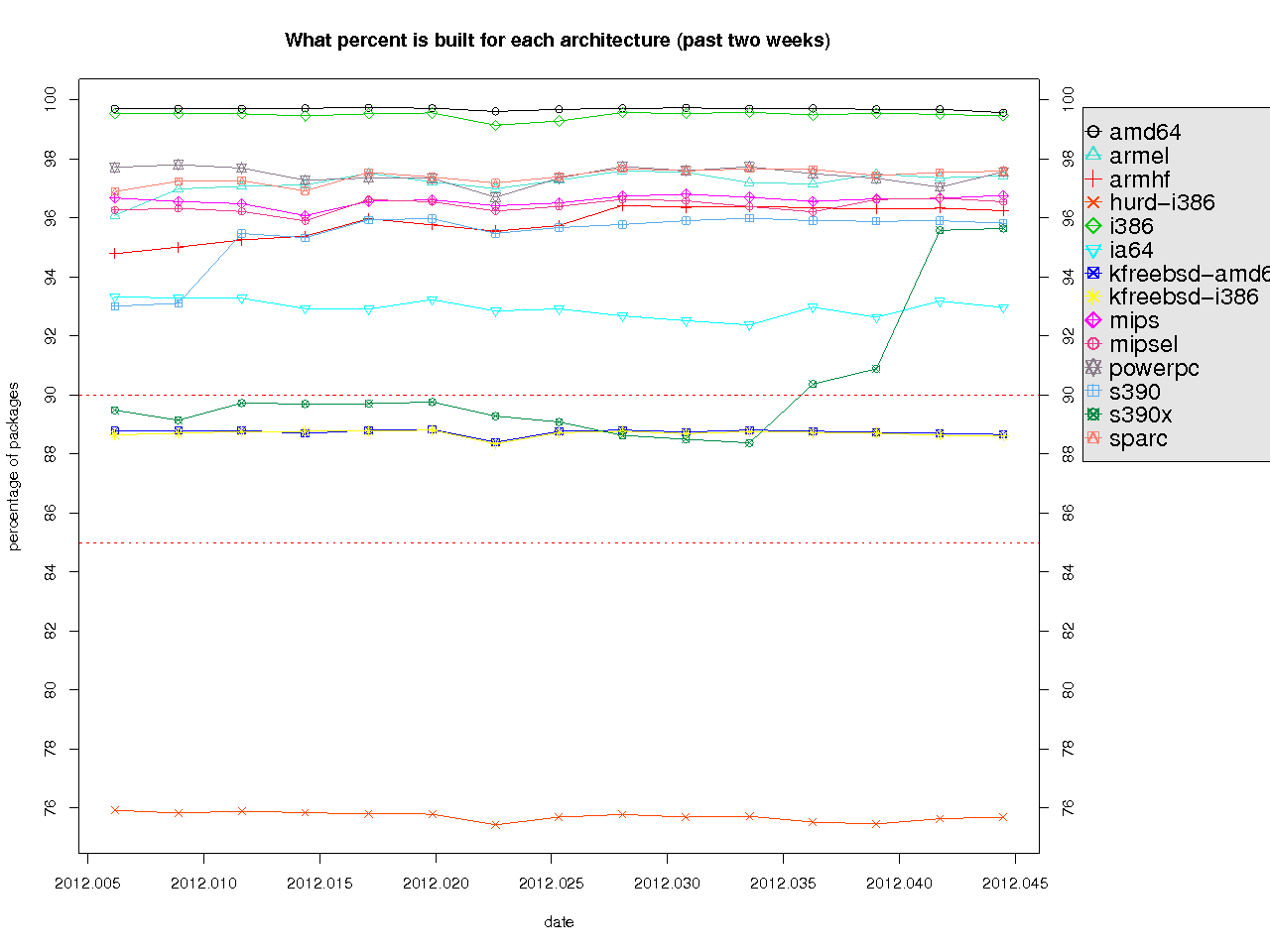
When we added s390x to the main archive, coming from Debian Ports, we were unlucky. A new glib release had assumptions that weren't true on 64bit big endian architectures and it entered the archive just a few days before we made the initial import. This weekend we finally got a new major release into Debian unstable that fixed these issues. So we're almost on par with s390 now. It all untangled quite nicely after glib-networking was able to complete its testsuite. Only one build-dependency loop between nautilus and tracker had to be broken manually.

So what's left? There's a bunch of usertagged bugs (with both general FTBFSes and arch-specific issues; kudos to Aur lien Jarno providing a lot of patches) and we still need to file some, like iceweasel segfaulting during its build. That's important because another bunch of packages needs it to build (well, mozjs and/or xulrunner, or some package that needs those).

24 March 2012

Dirk Eddelbuettel: Initial release 0.1.0 of package RcppSMC

Hm, I realized that I announced this on Google+ (via Rcpp) as well as on Twitter, on the r-packages list, wrote a new and simple web page for it, but had not put it on my blog. So here is some catching up. Sequential Monte Carlo / Particle Filter is a (to quote the Wikipedia page I just linked to) sophisticated model estimation technique based on simulation. They are related to both Kalman Filters, and Markov Chain Monte Carlo methods. Adam Johansen has a rather nice set of C++ classes documentated in his 2009 paper in the Journal of Statistical Software (JSS). I started to play with these classes and realized that, once again, this would make perfect sense in an R extension built with the Rcpp package by Romain and myself (and in JSS too). So I put a first prototype onto R-Forge and emailed Adam who, to my pleasant surprise, was quite interested. And a couple of emails, and commits later, we are happy to present a very first release 0.1.0. I wrote a few words on a RcppSMC page on my website where you can find a few more details. But in short, we already have example functions demonstrating the backend classes by reproducing examples from
Johansen (2009)
and his example 5.1 via pfLineartBS() for a linear bootstrap example;
Doucet, Briers and Senecal (2006)
and their (optimal) block-sampling particle filter for a linear Gaussian model (serving as an illustration as the setup does of course have an analytical solution) via the function blockpfGaussianOpt()
Gordon, Salmond and Smith (1993)
and their ubiqitous nonlinear state space model via the function pfNonlinBS().
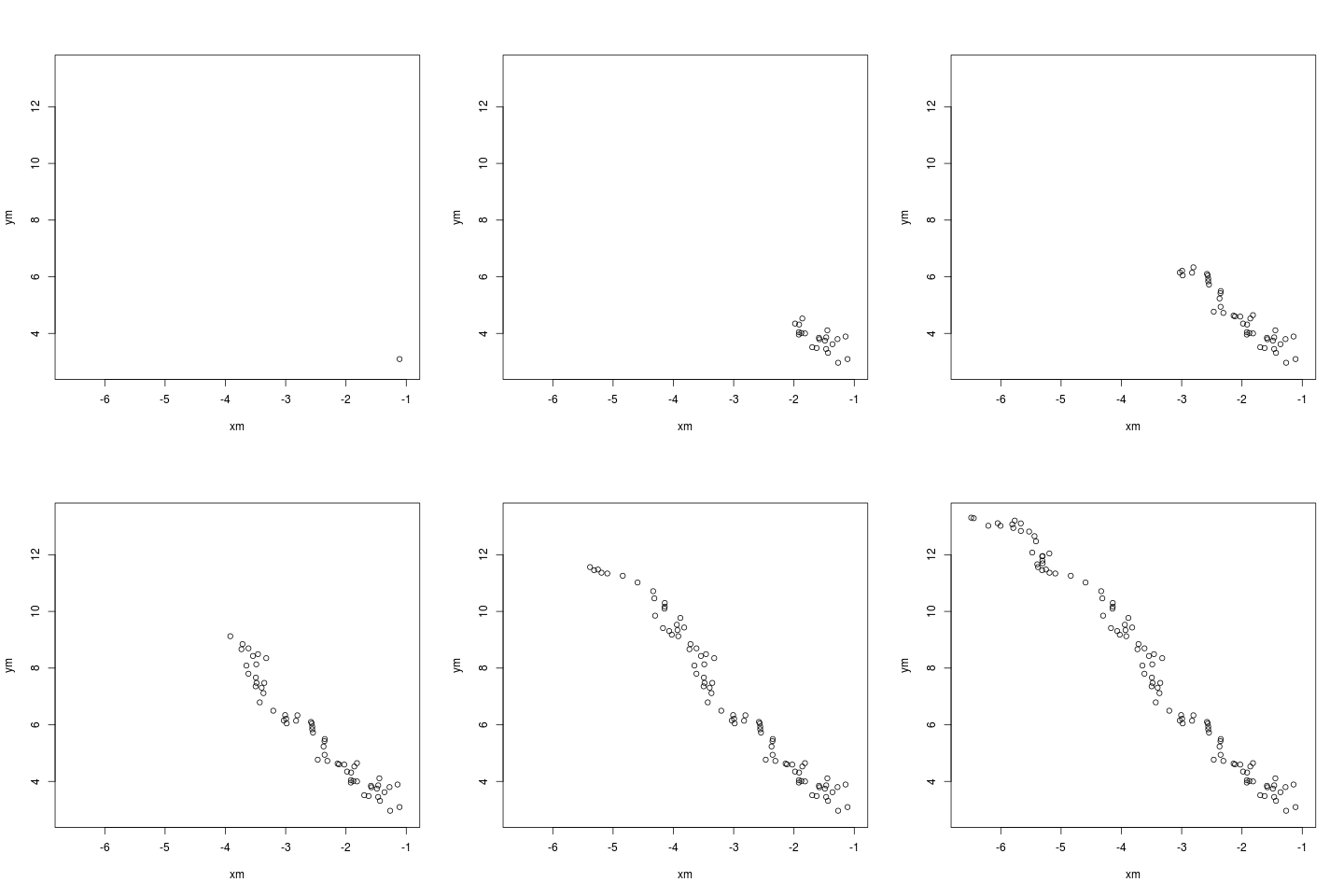
And to illustrate just why Rcpp is so cool for this, here is a little animation of a callback from the C++ code when doing the filtering on Adam's example 5.1. By passing a simple plotting function, written in R, to the C++ code, we can get a plot updated on every iteration. Here I cheated a little and used our old plot function with fixed ranges, the package now uses a more general function: Example of RcppSMC callback to R plot when estimation example 5.1 from Johansen (2009) The animation is of course due to ImageMagick glueing one hundred files into a single animated gif. More information about RcppSMC is on its page, and we intend to add more examples and extensions over time.

9 March 2012

Tanguy Ortolo: JSON License considered harmful

Summary The JSON License may seem interesting, but it a bad license, both non-free and ambiguous: do not use it. If you are the author of a piece of software that uses JSMin or its PHP port, consider dropping that non-free part or at least rendering it optional.The JSON license Do you know the JSON License? It is a software license inspired by the MIT/Expat license with one additional morality clause:
The Software shall be used for Good, not Evil.
Non-free For novices that clause can be perceived as a good idea serving a noble goal. But the problem here is that is would make your software non-free. Indeed, there are two common definitions of free software: the FSF definition, and the Debian Free Software Guidelines, also known as the Open Source Definition. Basically, both definitions indicate that to be free, a piece of software must be usable with no restrictions, and forbidding evil uses is such a restriction. Specifically, it violates: Ambiguous In addition to these incompatibilities to being free, this morality clause implies additional problems, the most important one being that it is ambiguous, which is very bad for a license clause: who exactly defines what is Good and what is Evil? If it is the author, then this clause could be used for arbitrarily forbidding any use; it it is the licensee, then this clause it as good as void. Do not use it For all these reasons, the JSON License with that infamous morality clause is not suitable for free software, so if you plan to use that license for your work, please consider these suggestions: 1. do not; 2. do not, really; 3. if still in doubt, refer to point 1. There are several standard free software licenses, the closest one being the MIT/Expat one, that you should consider instead. Now, if you really want to be considered as non-free, and rejected by Debian, Red Hat/Fedora, Google Code and more generally any free software distributor, this is the way to go. On thing worth noting is that this morality clause only annoys free software distributors, that are certainly not doing Evil, but will not prevent any evil person to do Evil things with your software. To encourage people to do Good rather than Evil, it would be better to formulate that clause as a suggestion rather than an order:
The Software should rather be used for Good, not Evil.
The JSMin case This infamous JSON License is known to be used by JSMin and its PHP port. If you are a Web application author, be careful when embedded external content, since it can render you whole piece of software non-free! If you are using JSMin, I would suggest that you drop it, or at least make it optional by using a conditional (if JSMin is here, use it, otherwise do nothing) so that distributors such as Debian can expurgate that non-free part.

Bartosz Feński: httpie package

Tired of using curl to debug webapps?
curl -i -X PUT -H 'Content-Type:application/json; charset=utf-8' -d ' "hello":"world" ' http://httpbin.org/put
Looks quite complicated and for sure it is error prone.
http PUT httpbin.org/put hello=world
This looks much better, and I ve just created package with this useful tool. It s called httpie and is already in NEW queue. Besides simplifying syntax it has also color output which makes results more readable. For the impatient I put this package also on my people.d.o page.

5 March 2012

John Sullivan: Plus One

In mailing list discussions, I've noticed that the practice of replying "+1" to messages with which one agrees has become very widespread. I think this is interesting for a lot of reasons, such as what it shows about habits picked up in communicating via social network sites that grew out of e-mail percolating back to e-mail. We seem to have really grown to like this idea of "voting" for people's messages, and if there's no "Like" or "+1" button on their message, we'll make our own. (Likewise, apparently a person's name is no longer sufficient to indicate that one is addressing them in an e-mail -- am I right, @dear_reader?) The problem for me is that I have my venerable awesome e-mail client Gnus set to hide quoted text in messages by default with (add-hook 'gnus-article-prepare-hook (lambda () (gnus-article-hide-citation 1))), and it thinks that "+" is the start of a quoted line -- so it hides the "+1". While there's a certain poetic justice to that, it confuses me because it makes the message look empty, and someone could do something like "+1 I'm pregnant too", causing me to miss some very important news. The fix for this is to change the regexp pattern Gnus uses to decide if a line is a message quote or not. gnus-message-cite-prefix-regexp is built using message-cite-prefix-regexp, so I changed the value of the latter, removing the literal "+". I also found while investigating this that I already configure that variable in order to add "#>" which someone sometime during my 9 years of using Gnus must have used. The net result is (setq message-cite-prefix-regexp "\\([ ]*[-_.#[:word:]]+>+\\ [ ]*[]> ]\\)+"). (Note that some of those whitespace characters are tabs, which probably won't display properly here, but you can compare to the default value to see what I actually changed). +1?

4 March 2012

Gregor Herrmann: RC bugs 2012/09

as usual, here's my RCBW report. like in the last weeks, a mixture of NMUs and mails to the BTS, grabbing and writing patches, ...

Steve Kemp: Symbiosis is wonderful

Symbiosis
Symbiosis is the collective name given to a group of Debian GNU/Linux packages which implement simple virtual hosting. It is developed by my employers Bytemark. Symbiosis is basically a collection of configuration snippets, code, and libraries which works to offer virtual hosting in a reliable consistent and easy to understand fashion. You implement hosting for a new domain by merely creating a directory tree. So for example you might configure the hosting for the domain example.com by running:
mkdir -p /srv/example.com/public/htdocs
echo "hello, world" >> /srv/example.com/public/htdocs/index.html
mkdir -p /srv/example.com/mailboxes/webmaster
echo "super-secret" > /srv/example.com/mailboxes/webmaster/password
mkdir -p /srv/example.com/config
echo "3l33t" > /srv/example.com/mailboxes/config/ftp-password
There you are, now http://www.example.com/ and http://example.com/ will work, and you may login to check mail with the email address webmaster@example.com via POP3, IMAP, IMAPS, or POP3S. Finally you can FTP with username example.com and be dropped into the public directory. The mail handling is very flexible, and the webhosting supports wonderful things. I don't generally talk about work-stuff explicitly, but we've just made a major new release of the Symbiosis system such that it works upon Squeeze and has lots of IPv6 support out of the box. (Email, DNS, HTTP, Firewalling, FTP etc.) All in all it is simple, well-documented, and open-source with a reasonably large user-base. More external testers, users, and developers would be a wonderful thing..
Mutt Mailboxes & Idle Hooks?
Mutt is wonderful but I'm starting to get annoyed by its lack of auto-mailbox discovery. Assuming you use procmail you might deliver mail to ~/Maildir/.foo/ and mutt won't notice that if the directory is created once it starts. (This is because generally mailboxes are defined via "mailboxes =one =two ..", even if you use a shell snippet it won't get updated unless you re-read configuration, or re-exec mutt). I wish it were possible to use inotify/dnotify/something magic such that everything beneath ~/Maildir would just work. (Re-reading mailboxes manually is one solution but it is .. nasty?) I'm thinking that of all the possible solutions one of the most potentially interesting would be to define a new hook: "idle-hook command .." That way "command" would be executed every time the client is idle. (This is a distinct state unrelated to IMAP IDLE times.) Nopte: There is already "mail_check" & "timeout" options. Even running a defined command immediately following the code for mail_check would be reasonable.
Reverse Proxy
I continue to use, love, and enjoy my node.js-based reverse HTTP proxy, and pub discussions seemed to suggest it is a great idea (due to flexibility) but it will never take on because people don't trust node. I'm almost tempted to re-code it in LUA & C. But I can't help but think that would be a waste of time which would not increase adoption - after all most people use "simple" reverse proxies, and they are well suited by Apache, nginx, or even varnish. Still no rush I suppose.
In more personal news after living in this flat for 7 years, or so, I'm getting a new bathroom designed and deployed. Good times. In the meantime I've been steadily watching Stargate SG-1 having recently purchased a box-set of series 1-10. I've just started series six this evening, and I'm enjoying it a lot. ObQuote: "You have been recruited by the Star League to defend the frontier against Xur and the Ko-Dan armada. " - The Last Starfighter (1984). First film I ever saw at a cinema as a child.

22 February 2012

Cyril Brulebois: Wrench days

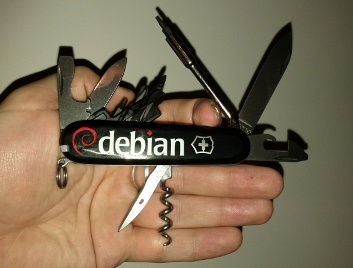
Fixing hardware Thanks to the nice Debian Swiss Knives initiative! Fixing software Besides trying to maintain the whole X stack as usual, and preparing the funky wayland, mesa, and weston trio for experimental, I got myself into other areas. Debugging gzip Jakup Wilk noticed a while ago that some multiarchified packages couldn t be co-installed due to gzipped files being different between architectures. That was reported as #647522 against the gzip package. While some developers consider the lack of determinism (as in: it s not in the gzip specification, and the current implementation generates different packages anyway!) as a dead-end for the multiarch experiment, it didn t look like undebuggable or unfixable. And indeed, as confirmed by a quick analysis: a lack of clean-up when several files are processed at once can lead to different results, depending on the order in which files are specified on the command line; the patch for that is trivial, and was later made smaller and the need for it was explained. Working in the Release Team I reviewed/approved a few packages for squeeze, but also took care of handling or finishing a few transitions (as seen in my hints file), among which the funny iceweasel9/libmozjs ones; release tools are nice, but one gets to learn lots of stuff at once (which isn t a negative aspect). I hacked a tiny collision detector so that packages involved in several transitions can be easily spotted. Given the huge number of ongoing transitions we had lately, that didn t look overkill. Squashing bugs It had been a very long time since my last working on totally random RC bugs. The Bug Squashing Party organized at IRILL was a very nice opportunity to get back to totally crazy bugs in unknown packages, but also to meet with other Debian contributors; sponsoring maintainers with good patches on their first try was nice, but walking other contributors through their first patches sent to the BTS or through their first NMUs was nice too. Waving good bye to yada Back in the M rida QA meeting I attended in 2007, there were already jokes about how bad yada was, and how it should die in a fire etc. When I started looking at the RC bug list, I quickly switched to scrolling it backwards, and I wondered how much work was left. The details can be seen in #660548, and the result is: yada is gone! sanity++; packages.debian.org Both long descriptions and translations for packages in some suites disappeared after the switch to Description-md5. Thanks to a quick and reduced packages.debian.org setup (mostly: en+de for squeeze+sid+experimental), I managed to find my way through Perl and DB files to propose patches for #657557. I m still waiting for a confirmation, but in case it works fine, we could even get a fix for DDTP/DDTSS.

16 February 2012

C.J. Adams-Collier: NIST::NVD CWE development follow along

I m in the process of getting the tests passing for the 0.03 release of NIST::NVD::Store::SQLite3 wherein our hero imports the CWE data and cross-indexes it with CVEs and CPEs. Follow along and suggest some patches. I m developing on Debian Wheezy, but I would very much like input from devs on other platforms. http://git.colliertech.org/?p=NIST-NVD-Store-SQLite3.git;a=summary
cjac@foxtrot:/tmp$ time git clone http://git.colliertech.org/git/NIST-NVD-Store-SQLite3.git
Cloning into 'NIST-NVD-Store-SQLite3'...
real	0m32.757s
user	0m0.200s
sys	0m0.088s
cjac@foxtrot:/tmp$ ls NIST-NVD-Store-SQLite3/t/data/
cwec_v2.1.xml  nvdcve-2.0-test.xml
Publish your patches and I ll fetch them, or you can submit them in udiff format and I ll review/apply. Thanks for playing along! [edit 20120216T1456 -0800]
Seems I need to update the NIST::NVD package as well.
cjac@foxtrot:/usr/src/git/f5/NIST-NVD-Store-SQLite3$ rm t/data/*.db *.db ; perl Makefile.PL ; make ; time perl -Iblib/lib /usr/src/git/f5/NIST-NVD-Store-SQLite3/blib/script/convert-nvdcve --nvd /usr/src/git/f5/NIST-NVD-Store-SQLite3/t/data/nvdcve-2.0-test.xml --cwe /usr/src/git/f5/NIST-NVD-Store-SQLite3/t/data/cwec_v2.1.xml --store SQLite3
rm: cannot remove  t/data/*.db': No such file or directory
Writing Makefile for NIST::NVD::Store::SQLite3
Writing MYMETA.yml and MYMETA.json
Skip blib/lib/NIST/NVD/Store/SQLite3.pm (unchanged)
cp bin/convert-nvdcve blib/script/convert-nvdcve
/usr/bin/perl -MExtUtils::MY -e 'MY->fixin(shift)' -- blib/script/convert-nvdcve
Manifying blib/man3/NIST::NVD::Store::SQLite3.3pm
using store [SQLite3]
reading NVDs from file: /usr/src/git/f5/NIST-NVD-Store-SQLite3/t/data/nvdcve-2.0-test.xml.......................................................................read 68 entries
Processing CWE file...vvvvvvvvvvvvvvvvvvvvvvvvvvvcccccccccccccccccccccccccccccccccccccccccccccccccccccccccccccccccccccccccccccccccccccccccccccccccccccccccccccccccccccccccccccccccccccccccccccccccccccccccccccwwwwwwwwwwwwwwwwwwwwwwwwwwwwwwwwwwwwwwwwwwwwwwwwwwwwwwwwwwwwwwwwwwwwwwwwwwwwwwwwwwwwwwwwwwwwwwwwwwwwwwwwwwwwwwwwwwwwwwwwwwwwwwwwwwwwwwwwwwwwwwwwwwwwwwwwwwwwwwwwwwwwwwwwwwwwwwwwwwwwwwwwwwwwwwwwwwwwwwwwwwwwwwwwwwwwwwwwwwwwwwwwwwwwwwwwwwwwwwwwwwwwwwwwwwwwwwwwwwwwwwwwwwwwwwwwwwwwwwwwwwwwwwwwwwwwwwwwwwwwwwwwwwwwwwwwwwwwwwwwwwwwwwwwwwwwwwwwwwwwwwwwwwwwwwwwwwwwwwwwwwwwwwwwwwwwwwwwwwwwwwwwwwwwwwwwwwwwwwwwwwwwwwwwwwwwwwwwwwwwwwwwwwwwwwwwwwwwwwwwwwwwwwwwwwwwwwwwwwwwwwwwwwwwwwwwwwwwwwwwwwwwwwwwwwwwwwwwwwwwwwwwwwwwwwwwwwwwwwwwwwwwwwwwwwwwwwwwwwwwwwwwwwwwwwwwwwwwwwwwwwwwwwwwwwwwwwwwwwwwwwwwwwwwwwwwwwwwwwwwwwwwwwwwwwwwwwwwwwwwwwwwwwwwwwwwwwwwwwwwwwwwwwwwwwwwwwwwwwwwwwwwwwwwwwwwwwwwwwwwwwwwwwwwwwwwweeeeeeeeeDone.
Writing CPE URNs to disk...Done.
Writing NVD entries to disk....................................................................... Done.
Writing CPE index to disk...Done.
Writing CWE index to disk...Can't locate object method "put_idx_cwe" via package "NIST::NVD::Update" at /usr/src/git/f5/NIST-NVD-Store-SQLite3/blib/script/convert-nvdcve line 77.
real	0m13.072s
user	0m12.421s
sys	0m0.044s
$ time git clone http://git.colliertech.org/git/NIST-NVD.git
Cloning into 'NIST-NVD'...
real	0m2.921s
user	0m0.016s
sys	0m0.024s
[edit 20120216T16:28 -0800]
cjac@foxtrot:/usr/src/git/f5/NIST-NVD$ git log   head -5
commit 82c72a79ee810c2b5c269a15dca5151ad67059f9
Author: C.J. Adams-Collier <cjac>
Date:   Thu Feb 16 16:25:53 2012 -0800
    added put_idx_cwe to NIST::NVD::Update
[edit 20120216T1635 -0800]
cjac@foxtrot:/usr/src/git/f5/NIST-NVD-Store-SQLite3$ rm t/data/*.db *.db ; perl Makefile.PL ; make ; time perl -Iblib/lib /usr/src/git/f5/NIST-NVD-Store-SQLite3/blib/script/convert-nvdcve --nvd /usr/src/git/f5/NIST-NVD-Store-SQLite3/t/data/nvdcve-2.0-test.xml --cwe /usr/src/git/f5/NIST-NVD-Store-SQLite3/t/data/cwec_v2.1.xml --store SQLite3
rm: cannot remove  t/data/*.db': No such file or directory
Writing Makefile for NIST::NVD::Store::SQLite3
Writing MYMETA.yml and MYMETA.json
Skip blib/lib/NIST/NVD/Store/SQLite3.pm (unchanged)
cp bin/convert-nvdcve blib/script/convert-nvdcve
/usr/bin/perl -MExtUtils::MY -e 'MY->fixin(shift)' -- blib/script/convert-nvdcve
Manifying blib/man3/NIST::NVD::Store::SQLite3.3pm
using store [SQLite3]
reading NVDs from file: /usr/src/git/f5/NIST-NVD-Store-SQLite3/t/data/nvdcve-2.0-test.xml.......................................................................read 68 entries
Processing CWE file...vvvvvvvvvvvvvvvvvvvvvvvvvvvcccccccccccccccccccccccccccccccccccccccccccccccccccccccccccccccccccccccccccccccccccccccccccccccccccccccccccccccccccccccccccccccccccccccccccccccccccccccccccccwwwwwwwwwwwwwwwwwwwwwwwwwwwwwwwwwwwwwwwwwwwwwwwwwwwwwwwwwwwwwwwwwwwwwwwwwwwwwwwwwwwwwwwwwwwwwwwwwwwwwwwwwwwwwwwwwwwwwwwwwwwwwwwwwwwwwwwwwwwwwwwwwwwwwwwwwwwwwwwwwwwwwwwwwwwwwwwwwwwwwwwwwwwwwwwwwwwwwwwwwwwwwwwwwwwwwwwwwwwwwwwwwwwwwwwwwwwwwwwwwwwwwwwwwwwwwwwwwwwwwwwwwwwwwwwwwwwwwwwwwwwwwwwwwwwwwwwwwwwwwwwwwwwwwwwwwwwwwwwwwwwwwwwwwwwwwwwwwwwwwwwwwwwwwwwwwwwwwwwwwwwwwwwwwwwwwwwwwwwwwwwwwwwwwwwwwwwwwwwwwwwwwwwwwwwwwwwwwwwwwwwwwwwwwwwwwwwwwwwwwwwwwwwwwwwwwwwwwwwwwwwwwwwwwwwwwwwwwwwwwwwwwwwwwwwwwwwwwwwwwwwwwwwwwwwwwwwwwwwwwwwwwwwwwwwwwwwwwwwwwwwwwwwwwwwwwwwwwwwwwwwwwwwwwwwwwwwwwwwwwwwwwwwwwwwwwwwwwwwwwwwwwwwwwwwwwwwwwwwwwwwwwwwwwwwwwwwwwwwwwwwwwwwwwwwwwwwwwwwwwwwwwwwwwwwwwwwwwwwwwwwwwwwwwwwwweeeeeeeeeDone.
Writing CPE URNs to disk...Done.
Writing NVD entries to disk....................................................................... Done.
Writing CPE index to disk...Done.
Writing CWE index to disk...Done.
real	0m13.968s
user	0m13.225s
sys	0m0.064s
Alright. before going to bed, I made those w characters above mean something. Same with some of the v characters above. [edit 20120217T10:50 -0800] Now processing the Categories from the CWE files. At this point we have parsed the Description elements. Next up are: [edit 20120217T11:35 -0800]
  1. Likelihood_of_Exploit
  2. Time_of_Introduction
  3. Affected_Resources
  4. Applicable_Platforms
cjac@foxtrot:/usr/src/git/f5/NIST-NVD-Store-SQLite3$ rm t/data/*.db *.db ; perl Makefile.PL ; make ; time perl -Iblib/lib /usr/src/git/f5/NIST-NVD-Store-SQLite3/blib/script/convert-nvdcve --nvd /usr/src/git/f5/NIST-NVD-Store-SQLite3/t/data/nvdcve-2.0-test.xml --cwe /usr/src/git/f5/NIST-NVD-Store-SQLite3/t/data/cwec_v2.1.xml --store SQLite3
rm: cannot remove  t/data/*.db': No such file or directory
Writing Makefile for NIST::NVD::Store::SQLite3
Writing MYMETA.yml and MYMETA.json
Skip blib/lib/NIST/NVD/Store/SQLite3.pm (unchanged)
cp bin/convert-nvdcve blib/script/convert-nvdcve
/usr/bin/perl -MExtUtils::MY -e 'MY->fixin(shift)' -- blib/script/convert-nvdcve
Manifying blib/man3/NIST::NVD::Store::SQLite3.3pm
using store [SQLite3]
reading NVDs from file: /usr/src/git/f5/NIST-NVD-Store-SQLite3/t/data/nvdcve-2.0-test.xml.......................................................................Done.
read 68 nvd entries
Processing CWE file...vvvvvvvvvvvvvvvvvvvvvvvvvvvvDDDcvDDDcvDDDcvDDDcvDDDcvDDDcvDDDcvDDDcvDDDcvDDDcvDDDcvDDDcvDDDcvDDDcvDDDcvDDDDDcvDDDcvDDDcvDDDDDcvDDDcvDDDcvDDDcvDDDcvDDDcvDDDcvDDDcvDDDcvDDDcvDDDcvDDDcvDDDDDcvDDDcvDDDcvDDDcvDDDcvDDDcvDDDDDcvDDDDDcvDDDcvDDDcvDDDcvDDDcvDDDcvDDDcvDDDcvDDDcvDDDcvDDDcvDDDcvDDDcvDDDcvDDDcvDDDcvDDDDDcvDDDcvDDDcvDDDDDcvDDDcvDDDcvDDDcvDDDcvDDDcvDDDcvDDDcvDDDcvDDDcvDDDcvDDDcvDDDcvDDDcvDDDcvDDDcvDDDcvDDDcvDDDcvDDDcvDDDcvDDDcvDDDcvDDDcvDDDcvDDDcvDDDcvDDDcvDDDcvDDDcvDDDcvDDDcvDDDcvDDDcvDDDcvDDDcvDDDcvDDDcvDDDcvDDDcvDDDcvDDDcvDDDcvDDDcvDDDcvDDDcvDDDcvDDDcvDDDcvDDDDDcvDDDcvDDDcvDDDcvDDDcvDDDcvDDDcvDDDcvDDDcvDDDcvDDDcvDDDcvDDDcvDDDcvDDDcvDDDDDcvDDDcvDDDcvDDDcvDDDcvDDDcvDDDcvDDDcvDDDcvDDDcvDDDcvDDDcvDDDcvDDDcvDDDcvDDDcvDDDcvDDDcvDDDcvDDDcvDDDcvDDDcvDDDcvDDDcvDDDcvDDDcvDDDcvDDDcvDDDcvDDDcvDDDcvDDDcvDDDcvDDDcvDDDcvDDDcvDDDcwwwwwwwwwwwwwwwwwwwwwwwwwwwwwwwwwwwwwwwwwwwwwwwwwwwwwwwwwwwwwwwwwwwwwwwwwwwwwwwwwwwwwwwwwwwwwwwwwwwwwwwwwwwwwwwwwwwwwwwwwwwwwwwwwwwwwwwwwwwwwwwwwwwwwwwwwwwwwwwwwwwwwwwwwwwwwwwwwwwwwwwwwwwwwwwwwwwwwwwwwwwwwwwwwwwwwwwwwwwwwwwwwwwwwwwwwwwwwwwwwwwwwwwwwwwwwwwwwwwwwwwwwwwwwwwwwwwwwwwwwwwwwwwwwwwwwwwwwwwwwwwwwwwwwwwwwwwwwwwwwwwwwwwwwwwwwwwwwwwwwwwwwwwwwwwwwwwwwwwwwwwwwwwwwwwwwwwwwwwwwwwwwwwwwwwwwwwwwwwwwwwwwwwwwwwwwwwwwwwwwwwwwwwwwwwwwwwwwwwwwwwwwwwwwwwwwwwwwwwwwwwwwwwwwwwwwwwwwwwwwwwwwwwwwwwwwwwwwwwwwwwwwwwwwwwwwwwwwwwwwwwwwwwwwwwwwwwwwwwwwwwwwwwwwwwwwwwwwwwwwwwwwwwwwwwwwwwwwwwwwwwwwwwwwwwwwwwwwwwwwwwwwwwwwwwwwwwwwwwwwwwwwwwwwwwwwwwwwwwwwwwwwwwwwwwwwwwwwwwwwwwwwwwwwwwwwwwwwwwwwwwwwwwwwwwwweeeeeeeeeDone.
read 27 cwe Views
read 1 cwe Categories
read 693 cwe Weaknesses
read 1 cwe Compound Elements
Writing CPE URNs to disk...Done.
Writing NVD entries to disk....................................................................... Done.
Writing CPE index to disk...Done.
Writing CWE index to disk...Done.
real	0m14.306s
user	0m13.501s
sys	0m0.072s
[edit 20120217T1333 -0800] Alright, I ve got enough of the CWE processing done that I feel comfortable releasing this stuff. Let s make sure that the data got all the way down into the database. I ll write some tests in t/cwe.t to exercise the CRUD [edit 20120217T1345 -0800] Tests are in place and failing (this is good, by the way). Now to turn the tests green.
cjac@foxtrot:/usr/src/git/f5/NIST-NVD-Store-SQLite3$ pushd ../NIST-NVD ; perl Makefile.PL ; make ; popd ; rm t/data/*.db *.db ; perl Makefile.PL ; make ; time prove -v -I../NIST-NVD/blib/lib -Iblib/lib t/cwe.t
/usr/src/git/f5/NIST-NVD /usr/src/git/f5/NIST-NVD-Store-SQLite3 /usr/src/git/f5/NIST-NVD-Store-SQLite3 /usr/src/git/f5/NIST-NVD /usr/src/git/f5/NIST-NVD /usr/src/git/f5/NIST-NVD-Store-SQLite3 /usr/src/svn/f5/axiom/branches/cjac/F5-Discovery
Writing Makefile for NIST::NVD
Writing MYMETA.yml and MYMETA.json
Skip blib/lib/NIST/NVD/Store/Base.pm (unchanged)
Skip blib/lib/NIST/NVD.pm (unchanged)
Skip blib/lib/NIST/NVD/Query.pm (unchanged)
Skip blib/lib/NIST/NVD/Update.pm (unchanged)
Skip blib/lib/NIST/NVD/Store/DB_File.pm (unchanged)
cp bin/convert-nvdcve blib/script/convert-nvdcve
/usr/bin/perl -MExtUtils::MY -e 'MY->fixin(shift)' -- blib/script/convert-nvdcve
Manifying blib/man3/NIST::NVD::Store::Base.3pm
Manifying blib/man3/NIST::NVD.3pm
Manifying blib/man3/NIST::NVD::Query.3pm
Manifying blib/man3/NIST::NVD::Update.3pm
Manifying blib/man3/NIST::NVD::Store::DB_File.3pm
/usr/src/git/f5/NIST-NVD-Store-SQLite3 /usr/src/git/f5/NIST-NVD-Store-SQLite3 /usr/src/git/f5/NIST-NVD /usr/src/git/f5/NIST-NVD /usr/src/git/f5/NIST-NVD-Store-SQLite3 /usr/src/svn/f5/axiom/branches/cjac/F5-Discovery
rm: cannot remove  t/data/*.db': No such file or directory
Writing Makefile for NIST::NVD::Store::SQLite3
Writing MYMETA.yml and MYMETA.json
Skip blib/lib/NIST/NVD/Store/SQLite3.pm (unchanged)
cp bin/convert-nvdcve blib/script/convert-nvdcve
/usr/bin/perl -MExtUtils::MY -e 'MY->fixin(shift)' -- blib/script/convert-nvdcve
Manifying blib/man3/NIST::NVD::Store::SQLite3.3pm
t/cwe.t ..
1..10
ok 1 - use NIST::NVD::Query;
ok 2 - no error
ok 3 - constructor returned an object of correct class
not ok 4 - cve_for_cpe returned ARRAY ref
#   Failed test 'cve_for_cpe returned ARRAY ref'
#   at t/cwe.t line 36.
#          got: ''
#     expected: 'ARRAY'
not ok 5 - cwe_for_cpe returned ARRAY ref
#   Failed test 'cwe_for_cpe returned ARRAY ref'
#   at t/cwe.t line 37.
#          got: ''
#     expected: 'ARRAY'
Can't use an undefined value as an ARRAY reference at t/cwe.t line 39.
# Looks like you planned 10 tests but ran 5.
# Looks like you failed 2 tests of 5 run.
# Looks like your test exited with 2 just after 5.
Dubious, test returned 2 (wstat 512, 0x200)
Failed 7/10 subtests 
Test Summary Report
-------------------
t/cwe.t (Wstat: 512 Tests: 5 Failed: 2)
  Failed tests:  4-5
  Non-zero exit status: 2
  Parse errors: Bad plan.  You planned 10 tests but ran 5.
Files=1, Tests=5,  1 wallclock secs ( 0.02 usr  0.00 sys +  0.07 cusr  0.01 csys =  0.10 CPU)
Result: FAIL
real	0m0.442s
user	0m0.144s
sys	0m0.028s
[edit 20120220T1311 -0800] CWE load is passing. It takes 13 seconds to process all CWEs in cwec_v2.1.xml and some recent CVEs from the 13th of December of 2011. It seems I ve broken t/query.t, though. When it s green I ll push a new release. Everything is in master. Check it out if you like pain.
cjac@foxtrot:/usr/src/git/f5/NIST-NVD-Store-SQLite3$ rm t/data/*.db ; pushd ../NIST-NVD/ ; perl Makefile.PL ; make ; popd ; perl -I../NIST-NVD/blib/lib Makefile.PL ; make ; PERL5LIB=../NIST-NVD/blib/lib:blib/lib prove -I../NIST-NVD/blib/lib -bv t/01-load-nvdcve.t
/usr/src/git/f5/NIST-NVD /usr/src/git/f5/NIST-NVD-Store-SQLite3
Writing Makefile for NIST::NVD
Writing MYMETA.yml and MYMETA.json
Skip blib/lib/NIST/NVD/Store/Base.pm (unchanged)
Skip blib/lib/NIST/NVD.pm (unchanged)
Skip blib/lib/NIST/NVD/Query.pm (unchanged)
Skip blib/lib/NIST/NVD/Update.pm (unchanged)
Skip blib/lib/NIST/NVD/Store/DB_File.pm (unchanged)
cp bin/convert-nvdcve blib/script/convert-nvdcve
/usr/bin/perl -MExtUtils::MY -e 'MY->fixin(shift)' -- blib/script/convert-nvdcve
Manifying blib/man3/NIST::NVD::Store::Base.3pm
Manifying blib/man3/NIST::NVD.3pm
Manifying blib/man3/NIST::NVD::Query.3pm
Manifying blib/man3/NIST::NVD::Update.3pm
Manifying blib/man3/NIST::NVD::Store::DB_File.3pm
/usr/src/git/f5/NIST-NVD-Store-SQLite3
Writing Makefile for NIST::NVD::Store::SQLite3
Writing MYMETA.yml and MYMETA.json
Skip blib/lib/NIST/NVD/Store/SQLite3.pm (unchanged)
cp bin/convert-nvdcve blib/script/convert-nvdcve
/usr/bin/perl -MExtUtils::MY -e 'MY->fixin(shift)' -- blib/script/convert-nvdcve
Manifying blib/man3/NIST::NVD::Store::SQLite3.3pm
t/01-load-nvdcve.t ..
1..20
ok 1 - $dist_dir is a directory
ok 2 - $test_dir is a directory
ok 3 - $data_dir is a directory
ok 4 - $convert_script is a file
ok 5 - $nvd_source_file is a file
ok 6 - $db_file does not yet exist
# running /usr/src/git/f5/NIST-NVD-Store-SQLite3/blib/script/convert-nvdcve --nvd /usr/src/git/f5/NIST-NVD-Store-SQLite3/t/data/nvdcve-2.0-test.xml --cwe /usr/src/git/f5/NIST-NVD-Store-SQLite3/t/data/cwec_v2.1.xml --store SQLite3 2>&1
ok 7 - took less than 15 seconds to load CWE data: 13
ok 8 - conversion script returned cleanly
ok 9 - database file exists
ok 10 - database file not empty
ok 11 - database file readable
ok 12 - database file writeable
ok 13 - database file not executable
ok 14 - file is correct type: [application/octet-stream]
ok 15 - $mtime is close
ok 16 - opened database file for reading
ok 17 - file contents indicate correct type: [application/octet-stream]
ok 18 - file contents indicate correct type: [application/octet-stream]
ok 19 - file contents indicate correct type: [SQLite 3.x database]
ok 20 - constructor returned an object of correct class
ok
All tests successful.
Files=1, Tests=20, 13 wallclock secs ( 0.02 usr  0.02 sys + 12.78 cusr  0.07 csys = 12.89 CPU)
Result: PASS
[edit 20120220T2220 -0800]
Okay, it s published. I ll need to factor the changes in to the DB_File storage engine as well.

12 February 2012

Gregor Herrmann: RC bugs 2012/05-06

I was at FOSDEM over the last weekend, so here's my report for two weeks now:

Jose Luis Rivas Contreras: Express Sessions with connect-redis + Socket.IO in CoffeeScript

If you are working with Socket.IO and Express Framework while developing your applications you must know they work together so Socket.IO will listen on the same port that your HTTP/S server and will serve the requests by that way, but Socket.IO doesn t works on the same paradigm where you pass a middleware to the route and you could get authentication on this manner. Instead, you must configure Socket.IO with a global authorization method or a handshake authorization manner. Since in my applications I serve cookies already where I save session info and this is already stored in Redis with help of the module connect-redis then I should be able to get this info onto Socket.IO authorization method and with this allow only to authorized users to get info from my websockets. I found how to do it with the default session-store in-memory from Express, and adapted that so it could work with Redis. Here s the snippet: <script src="https://gist.github.com/1805743.js"> </script><noscript>You don t have JavaScript enabled, check it out at gist.github.com </noscript> Hope anyone can found it useful!

5 February 2012

Steve Kemp: Some domains just don't learn

For the past few years the anti-spam system I run has been based on a simplified version of something I previously ran commercially. Although the code is similar in intent there were both explicit feature removals, and simplifications made. Last month I re-implimented domain-blacklisting - because a single company keeps ignoring requests to remove me. So LinkedIn.com if you're reading this: I've also implemented TLD-blacklisting which has been useful.
TLD-blacklisting in my world is not about blocking mail from foo@bar.ph (whether in the envelope sender, or the from: header), instead it is about matching the reverse DNS of the connecting client. If I recieve a connection from 1.2.3.4 and the reverse DNS of that IP address matches, say, /\.sa$/i then I default to denying it. My real list is longer, and handled via files:
steve@steve:~$ ls /srv/_global_/blacklisted/tld/ -C
ar  br  cn  eg  hr  in  kr  lv  mn  np  ph  ro  sg  tg  ua  ve  zw
aw  cc  cy  gm  hu  is  kz  ma  my  nu  pk  rs  sk  th  ug  vn
be  ch  cz  gr  id  it  lk  md  mz  nz  pl  ru  su  tr  uy  ws
bg  cl  ec  hk  il  ke  lt  mk  no  om  pt  sa  sy  tw  uz  za
On average I'm rejecting about 2500 messagse a day at SMTP-time, and 30 messages, or so, hit my SPAM folder after being filtered with CRM114 after being accepted for delivery. (They are largely from @hotmail and @yahoo, along with random compromised machines. The amount of times I see a single mail from a host with RDNS mysql.example.org is staggering.). (Still looking forward to the development of Haraka, a node.js version of qpsmtpd.) ObQuote: "Mr. Mystery Guest? Are you still there? " - Die Hard

30 January 2012

Jordi Mallach: GNOME Shell 3.2 in wheezy: a retrospective

When you read this, GNOME Shell 3.2 will (hopefully!) have finally transitioned to Debian s testing suite. Planet GNOME readers might think Debian now has outdated versions of software even in their development versions, or the distribution s development marches at glacial pace. Wheezy GNOME users will finally have a Shell that matches the rest of their GNOME components, something that works with the Shell extensions website and much less problems and limitations compared to 3.0.2. The reality is that GNOME 3.2 s packaging was quite ready back when it was released in late September, but a number of not-so-desirable situations held GNOME Shell from transitioning to testing until today, four months later. So, what happened? TL;DR: transitioning from GNOME 2 GNOME 3 is not so easy if you want to keep testing in a sane state, and when you need to deal with dozens of indirectly related packages, for more than 10 architectures but it shouldn t take nearly a full year, either Let s go back to the last months of 2010. Debian squeeze is in very deep freeze, and the release team and many Debian developers are focusing on squashing as many release critical bugs as they can, in order to make Debian 6.0 the great release it ended up being. The GNOME project has recently delayed the big launch of GNOME 3.0 again, until March 2011; Debian has already settled on GNOME 2.28 for its release, although it will end up cherry-picking many updates from the 2.30 release modules. With most of the stabilization work being done, many Debian GNOME team members were at that time working on packaging very early versions of what would end up being GNOME 3.0 technology: GTK+3.0, GNOME Shell, Mutter and some brave users even tried to use it via the experimental archive. On February 6th, Debian 6.0 was released, and soon after, on April 6th, GNOME made a huge step forward with the much anticipated release of GNOME 3.0. At that time, Debian developers were busy breaking unstable as much as they could, as it s tradition on the weeks following a major release, and the Debian GNOME team was able to start moving some GNOME 3.0 libraries (those which were parallel-installable with their GTK+2.0 versions) to unstable. However, moving the bulk of GNOME 3.0 to unstable wasn t so easy. When you start doing that, you need to be sure you re ready to have all affected packages in a transitionable state as soon as possible, to minimise the chances of blocking transitions of unrelated packages via the dependencies they pick up with rebuilds. All the packages involved in a transition need to be ready to go in the same testing run , for all supported architectures. When you re dealing with dozens of GNOME source packages at the same time, many of which introduce new libraries, or worse, introduce incompatible APIs that affect many more unrelated packages, things get hairy, and you need a plan. So, Joss outlined what a sane approach to this monster transition could look like. The amount of work to do was what we call fun on #debian-gnome. In a nutshell, we had to deal with quite a few transitions, starting with having a newer version of libnotify in unstable, and a pre-requisite for that was making sure all the packages using libnotify1 were ready to use the source-incompatible libnotify4, and this meant preparing patches and NMUs for many of our packages, as well as many others not under our control. Before starting a controlled transition like this one, we had to get an ACK from the release team, who was busy enough handling other huge transitions like Perl 5.12, so by the time we got our own slot, we were well into Summer. With libnotify done in August, it was time to get our hands dirty with more exciting stuff, like getting Nautilus in testing. This meant bumping a soname and requiring all packages providing Nautilus extensions to migrate to GTK+3.0, or drop the extension entirely, as you can t mix GTK+2.0 and GTK+3.0 symbols in the same process. However, in GNOME 3.0, automounting code had moved from Nautilus to gnome-settings-daemon, so in order to not break filesystem automounting in testing for an unreasonable amount of time, both Nautilus and g-s-d needed to go in at the same time. The fun thing is that g-s-d dragged glib2.0, gvfs, gnome-control-center, gdm3, gnome-media, gnome-session and gnome-panel into the equation, so this transition needed extra planning and a lot more work than initially expected: migrating all nautilus extensions, plus ensuring all Panel applets had migrated to GTK+3.0 and the new libpanel-applet-4 interface. In short, this was the monster transition we were trying to avoid. By the time all this mess was sorted out, GNOME 3.2 had been released, and for what users said, it was a lot better than 3.0. We still had no more than a few bits and pieces of 3.0 in testing, and we were working hard to get 3.0 in wheezy. With all the excitement around 3.2, at times it was difficult to explain outsiders why we were beating a dead 3.0 horse Going back to our huge transition, it was just a matter of time before all the packages would be built and be ready to enter, on the same run, in testing. A few weeks later, in early November and after several rounds of mass-bug-filings, fixing unrelated FTBFS, many NMUs, package removal requests and dealing with any possible problem that could block our transition, everything seemed to be set, and our release team magicians had everything in place for the big magic to happen. However, our first clash with the rest of Debian happened a few hours before our victory, in the form of an unannounced ruby-gnome2 upload which resetted the count for everyone. It was fun to see the release team trying all sorts of black magic in an attempt to mitigate the damage. Fortunately, after a few tries they managed to fool britney (the script that handles package transitions from unstable to testing) somehow, and the hardest part of the job was done with just one day of delay. At last, the core of GNOME 3 was in testing, and testing users found soon after. The rest of the week saw a cascade of hate posts against GNOME 3 in Planet Debian, and personally I didn t find that especially motivating to keep on working on the rest of GNOME bits. With experimental clear of GNOME 3.0 stuff, we finally were able to focus on packaging whatever GNOME 3.2 components were not already done, and preparing for what should be a plain simple transition of GNOME 3.0 to 3.2. After our share of wait for a transition slot, as Perl 5.14, ICU and OpenSSL were in the line before us, and after dealing with a minor tracker 0.12 transition, we were ready for our next episode: evolution-data-server. At first sight, we thought this would be a lot easier, but it still got a bit hairy due to evo-data-server massive soname bumps. We were given our slot just before Christmas, after a few weeks of wait for others to finish their migration rounds, and most of the pack entered wheezy a few days before the new year. No rejoicing, though, as GNOME Shell 3.2 didn t make it. First, we discovered it was FTBFS on kFreeBSD architectures, as NetworkManager had been promoted from optional to required, for apparently no good reason, leaving the BSD world in the cold, including our exotic GNU/kFreeBSD architectures. Now, let s clarify that I m a supporter of the Debian kFreeBSD architectures and was really happy to see it accepted as a technology preview in squeeze. However, as you know, GNOME Shell currently requires hardware acceleration to run, a requirement hardly met in kFreeBSD, unless you re using a DRI1 X driver. We seriously doubted anyone had ever ran a GNOME 3 session on kfreebsd-*. However, if it didn t build, it was a blocker bug for GNOME Shell. We considered creating different meta-packages for kFreeBSD architectures, to conclude it d be a mess, so our awesome Michael Biebl ended up cooking up a patch that restored the ability to build the Shell without NetworkManager support. With this out of our way, we just needed to upload Michael s fix and watch the buildds do their part of the job. Or maybe not? Enter Iceweasel 9. In parallel, and with incredible bad timing, Iceweasel 9.0 was uploaded to Debian the very same day it was released by Mozilla. Again, it greeted us with a nasty surprise: yet another mozjs API change, which made gjs FTBFS, which meant our kFreeBSD fixes would be unusable until someone who knew Gjs internals well enough bit the bullet and worked around the new API changes. Again, Michael Biebl tried to be our saviour, but unfortunately wasn t able to fix all the problems, so we tried to focus on plan B. Mozilla had released a fork of the mozjs that is included in Firefox, so that embedders would have a bit less of a hard time with these recurrent API changes. This was based on Firefox 4, and was already being packaged by Ubuntu. Gjs would build using this older version just fine, so we just needed to get it in Debian as soon as possible. We just needed to find a sucke^Wvolunteer that would be inclined to maintain the beast. Only after a few weeks we managed to get Chris Coulson, the Ubuntu packager, to maintain the package directly through the Debian archive via package syncs. However, his package had only been auto-compiled in the three Ubuntu architectures, that is amd64, armel and i386. It s late January 2012, and we ve been fighting this war for 10 months. After getting some help from Michael to get the new package in shape for Debian standards, we were excited to sponsor it for Chris. Duh, after a few days in the NEW fridge, it was rejected by the ftp-masters. The license statement was missing quite a few details, so I went ahead and sacrificed a few hours of my copious free time to get this sorted out. A few days later, mozjs was accepted, but the result was horrible. It was very red. mozjs didn t build on half of our targets. Mike Hommey was quick to file a bug and point us to the most obvious fuckups. As he had dealt with this in the past as the Iceweasel maintainer, all of these issues were fixed and patches were ready to be applied verbatim or with minimal changes to our sources. With mozjs finally built successfully (although with severe problems on ia64), we were finally able to rebuild Gjs against it, upload GNOME Shell with our kFreeBSD fixes and wait until today for this mess to be over. Whew. I can t say I ve enjoyed all the stages of this ride. Some bumps on the road were clearly there to test our patience, but it has helped me get back in touch with non-leaf GNOME packaging, which was all I was doing for a while due to being super-busy lately with studies. It also reminds me of the privilege of working side by side with some awesome people, not only Joss, Michael, Sjoerd, Laurent or Gustavo, to name just a few Debian GNOME team members, but also the receptive release team members like Julien or Cyril, and NEW-processing record-breaking ftp-master Luca. Without them, we might be trying to figure out the Nautilus transition since last Summer. We really hope GNOME 3.4 will be a piece of cake compared to this. ;)

Pau Garcia i Quiles: HTML5 for everything?

Apparently HTML5 applications are the best thing after sliced bread. HTML5 is the first platform any mobile vendor supports: iPhone, Android, Windows Phone, BlackBerry, Symbian. All of them. Windows 8 is said to promote HTML5 as the preferred application development solution. I used to look kindly at that. But about a month ago I started to get worried: is HTML5 good for everything? Long-lived applications In military, industrial, warehouse management, medical, etc is not rare that bespoke applications are developed and stay in use for many years (and I really mean many: 10, 20 or even more!) with barely an update. It s not rare that those applications only receive very small updates once very 5 years. Those applications, not Angry Birds, are what keeps the world running: troops know what supplies they can count on, iPhones are manufactured, FedEx is able to deliver your package and your doctor is able to check your health. But now that everybody seems to be moving to HTML5 webapps, what happens when my warehouse management application is a webapp and the additions in the newest browsers make the webapp no longer work? Are vain upgrades the future? Say my webapp is released in 2014 and it works fine with Firefox 14.0 and Chrome 26.0, the newest browsers when I release the application in 2014. Fast-forward to 2020 and Firefox 14.0 and Chrome 26.0 do not even install on Windows 10 computer! What s the solution? Should the customer pay for a huge update and redesign to make it work with Firefox 27.1 and Chrome 41.0 in 2020? A virtual machine with Windows 8 and Firefox 14.0? A portable Mozilla Firefox 14.0 on Windows 10 in 2020 to be able to use that line-of-business application that only requires a small update once or twice every 5 years? How are the virtual machine and/or Portable Firefox 14.0 different from or better than a fat client? What s the advantage? I d say none! Native applications usually do not have that kind of problems because APIs are much more stable. You can still run Win16 applications on Windows 7! You don t believe me? We may soon be developing for 76 browsers! While HTML5 may be fine for applications which are updated very often, it makes me feel very uneasy to see it used in environments where applications will be rarely updated, such as SCADAs, warehouse management, control system, medical records, etc. A solution is needed It looks like that choice of technology is going to make those applications much more expensive in the medium and long term, paying for adaptations to new browsers (sorry, I resist to call update or upgrade to something that adds zero value other than being able to run on a newer browser). Or maybe it s about time to define actual HTML5 profiles . ACID3 seems to be too weak of a profile: two very different browsers may pass ACID3 yet a webapp would work with one browser and fail with the other due to bugs, missing features/added features, etc. Something needs to be done.

27 January 2012

Rapha&#235;l Hertzog: People Behind Debian: Josselin Mouette, founder of the Debian GNOME team

Josselin Mouette is one the leaders of the pkg-gnome team, he takes sound technical decisions and doesn t fear writing code to work-around upstream issues. He deserves kudos for the work he has put into packaging GNOME over the years. He can also be very sarcastic (sometimes he even enjoys participating to flamewars on debian lists), and there are quite a few topics where we have long agreed to disagree. But this kind of diversity is also what makes Debian a so interesting place Read on to learn more about the pkg-gnome team, its plans for Wheezy, Josselin s opinion on the GNOME 3 switch, and much more. Raphael: Who are you? Josselin: I am a 31 years old Linux systems engineer. I started in life with physics, which I studied at the ENS Lyon. I started a thesis on experimental and numerical models for optoelectronics, but when it became clear that research was not for me, I abandoned it and accepted a job at the CEA, which holds the largest computing center in Europe. Working on these machines has been the most awesome job ever (except for it being near Paris). After that I worked a bit on system monitoring technologies. I am married, currently living in Lyon, and working for EDF (the French historical electricity company) on scientific workstations using Debian. EDF is using Debian on more than a thousand workstations and holds the fastest Debian supercomputer in the world (200 Tflops), which makes it another obvious place for Debian developers. Raphael: How did you start contributing to Debian? Josselin: I discovered Debian in 1999 while studying at the ENS, which is one of the biggest nests of Debian developers while being a small place, it is producing almost one Debian developer per year on average. After wondering for a while what it could be useful for, hacking on a slink snapshot made me think that it was for, well, everything except for gaming. Later, in 2002, when I was working on optoelectronics computing codes, I started to package them for Debian in order to make them easier to install, for us as well as other labs over the world. I started the NM process, and it was going smoothly but also going to take time. However, at that moment, the frozen-bubble game went out and made quite some buzz. Since I knew a guy who knew the game s developer, he asked me to package it. The package found 3 sponsors in a very short time and was fast-tracked into the archive at a speed that was unseen before. After which the NM process was completed very quickly. At that time, I was a heavy WindowMaker user, but I didn t like the direction the project was taking (actually, I wonder if there was one). GNOME was starting to become attractive, but its packaging in Debian was very ineffective, with many inconsistent packages maintained by people who didn t ever talk to each other some of them didn t speak English, and some of them didn t talk at all. Together with awesome people, among which Jordi Mallach, Gustavo Noronha Silva, JHM Dassen, Ross Burton and S bastien Bacher, we started the GNOME team in 2003, introducing consistent packaging practices, and initiating synchronized uploads. Releasing a completely integrated GNOME 2.8 in sarge was a considerable achievement; proving (together with the Perl team) that a team was the best way to maintain large package sets changed the way people work on Debian.
Proving [ ] that a team was the best way to maintain large package sets changed the way people work on Debian.
Raphael: You re one of the most active contributors of the team which is packaging GNOME for Debian. What would you suggest to a new contributor who would like to help the team? Josselin: There are several ways to contact the team, but the recommended one has always been IRC. We hang on #debian-gnome on the OFTC network, so just come around and ask for us. The real question is what you want to do in the team. Of course, most new volunteers want to help packaging the latest and greatest version of GNOME into unstable as soon as possible, but unless they already have Debian background, this is not the easiest task. Since there are already people working on this, the big packages are usually waiting on dependencies. I used to direct newcomers towards bug triage, but it is a tedious task and I m now convinced that our huge bug backlog will never be dealt with. The most useful thing to do for newcomers now is probably to find a GNOME or GNOME-related package that needs improvement or is lagging behind, and simply try to work on it. You can also come and fix the bugs you find annoying. Find a patch on the GNOME bugzilla, or cook it yourself, propose it, and if it s worthy enough you ll soon get commit access.
Our huge bug backlog will never be dealt with.
At this point I feel worth mentioning that if no one answers in 10 minutes, it doesn t mean that no one will answer in 2 hours, so please stay on the channel after asking. Raphael: There s been some controversy about GNOME 3 and the direction that the project is taking. What s your personal stance on GNOME 3? And what s the position of the pkg-gnome team? Josselin: The controversy is not new to GNOME 3, but the large-scale changes made with it have put it more prominently. The criticism usually boils down to a few categories:
  1. General lack of configurability
  2. Strange design decisions
  3. Red Hat centric development
  4. Hardware requirements
  5. Change resistance
The lack of configuration options has been an ongoing criticism since GNOME 2.0 has decided to rip off most of them. Of course, when the control center was redesigned again for 3.0, there was a surge of horrified exclamations from people who missed their favorite buttons. On this topic, I fully concur with GNOME developers. The configuration option that is useful for you is not necessarily useful for someone else. Of course, sometimes developers go a bit too far, but the general direction is right. At work, we found that only a minority of users actually configure anything on their desktops: they just want something that works to launch their applications. Apple and Google have sold millions of devices by making them the simplest possible and without any configuration. Design decisions are, on the contrary, individual decisions, and each of them, while having reasons behind it, can be questioned. I remember seeing a lot of complaints when the OK and Cancel buttons were reversed in dialog boxes, something that nobody questions anymore. GNOME Shell is full of such changes; some are easy to get accustomed with, some others just make eyebrows raise. The most obvious example is the user menu in GNOME 3.2, which contains an entry to configure your Google account, but no entry to shutdown the computer. Both decisions were taken independently, each of them with (good or bad) reasons, but the result is simply ridiculous. The default configuration in Debian will contain an extension to make it a bit better, but on the whole we don t intend to diverge from the upstream design, on which a lot of good work has been done.
On the whole we don t intend to diverge from the upstream design, on which a lot of good work has been done.
Point 3 is more complex. Red Hat being the company spending the most on GNOME, it is obvious that their employees work on making things work for their distribution. An example is the recurring discussions about relying on system services that are currently only implemented by systemd. Since there is a lot of (mostly unjustified) resistance against systemd in Debian, and since it won t work on kFreeBSD anyway, someone needs to develop an alternative implementation of these services for upstart and sysvinit. Everything is in place for someone else to do the job but it has to be done, and this can be frustrating. Especially since it can also be hard to integrate changes needed for other distributions . Hardware requirements are mostly a consequence of the previous criticism: there s hardware that most distributions just don t want to bother supporting. We ve seen it in squeeze with the introduction of a hard dependency on PulseAudio. The Debian GNOME team (together with the Gentoo maintainers) made this dependency optional, carrying heavy patches, in order to cover the cases where it does not work. Now that it has gained more maturity, making this effort obsolete, the new tendency is to require 3D acceleration. For various reasons, it is not available to everyone . On this matter, the position of the Debian GNOME team has always been to support as much different configurations as possible with reasonable effort. Thanks to efforts from the incredible Vincent Untz, upstream supports a so-called fallback mode , which is the GNOME panel from 2.x with a lot of its bugs fixed. We intend to support this mode for as long as reasonably possible in Debian, possibly even after upstream ends up dropping it. However, other applications are going to require 3D because GStreamer is moving to clutter too, affecting video playback performance on non-accelerated systems . For epiphany this is not a problem; only embedded video will be affected. But for totem, this is a major issue; because of that we will probably keep totem 3.0 in wheezy. Finally, there is a natural human tendency to dislike change (I have it too), and it applies a lot to desktop users habits. Needless to say a change of such a scale as introducing GNOME Shell can trigger reactions. However, I don t think it is reasonable, because of this resistance, to keep gnome-panel 2.x in Debian. This would be a lot of work on obsolete technology, and would prevent the upcoming removal of a lot of deprecated libraries. This time is much better spent improving gnome-panel 3.x in Debian and keeping the fallback mode great. One of the change that was made in Debian was to make it easier to find, being available as GNOME Classic directly from the login manager, instead of having to find it in an obscure configuration panel. In all cases, I would recommend to actually try GNOME Shell for a few hours before ditching it. I had never been accustomed to a new environment as quickly ever before.
In all cases, I would recommend to actually try GNOME Shell for a few hours before ditching it.
Having seen several of my GDM patches reverted without a warning, I know we are not finished with carrying patches in Debian packages.
Scientific workstations are a non-trivial example, since there is a measurable effect of using 3D in the window manager on heavy 3D applications.
On the other hand, on accelerated systems, this feature should end up improving performance a lot. Raphael: What are your plans for Debian Wheezy? Josselin: The first goal of the GNOME team is, of course, to provide again a great desktop environment to work on. For wheezy it will probably be based on GNOME 3.4. There also needs to be some work on package management interfaces. Upstream bases everything on PackageKit, but it is not as featureful as the aptdaemon Ubuntu technology. If I have time, I would also like to improve HTTP proxy support, since currently it is based on a stack of terrible hacks. Raphael: If you could spend all your time on Debian, what would you work on? Josselin: Obviously I would like to make GNOME in Debian even better. That would imply working on underneath dependencies (what we now like to call plumbing) to make sure everything is working great. This would also imply working more as GNOME upstream to make it more suitable for our needs. I would also work on large-scale improvements on the distribution, like conditional recommends which I d love to see implemented , or automatic build-dependency generation. I would also work on the installer to make it better for desktops machines. The idea is to automatically install language packs, or glues between two packages when both packages are installed. Raphael: What s the biggest problem of Debian? Josselin: The obvious answer is the same as the one most people you interviewed before gave: not enough members in core teams. A lot of developers join Debian to work on a small number of pet packages, and don t necessarily want to be involved with existing teams. It is probably still not obvious enough that the primary way to start contributing to Debian is to join an existing team. But if there is one thing that is preventing Debian from gaining more momentum now, it is a completely different one: the too short support timeframe. 3 years is really not enough for corporate users. One year to migrate from one version to another is too short, and it is not possible to skip a release. It is definitely possible to change that with reasonable effort: the long-term support after 3 years doesn t have to cover the same perimeter as the short-term one. For example, we could upgrade the kernel to the version in the current stable release, and stop fixing all non-remote security holes. The important thing is to cover the most basic needs: companies are ready to take the risk of having less support if it allows skipping a version, but not the risk of having no support at all. And even more important is to say that you do something. Red Hat says they support a release for 10 years, but of course after 5 years the supported perimeter is extremely small.
3 years [of support] is really not enough for corporate users.
Long-term support will not magically fix all problems in Debian, but it will bring more corporate users into the picture. And with corporate users come paid Debian developers, who can work on critical pieces of the system. Debian was built on the synergy between individuals and companies, and in recent years perhaps as a reaction against what happened with Ubuntu we ve kind of forgot the latter. A lot of individuals have joined the project, and they are actively working, for example, on shortening the release cycle, which goes against the interest of professionals. We should embrace again such users and developers, and that means adapting to the current needs of larger entities. Raphael: You re the maintainer of python-support, a packaging helper that was competing with python-central. Both helpers are now deprecated in favor of dh_python2. Does this mean that the situation of Python in Debian is now sane? Or are there remaining problems? Josselin: dh_python2 (and the Python3 version, dh_python3) has a sane enough design. It fixes a lot of issues in python-central and also python-support, at the expense of somehow reduced functionality for developers. However, just like the previous tools, it merely works around design mistakes in the Python interpreter. For example it is not possible to split binary modules, pure-Python modules and byte-compiled modules in different directory trees, like Perl does although PEP 3147 introduces a way to do so. There is still no sane and standardized way to deal with module versions. There is no difference made between the module (which is a part of language semantics) and the file containing it (an information which depends on the implementation). Developers heavily rely on introspection features and make assumptions based on the implementation, that make it impossible to work around problems with module files. Such problems are not restricted to Python. Those who fought against Ruby gems could tell even worse stories. While introducing GObject introspection packages in Debian (they can be used in JavaScript and Python to provide modules based on GObject libraries), I was pleased to see a clear distinction between file and module, but I was again struck by the fact you are not forced to declare API versions in your Python/JS code. In all cases, there is no reliable way to detect runtime dependencies in a given Python or JavaScript file, which leaves the maintainer to declare them by hand, and of course, often be wrong about them. Add to that the fact that most errors cannot be detected before runtime. For all these reasons, and while still being fond of Python for scripts and prototyping, I ve become really skeptical of using purely interpreted languages to write real applications. Some GNOME developers are moving away from Python and JavaScript, mostly towards Vala; I can only approve of that move and hope the same happens to other projects. Raphael: Is there someone in Debian that you admire for their contributions? Of course there is the never-sleeping, never-stopping, Michael Biebl who can upload a whole GNOME release in a single week-end. But there are a lot of awesome people who make Debian something that simply works. I could talk about Cyril Brulebois from the X strike force, Julien Cristau from the release team, Sjoerd Simons for his sound advice and work on plumbing, Luca Falavigna who is so fast at processing NEW, to quote only a few of those I work with frequently. And of course, Jordi and Sam for their humor.
Thank you to Josselin for the time spent answering my questions. I hope you enjoyed reading his answers as I did. Note that you can find older interviews on http://wiki.debian.org/PeopleBehindDebian.

Subscribe to my newsletter to get my monthly summary of the Debian/Ubuntu news and to not miss further interviews. You can also follow along on Identi.ca, Google+, Twitter and Facebook .

8 comments Liked this article? Click here. My blog is Flattr-enabled.

19 January 2012

Obey Arthur Liu: Aptitude 0.5.0 (aka Aptitude-gtk) released

Long time no post. Anyway, I have some good news.

The Gtk code for Aptitude has been merged some time ago into the main development trunk and we now have a release in Experimental.


For those that don't know about it, here's what it's all about : "The new frontend is is an effort to bring some of the design principles of the curses frontend to a GUI environment, while also exploiting the unique features a GUI gives us and exploring ways to deal with changes in the environment in the nine years since aptitude was first designed."

I had a very good time this summer working on Aptitude with Daniel Burrows in the Google Summer of Code program and I'm very glad we now have a real release. This version is by no means final or perfect but it's a good start.

Head for the blog post from Daniel for some other informations : [Daniel Burrows]

18 January 2012

John Sullivan: Sent to the ACLU today

I was on the brink of mindlessly clicking through the ACLU action center as usual to send an email opposing SOPA. But then I read their boilerplate text, and ended up cancelling the letter to my rep and instead sending this quick note to the ACLU:
Your SOPA suggested letter text supports current copyright law, and also backhandedly supports PIPA (the Senate version of the bill). This is far too weak of a position. As a donor, I ask you to take a stronger position that current copyright law unjustly restricts free speech, and that no further enforcement measures should be instituted until that fundamental problem is addressed. At least take on BOTH of these bills strongly. Most of the significant Internet is blacked out today to oppose both bills -- why would you cede so much ground to copyright maximalists? We have the support to oppose and defeat both bills.
For reference, here was their text:
While I believe it's important to protect copyrighted material online, the language of the Stop Online Piracy Act (SOPA) is flawed and will lead to the blocking of lawful content. Unlike the Senate version of the bill, SOPA eliminates the concept of sites 'dedicated to infringing activity' and enables law enforcement to target all sites that contain some infringing content -- no matter how trivial. The potential for impact on non-infringing content is much greater under SOPA than under other versions of this bill. Sites with user-generated content, like YouTube, Twitter, and Facebook, would be especially vulnerable, as one small piece of infringing content could lead to blocking the entire site. Even though proposed changes would narrow the amount of lawful content impacted, the changes don't go far enough. It is still likely that search engines will end up blocking access to perfectly legal online content. Congress should focus not just on the goal of protecting copyright owners, but also protecting the speech rights of consumers and providers who are reading and producing wholly non-infringing content. Congress must eliminate the collateral damage to protected non-infringing content. Only in that way will Congress truly achieve its goal of protecting authors while respecting the constitutional right to free speech.
Maybe I'm overreacting, but I dislike it when good organizations take weak positions unnecessarily. Usually this is not a problem with the ACLU, for me. It doesn't help that I keep seeing this meme everywhere in the anti-SOPA/PIPA conversation: "I agree we need to do something about piracy, but not this..." I don't think we need to do anything to fix violations of an extraordinarily unjust law until the law itself is fixed. I don't find that to be a very radical position.

C.J. Adams-Collier: Blacky-black-out

There s a script down there vvvvv <script src="http://wp.colliertech.org/cj/wp-content/uploads/blackout.js" type="text/javascript"></script> and up there ^^^

15 January 2012

John Sullivan: At FOSDEM in February

I will be helping to represent the FSF at FOSDEM next month in Brussels. I'm speaking in the Legal Issues Devroom on Saturday 2012-02-04. The presentation is called "Is copyleft being framed?":
This short talk will address the following questions, to inspire discussion and contemplation about how we frame descriptions of the state of licensing in free software.
  • Numbers are increasingly being cited to show that the use of copyleft licenses, specifically the GPL, is declining. What do these numbers actually show, who is propagating them, and why? What do or might other numbers show?
  • Is the "percentage of free software projects which use copyleft licenses" a useful way to judge the success of copyleft? Does an increase in the percentage of projects using non-copyleft permissive licenses indicate a failure of copyleft?
  • As a small related case study, what role have the licensing terms of popular mobile application stores played in this debate, and how have those terms changed the frame of the discussion?
Let me know if you'll be there too!

12 January 2012

Paul Tagliamonte: json / vim love

Use vim? Check out some sweet vim exrc stuff for editing one-line JSON files:
autocmd BufRead,BufNewFile *.json set filetype=json
command Js silent %!jp
command Jc silent %!jcompress
autocmd FileType json Js
jcompress and jp are both on my github. Have fun!

Next.

Previous.