Search Results: "ina"

6 July 2024

Dirk Eddelbuettel: binb 0.0.7 on CRAN: Maintenance

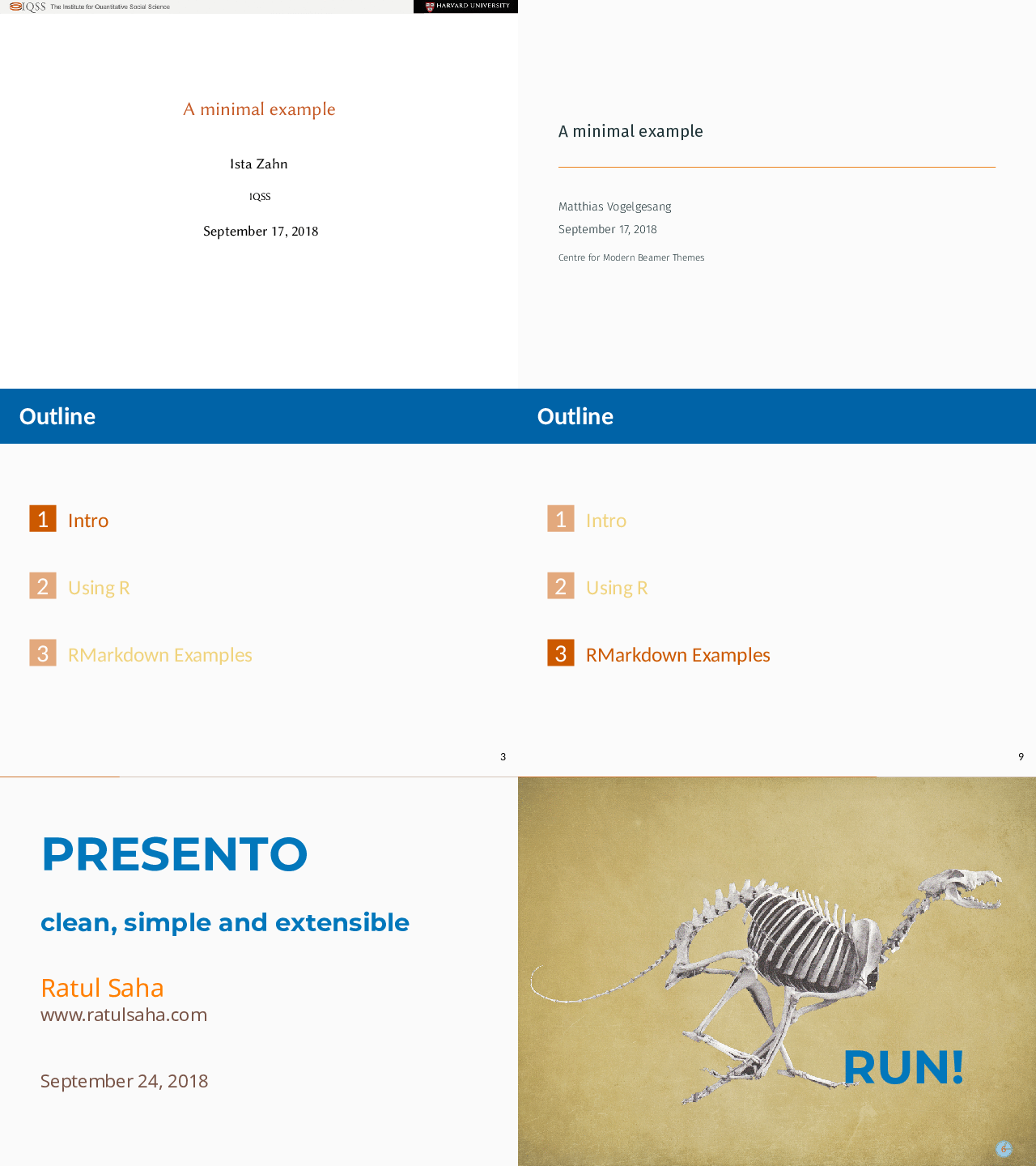
The seventh release of the binb package, and first in four years, is now on CRAN. binb regroups four rather nice themes for writing LaTeX Beamer presentations much more easily in (R)Markdown. As a teaser, a quick demo combining all four themes is available; documentation and examples are in the package. This release contains a CRAN-requested fix for a just-released new pandoc version which deals differently with overflowing bounding boxes from graphics; an added new LaTeX command is needed. We also polished continuous integration and related internals a few times but this does not contain directly user-facing changes in the package.

Changes in binb version 0.0.7 (2024-07-06)
  • Several rounds of small updates to ge continuous integration setup.
  • An additional LaTeX command needed by pandoc (>= 3.2.1) has been added.

CRANberries provides a summary of changes to the previous version. For questions or comments, please use the issue tracker at the GitHub repo. If you like this or other open-source work I do, you can now sponsor me at GitHub.

This post by Dirk Eddelbuettel originated on his Thinking inside the box blog. Please report excessive re-aggregation in third-party for-profit settings.

4 July 2024

Arturo Borrero Gonz lez: Wikimedia Toolforge: migrating Kubernetes from PodSecurityPolicy to Kyverno

Le ch teau de Val re et le Haut de Cry en juillet 2022 Christian David, CC BY-SA 4.0, via Wikimedia Commons This post was originally published in the Wikimedia Tech blog, authored by Arturo Borrero Gonzalez. Summary: this article shares the experience and learnings of migrating away from Kubernetes PodSecurityPolicy into Kyverno in the Wikimedia Toolforge platform. Wikimedia Toolforge is a Platform-as-a-Service, built with Kubernetes, and maintained by the Wikimedia Cloud Services team (WMCS). It is completely free and open, and we welcome anyone to use it to build and host tools (bots, webservices, scheduled jobs, etc) in support of Wikimedia projects. We provide a set of platform-specific services, command line interfaces, and shortcuts to help in the task of setting up webservices, jobs, and stuff like building container images, or using databases. Using these interfaces makes the underlying Kubernetes system pretty much invisible to users. We also allow direct access to the Kubernetes API, and some advanced users do directly interact with it. Each account has a Kubernetes namespace where they can freely deploy their workloads. We have a number of controls in place to ensure performance, stability, and fairness of the system, including quotas, RBAC permissions, and up until recently PodSecurityPolicies (PSP). At the time of this writing, we had around 3.500 Toolforge tool accounts in the system. We early adopted PSP in 2019 as a way to make sure Pods had the correct runtime configuration. We needed Pods to stay within the safe boundaries of a set of pre-defined parameters. Back when we adopted PSP there was already the option to use 3rd party agents, like OpenPolicyAgent Gatekeeper, but we decided not to invest in them, and went with a native, built-in mechanism instead. In 2021 it was announced that the PSP mechanism would be deprecated, and removed in Kubernetes 1.25. Even though we had been warned years in advance, we did not prioritize the migration of PSP until we were in Kubernetes 1.24, and blocked, unable to upgrade forward without taking actions. The WMCS team explored different alternatives for this migration, but eventually we decided to go with Kyverno as a replacement for PSP. And so with that decision it began the journey described in this blog post. First, we needed a source code refactor for one of the key components of our Toolforge Kubernetes: maintain-kubeusers. This custom piece of software that we built in-house, contains the logic to fetch accounts from LDAP and do the necessary instrumentation on Kubernetes to accommodate each one: create namespace, RBAC, quota, a kubeconfig file, etc. With the refactor, we introduced a proper reconciliation loop, in a way that the software would have a notion of what needs to be done for each account, what would be missing, what to delete, upgrade, and so on. This would allow us to easily deploy new resources for each account, or iterate on their definitions. The initial version of the refactor had a number of problems, though. For one, the new version of maintain-kubeusers was doing more filesystem interaction than the previous version, resulting in a slow reconciliation loop over all the accounts. We used NFS as the underlying storage system for Toolforge, and it could be very slow because of reasons beyond this blog post. This was corrected in the next few days after the initial refactor rollout. A side note with an implementation detail: we stored a configmap on each account namespace with the state of each resource. Storing more state on this configmap was our solution to avoid additional NFS latency. I initially estimated this refactor would take me a week to complete, but unfortunately it took me around three weeks instead. Previous to the refactor, there were several manual steps and cleanups required to be done when updating the definition of a resource. The process is now automated, more robust, performant, efficient and clean. So in my opinion it was worth it, even if it took more time than expected. Then, we worked on the Kyverno policies themselves. Because we had a very particular PSP setting, in order to ease the transition, we tried to replicate their semantics on a 1:1 basis as much as possible. This involved things like transparent mutation of Pod resources, then validation. Additionally, we had one different PSP definition for each account, so we decided to create one different Kyverno namespaced policy resource for each account namespace remember, we had 3.5k accounts. We created a Kyverno policy template that we would then render and inject for each account. For developing and testing all this, maintain-kubeusers and the Kyverno bits, we had a project called lima-kilo, which was a local Kubernetes setup replicating production Toolforge. This was used by each engineer in their laptop as a common development environment. We had planned the migration from PSP to Kyverno policies in stages, like this:
  1. update our internal template generators to make Pod security settings explicit
  2. introduce Kyverno policies in Audit mode
  3. see how the cluster would behave with them, and if we had any offending resources reported by the new policies, and correct them
  4. modify Kyverno policies and set them in Enforce mode
  5. drop PSP
In stage 1, we updated things like the toolforge-jobs-framework and tools-webservice. In stage 2, when we deployed the 3.5k Kyverno policy resources, our production cluster died almost immediately. Surprise. All the monitoring went red, the Kubernetes apiserver became irresponsibe, and we were unable to perform any administrative actions in the Kubernetes control plane, or even the underlying virtual machines. All Toolforge users were impacted. This was a full scale outage that required the energy of the whole WMCS team to recover from. We temporarily disabled Kyverno until we could learn what had occurred. This incident happened despite having tested before in lima-kilo and in another pre-production cluster we had, called Toolsbeta. But we had not tested that many policy resources. Clearly, this was something scale-related. After the incident, I went on and created 3.5k Kyverno policy resources on lima-kilo, and indeed I was able to reproduce the outage. We took a number of measures, corrected a few errors in our infrastructure, reached out to the Kyverno upstream developers, asking for advice, and at the end we did the following to accommodate the setup to our needs: I have to admit, I was briefly tempted to drop Kyverno, and even stop pursuing using an external policy agent entirely, and write our own custom admission controller out of concerns over performance of this architecture. However, after applying all the measures listed above, the system became very stable, so we decided to move forward. The second attempt at deploying it all went through just fine. No outage this time When we were in stage 4 we detected another bug. We had been following the Kubernetes upstream documentation for setting securityContext to the right values. In particular, we were enforcing the procMount to be set to the default value, which per the docs it was DefaultProcMount . However, that string is the name of the internal variable in the source code, whereas the actual default value is the string Default . This caused pods to be rightfully rejected by Kyverno while we figured the problem. I sent a patch upstream to fix this problem. We finally had everything in place, reached stage 5, and we were able to disable PSP. We unloaded the PSP controller from the kubernetes apiserver, and deleted every individual PSP definition. Everything was very smooth in this last step of the migration. This whole PSP project, including the maintain-kubeusers refactor, the outage, and all the different migration stages took roughly three months to complete. For me there are a number of valuable reasons to learn from this project. For one, the scale is something to consider, and test, when evaluating a new architecture or software component. Not doing so can lead to service outages, or unexpectedly poor performances. This is in the first chapter of the SRE handbook, but we got a reminder the hard way This post was originally published in the Wikimedia Tech blog, authored by Arturo Borrero Gonzalez.

3 July 2024

Mike Gabriel: Polis - a FLOSS Tool for Civic Participation -- Initial Evaluation and Adaptation (episode 2/5)

Here comes the 2nd article of the 5-episode blog post series written by Guido Berh rster, member of staff at my company Fre(i)e Software GmbH. Enjoy also this read on Guido's work on Polis,

Mike
Table of Contents of the Blog Post Series
  1. Introduction
  2. Initial evaluation and adaptation (this article)
  3. Issues extending Polis and adjusting our goals
  4. Creating (a) new frontend(s) for Polis
  5. Current status and roadmap
Polis - Initial evaluation and adaptation The Polis code base consists of a number of components, the administration and participation interfaces, a common web backend, and a statistics processing server. Both frontends and the backend are written in a mixture of JavaScript and TypeScript, only the statistics processing server is written in Clojure. In case of self hosting the preferred method of deployment is via Docker containers using Docker Compose or any other orchestrator. The participation frontend for conversations can either be used as a standalone web page or be embedded via an iframe. For our planned use case we initially defined the following goals: After a preliminary evaluation of our own and consulting with Policy Lab UK who were also evaluating and testing Polis and had already made a range of improvements related to self-hosting as well as bug fixes and modernization changes we decided to take their work as a base for our adaptations with the intent of submitting generally useful changes back to the Polis project. Subsequently, a number of changes were implemented, including the removal of hardcoded domain names, the elimination of unnecessary cookies and third-party requests, support for an alternative email sending service, and the option of disabling Facebook and X integration. For the branding our approach was to add an option allowing websites which are embedding conversations in an iframe to load an alternative stylesheet for overriding the native Polis branding. For this to be practical we intended to use CSS custom properties for defining branding-related styles such as colors and fonts. That approach turned out to be problematic because although the Polis participation frontend stylesheet is generated via SCSS and some of the colors are parameterized, however, they are not used consistently throughout the SCSS stylesheets, unfortunately. In addition the frontend templates contain a large amount of hardcoded style attributes. While we succeeded in implementing user-defined stylesheets, it took a disproportionate amount of development resources to parameterize all used colors and fonts via CSS custom properties aggravated by the fact that the SCSS and template files are huge and contain many unused rules and code.

Ian Jackson: derive-deftly is nearing 1.x - call for review/testing

derive-deftly, the template-based derive-macro facility for Rust, has been a great success. It s coming up to time to declare a stable 1.x version. If you d like to try it out, and have final comments / observations, now is the time. Introduction to derive-deftly Have you ever wished that you could that could write a new derive macro without having to mess with procedural macros? You can! derive-deftly lets you write a #[derive] macro, using a template syntax which looks a lot like macro_rules!:
use derive_deftly:: define_derive_deftly, Deftly ;
define_derive_deftly!  
    ListVariants:
    impl $ttype  
        fn list_variants() -> Vec<&'static str>  
            vec![ $( stringify!( $vname ) , ) ]


#[derive(Deftly)]
#[derive_deftly(ListVariants)]
enum Enum  
    UnitVariant,
    StructVariant   a: u8, b: u16  ,
    TupleVariant(u8, u16),
 
assert_eq!(
    Enum::list_variants(),
    ["UnitVariant", "StructVariant", "TupleVariant"],
);
Status derive-deftly has a wide range of features, which can be used to easily write sophisticated and reliable derive macros. We ve been using it in Arti, the Tor Project s reimplementation of Tor in Rust, and we ve found it very useful. There is comprehensive reference documentation, and more discursive User Guide for a more gentle introduction. Naturally, everything is fully tested. History derive-deftly started out as a Tor Hackweek project. It used to be called derive-adhoc. But we renamed it because we found that many of the most interesting use cases were really not very ad-hoc at all. Over the past months we ve been ticking off our 1.0 blocker tickets. We ve taken the opportunity to improve syntax, terminology, and semantics. We hope we have now made the last breaking changes. Plans - call for review/testing In the near future, we plan to declare version 1.0. After 1.x, we intend to make breaking changes very rarely. So, right now, we d like last-minute feedback. Are there any wrinkles that need to be sorted out? Please file tickets or MRs on our gitlab. Ideally, anything which might imply breaking changes would be submitted on or before the 13th of August. In the medium to long term, we have many ideas for how to make derive-deftly even more convenient, and even more powerful. But we are going to proceed cautiously, because we don t want to introduce bad syntax or bad features, which will require difficult decisions in the future about forward compatibility.

comment count unavailable comments

Samuel Henrique: Announcing wcurl: a curl wrapper to download files

tl;dr Whenever you need to download files through the terminal and don't feel like using wget:
wcurl example.com/filename.txt
Manpage:
https://manpages.debian.org/unstable/curl/wcurl.1.en.html

Availability (comes installed with the curl package):
  • Debian unstable - Since 2024-07-02
  • Debian testing - Since 2024-07-18
  • Debian 12/bookworm backports - Expected by the end of August 2024.
  • Debian 12/bookworm - Depends on whether Debian's release team will approve it, it could be available in the next point release.
  • Debian derivatives - Rolling releases will get it by the time it's on Debian testing (e.g.: Kali Linux). Stable derivatives only in their next major release.
If you don't want to wait for the package update to arrive, you can always copy the script and place it in your /usr/bin, the code is here:
https://github.com/Debian/wcurl/blob/main/wcurl
https://salsa.debian.org/debian/wcurl/-/blob/main/wcurl?ref_type=heads

Smoother CLI experience Starting with curl version 8.8.0-2, the Debian's curl package now ships a wcurl executable. wcurl is the solution for those who just need to download files without having to remember curl's parameters for things like automatically naming the files. Some people, myself included, would fall back to using wget whenever there was a need to download a file. Sometimes even installing wget just for that usecase. After all, it's easier to remember "apt install wget" rather than "curl -L -O -C - ...". wcurl consists of a simple shell script that provides sane defaults for the curl invocation, for when the use case is to just download files. By default, wcurl will:
  • Encode whitespaces in URLs;
  • Download multiple URLs in parallel if the installed curl's version is >= 7.66.0;
  • Follow redirects;
  • Automatically choose a filename as output;
  • Avoid overwriting files if the installed curl's version is >= 7.83.0 (--no-clobber);
  • Perform retries;
  • Set the downloaded file timestamp to the value provided by the server, if available;
  • Default to the protocol used as https if the URL doesn't contain any;
  • Disable curl's URL globbing parser so and [] characters in URLs are not treated specially.
Example to download a single file:
wcurl example.com/filename.txt
If you ever need to set a custom flag, you can make use of the --curl-options wcurl option, anything set there will be passed to the curl invocation. Just beware that if you need to set any custom flags, it's likely you will be better served by calling curl directly. The --curl-options option is there to allow for some flexibility in unforeseen circumstances.

The need for wcurl I've always felt a bit ashamed of not remembering curl's parameters for downloading a file and automatically naming it, having resorted to wget most of the times this was needed (even installing wget when it wasn't there, just for this). I've spoken to a few other experienced people I know and confirmed what could be obvious to others: a lot of people struggle with this. Recently, the curl project released the results of 2024's curl survey, which also showed this is as a much needed feature, just look at some of the answers:

Q: Which curl command line option do you think needs improvement and how?
-O, I really want wget like functionality where I don't have to specify the name
Downloading a file (like wget) could be improved - with automatic naming of the file
downloading files - wget is much cleaner
I wish the default behaviour when GETting a binary was to drop it on disk. That's the only reason 'wget foo.tgz" is still ingrained in my muscle memory .
Maybe have a way to download without specifying something in -o (the only reason i used wget still)
--remote-time should be default
--remote-name-all could really use a short flag

Q: If you miss support for something, tell us what!
"Write the data to the file named in the URL (or in redirects if I'm feeling daring), and timestamp the file to the last-modified-date". This is the main reason I'm still using wget.
I can finally feel less bad about falling back to wget due to not remembering the parameters I want.

Idealization vs. reality I don't believe curl will ever change its default behavior in such a way that would accommodate this need, as that would have a side-effect of breaking things which expect the current behavior (the blast radius is literally the solar system). This means a new executable needs to be shipped side-by-side with curl, an opportunity to start fresh and work with a more focused use case (to download files). Ideally, this new executable would be maintained by the curl project, make use of libcurl under-the-hood, and be available everywhere. Nobody wants to worry if their systems have the tool or not, it should always be there. Given I'm just a Debian Developer, with not as much free time as I wish, I've decided to write a simple shell script wrapper calling the curl CLI under-the-hood. wcurl will come installed with the curl package from now on, and I will check with the release team about shipping it on the current Debian stable as well. Shipping wcurl in other distros will be up to them (Debian-derivatives should pick it up automatically, though). We've tried to make it easy for anyone to ship this by using the curl license, keeping the script POSIX-compliant, and shipping a manpage. Maybe if there's enough interest across distributions, someone might sign up for implementing this in upstream curl and increase its reach. I would be happy with the curl project reusing the wcurl name when that happens. It's unlikely that wcurl would be shipped by curl upstream as it is, assuming they would prefer a solution that uses libcurl direclty (more similar to curl the CLI, to maintain). In the worst case, wcurl becomes a Debian-specific tool that only a few people are aware of, in the best case, it becomes the new go-to CLI tool for simply downloading files. I would be happy if at least someone other than me finds it useful.

Naming is hard When I started working on it, I was calling the new executable "curld" (stands for "curl download"), but then when discussing this in one of our weekly calls in the Debian Bras lia community, it was mentioned that this could be confused for a daemon. We then settled for the name "wcurl", suggested by Carlos Henrique Lima Melara <charles>. It doesn't really stand for anything, but it's very easy to remember. You know... "it's that wget alternative for when you want to use curl instead" :)

Feedback I'm hosting the code on Github and Debian's GitLab instance, feel free to open an issue to provide feedback.
https://salsa.debian.org/debian/wcurl
https://github.com/Debian/wcurl We also have a Matrix room for the Debian curl maintainers:
https://matrix.to/#/#debian-curl-maintainers:matrix.org

Acknowledgments The idea for wcurl came a few days before the curl-up conference 2024. I've been thinking a lot about developer productivity in the terminal lately, different tools and better defaults. Before curl-up, I was also thinking about packaging improvements for the curl package. I don't remember what exactly happened, but I likely had to download something and felt a bit ashamed of maintaining curl and not remembering the parameters to download files the way I wanted. I first discussed this idea in the conference, where I asked the participants about it and there were no concerns raised, and some people said I should give it a go. Participating in curl-up was a really great experience and I'm thankful for the interactions I've had there. On the Debian side, I've got reviews of the code and manpage by Sergio Durigan Junior <sergiodj>, Guilherme Puida Moreira <puida> and Carlos Henrique Lima Melara <charles>. Sergio ended up rewriting the tool to be POSIX-compliant (my version was written in bash), so he takes all the credit for the portability.

Changes since publication

2024-07-18
  • Update date of availability for Debian testing and expected date for bookworm backports.
  • Mention charles as the person who suggested "wcurl" as a name.
  • Update wcurl's -o/--opts options, it's now just --curl-options.
  • Remove mention of language spoken in the Matrix room, we are using English now.
  • Update list of features of wcurl.

2 July 2024

Bits from Debian: Bits from the DPL

Dear Debian community, Statement on Daniel Pocock The Debian project has successfully taken action to secure its trademarks and interests worldwide, as detailed in our press statement. I would like to personally thank everyone in the community who was involved in this process. I would have loved for you all to have spent your volunteer time on more fruitful things. Debian Boot team might need help I think I've identified the issue that finally motivated me to contact our teams: for a long time, I have had the impression that Debian is driven by several "one-person teams" (to varying extents of individual influence and susceptibility to burnout). As DPL, I see it as my task to find ways to address this issue and provide support. I received private responses from Debian Boot team members, which motivated me to kindly invite volunteers to some prominent and highly visible fields of work that you might find personally challenging. I recommend subscribing to the Debian Boot mailing list to see where you might be able to provide assistance. /usrmerge Helmut Grohne confirmed that the last remaining packages shipping aliased files inside the package set relevant to debootstrap were uploaded. Thanks a lot for Helmut and all contributors that helped to implement DEP17. Contacting more teams I'd like to repeat that I've registered a BoF for DebConf24 in Busan with the following description: This BoF is an attempt to gather as much as possible teams inside Debian to exchange experiences, discuss workflows inside teams, share their ways to attract newcomers etc. Each participant team should prepare a short description of their work and what team roles ( openings ) they have for new contributors. Even for delegated teams (membership is less fluid), it would be good to present the team, explain what it takes to be a team member, and what steps people usually go to end up being invited to participate. Some other teams can easily absorb contributions from salsa MRs, and at some point people get commit access. Anyway, the point is that we work on the idea that the pathway to become a team member becomes more clear from an outsider point-of-view. I'm lagging a bit behind my team contacting schedule and will not manage to contact every team before DebConf. As a (short) summary, I can draw some positive conclusions about my efforts to reach out to teams. I was able to identify some issues that were new to me and which I am now working on. Examples include limitations in Salsa and Salsa CI. I consider both essential parts of our infrastructure and will support both teams in enhancing their services. Some teams confirmed that they are basically using some common infrastructure (Salsa team space, mailing lists, IRC channels) but that the individual members of the team work on their own problems without sharing any common work. I have also not read about convincing strategies to attract newcomers to the team, as we have established, for instance, in the Debian Med team. DebConf attendance The amount of money needed to fly people to South Korea was higher than usual, so the DebConf bursary team had to make some difficult decisions about who could be reimbursed for travel expenses. I extended the budget for diversity and newcomers, which enabled us to invite some additional contributors. We hope that those who were not able to come this year can make it next year to Brest or to MiniDebConf Cambridge or Toulouse tag2upload On June 12, Sean Whitton requested comments on the debian-vote list regarding a General Resolution (GR) about tag2upload. The discussion began with technical details but unfortunately, as often happens in long threads, it drifted into abrasive language, prompting the community team to address the behavior of an opponent of the GR supporters. After 560 emails covering technical details, including a detailed security review by Russ Allbery, Sean finally proposed the GR on June 27, 2024 (two weeks after requesting comments). Firstly, I would like to thank the drivers of this GR and acknowledge the technical work behind it, including the security review. I am positively convinced that Debian can benefit from modernizing its infrastructure, particularly through stronger integration of Git into packaging workflows. Sam Hartman provided some historical context [1], [2], [3], [4], noting that this discussion originally took place five years ago with no results from several similarly lengthy threads. My favorite summary of the entire thread was given by Gregor Herrmann, which reflects the same gut feeling I have and highlights a structural problem within Debian that hinders technical changes. Addressing this issue is definitely a matter for the Debian Project Leader, and I will try to address it during my term. At the time of writing these bits, a proposal from ftpmaster, which is being continuously discussed, might lead to a solution. I was also asked to extend the GR discussion periods which I will do in separate mail. Talk: Debian GNU/Linux for Scientific Research I was invited to have a talk in the Systems-Facing Track of University of British Columbia (who is sponsoring rack space for several Debian servers). I admit it felt a bit strange to me after working more than 20 years for establishing Debian in scientific environments to be invited to such a talk "because I'm DPL". Kind regards Andreas.

Mike Gabriel: Polis - a FLOSS Tool for Civic Participation -- Introduction (episode 1/5)

This is the first article of a 5-episode blog post series written by Guido Berh rster, member of staff at my company Fre(i)e Software GmbH. Thanks, Guido for being on the Polis project. Enjoy the read on the work Guido has been doing over the past months,
Mike
A team lead by Raoul Kramer/BetaBreak is currently adapting Polis for evaluation and testing by several Dutch provincial governments and central government ministries. Guido Berh rster (author of this article) who is an employee at Fre(i)e Software GmbH has been involved in this project as the main software developer. This series of blog posts describes how and why Polis was initially modified and adapted, what issues the team ran into and how this ultimately lead them to start a new Open Source project called Particiapp for accelerating the development of alternative Polis frontends compatible to but independent from the upstream project. Table of Contents of the Blog Post Series
  1. Introduction (this article)
  2. Initial evaluation and adaptation
  3. Issues extending Polis and adjusting our goals
  4. Creating (a) new frontend(s) for Polis
  5. Current status and roadmap
Polis - The Introduction What is Polis? Polis is a platform for participation which helps to gather, analyze and understand viewpoints of large groups of participants on complex issues. In practical terms participants take part in conversations on a predefined topic by voting on statements or submitting their own statements (referred to as comments in Polis) for others to vote on1. Through statistical analysis including machine learning participants are sorted into groups based on similarities in voting behavior. In addition, group-informed and overall consensus statements are identified and presented to participants in real-time. This allows for participants to react to and refine statements and either individually or through a predefined process to come to an overall consensus. Furthermore, the order in which statements are presented to participants is influenced by a complex weighting system based on a number of factors such as variance, recency, and frequency of skipping. This so called comment routing is intended to facilitate a meaningful contribution of participants without requiring them to vote on each of a potentially huge number of statements 2. Polis open-ended nature sets it apart from online surveys using pre-defined questions and allows its users to gather a more accurate picture of the public opinion. In contrast to a discussion forum or comment section where participants directly reply to each other, it discourages unproductive behavior such as provocations or personal attacks by not presenting statements in chronological order in combination with voting. Finally, its comment routing is intended to provide scalability towards a large number of participants which generate a potentially large number of statements. The project was developed and is maintained by The Computational Democracy Project, a USA-based non-profit organization which provides a hosted version and offers related services. It is also released as Open Source software under the AGPL 3.0 license. Polis has been used in a variety of different contexts as part of broader political processes facilitating broader political participation and opinion-forming, and gathering feedback and creative input. Use of Polis in Taiwan One prominent use case of Polis is its adoption as part of the vTaiwan participatory governance project. Established by the g0v civic tech community in the wake of the 2014 mass protests by the Sunflower movement, the vTaiwan project enables consultations on proposed legislation among a broad range of stakeholders including government ministries, lawmakers, experts, interest groups, civil society as well as the broader public. Although the resulting recommendations are non-binding, they exert pressure on the government to take action and recommendations have been adopted into legislation.345 vTaiwan uses Polis for large-scale online deliberations as part of a structured participation process. These deliberations take place after identifying and involving stakeholders and experts and providing through information about the topic at hand to the public. Citizens are then given the opportunity to vote on statements or provide alternative proposals which allows for the refinement of ideas and ideally leads to a consensus at the end. The results of these online deliberations are then curated, discussed in publicly broadcast face-to-face meetings which ultimately produce concrete policy recommendations. vTaiwan has in numerous cases given impulses resulting in government action and provided significant input e.g. on legislation regulating Uber or technological experiments by Fintech startups.35 See also
  1. https://compdemocracy.org/Polis/
  2. https://compdemocracy.org/comment-routing/
  3. https://info.vtaiwan.tw/
  4. https://www.theguardian.com/world/2020/sep/27/taiwan-civic-hackers-polis-consensus-social-media-platform
  5. https://www.technologyreview.com/2018/08/21/240284/the-simple-but-ingenious-system-taiwan-uses-to-crowdsource-its-laws/

1 July 2024

Russell Coker: VoLTE in Australia

Introduction In Australia the 3G mobile frequencies are to be reused so they are in the process of shutting down the 3G service. That means that everyone has to use VoLTE (Voice Over LTE) for phone calls (including emergency calls). The shutdown time varies by telco, Kogan Mobile (one of the better services which has good value for money and generally works well) shut down their 3G service in January. Aldi Mobile (another one of the good services which is slightly more expensive but has included free calls to most first-world countries and uses the largest phone network) will shut theirs down at the end of August. For background there s a Fosdem talk about OpenSIPS with VoLTE and VoNR [1], it s more complex than you want to know. Also VoNR (Voice over New Radio) is the standard for 5G voice and it s different from VoLTE and has a fallback to VoLTE. Another good lecture for background information is the Fosdem talk on VoLTE at the handset end [2]. The PinePhonePro In October 2023 I tried using my PinePhonePro as my main phone but that only lasted a few days due to problems with calls and poor battery life [3]. Since then I went back to the Huawei Mate 10 Pro that I bought refurbished in June 2019 for $389. So that has been my main phone for 5 years now, giving a cost of $1.50 per week. I had tried using a Huawei Nova 7i running Android without Google Play as an experiment but that had failed, I do many things that need Android apps [4]. I followed the PinePhone wiki to get my PinePhonePro working with VoLTE [5]. That worked fine for me, the only difference from the instructions is that I had to use device /dev/ttyUSB3 and that the modem kept resetting itself during the process and when that happened I had to kill minicom and start again. After changing the setting and saving it the PinePhonePro seemed to work well with VoLTE on a Kogan Mobile SIM (so definitely not using 3G). One issue I have found is that Plasma Mobile (my preferred FOSS phone GUI) appears to have a library issue that results in polling every 14ms even when the screen is locked [6]. If you have a few processes doing that (which means the most lightly used Plasma system) it really hurts battery use. The maintainer has quite reasonably deferred action on this bug report given the KDE 6 transition. Later on in the Trixie development cycle I hope to get this issue resolved, I don t expect it to suddenly make battery life good. But it might make battery life acceptable. I am now idly considering carrying around my PinePhonePro in a powered off state for situations where I might need to do high security operations (root logins to servers or online banking) but for which carrying a laptop isn t convenient. It will do well for the turn on, do 30 mins of work that needs security, and then turn off scenario. Huawei Mate 10 Pro and Redmi 9A The Huawei Mate 10 Pro has been my main phone for 5 years and it has worked well, so it would be ideal if it could do VoLTE as the PinePhonePro isn t ready yet. All the web pages I ve seen about the Mate 10 Pro say that it will either allow upgrading to a VoLTE configuration if run with the right SIM or only support it with the right SIM. I did a test with a Chinese SIM which gave an option of turning on VoLTE but didn t allow any firmware updates and the VoLTE option went away when I put an Australian SIM in. Some forum comments had led me to believe that it would either permanently enable VoLTE or allow upgrading the firmware to one that enables VoLTE if I used a Chinese SIM but that is not the case. I didn t expect a high probability of success but I had to give it a go as it s a nice phone. I did some tests on a Redmi 9A (a terrible phone that has really bad latency on the UI in spite of having reasonably good hardware). The one I tested on didn t have VoLTE enabled when I got it, to test that I used the code *#*#4636#*#* in the dialler to get the menu of SIM information and it showed that VoLTE was not provisioned. I then had to update to the latest release of Android for that phone and enter *#*#86583#*#* in the dialler to enable VoLTE, the message displayed after entering that magic number must end in DISABLE . I get the impression that the code in question makes the phone not check certain aspects of whether the carrier is good for VoLTE and just do it. So apparently Kogan Mobile somehow gives the Redmi 9A the impression that VoLTE isn t supported but if the phone just goes ahead and connects it will work. I don t plan to use a Redmi 9A myself as it s too slow, but I added it to my collection to offer to anyone else I know who needs a phone with VoLTE and doesn t use the phone seriously or to someone who needs a known good phone for testing things. Samsung Galaxy Note 9 I got some Samsung Galaxy Note 9 phones to run Droidian as an experiment [7]. But Droidian dropped support for the Note 9 and I couldn t figure out how to enable VoLTE via Droidian, which was very annoying after I had spent $109 on a test phone and $215 on a phone for real use (I have no plans to try Droidian again at this time). I tried installing LineageOS on one Note 9 [8] which was much easier than expected (especially after previously installing Droidian). But VoLTE wasn t an option. According to Reddit LineageOS doesn t support VoLTE on Samsung devices and you can use a magisk module or a VoLTE enabler module but those aren t supported by LineageOS either [9]. I downloaded an original image for the Note 9 from SamsMobile.com [10]. That image booted past the orange stage (where if you have problems then your phone is probably permanently useless) but didn t boot into the OS. A friend helped me out with that and it turned out that the Heimdal flash tool on Linux didn t do something it needed to do and that Odin on Windows was required. After using Odin everything was fine and I have a Note 9 with VoLTE running the latest Samsung firmware which is security patch level 1st July 2022!!! So I have a choice between using a Note 9 for data and SMS while running a current version of Lineage OS with all security fixes or running a Samsung image with no security updates for 2 years which supports phone calls. So based on this I have to recommend Pixel as the phone of choice, it has a decent level of support from Google and long term support from LineageOS. According to the LineageOS web site you can run the current version of Lineage on the original Pixel phone from 2016! Of course getting VoLTE to work on it might be another saga, but it would probably be easier to do with LineageOS on a Pixel than on a Samsung phone. Conclusion The operation of the Note 9 for me is decent now apart from the potential security issues. The same goes for selling one of the phones. The PinePhonePro still has potential to become my daily driver at some future time if I and others can optimise power use. Also a complicating factor is that I want to have both Jabber and Matrix be actually instant IM systems not IM with a 5 minute delay, so suspend mode isn t a good option. Pixel phones will be a much higher priority when looking at phones to buy in future. The older Pixel phones go for as little as $100 on eBay and can still run the latest LineageOS. VoLTE seems needlessly complicated.

Niels Thykier: Debian packaging with style black

When I started working on the language server for debputy, one of several reasons was about automatic applying a formatting style. Such that you would not have to remember to manually reformat the file. One of the problems with supporting automatic formatting is that no one agrees on the "one true style". To make this concrete, Johannes Schauer Marin Rodrigues did the numbers of which wrap-and-sort option that are most common in https://bugs.debian.org/895570#46. Unsurprising, we end up with 14-15 different styles with various degrees of popularity. To make matters worse, wrap-and-sort does not provide a way to declare "this package uses options -sat". So that begged the question, how would debputy know which style it should use when it was going to reformat file. After a couple of false-starts, Christian Hofstaedtler mentioned that we could just have a field in debian/control for supporting a "per-package" setting in responds to my concern about adding a new "per-package" config file. At first, I was not happy with it, because how would you specify all of these options in a field (in a decent manner)? But then I realized that one I do not want all these styles and that I could start simpler. The Python code formatter black is quite successful despite not having a lot of personalized style options. In fact, black makes a statement out of not allowing a lot of different styles. Combing that, the result was X-Style: black (to be added to the Source stanza of debian/control), which every possible reference to the black tool for how styling would work. Namely, you outsource the style management to the tool (debputy) and then start using your focus on something else than discussing styles. As with black, this packaging formatting style is going to be opinionated and it will evolve over time. At the starting point, it is similar to wrap-and-sort -sat for the deb822 files (debputy does not reformat other files at the moment). But as mentioned, it will likely evolve and possible diverge from wrap-and-sort over time. The choice of the starting point was based on the numbers posted by Johannes #895570. It was not my personal favorite but it seemed to have a majority and is also close to the one suggested by salsa pipeline maintainers. The delta being -kb which I had originally but removed in 0.1.34 at request of Otto Kek l inen after reviewing the numbers from Johannes one more time. To facilitate this new change, I uploaded debputy/0.1.30 (a while back) to Debian unstable with the following changes:
  • Support for the X-Style: black header.
  • When a style is defined, the debputy lsp server command will now automatically reformat deb822 files on save (if the editor supports it) or on explicit "reformat file" request from the editor (usually indirectly from the user).
  • New subcommand debputy reformat command that will reformat the files, when a style is defined.
  • A new pre-commit hook repo to run debputy lint and debputy reformat. These hooks are available from https://salsa.debian.org/debian/debputy-pre-commit-hooks version v0.1 and can be used with the pre-commit tool (from the package of same name).
The obvious omission is a salsa-pipeline feature for this. Otto has put that on to his personal todo list and I am looking forward to that.
Beyond black Another thing I dislike about our existing style tooling is that if you run wrap-and-sort without any arguments, you have a higher probability of "trashing" the style of the current package than getting the desired result. Part of this is because wrap-and-sort's defaults are out of sync with the usage (which is basically what https://bugs.debian.org/895570 is about). But I see another problem. The wrap-and-sort tool explicitly defined options to tweak the style but provided maintainers no way to record their preference in any machine readable way. The net result is that we have tons of diverging styles and that you (as a user of wrap-and-sort) have to manually tell wrap-and-sort which style you want every time you run the tool. In my opinion that is not playing to the strengths of neither human nor machine. Rather, it is playing to the weaknesses of the human if anything at all. But the salsa-CI pipeline people also ran into this issue and decided to work around this deficiency. To use wrap-and-sort in the salsa-CI pipeline, you have to set a variable to activate the job and another variable with the actual options you want. The salsa-CI pipeline is quite machine readable and wrap-and-sort is widely used. I had debputy reformat also check for the salsa-CI variables as a fallback. This fallback also works for the editor mode (debputy lsp server), so you might not even have to run debputy reformat. :) This was a deliberate trade-off. While I do not want all us to have all these options, I also want Debian packaging to be less painful and have fewer paper cuts. Having debputy go extra lengths to meet wrap-and-sort users where they are came out as the better solution for me. A nice side-effect of this trade-off is that debputy reformat now a good tool for drive-by contributors. You can safely run debputy reformat on any package and either it will apply the styling or it will back out and inform you that no obvious style was detected. In the latter case, you would have to fallback to manually deducing the style and applying it.
Differences to wrap-and-sort The debputy reformat has some limitations or known differences to wrap-and-sort. Notably, debputy reformat (nor debputy lsp server) will not invoke wrap-and-sort. Instead, debputy has its own reformatting engine that provides similar features. One reason for not running wrap-and-sort is that I want debputy reformat to match the style that debputy lsp server will give you. That way, you get consistent style across all debputy commands. Another reason is that it is important to me that reformatting is safe and does not change semantics. This leads to two regrettable known differences to the wrap-and-sort behavior due to safety in addition to one scope limitation in debputy:
  1. debputy will ignore requests to sort the stanzas when the "keep first" option is disabled (-b --no-keep-first). This combination is unsafe reformatting. I feel it was a mistake for wrap-and-sort to ever allow this but at least it is no longer the default (-b is now -bk by default). This will be less of a problem in debhelper-compat 15, since the concept of "main package" will disappear and all multi-binary source packages will be required to use debian/package.install rather than debian/install.
  2. debputy will not reorder the contents of debhelper packaging files such as debian/install. This is also an (theoretical) unsafe thing to do. While the average package will not experience issues with this, there are rare corner cases where the re-ordering can affect the end result. I happen to know this, because I ran into issues when trying to optimize dh_install in a way that assumed the order did not matter. Stuff broke and there is now special-case code in dh_install to back out of that optimization when that happens.
  3. debputy has a limited list of wrap-and-sort options it understands. Some options may cause debputy to back out and disable reformatting entirely with a remark that it cannot apply that style. If you run into a case of this, feel free to file a feature request to support it. I will not promise to support everything, but if it is safe and trivially doable with the engine already, then I probably will.
As stated, where debputy cannot implement the wrap-and-sort styles fully, then it will currently implement a subset that is safe if that can be identified or back out entirely of the formatting when it cannot. In all cases, debputy will not break the formatting if it is correct. It may just fail at correcting one aspect of the wrap-and-sort style if you happen to get it wrong. It is also important to remember that the prerequisite for debputy applying any wrap-and-sort style is that you have set the salsa-CI pipeline variables to trigger wrap-and-sort with the salsa-CI pipeline. So there is still a CI check before the merge that will run the wrap-and-sort in its full glory that provides the final safety net for you.
Just give me a style In conclusion, if you, like me, are more interested in getting a consistent style rather than discussing what that style should be, now you can get that with X-Style: black. You can also have your custom wrap-and-sort style be picked up automatically for drive-by contributors.
$ apt satisfy 'dh-debputy (>= 0.1.30), python3-lsprotocol'
# Add  X-Style: black  to  debian/control  for "just give me a style"
#
# OR, if there is a specific  wrap-and-sort  style for you then set
# SALSA_CI_DISABLE_WRAP_AND_SORT=no plus set relevant options in
# SALSA_CI_WRAP_AND_SORT_ARGS in debian/salsa-ci.yml (or .gitlab-ci.yml)
$ debputy reformat
It is sadly not yet in the salsa-ci pipeline. Otto is looking into that and hopefully we will have it soon. :) And if you find yourself often doing archive-wide contributions and is tired of having to reverse engineer package formatting styles, consider using debputy reformat or debputy lsp server. If you use debputy in this way, please consider providing feedback on what would help you.

Russ Allbery: Review: Snuff

Review: Snuff, by Terry Pratchett
Series: Discworld #39
Publisher: Harper
Copyright: October 2011
Printing: January 2013
ISBN: 0-06-221886-7
Format: Mass market
Pages: 470
Snuff is the 39th Discworld novel and the 8th (and last) Watch novel. This is not a good place to start reading. Sam Vines has been talked, cajoled, and coerced into taking a vacation. Since he is now the Duke of Ankh, he has a country estate that he's never visited. Lady Sybil is insistent on remedying this, as is Vetinari. Both of them may have ulterior motives. They may also be colluding. It does not take long for Vimes to realize that something is amiss in the countryside. It's not that the servants are uncomfortable with him talking to them, the senior servants are annoyed that he talks to the wrong servants, and the maids turn to face the wall at the sight of him. Those are just the strange customs of the aristocracy, for which he has little understanding and even less patience. There's something else going on. The nobility is wary, the town blacksmith is angry about something more than disliking the nobles, and the bartender doesn't want to get involved. Vimes smells something suspicious. When he's framed for a murder, the suspicions seem justified. It takes some time before the reader learns what the local nobility are squirming about, so I won't spoil it. What I will say is that Snuff is Pratchett hammering away at one of his favorite targets: prejudice, cruelty, and treating people like things. Vimes, with his uncompromising morality, is one of the first to realize the depth of the problem. It takes most of the rest longer to come around, even Sybil. It's both painful, and painfully accurate, to contemplate how often recognition of other people's worth only comes once they do something that you recognize as valuable. This is one of the better-plotted Discworld novels. Vimes starts out with nothing but suspicions and stubbornness, and manages to turn Snuff into a mystery novel through dogged persistence. The story is one continuous plot arc with the normal Pratchett color (Young Sam's obsession with types of poo, for example) but without extended digressions. It also has considerably better villains than most Pratchett novels: layers of foot soldiers and plotters, each of which have to be dealt with in a suitable way. Even the concluding action sequences worked for me, which is not always a given in Discworld. The problem, unfortunately, is that the writing is getting a bit wobbly. Pratchett died of early-onset Alzheimer's in 2015, four years after this book was first published, and this is the first novel where I can see some early effects. It mostly shows up in the dialogue: it's just a bit flabby and a bit repetitive, and the characters, particularly towards the end of the book, start repeating the name of the person they're talking to every other line. Once I saw it, I couldn't unsee it, and it was annoying enough to rob a bit of enjoyment from the end of the book. That aside, though, this was a solid Discworld novel. Vimes testing his moral certainty against the world and forcing it into a more ethical shape is always rewarding, and here he takes more risks, with better justification, than in most of the Watch novels. We also find out that Vimes has a legacy from the events of Thud!, which has interesting implications that I wish Pratchett had more time to explore. I think the best part of this book is how it models the process of social change through archetypes: the campaigner who knew the right choice early on, the person who formed their opinion the first time they saw injustice, the person who gets there through a more explicit moral code, the ones who have to be pushed by someone who was a bit faster, the ones who have to be convinced but then work to convince others, and of course the person who is willing to take on the unfair and far-too-heavy burden of being exceptional enough that they can be used as a tool to force other people to acknowledge them as a person. And, since this is Discworld, Vetinari is lurking in the scenery pulling strings, balancing threats, navigating politics, and giving Vimes just enough leeway to try to change the world without abusing his power. I love that the amount of leeway Vimes gets depends on how egregious the offense is, and Vetinari calibrates this quite carefully without ever saying so openly. Recommended, and as much as I don't want to see this series end, this is not a bad entry for the Watch novels to end on. Followed in publication order by Raising Steam. Rating: 8 out of 10

29 June 2024

Russ Allbery: Review: Bitter Angels

Review: Bitter Angels, by C.L. Anderson
Publisher: Ballantine Books
Copyright: 2009
ISBN: 0-553-59217-3
Format: Mass market
Pages: 438
Bitter Angels is a stand-alone science fiction novel. It won the Philip K. Dick award for best SF original paperback in 2010. C.L. Anderson is a pen name for Sarah Zettel. Terese was a Guardian, one of the agents of the Pax Solaris who find ways to keep the peace in troubled systems and high-stress situations with the help of an implanted Companion, an assistant AI. Forty years ago, on one of those missions, she was captured and her Companion was forcibly removed. She was rescued by her friend and mentor and retired afterwards, starting a new life and a new family, trying to leave the memories behind. Now, the woman who rescued her is dead. She was murdered on duty in the Erasmus system, a corporate hellhole that appears to be on the verge of exploding into a political hot spot. Bianca's last instructions asked for Terese to replace her. Terese's family is furious at her for even considering returning to the Guardians, but she can't say no. Duty, and Bianca's dying request, call too strongly. Amerand is Security on Dazzle, one of the Erasmus stations. He is one of the refugees from Oblivion, the station that the First Bloods who rule the system let die. He keeps his head above water and tries to protect his father and find his mother without doing anything that the ever-present Clerks might find concerning. Keeping an eye on newly-arriving Solaris saints is a typical assignment, since the First Bloods don't trust the meddling do-gooders. But something is not quite right, and a cryptic warning from his Clerk makes him even more suspicious. This is the second book by Sarah Zettel that I've read, and both of them have been tense, claustrophobic thrillers set in a world with harsh social inequality and little space for the characters to maneuver. In this case, the structure of her future universe reminded me a bit of Iain M. Banks's Culture, but with less advanced technology and only humans. The Pax Solaris has eliminated war within its borders and greatly extended lifespans. That peace is maintained by Guardians, who play a role similar to Special Circumstances but a bit more idealist and less lethal. They show up where there are problems and meddle, manipulating and pushing to try to defuse the problems before they reach the Pax Solaris. Like a Culture novel, nearly all of the action takes place outside the Pax Solaris in the Erasmus system. Erasmus is a corporate colony that has turned into a cross between a hereditary dictatorship and the Corporate Rim from Martha Wells's Murderbot series. Debt slavery is ubiquitous, economic inequality is inconceivably vast, and the Clerks are everywhere. Erasmus natives like Amerand have very little leeway and even fewer options. Survival is a matter of not drawing the attention of the wrong people. Terese and her fellow Guardians are appalled, but also keenly aware that destabilizing the local politics may make the situation even worse and get a lot of people killed. Bitter Angels is structured like a mystery: who killed Bianca, and what was her plan when she was killed? Unlike a lot of books of this type, the villains are not idiots and their plan is both satisfyingly complex and still depressingly relevant. I don't think I'm giving anything away by saying that I have read recent news articles about people with very similar plans, albeit involving less science-fiction technology. Anderson starts with a tense situation and increases the pressure relentlessly, leaving the heroes one step behind the villains for almost the entire novel. It is not happy or optimistic reading at times, the book is quite dark but it certainly was engrossing. The one world-building quibble that I had is that the Erasmus system is portrayed partly as a hydraulic empire, and while this is arguably feasible given that spaceship travel is strictly controlled, it seemed like a weird choice given the prevalence of water on the nearby moons. Water smuggling plays a significant role in the plot, and I wasn't entirely convinced of the politics and logistics behind it. If this sort of thing bugs you, there are some pieces that may require suspension of disbelief. Bitter Angels is the sort of tense thriller where catastrophe is barely avoided and the cost of victory is too high, so you will want to be in the mood for that before you dive in. But if that's what you're looking for, I thought Anderson delivered a complex and satisfying story. Content warning: major character suicide. Rating: 7 out of 10

27 June 2024

Jonathan McDowell: Sorting out backup internet #4: IPv6

The final piece of my 5G (well, 4G) based based backup internet connection I needed to sort out was IPv6. While Three do support IPv6 in their network they only seem to enable it for certain devices, and the MC7010 is not one of those devices, even though it also supports IPv6. I use v6 a lot - over 50% of my external traffic, last time I looked. One suggested option was that I could drop the IPv6 Router Advertisements when the main external link went down, but I have a number of internal services that are only presented on v6 addresses so I needed to ensure clients in the house continued to have access to those. As it happens I ve used the Hurricane Electric IPv6 Tunnel Broker in the past, so my pass was re-instating that. The 5G link has a real external IPv4 address, and it s possible to update the endpoint using a simple HTTP GET. I added the following to my /etc/dhcp/dhclient-exit-hooks.d/modem-interface-route where we are dealing with an interface IP change:
# Update IPv6 tunnel with Hurricane Electric
curl --interface $interface 'https://username:password@ipv4.tunnelbroker.net/nic/update?hostname=1234'
I needed some additional configuration to bring things up, so /etc/network/interfaces got the following, configuring the 6in4 tunnel as well as the low preference default route, and source routing via the 5g table, similar to IPv4:
pre-up ip tunnel add he-ipv6 mode sit remote 216.66.80.26
pre-up ip link set he-ipv6 up
pre-up ip addr add 2001:db8:1234::2/64 dev he-ipv6
pre-up ip -6 rule add from 2001:db8:1234::/64 lookup 5g
pre-up ip -6 route add default dev he-ipv6 table 5g
pre-up ip -6 route add default dev he-ipv6 metric 1000
post-down ip tunnel del he-ipv6
We need to deal with IPv4 changes in for the tunnel endpoint, so modem-interface-route also got:
ip tunnel change he-ipv6 local $new_ip_address
/etc/nftables.conf had to be taught to accept the 6in4 packets from the tunnel in the input chain:
# Allow HE tunnel
iifname "sfp.31" ip protocol 41 ip saddr 216.66.80.26 accept
Finally, I had to engage in something I never thought I d deal with; IPv6 NAT. HE provide a /48, and my FTTP ISP provides me with a /56, so this meant I could do a nice stateless 1:1 mapping:
table ip6 nat  
  chain postrouting  
    type nat hook postrouting priority 0
    oifname "he-ipv6" snat ip6 prefix to ip6 saddr map   2001:db8:f00d::/56 : 2001:db8:666::/56  
   
 
This works. Mostly. The problem is that HE, not unreasonably, expect your IPv4 address to be pingable. And it turns out Three have some ranges that this works on, and some that it doesn t. Which means it s a bit hit and miss whether you can setup the tunnel. I spent a while trying to find an alternative free IPv6 tunnel provider with a UK endpoint. There s less call for them these days, so I didn t manage to find any that actually worked (or didn t have a similar pingable requirement). I did consider whether I wanted to end up with routes via a VM, as I described in the failover post, but looking at costings for VMs with providers who could actually give me an IPv6 range I decided the cost didn t make it worthwhile; the VM cost ended up being more than the backup SIM is costing monthly. Finally, it turns out happy eyeballs mostly means that when the 5G ends up on an IP that we can t setup the IPv6 tunnel on, things still mostly work. Browser usage fails over quickly and it s mostly my own SSH use that needs me to force IPv4. Purists will groan, but this turns out to be an acceptable trade-off for me, at present. Perhaps if I was seeing frequent failures the diverse routes approach to a VM would start to make sense, but for now I m pretty happy with the configuration in terms of having a mostly automatic backup link take over when the main link goes down.

Russ Allbery: Review: Lyorn

Review: Lyorn, by Steven Brust
Series: Vlad Taltos #17
Publisher: Tor
Copyright: 2024
ISBN: 1-4668-8971-3
Format: Kindle
Pages: 274
Lyorn is the 17th Vlad Taltos book and a direct sequel to 2014's Hawk. (Yes, actual main story progress!) You do not want to start reading here; you would be hopelessly confused. When this series is complete, I want to re-read the entire thing from the beginning and pick up more of the bits I missed the first time. Vlad is not, in fact, free to see his friends and get entangled in imperial politics again as I thought after Hawk. Despite the successes of that story, there is one remaining small problem: incredibly powerful magic users still want to kill him. His immediate solution is to shelter in a theater, since Draegaran theaters are well-known for their excellent magical shielding. This works well enough at first, but the theater is rehearsing a play about Draegaran politics that is highly offensive to the Lyorn and the theater may be shut down because of it. Vlad's enemies are also willing to lean on his friends to find him and kill him. This series continues to be thoroughly enjoyable. Lyorn is "just" more of Vlad being Vlad, meddling in everyone's business and coming up with elaborate plans with too many moving parts that he somehow manages to pull off, but I'll happily read lots of books like that. Vlad is both anxious and grumpy, both of which give the plot some needed tension without being overwhelming. There are no truly major world-building revelations here (or, if there are, I missed them), but there's a lot of processing of what the reader learned in Tsalmoth. It's increasingly looking like the payoff from those revelations is going to be the series finale. This is the first Vlad book that contains solid confirmation of where the series as a whole is headed. Brust mentioned some time ago that the last book is titled The Last Contract, and Lyorn comes close to stating explicitly what that contract will be. I am sure that it will be more complicated than it appears now and there are misdirections yet to come, but I am excited to see where Brust takes this idea. Vlad has been insistently apolitical for much of the series, meddling in politics only when he has to or to help his friends and otherwise treating it as a system that he has to navigate and survive. That was the root of the conflict in Teckla, all the way back at the start of the series. This may be starting to change, and when Brust ties it together with the Jenoine, the Great Weapon Godslayer, and the rest of the world-building he's cued up, the results are going to be explosive. Two books left: Chreotha and The Last Contract. I can hardly wait. In every Vlad book, Brust plays some sort of structural game. This time, befitting the setting, it's a musical. The action is interspersed with quotes from a fictional history about the play the theater is putting on, a work called Song of the Presses about political censorship during the reign of a Lyorn emperor in the 14th cycle, thousands of years before the time of this book. This was, at times, nearly as interesting as the main plot. The chapters are also numbered like the acts and scenes of a play, although this I didn't notice as much since books often have that structure anyway. Since this is a musical, there are also songs. Specifically, each chapter is introduced by a parody of songs from various musicals in our world, rewritten so that they fit within Brust's fictional musical. Brust is also a musician and a filker, so these songs are actually good, or at least they amused me a great deal. I'm not much of a musical fan and I still could hear the tune playing when I read most of them. Lyorn is not so good that I would rave about it. It's one of those functional connective books of a series that advances the plot, tells a good story, and has some fun along the way. The guns on the mantelpiece of this world have not gone off yet, and Vlad is still maneuvering into position. But it's looking like we're going to get the conclusion, and it's going to be spectacular. If you have read this far, you will want to keep reading. Followed by Chreotha, which may be a bit of a wait because apparently Brust is going to write The Last Contract first to make sure he ties up loose ends properly. Rating: 7 out of 10

24 June 2024

Dirk Eddelbuettel: x13binary 1.1.61 on CRAN: Maintenance

The x13binary team is thrilled to share the availability of Release 1.1.61 of the x13binary package providing the X-13ARIMA-SEATS program by the US Census Bureau which arrived on CRAN earlier today. This release brings two updates suggested by the tireless CRAN maintainers. Kurt Hornik suggested to now also ignore stderr when calling the x13 binary via system: it appears that builds under the new-ish and clang-based flang-new now emit on stderr even if Fortran-based binaries did not before. So we adjust. And Brian Ripley pointed out that our Makefile for creating the x13 binary was not quite as is should be, which we adjusted. And I just realized I should have named this 1.1.60-2 to follow the upstream convention but didn t. Next time. Courtesy of my CRANberries, there is also a diffstat report for this release showing changes to the previous release. If you like this or other open-source work I do, you can sponsor me at GitHub.

This post by Dirk Eddelbuettel originated on his Thinking inside the box blog. Please report excessive re-aggregation in third-party for-profit settings.

Dirk Eddelbuettel: digest 0.6.36 on CRAN: Big endian, maintenance

Release 0.6.36 of the digest package arrived at CRAN today and has also been uploaded to Debian. digest creates hash digests of arbitrary R objects. It can use a number different hashing algorithms (md5, sha-1, sha-256, sha-512, crc32, xxhash32, xxhash64, murmur32, spookyhash, blake3,crc32c, xxh3_64 and xxh3_128), and enables easy comparison of (potentially large and nested) R language objects as it relies on the native serialization in R. It is a mature and widely-used package (with 69.1 million downloads just on the partial cloud mirrors of CRAN which keep logs) as many tasks may involve caching of objects for which it provides convenient general-purpose hash key generation to quickly identify the various objects. This release updates one contributed C++ function to be compliant with R s revent preference for explicit declaration of REMAP, and improves the behavior under the (increasingly rare) big endian system via a patch to blake3 as well as a hint that spookyhash under big endian may not meed its reference output from little endian . My CRANberries provides a summary of changes to the previous version. For questions or comments use the issue tracker off the GitHub repo. For documentation (including the changelog) see the documentation site. If you like this or other open-source work I do, you can now sponsor me at GitHub.

This post by Dirk Eddelbuettel originated on his Thinking inside the box blog. Please report excessive re-aggregation in third-party for-profit settings.

23 June 2024

Sahil Dhiman: How I Write Blogs - June 2024 Edition

I wrote about my blog writing methodology back April 2021. My writing method has undergone a significant shift now, so thought about writing this update. New blog topics are added to my note-taking app quite frequently now. Occasionally going through the list, I merge topics, change order to prioritize certain topics or purely drop ideas which seems not worth a write-up. Due to this, I have the liberty to work on blogs according to mood. Writing the last one was tiring, so I chose to work on an easy one, i.e. this blog now. Topic decided, everything starts on etherpad now. Etherpad has this nice font and sync feature, which helps me write from any device of choice. Actual writing usually happens in the morning, right after I wake up. For most topics, I quickly jot down pointers and keep on expanding them over the course of multiple days at a leisurely pace. Though, sometime it adds too many pieces in the puzzle and takes additional time to put everything in flow. New pointer addition keeps on happening along with writing. Nowadays, pictures too dot my blog, which I rarely use to do earlier. I have come to believe on less usage of external links. These breaks the flow of readers. If someone is sufficiently motivated to learn more about something, finding useful sources isn t. As the first draft comes into being, I run it through LanguageTool for spelling corrections (which typically are many) and fixing grammatical issues. Post that, for the first time I read the complete write-up in one go for formation of coherent storyline, moving paragraphs around for form a structure , adding explainers wherever something new or unexplained is introduced, removing elaborate sentences, making amends wherever required and moving paragraphs around for forming structure. Another round of LanguageTool follows. All set now, I try to space out my final read before publishing, which helps find additional mistakes or loopholes. When everything is set, I do hugo to generate the site and rsync everything to the web server. A final git sync closes the publication part. After a day or two, I come back to read the blog on the website. This entails another round finding and fixing trivial mistakes. After this, it s set for good. Nowadays, in addition to being on my blog, everything is syndicated on Planet FSCI and Planet Debian, which has given it more visibility. As someone who s into infrastructure and Internet as a lot, I do pay attention to logs on my server, but as a disconnected exercise to if the blog is being read or not. More hits on the blog doesn t translate to any gratification for me, at least for writers point of view. Occasionally, people do mention my blog, which does flatter me. Four years and nearly a hundred posts later, I still wonder how I kept on writing for this long.

21 June 2024

Dirk Eddelbuettel: nanotime 0.3.9 on CRAN: Bugfix

A quick bug fix release 0.3.9 for our nanotime package is now on CRAN, following up on the 0.3.8 release made this week. nanotime relies on the RcppCCTZ package (as well as the RcppDate package for additional C++ operations) and offers efficient high(er) resolution time parsing and formatting up to nanosecond resolution, using the bit64 package for the actual integer64 arithmetic. Initially implemented using the S3 system, it has benefitted greatly from a rigorous refactoring by Leonardo who not only rejigged nanotime internals in S4 but also added new S4 types for periods, intervals and durations. The 0.3.8 release added a accurate parameter for POSIXct conversions, and it turns out that this did not test as expected on arm64 so we disabled the test on that platform. The NEWS snippet below has the full details.

Changes in version 0.3.9 (2024-06-21)
  • Condition two tests to not run on arm64 (Dirk in #129 fixing #128)

Thanks to my CRANberries, there is a diffstat report for this release. More details and examples are at the nanotime page; code, issue tickets etc at the GitHub repository and all documentation is provided at the nanotime documentation site. If you like this or other open-source work I do, you can sponsor me at GitHub.

This post by Dirk Eddelbuettel originated on his Thinking inside the box blog. Please report excessive re-aggregation in third-party for-profit settings.

Gunnar Wolf: A new RISC-V toy... requiring almost no tinkering

Shortly before coming back from Argentina, I got news of a very interesting set of little machines, the MilkV Duo. The specs looked really interesting and fun to play with, particularly those of the bigger model, Milk-V DUO S Some of the highlights: Milk-V Duo S Naturally, for close to only US$12 (plus shipping) for the configuration I wanted I bought one, and got it delivered in early May. The little box sat on my desk for close to six weeks until I had time to start tinkering with it I must say I am surprised. Not only the little bugger delivers what it promises, but it is way more mature than what I expected: It can be used right away without much tinkering with! I mean, I have played with it for less than an hour by now, and I ve even managed to get (almost) regular Debian working. Milk-V distributes a simple, 58.9MB compressed Linux image, based on Buildroot, a simple Linux image generator mostly used for embedded applications, as well as its source tree. I thought that would be a good starting point to work on setting up a minimal Debian filesystem, as I did with the CuBox-i4Pro ten years ago, and maybe even to grow towards a more official solution, akin to what we currently have for the Raspberry Pi family Until I discovered what looks like a friendly and very active online community of Milk-V users! I haven t yet engaged in it, but I stumbled across a thread announcing the availability of Debian images for the Milk-V family. And yes, it feels like a very normal Debian system. /etc/apt/sources.list does point to a third-party repository, but it s for only four packages, all related to pinmux controlfor CVITEK chips. It does feel like a completely normal Debian system! It is not as snappy and fast to load as Buildroot, but given Debian s generality, that s completely as expected. Even the wireless network, one of the usual pain points, works just out of the box! The Debian images can be built or downloaded from this Git repository. In case you wonder how is this system booting or what hardware it detects, I captured two boot logs:

19 June 2024

Dirk Eddelbuettel: nanotime 0.3.8 on CRAN: More Maintenance

Leonardo and I are happy to annunce that a new version 0.3.8 of our nanotime package arrived on CRAN today. It is the first release in over 1 1/2 years. nanotime relies on the RcppCCTZ package (as well as the RcppDate package for additional C++ operations) and offers efficient high(er) resolution time parsing and formatting up to nanosecond resolution, using the bit64 package for the actual integer64 arithmetic. Initially implemented using the S3 system, it has benefitted greatly from a rigorous refactoring by Leonardo who not only rejigged nanotime internals in S4 but also added new S4 types for periods, intervals and durations. This release responds to a number of enhancements including a new paramter accurate for POSIXct to nanotime conversions, a vector date converter, a switch to double return value when durations objects are dividded as well as a small battery of CRAN requests for changes and updates. This started with a move away from the now non-API function SET_S4_OBJECT which has been replaced by use of Rf_asS4. We also no longer need a custom compiler flag on Windows (where for some reasons nobody understands or remembers, bitfields are not packed) to small enhancements of manual page formatting and last-but-not-least avoidance of some new UBSAN warnings. The NEWS snippet has the full details.

Changes in version 0.3.8 (2024-06-19)
  • Time format documentation now has a reference to RcppCCTZ
  • The package no longer sets a default C++ compilation standard of C++11 (Dirk initially in #114, and later switched to C++17)
  • New accurate parameter for conversion from POSIXct to nanotime (Davor Josipovic and Leonardo in #116 closing #115)
  • The as.Date() function is now vectorized and can take a TZ argument (Leonardo and Dirk in #119 closing #118)
  • Use of internal function SET_S4_OBJECT has been replaced by API function Rf_asS4 (Leonardo in #121 closing #120)
  • An nanoduration / nanoduration expression now returns a double (Leonardo in #122 closing #117)
  • Bitfield calculations no longer require an Windows-only compiler switch (Leonardo in #124)
  • A simple manual page format nag involving has been addressed (Dirk in #126 fixing #125)
  • An set of tests tickling an UBSAN issue via Rcpp code no longer run unless CI is set (Dirk in #127 fixing #123)

Thanks to my CRANberries, there is a diffstat report for this release. More details and examples are at the nanotime page; code, issue tickets etc at the GitHub repository and all documentation is provided at the nanotime documentation site. If you like this or other open-source work I do, you can sponsor me at GitHub.

This post by Dirk Eddelbuettel originated on his Thinking inside the box blog. Please report excessive re-aggregation in third-party for-profit settings.

Sahil Dhiman: First Iteration of My Free Software Mirror

As I m gearing towards setting up a Free Software download mirror in India, it occurred to me that I haven t chronicled the work and motivation behind setting up the original mirror in the first place. Also, seems like it would be good to document stuff here for observing the progression, as the mirror is going multi-country now. Right now, my existing mirror i.e., mirrors.de.sahilister.net (was mirrors.sahilister.in), is hosted in Germany and serves traffic for Termux, NomadBSD, Blender, BlendOS and GIMP. For a while in between, it hosted OSMC project mirror as well. To explain what is a Free Software download mirror thing is first, I ll quote myself from work blog -
As most Free Software doesn t have commercial backing and require heavy downloads, the concept of software download mirrors helps take the traffic load off of the primary server, leading to geographical redundancy, higher availability and faster download in general.
So whenever someone wants to download a particular (mirrored) software and click download, upstream redirects the download to one of the mirror server which is geographical (or in other parameters) nearby to the user, leading to faster downloads and load sharing amongst all mirrors. Since the time I got into Linux and servers, I always wanted to help the community somehow, and mirroring seemed to be the most obvious thing. India seems to be a country which has traditionally seen less number of public download mirrors. IITB, TiFR, and some of the public institutions used to host them for popular Linux and Free Softwares, but they seem to be diminishing these days. In the last months of 2021, I started using Termux and saw that it had only a few mirrors (back then). I tried getting a high capacity, high bandwidth node in budget but it was hard in India in 2021-22. So after much deliberation, I decided to go where it s available and chose a German hosting provider with the thought of adding India node when conditions are favorable (thankfully that happened, and India node is live too now.). Termux required only 29 GB of storage, so went ahead and started mirroring it. I raised this issue in Termux s GitHub repository in January 2022. This blog post chronicles the start of the mirror. Termux has high request counts from a mirror point of view. Each Termux client, usually checks every mirror in selected group for availability before randomly selecting one for download (only other case is when client has explicitly selected a single mirror using termux-repo-change). The mirror started getting thousands of requests daily due to this but only a small percentage would actually get my mirror in selection, so download traffic was lower. Similar thing happened with OSMC too (which I started mirroring later). With this start, I started exploring various project that would be benefit from additional mirrors. Public information from Academic Computer Club in Ume s mirror and Freedif s mirror stats helped to figure out storage and bandwidth requirements for potential projects. Fun fact, Academic Computer Club in Ume (which is one of the prominent Debian, Ubuntu etc.) mirror, now has 200 Gbits/s uplink to the internet through SUNET. Later, I migrated to a different provider for better speeds and added LibreSpeed test on the mirror server. Those were fun times. Between OSMC, Termux and LibreSpeed, I was getting almost 1.2 millions hits/day on the server at its peak, crossing for the first time a TB/day traffic number. Next came Blender, which took the longest time to set up of around 9 10 months. Blender had a push-trigger requirement for rsync from upstream that took quite some back and forth. It now contributes the most amount of traffic on the mirror. On release days, mirror does more than 3 TB/day and normal days, it hovers around 2 TB/day. Gimp project is the latest addition. At one time, the mirror traffic touched 4.97 TB/day traffic number. That s when I decided on dropping LibreSpeed server to solely focus on mirroring for now, keeping the bandwidth allotment for serving downloads only. The mirror projects selection grew organically. I used to reach out many projects discussing the need of for additional mirrors. Some projects outright denied mirroring request as Germany already has a good academic mirrors boosting 20-25 Gbits/s speeds from FTP era, which seems fair. Finding the niche was essential to only add softwares, which would truly benefit from additional capacity. There were months when nothing much would happen with the mirror, rsync would continue to update the mirror while nginx would keep on serving the traffic. Nowadays, the mirror pushes around 70 TB/month. I occasionally check logs, vnstat, add new security stuff here and there and pay the bills. It now saturates the Gigabit link sometimes and goes beyond that, peaking around 1.42 Gbits/s (the hosting provider seems to be upping their game). The plan is to upgrade the link to better speeds. vnstat yearly
Yearly traffic stats (through vnstat -y )
On the way, learned quite a few things like - GeoIP Map of Clients from Yesterday Access Logs
GeoIP Map of Clients from Yesterday's Access Logs. Click to enlarge
Generated from IPinfo.io
In hindsight, the statistics look amazing, hundreds of TBs of traffic served from the mirror, month after month. That does show that there s still an appetite for public mirrors in time of commercially donated CDNs and GitHub. The world could have done with one less mirror, but it saved some time, lessened the burden for others, while providing redundancy and traffic localization with one additional mirror. And it s fun for someone like me who s into infrastructure that powers the Internet. Now, I ll try focusing and expanding the India mirror, which in itself started pushing almost half a TB/day. Long live Free Software and public download mirrors.

Next.

Previous.