Search Results: "hug"

9 December 2011

Russell Coker: Some OWS Stuff

There is an interesting interview with Richard Wilkinson on ted.com about the damage to society that is caused by excessive inequality [1]. The conclusion is interesting, it seems that one part of the solution is to send the message that excessive greed is anti-social. The demonstrations against the greedy 1% seem likely to do some good in this regard. He also has a TED talk about this in which he shows that even the rich don t benefit from great inequality [2]. If nothing else the links between great inequality and high rates of mental illness and murder should convince people that they don t want to live in such a society. Buying Cameras Some of the radio news reports have claimed that some of the people in OWS camps in Australia are somehow unworthy because they have smart-phones and digital cameras. They seem to believe that people have to demonstrate great poverty to have standing to complain. The problem here is that owning a mobile phone is essential to getting employment in many industries, so the vast majority of people who are old enough to work but not near retirement age just have to own a mobile phone. Once you have decided to use a phone if you are going to use it a lot (which you probably will if living in a tent in a public place) then being on a contract usually makes economic sense. As the cheapest contracts include a free Android phone that means almost everyone who is old enough to be allowed out alone at night and young enough to be willing to sleep rough for a cause will have such a phone. A related complaint is about people owning good cameras. One reason for this is the fact that the huge number of cameras deters the police from using excessive force that s a good justification for spending money on a good camera. But then a good camera doesn t cost much nowadays, the specs on $100 cameras are quite impressive and a camera that costs $400 new will have features that are useful for professional photographers and cameras are even cheaper on ebay. In Australia social security payments for a single person who is out of work are as much as $486.80 per fortnight [3]. Therefore someone who is living on social security could buy a great camera if they saved up two weeks of social security payments or buy a similar camera on ebay for one week s worth of payments. When at a protest the widespread use of cameras is essential for protection against police brutality. It s worth saving up for a camera. But really they are missing the point, OWS is about representing ~99% of the population. Even people on the average income are suffering because of the greed of the rich. Is Australia such a Great Place? There have been claims that Australia is such a great place that OWS protests are not needed, supposedly we have a very egalitarian society. The ABS data shows that the level of inequality as expressed by numbers isn t that great when restricted to just income if you restrict the analysis to the top 20% [4]. The mean gross household income per week is $340 for the lowest quintile and $2,380 for the highest quintile giving a ratio of 1:7.0. But when you look at total household net worth it s $27,400 vs $1,720,700 a ratio of 1:62.8! The ratio for the richest 1% would surely be a lot greater but a quick search of abs.gov.au didn t turn up any statistics on them. Also Richard Wilkinson s analysis puts Australia quite close to the US. If the people who are in the top 1% earned their money, paid taxes, and didn t pervert the political process then there wouldn t be any OWS protests. The corruption in the political process and rent seeking by corporations isn t as bad here as it is in the US, but it s bad enough that we need some serious changes. Emily Manuel wrote an interesting article for Tiger Beatdown about the need for an Occupy movement in Australia [5]. Her description of the political problems in Australia is quite clear. But I wasn t convinced by her analysis which suggested that Australia is different from the US in any significant way. Really Comparing Income To properly compare income it doesn t make sense to compare a ratio of money earned, or disposable income which is often misleading due to disagreements about what is considered disposable. It s really about which of the things that you want to do can be achieved on your income. One possible way of comparing it is based on Maslow s hierarchy of human needs. The poorest 20% of households in Australia have a gross income of $340 per week. The ABS shows that the average of private rental prices in the 8 capital cities (where most of the population lives) is $218 per week [6]. Obviously the poorest households can t afford an average rent unless you have lots of people packed in one house. No matter how you look at the numbers it s going to be difficult for low income people to pay for rent and food. That puts them on the bottom level of Maslow s higherarchy. It seems to me that the benefits of increased income diminish and it becomes more of a contest to be richer than other people. Owning an old car is a significant benefit over having no car. Owning a new car has some real benefits over an old car. Luxury cars usually have safety features before they are introduced to cheaper cars, but apart from that the benefit of owning a luxury car is small. Owning multiple Rolls-Royces doesn t seem to provide any real benefit, someone who would want to do that would probably be better served by hiring a good psychologist. Update: In a comment Brendan Scott cited The Theory of the Leisure Class by Thorstein Veblen. That s a great point, and I ll have to read that book! I still maintain that owning two Rolls Royces is a symptom of psychological problems, people who can sort out such problems won t feel the need to try and prove that they have more money than others. Charles Stross has an interesting article about wealth disparity etc [7]. Being a sci-fi author he also explores what life might be like after Drexler boxes satisfy most of our current materiel needs. The Age has an informative article by Suzy Freeman-Greene contrasting the OWS protests in Melbourne which were broken up by police to the Catholic anti-abortion protests that have been going on for more than 20 years [8]. It seems that corporations aren t the only large organisations that are pwning democracy!

6 December 2011

John Goerzen: Snapshots of Life

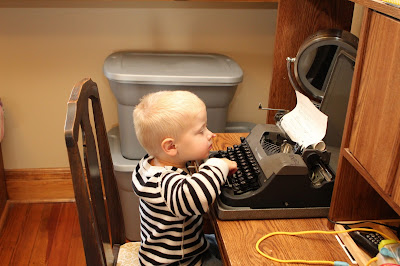
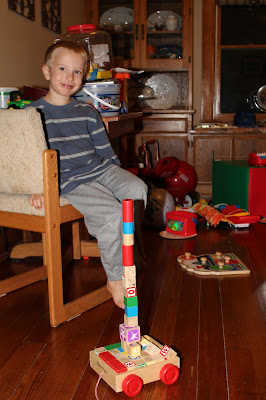
It s been busy lately, and I haven t had the time to blog. With the change in job, various travel, and settling into a new routine, I ve not done as much writing of late. But life marches on, and before memories grow too fleeting, I think I should share a few. We recently changed the arrangements for the boys. Instead of them each having their own room in which they sleep and sometimes play, we purchased a bunk bed. Oliver graduated from his crib to the lower bunk, and Jacob has the higher bunk. This has, predictably, created a few opportunities for behavior issues. Overall, it s going well, and they appreciate their new, more open, play room. Both boys sleep with their stuffed animals. Jacob calls his my friends . He still likes his butterfly, which he has had since he was an infant. He sometimes talks about how much he loves his friends, and how they like to get hugs, and how they are happy. Jacob continues to enjoy reading. He has a toy low-res camera and he even recorded a video of himself reading Brown Bear, Brown Bear. Oliver s vocabulary is coming alive and is fun to watch. Jacob has taken to trying to teach Oliver how to say things. One day, Jacob saw a number like 451 on the side of a train, producing a conversation like this: Oliver, can you say four hundred and fifty-one? Four dred iffy on! You got it!!! YAY! Today as I was walking past Oliver s train track on the floor, he grabbed me by the hand, had me sit down, and kept holding on to make sure I d stay right where he wanted me as he pointed and talked all about his trains. Aww. One cold and windy Saturday morning, the boys were getting restless. What to do, we thought? I decided to bring out one of the manual typewriters from my collection. Oliver loved watching it do things as he pressed buttons. Jacob enjoyed spelling mom . New problem: boys fighting over how long each one s turn at the typewriter is. This has gone on for a month now. Ahh, winter. A few weeks ago, Jacob informed us that he built an antenna out of blocks. He was REALLY proud of it, and even, incredibly, insisted I take his picture with it! I m pleased to have a 5-year-old that calls this structure an antenna instead of a skyscraper or tower or some such thing ;-) We took a train trip to Portland, OR, recently. That s about 2.5 days on the train each way. It went pretty well we had quite a bit of excitement though it got a little long for the boys at times. One evening, Jacob excitedly noted that the sky was almost really dark blue, just like my song! Wow. That was a song he made up in New York in summer 2010. Jacob enjoyed collecting leaves as we walked around in Portland. He would then stash his pile of leaves outside the door of whatever building we d enter, then hope to find them still there when we got back out. It usually worked out OK for him.

28 November 2011

Vincent Bernat: SSL/TLS & Perfect Forward Secrecy

Once the private key of some HTTPS web site is compromised, an attacker is able to build a man-in-the-middle attack to intercept and decrypt any communication with the web site. The first step against such an attack is the revocation of the associated certificate through a CRL or a protocol like OCSP. Unfortunately, the attacker could also have recorded past communications protected by this private key and therefore decrypt them. Forward secrecy allows today information to be kept secret even if the private key is compromised in the future. Achieving this property is usually costly and therefore, most web servers do not enable it on purpose. Google recently announced support of forward secrecy on their HTTPS sites. Adam Langley wrote a post with more details on what was achieved to increase efficiency of such a mechanism: with a few fellow people, he wrote an efficient implementation of some elliptic curve cryptography for OpenSSL.

Without forward secrecy To understand the problem when forward secrecy is absent, let s look at the classic TLS handshake when using a cipher suite like AES128-SHA. During this handshake, the server will present its certificate and both the client and the server will agree on a master secret. TLS full handshake This secret is built from a 48byte premaster secret generated and encrypted by the client with the public key of the server. It is then sent in a Client Key Exchange message to the server during the third step of the TLS handshake. The master secret is derived from this premaster secret and random values sent in clear-text with Client Hello and Server Hello messages. This scheme is secure as long as only the server is able to decrypt the premaster secret (with its private key) sent by the client. Let s suppose that an attacker records all exchanges between the server and clients during a year. Two years later, the server is decommissioned and sent for recycling. The attacker is able to recover the hard drive with the private key. She can now decrypt any session she recorded: the encrypted premaster secret sent by a client is decrypted with the private key and the master secret is derived from it. The attacker can now recover passwords and other sensitive information that can still be valuable today. The main problem lies in the fact that the private key is used for two purposes: authentication of the server and encryption of a shared secret. Authentication only matters while the communication is established, but encryption is expected to last for years.

Diffie-Hellman with discrete logarithm One way to solve the problem is to keep using the private key for authentication but uses an independent mechanism to agree on a shared secret. Hopefully, there exists a well-known protocol for this: the Diffie-Hellman key exchange. It is a method of exchanging keys without any prior knowledge. Here is how it works in TLS:
  1. The server needs to generate once (for example, with openssl dhparam command):
  2. The server picks a random integer a and compute g^a \mod p . After sending its regular Certificate message, it will also send a Server Key Exchange message (not included in the handshake depicted above) containing, unencrypted but signed with its private key for authentication purpose:
    • random value from the Client Hello message,
    • random value from the Server Hello message,
    • p , g ,
    • g^a\mod p=A .
  3. The client checks that the signature is correct. It also picks a random integer b and sends g^b \mod p=B in a Client Key Exchange message. It will also compute A^b\mod p=g^ ab \mod p which is the premaster secret from which the master secret is derived.
  4. The server will receive B and compute B^a\mod p=g^ ab \mod p which is the same premaster secret known by the client.
Again, the private key is only used for authentication purpose. An eavesdropper will only know p , g , g^a\mod p and g^b\mod p . Computing g^ ab \mod p from those values is the discrete logarithm problem for which there is no known efficient solution. Because the Diffie-Hellman exchange described above always uses new random values a and b , it is called Ephemeral Diffie-Hellman (EDH or DHE). Cipher suites like DHE-RSA-AES128-SHA use this protocol to achieve perfect forward secrecy1. To achieve a good level of security, parameters of the same size as the key are usually used (the security provided by the discrete logarithm problem is about the same as the security provided by factorisation of two large prime numbers) and therefore, the exponentiation operations are pretty slow as we can see in the benchmark below: Graphical comparison of speed with and without DHE

Diffie-Hellman with elliptic curves Fortunately, there exists another way to achieve a Diffie-Hellman key exchange with the help of elliptic curve cryptography which is based on the algebraic structure of elliptic curves over finite fields. To get some background on this, be sure to check first Wikipedia article on elliptic curves. Elliptic curve cryptography allows one to achieve the same level of security than RSA with smaller keys. For example, a 224bit elliptic curve is believed to be as secure as a 2048bit RSA key.

Some theory Diffie-Hellman key exchange described above can easily be translated to elliptic curves. Instead of defining p and g , you get some elliptic curve, y^2=x^3+\alpha x+\beta , a prime p and a base point G . All those parameters are public. In fact, while they can be generated by the server, this is a difficult operation and they are usually chosen among a set of published ones. The use of elliptic curves is an extension of TLS described in RFC 4492. Unlike with the classic Diffie-Hellman key exchange, the client and the server need to agree on the various paremeters. Most of this agreement is done inside Client Hello and Server Hello messages. While it is possible to define some arbitrary parameters, web browsers will only support a handful of predefined curves, usually NIST P-256, P-384 and P-521. From here, the key exchange with elliptic curves is pretty similar to the classic Diffie-Hellman one:
  1. The server picks a random integer a and compute aG which will be sent, unencrypted but signed with its private key for authentication purpose, in a Server Key Exchange message.
  2. The client checks that the signature is correct. It also picks a random integer b and sends bG in a Client Key Exchange message. It will also compute b\cdot aG=abG which is the premaster secret from which the master secret is derived.
  3. The server will receive bG and compute a\cdot bG=abG which is the same premaster secret known by the client.
An eavesdropper will only see aG and bG and won t be able to compute efficiently abG . Using ECDHE-RSA-AES128-SHA cipher suite (with P-256 for example) is already a huge speed improvement over DHE-RSA-AES128-SHA thanks to the reduced size of the various parameters involved. Web browsers only support a handful of well-defined elliptic curves, chosen to ease an efficient implementation. Bodo M ller, Emilia K sper and Adam Langley have provided 64bit optimized versions of NIST P-224, P-256 and P-521 for OpenSSL. To get even more details on the matter, you can read the end of the introduction on elliptic curves from Adam Langley, then a short paper from Emilia K sper which presents a 64bit optimized implementation of the NIST elliptic curve NIST P-224.

In practice First, keep in mind that elliptic curve cryptography is not supported by all browsers. Recent versions of Firefox and Chrome should handle NIST P-256, P-384 and P-521 but for most versions Internet Explorer, you are currently out of luck. Therefore, you need to keep accepting other cipher suites. You need a recent version of OpenSSL. Support for ECDHE cipher suites has been added in OpenSSL 1.0.0. Check with openssl ciphers ECDH that your version supports them. If you want to use the 64bit optimized version, you need to run a snapshot of OpenSSL 1.0.1, configured with enable-ec_nistp_64_gcc_128 option. A recent GCC is also required in this case. Next, you need to choose the appropriate cipher suites. If forward secrecy is an option for you, you can opt for ECDHE-RSA-AES128-SHA:AES128-SHA:RC4-SHA cipher suites which should be compatible with most browsers. If you really need forward secrecy, you may opt for ECDHE-RSA-AES128-SHA:DHE-RSA-AES128-SHA:EDH-DSS-DES-CBC3-SHA instead. Then, you need to ensure the order of cipher suites is respected. On nginx, this is done with ssl_prefer_server_ciphers on. On Apache, this is SSLHonorCipherOrder on. UPDATED: You need to check ECDHE support for your web server. For nginx, the support has been added in 1.0.6 and 1.1.0. The curve selected defaults to NIST P-256. You can specify another one with ssl_ecdh_curve directive. For Apache, it has been added in 2.3.3 and does not exist in the current stable branch. Adding support for ECDHE is quite easy. You can check how I added it in stud. This issue also exists for DHE cipher suites, in which case you also might have to specify DH parameters to use (generated with openssl dhparam) using some special directive or by appending the parameters to the certificate. Check Immerda Techblog article for more background about this point. The implementation of TLS session tickets may be incompatible with forward secrecy, depending on how they are implemented. When they are protected by a random key generated at the start of the server, the same key could be used for months. Some implementations2 may derive the key from the private key. In this case, forward secrecy is broken. If forward secrecy is a requirement for you, you need to either disable tickets or ensure that key rotation happens often. Check with openssl s_client -tls1 -cipher ECDH -connect 127.0.0.1:443 that everything works as expected.

Some benchmarks With the help of the micro-benchmark tool that I developed for my previous article, we can compare the efficiency of cipher suites providing forward secrecy: Speed comparison with/without DHE/ECDHE I have used a snapshot of OpenSSL 1.0.1 (2011/11/25). The optimized version of ECDHE is the one you get by using enable-ec_nistp_64_gcc_128 option when configuring OpenSSL. Let s focus on the server part. Enabling DHE-RSA-AES128-SHA cipher suite hinders the performance of TLS handshakes by a factor of 3. Using ECDHE-RSA-AES128-SHA instead only adds an overhead of 27%. However, if we use the 64bit optimized version, the cost is only 15%. The overhead is only per full TLS handshake. If 3 out of 4 of your handshakes are resumed, you need to adjust the numbers. Your mileage may vary but the computational cost for enabling perfect forward secrecy with an ECDHE cipher suite seems a small sacrifice for better security.

  1. Perfect forward secrecy is an enhanced version of forward secrecy. It assumes each exchanged key are independent and therefore a compromised key cannot be used to compromise another one.
  2. For example, this is the case of the implementation I have proposed for stud to enable sharing of tickets between multiple hosts.

27 November 2011

Craig Sanders: problems with Linux and Aten CS1784A KVM switch

Dear lazyweb, I bought an Aten CS1784A DVI+USB KVM switch a couple of months ago. I m pretty happy with it except for one annoying problem. It has a Dell multimedia USB keyboard plugged into it (picked it up from a swap meet for $15 nice. it's a pretty good keyboard in its own right but i mostly bought it to match what I use at work), and a Logitech MX518 mouse connected. Also two computers one runs Linux only. The other is switched off most of the time, but is occasionally powered up to boot into either Linux to experiment with stuff i don't want to do on my main system (like gnome 3) or sometimes Win7 to play games. OK, that s the background data. Here s the problem Whenever I reboot either of the Linux installations, the KVM stops recognising the keyboard. I have to unplug the keyboard and plug it back in before any input is recognised. Keyboard input doesn't get through to the currently active system, and I can't even use the KVM's magic key <ScrlLock><ScrlLock>n<Enter> to switch between systems it doesn't even beep after the 2nd ScrlLock as it should, so it seems as if all keyboard input is ignored by the KVM, or the keyboard is totally confused and not sending anything. The mouse continues to work during this. Rebooting Win7 doesn't do this. The keyboard just works as it should. The problem occurs sometime between the time Linux is selected from the Grub2 menu and the gdm login screen is displayed (same result with both gdm on my main system and gdm3 on my secondary system). The keyboard works when plugged directly into either system, without the KVM. I d been using it for several months before I got the KVM, and I ve tested that it still works correctly across a reboot if i plug it in directly. Googling for "+linux +CS1784A" just gives me hundreds of pages from web sites selling the KVM, but no useful info. Anyone seen anything like this before? Can anyone think of anything that linux might be doing in it's console or X initialisation that would confuse the KVM? it's not a huge problem because I really don't reboot all that often more of an annoyance that I'd like to go away. problems with Linux and Aten CS1784A KVM switch is a post from: Errata

26 November 2011

Andrew McMillan: CeBIT 2011 in (overdue) review

The German Linux Magazine runs a sponsored an "Open Source Lounge" at CeBIT each year. Last year I put in a proposal for DAViCal and it got accepted! With some airfare support from InternetNZ I got to showcase my Free Software project at the largest IT trade fair in the world.If you have an open source project to promote I can't recommend this highly enough. Below is a review of my experience at CeBIT early this year. This is long overdue for posting, and I'm prompted now because submissions are now open for the Open Source Project Lounge at CeBIT in 2012. Apply now.The German Linux Magazine runs a sponsored an "Open Source Lounge" at CeBIT each year. Last year I put in a proposal for DAViCal and it got accepted! With some airfare support from InternetNZ I got to showcase my Free Software project at the largest IT trade fair in the world. If you have an open source project to promote I can't recommend this highly enough. Below is a review of my experience at CeBIT early this year. This is long overdue for posting, and I'm prompted now because submissions are now open for the Open Source Project Lounge at CeBIT in 2012. Apply now.

CeBIT Hall 2 is an enormous space

DAViCal at CeBIT 2011 CeBIT in Hannover is said to be the largest trade fair in the world, attracting over 300,000 visitors during it's five days. Late last year a DAViCal user in Germany suggested that I apply for a free booth for DAViCal in the Linux New Media Open Source Project Lounge . When DAViCal was accepted, I realised I needed some funding to help me travel around the world to attend, so I applied for a grant from InternetNZ who were kind enough to agree to cover part of my travel costs, and I was on my way. Germany in March is cold, especially for me coming from Summer! My travel allowed for a couple of days in Germany before CeBIT because that was when I could get the cheapest flights, and I wanted to have a little time to recover from the journey. Everyone had warned me to pack my winter woollies, and they were definitely needed! I stayed with a friend in Hamburg for two days and on the the second day we walked through the frozen park, past the frozen lake and over the frozen streams to see the Attraktor Hackerspace in Hamburg Nord where the CCC also hold their meetings a very impressive hackerspace in a repurposed bank (including the vault :-) with several separated areas for talks, meetings and workplaces. The day before CeBIT I travelled to Hannover to take a look at my booth space, fetch exhibitor passes for myself and volunteers and generally prepare to do battle with the crowds. The following day the fair started and it was up at 6:30 to get ready and catch the 7:38 train out to the fairgrounds. Although the fair opens at 9:00 there was always something to do between eight o'clock or so when I arrived at my booth and when the attendees started wandering past.
I was fortunate to have two volunteers for my booth who were there all week, as well as a couple more who turned up on the first two days. Not only did this mean that I got to spend a few hours during the week actually wandering the fairgrounds, but that I had some knowledgeable native german speakers for the occasional visitor who could not speak English. DAViCal has been translated into a dozen languages, and there had been some extra work put in to update the German translation before CeBIT also. As well as showing DAViCal, I was also able to demonstrate a new project at the fair which was aCal - a CalDAV Calendar Client for Android which I had released into the market just a few days beforehand for a token sum (it is licensed GPL v3 or later and the source code is available on gitorious.org). Having the smartphone devices available was great for giving live demonstrations, and I used the timetable for events at the Open Source Forum across the aisle from the Open Source Lounge to populate a calendar that we shared among a variety of devices. The first day was really the calm before the storm, and we saw lots of people asking what we were about, and had some good conversations with people wanting to know more, or telling us they used the software and were very happy with it.
CeBIT closes the gates at 18:00 with the visitor supply drying up pretty quickly around then and the secret lives of the exhibitors are revealed with people starting to relax and joke, and beer or wine starting to come out and some booth parties kicking off... if you have the stamina! I didn't, so it was off back to the train, to Hildesheim, to dinner and to bed. That first day blurred into the next, and the next and by Friday I was starting to lose my voice with all the talking I had been doing. I was visited by a chap from Posnan University who are a DAViCal user and he invited me down to the Polish stand to tell me about what they do there, and he agreed that they would love to help get the Polish translation improved. Another DAViCal user turned up with some bavarian wheat beer and a special beer glass for it by way of thanks. In some spare moments I fixed a bug in aCal's handling of character sets and uploaded a new version, so that we could use umlauts in events. Many people came past to talk to us, some of whom want to help with them project or have ideas for interesting things to do with DAViCal, some were already users of DAViCal and some went away thinking that they would be in the future. The last day of CeBIT is a little different: it's a Saturday and the doors are opened to the public and the minimum age is lowered to allow children to attend the event. I had been warned that this day is a madhouse, and it did indeed seem to be so for many booths. For DAViCal it was probably quieter than the day before, I think perhaps because calendar server software is inherently less sexy than many of the other things on display. We still had plenty of great discussions with interested people nonetheless and to be honest I was fairly happy to be spared the further exhaustion that had been threatened. Sunday was spent recuperating: discovering that Hildesheim has a great little restaurant that does traditional german pancakes for breakfast and then wandering around the small city soaking in the sunshine that I'd seen through the windows outside all week. On Monday I caught the train to M nchengladbach to meet with an organisation that might provide support for DAViCal in Germany, but who hadn't been able to come to the fair to see me due to illness. I was encouraged to spend the night in Aachen a beautiful little city , which I did, arriving around sunset and I spent a couple more days before flying home being intensely antisocial to recover from the furious week beforehand. Is CeBIT worth it? CeBIT seemed to me to be quite a different business model, or perhaps on a different scale. I've seen trade fairs in New Zealand for other purposes, but not to showcase software and services in quite this way. To give an idea of it's scale, consider that I had a tiny booth in a hall that was probably four times the size of the TSB Arena, and CeBIT included around 20 such buildings , packed with exhibitors, with free buses to get around the campus, acres of multi-storey parking buildings, two train stations, and so on. The scale of the event is incredible.

Polish people are huge too, like these friendly DAViCal
users from Pozna University of Technology who
showed me all the cool toys they brought to CeBIT.

As a result of this scale, CeBIT boasts impressive visitor numbers, and while a visitor will usually attend with a specific area of interest in relation to their business they will also wander the fair to see other areas of more personal interest, or just to see what is around. Open Source is a specific area of interest to a significant percentage of business in Germany, and Deutsche Messe, the fair operators, recognise the value of having an open source area as a draw for visitors, with the primary open source area placed in Hall 2, directly off the main north entrance. Within the open source area, the Open Source Project Lounge , where DAViCal was located, is a series of booths sponsored by Linux New Media AG. Projects in the Open Source Lounge are selected by a jury of Linux New Media, Deutsche Messe and several community advisors, so as such there is a range of interesting projects on show and the draw of any given project has a flow-on effect to the others. As an example, at one point while briefly minding the adjacent stand for the OpenEmbedded project I was unable to help an inquiring visitor, but I was able to talk about DAViCal with him until the exhibitor returned to answer his question. His interest in DAViCal was definitely increased in this process, and I'm sure that many people came into our area of the lounge attracted by a specific exhibitor and moving on to see some of the others. Outside of this association with open source, however, CeBIT offers something which general free software events cannot: an association with mainstream software and services. This presentation of Open Source alongside IBM, SAP, HP, Oracle, Software AG, Apple, Microsoft and so forth makes inclusion at this event particularly valuable. Free software solutions can have good brand recognition within the open ecosystem itself and yet be practically unheard of outside it. Most traditional methods of communication with suppliers don't work well with Open Source projects: a request for proposal will sail silently by, unless noted by a related commercial entity. In general there is no sales department, and marketing is frequently a desultory hit or miss affair. The fair is different. The fair is about talking with people. While there is still plenty of collateral marketing with brochures, signs, presentations and giveaway knick-knacks those things are just there to bring people into range: the real action happens when you engage a person in conversation, and at that point a humble free software project can be on an equal footing with a larger booth staffed with eager young salesmen. Of course there are a number of places where free software can get a booth. Linuxtag is a German example where there are many booths for free software projects, linux.conf.au also offers booths to free software projects during it's more outreach Open Day and software freedom day events happen all around the world where booths are available, but the audience arriving at these events are all largely pre-sold on openness and free software. So in presenting this broad blend of people, in a way in which free software projects can present on a roughly equal footing with their commercial brethren, CeBIT is an opportunity not to be missed. The numbers speak for themselves, too: traffic to the DAViCal websites has increased by about 50% around CeBIT with 25% coming from Germany, but significant increases also from France, Netherlands, Italy, Switzerland and Poland. Traffic to the DAViCal wiki has doubled over the last 12 months in a steady increase to around 200,000 page views each month. This sudden increase to around 10000/day in March, with some days during CeBIT peaking at over 20000/day The Future I won't be returning to CeBIT to represent DAViCal in Hannover next year as the sponsored booth is pretty much a one-time thing and the costs involved in purchasing a booth for attendance at the fair are significant (around NZD$15000 for a small 3m x 2m stall). It's possible that I will return next year in a different capacity, as one of the larger stand organisers has confidentially indicated he will invite me to attend as part of an Open Source Apps area that he is considering running on his stand, somewhat along the lines of the Open Source Lounge . Time will tell, I guess, but if invited I think I would definitely go for that. I will definitely be suggesting to a few specific free software projects that they should apply for the Linux New Media opportunity when it comes around again. Koha is one project that immediately springs to mind, but of course there are many, many worthy free software projects and this opportunity seems to be little-understood outside of Germany.

Britta was unfailingly helpful and charming

If I do convince a project to apply, and they are successful, I will also try and give them some assistance and background knowledge to understand the fair, and how best they can take advantage of the opportunity it offers. Some basic tips would be: and finally... I would like to express my appreciation to InternetNZ for the grant to partially cover my travel costs to Hannover, making my attendance at this outstanding event much more achievable. My thanks also to Britta Wulfling who supported all of the projects in the Open Source Lounge. My friends Alexander & Meike in Hildesheim who supplied somewhere for me to recuperate, and accompanied me to the fair every day to run the Debian booth. Thanks also, of course, to the German Linux Magazine for selecting DAViCal for a free booth, and to Benny who pointed the opportunity out, encouraged me to apply, and came along and helped out for the whole week.

Jonathan McDowell: All I need is a large enough white wall

I think I'm currently supposed to be out buying a TV at the moment. Or something else expensive. Instead I'm lying on the sofa listening to Whale and drinking tea. That's much better in my opinion, but it reminded me that I hadn't mentioned that I bought a projector. I had the loan of a projector for a while when I was in Belfast. It was a huge thing that made a lot of noise, but was pretty cool for watching films with. When I moved to the US I decided not to bother with a TV to start with - using my laptop did just fine for most things. Except films. They really benefit from a bigger screen. Especially if you want to watch them with someone else. So I started looking at pico projectors, because I wanted something small and cute that I could throw in a bag with my tiny laptop. At the time the best the pico projectors could do was 840x480, which I felt wasn't really that great. However back in January TI announced their DLP Pico HD chipset, offering a resolution 1280x800. I kept a look out for projectors using this to appear, and eventually, in July, Amazon claimed to have availability of the Vivtek Qumi. So I bought one. And I'm very happy with it. I'm not a heavy user, and there are some niggles, but it's small and does exactly what I want. In low light conditions it'll happily throw an image all the way across the room, which is more than it's rated at. There's a mini-HDMI connector on the back, so it's a doddle to plug it into my laptop using the supplied HDMI to mini-HDMI cable. The laptop auto-detects the device and extends the desktop appropriate, as you'd expect. It'll also do media playback itself - there's a USB host port and a micro SD slot on the back. This works ok, and the included remote means you can easily set the projector somewhere above your head and still be able to easily control it. Unfortunately the built in speakers are fairly useless. There's a 3.5mm socket for external speakers, but having to plug something else in detracts from the convenience factor of the built-in media player. Also my unit had the power switch installed upside down (the little red line indicating the power is on actually shows up when it's off), but that's the only complaint I've got about the build quality. There's a little neoprene case to store the thing in as well. So, er, yeah. I think I can continue to make do without a normal TV for a while longer and avoid the nightmare that I suspect are the shops on Black Friday.

22 November 2011

Rapha&#235;l Hertzog: People behind Debian: Stefano Zacchiroli, Debian Project Leader

picture by Tiago Bortoletto Vaz, CC BY-NC-SA 2.0


It s been one year since the first People behind Debian interview. For this special occasion, I wanted a special guest and I m happy that our Debian Project Leader (DPL) Stefano Zacchiroli accepted my invitation. He has a difficult role in the community, but he s doing a really great job of it. He s a great mediator in difficult situations, but he s also opinionated and can push a discussion towards a conclusion. Read on to learn how he became a Debian developer and later DPL, what he s excited about in the next Debian release, and much more. Raphael: Who are you? Stefano: I m Stefano Zacchiroli, but I prefer to be called Zack, both on the Internet and in real life. I m 32, Italian, emigrated to France about 4 years ago. I live in Paris, and I find it to be one of the most gorgeous and exciting cities in the world. As my day job I m a Computer Science researcher and teacher at University Paris Diderot and IRILL. In my copious free time I contribute to Debian, and I m firmly convinced that doing so is an effective way to help the cause of Free Software. Besides, I find it to be a lot of fun! Raphael: How did you start contributing to Debian? Stefano: Flash back to 1999, when I was a 2nd year student in Computer Science at the University of Bologna. Back then in Italy it was uncommon for young geeks to get exposed to Free Software: Internet was way less pervasive than today and most computer magazines didn t pay much attention to GNU/Linux. Luckily for me, the professor in charge of the student lab was a Free Software enthusiast and all students machines there were running Debian. Not only that, but there was also a student program that allowed volunteers to become sysadmins after having shown their skills and convinced the director they were trustworthy. Becoming one of those volunteer Debian admins quickly became one of my top objectives for the year, and that is were I ve learned using Debian. The year after that, I got in touch with a research group that was to become the happy bunch of hackers with whom I would have done both my master and PhD theses. They were designing a new proof assistant. Most of the development was in OCaml and happened on Debian. OCaml was available in Debian, but many of the libraries we needed were not. So I approached the Debian OCaml Team offering to help. Before I realize what was going on I was (co-)maintainer of tens of OCaml-related packages. At some point I got told I think you should apply as a Debian Developer . So I did and in a couple of months I went through the New Member (NM) process, that was back then in its infancy. I still remember my happiness while reading the account created mail, the day after my 22nd birthday. I know the NM process went through some bad publicity in the past, but I m happy to see that nowadays the process can be as swift as it has been for me 10 years ago. Raphael: It s your second year as Debian Project Leader (DPL). Are you feeling more productive in the role? Do you fear to burn out? Stefano: I m feeling way more productive, no doubts. The task of the Debian Project Leader is not necessarily difficult, but it is a complex and scarcely documented one. It is also profoundly different from any other task that Debian people usually work on, so that experience doesn t help much in getting started. Before becoming effective as DPL one needs to get to know many people and mechanisms he is not familiar with. More importantly, one needs to set up a personal work-flow that allows to keep up with day-to-day DPL tasks (which are aplenty) as well as with urgencies (that tend to pop-up in the leader@debian.org INBOX at the least convenient time). Finally, one also needs to do proper traffic shaping and always retain enough motivation bandwidth to keep the Project informed about what is going on in DPL-land. Finding the right balance among all these ingredients can take some time. Once one is past it, everything goes way more smoothly. The above is why I m constantly encouraging people interested in running for DPL in the future to reach out to me and work on some tasks of the current DPL s TODO list. I swear it is not just a cheap attempt at slavery!. It is rather an attempt at DPL mentoring that could be beneficial: both to give future candidates more awareness of the task, and to reduce the potential downtime when handing over from one DPL to the next. Regarding burn out, I don t feel prone to its risk these days. If I look back, I can say that my contributions as DPL have been pretty constant in volume over time; my enthusiasm for the task, if anything, is on the rise. The effectiveness of my contributions as DPL are, on the other hand, not mine to judge. Raphael: If you had to single out two achievements where you were involved as DPL, what would they be? Stefano: I d go for the following two, in no particular order: OK, let me cheat and add a third one I m also proud of having been able to report to the Project my whereabouts as DPL, thoroughly and periodically, since the very beginning is first term. People annoyed by my reporting logorrhea now have all my sympathies. Raphael: Among the possible new features of Debian Wheezy, which one gets you excited most? Stefano: It s multi-arch, no doubt. Even though it is not a directly user visible change, it s a very far reaching one. It is also one of those changes that make me feel that moment of truth of coders, when you realize you are finally doing the right thing and ditching piles of ugly hacks.
It s multi-arch [ ] you realize you are finally doing the right thing and ditching piles of ugly hacks.
Raphael: If you were not DPL and could spend all your time on Debian, what project would you do? Stefano: I would sit down and do software development for Debian. It s impressive how many important and beneficial changes for Debian could be delivered by specific software improvements in various parts of our infrastructure. We tend to attract many packagers, but not so many people willing to maintain Debian infrastructure softwares like dak, britney, debbugs, the PTS, etc. Their maintenance burden then falls on the shoulders of the respective teams which are generally very busy with other important tasks. As a project, we seem to be more appealing to packagers than to software developers. That is a pity given the amount of exciting coding tasks that are everywhere in Debian. Part of the reason we are not appealing to developers is that we are not particularly good at collecting coding tasks in a place where interested developers could easily pick them up. It also takes quite a bit of inside knowledge to spot infrastructure bugs and understand how to fix them. I long for some spare hacking time to check if I m still good enough of a coder to hunt down longstanding bugs in our infrastructure, which have ended up being my pet peeves. I d also love to dive again into RCBW. It s less committing than package maintenance, more diverse and challenging, and also an immensely useful activity to get Debian releases done. Raphael: Martin Michlmayr is worried that there is so few paid opportunities around Debian. Do you agree with his sentiment, and if yes do you have ideas on how to improve this situation? Stefano: The idealistic me wishes Debian to be a community made only of volunteers that devote their free time to the Project. Oh, and that me also wishes Debian to be competitive with similar projects, no matter how many full-time employees others have! That is coherent with a view of society where everyone has a day job, but also engages in volunteering activities ensuring that public interest is pursued by people motivated by interests other than profit. But I do realize that for Free Software to succeed companies, employees, and salaries should all have a role. I admire projects that strike a good balance between volunteer and paid work. The Linux kernel is emblematic in that respect: many developers are paid by companies that have a commercial or strategic interest in Linux. Nevertheless volunteers contributions are aplenty and the Linux community gives a convincing impression that choices are driven by the community itself (or by its benevolent dictator) without money-driven impositions.
I do realize that for Free Software to succeed companies, employees, and salaries should all have a role.
Such an ecosystem does not exist around Debian. We do have a partner program that allows for it to happen, but we have very few partners with an interest in doing distribution development work. Like Martin, I m worried by this state of affairs, because it de facto means we lag behind in terms of available people power. In a community of volunteers, that might frustrate people and that is not good. To improve over the status quo the first step is to federate together small and medium companies that have a strategic interest in Debian and listen to their needs. I m already in touch with representatives of such companies that, in many cases, already employ Debian Developers to do some distribution work in Debian. We will be soon sending out a call to reach out to more such companies, but since we are discussing this, why waiting? If some of our readers here are representative of such companies, I encourage them to get in touch with me about this. Raphael: You know that the fundraising campaign for the Debian Administrator s Handbook is on good track but the liberation of the book is not yet assured. What do you think of this project? Stefano: I m happy about the project, to the point that I ve accepted writing a testimonial for it :-) . I m sad about the scarce availability of up to date and high quality (DFSG-)Free books about Debian and I welcome any initiative that might help closing that gap.
I m sad about the scarce availability of up to date and high quality (DFSG-)Free books about Debian.
Free Culture is a great offspring of Free Software and I m convinced we need to stand up against double standards in the two camps. Letting aside software-specific licensing details, the basic freedoms to be defended are the same. They are those freedoms that ensure that a reader is in full control of his book, pretty much as they ensure that a computer user is in full control of the software that runs on it. I m therefore proud that Debian has long resolved that the Debian Free Software Guidelines (DFSG) apply not only to software but also to books and other pieces of documentation. But the status quo implies that not only we have very few up to date, high quality books about Debian. It also implies that, at present, we have no such book that we can distribute in the Debian archive, showing off the Free Software (and Free Culture!) values we stand for.
Crowdfunding is considered to be a good mate for Free Culture, where the services model that applies to Free Software is more difficult to exploit. I so wish any luck to yours and Roland s initiative. A different matter is whether Debian, as a project, should endorse the initiative and actively campaign for it. As you know, I think it should not. While we do advertise general project donations, we don t do mission-specific fundraising campaign for Debian itself. Coherently with that, I don t think we should relay crowdfunding campaigns for 3rd parties, even when the result would be beneficial to Debian. Raphael: Is there someone in Debian that you admire for their contributions? Stefano: There are two classes of people that I particularly admire in Debian:
Thank you to Zack for the time spent answering my questions. I hope you enjoyed reading his answers as I did.

Subscribe to my newsletter to get my monthly summary of the Debian/Ubuntu news and to not miss further interviews. You can also follow along on Identi.ca, Google+, Twitter and Facebook .

7 comments Liked this article? Click here. My blog is Flattr-enabled.

Michal &#268;iha&#345;: phpMyAdmin translations

Today, while merging changes to phpMyAdmin from our translation server I was very surprised that we have two languages which already reached 100% - Slovenian and Turkish (and four more just few strings from 100%). The huge amount of new strings introduced during 3.5 development (mostly being MySQL advisor hints) made me thing it will take very long time till they all get translated, but I was proven wrong. Anyway there is still lot of work to do, so feel free to join our translators team.

Filed under: English Phpmyadmin 0 comments Flattr this!

15 November 2011

Michael Casadevall: Secure Boot - its here and been here for quite awhile ...

There's been a lot of noise with Microsoft requiring Secure Boot for Windows 8 OEMs. For those of you unfamiliar with it, Secure Boot requires that the boot chain is signed, and this 'feature' must be enabled by default. Although I have been unable to find specific details, it appears that the chain of trust needs to extend from BIOS/UEFI all the way down to the kernel. Obviously, requiring a signed boot chain makes using FOSS platforms like Ubuntu or Debian an impossibility short of having the UEFI Platform Key and resigning the entire chain.

Steven Sinofsky's MSDN blog has a fairly good overview how it works. Canonical and Red Hat also have a good white paper on why secure boot is a serious problem for Linux distributions. Even if secure boot itself can be disabled, it *greatly* rises the bar for general end-users to successfully install Ubuntu on their machine. In addition, it is the responsibility of OEM and BIOS manufacturers to provide the option to disable it.

There already has been a long history of OEMs removing BIOS options or introducing DRM; for instance, locking out VTx on Sony laptops, or restricting laptops to only accept 'branded' wifi and 3G cards. Given this track record, can OEMs realistically be trusted to have this option available?

What most people don't realize is that secure boot itself is not a new concept; its simply part of the Trusted Computing initiative, and has been implemented on embedded platforms for many years. If you own any iPhone, or one of the vast majority of Android devices, you are using a device that either has the secure boot feature, or something very close. This especially painful in Android as Google's security system restricts users to a *very* limited shell and subset of utilities which can be used on non-rooted devices. WebOS, Maemo, and to my knowledge Meego give the end-user full unrestricted access to the boot chain and you can swap kernels and even the entire OS out if one was so motivated.

Although it is still an ongoing problem, several vendors such as HTC, Samsung, Motorola (kinda), and even Sony. In the Android community, having unlockable bootloaders has been a welcome middle ground in the traditionally restrictive and locked-down world of cellular devices.

While some may argue that such locks are necessary to protect consumers, it is perfectly feasible to create devices with unlocked bootloaders that are still secure. The Nook Color's is an Android powered eReader. It's stock firmware doesn't allow sideloaded applications or even access to a user shell via adb, but the BootROM on the device attempts to boot from the microSD card before eMMC, making it possible for enterprising users to easily modify the underlying OS (as well as making it physically impossible to brick the device due to a bad flash). Barnes and Nobles even sells a book on rooting the Nook Color; it was right next to the devices on display at the time. In addition, they've continued the tradition of easily modifiable devices with both the Nook Simple Touch, and the Nook Tablet.

One of the most impressive attributes is the possibility of running Ubuntu on it. The absolute poster child for this is the Toshiba AC100. For those of you unfamiliar, it ultralight netbook that shipped with Android 2.1/2.2 with easy access to the built in flash via the mini-USB port on the side of the device. Due to the valiant efforts of the AC100 community, Ubuntu was ported to this device, and became a supported platform with images available on cdimages.ubuntu.com. If you were an attendee at UDS, you likely saw several AC100s all running Ubuntu.

This brings me to the point that motivated me to write this post in the first place. One of the most impressive tablets I've seen to date is the ASUS eeePad Transformer, an Android tablet with fully dockable keyboard. I have one of these devices, and its one of the most impressive and usable Android tablets I own. Sadly, such a powerful device was hobbled from its true potential due to ASUS's decision to ship the device with a locked and encrypted bootloader. Surprisingly, the Secure Boot Key (SBK) was acquired and released to the wild, making it possible to reflash the device. Sadly, even with the SBK, the device's bootloader is still extremely hobbled compared to the AC100 making flashing a slow and difficult process.

In response, ASUS refreshed the eeePad's hardware to the new B70 SKU, which has a new Secure Boot. Despite this, a root exploit was recently found to allow people to circumvent these restrictions and install customs ROMs. It is however only a manor of time before ASUS responds and releases a new update that fixes this bug.

Steven Barker (lilstevie) on xda-developers successfully created a port of Ubuntu to the Transformer. Currently, installing Ubuntu on the Transformer requires nvflash access, so its not possible to use his image on the newly liberated B70 devices. I am certain that a new method of installing via an update.zip will be developed for those of us with hobbled devices.

It is a showcase of what is possible when you have open hardware, and also proves one indisputable point: any 'trusted boot' or DRM scheme can and will be defeated; at best you piss off your userbase, and at worst, you force users to exploit bugs to gain control of their device. As it is impossible to reflash these devices from the bootloader, a failed kernel flash WILL brick these devices, increasing warranty and support costs as users try to return their now broken devices.

In closing, while there have been some victories in ongoing war of open hardware vs. trusted comptuing, the road ahead still remains very murky. Victories in the mobile market have shown that there is a market for open devices. Google's own Nexus One was sold as a developers phone and as a way to encourage manufacturers to raise the bar. It sold well enough to recoup its development costs.. While there is no official statements, the Nokia N900 is suspected to have broken all sales expectations, backed up by the fact that Angry Birds sold extremely well on the Ovi Store for the N900.

From the article in question:
What reaction have you had in terms of sales and customer feedback?

Angry Birds had already been launched on App Store before it came out on Ovi Store, and it had a great review average from iPhone reviewers and users alike, so we expected a good reception from N900 users as well.

Even so, we were quite surprised by just how the N900 community immediately took the game to heart. The game obviously made many people very happy, and that is really the greatest achievement that anyone who creates entertainment for a living can hope for. Well, maybe the greatest achievement is huge bundles of cash, but making people happy comes a close second.

In the first week that Angry Birds has been on the Ovi Store, it has been downloaded almost as many times as the iPhone version in six weeks. Given that most N900 users have not even used Ovi Store yet, we are confident that there will be many more downloads in the months to come, and are sure that the N900 version will be very profitable.

That being said, with Microsoft pushing secure boot and trusted computing down everyone's throats with Windows 8, it is hard to say what the future might hold for those of us who want to own our devices.

14 November 2011

Vincent Bernat: A quick look at Typekit

Back in the dark ages of the web, before the introduction of CSS 3, browsers could only display fonts available on the client system. Thanks to the introduction of @font-face and its now widespread support, this is over. Now, Web designers have access to a large selection of fonts and most users will be able to appreciate them. Typekit provides a subscription-based library of hosted, high-quality fonts to use on websites. I expose here my own, mostly uneducated1 on the typographic side, look on this service.

Fonts embedding 101 There are several ways to embed fonts for the Web. Let s have a look at the most common ones.

Self-hosting and @font-face A first possibility is to host fonts yourself and provide a CSS file with the appropriate @font-face declarations. There are five important things to know:
  1. There is no common format. You will need to host different versions of the same font to support most browsers.
  2. Of course, Internet Explorer comes with its own quirks that you need to work around.
  3. Most browsers enforce a same origin policy. You need to serve your fonts from the same domain as the requesting page. You can circumvent such a limitation by enabling cross-origin resource sharing: add an Access-Control-Allow-Origin header when serving fonts.
  4. Fonts are unlikely to change. To leverage caching, configure an explicit expiration date far in the future. Something like 30 days.
  5. There is no MIME types registered for fonts. Don t bother setting one, even if Google Chrome likes to complain about them in the console.
One great resource is Font Squirrel which provides kits with fonts and the appropriate CSS declarations. You choose your font family (or upload one of your own), the formats that you want to use (check them all) and you will get a ZIP archive with all fonts and a CSS file. You may want to tweak it a bit to enable automatic use of the bold variant when needed and to use a local copy if available. For example, if you choose Crimson, an oldstyle typeface, you may want to declare the bold version with font-weight: bold and add local names:
@font-face  
    font-family: 'Crimson';
    src: url('Crimson-Bold-webfont.eot');
    src: local('Crimson Bold'), local('Crimson Text Bold'),
         url('Crimson-Bold-webfont.eot?#iefix') format('embedded-opentype'),
         url('Crimson-Bold-webfont.woff') format('woff'),
         url('Crimson-Bold-webfont.ttf') format('truetype'),
         url('Crimson-Bold-webfont.svg#CrimsonBold') format('svg');
    font-weight: bold;
    font-style: normal;
 

Google Web Fonts For open-source fonts, you can also use Google Web Fonts instead of hosting the files yourself. Build a collection of fonts and choose the variants that you want to use for each of them. You will then be provided with a code snippet to paste in the <head> element of your page. For example, for Crimson:
<link href='http://fonts.googleapis.com/css?family=Crimson+Text:400,700,400italic'
      rel='stylesheet' type='text/css'>
Why choose this solution over self-hosting?
  1. You don t use your own bandwith to serve fonts. This may be important if you pay for it.
  2. Google uses its own CDN to serve fonts. If you don t use a CDN yourself, this can be a major performance improvement.
  3. Caching is more efficient since many sites will use the same font.
  4. It s easier to do it right.
Unless you are concerned about Google tracking your users2, I think this is a better solution than self-hosting. Quick delivery of fonts is pretty important since content rendering can be delayed by them.

Typekit: the good parts So, why choose Typekit? First, there is the very large choice of fonts. The first paid plan comes with more than 500 fonts from about 80 foundries. There are about a hundred serif fonts and a couple hundred sans serif ones. Typekit provides a convenient interface to browse fonts. You can either search fonts by name or by characteristics. In the last case, you can filter on properties like the classification (serif, sans serif, decorative, etc.), weight, width, contrast, x-height, recommended use or language support. Once a font is selected and added to your kit, you can easily choose what variants you want. The kit total size is displayed. If you happen to meet any problem or have some questions, Typekit support is very responsive. I got clear and crisp answers in less than a few hours in the week-end.

and the bad ones Unfortunately, Typekit has also some shortcomings. One of the most commonly cited is that Javascript is mandatory. No Javascript, no fonts. If you want to display the appropriate fonts for users without Javascript, you should just not use Typekit.

Not free, nor free While Typekit offers some open-source fonts, most of them are not. Moreover, only a few of them are available in the free plan. While I would prefer to use open-source fonts, I don t consider this a strong requirement: if you are dissatisfied for some reason, switching back to open-source fonts (or another service) is fast and easy. I like serif fonts a lot and they get less attention from the FLOSS world: it is difficult to find one whose readability on screen is excellent. Droid Serif is a nice font but is a bit too black for me. Maybe Cardo would be a good match. You may disagree and in this case, Google Web Fonts or self-hosting seem the perfect match.

Difficulty to choose and test fonts While browsing fonts is easy and smooth, choosing and testing them is another matter. For example, Typekit is missing some interface to compare font rendering for whole paragraphs at a given size. It also misses a way to check how two fonts render together, one for headings and one for paragraphs. Here, Google Web Fonts is more versatile. Things become really difficult when you want to test your selected fonts for real. Except if you have invested into one of the expensive plans, you can only include a limited number of fonts in your kit. Each time you want to try another set of fonts, you need to modify your kit and wait for it to be distributed across Typekit network. You may have to wait five or ten minutes between each change! Another inconvenient thing is that once you publish your site, any change to the kit will affect the published version. Therefore, you need to use a second kit for development and play back and forth with those two kits. What would be convenient here is a special kit with all fonts from the library with restricted access to some IP to avoid abuse. This is something done by Fontdeck, a competitor.

Poor subset support Because you want to keep the font size small (about 30 kB for each variant), Typekit usually proposes two subsets: the default one contains only latin characters and the complete one with all glyphs. If some glyph is absent from the default subset, you need to use the complete one which is roughly two to four times the size of the default one. This is a bit huge for only one character. What would be nice is to have subsets for each language. In my case, I would take a French subset because I need the glyph which appears in French in words like c ur (heart or core) or il (eye). I don t want to select the complete subset just for this character. When a glyph is absent, the next font in the CSS stack is used. For example, if the selected font is FF Tisa Web Pro and the next font in the stack is Droid Serif, here is how the word c ur may be rendered. On the first line, FF Tisa Web Pro contains the appropriate glyph. On the second line, the glyph is absent and taken from Droid Serif. Since x-height and contrast are a bit different, the replaced glyph seems out of tone. At small sizes, the difference accounts for more than 10%. Various rendering of word "c ur" I have also added a third line where the ligature is built from o and e and the following style is applied to e :
.lf-ligature  
    margin-left: -0.172em;
    zoom: 1; /* Here to trigger hasLayout on IE7 */
 
As you can see, the result seems good. I have a piece of Javascript turning a ligature into the appropriate markup. It can be extended to handle more ligatures and could be adapted to handle other composed characters (like the ones in Anton n Dvo k ).

Defective caching Because a document can only be rendered after the fonts have been loaded3, it is pretty important to deliver fonts as fast as possible. Typekit uses Edgecast as a CDN and DynECT for DNS hosting. Two files are downloaded. Both of them are hosted on use.typekit.com. The first one is a script that will act as a loader. Based on the characteristics of your browser, it will choose how to download the requested fonts for best rendering. The second file is generally a big CSS file containing the fonts. Here are the headers returned for the first file:
HTTP/1.1 200 OK
Accept-Ranges: bytes
Cache-Control: max-age=300
Content-Encoding: gzip
Content-Type: text/javascript
Date: Tue, 08 Nov 2011 18:34:16 GMT
ETag: "388467610+gzip"
Expires: Tue, 08 Nov 2011 18:39:16 GMT
Last-Modified: Sat, 05 Nov 2011 09:31:57 GMT
Server: ECS (cdg/D624)
Vary: Accept-Encoding
X-Cache: HIT
Content-Length: 7440
First, notice that the content is served compressed. Good point. The next headers to look at are Cache-Control, Date, ETag and Expires: the server requests the content to be cached for 5 minutes. When the browser notices that its copy is out-of-date, it will issue a new request including a If-None-Match: 388467610+gzip header. Unless the kit has been modified, the server will answer with 304 Not Modified and no content. The copy of the browser will be valid for another 5 minutes. This means that after 5 minutes, at least 3 round-trips are needed to check if our fonts are up-to-date. Worse, sometimes, Typekit servers may be just slow. They can wait one second before answering, just to send a 304. Since the first file is a script embedded in <head>, the whole page is blocked until you get the answer. Here is an illustrative example with Chromium 14 where a page using Typekit is loaded while all static assets are in the navigator cache and things have gone wrong (which is pretty rare): Screenshot of Chromium Inspector Since fonts are needed, the rendering has been paused for 3.5 seconds until Typekit was fully loaded. If we look more closely, we may also notice we got a status 200 from the server instead of 304. Here is an excerpt of the browser request:
GET /tyt0atd.js HTTP/1.1
Host: use.typekit.com
Connection: keep-alive
Accept-Encoding: gzip,deflate,sdch
If-None-Match: "2200251225+gzip"
If-Modified-Since: Thu, 10 Nov 2011 11:38:11 GMT
And here is an excerpt of the answer headers:
HTTP/1.1 200 OK
Accept-Ranges: bytes
Cache-Control: max-age=300
Content-Type: text/javascript
Date: Fri, 11 Nov 2011 17:10:03 GMT
ETag: "2200251225"
Expires: Fri, 11 Nov 2011 17:15:03 GMT
Last-Modified: Thu, 10 Nov 2011 11:38:11 GMT
Server: EOS (lax001/54E5)
Content-Length: 25755
What happened? For some unknown reason, the server denied the access to the compressed version of the resource: there is no Content-Encoding: gzip while the browser did send Accept-Encoding: gzip. The tag provided by the browser (2200251225+gzip) came obviously from the compressed resource and therefore does not match. RFC 2616 requests If-Modified-Since header to be ignored if the tag does not match. Consequently, the server answers with 200 OK and resend the whole file. The same problem happened with the CSS file. Let me stress again how important the problem is: we had to download again the two files but we also downloaded the non-compressed version. Now, let s suppose that we did not run into this problem and the server answered with 304 Not Modified. The result is still not satisfactory: we would have waited 1.3 seconds to get both answers from the server. Keep in mind that most of the time, Typekit is pretty fast. Here is how I think this should have been done: each time you modify your font kit, you get a new URL to use (containing the version of the font kit for example). This resource and the associated fonts (whose URL is also versioned) are requested to be cached for several days. As a sidenote, this also enables to modify a kit for your development environment without modifying the kit for your production site. I suspect that Typekit did not go this way to track kit usage more accurately and enforce the appropriate pricing. Having multiple versions of the same kit would also allow us to use more fonts that we are paying for. UPDATED: Typekit support knows the problem and is working on it:
You ve identified a small bug in our CDN provider that we re working with them to fix. Hopefully I can give an explanation of what s happening. The CDN edge servers have a cache of recently served kits on them. Any request that is served from that cache will be correctly Gzipped and handle ETags. Unfortunately, if the content isn t already in cache and needs to be fetched from the master origin server then the request won t be gzipped correctly which has the side effect of breaking ETags. [ ] We are working to on getting this bug fixed, but any change to a globally distributed CDN will take some time. We re also working on having our content cached longer than 5 minutes whilst still allowing people to quickly update their site.

Conclusion I have mixed feelings about Typekit. While the difficulty to test fonts and the lack of language-related subsets are annoying, I have been able to work around them. However, the caching problem is more annoying. I am still considering going back to Google Web Fonts just because of this.

  1. While I have a high interest in typography, have my own copy of The Elements of Typographic Style by Robert Bringhurst and have throughly read The Elements of Typographic Style Applied to the Web , I am still fairly novice on this matter.
  2. Google serves fonts from a cookie-less domain. Technically, they could still do some kind of tracking but I believe they don t.
  3. In fact, browsers have different strategies on how to render before fonts availability. Paul Irish wrote a comprehensive article on FOUT. One common strategy is to render a blank space until downloaded fonts are available. If this takes too much time, fallback fonts may be used.

9 November 2011

Michal &#268;iha&#345;: Back on track with Gammu

During summer, I somehow managed to collect huge backlog on Gammu. This consisted on few hundredths of emails to reply, bug reports, not reviewed records in phone database and so on. Today I can finally say this is mostly over and I should be able to react more quickly. Though this does not change anything on previous statements about limiting my involvement there. Processing emails went quite smoothly, luckily some of them resolved themselves or others have helped on mailing list. With bug reports it is more troublesome, because there are topic which I don't want to touch and thus looking for volunteers to work on that. Maintaining Gammu packages in Ubuntu PPA so that users would be able to install latest version easily is one of such tasks, which are waiting for somebody. Anyway I feel much better without those unread emails and I hope not to collect so huge pile of them again :-).

Filed under: English Gammu 0 comments Flattr this!

23 October 2011

Uwe Hermann: The TrekStor eBook Reader 3.0 (EBR30-a), review and dissection

The TrekStor eBook Reader 3.0, front
The TrekStor eBook Reader 3.0, front on There a many, many, e-book reader devices available these days, and they're quickly becoming pretty affordable. The currently cheapest device in Germany (that I know of) is the TrekStor eBook Reader 3.0, model number EBR30-a, at 59.- Euros via Weltbild or Hugendubel. The device has an 800x480 7" TFT (yep, no e-ink), 2100mAh battery, it can display PDFs, EPUB, and TXT files (and Adobe DRM crap, which I don't really care about), it has an accelerometer which allows for landscape/portrait switching, it can play MP3, OGG, WAV, and WMA audio files (headphone jack), it can display pictures (BMP, GIF, JPG, even PNG, though that's not mentioned in the vendor's specs), and it has 2GB internal storage for books/music/pictures. Uploading of (non-DRM) content is done by a simple file copy, it enumerates as a standard USB mass storage device with FAT filesystem. It's a relatively nice reader for the price, I've read a few PDFs (datasheets, presentations) on it in the subway/train while listening to music from the device and it's quite OK for my purposes. So much for the review part. However, I didn't really buy it for reading books on it, I was more interested in taking it apart, of course ;-) My hope was that it would turn out to be a really cheap device running Linux/U-Boot which would be perfect for playing around with embedded Linux stuff. Unfortunately, I wasn't so lucky (it seems). The TrekStor eBook Reader 3.0, opened I've posted a few photos of the device and its hardware components on my flickr account and over at randomprojects.org, together with all the information I was able to find out so far. Here's a quick summary: The TrekStor eBook Reader 3.0, CPU There are public datasheets for most of the hardware components (see randomprojects.org for links), but unfortunately the most important one (for the CPU) is not yet found/identified. I was told that the CPU/SoC is probably based on an ARM9 (ARM926EJ-S) core and the firmware running on it seems to be some uCos-based RTOS (not Linux, unfortunately). So far I was not able to find out the vendor name or website of the "FI E200" CPU/SoC (let alone any datasheets), any hints would be highly appreciated. I checked arm.com: Processor Licensees, but the only two companies whose name starts with "F" having licensed an ARM9 core are Fujitsu and Freescale, which doesn't fit, I think? I could (and probably will) check the PCB for RX/TX lines on an UART and/or JTAG pads (none are obviously labelled), and given that it's and ARM9 core there is a good chance that OpenOCD can be used and that a standard cross-gcc for ARM will work. However, that is all pretty pointless until it's clear which SoC exactly is used, and thus whether there is already Linux and/or U-Boot support for it and/or whether datasheets are available so that the respective code could be written. Without datasheets, this is going to be a pretty painful experience, not really worth investing much time, IMHO. If anyone knows more about the vendor/device and respective datasheets, please let me know. Thanks!

22 October 2011

Vincent Sanders: I do not want anything NASty to happen

I have a lot of digital data to store, like most people I have photos, music, home movies, email and lots of other random data. Being a programmer I also tend to have huge piles of source code and builds lying about. If all that was not enough I work from home so I have copious mountains of work data too.

Many years ago I decided I wanted a single robust, backed up, file server for all of this. So I slapped together a machine from leftovers stuffed some drives in a software RAID array, served over NFS and CIFS and never looked back.

Over time the hardware has changed and the system upgraded but the basic approach of a custom built server has remained. When I needed a build engine to churn out hundreds of kernels a day for the ARM Linux autobuilder the system was expanded to cope and mid 2009 the current instantiation was created.

Current full height tower fileserverThe current system is a huge tower case (courtesy of Mark Hymers) containing a Core 2 Quad 2.33GHz (8 threads) with 8Gigabytes of memory and 13 drives across four SATA controllers split into several RAID arrays. Despite buying new drives at higher capacities I have tended to keep the old drives around for extra storage resulting in what you see here.

I recently looked at the power usage of this monster and realised I was paying a lot of money to spin rust which was simply uneconomic. Seriously, why did I have six sub 200Gigabyte drives running when a single 2T to replace them would pay for itself in power saved in under a month! In addition I no longer required the compute power available either, most definitely time for a downsize!

Several friends suggested a HP micro server might be just the thing. After examining and evaluating some other options (Thecus and QNAP NAS) I decided the HP route was most definitely the best value for money.

The HP Proliant micro server is a dual core Athlon II 1.3GHz system with a Gigabyte of memory, space for four SATA hard drives and a single 5 inch bay for an optical drive. All this in a roughly 250mm on a side cube.

My HP proliant microserverI went out and bought the server from ebuyer for 235 with free shipping and 100 cashback. I Immediately sent off the cash back paperwork so I would not forget(what an odd way to get discount) so total cost for the unit was 135. I then used Crucial to select a suitable memory upgrade to take the total to 2 Gigabytes of RAM for 14

The final piece of the solution was the drives for the storage. I decided the best capacity to cost ratio could be had from 2 TB drives and with four bays available would give a raw capacity of 8 TB or more usefully for this discussion 7.8 TiB

I did an experiment with 3x1 TB 7200 RPM drives from the existing server and determined that The overall system would not really benefit enough to justify the 50% price premium of 7200 RPM drives over 5400 RPM devices. I ended up getting four Samsung Spinpoint F4EG 2 TB drives for 230.

I also bought a black LG DVD-RW drive for 16 I would have also required a SATA data cable and a molex to SATA power cable if I had not already got them.

My HP microserver with the front door openPutting the components together was really simple. The internal layout and design of the enclosure mean it is easy to work with and has the feel of build quality I usually associate with HP and IBM server kit not something this small and inexpensive.

The provided documentation is good but unnecessary as most operations are obvious. They even provide the bolts to attach all the drives along with a wrench in the lockable front door, how thoughtful is that!

I then installed the system with Debian squeeze from the optical drive. Principally because I happened to have a network installer CD to hand although the BIOS does have network boot capability.

I used the installer to put the whole initial system together and did not have to resort to the command line even once, very impressed with how far D-I has come.

After asking several people for advice the general consensus was that I should create two partitions on each drive one for a RAID 1 /boot and one for a RAID 5 LVM area.

I did have to perform the entire install a second time because there is a gotcha with GUID Partition Table, RAID 1 boot drives and GRUB. You must have a small "BIOS" partition on the front of the drive or GRUB cannot install in the MBR and your system will not boot!

The partition layout I ended up with looks like:
Model: ATA SAMSUNG HD204UI (scsi)
Disk /dev/sda: 2000GB
Sector size (logical/physical): 512B/512B
Partition Table: gpt

Number Start End Size File system Name Flags
1 17.4kB 32.0MB 32.0MB bios_grub
3 32.0MB 1000MB 968MB raid
2 1000MB 2000GB 1999GB raid

The small Gigabyte partition was configured as a RAID 1 across all four drives and formatted with ext2 and mount point of /boot. The large space was configured as RAID 5 across all four drives with LVM on top. Logical volumes were allocated formatted ext3 (on advice from seevral people about ext4 instability they had observed) for 50 GiB root, 4 GiB swap and 1 TiB home space.

The normal Debian install proceeded and after the post install reboot I was presented with a login prompt. Absolutely no surprises at all no additional drivers required and a correctly running system.

Over the next few days I did the usual sysadmin stuff, rsynced data from the old fileserver including creating logical volumes for the various arrays from the old server none of which presented much of a problem. The 5.5TiB Raid 5 did however take a day or so to sync!

I used the microservers eSATA port to attach external drives I use for backup purposes which has also not been an issue so far.

I am currently running both the new and old systems for a few days and rsyncing data to the microserver until I am sure of it. Actually I will make the switch this weekend and shut the old system down and leave it till next weekend before I scrub the old drives.

Before I made it live I decided to run some benchmarks and gather some data just for interest.
Bonnie (Version 1.96) was run in the root logical volume (I repeated the tests in other volumes, there is sub 1% variation) the test used a 4GiB size and 16 files

Sequential OutputSequential InputRandom SeeksSequential CreateRandom Create
Per ChrBlockRewritePer ChrBlockCreateReadDeleteCreateReadDelete
/sec378K41M37M2216K330M412.811697+++++1833014246+++++14371
%CPU9711891301524+++2829+++22
Latency109ms681ms324ms116ms93389 s250ms29021 s814 s842 s362 s51 s61 s

Does not seem to be any notable issues there, the write speeds are a little lower than I might like but that is the cost of RAID 5 and 5400 RPM drives.

The rsync operations used to sync up the live data seem to manage just short of 20MiB/s for the home partition comprising of 250GiB in two and a half million files with the expected mix of file sizes. The video partition managed 33MiB/s on 1TiB of data in nine thousand files.

The bonnie tests were performed accessing the server over NFS with 24GiB size and 16 files.
Sequential OutputSequential InputRandom SeeksSequential CreateRandom Create
Per ChrBlockRewritePer ChrBlockCreateReadDeleteCreateReadDelete
/sec1733K29M19M4608K106M358.3146537142402157640821529
%CPU98249310108109997
Latency10894 s23242ms69159ms49772 s224ms250ms148ms24821 s157ms108ms2074 s719ms

or alternatively as percentages against the previous direct access values

Sequential OutputSequential InputRandom SeeksSequential CreateRandom Create
Per ChrBlockRewritePer ChrBlockCreateReadDeleteCreateReadDelete
/sec4646851213328712+++1311+++10
CPU1011850104347133+++3231+++31
Latency925121324893227795093049186462983440661178688

Not that that tells us much aside from that write is a bit slower over the network, read is gigabit network bandwidth limited and latency of disc over the network is generally poorer than direct.

In summary the total cost was 395 for a complete ready to use system with 5.5TiB of RAID 5 storage which can be NFS served at nearly 900Mbit/s. Overall I am happy with the result, my only real issue is the write performance is a little disappointing but it is good enough for what I need.

20 October 2011

Pau Garcia i Quiles: The Secure Boot controversy

Red Hat s Matthew Garrett let the cat out of the bag about a month ago: when UEFI Secure Boot is adopted by mainboard manufacturers to satisfy Microsoft Windows 8 requirements, it may very well be the case that Linux and others (BSD, Haiku, Minix, OS/2, etc) will no longer boot. Matthew has written about it extensively and seems to know very well what the issues are (part I, part II), the details about signing binaries and why Linux does not support Secure Boot yet. The Free Software Foundation has also released a statement and started a campaign, which is, as usually, anti-Microsoft instead of pro-solutions. Now let me express my opinion on this matter: this is not Microsoft s fault. Facts Let s see what are the facts in this controversy: Problem The problem stems from the fact that most Linux vendors do not have the power to get their certificates in UEFI BIOS. Red Hat and Suse will for sure get their certificates bundled in server UEFI BIOS. Debian and Ubuntu? Maybe. NetBSD, OpenIndiana, Slackware, etc? No way. This is, in my humble opinion, a serious defect in the standard. A huge omission. Apparently while developing the Secure Boot specification everybody was busy talking about signed binaries, yet nobody thought for a second how the certificates will get into the UEFI BIOS. What should have been done The UEFI secure boot standard should have defined an organization (a Secure Boot Certification Authority ) that would issue and/or receive certificates from organizations/companies (Red Hat, Oracle, Ubuntu, Microsoft, Apple, etc) that want their binaries signed. This SBCA would also be in charge of verifying the background of those organizations. There is actually no need for a new organization: just use an existing one, such as Verisign, that carries on with this task for Microsoft for kernel-level binaries (AuthentiCode). Given that there is no Secure Boot Certification Authority, Microsoft asked BIOS (UEFI) developers and manufacturers to include their certificates, which looks 100% logical to me. The fact that Linux distributions do not have such power is unfortunate, but it is not Microsoft s fault at all. What can we do? Given its strong ties with Intel, AMD and others, maybe the Linux Foundation could start a task force and a Temporary Secure Boot Certification Authority to deal with UEFI BIOS manufacturers and developers. This task force and TSBCA would act as a proxy for minorities such as Linux, BSD, etc distributions. I am convinced this is our best chance to get something done in a reasonable amount of time. Complaining will not get us anything. Screaming at Microsoft will not get us anything. We need to propose solutions. Wait! Non-Microsoft certificates? Why? In addition to the missing Secure Boot Certification Authority, there is a second problem apparently nobody is talking about: what is the advantage mainboard manufacturers get from including non-Microsoft certificates? For instance: why would Gigabyte (or any other mainboard manufacturer) include the certificate for, say, Haiku? The benefit for Gigabyte would be negligible and if someone with ill-intentions gets Haiku s certificate, that piece of malware will be installable on all Gigabyte s mainboards.This would lead to manufacturer-targetted malware, which would be fatal to Gigabyte: oh, want to be immune to the-grandchild-of-Stuxnet? Buy (a computer with) an MSI mainboard, which does not include Haiku s certificate Given that 99% of desktops and laptops only run Windows, the result of this (yet unresolved) problem would be that manufacturers will only install Microsoft certificates, therefore they would be immune to malware signed with a Slackware certificate in the wild. If we are lucky, mainboard manufacturers will give us an utility to install more certificates under your own risk. The solution to the first problem looks easy to me. The solution to the second looks much more worrying to me.

19 October 2011

Yves-Alexis Perez: Debian grsec kernels

I received recently a mail about my attempt to provide Grsecurity kernels in Debian. The sender found the bug by accident, and asked me why I didn't do some more publicity here. So here we are. I won't go into details on what grsecurity is, it's fairly complex. But it's basically a hardening patch for the Linux kernel, with three main components: A lot of this touches low level stuff in the kernel, especially memory management. Ideally this patch would be pushed upstream, but Brad Spengler (grsecurity main developper) already said he wasn't interested in upstreaming it and upstream already said the patch was too huge and invasive to include it like that (especially since the original authors aren't interested in maintaining it upstream). There's an ongoing effort to split the patch and merge things little by little, but in the meanwhile having a mid-term solution would be nice. I know Debian users rebuilding grsecurity-patched kernels themselves, and I know some of them would appreciate having them included in the Debian kernel. Fortunately, the linux-2.6 source package has a nice feature which is called featureset. Basically it's a way to build some (binary) packages using a different set of patches and a different config. For example this was used to provide xen/openvz/vserver patchsets, and is now used to provide rt kernels. So I though it'd be nice to provide a grsec featureset, and starting doing the work. I have a working setup for producing those kernels, so I've opened a wishlist bug against the kernel (#605090) to have this merged. Those packages follow the sid kernel. There's an ongoing work for Squeeze, but it's a bit harder there because both the grsecurity patchset and the Debian kernel ship a whole lot of backports to the Linux kernel, meaning the grsecurity patch doesn't apply directly to the Debian source package. Basically I need to remove some of the hunks (since they are already applied to the source) and port some others (since there are some backported code not present in the vanilla 2.6.32, for example the drm code). Until the patches are merged and the bug is closed, I host some of the built packages at:

deb http://molly.corsac.net/~corsac/debian/kernel-grsec/packages/ sid/ The repository is signed by my key which you can add to your apt setup using apt-key add. If you want to rebuild the packages yourself, here's the method:

mkdir kernel-grsec
cd kernel-grsec
svn checkout svn://svn.debian.org/svn/kernel/dists/sid/linux-2.6
git clone git://anonscm.debian.org/users/corsac/grsec-patches.git
wget http://www.kernel.org/pub/linux/kernel/v3.0/linux-3.0.tar.bz2
wget http://www.kernel.org/pub/linux/kernel/v3.0/linux-3.0.tar.bz2.sign
gpg --verify linux-3.0.tar.bz2
cd linux-2.6
apt-get build-dep linux-2.6
export QUILT_PATCHES=../grsec-patches
quilt push -a
python debian/bin/genorig.py ../linux-3.0.tar.bz2
debian/rules orig
fakeroot debian/rules source
fakeroot make -f debian/rules.gen binary-arch_amd64_grsec_amd64 You could also do dpkg-buildpackage, pdebuild or whatever. Kernel handbook is a nice reading too if you want more information on how to rebuild Debian kernels. The quilt push -a may fail if you checkout an svn version more recent than mine. I try to keep patches up to date but I usually have some delay. Note that installing the kernel will require installing linux-grsec-base package. Binary is not yet available on my mirror but you can easily build it. Source can be found on git.debian.org. If you're interested by this, don't hesitate to mail me or the bug.

Matthew Garrett: Management of UEFI secure booting

This post is made in a personal capacity. While it represents the outcome of multiple discussions on the topic with a variety of people, nothing written below should be construed as Red Hat's corporate position

The FSF have released a statement on UEFI secure boot. It explains the fundamental issue here, which isn't something as simple as "will OEMs let me install Linux". It's "Does the end user have the ability to manage their own keys".

Secure boot is a valuable feature. It does neatly deal with the growing threat of pre-OS malware. There is an incentive for it to be supported under Linux. I discussed the technical aspects of implementing support for it here - it's not a huge deal of work, and it is being worked on. So let's not worry about that side of things. The problem is with the keys.

Secure boot is implemented in a straightforward way. Each section of a PE-COFF file is added together and a hash taken[1]. This hash is signed with the private half of a signing key and embedded into the binary. When you attempt to execute a file under UEFI, the firmware attempts to decrypt the embedded hash. This requires that the firmware have a either a copy of the public half of the signing key in its key database, or for there to be a chain of trust from the signing key to a key in its key database. Once it has the decrypted hash, it generates its own hash of the binary and compares them. If they match, the binary is executed.

What happens if it doesn't match? Per the UEFI specification, the firmware can then prompt the user and ask if they want to execute it anyway. If the user accepts then the hash of the binary is remembered[4] and can continue to be executed in future. This is similar to what you get when you visit a self-signed https site, or when you connect to an ssh server for the first time - the user must explicitly state that they trust the software that is being booted.

This is a little awkward for a couple of reasons. First, it means that any updates to the bootloader would require the user to manually accept the binary again. Second, as we've seen with https, there's the risk of uesrs just blindly accepting things. If it's acceptable to do this off internal media[5] then malware could just rely on some number of users saying "yes". And thirdly, we've been told that Microsoft's Windows logo requirements forbid this option.

The first is problematic but manageable with appropriate documentation. The second is a real risk that makes this approach far less compelling. And the third is probably a showstopper.

So signed but untrusted binaries are probably out, on technological, UI and policy grounds. What else?

We can sign binaries with a trusted key. This gets us interoperability, but comes at a cost. The first issue here is that we still don't know what the process for getting a trusted key is going to be. One option is for something like a generic Linux key that's provided by all firmware vendors. As long as the OEM doesn't remove it, then that Linux key could be used to sign other keys that are used by individual Linux vendors. The main difficulty involved in this is having the Linux key be managed by an authority that OEMs can trust to only provide keys to trustworthy organisations and maintain control of the private half of the key. Remember, if any malware is signed with any of these keys, it'll boot on any machine carrying this key. It's a lot of trust. It's not obvious that there's an organisation with sufficient trust at the moment.

The second approach is for each Linux vendor to generate their own key and get every OEM to carry it. Let's rule this out on the basis that it's an approach that doesn't scale at all. Red Hat could probably get its key into a bunch of OEM systems. Canonical too. Oracle? Probably for the vendors they care about. It's likely to be much harder for everyone else, and you still end up with the risk that you've just bought a computer that'll boot Red Hat but not Ubuntu.

The third approach is for each Linux vendor to obtain a key from someone who's already trusted. The most obvious authority here is Microsoft. Ignoring the PR unpleasantness involved with Linux vendors having to do business with Microsoft to get signed, so far Microsoft haven't given us any indication that this will be possible.

So every approach that involves us signing with a trusted key comes with associated problems. There's also a common problem with all of them - you only get to play if you have your own trusted key. Corporate Linux vendors can probably find a way to manage this. Everyone else (volunteer or hobbyist vendors, end users who want to run their own OS, anyone who wants to use a modified bootloader or kernel) is shut out.

The obvious workaround is for them to just turn off secure boot. Ignoring the arguments over whether or not OEMs will provide that option[6], it benefits nobody for Linux installation to require disabling a legitimate security feature. It's also not likely to be in a standard location on all systems and may have different naming. It's a support nightmare. Let's focus on trying to find a solution that provides the security and doesn't have obvious scaling issues.

There's a pretty simple one. If the problem centres around installing signing keys, why not have a standardised way of installing signing keys?

What we've proposed for this is an extension of the current UEFI standard for booting off removable media. There's a standardised location for putting the bootloader for USB sticks or optical media. For 32-bit PCs, it's EFI/BOOT/BOOTIA32.EFI. For 64-bit, it's EFI/BOOT/BOOTX64.EFI. Our proposal is to specify a path for key storage on the media. If the user attempts to boot off an item of removable media and finds a key file, we would like the firmware to prompt the user to install the key. Once the key is installed, the firmware will attempt to boot the bootloader on the removable media.

How does this avoid the problems associated with prompting the user to boot untrusted binaries? The first is that there's no problem with updates. Because a key has been imported, as long as future bootloader updates are signed with the same key, they'll boot without prompting the user. The second is that it can be limited to removable media. If malware infects the system and installs itself onto the hard drive, the firmware won't prompt for key installation. It'll just refuse to boot and fall back on whatever recovery procedures the OEM has implemented. The only way it could get on the system would involve the user explicitly booting off removable media, which would be a significant hurdle. If you're at that stage then you can also convince the user to disable secure boot entirely.

This proposal has been brought up with the UEFI standards working group, and with the UEFI plugfest taking place next week we're hoping it'll be discussed. It seems to satisfy the dual requirements of maintaining system security and ensuring that users have the flexibility to choose what they run on their system. But as with all technical proposals, feedback is entirely welcome.

[1] Hilariously, Microsoft's signing tool gets this wrong by also adding the contents of gaps between sections in direct contravention of their own specification. This is fine for binaries generated by Microsoft's toolchain because they don't have any gaps, but since our binaries do contain gaps[2] and since the standard firmware implementation[3] does implement the specification correctly, any Linux-generated binaries signed with the Microsoft tool fail validation. Go team.
[2] Something that is, as far as we can tell, permitted by the PE-COFF specification
[3] Written by Intel, not Microsoft
[4] Note that this means that only the specific binary is considered trusted. No key is imported, and any other binaries signed with the same key will also need to be manually trusted in the same way.
[5] As would be required if you ever want to be able to update your bootloader
[6] And to forestall panic, at this point we expect that most OEMs will provide this option on most hardware, if only because customers will still want to boot Windows 7. We do know that some hardware will ship without it. It's not implausible that some OEMs will remove it in order to reduce their support burden. But for the foreseeable future, you'll be able to buy hardware that runs Linux.

comment count unavailable comments

12 October 2011

Sam Hartman: Moonshot SSP

It s been a while since I ve written about Moonshot. A lot has gone on; we ve been too busy doing to be busy blogging. However there s something that s happened recently that s so cool I had to take a moment to discuss it. Padl Software, the same people (well person) who brought us LDAP support to replace NIS and the first Active Directory clone, has now produced a GSS-EAP Security Service Provider. That s software that implements the Moonshot protocol and plugs it into the standard Windows security infrastructure. This is neat because it allows you to use GSS-EAP with unmodified Windows applications like Internet Explorer and Outlook/Exchange. Obviously, this will be great for Moonshot. However, I think the positive affects are more far-reaching than that. Luke has demonstrated that we can evolve the Windows security infrastructure without waiting for Microsoft to lead the way. For those of us working in the enterprise security space, that s huge. We can innovate and bring our innovation to Windows. In terms of getting acceptance in important user communities, getting funding for work, and making a practical difference, that s a big deal. This code is still in the early stages. Padl has not decided how the code will be made available. We don t know if it will be under an open-source license yet. Luke, naturally wants to get paid for his work. However if this code does get released under an open-source license, it will be very valuable. That will give all of us who are looking for a starting point for security innovations a starting point for bringing our innovations to Windows. Some in the open-source community will argue that we shouldn t work on improving Windows: if the open-source platforms have features Windows does not, then it may drive people to open-source. Especially for enterprise infrastructure, it tends not to work that way. You need broad cross-platform support to drive new technology. However, it does mean that we can take control of the evolution of our infrastructure; even for Windows there is no requirement that a single vendor controls what is possible.

10 October 2011

Vincent Bernat: SSL termination: stunnel, nginx & stud, round 2

A month ago, I published an article on the compared performances of stunnel, nginx and stud as SSL terminators. The conclusion was to use stud on a 64-bit system, with session caching and AES. stunnel was unable to scale properly and nginx exhibited important latency issues. I got constructive comments on many aspects. Therefore, here is the second round. The protagonists are the same but both the conditions and the conclusions have changed a bit.

Benchmarks The hardware platform remains unchanged: We focus on the following environment:
  • Ubuntu Lucid, featuring a patched version of OpenSSL 0.9.8k with AES-NI builtin and enabled by default
  • 2.6.39 kernel (250 HZ)
  • 64-bit
  • 1 core for HAProxy, 2 cores for network cards1, 4 cores for SSL, 1 core for the system
  • system limit of 100,000 file descriptors per process
On the SSL side, the main components are:
  • 2048-bit certificates
  • AES128-SHA cipher suite
  • 8 HTTP/1.0 requests per client
  • HTTP response payload of 1024 bytes
If you are interested in different conditions (32-bit, number of cores, 1024-bit certificates, proportion of session reuses), have a look at the previous article whose results on the matter are still valid. I only consider 2048-bit certificates because most certificates issued today are 2048-bit. In SP800-57, NIST advises that 1024-bit RSA keys will no longer be viable after 2010 and advises moving to 2048-bit RSA keys:
If information is initially signed in 2009 and needs to remain secure for a maximum of ten years (i.e., from 2009 to 2019), a 1024-bit RSA key would not provide sufficient protection between 2011 and 2019 and, therefore, it is not recommended that 1024-bit RSA be used in this case.
And the protagonists are: UPDATED: Configuration of nginx has been updated to switch to off both multi_accept and accept_mutex thanks to the feedback of Maxim Dounin on latency issues that were present in the previous article (and still present in the early version of this article). HAProxy (configuration) is used for stunnel and stud to add load-balancing. For each test, we want to maximize the number of HTTP transactions per second (TPS) while minimizing latency and unsucessful transactions. The maximum number of allowed failed transactions is set at 1 transaction out of 1000. The maximum allowed average latency is 100 ms2.

Control case Below is the first comparison between stud, nginx and stunnel on plain Ubuntu Lucid. Like in previous benchs, stunnel is not able to scale, with a maximum of 400 TPS. However, early latency issues of nginx has been solved, thanks to the change in configuration. stud and nginx gets similar performance but, as you can see on the bottom plot (whose scale is logarithmic) stud starts with an initial latency of 40 ms. This is pretty annoying. I have tried some micro optimization to solve this issue but without luck. If latency matters for you, stick with stunnel or nginx (or find where the problem lies in stud). UPDATED: After reporting this issue, a fix has been commited. The culprit was Nagle s algorithm which improves bandwidth at the expense of latency. With the fix, performances are mostly the same but there is no latency penalty any more. stud, nginx, stunnel on Ubuntu Lucid

OpenSSL 1.0.0e When I published the first round of benchmarks, Micha Trojnara was dubious about the bad results of stunnel. He told me on Twitter:
I solved it! You compiled stunnel against a 4 years old OpenSSL with MT-unsafe SSL_accept. Upgrade OpenSSL and rebuild stunnel. This bug was fixed in OpenSSL 1.0.0b. I implemented a (slow) workaround, so stunnel doesn t crash with earlier versions of OpenSSL.
Therefore, I backported Ubuntu Oneiric OpenSSL 1.0.0e to Ubuntu Lucid3 and, as you can see yourself on the plot below, there is a huge performance boost for stunnel: about 400%! stud features a slight improvement too (about 8%) but still starts with a latency of 40 ms while nginx does not improve. stud, nginx, stunnel with OpenSSL 1.0.0e

Intel Accelerator Engine Most Linux distributions are still using OpenSSL 0.9.8. For example, Debian Squeeze ships with OpenSSL 0.9.8o, Ubuntu Lucid with 0.9.8k and RHEL 5.7 with 0.9.8e. Therefore, they are not eligible to recent performance improvements. To solve this, Intel released Intel Accelerator Engine, which also brings, among other things, AES-NI support:
This is essentially a collection of assembler modules from development OpenSSL branch, packed together as a standalone engine. Standalone means that it can be compiled outside OpenSSL source tree without patching the latter. Idea is to provide a way to utilize new code in already released OpenSSL versions constrained by support and release policies limiting their evolvement to genuine bug fixes.
Alas, in my tests, there was no improvement compared to OpenSSL 1.0.0e (already patched with AES-NI support). stunnel comes with out-of-the-box support for additional engines. Just add something like this to your stunnel.conf:
engine=dynamic
engineCtrl=SO_PATH:/WOO/intel-accel-1.4/libintel-accel.so
engineCtrl=ID:intel-accel
engineCtrl=LIST_ADD:1
engineCtrl=LOAD
engineCtrl=INIT
For stud, you should grab support for engine selection from GitHub and for nginx, just specify the engine with ssl_engine.

Intel Performance Primitives In his great article Accelerated SSL , Simon Kuhn shows huge performance improvements by using Intel s IPP library, a library aimed at leveraging power of multi-core processors and including some cryptographic primitives and a patch to make use of them in OpenSSL. Unfortunately, this library is not free, not even as in free beer . The patch provided by Intel only applies on OpenSSL 0.9.8j. Simon updated it for OpenSSL 1.0.0d. It also applies with a slight modification to OpenSSL 1.0.0e. Look at Simon s article for instructions on how to compile OpenSSL with IPP. Simon measured 220% improvement on RSA 1024-bit private key operations by using this library. Unfortunately, we don t get such a performance burst with stud which exhibits a 15% improvement (but remember that private key operations only happen once every 8 transactions thanks to session reuse). Worst, with stunnel, performances are reduced by one third and nginx just segfaults. I think such a library is risky to use in production. stud and stunnel with IPP

Hyperthreading During the previous tests, only half the capacity of each core were used. For stud, adding more workers per core only slightly improves this situation (less than 10% with 4 workers per core). Therefore, I thought using hyperthreading could rectify the situation here. In this case, stud, stunnel and nginx are allocated 8 virtual cores instead of 4. stud only got a small improvement of 5%, nginx a moderate improvement of 11% while stunnel got a significant improvement of 26%. stud, stunnel and nginx with hyperthreading

Conclusion Here is a quick recap of the maximum TPS reached on each tests (while keeping average response time below 100 ms). All tests were run on 4 physical cores with 2048-bit certificates, AES128-SHA cipher suite. Each client makes 8 HTTP requests and reuse the first SSL session.
Context nginx 1.1.4 stunnel 4.44 stud @e207dbc5a3
OpenSSL 0.9.8k 1489 TPS 400 TPS 1492 TPS
OpenSSL 1.0.0e 1501 TPS 1561 TPS 1609 TPS
OpenSSL 1.0.0e + IPP - 1101 TPS 1857 TPS
OpenSSL 1.0.0e + HT 1718 TPS 1973 TPS 1694 TPS
I also would like to stress that below 1500 TPS, stunnel adds an overhead of a few milliseconds while stud adds 40 milliseconds. With OpenSSL 1.0.0e and hyperthreading enabled, stunnel has both good performance and low latency on low loads to moderate loads. You may just want to limit the number of allowed connections to avoid collapsing on high loads. While in the previous round, stud was the champion and stunnel lagged behind, the situation is now reversed : stunnel is on top! UPDATED: As said earlier, the latency issue with stud has been solved. Performances remain mostly the same.

  1. HAProxy and network cards don t need dedicated core for this kind of load. However, if you also want to handle non SSL traffic, those dedicated cores can get busy.
  2. The real condition is more complex. Each point is considered valid if the corresponding average latency is less than 100 ms or if the average on the next 8 points is less than 100 ms. Temporary latency bursts are therefore allowed. We are not so forgiveful with failed transactions.
  3. This is pretty straighforward: I just dropped multiarch support. I chose to use Ubuntu version of OpenSSL instead of upstream because there are some interesting patches, like automatic support of AES-NI.

9 October 2011

Andrew Pollock: [life] There's something to be said for a destination wedding

Our friends Andrew and Janice finally tied the knot last Sunday, in Langkawi, Malaysia. They're Aussies currently living in New York, and Janice is of Malaysian descent, so I think part of the reason was to accommodate some Malaysian relatives that wouldn't be able to travel, and the other reason was that it was going to mean a bunch of people had to travel anyway, so why not travel somewhere a bit exotic? As my sister is getting married later this month in Brisbane, we decided to spare Zoe two massive international flights in close succession, and Sarah and Zoe flew out a few days ahead of me, and went to Brisbane, and then Zoe, Sarah and her mum flew to Langkawi from there, and I flew there from San Francisco, with the plan being for Sarah and Zoe to hang out in Brisbane for the 4 weeks in between weddings. It was the longest amount of travel I think I've ever done. I hadn't sat down and calculated what the travel time was beforehand, and when I got on the flight from San Francisco to Hong Kong, and they said it was going to be nearly 14 hours just to Hong Kong, I nearly wept. The only good thing about it was I didn't have to wrangle a toddler as well. From there, I had to get to Singapore, with a several hour layover, and then another flight from Singapore to Langkawi. I left SFO at 1:20am on Monday morning, and finally arrived at about 7am (San Francisco time) the following day. I didn't even bother getting off the plane in Hong Kong, it was only an hour and a half layover. I think the layover in Singapore was 5 hours, and it was a separate flight. Singapore airport at least was pretty good to kill time in. It was funny, I was reading Wired while I was killing time in Singapore, and they had an article, which included a side bar on 10 Best Airports to Get Stuck In, and I observed that getting to Langkawi and back involved using 4 of them. The flight into Langkawi was more eventful than usual. I was dozing a bit as we were coming in to land, and I woke up to the sensation of taking off again. I wondered if we'd had an aborted landing? Sure enough, soon after, the captain got on the public address and said that they'd had to abort the landing due to bad weather in Langkawi. He had pretty bad Engrish, thanking us for our frustration and saying something about fuel, so I didn't get a lot of the details. We proceeded to circle for a while before finally landing. I think the flight ended up landing something like an hour or more later than scheduled. So that was mildly exciting. Langkawi airport was one of those little "walk across the tarmac" places. I think I stood the closest to an operating jet engine that I ever have, as another aeroplane taxied in to a stop between my plane and the terminal while I was walking to it. Loud. Anyway, that was all just me getting there. Sarah had a bit of fun getting to Brisbane on her own with Zoe. She's now too long to sleep in an in-flight bassinet, and doesn't seem to like sleeping vertically in the Ergo Baby Carrier (possibly she was too hot in it). I think she got a bit of sleep lying across Sarah's lap, but Sarah didn't get much sleep. I think there was similar fun for the Brisbane to Kuala Lumpur flight, but at least she had two laps to lie across for that one. Sarah, Zoe and Sarah's mum arrived in Langkawi earlier in the day on Tuesday, and I made it to the resort at about 10pm (local time) and pretty much immediately crashed for the night. The Westin Langkawi was just fabulous. I don't think we've stayed at a resort since our honeymoon, and this resort was a whole other level compared to Heron Island. The rooms were very comfortable, and the resort was very accommodating of a toddler. Their Kids Club menu was excellent. The breakfast buffet (included in our room rate) was the most comprehensive breakfast buffet I have ever seen in a hotel. The only thing missing was bacon, being a Muslim country, but I can live without that. It was pretty easy to just fill up on breakfast, skip lunch and just have a light dinner. The on-resort dining prices were also very reasonable. The off-resort prices were even cheaper. The resort facilities in general were very comprehensive. Three pools. A children's play room. A well equipped gym and recreational area including squash courts. An extremely nice day spa. The thing I liked best about the whole destination wedding thing was all of the activities leading up to the actual wedding. The wedding was on the Sunday, and we had the Hen's and Buck's parties on Friday. Apparently Australia is the only place that calls it a Buck's party. The rest of the world calls it a Stag party, how about that? There was some last-minute changes to the Buck's party, and we ended up chartering this huge $2 million yacht for 4 hours and going for a cruise and doing some jetskiing and water sports. The captain was Aussie, so we all had a good chat with him. Apparently it's a corporate vessel, with an exclusive chartering arrangement with the Westin. On Friday night, we all went out to a seafood buffet dinner at the Yellow Cafe over at Cenang Beach. Most of the guys and girls already knew each other courtesy of the day's activities, so dinner involved a lot of meeting the other halves. What I really liked about all of the pre-wedding stuff was that by the time the wedding rolled around, you really felt like you knew a bunch of Andrew and Janice's family and friends, which I think made the whole thing feel a lot more intimate. Saturday was a recovery day. Sarah's aunties Glenda (who was in Singapore on business) and Vicki (who lives in Thailand) had joined us at the resort by this stage, so we were all knocking around together checking out the island. We took the cable car to the top, but unfortunately the sky bridge was closed due to the inclement weather. There was a lot of touristy stuff at the bottom of where the cable car was, and Zoe got to have an encounter with a very large python. She even tried to give it a kiss. One of the things that was surprising was how popular Zoe was with all of the locals and other Asian tourists. We could probably have charged for photographs. There was a little girl, who I thought was possibly a similar age to Zoe (turned out she was two and a half) and I asked her parents if I could take a photo of the two girls together, and no sooner had they sat down together and a virtual paparazzi materialised out of nowhere taking photographs. Similarly, all of the staff at the Westin were totally taken by Zoe, and wanted to touch her. To her credit, Zoe handled all of the extra attention pretty well. The wedding wasn't until 6pm on Sunday, so we did a 4 hour island hopping boat tour in the morning. That was a bit of an experience. It was nothing short of sheer bedlam trying to board the right boat at the wharf (I use the term lightly) and then the boat's captain had to arrange the passengers appropriately so as to keep the boat on an even keel. It was a narrow motor boat with a canopy cover over the back two thirds of it. First stop was Dayang Bunting Island, home of Pregnant Maiden Lake, where we stopped for 45 minutes. More bedlam ensued getting off the boat at the wharf there (there was veritable flotilla of tour boats all trying to load and unload at the same time). Monkeys abounded. They seemed incredibly tame. We were practically tripping over them. Zoe didn't seem to be as taken by the monkeys as I thought she would. It was a short walk up a reasonable flight of stairs to get to the lake, though some incredibly humid jungle, and once we got there, there wasn't a huge amount to do in the time we had available. So we dunked Zoe's feet in the lake a few times and then made our way back to the chaos at the wharf and got back on our boat. We stopped for a similar amount of time at another island with a pretty nice beach, and Zoe had enough time to a quick swim in the ocean with Sarah, and then we made our way back to the boat again to another spot where we watched sea eagle feeding. Heaps of eagles circling overhead would take turns to swoop down and grab fish and fly off again. It was impressive. I think I managed to snap some good action shots with the long lens. Then we had the wedding itself. It was on the beach out the front of the Heavenly Spa on the resort. Let me say, the Westin knows how to put a wedding together. The ceremony was as lovely as the location. For the reception, the one 5 bedroom villa on the resort was booked for the night. Dinner was a buffet on the lawn out the front (briefly delayed thanks to a rain shower) and then speeches and general partying happened around the terrace out the back of the villa. There were some beautiful speeches. Janice's brought a tear to my eye. Part of the whole package included something like a 10 person video crew that were running around capturing everything. It felt a bit surreal. It was definitely the most high-end wedding I've ever been to (sorry Scott and Julie, your "Wedding of the Century" has been eclipsed by the "Wedding of the Millennium"). Monday was a wind down day. Zoe mercifully gave us a sleep in until 8am. Our flights didn't leave until the evening on Tuesday, so after we checked out we went for a drive around the island to try and get Zoe to take a nap in the car. We ended up at the fruit farm, which to the best of my understanding is run by the government. Zoe had fallen asleep by this stage, and Sarah said she'd stay behind in the car and have a nap too. So her mum and I went on the tour. It was a fun little tour. There were only four of us on it. They drive you around the farm on the back of a truck and show you the various crops they have. They stop at a few places and give you a bunch of fruit samples, attempt to answer your questions, and take funny pictures of you. The favourite seemed to be to dangle a fruit on a knife up close in front of the camera while having the subject(s) in the background look like they're carrying an enormous fruit. We got back to the car to an upset Sarah and small group of locals milling around. Sarah had managed to lock Zoe in the car for about 30 minutes when she got out to make her a sandwich after Zoe had woken up from her nap. Fortunately the engine was running and the air conditioning was on, so there was no risk of Zoe overheating (on the contrary, she was a bit on the cool side). Some kind locals had somehow figured out which car rental company to call (it's possible there's only one) and someone came out with a spare key, so the crisis was averted just before we got back to the car. It's the first time Zoe's been locked in the car (it's pretty much impossible in the Prius) and it was just our luck that it'd happen in a foreign country! One of the saddest things about Langkawi was the amount of garbage floating around in the ocean, and washing up on the beaches. I was swimming in the ocean off the yacht while we were out on the Buck's party, and it was disgusting. The jetski was temporarily disabled due to sucking in something. We visited Black Sand Beach, which was supposed to be something of a tourist attraction. Covered in trash. Ian Kiernan would be sad. The captain of the yacht we were on for the Buck's party said it was all from Thailand and got flushed out of all the rivers and streams by the recent rain. Just goes to show how connected everything is. The house is very quiet without Sarah and Zoe, but my friend Liam is visiting from Zurich for a couple of weeks, so that's helping break the silence. I'm using the time to get a heap of things done that I don't otherwise get time to get done. Unfortunately the photos from the trip are only available on Facebook at the moment, but they'll eventually get uploaded here.

7 October 2011

Matthew Garrett: Margaret Dayhoff

It's become kind of a clich for me to claim that the reason I'm happy working on ACPI and UEFI and similarly arcane pieces of convoluted functionality is that no matter how bad things are there's at least some form of documentation and there's a well-understood language at the heart of them. My PhD was in biology, working on fruitflies. They're a poorly documented set of layering violations which only work because of side-effects at the quantum level, and they tend to die at inconvenient times. They're made up of 165 million bases of a byte code language that's almost impossible to bootstrap[1] and which passes through an intermediate representations before it does anything useful[2]. It's an awful field to try to do rigorous work in because your attempts to impose any kind of meaningful order on what you're looking at are pretty much guaranteed to be sufficiently naive that your results bear a resemblance to reality more by accident than design.

The field of bioinformatics is a fairly young one, and because of that it's very easy to be ignorant of its history. Crick and Watson (and those other people) determined the structure of DNA. Sanger worked out how to sequence proteins and nucleic acids. Some other people made all of these things faster and better and now we have huge sequence databases that mean we can get hold of an intractable quantity of data faster than we could ever plausibly need to, and what else is there to know?

Margaret Dayhoff graduated with a PhD in quantum chemistry from Columbia, where she'd performed computational analysis of various molecules to calculate their resonance energies[3]. The next few years involved plenty of worthwhile research that aren't relevant to the story, so we'll (entirely unfairly) skip forward to the early 60s and the problem of turning a set of sequence fragments into a single sequence. Dayhoff worked on a suite of applications called "Comprotein". The original paper can be downloaded here, and it's a charming look back at a rigorous analysis of a problem that anyone in the field would take for granted these days. Modern fragment assembly involves taking millions of DNA sequence reads and assembling them into an entire genome. In 1960, we were still at the point where it was only just getting impractical to do everything by hand.

This single piece of software was arguably the birth of modern bioinformatics, the creation of a computational method for taking sequence data and turning it into something more useful. But Dayhoff didn't stop there. The 60s brought a growing realisation that small sequence differences between the same protein in related species could give insight into their evolutionary past. In 1965 Dayhoff released the first edition of the Atlas of Protein Sequence and Structure, containing all 65 protein sequences that had been determined by then. Around the same time she developed computational methods for analysing the evolutionary relationship of these sequences, helping produce the first computationally generated phylogenetic tree. Her single-letter representation of amino acids was born of necessity[4] but remains the standard for protein sequences. And the atlas of 65 protein sequences developed into the Protein Information Resource, a dial-up database that allowed researchers to download the sequences they were interested in. It's now part of UniProt, the world's largest protein database.

Her contributions to the field were immense. Every aspect of her work on bioinformatics is present in the modern day larger, faster and more capable, but still very much tied to the techniques and concepts she pioneered. And so it still puzzles me that I only heard of her for the first time when I went back to write the introduction to my thesis. She's remembered today in the form of the Margaret Oakley Dayhoff award for women showing high promise in biophysics, having died of a heart attack at only 57.

I don't work on fruitflies any more, and to be honest I'm not terribly upset by that. But it's still somewhat disconcerting that I spent almost 10 years working in a field so defined by one person that I knew so little about. So my contribution to Ada Lovelace day is to highlight a pivotal woman in science who heavily influenced my life without me even knowing.

[1] You think it's difficult bringing up a compiler on a new architecture? Try bringing up a fruitfly from scratch.
[2] Except for the cases where the low-level language itself is functionally significant, and the cases where the intermediate representation is functionally significant.
[3] Something that seems to have involved a lot of putting punch cards through a set of machines, getting new cards out, and repeating. I'm glad I live in the future.
[4] The three-letter representation took up too much space on punch cards

comment count unavailable comments

Next.

Previous.