Search Results: "ema"

10 August 2022

Shirish Agarwal: Mum, Samsung Galaxy M-52

Mum I dunno from where to start. While I m not supposed to announce it, mum left this earth a month ago (thirteen days when I started to write this blog post) ago. I am still in part denial, part shock, and morose. Of all the seasons in a year, the rainy season used to be my favorite, now would I ever be able to look and feel other than the emptiness that this season has given me? In some senses, it is and was very ironic, when she became ill about last year, I had promised myself I would be by her side for 5-6 years, not go anywhere either Hillhacks or Debconf or any meetup and I was ok with that. Now that she s no more I have no clue why am I living. What is the purpose, the utility? When she was alive, the utility was understandable. We had an unspoken agreement, I would like after her, and she was supposed to look after me. A part of me self-blames as I am sure, I have done thousands of things wrong otherwise the deal was that she was going to be for another decade. But now that she has left not even halfway, I dunno what to do. I don t have someone to fight with anymore  It s mostly a robotic existence atm. I try to distract myself via movies, web series, the web, books, etc. whatever can take my mind off. From the day she died to date, I have a lower back pain which acts as a reminder. It s been a month, I eat, drink, and am surviving but still feel empty. I do things suggested by extended family but within there is no feeling, just emptiness :(. I have no clue if things will get better and even if I do want the change. I clearly have no idea, so let me share a little about what I know.

Samsung Galaxy M-52G Just a couple of days before she died, part of our extended family had come and she chose that opportunity to gift me Samsung Galaxy M-52G even though my birthday was 3 months away. Ironically, after I purchased it, the next day, one of the resellers of the phone cut the price from INR 28k to 20k. If a day more, I could have saved another 8k/- but what s done is done  To my mind, the phone is middling yet a solid phone. I had the phone drop accidentally at times but not a single scratch or anything like that. One can look at the specs in greater detail on fccd.io. Before the recent price drop, as I shared it was a mid-range phone so am gonna review it on that basis itself. One of the first things I did is to buy a plastic cover as well as a cover shield even though the original one is meant to work for a year or more. This was simply for added protection and it has served me to date. Even with the additional weight, I can easily use it with one hand. It only becomes problematic when using chatting apps. such as Whatsapp, Telegram, Quicksy and a few others where it comes with Samsung keyboard with the divided/split keyboard. The A.I. for guessing words and sentences are spot-on when you are doing it in English but if you try a mixture of Hinglish (Hindi and English) that becomes a bit of a nightmare. Tryng to each A.I; new words is something of a task. I wish there was an interface in which I could train the A.I. so it could be served for Hinglish words also. I do think it does, but it s too rudimentary as it is to be any useful at least where it is now.

WiFi Direct While my previous phone did use wifi direct but it that ancient android version wasn t wedded to Wifi Direct as this one is. You have essentially two ways to connect to any system outside. One is through Wi-Fi Direct and the more expensive way is through mobile data. One of the strange things I found quite a number of times, that Wifi would lose it pairings. Before we get into it, Wikipedia has a good explanation of what Wifi direct is all about. Apparently, either my phone or my modem loses the pairing, which of the two is the culprit, I really don t know. There are two apps from the Play Store that do help in figuring out what the issue is (although it is limited in what it gives out in info. but still good.) The first one is Wifi Signal Meter and the other one is WifiAnalyzer (open-source). I have found that pairing done through Wifi Signal Meter works better than through Google s own implementation which feels lacking. The whole universe of Android seems to be built on apps and games and many of these can be bought for money, but many of these can also be played using a combination of micro-transactions and ads. For many a game, you cannot play for more than 5 minutes before you either see an ad or wait for something like 2-3 hrs. before you attempt again. Hogwarts Mystery, for e.g., is an example of that. Another one would be Explore Lands . While Hogwarts Mystery is more towards the lore created by J.K.Rowling and you can really get into the thick of things if you know the lore, Explore lands is more into Exploration of areas. In both the games, you are basically looking to gain energy over a period of time, which requires either money or viewing ads or a combination of both Sadly most ads and even Google don t seem to have caught up that I m deaf so most ads do not have subtitles, so more often than not they are useless to me. I have found also that many games share screenshots or videos that have nothing to do with how the game is. So there is quite a bit of misleading going on. I did read that Android had been having issues with connecting with developers after their app. is in the Play Store. Most apps. ask and require a whole lot of permissions that aren t needed by that app.

F-Droid Think Pirate Praveen had introduced me to F-Droid and a whole lot of things have happened in F-Droid, lot more apps. games etc. the look of F-Droid has been pulled back. In fact, I found Neo Store to be a better skin to see F-Droid. I have yet to explore more of F-Droid before sharing any recommendations and spending some time on it. I do find that many of foss apps. do need to work on how we communicate with our users. For e.g. one app. that Praveen had shared with me recently was Quicksy. And while it is better, it uses a double negative while asking permission whether it should or not to use more of the phone s resources. It is an example of that sort of language that we need to be aware of and be better. I know this post is more on the mobile rather than the desktop but that is where I m living currently.

8 August 2022

Ian Jackson: dkim-rotate - rotation and revocation of DKIM signing keys

Background Internet email is becoming more reliant on DKIM, a scheme for having mail servers cryptographically sign emails. The Big Email providers have started silently spambinning messages that lack either DKIM signatures, or SPF. DKIM is arguably less broken than SPF, so I wanted to deploy it. But it has a problem: if done in a naive way, it makes all your emails non-repudiable, forever. This is not really a desirable property - at least, not desirable for you, although it can be nice for someone who (for example) gets hold of leaked messages obtained by hacking mailboxes. This problem was described at some length in Matthew Green s article Ok Google: please publish your DKIM secret keys. Following links from that article does get you to a short script to achieve key rotation but it had a number of problems, and wasn t useable in my context. dkim-rotate So I have written my own software for rotating and revoking DKIM keys: dkim-rotate. I think it is a good solution to this problem, and it ought to be deployable in many contexts (and readily adaptable to those it doesn t already support). Here s the feature list taken from the README: Complications It seems like it should be a simple problem. Keep N keys, and every day (or whatever), generate and start using a new key, and deliberately leak the oldest private key. But, things are more complicated than that. Considerably more complicated, as it turns out. I didn t want the DKIM key rotation software to have to edit the actual DNS zones for each relevant mail domain. That would tightly entangle the mail server administration with the DNS administration, and there are many contexts (including many of mine) where these roles are separated. The solution is to use DNS aliases (CNAME). But, now we need a fixed, relatively small, set of CNAME records for each mail domain. That means a fixed, relatively small set of key identifiers ( selectors in DKIM terminology), which must be used in rotation. We don t want the private keys to be published via the DNS because that makes an ever-growing DNS zone, which isn t great for performance; and, because we want to place barriers in the way of processes which might enumerate the set of keys we use (and the set of keys we have leaked) and keep records of what status each key had when. So we need a separate publication channel - for which a webserver was the obvious answer. We want the private keys to be readily noticeable and findable by someone who is verifying an alleged leaked email dump, but to be hard to enumerate. (One part of the strategy for this is to leave a note about it, with the prospective private key url, in the email headers.) The key rotation operations are more complicated than first appears, too. The short summary, above, neglects to consider the fact that DNS updates have a nonzero propagation time: if you change the DNS, not everyone on the Internet will experience the change immediately. So as well as a timeout for how long it might take an email to be delivered (ie, how long the DKIM signature remains valid), there is also a timeout for how long to wait after updating the DNS, before relying on everyone having got the memo. (This same timeout applies both before starting to sign emails with a new key, and before deliberately compromising a key which has been withdrawn and deadvertised.) Updating the DNS, and the MTA configuration, are fallible operations. So we need to cope with out-of-course situations, where a previous DNS or MTA update failed. In that case, we need to retry the failed update, and not proceed with key rotation. We mustn t start the timer for the key rotation until the update has been implemented. The rotation script will usually be run by cron, but it might be run by hand, and when it is run by hand it ought not to jump the gun and do anything too early (ie, before the relevant timeout has expired). cron jobs don t always run, and don t always run at precisely the right time. (And there s daylight saving time, to consider, too.) So overall, it s not sufficient to drive the system via cron and have it proceed by one unit of rotation on each run. And, hardest of all, I wanted to support post-deployment configuration changes, while continuing to keep the whole the system operational. Otherwise, you have to bake in all the timing parameters right at the beginning and can t change anything ever. So for example, I wanted to be able to change the email and DNS propagation delays, and even the number of selectors to use, without adversely affecting the delivery of already-sent emails, and without having to shut anything down. I think I have solved these problems. The resulting system is one which keeps track of the timing constraints, and the next event which might occur, on a per-key basis. It calculates on each run, which key(s) can be advanced to the next stage of their lifecycle, and performs the appropriate operations. The regular key update schedule is then an emergent property of the config parameters and cron job schedule. (I provide some example config.) Exim Integrating dkim-rotate itself with Exim was fairly easy. The lsearch lookup function can be used to fish information out of a suitable data file maintained by dkim-rotate. But a final awkwardness was getting Exim to make the right DKIM signatures, at the right time. When making a DKIM signature, one must choose a signing authority domain name: who should we claim to be? (This is the SDID in DKIM terms.) A mailserver that handles many different mail domains will be able to make good signatures on behalf of many of them. It seems to me that domain to be the mail domain in the From: header of the email. (The RFC doesn t seem to be clear on what is expected.) Exim doesn t seem to have anything builtin to do that. And, you only want to DKIM-sign emails that are originated locally or from trustworthy sources. You don t want to DKIM-sign messages that you received from the global Internet, and are sending out again (eg because of an email alias or mailing list). In theory if you verify DKIM on all incoming emails, you could avoid being fooled into signing bad emails, but rejecting all non-DKIM-verified email would be a very strong policy decision. Again, Exim doesn t seem to have cooked machinery. The resulting Exim configuration parameters run to 22 lines, and because they re parameters to an existing config item (the smtp transport) they can t even easily be deployed as a drop-in file via Debian s split config Exim configuration scheme. (I don t know if the file written for Exim s use by dkim-rotate would be suitable for other MTAs, but this part of dkim-rotate could easily be extended.) Conclusion I have today released dkim-rotate 0.4, which is the first public release for general use. I have it deployed and working, but it s new so there may well be bugs to work out. If you would like to try it out, you can get it via git from Debian Salsa. (Debian folks can also find it freshly in Debian unstable.)

comment count unavailable comments

7 August 2022

Dirk Eddelbuettel: RApiSerialize 0.1.1 on CRAN: Updates

A new release 0.1.1 of RApiSerialize is now on CRAN. While this is the first release in seven years (!!), it brings mostly minor internal updates along with the option of using serialization format 3. The package is used by both my RcppRedis as well as by Travers excellent qs package. Neither one of us has a need to switch to format 3 yet so format 2 remains the default. But along with other standard updates to package internals, it was straightforward to offer the newer format so that is what we did.

Changes in version 0.1.1 (2022-08-07)
  • Updated CI use to r-ci
  • Expanded and updated both DESCRIPTION and README.md
  • Updated package internals to register compiled functions
  • Add support for serialization format 3, default remains 2
  • Minor synchronization with upstream

Courtesy of my CRANberries, there is also a diffstat to the previous version. More details are at the RApiSerialize page; code, issue tickets etc at the GitHub repository. If you like this or other open-source work I do, you can now sponsor me at GitHub.

This post by Dirk Eddelbuettel originated on his Thinking inside the box blog. Please report excessive re-aggregation in third-party for-profit settings.

5 August 2022

Thorsten Alteholz: My Debian Activities in July 2022

FTP master This month I accepted 420 and rejected 44 packages. The overall number of packages that got accepted was 422. I am sad to write the following lines, but unfortunately there are people who rather take advantage of others instead of doing a proper maintenance of their packages. So, in order to find time slots for as much packages in NEW as possible, I no longer write a debian/copyright for others. I know it is a boring task to collect the copyright information, but our policy still requires this. Of course nobody is perfect and certainly one or the other license or copyright holder can be overlooked. Luckily most of the contributors maintain their debian/copyright very thouroughly with a terrific result. On the other hand some contributors upload only some crap and demand that I exactly list what is missing. I am no longer willing to do this. I am going to stop processing after I found a few missing things and reject the package. When I see repeatedly uploads containing only improvements with things I pointed out, I will process this package only after all others from NEW are done. Debian LTS This was my ninety-seventh month that I did some work for the Debian LTS initiative, started by Raphael Hertzog at Freexian. This month my all in all workload has been 35.75h. Unfortunately Stretch LTS has moved to Stretch ELTS and Buster LTS was not yet opened in July. So I think this is the first month I did not work all assigned hours. Besides things on security-master, I only worked 20h on moving the LTS documentation to their new destination. At the moment the documentation is spread over several locations. As searching over all those locations is not possible, it shall be collected at one place. Debian ELTS This month was the forty-eighth ELTS month. During my allocated time I uploaded: I also started to work on mod-wsgi and my patch was already approved by the maintainer. Now I am waiting for the security team to decide whether it will be uploaded as DSA or via PU. Last but not least I did some days of frontdesk duties. Other stuff This month I uploaded new upstream versions or improved packaging of:

Dirk Eddelbuettel: RcppXts 0.0.5 on CRAN: Routine Refreshment

A full eight and half years (!!) since its 0.0.4 release, version 0.0.5 of RcppXts is now on CRAN. The RcppXts package demonstrates how to access the export C API of xts which we contributed a looong time ago. This release contains an accumulated small set of updates made as the CRAN Policies evolved. We now register and use the shared library routines (updates in both src/init.c and NAMESPACE), turned on continuous integration, switched it from the now disgraces service to another, adopted our portable r-ci along with r2, added badges to the README.md, updated to https URLs, and made sure the methods package (from base R) was actually imported (something Rcpp has a need for at startup). That latter part now triggered a recent email from the CRAN maintainers which prompted this release. The NEWS entries follow.

Changes in version 0.0.5 (2022-08-05)
  • Depends on xts 0.9-6 now on CRAN
  • Exports (and documents) a number of additional functions
  • Switch CI use to r-ci and r2u
  • README.md, DESCRIPTION and NEWS.Rd were updated and expanded
  • NAMESPACE import of the shared library uses registration

Courtesy of my CRANberries, there is also a diffstat report for this release. A bit more information about the package is available here as well as at the GitHub repo. If you like this or other open-source work I do, you can now sponsor me at GitHub.

This post by Dirk Eddelbuettel originated on his Thinking inside the box blog. Please report excessive re-aggregation in third-party for-profit settings.

4 August 2022

Jamie McClelland: Fine tuning Thunderbird's end-to-end encryption

I love that Thunderbird really tackled OpenPGP head on and incorporated it directly into the client. I know it s been a bit rough for some users, but I think it s a good long term investment. And to demonstrate I ll now complain about a minor issue :). I replied to an encrypted message but couldn t send the response using encryption. I got an error message indicating that End-to-end encryption requires resolving certificate issues for and it listed the recipient email address. Screen shot of error message saying: End-to-end encryption requires resolving certificate issues for I spent an enormous amount of time examining the recipient s OpenPGP key. I made sure it was not expired. I made sure it was actually in my Thunderbird key store not just in my OpenPGP keychain. I made sure I had indicated that I trust it enough to use. I re-downloaded it. I eventually gave up and didn t send the email. Then I responded to another encrypted email and it worked. What!?!? I spent more time comparing the recipients before I realized the problem was the sending address, not the recipient address. I have an OpenPGP key that lists several identities. I have a Thunderbird Account that uses the Identities feature to add several from addresses. And, it turns out that in Thunderbird, you need to indicate which OpenPGP key to use for your main account but also for each identity. When you drill down to Manage Identities for your account, you are able to indicate which OpenPGP key you want to use for each identity. Once I indicated that each identity should use my OpenPGP key, the issue was resolved. And here s my Thunderbird bug asking for an error message pointing to the sender address, not the recipient address.

Jamie McClelland: Fine tuning Thunderbird's end-to-end encryption

I love that Thunderbird really tackled OpenPGP head on and incorporated it directly into the client. I know it s been a bit rough for some users, but I think it s a good long term investment. And to demonstrate I ll now complain about a minor issue :). I replied to an encrypted message but couldn t send the response using encryption. I got an error message indicating that End-to-end encryption requires resolving certificate issues for and it listed the recipient email address. “Screen shot of error message saying: End-to-end encryption requires resolving certificate issues for [blacked out email address]” I spent an enormous amount of time examining the recipient s OpenPGP key. I made sure it was not expired. I made sure it was actually in my Thunderbird key store not just in my OpenPGP keychain. I made sure I had indicated that I trust it enough to use. I re-downloaded it. I eventually gave up and didn t send the email. Then I responded to another encrypted email and it worked. What!?!? I spent more time comparing the recipients before I realized the problem was the sending address, not the recipient address. I have an OpenPGP key that lists several identities. I have a Thunderbird Account that uses the Identities feature to add several from addresses. And, it turns out that in Thunderbird, you need to indicate which OpenPGP key to use for your main account but also for each identity. When you drill down to Manage Identities for your account, you are able to indicate which OpenPGP key you want to use for each identity. Once I indicated that each identity should use my OpenPGP key, the issue was resolved. And here s my Thunderbird bug asking for an error message pointing to the sender address, not the recipient address.

Reproducible Builds: Reproducible Builds in July 2022

Welcome to the July 2022 report from the Reproducible Builds project! In our reports we attempt to outline the most relevant things that have been going on in the past month. As a brief introduction, the reproducible builds effort is concerned with ensuring no flaws have been introduced during this compilation process by promising identical results are always generated from a given source, thus allowing multiple third-parties to come to a consensus on whether a build was compromised. As ever, if you are interested in contributing to the project, please visit our Contribute page on our website.

Reproducible Builds summit 2022 Despite several delays, we are pleased to announce that registration is open for our in-person summit this year: November 1st November 3rd
The event will happen in Venice (Italy). We intend to pick a venue reachable via the train station and an international airport. However, the precise venue will depend on the number of attendees. Please see the announcement email for information about how to register.

Is reproducibility practical? Ludovic Court s published an informative blog post this month asking the important question: Is reproducibility practical?:
Our attention was recently caught by a nice slide deck on the methods and tools for reproducible research in the R programming language. Among those, the talk mentions Guix, stating that it is for professional, sensitive applications that require ultimate reproducibility , which is probably a bit overkill for Reproducible Research . While we were flattered to see Guix suggested as good tool for reproducibility, the very notion that there s a kind of reproducibility that is ultimate and, essentially, impractical, is something that left us wondering: What kind of reproducibility do scientists need, if not the ultimate kind? Is reproducibility practical at all, or is it more of a horizon?
The post goes on to outlines the concept of reproducibility, situating examples within the context of the GNU Guix operating system.

diffoscope diffoscope is our in-depth and content-aware diff utility. Not only can it locate and diagnose reproducibility issues, it can provide human-readable diffs from many kinds of binary formats. This month, Chris Lamb prepared and uploaded versions 218, 219 and 220 to Debian, as well as made the following changes:
  • New features:
  • Bug fixes:
    • Fix a regression introduced in version 207 where diffoscope would crash if one directory contained a directory that wasn t in the other. Thanks to Alderico Gallo for the testcase. [ ]
    • Don t traceback if we encounter an invalid Unicode character in Haskell versioning headers. [ ]
  • Output improvements:
  • Codebase improvements:
    • Space out a file a little. [ ]
    • Update various copyright years. [ ]

Mailing list On our mailing list this month:
  • Roland Clobus posted his Eleventh status update about reproducible [Debian] live-build ISO images, noting amongst many other things! that all major desktops build reproducibly with bullseye, bookworm and sid.
  • Santiago Torres-Arias announced a Call for Papers (CfP) for a new SCORED conference, an academic workshop around software supply chain security . As Santiago highlights, this new conference invites reviewers from industry, open source, governement and academia to review the papers [and] I think that this is super important to tackle the supply chain security task .

Upstream patches The Reproducible Builds project attempts to fix as many currently-unreproducible packages as possible. This month, however, we submitted the following patches:

Reprotest reprotest is the Reproducible Builds project s end-user tool to build the same source code twice in widely and deliberate different environments, and checking whether the binaries produced by the builds have any differences. This month, the following changes were made:
  • Holger Levsen:
    • Uploaded version 0.7.21 to Debian unstable as well as mark 0.7.22 development in the repository [ ].
    • Make diffoscope dependency unversioned as the required version is met even in Debian buster. [ ]
    • Revert an accidentally committed hunk. [ ]
  • Mattia Rizzolo:
    • Apply a patch from Nick Rosbrook to not force the tests to run only against Python 3.9. [ ]
    • Run the tests through pybuild in order to run them against all supported Python 3.x versions. [ ]
    • Fix a deprecation warning in the setup.cfg file. [ ]
    • Close a new Debian bug. [ ]

Reproducible builds website A number of changes were made to the Reproducible Builds website and documentation this month, including:
  • Arnout Engelen:
  • Chris Lamb:
    • Correct some grammar. [ ]
  • Holger Levsen:
    • Add talk from FOSDEM 2015 presented by Holger and Lunar. [ ]
    • Show date of presentations if we have them. [ ][ ]
    • Add my presentation from DebConf22 [ ] and from Debian Reunion Hamburg 2022 [ ].
    • Add dhole to the speakers of the DebConf15 talk. [ ]
    • Add raboof s talk Reproducible Builds for Trustworthy Binaries from May Contain Hackers. [ ]
    • Drop some Debian-related suggested ideas which are not really relevant anymore. [ ]
    • Add a link to list of packages with patches ready to be NMUed. [ ]
  • Mattia Rizzolo:
    • Add information about our upcoming event in Venice. [ ][ ][ ][ ]

Testing framework The Reproducible Builds project runs a significant testing framework at tests.reproducible-builds.org, to check packages and other artifacts for reproducibility. This month, Holger Levsen made the following changes:
  • Debian-related changes:
    • Create graphs displaying existing .buildinfo files per each Debian suite/arch. [ ][ ]
    • Fix a typo in the Debian dashboard. [ ][ ]
    • Fix some issues in the pkg-r package set definition. [ ][ ][ ]
    • Improve the builtin-pho HTML output. [ ][ ][ ][ ]
    • Temporarily disable all live builds as our snapshot mirror is offline. [ ]
  • Automated node health checks:
    • Detect dpkg failures. [ ]
    • Detect files with bad UNIX permissions. [ ]
    • Relax a regular expression in order to detect Debian Live image build failures. [ ]
  • Misc changes:
    • Test that FreeBSD virtual machine has been updated to version 13.1. [ ]
    • Add a reminder about powercycling the armhf-architecture mst0X node. [ ]
    • Fix a number of typos. [ ][ ]
    • Update documentation. [ ][ ]
    • Fix Munin monitoring configuration for some nodes. [ ]
    • Fix the static IP address for a node. [ ]
In addition, Vagrant Cascadian updated host keys for the cbxi4pro0 and wbq0 nodes [ ] and, finally, node maintenance was also performed by Mattia Rizzolo [ ] and Holger Levsen [ ][ ][ ].

Contact As ever, if you are interested in contributing to the Reproducible Builds project, please visit our Contribute page on our website. However, you can get in touch with us via:

26 July 2022

Raphaël Hertzog: Freexian s report about Debian Long Term Support, June 2022

A Debian LTS logo
Like each month, have a look at the work funded by Freexian s Debian LTS offering. Debian project funding No any major updates on running projects.
Two 1, 2 projects are in the pipeline now.
Tryton project is in a review phase. Gradle projects is still fighting in work. In June, we put aside 2254 EUR to fund Debian projects. We re looking forward to receive more projects from various Debian teams! Learn more about the rationale behind this initiative in this article. Debian LTS contributors In June, 15 contributors have been paid to work on Debian LTS, their reports are available: Evolution of the situation In June we released 27 DLAs.

This is a special month, where we have two releases (stretch and jessie) as ELTS and NO release as LTS. Buster is still handled by the security team and will probably be given in LTS hands at the beginning of the August. During this month we are updating the infrastructure, documentation and improve our internal processes to switch to a new release.
Many developers have just returned back from Debconf22, hold in Prizren, Kosovo! Many (E)LTS members could meet face-to-face and discuss some technical and social topics! Also LTS BoF took place, where the project was introduced (link to video).
Thanks to our sponsors Sponsors that joined recently are in bold. We are pleased to welcome Alter Way where their support of Debian is publicly acknowledged at the higher level, see this French quote of Alterway s CEO.

25 July 2022

Bits from Debian: DebConf22 closes in Prizren and DebConf23 dates announced

DebConf22 group photo - click to enlarge On Sunday 24 July 2022, the annual Debian Developers and Contributors Conference came to a close. Hosting 260 attendees from 38 different countries over a combined 91 event talks, discussion sessions, Birds of a Feather (BoF) gatherings, workshops, and activities, DebConf22 was a large success. The conference was preceded by the annual DebCamp held 10 July to 16 July which focused on individual work and team sprints for in-person collaboration towards developing Debian. In particular, this year there have been sprints to advance development of Mobian/Debian on mobile, reproducible builds and Python in Debian, and a BootCamp for newcomers, to get introduced to Debian and have some hands-on experience with using it and contributing to the community. The actual Debian Developers Conference started on Sunday 17 July 2022. Together with activities such as the traditional 'Bits from the DPL' talk, the continuous key-signing party, lightning talks and the announcement of next year's DebConf (DebConf23 in Kochi, India), there were several sessions related to programming language teams such as Python, Perl and Ruby, as well as news updates on several projects and internal Debian teams, discussion sessions (BoFs) from many technical teams (Long Term Support, Android tools, Debian Derivatives, Debian Installer and Images team, Debian Science...) and local communities (Debian Brasil, Debian India, the Debian Local Teams), along with many other events of interest regarding Debian and free software. The schedule was updated each day with planned and ad-hoc activities introduced by attendees over the course of the entire conference. Several activities that couldn\'t be organized in past years due to the COVID pandemic returned to the conference\'s schedule: a job fair, open-mic and poetry night, the traditional Cheese and Wine party, the group photos and the Day Trip. For those who were not able to attend, most of the talks and sessions were recorded for live streams with videos made, available through the Debian meetings archive website. Almost all of the sessions facilitated remote participation via IRC messaging apps or online collaborative text documents. The DebConf22 website will remain active for archival purposes and will continue to offer links to the presentations and videos of talks and events. Next year, DebConf23 will be held in Kochi, India, from September 10 to September 16, 2023. As tradition follows before the next DebConf the local organizers in India will start the conference activites with DebCamp (September 03 to September 09, 2023), with particular focus on individual and team work towards improving the distribution. DebConf is committed to a safe and welcome environment for all participants. See the web page about the Code of Conduct in DebConf22 website for more details on this. Debian thanks the commitment of numerous sponsors to support DebConf22, particularly our Platinum Sponsors: Lenovo, Infomaniak, ITP Prizren and Google. About Debian The Debian Project was founded in 1993 by Ian Murdock to be a truly free community project. Since then the project has grown to be one of the largest and most influential open source projects. Thousands of volunteers from all over the world work together to create and maintain Debian software. Available in 70 languages, and supporting a huge range of computer types, Debian calls itself the universal operating system. About DebConf DebConf is the Debian Project's developer conference. In addition to a full schedule of technical, social and policy talks, DebConf provides an opportunity for developers, contributors and other interested people to meet in person and work together more closely. It has taken place annually since 2000 in locations as varied as Scotland, Argentina, and Bosnia and Herzegovina. More information about DebConf is available from https://debconf.org/. About Lenovo As a global technology leader manufacturing a wide portfolio of connected products, including smartphones, tablets, PCs and workstations as well as AR/VR devices, smart home/office and data center solutions, Lenovo understands how critical open systems and platforms are to a connected world. About Infomaniak Infomaniak is Switzerland\'s largest web-hosting company, also offering backup and storage services, solutions for event organizers, live-streaming and video on demand services. It wholly owns its datacenters and all elements critical to the functioning of the services and products provided by the company (both software and hardware). About ITP Prizren Innovation and Training Park Prizren intends to be a changing and boosting element in the area of ICT, agro-food and creatives industries, through the creation and management of a favourable environment and efficient services for SMEs, exploiting different kinds of innovations that can contribute to Kosovo to improve its level of development in industry and research, bringing benefits to the economy and society of the country as a whole. About Google Google is one of the largest technology companies in the world, providing a wide range of Internet-related services and products such as online advertising technologies, search, cloud computing, software, and hardware. Google has been supporting Debian by sponsoring DebConf for more than ten years, and is also a Debian partner sponsoring parts of Salsa's continuous integration infrastructure within Google Cloud Platform. Contact Information For further information, please visit the DebConf22 web page at https://debconf22.debconf.org/ or send mail to press@debian.org.

20 July 2022

Antoine Beaupr : Relaying mail through debian.org

Back in 2020, I wrote this article about using DKIM to sign outgoing debian.org mail. This worked well for me for a while: outgoing mail was signed with DKIM and somehow was delivered. Maybe. Who knows. But now we have a relay server which makes this kind of moot. So I have changed my configuration to use that relay instead of sending email on my own. It seems more reliable that mail seems to be coming from a real debian.org machine, so I'm hoping this will have better reputation than my current setup. In general, you should follow the DSA documentation which includes a Postfix configuration. In my case, it was basically this patch:
diff --git a/postfix/main.cf b/postfix/main.cf
index 7fe6dd9e..eabe714a 100644
--- a/postfix/main.cf
+++ b/postfix/main.cf
@@ -55,3 +55,4 @@ smtp_sasl_security_options =
 smtp_sender_dependent_authentication = yes
 sender_dependent_relayhost_maps = hash:/etc/postfix/sender_relay
 sender_dependent_default_transport_maps = hash:/etc/postfix/sender_transport
+smtp_tls_policy_maps = hash:/etc/postfix/tls_policy
diff --git a/postfix/sender_relay b/postfix/sender_relay
index b486d687..997cce19 100644
--- /dev/null
+++ b/postfix/sender_relay
@@ -0,0 +1,2 @@
+# Per-sender provider; see also /etc/postfix/sasl_passwd.
+@debian.org    [mail-submit.debian.org]:submission
diff --git a/postfix/sender_transport b/postfix/sender_transport
index ca69bc7a..c506c1fc 100644
--- /dev/null
+++ b/postfix/sender_transport
@@ -0,0 +1,1 @@
+anarcat@debian.org     smtp:
diff --git a/postfix/tls_policy b/postfix/tls_policy
new file mode 100644
index 00000000..9347921a
--- /dev/null
+++ b/postfix/tls_policy
@@ -0,0 +1,1 @@
+submission.torproject.org:submission   verify ciphers=high
This configuration differs from the one provided by DSA because I already had the following configured:
sender_dependent_relayhost_maps = hash:/etc/postfix/sender_relay
smtp_sender_dependent_authentication = yes
smtp_sasl_auth_enable = yes
smtp_sasl_password_maps = hash:/etc/postfix/sasl_passwd
smtp_sasl_tls_security_options = noanonymous
I also don't show the patch on /etc/postfix/sasl_passwd for obvious security reasons. I also had to setup a tls_policy map, because I couldn't use dane for all my remotes. You'll notice I also had to setup a sender_transport because I use a non-default default_transport as well. It also seems like you can keep the previous DKIM configuration in parallel with this one, as long as you don't double-sign outgoing mail. Since this configuration here is done on my mail client (i.e. not on the server where I am running OpenDKIM), I'm not double-signing so I left the DKIM configuration alone. But if I wanted to remove it, the magic command is:
echo "del dkimPubKey"   gpg --clearsign   mail changes@db.debian.org

19 July 2022

Craig Small: Linux Memory Statistics

Pretty much everyone who has spent some time on a command line in Linux would have looked at the free command. This command provides some overall statistics on the memory and how it is used. Typical output looks something like this:
             total        used        free      shared  buff/cache  available
Mem:      32717924     3101156    26950016      143608     2666752  29011928
Swap:      1000444           0     1000444
Memory sits in the first row after the headers then we have the swap statistics. Most of the numbers are directly fetched from the procfs file /proc/meminfo which are scaled and presented to the user. A good example of a simple stat is total, which is just the MemTotal row located in that file. For the rest of this post, I ll make the rows from /proc/meminfo have an amber background. What is Free, and what is Used? While you could say that the free value is also merely the MemFree row, this is where Linux memory statistics start to get odd. While that value is indeed what is found for MemFree and not a calculated field, it can be misleading. Most people would assume that Free means free to use, with the implication that only this amount of memory is free to use and nothing more. That would also mean the used value is really used by something and nothing else can use it. In the early days of free and Linux statistics in general that was how it looked. Used is a calculated field (there is no MemUsed row) and was, initially, Total - Free. The problem was, Used also included Buffers and Cached values. This meant that it looked like Linux was using a lot of memory for something. If you read old messages before 2002 that are talking about excessive memory use, they quite likely are looking at the values printed by free. The thing was, under memory pressure the kernel could release Buffers and Cached for use. Not all of the storage but some of it so it wasn t all used. To counter this, free showed a row between Memory and Swap with Used having Buffers and Cached removed and Free having the same values added:
             total       used       free     shared    buffers     cached
Mem:      32717924    6063648   26654276          0     313552    2234436
-/+ buffers/cache:    3515660   29202264
Swap:      1000444          0    1000444
You might notice that this older version of free from around 2001 shows buffers and cached separately and there s no available column (we ll get to Available later.) Shared appears as zero because the old row was labelled MemShared and not Shmem which was changed in Linux 2.6 and I m running a system way past that version. It s not ideal, you can say that the amount of free memory is something above 26654276 and below 29202264 KiB but nothing more accurate. buffers and cached are almost never all-used or all-unused so the real figure is not either of those numbers but something in-between. Cached, just not for Caches That appeared to be an uneasy truce within the Linux memory statistics world for a while. By 2014 we realised that there was a problem with Cached. This field used to have the memory used for a cache for files read from storage. While this value still has that component, it was also being used for tmpfs storage and the use of tmpfs went from an interesting idea to being everywhere. Cheaper memory meant larger tmpfs partitions went from a luxury to something everyone was doing. The problem is with large files put into a tmpfs partition the Free would decrease, but so would Cached meaning the free column in the -/+ row would not change much and understate the impact of files in tmpfs. Lucky enough in Linux 2.6.32 the developers added a Shmem row which was the amount of memory used for shmem and tmpfs. Subtracting that value from Cached gave you the real cached value which we call main_cache and very briefly this is what the cached value would show in free. However, this caused further problems because not all Shem can be reclaimed and reused and probably swapped one set of problematic values for another. It did however prompt the Linux kernel community to have a look at the problem. Enter Available There was increasing awareness of the issues with working out how much memory a system has free within the kernel community. It wasn t just the output of free or the percentage values in top, but load balancer or workload placing systems would have their own view of this value. As memory management and use within the Linux kernel evolved, what was or wasn t free changed and all the userland programs were expected somehow to keep up. The kernel developers realised the best place to get an estimate of the memory not used was in the kernel and they created a new memory statistic called Available. That way if how the memory is used or set to be unreclaimable they could change it and userland programs would go along with it. procps has a fallback for this value and it s a pretty complicated setup.
  1. Find the min_free_kybtes setting in sysfs which is the minimum amount of free memory the kernel will handle
  2. Add a 25% to this value (e.g. if it was 4000 make it 5000), this is the low watermark
  3. To find available, start with MemFree and subtract the low watermark
  4. If half of both Inactive(file) and Active(file) values are greater than the low watermark, add that half value otherwise add the sum of the values minus the low watermark
  5. If half of Slab Claimable is greater than the low watermark, add that half value otherwise add Slab Claimable minus the low watermark
  6. If what you get is less than zero, make available zero
  7. Or, just look at Available in /proc/meminfo
For the free program, we added the Available value and the +/- line was removed. The main_cache value was Cached + Slab while Used was calculated as Total - Free - main_cache - Buffers. This was very close to what the Used column in the +/- line used to show. What s on the Slab? The next issue that came across was the use of slabs. At this point, main_cache was Cached + Slab, but Slab consists of reclaimable and unreclaimable components. One part of Slab can be used elsewhere if needed and the other cannot but the procps tools treated them the same. The Used calculation should not subtract SUnreclaim from the Total because it is actually being used. So in 2015 main_cache was changed to be Cached + SReclaimable. This meant that Used memory was calculated as Total - Free - Cached - SReclaimable - Buffers. Revenge of tmpfs and the return of Available The tmpfs impacting Cached was still an issue. If you added a 10MB file into a tmpfs partition, then Free would reduce by 10MB and Cached would increase by 10MB meaning Used stayed unchanged even though 10MB had gone somewhere. It was time to retire the complex calculation of Used. For procps 4.0.1 onwards, Used now means not available . We take the Total memory and subtract the Available memory. This is not a perfect setup but it is probably going to be the best one we have and testing is giving us much more sensible results. It s also easier for people to understand (take the total value you see in free, then subtract the available value). What does that mean for main_cache which is part of the buff/cache value you see? As this value is no longer in the used memory calculation, it is less important. Should it also be reverted to simply Cached without the reclaimable Slabs? The calculated fields In summary, what this means for the calculated fields in procps at least is: Almost everything else, with the exception of some bounds checking, is what you get out of /proc/meminfo which is straight from the kernel.

18 July 2022

Bits from Debian: DebConf22 welcomes its sponsors!

DebConf22 is taking place in Prizren, Kosovo, from 17th to 24th July, 2022. It is the 23rd edition of the Debian conference and organizers are working hard to create another interesting and fruitful event for attendees. We would like to warmly welcome the sponsors of DebConf22, and introduce you to them. We have four Platinum sponsors. Our first Platinum sponsor is Lenovo. As a global technology leader manufacturing a wide portfolio of connected products, including smartphones, tablets, PCs and workstations as well as AR/VR devices, smart home/office and data center solutions, Lenovo understands how critical open systems and platforms are to a connected world. Infomaniak is our second Platinum sponsor. Infomaniak is Switzerland's largest web-hosting company, also offering backup and storage services, solutions for event organizers, live-streaming and video on demand services. It wholly owns its datacenters and all elements critical to the functioning of the services and products provided by the company (both software and hardware). The ITP Prizren is our third Platinum sponsor. ITP Prizren intends to be a changing and boosting element in the area of ICT, agro-food and creatives industries, through the creation and management of a favourable environment and efficient services for SMEs, exploiting different kinds of innovations that can contribute to Kosovo to improve its level of development in industry and research, bringing benefits to the economy and society of the country as a whole. Google is our fourth Platinum sponsor. Google is one of the largest technology companies in the world, providing a wide range of Internet-related services and products such as online advertising technologies, search, cloud computing, software, and hardware. Google has been supporting Debian by sponsoring DebConf for more than ten years, and is also a Debian partner sponsoring parts of Salsa's continuous integration infrastructure within Google Cloud Platform. Our Gold sponsors are: Roche, a major international pharmaceutical provider and research company dedicated to personalized healthcare. Microsoft, enables digital transformation for the era of an intelligent cloud and an intelligent edge. Its mission is to empower every person and every organization on the planet to achieve more. Ipko Telecommunications, provides telecommunication services and it is the first and the most dominant mobile operator which offers fast-speed mobile internet 3G and 4G networks in Kosovo. Ubuntu, the Operating System delivered by Canonical. U.S. Agency for International Development, leads international development and humanitarian efforts to save lives, reduce poverty, strengthen democratic governance and help people progress beyond assistance. Our Silver sponsors are: Pexip, is the video communications platform that solves the needs of large organizations. Deepin is a Chinese commercial company focusing on the development and service of Linux-based operating systems. Hudson River Trading, a company researching and developing automated trading algorithms using advanced mathematical techniques. Amazon Web Services (AWS), is one of the world's most comprehensive and broadly adopted cloud platforms, offering over 175 fully featured services from data centers globally. The Bern University of Applied Sciences with near 7,800 students enrolled, located in the Swiss capital. credativ, a service-oriented company focusing on open-source software and also a Debian development partner. Collabora, a global consultancy delivering Open Source software solutions to the commercial world. Arm: with the world s Best SoC Design Portfolio, Arm powered solutions have been supporting innovation for more than 30 years and are deployed in over 225 billion chips to date. GitLab, an open source end-to-end software development platform with built-in version control, issue tracking, code review, CI/CD, and more. Two Sigma, rigorous inquiry, data analysis, and invention to help solve the toughest challenges across financial services. Starlabs, builds software experiences and focus on building teams that deliver creative Tech Solutions for our clients. Solaborate, has the world s most integrated and powerful virtual care delivery platform. Civil Infrastructure Platform, a collaborative project hosted by the Linux Foundation, establishing an open source base layer of industrial grade software. Matanel Foundation, operates in Israel, as its first concern is to preserve the cohesion of a society and a nation plagued by divisions. Bronze sponsors: bevuta IT, Kutia, Univention, Freexian. And finally, our Supporter level sponsors: Altus Metrum, Linux Professional Institute, Olimex, Trembelat, Makerspace IC Prizren, Cloud68.co, Gandi.net, ISG.EE, IPKO Foundation, The Deutsche Gesellschaft f r Internationale Zusammenarbeit (GIZ) GmbH. Thanks to all our sponsors for their support! Their contributions make it possible for a large number of Debian contributors from all over the globe to work together, help and learn from each other in DebConf22. DebConf22 logo

17 July 2022

Russ Allbery: Review: Trang

Review: Trang, by Mary Sisson
Series: Trang #1
Publisher: Mary Sisson
Copyright: 2011
Printing: December 2013
ASIN: B004I6DAQ8
Format: Kindle
Pages: 374
In 2113, a radio mapping satellite near the Titan station disappeared. It then reappeared five days later, apparently damaged and broadcasting a signal that made computers crash. The satellite was immediately sent back to the Space Authority base in Beijing for careful examination, but the techs on the station were able to decode the transmission: a request for the contents of databases. The general manager of the station sent a probe to the same location and it too vanished, returning two days later with a picture of a portal, followed shortly by an alien probe. Five years later, Philippe Trang has been assigned as the first human diplomat to an alien space station in intergalactic space at the nexus of multiple portals. Humans will apparently be the eighth type of intelligent life to send a representative to the station. He'll have a translation system, a security detail, and the groundwork of five years of audiovisual communications with the aliens, including one that was able to learn English. But he'll be the first official diplomatic representative physically there. The current style in SF might lead you to expect a tense thriller full of nearly incomprehensible aliens, unexplained devices, and creepy mysteries. This is not that sort of book. The best comparison point I could think of is James White's Sector General novels, except with a diplomat rather than a doctor. The aliens are moderately strange (not just humans in prosthetic makeup), but are mostly earnest, well-meaning, and welcoming. Trang's security escort is more military than he expects, but that becomes a satisfying negotiation rather than an ongoing problem. There is confusion, misunderstandings, and even violence, but most of it is sorted out by earnest discussion and attempts at mutual understanding. This is, in other words, diplomat competence porn (albeit written by someone who is not a diplomat, so I wouldn't expect too much realism). Trang defuses rather than confronts, patiently sorts through the nuances of a pre-existing complex dynamic between aliens without prematurely picking sides, and has the presence of mind to realize that the special forces troops assigned to him are another culture he needs to approach with the same skills. Most of the book is low-stakes confusion, curiosity, and careful exploration, which could have been boring but wasn't. It helps that Sisson packs a lot of complexity into the station dynamics and reveals it in ways that I found enjoyably unpredictable. Some caveats: This is a self-published first novel (albeit by an experienced reporter and editor) and it shows. The book has a sort of plastic Technicolor feel that I sometimes see in self-published novels, where the details aren't quite deep enough, the writing isn't quite polished, and the dialog isn't quite as tight as I'm used to. It also meanders in a way that few commercial novels do, including slice-of-life moments and small asides that don't go anywhere. This can be either a bug or a feature depending on what you're in the mood for. I found it relaxing and stress-relieving, which is what I was looking for, but you may have a different experience. I will warn that the climax features a sudden escalation of stakes that I don't think was sufficiently signaled by the tone of the writing, and thus felt a bit unreal. Sisson also includes a couple deus ex machina twists that felt a bit predictable and easy, and I didn't find the implied recent history of one of the alien civilizations that believable. The conclusion is therefore not the strongest part of the book; if you're not enjoying the journey, it probably won't get better. But, all that said, this was fun, and I've already bought the second book in the series. It's low-stakes, gentle SF with a core of discovery and exploration rather than social dynamics, and I haven't run across much of that recently. The worst thing in the book is some dream glimpses at a horrific event in Trang's past that's never entirely on camera. It's not as pacifist as James White, but it's close. Recommended, especially if you liked Sector General. White's series is so singular that I previously would have struggled to find a suggestion for someone who wanted more exactly like that (but without the Bewitched-era sexism). Now I have an answer. Score another one for Susan Stepney, who is also how I found Julie Czerneda. Trang is also currently free for Kindle, so you can't beat the price. Followed by Trust. Rating: 8 out of 10

16 July 2022

Petter Reinholdtsen: Automatic LinuxCNC servo PID tuning?

While working on a CNC with servo motors controlled by the LinuxCNC PID controller, I recently had to learn how to tune the collection of values that control such mathematical machinery that a PID controller is. It proved to be a lot harder than I hoped, and I still have not succeeded in getting the Z PID controller to successfully defy gravity, nor X and Y to move accurately and reliably. But while climbing up this rather steep learning curve, I discovered that some motor control systems are able to tune their PID controllers. I got the impression from the documentation that LinuxCNC were not. This proved to be not true The LinuxCNC pid component is the recommended PID controller to use. It uses eight constants Pgain, Igain, Dgain, bias, FF0, FF1, FF2 and FF3 to calculate the output value based on current and wanted state, and all of these need to have a sensible value for the controller to behave properly. Note, there are even more values involved, theser are just the most important ones. In my case I need the X, Y and Z axes to follow the requested path with little error. This has proved quite a challenge for someone who have never tuned a PID controller before, but there is at least some help to be found. I discovered that included in LinuxCNC was this old PID component at_pid claiming to have auto tuning capabilities. Sadly it had been neglected since 2011, and could not be used as a plug in replacement for the default pid component. One would have to rewriting the LinuxCNC HAL setup to test at_pid. This was rather sad, when I wanted to quickly test auto tuning to see if it did a better job than me at figuring out good P, I and D values to use. I decided to have a look if the situation could be improved. This involved trying to understand the code and history of the pid and at_pid components. Apparently they had a common ancestor, as code structure, comments and variable names were quite close to each other. Sadly this was not reflected in the git history, making it hard to figure out what really happened. My guess is that the author of at_pid.c took a version of pid.c, rewrote it to follow the structure he wished pid.c to have, then added support for auto tuning and finally got it included into the LinuxCNC repository. The restructuring and lack of early history made it harder to figure out which part of the code were relevant to the auto tuning, and which part of the code needed to be updated to work the same way as the current pid.c implementation. I started by trying to isolate relevant changes in pid.c, and applying them to at_pid.c. My aim was to make sure the at_pid component could replace the pid component with a simple change in the HAL setup loadrt line, without having to "rewire" the rest of the HAL configuration. After a few hours following this approach, I had learned quite a lot about the code structure of both components, while concluding I was heading down the wrong rabbit hole, and should get back to the surface and find a different path. For the second attempt, I decided to throw away all the PID control related part of the original at_pid.c, and instead isolate and lift the auto tuning part of the code and inject it into a copy of pid.c. This ensured compatibility with the current pid component, while adding auto tuning as a run time option. To make it easier to identify the relevant parts in the future, I wrapped all the auto tuning code with '#ifdef AUTO_TUNER'. The end result behave just like the current pid component by default, as that part of the code is identical. The end result entered the LinuxCNC master branch a few days ago. To enable auto tuning, one need to set a few HAL pins in the PID component. The most important ones are tune-effort, tune-mode and tune-start. But lets take a step back, and see what the auto tuning code will do. I do not know the mathematical foundation of the at_pid algorithm, but from observation I can tell that the algorithm will, when enabled, produce a square wave pattern centered around the bias value on the output pin of the PID controller. This can be seen using the HAL Scope provided by LinuxCNC. In my case, this is translated into voltage (+-10V) sent to the motor controller, which in turn is translated into motor speed. So at_pid will ask the motor to move the axis back and forth. The number of cycles in the pattern is controlled by the tune-cycles pin, and the extremes of the wave pattern is controlled by the tune-effort pin. Of course, trying to change the direction of a physical object instantly (as in going directly from a positive voltage to the equivalent negative voltage) do not change velocity instantly, and it take some time for the object to slow down and move in the opposite direction. This result in a more smooth movement wave form, as the axis in question were vibrating back and forth. When the axis reached the target speed in the opposing direction, the auto tuner change direction again. After several of these changes, the average time delay between the 'peaks' and 'valleys' of this movement graph is then used to calculate proposed values for Pgain, Igain and Dgain, and insert them into the HAL model to use by the pid controller. The auto tuned settings are not great, but htye work a lot better than the values I had been able to cook up on my own, at least for the horizontal X and Y axis. But I had to use very small tune-effort values, as my motor controllers error out if the voltage change too quickly. I've been less lucky with the Z axis, which is moving a heavy object up and down, and seem to confuse the algorithm. The Z axis movement became a lot better when I introduced a bias value to counter the gravitational drag, but I will have to work a lot more on the Z axis PID values. Armed with this knowledge, it is time to look at how to do the tuning. Lets say the HAL configuration in question load the PID component for X, Y and Z like this:
loadrt pid names=pid.x,pid.y,pid.z
Armed with the new and improved at_pid component, the new line will look like this:
loadrt at_pid names=pid.x,pid.y,pid.z
The rest of the HAL setup can stay the same. This work because the components are referenced by name. If the component had used count=3 instead, all use of pid.# had to be changed to at_pid.#. To start tuning the X axis, move the axis to the middle of its range, to make sure it do not hit anything when it start moving back and forth. Next, set the tune-effort to a low number in the output range. I used 0.1 as my initial value. Next, assign 1 to the tune-mode value. Note, this will disable the pid controlling part and feed 0 to the output pin, which in my case initially caused a lot of drift. In my case it proved to be a good idea with X and Y to tune the motor driver to make sure 0 voltage stopped the motor rotation. On the other hand, for the Z axis this proved to be a bad idea, so it will depend on your setup. It might help to set the bias value to a output value that reduce or eliminate the axis drift. Finally, after setting tune-mode, set tune-start to 1 to activate the auto tuning. If all go well, your axis will vibrate for a few seconds and when it is done, new values for Pgain, Igain and Dgain will be active. To test them, change tune-mode back to 0. Note that this might cause the machine to suddenly jerk as it bring the axis back to its commanded position, which it might have drifted away from during tuning. To summarize with some halcmd lines:
setp pid.x.tune-effort 0.1
setp pid.x.tune-mode 1
setp pid.x.tune-start 1
# wait for the tuning to complete
setp pid.x.tune-mode 0
After doing this task quite a few times while trying to figure out how to properly tune the PID controllers on the machine in, I decided to figure out if this process could be automated, and wrote a script to do the entire tuning process from power on. The end result will ensure the machine is powered on and ready to run, home all axis if it is not already done, check that the extra tuning pins are available, move the axis to its mid point, run the auto tuning and re-enable the pid controller when it is done. It can be run several times. Check out the run-auto-pid-tuner script on github if you want to learn how it is done. My hope is that this little adventure can inspire someone who know more about motor PID controller tuning can implement even better algorithms for automatic PID tuning in LinuxCNC, making life easier for both me and all the others that want to use LinuxCNC but lack the in depth knowledge needed to tune PID controllers well. As usual, if you use Bitcoin and want to show your support of my activities, please send Bitcoin donations to my address 15oWEoG9dUPovwmUL9KWAnYRtNJEkP1u1b.

Thomas Goirand: My work during debcamp

I arrived in Prizren late on Wednesday. Here s what I did during debcamp (so over 3 days). I hope this post just motivates others to contribute more to Debian. At least 2 DDs want to upload packages that need a new version of python3-jsonschema (ie: version > 4.x). Unfortunately, version 4 broke a few packages. I therefore uploaded it to Experimental a few months/week, so I could see the result of autopkgtest reading the pseudo excuse page. And it showed a few packages broke. Here s the one used (or part of) OpenStack: Thanks to a reactive upstream, I was able to fix the first 4 above, but not Sahara yet. Vitrage poped-up when I uploade Debian release 2 of jsonschema, surprisingly. Also python3-jsonschema autopkgtest itself was broken because missing python3-pip in depends, but that should be fixed also.

I then filed bugs for packages not under my control: It looks tlike now there s also spyder which wasn t in the list a few hours ago. Maybe I should also file a bug against it. At this point, I don t think the python-jsonschema transition is finished, but it s on good tracks.
Then I also uploaded a new package of Ceph removing the ceph-mgr-diskprediction-local because it depended on python3-sklearn that the release team wanted to remove. I also prepared a point release update for it, but I m currently waiting for the previous upload to migrate to testing before uploading the point release.

Last, I wrote the missing update command for extrepo, and pushed the merge request to Salsa. Now extrepo should be feature complete (at least from my point of view). I also merged the patch for numberstation fixing the debian/copyright, and uploaded it to the NEW queue. It s a new package that does 2 factor authentication, and is mobile friendly: it works perfectly on any Mobian powered phone. Next, I intend to work with Arthur on the Cloud image finder. I hope we can find the time to work on it so it does what I need (ie: support the kind of setup I want to do, with HA, puppet, etc.).

13 July 2022

Reproducible Builds: Reproducible Builds in June 2022

Welcome to the June 2022 report from the Reproducible Builds project. In these reports, we outline the most important things that we have been up to over the past month. As a quick recap, whilst anyone may inspect the source code of free software for malicious flaws, almost all software is distributed to end users as pre-compiled binaries.

Save the date! Despite several delays, we are pleased to announce dates for our in-person summit this year: November 1st 2022 November 3rd 2022
The event will happen in/around Venice (Italy), and we intend to pick a venue reachable via the train station and an international airport. However, the precise venue will depend on the number of attendees. Please see the announcement mail from Mattia Rizzolo, and do keep an eye on the mailing list for further announcements as it will hopefully include registration instructions.

News David Wheeler filed an issue against the Rust programming language to report that builds are not reproducible because full path to the source code is in the panic and debug strings . Luckily, as one of the responses mentions: the --remap-path-prefix solves this problem and has been used to great effect in build systems that rely on reproducibility (Bazel, Nix) to work at all and that there are efforts to teach cargo about it here .
The Python Security team announced that:
The ctx hosted project on PyPI was taken over via user account compromise and replaced with a malicious project which contained runtime code which collected the content of os.environ.items() when instantiating Ctx objects. The captured environment variables were sent as a base64 encoded query parameter to a Heroku application [ ]
As their announcement later goes onto state, version-pinning using hash-checking mode can prevent this attack, although this does depend on specific installations using this mode, rather than a prevention that can be applied systematically.
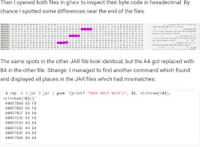
Developer vanitasvitae published an interesting and entertaining blog post detailing the blow-by-blow steps of debugging a reproducibility issue in PGPainless, a library which aims to make using OpenPGP in Java projects as simple as possible . Whilst their in-depth research into the internals of the .jar may have been unnecessary given that diffoscope would have identified the, it must be said that there is something to be said with occasionally delving into seemingly low-level details, as well describing any debugging process. Indeed, as vanitasvitae writes:
Yes, this would have spared me from 3h of debugging But I probably would also not have gone onto this little dive into the JAR/ZIP format, so in the end I m not mad.

Kees Cook published a short and practical blog post detailing how he uses reproducibility properties to aid work to replace one-element arrays in the Linux kernel. Kees approach is based on the principle that if a (small) proposed change is considered equivalent by the compiler, then the generated output will be identical but only if no other arbitrary or unrelated changes are introduced. Kees mentions the fantastic diffoscope tool, as well as various kernel-specific build options (eg. KBUILD_BUILD_TIMESTAMP) in order to prepare my build with the known to disrupt code layout options disabled .
Stefano Zacchiroli gave a presentation at GDR S curit Informatique based in part on a paper co-written with Chris Lamb titled Increasing the Integrity of Software Supply Chains. (Tweet)

Debian In Debian in this month, 28 reviews of Debian packages were added, 35 were updated and 27 were removed this month adding to our knowledge about identified issues. Two issue types were added: nondeterministic_checksum_generated_by_coq and nondetermistic_js_output_from_webpack. After Holger Levsen found hundreds of packages in the bookworm distribution that lack .buildinfo files, he uploaded 404 source packages to the archive (with no meaningful source changes). Currently bookworm now shows only 8 packages without .buildinfo files, and those 8 are fixed in unstable and should migrate shortly. By contrast, Debian unstable will always have packages without .buildinfo files, as this is how they come through the NEW queue. However, as these packages were not built on the official build servers (ie. they were uploaded by the maintainer) they will never migrate to Debian testing. In the future, therefore, testing should never have packages without .buildinfo files again. Roland Clobus posted yet another in-depth status report about his progress making the Debian Live images build reproducibly to our mailing list. In this update, Roland mentions that all major desktops build reproducibly with bullseye, bookworm and sid but also goes on to outline the progress made with automated testing of the generated images using openQA.

GNU Guix Vagrant Cascadian made a significant number of contributions to GNU Guix: Elsewhere in GNU Guix, Ludovic Court s published a paper in the journal The Art, Science, and Engineering of Programming called Building a Secure Software Supply Chain with GNU Guix:
This paper focuses on one research question: how can [Guix]((https://www.gnu.org/software/guix/) and similar systems allow users to securely update their software? [ ] Our main contribution is a model and tool to authenticate new Git revisions. We further show how, building on Git semantics, we build protections against downgrade attacks and related threats. We explain implementation choices. This work has been deployed in production two years ago, giving us insight on its actual use at scale every day. The Git checkout authentication at its core is applicable beyond the specific use case of Guix, and we think it could benefit to developer teams that use Git.
A full PDF of the text is available.

openSUSE In the world of openSUSE, SUSE announced at SUSECon that they are preparing to meet SLSA level 4. (SLSA (Supply chain Levels for Software Artifacts) is a new industry-led standardisation effort that aims to protect the integrity of the software supply chain.) However, at the time of writing, timestamps within RPM archives are not normalised, so bit-for-bit identical reproducible builds are not possible. Some in-toto provenance files published for SUSE s SLE-15-SP4 as one result of the SLSA level 4 effort. Old binaries are not rebuilt, so only new builds (e.g. maintenance updates) have this metadata added. Lastly, Bernhard M. Wiedemann posted his usual monthly openSUSE reproducible builds status report.

diffoscope diffoscope is our in-depth and content-aware diff utility. Not only can it locate and diagnose reproducibility issues, it can provide human-readable diffs from many kinds of binary formats. This month, Chris Lamb prepared and uploaded versions 215, 216 and 217 to Debian unstable. Chris Lamb also made the following changes:
  • New features:
    • Print profile output if we were called with --profile and we were killed via a TERM signal. This should help in situations where diffoscope is terminated due to some sort of timeout. [ ]
    • Support both PyPDF 1.x and 2.x. [ ]
  • Bug fixes:
    • Also catch IndexError exceptions (in addition to ValueError) when parsing .pyc files. (#1012258)
    • Correct the logic for supporting different versions of the argcomplete module. [ ]
  • Output improvements:
    • Don t leak the (likely-temporary) pathname when comparing PDF documents. [ ]
  • Logging improvements:
    • Update test fixtures for GNU readelf 2.38 (now in Debian unstable). [ ][ ]
    • Be more specific about the minimum required version of readelf (ie. binutils), as it appears that this patch level version change resulted in a change of output, not the minor version. [ ]
    • Use our @skip_unless_tool_is_at_least decorator (NB. at_least) over @skip_if_tool_version_is (NB. is) to fix tests under Debian stable. [ ]
    • Emit a warning if/when we are handling a UNIX TERM signal. [ ]
  • Codebase improvements:
    • Clarify in what situations the main finally block gets called with respect to TERM signal handling. [ ]
    • Clarify control flow in the diffoscope.profiling module. [ ]
    • Correctly package the scripts/ directory. [ ]
In addition, Edward Betts updated a broken link to the RSS on the diffoscope homepage and Vagrant Cascadian updated the diffoscope package in GNU Guix [ ][ ][ ].

Upstream patches The Reproducible Builds project detects, dissects and attempts to fix as many currently-unreproducible packages as possible. We endeavour to send all of our patches upstream where appropriate. This month, we wrote a large number of such patches, including:

Testing framework The Reproducible Builds project runs a significant testing framework at tests.reproducible-builds.org, to check packages and other artifacts for reproducibility. This month, the following changes were made:
  • Holger Levsen:
    • Add a package set for packages that use the R programming language [ ] as well as one for Rust [ ].
    • Improve package set matching for Python [ ] and font-related [ ] packages.
    • Install the lz4, lzop and xz-utils packages on all nodes in order to detect running kernels. [ ]
    • Improve the cleanup mechanisms when testing the reproducibility of Debian Live images. [ ][ ]
    • In the automated node health checks, deprioritise the generic kernel warning . [ ]
  • Roland Clobus (Debian Live image reproducibility):
    • Add various maintenance jobs to the Jenkins view. [ ]
    • Cleanup old workspaces after 24 hours. [ ]
    • Cleanup temporary workspace and resulting directories. [ ]
    • Implement a number of fixes and improvements around publishing files. [ ][ ][ ]
    • Don t attempt to preserve the file timestamps when copying artifacts. [ ]
And finally, node maintenance was also performed by Mattia Rizzolo [ ].

Mailing list and website On our mailing list this month: Lastly, Chris Lamb updated the main Reproducible Builds website and documentation in a number of small ways, but primarily published an interview with Hans-Christoph Steiner of the F-Droid project. Chris Lamb also added a Coffeescript example for parsing and using the SOURCE_DATE_EPOCH environment variable [ ]. In addition, Sebastian Crane very-helpfully updated the screenshot of salsa.debian.org s request access button on the How to join the Salsa group. [ ]

Contact If you are interested in contributing to the Reproducible Builds project, please visit our Contribute page on our website. However, you can get in touch with us via:

9 July 2022

Dirk Eddelbuettel: Rcpp 1.0.9 on CRAN: Regular Updates

rcpp logo The Rcpp team is please to announce the newest release 1.0.9 of Rcpp which hit CRAN late yesterday, and has been uploaded to Debian as well. Windows and macOS builds should appear at CRAN in the next few days, as will builds in different Linux distribution and of course at r2u. The release was prepared om July 2, but it took a few days to clear a handful of spurious errors as false positives with CRAN this can when the set of reverse dependencies is so large, and the CRAN team remains busy. This release continues with the six-months cycle started with release 1.0.5 in July 2020. (This time, CRAN had asked for an interim release to silence a C++ warning; we then needed a quick follow-up to tweak tests.) As a reminder, interim dev or rc releases should generally be available in the Rcpp drat repo. These rolling release tend to work just as well, and are also fully tested against all reverse-dependencies. Rcpp has become the most popular way of enhancing R with C or C++ code. Right now, around 2559 packages on CRAN depend on Rcpp for making analytical code go faster and further, along with 252 in BioConductor. On CRAN, 13.9% of all packages depend (directly) on CRAN, and 58.5% of all compiled packages do. From the cloud mirror of CRAN (which is but a subset of all CRAN downloads), Rcpp has been downloaded 61.5 million times. This release is incremental and extends Rcpp with a number of small improvements all detailed in the NEWS file as well as below. We want to highlight the external contributions: a precious list tag is cleared on removal, and a move constructor and assignment for strings has been added (thanks to Dean Scarff), and (thanks to Bill Denney and Marco Colombo) two minor errors are corrected in the vignette documentation. A big Thank You! to everybody who contributed pull request, opened or answered issues, or questions at StackOverflow or on the mailing list. The full list of details follows.

Changes in Rcpp hotfix release version 1.0.9 (2022-07-02)
  • Changes in Rcpp API:
    • Accomodate C++98 compilation by adjusting attributes.cpp (Dirk in #1193 fixing #1192)
    • Accomodate newest compilers replacing deprecated std::unary_function and std::binary_function with std::function (Dirk in #1202 fixing #1201 and CRAN request)
    • Upon removal from precious list, the tag is set to null (I aki in #1205 fixing #1203)
    • Move constructor and assignment for strings have been added (Dean Scarff in #1219).
  • Changes in Rcpp Documentation:
    • Adjust one overflowing column (Bill Denney in #1196 fixing #1195)
    • Correct a typo in the FAQ (Marco Colombo in #1217)
  • Changes in Rcpp Deployment:
    • Accomodate four digit version numbers in unit test (Dirk)
    • Do not run complete test suite to limit test time to CRAN preference (Dirk in #1206)
    • Small updates to the CI test containers have been made
    • Some of changes also applied to an interim release 1.0.8.3 made for CRAN on 2022-03-14.

Thanks to my CRANberries, you can also look at a diff to the previous release. Questions, comments etc should go to the rcpp-devel mailing list off the R-Forge page. Bugs reports are welcome at the GitHub issue tracker as well (where one can also search among open or closed issues); questions are also welcome under rcpp tag at StackOverflow which also allows searching among the (currently) 2886 previous questions. If you like this or other open-source work I do, you can sponsor me at GitHub.

This post by Dirk Eddelbuettel originated on his Thinking inside the box blog. Please report excessive re-aggregation in third-party for-profit settings.

6 July 2022

Russ Allbery: Review: A Master of Djinn

Review: A Master of Djinn, by P. Dj l Clark
Series: Dead Djinn Universe #1
Publisher: Tordotcom
Copyright: 2021
ISBN: 1-250-26767-6
Format: Kindle
Pages: 391
A Master of Djinn is the first novel in the Dead Djinn Universe, but (as you might guess from the series title) is a direct sequel to the novelette "A Dead Djinn in Cairo". The novelette is not as good as the novel, but I recommend reading it first for the character introductions and some plot elements that carry over. Reading The Haunting of Tram Car 015 first is entirely optional. In 1912 in a mansion in Giza, a secret society of (mostly) British men is meeting. The Hermetic Brotherhood of Al-Jahiz is devoted to unlocking the mysteries of the Soudanese mystic al-Jahiz. In our world, these men would likely be colonialist plunderers. In this world, they still aspire to that role, but they're playing catch-up. Al-Jahiz bored into the Kaf, releasing djinn and magic into the world and making Egypt a world power in its own right. Now, its cities are full of clockwork marvels, djinn walk the streets as citizens, and British rule has been ejected from India and Africa by local magic. This group of still-rich romantics and crackpots hopes to discover the knowledge lost when al-Jahiz disappeared. They have not had much success. This will not save their lives. Fatma el-Sha'arawi is a special investigator for the Ministry of Alchemy, Enchantments, and Supernatural Entities. Her job is sorting out the problems caused by this new magic, such as a couple of young thieves with a bottle full of sleeping djinn whose angry reaction to being unexpectedly woken has very little to do with wishes. She is one of the few female investigators in a ministry that is slowly modernizing with the rest of society (Egyptian women just got the vote). She's also the one called to investigate the murder of a secret society of British men and a couple of Cairenes by a black-robed man in a golden mask. The black-robed man claims to be al-Jahiz returned, and proves to be terrifyingly adept at manipulating crowds and sparking popular dissent. Fatma and the Ministry's first attempt to handle him is a poorly-judged confrontation stymied by hostile crowds, the man's duplicating bodyguard, and his own fighting ability. From there, it's a race between Fatma's pursuit of linear clues and the black-robed man's efforts to destabilize society. This, like the previous short stories, is a police procedural, but it has considerably more room to breathe at novel length. That serves it well, since as with "A Dead Djinn in Cairo" the procedural part is a linear, reactive vehicle for plot exposition. I was more invested in Fatma's relationships with the supporting characters. Since the previous story, she's struck up a romance with Siti, a highly competent follower of the old Egyptian gods (Hathor in particular) and my favorite character in the book. She's also been assigned a new partner, Hadia, a new graduate and another female agent. The slow defeat of Fatma's irritation at not being allowed to work alone by Hadia's cheerful competence and persistence (and willingness to do paperwork) adds a lot to the characterization. The setting felt a bit less atmospheric than The Haunting of Tram Car 015, but we get more details of international politics, and they're a delight. Clark takes obvious (and warranted) glee in showing how the reintroduction of magic has shifted the balance of power away from the colonial empires. Cairo is a bustling steampunk metropolis and capital of a world power, welcoming envoys from West African kingdoms alongside the (still racist and obnoxious but now much less powerful) British and other Europeans. European countries were forced to search their own mythology for possible sources of magic power, which leads to the hilarious scene of the German Kaiser carrying a sleepy goblin on his shoulder to monitor his diplomacy. The magic of the story was less successful for me, although still enjoyable. The angels from "A Dead Djinn in Cairo" make another appearance and again felt like the freshest bit of world-building, but we don't find out much more about them. I liked the djinn and their widely-varied types and magic, but apart from them and a few glimpses of Egypt's older gods, that was the extent of the underlying structure. There is a significant magical artifact, but the characters are essentially handed an instruction manual, use it according to its instructions, and it then does what it was documented to do. It was a bit unsatisfying. I'm the type of fantasy reader who always wants to read the sourcebook for the magic system, but this is not that sort of a book. Instead, it's the kind of book where the investigator steadily follows a linear trail of clues and leads until they reach the final confrontation. Here, the confrontation felt remarkably like cut scenes from a Japanese RPG: sudden vast changes in scale, clockwork constructs, massive monsters, villains standing on mobile platforms, and surprise combat reversals. I could almost hear the fight music and see the dialog boxes pop up. This isn't exactly a complaint I love Japanese RPGs but it did add to the feeling that the plot was on rails and didn't require many decisions from the protagonist. Clark also relies on an overused plot cliche in the climactic battle, which was a minor disappointment. A Master of Djinn won the Nebula for best 2021 novel, I suspect largely on the basis of its setting and refreshingly non-European magical system. I don't entirely agree; the writing is still a bit clunky, with unnecessary sentences and stock phrases showing up here and there, and I think it suffers from the typical deficiencies of SFF writers writing mysteries or police procedurals without the plot sophistication normally found in that genre. But this is good stuff for a first novel, with fun supporting characters (loved the librarian) and some great world-building. I would happily read more in this universe. Rating: 7 out of 10

2 July 2022

Fran ois Marier: Remote logging of Turris Omnia log messages using syslog-ng and rsyslog

As part of debugging an upstream connection problem I've been seeing recently, I wanted to be able to monitor the logs from my Turris Omnia router. Here's how I configured it to send its logs to a server I already had on the local network.

Server setup The first thing I did was to open up my server's rsyslog (Debian's default syslog server) to remote connections since it's going to be the destination host for the router's log messages. I added the following to /etc/rsyslog.d/router.conf:
module(load="imtcp")
input(type="imtcp" port="514")
if $fromhost-ip == '192.168.1.1' then  
    if $syslogseverity <= 5 then  
        action(type="omfile" file="/var/log/router.log")
     
    stop
 
This is using the latest rsyslog configuration method: a handy scripting language called RainerScript. Severity level 5 maps to "notice" which consists of unusual non-error conditions, and 192.168.1.1 is of course the IP address of the router on the LAN side. With this, I'm directing all router log messages to a separate file, filtering out anything less important than severity 5. In order for rsyslog to pick up this new configuration file, I restarted it:
systemctl restart rsyslog.service
and checked that it was running correctly (e.g. no syntax errors in the new config file) using:
systemctl status rsyslog.service
Since I added a new log file, I also setup log rotation for it by putting the following in /etc/logrotate.d/router:
/var/log/router.log
 
    rotate 4
    weekly
    missingok
    notifempty
    compress
    delaycompress
    sharedscripts
    postrotate
        /usr/lib/rsyslog/rsyslog-rotate
    endscript
 
In addition, since I use logcheck to monitor my server logs and email me errors, I had to add /var/log/router.log to /etc/logcheck/logcheck.logfiles. Finally I opened the rsyslog port to the router in my server's firewall by adding the following to /etc/network/iptables.up.rules:
# Allow logs from the router
-A INPUT -s 192.168.1.1 -p tcp --dport 514 -j ACCEPT
and ran iptables-apply. With all of this in place, it was time to get the router to send messages.

Router setup As suggested on the Turris forum, I ssh'ed into my router and added this in /etc/syslog-ng.d/remote.conf:
destination d_loghost  
        network("192.168.1.200" time-zone("America/Vancouver"));
 ;
source dns  
        file("/var/log/resolver");
 ;
log  
        source(src);
        source(net);
        source(kernel);
        source(dns);
        destination(d_loghost);
 ;
Setting the timezone to the same as my server was needed because the router messages were otherwise sent with UTC timestamps. To ensure that the destination host always gets the same IP address (192.168.1.200), I went to the advanced DHCP configuration page and added a static lease for the server's MAC address so that it always gets assigned 192.168.1.200. If that wasn't already the server's IP address, you'll have to restart it for this to take effect. Finally, I restarted the syslog-ng daemon on the router to pick up the new config file:
/etc/init.d/syslog-ng restart

Testing In order to test this configuration, I opened three terminal windows:
  1. tail -f /var/log/syslog on the server
  2. tail -f /var/log/router.log on the server
  3. tail -f /var/log/messages on the router
I immediately started to see messages from the router in the third window and some of these, not all because of my severity-5 filter, were flowing to the second window as well. Also important is that none of the messages make it to the first window, otherwise log messages from the router would be mixed in with the server's own logs. That's the purpose of the stop command in /etc/rsyslog.d/router.conf. To force a log messages to be emitted by the router, simply ssh into it and issue the following command:
logger Test
It should show up in the second and third windows immediately if you've got everything setup correctly

Next.

Previous.