Search Results: "dom"

18 September 2017

Carl Chenet: The Github threat

Many voices arise now and then against risks linked to the Github use by Free Software projects. Yet the infatuation for the collaborative forge of the Octocat Californian start-ups doesn t seem to fade away.

These recent years, Github and its services take an important role in software engineering as they are seen as easy to use, efficient for a daily workload with interesting functions in enterprise collaborative workflow or amid a Free Software project. What are the arguments against using its services and are they valid? We will list them first, then we ll examine their validity.

1. Critical points

1.1 Centralization

The Github application belongs to a single entity, Github Inc, a US company which manage it alone. So, a unique company under US legislation manages the access to most of Free Software application code sources, which may be a problem with groups using it when a code source is no longer available, for political or technical reason.

The Octocat, the Github mascot

This centralization leads to another trouble: as it obtained critical mass, it becomes more and more difficult not having a Github account. People who don t use Github, by choice or not, are becoming a silent minority. It is now fashionable to use Github, and not doing so is seen as out of date . The same phenomenon is a classic, and even the norm, for proprietary social networks (Facebook, Twitter, Instagram).

1.2 A Proprietary Software

When you interact with Github, you are using a proprietary software, with no access to its source code and which may not work the way you think it is. It is a problem at different levels. First, ideologically, but foremost in practice. In the Github case, we send them code we can control outside of their interface. We also send them personal information (profile, Github interactions). And mostly, Github forces any project which goes through the US platform to use a crucial proprietary tools: its bug tracking system.

Windows, the epitome of proprietary software, even if others took the same path

1.3 The Uniformization

Working with Github interface seems easy and intuitive to most. Lots of companies now use it as a source repository, and many developers leaving a company find the same Github working environment in the next one. This pervasive presence of Github in free software development environment is a part of the uniformization of said developers working space.

Uniforms always bring Army in my mind, here the Clone army

2 Critical points cross-examination

2.1 Regarding the centralization

2.1.1 Service availability rate

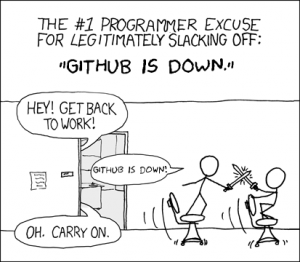
As said above, nowadays, Github is the main repository of Free Software source code. As such it is a favorite target for cyberattacks. DDOS hit it in March and August 2015. On December 15, 2015, an outage led to the inaccessibility of 5% of the repositories. The same occurred on November 15. And these are only the incident reported by Github itself. One can imagine that the mean outage rate of the platform is underestimated.
2.1.2 Chain reaction could block Free Software development

Today many dependency maintenance tools, as npm for javascript, Bundler for Ruby or even pip for Python can access an application source code directly from Github. Free Software projects getting more and more linked and codependents, if one component is down, all the developing process stop.

One of the best examples is the npmgate. Any company could legally demand that Github take down some source code from its repository, which could create a chain reaction and blocking the development of many Free Software projects, as suffered the Node.js community from the decisions of Npm, Inc, the company managing npm.

2.2 A historical precedent: SourceForge

Github didn t appear out of the blue. In his time, its predecessor, SourceForge, was also extremely popular.

Heavily centralized, based on strong interaction with the community, SourceForge is now seen as an aging SAAS (Software As A Service) and sees most of its customers fleeing to Github. Which creates lots of hurdles for those who stayed. The Gimp project suffered from spams and terrible advertising, which led to the departure of the VLC project, then from installers corrupted with adwares instead of the official Gimp installer for Windows. And finally, the Project Gimp s SourceForge account was hacked by SourceForge team itself!

These are very recent examples of what can do a commercial entity when it is under its stakeholders pressure. It is vital to really understand what it means to trust them with data and exchange centralization, where it could have tremendous repercussion on the day-to-day life and the habits of the Free Software and open source community.

2.3. Regarding proprietary software

2.3.1 One community, several opinions on proprietary software

Mostly based on ideology, this point deals with the definition every member of the community gives to Free Software and open source. Mostly about one thing: is it viral or not? Or GPL vs MIT/BSD.

Those on the side of the viral Free Software will have trouble to use a proprietary software as this last one shouldn t even exist. It must be assimilated, to quote Star Trek, as it is a connected black box, endangering privacy, corrupting for profit our uses and restrain our freedom to use as we re pleased what we own, etc.

Those on the side of complete freedom have no qualms using proprietary software as their very existence is a consequence of freedom without restriction. They even agree that code they developed may be a part of proprietary software, which is quite a common occurrence. This part of the Free Software community has no qualm using Github, which is well within their ideology parameters. Just take a look at the Janson amphitheater during Fosdem and check how many Apple laptops running on macOS are around.

FreeBSD, the main BSD project under the BSD license

2.3.2 Data loss and data restrictions linked to proprietary software use

Even without ideological consideration, and just focusing on Github infrastructure, the bug tracking system is a major problem by itself.

Bug report builds the memory of Free Software projects. It is the entrance point for new contributors, the place to find bug reporting, requests for new functions, etc. The project history can t be limited only to the code. It s very common to find bug reports when you copy and paste an error message in a search engine. Not their historical importance is precious for the project itself, but also for its present and future users.

Github gives the ability to extract bug reports through its API. What would happen if Github is down or if the platform doesn t support this feature anymore? In my opinion, not that many projects ever thought of this outcome. How could they move all the data generated by Github into a new bug tracking system? One old example now is Astrid, a TODO list bought by Yahoo a few years ago. Very popular, it grew fast until it was closed overnight, with only a few weeks for its users to extract their data. It was only a to-do list. The same situation with Github would be tremendously difficult to manage for several projects if they even have the ability to deal with it. Code would still be available and could still live somewhere else, but the project memory would be lost. A project like Debian has today more than 800,000 bug reports, which are a data treasure trove about problems solved, function requests and where the development stand on each. The developers of the Cpython project have anticipated the problem and decided not to use Github bug tracking systems.

Issues, the Github proprietary bug tracking system

Another thing we could lose if Github suddenly disappear: all the work currently done regarding the push requests (aka PRs). This Github function gives the ability to clone one project s Github repository, to modify it to fit your needs, then to offer your own modification to the original repository. The original repository s owner will then review said modification, and if he or she agrees with them will fuse them into the original repository. As such, it s one of the main advantages of Github, since it can be done easily through its graphic interface.

However reviewing all the PRs may be quite long, and most of the successful projects have several ongoing PRs. And this PRs and/or the proprietary bug tracking system are commonly used as a platform for comment and discussion between developers.

Code itself is not lost if Github is down (except one specific situation as seen below), but the peer review works materialized in the PRs and the bug tracking system is lost. Let s remember than the PR mechanism let you clone and modify projects and then generate PRs directly from its proprietary web interface without downloading a single code line on your computer. In this particular case, if Github is down, all the code and the work in progress is lost. Some also use Github as a bookmark place. They follow their favorite projects activity through the Watch function. This technological watch style of data collection would also be lost if Github is down.

Debian, one of the main Free Software projects with at least a thousand official contributors

2.4 Uniformization

The Free Software community is walking a thigh rope between normalization needed for an easier interoperability between its products and an attraction for novelty led by a strong need for differentiation from what is already there.

Github popularized the use of Git, a great tool now used through various sectors far away from its original programming field. Step by step, Git is now so prominent it s almost impossible to even think to another source control manager, even if awesome alternate solutions, unfortunately not as popular, exist as Mercurial.

A new Free Software project is now a Git repository on Github with README.md added as a quick description. All the other solutions are ostracized? How? None or very few potential contributors would notice said projects. It seems very difficult now to encourage potential contributors into learning a new source control manager AND a new forge for every project they want to contribute. Which was a basic requirement a few years ago. It s quite sad because Github, offering an original experience to its users, cut them out of a whole possibility realm. Maybe Github is one of the best web versioning control systems. But being the main one doesn t let room for a new competitor to grow. And it let Github initiate development newcomers into a narrow function set, totally unrelated to the strength of the Git tool itself.

3. Centralization, uniformization, proprietary software What s next? Laziness?

Fight against centralization is a main part of the Free Software ideology as centralization strengthens the power of those who manage it and who through it control those who are managed by it. Uniformization allergies born against main software companies and their wishes to impose a closed commercial software world was for a long time the main fuel for innovation thirst and intelligent alternative development. As we said above, part of the Free Software community was built as a reaction to proprietary software and their threat. The other part, without hoping for their disappearance, still chose a development model opposite to proprietary software, at least in the beginning, as now there s more and more bridges between the two.

The Github effect is a morbid one because of its consequences: at least centralization, uniformization, proprietary software usage as their bug tracking system. But some years ago the Dear Github buzz showed one more side effect, one I ve never thought about: laziness. For those who don t know what it is about, this letter is a complaint from several spokespersons from several Free Software projects which demand to Github team to finally implement, after years of polite asking, new functions. Since when Free Software project facing a roadblock request for clemency and don t build themselves the path they need? When Torvalds was involved in the Bitkeeper problem and the Linux kernel development team couldn t use anymore their revision control software, he developed Git. The mere fact of not being able to use one tool or functions lacking is the main motivation to seek alternative solutions and, as such, of the Free Software movement. Every Free Software community member able to code should have this reflex. You don t like what Github offers? Switch to Gitlab. You don t like it Gitlab? Improve it or make your own solution.

The Gitlab logo

Let s be crystal clear. I ve never said that every Free Software developers blocked should code his or her own alternative. We all have our own priorities, and some of us even like their beauty sleep, including me. But, to see that this open letter to Github has 1340 names attached to it, among them some spokespersons for major Free Software project showed me that need, willpower and strength to code a replacement are here. Maybe said replacement will be born from this letter, it would be the best outcome of this buzz.

In the end, Github usage is just another example of Internet usage massification. As Internet users are bound to go to massively centralized social network as Facebook or Twitter, developers are following the same path with Github. Even if a large fraction of developers realize the threat linked this centralized and proprietary organization, the whole community is following this centralization and uniformization trend. Github service is useful, free or with a reasonable price (depending on the functions you need) easy to use and up most of the time. Why would we try something else? Maybe because others are using us while we are savoring the convenience? The Free Software community seems to be quite sleepy to me.

The lion enjoying the hearth warm

About Me Carl Chenet, Free Software Indie Hacker, founder of the French-speaking Hacker News-like Journal du hacker. Follow me on social networks Translated from French by St phanie Chaptal. Original article written in 2015.

Russ Allbery: Consolidation haul

My parents are less fond than I am of filling every available wall in their house with bookshelves and did a pruning of their books. A lot of them duplicated other things that I had, or didn't sound interesting, but I still ended up with two boxes of books (and now have to decide which of my books to prune, since I'm out of shelf space). Also included is the regular accumulation of new ebook purchases. Mitch Albom Tuesdays with Morrie (nonfiction)
Ilona Andrews Clean Sweep (sff)
Catherine Asaro Charmed Sphere (sff)
Isaac Asimov The Caves of Steel (sff)
Isaac Asimov The Naked Sun (sff)
Marie Brennan Dice Tales (nonfiction)
Captain Eric "Winkle" Brown Wings on My Sleeve (nonfiction)
Brian Christian & Tom Griffiths Algorithms to Live By (nonfiction)
Tom Clancy The Cardinal of the Kremlin (thriller)
Tom Clancy The Hunt for the Red October (thriller)
Tom Clancy Red Storm Rising (thriller)
April Daniels Sovereign (sff)
Tom Flynn Galactic Rapture (sff)
Neil Gaiman American Gods (sff)
Gary J. Hudson They Had to Go Out (nonfiction)
Catherine Ryan Hyde Pay It Forward (mainstream)
John Irving A Prayer for Owen Meany (mainstream)
John Irving The Cider House Rules (mainstream)
John Irving The Hotel New Hampshire (mainstream)
Lawrence M. Krauss Beyond Star Trek (nonfiction)
Lawrence M. Krauss The Physics of Star Trek (nonfiction)
Ursula K. Le Guin Four Ways to Forgiveness (sff collection)
Ursula K. Le Guin Words Are My Matter (nonfiction)
Richard Matheson Somewhere in Time (sff)
Larry Niven Limits (sff collection)
Larry Niven The Long ARM of Gil Hamilton (sff collection)
Larry Niven The Magic Goes Away (sff)
Larry Niven Protector (sff)
Larry Niven World of Ptavvs (sff)
Larry Niven & Jerry Pournelle The Gripping Hand (sff)
Larry Niven & Jerry Pournelle Inferno (sff)
Larry Niven & Jerry Pournelle The Mote in God's Eye (sff)
Flann O'Brien The Best of Myles (nonfiction)
Jerry Pournelle Exiles to Glory (sff)
Jerry Pournelle The Mercenary (sff)
Jerry Pournelle Prince of Mercenaries (sff)
Jerry Pournelle West of Honor (sff)
Jerry Pournelle (ed.) Codominium: Revolt on War World (sff anthology)
Jerry Pournelle & S.M. Stirling Go Tell the Spartans (sff)
J.D. Salinger The Catcher in the Rye (mainstream)
Jessica Amanda Salmonson The Swordswoman (sff)
Stanley Schmidt Aliens and Alien Societies (nonfiction)
Cecilia Tan (ed.) Sextopia (sff anthology)
Lavie Tidhar Central Station (sff)
Catherynne Valente Chicks Dig Gaming (nonfiction)
J.E. Zimmerman Dictionary of Classical Mythology (nonfiction) This is an interesting tour of a lot of stuff I read as a teenager (Asimov, Niven, Clancy, and Pournelle, mostly in combination with Niven but sometimes his solo work). I suspect I will no longer consider many of these books to be very good, and some of them will probably go back into used bookstores after I've re-read them for memory's sake, or when I run low on space again. But all those mass market SF novels were a big part of my teenage years, and a few (like Mote In God's Eye) I definitely want to read again. Also included is a random collection of stuff my parents picked up over the years. I don't know what to expect from a lot of it, which makes it fun to anticipate. Fall vacation is coming up, and with it a large amount of uninterrupted reading time.

17 September 2017

Iain R. Learmonth: Free Software Efforts (2017W37)

I d like to start making weekly reports again on my free software efforts. Part of the reason for these reports is for me to see how much time I m putting into free software. Hopefully I can keep these reports up.

Debian I have updated txtorcon (a Twisted-based asynchronous Tor control protocol implementation used by ooniprobe, magic-wormhole and tahoe-lafs) to its latest upstream version. I ve also added two new binary packages that are built by the txtorcon source package: python3-txtorcon and python-txtorcon-doc for Python 3 support and generated HTML documentation respectively. I have gone through the scapy (Python module for the forging and dissection of network packets) bugs and closed a couple that seem to have been silently fixed by new upstream releases and not been caught in the BTS. I ve uploaded a minor revision to include a patch that fixes the version number reported by scapy. I have prepared and uploaded a new package for measurement-kit (a portable C++11 network measurement library) from the Open Observatory of Network Interference, which at time of writing is still in the NEW queue. I have also updated ooniprobe (probe for the Open Observatory of Network Interference) to its latest upstream version. I have updated the Swedish debconf strings in the xastir (X Amateur Station Tracking and Information Reporting) package, thanks to the translators. I have updated the direwolf (soundcard terminal node controller for APRS) package to its latest upstream version and fixed the creation of the system user to run direwolf with systemd to happen at the time the package is installed. Unfortunately, it has been necessary to drop the PDF documentation from the package as I was unable to contact the upstream author and acquire the Microsoft Word sources for this release. I have reviewed and sponsored the uploads of the new packages comptext (GUI based tool to compare two text streams), comptty (GUI based tool to compare two radio teletype streams) and flnet (amateur radio net control station software) in the hamradio team. Thanks to Ana Custura for preparing those packages, comptext and comptty are now available in unstable. I have updated the Debian Hamradio Blend metapackages to include cubicsdr (a software defined radio receiver). This build also refreshes the list of packages that can now be included as they had not been packaged at the time of the last build. I have produced and uploaded an initial package for python-azure-devtools (development tools for Azure SDK and CLI for Python) and have updated python-azure (the Azure SDK for Python) to a recent git snapshot. Due to some issues with python-vcr it is currently not possible to run the test suite as part of the build process and I m watching the situation. I have also fixed the auto dependency generation for python3-azure, which had previously been broken. Bugs closed (fixed/wontfix): #873036, #871940, #869566, #873083, #867420, #861753, #855385, #855497, #684727, #683711

Tor Project I have been working through tickets for Atlas (a tool for looking up details about Tor relays and bridges) and have merged and deployed a number of fixes. Some highlights include: bandwidth sorting in search results is now semantically correct (not just an alphanumeric sort ignoring units), added when a relay was first seen to the details page along with the host name if a reverse DNS record has been found for the IP address of the relay and added support for the NoEdConsensus flag (although happily no relays had this flag at the time this support was added). The metrics team has been working on merging projects into the metrics team website to give a unified view of information about the Tor network. This week I have been working towards a prototype of a port of Atlas to the metrics website s style and this work has been published in my personal Atlas git repository. If you d like to have a click around, you can do so. A relay operators meetup will be happening in Montreal on the 14th of October. I won t be present, but I have taken this opportunity to ask operators if there s anything that they would like from Atlas that they are not currently getting. Some feedback has already been received and turned into code and trac tickets. I also attended the weekly metrics team meeting in #tor-dev. Bugs closed (fixed/wontfix): #6787, #9814, #21958, #21636, #23296, #23160

Sustainability I believe it is important to be clear not only about the work I have already completed but also about the sustainability of this work into the future. I plan to include a short report on the current sustainability of my work in each weekly report. I continue to be happy to spend my time on this work, however I do find myself in a position where it may not be sustainable when it comes to hardware. My desktop, a Sun Ultra 24, is now 10 years old and I m starting to see random reboots which so far have not been explained. It is incredibly annoying to have this happen during a long build. Further, the hard drives in my NAS which are used for the local backups and for my local Debian mirror are starting to show SMART errors. It is not currently within my budget to replace any of this hardware. Please contact me if you believe you can help.
This week's energy was provided by Club Mate

Raphaël Hertzog: Freexian s report about Debian Long Term Support, August 2017

A Debian LTS logoLike each month, here comes a report about the work of paid contributors to Debian LTS. Individual reports In August, about 189 work hours have been dispatched among 12 paid contributors. Their reports are available: Evolution of the situation The number of sponsored hours is the same as last month. The security tracker currently lists 59 packages with a known CVE and the dla-needed.txt file 60. The number of packages with open issues decreased slightly compared to last month but we re not yet back to the usual situation. The number of CVE to fix per package tends to increase due to the increased usage of fuzzers. Thanks to our sponsors New sponsors are in bold.

No comment Liked this article? Click here. My blog is Flattr-enabled.

14 September 2017

Lior Kaplan: Public money? Public Code!

An open letter published today to the EU government says:
Why is software created using taxpayers money not released as Free Software?
We want legislation requiring that publicly financed software developed for the public sector be made publicly available under a Free and Open Source Software licence. If it is public money, it should be public code as well. Code paid by the people should be available to the people!
See https://publiccode.eu/ for the campaign details. This makes me think of starting an Israeli version
Filed under: Uncategorized

13 September 2017

Vincent Bernat: Route-based IPsec VPN on Linux with strongSwan

A common way to establish an IPsec tunnel on Linux is to use an IKE daemon, like the one from the strongSwan project, with a minimal configuration1:
conn V2-1
  left        = 2001:db8:1::1
  leftsubnet  = 2001:db8:a1::/64
  right       = 2001:db8:2::1
  rightsubnet = 2001:db8:a2::/64
  authby      = psk
  auto        = route
The same configuration can be used on both sides. Each side will figure out if it is left or right . The IPsec site-to-site tunnel endpoints are 2001:db8: 1::1 and 2001:db8: 2::1. The protected subnets are 2001:db8: a1::/64 and 2001:db8: a2::/64. As a result, strongSwan configures the following policies in the kernel:
$ ip xfrm policy
src 2001:db8:a1::/64 dst 2001:db8:a2::/64
        dir out priority 399999 ptype main
        tmpl src 2001:db8:1::1 dst 2001:db8:2::1
                proto esp reqid 4 mode tunnel
src 2001:db8:a2::/64 dst 2001:db8:a1::/64
        dir fwd priority 399999 ptype main
        tmpl src 2001:db8:2::1 dst 2001:db8:1::1
                proto esp reqid 4 mode tunnel
src 2001:db8:a2::/64 dst 2001:db8:a1::/64
        dir in priority 399999 ptype main
        tmpl src 2001:db8:2::1 dst 2001:db8:1::1
                proto esp reqid 4 mode tunnel
[ ]
This kind of IPsec tunnel is a policy-based VPN: encapsulation and decapsulation are governed by these policies. Each of them contains the following elements: When a matching policy is found, the kernel will look for a corresponding security association (using reqid and the endpoint source and destination addresses):
$ ip xfrm state
src 2001:db8:1::1 dst 2001:db8:2::1
        proto esp spi 0xc1890b6e reqid 4 mode tunnel
        replay-window 0 flag af-unspec
        auth-trunc hmac(sha256) 0x5b68[ ]8ba2904 128
        enc cbc(aes) 0x8e0e377ad8fd91e8553648340ff0fa06
        anti-replay context: seq 0x0, oseq 0x0, bitmap 0x00000000
[ ]
If no security association is found, the packet is put on hold and the IKE daemon is asked to negotiate an appropriate one. Otherwise, the packet is encapsulated. The receiving end identifies the appropriate security association using the SPI in the header. Two security associations are needed to establish a bidirectionnal tunnel:
$ tcpdump -pni eth0 -c2 -s0 esp
13:07:30.871150 IP6 2001:db8:1::1 > 2001:db8:2::1: ESP(spi=0xc1890b6e,seq=0x222)
13:07:30.872297 IP6 2001:db8:2::1 > 2001:db8:1::1: ESP(spi=0xcf2426b6,seq=0x204)
All IPsec implementations are compatible with policy-based VPNs. However, some configurations are difficult to implement. For example, consider the following proposition for redundant site-to-site VPNs: Redundant VPNs between 3 sites A possible configuration between V1-1 and V2-1 could be:
conn V1-1-to-V2-1
  left        = 2001:db8:1::1
  leftsubnet  = 2001:db8:a1::/64,2001:db8:a6::cc:1/128,2001:db8:a6::cc:5/128
  right       = 2001:db8:2::1
  rightsubnet = 2001:db8:a2::/64,2001:db8:a6::/64,2001:db8:a8::/64
  authby      = psk
  keyexchange = ikev2
  auto        = route
Each time a subnet is modified on one site, the configurations need to be updated on all sites. Moreover, overlapping subnets (2001:db8: a6::/64 on one side and 2001:db8: a6::cc:1/128 at the other) can also be problematic. The alternative is to use route-based VPNs: any packet traversing a pseudo-interface will be encapsulated using a security policy bound to the interface. This brings two features:
  1. Routing daemons can be used to distribute routes to be protected by the VPN. This decreases the administrative burden when many subnets are present on each side.
  2. Encapsulation and decapsulation can be executed in a different routing instance or namespace. This enables a clean separation between a private routing instance (where VPN users are) and a public routing instance (where VPN endpoints are).

Route-based VPN on Juniper Before looking at how to achieve that on Linux, let s have a look at the way it works with a JunOS-based platform (like a Juniper vSRX). This platform as long-standing history of supporting route-based VPNs (a feature already present in the Netscreen ISG platform). Let s assume we want to configure the IPsec VPN from V3-2 to V1-1. First, we need to configure the tunnel interface and bind it to the private routing instance containing only internal routes (with IPv4, they would have been RFC 1918 routes):
interfaces  
    st0  
        unit 1  
            family inet6  
                address 2001:db8:ff::7/127;


routing-instances  
    private  
        instance-type virtual-router;
        interface st0.1;
     
 
The second step is to configure the VPN:
security  
    /* Phase 1 configuration */
    ike  
        proposal IKE-P1  
            authentication-method pre-shared-keys;
            dh-group group20;
            encryption-algorithm aes-256-gcm;
         
        policy IKE-V1-1  
            mode main;
            proposals IKE-P1;
            pre-shared-key ascii-text "d8bdRxaY22oH1j89Z2nATeYyrXfP9ga6xC5mi0RG1uc";
         
        gateway GW-V1-1  
            ike-policy IKE-V1-1;
            address 2001:db8:1::1;
            external-interface lo0.1;
            general-ikeid;
            version v2-only;
         
     
    /* Phase 2 configuration */
    ipsec  
        proposal ESP-P2  
            protocol esp;
            encryption-algorithm aes-256-gcm;
         
        policy IPSEC-V1-1  
            perfect-forward-secrecy keys group20;
            proposals ESP-P2;
         
        vpn VPN-V1-1  
            bind-interface st0.1;
            df-bit copy;
            ike  
                gateway GW-V1-1;
                ipsec-policy IPSEC-V1-1;
             
            establish-tunnels on-traffic;


We get a route-based VPN because we bind the st0.1 interface to the VPN-V1-1 VPN. Once the VPN is up, any packet entering st0.1 will be encapsulated and sent to the 2001:db8: 1::1 endpoint. The last step is to configure BGP in the private routing instance to exchange routes with the remote site:
routing-instances  
    private  
        routing-options  
            router-id 1.0.3.2;
            maximum-paths 16;
         
        protocols  
            bgp  
                preference 140;
                log-updown;
                group v4-VPN  
                    type external;
                    local-as 65003;
                    hold-time 6;
                    neighbor 2001:db8:ff::6 peer-as 65001;
                    multipath;
                    export [ NEXT-HOP-SELF OUR-ROUTES NOTHING ];


The export filter OUR-ROUTES needs to select the routes to be advertised to the other peers. For example:
policy-options  
    policy-statement OUR-ROUTES  
        term 10  
            from  
                protocol ospf3;
                route-type internal;
             
            then  
                metric 0;
                accept;


The configuration needs to be repeated for the other peers. The complete version is available on GitHub. Once the BGP sessions are up, we start learning routes from the other sites. For example, here is the route for 2001:db8: a1::/64:
> show route 2001:db8:a1::/64 protocol bgp table private.inet6.0 best-path
private.inet6.0: 15 destinations, 19 routes (15 active, 0 holddown, 0 hidden)
+ = Active Route, - = Last Active, * = Both
2001:db8:a1::/64   *[BGP/140] 01:12:32, localpref 100, from 2001:db8:ff::6
                      AS path: 65001 I, validation-state: unverified
                      to 2001:db8:ff::6 via st0.1
                    > to 2001:db8:ff::14 via st0.2
It was learnt both from V1-1 (through st0.1) and V1-2 (through st0.2). The route is part of the private routing instance but encapsulated packets are sent/received in the public routing instance. No route-leaking is needed for this configuration. The VPN cannot be used as a gateway from internal hosts to external hosts (or vice-versa). This could also have been done with JunOS security policies (stateful firewall rules) but doing the separation with routing instances also ensure routes from different domains are not mixed and a simple policy misconfiguration won t lead to a disaster.

Route-based VPN on Linux Starting from Linux 3.15, a similar configuration is possible with the help of a virtual tunnel interface3. First, we create the private namespace:
# ip netns add private
# ip netns exec private sysctl -qw net.ipv6.conf.all.forwarding=1
Any private interface needs to be moved to this namespace (no IP is configured as we can use IPv6 link-local addresses):
# ip link set netns private dev eth1
# ip link set netns private dev eth2
# ip netns exec private ip link set up dev eth1
# ip netns exec private ip link set up dev eth2
Then, we create vti6, a tunnel interface (similar to st0.1 in the JunOS example):
# ip tunnel add vti6 \
   mode vti6 \
   local 2001:db8:1::1 \
   remote 2001:db8:3::2 \
   key 6
# ip link set netns private dev vti6
# ip netns exec private ip addr add 2001:db8:ff::6/127 dev vti6
# ip netns exec private sysctl -qw net.ipv4.conf.vti6.disable_policy=1
# ip netns exec private sysctl -qw net.ipv4.conf.vti6.disable_xfrm=1
# ip netns exec private ip link set vti6 mtu 1500
# ip netns exec private ip link set vti6 up
The tunnel interface is created in the initial namespace and moved to the private one. It will remember its original namespace where it will process encapsulated packets. Any packet entering the interface will temporarily get a firewall mark of 6 that will be used only to match the appropriate IPsec policy4 below. The kernel sets a low MTU on the interface to handle any possible combination of ciphers and protocols. We set it to 1500 and let PMTUD do its work. We can then configure strongSwan5:
conn V3-2
  left        = 2001:db8:1::1
  leftsubnet  = ::/0
  right       = 2001:db8:3::2
  rightsubnet = ::/0
  authby      = psk
  mark        = 6
  auto        = route
  keyexchange = ikev2
  keyingtries = %forever
  ike         = aes256gcm16-prfsha384-ecp384!
  esp         = aes256gcm16-prfsha384-ecp384!
  mobike      = no
The IKE daemon configures the following policies in the kernel:
$ ip xfrm policy
src ::/0 dst ::/0
        dir out priority 399999 ptype main
        mark 0x6/0xffffffff
        tmpl src 2001:db8:1::1 dst 2001:db8:3::2
                proto esp reqid 1 mode tunnel
src ::/0 dst ::/0
        dir fwd priority 399999 ptype main
        mark 0x6/0xffffffff
        tmpl src 2001:db8:3::2 dst 2001:db8:1::1
                proto esp reqid 1 mode tunnel
src ::/0 dst ::/0
        dir in priority 399999 ptype main
        mark 0x6/0xffffffff
        tmpl src 2001:db8:3::2 dst 2001:db8:1::1
                proto esp reqid 1 mode tunnel
[ ]
Those policies are used for any source or destination as long as the firewall mark is equal to 6, which matches the mark configured for the tunnel interface. The last step is to configure BGP to exchange routes. We can use BIRD for this:
router id 1.0.1.1;
protocol device  
   scan time 10;
 
protocol kernel  
   persist;
   learn;
   import all;
   export all;
   merge paths yes;
 
protocol bgp IBGP_V3_2  
   local 2001:db8:ff::6 as 65001;
   neighbor 2001:db8:ff::7 as 65003;
   import all;
   export where ifname ~ "eth*";
   preference 160;
   hold time 6;
 
Once BIRD is started in the private namespace, we can check routes are learned correctly:
$ ip netns exec private ip -6 route show 2001:db8:a3::/64
2001:db8:a3::/64 proto bird metric 1024
        nexthop via 2001:db8:ff::5  dev vti5 weight 1
        nexthop via 2001:db8:ff::7  dev vti6 weight 1
The above route was learnt from both V3-1 (through vti5) and V3-2 (through vti6). Like for the JunOS version, there is no route-leaking between the private namespace and the initial one. The VPN cannot be used as a gateway between the two namespaces, only for encapsulation. This also prevent a misconfiguration (for example, IKE daemon not running) from allowing packets to leave the private network. As a bonus, unencrypted traffic can be observed with tcpdump on the tunnel interface:
$ ip netns exec private tcpdump -pni vti6 icmp6
tcpdump: verbose output suppressed, use -v or -vv for full protocol decode
listening on vti6, link-type LINUX_SLL (Linux cooked), capture size 262144 bytes
20:51:15.258708 IP6 2001:db8:a1::1 > 2001:db8:a3::1: ICMP6, echo request, seq 69
20:51:15.260874 IP6 2001:db8:a3::1 > 2001:db8:a1::1: ICMP6, echo reply, seq 69
You can find all the configuration files for this example on GitHub. The documentation of strongSwan also features a page about route-based VPNs.

  1. Everything in this post should work with Libreswan.
  2. fwd is for incoming packets on non-local addresses. It only makes sense in transport mode and is a Linux-only particularity.
  3. Virtual tunnel interfaces (VTI) were introduced in Linux 3.6 (for IPv4) and Linux 3.12 (for IPv6). Appropriate namespace support was added in 3.15. KLIPS, an alternative out-of-tree stack available since Linux 2.2, also features tunnel interfaces.
  4. The mark is set right before doing a policy lookup and restored after that. Consequently, it doesn t affect other possible uses (filtering, routing). However, as Netfilter can also set a mark, one should be careful for conflicts.
  5. The ciphers used here are the strongest ones currently possible while keeping compatibility with JunOS. The documentation for strongSwan contains a complete list of supported algorithms as well as security recommendations to choose them.

10 September 2017

Adnan Hodzic: Secure traffic to ZNC on Synology with Let s Encrypt

I ve been using IRC since late 1990 s, and I continue to do so to this day due to it (still) being one of the driving development forces in various open source communities. Especially in Linux development and some of my acquintances I can only get in touch with via IRC :) My Setup On my Synology NAS I run ZNC (IRC bouncer/proxy) to which I connect using various IRC clients (irssi/XChat Azure/AndChat) from various platforms (Linux/Mac/Android). In this case ZNC serves as a gateway and no matter which device/client I connect from, I m always connected to same IRC servers/chat rooms/settings when I left off. This is all fine and dandy, but connecting from external networks to ZNC means you will hand in your ZNC credentials in plain text. Which is a problem for me, even thought we re only talking about IRC bouncer/proxy. With that said, how do we encrypt external traffic to our ZNC? HowTo: Chat securely with ZNC on Synology using Let s Encrypt SSL certificate For reference or more thorough explanation of some of the steps/topics please refer to: Secure (HTTPS) public access to Synology NAS using Let s Encrypt (free) SSL certificate

Requirements:

1: DNS setup Create A record for sub/domain you d like to use to connect to your ZNC and point it to your Synology NAS external (WAN) IP. For your reference, subdomain I ll use is: irc.hodzic.org 2: Create Let s Encrypt certificate
DSM: Control Panel > Security > Certificates > Add
Followed by:
Add a new certificate > Get a certificate from Let's Encrypt
Followed by adding domain name A record was created for in Step 1, i.e: Get a certificate from Let's Encrypt for irc.hodzic.org After certificate is created, don t forget to configure newly created certificate to point to correct domain name, i.e: Configure Let's Encrypt Certificate 3: Install ZNC In case you already have ZNC installed, I suggest you remove it and do a clean install. Mainly due to some problems with package in past, where ZNC wouldn t start automatically on boot which lead to creating projects like: synology-znc-autostart. In latest version, all of these problems have been fixed and couple of new features have been added. ZNC can be installed using Synology s Package Center, if community package sources are enabled. Which can simply be done by adding new package sources:
Name: SynoCommunity
Location: http://packages.synocommunity.com
Enable Community package sources in Synology Package Center To successfuly authenticate newly added source, under General tab, Trust Level should be set to Any publisher As part of installation process, ZNC config will be run with most sane/useful options and admin user will be created allowing you access to ZNC webadmin. 4: Secure access to ZNC webadmin Now we want to bind our sub/domain created in Step 1 to ZNC webadmin, and secure external access to it. This can be done by creating a reverse proxy. As part of this, you need to know which port has been allocated for SSL in ZNC Webadmin, i.e: ZNC Webadmin > Global settings - Listen Ports In this case, we can see it s 8251. Reverse Proxy can be created in:
DSM: Control Panel > Application Portal > Reverse Proxy > Create
Where sub/domain created in Step 1 needs to be point to ZNC SSL port on localhost, i.e: Reverse proxy: irc.hodzic.org setup ZNC Webadmin is now available via HTTPS on external network for the sub/domain you setup as part of Step 1, or in my case: ZNC webadmin (HTTPS) As part of this step, in ZNC webadmin I d advise you to create IRC servers and chatrooms you would like to connect to later. Step 5: Create .pem file from LetsEncrpyt certificate for ZNC to use On Synology, Let s Encrypt certificates are stored and located on:
/usr/syno/etc/certificate/_archive/
In case you have multiple certificates, based on date your certificate was created, you can determine in which directory is your newly generated certificated stored, i.e:
drwx------ 2 root root 4096 Sep 10 12:57 JeRh3Y
Once it s determined which certifiate is the one we want use, generate .pem by running following: sudo cat /usr/syno/etc/certificate/_archive/JeRh3Y/ privkey,cert,chain .pem > /usr/local/znc/var/znc.pem After this restart ZNC: sudo /var/packages/znc/scripts/start-stop-status stop && sudo /var/packages/znc/scripts/start-stop-status start 6: Configure IRC client In this example I ll use XChat Azure on MacOS, and same procedure should be identical for HexChat/XChat clients on any other platform. Altough all information is picked up from ZNC itself, user details will need to be filled in. In my setup I automatically connect to freenode and oftc networks, so I created two for local network and two for external network usage, later is the one we re concentrating on. On General tab of our newly created server, hostname for our server should be the sub/domain we ve setup as part of Step 1 , and port number should be the one we defined in Step 4 , SSL checkbox must be checked. Xchat Azure: Network list - General tab On Connecting tab Server password field needs to be filled in following format:
johndoe/freenode:password
Where, johndoe is ZNC username. freenode is ZNC network name, and password is ZNC password. Xchat Azure: Network list - Connecting tab freenode in this case must first be created as part of ZNC webadmin configuration, mentioned in step 4 . Same case is for oftc network configuration. As part of establishing the connection, information about our Let s Encrypt certificate will be displayed, after which connection will be established and you ll be automatically logged into all chatrooms. Happy hacking!

Sylvain Beucler: dot-zed archive file format

TL,DR: I reverse-engineered the .zed encrypted archive format.
Following a clean-room design, I'm providing a description that can be implemented by a third-party.
Interested? :) (reference version at: https://www.beuc.net/zed/) .zed archive file format Introduction Archives with the .zed extension are conceptually similar to an encrypted .zip file. In addition to a specific format, .zed files support multiple users: files are encrypted using the archive master key, which itself is encrypted for each user and/or authentication method (password, RSA key through certificate or PKCS#11 token). Metadata such as filenames is partially encrypted. .zed archives are used as stand-alone or attached to e-mails with the help of a MS Outlook plugin. A variant, which is not covered here, can encrypt/decrypt MS Windows folders on the fly like ecryptfs. In the spirit of academic and independent research this document provides a description of the file format and encryption algorithms for this encrypted file archive. See the conventions section for conventions and acronyms used in this document. Structure overview The .zed file format is composed of several layers. Or as a diagram:
+----------------------------------------------------------------------------------------------------+
  .zed archive (MS-CBF)                                                                               
                                                                                                      
   stream #1                         stream #2                       stream #3...                     
  +------------------------------+  +---------------------------+  +---------------------------+      
    metadata (MS-OLEPS)               encryption (AES)               encryption (AES)                 
                                      512-bytes chunks               512-bytes chunks                 
    +--------------------------+                                                                      
      obfuscation (static key)        +-----------------------+      +-----------------------+        
      +----------------------+       -  compression (zlib)     -    -  compression (zlib)     -       
       _ctlfile (TLV)                                                                            ...  
      +----------------------+          +---------------+              +---------------+               
    +--------------------------+          file contents                  file contents                
                                                                                                      
    +--------------------------+     -  +---------------+      -    -  +---------------+      -       
      _catalog (TLV)                                                                                  
    +--------------------------+      +-----------------------+      +-----------------------+        
  +------------------------------+  +---------------------------+  +---------------------------+      
+----------------------------------------------------------------------------------------------------+
Encryption schemes Several AES key sizes are supported, such as 128 and 256 bits. The Cipher Block Chaining (CBC) block cipher mode of operation is used to decrypt multiple AES 16-byte blocks, which means an initialisation vector (IV) is stored in clear along with the ciphertext. All filenames and file contents are encrypted using the same encryption mode, key and IV (e.g. if you remove and re-add a file in the archive, the resulting stream will be identical). No cleartext padding is used during encryption; instead, several end-of-stream handlers are available, so the ciphertext has exactly the size of the cleartext (e.g. the size of the compressed file). The following variants were identified in the 'encryption_mode' field. STREAM This is the end-of-stream handler for: This end-of-stream handler is apparently specific to the .zed format, and applied when the cleartext's does not end on a 16-byte boundary ; in this case special processing is performed on the last partial 16-byte block. The encryption and decryption phases are identical: let's assume the last partial block of cleartext (for encryption) or ciphertext (for decryption) was appended after all the complete 16-byte blocks of ciphertext: In either case, if the full ciphertext is less then one AES block (< 16 bytes), then the IV is used instead of the second-to-last block. CTS CTS or CipherText Stealing is the end-of-stream handler for: It matches the CBC-CS3 variant as described in Recommendation for Block Cipher Modes of Operation: Three Variants of Ciphertext Stealing for CBC Mode. Empty cleartext Since empty filenames or metadata are invalid, and since all files are compressed (resulting in a minimum 8-byte zlib cleartext), no empty cleartext was encrypted in the archive. metadata stream It is named 05356861616161716149656b7a6565636e576a33317a7868304e63 (hexadecimal), i.e. the character with code 5 followed by '5haaaaqaIekzeecnWj31zxh0Nc' (ASCII). The format used is OLE Property Set (MS-OLEPS). It introduces 2 property names "_ctlfile" (index 3) and "_catalog" (index 4), and 2 instances of said properties each containing an application-specific VT_BLOB (type 0x0041). _ctlfile: obfuscated global properties and access list This subpart is stored under index 3 ("_ctlfile") of the MS-OLEPS metadata. It consists of: The ciphertext is encrypted with AES-CBC "STREAM" mode using 128-bit static key 37F13CF81C780AF26B6A52654F794AEF (hexadecimal) and the prepended IV so as to obfuscate the access list. The ciphertext is continuous and not split in chunks (unlike files), even when it is larger than 512 bytes. The decrypted text contain properties in a TLV format as described in _ctlfile TLV: Archives may include "mandatory" users that cannot be removed. They are typically used to add an enterprise wide recovery RSA key to all archives. Extreme care must be taken to protect these key, as it can decrypt all past archives generated from within that company. _catalog: file list This subpart is stored under index 4 ("_catalog") of the MS-OLEPS metadata. It contains a series of 'fileprops' TLV structures, one for each file or directory. The file hierarchy can be reconstructed by checking the 'parent_id' field of each file entry. If 'parent_id' is 0 then the file is located at the top-level of the hierarchy, otherwise it's located under the directory with the matching 'file_id'. TLV format This format is a series of fields : Value semantics depend on its Type. It may contain an uint32be integer, a UTF-16LE string, a character sequence, or an inner TLV structure. Unless otherwise noted, TLV structures appear once. Some fields are optional and may not be present at all (e.g. 'archive_createdwith'). Some fields are unique within a structure (e.g. 'files_iv'), other may be repeated within a structure to form a list (e.g. 'fileprops' and 'passworduser'). The following top-level types that have been identified, and detailed in the next sections: Some additional unidentified types may be present. _ctlfile TLV _catalog TLV Decrypting the archive AES key rsauser The user accessing the archive will be authenticated by comparing his/her X509 certificate with the one stored in the 'certificate' field using DER format. The 'files_key_ciphertext' field is then decrypted using the PKCS#1 v1.5 encryption mechanism, with the private key that matches the user certificate. passworduser An intermediary user key, a user IV and an integrity checksum will be derived from the user password, using the deprecated PKCS#12 method as described at rfc7292 appendix B. Note: this is not PKCS#5 (nor PBKDF1/PBKDF2), this is an incompatible method from PKCS#12 that notably does not use HMAC. The 'pkcs12_hashfunc' field defines the underlying hash function. The following values have been identified: PBA - Password-based authentication The user accessing the archive will be authenticated by deriving an 8-byte sequence from his/her password. The parameters for the derivation function are: The derivation is checked against 'pba_checksum'. PBE - Password-based encryption Once the user is identified, 2 new values are derived from the password with different parameters to produce the IV and the key decryption key, with the same hash function: The parameters specific to user key are: The user key needs to be truncated to a length of 'encryption_strength', as specified in bytes in the archive properties. The parameters specific to user IV are: Once the key decryption key and the IV are derived, 'files_key_ciphertext' is decrypted using AES CBC, with PKCS#7 padding. Identifying file streams The name of the MS-CFB stream is derived by shuffling the bytes from the 'file_id' field and then encoding the result as hexadecimal. The reordering is:
Initial  offset: 0 1 2 3 4 5 6 7 8 9 10 11 12 13 14 15
Shuffled offset: 3 2 1 0 5 4 7 6 8 9 10 11 12 13 14 15
The 16th byte is usually a NUL byte, hence the stream identifier is a 30-character-long string. Decrypting files The compressed stream is split in chunks of 512 bytes, each of them encrypted separately using AES CBS and the global archive encryption scheme. Decryption uses the global AES key (retrieved using the user credentials), and the global IV (retrieved from the deobfuscated archive metadata). The IV for each chunk is computed by: Each chunk is an independent stream and the decryption process involves end-of-stream handling even if this is not the end of the actual file. This is particularly important for the CTS handler. Note: this is not to be confused with CTR block cipher mode of operation with operates differently and requires a nonce. Decompressing files Compressed streams are zlib stream with default compression options and can be decompressed following the zlib format. Test cases Excluded for brevity, cf. https://www.beuc.net/zed/#test-cases. Conventions and references Feedback Feel free to send comments at beuc@beuc.net. If you have .zed files that you think are not covered by this document, please send them as well (replace sensitive files with other ones). The author's GPG key can be found at 8FF1CB6E8D89059F. Copyright (C) 2017 Sylvain Beucler Copying and distribution of this file, with or without modification, are permitted in any medium without royalty provided the copyright notice and this notice are preserved. This file is offered as-is, without any warranty.

5 September 2017

Kees Cook: security things in Linux v4.13

Previously: v4.12. Here s a short summary of some of interesting security things in Sunday s v4.13 release of the Linux kernel: security documentation ReSTification
The kernel has been switching to formatting documentation with ReST, and I noticed that none of the Documentation/security/ tree had been converted yet. I took the opportunity to take a few passes at formatting the existing documentation and, at Jon Corbet s recommendation, split it up between end-user documentation (which is mainly how to use LSMs) and developer documentation (which is mainly how to use various internal APIs). A bunch of these docs need some updating, so maybe with the improved visibility, they ll get some extra attention. CONFIG_REFCOUNT_FULL
Since Peter Zijlstra implemented the refcount_t API in v4.11, Elena Reshetova (with Hans Liljestrand and David Windsor) has been systematically replacing atomic_t reference counters with refcount_t. As of v4.13, there are now close to 125 conversions with many more to come. However, there were concerns over the performance characteristics of the refcount_t implementation from the maintainers of the net, mm, and block subsystems. In order to assuage these concerns and help the conversion progress continue, I added an unchecked refcount_t implementation (identical to the earlier atomic_t implementation) as the default, with the fully checked implementation now available under CONFIG_REFCOUNT_FULL. The plan is that for v4.14 and beyond, the kernel can grow per-architecture implementations of refcount_t that have performance characteristics on par with atomic_t (as done in grsecurity s PAX_REFCOUNT). CONFIG_FORTIFY_SOURCE
Daniel Micay created a version of glibc s FORTIFY_SOURCE compile-time and run-time protection for finding overflows in the common string (e.g. strcpy, strcmp) and memory (e.g. memcpy, memcmp) functions. The idea is that since the compiler already knows the size of many of the buffer arguments used by these functions, it can already build in checks for buffer overflows. When all the sizes are known at compile time, this can actually allow the compiler to fail the build instead of continuing with a proven overflow. When only some of the sizes are known (e.g. destination size is known at compile-time, but source size is only known at run-time) run-time checks are added to catch any cases where an overflow might happen. Adding this found several places where minor leaks were happening, and Daniel and I chased down fixes for them. One interesting note about this protection is that is only examines the size of the whole object for its size (via __builtin_object_size(..., 0)). If you have a string within a structure, CONFIG_FORTIFY_SOURCE as currently implemented will make sure only that you can t copy beyond the structure (but therefore, you can still overflow the string within the structure). The next step in enhancing this protection is to switch from 0 (above) to 1, which will use the closest surrounding subobject (e.g. the string). However, there are a lot of cases where the kernel intentionally copies across multiple structure fields, which means more fixes before this higher level can be enabled. NULL-prefixed stack canary
Rik van Riel and Daniel Micay changed how the stack canary is defined on 64-bit systems to always make sure that the leading byte is zero. This provides a deterministic defense against overflowing string functions (e.g. strcpy), since they will either stop an overflowing read at the NULL byte, or be unable to write a NULL byte, thereby always triggering the canary check. This does reduce the entropy from 64 bits to 56 bits for overflow cases where NULL bytes can be written (e.g. memcpy), but the trade-off is worth it. (Besdies, x86_64 s canary was 32-bits until recently.) IPC refactoring
Partially in support of allowing IPC structure layouts to be randomized by the randstruct plugin, Manfred Spraul and I reorganized the internal layout of how IPC is tracked in the kernel. The resulting allocations are smaller and much easier to deal with, even if I initially missed a few needed container_of() uses. randstruct gcc plugin
I ported grsecurity s clever randstruct gcc plugin to upstream. This plugin allows structure layouts to be randomized on a per-build basis, providing a probabilistic defense against attacks that need to know the location of sensitive structure fields in kernel memory (which is most attacks). By moving things around in this fashion, attackers need to perform much more work to determine the resulting layout before they can mount a reliable attack. Unfortunately, due to the timing of the development cycle, only the manual mode of randstruct landed in upstream (i.e. marking structures with __randomize_layout). v4.14 will also have the automatic mode enabled, which randomizes all structures that contain only function pointers. A large number of fixes to support randstruct have been landing from v4.10 through v4.13, most of which were already identified and fixed by grsecurity, but many were novel, either in newly added drivers, as whitelisted cross-structure casts, refactorings (like IPC noted above), or in a corner case on ARM found during upstream testing. lower ELF_ET_DYN_BASE
One of the issues identified from the Stack Clash set of vulnerabilities was that it was possible to collide stack memory with the highest portion of a PIE program s text memory since the default ELF_ET_DYN_BASE (the lowest possible random position of a PIE executable in memory) was already so high in the memory layout (specifically, 2/3rds of the way through the address space). Fixing this required teaching the ELF loader how to load interpreters as shared objects in the mmap region instead of as a PIE executable (to avoid potentially colliding with the binary it was loading). As a result, the PIE default could be moved down to ET_EXEC (0x400000) on 32-bit, entirely avoiding the subset of Stack Clash attacks. 64-bit could be moved to just above the 32-bit address space (0x100000000), leaving the entire 32-bit region open for VMs to do 32-bit addressing, but late in the cycle it was discovered that Address Sanitizer couldn t handle it moving. With most of the Stack Clash risk only applicable to 32-bit, fixing 64-bit has been deferred until there is a way to teach Address Sanitizer how to load itself as a shared object instead of as a PIE binary. early device randomness
I noticed that early device randomness wasn t actually getting added to the kernel entropy pools, so I fixed that to improve the effectiveness of the latent_entropy gcc plugin. That s it for now; please let me know if I missed anything. As a side note, I was rather alarmed to discover that due to all my trivial ReSTification formatting, and tiny FORTIFY_SOURCE and randstruct fixes, I made it into the most active 4.13 developers list (by patch count) at LWN with 76 patches: a whopping 0.6% of the cycle s patches. ;) Anyway, the v4.14 merge window is open!

2017, Kees Cook. This work is licensed under a Creative Commons Attribution-ShareAlike 3.0 License.
Creative Commons License

4 September 2017

Dominique Dumont: cme: some read-write backend features are being deprecated

Hello Config::Model and cme read and write configuration data with a set of backend classes, like Config::Model::Backend::IniFile. These classes are managed by Config::Model::BackendMgr. Well, that s the simplified view. Actually, the backend manager can handle several different backends to read and write data: read backends are tried until one of them succeeds to read configuration data. And write backend cen be different from the read backend, thus offering the possibility to migrare from one format to another. This feature came at the beginning of the project, back in 2005. This felt like a good idea to let user migrate from one data format to another. More than 10 years later, this feature has never been used and is handled by a bunch of messy code that hampers further evolution of the backend classes. So, without further ado, I m going to deprecate the following features in order to simplify the backend manager: Unless someone objects, actual removal of these feature will be done in the next few months, after a quite short deprecation period. All the best
Tagged: cme, config-model, Config::Model, configuration

31 August 2017

Paul Wise: FLOSS Activities August 2017

Changes

Issues

Review

Administration
  • myrepos: get commit/admin access from joeyh at DebConf17, add commit/admin access for other patch submitters, apply my stack of patches
  • Debian: fix weird log file issues, redirect hardware donor, cleaned up a weird dir, fix some OOB info, ask for TLS on meetings-archive.d.n, check an I/O error, restart broken stunnels, powercycle 1 borked machine,
  • Debian mentors: lintian/security updates & reboot
  • Debian wiki: remove some stray cache files, whitelist 3 email domains, whitelist some email addresses, disable 1 spammer account, disable 1 accounts with bouncing email,
  • Debian QA: apply patch to fix PTS watch file errors, deploy changes
  • Debian derivatives census: run scripts for Purism, remove some noise from logs, trigger a recheck, merge fix by Unit193, deploy changes
  • Openmoko: security updates, reboots, enable unattended-upgrades

Communication
  • Attended DebConf17 and provided some input in BoFs
  • Sent Misc Dev News #44
  • Invite Google gLinux (on IRC) to the Debian derivatives census
  • Welcome Sven Haardiek (of GreenboneOS) to the Debian derivatives census
  • Inquire about the status of Canaima

Sponsors The samba bug report was sponsored by my employer. All other work was done on a volunteer basis.

Chris Lamb: Free software activities in August 2017

Here is my monthly update covering what I have been doing in the free software world in August 2017 (previous month):
Reproducible builds

Whilst anyone can inspect the source code of free software for malicious flaws, most software is distributed pre-compiled to end users. The motivation behind the Reproducible Builds effort is to allow verification that no flaws have been introduced either maliciously or accidentally during this compilation process by promising identical results are always generated from a given source, thus allowing multiple third-parties to come to a consensus on whether a build was compromised. I have generously been awarded a grant from the Core Infrastructure Initiative to fund my work in this area. This month I:
  • Presented a status update at Debconf17 in Montr al, Canada alongside Holger Levsen, Maria Glukhova, Steven Chamberlain, Vagrant Cascadian, Valerie Young and Ximin Luo.
  • I worked on the following issues upstream:
    • glib2.0: Please make the output of gio-querymodules reproducible. (...)
    • gcab: Please make the output reproducible. (...)
    • gtk+2.0: Please make the immodules.cache files reproducible. (...)
    • desktop-file-utils: Please make the output reproducible. (...)
  • Within Debian:
  • Categorised a large number of packages and issues in the Reproducible Builds "notes" repository.
  • Worked on publishing our weekly reports. (#118, #119, #120, #121 & #122)

I also made the following changes to our tooling:
diffoscope

diffoscope is our in-depth and content-aware diff utility that can locate and diagnose reproducibility issues.

  • Use name attribute over path to avoid leaking comparison full path in output. (commit)
  • Add missing skip_unless_module_exists import. (commit)
  • Tidy diffoscope.progress and the XML comparator (commit, commit)

disorderfs

disorderfs is our FUSE-based filesystem that deliberately introduces non-determinism into directory system calls in order to flush out reproducibility issues.

  • Add a simple autopkgtest smoke test. (commit)


Debian
Patches contributed
  • openssh: Quote the IP address in ssh-keygen -f suggestions. (#872643)
  • libgfshare:
    • SIGSEGV if /dev/urandom is not accessible. (#873047)
    • Add bindnow hardening. (#872740)
    • Support nodoc build profile. (#872739)
  • devscripts:
  • memcached: Add hardening to systemd .service file. (#871610)
  • googler: Tidy long and short package descriptions. (#872461)
  • gnome-split: Homepage points to domain-parked website. (#873037)

Uploads
  • python-django 1:1.11.4-1 New upstream release.
  • redis:
    • 4:4.0.1-3 Drop yet more non-deterministic tests.
    • 4:4.0.1-4 Tighten systemd/seccomp hardening.
    • 4:4.0.1-5 Drop even more tests with timing issues.
    • 4:4.0.1-6 Don't install completions to /usr/share/bash-completion/completions/debian/bash_completion/.
    • 4:4.0.1-7 Don't let sentinel integration tests fail the build as they use too many timers to be meaningful. (#872075)
  • python-gflags 1.5.1-3 If SOURCE_DATE_EPOCH is set, either use that as a source of current dates or the UTC-version of the file's modification time (#836004), don't call update-alternatives --remove in postrm. update debian/watch/Homepage & refresh/tidy the packaging.
  • bfs 1.1.1-1 New upstream release, tidy autopkgtest & patches, organising the latter with Pq-Topic.
  • python-daiquiri 1.2.2-1 New upstream release, tidy autopkgtests & update travis.yml from travis.debian.net.
  • aptfs 2:0.10-2 Add upstream signing key, refer to /usr/share/common-licenses/GPL-3 in debian/copyright & tidy autopkgtests.
  • adminer 4.3.1-2 Add a simple autopkgtest & don't install the Selenium-based tests in the binary package.
  • zoneminder (1.30.4+dfsg-2) Prevent build failures with GCC 7 (#853717) & correct example /etc/fstab entries in README.Debian (#858673).

Finally, I reviewed and sponsored uploads of astral, inflection, more-itertools, trollius-redis & wolfssl.

Debian LTS

This month I have been paid to work 18 hours on Debian Long Term Support (LTS). In that time I did the following:
  • "Frontdesk" duties, triaging CVEs, etc.
  • Issued DLA 1049-1 for libsndfile preventing a remote denial of service attack.
  • Issued DLA 1052-1 against subversion to correct an arbitrary code execution vulnerability.
  • Issued DLA 1054-1 for the libgxps XML Paper Specification library to prevent a remote denial of service attack.
  • Issued DLA 1056-1 for cvs to prevent a command injection vulnerability.
  • Issued DLA 1059-1 for the strongswan VPN software to close a denial of service attack.

Debian bugs filed
  • wget: Please hash the hostname in ~/.wget-hsts files. (#870813)
  • debian-policy: Clarify whether mailing lists in Maintainers/Uploaders may be moderated. (#871534)
  • git-buildpackage: "pq export" discards text within square brackets. (#872354)
  • qa.debian.org: Escape HTML in debcheck before outputting. (#872646)
  • pristine-tar: Enable multithreaded compression in pristine-xz. (#873229)
  • tryton-meta: Please combine tryton-modules-* into a single source package with multiple binaries. (#873042)
  • azure-cli:
  • fwupd-tests: Don't ship test files to generic /usr/share/installed-tests dir. (#872458)
  • libvorbis: Maintainer fields points to a moderated mailing list. (#871258)
  • rmlint-gui: Ship a rmlint-gui binary. (#872162)
  • template-glib: debian/copyright references online source without quotation. (#873619)

FTP Team

As a Debian FTP assistant I ACCEPTed 147 packages: abiword, adacgi, adasockets, ahven, animal-sniffer, astral, astroidmail, at-at-clojure, audacious, backdoor-factory, bdfproxy, binutils, blag-fortune, bluez-qt, cheshire-clojure, core-match-clojure, core-memoize-clojure, cypari2, data-priority-map-clojure, debian-edu, debian-multimedia, deepin-gettext-tools, dehydrated-hook-ddns-tsig, diceware, dtksettings, emacs-ivy, farbfeld, gcc-7-cross-ports, git-lfs, glewlwyd, gnome-recipes, gnome-shell-extension-tilix-dropdown, gnupg2, golang-github-aliyun-aliyun-oss-go-sdk, golang-github-approvals-go-approval-tests, golang-github-cheekybits-is, golang-github-chzyer-readline, golang-github-denverdino-aliyungo, golang-github-glendc-gopher-json, golang-github-gophercloud-gophercloud, golang-github-hashicorp-go-rootcerts, golang-github-matryer-try, golang-github-opentracing-contrib-go-stdlib, golang-github-opentracing-opentracing-go, golang-github-tdewolff-buffer, golang-github-tdewolff-minify, golang-github-tdewolff-parse, golang-github-tdewolff-strconv, golang-github-tdewolff-test, golang-gopkg-go-playground-validator.v8, gprbuild, gsl, gtts, hunspell-dz, hyperlink, importmagic, inflection, insighttoolkit4, isa-support, jaraco.itertools, java-classpath-clojure, java-jmx-clojure, jellyfish1, lazymap-clojure, libblockdev, libbytesize, libconfig-zomg-perl, libdazzle, libglvnd, libjs-emojify, libjwt, libmysofa, libundead, linux, lua-mode, math-combinatorics-clojure, math-numeric-tower-clojure, mediagoblin, medley-clojure, more-itertools, mozjs52, openssh-ssh1, org-mode, oysttyer, pcscada, pgsphere, poppler, puppetdb, py3status, pycryptodome, pysha3, python-cliapp, python-coloredlogs, python-consul, python-deprecation, python-django-celery-results, python-dropbox, python-fswrap, python-hbmqtt, python-intbitset, python-meshio, python-parameterized, python-pgpy, python-py-zipkin, python-pymeasure, python-thriftpy, python-tinyrpc, python-udatetime, python-wither, python-xapp, pythonqt, r-cran-bit, r-cran-bit64, r-cran-blob, r-cran-lmertest, r-cran-quantmod, r-cran-ttr, racket-mode, restorecond, rss-bridge, ruby-declarative, ruby-declarative-option, ruby-errbase, ruby-google-api-client, ruby-rash-alt, ruby-representable, ruby-test-xml, ruby-uber, sambamba, semodule-utils, shimdandy, sjacket-clojure, soapysdr, stencil-clojure, swath, template-glib, tools-analyzer-jvm-clojure, tools-namespace-clojure, uim, util-linux, vim-airline, vim-airline-themes, volume-key, wget2, xchat, xfce4-eyes-plugin & xorg-gtest. I additionally filed 6 RC bugs against packages that had incomplete debian/copyright files against: gnome-recipes, golang-1.9, libdazzle, poppler, python-py-zipkin & template-glib.

30 August 2017

Kees Cook: GRUB and LUKS

I got myself stuck yesterday with GRUB running from an ext4 /boot/grub, but with /boot inside my LUKS LVM root partition, which meant GRUB couldn t load the initramfs and kernel. Luckily, it turns out that GRUB does know how to mount LUKS volumes (and LVM volumes), but all the instructions I could find talk about setting this up ahead of time ( Add GRUB_ENABLE_CRYPTODISK=y to /etc/default/grub ), rather than what the correct manual GRUB commands are to get things running on a failed boot. These are my notes on that, in case I ever need to do this again, since there was one specific gotcha with using GRUB s cryptomount command (noted below). Available devices were the raw disk (hd0), the /boot/grub partition (hd0,msdos1), and the LUKS volume (hd0,msdos5):
grub> ls
(hd0) (hd0,msdos1) (hd0,msdos5)
Used cryptomount to open the LUKS volume (but without ()s! It says it works if you use parens, but then you can t use the resulting (crypto0)):
grub> insmod luks
grub> cryptomount hd0,msdos5
Enter password...
Slot 0 opened.
Then you can load LVM and it ll see inside the LUKS volume:
grub> insmod lvm
grub> ls
(crypto0) (hd0) (hd0,msdos1) (hd0,msdos5) (lvm/rootvg-rootlv)
And then I could boot normally:
grub> configfile $prefix/grub.cfg
After booting, I added GRUB_ENABLE_CRYPTODISK=y to /etc/default/grub and ran update-grub. I could boot normally after that, though I d be prompted twice for the LUKS passphrase (once by GRUB, then again by the initramfs). To avoid this, it s possible to add a second LUKS passphrase, contained in a file in the initramfs, as described here and works for Ubuntu and Debian too. The quick summary is: Create the keyfile and add it to LUKS:
# dd bs=512 count=4 if=/dev/urandom of=/crypto_keyfile.bin
# chmod 0400 /crypto_keyfile.bin
# cryptsetup luksAddKey /dev/sda5 /crypto_keyfile.bin
*enter original password*
Adjust the /etc/crypttab to include passing the file via /bin/cat:
sda5_crypt UUID=4aa5da72-8da6-11e7-8ac9-001cc008534d /crypto_keyfile.bin luks,keyscript=/bin/cat
Add an initramfs hook to copy the key file into the initramfs, keep non-root users from being able to read your initramfs, and trigger a rebuild:
# cat > /etc/initramfs-tools/hooks/crypto_keyfile <<EOF
#!/bin/bash
if [ "$1" = "prereqs" ] ; then
    cp /crypto_keyfile.bin "$ DESTDIR "
fi
EOF
# chmod a+x /etc/initramfs-tools/hooks/crypto_keyfile
# chmod 0700 /boot
# update-initramfs -u
This has the downside of leaving a LUKS passphrase in the clear while you re booted, but if someone has root, they can just get your dm-crypt encryption key directly anyway:
# dmsetup table --showkeys sda5_crypt
0 155797496 crypt aes-cbc-essiv:sha256 e3b0c44298fc1c149afbf4c8996fb92427ae41e4649b934ca495991b7852b855 0 8:5 2056
And of course if you re worried about Evil Maid attacks, you ll need a real static root of trust instead of doing full disk encryption passphrase prompting from an unverified /boot partition. :)

2017, Kees Cook. This work is licensed under a Creative Commons Attribution-ShareAlike 3.0 License.
Creative Commons License

28 August 2017

John Goerzen: The Joy of Exploring: Old Phone Systems, Pizza, and Discovery

This story involves boys pretending to be pizza deliverymen using a working automated Strowger telephone exchange demonstrator on display in a museum, which is very old and is, to my knowledge, the only such working exhibit in the world. (Yes, I have video.) But first, a thought on exploration. There are those that would say that there is nothing left to explore anymore that the whole earth is mapped, photographed by satellites, and, well, known. I prefer to look at it a different way: the earth is full of places that billions of people will never see, and probably don t even know about. Those places may be quiet country creeks, peaceful neighborhoods one block away from major tourist attractions, an MTA museum in Brooklyn, a state park in Arkansas, or a beautiful church in Germany. Martha is not yet two months old, and last week she and I spent a surprisingly long amount of time just gazing at tree branches she was mesmerized, and why not, because to her, everything is new. As I was exploring in Portland two weeks ago, I happened to pick up a nearly-forgotten book by a nearly-forgotten person, Beryl Markham, a woman who was a pilot in Africa about 80 years ago. The passage that I happened to randomly flip to in the bookstore, which really grabbed my attention, was this:
The available aviation maps of Africa in use at that time all bore the cartographer s scale mark, 1/2,000,000 one over two million. An inch on the map was about thitry-two miles in the air, as compared to the flying maps of Europe on which one inch represented no more than four air miles. Moreover, it seemed that the printers of the African maps had a slightly malicious habit of including, in large letters, the names of towns, junctions, and villages which, while most of them did exist in fact, as a group of thatched huts may exist or a water hold, they were usually so inconsequential as completely to escape discovery from the cockpit. Beyond this, it was even more disconcerting to examine your charts before a proposed flight only to find that in many cases the bulk of the terrain over which you had to fly was bluntly marked: UNSURVEYED . It was as if the mapmakers had said, We are aware that between this spot and that one, there are several hundred thousands of acres, but until you make a forced landing there, we won t know whether it is mud, desert, or jungle and the chances are we won t know then! Beryl Markham, West With the Night
My aviation maps today have no such markings. The continent is covered with radio beacons, the world with GPS, the maps with precise elevations of the ground and everything from skyscrapers to antenna towers. And yet, despite all we know, the world is still a breathtaking adventure. Yesterday, the boys and I were going to fly to Abilene, KS, to see a museum (Seelye Mansion). Circumstances were such that we neither flew, nor saw that museum. But we still went to Abilene, and wound up at the Museum of Independent Telephony, a wondrous place for anyone interested in the history of technology. As it is one of those off-the-beaten-path sorts of places, the boys got 2.5 hours to use the hands-on exhibits of real old phones, switchboards, and also the schoolhouse out back. They decided why not? to use this historic equipment to pretend to order pizzas. Jacob and Oliver proceeded to invent all sorts of things to use the phones for: ordering pizza, calling the cops to chase the pizza delivery guys, etc. They were so interested that by 2PM we still hadn t had lunch and they claimed we re not hungry despite the fact that we were going to get pizza for lunch. And I certainly enjoyed the exhibits on the evolution of telephones, switching (from manual plugboards to automated switchboards), and such. This place was known it even has a website, I had been there before, and in fact so had the boys (my parents took them there a couple of years ago). But yesterday, we discovered the Strowger switch had been repaired since the last visit, and that it, in fact, is great for conversations about pizza. Whether it s seeing an eclipse, discovering a fascination with tree branches, or historic telephones, a spirit of curiosity and exploration lets a person find fun adventures almost anywhere.

27 August 2017

Andrew Cater: Helping out around the edges ...

for two point releases of Debian CDs.

Lots of testing, lots of folk chatting on IRC on #debian-cd - it's a good process.

Very impressed by processes behind the scenes to obtain necessary computer accounts, access to machines and various other things that are absolutely necessary and invisible from the outside. Hofstadter's law applies of course - it always takes longer than you think, even when you take into account Hofstadter's law.

Also many thanks for the patience and tolerance of people I've known for many years but who I get to see all too seldom. It's a nice group to be with, as ever.

26 August 2017

Nathan Handler: freenode #live

For those of you who might not be aware, freenode is an IRC network that caters to free and open source projects. We have had a goal for a number of years to hold freenode #live, an in-person conference where our staff, projects, FOSS supporters, and IRC enthusiasts could all get together in one place. Thanks to some very generous sponsorship, primarily by Private Internet Access, this conference is finally happening! The first ever freenode #live conference will take place October 28 - 29, 2017 in Bristol, United Kingdom. This conference will only be a success with support from the community. Luckily, there are many ways to help out.

  1. Register to attend. We are working on putting together a great lineup of speakers that you will not want to miss. Registering allows us to finalize many logistical details surrounding the event to make sure everything runs smoothly.
  2. Do you represent a FOSS group? We would love to have your group present at the event. There will be an exhibitor hall where you can advertise your organization and attract new users and contributors.
  3. Submit a talk. Our call for proposals is still open. New and experienced speakers are welcome. Feel free to contact 2017-team@freenode.live and we would be happy to work with you to come up with a talk idea or provide feedback.
  4. If you or your company are interested in helping to sponsor this event, please reach out to exhibit@freenode.live. We have opportunities for budgets of all sizes.
I look forward to hopefully seeing you at freenode #live!

24 August 2017

Urvika Gola: Much awaited.. DebConf 17 in Montreal.

On 5th August I got a chance to attend, speak and experience DebConf 2017 at Montreal, Canada. The conference was stretch ed from 6 August to 12 August .
debconf_picture1Seasons of Debian Summer of Code & Winter of Outreachy
Pretty late for me to document my DebConf fun-learning-experiences, thanks to my delaying tactics.. I need to overcome.
But better late than ever, I had amazing time at DebConf. I got to meet and learn from my Outreachy Mentor, Daniel Pocock!
img_5634-e1503506917678.jpgPicture of Daniel and me captured by : Dorina Mosku
One thing about DebConf I loved was the amount of Diversity in Debian family! As a beginner, I got to get a big picture of what all projects are there. Daniel helped me a lot in getting started with packaging in Debian. I really appreciate the time he took out to guide me @DebConf and Pranav, remotely. One specific line I liked about Daniel s talk on Open Day, 5th August Free Communications with Free Software and Debian while talking about free RTC (Real Time Communication) is that, ..Instead of communication controlling the user, the user can control the communcation.. I talked about free RTC, my Project Lumicall and about my journey being an Outreachy Intern with Debian. I also covered my co-speaker s project work on Lumicall being a GSoC 2016 student.
IMG_0796Picture captured by Aigars Mahinovs
debconf_picture2Managing Debian s RTC services Daniel Pocock
Meeting the Outreachy family feels amaazzing! Karen Sandler, executive director of the Software Freedom Conservancy gave a talk on the Significance and Impact of Outreachy and Debian s support for the programme.
DG58B_gXUAA2GsAwith Karen Sandler and Outreachy alumini
DebConf 2017 has been a wonderful conference with the community being very welcoming and helpful

23 August 2017

Antoine Beaupr : The supposed decline of copyleft

At DebConf17, John Sullivan, the executive director of the FSF, gave a talk on the supposed decline of the use of copyleft licenses use free-software projects. In his presentation, Sullivan questioned the notion that permissive licenses, like the BSD or MIT licenses, are gaining ground at the expense of the traditionally dominant copyleft licenses from the FSF. While there does seem to be a rise in the use of permissive licenses, in general, there are several possible explanations for the phenomenon.

When the rumor mill starts Sullivan gave a recent example of the claim of the decline of copyleft in an article on Opensource.com by Jono Bacon from February 2017 that showed a histogram of license usage between 2010 and 2017 (seen below).
[Black Duck   histogram]
From that, Bacon elaborates possible reasons for the apparent decline of the GPL. The graphic used in the article was actually generated by Stephen O'Grady in a January article, The State Of Open Source Licensing, which said:
In Black Duck's sample, the most popular variant of the GPL version 2 is less than half as popular as it was (46% to 19%). Over the same span, the permissive MIT has gone from 8% share to 29%, while its permissive cousin the Apache License 2.0 jumped from 5% to 15%.
Sullivan, however, argued that the methodology used to create both articles was problematic. Neither contains original research: the graphs actually come from the Black Duck Software "KnowledgeBase" data, which was partly created from the old Ohloh web site now known as Open Hub. To show one problem with the data, Sullivan mentioned two free-software projects, GNU Bash and GNU Emacs, that had been showcased on the front page of Ohloh.net in 2012. On the site, Bash was (and still is) listed as GPLv2+, whereas it changed to GPLv3 in 2011. He also claimed that "Emacs was listed as licensed under GPLv3-only, which is a license Emacs has never had in its history", although I wasn't able to verify that information from the Internet archive. Basically, according to Sullivan, "the two projects featured on the front page of a site that was using [the Black Duck] data set were wrong". This, in turn, seriously brings into question the quality of the data:
I reported this problem and we'll continue to do that but when someone is not sharing the data set that they're using for other people to evaluate it and we see glimpses of it which are incorrect, that should give us a lot of hesitation about accepting any conclusion that comes out of it.
Reproducible observations are necessary to the establishment of solid theories in science. Sullivan didn't try to contact Black Duck to get access to the database, because he assumed (rightly, as it turned out) that he would need to "pay for the data under terms that forbid you to share that information with anybody else". So I wrote Black Duck myself to confirm this information. In an email interview, Patrick Carey from Black Duck confirmed its data set is proprietary. He believes, however, that through a "combination of human and automated techniques", Black Duck is "highly confident at the accuracy and completeness of the data in the KnowledgeBase". He did point out, however, that "the way we track the data may not necessarily be optimal for answering the question on license use trend" as "that would entail examination of new open source projects coming into existence each year and the licenses used by them". In other words, even according to Black Duck, its database may not be useful to establish the conclusions drawn by those articles. Carey did agree with those conclusions intuitively, however, saying that "there seems to be a shift toward Apache and MIT licenses in new projects, though I don't have data to back that up". He suggested that "an effective way to answer the trend question would be to analyze the new projects on GitHub over the last 5-10 years." Carey also suggested that "GitHub has become so dominant over the recent years that just looking at projects on GitHub would give you a reasonable sampling from which to draw conclusions".
[GitHub   graph]
Indeed, GitHub published a report in 2015 that also seems to confirm MIT's popularity (45%), surpassing copyleft licenses (24%). The data is, however, not without its own limitations. For example, in the above graph going back to the inception of GitHub in 2008, we see a rather abnormal spike in 2013, which seems to correlate with the launch of the choosealicense.com site, described by GitHub as "our first pass at making open source licensing on GitHub easier". In his talk, Sullivan was critical of the initial version of the site which he described as biased toward permissive licenses. Because the GitHub project creation page links to the site, Sullivan explained that the site's bias could have actually influenced GitHub users' license choices. Following a talk from Sullivan at FOSDEM 2016, GitHub addressed the problem later that year by rewording parts of the front page to be more accurate, but that any change in license choice obviously doesn't show in the report produced in 2015 and won't affect choices users have already made. Therefore, there can be reasonable doubts that GitHub's subset of software projects may not actually be that representative of the larger free-software community.

In search of solid evidence So it seems we are missing good, reproducible results to confirm or dispel these claims. Sullivan explained that it is a difficult problem, if only in the way you select which projects to analyze: the impact of a MIT-licensed personal wiki will obviously be vastly different from, say, a GPL-licensed C compiler or kernel. We may want to distinguish between active and inactive projects. Then there is the problem of code duplication, both across publication platforms (a project may be published on GitHub and SourceForge for example) but also across projects (code may be copy-pasted between projects). We should think about how to evaluate the license of a given project: different files in the same code base regularly have different licenses often none at all. This is why having a clear, documented and publicly available data set and methodology is critical. Without this, the assumptions made are not clear and it is unreasonable to draw certain conclusions from the results. It turns out that some researchers did that kind of open research in 2016 in a paper called "The Debsources Dataset: Two Decades of Free and Open Source Software" [PDF] by Matthieu Caneill, Daniel M. Germ n, and Stefano Zacchiroli. The Debsources data set is the complete Debian source code that covers a large history of the Debian project and therefore includes thousands of free-software projects of different origins. According to the paper:
The long history of Debian creates a perfect subject to evaluate how FOSS licenses use has evolved over time, and the popularity of licenses currently in use.
Sullivan argued that the Debsources data set is interesting because of its quality: every package in Debian has been reviewed by multiple humans, including the original packager, but also by the FTP masters to ensure that the distribution can legally redistribute the software. The existence of a package in Debian provides a minimal "proof of use": unmaintained packages get removed from Debian on a regular basis and the mere fact that a piece of software gets packaged in Debian means at least some users found it important enough to work on packaging it. Debian packagers make specific efforts to avoid code duplication between packages in order to ease security maintenance. The data set covers a period longer than Black Duck's or GitHub's, as it goes all the way back to the Hamm 2.0 release in 1998. The data and how to reproduce it are freely available under a CC BY-SA 4.0 license.
[Debsource   graph]
Sullivan presented the above graph from the research paper that showed the evolution of software license use in the Debian archive. Whereas previous graphs showed statistics in percentages, this one showed actual absolute numbers, where we can't actually distinguish a decline in copyleft licenses. To quote the paper again:
The top license is, once again, GPL-2.0+, followed by: Artistic-1.0/GPL dual-licensing (the licensing choice of Perl and most Perl libraries), GPL-3.0+, and Apache-2.0.
Indeed, looking at the graph, at most do we see a rise of the Apache and MIT licenses and no decline of the GPL per se, although its adoption does seem to slow down in recent years. We should also mention the possibility that Debian's data set has the opposite bias: toward GPL software. The Debian project is culturally quite different from the GitHub community and even the larger free-software ecosystem, naturally, which could explain the disparity in the results. We can only hope a similar analysis can be performed on the much larger Software Heritage data set eventually, which may give more representative results. The paper acknowledges this problem:
Debian is likely representative of enterprise use of FOSS as a base operating system, where stable, long-term and seldomly updated software products are desirable. Conversely Debian is unlikely representative of more dynamic FOSS environments (e.g., modern Web-development with micro libraries) where users, who are usually developers themselves, expect to receive library updates on a daily basis.
The Debsources research also shares methodology limitations with Black Duck: while Debian packages are reviewed before uploading and we can rely on the copyright information provided by Debian maintainers, the research also relies on automated tools (specifically FOSSology) to retrieve license information. Sullivan also warned against "ascribing reason to numbers": people may have different reasons for choosing a particular license. Developers may choose the MIT license because it has fewer words, for compatibility reasons, or simply because "their lawyers told them to". It may not imply an actual deliberate philosophical or ideological choice. Finally, he brought up the theory that the rise of non-copyleft licenses isn't necessarily at the detriment of the GPL. He explained that, even if there is an actual decline, it may not be much of a problem if there is an overall growth of free software to the detriment of proprietary software. He reminded the audience that non-copyleft licenses are still free software, according to the FSF and the Debian Free Software Guidelines, so their rise is still a positive outcome. Even if the GPL is a better tool to accomplish the goal of a free-software world, we can all acknowledge that the conversion of proprietary software to more permissive and certainly simpler licenses is definitely heading in the right direction.
[I would like to thank the DebConf organizers for providing meals for me during the conference.] Note: this article first appeared in the Linux Weekly News.

20 August 2017

Steinar H. Gunderson: Random codec notes

Post-Solskogen, there hasn't been all that many commits in the main Nageru repository, but that doesn't mean the project is standing still. In particular, I've been working with NVIDIA to shake out a crash bug in their drivers (which in itself uncovered some interesting debugging techniques, although in the end, the bug turned out just to be uncovered by the boring standard technique of analyzing crash dumps and writing a minimal program to reproduce). But I've also been looking at intraframe codecs; my sort-of plan was to go to VideoLAN Dev Days to present my findings, but unfortunately, there seems to be a schedule conflict, so instead, you can have some scattered random notes: Work in progress :-) Maybe something more coherent will come out eventually. Edit: Forgot about TF switching!

Next.

Previous.