Search Results: "beh"

8 June 2016

Jonathan Dowland: Some tools for working with Docker images

For developing complex, real-world Docker images, there are a number of tools that can make life easier. The first thing to realise is that the Dockerfile format is severely limited. At work, we have eventually outgrown it and it has been replaced with a structured YAML document that is processed into a Dockerfile by a tool called dogen. There are several advantages to this, but I'll point out two: firstly, having data about the image available in a structured format makes automatically deriving technical documentation very easy. Secondly, some of the quirks of Dockerfiles, such as the ADD command respecting the environment's umask, are worked around in the dogen tool. We have a large suite of integration tests that we run against images to make sure that we haven't introduced regressions during their development. The core of this is the Container Testing Framework, which makes use of the Behave system. Each command that is run in a Dockerfile generates a new docker image layer. In practice, this can mean a real-world image has a great number of layers underneath it. Docker-dot-com have resisted introducing layer squashing into their tools, but with both hard limits for layers in some of the storage backends, and performance issues for most of the rest, this is a very real issue. Marek Goldmann wrote a squashing tool that we use to control the number of intermediate layers that are introduced by our images. Finally, even with tools like dogen and ctf, we would like to be able to have more sophisticated tools than shell scripts for configuring images, both at image build time and container run time. We want to do this without introducing extra dependencies inside the images which will not otherwise be used for their operation. Ansible could be a solution for this, but there are practical issues with relying on it for runtime configuration in our situation. For that reason David Becvarik is designing and implementing Container Configuration Tool, or cct, a framework for performing configuration of containers written in Python.

Lucas Nussbaum: Re: Sysadmin Skills and University Degrees

Russell Coker wrote about Sysadmin Skills and University Degrees. I couldn t agree more that a major deficiency in Computer Science degrees is the lack of sysadmin training. It seems like most sysadmins learned most of what they know from experience. It s very hard to recruit young engineers (freshly out of university) for sysadmin jobs, and the job interviews are often a bit depressing. Sysadmins jobs are also not very popular with this public, probably because university curriculums fail to emphasize what s exciting about those jobs. However, I think I disagree rather deeply with Russell s detailed analysis. First, Version Control. Well, I think that it s pretty well covered in university curriculums nowadays. From my point of view, teaching CS in Universit de Lorraine (France), mostly in Licence Professionnelle Administration de Syst mes, R seaux et Applications base de Logiciels Libres (warning: french), a BSc degree focusing on Linux systems administration, it s not usual to see student projects with a mandatory use of Git. And it doesn t seem to be a major problem for students (which always surprises me). However, I wouldn t rate Version Control as the most important thing that is required for a sysadmin. Similarly Dependencies and Backups are things that should be covered, but probably not as first class citizens. I think that there are several pillars in the typical sysadmin knowledge. First and foremost, sysadmins need a good understanding of the inner workings of an operating system. I sometimes feel that many Operating Systems Design courses are a bit too much focused on the Design side of things. Yes, it s useful to understand the low-level mechanisms, and be able to (mentally) recreate an OS from scratch. But it s also interesting to know how real systems are actually built, and what are the trade-off involved. I very much enjoyed reading Branden Gregg s Systems Performance: Enterprise and the Cloud because each chapter starts with a great overview of how things are in the real world, with a very good level of detail. Also, addressing OS design from the point of view of performance could be a way to turn those courses into something more attractive for students: many people like to measure, benchmark, optimize things, and it s quite easy to demonstrate how different designs, or different configurations, make a big difference in terms of performance in the context of OS design. It s possible to be a sysadmin and ignore, say, the existence of the VFS, but there s a large class of problems that you will never be able to solve. It can be a good trade-off for a curriculum (e.g. at the BSc level) to decide to ignore most of the low-level stuff, but it s important to be aware of it. Students also need to learn how to design a proper infrastructure (that meets requirements in terms of scalability, availability, security, and maybe elasticity). Yes, backups are important. But monitoring is, too. As well as high availability. In order to scale, it s important to be able to automatize stuff. Russell writes that Sysadmins need some programming skills, but that s mostly scripting and basic debugging. Well, when you design an infrastructure, or when you use configuration management tools such as Puppet, in some sense, you are programming, and in terms of needs to abstract things, it s actually similar to doing object-oriented programming, with similar choices (should I use that off-the-shelf puppet module, or re-develop my own? How should everything fit together?). Also, when debugging, it s often useful to be able to dig into code, understand what the developer was trying to do, and if the expected behavior actually matches what you are seeing. It often results in spending a lot of time to create a one-line fix, and it requires very advanced programming skills. Again, it s possible to be a sysadmin with only limited software development knowledge, but there s a large class of things that you are unlikely to address properly. I think that what makes sysadmins jobs both very interesting and very challenging is that they require a very wide range of knowledge. There s often the ability to learn about new stuff (much more than in software development jobs). Of course, the difficult question is where to draw the line. What is the sysadmin knowledge that every CS graduate should have, even in curriculums not targeting sysadmin jobs? What is the sysadmin knowledge for a sysadmin BSc degree? for a sysadmin MSc degree?

Russell Coker: Sysadmin Skills and University Degrees

I think that a major deficiency in Computer Science degrees is the lack of sysadmin training. Version Control The first thing that needs to be added is the basics of version control. CVS (which is now regarded as obsolete) was initially released when I was in the first year of university. But SCCS and RCS had been in use for some time. I think that the people who designed my course were remiss in not adding any mention of version control (not even strategies for saving old versions of your work), one could say that they taught us about version control by letting us accidentally delete our assignments. :-# If a course is aimed at just teaching programmers (as most CS degrees are) then version control for group assignments should be a standard part of the course. Having some marks allocated for the quality of comments in the commit log would also be good. A modern CS degree should cover distributed version control, that means covering Git as it s the most popular distributed version control system nowadays. For people who want to work as sysadmins (as opposed to developers who run their own PCs) a course should have an optional subject for version control of an entire system. That includes tools like etckeeper for version control of system configuration and tools like Puppet for automated configuration and system maintenance. Dependencies It s quite reasonable for a CS degree to provide simplified problems for the students to solve so they can concentrate on one task. But in the real world the problems are more complex. One of the more difficult parts of managing real systems is dependencies. You have issues of header files etc at compile time and library versions at deployment. Often you need a program to run on systems with different versions of the OS which means making it compile for both and deal with differences in behaviour. There are lots of hacky things that people do to deal with dependencies in systems. People link compiled programs statically, install custom versions of interpreters in user home directories or /usr/local for daemons, and do many other things. These things can have bad consequences including data loss, system downtime, and security problems. It s not always wrong to do such things, but it s something that should only be done with knowledge of the potential consequences and a plan for mitigating them. A CS degree should teach the potential advantages and disadvantages of these options to allow graduates to make informed decisions. Backups I ve met many people who call themselves computer professionals and think that backups aren t needed. I ve seen production systems that were designed in a way that backups were impossible. The lack of backups is a serious problem for the entire industry. Some lectures about backups could be part of a version control subject in a general CS degree. For a degree that majors in Sysadmin at least one subject about backups is appropriate. For any backup (even backing up your home PC) you should have offsite backups to deal with fire damage, multiple backups of different ages (especially important now that encryption malware is a serious threat), and a plan for how fast you can restore things. The most common use of backups is to deal with the case of deleting the wrong file. Unfortunately this case seems to be the most rarely mentioned. Another common situation that should be covered is a configuration error that results in a system that won t boot correctly. It s a very common problem and one that can be solved quickly if you are prepared but which can take a long time if you aren t. For a Sysadmin course it is important to cover backups of systems in remote datacenters. Hardware A good CS degree should cover the process of selecting suitable hardware. Programmers often get to advise on the hardware used to run their code, especially at smaller companies. Reliability features such as RAID, ECC RAM, and clustering should be covered. Planning for upgrades is a very important part of this which is usually not taught. Not only do you need to plan for an upgrade without much downtime or cost but you also need to plan for what upgrades are possible. Next year will your system require hardware that is more powerful than you can buy next year? If so you need to plan for a cluster now. For a Sysadmin course some training about selecting cloud providers and remote datacenter hosting should be provided. There are many complex issues that determine whether it s most appropriate to use a cloud service, hosted virtual machines, hosted physical servers managed by the ISP, hosted physical servers purchased by the client, or on-site servers. Often a large system will involve 2 or more of those options, even some small companies use 3 or more of those options to try and provide the performance and reliability they need at a price they can afford. We Need Sysadmin Degrees Covering the basic coding skills takes a lot of time. I don t think we can reasonably expect a CS degree to cover all that and also give good coverage to sysadmin work. While some basic sysadmin skills are needed by every programmer I think we need to have separate majors for people who want a career in system administration. Sysadmins need some programming skills, but that s mostly scripting and basic debugging. Someone who s main job is as a sysadmin can probably expect to never make any significant change to a program that s more than 10,000 lines long. A large amount of the programming in a CS degree can be replaced by file a bug report for a sysadmin degree. This doesn t mean that sysadmins shouldn t be doing software development or that they aren t good at it. One noteworthy fact is that it appears that the most common job among developers of the Debian distribution of Linux is System Administration. Developing an OS involves some of the most intensive and demanding programming. But I think that more than a few people who do such work would have skipped a couple of programming subjects in favour of sysadmin subjects if they were given a choice. Suggestions Did I miss anything? What other sysadmin skills should be taught in a CS degree? Do any universities teach these things now? If so please name them in the comments, it is good to help people find universities that teach them what they want to learn and help them in their career.

7 June 2016

Enrico Zini: You'll thank me later

I agree with this post by Matthew Garrett. I am quite convinced that most of the communities that I have known are vulnerable to people who are good manipulators of people. Also, in my experience, manipulation by negating, pushing, or reframing the boundaries of people tends not to be recognised as manipulation, let alone abusive behaviour. It's not about physically forcing people to do things that they don't want to do. It's about pushing people, again and again, wearing them out, making them feel like, despite their actual needs and wants, saying "yes" to you is the only viable way out. It can happen for sex, and it can happen for getting a patch merged. It can happen out of habit. It can happen for pretty much anything. Consent culture was not part of my education, and it was something I've had to discover for myself. I assume that to be a common experience, and that pushing against boundaries does happen, even without malicious intentions, on a regular basis. However, it is not ok. Take insisting. It is not the same as persisting. Persisting is what I do when I advocate for change. Persisting is what I do when the first version of my code segfaults. Insisting is what I do when a person says "no" to me and I don't want to accept it. Is it ok to insist that a friend, whom you think is sick, goes and gets help? Is it ok to insist that a friend, whom you think is sexually repressed, pushes through their boundaries to explore their sexuality with you? In both cases, one may say, or think, trust me, you'll thank me afterwards. In both cases, what if afterwards I have nothing to thank you for? I see a common pattern in you'll thank me afterwards situations. It can be in good faith, it can be creepy, it can be abusive, and most of the time, what it is, is dangerously unclear to most of the people involved. I think that in a community like Debian, at the level of personal interaction, Insisting is not ok. I think that in a community like Debian, at the level of personal interaction, "You'll thank me afterwards" is not ok. When I say it's not ok I mean that it should not happen. If it happens, people must be free to say "stop". If it doesn't stop, people must expect to be able to easily find support, understanding, and help to make it stop. Just like when people upload untested packages. Pushing against personal boundaries of people is not ok, and pushing against personal boundaries does happen. When you get involved in a new community, such as Debian, find out early where, if that happens, you can find support, understanding, and help to make it stop. If you cannot find any, or if the only thing you can find is people who say "it never happens here", consider whether you really want to be in that community.

Matthew Garrett: Be wary of heroes

Inspiring change is difficult. Fighting the status quo typically means being able to communicate so effectively that powerful opponents can't win merely by outspending you. People need to read your work or hear you speak and leave with enough conviction that they in turn can convince others. You need charisma. You need to be smart. And you need to be able to tailor your message depending on the audience, even down to telling an individual exactly what they need to hear to take your side. Not many people have all these qualities, but those who do are powerful and you want them on your side.

But the skills that allow you to convince people that they shouldn't listen to a politician's arguments are the same skills that allow you to convince people that they shouldn't listen to someone you abused. The ability that allows you to argue that someone should change their mind about whether a given behaviour is of social benefit is the same ability that allows you to argue that someone should change their mind about whether they should sleep with you. The visibility that gives you the power to force people to take you seriously is the same visibility that makes people afraid to publicly criticise you.

We need these people, but we also need to be aware that their talents can be used to hurt as well as to help. We need to hold them to higher standards of scrutiny. We need to listen to stories about their behaviour, even if we don't want to believe them. And when there are reasons to believe those stories, we need to act on them. That means people need to feel safe in coming forward with their experiences, which means that nobody should have the power to damage them in reprisal. If you're not careful, allowing charismatic individuals to become the public face of your organisation gives them that power.

There's no reason to believe that someone is bad merely because they're charismatic, but this kind of role allows a charismatic abuser both a great deal of cover and a great deal of opportunity. Sometimes people are just too good to be true. Pretending otherwise doesn't benefit anybody but the abusers.

comment count unavailable comments

6 June 2016

John Goerzen: How git-annex replaces Dropbox + encfs with untrusted providers

git-annex has been around for a long time, but I just recently stumbled across some of the work Joey has been doing to it. This post isn t about it s traditional roots in git or all the features it has for partial copies of large data sets, but rather for its live syncing capabilities like Dropbox. It takes a bit to wrap your head around, because git-annex is just a little different from everything else. It s sort of like a different-colored smell. The git-annex wiki has a lot of great information both low-level reference and a high-level 10-minute screencast showing how easy it is to set up. I found I had to sort of piece together the architecture between those levels, so I m writing this all down hoping it will benefit others that are curious. Ir you just want to use it, you don t need to know all this. But I like to understand how my tools work. Overview git-annex lets you set up a live syncing solution that requires no central provider at all, or can be used with a completely untrusted central provider. Depending on your usage pattern, this central provider could require only a few MBs of space even for repositories containing gigabytes or terabytes of data that is kept in sync. Let s take a look at the high-level architecture of the tool. Then I ll illustrate how it works with some scenarios. Three Layers Fundamentally, git-annex takes layers that are all combined in Dropbox and separates them out. There is the storage layer, which stores the literal data bytes that you are interested in. git-annex indexes the data in storage by a hash. There is metadata, which is for things like a filename-to-hash mapping and revision history. And then there is an optional layer, which is live signaling used to drive the real-time syncing. git-annex has several modes of operation, and the one that enables live syncing is called the git-annex assistant. It runs as a daemon, and is available for Linux/POSIX platforms, Windows, Mac, and Android. I ll be covering it here. The storage layer The storage layer simply is blobs of data. These blobs are indexed by a hash, and can be optionally encrypted at rest at remote backends. git-annex has a large number of storage backends; some examples include rsync, a remote machine with git-annex on it that has ssh installed, WebDAV, S3, Amazon Glacier, removable USB drive, etc. There s a huge list. One of the git-annex features is that each client knows the state of each storage repository, as well as the capability set of each storage repository. So let s say you have a workstation at home and a laptop you take with you to work or the coffee shop. You d like changes on one to be instantly recognized on another. With something like Dropbox or OwnCloud, every file in the set you want synchronized has to reside on a server in the cloud. With git-annex, it can be configured such that the server in the cloud only contains a copy of a file until every client has synced it up, at which point it gets removed. Think about it that is often what you want anyhow, so why maintain an unnecessary copy after it s synced everywhere? (This behavior is, of course, configurable.) git-annex can also avoid storing in the cloud entirely if the machines are able to reach each other directly at least some of the time. The metadata layer Metadata about your files includes a mapping from the file names to the storage location (based on hashes), change history, and information about the status of each machine that participates in the syncing. On your clients, git-annex stores this using git. This detail is very useful to some, and irrelevant to others. Some of the git-annex storage backends can support only storage (S3, for instance). Some can support both storage and metadata (rsync, ssh, local drives, etc.) You can even configure a backend to support only metadata (more on why that may be useful in a bit). When you are working with a git-backed repository for git-annex, it can hold data, metadata, or both. So, to have a working sync system, you must have a way to transport both the data and the metadata. The transport for the metadata is generally rsync or git, but it can also be XMPP in which Git changesets are basically wrapped up in XMPP presence messages. Joey says, however, that there are some known issues with XMPP servers sometimes dropping or reordering some XMPP messages, so he doesn t encourage that method currently. The live signaling layer So once you have your data and metadata, you can already do syncs via git annex sync --contents. But the real killer feature here will be automatic detection of changes, both on the local and the remote. To do that, you need some way of live signaling. git-annex supports two methods. The first requires ssh access to a remote machine where git-annex is installed. In this mode of operation, when the git-annex assistant fires up, it opens up a persistent ssh connection to the remote and runs the git-annex-shell over there, which notifies it of changes to the git metadata repository. When a change is detected, a sync is initiated. This is considered ideal. A substitute can be XMPP, and git-annex actually converts git commits into a form that can be sent over XMPP. As I mentioned above, there are some known reliability issues with this and it is not the recommended option. Encryption When it comes to encryption, you generally are concerned about all three layers. In an ideal scenario, the encryption and decryption happens entirely on the client side, so no service provider ever has any details about your data. The live signaling layer is encrypted pretty trivially; the ssh sessions are, of course, encrypted and TLS support in XMPP is pervasive these days. However, this is not end-to-end encryption; those messages are decrypted by the service provider, so a service provider could theoretically spy on metadata, which may include change times and filenames, though not the contents of files themselves. The data layer also can be encrypted very trivially. In the case of the dumb backends like S3, git-annex can use symmetric encryption or a gpg keypair and all that ever shows up on the server are arbitrarily-named buckets. You can also use a gcrypt-based git repository. This can cover both data and metadata and, if the target also has git-annex installed, the live signalling layer. Using a gcrypt-based git repository for the metadata and live signalling is the only way to accomplish live syncing with 100% client-side encryption. All of these methods are implemented in terms of gpg, and can support symmetric of public-key encryption. It should be noted here that the current release versions of git-annex need a one-character patch in order to fix live syncing with a remote using gcrypt. For those of you running jessie, I recommend the version in jessie-backports, which is presently 5.20151208. For your convenience, I have compiled an amd64 binary that can drop in over /usr/bin/git-annex if you have this version. You can download it and a gpg signature for it. Note that you only need this binary on the clients; the server can use the version from jessie-backports without issue. Putting the pieces together: some scenarios Now that I ve explained the layers, let s look at how they fit together. Scenario 1: Central server In this scenario, you might have a workstation and a laptop that sync up with each other by way of a central server that also has a full copy of the data. This is the scenario that most closely resembles Dropbox, box, or OwnCloud. Here you would basically follow the steps in the git-assistant screencast: install git-annex on a server somewhere, and point your clients to it. If you want full end-to-end encryption, I would recommend letting git-annex generate a gpg keypair for you, which you would then need to copy to both your laptop and workstation (but not the server). Every change you make locally will be synced to the server, and then from the server to your other PC. All three systems would be configured in the client transfer group. Scenario 1a: Central server without a full copy of the data In this scenario, everything is configured the same except the central server is configured with the transfer transfer group. This means that the actual data synced to it is deleted after it has been propagated to all clients. Since git-annex can verify which repository has received a copy of which data, it can easily enough delete the actual file content from the central server after it has been copied to all the clients. Many people use something like Dropbox or OwnCloud as a multi-PC syncing solution anyhow, so once the files have been synced everywhere, it makes sense to remove them from the central server. This is often a good ideal for people. There are some obvious downsides that are sometimes relevant. For instance, to add a third sync client, it must be able to initially copy down from one of the existing clients. Or, if you intend to access the data from a device such as a cell phone where you don t intend for it to have a copy of all data all the time, you won t have as convenient way to download your data. Scenario 1b: Split data/metadata central servers Imagine that you have a shell or rsync account on some remote system where you can run git-annex, but don t have much storage space. Maybe you have a cheap VPS or shell account somewhere, but it s just not big enough to hold your data. The answer to this would be to use this shell or rsync account for the metadata, but put the data elsewhere. You could, for instance, store the data in Amazon S3 or Amazon Glacier. These backends aren t capable of storing the git-annex metadata, so all you need is a shell or rsync account somewhere to sync up the metadata. (Or, as below, you might even combine a fully distributed approach with this.) Then you can have your encrypted data pushed up to S3 or some such service, which presumably will grow to whatever size you need. Scenario 2: Fully distributed Like git itself, git-annex does not actually need a central server at all. If your different clients can reach each other directly at least some of the time, that is good enough. Of course, a given client will not be able to do fully automatic live sync unless it can reach at least one other client, so changes may not propagate as quickly. You can simply set this up by making ssh connections available between your clients. git-annex assistant can automatically generate appropriate ~/.ssh/authorized_keys entries for you. Scenario 2a: Fully distributed with multiple disconnected branches You can even have a graph of connections available. For instance, you might have a couple machines at home and a couple machines at work with no ability to have a direct connection between them (due to, say, firewalls). The two machines at home could sync with each other in real-time, as could the two machines at work. git-annex also supports things like USB drives as a transport mechanism, so you could throw a USB drive in your pocket each morning, pop it in to one client at work, and poof both clients are synced up over there. Repeat when you get home in the evening, and you re synced there. The USB drive s repository can, of course, be of the transport type so data is automatically deleted from it once it s been synced everywhere. Scenario 3: Hybrid git-annex can support LAN sync even if you have a central server. If your laptop, say, travels around but is sometimes on the same LAN as your PC, git-annex can easily sync directly between the two when they are reachable, saving a round-trip to the server. You can assign a cost to each remote, and git-annex will always try to sync first to the lowest-cost path that is available. Drawbacks of git-annex There are some scenarios where git-annex with the assistant won t be as useful as one of the more traditional instant-sync systems. The first and most obvious one is if you want to access the files without the git-annex client. For instance, many of the other tools let you generate a URL that you can email to people, and then they can download files without any special client software. This is not directly possible with git-annex. You could, of course, make something like a public_html directory be managed with git-annex, but it wouldn t provide things like obfuscated URLs, password-protected sharing, time-limited sharing, etc. that you get with other systems. While you can share your repositories with others that have git-annex, you can t share individual subdirectories; for a given repository, it is all or nothing. The Android client for git-annex is a pretty interesting thing: it is mostly a small POSIX environment, providing a terminal, git, gpg, and the same web interface that you get on a standalone machine. This means that the git-annex Android client is fully functional compared to a desktop one. It also has a quick setup process for syncing off your photos/videos. On the other hand, the integration with the Android ecosystem is poor compared to most other tools. Other git-annex features git-annex has a lot to offer besides the git-annex assistant. Besides the things I ve already mentioned, any given git-annex repository including your client repository can have a partial copy of the full content. Say, for instance, that you set up a git-annex repository for your music collection, which is quite large. You want some music on your netbook, but don t have room for it all. You can tell git-annex to get or drop files from the netbook s repository without deleting them remotely. git-annex has quite a few ways to automate and configure this, including making sure that at least a certain number of copies of a file exist in your git-annex ecosystem. Conclusion I initially started looking at git-annex due to the security issues with encfs, and the difficulty with setting up ecryptfs in this way. (I had been layering encfs atop OwnCloud). git-annex certainly ticks the box for me security-wise, and obviously anything encrypted with encfs wasn t going to be shared with others anyhow. I ll be using git-annex more in the future, I m sure.

5 June 2016

Petter Reinholdtsen: A program should be able to open its own files on Linux

Many years ago, when koffice was fresh and with few users, I decided to test its presentation tool when making the slides for a talk I was giving for NUUG on Japhar, a free Java virtual machine. I wrote the first draft of the slides, saved the result and went to bed the day before I would give the talk. The next day I took a plane to the location where the meeting should take place, and on the plane I started up koffice again to polish the talk a bit, only to discover that kpresenter refused to load its own data file. I cursed a bit and started making the slides again from memory, to have something to present when I arrived. I tested that the saved files could be loaded, and the day seemed to be rescued. I continued to polish the slides until I suddenly discovered that the saved file could no longer be loaded into kpresenter. In the end I had to rewrite the slides three times, condensing the content until the talk became shorter and shorter. After the talk I was able to pinpoint the problem kpresenter wrote inline images in a way itself could not understand. Eventually that bug was fixed and kpresenter ended up being a great program to make slides. The point I'm trying to make is that we expect a program to be able to load its own data files, and it is embarrassing to its developers if it can't. Did you ever experience a program failing to load its own data files from the desktop file browser? It is not a uncommon problem. A while back I discovered that the screencast recorder gtk-recordmydesktop would save an Ogg Theora video file the KDE file browser would refuse to open. No video player claimed to understand such file. I tracked down the cause being file --mime-type returning the application/ogg MIME type, which no video player I had installed listed as a MIME type they would understand. I asked for file to change its behavour and use the MIME type video/ogg instead. I also asked several video players to add video/ogg to their desktop files, to give the file browser an idea what to do about Ogg Theora files. After a while, the desktop file browsers in Debian started to handle the output from gtk-recordmydesktop properly. But history repeats itself. A few days ago I tested the music system Rosegarden again, and I discovered that the KDE and xfce file browsers did not know what to do with the Rosegarden project files (*.rg). I've reported the rosegarden problem to BTS and a fix is commited to git and will be included in the next upload. To increase the chance of me remembering how to fix the problem next time some program fail to load its files from the file browser, here are some notes on how to fix it. The file browsers in Debian in general operates on MIME types. There are two sources for the MIME type of a given file. The output from file --mime-type mentioned above, and the content of the shared MIME type registry (under /usr/share/mime/). The file MIME type is mapped to programs supporting the MIME type, and this information is collected from the desktop files available in /usr/share/applications/. If there is one desktop file claiming support for the MIME type of the file, it is activated when asking to open a given file. If there are more, one can normally select which one to use by right-clicking on the file and selecting the wanted one using 'Open with' or similar. In general this work well. But it depend on each program picking a good MIME type (preferably a MIME type registered with IANA), file and/or the shared MIME registry recognizing the file and the desktop file to list the MIME type in its list of supported MIME types. The /usr/share/mime/packages/rosegarden.xml entry for the Shared MIME database look like this:
<?xml version="1.0" encoding="UTF-8"?>
<mime-info xmlns="http://www.freedesktop.org/standards/shared-mime-info">
  <mime-type type="audio/x-rosegarden">
    <sub-class-of type="application/x-gzip"/>
    <comment>Rosegarden project file</comment>
    <glob pattern="*.rg"/>
  </mime-type>
</mime-info>
This states that audio/x-rosegarden is a kind of application/x-gzip (it is a gzipped XML file). Note, it is much better to use an official MIME type registered with IANA than it is to make up ones own unofficial ones like the x-rosegarden type used by rosegarden. The desktop file of the rosegarden program failed to list audio/x-rosegarden in its list of supported MIME types, causing the file browsers to have no idea what to do with *.rg files:
% grep Mime /usr/share/applications/rosegarden.desktop
MimeType=audio/x-rosegarden-composition;audio/x-rosegarden-device;audio/x-rosegarden-project;audio/x-rosegarden-template;audio/midi;
X-KDE-NativeMimeType=audio/x-rosegarden-composition
%
The fix was to add "audio/x-rosegarden;" at the end of the MimeType= line. If you run into a file which fail to open the correct program when selected from the file browser, please check out the output from file --mime-type for the file, ensure the file ending and MIME type is registered somewhere under /usr/share/mime/ and check that some desktop file under /usr/share/applications/ is claiming support for this MIME type. If not, please report a bug to have it fixed. :)

3 June 2016

Gunnar Wolf: Stop it with those short PGP key IDs!

Debian is quite probably the project that most uses a OpenPGP implementation (that is, GnuPG, or gpg) for many of its internal operations, and that places most trust in it. PGP is also very widely used, of course, in many other projects and between individuals. It is regarded as a secure way to do all sorts of crypto (mainly, encrypting/decrypting private stuff, signing public stuff, certifying other people's identities). PGP's lineage traces back to Phil Zimmerman's program, first published in 1991 By far, not a newcomer PGP is secure, as it was 25 years ago. However, some uses of it might not be so. We went through several migrations related to algorithmic weaknesses (i.e. v3 keys using MD5; SHA1 is strongly discouraged, although not yet completely broken, and it should be avoided as well) or to computational complexity (as the migration away from keys smaller than 2048 bits, strongly prefering 4096 bits). But some vulnerabilities are human usage (that is, configuration-) related. Today, Enrico Zini gave us a heads-up in the #debian-keyring IRC channel, and started a thread in the debian-private mailing list; I understand the mail to a private list was partly meant to get our collective attention, and to allow for potentially security-relevant information to be shared. I won't go into details about what is, is not, should be or should not be private, but I'll post here only what's public information already. What are short and long key IDs? I'll start by quoting Enrico's mail:
there are currently at least 3 ways to refer to a gpg key: short key ID (last 8 hex digits of fingerprint), long key ID (last 16 hex digits) and full fingerprint. The short key ID used to be popular, and since 5 years it is known that it is computationally easy to generate a gnupg key with an arbitrary short key id. A mitigation to this is using "keyid-format long" in gpg.conf, and a better thing to do, especially in scripts, is to use the full fingerprint to refer to a key, or just ship the public key for verification and skip the key servers. Note that in case of keyid collision, gpg will download and import all the matching keys, and will use all the matching keys for verifying signatures.
So... What is this about? We humans are quite bad at recognizing and remembering randomly-generated strings with no inherent patterns in them. Every GPG key can be uniquely identified by its fingerprint, a 128-bit string, usually encoded as ten blocks of four hexadecimal characters (this allows for 160 bits; I guess there's space for a checksum in it). That is, my (full) key's signature is:
AB41 C1C6 8AFD 668C A045  EBF8 673A 03E4 C1DB 921F
However, it's quite hard to recognize such a long string, let alone memorize it! So, we often do what humans do: Given that strong cryptography implies a homogenous probability distribution, people compromised on using just a portion of the key the last portion. The short key ID. Mine is then the last two blocks (shown in boldface): C1DB921F. We can also use what's known as the long key ID, that's twice as long: 64 bits. However, while I can speak my short key ID on a single breath (and maybe even expect you to remember and note it down), try doing so with the long one (shown in italics above): 673A03E4C1DB921F. Nah. Too much for our little, analog brains. This short and almost-rememberable number has then 32 bits of entropy I have less than one in 4,000,000,000 chance of generating a new key with this same short key ID. Besides, key generation is a CPU-intensive operation, so it's quite unlikely we will have a collision, right? Well, wrong. Previous successful attacks on short key IDs Already five years ago, Asheesh Laroia migrated his 1024D key to a 4096R. And, as he describes in his always-entertaining fashion, he made his computer sweat until he was able to create a new key for which the short key ID collided with the old one. It might not seem like a big deal, as he did this non-maliciously, but this easily should have spelt game over for the usage of short key IDs. After all, being able to generate a collision is usually the end for cryptographic systems. Asheesh specifically mentioned in his posting how this could be abused. But we didn't listen. Short key IDs are just too convenient! Besides, they allow us to have fun, can be a means of expression! I know of at least two keys that would qualify as vanity: Obey Arthur Liu's 0x29C0FFEE (created in 2009) and Keith Packard's 0x00000011 (created in 2012). Then we got the Evil 32 project. They developed Scallion, started (AFAICT) in 2012. Scallion automates the search for a 32-bit collision using GPUs; they claim that it takes only four seconds to find a collision. So, they went through the strong set of the public PGP Web of Trust, and created a (32-bit-)colliding key for each of the existing keys. And what happened now? What happened today? We still don't really know, but it seems we found a first potentially malicious collision that is, the first "nonacademic" case. Enrico found two keys sharing the 9F6C6333 short ID, apparently belonging to the same person (as would be the case of Asheesh, mentioned above). After contacting Gustavo, though, he does not know about the second That is, it can be clearly regarded as an impersonation attempt. Besides, what gave away this attempt are the signatures it has: Both keys are signed by what appears to be the same three keys: B29B232A, F2C850CA and 789038F2. Those three keys are not (yet?) uploaded to the keyservers, though... But we can expect them to appear at any point in the future. We don't know who is behind this, or what his purpose is. We just know this looks very evil. Now, don't panic: Gustavo's key is safe. Same for his certifiers, Marga, Agust n and Maxy. It's just a 32-bit collision. So, in principle, the only parties that could be cheated to trust the attacker are humans, right? Nope. Enrico tested on the PGP pathfinder & key statistics service, a keyserver that finds trust paths between any two arbitrary keys in the strong set. Surprise: The pathfinder works on the short key IDs, even when supplied full fingerprints. So, it turns out I have three faked trust paths into our impostor. What next? There are several things this should urge us to do. And there are surely many other important recommendations. But this is a good set of points to start with. [update] I was pointed at Daniel Kahn Gillmor's 2013 blog post, OpenPGP Key IDs are not useful. Daniel argues, in short, that cutting a fingerprint in order to get a (32- or 64-bit) short key ID is the worst of all worlds, and we should rather target either always showing full fingerprints, or not showing it at all (and leaving all the crypto-checking bits to be done by the software, as comparing 160-bit strings is not natural for us humans). [update] This post was picked up by LWN.net. A very interesting discussion continues in their comments.

1 June 2016

Keerthana Krishnan: Things I wish someone told me about Debian 8 (Jessie) installation

After using Ubuntu for the past 5+ years, I m pretty used to linux. The huge mistake I made was assuming that Debian installation would be as easy as Ubuntu. Truth : It isn t. Ubuntu is much more user friendly and tame. Debian is much more larger with more cuztomisation options, something that might be overwhelming to those used to the slick UX of Unity. Disclaimer : This guide is for people who are used to linux, preferably some other distro like Fedora or Ubuntu and wants to change to Debian. Note : If you want to dual boot Debian with Fedora, install debian first. Fedora is pretty good at the partition adjustment thing. Now go ahead and install all the software you want! A good list is given here. Have fun with your new OS! (Edit: I m still getting used to Debian so any and all comments about the above are welcome!  )

31 May 2016

Chris Lamb: Free software activities in May 2016

Here is my monthly update covering a large part of what I have been doing in the free software world (previously):
Debian My work in the Reproducible Builds project was covered in our weekly reports. (#53, #54, #55, #56 & #57)
Debian LTS

This month I have been paid to work 18 hours on Debian Long Term Support (LTS). In that time I did the following:
  • A week of "frontdesk" duties, triaging CVEs, assigning tasks, etc.
  • Issued DLA 464-1 for libav, a multimedia player, server, encoder and transcoder library that fixed a use-after free vulnerability.
  • Issued DLA 469-1 for libgwenhywfar (an OS abstraction layer that allows porting of software to different operating systems like Linux, *BSD, Windows, etc.) correcting the use of an outdated CA certificate bundle.
  • Issued DLA 470-1 for libksba, a X.509 and CMS certificate support library. patching a buffer vulnerability.
  • Issued DLA 474-1 for dosfstools, a collection of utilities for making and checking MS-DOS FAT filesystems, fixing an invalid memory and heap overflow vulnerability.
  • Issued DLA 482-1 for libgd2 graphics library, rectifying a stack consumption vulnerability.

Uploads
  • python-django (1.9.6-1) New upstream bugfix release.
  • redis (3.2.0-1, etc.) New upstream release, correct build on more exotic architectures and minor packaging fixups.
  • gunicorn (19.5.0-1 & 19.6.0-1) New upstream releases and minor packaging fixups.


30 May 2016

Reproducible builds folks: Reproducible builds: week 57 in Stretch cycle

What happened in the Reproducible Builds effort between May 22nd and May 28th 2016: Media coverage Documentation update Toolchain fixes Packages fixed The following 18 packages have become reproducible due to changes in their build dependencies: canl-c configshell dbus-java dune-common frobby frown installation-guide jexcelapi libjsyntaxpane-java malaga octave-ocs paje.app pd-boids pfstools r-cran-rniftilib scscp-imcce snort vim-addon-manager The following packages have become reproducible after being fixed: Some uploads have fixed some reproducibility issues, but not all of them: Patches submitted that have not made their way to the archive yet: Package reviews 123 reviews have been added, 57 have been updated and 135 have been removed in this week. 21 FTBFS bugs have been reported by Chris Lamb and Santiago Vila. strip-nondeterminism development tests.reproducible-builds.org Misc. This week's edition was written by Reiner Herrmann and Holger Levsen and reviewed by a bunch of Reproducible builds folks on IRC.

28 May 2016

Russ Allbery: Another small book haul

Book reading is happening, and more book review posting will be happening. I'm a bit behind in writing reviews, but the holiday weekend is a good opportunity to do a bit of catching up. In the meantime, here are some new acquisitions: Roxanne J. Coady & Joy Johannessen (ed.) The Books That Changed My Life (nonfiction)
James S.A. Corey Caliban's War (sff)
James S.A. Corey Abaddon's Gate (sff)
Max Gladstone Full Fathom Five (sff)
Max Gladstone Last First Snow (sff)
N.K. Jemisin The Fifth Season (sff)
Guy Gavriel Kay Children of Earth and Sky (sff)
Naomi Novik Uprooted (sff)
Ada Palmer Too Like the Lightning (sff)
Graydon Saunders Safely You Deliver (sff)
Neal Stephenson Seveneves (sff)
Jeff VanderMeer Annihilation (sff) This is mostly catching up on books that were nominated for awards. I want to read the (legitimate) nominees for Hugo best novel this year if I can find the time, and VanderMeer won the Nebula last year. The rest of Gladstone's series to date was on sale, and I really liked the first book. And of course a new Guy Gavriel Kay is buy on sight. I'm currently re-reading The Sarantine Mosaic, since I read that before I started writing reviews and Children of Earth and Sky is apparently set in historical contact with it. (It's possible all of Kay's historical fantasies are set in the same universe, but they're usually fairly disconnected.)

27 May 2016

Kevin Avignon: Euler problems

Hi guys, Late post before I go to bed. I don t know if you ever heard about Euler problems ? It s a series of challenging computer and mathematical programming problems. They require some thinking in order to be solved. The reason behind solving them is to acquire better skills at problem solving, which is something Continue reading Euler problems

23 May 2016

Daniel Pocock: PostBooks, PostgreSQL and pgDay.ch talk

PostBooks 4.9.5 was recently released and the packages for Debian (including jessie-backports), Ubuntu and Fedora have been updated. Postbooks at pgDay.ch in Rapperswil, Switzerland pgDay.ch is coming on Friday, 24 June. It is at the HSR Hochschule f r Technik Rapperswil, at the eastern end of Lake Zurich. I'll be making a presentation about Postbooks in the business track at 11:00. Getting started with accounting using free, open source software If you are not currently using a double-entry accounting system or if you are looking to move to a system that is based on completely free, open source software, please see my comparison of free, open source accounting software. Free and open source solutions offer significant advantages: flexibility, businesses can choose any programmer to modify the code, and use of SQL back-ends, multi-user support and multi-currency support are standard. These are all things that proprietary vendors charge extra money for. Accounting software is the lowest common denominator in the world of business software, people keen on the success of free and open source software may find that encouraging businesses to use one of these solutions is a great way to lay a foundation where other free software solutions can thrive. PostBooks new web and mobile front end xTuple, the team behind Postbooks, has been busy developing a new Web and Mobile front-end for their ERP, CRM and accounting suite, powered by the same PostgreSQL backend as the Linux desktop client. More help is needed to create official packages of the JavaScript dependencies before the Web and Mobile solution itself can be packaged.

19 May 2016

Antoine Beaupr : My free software activities, May 2016

Debian Long Term Support (LTS) This is my 6th month working on Debian LTS, started by Raphael Hertzog at Freexian. This is my largest month so far, for which I had requested 20 hours of work.

Xen work I spent the largest amount of time working on the Xen packages. We had to re-roll the patches because it turned out we originally just imported the package from Ubuntu as-is. This was a mistake because that package forked off the Debian packaging a while ago and included regressions in the packaging itself, not just security fixes. So I went ahead and rerolled the whole patchset and tested it on Koumbit's test server. Brian May then completed the uploaded, which included about 40 new patches, mostly from Ubuntu.

Frontdesk duties Next up was the frontdesk duties I had taken this week. This was mostly uneventful, although I had forgotten how to do some of the work and thus ended up doing extensive work on the contributor's documentation. This is especially important since new contributors joined the team! I also did a lot of Debian documentation work in my non-sponsored work below. The triage work involved chasing around missing DLAs, triaging away OpenJDK-6 (for which, let me remind you, security support has ended in LTS), raised the question of Mediawiki maintenance.

Other LTS work I also did a bunch of smaller stuff. Of importance, I can note that I uploaded two advisories that were pending from April: NSS and phpMyAdmin. I also reviewed the patches for the ICU update, since I built the one for squeeze (but didn't have time to upload before squeeze hit end-of-life). I have tried to contribute to the NTP security support but that was way too confusing to me, and I have left it to the package maintainer which seemed to be on top of things, even if things mean complete chaos and confusion in the world of NTP. I somehow thought that situation had improved with the recent investments in ntpsec and ntimed, but unfortunately Debian has not switched to the ntpsec codebase, so it seems that the NTP efforts have diverged in three different projects instead of closing into a single, better codebase.

Future LTS work This is likely to be my last month of work on LTS until September. I will try to contribute a few hours in June, but July and August will be very busy for me outside of Debian, so it's unlikely that I contribute much to the project during the summer. My backlog included those packages which might be of interest to other LTS contributors:
  • libxml2: no upstream fix, but needs fixing!
  • tiff ,3 : same mess
  • libgd2: maintainer contacted
  • samba regression: mailed bug #821811 to try to revive the effort
  • policykit-1: to be investigated
  • p7zip: same

Other free software work

Debian documentation I wrote an detailed short guide to Debian package development, something I felt was missing from the existing corpus, which seems to be too focus in covering all alternatives. My guide is opinionated: I believe there is a right and wrong way of doing things, or at least, there are best practices, especially when just patching packages. I ended up retroactively publishing that as a blog post - now I can simply tag an item with blog and it shows up in the blog. (Of course, because of a mis-configuration on my side, I have suffered from long delays publishing to Debian planet, so all the posts dates are off in the Planet RSS feed. This will hopefully be resolved around the time this post is published, but this allowed me to get more familiar with the Planet Venus software, as detailed in that other article.) Apart from the guide, I have also done extensive research to collate information that allowed me to create workflow graphs of the various Debian repositories, which I have published in the Debian Release section of the Debian wiki. Here is the graph: It helps me understand how packages flow between different suites and who uploads what where. This emerged after I realized I didn't really understand how "proposed updates" worked. Since we are looking at implementing a similar process for the security queue, I figured it was useful to show what changes would happen, graphically. I have also published a graph that describes the relations between different software that make up the Debian archive. The idea behind this is also to provide an overview of what happens when you upload a package in the Debian archive, but it is more aimed at Debian developers trying to figure out why things are not working as expected. The graphs were done with Graphviz, which allowed me to link to various components in the graph easily, which is neat. I also prefered Graphviz over Dia or other tools because it is easier to version and I don't have to bother (too much) about the layout and tweaking the looks. The downside is, of course, that when Graphviz makes the wrong decision, it's actually pretty hard to make it do the right thing, but there are various workarounds that I have found that made the graphs look pretty good. The source is of course available in git but I feel all this documentation (including the guide) should go in a more official document somewhere. I couldn't quite figure out where. Advice on this would be of course welcome.

Ikiwiki I have made yet another plugin for Ikiwiki, called irker, which enables wikis to send notifications to IRC channels, thanks to the simple irker bot. I had trouble with Irker in the past, since it was not quite reliable: it would disappear from channels and not return when we'd send it a notification. Unfortunately, the alternative, the KGB bot is much heavier: each repository needs a server-side, centralized configuration to operate properly. Irker's design is simpler and more adapted to a simple plugin like this. Let's hope it will work reliably enough for my needs. I have also suggested improvements to the footnotes styles, since they looked like hell in my Debian guide. It turns out this was an issue with the multimarkdown plugin that doesn't use proper semantic markup to identify footnotes. The proper fix is to enable footnotes in the default Discount plugin, which will require another, separate patch. Finally, I have done some improvements (I hope!) on the layout of this theme. I made the top header much lighter and transparent to work around an issue where followed anchors would be hidden under the top header. I have also removed the top menu made out of the sidebar plugin because it was cluttering the display too much. Those links are all on the frontpage anyways and I suspect people were not using them so much. The code is, as before, available in this git repository although you may want to start from the new ikistrap theme that is based on Bootstrap 4 and that may eventually be merged in ikiwiki directly.

DNS diagnostics Through this interesting overview of various *ping tools, I got found out about the dnsdiag tool which currently allows users to do DNS traces, tampering detection and ping over DNS. In the hope of packaging it into Debian, I have requested clarifications regarding a modification to the DNSpython library the tool uses. But I went even further and boldly opened a discussion about replacing DNSstuff, the venerable DNS diagnostic tools that is now commercial. It is somewhat surprising that there is no software that has even been publicly released that does those sanity checks for DNS, given how old DNS is. Incidentally, I have also requested smtpping to be packaged in Debian as well but httping is already packaged.

Link checking In the process of writing this article, I suddenly remembered that I constantly make mistakes in the various links I post on my site. So I started looking at a link checker, another tool that should be well established but that, surprisingly, is not quite there yet. I have found this neat software written in Python called LinkChecker. Unfortunately, it is basically broken in Debian, so I had to do a non-maintainer upload to fix that old bug. I managed to force myself to not take over maintainership of this orphaned package but I may end up doing just that if no one steps up the next time I find issues in the package. One of the problems I had checking links in my blog is that I constantly refer to sites that are hostile to bots, like the Debian bugtracker and MoinMoin wikis. So I published a patch that adds a --no-robots flag to be able to crawl those sites effectively. I know there is the W3C tool but it's written in Perl, and there's probably zero chance for me to convince those guys to bypass robots exclusion rules, so I am sticking to Linkchecker.

Other Debian packaging work At my request, Drush has finally been removed from Debian. Hopefully someone else will pick up that work, but since it basically needs to be redone from scratch, there was no sense in keeping it in the next release of Debian. Similarly, Semanticscuttle was removed from Debian as well. I have uploaded new versions of tuptime, sopel and smokeping. I have also file a Request For Help for Smokeping. I am happy to report there was a quick response and people will be stepping up to help with the maintenance of that venerable monitoring software.

Background radiation Finally, here's the generic background noise of me running around like a chicken with his head cut off: Finally, I should mention that I will be less active in the coming months, as I will be heading outside as the summer finally came! I somewhat feel uncomfortable documenting publicly my summer here, as I am more protective of my privacy than I was before on this blog. But we'll see how it goes, maybe you'll hear non-technical articles here again soon!

18 May 2016

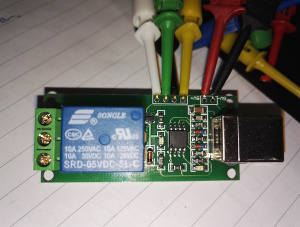
Jonathan McDowell: First steps with the ATtiny45

1 port USB Relay
These days the phrase embedded usually means no console (except, if you re lucky, console on a UART for debugging) and probably busybox for as much of userspace as you can get away with. You possibly have package management from OpenEmbedded or similar, though it might just be a horrible kludged together rootfs if someone hates you. Either way it s rare for it not to involve some sort of hardware and OS much more advanced than the 8 bit machines I started out programming on. That is, unless you re playing with Arduinos or other similar hardware. I m currently waiting on some ESP8266 dev boards to arrive, but even they re quite advanced, with wifi and a basic OS framework provided. A long time ago I meant to get around to playing with PICs but never managed to do so. What I realised recently was that I have a ready made USB relay board that is powered by an ATtiny45. First step was to figure out if there were suitable programming pins available, which turned out to be all brought out conveniently to the edge of the board. Next I got out my trusty Bus Pirate, installed avrdude and lo and behold:
$ avrdude -p attiny45 -c buspirate -P /dev/ttyUSB0
Attempting to initiate BusPirate binary mode...
avrdude: Paged flash write enabled.
avrdude: AVR device initialized and ready to accept instructions
Reading   ##################################################   100% 0.01s
avrdude: Device signature = 0x1e9206 (probably t45)
avrdude: safemode: Fuses OK (E:FF, H:DD, L:E1)
avrdude done.  Thank you.
Perfect. I then read the existing flash image off the device, disassembled it, worked out it was based on V-USB and then proceeded to work out that the only interesting extra bit was that the relay was hanging off pin 3 on IO port B. Which led to me knocking up what I thought should be a functionally equivalent version of the firmware, available locally or on GitHub. It s worked with my basic testing so far and has confirmed to me I understand how the board is set up, meaning I can start to think about what else I could do with it

16 May 2016

Steinar H. Gunderson: stretch on ODROID XU4

I recently acquired an ODROID XU4. Despite being 32-bit, it's currently at the upper end of cheap SoC-based devboards; it's based on Exynos 5422 (which sits in Samsung Galaxy S5), which means 2 GHz quadcore Cortex-A15 (plus four slower Cortex-A7, in a big.LITTLE configuration), 2 GB RAM, USB 3.0, gigabit Ethernet, a Mali-T628 GPU and eMMC/SD storage. (My one gripe about the hardware is that you can't put on the case lid while still getting access to the serial console.) Now, since I didn't want it for HTPC or something similar (I wanted a server/router I could carry with me), I didn't care much about the included Ubuntu derivative with all sorts of Samsung modifications, so instead, I went on to see if I could run Debian on it. (Spoiler alert: You can't exactly just download debian-installer and run it.) It turns out there are lots of people who make Debian images, but they're still filled with custom stuff here and there. In recent times, people have put down heroic efforts to make unified ARM kernels; servers et al can now enumerate hardware using ACPI, while SoCs (such as the XU4) have a device tree file (loaded by the bootloader) containing a functional description of what hardware exists and how it's hooked up. And lo and behold, the 4.5.0 armmp kernel from stretch boots and mostly works! Well except for that there's no HDMI output. :-) There are two goals I'd like to achieve by this exercise: First, it's usually much easier to upgrade things if they are close to mainline. (I wanted support for sch_fq, for instance, which isn't in 3.10, and the vendor kernel is 3.10.) Second, anything that doesn't work in Debian is suddenly exposed pretty harshly, and can be filed bugs for and fixed which benefits not only XU4 users (if nothing else, because the custom distros have to carry less delta), but usually also other boards as most issues are of a somewhat more generic nature. Yet, the ideal seems to puzzle some of the more seasoned people in the ODROID user groups; I guess sometimes it's nice to come in as a na ve new user. :-) So far, I've filed bugs or feature requests to the kernel (#823552, #824435), U-Boot (#824356), grub (#823955, #824399), and login (#824391) and yes, that includes for the aforemented lack of HDMI output. Some of them are already fixed; with some luck, maybe the XU4 can be added next to the other Exynos5 board at the compatibility list for the armmp kernels at some point. :-) You can get the image at http://storage.sesse.net/debian-xu4/. Be sure to read the README and the linked ODROID forum post.

15 May 2016

Bits from Debian: What does it mean that ZFS is included in Debian?

Petter Reinholdtsen recently blogged about ZFS availability in Debian. Many people have worked hard on getting ZFS support available in Debian and we would like to thank everyone involved in getting to this point and explain what ZFS in Debian means. The landing of ZFS in the Debian archive was blocked for years due to licensing problems. Finally, the inclusion of ZFS was announced slightly more than a year ago, on April 2015 by the DPL at the time, Lucas Nussbaum who wrote "We received legal advice from Software Freedom Law Center about the inclusion of libdvdcss and ZFS in Debian, which should unblock the situation in both cases and enable us to ship them in Debian soon.". In January this year, the following DPL, Neil McGovern blogged with a lot of more details about the legal situation behind this and summarized it as "TLDR: It s going in contrib, as a source only dkms module." ZFS is not available exactly in Debian, since Debian is only what's included in the "main" section archive. What people really meant here is that ZFS code is now in included in "contrib" and it's available for users using DKMS. Many people also mixed this with Ubuntu now including ZFS. However, Debian and Ubuntu are not doing the same, Ubuntu is shipping directly pre-built kernel modules, something that is considered to be a GPL violation. As the Software Freedom Conservancy wrote "while licensed under an acceptable license for Debian's Free Software Guidelines, also has a default use that can cause licensing problems for downstream Debian users".

Norbert Preining: Foreigners in Japan are evil

at least what Tokyo Shinjuku ward belives. They have put out a very nice brochure about how to behave as a foreigner in Japan: English (local copy) and Japanese (local copy). Nothing in there is really bad, but the tendency is so clear that it makes me think what on earth do you believe we are doing in this country?
foreigners Now what is so strange on that? And if you have never lived in Japan you will probably not understand. But reading through this pamphlet I felt like a criminal from the first page on. If you don t want to read through it, here a short summary: So if you count up, we have 23 pages of warnings, and 1 (as in *one*) page of practical information. Do I need to add more about how we foreigners are considered in Japan? Just a few points about details: I accept the good intention of the Shinjuku ward to bring forth a bit of warnings and guidance. But the way it was done it speaks volumes about how we foreigners are treated second class.

10 May 2016

Reproducible builds folks: Reproducible builds: week 54 in Stretch cycle

What happened in the Reproducible Builds effort between May 1st and May 7th 2016: Media coverage There has been a surprising tweet last week: "Props to @FiloSottile for his nifty gvt golang tool. We're using it to get reproducible builds for a Zika & West Nile monitoring project." and to our surprise Kenn confirmed privately that he indeed meant "reproducible builds" as in "bit by bit identical builds". Wow. We're looking forward to learn more details about this; for now we just know that they are doing this for software quality reasons basically. Two of the four GSoC and Outreachy participants for Reproducible builds posted their introductions to Planet Debian: Toolchain fixes and other upstream developments dpkg 1.18.5 was uploaded fixing two bugs relevant to us: This upload made it necessary to rebase our dpkg on the version on sid again, which Niko Tyni and Lunar promptly did. Then a few days later 1.18.6 was released to fix a regression in the previous upload, and Niko promptly updated our patched version again. Following this Niko Tyni found #823428: "dpkg: many packages affected by dpkg-source: error: source package uses only weak checksums". Alexis Bienven e worked on tex related packages and SOURCE_DATE_EPOCH: Emmanuel Bourg uploaded jflex/1.4.3+dfsg-2, which removes timestamps from generated files. Packages fixed The following 285 packages have become reproducible due to changes in their build dependencies (mostly from GCC honouring SOURCE_DATE_EPOCH, see the previous week report): 0ad abiword abcm2ps acedb acpica-unix actiona alliance amarok amideco amsynth anjuta aolserver4-nsmysql aolserver4-nsopenssl aolserver4-nssqlite3 apbs aqsis aria2 ascd ascii2binary atheme-services audacity autodocksuite avis awardeco bacula ballerburg bb berusky berusky2 bindechexascii binkd boinc boost1.58 boost1.60 bwctl cairo-dock cd-hit cenon.app chipw ckermit clp clustalo cmatrix coinor-cbc commons-pool cppformat crashmail crrcsim csvimp cyphesis-cpp dact dar darcs darkradiant dcap dia distcc dolphin-emu drumkv1 dtach dune-localfunctions dvbsnoop dvbstreamer eclib ed2k-hash edfbrowser efax-gtk efax exonerate f-irc fakepop fbb filezilla fityk flasm flightgear fluxbox fmit fossil freedink-dfarc freehdl freemedforms-project freeplayer freeradius fxload gdb-arm-none-eabi geany-plugins geany geda-gaf gfm gif2png giflib gifticlib glaurung glusterfs gnokii gnubiff gnugk goaccess gocr goldencheetah gom gopchop gosmore gpsim gputils grcompiler grisbi gtkpod gvpe hardlink haskell-github hashrat hatari herculesstudio hpcc hypre i2util incron infiniband-diags infon ips iptotal ipv6calc iqtree jabber-muc jama jamnntpd janino jcharts joy2key jpilot jumpnbump jvim kanatest kbuild kchmviewer konclude krename kscope kvpnc latexdiff lcrack leocad libace-perl libcaca libcgicc libdap libdbi-drivers libewf libjlayer-java libkcompactdisc liblscp libmp3spi-java libpwiz librecad libspin-java libuninum libzypp lightdm-gtk-greeter lighttpd linpac lookup lz4 lzop maitreya meshlab mgetty mhwaveedit minbif minc-tools moc mrtrix mscompress msort mudlet multiwatch mysecureshell nifticlib nkf noblenote nqc numactl numad octave-optim omega-rpg open-cobol openmama openmprtl openrpt opensm openvpn openvswitch owx pads parsinsert pcb pd-hcs pd-hexloader pd-hid pd-libdir pear-channels pgn-extract phnxdeco php-amqp php-apcu-bc php-apcu php-solr pidgin-librvp plan plymouth pnscan pocketsphinx polygraph portaudio19 postbooks-updater postbooks powertop previsat progressivemauve puredata-import pycurl qjackctl qmidinet qsampler qsopt-ex qsynth qtractor quassel quelcom quickplot qxgedit ratpoison rlpr robojournal samplv1 sanlock saods9 schism scorched3d scummvm-tools sdlbasic sgrep simh sinfo sip-tester sludge sniffit sox spd speex stimfit swarm-cluster synfig synthv1 syslog-ng tart tessa theseus thunar-vcs-plugin ticcutils tickr tilp2 timbl timblserver tkgate transtermhp tstools tvoe ucarp ultracopier undbx uni2ascii uniutils universalindentgui util-vserver uudeview vfu virtualjaguar vmpk voms voxbo vpcs wipe x264 xcfa xfrisk xmorph xmount xyscan yacas yasm z88dk zeal zsync zynaddsubfx Last week the 1000th bug usertagged "reproducible" was fixed! This means roughly 2 bugs per day since 2015-01-01. Kudos and huge thanks to everyone involved! Please also note: FTBFS packages have not been counted here and there are still 600 open bugs with reproducible patches provided. Please help bringing that number down to 0! The following packages have become reproducible after being fixed: Some uploads have fixed some reproducibility issues, but not all of them: Uploads which fix reproducibility issues, but currently FTBFS: Patches submitted that have not made their way to the archive yet: Package reviews 54 reviews have been added, 6 have been updated and 44 have been removed in this week. 18 FTBFS bugs have been reported by Chris Lamb, James Cowgill and Niko Tyni. diffoscope development Thanks to Mattia, diffoscope 52~bpo8+1 is available in jessie-backports now. tests.reproducible-builds.org Misc. This week's edition was written by Reiner Herrmann, Holger Levsen and Mattia Rizzolo and reviewed by a bunch of Reproducible builds folks on IRC. Mattia also wrote a small ikiwiki macro for this blog to ease linking reproducible issues, packages in the package tracker and bugs in the Debian BTS.

Next.

Previous.