Search Results: "Dirk Eddelbuettel"

20 December 2010

Dirk Eddelbuettel: Rcpp 0.9.0 and RcppClassic 0.9.0

A new release 0.9.0 of Rcpp is now available at CRAN and has just been uploaded to Debian. As always, sources are also available from my local directory here. With this release, the older API which we have been referring to as the classic Rcpp API has been split off into its own new package RcppClassic to ensure backwards compatibility. Rcpp will now contain only the new API. We also fixes a number a minor bugs and applied a few contributed patches which extended functionality or documentation as detailed below in the NEWS entry:
0.9.0   2010-12-19
    o   The classic API was factored out into its own package RcppClassic which
        is released concurrently with this version.
    o   If an object is created but not initialized, attempting to use
        it now gives a more sensible error message (by forwarding an
        Rcpp::not_initialized exception to R).
    o   SubMatrix fixed, and Matrix types now have a nested ::Sub typedef.
  
    o   New unexported function SHLIB() to aid in creating a shared library on
        the command-line or in Makefile (similar to CxxFlags() / LdFlags()).
    o   Module gets a seven-argument ctor thanks to a patch from Tama Ma.
    o   The (still incomplete) QuickRef vignette has grown thanks to a patch
        by Christian Gunning.
    o   Added a sprintf template intended for logging and error messages.
    o   Date::getYear() corrected (where addition of 1900 was not called for); 
        corresponding change in constructor from three ints made as well.
    o   Date() and Datetime() constructors from string received a missing
        conversion to int and double following strptime. The default format
        string for the Datetime() strptime call was also corrected.
    o   A few minor fixes throughout, see ChangeLog.
Thanks to CRANberries, there is also a diff to the previous release 0.8.9. As always, even fuller details are on the Rcpp Changelog page and the Rcpp page which also leads to the downloads, the browseable doxygen docs and zip files of doxygen output for the standard formats. A local directory has source and documentation too. Questions, comments etc should go to the rcpp-devel mailing list off the R-Forge page

18 December 2010

Dirk Eddelbuettel: Introduction to ESS: talk and slides

We had another meeting of the Chicago R User Group last evening. This was scheduled somewhat belatedly once we learned that Drew Conway would be in town. Drew gave a very nice talk about his brand new infochimps package (for accessing the eponymous infochimps data service and marketplace). Slides are available on Drew's blog. In fact, he had already blogged about his talk before I had even started to write my slides... The user group meetings have a meme of showing how to use R with different editors, UIs, IDEs,... It started with a presentation on Eclipse and its StatET plugin. So a while ago I had offered to present on ESS, the wonderful Emacs mode for R (and as well as SAS, Stata, BUGS, JAGS, ...). And now I owe a big thanks to the ESS Core team for keeping all their documentation, talks, papers etc in their SVN archive, and particularly to Stephen Eglen for putting the source code to Tony Rossini's tutorial from useR! 2006 in Vienna there. This allowed me to quickly whip up a few slides though a good part of the presentation did involve a live demo missing from the slides. Again, big thanks to Tony for the old slides and to Stephen for making them accessible when I mentioned the idea of this talk a while back -- it allowed to put this together on short notice. And for those going to useR! 2011 in Warwick next summer, Stephen will present a full three-hour ESS tutorial which will cover ESS in much more detail.

14 December 2010

Dirk Eddelbuettel: RcppDE 0.1.0

A new package RcppDE has been uploaded in a first version 0.1.0 to CRAN. It provides differential evolution optimisation---a variant of stochastic optimisation that is similar to genetic algorithms but particularly suitable for the floating-point representations common in numerical optimisation. It builds of on the nice DEoptim package by Ardia et al, but reimplements the algorithm in C++ (rather than C) using a large serving of Rcpp and RcppArmadillo. I worked on this on for a few evenings and weekends in October and November and then spent a few more evenings writing a paper / vignette (which is finished as a very first draft now) about it. This was an interesting and captivating problem as I had worked on genetic algorithms going back quite some time to the beginning and then again the end of graduate school (and traces of that early work are near the bottom of my presentations page). So what got me started? DEoptim is a really nice package, but it is implemented in old-school C. There is nothing wrong with that per se, but at the same time that I was wrestling with GAs, I also taught myself C++ which, to put it simply, offers a few more choices to the programmer. I like having those choices. And with all the work that Romain and I have put into Rcpp, I was curious how far I could push this cart if I were to move it along. I made a bet with myself starting from the old saw shorter, easier, faster: pick any two. Would it be possible to achieve all three of these goals? DEoptim, and I take version 2.0-7 as my reference point here, is pretty efficiently yet verbosely coded. Copying a vector takes a loop with an assignment for each element, copying a matrix does the same using two loops. Replacing that with a single statement in C++ is pretty easy. We also have a few little optimisations behind the scenes here and there in Rcpp: would all that be enough to move the needle in terms of performance? And the same time, DEoptim is also full of the uses of the old R API which we often point to in the Rcpp documentation so fixing readibility should be a relatively low-hanging fruit. To cut a long story short, I was able to reduce code size quite easily by using a combination of C++ and Rcpp idioms. I was also able to get to faster: the paper / vignette demostrates consistent speed improvements on all setups that I tested (three standard functions on three small and three larger parameter vectors). More important speed gains were achieved by allowing use of objective functions that are written in C++ which again is both possible and easy thanks to Rcpp. That leaves easier to prove: adding compiled objective functions is one indication; further proof could be provided by, say, moving the inner loop to parallel execution thanks to Open MP which I may attempt over the next few months. So far I'd like to give myself about half a point here. So not quite yet shorter, easier, faster: pick any three, but working on it. Over the next few days I may try to follow up with a blog post or two contrasting some code examples and maybe showing a chart from the vignette.
11 December 2010

Dirk Eddelbuettel: Regina Carter / Esperanza Spalding

Went to the Chicago Symphony yesterday to see Regina Carter as well as Jazz wunderkind Esperanza Spalding perform one seat each with their respective bands. Regina Carter was presenting material from her current record 'Reverse Thread'. This was a real nice set of African-themed world music featuring Carter herself on violin, Yacouba Sissoko on kora, Will Holshouser on accordion, Chris Lightcap on bass and Alvester Garnett on drums. Some of pieces were really, really nicely done and I particularly enjoyed Holshouser on the accordion. After the break, Esperanza Spalding come on for her Chamber Music Society'. Lovely setup with Spalding on acoustic bass and vocals, Leo Genovese on piano/keyboards, Sara Caswell on violin, Lois Martin on viola, Jody Redhage on cello, the always impressice Terry Lyne Carrington on drums and Leala Cyr on backing vocals (and one co-lead in a really nice duet with Spalding). This was clearly more experimental and a chunk of the audience left during the act. But there is room for improvided chamber music, and it was a good modern music act. And Spalding is really quite impressive and I will gladly go and see her again.

8 December 2010

Dirk Eddelbuettel: inline 0.3.8

Romain pushed verion 0.3.8 of inline to CRAN earlier today, and I just updated the Debian package. This version adds an internal performance enhancement which is obtained by making due with fewer reads. The short NEWS file entry follows:
0.3.8   2010-12-07
    o   faster cfunction and cxxfunction by loading and resolving the routine
        at "compile" time

1 December 2010

Dirk Eddelbuettel: RcppGSL 0.1.0

Earlier in the year, Romain and I did a bunch of initial work on a wrapper from R to the GNU GSL by way of our Rcpp package for seamless R and C++ integration. But other work kept us busy and this fell a little to the side. We have now found some time to finish this work for a first release, together with a nicely detailed eleven page package vignette. As of today, the package is now a CRAN package, and Romain already posted a nice announcement on his blog and on the rcpp-devel list. So what does RcppGSL do? I gave the package its own webpage here as well and listed these points as key features of RcppGSL: Also provided is a simple example which is a simple implementation of a column norm (which we could easily compute directly in R, but we are simply re-using an example from Section 8.4.14 of the GSL manual):
#include <RcppGSL.h>
#include <gsl/gsl_matrix.h>
#include <gsl/gsl_blas.h>
extern "C" SEXP colNorm(SEXP sM)  
  try  
        RcppGSL::matrix<double> M = sM;     // create gsl data structures from SEXP
        int k = M.ncol();
        Rcpp::NumericVector n(k);           // to store results
        for (int j = 0; j < k; j++)  
            RcppGSL::vector_view<double> colview = gsl_matrix_column (M, j);
            n[j] = gsl_blas_dnrm2(colview);
         
        M.free() ;
        return n;                           // return vector
    catch( std::exception &ex )  
        forward_exception_to_r( ex );
    catch(...)  
        ::Rf_error( "c++ exception (unknown reason)" );
   
  return R_NilValue; // -Wall
 
This example function is implemented in an example package contained in the RcppGSL package itself -- so that users have a complete stanza to use in their packages. This will then build a user package on Linux, OS X and Windows provided the GSL is installed (and on Windows you have to do all the extra steps of defining an environment variable pointing to and of course install Rtools to build in the first place---Linux and OS X are so much easier for development). Another complete example is in the package itself and provides a faster (compiled) alternative to the standard lm() function in R; this example is the continuation of the same example I had in several versions of my Intro to HPC with R tutorials and in the Rcpp package itself as an early example. We will try to touch base with CRAN package authors using both GSL and Rcpp to see how this can help them. The API in our package may well be incomplete, but we are always happy to try to respond to requests for additional features brought to our attention, preferably via the rcpp-devel list. More information is on the RcppGSL page. Questions, comments etc should go to the rcpp-devel mailing list off the R-Forge page.

Dirk Eddelbuettel: RQuantLib 0.3.5

The new RQuantLib release 0.3.5 is now on CRAN and in Debian. RQuantLib combines (some of) the quantitative analytics of QuantLib with the R statistical computing environment and language. Most of the changes were made two and four weeks ago: first in response to some warnings triggered by R 2.12.0 on the included manual pages which needed a brush-up, and then again is some consolidation of manual pages and some other minor tweaks. The release was then held back at CRAN as we noticed that manual pages, when collated to a single large document, triggered a segmentation fault in the latex compiler. Oddly enough only in Europe (if the a4paper option was used) and not here (where I use uspaper). Long story short, this turns out to be a bug in the latex toolchain (which we reported as Debian bug report 604754) which is apparently is known but has no known fix yet (a sample file was supplied with the bug report if you want to take a look). With that, special thanks go to Kurt Hornik and Brian Ripley on the R Core team who made a change to how R processes the manual which made it resilient to the latex bug so that normal release of the package could proceed (and the shiny manual is available too). Thanks to CRANberries, there is also a diff to the previous release 0.3.4. Full changelog details, examples and more details about this package are at my RQuantLib page.

28 November 2010

Dirk Eddelbuettel: Rcpp 0.8.9

A new release 0.8.9 of Rcpp is now available at CRAN and has just been uploaded to Debian. As always, sources are also available from my local directory here. This release comes a few weeks after the preceding 0.8.8 release and continues with a number of enhancements mostly to what we call Rcpp modules, our even-easier C++/R integration which follow some ideas from Boost.Python. Our corresponding Rcpp-modules vignette has been updated too. The NEWS entry follows below:
0.8.9   2010-11-27
    o   Many improvements were made to in 'Rcpp modules':
        - exposing multiple constructors
        - overloaded methods
        - self-documentation of classes, methods, constructors, fields and 
          functions.
        - new R function "populate" to facilitate working with modules in 
          packages. 
        - formal argument specification of functions.
        - updated support for Rcpp.package.skeleton.
        - constructors can now take many more arguments.
        
    o   The 'Rcpp-modules' vignette was updated as well and describe many
        of the new features
    o   New template class Rcpp::SubMatrix<rtype> and support syntax in Matrix
        to extract a submatrix: 
        
           NumericMatrix x = ... ;
        
           // extract the first three columns
           SubMatrix<realsxp> y = x( _ , Range(0,2) ) ; 
        
           // extract the first three rows
           SubMatrix<realsxp> y = x( Range(0,2), _ ) ; 
        
           // extract the top 3x3 sub matrix
           SubMatrix<realsxp> y = x( Range(0,2), Range(0,2) ) ; 
    o   Reference Classes no longer require a default constructor for
        subclasses of C++ classes    
    o   Consistently revert to using backticks rather than shell expansion
        to compute library file location when building packages against Rcpp
        on the default platforms; this has been applied to internal test
        packages as well as CRAN/BioC packages using Rcpp
Thanks to CRANberries, there is also a diff to the previous release 0.8.8: As always, even fuller details are on the Rcpp Changelog page and the Rcpp page which also leads to the downloads, the browseable doxygen docs and zip files of doxygen output for the standard formats. A local directory has source and documentation too. Questions, comments etc should go to the rcpp-devel mailing list off the R-Forge page

26 November 2010

Dirk Eddelbuettel: RcppArmadillo 0.2.10

Conrad Sanderson released version 1.0.0 of Armadillo, his templated C++ library for linear algebra, earlier this week. So congratulations to Conrad on reaching 1.0.0! I folded his version 1.0.0 into a new release 0.2.10 of RcppArmadillo, our Rcpp-based integration into R. Other small changes comprises a small fix to the build process, and additional output in the summary() function for the fastLm function. The short NEWS file extract follows, also containing Conrad's entry for 1.0.0:
0.2.10  2010-11-25
    o   Upgraded to Armadillo 1.0.0 "Antipodean Antileech"
         * After 2 1/2 years of collaborative development, we are proud to
           release the 1.0 milestone version. 
         * Many thanks are extended to all contributors and bug reporters.
    o   R/RcppArmadillo.package.skeleton.R: Updated to no longer rely on GNU
        make for builds of packages using RcppArmadillo
 
    o   summary() for fastLm() objects now returns r.squared and adj.r.squared
And courtesy of CRANberries, here is the diff to the previous release 0.2.9:
 ChangeLog                                                   17 ++++++++
 DESCRIPTION                                                 25 +++++------
 R/RcppArmadillo.package.skeleton.R                           4 -
 R/fastLm.R                                                  21 +++++++++
 inst/NEWS                                                   13 ++++++
 inst/doc/RcppArmadillo-unitTests.pdf                     binary
 inst/doc/unitTests-results/RcppArmadillo-unitTests.html      6 +-
 inst/doc/unitTests-results/RcppArmadillo-unitTests.txt      34 ++++++++--------
 inst/include/armadillo_bits/arma_version.hpp                15 +++++--
 inst/skeleton/Makevars                                       2 
 src/Makevars                                                 2 
 src/Makevars.win                                             2 
 12 files changed, 97 insertions(+), 44 deletions(-)
More information is on the RcppArmadillo page. Questions, comments etc should go to the rcpp-devel mailing list off the R-Forge page.

12 November 2010

Dirk Eddelbuettel: RcppArmadillo 0.2.9

The new version 0.2.9 of RcppArmadillo has been uploaded to CRAN. The only change is an update of the included Armadillo template library to version 0.9.92 which Conrad released this week. RcppArmadillo makes it easy to write highly efficient and highly readable C++ code for linear algebra (based on Armadillo) in R extensions (using Rcpp for the interface). The short NEWS file extract follows, also containing Conrad's entry for 0.9.92::
0.2.9   2010-11-11
    o   Upgraded to Armadillo 0.9.92 "Wall Street Gangster":
         * Fixes for compilation issues under the Intel C++ compiler
         * Added matrix norms
More information is on the RcppArmadillo page. Questions, comments etc should go to the rcpp-devel mailing list off the R-Forge page.

3 November 2010

Dirk Eddelbuettel: inline 0.3.7

A bug-fix release 0.3.7 of inline is now on CRAN and at Debian. It fixes a minor bug: when package.skeleton() was called to convert one or more functions created with this package into a package, the corner case of just a single submitted function failed. This is now corrected. Otherwise this release is unchanged from the previous release 0.3.6 from August.

Dirk Eddelbuettel: Rcpp 0.8.8

A bug-fix release 0.8.8 of Rcpp is now available. It is awaiting processing at CRAN, and will be uploaded to Debian once processed at CRAN. In the meantime, sources are available from my local directory here. This release follows on the heels of 0.8.7, but contains fixes for a few small things Romain and I had noticed over the last two weeks since releasing 0.8.7 and contains only a small number of new tweaks. The NEWS entry follows below:
0.8.8   2010-11-01
    o   New syntactic shortcut to extract rows and columns of a Matrix. 
        x(i,_) extracts the i-th row and x(_,i) extracts the i-th column. 
    
    o   Matrix indexing is more efficient. However, faster indexing is
        disabled if g++ 4.5.0 or later is used.
    o   A few new Rcpp operators such as cumsum, operator=(sugar)
    o   Variety of bug fixes:
        - column indexing was incorrect in some cases
        - compilation using clang/llvm (thanks to Karl Millar for the patch)
        - instantation order of Module corrected
        - POSIXct, POSIXt now correctly ordered for R 2.12.0 
As always, even fuller details are on the Rcpp Changelog page and the Rcpp page which also leads to the downloads, the browseable doxygen docs and zip files of doxygen output for the standard formats. A local directory has source and documentation too. Questions, comments etc should go to the rcpp-devel mailing list off the R-Forge page

28 October 2010

Dirk Eddelbuettel: Google Tech Talk on Integrating R and C++: video and slides

Last Friday, Romain and I were guests of the R intergrouplet (what an adorable name!) at Google's headquarter in Mountain View. This arose out of discussions following useR! 2010 where we met Google's Murray Stokely. There appears to be ever increasing use of R at Google, and so it was a great opportunity to give a Google Tech Talk about R and C++ integration --- centered around our Rcpp, RInside and RProtoBuf packages which facilitate interoperability between R and C++. A video recording of our ninety-minute talk is already available via the YouTube channel for Google Tech Talks. The (large) pdf with slides (which Romain had already posted on slideshare) is also available from my presentations page. The remainder of the weekend was nice too (with the notably exception of the extremly sucky weather). We got to to spend some time at the Google Summer of Code Mentor Summit which is always a fun event and a great way to meet other open source folks in person. And we also took one afternoon off to spend some with John Chambers discussing further work involving Rcpp and the new ReferenceClasses that appeared in the just-released R version 2.12.0. This should be a nice avenue to further integrate R and C++ in the near future.

18 October 2010

Dirk Eddelbuettel: RProtoBuf 0.2.1

A fresh minor release of RProtoBuf, now at version 0.2.1, has appeared earlier today on CRAN. RProtoBuf provides GNU R bindings for the Google Protobuf data encoding library used and released by Google. This releases extends the recent 0.2.0 release of RProtoBuf with a patch for raw bytes serialization which Koert Kuipers kindly contributed. This helps RProtoBuf for RPC communication where raw bytes are often a preferred form. As always, there is more information at the RProtoBuf page which has a draft package vignette, a 'quick' overview vignette and a unit test summary vignette. Questions, comments etc should go to the rprotobuf mailing list off the RProtoBuf page at R-Forge.

17 October 2010

Dirk Eddelbuettel: RPostgreSQL 0.1-7

After a somewhat long hiatus, RPostgreSQL version 0.1-7 has now been released to CRAN. RPostgreSQL connects R to PostgreSQL database systems using the standard DBI interface. This version fixes a number of issues that had been compiled in the issue tracker on the project site at Google Code. Tomoaki Nishiyama, who joined our small development group for his package a few weeks ago, was instrumental in a number of these fixes, with assistance from Joe Conway. The relevant NEWS file entry follows below:
Version 0.1-7 -- 2010-10-17
    o   Several potential buffer overruns were fixed
    o   dbWriteTable now writes a data.frame to database through a network
        connection rather than a temporary file. Note that row_names may be
        changed in future releases.  Also, passing in filenames instead of
        data.frame is not supported at this time. 
    o   When no host is specified, a connection to the PostgreSQL server 
        is made via UNIX domain socket (just like psql does)
    o   Table and column names are case sensitive, and identifiers are escaped
        or quoted appropriately, so that any form of table/column names can be
        created, searched, or removed, including upper-, lower- and mixed-case.
    o   nullOk in dbColumnInfo has a return value of NA when the column does
        not correspond to a column in the table. The utility of nullOk is
        doubtful but not removed at this time.
    o   Correct Windows getpid() declaration (with thanks to Brian D. Ripley)
    o   A call of as.POSIXct() with a time format string wrongly passed to TZ
        has been corrected; this should help with intra-day timestamps (with
        thanks to Steve Eick)
    o   Usage of tmpdir has been improved on similarly to Linux (with thanks
        to Robert McGehee)
More information is on the my RPostgreSQL page, and on project site at Google Code.

16 October 2010

Dirk Eddelbuettel: RcppArmadillo 0.2.8

Version 0.2.8 of RcppArmadillo is now on CRAN. This updates the included Armadillo template library to version 0.9.90 which Conrad released two few days ago. RcppArmadillo makes it easy to write highly efficient and highly readable C++ code for linear algebra (based on Armadillo) in R extensions (using Rcpp for the interface). The short NEWS file extract follows, also containing Conrad's entry for 0.9.90::
    o   Upgraded to Armadillo 0.9.90 "Water Dragon":
         * Added unsafe_col()
         * Speedups and bugfixes in lu()
         * Minimisation of pedantic compiler warnings
    o   Switched NEWS and ChangeLog between inst/ and the top-level directory
        so that NEWS (this file) gets installed with the package
More information is on the RcppArmadillo page. Questions, comments etc should go to the rcpp-devel mailing list off the R-Forge page.

15 October 2010

Dirk Eddelbuettel: Rcpp 0.8.7

With the scheduled R release of version 2.12.0 this morning, we have just uploaded version 0.8.7 of Rcpp to CRAN; Debian will follow shortly once the autobuilders have processed R 2.12.0 This Rcpp release depends on R 2.12.0 as two things have changed. First, we play along with change in R concerning the ordering of inheritance for time classes. But secondly, and more importantly, we support in Rcpp the corresponding change R itself which brings the new ReferenceClasses. Here is corresponding bit from R's NEWS file for R 2.12.0:
    o A facility for defining reference-based S4 classes (in the OOP
      style of Java, C++, etc.) has been added experimentally to
      package methods; see ?ReferenceClasses.
[...]
    o An experimental new programming model has been added to package
      methods for reference (OOP-style) classes and methods.  See
      ?ReferenceClasses.
This was made possible in large part by code committed by John Chambers (whom we had welcomed recently as a co-author to Rcpp) building on the changes he made to R 2.12.0 itself, as well on the work Romain had done with 'Rcpp Modules'. The R help page for ReferenceClasses carries a reference (bad pun) to Rcpp 0.8.7 so these two releases do go together. This should be a lot of fun over the next little while: S3, S4, and now ReferenceClasses. We also made a number of internal changes some of which leads to speed-ups and internal improvement. The NEWS entry follows below:
0.8.7   2010-10-15
    o   As of this version, Rcpp depends on R 2.12 or greater as it interfaces 
        the new reference classes (see below) and also reflects the POSIXt class
        reordering both of which appeared with R version 2.12.0
    o   new Rcpp::Reference class, that allows internal manipulation of R 2.12.0
        reference classes. The class exposes a constructor that takes the name
        of the target reference class and a field(string) method that implements
        the proxy pattern to get/set reference fields using callbacks to the 
        R operators "$" and "$<-" in order to preserve the R-level encapsulation
    o   the R side of the preceding item allows methods to be written
        in R as per ?ReferenceClasses, accessing fields by name and
        assigning them using "<<-".  Classes extracted from modules
        are R reference classes.  They can be subclassed in R, and/or R methods
        can be defined using the $methods(...) mechanism.
    o   internal performance improvements for Rcpp sugar as well as an added
        'noNA()' wrapper to omit tests for NA values -- see the included
        examples in inst/examples/convolveBenchmarks for the speedups
    o   more internal performance gains with Functions and Environments
As always, even fuller details are in Rcpp Changelog page and the Rcpp page which also leads to the downloads, the browseable doxygen docs and zip files of doxygen output for the standard formats. A local directory has source and documentation too. Questions, comments etc should go to the rcpp-devel mailing list off the R-Forge page

11 October 2010

Dirk Eddelbuettel: Chicago Marathon 2010

It's the Monday of the Columbus Day weekend here, so I must have been running a Chicago Marathon yesterday. Indeed -- the 34th annual Chicago Marathon took place yesterday but everything was about its 10/10/10 date. The symmetric set of numbers was in all advertisements, posters, street signs, on our bibs, the medals, the (nice, for once) race shirt. Everywhere, and yes, I will admit that it was also part of the reason I finally registered earlier in the year shortly before the race sold out. This was the sixth time I ran this race (and my 14th marathon overall). And I still can't run this course all that well: never got a Boston qualification here. As I had mentioned when I blogged about my third Boston Marathon earlier in the year and the recent Chicago Half-Marathon, I have had some recurrent issue with a sore achilles which limited my running throughout the year. It had gotten better but a quick summary of the miles in my running log showed that I had been running only about 80% of the training miles I had in prior years. And not a single 20-miler. I knew I'd have to pay for that. Plus, as so often, the weather. Not quite as hot as the record-heat of 2007. But close enough: high 60s at the start and high 70s or even low 80s towards the end. But I have to compliment to the race organisers. The race was very well organised (following the experience of 2007) with extra water stops, extra sponges handed out at several spots (!!) and very good communication when during the race the alert level was raised to yellow given the heat and humidity. The searchable results now show a fair number of non-finishers, but at least nobody seems to have died. But it looked ugly on the course. I think I ran by three or four sets of paramedics assisting runners who were 'down and out'.. So how did I do? Fair, I suppose -- I ran pretty well for sixteen miles, then needed a first short walking break and continued to run well towards and past the 18 mile waterstop where a bunch of friends and fellow Oak Park runners were helping. But not long after that, I crumbled and needed to alternate walking and running for most of the remainder. With that I came in at 3:41:41, or a 8:28 min/mile pace. And which is by two seconds slower than the previous 'worst' from 2007. But heck, at least it's still more than three minutes faster than Dubya in Houston in 1993 ... I also got beat by a few local running friends as well as by Chicago's own marathon juggler. So there. Maybe I'll train a bit more next time.

4 October 2010

Dirk Eddelbuettel: More BLAS, BLASter, BLAStest: Updates on gcbd

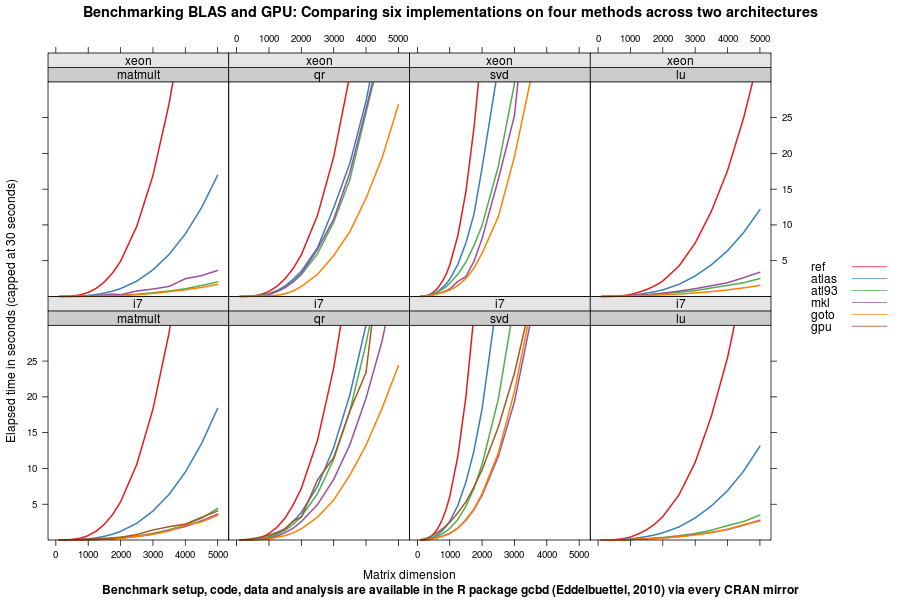
Following up on my initial post announcing gcbd, here is a brief note on a new version. The initial post announced version 0.2.2 which was the first CRAN version of gcbd. I updated to 0.2.3 when I made the aforementioned first blog post about gcbd with the lattice plot of the BLAS and GPU benchmark results across six different implementations (from reference BLAS to two Atlas versions, Goto, MKL and a GPU-based one). There is now a new version 0.2.4 of gcbd on CRAN. I revised the paper ever so slightly based on some more feedback, and focussed the results sections by concentrating on just the log-axes lattice blot and the corresponding lattice plot of raw results---where the y-axis is capped at 30 seconds: GPU/CPU Benchmark Results in levels This chart--in levels rather than using logarithmic axes is done here--nicely illustrates just how large the performance difference can be for for matrix multiplication and LU decomposition. QR and SVD are closer but accelerated BLAS libraries still win. GPUs can be compelling for some tasks and large sizes. More discussion is still available in the paper which is also included in the gcbd package for R.

26 September 2010

Dirk Eddelbuettel: RcppArmadillo 0.2.7

Version 0.2.7 of RcppArmadillo is now on CRAN. This updates the includes Armadillo template library to version 0.9.80 which Conrad released a few days ago. RcppArmadillo makes it easy to write highly efficient and highly readable C++ code for linear algebra (based on Armadillo) in R extensions (using Rcpp for the interface). The short NEWS file extract follows, also containing Conrad's entry for 0.9.80::
0.2.7   2010-09-25
    o   Upgraded to Armadillo 0.9.80 "Chihuahua Muncher":
         * Added join_slices(), insert_slices(), shed_slices()
         * Added in-place operations on diagonals
         * Various speedups due to internal architecture improvements
More information is on the RcppArmadillo page. Questions, comments etc should go to the rcpp-devel mailing list off the R-Forge page.

Next.

Previous.