Search Results: "ed"

6 May 2014

Steve Kemp: New emacs?

The recent flurry of activity with neovim have made me wonder if there could be something similar for the other editor, emacs. If you poke around recent GNU Emacs releases you'll come across random signs that the code carries a lot of baggage:
/usr/share/emacs/23.4/etc/MACHINES
There are special considerations for a variety of this system which is known as the Yellow Dog [GNU/]Linux' Yellow Dog [GNU/]Linux has been dead for many years now.
/etc/emacs/site-start.d/50dictionaries-common.el
Contains references to skipping stuff that runs under Emacs 19, 20, 21, & 22.
None of these are huge things, and the core code of Emacs is a pleasure to read in many places, but it does make you think, or not, whichever the case may be it is all good :) (I do all "real work" in emacs. I write all outgoing emails in vim, and use it for git/mercurial commit messsages, otherwise the only time I use it is for random one-line edits over slow links.)

Michal Čihař: Weblate 1.9

Weblate 1.9 has been released today. It comes with lot of improvements and bug fixes and with experimental Zen mode for editing translations. Full list of changes for 1.9: You can find more information about Weblate on http://weblate.org, the code is hosted on Github. If you are curious how it looks, you can try it out on demo server. You can login there with demo account using demo password or register your own user. Ready to run appliances will be soon available in SUSE Studio Gallery. Weblate is also being used https://l10n.cihar.com/ as official translating service for phpMyAdmin, Gammu, Weblate itself and others. If you are free software project which would like to use Weblate, I'm happy to help you with set up or even host Weblate for you. Further development of Weblate would not be possible without people providing donations, thanks to everybody who have helped so far!

Filed under: English phpMyAdmin SUSE Weblate 0 comments Flattr this!

Junichi Uekawa: Trying out Debian arm64 port on chroot running inside qemu-user-static.

Trying out Debian arm64 port on chroot running inside qemu-user-static. It seems like it's getting closer to being ready. qemu 2.0 already hit Debian unstable, so qemu-aarch64-static is already available in qemu-user-static package. Today, debootstrap cross almost works but doesn't, because of some missing dependencies in debian-ports. hmmm... Some of the commands I needed to do:

5 May 2014

Dirk Eddelbuettel: RcppArmadillo 0.4.300.0

A new release 4.300 of Armadillo, the templated C++ library for linear algebra, was released by Conrad a few days ago. As usual, this was rolled up in a new RcppArmadillo release 0.4.300.0 which is now on CRAN and in Debian. This release brings nice new upstream changes such as faster find() as well as corresponding functions to find elements which are either finite or non-finite, based on a suggestion we made. This may need an RcppArmadillo specific extension as R extends the IEEE logic to supported NA, NaN and Inf on floating point variables whereas standard C++ (and hence Armadillo) only supports the latter two. We hope to work on this shortly. Kevin also put in some code to make sure unsigned int vectors and matrices are converted correctly, and I updated the short configure script checking for complete LAPACK support to account for the R 3.0.3 or later case.
Changes in RcppArmadillo version 0.4.300.0 (2014-05-04)
  • Upgraded to Armadillo release Version 4.300 (Medieval Cornea Scraper)
    • faster find()
    • added find_finite() and find_nonfinite() for finding indices of finite and non-finite elements
    • expressions X=inv(A)*B*C and X=A.i()*B*C are automatically converted to X=solve(A,B*C)
  • Corrected conversion to unsigned int vectors and matrices
  • Configure script now checks for R version 3.0.3 or newer to enable complex divide-and-conquer SVD in case of R-supplied LAPACK
Courtesy of CRANberries, there is also a diffstat report for the most recent release As always, more detailed information is on the RcppArmadillo page. Questions, comments etc should go to the rcpp-devel mailing list off the R-Forge page.

This post by Dirk Eddelbuettel originated on his Thinking inside the box blog. Please report excessive re-aggregation in third-party for-profit settings.

Vincent Bernat: Dashkiosk: manage dashboards on multiple displays

Dashkiosk is a solution to manage dashboards on multiple displays. It comes in four parts:
  1. A server will manage the screens by sending URL to be displayed. A web interface enables an administrator to configure groups of dashboards and attach them to a set of displays.
  2. A receiver runs in a browser attached to each screen. On start, it contacts the server and waits for the URL to display.
  3. An Android application provides a simple fullscreen webview to display the receiver.
  4. A Chromecast custom receiver which will run the regular receiver to display dashboards using Google Chromecast devices. The server is able to drive Chromecast devices through nodecastor, a reimplementation of the sender API.
For a demo, have a look at the following video (it is also available as an Ogg Theora video).

Gunnar Wolf: Correction for @osupiita

I was invited to give a talk at a local conference, OS-UPIITA. I have been invited to this conference before, and will gladly be there again. But I was recently pointed at the invitation poster they are distributing (which I reproduce here for your convenience) And I must make a couple of corrections here:
  1. First and foremost: I don't want to trick anybody. I am not the Director of Debian Mexico. In fact, Debian Mexico does not exist. I am just a humble Debian Developer.
  2. I accept the conference title, because that's what they requested from me. I'm trying to come up with a coherent exposition, but whoever knows me must be perfectly aware that I don't know (nor really care about) how to make money with Free Software. I have lived all of my professional life thanks to Free Software, but I'm against the entrepenurial culture. I will talk about my vision, of course, so if you want to hear me rant, you are invited to join us ;-)
  3. I specifically asked the organizing committee by mid-April, when they gave me the talk title, to replace "Open Source" with "Free Software" in my talk. Even though the conference is called "OS UPIITA" (as it is the Open Source conference in the UPIITA unit of Instituto Polit cnico Nacional), I cannot identify with the Open Source monkier. And if we are talking about a deeply ideological issue, which is the case here, I request to use the name I can relate with. For my talk only, of course.
</rant> But anyway, I will be very happy to be there, and believe me, am working to come up with a good talk. OS-UPIITA friends: Please correct your online banners carrying this wrong data. [update] OS-UPIITA changed the poster! I'm just keeping this one for the memory ;-) [update 2] I was there, and gave the talk. And it was even a success, yay! \o/ Care to see it? Here is the presented material.
AttachmentSize
osupiita_chico.jpg43.74 KB

Thomas Goirand: OpenStack Icehouse bugs all cleaned-up

I ve done some clean-up in the Debian BTS. The result can be seen in the QA graphs: The last remaining 6 bugs are only affecting OpenStack Essex (which is what Wheezy ships, and which unfortunately I have not enough time to support properly), and the last one is waiting for FTP masters approval after I added Python 3 support to oslo-config (OpenStack is slowly moving to Python3, and I ve tried to add support to Python3 in the packages as well each time it was possible). Also, the Icehouse packages have passed the tempest tests (a set of functional tests) which we run in our continuous integration system. As I was doing some triaging, it is possible that some bugs have been closed a bit quickly (like for example the Ceilometer FTBFS which I couldn t reproduce, even with sbuild and cowbuilder), so it is well possible that some more QA work will be needed later on. I m also expecting a new set of patches for supporting Ceph in Nova. I m sure there s issues which we will discover later on, however, it is nice to have this result right after the first Icehouse release of OpenStack. Next up: testing new components that I uploaded for this release: Trove (DB as a Service), Designate (DNS as a Service), Ironic (Metal as a Service, or cloud computing on bare-metal), and TripleO (OpenStack on OpenStack). I unfortunately know already that TripleO and Tuskar wont really work yet, and that it needs some patches to be sent upstream for it to support Debian correctly (let s work it out for Juno!). So please consider it as a technology preview only. Though Trove, Designate and Ironic are supposed to be in good enough shape, I didn t have the chance to test them more than just installing the packages and checking daemons are running and connected to the various components of OpenStack (eg: database, keystone and RabbitMQ). Please do test them and report bugs in the BTS. I d like to thanks Gustavo Panizzo & Thomas Bechtold who contributed to this release, and also the folks at eNovance (Emilien, Cyril, Seb ) who provided precious help with the CI and package quality. See you in the Juno Atlanta design summit next week (as hopefully, my plane ticket issue will be soon solved).

Michal &#268;iha&#345;: Going to LinuxTag

Together with many phpMyAdmin guys, I'm traveling to LinuxTag 2014 in few days. We'll have a booth there (hall 6, booth A13), where we will show some demos and you can stop by and chat with us. Of course my presence there will not be just about phpMyAdmin, I'll meet there few Weblate users and developers, but if you have anything else to discuss, just stop by, I'll be usually around the booth.

Filed under: English phpMyAdmin Weblate 0 comments Flattr this!

Steve Kemp: Sometimes it is surprising how stable systems are

Yesterday I received an automated alert from my kvm-hosting host-machine, informing me that one of the drives in the RAID-pair had failed. This particular machine has been up and running since 2009, and according to my outage log this is the first downtime in three years. (The uptime was over 1000 days, which seems to confirm that pretty nicely.) I like reliable systems, and sometimes it's worth remembering just how well they can work. In other news I'm currently continuing to chase a new job. The companies I've approached, or which have approached me, are being a little slow in replying which is a shame, but I'm not hugely concerned .. yet. I'm going to give things another week, or so, and then add a banner to the Debian-Administration website, and see if that results in anything interesting. In the meantime I've got some wood, and a new mitre saw, and I will be spending the remainder of today working on my new desk. Doing physical things is always fun, and right now especially.

Robert Collins: Distributed bugtracking quick thoughts

Just saw http://sny.no/2014/04/dbts and I feel compelled to note that distributed bug trackers are not new the earliest I personally encountered was Aaron Bentley s Bugs everywhere coming up on it s 10th birthday. BE meets many of the criteria in the dbts post I read earlier today, but it hasn t taken over the world and I think this is in large part due to the propogation nature of bugs being very different to code different solutions are needed. XXXX: With distributed code versioning we often see people going to some effort to avoid conflicts semantic conflicts are common, and representation conflicts extremely common.The idions Take for example https://bugs.launchpad.net/ubuntu/+source/ntp/+bug/805661. Here we can look at the nature of the content:
  1. Concurrent cannot-conflict content e.g. the discussion about the bug. In general everyone should have this in their local bug database as soon as possible, and anyone can write to it.
  2. Observations of fact e.g. the code change that should fix the bug has landed in Ubuntu or Commit C should fix the bug .
  3. Reports of symptoms e.g. Foo does not work for me in Ubuntu with package versions X, Y and Z .
  4. Collaboratively edited metadata tags, title, description, and arguably even the fields like package, open/closed, importance.
Note that only one of these things the commit to fix the bug happens in the same code tree as the code; and that the commit fixing it may be delayed by many things before the fix is available to users. Also note that conceptually conflicts can happen in any of those fields except 1). Anyhow my humble suggestion for tackling the conflicts angle is to treat all changes to a bug as events in a timeline e.g. adding a tag foo is an event to add foo , rather than an event setting the tags list to bar,foo then multiple editors adding foo do not conflict (or need special handling). Collaboratively edited fields would be likely be unsatisfying with this approach though last-writer-wins isn t a great story. OTOH the number of people that edit the collaborative fields on any given bug tend to be quite low so one could defer that to manual fixups. Further, as a developer wanting local access to my bug database, syncing all of these things is appealing but if I m dealing with a million-bug bug database, I may actually need the ability to filter what I sync or do not sync with some care. Even if I want everything, query performance on such a database is crucial for usability (something git demonstrated convincingly in the VCS space). Lastly, I don t think distributed bug tracking is needed it doesn t solve a deeply burning use case offline access would be a 90% solution for most people. What does need rethinking is the hugely manual process most bug systems use today. Making tools like whoopsie-daisy widely available is much more interesting (and that may require distributed underpinnings to work well and securely). Automatic collation of distinct reports and surfacing the most commonly experienced faults to developers offers a path to evidence based assessment of quality something I think we badly need.

4 May 2014

Mehdi Dogguy: Clickable DepWaits and Edos results in pgstatus

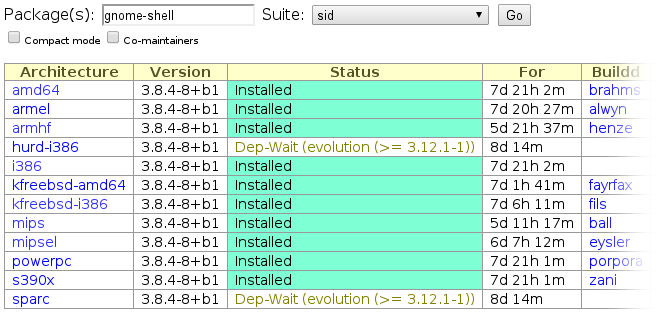
A long time ago, St phane Glondu implemented an alternative to the Buildd status pages. It was implemented in OCaml and had some unique features. I think that my favorite one was the ability to click on package names appearing in DepWaits.

What you see on the image below is a simple example where the package gnome-shell Dep-Waits on a single package. This prevents buildd daemons to start the job as long as the specific version of the specified package or some new package are available. So, each package name in that field became now clickable and points to its buildd status page.


Similarly to Dep-Waits, results of edos-debcheck, which is used to spot installability issues of build dependencies, are now clickable too.

If you are a porter or if you are tracking down a build issue, I am sure you'll appreciate these two new features. Enjoy! As usual, if you notice some bugs or have some feature requests, please let me know.

R&#233;mi Vanicat: git-annex-on-hubic

A Git annex hook for Hubic I've just finished the git annex hook I was writing. It create a special remote that will use Hubic as a storage for git annex's objects. To use it, you will have to download it from github. It depend on To use it, you first need to initialize your account. You need an hubic account, but also a client_id and client_secret, that you can generate in My account then Developer. For my hook to work, you need to use http://localhost:4090/ as the Redirect URI (Domaine de redirection in french) Credential will be stored in dbus's org.freedesktop.secrets service, both gnome and kde will give you one. So run hubic-git-annex-hook --init, it will ask for your hubic username, password, your client id and your client secret that you just generate, and store them in the org.freedesktop.secrets service. Then configure git-annex to use it :
git config annex.hubic-hook /full/path/to/hubic-git-annex-hook $HUBIC_USERNAME $CONTAINER
the CONTAINER is openstack concept, that contain the files. Hubic use the container default for its synchronization application, you should probably use another. If the CONTAINER do not exist, the hook will create it. You finally need to create the special remote :
git annex initremote hubic type=hook hooktype=hubic encryption=none
(you could chose any other name than hubic), you can then git annex copy --to=hubic

Dominique Dumont: Deprecating experience level and preset value in Config::Model

Hello The next releases of Config::Model will deprecate 2 (mis)features: The behavior of cme check will not change. People using cme edit with the GUI will see many more configuration parameters. All the best

Jonathan Wiltshire: iptables-persistent overhaul

A couple of weeks ago I finally got round to doing some major surgery on iptables-persistent. First of all it is principally now called netfilter-persistent (although the source package hasn t been renamed) and has a plugin architecture so that it can be extended by other packages. One of those packages is iptables-persistent; others may follow. This opens the way to fixing #662743 and #697088 (patches always welcome). There s also a new binary to handle loading/unloading of rules, instead of having all the logic in an init script. I was therefore able to add systemd support as a first-class unit, and I d appreciate patches for an Upstart service (as I m largely unfamiliar with it). Plugins are simply dropped into /usr/share/netfilter-persistent/plugins.d and must follow certain minimum conventions, detailed in netfilter-persistent(1). They can be any executable, so compiled or interpreted binaries are acceptable. This release finally gets the magic 1.0 identifier. It reaches Jessie today, and is already in Ubuntu Utopic. Flattr
iptables-persistent overhaul is a post from: jwiltshire.org.uk Flattr

Dominique Dumont: Another package configuration upgrade project

Hello I ve recently learned that Debian Google Summer of Code 2014 features a project to improve package configuration upgrade based on Elektra library Despite the fact that this project competes directly with the work done for lcdproc upgrades, I m very glad that the idea of improving configuration upgrade is getting more attention and I welcome this new project. All the best
Tagged: configuration, debian, GSoC, upgrade

Wouter Verhelst: 36

Next tuesday is my birthday. Since it's been a while since I last celebrated that, and since it's been a while since I last made some waffles, I decided to combine those two issues and do a waffle party next sunday (may 11th), at my apartment in Mechelen, between 12:00 and 17:00. If you can read this, and you have reason to assume I'll recognize you on sight, you're hereby invited. Please do let me know if you're coming though, and around what time, so I can prepare enough dough etc. See you there?

DebConf team: DebConf14 registration back online (Posted by Steve Langasek)

Thanks to the work of the Alioth admins and the DSA team, single sign-on services are back online. Everyone will again be able to register for DebConf14 according to the steps described on this page.

DebConf team: DebConf14 registration temporarily offline for non-developers (Posted by Steve Langasek)

An issue with the integration between alioth.debian.org and sso.debian.org is currently preventing people other than Debian developers from logging in to the DebConf website for registration. We apologize for the inconvenience. Administrators are working to resolve the issue as quickly as possible; we will update this blog once the problem has been resolved. In the meantime, Debian developers can continue to register using their debian.org SSO credentials.

Francois Marier: What's in a debian/ directory?

If you're looking to get started at packaging free software for Debian, you should start with the excellent New Maintainers' Guide or the Introduction to Debian Packaging on the Debian wiki. Once you know the basics, or if you prefer to learn by example, you may be interested in the full walkthrough which follows. We will look at the contents of three simple packages.

node-libravatar This package is a node.js library for the Libravatar service. Version 2.0.0-3 of that package contains the following files in its debian/ directory:
  • changelog
  • compat
  • control
  • copyright
  • docs
  • node-libravatar.install
  • rules
  • source/format
  • watch

debian/control
Source: node-libravatar
Priority: extra
Maintainer: Francois Marier <francois@debian.org>
Build-Depends: debhelper (>= 9)
Standards-Version: 3.9.4
Section: web
Homepage: https://github.com/fmarier/node-libravatar
Vcs-Git: git://git.debian.org/collab-maint/node-libravatar.git
Vcs-Browser: http://git.debian.org/?p=collab-maint/node-libravatar.git;a=summary
Package: node-libravatar
Architecture: all
Depends: $ shlibs:Depends , $ misc:Depends , nodejs
Description: libravatar library for NodeJS
 This library allows web application authors to make use of the free Libravatar
 service (https://www.libravatar.org). This service hosts avatar images for
 users and allows other sites to look them up using email addresses.
 .
 node-libravatar includes full support for federated avatar servers.
This is probably the most important file since it contains the bulk of the metadata about this package. Maintainer is a required field listing the maintainer of that package, which can be a person or a team. It only contains a single value though, any co-maintainers will be listed under the optional Uploaders field. Build-Depends lists the packages which are needed to build the package (e.g. a compiler), as opposed to those which are needed to install the binary package (e.g. a library it uses). Standards-Version refers to the version of the Debian Policy that this package complies with. The Homepage field refers to the upstream homepage, whereas the Vcs-* fields point to the repository where the packaging is stored. If you take a look at the node-libravatar packaging repository you will see that it contains three branches:
  • upstream is the source as it was in the tarball downloaded from upstream.
  • master is the upstream branch along with all of the Debian customizations.
  • pristine-tar is unrelated to the other two branches and is used by the pristine-tar tool to reconstitute the original upstream tarball as needed.
After these fields comes a new section which starts with a Package field. This is the definition of a binary package, not to be confused with the Source field at the top of this file, which refers to the name of the source package. In this particular example, they are both the same and there is only one of each, however this is not always the case, as we'll see later. Inside that binary package definition, lives the Architecture field which is normally one of these two:
  • all for a binary package that will work on all architectures but only needs to be built once
  • any for a binary package that will work everywhere but that will need to be built separately for each architecture
Finally, the last field worth pointing out is the Depends field which lists all of the runtime dependencies that the binary package has. This is what will be pulled in by apt-get when you apt-get install node-libravatar. The two variables will be substituted later by debhelper.

debian/changelog
node-libravatar (2.0.0-3) unstable; urgency=low
  * debian/watch: poll github directly
  * Bump Standards-Version up to 3.9.4
 -- Francois Marier <francois@debian.org>  Mon, 20 May 2013 12:07:49 +1200
node-libravatar (2.0.0-2) unstable; urgency=low
  * More precise license tag and upstream contact in debian/copyright
 -- Francois Marier <francois@debian.org>  Tue, 29 May 2012 22:51:03 +1200
node-libravatar (2.0.0-1) unstable; urgency=low
  * New upstream release
    - new non-backward-compatible API
 -- Francois Marier <francois@debian.org>  Mon, 07 May 2012 14:54:19 +1200
node-libravatar (1.1.1-1) unstable; urgency=low
  * Initial release (Closes: #661771)
 -- Francois Marier <francois@debian.org>  Fri, 02 Mar 2012 15:29:57 +1300
This may seem at first like a mundane file, but it is very important since it is the canonical source of the package version (2.0.0-3 in this case). This is the only place where you need to bump the package version when uploading a new package to the Debian archive. The first line also includes the distribution where the package will be uploaded. It is usually one of these values:
  • unstable for the vast majority of uploads
  • stable for uploads that have been approved by the release maintainers and fix serious bugs in the stable version of Debian
  • stable-security for security fixes to the stable version of Debian that cannot wait until the next stable point release and have been approved by the security team
Packages uploaded to unstable will migrate automatically to testing provided that a few conditions are met (e.g. no release-critical bugs were introduced). The length of time before that migration is influenced by the urgency field (low, medium or high) in the changelog entry. Another thing worth noting is that the first upload normally needs to close an ITP (Intent to Package) bug.

debian/rules
#!/usr/bin/make -f
# -*- makefile -*-
%:
    dh $@ 
override_dh_auto_test:
As can be gathered from the first two lines of this file, this is a Makefile. This is what controls how the package is built. There's not much to see and that's because most of its content is automatically added by debhelper. So let's look at it in action by building the package:
$ git buildpackage -us -uc
and then looking at parts of the build log (../node-libravatar_2.0.0-3_amd64.build):
 fakeroot debian/rules clean
dh clean 
   dh_testdir
   dh_auto_clean
   dh_clean
One of the first things we see is the debian/rules file being run with the clean target. To find out what that does, have a look at the dh_auto_clean which states that it will attempt to delete build residues and run something like make clean using the upstream Makefile.
 debian/rules build
dh build 
   dh_testdir
   dh_auto_configure
   dh_auto_build
Next we see the build target being invoked and looking at dh_auto_configure we see that this will essentially run ./configure and its equivalents. The dh_auto_build helper script then takes care of running make (or equivalent) on the upstream code. This should be familiar to anybody who has ever built a piece of free software from scratch and has encountered the usual method for building from source:
./configure
make
make install
Finally, we get to actually build the .deb:
 fakeroot debian/rules binary
dh binary 
   dh_testroot
   dh_prep
   dh_installdirs
   dh_auto_install
   dh_install
...
   dh_md5sums
   dh_builddeb
dpkg-deb: building package  node-libravatar' in  ../node-libravatar_2.0.0-3_all.deb'.
Here we see a number of helpers, including dh_auto_install which takes care of running make install. Going back to the debian/rules, we notice that there is manually defined target at the bottom of the file:
override_dh_auto_test:
which essentially disables dh_auto_test by replacing it with an empty set of commands. The reason for this becomes clear when we take a look at the test target of the upstream Makefile and the dependencies it has: tap, a node.js library that is not yet available in Debian. In other words, we can't run the test suite on the build machines so we need to disable it here.

debian/compat
9
This file simply specifies the version of debhelper that is required by the various helpers used in debian/rules. Version 9 is the latest at the moment.

debian/copyright
Format: http://www.debian.org/doc/packaging-manuals/copyright-format/1.0/
Upstream-Name: node-libravatar
Upstream-Contact: Francois Marier <francois@libravatar.org>
Source: https://github.com/fmarier/node-libravatar
Files: *
Copyright: 2011 Francois Marier <francois@libravatar.org>
License: Expat
Files: debian/*
Copyright: 2012 Francois Marier <francois@debian.org>
License: Expat
License: Expat
 Permission is hereby granted, free of charge, to any person obtaining a copy of this
 software and associated documentation files (the "Software"), to deal in the Software
 without restriction, including without limitation the rights to use, copy, modify,
 merge, publish, distribute, sublicense, and/or sell copies of the Software, and to
 permit persons to whom the Software is furnished to do so, subject to the following
 conditions:
 .
 The above copyright notice and this permission notice shall be included in all copies
 or substantial portions of the Software.
 .
 THE SOFTWARE IS PROVIDED "AS IS", WITHOUT WARRANTY OF ANY KIND, EXPRESS OR IMPLIED,
 INCLUDING BUT NOT LIMITED TO THE WARRANTIES OF MERCHANTABILITY, FITNESS FOR A
 PARTICULAR PURPOSE AND NONINFRINGEMENT. IN NO EVENT SHALL THE AUTHORS OR COPYRIGHT
 HOLDERS BE LIABLE FOR ANY CLAIM, DAMAGES OR OTHER LIABILITY, WHETHER IN AN ACTION OF
 CONTRACT, TORT OR OTHERWISE, ARISING FROM, OUT OF OR IN CONNECTION WITH THE SOFTWARE
 OR THE USE OR OTHER DEALINGS IN THE SOFTWARE.
This machine-readable file lists all of the different licenses encountered in this package. It requires that the maintainer audits the upstream code for any copyright statements that might be present in addition to the license of the package as a whole.

debian/docs
README.md
This file contains a list of upstream files that will be copied into the /usr/share/doc/node-libravatar/ directory by dh_installdocs.

debian/node-libravatar.install
lib/*    usr/lib/nodejs/
The install file is used by dh_install to supplement the work done by dh_auto_install which, as we have seen earlier, essentially just runs make install on the upstream Makefile. Looking at that upstream Makefile, it becomes clear that the files will need to be installed manually by the Debian package since that Makefile doesn't have an install target.

debian/watch
version=3
https://github.com/fmarier/node-libravatar/tags /fmarier/node-libravatar/archive/node-libravatar-([0-9.]+)\.tar\.gz
This is the file that allows Debian tools like the Package Tracking System to automatically detect that a new upstream version is available. What it does is simply visit the upstream page which contains all of the release tarballs and look for links which have an href matching the above regular expression. Running uscan --report --verbose will show us all of the tarballs that can be automatically discovered using this watch file:
-- Scanning for watchfiles in .
-- Found watchfile in ./debian
-- In debian/watch, processing watchfile line:
   https://github.com/fmarier/node-libravatar/tags /fmarier/node-libravatar/archive/node-libravatar-([0-9.]+)\.tar\.gz
-- Found the following matching hrefs:
     /fmarier/node-libravatar/archive/node-libravatar-2.0.0.tar.gz
     /fmarier/node-libravatar/archive/node-libravatar-1.1.1.tar.gz
     /fmarier/node-libravatar/archive/node-libravatar-1.1.0.tar.gz
     /fmarier/node-libravatar/archive/node-libravatar-1.0.1.tar.gz
     /fmarier/node-libravatar/archive/node-libravatar-1.0.0.tar.gz
Newest version on remote site is 2.0.0, local version is 2.0.0
 => Package is up to date
-- Scan finished

pylibravatar This second package is the equivalent Python library for the Libravatar service. Version 1.6-2 of that package contains similar files in its debian/ directory, but let's look at two in particular:
  • control
  • upstream/signing-key.asc

debian/control
Source: pylibravatar
Section: python
Priority: optional
Maintainer: Francois Marier <francois@debian.org>
Build-Depends: debhelper (>= 9), python-all, python3-all
Standards-Version: 3.9.5
Homepage: https://launchpad.net/pyLibravatar
...
Package: python-libravatar
Architecture: all
Depends: $ misc:Depends , $ python:Depends , python-dns, python
Description: Libravatar module for Python 2
 Module to make use of the federated Libravatar.org avatar hosting service
 from within Python applications.
...
Package: python3-libravatar
Architecture: all
Depends: $ misc:Depends , $ python3:Depends , python3-dns, python3
Description: Libravatar module for Python 3
 Module to make use of the federated Libravatar.org avatar hosting service
 from within Python applications.
...
Here is an example of a source package (pylibravatar) which builds two separate binary packages: python-libravatar and python3-libravatar. This highlights the fact that a given upstream source can be split into several binary packages in the archive when it makes sense. In this case, there is no point in Python 2 applications pulling in the Python 3 files, so the two separate packages make sense. Another common example is the use of a -doc package to separate the documentation from the rest of a package so that it doesn't need to be installed on production servers for example.

debian/upstream/signing-key.asc
-----BEGIN PGP PUBLIC KEY BLOCK-----
Version: GnuPG v1
mQINBEpQYz4BEAC7REQD1za69RUnkt6nRCFhSJmmoeJc+yEiWTKc9GOIMAwJDme1
+CMYgVn4Xzf1VQYwD/lE+mfWgyeMomLQjDM1mxx/LOM2a1WWPOk9+PvQwKfRJy92
...
UxDtZm/4yUmU6KvHvOGiDCMuIiB+MqhqJJ5wf80wXhzu8nmC+fyGt6nvu0ggMle8
sAMgXt/aQUTZE5zNCQ==
=RkTO
-----END PGP PUBLIC KEY BLOCK-----
This is simply the OpenPGP key that the upstream developer uses to sign release tarballs. Since PGP signatures are available on the upstream download page, it's possible to instruct uscan to check signatures before downloading tarballs. The way to do that is to use the pgpsigurlmange option in debian/watch:
version=3
opts=pgpsigurlmangle=s/$/.asc/ https://pypi.python.org/pypi/pyLibravatar https://pypi.python.org/packages/source/p/pyLibravatar/pyLibravatar-(.*)\.tar\.gz
which is simply a regular expression replacement string which takes the tarball URL and converts it to the URL of the matching PGP signature.

fcheck The last package we will look at is a file integrity checker. It essentially goes through all of the files in /usr/bin/ and /usr/lib/ and stores a hash of them in its database. When one of these files changes, you get an email. In particular, we will look at the following files in the debian/ directory of version 2.7.59-18:
  • dirs
  • fcheck.cron.d
  • fcheck.postrm
  • fcheck.postinst
  • patches/
  • README.Debian
  • rules
  • source/format

debian/patches This directory contains ten patches as well as a file called series which lists the patches that should be applied to the upstream source and in which order. Should you need to temporarily disable a patch, simply remove it from this file and it will no longer be applied at build time. Let's have a look at patches/04_cfg_sha256.patch:
Description: Switch to sha256 hash algorithm
Forwarded: not needed
Author: Francois Marier <francois@debian.org>
Last-Update: 2009-03-15
--- a/fcheck.cfg
+++ b/fcheck.cfg
@@ -149,8 +149,7 @@ TimeZone        = EST5EDT
 #$Signature      = /usr/bin/sum
 #$Signature      = /usr/bin/cksum
 #$Signature      = /usr/bin/md5sum
-$Signature      = /bin/cksum
-
+$Signature      = /usr/bin/sha256sum
 # Include an optional configuration file.
This is a very simple patch which changes the default configuration of fcheck to promote the use of a stronger hash function. At the top of the file is a bunch of metadata in the DEP-3 format. Why does this package contain so many customizations to the upstream code when Debian's policy is to push fixes upstream and work towards reduce the delta between upstream and Debian's code? The answer can be found in debian/control:
Homepage: http://web.archive.org/web/20050415074059/www.geocities.com/fcheck2000/
This package no longer has an upstream maintainer and its original source is gone. In other words, the Debian package is where all of the new bug fixes get done.

debian/source/format
3.0 (quilt)
This file contains what is called the source package format. What it basically says is that the patches found in debian/patches/ will be applied to the upstream source using the quilt tool at build time.

debian/fcheck.postrm
#!/bin/sh
# postrm script for fcheck
#
# see: dh_installdeb(1)
set -e
# summary of how this script can be called:
#        * <postrm>  remove'
#        * <postrm>  purge'
#        * <old-postrm>  upgrade' <new-version>
#        * <new-postrm>  failed-upgrade' <old-version>
#        * <new-postrm>  abort-install'
#        * <new-postrm>  abort-install' <old-version>
#        * <new-postrm>  abort-upgrade' <old-version>
#        * <disappearer's-postrm>  disappear' <overwriter>
#          <overwriter-version>
# for details, see http://www.debian.org/doc/debian-policy/ or
# the debian-policy package
case "$1" in
    remove upgrade failed-upgrade abort-install abort-upgrade disappear)
    ;;
    purge)
      if [ -e /var/lib/fcheck/fcheck.dbf ]; then
        echo "Purging old database file ..."
        rm -f /var/lib/fcheck/fcheck.dbf
      fi
      rm -rf /var/lib/fcheck
      rm -rf /var/log/fcheck
      rm -rf /etc/fcheck
    ;;
    *)
        echo "postrm called with unknown argument \ $1'" >&2
        exit 1
    ;;
esac
# dh_installdeb will replace this with shell code automatically
# generated by other debhelper scripts.
#DEBHELPER#
exit 0
This script is one of the many possible maintainer scripts that a package can provide if needed. This particular one, as the name suggests, will be run after the package is removed (apt-get remove fcheck) or purged (apt-get remove --purge fcheck). Looking at the case statement above, it doesn't do anything extra in the remove case, but it deletes a few files and directories when called with the purge argument.

debian/README.Debian This optional README file contains Debian-specific instructions that might be useful to users. It supplements the upstream README which is often more generic and cannot assume a particular system configuration.

debian/rules
#!/usr/bin/make -f
# -*- makefile -*-
# Sample debian/rules that uses debhelper.
# This file was originally written by Joey Hess and Craig Small.
# As a special exception, when this file is copied by dh-make into a
# dh-make output file, you may use that output file without restriction.
# This special exception was added by Craig Small in version 0.37 of dh-make.
# Uncomment this to turn on verbose mode.
#export DH_VERBOSE=1
build-arch:
build-indep:
build: build-stamp
build-stamp:
    dh_testdir
    pod2man --section=8 $(CURDIR)/debian/fcheck.pod > $(CURDIR)/fcheck.8
    touch build-stamp
clean:
    dh_testdir
    dh_testroot
    rm -f build-stamp 
    rm -f $(CURDIR)/fcheck.8
    dh_clean
install: build
    dh_testdir
    dh_testroot
    dh_prep
    dh_installdirs
    cp $(CURDIR)/fcheck $(CURDIR)/debian/fcheck/usr/sbin/fcheck
    cp $(CURDIR)/fcheck.cfg $(CURDIR)/debian/fcheck/etc/fcheck/fcheck.cfg
# Build architecture-independent files here.
binary-arch: build install
# Build architecture-independent files here.
binary-indep: build install
    dh_testdir
    dh_testroot
    dh_installdocs
    dh_installcron
    dh_installman fcheck.8
    dh_installchangelogs
    dh_installexamples
    dh_installlogcheck
    dh_link
    dh_strip
    dh_compress
    dh_fixperms
    dh_installdeb
    dh_shlibdeps
    dh_gencontrol
    dh_md5sums
    dh_builddeb
binary: binary-indep binary-arch
.PHONY: build clean binary-indep binary-arch binary install
This is an example of a old-style debian/rules file which you still encounter in packages which haven't yet upgraded to the latest version of debhelper 9, as can be shown by the contents of debian/compat:
8
It does essentially the same thing that what we've seen in the build log, but in a more verbose way.

debian/dirs
usr/sbin
etc/fcheck
This file contains a list of directories that dh_installdirs will create in the build directory. The reason why these directories need to be created is that files are copied into these directories in the install target of the debian/rules file. Note that this is different from directories which are created at the time of installation of the package. In that case, the directory (e.g. /var/log/fcheck/) must be created in the postinst script and removed in the postrm script.

debian/fcheck.cron.d
#
# Regular cron job for the fcheck package
#
30 */2  * * *   root    test -x /usr/sbin/fcheck && if ! nice ionice -c3 /usr/sbin/fcheck -asxrf /etc/fcheck/fcheck.cfg >/var/run/fcheck.out 2>&1; then mailx -s "ALERT: [fcheck]  hostname --fqdn " root </var/run/fcheck.out ; /usr/sbin/fcheck -cadsxlf /etc/fcheck/fcheck.cfg ; fi ; rm -f /var/run/fcheck.out
This file is the cronjob which drives the checks performed by this package. It will be copied to /etc/cron.d/fcheck by dh_installcron.

Andrew Pollock: [debian] Toning it down a bit

I received a complaint about the frequency of my life category posts appearing on Planet Debian. It's the first such complaint I've received, whereas I've received more complimentary feedback, presumably from readers via Planet Debian. It has made me self-conscious about my posts, though, and I don't want it to affect my blogging, so I've pulled the life category from what I feed to Planet Debian. If you want to keep up with the minutia of my life, and you were doing that via Planet Debian, you'll have to follow my blog directly. My apologies if anyone was annoyed.

Next.

Previous.