Republished by Slate. Translations available in French (Fran ais), Spanish (Espa ol), Chinese ( )
For almost 15 years, I have run my own email server which I use for all of my non-work correspondence. I do so to keep autonomy, control, and privacy over my email and so that no big company has copies of all of my personal email.
A few years ago, I was surprised to find out that my friend Peter Eckersley a very privacy conscious person who is Technology Projects Director at the EFF used Gmail. I asked him why he would willingly give Google copies of all his email. Peter pointed out that if all of your friends use Gmail, Google has your email anyway. Any time I email somebody who uses Gmail and anytime they email me Google has that email.
Since our conversation, I have often wondered just how much of my email Google really has. This weekend, I wrote a small program to go through all the email I have kept in my personal inbox since April 2004 (when Gmail was started) to find out.
One challenge with answering the question is that many people, like Peter, use Gmail to read, compose, and send email but they configure Gmail to send email from a non-gmail.com From address. To catch these, my program looks through each message s headers that record which computers handled the message on its way to my server and to pick out messages that have traveled through google.com, gmail.com, or googlemail.com. Although I usually filter them, my personal mailbox contains emails sent through a number of mailing lists. Since these mailing lists often hide the true provenance of a message, I exclude all messages that are marked as coming from lists using the (usually invisible) Precedence header.
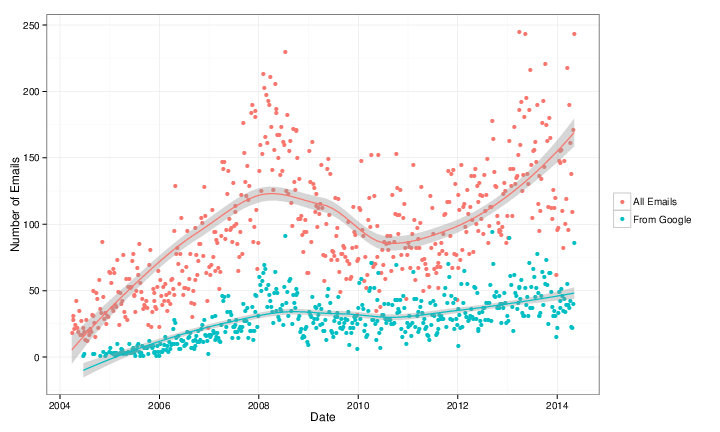
The following graph shows the numbers of emails in my personal inbox each week in red and the subset from Google in blue. Because the number of emails I receive week-to-week tends to vary quite a bit, I ve included a LOESS smoother which shows a moving average over several weeks.
From eyeballing the graph, the answer to seems to be that, although it varies, about a third of the email in my inbox comes from Google!
Keep in mind that this is all of my personal email and includes automatic and computer generated mail from banks and retailers, etc. Although it is true that Google doesn t have these messages, it suggests that the proportion of my truly personal email that comes via Google is probably much higher.
I would also like to know how much of the email I send goes to Google. I can do this by looking at emails in my inbox that I have replied to. This works if I am willing to assume that if I reply to an email sent from Google, it ends up back at Google. In some ways, doing this addresses the problem with the emails from retailers and banks since I am very unlikely to reply to those emails. In this sense, it also reflects a measure of more truly personal email.
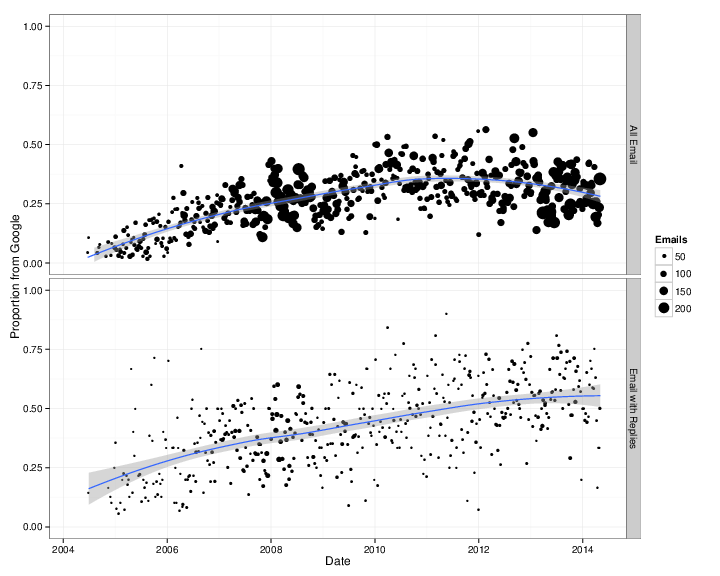
I ve broken down the proportions of emails I received that come from Google in the graph below for all email (top) and for emails I have replied to (bottom). In the graphs, the size of the dots represents the total number of emails counted to make that proportion. Once again, I ve included the LOESS moving average.
The answer is surprisingly large. Despite the fact that I spend hundreds of dollars a year and hours of work to host my own email server, Google has about half of my personal email! Last year, Google delivered 57% of the emails in my inbox that I replied to. They have delivered more than a third of all the email I ve replied to every year since 2006 and more than half since 2010. On the upside, there is some indication that the proportion is going down. So far this year, only 51% of the emails I ve replied to arrived from Google.
The numbers are higher than I imagined and reflect somewhat depressing news. They show how it s complicated to think about privacy and autonomy for communication between parties. I m not sure what to do except encourage others to consider, in the wake of the Snowden revelations and everything else, whether you really want Google to have all your email. And half of mine.
If you want to run the analysis on your own, you re welcome to the Python and R code I used to produce the numbers and graphs.
Oracle won their appeal regarding whether APIs are copyrightable. There'll be ongoing argument about whether Google's use of those APIs is fair use or not, and perhaps an appeal to the Supreme Court, but that's the new status quo. This will doubtless result in arguments over whether Oracle's implementation of Linux APIs in Solaris 10 was a violation of copyright or not (and presumably Google are currently checking whether they own any code that Oracle reimplemented), but that's not what I'm going to talk about today.
The end result is that no real taxi driver can afford a license: most of them have to rent their license from one of the speculators who bought the license. These fixed rental fees have to be paid every month whether the driver uses their car or not. Consequently, taxi drivers have cut back on other expenses, they are often criticised for failing to keep their cars clean and the industry as a whole is criticised due to the poor quality of drivers who don't even know their way around the city. The reason, of course, is simple: by the time some newly arrived immigrant has learnt his way around Melbourne he has also figured out that the economics of driving a taxi are not in his favor. Realizing there is no way to break even, they take other jobs instead.
It was originally speculated that the government review would dramatically reduce or abolish these speculative practices but ultimately lower license charges have only been used for the issue of 60 new licenses, barely 1% of the taxi fleet in the city today. Furthermore, the new licenses were only available to existing players in the industry.
Uber to the rescue?
Uber drove into the perfect storm as they launched their service in Melbourne in 2013.
Uber drivers get a significant benefit over their competitors in traditional taxis. In particular, as they don't have the fixed monthly payment to rent a taxi license, they don't have to work every day and can even take holidays or take time to clean the cars. These things may simultaneously benefit road safety and passenger comfort.
Meanwhile, those people who speculated on the old taxi licenses have tried hunger strikes and all kinds of other desperate tactics to defer the inevitable loss of their "investment".
The reality is that crowdsourcing is here to stay. Even if Uber is stopped by bullying and intimidation, the inefficiency of Melbourne's taxi system is plain for all to see and both customers and drivers will continue looking for alternatives. Other car-pooling apps based on barter or cost sharing will continue to find ways to operate even if the Uber model is prohibited.
It is interesting to note that the last great reform of Melbourne taxis, under Premier Jeff Kennett in the 1990s, simply resulted in a change of paint with the aim of making them look like those in New York City. Disruptive services like Uber (with their numerous technology-powered innovations to save time and money) appear to be doing far more to improve the lives of passengers and drivers.
The hidden cost
That said, large scale schemes like Uber do also have a down side for customer privacy. Hailing cabs in the street leaves no records of your movements. This new model, however, is leaving a very detailed trail of breadcrumbs that can be used for both marketing purposes or extracted (lawfully or otherwise) by some third party who wishes to monitor a particular customer's past or future movements. This is the trade-off that arises when we benefit from the efficiencies of any cloud-based service.
Take a sneak peek into the sophisticated engineering processes underway here at the Hanson Robotics Lab in sunny Hong Kong.
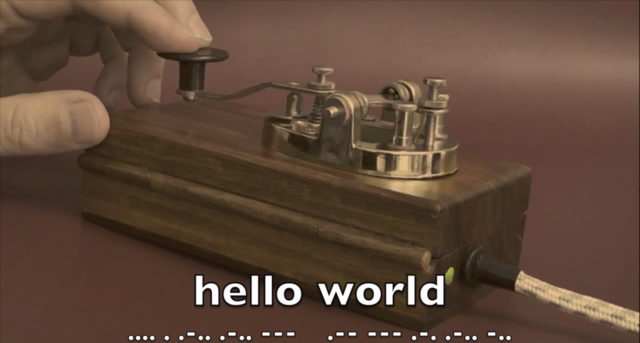
Hello, World!
I ve deployed my first instance of lenin to my backup VCS (lucifer.pault.ag), and it s going great.
(Screenshot of the first few instances for good measure)
I m excited to see how it develops!
The DC15 team met Saturday at the Heidelberg
International Youth Hostel to kick
off the organisation of DebConf15. While a handful of team members
unfortunately had to excuse themselves, 18 people showed up, and the spirit
level was high.
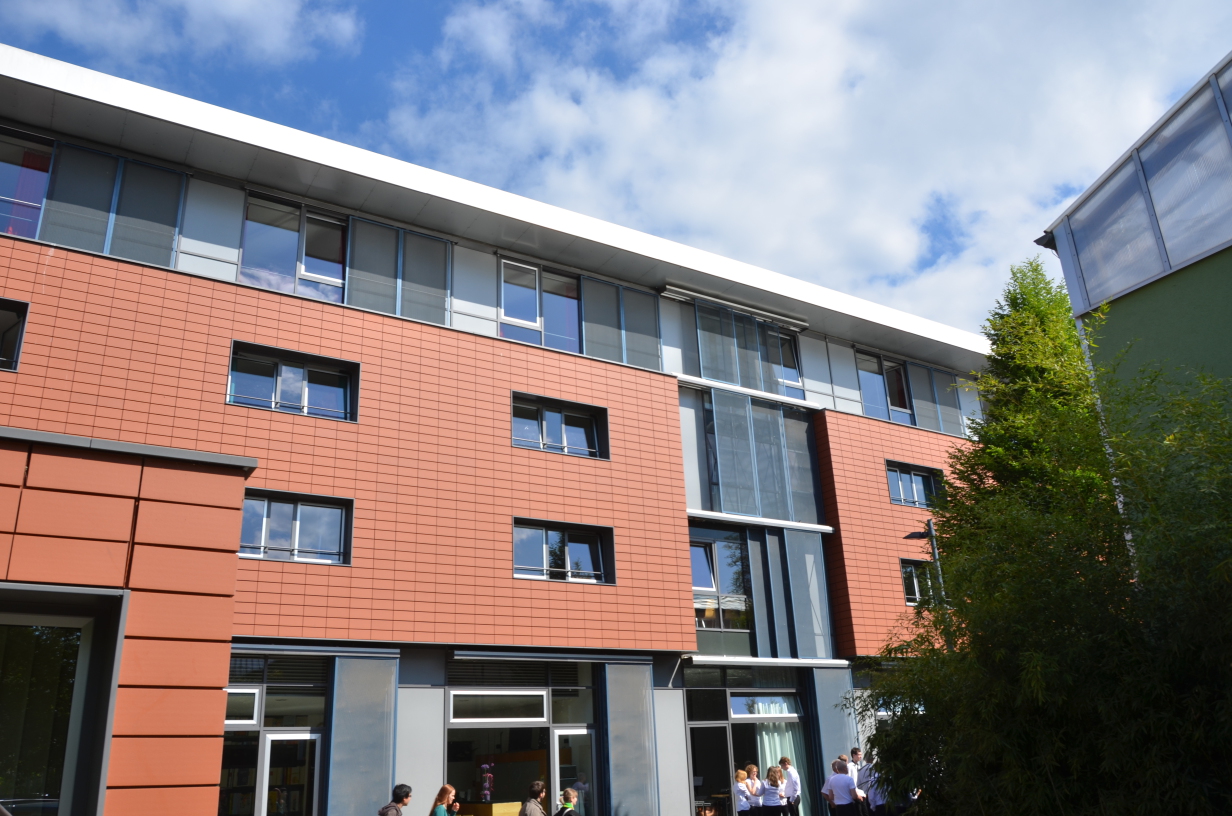
Self-contained in beautiful surroundings
The youth hostel is the expected venue for DebConf15, which is slated to take
place in August 2015. It sleeps more than 400 people, and it features two large
conference rooms. Several smaller rooms can be used for team meetings and
impromptu birds-of-a-feather sessions.
The venue is located
a little bit outside of Heidelberg s centre, right on the side of the
Neckar river, north of the Heidelberg Zoo, west of a university
campus, and south of a sports field.
Fantastic, child-friendly DebConf venue
The large cafeteria and the plentiful outside space usable for eating, working,
chatting and playing make it a fantastic venue for DebConf. And far away from
traffic, with a play area, space to run around, and the zoo next door, it s
very suitable to families with children, too.
Become part of the team!
If you are interested in being part of the organisation of our conference, we
welcome you on our mailing
list and look forward to your contributions! There is also the
#debconf15-germany IRC channel on irc.debian.org, and we
have a list of DC15
sub-teams to give you an overview. Feel free to add yourself, or just help
out and someone will add you.
(Photos by Michael Banck and Richard Hartmann, used under the terms of the CC
by-sa licence 3.0)
Recently I was wearing my Free Hugs shirt to different Free Software meetings, and I came up with the idea if we are advocating the Free in Software specificly, why not come up with Free Hugging Guidelines, too. So here they are, from now on considered to be named the RFHG.
Group Hug modificationand of course the
Free Hugs Campaignare great examples of what we consider Free.
Near the end of my internship with Simon Peyton Jones at MSR Cambridge I tackled the problem that foldl is not a good consumer in the sense of list fusion, as the resulting code compiles quite badly. I found an analysis that would allow GHC to safely do the required transformation to fix this in the common case; I dubbed this analysis Call Arity. The code is in GHC master (but not in 7.8), and I get to present at the Trends in Functional Programming conference in Soesterburg in 2 weeks. If you are curious you can either look at the code in CallArity.hs or the submitted paper, which yet has to go through the formal post-conference peer review in order to be officially accepted.
If you are going to TFP as well and want to get your GPG key signed, just talk to me there!
XBMC v13.0 Gotham
Debian has recently received a donation of 8 build machines from Marvell. The new machines come with Quad core MV78460 Armada XP CPU's, DDR3 DIMM slot so we can plug in more memory, and speedy sata ports. They replace the well served Marvell MV78200 based builders - ones that have been building debian armel since 2009. We are planning a more detailed announcement, but I'll provide a quick summary: The speed increase provided by MV78460 can viewed by comparing build times on selected builds since early april:

Qemu build times. We can now build Qemu in 2h instead of 16h -8x faster than before! Certainly a substantial improvement, so impressive kit from Marvell! But not all packages gain this amount of speedup:
webkitgtk build times. This example, webkitgtk, builds barely 3x faster. The explanation is found from debian/rules of webkitgkt: The old builders are single-core[1], so the regardless of parallel building, you can easily max out the cpu. New builders will use only 1 of 4 cores without parallel build support in debian/rules.
# Parallel builds are unstable, see #714072 and #722520
# ifneq (,$(filter parallel=%,$(DEB_BUILD_OPTIONS)))
# NUMJOBS = $(patsubst parallel=%,%,$(filter parallel=%,$(DEB_BUILD_OPTIONS)))
# MAKEARGUMENTS += -j$(NUMJOBS)
# endif
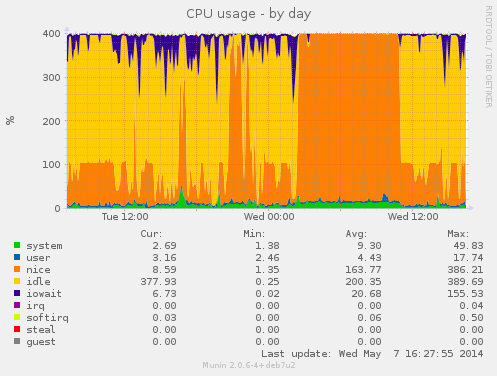
During this buildd cpu usage graph, we see most time only one CPU is consumed. So for fast package build times.. make sure your packages supports parallel building. For developers, abel.debian.org is porter machine with Armada XP. It has schroot's for both armel and armhf. set "DEB_BUILD_OPTIONS=parallel=4" and off you go. Finally I'd like to thank Thomas Petazzoni, Maen Suleiman, Hector Oron, Steve McIntyre, Adam Conrad and Jon Ward for making the upgrade happen. Meanwhile, we have unrelated trouble - a bunch of disks have broken within a few days apart. I take the warranty just run out... [1] only from Linux's point of view. - mv78200 has actually 2 cores, just not SMP or coherent. You could run an RTOS on the other core while you run Linux on the other.

Some brief notes, between tourist-moments.
Images/People/2014/ Images/People/2014/01/ Images/People/2014/01/03-Heidi/ RAW JPG thumbs Images/People/2014/01/13-Hanna/ RAW JPG thumbs ..On that basis I just dropped a .meta file in each directory with brief notes. e.g:
name = Jasmine XXX location = Leith, Edinburgh source = modelmayhem theme = umbrella, rain, water contact = 0774xxxxxxxThen I wrote a trivial perl script to find *.meta - allowing me to create IMAGE_123.CR2.meta too - and the job was done.
The Linux Security Summit is happening in Chicago August 18th and 19th, just before LinuxCon. Send us some presentation and topic proposals, and join the conversation with other like-minded people. :)
I d love to see what people have been working on, and what they d like to work on. Our general topics will hopefully include:
2014, Kees Cook. This work is licensed under a Creative Commons Attribution-ShareAlike 3.0 License.
As promised, today I would like to write a bit about the making of
The Hacker's Guide to Python. It has
been a very interesting experimentation, and I think it is worth sharing it
with you.
The inspiration
All started out at the beginning of August 2013. I was spending my summer,
as the rest of the year, hacking on OpenStack.
As years passed, I got more and more deeply involved in the various tools
that we either built or contributed to within the OpenStack community. And I
somehow got the feeling that my experience with Python, the way we used it
inside OpenStack and other applications during these last years was worth
sharing. Worth writing something bigger than a few blog posts.
The OpenStack project is doing code reviews, and therefore so did I for
almost two years. That inspired a lot of topics, like
the definitive guide to method decorators
that I wrote at the time I started the hacker's guide. Stumbling upon the
same mistakes or misunderstanding over and over is, somehow, inspiring.
I also stumbled upon Nathan Barry's blog and book
Authority which were very helpful to
get started and some sort of guideline.
All of that brought me enough ideas to start writing a book about Python
software development for people already familiar with the language.
The writing
The first thing I started to do is to list all the topics I wanted to write
about. The list turned out to have subjects that had no direct interest for
a practical guide. For example, on one hand, very few developers know in
details how metaclasses work, but on the other hand, I never had to write a
metaclass during these last years. That's the kind of subject I decided not
to write about, dropped all subjects that I felt were not going to help my
reader to be more productive. Even if they could be technically interesting.
pub 2048R/9C6C32C7 2014-02-16 Laura ARJONA REINA <larjona99@gmail.com> Laura ARJONA REINA <larjona@fsfe.org> Laura ARJONA REINA <laura.arjona@upm.es> Old key 0xE20474C3 no longer valid: lost secret key. (Clave antigua 0xE20474C4 ya no es v lida: clave secreta perdida.) Fingerprint=F29B A6D8 D1DC A30F 3E34 53DF 5CD1 FDE5 9C6C 32C7Please act as if it does not exist. The reason is that I cannot remember the passphrase of my master GPG key. This is why I didn t signed any of the keys of people that I met in Barcelona MiniDebconf. My geek self steem is a bit undermined, but feeling sorry for myself accomplishes nothing, so I think I will not hide problems and move on. I ll post about my new key soon. Long version The bad news The bad news are many. I generated my key in February 2014 (I generated my very first GPG Key in 2010, as an exercise, but never used it again, and in 2014 I couldn t remember the passphrase, and the paper where it was written, had got lost before). Anyway, February 2014, new GPG key. I followed the Howto in FSFE wiki in order to use my brand new FSFE SmartCard. I have to admit that I didn t understand very well how all this works, and it seems that my main mistake was to miss-understand that since I was using a smartcard, with a PIN and an Admin PIN, remembering passphrases was no longer required (only remembering the PINs). I was WRONG! PINs are for daily use with the subkeys of your card (for encryption, decryption, and signing stuff different than GPG keys), you still have the master key that is not in the card (but in a separate medium in a safe place), and for the master key we still use passphrase, and the master key is the one that allows signing keys from other people, and changing, revoking, adding subkeys, etc. So, it seems I used a random passphrase that I didn t write down and I could not remember, due to this terrible missunderstanding. Another bad news is that I didn t generate a revocation certificate (well in fact, I was going to generate just before signing the first key of another person, and then I realize that it was asking the passphrase, hence the problem). First I thought that it should ask the PIN and my smartcard setup was wrong or anything, but after reading and interchanging emails with other people more experienced than me, I realized that I should remember that passphrase. And I couldn t. So there are no revocation certificates :( Another bad news is that some (awesome) people already signed my key, and it will be difficult to meet again so they sign my new key. I was thinking about applying to the Debian new member process this summer, and I have not many opportunities to meet Debian people in person, so I gathered quite a lot signs last March in MiniDebConf Barcelona. Now I m again at the starting point (well, this is perfect excuse to try to join a Debian event soon :) I don t know how I would manage to do it, but I ll try!). The good news (Always look at the bright side of life ) The main good news is that I didn t used the GPG key for signing/encrypting important stuff: I just interchanged some encrypted mail as test with friends, and signed some mails sent to public mailing lists (for signing mails I was using the smartcard PIN so I didn t notiece the problem). The other main good news is that my key is not compromised (well, you can never be sure, but I think so). I cannot revoke it but I m quite sure nothing important depends on that key. Other good news is that I have read a lot about how GPG works and how the smartcard works, keys and subkeys and all this stuff, and I think now I understand everything quite better. I have learned (and also tried) tools as nasty, John The Ripper and rephrase to try to recover the passphrase. I didn t recover it, but at least I know that all those (free software) tools exist and how to use them :) And I have learned the lesson: to be extremely careful, test that everything works (not just try one or two things, test everything) and to not leave work for later (and for example, generate the revocation certificates just right after the keys). Next steps I ll send a message to all the friends that signed or downloaded my old GPG key apologysing and pointing to this blog post so they learn the details about why I create a new key. I ll take this opportunity to download and use the Tails (The Agnostic Incognito System, a Debian derivative which is a live system and is focused in protecting privacy and anonymity of the user). Tails will be my safe, network disconnected environment to generate the new keys and do the sensible tasks with them. I think this time I will create my main key 4096-bit long (since now I understand that the main key is not stored in the card) and the subkeys can be 2048-bit or 3072 to fit in the smarcard. Well, hands on! I ll write another blog post when my new GPG keys are ready. I hope third time s the charm! Note: Thank you to all the people that gave me advice and support (knowledge, links, moral support) about this issue. You know who you are!
There is a strange bug in Planet Debian I am seeing since
I joined. It is rather minor, but since it is an accessibility
bug, I'd like to mention it here. I have written to
the Planet Debian maintainers, and was told to figure it out myself.
This is a pattern, accessibility is considered wishlist, apparently.
And the affected people are supposed to fix it on their own.
It is better if I don't say anything more about that attitude.
hackergotchi forAnd for those where it works, it looks like:
hackergotchi for Dirk EddelbuettelStrange, isn't it? If you have any idea why this might be happening, let me know, or even better, tell Planet Debian maintainers how to fix it. P.S.: Package planet-venus says it is a rewrite of Planet, and Planet can be found in Debian as well. I don't see it in unstable, maybe I am blind? Or has it been removed recently? If so, the package description of planet-venus is wrong.
I have been looking for an App like this since I got my first iOS device in
december 2011. Finally, it is here! A single-player (bot-driven) poker
app for iOS, THETA Poker Pro, fully accessible and usable with VoiceOver.
AppleVis has a review.
It doesn't happen very often, but App programmers in the iOS Universe
do indeed sometimes think about Accessibility support, and the APIs
provided by Apple are useful enough to allow programmers to write
very accessible apps. You can say about Apple whatever you want,
currently, it is the company providing the best accessibility support on the market.
Why? Because they made accessibility a first-class citizen of their platform(s).
This is where policy helps. If you can dictate top-down that
you support people with disabilities, things actually
start to happen. If you have to ask, hope, and wait, like it is with
free software, things do not really progress as fast as the users need it.
Back to THETA Poker Pro: The default configuration is already very useable with VoiceOver.
However, if you want the cards placed on the board announced to you, so that
you do not have to discover them manually by touch, you can enable the
"Card Announcement" item in the Options menu. You can also set message delay
a bit slower, such that all messages are actually fully spoken and not cut off sometimes.
With these two settings adjusted, and maybe "Animation" set to "Very fast",
the game feels extremely nice. There is actually nothing I would
want to change, which does not happen very often when I test
a program for its accessibility.
With these settings changed, game play is very smooth with VoiceOver, you basically
just have to tap your cards to check, tap the deck to fold, or tap
your chips to raise. Very simple, and these three "buttons" are on
the bottom of the screen, so rather easy and quick to find.
All other activity is automatically announced by VoiceOver.
I have played a few hundred hands already with this App. It is a wonderful
way to pass time. For instance, I don't like to go to my
doctor, because I usually wait up to two or three hours. I had to pay
her a visit on monday. While waiting, I played "a few" hands, and
suddenly, I was already called in. When I came out again, I checked the
time and was rather surprised that yes, I have waited two hours again,
but this time, I didn't notice! :-)
Special thanks go to the author(s) of this app.
It is a good example of an App that was not specially made for the blind,
but which feels like it was. Thanks, you've made my week!
I guess I ve had them around for a while Maybe I should clean these up
cjac@ns1:~$ ls /lib/modules/ 2.6.18-4-xen-amd64colliertech.fw+0 2.6.32-5-amd64 2.6.24-19-xen 3.2.0-4-amd64 cjac@ns2:~$ ls /lib/modules/ 2.6.18-4-xen-amd64colliertech.fw+0 2.6.24-19-xen 2.6.32-5-amd64 cjac@ns2:~$ sudo rsync -aue ssh ns1:/lib/modules/ uname -r /lib/modulesI remember editing the .config file for that kernel and building it on my first ever 64-bit system back in 2004 or so.
A bug-fix release 0.3.2.1.2 is of RcppEigen
is now on CRAN and in
Debian. It contains a short upstream
patch by Gaek Guennebaud for the UBSAN warnings that were flagged at CRAN
(from a rather harmless cpu-id comparison).
The NEWS entry follows.
Changes in RcppEigen version 0.3.2.1.2 (2014-05-05)Courtesy of CRANberries, there are diffstat reports for the most recent release. Questions, comments etc about RcppEigen should go to the rcpp-devel mailing list off the R-Forge page.
- Applied upstream patch to not trigger g++ UBSAN warning on the cpu id comparison, with thanks to Gael Guennebaud for the patch
This post by Dirk Eddelbuettel originated on his Thinking inside the box blog. Please report excessive re-aggregation in third-party for-profit settings.
Next.