Search Results: "ag"

10 October 2013

Russ Allbery: Review: 2312

Review: 2312, by Kim Stanley Robinson
Publisher: Orbit
Copyright: 2012
ISBN: 0-316-19280-5
Format: Kindle
Pages: 563
Swan Er Hong is a native of Mercury, granddaughter of one of the most influential women in the solar system. Alex, known as the Lion of Mercury, has just died as the story opens, and Swan is mourning. But she's also discovering that something else has been going on, something that Alex had not confided in her. Something that involves an inspector from the asteroids, a scientist from Titan, and a message Alex left in the event of her death, asking Swan to convey something personally to another scientist on Io. And then Mercury is attacked and the situation becomes much more complicated. 2312 is, like most Robinson novels, built on top of monumental world-building. The date is given away by the title; the setting is a solar system full of terraforming, habitats, and explosive human colonization. There are human settlements on every world that could possibly sustain them, including a terraformed Mars and a vast in-progress terraforming project on Venus. Mercury, Song's home, supports the city known as Terminator, a shielded habitat that travels around the planet on rails, pushed forward by the thermal expansion of metal at sunrise. Humans have scattered across the solar system and changed everything they've touched, even the asteroids. Many of those have been repurposed as long-haul shuttles: self-contained habitats on carefully-designed routes on which people live for months or years until they get to their destinations. Parts of this book are gorgeous. One of Robinson's strengths is creating images of the vastness of space, science, and human endeavor that feel plausible and inspiring at the same time. The setting of 2312 frees him to go wild with mega construction projects, and he takes full advantage. Parts of the book inspire the same sense of awe as the Hoover Dam or the Great Wall of China, transplanted into space and backed with neat scientific ideas to ponder. (Even if the more skeptical will note certain human habitation hazards, such as prolonged weightlessness and radiation, are mostly hand-waved away.) Unusually for a Robinson novel, 2312 also features an interesting and vibrant protagonist. Usually I can barely remember Robinson's protagonists five minutes after I finish the book, but Swan is so impulsive, erratic, and emotionally intense that I doubt I'll forget her. Her past is stuffed with outrageous risks and intense creativity: having songbird neurons transplanted into her brain, ingesting extraterrestrial bacteria, designing habitats in the asteroid belt, and creating art on the plains of Mercury. As the story gets underway, she meets the oversized and mellow Wahram; at first, she finds him boring, but then they're thrown together by one of the best set pieces of the book, and both they and the reader discover they work well together. Wahram serves as a straight man and as a stand-in for the reader's opinion, showing Swan all the more clearly in contrast. All this sounds quite promising. Unfortunately, what makes 2312 an ambitious failure rather than an excellent story is the story part. Robinson has built an amazing world, but he doesn't seem to know what to do with it. His economy, at least outside of Earth (and more on that in a moment), is essentially post-scarcity. Few of the characters we meet seem to have any concept of fiscal or practical limitation. They head across the solar system on a moment's notice, take vacations in habitats, or head to favorite spots for the view. It felt like Robinson was trying to write a Culture story. Unlike Banks, however, he struggles with generating a plot. 2312 is, in structure, a murder mystery. The characters witness a crime, survive it, and then intend to investigate it, and the crime appears to grow and link to fault lines in their society. This could have worked, but it has two problems: their society is only barely coherent enough for the reader to perceive the potential fault lines, and Robinson seems to have no idea how to construct a mystery plot. There is no sense of coherence to Swan and Wahram's approach, no sense of a gathering of clues, and very little sense of drama. All of the plot revelations are either dropped in Swan's lap by another character at a convenient moment or generated by Swan refusing to take the plot of the book seriously. The characters do essentially no meaningful investigation on-camera and show almost no investment in the outcome of the plot. When the climax comes, it's all weirdly forgettable. There are also large sections of the book that appear to have nothing to do with the rest of the plot, and that's where the unfortunate interval on Earth comes in. Robinson takes advantage of the scenes on Earth to do a bit of alienation and shows how foreign and strange and stifling Earth feels to someone who grew up outside of its atmosphere. Parts of this work, but he puts the plot on hold to do it. And parts of it do not work at all. The most glaring example is Swan and Wahram's bizarre bit of attempted charity in Africa, which comes across as stunningly high-handed and arrogant. This could be in character, particularly for Swan (who is not long on empathy), but, if so, the book doesn't signal to the reader that it should be read that way. Instead, there are some side (or snide) comments that seem to indicate Robinson knows nothing about the economic arc of Africa from the past twenty years. And when their absurd, botched, condescending charity plan fails for all the obvious reasons, the characters, and apparently the novel, throw up their hands and write Earth off as a stagnant lost cause that can't accept the imposition of a good idea and go back to the plot, never apparently caring about Earth again. Almost as frustrating is the way that these interludes are tied back into the story, which is usually through Swan getting ridiculously lucky on her random encounter rolls. It felt like whenever Robinson needed to make progress in the plot, Swan would just accidentally run into exactly the right person or situation to bring up the next plot point or to have some investigation make sense. (Not that Swan usually figured this out. Normally, the inspector explains it to her.) The author's finger was planted so firmly on the scales that it destroyed my suspension of disbelief and made a mockery of the idea that the characters were actually investigating anything. 2312 is built around a skeleton of a plot, but the lack of engagement with it, the lack of tension and emotion, the way the next developments are generally narrated to the protagonists and the reader, and the repeated use of random encounters to steer it left me without much reason to care. Robinson tries a few twists, but since the story never felt committed to its plot anyway, those twists feel less like planned complications and more like another random veer in the road. It didn't help that the final outcome was more prosaic and forgettable than the book had been implying it would be. There is a lot to like here. I'm very pleased to see Robinson finally write a memorable protagonist, and he's very good at both world-building and set pieces. But it needed a plot, and it needed a more coherent and complete cultural backdrop for its characters. Without both, it fell back into the typical Robinson trap: gorgeous moments separated by a whole lot of boring, and an overall impression of a construction tour rather than a story. There are bits of it I loved and still remember, particularly Song and Wahram in the tunnels of Mercury (which is possibly the best extended characterization Robinson has ever written). But the book as a whole is a mess, and I can't recommend wading through it for the good parts. Rating: 5 out of 10

Matthew Palmer: How *not* to respond to interview feedback

Seen at $DAYJOB, from a candidate we rejected due to a pretty poor showing in a phone interview:
May I suggest that your company puts in place a more effective way of interviewing potential candidates. Please pass this to comment to your senior management so they may look at improving this process.
I m not sure I ve ever seen such a clear confirmation that our interviewing process is working as intended. While we hire for smart people who don t meekly accept the status quo, we d prefer it if our staff don t mouth off when things don t go their way. Customers tend to frown on such outbursts.

Russ Allbery: One more haul

Just a few more recently-released books that I had to pick up. Sheila Bair Bull by the Horns (non-fiction)
Elizabeth Bear Book of Iron (sff)
Steven Brust & Skyler White The Incrementalists (sff)
J.M. Coetzee The Childhood of Jesus (mainstream)
Elizabeth Wein Rose Under Fire (mainstream)
Walter Jon Williams Knight Moves (sff) Time to get back into the reading habit. That's the plan for the next couple of weeks.

9 October 2013

John Goerzen: Two Kittens

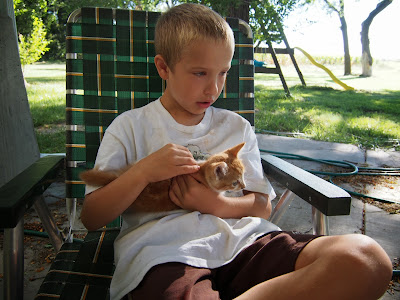
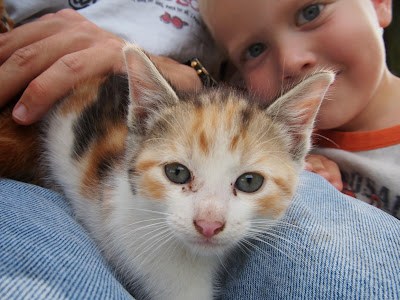
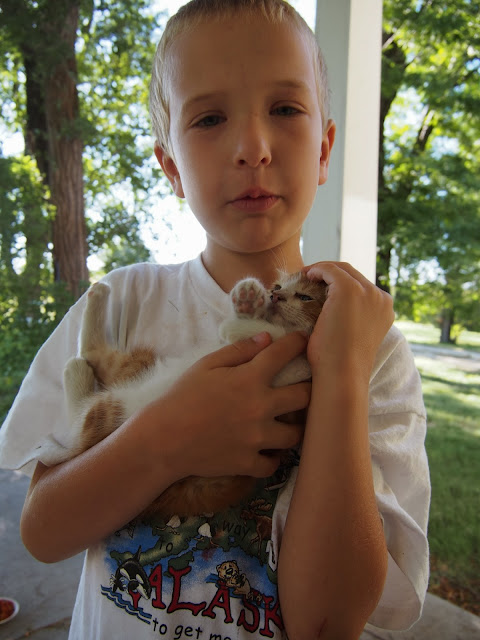
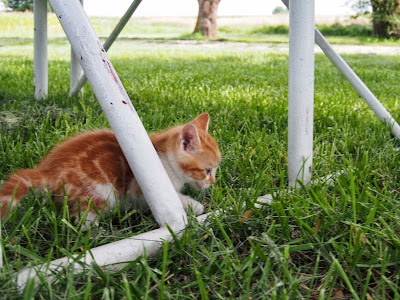
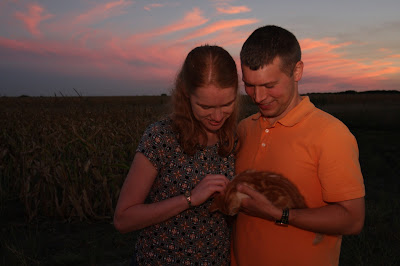
Almost every time he got off the bus for the past month and a half, Jacob started his afternoon in the same way. Before toys, before his trains and his toy bus, before anything indoors, he went for our cats. Here he is, cradling his favorite, Tigger: Laura and I both grew up around cats. We had been talking about kittens, and shortly after we got engaged, one of my relatives offered us some free kittens. We went to his place one evening and selected two of them one calico and one tiger-colored. Since what is now my place will soon be our place, they came to live with me. Our cats were one of the first things we did to prepare for our lives together. Oliver wanted to name them some rather impractical sentence-long names ( The Cat Who Always Likes To Run ), so Laura and I suggested some names from one of their favorite books: Tigger and Roo. They both liked the names, but Oliver thought they should be called Tigger the Digger and Roo the Runner . Never mind that they were just 6 weeks old at the time, and not really old enough to either dig or run. Here s Oliver with Roo, the day after the kittens arrived here. I have always had outside cats, both because I m allergic to cats so I need them to be outside, and because they sometimes literally quiver with joy of being outdoors. Tigger and Roo often chased insects, wrestled with each other, ran up (and slowly came back down) trees, and just loved the outside. Sometimes, I have taken my laptop and wireless headset and work from the back porch. The kittens climb up my jeans, inspect the laptop, and once Roo even fell asleep on my lap at one of those times. Jacob has been particularly attached to Tigger, calling him my very best friend. When Jacob picks him up after school, Tigger often purrs while cradled in Jacob s arms, and Jacob comments that Tigger loves me. Oh dad, he knows I am his friend! The kittens have been growing, and becoming more and more comfortable with their home in the country. Whenever I go outside, it isn t long before there are two energetic kittens near my feet, running back and forth, sometimes being very difficult to avoid stepping on. I call and I see little heads looking at me, from up in a tree, or peeking out from the grain elevator door, or from under the grill. They stare for just a second, and then start running, sometimes comically crashing into something in their haste. Yesterday when I went to give them food, I called and no cats came. I was concerned, and walked around the yard, but at some point either they come or they don t. Yesterday afternoon, just after the bus dropped off Jacob, I discovered Tigger on the ground, motionless. Once Jacob was in the house, I went to investigate, and found Tigger was dead. As I was moving his body, I saw Roo was dead, too. Both apparently from some sort of sudden physical injury a bit mysterious, because neither of them were at a place where they had ever gone before. While all this was happening, I had to also think about how I was going to tell the boys about this. I tried to minimize what he could see, Jacob had caught an unavoidable glimpse of Tigger as we were walking back from the bus, but didn t know exactly what had happened. He waited in the house, and when I came back, asked me if Tigger was dead. I said he was. Jacob started crying, saying, Oh Dad, I am so sad , and reached up for a hug. I picked him up and held him, then sat down on the couch and let him curl up on my lap. I could quite honestly let him know he wasn t alone, telling him I am sad, too. Oliver arrived not long after, and he too was sad, though not as much as Jacob. Both boys pretty soon wanted to see them. I decided this was important for them for closure, and to understand, so while they waited in the house, I went back out to arrange the kittens to hide their faces, the part that looks most unnatural after they die. The boys and I walked out to where I put them, then I carried both of them the last few feet. We stood a little ways back close enough to see who was there, far enough to not get too much detail and they were both sniffling. I tried to put voice to the occasion, saying, Goodbye, Tigger and Roo. We love you. Oliver asked if they could hear us. I said No, but I told them what I felt like anyway. Jacob, through tears, said, Dad, maybe they are in heaven now. We went back inside. Jacob said, Oh dad, I am so sad. This is the saddest day of my life. My heart is breaking. Hearing a 7-year-old say that isn t exactly easy for a dad. Pretty soon he was thinking of sort of comfort activities to do, saying I think I would feel better if we did So they decided to watch a favorite TV program. Jacob asked if Laura knew yet, and when I said no, he got his take-charge voice and said, Dad, you will start the TV show for us. While we are watching, you will send Laura an email to tell her about Tigger and Roo. OK? What could I say, it wasn t a bad idea. Pretty soon both boys were talking and laughing. It was Big Truck Night last night, at a town about half an hour away. It s an annual event we were already planning to attend, where all sorts of Big Trucks firetrucks, school bus, combine, bucket truck, cement truck, etc show up and are open for kids to climb in and explore. It s always a highlight for them. They played and sang happily as we drove, excitedly opened and closed the big door on the school bus and yelled All Aboard! from the top of the combine. We ate dinner, and drove back home. When we got home, Jacob mentioned the cats again, in a sort of matter-of-fact way, and also wanted to make sure he knew Laura had got the message. A person never wakes up expecting to have to dump a bowl of un-eaten cat food, or to give an impromptu cat funeral for little boys. As it was happening, I wished they hadn t been around right then. But in retrospect, I am glad they were. They had been part of life for those kittens, and it is only right that they could be included in being part of death. They got visual closure this way, and will never wonder if the cats are coming back someday. They had a chance to say goodbye. Here is how I remember the kittens.

Raphael Geissert: A bashism a week: maths

You've probably already done some basic maths in shell scripts, but do you know what else you can actually do?

Pick at least 4 operations that you can do in bashisms-free shell scripts:

$((n+1))
$((n>8))
$((n^4))
$((--n))
$((n*=5))
$((n++))
$((n==1?2:3))

The POSIX:2001 standard defines the arithmetic expansion requirements, which leads us to selecting all of the above operations except two:

$((--n))
$((n++))

"--" and "++" are not required to be implemented, and in some cases they may lead to unexpected results, such as the following:


$ bash -c 'n=1; echo $((++n))'
2
$ dash -c 'n=1; echo $((++n))'
1


Remember, if you rely on any non-standard behaviour or feature make sure you document it and, if feasible, check for it at run-time.

8 October 2013

Daniel Kahn Gillmor: Unaccountable surveillance is wrong

As I mentioned earlier, the information in the documents released by Edward Snowden show a clear pattern of corporate and government abuse of the information networks that are now deeply intertwined with the lives of many people all over the world. Surveillance is a power dynamic where the party doing the spying has power over the party being surveilled. The surveillance state that results when one party has "Global Cryptologic Dominance" is a seriously bad outcome. The old saw goes "power corrupts, and absolute power corrupts absolutely". In this case, the stated goal of my government appears to be absolute power in this domain, with no constraint on the inevitable corruption. If you are a supporter of any sort of a just social contract (e.g. International Principles on the Application of Human Rights to Communications Surveillance), the situation should be deeply disturbing. One of the major sub-threads in this discussion is how the NSA and their allies have actively tampered with and weakened the cryptographic infrastructure that everyone relies on for authenticated and confidential communications on the 'net. This kind of malicious work puts everyone's communication at risk, not only those people who the NSA counts among their "targets" (and the NSA's "target" selection methods are themselves fraught with serious problems). The US government is supposed to take pride in the checks and balances that keep absolute power out of any one particular branch. One of the latest attempts to simulate "checks and balances" was the President's creation of a "Review Group" to oversee the current malefactors. The review group then asked for public comment. A group of technologists (including myself) submitted a comment demanding that the review group provide concrete technical details to independent technologists. Without knowing the specifics of how the various surveillance mechanisms operate, the public in general can't make informed assessments about what they should consider to be personally safe. And lack of detailed technical knowledge also makes it much harder to mount an effective political or legal opposition to the global surveillance state (e.g. consider the terrible Clapper v. Amnesty International decision, where plaintiffs were denied standing to sue the Director of National Intelligence because they could not demonstrate that they were being surveilled). It's also worth noting that the advocates for global surveillance do not themselves want to be surveilled, and that (for example) the NSA has tried to obscure as much of their operations as possible, by over-classifying documents, and making spurious claims of "national security". This is where the surveillance power dynamic is most baldly in play, and many parts of the US government intelligence and military apparatus has a long history of acting in bad faith to obscure its activities. The people who have been operating these surveillance systems should be ashamed of their work, and those who have been overseeing the operation of these systems should be ashamed of themselves. We need to better understand the scope of the damage done to our global infrastructure so we can repair it if we have any hope of avoiding a complete surveillance state in the future. Getting the technical details of these compromises in the hands of the public is one step on the path toward a healthier society. PostscriptLest I be accused of optimism, let me make clear that fixing the technical harms is necessary, but not sufficient; even if our technical infrastructure had not been deliberately damaged, or if we manage to repair it and stop people from damaging it again, far too many people still regularly accept ubiquitous private (corporate) surveillance. Private surveillance organizations (like Facebook and Google) are too often in a position where their business interests are at odds with their users' interests, and powerful adversaries can use a surveillance organization as a lever against weaker parties. But helping people to improve their own data sovereignty and to avoid subjecting their friends and allies to private surveillance is a discussion for a separate post, i think.Tags: cryptography, nsa

Thomas Goirand: OpenStack 2013.2~rc1, aka Havana, fully available in Debian Experimental

Announcement After a very long work, over the course of 4 months, I have finished packaging the first RC1 of OpenStack. This comes on time, just 9 days before the official Havana release. Please do try this RC1 before the official 2013.2, code name Havana, is released, and hopefully uploaded to Debian. All of the packages are available from Debian Experimental, keeping Grizzly in Sid. However, there is also some private repositories that I maintain, holding Wheezy backports: deb http://havana.pkgs.enovance.com/debian havana main deb http://archive.gplhost.com/debian havana-backports main The first repository holds the packages maintained within the Alioth group. These are built directly from my Jenkins machine, on each git push. The 2nd repository is holding backports from Sid to Wheezy for the packages that I don t actively maintain (though a lot of them are in the Python module team, in which I do a lot of packaging and updates as well). A few numbers A few numbers about this now. I had to work on 145 source packages: at least backport them to Wheezy, and push them in the GPLHost archive repository above. This generates 360 binary packages. Out of these, I maintain 77 source packages within the Alioth OpenStack group, generating 209 .deb files. That s a lot of stuff to deal with (and I feel sometimes a bit dizzy about it). While OpenStack is a big jigsaw puzzle to solve for the users, it is even more for someone who has to deal with all the (sometimes buried in the the code) Python dependencies. I hope others will come and join me in this packaging effort, since over the time, there s more and more work to be done, as the project grows. Note that most of the work is unfortunately done on packaging (and updating) the Python dependencies, working on the packages themselves is done last, at the end of the cycle. Other things not packaged (yet) Before the release (and the forthcoming Hongkong summit on the 5th of November), I hope to be able to finish packaging TripleO. TripleO is in fact OpenStack on OpenStack, which works with nova-baremetal. I have no idea how to test or install this, though it sounds like a lot of fun. There are 6 source packages that need to be done. Also, pending on the FTP masters NEW queue, is Trove: Database as a Service. I hope this one can get through soon. There is, also, Marconi, which is an incubated project for a new message queuing service, which probably will replace RabbitMQ (I m not sure yet what it does, and I will be happy to hear about it at the summit). Lastly, there s Ironic, which will at some point, replace nova-baremetal. That is, it does cloud computing over bare metal, without virtualization. All of these new projects are still in an incubation stage, and are not part of the official release yet. Though, I have learned over the course of this past year, that with OpenStack, it s never early enough to start the packaging work. Thanks to my sponsor! Please note that all of this wouldn t be possible without eNovance sponsoring my packaging work. A big up to all of them for supporting and loving Debian! You guys rox. Also a special thanks to Mehdi / Sileth, for his work testing everything with the Tempest functional tests and the CI platform.

Thomas Goirand: My old 1024 bits key is dead, please use 0xAC6B43FE

-----BEGIN PGP SIGNED MESSAGE-----
Hash: SHA256
Hi,
I am not using my old GPG key, 0x98EF9A49 anymore. My new key, using
4096 SHA2 256,
with fingerprint:
A0B1 A9F3 5089 5613 0E7A  425C D416 AD15 AC6B 43FE
has replaced the old one in the Debian keyring. Please don't encrypt
message to me using the old key anymore.
Since the idea is that we shouldn't trust 1024 bits keys anymore, I'm
not signing this message with the old key, but only with the new one,
which has gathered enough signatures from Debian Developers (more than a
dozen).
Thomas Goirand (zigo)
-----BEGIN PGP SIGNATURE-----
Version: GnuPG v1.4.12 (GNU/Linux)
iQIcBAEBCAAGBQJSVC02AAoJENQWrRWsa0P+3wAP/i2ORGgXMoQVtjoUNX+x/Ovz
yoNSLztmih4pOLw9+qHJfM+OkBKUPwrkyjgBWkwD2IxoM2WRgNZaY5q/jBEaMVgq
psegqAm99zkX0XJTIYfqwOZFA1JLWMi1uLJQO71j0tkJWPzBSa6Jhai81X89HKgq
PqQXver+WbORHkYGIWwBvwj+VbPZ+ssY7sjbdWTaiMcaYjzLQR4s994FOFfTWH8G
5zLdwj+lD/+tBH90qcB9ETlbSE1WG4zBwz5f4++FcPYVUfBPosE/hcyhIp6p3SPK
8F6B51pUvqwRe52unZcoA30gEtlz+VNHGQ3yF3T1/HPlfkyysAypnZOw0md6CFv8
oIgsT+JBXVavfxxAJtemogyAQ/DPBEGuYmr72SSav+05BluBcK8Oevt3tIKnf7Q5
lPTs7lxGBKI0kSxKttm+JcDNkm70+Olh6bwh2KUPBSyVw0Sf6fmQdJt97tC4q7ky
945l42IGTOSY0rqdmOgCRu8Q5W1Ela9EDZN2jPmPu4P6nzqIRHUw3gS+YBeF1i+H
/2jw4yXSXSYQ+fVWJqNb5R2raR37ytNWcZvZvt4gDxBWRqnaK+UTN6tdF323HKmr
V/67+ewIhFtH6a9W9mPakyfiHqoK6QOyOhdjQIzL+g26QMrjJdOEWkqzvuIboGsw
OnyYVaKsZSFoKBs0kOFw
=qjaO
-----END PGP SIGNATURE-----

Petter Reinholdtsen: Skolelinux / Debian Edu 7.1 install and overview video from Marcelo Salvador

The other day I was pleased and surprised to discover that Marcelo Salvador had published a video on Youtube showing how to install the standalone Debian Edu / Skolelinux profile. This is the profile intended for use at home or on laptops that should not be integrated into the provided network services (no central home directory, no Kerberos / LDAP directory etc, in other word a single user machine). The result is 11 minutes long, and show some user applications (seem to be rather randomly picked). Missed a few of my favorites like celestia, planets and chromium showing the Zygote Body 3D model of the human body, but I guess he did not know about those or find other programs more interesting. :) And the video do not show the advantages I believe is one of the most valuable featuers in Debian Edu, its central school server making it possible to run hundreds of computers without hard drives by installing one central LTSP server. Anyway, check out the video, embedded below and linked to above: Are there other nice videos demonstrating Skolelinux? Please let me know. :)

Gergely Nagy: Onto the margin of a summer of code

Just as last year, BalaBit applied to become a mentoring organisation for this year's Google Summer of Code, but like the year before, were not accepted. Instead, the openSUSE project was kind enough to give us two slots of their own, similarly to the year before - we are very thankful for this, and this year, both of the projects we took were closed successfully! So much so, that one of them was already merged into syslog-ng 3.5.0beta2, and the other one is being prepared for getting merged into the Incubator. I also helped out a little with Clojure & Leiningen packaging, although my contributions there were minimal at best.On the whole, I really liked this year's programme, our students accomplished a lot, and the whole summer was a great experience in itself, I learned a lot about mentoring, and about working with other people, people who are very new to the codebase they're working on. I would like to summarise what I learned and observed this year, in the hopes that others may find them useful too.This year, we set fairly ambitious goals for our students: they had to write a Redis and a MySQL destination, both of which presented interesting challenges to the students. None of them had prior experience with the syslog-ng source code, and their programming knowledge was mostly in C#, not plain old C which syslog-ng is written in. They also had to dabble a bit in the bowels of our overly complex configure.ac and a few Makefiles. Wasn't an easy task.In the beginning, we tasked the students to write proof of concept code, to get familiar with the libraries they will need to use - no syslog-ng involved at this point. This sounded like a good idea on paper, but without clear goals and milestones, a lot of time was spent on this task, and the students ran into a few dead-ends which could have been avoided, if we, the mentors, were more careful. This resulted in a reasonably poor first term, frustration and caused many a sleepless nights. We had to change our approach if we wanted to see the projects succeed.So we sat down with the students, and took one big leap: in person, we explained some of the internals of syslog-ng, did code reviews with them, and so on. But the best thing we did was what my colleague (and the main mentor), Viktor Tusa, came up with: we wrote a test script, that started syslog-ng, configured it, and ran tests against it. Students had to make their code pass the test by the next in-person meeting. This helped tremendously, and increased the speed they worked at by an order of magnitude at least. We kept developing the test script further, and so did the projects improve.ConclusionsThere are a couple of conclusions I arrived at as the programme concluded, things we (or other mentors, as I plan to participate as a student next year) will need to improve upon in the coming years.

Raphael Geissert: Faster, more stable and new opportunities

A new version of the code behind http.debian.net was deployed a few days ago. It has proved to be far more stable, faster, and scalable compared to the previous mod_perl-based deployment.

There were a couple of glitches during the earlier roll-out for IPv6 users, fixed thanks to the reports by Cyril Brulebois, Michael Stapelberg and Robert Drake.

What's behind?
The redirector is now a plack application (with no middlewere) running under the Starman server with an apache fronted. Requests are processed faster than before and there mod_perl-induced system overload is finally gone.

The redirector is now easier to test and develop. Deploying the live instance is not yet fully streamlined, but it has seen a lot of improvement. Some important changes to the way the redirector works are already on their way to see the light and I am going to be announcing them when they do. Fork the repository and hack a few changes, contributions are welcome :)

It's probably time to move it under debian.org, and finish making it the default everywhere. It's even made its way into the installation manual.

Russ Allbery: Review: Grimspace

Review: Grimspace, by Ann Aguirre
Series: Sirantha Jax #1
Publisher: Ace
Copyright: March 2008
ISBN: 0-441-01599-9
Format: Mass market
Pages: 312
Sirantha Jax is a jumper: a person with the rare genetic ability to jump spaceships through the shortcut dimension of grimspace. It's a science fiction idea with a long pedigree. It creates a separate in-group for the characters to belong to, a society with its own rules, and sets up tension with the rest of the institutions of the world. In Aguirre's version, jumpers can provide the transition but direction in grimspace has to be done by a pilot, and the jumper and the pilot develop a deep psychic bond. Jax had been jumping with her husband piloting, but on their last trip their ship crashed, killing everyone on board except her. As Grimspace opens, Jax is in a treatment facility that's much more like a prison. In theory, they're trying to figure out whether she's still able to (and safe to allow to) jump. In practice, something quite a bit more sinister is going on, a fact that the reader senses early but only learns more about after Jax is helped to escape. Scarred, deeply depressed, and nearly suicidal, she's pulled into the subversive plans of a small ship of renegades who are trying to break open the Corp monopoly on grimspace travel and their tight hold over every jumper. But she's not sure whether she trusts them, or whether she cares enough about their crusade to truly join in. Grimspace follows well-trod SF paths of special cadres of pilots and navigators, lawless corners of space with local warlords, and rebellion against smothering centralization, but its first-person protagonist and point of view have more in common with urban fantasy. It's written in first-person and, at times, nearly stream of consciousness from Jax's perspective, and Jax displays plenty of profanity, acidic commentary, and emotional angst. If her special ability were shapeshifting or magic instead of jumping spaceships, one could easily see her as the typical burned-out urban fantasy detective. I liked that. It's a fun point of view when it's written well, and it felt fresh when applied to a science fiction background instead of the more typical fantasy. That said, Grimspace has a rather rough start. Jax isn't sure what's going on at first and also isn't sure she cares, and I thought that carried over to the reader's experience. The first section of the book is rough and jagged, with staccato bursts of character introduction, world-building that doesn't quite cohere, and an extended stop on a very odd outback planet that felt to me like a repurposed stage from a western. Part of the early problem is that Jax and the reader are being intentionally kept in the dark about the real goal of this group, but part of the problem is also that none of the characters start off as very likable. That includes Jax, who is a complete mess and who is both scared and despairing to the point of being almost nihilistic. The world-building unfortunately does not carry the reader through that part of the story, and at about eighty pages in I wasn't sure I was going to like this book. It does, however, get much better. For one, Jax calms down and starts making emotional connections with the rest of the crew, and that lets her demonstrate skills as a fearless problem solver. For another, while the goal of the group of people she's fallen in with isn't exactly deep, it does make sense and it does slowly become a cause the reader (and Jax) can believe in. The frenetic pace of introduction and discovery also slows down, the cast stabilizes, and the surroundings get a bit less weird (and a bit more conventional for a science fiction novel). I didn't care for the alien baby subplot I rarely do but the rest of the story slowly pulled me in. One thing Aguirre did extremely well was surprise me. There are several points later in the book where Jax gets put in a fairly typical high-stress position and does something very atypical in reaction to it, twisting the story into a shape quite a bit unlike what I had been expecting. That made Jax feel like a true free agent, establishing her independence and her desire to control her own life, and that appealed to me. Aguirre also palms one card exceptionally well, setting up an ending that I thought was the best set of scenes in the whole book, and that had me thoroughly engrossed. One can see the bones of the urban fantasy heroine inside Jax's character, but they're fresh and interesting in an SF world, and they work better than I would have expected. There is a romance, in fitting with the urban fantasy inspiration, and it didn't quite work for me, but Aguirre also builds in a reason why it might not make sense and makes it spiky and fragile without being too cliched. By the end of the book, I was, if not entirely persuaded, at least willing to go along for the ride. And that's the best summary of Grimspace, I think. Parts of it don't make a great deal of sense, and parts of it are quite choppy. But I liked Jax once she starts getting a handle on her trauma, the other characters grew on me, and the plot surprised me in some interesting ways. It's not the smoothest or most polished SF novel I've read, but it has a lot of energy and an unusual genre mix. I think I'll stick along for the ride. Followed by Wanderlust. Rating: 7 out of 10

Russ Allbery: krb5-strength 2.0

This is a rather huge release of my password strength checking package for Heimdal and MIT Kerberos KDCs, incorporating quite a bit of new work as well as some substantial restructuring. The largest change is that MIT Kerberos is now fully supported, not just with provided patches, thanks to work by Greg Hudson and MIT. The package can now build plugins for either MIT or Heimdal, as well as an external password quality program for Heimdal (the preferred method for that implementation). Alongside that change, the plugin installation path has changed to fit the layout of MIT plugins (as well as I understand it). This version also now supports password dictionaries other than CrackLib. You can generate a CDB dictionary from a wordlist using a utility included in the package and use it instead of or as a supplement to CrackLib. This dictionary lookup uses a much simpler set of permutations (the password as given plus removing some leading and trailing characters), providing a simpler approach suitable for much larger dictionaries. (CrackLib does a lot of transformations before dictionary lookup that are dubious, such as ignoring case and punctuation.) Also in this release are new configuration options to control additional checks: minimum password length (independent of whatever length CrackLib requires), requiring at least one non-alphabetic character, and rejecting non-ASCII or non-printable characters. The latter isn't to make the password stronger, but to prevent user frustration since those characters often can't be reliably entered in different situations and can result in an unreproducible password, particularly since Kerberos doesn't define a password normalization. In support of these changes, and to make testing easier, the plugin can be configured without a dictionary of any kind, or with any combination of CDB and CrackLib dictionaries. The checks for passwords based on principals are now more comprehensive, checking not only the local part but also each component of the principal with leading or trailing digits. Since many sites put their institution name in the Kerberos realm, this will also check for passwords based on the institution name. There are also some fixes to the internal CrackLib implementation, in case it is used instead of the system CrackLib, to better handle long passwords by scaling the test for simplistic passwords. You can get the latest release from the krb5-strength distribution page.

7 October 2013

Vincent Fourmond: Release 0.7 of ctioga2

Quite a bit of work has gone into ctioga2 since my last post. Among the most interesting features, ctioga2 now features:
The latter feature proved actually instrumental in a research project under way in my lab (which is why I wrote it in the first place). It is demonstrated in the image above, made using this code.I've also started the gnuplot versus ctioga2 gallery I was speaking about in my last post, where I try to reproduce most of gnuplot's examples using ctioga2; it can be found here. While I don't like so much the look of the gnuplot graphs, and I try to keep the look of ctioga2's as close as possible to that look, it proved invaluable in detecting small bugs, fixing small glitches and providing inspiration for new features.In the meantime, my todo-list for ctioga2 doesn't seem to get any smaller. Let's hope I'll implement them fast enough ! Keep posted...

Gregor Herrmann: using lintian profiles for fun & profit

since lintian gained support for vendor profiles, or at least since it has a nice documentation about writing checks & even a tutorial (the latter only local/in the package), I thought about writing some checks in a specific 'pkg-perl' profile. after talking to niels at debconf13, I tried in late august, & realized that at least simple checks are fun to write & really not difficult; luckily niels also reviewed my first attempts. & axel soon joined the fun & added some more checks. so here we are: the new pkg-perl-tools package also ships a lintian vendor profile 'pkg-perl' with a couple of simple but still useful checks that help to enforce our group policy. if you want to use them, install the package and check /usr/share/doc/pkg-perl-tools/README.lintian, if you want to look at the checks, you can also clone the git repo or inspect it in gitweb (directory lintian).

Michal Čihař: First day of Hackweek

First day of hackweek did not really go as planned. I had to spend too much time on tasks which I did not now I will have to do in advance. I've started with releasing Weblate 1.7. As a part of that I update SUSE Studio images with Weblate. Unfortunately this turned out to be more challenging than usual as with new version the build script always failed but without any obvious error. After some time, I've realized that it just does not show whole output, so the last (and most important) lines are missing. Then it was easy to spot that the problem is in Whoosh version and it's just matter of providing newer version. After fixing the image, I could finally focus on Weblate's issue tracker and resolved few issues and questions. I've also improved some of the in application documentation and links to documentation or other resources. Meanwhile I could also setup translation hosting for monkeysign, happy translating!

Filed under: English SUSE Weblate 0 comments Flattr this!

Michal Čihař: Weblate 1.7

Weblate 1.7 has been released today. It comes with lot of improvements, especially in translation speed and many new features. Full list of changes for 1.7: You can find more information about Weblate on it's website, the code is hosted on Github. If you are curious how it looks, you can try it out on demo server. You can login there with demo account using demo password or register your own user. Ready to run appliances will be soon available in SUSE Studio Gallery. Weblate is also being used https://l10n.cihar.com/ as official translating service for phpMyAdmin, Gammu, Weblate itself and others. If you are free software project which would like to use Weblate, I'm happy to help you with set up or even host Weblate for you. Further development of Weblate would not be possible without people providing donations, thanks to everybody who have helped so far!

Filed under: English SUSE Weblate 1 comments Flattr this!

Stefano Zacchiroli: so long F2C423BC

and thanks for all the sigs Bandwagoning just a bit, and only a few days past the 3-year anniversary of my 4096R GPG key, I've finally got my acts together and revoked my old 1024D GPG key. If you haven't yet switched to a GPG key stronger than 1024D, you definitely should.
Think of the kittens.

6 October 2013

Axel Beckert: Searching in Screen's copy mode

I m using GNU Screen daily for definitely more than a decade and I became maintainer of Debian s screen package nearly exactly two years ago. Nevertheless it still happens occassionally that I discover features yet unknown to me. Recently I had one of these moments again: I looked for a specific line in the long output of a command which has run inside a Screen session. For that I entered Screen s copy mode with Ctrl-A [ and scrolled around with arrow keys and page-up and -down keys. But didn t find it. I thought, it would be cool if I can search for the string I m looking for. Intu tively I typed /, the search string and pressed enter. And it worked! It jumped to the next occurrence of that string. Of course I immediately had to check if tmux has such a feature, too. And it indeed has, but it seems to be a less sophisticated implementation:
Feature Key-binding in GNU Screen Key-binding in Tmux
Switch into copy/scroll mode
(needed for the remainder)
Ctrl-A [ Ctrl-B [
Search for string once, forward / + string + Enter Ctrl-S + string + Enter
Search for string once, backward ? + string + Enter Ctrl-R + string + Enter
Search for string again, forward / Enter Ctrl-S Enter
Search for string again, backward ? Enter Ctrl-R Enter
Incremental search for string, forward Ctrl-S + string -
Incremental search for string, backward Ctrl-R + string -
(Incremental) search for next occurrence, forward Ctrl-S again -
(Incremental) search for next occurrence, backward Ctrl-R again -
Being able to do incremental search like with GNU Emacs gave me yet another reason for continuing to use Screen and not to switch Tmux. ;-)

Russ Allbery: AFS::PAG 1.01

This is a small bug-fix release for my AFS::PAG Perl module, which wraps the libkafs or libkopenafs interface. I apparently had only thoroughly tested the build system when the internal libkafs replacement was used, and it didn't build properly if real AFS libraries were available. That should now be fixed, and I also fixed the metadata to note that autodie is required. You can get the latest version from the AFS::PAG distribution page.

Next.

Previous.