It's nice to see that the overall tone of some key
debates is slowly changing. The stance of not securing the
whole stack piece by piece because some unrelated part in the stack
is leaking information as well is steadily losing ground.
Another impact of this whole mess is that you can't really be
certain why some parties are arguing against pervasive
encryption any more. On the plus side, that makes defaulting to
safety simpler.
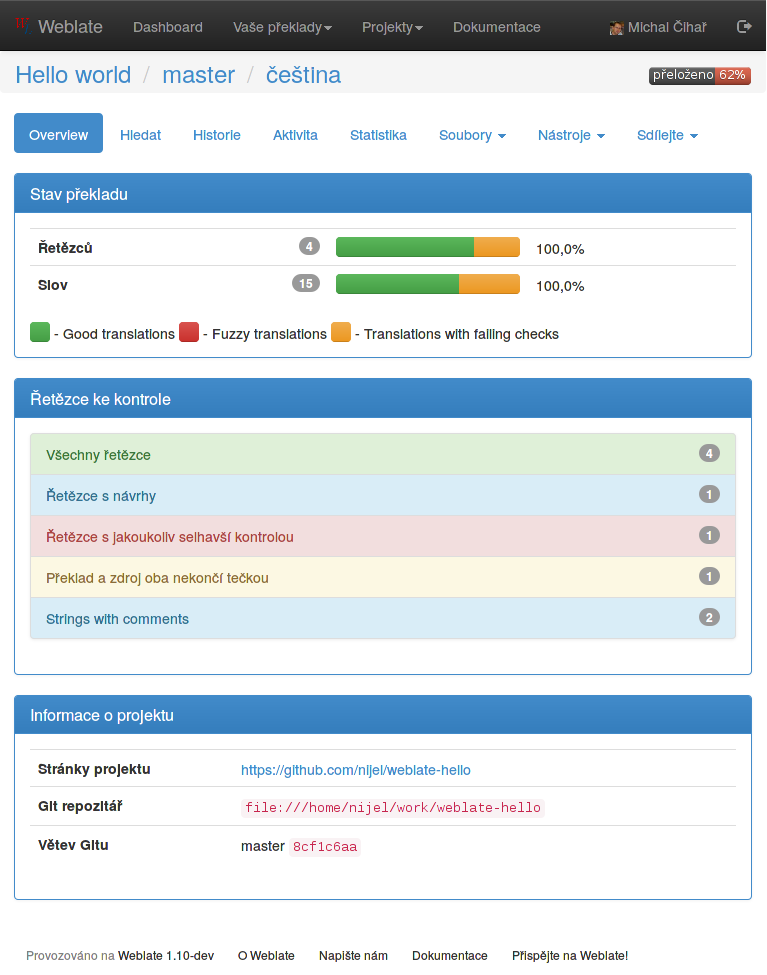
For quite some time I was pretty confident that Weblate will need some UI rewrite at some point. This is always problematic thing for me as I'm no way an UI designer and thus I always hope that somebody else will do that. I've anyway spent few hours on train home from LinuxTag to check what I could do with that.
The first choice for me was to try Twitter Bootstrap as I've quite good experience with using that for UI at work, so I hoped it will work quite well for Weblate as well. The first steps went quite nicely, so I could share first screenshots on Twitter and continue to work on that.
After few days, I'm quite happy with basic parts of the interface, though the most important things (eg. the page for translating) are still missing. But I think it's good time to ask for initial feedback on that.
Main motivation was to unite two tab layout used on main pages, which turned out to be quite confusing as most users did not really get into bottom page of the page and thus did not find important functions available there. So all functions are accessible from top page navigation, either directly or being in menu.
I've also decide to use colors a bit more to indicate the important things. So the progress bars are more visible now (and the same progress bar now indicates status of translation per words). The quality checks also got their severity, which in turn is used to highlight the most critical ones. The theme will probably change a bit (so far it's using default theme as I did not care much to change that).
So let's take a look at following screenshot and let me know your thoughts:
You can also try that yourself, everything is developed in the bootstrap branch in our Git repository.
I previously wrote about the case for a Basic Income in Australia [1]. Since then I read an interesting article by Rutger Bregman in the Dutch site The Correspondent discussing the benefit that such Basic Income schemes have given in various places [2], he makes a great case for giving a Basic Income to poor people. However I believe that it should be provided to everyone. I believe that government payments shouldn t be means tested because the proportion of the population who earn more than the cutoff is usually very small (IE it doesn t save much money), because the money will be recovered from wealthy people in tax, and because the bureaucracy involved in determining who is eligible involves spending tax money to pay bureaucrats and costing everyone time in dealing with the process.
The concept of an Attention Economy has been getting some interest recently. But discussions of it seem to be mostly concerned with the needs of fairly wealthy people, how to advertise to them, how to filter out unwanted ads for them, etc. But the costs in attention can be even worse for people on low incomes or social security because they have many attention costs that could be solved by money. Many common essential purchases (EG soap, basic foods, and purely functional clothes) can become difficult decisions if saving a few dollars is important. The amount of thought involved in buying such items can result in someone who s not well off having little energy to concentrate on other things. I think that to have an effective social security system we need to consider how much cognitive effort is being required of people who are receiving benefits.
Last month I wrote yet another review of mobile phone plans in Australia [3]. Every time I do this it takes a significant amount of time because the Telcos devise overly complex plans to make it difficult to compare their offerings. It seems that they aim to make their offerings somewhat competitive if you can interpret them but confusing enough to allow many (most?) of their customers to pay needlessly high bills. I could just pick a random telco and pay whatever it takes, spending an extra $10 or $20 per month isn t such a big deal for me. Even though I advise a number of my relatives on the cheapest phone plan it s probably only barely saving enough money to be worth the effort, a major motivation for me is being stubborn and not wanting telcos to rip people off.
The Importance of Mobile Phones
A mobile phone seems to be essential for most people. Mobile phones are used for making medical appointments and for applying for work, so in almost every case some of the financial assistance paid to a job seeker or person on a disability pension will go towards mobile phone costs. The aims of the social security benefits seem to clearly involve a phone service. Given that most people who receive social security payments spend some of that money on mobile phone bills the government has a direct financial interest in not having such money wasted on needlessly expensive phone plans. As we also don t want to have people on social security spending time and attention trying to find the best phone plan it makes sense to have the government help manage this process.
Good communications is regarded as essential to education and economic development. A huge amount of taxpayer money was spent on the NBN (and then wasted by Tony Abbott when he cancelled the original plans) for these benefits.
Good phone access is also an issue of personal safety. While it is possible to call emergency services from a mobile phone that doesn t have a valid SIM there are probably few people who keep a spare phone charged for that purpose. Also there are a variety of issues that can impact life or health which can best be resolved by calling friends or relatives.
Free Phones
I think that the best solution to these problems is for the government to directly pay mobile phone bills. If we are going to have a Basic Income then the government should make the base payment for mobile phone calls for every resident, if not then the government should make the base payment for everyone who receives any form of social security payment. Obviously the amount of data that could be transferred over a 3G network is greatly in excess of the amount that any plans allow and offering true unlimited calling leads to people using mobile phones as baby-monitors, so some limits are necessary. But the government could cheaply pay for a phone plan that exceeds the requirements of most people and then allow anyone who wants more data or calls to pay extra.
Which Plan?
The cheapest all-inclusive mobile phone plan in recent times was Kogan who charged $299 per annum for 6G of data per month and unlimited calls. The cheapest current offer for unlimited calls seems to be Lebara s $30 per month offer which includes 2G of data.
My observation is that people who use 3G Internet just for phone use (as opposed to tethering a laptop or providing home Internet), who use a home Wifi network for installing Android programs and don t play Ingress tend to use a lot less than 1G of data per month. I would use between 400M and 700M per month if I wasn t playing Ingress and didn t use my phone as a Wifi access point.
In terms of call volume, 600 minutes a month should be enough to cover the basic needs of most people judging by the number of plans on offer with limits smaller than that.
As a current Lebara offer is $30 per month for unlimited calls and 2G of data (and there are similar offers from other telcos), it should be possible for a telco to offer 600 minutes of calls and 1G of data for less than $15 per month. When the government is paying (no bad debts) and many of the users will use much less than the quota such a plan should be profitable at $10 per month or less.
Implementation
The way to implement this would be to start with a tender that has a hard requirement for the minimum amount of service provided. This would include the number of minutes per month for calls, the number of SMS sent, and the amount of data transfer. To avoid excessive billing (a standard telco scam) there should be a requirement that fees for extra use not exceed some small multiple of the base rate, for example if the government was paying $10 for 600 minutes of calls and 1G of data the excess usage charges could be capped at 3 cents per meg and 5 cents per minute (3* the base rate) which would be profitable for the telco but not a scam.
If the telcos act in a market driven competitive manner they will compete to provide the most attractive offerings for $10 per month.
If the build cost of the NBN had been invested at government bond rates (for any of the rates used for current bonds) then it would pay for the mobile phone bills for every resident forever, so the cost of providing phones for everyone is in the range of government telecommunications programs. If people who are working were to pay an extra $10 in tax and people who are on social security had their benefits reduced by $10 then that would be a great deal if it saved them the $20 or more that most people spend on a basic phone plan.
Government Phone Delays
A friend who s a single mother pays for an unlimited mobile phone plan because calls to the social security office are usually kept on hold for more than an hour. It s likely that she could save money over the course of a year by paying for a cheaper plan and just dealing with the occasional big bill, but she needs to budget carefully and feels that she can t take that risk. It seems stupid that government phone delays (partly caused by cutting funds for staff) cause increased expenses for people who are receiving social security payments. If the government implemented a smart queuing system that allowed them to call people back instead of making them wait on hold then it would save money overall.
So there are obviously other ways that the government can save money on phone calls and time for everyone.
I've been using Linode since 2010, and many of
my friends have heard me talk about how big a fan I am of linode. I've
used Debian unstable on all my Linodes, since I often use them as a remote
shell for general purpose Debian development. I've found my linodes to be
indispensable, and I really love Linode.
The Problem
Recently, because of my work on Docker, I was forced
to stop using the Linode kernel in favor of the stock Debian kernel, since
the stock Linode kernel has no aufs support, and the default LVM-based
devicemapper backend can be quite a pain.
I tried loading in btrfs support, and
using that to host the Docker instance backed with btrfs, but it was throwing
errors as well. Stuck with unstable backends, I wanted to use the
aufs backend, which, dispite problems in
aufs internally, is quite stable with Docker (and in general).
I started to run through the Linode Library's guide on PV-Grub,
but that resulted in a cryptic error with xen not understanding the compression
of the kernel. I checked for recent changes to the compresson, and lo, the
Debian kernel has been switched to use xz compression in sid. Awesome news,
really. XZ compression is awesome, and I've been super impressed with how
universally we've adopted it in Debian. Keep it up! However, it appears only
a newer pv-grub than the Linode hosts have installed will fix this.
After contacting the (ever friendly) Linode support, they were unable to give
me a timeline on adding xz support, which would entail upgrading pv-grub. It
was quite disapointing news, to be honest. Workarounds were suggested,
but I'm not quite happy with them as proper solutions.
After asking in #debian-kernel, waldi was
able to give me a few pointers, and the following is very inspired by him,
the only thing that changed much was config tweaking, which was easy enough.
Thanks, Bastian!
The Constraints
I wanted to maintain a 100% stock configuration from the kernel up.
When I upgraded my kernel, I wanted to just work. I didn't want to
unpack and repack the kernel, and I didn't want to install software
outside main on my system. It had to be 100% Debian and unmodified.
The Solution
Left unable to run my own kernel directly in the Linode interface, the tact
here was to use Linode's old pv-grub to chain-load grub-xen, which loaded
a modern kernel. Turns out this works great.
Let's start by creating a config for Linode's pv-grub to read
and use.
sudomkdir-p/boot/grub/
Now, since pv-grub is legacy grub, we can write out the following
config to chain-load in grub-xen (which is just Grub 2.0, as far as I can
tell) to /boot/grub/menu.lst. And to think, I almost forgot all about
menu.lst. Almost.
Next, change your boot configuration to use pv-grub, and give the machine
a kick. Should work great! If you run into issues, use the lish shell to
debug it, and let me know what else I should include in this post!
Hack on!
This is the second post in a series of posts describing a secure alternative to applications like WhatsApp. I started with the following statement:
I believe it is possible to build a system with the simplicity and functionality of WhatsApp or Viber, which provides end-to-end encryption, is built on free software and open protocols, that supports federation and is almost decentralised, and that would allow interested companies to turn a profit without compromising any of these principles.
In this post, I will outline the concepts behind the most critical component of the architecture: the directory service.
Outline
I say this is the most critical component, because here lies what makes this architecture different, but also because this is the weakest link in the whole idea. I expect criticism, specially on some security trade-offs, and I hope that people that know better than me can help me improve it.
The directory service is what allows the users to register easily, without using passwords, to be able to receive calls and messages from other users, even if they are not part of the network, and to do all this with a reasonable security model.
Let's get technical
The directory service is basically a DNSSEC-protected DNS zone serving ENUM records, along with public keys associated with each user identifier.
A TLS-enabled API will enable account creation and validation, DNS records publishing, and encrypted records querying.
Applications not supporting that API use standard ENUM querying, and the user manually uses traditional web-based methods for account and records management. This allows interoperability with any existing clients and SIP services.
The service will authenticate users by using the usual methods to probe ownership of phone numbers: sending an encrypted SMS with a secret that the client application uses then to claim the phone number.
This same method can be used to validate ownership of identifiers that are not phone numbers, like pre-existing SIP or email addresses.
Once the user is authenticated, the directory service will publish the user's public key and SIP address, both associated with the phone number.
When a user wants to place a call or send a message, it uses a DNSSEC-enabled resolver to get securely the other party's public key and SIP address. The user can also perform bulk look-ups, to discover which people on theirs address book is already in the system.
These operations disclose an important amount of private data, and I don't think this can be mitigated in an acceptable manner, and therefore the directory service needs to forget the queries as soon as possible, and not to store any logs of these.
Also, DNS queries are not encrypted, and are thus vulnerable to snooping by third parties. To mitigate this, the service needs to implement an encrypted but anonymous API to perform queries, and thus offer extra privacy to clients that support the API.
The idea is to have more than one service running on different domain names, but not many: they need to keep consistency and replicate among them, and the security and privacy implications of one service not being properly implemented or administered are too big.
Therefore, there must not be more than a handful of these, they need to be properly audited, and must not be operated by any for-profit organisation.
Security
The Web of Trust is hard. End users don't like hard.
Traditional PKI is prohibitely costly, and broken. OTR is good, but is still not hassle-free.
Using one of the proposedextensions to DANE, we can solve this problem: using DNSSEC, we can have each users' public key published where everybody can retrieve it securely.
This published key can then be used for end-to-end encryption and client authentication with all the components of this architecture.
Who creates the key pair? In the simple case, the client application creates the key pair, and stores it in an appropriate container in the mobile device. It then chooses one of many cooperating directory services, and gets the public key associated with the phone number.
If the private key is lost (lost your phone?), a new pair is generated and published, after passing the same checks of number ownership, and the old keys are discarded. This opens the door for some attacks, but those can be mitigated by having the client application verify the public records periodically, and the service requiring extra checks for key replacement. For example, by also using a challenge sent by email.
What if I want to do things my way? Perfect, you create your keys, and then use the same mechanisms to register with the identity service. Also, you use the service to tell other users to connect to your own SIP server when they want to talk to your phone number.
Does this sound like ENUM? It is ENUM, but better. Just by adding DNSSEC, an unified API, and the capability of publishing key material along with the routing information, you got yourself a reasonably secure way of distributing keys and locating users.
Interaction with other components
Once the user records are published, the SIP server can use the public key to authenticate the user, and removes the need for passwords. The same principle applies to account creation: if the user has published key material under a phone number's record, the SIP server must accept account creation requests for the same phone number, provided these are authenticated with the private key.
If the user wants to switch providers, it is as simple as creating a new account in the new provider, and then updating the ENUM record.
The client application queries the service (and possibly other ENUM providers) before placing a call or sending a message. If the peer has keys published, the client can refuse to communicate if the keys don't match, or the peer is not offering call encryption.
When public keys are not found, the client can downgrade to traditional unauthenticated encryption, or unencrypted communications.
To be continued
In the next posts, I will talk about the overseeing organisation, the SIP service providers, and the client application, and how they all fit together. Stay tuned!
So I ve configured voice service a number of times, but never using Cisco equipment. There s a business starting up here on Orcas Island and they need a number of lines voice and fax service. I had a spare 2801 router laying around and heard that it s possible to provision voice service using these machines. So I looked on eBay for a module that will provide more than two FXS ports and decided on the VIC-4FXS. When it was delivered, I installed it and booted the router. It told me that it needed a PVDM DSP Module, so I got one of those as well. It has arrived. I have installed it. Now when I boot the router, I don t get a warning or an error.
configure the router to send outbound calls to the SIP server
configure the router to send inbound calls to FXS ports 2,3,4 in round robin
configure the router to send inbound calls to the correct ports on the VIC-4FXS
dial-peer voice 1 pots
 preference 7
 destination-pattern 3602987792
 translate-outgoing called 10
 port 0/2/0
 forward-digits all
!
dial-peer voice 2 pots
 preference 2
 destination-pattern 3602987793
 translate-outgoing called 10
 port 0/2/1
 forward-digits all
!
dial-peer voice 3 pots
 preference 3
 destination-pattern 3602987794
 translate-outgoing called 10
 port 0/2/2
 forward-digits all
!
dial-peer voice 4 pots
 preference 4
 destination-pattern 3602987795
 translate-outgoing called 10
 port 0/2/3
 forward-digits all
configure the router to accept inbound calls from the asterisk call server
voice service voip
 allow-connections sip to sip
 no supplementary-service sip moved-temporarily
 no supplementary-service sip refer
 fax protocol t38 ls-redundancy 0 hs-redundancy 0 fallback cisco
 sip
  registrar server expires max 3600 min 3600
  localhost dns:8.8.8.8
configure the asterisk call server to send inbound calls to the router
On asterisk call server, edit sip.conf to register with SIP server on cisco router at 172.16.78.209:
I ve been searching for interesting ways to manipulate RDF graphs in Python, to create an application that would handle Linked Data Resources in an OO-way, i.e. using Python classes and not tables/sets/lists of triples. The data will be persisted in graphs in a triple store, accessed through a SPARQL enpoint.
In this post, I ll illustrate how I managed to tie RDFLib s SPARQLStore plugin and RDFAlchemy to reach a rather nice looking result.
RDFLib provides tools to manipulate graphs, but most of the examples I found didn t load Graph instances from SPARQL, and generally used SPARQLWrapper results (tables) manually. Here comes a first tool to the rescue : SPARQLStore, which allows to dynamically query a remote SPARQL endpoint when navigating an RDFLib graph. I couldn t find a lot of documentation about it, but I found some hints in slide 51 of the excellent presentation by Tatiana Al-Chueyr Linking the world with Python and Semantics.
Now, I know how I can manipulate the RDFLib Graphs queried from a remote SPARQL endpoint with the usual methods, I m still not satisfied, because I want OO stuff, not lists of (predicate, object) tuples.
Here comes the second tool, RDFAlchemy, which allows to create descriptor classes mapping RDF Resources to Python classes. Here again, there isn t much docs available, but I found the excellent tutorial by Ted Lawless Reading and writing RDF for VIVO with RDFAlchemy.
Now we can put the 2 pieces together, modulo a few precautions : the SPARQLStore plugin of RDFLib will generate SPARQL queries everytime a graph is navigated, whereas RDFAlchemy expects the graph to be in memory (at least AFAIU). So we ll have to manually pre-load the contents of the graphs that we need for all the attributes of the descriptor classes.
I ve written an example code that illustrates this by trying to query french films in Wikipedia. Here s a copy of the gist. Attention, it will query DBPedia a lot, so pay attention to the bandwidth and memory if you change parameters.
It isn t perfect, and I still need to investigate benefits and limitations of the approach. On clear limitation is the number of SPARQL queries made on the endpoint, instead of a smarter pre-loading.
Also, on a side note, during tests I could spot a few issues with SPARQLStore, which seems lagging behind probably not used by so many people. The RDFAlchemy project doesn t seem to be in great health, mostly unmaintained from what I can see (and notice that I linked to the GitHub clone/fork that seemed to be the latest maintained while the original author s seems dead), but nevertheless, the code works with a more recent RDFLib, so that s not so bad.
Stay tuned for more adventures in Linked Data land in Python.
I wrote my own init. I didn't mean to, and in the end, it took 2 lines of
code. Here's how.
Propellor has the nice feature of
supporting provisioning of Docker containers. Since Docker normally runs
just one command inside the container, I made the command that docker
runs be propellor, which runs inside the container and takes care of
provisioning it according to its configuration.
For example, here's a real live configuration of a container:
When propellor is run inside this container, it takes care of installing
apache, and since the property states apache should be running, it also starts
the daemon if necessary.
At boot, docker remembers the command that was used to start the container
last time, and runs it again. This time, apache is already installed,
so propellor simply starts the daemon.
This was surprising, but it was just what I wanted too! The only missing
bit to make this otherwise entirely free implementation of init work properly
was two lines of code:
Propellor-as-init also starts up a simple equalivilant of rsh on a named pipe
(for communication between the propellor inside and outside the container),
and also runs a root login shell (so the user can attach to the container and
administer it). Also, running a compiled program from the host system
inside a container, which might use a different distribution or
architecture was an interesting challenge
(solved using the method described in completely linux distribution-independent packaging).
So it wasn't entirely trivial, but as far as init goes, it's probably
one of the simpler implementations out there.
I know that there are various other solutions on the space of an init for
Docker -- personally I'd rather the host's systemd integrated with it
so I could see the status of the container's daemons in systemctl status.
If that does happen, perhaps I'll eventually be able to remove 2 lines of code
from propellor.
Today I released version 0.25 of my console mail client, which is a release focussed upon portability (DragonFly BSD, and MacOSX specifically).
Over the past couple of weeks I've written a fair bit of code, wondering if I want to make the jump to a graphical email client, but the conclusion for the moment has to be no.
With the scripting support built into my client, and even before then using the hooks/hacks that mutt supported, I just process mail so much more quickly than via a GUI system.
I also benefit from reading the mail on the host to which it is delivered - mail gets filtered by something like procmail, and I read it in-situa. IMAP is available if I travel, but I rarely do so.
Having a GUI client might be fun, but it would mean I'd read mail on my desktop - pretty much the only system I don't backup (except for images, videos, and local media). It would also involve running imapsync, or similar, to pull the mail in, and relaying through the remote server to avoid my ISPs poor IP-reputation.
In short I believe if I use a GUI client I'll get slower, and I'll still need the remote host regardless.
It was this time last year when I thought it was functional, but now it is functional, battle-tested, and reliable.
So I guess I'm done with email for the next few years. Maybe in that time somebody will write something better - console based for preference, GUI as a last resort, and certainly not another webmail client.
In other news ..
I had a fun interview on Monday, it went well until they admitted they couldn't afford me - so their goal is to pay a junior member a small salary and hope to get somebody senior to work part-time for a similarly minimal salary. Might work for somebody else, but it wouldn't for me right now, so on that basis I declined.
The most annoying thing about interviewing is the waiting, between the early flirting about duties and expectations, to scheduling meetings, and then awaiting decisions.
On that note I'm half-way through building a new desk which is a nice physical job I can really concentrate upon. I'm currently waiting for the stain to dry on the legs, and then I'll get the damn thing finished. It probably looks more "rustic" than "modern", but it smells nice, so that's the main thing ;)
Expect pictures when it is finished.
Random thoughts of a new contributor
I've started to contribute to Mozilla - and particularly to the Firefox Desktop QA team -
at the end of March, in order to apply for the OPW
with Mozilla as Bug Wrangler.
While being already part of the Free Software world as contributor clearly helps,
it's always difficult to find your way at first in such a big project, no matter how helpful the people you're working with are.
It's about trying to understand how the project is organized and who works on what, what is expected from you
as contributor and the specific style of interaction and contribution accepted in the project.
So, here's a couple of thought about it: the necessary disclaimer is that I'm a long-time Debian contributor meaning that,
inevitably, Debian is my reference model.
Also, everything I'm writing here regards only the specific part of the project I've been working in: Desktop QA and Bugmastering.
Documentation
The first thing that I noticed is the huge amount of documentation. Everything is very well documented
and while this is definitely a plus in my book, it's sometimes difficult to keep track of all this resources.
AFAICT, there are basically three main sources of documentation:
Some of the documents on these three different places are sometimes similar, making them redundant and it's difficult
to remember where you read what. At least for me. My workaround has been to bookmark pages as a mad woman, and also to
make a list on my wikipage of the pages I found more useful.
My top five of useful pages? Here we go!
And speaking of triage, special shout-out for the most useful addon ever for Mozilla triagers/testers: Nightly Tester Tools.
Community interaction
For someone coming from Debian, where everything is done via public mailing lists and/or IRC chans, Mozilla was a bit of a cultural shock.
The mailing lists are not very much used, at least in the QA community (or I'm not subscribed to the right ones ;)).
As for IRC, while there are many channels, they are not very active: meetings and important discussions are held using a proprietary videoconference software (Vidyo), and are mostly restricted to employees (but other people can join if they have a guest URL).
On the other hand, every time I asked for help - even the most stupid question - on IRC, I got a useful reply. And thanks to the folks on #testdays and #qa (especially petruta and Aleksej) I was able to speed up the learning process and understand how things work in the project.
So, while I'd like to see more public meetings, it's also true that the community is working well on interaction among contributors.
Community outreach
This is where I think Debian could borrow a couple of ideas. Mozilla basically got me hooked
thanks to their Bugdays: every Monday and Wednesday are - respectively -
dedicated to Triage and Verification of bugs. The events are open to everyone,
the wikipages for the events provide a good tutorial explaining the workflow in detail, and if you have any doubts
there are always people willing to help you on the dedicated IRC chan.
Every bug worked on during these events is also tagged: so that later it's possible to
check how successful the day was in terms of participation.
Bugzilla and the triaging/verification workflow
About Bugzilla I can only say that I like it. I like how flexible is for search queries, I like the possibility to have custom tags
on the whiteboard (as the [bugday-xxxxxx] one) and the smart way to interact among people in the bug without making the bug go stale (ie,
mostly the needinfo feature).
But beside the software used as BTS, I must admit that I really like the workflow and the whole concept of triaging in Mozilla.
The granularity of rights (everyone, canconfirm, editbugs) and the clear procedure for a permission upgrade; the presence of a team
constantly working on cleaning the incoming bugs, regardless of the product/component, to make easier for the developers the filtering
and the resolution as well; the attention to details of the verification process: each bug marked as Resolved Fixed need
to be Verified, to be sure that it's been actually fixed... All these things are really impressive.
This, obviously, is something that can be done inside an upstream project where there are people doing paid work,
and where the products are not too many. I cannot see how this kind of QA process can be applied to bugs against an entire OS.
But there are some things we (as in Debian) could take inspiration from.
Organizing regular Bugdays, for instance.
Creating a team of triagers to help both with incoming and with very old bugs.
And this, again, is a kind of work that can be done by everyone,
not only coding contributors: meaning that an additional effect would be to increase the diversity in the contributors pool.
As a side note: I'll start my OPW internship next Monday, and will spend three months playing with bugs and learning
how to be a Bug Wrangler! \o/\o/
Did I get your attention with the title? Good. In this post I will outline something that I have been thinking about for some months:
I believe it is possible to build a system with the simplicity and functionality of WhatsApp or Viber, which provides end-to-end encryption, is built on free software and open protocols, that supports federation and is almost decentralised, and that would allow interested companies to turn a profit without compromising any of these principles.
Introduction
This is the first post of a series that I will be publishing in the next few days. Many parts of these posts will be technical, but I expect that the main concepts can be understood by a wider audience.
What I am proposing seems like a bold statement, I know. Maybe there is some fatal flaw somewhere in my thinking, and that is why I am publishing this: I hope to get constructive feedback, and maybe get enough traction to start implementing it Real Soon Now .
I have been thinking about this problem since February, when I discussed this extensively with friends at FOSDEM. I have already published a critique of Telegram, which had way more impact than I ever imagined, showing that there is people out there interested in this kind of stuff. The last posts about DNSSEC and DANE were part of my musings about this, too.
There are many components that need to be built for this to happen. But more importantly, this can only be useful if it gains a critical mass. And that's why I think making this a viable business tool is very important. At the same time, that means I need to think extra carefully to make it impossible for any for-profit company to mutate this effort into Just Another Walled Garden.
My goals for this architecture are:
First and foremost, target the same people that nowadays is using a plethora of walled gardens for their instant communication needs. That is WhatsApp, Viber, Skype, Facebook messenger, etc.
It must focus on mobile, that is what people care about, without forgetting about other use cases.
Creating an account and placing the first call/text message should be as easy as it is currently with the competition.
All communication must be encrypted end-to-end with public-key cryptography; nobody but the user has access to the private keys.
Most components must be decentralised, and allow for competition.
There should be as little trust as possible placed on any part of the system.
Anybody can set up a compatible service provider and offer it to its users, while having full interoperability with other providers.
Compatible services which are not part of the network must be able to interoperate.
Contacting a person should happen even if they are not subscribed to the service. The client application must fall-back seamlessly to using interoperability gateways, PSTN termination, or the mobile network.
Interoperability with the competition is desirable, but possibly is better left to be implemented by the client applications.
Components
I have identified a few components needed for this to work, I will expand on each one later.
A flagship mobile application for Android and iOS, based on Lumicall or CSIPSimple, but with several important modifications.
One or many directory and authentication services, based on ENUM and DNSSEC. These are the most critical piece of this idea, and possibly must only be operated by community-governed non-profits.
One or many service providers, that offer simple account creation, registration, and optionally PSTN termination (which can be the main way of generating profit). An API needs to be defined for operations that are not part of the communications protocol, like account creation, credit purchasing, and balance querying.
A network governing charter, and a trusted non-profit organisation that oversees that any participating parties are following the charter. This organisation defines which directory services are to be trusted (and possibly operates one of them), and which service providers the client application can use to create accounts.
Key points
Some of the issues that need to be solved are:
How to handle and distribute public keys securely without the user understanding anything about security.
How to make registration painless and password-free, while offering an acceptable level of security.
How to fund development of the client application, and maintenance of the directory services.
How to get companies interested in this, so them would bring users to the network.
How to allow the user to migrate from one service provider to another, to improve competition.
How to prevent any party from subverting the spirit of the network.
How to make the client application work everywhere and have reasonably quality.
To be continued
I think I have answers to most of these problems. I will elaborate in the next few days, stay tuned!
Footnotes
The name is something I've chosen a name in less than 2 minutes, while starting this post, so probably is awful.
The distributed part is only half true, as the directory services need to be centralised, but I think it's good enough.
I am aware that Lumicall seems to be trying to build something similar. I only found about that recently, when I was thinking about this design. Sadly, I think it has several shortcomings, but it is definitely one of the building blocks of this project.
I have just tagged Obnam (my backup program) 1.8 in git, and built and
uploaded Debian packages to code.liw.fi and Debian unstable. NEWS
snippet below.
Version 1.8, released 2014-05-13
The error message has been improved for when setting metadata
(owner, permission, and similar) of a restored file fails.
obnam force-lock now works even when the client running it is not
in the client list.
Security issues:
Joey Hess found a problem in obnam restore: restored files would
be created with quite liberal default permissions, which would be
set to the backed-up permissions later. This could allow a snooper
to read files they shouldn't be. This has been fixed now by using
restrictive default permissions. A workaround for older versions is
to create a directory, set its permissions to 0700, and restore to a
subdirectory of that directory.
Bug fixes:
--help output no longer shows the default value of any options. It
was shown only for a few options anyway. The proper way to see the
current settings is with the --dump-config option. The bug that
was fixed that the generated manual page no longer contains values
that are specific to the machine doing the generation, such as the
hostname as the default value for --client-name. Reported by
SanskritFritz.
When a file was backed up, and later excluded with --exclude,
Obnam wouldn't remove it from the new backups. Now it does. Bug
fixed by Anssi Hannula, though his patch got changed because it no
longer applied.
When restoring extended attributes not in the user namespace
(named like user.foo) Obnam now ignores them, instead of trying to
set them and crashing.
When restoring from a directory that is not a repository, the
error message is now clearer.
Obnam would previously allow the backup root to be a symbolic link
pointing at a directory. However, this only worked for backups. No
other operations would work and would only see the symbolic link,
not the directory it pointed at. Obnam now gives an error message
even for the backup.
Obnam no longer excludes files named syslog or none, if the
setting --log=none or --log=syslog is used.
Endlich tut mal jemand was gegen die
rechte Hetzpartei! Ein Arbeitskollege fragt, ob man die nicht
einfach mit einem langen Heckenschneider abmachen kann aber sie so
l cherlich zu machen hat auch was
Finally, someone is doing something against this Nazi party!
A coworker wondered whether it s legal to cut them off with a long
tool, but making them ridiculous like this is also funny
(Explanation: the Pro NRW people put their campaign
thingies (sorry, I don t speak English well) up on lamp posts very high,
because they are taken down by other citizens immediately otherwise,
so there s now people making fun of them for using long ladders (to
put them up there, so the offended citizens need equally long ladders
or tools with long arms) in leaning on the saying that lies have long
legs here: ladders.)
Recently I've been seeing lot of posts about DNSSEC on Internet and I
thought I should configure my domain to be secured by DNSSEC.
copyninja.info domain is now secured with DNSSEC you can verify
this by DNSSEC analyzer by Verisign and DNSViz online tool or by
installing DNSSEC validator addon for
your browser.
There are good amount of tutorials and guides available to enable
DNSSEC for your domain, still I want to note down steps I followed to
here for the record (of course it will be helpful for me if I forget
it ;-))
First step will be installing bind9 and dnssec-tools package, if
you use aptitude installing dnssec-tools will pull down the bind9
unless you have configured aptitude to not install the Recommends.
Next setting up the zone file for your domain, for this first make a
copy of /etc/bind/db.local as /etc/bind/db.example.com, replace
example.com with your domain name. Now you need to add your zone
records to the zone file.
Next edit the /etc/bind/named.conf.local file and add following lines
zone "example.com"
    type master;
    file "/etc/bind/db.copyninja.info";
    allow-transfer  secondary; ;
 ;
Here replace secondary with your secondary DNS servers, if you don't
have one you can ommit this but its always recommended to have
secondary DNS servers for a zone, in cases when primary fails. After
this we need to enable DNSSEC on bind, this is done by editing the
file /etc/bind/named.conf.options. Add following lines into
options section.
A more explanation on this can be found on Linux Journal article.
Now its time to create DNSSEC keys and sign your zone, more about
different DNSSEC keys and records can be found in the Linux Journal
Article on implementation.
I used zonesigner utility from dnssec-tools which does job of
signing and including KSK and ZSK keys into bind configuration which
otherwise should be done manually. Here is the command line I used for
generating keys, thanks to Jonas for this.
Here we store our keys into /etc/bind/keys directory, and use
RSASHA256 algorithm for key generation which is more stronger than
the default used RSASHA1 (atleast thats what Jonas told me). This will
create ZSK and KSK for the signing zone and creates a signed zone file
db.example.com.signed in same directory as original zone file. Now all
you need to do is replace the zone file from db.example.com to
db.example.com.signed in file directive with your named.conf.local
file.
Note that this keys expire after 30 days so you need to resign your
zone before 30 days. For resigning just run zonesigner from
/etc/bind/keys. You can setup cron job to do this periodically.
Our signed zone is ready but we are not done yet! For DNSSEC to work
others should trust your signed record for this you need to register
your public keys with registrar for your domain and this can be done
via your domain provider (in my case this is Gandi).
You need to check your domain name providers documentation on how to
do this. For Gandi users there is a nice documentation.
Using % ?_smp_flags can speed up your build a lot.
Above RPM macro enables SMP, use all CPU cores to build package and it looks good. We can easily buy multi core processor machine nowadays even if it is cheapest laptop.
In Debian, we can do parallel build by specifiying DEBBUILDOPT=-"j<job number>" in /etc/pbuilderrc and run pbuilder/cowbuilder, but this % ?_smp_flags can automatically use multiple cores without any setting, good. However, add % ?_smp_flags to each rpm spec file, it means that we need to modify each source package, is not handy.
Then back to Debian, I've made a quick hack to dpkg-buildpackage (disclaimer: I'm Perl beginner, you know :).
Pros) - Automatically use all CPU cores to build package, faster build.
Cons) - some package would be FTBFS (e.g. Bug#694726) but it should be fixed, right? ;)
It may break some builds but "enable multiple build by default, and specify single build exceptions to each problematic packages" is better, IMHO.
So I was needing a resulting JSON array with possible solutions for a given address or city name and then angular-geocomplete was made.
The great thing is that you can use it together with typeahead and now you have address/location autocomplete, just like the one on Google Maps.
And yes, it does uses Google Maps's API.
What's the advantage of this thing? You get coordinates together with all the names.
Installable via bower as well with bower install angular-geocomplete.
Any issue: to the GitHub tracker.
This is an updated version of an
earlier post in March.
A number of talks about Rcpp are scheduled
over the next couple of months:
On Wednesday May 14 I will be speaking at the Chicago R Users Group
meeting charmingly titled Warm Up for R/Finance, along with
fellow R/Finance organizer Josh
Ulrich, fellow R/Finance regular Kent Hosxey as well as Cliff
Clive. I will talk about Redis and my rather recent nascent
RcppRedis package.
Our sixth international conference R/Finance
will take place May 16 and 17, 2014, at UIC in Chicago. See the current
agenda for details of the program---which
once again will be preceded by one-hour workshops. And as in the past, I will offer a one-hour
gentle introduction to Rcpp. This workshop requires
registration and a fee, and registraion will close shortly.
I will also present a short lightning talk about the
RcppRedis package
as part of the conference proper.
A few days later, on May 20, 2014, I will present a one-hour webinar which is part of a series
organized by Ray DiGiacomo and the Orange County R Users Group.
See this page for details and registration
information; the talk itself will be free of charge.
Later in the month, on May 30, 2014, I will give a talk / guest lecture about
Rcpp and
RcppArmadillo and
over in Economics at the University of Chicago. I reckon that this event is not open to anybody
not part of U of C.
Another three-hour tutorial is scheduled for the tutorial day preceding
useR! 2014 at UCLA in early July. This tutorial will
also require registration as part of the annual useR! conference.
I am very honoured to have been asked to give one of the
invited keynotes at
useR! 2014. The talk may (or may not) cover at least some aspects
of Rcpp.
As my talk proposal about the recent
RcppZiggurat
package for faster Normal RNGs was accepted, I will also give a regular
conference talk.
So the month of June remains pretty open. If someone wants me to talk somewhere else, preferably on a
Saturday, feel free to get in touch.
Oracle has demonstrated that implementing an API is effectively the same as copying code from a program. To me, as a non-lawyer programmer, this surprising court decision seems to mutate copyrights into a kind of Software-Patent-Lite(tm) without the benefit of examiners or a 15 year term limit. This seems like a chilling new tool for deep pockets companies like Oracle to go about tormenting people. Thinking more deeply, however, you begin to wonder if Oracle hasn t inadvertently created some kind of Free Software Doomsday weapon.
After all, if simply implementing an API makes you code a derivative work then doesn t that mean the terms of the GPL will apply on any code that implements the API of a GPL d system? Even if you didn t copy code you have implemented that API and according to Oracle that s a derived work. If you ask me, its the most excitingly vauge and contagious information phenomena since the Open Data Base License.
The aaddition of lambdas in C++11 has greatly improved the flexibility
of the language as a whole. C++14 will add a few more abilities.
C++ Truths has a very nice and brief overview of what C++14 will
allow. Part 1 goes from the very basics via closures to a small
demonstration of partial function application. And Part 2 continues
by showing recursive lambdas, overloaded lambdas, pattern matching,
in-place parameter pack expansion (neat) and finally even memoisation.
These code examples have been the most inspiring ones I have
seen lately. If you have any interest in C++, go read them.
I had a really productive day today actually working on Debian, as planned
for my Mondays.
I'm still working through my list of packages, trying to get them all
vaguely up to date for jessie. It's mostly just addressing Lintian issues
that mostly revolve around old standards versions, with the occasional new
upstream release. I've also been doing bug triage where the bugs aren't
overwhelming.
Today I made uploads for pssh (a new upstream release),
pymetrics (mostly
just a rebuild), rcs-blame (mostly just a rebuild) and
simpleproxy (mostly
just a rebuild).
I need to revisit simpleproxy, because I'm having problems convincing the
resulting binary to be linked correctly for relro. It's weird, because I'm
doing everything I'm supposed to be doing and I can see all the other
hardening flags being passed in except for this one.
I really like simplifying down debian/rules using dh,
that really makes things readable. You can see the useful stuff without
losing it in all the boilerplate. For some reason I was never a fan of CDBS,
but I'm quite liking dh. I think it's because it's less opaque than
CDBS.
 For quite some time I was pretty confident that
 I've been using
 This is the second post in a series of posts describing a secure alternative to applications like WhatsApp. I
 So I ve configured voice service a number of times, but never using Cisco equipment. There s a business starting up here on Orcas Island and they need a number of lines voice and fax service. I had a spare 2801 router laying around and heard that it s possible to provision voice service using these machines. So I looked on eBay for a module that will provide more than two FXS ports and decided on the
 I ve been searching for interesting ways to manipulate RDF graphs in Python, to create an application that would handle Linked Data Resources in an OO-way, i.e. using Python classes and not tables/sets/lists of triples. The data will be persisted in graphs in a triple store, accessed through a SPARQL enpoint.
In this post, I ll illustrate how I managed to tie RDFLib s SPARQLStore plugin and RDFAlchemy to reach a rather nice looking result.
 I wrote my own
 Today I released version 0.25 of my

 I have just tagged Obnam (my backup program) 1.8 in git, and built and
uploaded Debian packages to code.liw.fi and Debian unstable. NEWS
snippet below.
Version 1.8, released 2014-05-13


 Recently I've been seeing lot of posts about DNSSEC on Internet and I
thought I should configure my domain to be secured by DNSSEC.
copyninja.info domain is now secured with DNSSEC you can verify
this by
 So I was needing a resulting JSON array with possible solutions for a given address or city name and then
 This is an updated version of
 Oracle has demonstrated that implementing an API is effectively the same as copying code from a program. To me, as a non-lawyer programmer, this surprising court decision seems to mutate copyrights into a kind of Software-Patent-Lite(tm) without the benefit of examiners or a 15 year term limit. This seems like a chilling new tool for deep pockets companies like Oracle to go about tormenting people. Thinking more deeply, however, you begin to wonder if Oracle hasn t inadvertently created some kind of Free Software Doomsday weapon.
After all, if simply implementing an API makes you code a derivative work then doesn t that mean the terms of the GPL will apply on any code that implements the API of a GPL d system? Even if you didn t copy code you have implemented that API and according to Oracle that s a derived work. If you ask me, its the most excitingly vauge and contagious information phenomena since the Open Data Base License.
 The aaddition of lambdas in C++11 has greatly improved the flexibility
of the language as a whole. C++14 will add a few more abilities.
 I had a really productive day today actually working on Debian, as planned
for my Mondays.
I'm still working through my list of packages, trying to get them all
vaguely up to date for jessie. It's mostly just addressing Lintian issues
that mostly revolve around old standards versions, with the occasional new
upstream release. I've also been doing bug triage where the bugs aren't
overwhelming.
Today I made uploads for pssh (a new upstream release),
pymetrics (mostly
just a rebuild), rcs-blame (mostly just a rebuild) and
simpleproxy (mostly
just a rebuild).
I need to revisit simpleproxy, because I'm having problems convincing the
resulting binary to be linked correctly for relro. It's weird, because I'm
doing everything I'm supposed to be doing and I can see all the other
hardening flags being passed in except for this one.
I really like simplifying down debian/rules using dh,
that really makes things readable. You can see the useful stuff without
losing it in all the boilerplate. For some reason I was never a fan of CDBS,
but I'm quite liking dh. I think it's because it's less opaque than
CDBS.