Search Results: "tar"

28 April 2009

Muammar El Khatib: Open Chrome = Wireless problem in HP 2133?

I had almost two weeks without Wireless connection in my HP 2133. Due of the fact of being busy doing other stuff, it was today until I had time to try something. So, I proceeded to google it and I found a bug in Launchpad about it. There was said that the problem was caused by Open Chrome driver. I have to accept that when I read it I was kind of skeptic. I thought: What has to do a Video Driver with a Wi Fi microcode not responding? (real translation: WTF is this?)

So, I open a terminal. I went to /etc/X11/xorg.conf and I change the only line in xorg.conf (new version of XORG was able to recognize the Video Card and it was working right without using the bunch of options and sections as you can see in http://wiki.debian.org/InstallingDebianOn/HP/HP2133 , except the fact that Wi Fi stopped working) to this:


Section "Device"
Identifier "VESA"
Driver "vesa"
BusID "PCI:1:0:0"
Screen 0
Option "ActiveDevice" "LCD,CRT"
Option "ForceLCD"
Option "SWCursor" "True"
EndSection


I restarted the machine, because I had fucked off Wicd trying to get connected to the Wireless Router and there wasn't any way to get it work again, and when I entered my XFCE4 session and tried the Wireless it just worked again... shit.. I can't understand. That was weird. So for the record. If you are getting this problem to get connected with your HP 2133 using either Debian or Ubuntu, given that you got it working before, so change the driver in the Device section from Open Chrome to VESA and you should get the problem solved. I tested it in Debian Unstable.

27 April 2009

Gunnar Wolf: Damn you pigopolists! (or whatever)

We have had a quite strange couple of days... Everything was smooth as usual on Thursday. As I posted here, I cycled to Iztacala to give a talk and back, and basically had a good time. We had heard news some days earlier on the radio that the usual seasonal flu was still present by mid-April, while usually it disappeared by early March... But nothing more. But Friday morning, as I listened to my usual news program, Aristegui repeated over and over that the Health ministry had ordered (in a press conference at 23:00 the previous day) schools of all levels not to hold activities... Quite unusual, but WTF... Got to work as usual, around 9 AM. The first thing I see in the Institute, our Academic Secretary telling us all to finish our most urgent business and head back home, do not pass go, do not collect $200. And... During the morning it started sinking in. This is a very weird and somehow scary situation. We are facing -as you all must know by now- a previously unknown strain of flu virus (influenza porcina H1N1B, AFAICT). During the past couple of days, we have seen the scenes we wondered about during the past decade, mainly in South East Asia (with SARS and with bird flu): Everybody is scared, nobody really understands what they are scared of, people do stay at home. The streets are eerily quiet, and many people are seen with masks covering nose and mouth. I must recognize our federal and local governments are acting very well coordinated (for the first time in probably over a decade, since they were from different parties for the first time). This has been clearly labeled as an epidemic (over 1600 sick people reported at hospitals, and over 100 deceased) and has spread to many of our country's states (as well as to other many countries, although it still seems to be controlled there - But we have got reports from the USA, Canada, France, Spain, Israel and New Zealand so far). I will most probably spend the next full week at home, as my University (as well as all schools and universities in this city and at least the Mexico, Nuevo Le n and San Luis Potos states) will be closed until May 6th. Of course, sports and cultural activities are all suspended as well. Many (most?) bars and restaurants remain closed. Today, my parents came from neighbouring Cuernavaca (where no alerts have yet been emitted, but will surely follow), and we went out for lunch (to a nice Yucatan food place, chosen partly as it had very little concurrence and because we could sit outdoors. Yes, I must specially thank them for being as imprudent as coming over here, given the generalized scare... I know there was nothing I could do to prevent them from doing so :-) And... In this strange climate, I can only thank I am not a party-organizer or anything like that, as I'd have had my plans frustrated. Here I sit next to my laptop, in my halfway-re-windowed house, with a still shrink-wrapped book that looks beautiful (La bicicleta: Rito, t cnica y pasi n), eager to open it (Thanks, Nadezhda! :-* ). Happy birthday to me. Take off the mask, blow 33 candles, put mask back on. Thankfully there is no cake to eat, as it could be messy with the mask on.

John Goerzen: We Are Plains People, And Our Music Has Tornadoes

There s little that scares Kansans more than a good tornado. And, truth be told, there s little that excites us more than a good tornado, either. After all, we know it s going to be good for a story. Here on the plains, it is easy to remember how powerful nature really is. Weather sweeps in from all directions with little to hinder it, and tonight was a night few will forget. The 300-member Kansas Mennonite Men s Chorus, of which I m a member, had a concert tonight at 7, and we had a practice starting at 3. We sang in the beautiful old Memorial Hall on the campus of Bethel College. I need to describe the building a bit for you. It was built in 1938, in the day before auditorium designers decided you need to remove the outdoors. Three sides are full of windows, and it s just a few feet from the front doors into the auditorium itself. There is no air conditioning, so in a very humid day like today, every possible door and window is open. To stand on the stage and look out over the audience, you see light coming in from every direction, extremely bright light when there s lightning. It s been storming all afternoon. Our rehearsal featured thunderclaps, driving rain that was very audible inside, flickering lights. It was, in all honesty, a bit exciting. At about 6:35, word came that a tornado warning had been issued for the county. A few minutes later, about 20 minutes before start time, sirens were activated and the decision was made to evacuate to safety in the building s basement and an adjoining building. I, and a number of college students singing with the choir, wound up as a sort of impromptu ushers, directing people to the best place for safety and helping to get people into space efficiently. It was rather stuffy in those basement hallways, but it was also quite loud due to all the excited visiting going on. The KMMC concerts aren t usually like this. A few minutes later, word came that the tornado warning was canceled. I went down the steps, yelled out the news, and got a big cheer. People poured back upstairs. We got started a few minutes late, but nobody quite cared. A group of brass players was going to provide the prelude, but their first trumpet player had to leave at the last minute because his tool shed had blown over. They covered for him well in the concert though. When I got home later, Terah saw me and said, I thought they d cancel the concert because of the tornado. I just had to laugh, and pointed out, This is Kansas. After a tornado evacuation, it just got everybody more excited for the program! (Of course, had there been a strike, it would have been a different story.) And it was a great program. There was excitement in the air. And it was incredibly hot and stuffy on the stage with 300 men. I had sweat running down my face. The rain and the thunder continued, sometimes improving the program. About halfway through, we sang Prayer of the Children, written by Kurt Bestor, someone that was terribly saddened by the destruction during the civil war in the Balkans. The lyrics go, in part:
Can you hear the prayer of the children
on bended knee, in the shadow of an unknown room? Empty eyes with no more tears to cry,
turning heavenward to the light. Cryin Jesus, help me
to see the morning light of one more day. . . Can you hear the voice of the children
softly pleading for silence in their shattered world?. . . Angry guns preach a gospel full of hate
blood of the innocent on their hands. For when darkness clears, I know you re near,
brining peace again. Can you hear
the prayer of the children?
And when we get to the last phrase, there s a long rest after Can you hear . We sang it the phrase, and with perfect timing as we paused for the rest, was a loud clap of thunder. And after the last word of the song, total silence. Nobody moved for a few seconds, and then applause rang out. A couple of years ago, I was in the audience at a concert in the same building. Ominous weather lurked that day too. Before the concert started, the director said something like this, before giving information about evacuation procedures, should they be needed: We are plains people. We are privileged to see the awesome power and beauty of the weather and nature up close every day. If we should be a little too privileged today, here s what we ll do

25 April 2009

Biella Coleman: Wikipedia Art

This is a website kick started by artists who are collecting performance pieces critical of (and perhaps also commenting on) this pretty famous site, who is unhappy that the art project incorporates their name into their webpage. Here is some more official commentary from the EFF who is supporting the artists.

Daniel Kahn Gillmor: multiple USB serial adapters on a SheevaPlug

I just noticed Matthew Palmer's Insane/Brilliant idea of the day: he proposes to use large sets of USB serial adapters with a sheevaplug as a cheap serial console server. As part of upstream on cereal, i feel obliged to mention that package as a tool for managing serial console farms like this. It's designed to run in a small footprint, stores timestamped logs for the consoles, supports concurrent remote access, and uses standard unix accounts (usually via ssh) to permit read and/or write access to each port. It has saved me exactly the headaches Matt describes many times. However, i've had trouble getting multiple identical USB serial adapters to persist at standard device file locations across reboot. That is, if you have four pl2303 devices from the same manufacturer, it seems to be a crapshoot which one will be /dev/ttyUSB0 after you restart your system. I could find no distinguishing data in the sysfs to get udev to persistently key off of, anyway. if you know a way to do it, i'd be happy to see it! Depending on how many ports you need, another alternative would be to use a sheevaplug with a multiport USB-to-serial adapter. While i haven't tried this specific hardware, it would remove the need for the hub, and potentially would mean you didn't need any extra power. I'm assuming that this device would give you persistent port naming, but i haven't tried it. Pricewise, it seems to be a win, too: $100 for the SheevaPlug and $100 for the 8-port adapter.Tags: cereal, sheevaplug

24 April 2009

Gunnar Wolf: Some prefer marathoning... I prefer going to my old workplace

I was invited to talk about Free Software at yesterday's FLISOL. Yesterday? Aren't FLISOLs organized on Saturday? Well, not this one, for various reasons which I won't quote here. And no, I am not a supporter of the installfests idea, but I went gladly to talk about what is Free Software all about - The philosophy behind Free Software. Besides, the talk was at FES Iztacala, where I worked for four happy years, 1999-2003. I have not been often to Iztacala since 2003 (probably I have visited only three or four times), partly because of the distance (~25Km from home in a straight line, but the city's Northern part is quite poorly communicated). The last time I was there, last October, I went by bike, just to test my endurance and... because I could. Yesterday, I also did, not to be outdone by my fellow Debianers Christian and Dirk. Think they are so cool because they can run for 43Km? Well, I had my 55Km yesterday, and I was not even in a competition! (yes, yes, running and biking is not the same. So sue me. I just didn't want to stand still and let them walk away with all of the fun!) I took slightly different routes (my route to get there on Nokia Sportstracker and OpenStreetMap trace, my route back on Nokia Sportstracker and OpenStreetMap trace), crossing diagonally Azcapotzalco, a region of the city (delegaci n) I hardly know... The Sourthern of it seems like a continuation of Tacuba to the North, small and not-very-well-communicated prior villages engulfed by our hungry, huge city. The Northern half is a mostly industrial area, with very sparse population, lots of trucks, and streets that are not in the best shape. You can end up feeling lonely in those regions, and I am glad not to have crossed back by night. And the trip back was interesting as well... Mexico City is home to many more bikers you would expect given its size, and it is very common to find other people doing nice long stretches. In this case, I started cycling quite close to another guy in a white bike more or less when I got to Calzada Camarones. Possibly we had passed each other over and over until after Tlatelolco, arriving to Guerrero, where I approached him at a stoplight:
Hi! Where to?
Near Vocacional 7, Iztapalapa!
Nice! I'm just going to Copilco Every now and then we crossed each other... Turns out he does this ~30Km commute daily between Iztapalapa and Azcapotzalco. Quite admirable, to be honest. I also crossed my road with Sergio Mendoza, fellow Debianer (and co-administrator of our Mexican mirror) around Centro M dico (about 7Km north from my destination), whom I had only seen before around the University. Nice surprise. And yes, getting to know the city by bike is the best way to go! Back to the conference... my first thought when I was invited was to present Qu es el Software Libre?, a talk I have given over and over since... 2002 (although, yes, with updates). I must say it's one of the best structured talks I have prepared and has almost always been very successful - But give the same talk based on the same script over and over (AFAICT, around 20 times), and you will be fed up with it. And yes, yesterday I didn't take my laptop along, and didn't put my presentation on a USB stick - I took a pen and some paper, and during the presentation prior to mine, wrote some points to go over. And yes, it was a refreshing change. The talk was as successful as expected, and it's much more refreshing to talk about the same topics bot on a different way, and without being constrained to a predefined script. I know that organizing formally your ideas makes sure you don't miss out important points and that the audience is sometimes encouraged to pay attention by having some bullet points to look at - But on the other hand, it is much easier to follow your audience's interest if you are not bound by the script. And the few times I've spoken that way, it has felt refreshing and nice.

Jon Dowland: my first attempt at hacking on Linux: a story

I have a little job that runs on my web server and tells me what URIs people have tried to fetch over the last 24 hours which were not successful. One of these URIs was for a page that used to contain my first ever Linux device driver. That device driver is now obsolete and so there was little point in tracking down the code and putting it back in place, but I did think there was a story to tell, so today I wrote down what happened with this driver at the URI. Thanks to the magic of ikiwiki's "inline" directive, here it is in the log: This is a story about my first real attempt to contribute to the Linux kernel. The Davicom DM9601 is a cheap USB NIC that I picked up on ebay at some point in late 2006. Suprisingly, at the time, there was no driver for it in the Linux kernel. I'd had some experience hacking on the kernel whilst working for IBM and I've always wanted to get more involved, so I thought this would be a good opportunity. I searched around and managed to find a vendor-written driver for the 2.4.x kernel series, but nothing newer. I felt that the best approach would be to start porting this driver to 2.6, improving it along the way. I got to work, and after several hours I had something that would compile against 2.6 series headers, at least, so I put my progress online and wrote a short log post about it (dm9601). A really invaluable resource whilst doing this was LWN.net's "Porting device drivers to the 2.6 kernel". Once I had the code up there, kernel hacker Arnd Bergmann got in touch with me. He said, quite frankly, that my driver had a long way to go, but that he would be willing to help mentor me and guide me in improving it so that it would make it into mainline. This was fantastic news: this is exactly what people need when trying to get up to speed with the customs of something as complex as the kernel development community. Arnd sent me a long list of things I needed to fix. Whilst I had my code online I had several other people get in touch with me and provide things like device IDs for their NICs that they needed to add in order to get it to work for their hardware. Several weeks later, after implementing a good chunk of Arnd's suggestions, I had a driver that worked, at least a little bit, with 2.6, so I got back in touch with Arnd. Bad news, for me at least: Peter Korsgaard, another kernel hacker, had implemented a dm9601 driver from scratch over a weekend. Apparently he was at a friend's house, his friend had this device, he noticed there wasn't a driver in the kernel already and sat down to write it as a fun project. From scratch. In one weekend. This was a bit of a blow. I couldn't imagine having the skill and knowledge required to be able to pump out a driver like that, but I knew the first step on the road was what I was doing, and that road was now closed. I couldn't really blame Peter, I could only really feel quite jealous at his prowess, so that was the end of that. His driver was much leaner, much tidier, fitted the kernel programming style properly, and was thus accepted. However, for my hardware at least, it didn't actually work, and he didn't have access to the device after that one weekend, so he wasn't in a position to fix it. This situation lasted about 4 months from 2007-02-23, when Peter's driver was accepted, until about 2007-06-27 with this patch. From this whole experience, I did manage to get one small patch into the kernel: one which added the device IDs for my NIC and those of the people who had got in touch with me.

23 April 2009

Michal Čihař: Server migration

This Friday, I will finally change hardware which runs this server. As there are quite a lot of services to migrate, you can expect downtime tomorrow evening (starting around 18:00 CEST) of unexpected length. As soon as everything is up, feel free to complain what is broken and did not survive migration.

Biella Coleman: Viral Videos

I am sure many have seen this video pirates. drugs. gay marriage and I think it speaks for itself. But I have to say, this video caught be off guard early this morning when I am first exposed to the day s viral videos, memes, and other savory and unsavory delights. Though I have been consuming and digesting this stuff for awhile now, I am still amazed by the craziness, creativity, outrageousness (often offense) that circulates every day, without fail, on the internets. Most of the stuff, even if pretty low brow can be said to be artistic in one classical sense of art: l art pour l art , with the aesthetics being focused on some combination of shock, irony, and humor. But how about the political activists? They are not dipping into this genre enough and it s high time they use start using these tactics/viral videos to shock/shame their opponents, using the sugar coating of humor and raw audacity to spread their message.

Axel Beckert: Screen and Emacsclient: Automatically switching to the Emacs window

For a very long time, I use mutt with emacsclient as configured editor and a single GNU Emacs instance started from either .screenrc or .Xsession, depending on the system. And I m very used to switching the virtual desktop or the screen window after starting a mail in mutt. Since Debian 5.0 Lenny and Emacs 22, Emacs automatically grabs the focus and switches to the right virtual desktop. So after telling mutt recipient and subject of a new e-mail, it invokes emacsclient and immediately the focus has moved to the running Emacs instance. Because I was used to switch one virtual desktop to the right at that point, I often found my self two desktops to the right until I got used to it. :-) I usually hate applications which grab the focus without being asked. But in this case I basically asked for it. And there s no delay like with starting up an application which has to read in some database first think of Liferea or Rhythmbox which take many seconds to minutes to start up, even on my 2.2 GHz dual core ThinkPad. In the meanwhile I got so used to that automatic desktop switch that I forget to switch the screen window in the second scenario where I use this combination: My screen doesn t automatically switch to the Emacs window (window 1) after I told mutt recepient and subject in window 2. Knowing that screen is quite scriptable, I found out that only a very small change is needed to my mutt configuration to get that desktop feature to my everyday screen session. I simply replaced the editor setting in my .muttrc with the following line:
set editor="screen -X select 1;emacsclient"
Now mutt tells screen to switch to window 1 (where Emacs is running) and then tells Emacs to open the appropriate file to edit my new mail. Update Friday, 2009-04-24, 18:22 Even though Zack surely is right with his comment about the multi-terminal feature of the upcoming GNU Emacs 23, I still have Etch (and therefore GNU Emacs 21) on the server where I have my screen session. So the next step was to switch back to the mutt window (window 2) after I m finished with editing the mail. Since mutt gives the the file to edit as argument to the contents of $editor, simply adding ;screen -X select 2 at the end of $editor doesn t suffice. So I wrote a small shell script (named ~/.mutt/editor.sh) as wrapper which calls all the commands and passes the parameters to the right command:
#!/bin/sh
screen -X select 1
emacsclient -a ~/.mutt/alteditor.sh "$@"
screen -X select 2
Of course, $editor is now set to that script:
set editor="/home/abe/.mutt/editor.sh"
Emacsclient of GNU Emacs 21 already supports the -a option to call another editor in case of not being able to connect to a running Emacs instance. Since I don t want to switch to another screen window in that case, I wrote a second shell script (named ~/.mutt/alteditor.sh) which switches back to the mutt window and then calls GNU Zile, my preferred low-end emacs clone:
#!/bin/sh
screen -X select 2
zile "$@"
screen -X select 1
I love it!

Romain Beauxis: Lastfm no longer free as in free beer (and some bits about xml in OCaml)

Lastfm no longer free as in free beer As I was trying move the code of ocaml-lastfm [1] from the unmaintained xml-light [2] to xmlm [3], I discovered that it now fails to request track in anonymous mode. Then, I went on the lastfm [4] site, and discovered that now I cannot find any full content available for anonymous users. Some more researches and I found this [5]:
Today we are making the changes to the radio that were previously announced here. This means that from today, listeners to Last.fm Radio outside of the USA, UK and Germany will be asked to subscribe for 3.00 per month, after a 30 track free trial period. In the USA, UK and Germany, where it's feasible to run an ad-supported radio service, there won't be any changes. Everything else on Last.fm (scrobbling, recommendations, charts, biographies, events, videos etc.) will remain free in all countries, like it is now.
JPEG - 42.5 kb
Alcool ! Voil l'ennemi.
Poster by French painter and missionary Fr d ric Christol (1850-1933) warning of the dangers of absinthe and other alcoholic drinks.
Although I will not comment this with the same violence as in the comments of the above message, this is not a good news at all. I totally understand how it can be difficult to find financial resources for this kind of business, and how complicated it can be after few years to maintain an activity that initially was breaking new and attracting investors. However, given the current global [6] propaganda [7] campaign [8] that is organized [9] by the major music companies, I do not believe this decision has only to do with lastfm's financial resources. In particular, also the legality of Deezer [10] was challenged by universal [11] such that they had to require registration [12] and also limit drastically the available titles. The current situation is now really becoming worse and worse. Not only the music companies are trying to push for dangerous laws for the civil rights while pretending to fight against illegal music sharing, but also they are trying to shutdown all the new competitors that were successful in doing exactly what they refused to do during the same time. All of this is just simply pathetic, and I strongly hope there will soon be an end to this, which will surely mean for these companies adapt or perish.. Or perhaps they plan to impose their restricting and dangerous laws in any country in the world ? Another remark about all this is that it clearly demonstrate the importance of having the right to copy and store for your own usage any copyrighted material. Indeed, these are not only products but also artistic productions, and for this reason it is important to be able to save them in some place in order to not loose track of it if the streaming company was to be shutdown, as it seems to be the trend now.
JPEG - 71 kb
Viktor Oliva: The Absinthe Drinker.
The original painting can be found in the Caf Slavia in Prague.

Moving from xml-light to Xmlm The other part of this post is about moving from xml-light to xmlm. This is in fact very easy, and should only be a matter of adding a piece of code like this:
type xml =
Element of (string * (string * string) list * xml list)
PCData of string

let parse_string s =
let source = String (0,s) in
let input = Xmlm.make_input source in
(* Map a tag representation in xmlm to
* (name, attributes list) where attribute = string*string. *)
let make_tag (x,l) =
(* Forget about the uri attribute *)
let l =
List.map (fun ((_,y),z) -> (y,z)) l
in
snd x,l
in
let rec get_elems l =
if Xmlm.eoi input then
l
else
match Xmlm.input input with
El_start tag ->
let elem = get_elems [] in
let (name,attributes) = make_tag tag in
get_elems ((Element (name, attributes, List.rev elem)) :: l)
El_end -> l
Data s ->
get_elems ((PCData s) :: l)
Dtd _ -> get_elems l
in
let elems = get_elems [] in
Element ("", [], List.rev elems)
This is a very simple code that surely needs more fixes, but starting from that, you can parse a string into an equivalent representation of the xml data, and then use it as before in your code..


[1] Ocaml-lastfm: http://www.rastageeks.org/lastfm.html [2] Xml-light: http://tech.motion-twin.com/xmlligh... [3] Xmlm: http://erratique.ch/software/xmlm [4] Lastfm: http://www.last.fm/ [5] "Radio Subscriptions": http://blog.last.fm/2009/04/22/radi... [6] "New Zealand: safe from Big Music. Or is it?": http://www.p2pnet.net/story/19074 [7] " La Quadrature du Net discr dit e aupr s des d put s anti-Hadopi": http://www.numerama.com/magazine/12.... Link is in french. It explains how, after filling a so-called petition with hundreds of signatures from employees presented as artists, or artists abused by the presentation of the content, these companies complain about the "totalitarian methods" used to verify the validity of the signature, which were simply based on the public available information on these names on the web, while they propose a system that would automatically cut the internet access to probably 1.000 people a day in France... [8] "Faux proc s : Les pirates paient": http://www.ecrans.fr/Faux-proces-Le.... again, in french, the article reports a Danish study that prove once again that people who tend to download a lot of music are also much more likely to spend their money in the music business, being concert, records or else.. [9] ""Three strikes" for Ireland - Eircom, music industry settle filtering case": http://tjmcintyre.com/2009/01/three... [10] Deezer: http://www.deezer.com/ [11] "Universal Music challenges the legality of Deezer, a free streaming website": http://french-law.net/universal-mus... [12] "Now Deezer Required Registration": http://forums.techarena.in/technolo...

Manoj Srivastava: Manoj: Ontologies: Towards a generic, distribution agnostic tool for building packages from a VCS

This is a continuation from before. I am digressing a little in this post. One of the things I want to get out of this exercise is to learn more about Ontologies and Ontology editors, and on the principle that you can never learn something unless you build something with it (aka bone knowledge), so this is gathering my thoughts to get started on creating an Ontology for package building. Perhaps this has been done before, and better, but I ll probably learn more trying to create my own. Also, I am playing around with code, an odd melange of my package building porcelain, and gitpkg, and other ideas bruited on IRC, and I don t want to blog about something that would be embarrassing in the long run if some of the concepts I have milling around turn out to not meet the challenge of first contact with reality. I want to create a ontology related to packaging software. It should be general enough to cater to the needs any packaging effort in a distribution agnostic and version control agnostic manner. It should enable us to talk about packaging schemes and mechanisms, compare different methods, and perhaps to work towards a common interchange mechanism good enough for people to share the efforts spent in packaging software. The ontology should be able to describe common practices in packaging, concepts of upstream sources, versioning, commits, package versions, and other meta-data related to packages. vcs-pkg concept diagram I am doing this ontology primarily for myself, but I hope this might be useful for other folks involved in packaging software. So, here follow a set of concepts related to packaging software, people who like pretty pictures can click on the thumbnail on the right:

22 April 2009

Matthew Palmer: from idiot import *

I would like to propose that anyone who uses the following code to import a pile of cruft into a Python module be beaten, shot, drowned, hung, drawn, quartered, tarred, feathered, and made to watch a Vin Diesel marathon:
	from module import *
That is all.

Matthew Palmer: Really, Really Distributed Revision Control

While I'm not a fan of cut-n-paste coding, on the odd occasion it's handy to grab a snippet of code out of someone else's blog and plop it in. Jeff Atwood of Coding Horror has a solution to some of the downsides of ripping a bit of code from somewhere on the Internet: publishers of code snippets generate a new GUID, tag each code snippet with a GUID, and you paste that comment in with the rest of the code when you take it. Then, if you (or someone else) needs to look at the context of the chunk of code, find it's author, look for improvements or commentary, or see who else has used that snippet in their own projects, you can search for that GUID and you should come up with only that GUID as a result.
What I propose is this:
// codesnippet:1c125546-b87c-49ff-8130-a24a3deda659
- (void)fadeOutWindow:(NSWindow*)window 
        // code
 
Attach a one line comment convention with a new GUID to any code snippet you publish on the web. This ties the snippet of code to its author and any subsequent clones. A trivial search for the code snippet GUID would identify every other copy of the snippet on the web:
http://www.google.com/search?q=1c125546-b87c-49ff-8130-a24a3deda659
How very, very cunning. He also proposes that if you modify a snippet and republish it, you should keep the old GUID and also add one of your own, so you can track the origin and help other people find your alternate version. Attaching unique identifiers to chunks of code and sending them all around the Internet. Does this sound like distributed revision control to anyone else? A lot easier to master than Git's UI, too...

Biella Coleman: They keep on coming

There are two topics that seem to receive a steady stream of comments on this blog. My entry on Edmonton garners a smattering of comments every few months, usually giving E-town a huge thumbs down. The other entry concerns my tribulations with BCBS and here I receive a steady stream of sad stories all of which point to the horrors caused by some branch of BCBS such as my least favorite one Horizon Blue Cross Blue Shield of NJ. Along with the comment posted above, I got this one asking me to reveal the email address of the PR director of BCBS NJ. In the past I advised folks to google it to find it. But I just tried and it is actually a bit harder to find and I wonder if I should post to one of the many press releases that exist on the web with this information? I hope thats some with some sort of time and lots of anger (toward BCBS) to start a website specifically geared toward and against BCBS. Call it Blue Cross No Shield (I think I actually own that and am pretty proud of the name) or something of that nature and throw up some blog and post horror stories in the style of the consumerist. There will be no shortage of them, especially if the blog is national in scope. Get a mailing list going and start a fax campaign among many others. Share contact information about public relations directors and Other People in Power, tips and advice on fighting them, and perhaps even move to the next level of organizing. I am not sure writing this here will do anything to inspire other and I would love to do this sort of rabble rousing as I get immense pleasure from doing so. But I simply am in the red when it comes to time. But I hope that some of the folks that have posted comments on this blog take the initiative to start a larger campaign (or someone can point me to an exisitng one). update: Now that I think of it, The Consumerist should really take up this cause and devote a section JUST to health insurance. They are already a brand name of sorts with lots of eyeballs on the site, everyday.

21 April 2009

Russell Coker: Mo Rewards

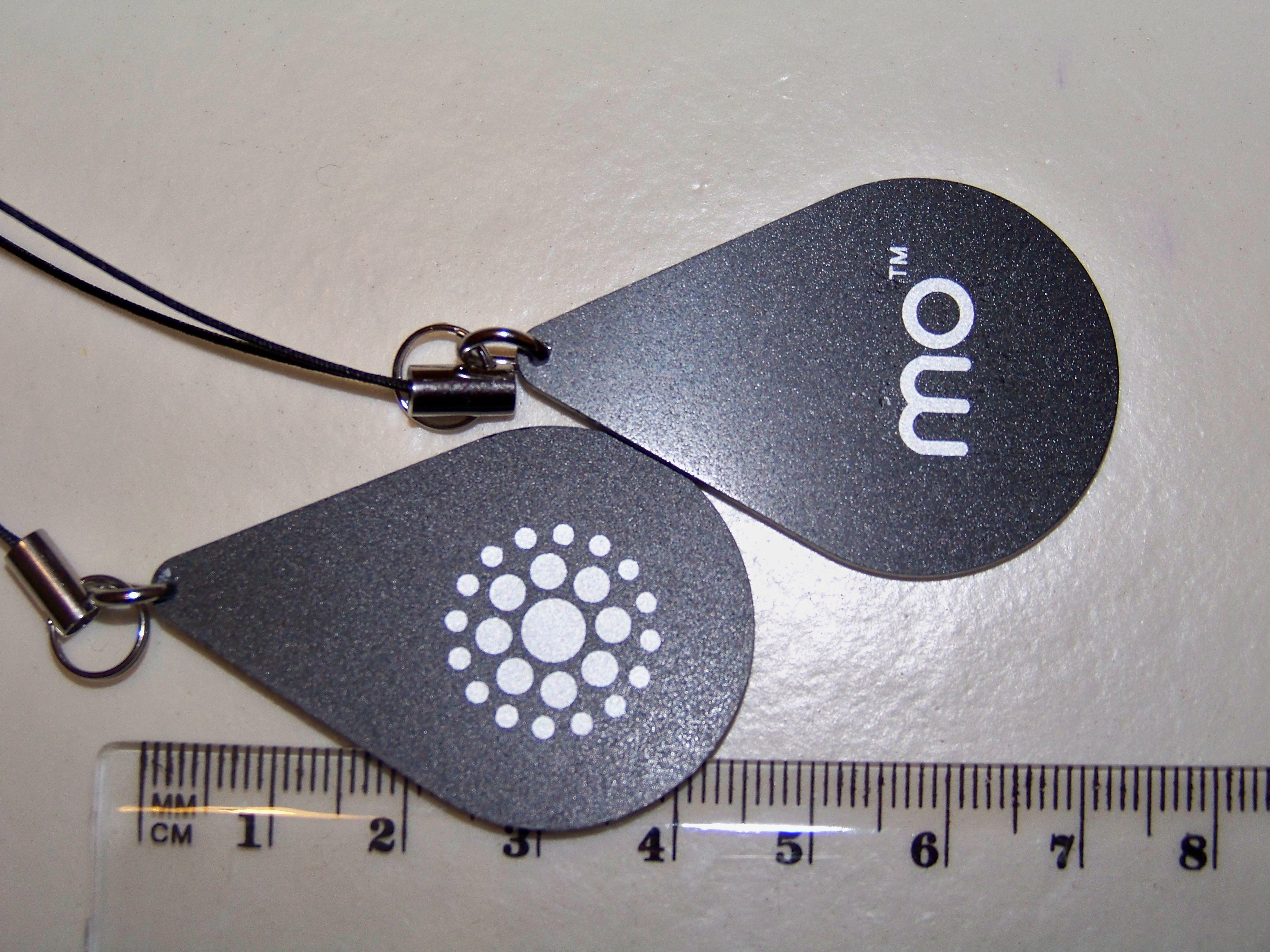
While shopping at Highpoint [1] today I noticed that they had a new loyalty system. It s called Mo Rewards [2] (for which the real web site is at MoCoMedia.net [3] which has no link from the main site because they didn t care enough about their web presence). The way that Mo works is that everyone gets a free RFID token similar to the two in the above photograph. The token comes with a pseudo-random seven letter code that you have to SMS to register it to your phone. You SMS the code and then receive a confirmation SMS. After that you can wave your token near a detector any time you visit the shopping center and you will receive three SMS messages with discount offers. You can send an SMS with your gender and birth-year to receive more targeted offers. To redeem offers you have to wave your token near a detector at the store so they know who is using the offers. Then of course once the database knows that you are a regular customer at a certain shop they can send you targeted advertising to entice you to buy from that shop on every visit. I presume that they have some sort of bidding system for adverts from the shops of a similar nature to the Google advertising. It s an interesting system and a lot better than most loyalty programs. One interesting thing about this is that high quality RFID devices are being given out for free. The tokens are quite solidly constructed and could be used for a variety of other purposes. I couldn t find anyone offering RFID tags at a reasonable price with a quick Google search (the cheapest was $75 for 100 tags - and they were the fragile ones used for marking stock in shops). So a hobbyist who wanted to do some RFID stuff could buy a cheap reader under one of the demo offers (where you get a reader and a small quantity of keys for a reasonable price) and then collect free RFID tokens from shopping centers. I expect that the number of people who would do such things is small enough to not be statistically significant and therefore not affect the business model. The tags are given out freely with no requirement that you must use them for the expected purpose (Mo Rewards) instead of using them for your own RFID work.

Alastair McKinstry: And now the fun begins ...

From the exoplanets mailing list:
A 1.9 Earth mass exoplanet (period 3 days)
has been detected around Gliese 581 (Mayor et al).
See
http://exoplanet.eu/planet.php?p1=Gl+581&p2=d
It is the lightest planet detected up to date around a main sequence star.
In addition, the planet Gliese 581 d has a revised period of 67 days,
bringing it in the habitable zone of the parent star.
Jean Schneider
Gliese 581d is now more solidly inside the habitable zone; it was considered before to be on the outer edge of the habitable zone (this work moves its believed semi-major axis from 0.25 AU to 0.22 AU). Gliese 581d was a maybe for habitability (see this Centauri dreams article for example), depending on cloud cover, etc. Now its definitely in. The new Gl 581e is beyond the classical habitable zone. These planets are quite close in: Rory Barnes and colleagues at Lunar and Planetary Laboratory in Arizona did some good work on the habitability of Gliese 581 c (paper online) and concluded that it would be tidally heated to such a degree it was probably never habitable. Such tidal heating might make Gl 581e habitable; time to run the model again. Correction: On reading the ESO Press release and paper (via) it appears that Gl 581e is inside the orbit of Gl 581b, and too close to the star to be habitable. To date, planets have been labelled b, c, d .. as they are discovered, and they've been discovered shortest-period first, so 'b' also meant closest to the star. Now Gl 581e is closest to the star, with a period of 3 days. Tags , , ,

Romain Beauxis: Liquidsoap now supports AAC+ encoding.

The plot Following many user requests , we were considering adding this format to the list of supported encoders. As for mp3 encoding, this support was subject to some legal issues. These issues were indeed the initial motivation for implementing icecast2 using the patent-free ogg codecs and container for streaming data. However, it seems that many users and net-radios are still asking for these formats. There can be several motivations for that, among which I can list the following major ones:
  • These formats are supported by more players and, in particular, embedded devices, which are the main target for net-radios
  • For the case of AAC+, the codec supports a very good audio quality for low bandwidths, such as 64 and 32kb/s.

The philosophy There is a constant complain from the open source communities about the use of patent-encumbered formats. In particular, those formats are not allowed in the Wikimedia commons and the corresponding encoders, in particular mp3 encoders, are not supported by for instance the Debian distribution. In a similar intent to push for a wider usage of patent-free codecs, the icecast project reimplemented its streaming server in order to use the ogg container and codecs. All these actions are very important. In particular, the support for ogg/theora video files in firefox, and hopefully the major HTML 5 browser is mainly the result of wikipedia refusing other video formats. Indeed, wikipedia is now a major website, and it would be insane to not support the videos there. However, I for myself do not like when these actions become too restrictive to the user. For this matter, I personally prefer freedom of choice among other considerations. Also, as a matter of fact, when trying to change the situation about these issues, one has to take into account the relative importance of each actor. It is because wikipedia is already huge that it has managed to change the things. Hence, in the case of net-radios, a majority of potential users are asking for AAC+ and other patent-encumbered formats. Although this is not the ideal situation we would like to see, there comes a point were either the free-software projects have something to propose, or the users will just go for a proprietary software, which is even worse to the situation. For this purpose, I believed it was important to add such support into our software. However, as you will see later, we do not implement ourself the encoding algorithm, but only added support for external encoders. That way, we simply let the user choose what he wants to use, but remain a patent-free and open-source software.

The implementation Since mp3 was, and still is, the major target for net-radios, icecast2 still has the possibility to stream this format. In fact, this format, as well as AAC+, does not have headers, such that it is possible to decode a stream at any point in it. Hence, in this case, icecast only acts as a proxy, and the only constraint is to send it the encoded data at real rate. Hence, the main library for streaming to icecast, libshout, parses the audio data that it receives, and schedules the streaming according to real rate. Additionally, it also supports a raw mechanism, for which there would be not such mangling. In the case of liquidsoap, we did not need this feature of the libshout since the software is already working in real time. Furthermore, the source connection protocol provides a content-type header field, which allows icecast to display the correct mime for the data format that is streamed. All in all, in order to send AAC+ data to icecast, one needs to send the correct mime-type in the source connection headers, and then send audio data at the correct rate. However, the libshout did not allow to set an arbitrary content-type header. Hence, I proposed a patch. It was proposed for an inclusion into main code, since I believe it is interesting not only for our specific need, but also for any other generic data format support. Although the patch was accepted, it was never committed. So, we decided to go on: since liquidsoap need not the real rate mangling feature of the libhsout, and since the source protocol is mainly a basic HTTP, we decided it was worth a custom implementation. This implementation was quite easy, thanks to the powerful capabilities of the OCaml language, and resulted in a custom implementation, ocaml-cry, that does the same as libshout, except that it does not control the rate of the data flow sent to the icecast server. Then, we also needed to support encoding data to the AAC format. After looking at the only available open-source encoder, aacplusenc, I tried to propose some changes in order to export a library and be able to use it in liquidsoap. However, these propositions did not make it into upstream's code, so I decided to also move on and use directly the encoder binary. Hence, using only the good old unix standard input/output mechanism, it is possible to start an encoder as a child process, send it the raw PCM data to its standard input and read the encoded data from its standard output. This lead to the development of the external output operators, which include output.icecast.external. Although this implementation was not easy, it now appears to work quite well in the current SVN version. In particular, the encoder process exits correctly for the FLAC encoder, which is needed in order to stream correctly, since the ogg container needs a restart for every track. Hence, we also gained support for encoding to the FLAC audio format, which was not binded for OCaml (yet ?) because its callback-driven API makes it tricky to do. Additionally, the support for external processes as encoders allows to use the lame binary for encoding mp3 data. Hence, liquidsoap can now encode mp3 data without the need of a built-in support for it. And, as always, the idea of using external processes spread over several other operators, including the support for external file and stream decoders, enabling support for many audio format (in fact almost all supported in linux, using mplayer). In conclusion, liquidsoap now has a fairly good support for AAC+ audio streaming, as well as a many new formats for decoding files and streams. It also support arbitrary formats and encoders using a custom variant of the output.icecast.external. Hence, provided your format can be decoded from any point in the stream, you should be able to use liquidsoap to stream data to icecast as soon as you have a binary which is able to receive RAW or WAV PCM data to its standard input and send encoded data to its standard output. As an illustration, here is an implementation of the output.icecast.aacplusenc:
def output.icecast.aacplusenc(
~id="output.icecast.aacplusenc",
~start=true,
~restart=true,
~restart_delay=3,
~host="localhost",
~port=8000,
~user="source",
~password="hackme",
~genre="Misc",
~url="http://savonet.sf.net/",
~description="OCaml Radio!",
~public=true,
~dumpfile="",
~mount="Use [name]",
~name="Use [mount]",
~protocol="http",
~aacplusenc="aacplusenc",
~bitrate=64,
~restart_on_crash=false,
~restart_on_new_track=false,
~restart_encoder_delay=3600,
~headers=[],
s)
# Metadata update is set by ICY with icecast
def aacplusenc_p(m)
"# aacplusenc - - # bitrate "
end
output.icecast.external(id=id,
process=aacplusenc_p,
bitrate=bitrate,
start=start,
restart=restart,
restart_delay=restart_delay,
host=host,
port=port,
user=user,
password=password,
genre=genre,
url=url,
description=description,
public=public,
dumpfile=dumpfile,
name=name,
mount=mount,
protocol=protocol,
header=true,
restart_on_crash=restart_on_crash,
restart_on_new_track=restart_on_new_track,
headers=headers,
restart_encoder_delay=restart_encoder_delay,
format="audio/aacp",
s)
end

Ingo Juergensmann: Finally finished!

This morning the build of the Parma Polyhedra Library (ppl) finished on my m68k buildd:

buildd@spice:~$ head logs/ppl_0.10-4_20090228-2019
Automatic build of ppl_0.10-4 on spice by sbuild/m68k 98
Build started at 20090228-2019
....
Finished at 20090421-0636
Build needed 1231:16:23, 1342752k disk space


Yes, the build needed 51 days 10:16:23 on that 68040/40, mostly because the build needed some amount of memory that exceeded the available 64 MB. Nevertheless I'm not the only one that wasn't very happy about the long build times of ppl as bug #517659 shows. It kept me away from shutting down the buildd for a long time to do the yearly clean up of the inner parts (removing the dust), but led to a rather high uptime as already reported. Now I can shutdown the machine for the clean up and attaching it to a UPS in the next days - after more than 510 days!

Next.

Previous.