Search Results: "ag"

1 November 2013

Petter Reinholdtsen: Browser plugin for SPICE (spice-xpi) uploaded to Debian

The SPICE protocol for remote display access is the preferred solution with oVirt and RedHat Enterprise Virtualization, and I was sad to discover the other day that the browser plugin needed to use these systems seamlessly was missing in Debian. The request for a package was from 2012-04-10 with no progress since 2013-04-01, so I decided to wrap up a package based on the great work from Cajus Pollmeier and put it in a collab-maint maintained git repository to get a package I could use. I would very much like others to help me maintain the package (or just take over, I do not mind), but as no-one had volunteered so far, I just uploaded it to NEW. I hope it will be available in Debian in a few days. The source is now available from http://anonscm.debian.org/gitweb/?p=collab-maint/spice-xpi.git;a=summary.

31 October 2013

Tanguy Ortolo: How to implement a Postfix spam trap?

Open envelope Spam trap Dear lazyweb, I am considering to implement spam traps and evaluate their efficiency. The idea as rather simple:
  1. publish some real-looking email addresses on websites, in ways that no human would use them to send legitimate mail, for instance in hidden texts, or in texts clearly stating they should not be used;
  2. when my mail server receives a message for one of these address, blacklist the originating server for some time so it cannot spam real recipients.
Practical implementation Now, I have to decide on how to implement that with my Postfix server. I am thinking of using fail2ban to simply detect attempts to send mail to my spam traps and blocking these spammers at iptables-level, but I do not think that will give me much tuning possibilities. Do you have other suggestions? Implementation details I also have to think about some specific details. Here is what I identified so far, do you think I am missing something that may be useful?

Daniel Pocock: init systems: what do users want?

The debate about Debian init system replacement continues and many developers have given their opinions. However, what do the users want? What type of features will make it easier for users to adopt and promote Debian and free software in general? Could this even help bring improvements to other distributions too? Some of the possibilities I've previously raised for discussion (and they are not specific to Debian by any means):
  • Better integration with tools for service monitoring (for example, so Nagios can automatically detect all the services on a system and the dependency relationship between them, avoiding any manual configuration of the monitoring system)
  • Better integration with tools for service management (for example, so Nagios can more easily restart a service without having to provide some action script developed by hand)
  • Better support for dependencies in clustering and distributed environments (e.g. Apache on host A should only start after MySQL is running on host B or host C)
  • Support for multiple instances of a service, each with separate configuration files on the same host
Some of the systems up for discussion go some of the way to addressing these types of requirements - none of them go all the way. What other requirements do people have? Should Debian wait a little longer and let the different solutions compete to offer more of these things before any decision is made? My own feeling is that Debian should not commit to something that will involve any loss in current features or support for ports and we should use this opportunity to find the best possible set of features for the future.

Russell Coker: Links October 2013

Wired has an interesting article by David Samuels about the Skybox, a small satellite (about the size of a bar fridge) that is being developed to provide cheap photographs of the Earth from low orbit [1]. Governments of major countries will probably try to limit what they do, but if they can prove that it s viable then someone else from a different jurisdiction will build similar satellites. Alice Dreger gave an interesting TED talk about the various ways that people can fall outside the expected genetic sex binary [2]. The short film Love is All You Need has an interesting way of showing the way that non-straight kids are treated [3]. The Guardian has an interesting article by Ranjana Srivastava about doctors and depression [4]. Don Marti wrote an interesting post about believing bullshit as a way of demonstrating group loyalty [5]. Zacqart Adam Green wrote an interesting article for the Falkvinge blog about the way that the Ouya gaming console can teach children about free software and political freedom [6]. Read more at www.ouya.tv [7]. It s a pity that the Ouya is not conveniently sold outside the US and the UK, with shipping it would probably cost a lot more than $99 in Australia. Tim Chevalier wrote an interesting post for Geek Feminism about the unintended consequences of some codes of conduct [8]. Tim Chevalier wrote an interesting Geek Feminism post about Wikipedia describing how the Neutral Point Of View is a way of representing the views of people in power [9]. Ramin Shokrizade wrote an interesting article for Gamasutra about the Free 2 Play (F2P) techniques [10]. The concept of F2P games is that the game can be installed for free but requires regular small payments to make the game easier, apparently some people pay $3000 per year or more. The TED blog has an interesting interview with Jack Andraka, a teenager who invented a new test for pancreatic cancer (and also ovarian and lung cancer) that is cheaper, faster, and less invasive than other tests [11]. The blog post also has a link to Jack s TED talk.

Jaldhar Vyas: If You Like Your Init System You Can Keep It

systemd.gov

30 October 2013

Daniel Kahn Gillmor: getting to TLS (STARTTLS HOWTO)

Many protocols today allow you to upgrade to TLS from within a cleartext version of the protocol. This often falls under the rubric of "STARTTLS", though different protocols have different ways of doing it. I often forget the exact steps, and when i'm debugging a TLS connection (e.g. with tools like gnutls-cli) i need to poke a remote peer into being ready for a TLS handshake. So i'm noting the different mechanisms here. lines starting with C: are from the client, lines starting with S: are from the server. many of these are (roughly) built into openssl s_client, using the -starttls option. Sometimes this doesn't work because the handshake needs tuning for a given server; other times you want to do this with a different TLS library. To use the techniques below with gnutls-cli from the gnutls-bin package, just provide the --starttls argument (and the appropriate --port XXX argument), and then hit Ctrl+D when you think it's ok to start the TLS negotiation. SMTP The polite SMTP handshake (on port 25 or port 587) that negotiates a TLS upgrade looks like:
C: EHLO myhostname.example
S: [...]
S: 250-STARTTLS
S: [...]
S: 250 [somefeature]
C: STARTTLS
S: 220 2.0.0 Ready to start TLS
<Client can begin TLS handshake>
IMAP The polite IMAP handshake (on port 143) that negotiates a TLS upgrade looks like:
S: OK [CAPABILITY IMAP4rev1 [...] STARTTLS [...]] [...]
C: A STARTTLS
S: A OK Begin TLS negotiation now
<Client can begin TLS handshake>
POP The polite POP handshake (on port 110) that negotiates a TLS upgrade looks like:
S: +OK POP3 ready
C: STLS
S: +OK Begin TLS 
<Client can begin TLS handshake>
XMPP The polite XMPP handshake (on port 5222 for client-to-server, or port 5269 for server-to-server) that negiotiates a TLS upgrade looks something like (note that the domain requested needs to be the right one):
C: <?xml version="1.0"?><stream:stream to="example.net"
C:  xmlns="jabber:client" xmlns:stream="http://etherx.jabber.org/streams" version="1.0">
S: <?xml version='1.0'?>
S: <stream:stream
S:  xmlns:db='jabber:server:dialback'
S:  xmlns:stream='http://etherx.jabber.org/streams'
S:  version='1.0'
S:  from='example.net'
S:  id='d34edc7c-22bd-44b3-9dba-8162da5b5e72'
S:  xml:lang='en'
S:  xmlns='jabber:server'>
S: <stream:features>
S: <dialback xmlns='urn:xmpp:features:dialback'/>
S: <starttls xmlns='urn:ietf:params:xml:ns:xmpp-tls'/>
S: </stream:features>
C: <starttls xmlns="urn:ietf:params:xml:ns:xmpp-tls" id="1"/>
S: <proceed xmlns='urn:ietf:params:xml:ns:xmpp-tls'/>
<Client can begin TLS handshake>
NNTP RogerBW (in the comments below) points out that NNTP has TLS support:
C: CAPABILITIES
S: [...]
S: STARTTLS
S: [...]
S: .
C: STARTTLS
S: 382 Continue with TLS negotiation
PostgreSQL I got mail from James Cloos suggesting how to negotiate an upgrade to TLS over the PostgreSQL RDBMS. He points to the protocol docs, and in particular, to multiple protocol flow documents, and SSLRequest and StartupMessage chunks of the protocol spec (and clarification that data is sent in network byte order). It won't work in a text-mode communication, but it's worth noting here anyway: The client starts by sending these eight octets:
0x00 0x00 0x00 0x08 0x04 0xD2 0x16 0x2F
and the server replies with 'S' for secure or 'N' for not. If the reply is S, TLS negotiation follows. The message represents int32(8) specifying that there are 8 octets and int16(1234),int16(5678). All sent in network order. (The non-TLS case starts with a similar message with int16(3),int16(0) for protocol version 3.0. Starttls is essentially pg protocol version 1234.5678.) what else? I don't know (but would like to) how to do: If you know other mechanisms, or see bugs with the simple handshakes i've posted above, please let me know either by e-mail or on the comments here. Other interesting notes: RFC 2817, a not-widely-supported mechanism for upgrading to TLS in the middle of a normal HTTP session.Tags: gnutls, imap, pop, postgresql, smtp, starttls, tls, xmpp

Joey Hess: license monads

This could have been a blog post about toothbrushes for monkeys, which I seem to have dreamed about this morning. But then I was vaguely listening to the FAIFCast in the car, and I came up with something even more esoteric to write about! License monads would allow separating parts of code that are under different licenses, in a rigorous fashion. For example, we might have two functions in different license monads:
foo :: String -> GPL String
bar :: Char -> BSD Char
Perhaps foo needs to use bar to calculate its value. It can only do so if there's a way to lift code in the BSD monad into the GPL monad. Which we can legally write, since the BSD license is upwards-compatable with the GPL:
liftGPL :: BSD a -> GPL a
On the other hand, there should be no way provided to lift the GPL monad into the BSD monad. So bar cannot be written using code from foo, which would violate foo's GPL license. Perhaps the reason I am thinking about this is that the other day I found myself refactoring some code out of the git-annex webapp (which is AGPL licensed) and into the git-annex assistant (which is GPL licensed). Which meant I had to relicense that code. Luckily that was easy to do legally speaking, since I am the only author of the git-annex webapp so far, and own the whole license of it. (Actually, it's only around 3 thousand lines of code, and another thousand of html.) It also turned out to be easy to do the refactoring, technically speaking because looking at the code, I realized I had accidentially written it in the wrong monad; all the functions were in the webapp's Handler monad, but all of them used liftAnnex to actually do their work in the Annex monad. If that had not been the case, I would not have been able to refactor the code, at least not without entirely rewriting it. It's as if I had accidentially written:
foo :: String -> GPL String
foo = mapM (liftGPL . bar)
Which can be generalized to:
foo :: String -> BSD String
foo = mapM bar
I don't think that license monads can be realistically used in the current world, because lawyers and math often don't mix well. Lawyers have, after all, in the past written laws re-defining pi to be 3. Still, license monads are an interesting way to think about things for myself. They capture how my code and licenses are structured and allow me to reason about it on a more granular level than the licences of individual files. (I have a vague feeling someone else may have written about this idea before? Perhaps I should have been blogging about monkey toothbrushes after all...)

Tanguy Ortolo: Beware of symlinks when testing a file existence

A strange problem Yesterday, I was reported a funny problem with the dokuwiki Debian package's postinst script, which contains a piece of shell script similar to that:
# Check the destination does not already exist
if [ ! -e /the/destination ]
then
    ln -s /some/file /the/destination
fi
It was failing with that message: ln: failed to create symbolic link '/the/destination': File exists. Even though I had just tested it did not exist!
View of a comete colliding with the Earth

Collision detected

The explanation The reason of that failure is quite simple, but easy to forget: test(1), aka [, uses stat(2), which dereferences symlinks when testing for file existence! So, test ! -e /the/destination does not mean check there is no file there but rather check there is either no file or only a dead symlink . So, the correct way to write such a piece of code is:
# Check there is not already a file or a (dead) symlink
if [ ! -e /the/destination -a ! -h /the/destination ]
then
    ln -s /some/file /the/destination
fi

Matthew Palmer: How to deal with the "package gcc: " problem in Puppet

In a comment to yesterday s post on why your Puppet module sucks, Warren asks what can be done about the problem of multiple modules needing to include the same package (gcc being the most common example I m yet to come across). As I stated previously, there is no sane, standardised way for multiple independent modules to cooperate to ensure that certain packages are installed for their cooperative use. If it wasn t already obvious, I consider this to be a significant failing in Puppet, and one which essentially renders any attempt at public, wide-scale reuse of Puppet modules impossible. Software packages are such a fundamental part of system management today that it is rare for a module not to want to interact with them in some way. Without strong leadership from Puppet Labs, or someone core to the project who s willing to be very noisy and obnoxious on the subject, the issue is fundamentally unsolveable, because it requires either deep (and non-backwards-compatible) changes to how Puppet works at a core level, or it needs cooperation from everyone who writes Puppet modules for public consumption (to use a single, coordinated approach to common packages). The approaches that I ve seen people advocate using, or that I ve considered myself, roughly fall into the following camps.

Put your package into a class in your module Absofrickinglutely useless, because the elementary package resources you end up creating will still conflict with other modules package resources. Anyone who suggests this can be permanently ignored, as they don t understand the problem being solved.

Use a globally common module of classes representing common packages This could work, if you could get everyone who writes modules to use it (see someone willing to be very noisy and obnoxious ). Practically speaking, anyone who suggests this doesn t understand human nature. I don t see this actually happening any time soon.

Use the defined() function everywhere By wrapping all your package resources in if !defined(Package["foo"]) blocks, you can at least stop your module from causing explosions. What it doesn t do is make sure that the various definitions of the package resource are congruent (imagine if one was package "gcc": ensure => absent ). In order to safely avoid explosion, everyone would have to follow this approach, which (in the worst case) reduces the problem to the globally common module of classes. However, it s the least-worst approach I can practically consider. At least your module won t be the cause of explosions, and realistically no module s going to ask for gcc to be removed (or, if they are, you ll quickly find them and kill them). I ve seen calls from Puppet core dev team members to deprecate and remove the defined() function entirely. Given the complete lack of alternatives, this is a disturbing illustration of just how out of touch they are from the unfortunate realities of practical Puppetry.

Use virtual resources This is yet another variant of the common class technique that would require everyone, everywhere, to dance to the same tune. It has all the same problems, and hence gets a big thumbs-down from me.

Use singleton_packages This module is a valiant attempt to work around the problem, but practically speaking is no better than using defined() because again, if a module that isn t using singleton_packages specifies package "gcc": ensure => absent , you re going to end up with assplosion. The mandatory dependency on hiera doesn t win me over, either (I m a hiera-skeptic, for reasons which I might go into some other time).

Use only modules from a single source This is the solution that I use myself, if that s any recommendation As a result of pretty much every publically-available Puppet module sucking for one reason or another, I do not, currently, have any externally-written Puppet modules in the trees that I use. Every module (158, at current count) has been written by someone in the sysadmin team at $DAYJOB, to our common standards. This means that I can coordinate use of package resources, using our module of common classes where appropriate, or refactor modules to separate concerns appropriately. If you re wondering why we don t have all of these 158 modules available publically, well, we have a few of them up, but yes, the vast majority of them aren t publically available. Some of them suck mightily, while many others are just too intertwined with other modules to be able to use on their own, and we don t want to release crap code there s far too much of that out there already.

Matthew Palmer: How to deal with the "package gcc: " problem in Puppet

In a comment to yesterday s post on why your Puppet module sucks, Warren asks what can be done about the problem of multiple modules needing to include the same package (gcc being the most common example I m yet to come across). As I stated previously, there is no sane, standardised way for multiple independent modules to cooperate to ensure that certain packages are installed for their cooperative use. If it wasn t already obvious, I consider this to be a significant failing in Puppet, and one which essentially renders any attempt at public, wide-scale reuse of Puppet modules impossible. Software packages are such a fundamental part of system management today that it is rare for a module not to want to interact with them in some way. Without strong leadership from Puppet Labs, or someone core to the project who s willing to be very noisy and obnoxious on the subject, the issue is fundamentally unsolveable, because it requires either deep (and non-backwards-compatible) changes to how Puppet works at a core level, or it needs cooperation from everyone who writes Puppet modules for public consumption (to use a single, coordinated approach to common packages). The approaches that I ve seen people advocate using, or that I ve considered myself, roughly fall into the following camps.

Put your package into a class in your module Absofrickinglutely useless, because the elementary package resources you end up creating will still conflict with other modules package resources. Anyone who suggests this can be permanently ignored, as they don t understand the problem being solved.

Use a globally common module of classes representing common packages This could work, if you could get everyone who writes modules to use it (see someone willing to be very noisy and obnoxious ). Practically speaking, anyone who suggests this doesn t understand human nature. I don t see this actually happening any time soon.

Use the defined() function everywhere By wrapping all your package resources in if !defined(Package["foo"]) blocks, you can at least stop your module from causing explosions. What it doesn t do is make sure that the various definitions of the package resource are congruent (imagine if one was package "gcc": ensure => absent ). In order to safely avoid explosion, everyone would have to follow this approach, which (in the worst case) reduces the problem to the globally common module of classes. However, it s the least-worst approach I can practically consider. At least your module won t be the cause of explosions, and realistically no module s going to ask for gcc to be removed (or, if they are, you ll quickly find them and kill them). I ve seen calls from Puppet core dev team members to deprecate and remove the defined() function entirely. Given the complete lack of alternatives, this is a disturbing illustration of just how out of touch they are from the unfortunate realities of practical Puppetry.

Use virtual resources This is yet another variant of the common class technique that would require everyone, everywhere, to dance to the same tune. It has all the same problems, and hence gets a big thumbs-down from me.

Use singleton_packages This module is a valiant attempt to work around the problem, but practically speaking is no better than using defined() because again, if a module that isn t using singleton_packages specifies package "gcc": ensure => absent , you re going to end up with assplosion. The mandatory dependency on hiera doesn t win me over, either (I m a hiera-skeptic, for reasons which I might go into some other time).

Use only modules from a single source This is the solution that I use myself, if that s any recommendation As a result of pretty much every publically-available Puppet module sucking for one reason or another, I do not, currently, have any externally-written Puppet modules in the trees that I use. Every module (158, at current count) has been written by someone in the sysadmin team at $DAYJOB, to our common standards. This means that I can coordinate use of package resources, using our module of common classes where appropriate, or refactor modules to separate concerns appropriately. If you re wondering why we don t have all of these 158 modules available publically, well, we have a few of them up, but yes, the vast majority of them aren t publically available. Some of them suck mightily, while many others are just too intertwined with other modules to be able to use on their own, and we don t want to release crap code there s far too much of that out there already.

29 October 2013

Dirk Eddelbuettel: Rcpp 0.10.6

A new maintenance release 0.10.6 of Rcpp is now on the CRAN network for GNU R; binaries for Debian have been uploaded as well. This version ties up a number of smaller loose ends, but also adds a few new things, particularly John's new exposeClass. Details are as usual in the NEWS extract below, and also in the ChangeLog file in the package and on the Rcpp Changelog page.
Changes in Rcpp version 0.10.6 (2013-10-27)
  • Changes in Rcpp API:
    • The function exposeClass takes a description of the constructors, fields and methods to be exposed from a C++ class, and writes C++ and R files in the package. Inherited classes can be dealt with, but require data type information. This approach avoids hand-coding module files.
    • Two missing is<>() templates for CharacterVector and CharacterMatrix have been added, and some tests for is_na() and is_finite() have been corrected thanks to Thomas Tse.
  • Changes in R code:
    • Export linking helper function LdFlags as well as RcppLdFlags.
    • Function Rcpp.package.skeleton() no longer passes a namespace argument on to package.skeleton()
  • Changes in R setup:
    • Raise requirement for R itself to be version 3.0.0 or later as needed by the vignette processing
  • Changes in Rcpp attributes:
    • sourceCpp now correctly binds to Rtools 3.0 and 3.1
Thanks to CRANberries, you can also look at a diff to the previous release 0.10.5. As always, even fuller details are on the Rcpp Changelog page and the Rcpp page which also leads to the downloads, the browseable doxygen docs and zip files of doxygen output for the standard formats. A local directory has source and documentation too. Questions, comments etc should go to the rcpp-devel mailing list off the R-Forge page

This post by Dirk Eddelbuettel originated on his Thinking inside the box blog. Please report excessive re-aggregation in third-party for-profit settings.

Pau Garcia i Quiles: FOSDEM 2014 Desktops DevRoom Call for Talks

FOSDEM is one of the largest gatherings of Free Software contributors in the world and happens each February in Brussels (Belgium). One of the tracks will be the Desktops DevRoom (formerly known as CrossDesktop DevRoom ), which will host Desktop-related talks. We are now inviting proposals for talks about Free/Libre/Open-source Software on the topics of Desktop development, Desktop applications and interoperability amongst Desktop Environments. This is a unique opportunity to show novel ideas and developments to a wide technical audience. Topics accepted include, but are not limited to: Enlightenment, Gnome, KDE, Unity, XFCE/Razor, Windows, Mac OS X, general desktop matters, applications that enhance desktops and web (when related to desktop). Talks can be very specific, such as developing mobile applications with Qt Quick; or as general as predictions for the fusion of Desktop and web in 5 years time. Topics that are of interest to the users and developers of all desktop environments are especially welcome. The FOSDEM 2013 schedule might give you some inspiration. Please include the following information when submitting a proposal: The deadline for submissions is December 14th 2013. FOSDEM will be held on the weekend of 1-2 February 2014. Please use the following website to submit your proposals: https://penta.fosdem.org/submission/FOSDEM14 You can also join the devroom s mailing list, which is the official communication channel for the DevRoom: desktops-devroom@lists.fosdem.org (subscription page for the mailing list) The Desktops DevRoom 2014 Organization Team

Soeren Sonnenburg: Shogun Toolbox Version 3.0 released!

Dear all, we are proud to announce the 3.0 release of the Shogun Machine-Learning Toolbox. This release features the incredible projects of our 8 hard-working Google Summer of Code students. In addition, you get other cool new features as well as lots of internal improvements, bugfixes, and documentation improvements. To speak in numbers, we got more than 2000 commits changing almost 400000 lines in more than 7000 files and increased the number of unit tests from 50 to 600. This is the largest release that Shogun ever had! Please visit http://shogun-toolbox.org/ to obtain Shogun. News Here is a brief description of what is new, starting with the GSoC projects, which deserve most fame: Screenshots Everyone likes screenshots. Well, we have got something better! All of the above projects (and more) are now documented in the form of IPython notebooks, combining machine learning fundamentals, code, and plots. Those are a great looking way that we chose to document our framework from now on. Have a look at them and feel free to submit your use case as a notebook! FGM.html GMM.html HashedDocDotFeatures.html LMNN.html SupportVectorMachines.html Tapkee.html bss_audio.html bss_image.html ecg_sep.html gaussian_processes.html logdet.html mmd_two_sample_testing.html The web-demo framework has been integrated into our website, go check them out. Other changes We finally moved to the Shogun build process to CMake. Through GSoC, added a general clone and equals methods to all Shogun objects, and added automagic unit-testing for serialisation and clone/equals for all classes. Other new features include multiclass LDA, and probability outputs for multiclass SVMs. For the full list, see the NEWS. Workshop Videos and slides In case you missed the first Shogun workshop that we organised in Berlin last July, all of the talks have been put online. Shogun in the Cloud As setting up the right environment for shogun and installing it was always one of the biggest problems for the users (hence the switching to CMake), we have created a sandbox where you can try out shogun on your own without installing shogun on your system! Basically it's a web-service which give you access to your own ipython notebook server with all the shogun notebooks. Of course you are more than welcome to create and share your own notebooks using this service! *NOTE*: This is a courtesy service created by Shogun Toolbox developers, hence if you like it please consider some form of donation to the project so that we can keep up this service running for you. Try shogun in the cloud. Thanks The release has been made possible by the hard work of all of our GSoC students, see list above. Thanks also to Thoralf Klein and Bj rn Esser for the load of great contributions. Last but not least, thanks to all the people who use Shogun and provide feedback. S ren Sonnenburg on behalf of the Shogun team (+ Viktor Gal, Sergey Lisitsyn, Heiko Strathmann and Fernando Iglesias)

Soeren Sonnenburg: Shogun goes cloud

Shogun goes cloud. Try out http://cloud.shogun-toolbox.org to interactively play with machine learning algorithms or try any of the interactive demos. The SHOGUN Machine Learning Toolbox is a collection of algorithms designed for unified learning for a broad range of feature types and learning settings, like classification, regression, or explorative data analysis. For more information visit http://www.shogun-toolbox.org.

Eddy Petri&#537;or: The stupidest trend in laptop design is...

... numpads on laptop keyboards.

Just because a very, very, very restricted segment of the population is into accounting or other jobs needing frequent numeric input, almost all laptop manufacturers feel the stupid urge to place a numpad on laptops with screens over 14''.

Reasons why a numpad on a laptop is a bad idea:
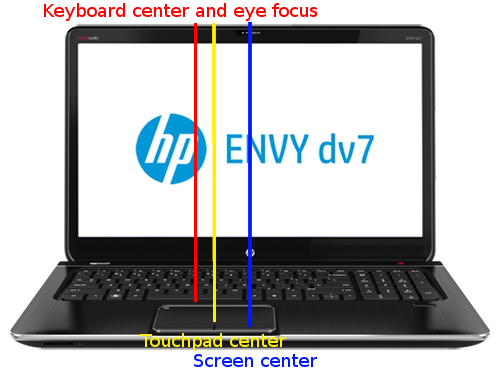
The numpad forces eye focus and users' hands to be way off center.
The touchpad looks as if it was thrown to the side by accident
Note how the designer tried to offset the misalignment forced
by the numpad by "positioning" the touchpad closer to center,
but not in line with the space bar (and the keyboard)

Without numpad the position is almost perfect!
The symmetry of the laptop improves on the design.
Notice how the touchpad is also centered.


What's worse is that most resellers do not have filters for this particular mis-feature, so you can't easily exclude laptops corrupted by this horrendous idea.

So, if you're a laptop designer, please stop putting numpads on laptops.

It will make for better looking laptops and you'll have the opportunity to be the one stating the obvious: numpads are generally useless! Even on desktop keyboards!

Matthew Palmer: Why Your Puppet Module Sucks

I use Puppet a lot at work, and I use a lot of modules written by other people, as well as writing quite a number of my own. Here s a brief list of reasons why I might say that your module sucks.

1. You use global variables This would have to be both the most common idiom that just makes my teeth grind. Defined types exist for a bloody reason. Global variables make it incredibly difficult to reason about what is going to happen when I use a particular global variable (see also You don t write documentation ), and I get no feedback if I typo a global variable name. Add in a healthy heaping of lack of namespacing , and you ve basically guaranteed that your module will be loudly cursed.

2. You use parameterised classes I ve never managed to work out why parameterised classes even exist. They ve got all the problems of regular classes, as well as all the problems of types. There was a fantastic opportunity with parameterised classes to fix some of the really annoying things about regular resources, such as doing conflict checking on parameters and only barfing if there was a conflict but no, if you define the same class twice, even with identical parameters, Puppet will smack you on the hand and take away your biscuit. FFFFFFUUUUUUUUUUUU-

3. You fail at using fail() Modules are supposed to be reusable. That s their whole reason for existence. One of the benefits of Puppet is that you can provide an OS-independent interface for configuring something. However, unless you re some absolute God of cross-platform compatibility, you will only be writing your module to support those OSes or distros that you, personally, care about. That s cool if you don t know anything about OS X, you probably shouldn t be guessing at how to support something on that platform anyway. However, when you do have some sort of platform-specific code, for the love of pete, have a default or else clause that calls fail() with a useful and descriptive error message, to indicate clearly that you haven t included support for whatever environment the module s being used in. Failing to do this can cause some really spectacular explosions, because the rest of your module assumes that certain things have been done in the platform-specific code, and when it hasn t hoo boy.

4. You don t write documentation Yes, it isn t easy to write good documentation. I know that. But without documentation, your module is going to be practically unuseable. So if you don t have docs, your module is basically useless. Well done, you.

5. You have undeclared dependencies This also includes declaring your dependencies in a non-machine-parseable manner; I m not going to grovel through your README for the list of other modules I might need; I have machines to do that kind of thing for me. If I try to use your module, and it craps out on trying to reference some sort of type or class that doesn t appear at all related to your module, I will call into question your ancestry, and die a little more inside.

6. You use common packages without even trying to avoid the pitfalls OK, to be fair this is, ultimately, Puppet s grand fuckup, not yours, but you at least need to pretend to care There is no sane, standardised way in Puppet for multiple modules to install the same package. Let s say that a module I write needs to have a compiler. So I package "gcc": . Then someone else s module also wants a compiler, so it also package "gcc": . FWAKOOM! says Puppet. What the fuck? says the poor sysadmin, who just wanted both a virtualenv and an RVM environment on the one machine. Basically, using packages is going to make your module suck. Does that mean that this makes wide distribution of a large repository of modules written by different people nigh-on impossible? Yes. Fantastic.

Matthew Palmer: Why Your Puppet Module Sucks

I use Puppet a lot at work, and I use a lot of modules written by other people, as well as writing quite a number of my own. Here s a brief list of reasons why I might say that your module sucks.

1. You use global variables This would have to be both the most common idiom that just makes my teeth grind. Defined types exist for a bloody reason. Global variables make it incredibly difficult to reason about what is going to happen when I use a particular global variable (see also You don t write documentation ), and I get no feedback if I typo a global variable name. Add in a healthy heaping of lack of namespacing , and you ve basically guaranteed that your module will be loudly cursed.

2. You use parameterised classes I ve never managed to work out why parameterised classes even exist. They ve got all the problems of regular classes, as well as all the problems of types. There was a fantastic opportunity with parameterised classes to fix some of the really annoying things about regular resources, such as doing conflict checking on parameters and only barfing if there was a conflict but no, if you define the same class twice, even with identical parameters, Puppet will smack you on the hand and take away your biscuit. FFFFFFUUUUUUUUUUUU-

3. You fail at using fail() Modules are supposed to be reusable. That s their whole reason for existence. One of the benefits of Puppet is that you can provide an OS-independent interface for configuring something. However, unless you re some absolute God of cross-platform compatibility, you will only be writing your module to support those OSes or distros that you, personally, care about. That s cool if you don t know anything about OS X, you probably shouldn t be guessing at how to support something on that platform anyway. However, when you do have some sort of platform-specific code, for the love of pete, have a default or else clause that calls fail() with a useful and descriptive error message, to indicate clearly that you haven t included support for whatever environment the module s being used in. Failing to do this can cause some really spectacular explosions, because the rest of your module assumes that certain things have been done in the platform-specific code, and when it hasn t hoo boy.

4. You don t write documentation Yes, it isn t easy to write good documentation. I know that. But without documentation, your module is going to be practically unuseable. So if you don t have docs, your module is basically useless. Well done, you.

5. You have undeclared dependencies This also includes declaring your dependencies in a non-machine-parseable manner; I m not going to grovel through your README for the list of other modules I might need; I have machines to do that kind of thing for me. If I try to use your module, and it craps out on trying to reference some sort of type or class that doesn t appear at all related to your module, I will call into question your ancestry, and die a little more inside.

6. You use common packages without even trying to avoid the pitfalls OK, to be fair this is, ultimately, Puppet s grand fuckup, not yours, but you at least need to pretend to care There is no sane, standardised way in Puppet for multiple modules to install the same package. Let s say that a module I write needs to have a compiler. So I package "gcc": . Then someone else s module also wants a compiler, so it also package "gcc": . FWAKOOM! says Puppet. What the fuck? says the poor sysadmin, who just wanted both a virtualenv and an RVM environment on the one machine. Basically, using packages is going to make your module suck. Does that mean that this makes wide distribution of a large repository of modules written by different people nigh-on impossible? Yes. Fantastic.

28 October 2013

Keith Packard: Quaternions

Tracking Orientation with Quaternions I spent the flight back from china and the weekend adding orientation tracking to AltOS. I d done a bit of research over the last year or so working out the technique, but there s always a big step between reading about something and actually doing it. I know there are a pile of quaternion articles on the net, but I wanted to write down precisely what I did, mostly as a reminder to myself in the future when I need to go fix the code Quaternion Basics Quaternions were invented by Sir William Rowan Hamilton around 1843. It seems to have started off as a purely theoretical piece of math, extending complex numbers from two dimensions to four by introducing two more roots of -1 and defining them to follow:
i  = j  = k  = ijk = -1
Use these new roots to create numbers with four real components, three of which are multiplied by our three roots:
r + ix + jy + kz
With a bit of algebra, you can figure out how to add and multiply these composite values, using the above definition to reduce and combine terms so that you end up with a set which is closed under the usual operations. Then we add a few more definitions, like the conjugate:
q = (r + ix + jy + kz)
q* = (r - ix - jy - kz)
The norm:
  q   =  (qq*) =  (r  + x  + y  + z )
u is a unit quaternion if its norm is one:
  u   = 1
Quaternions and Rotation Ok, so we ve got a cute little 4-dimensional algebra. How does this help with our rotation problem? Let s figure out how to rotate a point in space by an arbitrary rotation, defined by an axis of rotation and an amount in radians. First, take a vector, v , and construct a quaternion, q as follows:
q = 0 + ivx + jvy + kvz
Now, take a unit quaternion u , which represents a vector in the above form along the axis of rotation, and a rotation amount, , and construct a quaternion r as follows:
r = cos  /2 + u sin  /2
With a pile of algebra, you can show that the rotation of q by r is:
q  = r q r*
In addition, if you have two rotations, s and r , then the composite rotation, t , a rotation by r followed by s can be computed with:
q  = s (r q r*) s*
    = (sr) q (r*s*)
    = (sr) q (sr)*
t   = s r
q  = t q t*
That s a whole lot simpler than carrying around a 3x3 matrix to do the rotation, which makes sense as a matrix representation of a rotation has a bunch of redundant information, and it avoids a pile of problems if you try to represent the motion as three separate axial rotations performed in sequence. Computing an initial rotation Ok, so the rocket is sitting on the pad, and it s tilted slightly. I need to compute the initial rotation quaternion based on the accelerometer readings which provide a vector, g pointing up. Essentially, I want to compute the rotation that would take g and make it point straight down. Construct a vector v , which does point straight up:
g = (0, ax, ay, az) / norm(0, ax, ay, az)
v = (0, 0, 0, 1)
G is normalized so that it is also a unit vector. The cross product between g and v will be a vector normal to both, which is the axis of rotation. As both g and v are unit vectors, the length of their cross product will be sin
a = g   v
  = u sin  
The angle between g and v is the dot product of the two vectors, divided by the length of both. As both g and v are unit vectors, the product of their lengths is one, so we have
cos   = g   v
For our quaternion, we need cos /2 and sin /2 which we can get from the half-angle formulae:
cos  /2 =  ((1 + cos  )/2)
sin  /2 =  ((1 - cos  )/2)
Now we construct our quaternion by factoring out sin from the a and:
q = cos  /2 + u sin   sin  /2 / sin  
Updating the rotation based on gyro readings The gyro sensor reports the rate of rotation along all three axes, to compute the change in rotation, we take the instantaneous sensor value and multiply it by the time since the last reading and divide by two (because we want half angles for our quaternions). With the three half angles, (x,y,z), we can compute a composite rotation quaternion:
   cos x cos y cos z + sin x sin y sin z +
i (sin x cos y cos z - cos x sin y sin z) +
j (cos x sin y cos z + sin x cos y sin z) +
k (cos x cos y sin z - sin x sin y cos z)
Now we combine this with the previous rotation to construct our current rotation. Doing this faster If we read our sensor fast enough that the angles were a small fraction of a radian, then we could take advantage of this approximation:
sin x   x
cos x   1
that simplifies the above computation considerably:
1 + xyz + i (x - yz) + j (y + xz) + k (z - xy)
And, as x, y, z 1, we can further simplify by dropping the quadratic and cubic elements as insignificant:
1 + ix + jy + kz
This works at our 100Hz sampling rate when the rotation rates are modest, but quick motions will introduce a bunch of error. Given that we ve got plenty of CPU for this task, there s no reason to use this simpler model. If we did crank up the sensor rate a bunch, we might reconsider. Computing the Current Orientation We have a rotation quaternion which maps the flight frame back to the ground frame. To compute the angle from vertical, we simply take a vector in flight frame along the path of flight (0, 0, 0, 1) and rotate that back to the ground frame:
g = r (0 0 0 1) r*
That will be a unit vector in ground frame pointing along the axis of the rocket. The arc-cosine of the Z element will be the angle from vertical. Results All of the above code is checked into the AltOS git repository I added a test mode to the firmware that just dumps out the current orientation over the USB link which lets you play with rotating the board to see how well the system tracks the current orientation. There s a bit of gyro drift, as you d expect, but overall, the system tracks the current orientation within less than a tenth of a degree per second. Even with all of this computation added, the whole flight software is consuming less than 7% of the STM32L CPU time.

Matthias Klumpp: Tanglu update & release plans

Long time with no article about Tanglu! This was mainly because we were busy with the project itself, improving various aspects of the distribution. So, here is a new summary on what has been done and what you can expect from the first release ;-) Tanglu QA We further improved the automatic archive QA. There is now qa.tanglu.org, which constantly monitors the number of uninstallable or unbuildable packages in the Tanglu suites. It also provides tanglu-platform-smallstatus information on the metapackage generator, which helps us in finding out which packages are available on the live-cds. Furthermore, information about the staging->devel migration process is provided, to answer the question why a package does not migrate (this still needs some improvements, but it is being worked on). We also use some code from Ubuntu to monitor package versions in Debian and upstream, which helps to see if others have released newer versions of software shipped with Tanglu. This already resulted in many improvements: The Tanglu Aequorea suite does not contain unbuildable packages (at least not due to build-dependency changed), and all live-cds are working well. We will soon migrate the archive to a new server, which frees some server capacities we can use for automated QA and things like automatic live-CD building. Live-CDs, Installer, Alpha-Releases We currently don t do Alpha-Releases of Tanglu, but we create Live-CD snapshots of Tanglu, which are available at releases.tanglu.org (or mirror1, mirror2). These snapshots still have issues and are just early previews. They also ship without and installer, we are still working on that part. Please note that CD more or less means DVD or USB-Stick right now (and this won t change the expected image size will be around 800MB). Release Planning I am happy to announce that we will do a release this year, most likely in December. But what can you expect from the release? KDE 4.11kde-konqui We will ship with KDE 4.11, which will be the only desktop we officially support so far. The reason is simply lack of manpower we could promise to support more, but that would just be not realistic for the small team. So we focus on KDE (Plasma Shells) right now, and try to make it awesome. Also, the team consists mostly of KDE people right now, which contributed to that decision ;-) . If you want to try Tanglu, right now the KDE live-images are the best to try it out. GNOME 3.8 gnome-logoWe will also provide images with GNOME. The problem with GNOME is, that the GNOME team does not have enough manpower to maintain the whole desktop or to upgrade it to the latest version (it is essentially just me looking at it from time to time). So GNOME will be available in a preview state. We invite everyone with GNOME knowledge to join the project and help improving Tanglu-GNOME GNOMErs, we want you! systemd >= 204 We ship with systemd by default, which works nicely so far, although more testing needs to be done. The logind service will be used to replace ConsoleKit, if we manage to get everything in place and working in time (if there are issues, we might switch back to CK for one release). There are some plans to use a higher systemd version, due to some improvements made there, but if this will be done is still unclear (Debian will most likely stick to 204 for some time, because with systemd > 205, running it as pid 1 will be mandatory to use logind (and Debian is just in the process to decide which init-system we will use there)). Systemd will run in SysVInit compatibility mode for most of the available services. This will improve in later Tanglu releases. Of course, systemd is usable, even if not every init-script has been converted to a service file. It just has an impact on startup times, so Tanglu will not be the distributions with the fastest startup times (yet ;-) ). Debian Package Mixdebian_logo1 Tanglu consists mostly of packages from Debian Testing (Jessie), but we take full advantage of the Debian archive, so you will also find package versions from Unstable or even Experimental (where it made sense). A very small portion of packages has also been merged with Ubuntu. Although stuff has been changed, the incompatibilities with Debian are almost zero, so if you are installing Tanglu, it will currently feel like an more up-to-date Debian Testing with some extras. Still, the differences are large enough that upgrading a Debian system to Tanglu might result in some issues. Installer Right now, the installer is a major field of work. Tanglu will most likely ship with the Debian-Installer, because it is the easiest thing to do right now. For later releases, it is planned to also offer the Ubiquity installer (the thing Ubuntu uses), or a new installer with a similar UI and concept. Other Cool Things266px-Wayland_Logo Tanglu will ship with a fully working Qt5 (which is currently being tested and updated) and the latest version of Wayland/Weston as a preview for developers to play around with. We also ship with Perl 5.18 and Haskell GHC 7.6, as well as with GCC 4.8 as default compiler (although the whole distribution does not yet compile with GCC 4.8). We might ship with Linux 3.12, but this also depends on other things. The Linux kernel build will be the same as in Debian. There might be more things to come :-) Please do always keep in mind that Tanglu is a new project, so the first release might still have some teething problems but we re working on it. The Aequorea release will be supported one to two more months after the next release is out. Tanglu Policy I started to draft a Tanglu policy, which defines stuff like the procedures to become a Tanglu project member and/or developer, some basic values of the distribution, decision making processes etc. This work is at a very early stage right now, and will need lots of feedback later. But as soon as it is done, joining the project will be easier and what Tanglu is will be well-defined. The policy will also include a Code-of-Conduct as an additional document from the start. We need help! ;-) First of all, thanks to everyone working on Tanglu! You are amazing! Also, many thanks to every Debian developer or contributor who helped a lot in setting the project up and contributed knowledge. And of course, thanks to everyone else who contributed by creating awesome artwork, helped with code, TangluTanglu Logo (big) archive mirrors, buildd-servers or by testing the distribution and providing feedback! (given the state the aequorea suite was in at the beginning, testing was a really frustrating activity but people still did it!) So, if you would like to help, just find us on #tanglu-devel on Freenode or join the tg-devel mailinglist. We also really need some people taking care of the Tanglu website and updating it with some recent information from time to time, so people can see what is going on. Before we have the Tanglu policy finished and the Tanglu members and developers directory in place (a software which allows us to track all registered developers and gives them an @tanglu.org mailalias), the start might be a bit confusing, but we do our best to make it easy for new people to join. The best way is asking people. Tanglu is still created by an incredibly small team, which has a large task to accomplish. Help is welcome :-)


Dirk Eddelbuettel: Kurt Elling at Dominican University

Some catchup blogging: Kurt Elling was back in town on October 19, and not just in Chicago but quite literally in our little 'burb as the headliner for this season's concerts at Domiminican University. They had done us the favour of inviting Dianne Reeves back in March 2009, but this was clearly going to be a real treat. And I managed to snatch four front row (!!) tickets as soon as I heard about it, and the show once again didn't disappoint. Elling was as usual accompanied by his long-time collaborator Laurence Hobgood on piano, as well as local heros Clark Sommers on bass and John McLean on guitar. This time, Quincy Davies was on drums. And this band is realiably excellent, as is Elling in any live setting. The set was dominated by pieces from his most recent record and augmented by a few other standout pieces. There is a pretty rich set of live music by Elling on YouTube, see for example On Broadway (which was part of the set in a wonderfully fast and funked-up variant), Golden Lady (from the previous album, and also played live this time) or for example this wonderful version of You Send Me (also part of the concert). I snatched a photo or two (while at least turning my flash off, unlike the weird gal to my left, but I digress) and posted one on Google+. Kurt Elling will be back in Chicago at the Green Mill in early January. Expect to me there, and I hope to see you too!

This post by Dirk Eddelbuettel originated on his Thinking inside the box blog. Please report excessive re-aggregation in third-party for-profit settings.

Next.

Previous.