Search Results: "tim"

16 January 2011

Dirk Eddelbuettel: Plotting overbought / oversold regions in R

The good folks at Bespoke Investment Group frequently show charts of so-called overbought or oversold levels; see e.g. here for the most recent global markets snapshot. Classifying markets as overbought or oversold is a popular heuristic. It starts from computing a rolling smoothed estimate of the prices, usually via a (exponential or standard) moving average over a suitable number of days (where Bespoke uses 50 days, see here). This is typically coupled with a (simple) rolling standard deviation. Overbought and oversold regions are then constructed by taking the smoothed mean plus/minus one and two standard deviations. Doing this is in R is pretty easy thanks to the combination of R's rich base functions and its add-on packages from CRAN. Below is a simply function I wrote a couple of months ago---and I figured I might as well release. It relies on the powerful packages quantmod and TTR by my pals Jeff Ryan and Josh Ulrich, respectively.
## plotOBOS -- displaying overbough/oversold as eg in Bespoke's plots
##
## Copyright (C) 2010 - 2011  Dirk Eddelbuettel
##
## This is free software: you can redistribute it and/or modify it
## under the terms of the GNU General Public License as published by
## the Free Software Foundation, either version 2 of the License, or
## (at your option) any later version.
suppressMessages(library(quantmod))     # for getSymbols(), brings in xts too
suppressMessages(library(TTR))          # for various moving averages
plotOBOS <- function(symbol, n=50, type=c("sma", "ema", "zlema"), years=1, blue=TRUE)  
    today <- Sys.Date()
    X <- getSymbols(symbol, src="yahoo", from=format(today-365*years-2*n), auto.assign=FALSE)
    x <- X[,6]                          # use Adjusted
    type <- match.arg(type)
    xd <- switch(type,                  # compute xd as the central location via selected MA smoother
                 sma = SMA(x,n),
                 ema = EMA(x,n),
                 zlema = ZLEMA(x,n))
    xv <- runSD(x, n)                   # compute xv as the rolling volatility
    strt <- paste(format(today-365*years), "::", sep="")
    x  <- x[strt]                       # subset plotting range using xts' nice functionality
    xd <- xd[strt]
    xv <- xv[strt]
    xyd <- xy.coords(.index(xd),xd[,1]) # xy coordinates for direct plot commands
    xyv <- xy.coords(.index(xv),xv[,1])
    n <- length(xyd$x)
    xx <- xyd$x[c(1,1:n,n:1)]           # for polygon(): from first point to last and back
    if (blue)  
        blues5 <- c("#EFF3FF", "#BDD7E7", "#6BAED6", "#3182BD", "#08519C") # cf brewer.pal(5, "Blues")
        fairlylight <- rgb(189/255, 215/255, 231/255, alpha=0.625) # aka blues5[2]
        verylight <- rgb(239/255, 243/255, 255/255, alpha=0.625) # aka blues5[1]
        dark <- rgb(8/255, 81/255, 156/255, alpha=0.625) # aka blues5[5]
      else  
        fairlylight <- rgb(204/255, 204/255, 204/255, alpha=0.5)         # grays with alpha-blending at 50%
        verylight <- rgb(242/255, 242/255, 242/255, alpha=0.5)
        dark <- 'black'
     
    plot(x, ylim=range(range(xd+2*xv, xd-2*xv, na.rm=TRUE)), main=symbol, col=fairlylight) 		# basic xts plot
    polygon(x=xx, y=c(xyd$y[1]+xyv$y[1], xyd$y+2*xyv$y, rev(xyd$y+xyv$y)), border=NA, col=fairlylight) 	# upper
    polygon(x=xx, y=c(xyd$y[1]-1*xyv$y[1], xyd$y+1*xyv$y, rev(xyd$y-1*xyv$y)), border=NA, col=verylight)# center
    polygon(x=xx, y=c(xyd$y[1]-xyv$y[1], xyd$y-2*xyv$y, rev(xyd$y-xyv$y)), border=NA, col=fairlylight) 	# lower
    lines(xd, lwd=2, col=fairlylight)   # central smooted location
    lines(x, lwd=3, col=dark)           # actual price, thicker
    invisible(NULL)
 
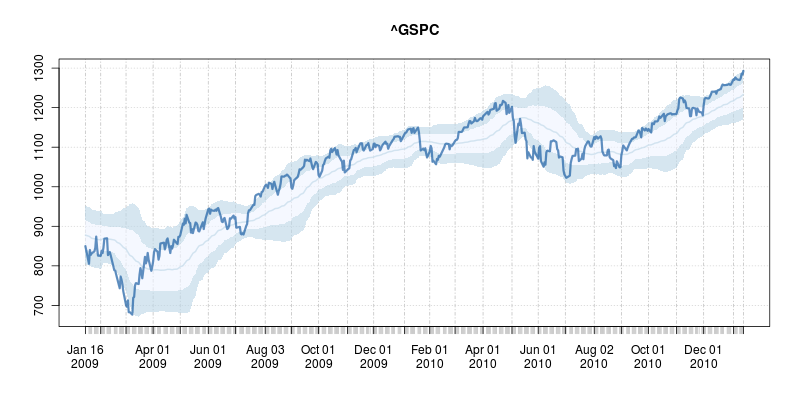
After downloading data and computing the rolling smoothed mean and standard deviation, it really is just a matter of plotting (appropriate) filled polygons. Here I used colors from the neat RColorBrewer package with some alpha blending. Colors can be turned off via an option to the function; ranges, data length and type of smoother can also be picked. To call this in R, simply source the file and the call, say, plotOBOS("^GSPC", years=2) which creates a two-year plot of the SP500 as shown here: Example chart of overbought/oversold levels from plotOBOS() function This shows the market did indeed bounce off the oversold lows nicely on a few occassions in 2009 and 2010 --- but also continued to slide after hitting the condition. Nothing is foolproof, and certainly nothing as simple as this is, so buyer beware. But it may prove useful in conjunction with other tools. The code for the script is here and of course available under GPL 2 or later. I'd be happy to help incorporate it into some other finance package. Lastly, if you read this post this far, also consider our R / Finance conference coming at the end of April.

Edit: Corrected several typos with thanks to Josh.

John Goerzen: 24 hours with Jacob

Friday, I wrote about the train trip Jacob and I were planning to take. Here s the story about it. Friday night, Jacob was super excited. He was running around the house, talking about trains. I had him pack his own backpack with toys this time, which were you guessed it trains. Plus train track. His usual bedtime is around 7. He was still awake in his room at about 11, too excited to sleep. The train was an hour late into Newton, so got up, got ready, and then went into Jacob s room at 3:15AM. I put my arm around him and said his name softly. No response. I said, just a little louder, Jacob, it s time to wake up to go to the train station. There was about a 2-second pause and then he sat bolt upright rubbing his eyes. A couple seconds later, in a very tired but clear voice, OK dad, let s go! That is, I believe, a record for waking up speed for Jacob. We went downstairs, got coats, mittens, hats, etc. on, made sure we had the stuffed butterfly he always sleeps with, and went out the door. As usual, Jacob chattered happily during the entire 15-minute drive to the Amtrak station. One of these days I need to remember to record it because it s unique. He described things to me ranging from the difference between freight and passenger trains, to what the dining car is all about, to tractors and how to ride them safely. Newton has some winter lights , and a few places still had Christmas lights, which were of course big hits. We had to wait a few minutes at the Amtrak station, and Jacob hadn t shown any signs of slowing down yet. He wanted to look at every Amtrak poster, picture, logo, or sign in the building. This generally meant me holding him up high while he leaned over to touch it and make out a few words. Then, of course, he would pick out minute details about the trains, such as how many coach cars he thought they had, and we d visit about that for awhile. We got on at about 4:20. We found our seats, and Jacob showed no signs of calming down, despite having had only 4 hours of sleep (instead of his usual 11) so far. We checked out the buttons for lights. And, of course, he excitedly yelled out, Dad, the train is moving! He spent the next while mostly watching out his window, but also still exploring his space. Finally at about 5, I said, Jacob, I am really tired. I am going to sleep now. Will you sleep too? His response: Oh sure dad, I will sleep with my eyes open! As a result, no sleep was had for Jacob, and only a little for me. The dining car opens for breakfast at 6:30, which is normally a rather foreign time for breakfast on the train for us. But we were both awake so I figured might as well go. So Jacob and I went to the dining car. We sat with a woman going from New Mexico to Lawrence for her grandpa s funeral, though it was expected and she was having a good time on the train. Jacob turned completely shy, and refused to say a word, except maybe a few whispered into my ear. He got his favorite railroad French toast, and had me drizzle some syrup on it. I used the word drizzle for syrup the first time he had French toast on the train, and if I fail to use that word in the dining car, I will hear about it in no uncertain terms from Jacob. He loved his dining car breakfast, but we spent about an hour and a half there. He was really slow at eating because his face was pressed up against the window so much. But that was just fine; we had nowhere else to be, the person eating breakfast with us enjoyed visiting (and, apparently, scaring the dining car staff with tales of bears in the New Mexico mountains). This was what the train trip was all about, after all. We played in the lounge car for awhile. The almost floor-to-ceiling wrap-around windows provided a great view for him, and more opportunities to press his face against a window. We talked about freight trains that he saw, noticed the snow on some of them. Then we found the back of the train and he got to look out the back window. Back at our seat, he played with his toys for about 10 minutes, which was all he used them on the entire trip. There was just too much else to enjoy. When we used the restroom on the train, he d comment on how much he liked the Amtrak soap. It smells SO very very good! He wanted to wash his hands on the train. By late morning, he had decided: Dad, I LOVE this Amtrak soap. It smells like peaches! Shall your hands smell like peaches too? And, when we d get back up to our seats, he d put his hands in my face, saying, Dad, smell that! My hands smell like peaches! It was from the AMTRAK SOAP! At some point, he discovered the airline-style safety brochures in the seat back pockets. These were filled with diagrams of the train car, a few photos, and lots of icons with descriptions. I don t know how many times I read the thing to him, or really how many times he then recited it to me from memory. It was a lot. He spent hours with those brochures. Jacob had already told me that he wanted pizza for lunch, so I got him the kid-sized pizza. It wasn t all that big, and he could have devoured at least half of it when hungry. But he was getting really tired and ate only a few bites of pizza and a few chips. Pretty soon he was leaning up against me, the window, and eventually had his head on the table in some tomato sauce. But he didn t quite fall asleep by the time we went back to our seats, and of course was wide awake by that point. Jacob loves spotting the word Amtrak on things. It was very exciting when he noticed his orange juice at breakfast, and milk at lunch, were Amtrak juice and Amtrak milk due to the logo on the cups. At dinner he noticed we had Amtrak plates, and when I pointed out that his metal fork had the Amtrak logo on it, he got very excited and had to check every piece of silverware within reach. Dad, I have an Amtrak fork too! . And dad, YOU also have an Amtrak fork! We ALL have Amtrak forks! *cackling laughter* I finally insisted that Jacob lay down for some quiet time. I closed the curtains, and he finally did fall asleep less than an hour before our arrival into Galesburg. So by 2:15 he was up to 4.75 hours of sleep, I guess. We stopped in the train station briefly, then started our walk to the Discovery Depot Children s Museum, which was right nearby. Although I made no comment about it, Jacob said, Dad, there is a train museum RIGHT HERE! Yes, you re right Jacob. I can see a steam engine and some cars here. Let s go in! I don t think it s open today. It IS open shall we go check? It wasn t, and that was mighty sad though when he spotted another old caboose sitting outside the children s museum, the day suddenly seemed brighter. He complained of how cold he was, although my suggestion that he stop walking through the big piles of snowdrifts was met with a whiny, But dad, I WANT to do that! We went inside the museum (having to walk right buy the locked caboose thankfully the people at the desk promised to unlock it for us when we were ready) and Jacob started to explore. There was some wooden play trains big enough for children to climb in which he enjoyed, but in general he went from one thing to the next every minute or two as he does when he s really tired or overstimulated. Until, that is, he discovered the giant toy train table. It had a multi-level wooden track setup, and many toy trains with magnetic hitches. It was like what we have at home, only much bigger and fancier. He spent a LONG time with that. We then briefly explored the rest of the museum and went out into the caboose. It wasn t the hit it might have been, possibly because there are several at the Great Plains Transportation Museum that he gets to go in on a somewhat regular basis. After that, he was ready to go back into the museum, but I was feeling rather over-stimulated. On a day when the highs were still well below freezing, it seemed just about every family in Galesburg was crowded into the children s museum, making it loud and crowded which I don t enjoy at all. So I suggested maybe it was snack time instead. A moment s thought, then he started to pull me out of the caboose before I could get my gloves back on Yes dad, I think it IS snack time. Let s go. Let s go NOW! We walked over to Uncle Billy s Bakery (Google link or minimal website). Jacob spotted some sugar cookies shaped like mittens. Despite my reluctance to get him more sugar, he was so excited plus I had barely prevented a meltdown at lunch by promising him that he would get dessert later in the day so he picked two red mitten cookies. I got myself a wonderful peach muffin and a croissant and we sat down at one of the tables by the window. I taught Jacob how to hang his coat on his chair and he lit into those cookies. I spotted a guy at the next table over wearing a BNSF jacket, and asked him if he worked for the railroad. He had retired as an engineer a couple of years ago, and had worked various jobs before that. He grew up in Manhattan, KS and so was interested in our trip and very friendly. While we visited, Jacob devoured his cookies and increasing portions of my snack as well. He told us about a new shop The Stray Cat just two stores down that was having a grand opening event today. They make decorations and art out of basically discarded items, and had some really nifty things that I may have bought had I not been wanting for space in our backpack. Then I spotted Sweets Old-Fashioned Ice Cream, Candy, and Soda Shop across the road. I figured he d love it and I was already in for the sugar so might as well. He picked out some birthday cake flavor ice cream for himself. I got huckleberry ice cream, which he insisted on calling purpleberry and managed to get some tastes of as well. After that, we went to the train station. It was about an hour until our train would be there. I wasn t sure if we d find enough to do, but I shouldn t have worried. Earlier, we had made the happy discovery that the station s restroom featured the Amtrak soap, so there was that. Then there was the model Amtrak train in the ticket window, which Jacob kept wanting to look at while I d hold him. And also, the California Zephyr came in. We watched it arrive from the station window, saw people get off and on, and saw it leave maybe the first time Jacob has witnessed all that in person. And, of course, we looked at the pictures in that train station. The ticketmaster gave Jacob a paper conductor s hat with puzzles and mazes on the back side. And then it was time to get onto our train back home. We ate dinner Jacob again ate little and almost fell asleep and got back to our seats. I let Jacob stay awake until about 8, when he was starting to get a bit fragile. It took him awhile to fall asleep, but he finally did at about 8:30. Today he s still been all excited. He will randomly tell us about bits of the trip, that the man at supper called his grilled cheese sandwich piece little when it was really big, what we did at the ice cream store, etc. And I do think that he is now a train safety expert. All in all, I think that is probably the most excitement he s ever had in 24 hours and it was a lot of fun to be with him for it!

Nikita Youshchenko: Render PDFs on GPU?

Recently I tried once more to read a pdf file on n900. And as usual, it worked bad. Not only because of small screen that particular pdf had two-column formatting, and n900 s screen is wide enough to display one of these two columns with a readable font. Much worse was extremely slow redrawing. Finger scrolling on a touch screen is cool but only if system has enough power to immediately show content as it is scrolled to be visible. In practice I try to scroll with finger, then a second or two pass, then page on the screen starts to move, replaying all my finger movement during that second or two (which was not very direct because of no quick visual feedback), by the way text at borders goes out of screen for a moment, and that area becomes broken and is redrawn only after several more seconds. And then, in less than a minute (after reading displayed content), all that has to be repeated. In total, this makes UI almost unusable. While looking at this, I thought why not use GPU here? This device has a powerful GPU, enough even for non-trivial games. So why not convert a pdf page into a scene description for GPU, and then get zero-delay scrolling and scaling at least? This could be useful even on desktops sometimes pdf viewers do have interactivity problems, especially at very-large scale (400% or more) which is needed to view board schematics diagrams. Anyone ever implemented this? Or maybe wants to implement?.. :)

Michal &#268;iha&#345;: Photo of a week 2

The second week is ending and it's time to publish another photo for project 52. Again one picture from Prague (though the lightboards say welcome to Brno), this time taken in night: Nuselsk  most

Filed under: English Photography 0 comments Flattr this!

Richard Darst: DebianNYC Novice Night

The next DebianNYC Novice Night is this Tuesday, January 18th from 18:30 -- ??. Last time was a great success, with a wide variety of people attending. This one should be even better.If you want to come, all information is at that link. Come to get help installing Debian, using it, or even just to talk. Everyone who comes will help teach and learn things. If you are a current user, come out to give us a hand!

Christian Perrier: Berlin it will be

I just registered for the 38th Berlin marathon on September 25th 2011. We (Elizabeth and /me) will of course use this opportunity to visit the city (our first time in Berlin), coming on Thursday 22th and leaving on Monday 26th. I aim for 3h30. We'll see..:-)

15 January 2011

Thorsten Glaser: FOSDEM 2011 Let the beards grow!

FOSDEM, the Free and Open Source Software Developers' European Meeting

Who s not? Same procedure as every year.

(okay, lolando prefers ski ng but ) Anyway. A cow orker told me that Belgium again/still has no gouvernment, and they have been asked to grow out their beards until they do. I found evidence on the net but won t link it here, also it s on German anyway. Let s all join in. (Besides, I now have an excuse to not shave, maybe even my grandmother will accept this one ) RT said on IRC that mksh will probably work on MSYS. My Debian/m68k stuff is coming around nicely, but I still haven t gotten around to do everything planned, plus I need to grow a new kernel and eglibc, after the latest uploads, and the 2.6.37 based one panics. Also I ve got to take care to not overwork myself. (And make a MirBSD ISO for FOSDEM.) But hey, it s been not working for some time and better now. And slow anyway yet we re progressing. Does anyone know how to debug that a C programme only calling res_init(3) segfaults? Benny is apparently not just working on making NetBSD pkgsrc available on MirOS BSD (picking up my work from 4+ years ago) but also replacing The MirPorts Framework with it. Sad, as I got a request for a gajim MirPort over a cocktail just this evening

Nikita Youshchenko: Fixing printing from iceweasel / firefox on Samsung CLP-315

I have a Samsung CLP-315 printer. It works will with CUPS and foo2qpdl driver. Just ignore all the anti-distro junk written at driver s homepage, run aptitude install foo2zjs, and enjoy working printer on consistent system. But since the beginning there was a strange problem printing worked from everywhere, but not from iceweasel. If tried to print from the browser, error page was printed instead. So had to print to a pdf file, open it in kpdf, and print from there. Working but annoying. At last decided to do something with this. A quick search shows that problem is known, is not new, and as such has little chance to be quickly resolved. But then I found this hint. I immediately checked paper size in iceweasel s print dialog and yes, it was Letter! But the setting was greyed out, so unchangeable I ve tried to play with about:config (searching for print there), then tried to remove all printer setup from prefs.js no result, still Letter without option to change. But a web search helped again. Someone pointed that iceweasel has a separate menu item for page setup, at File::Page setup! That is where paper size has to be configured, tab within print dialog does not work! Mozilla people are wonderful UI designers. Many thanks to them for months of non-working printing. I ve told myself zillion of times that I should perform active steps to get rid of bugs on computers I use search the web for solutions, report bugs, fix code myself if nothing helps. That s the very point of using free software, after all. But still laziness lack of free time random real-life issues make me not to do so too often. So also many thanks to myself for months of non-working printing. But now printing from browser works, and that s good news :) . Update: full thanks above should be directed to, in order: And real thanks to the person (link above) for the hint about page size in applications that are unable to print :)

Jordi Mallach: 32

On Saturday I turned 32. I haven't been able to sit down for ten minutes and scribble the mandatory blog entry, a sign that I'm extremely busy (luckily not only due to academic and professional reasons; the social part of the problem is very significant). This year I was gifted with a costumes Festa de l'Horta being held on the very same day as my birthday, and it was memorable (in many ways). Add an unexpected climbing evening on Friday, and getting to see my fantastic 2 year old niece Vida, who came from Norwich for a visit, made a great birthday weekend. I feel I'm going through a very, very sweet stage of my life; I really can't remember the last time I generally had no big worries or black clouds all over my head. I hope it stays like this for a while...
Jordi Mallach: Smoke

Last night was the last time I came back from a pub with my clothes stinking due to tobacco smoke. The Spanish congress has finally approved a real anti-smoking law which will ban smoking on public areas, with no exceptions or ways to workaround the ban. Starting on January 2nd, the Spanish state will be a smoke-free region (or mostly, it seems it'll be permitted in open-air events like football stadiums or bullrings, and I don't think that will be a great problem for me, specially the latter). For years, my intolerance to smoke has been increasing and I'm really expectant to see the benefits of this law in my habits. After more than 30 years dealing with smoke around us, it's our turn now. I've been speaking to a few barmans. In general they seem worried this will affect their business, but I can't see how it will. Spain has a big culture for having mid-morning almuerzos in bars, and people are not going to give that up due to not being able to smoke. They will just do it after they get out, not during the coffee, and that's it. The barmans of the two bars I visit most are non-smokers, but have to breath the smoke of hundreds of cigarretes every day, and can't do anything about it. Until tomorrow, when this will end and everyone will have a right to breath better air. I hope this kind of legislation continues to be adopted throughout Europe, because the FOSDEM welcome party is probably the next smoke horror I'll have to face soonish. :)

Jordi Mallach: The unforeseen consequences of our GR 11 Summer walk

I knew walking all over the Pyrenees during a whole month would come with some side effects. I could imagine having a few muscular issues in my legs and some back pain for a while after getting back; after all we did over 7 hours of exercise every single day during a month. What I got after our hike was totally unexpected... I should have run a half marathon in Gandia on the 21st, and instead I stayed at home doing some assignments. When we came back, I was in a really good condition, and wanted to keep the good shape we had built the month before. Given I haven't been able to swim for nearly a year now, due to the Misterious Shoulder Injury and I don't have enough time to go out cycling regularly, I centered my efforts in running, with the idea of starting to get prepared for cross/mountain races this season. Training had to wait a little because some days after getting back, I got a sudden pain on both knees, which even made climbing stairs difficult. It stuck for a while, and when it finally went away, more or less, I went ahead and tried going out for a run. I haven't been training for over two years, so I indended to increase the distances proggressively. The first day I went out, I ran really nicely for the first 25 minutes, and suddenly I started getting an intense pain in the outer side of my right knee, to the point I could barely walk back home. I've tried letting them rest for weeks, and every time I try them, the pain comes back. My physiotherapist says my body has developed quite a few asymmetries, probably caused by the many days I had to walk crippled by a big blister in my right foot. As time passes, I feel I'm losing all the physical improvements I had developed during the summer, and I can't do anything about it. The new approach to tackle this is yoga. I know my body isn't too elastic, and the lack of stretching during the walk made it even worse, so I'll try to forget about real traning during some time and focus on healing my muscles. Hopefully, this will help me resolve the nastiest physical problem I've ever come across.

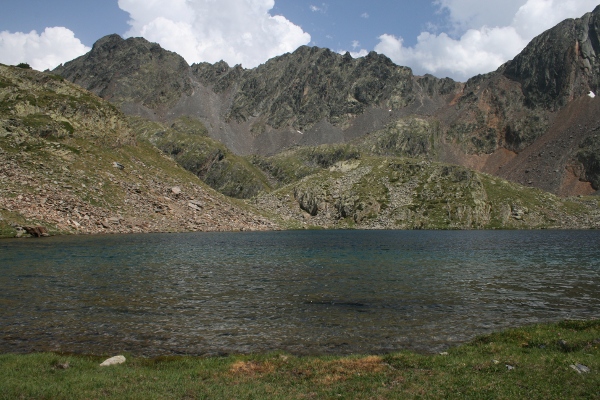
Jordi Mallach: Hiking through the Pyrenean GR 11

Tomorrow, at this time, I'll probably be unsuccessfully trying to find a comfortable position on a seat of the Bilmanbus to Irun. Very early on Saturday, as soon as we get off the bus, Maria and I will quickly head to Hondarribia's beach in Cape Higer to symbolically wet our feet in the waters of the Cantabrian Sea. We won't have much time to enjoy the cold waters of the ocean, though. Soon after that, we'll have to take a deep breath, look East, and start walking if we want to achieve our utmost objective: take a bath in the beautiful beaches of the Cap de Creus, in the Mediterranean sea. In between, 30 days and 840 kilometres of thick woods, deep valleys, high peaks and cold waters, all of which shape incredible landscapes.


The Portella de Baiau, during our 2008 trip For a whole month, we'll be mostly disconnected from everything else that isn't our knee ache, our blisters, the Sun over our heads or where to get food. It's the first time I leave on a hiking trip as long and tough as this one, and I feel both uncertainty and eagerness. We've been so busy during the last few months that we've been unable to train at all for this, and I'm probably in the worst physical condition in a decade. It's too late to take care of that now, so we'll try to take good care of our legs and spine. In order to get back home in the Mediterranean, we'll have to be fast, some days joining two stages and skipping a few that we know are not that interesting (sections over asphalt, etc.). It's hard to make it in just one month, but we'll try our best. The plan is going to sleep not long after sunset, getting up at dawn, to be able to walk for a decent time before the heat starts being a handicap and just resting at midday, when the Sun is strongest. Of course, this means that I'm missing, yet again, this year's edition of DebConf in New York City, which is really sad because I was looking forward hanging around with Mako, Mika, Biella, micah, Clint and the rest of the NYC/ Boston gang, but when the idea of doing a long trip this summer popped up around January, it was clear DebConf seemed unlikely this year. I hope all of you have a lot of fun, and see you in a few weeks!

Jordi Mallach: De mar a mar, hiking across the Pyrenees

Two weeks ago, Maria and I completed one of our dreams when we arrived in Cap de Creus, where the Pyrenean range sinks in the Mediterranean. To get there, we walked hundreds of kilometres during a month, crossed dozens of steep valleys and enjoyed one of the richest experiences of our lives.

We managed to complete this challenge without facing major problems or pains, and after the first five our six days, our legs seemed to have gotten used to the daily effort and it started to be easier and easier. Our morale kept growing as days passed and we advanced east. When I started walking on a cold and rainy morning in Hondarribia, after barely no rest in the night bus to Ir n, I thought for myself that it was improbable that we'd manage to get anywhere near Catalunya, that one of us would get injuried way before, or we'd just give up and go for the easy beach vacation in the Basque Country.
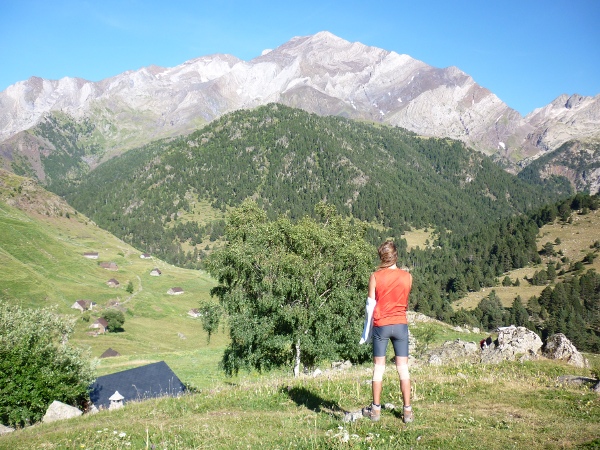

Biad s refuge, under Posets But we didn't, and after a somewhat painful start, with our boots soaking wet during the stages that crossed the enchanting Selva de Irati which ended up with me getting the biggest blister I've ever seen, we started to walk farther every day, extending the stages when we felt strong after reaching their official end. When we crossed from Nafarroa to Aragonese territory, the mental wall that I had built over the toughest stages in our quest started to fall apart. Days later, we found ourselves climbing down to Pineta, leaving Ordesa behind and enjoying a feeling that our adventure could not go better. The weather had been perfect for over a week and our legs and back were strong to go all over the way to the sea.


Ca n de A isclo, on our way to Pineta When we finally saw that huge blue stain on the horizon, the day before getting to the last mark, we got really excited. We had made it, but as we walked towards the cape, happiness slowly got mixed with melancholy. An unforgettable adventure was about to end, and we didn't want to face our return to the city and our routines. It had been many days surrounded only by awesome landscapes, and living without watches, with only sunlight and weariness marking the time to get in our sleeping bags.


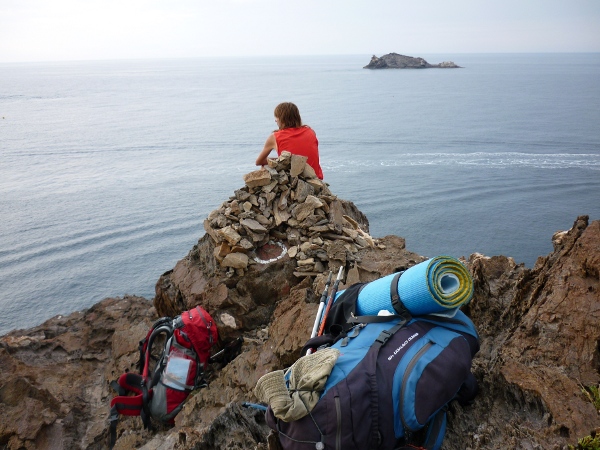
At the very last red and white mark of our journey We've had plenty of time to meet great people. Starting with the Navarrian brothers we met in the early stage, which provided us with a good pace to follow while our leg muscles were still building up; or Kike and Ana, who drove from Pamplona to visit us during the first Aragonese stages (thanks for the supplies!). Tom s and Roger, young hikers from Matar , surprised us with their maturity and experience as mountaineers; we had the pleasure to join forces during four days, walking a really cool variant through the Infiernos and Collado del Letrero which avoided going through the ghost city of Panticosa. Roger and Tom s, we really hope to meet you soon! Andreu, Manel, Ghandi and Ga la visited us at the Vall de N ria and were unlucky to suffer a frightening hail and thunder storm when they left our shelter on their way back to their car. Thanks! All of you have been a very special part of our experience!

This adventure through GR 11 has been incredibly positive for us for several reasons. We've learned a lot about ourselves and strengthened our relation, and now I know how powerful drive can be; to get somewhere, no matter how far, it's really easy if you just believe you can do it and desire to get there. Maria and I are proud of what we've done, and no wonder we're looking for new challenges. An obvious one would be repeating this experience, going through the French side of the Pyrenees, but for now, the Corsican GR 20 seems the most appealing. We'll see, next summer!

Enrico Zini: Yet another Ubuntu anecdote

Yet another Ubuntu anecdote Some posts on planet made me remember of a little Canonical-related story of mine. Many years ago I shortly contracted for Canonical. It was interesting and fun. At the time I didn't have any experience of being temporarily hired by a foreign company, so I rang my labour union to get an appointment, to make sure with them that everything was allright. The phone call went more or less like this: Me:
Hello. I have received this contract for temporary employment by a foreign company and I wondered if I could book an appointment to come show it to you to see if it's all ok.
Their answer rather cut me short:
Hi. Be careful! People get temporary employment from obscure companies with the headquarters, like, in the Isle of Man, they do the job, the company disappears and they never get paid. There's bad stuff out there!
I looked at the contract, the heading said something like "Canonical ltd, Douglas, Isle of Man". I was certain that the union people would have never understood what was going on. I politely thanked them for their time and hung up. However, to this day I still regret that I didn't insist:
Uh, yes, the company is indeed in the Isle of Man. But what if I told you that it's owned by an astronaut?
I just signed the contract and had a good time.

Charles Plessy: Hello, planets!

This is my first post on Planet Debian. In the title, I used the plural for planets, as I will try to be bilingual, and send here each time a translation from my post on Plan te Debian. For this, I will use po4a and Virtaal or Poedit, mostly for training purpose since there is not much to translate anyway. Conversions will be via ikiwiki s po plugin. This blog is hosted on Branchable. I am a Debian developer since 2008, and specialize in bioinformatics through the Debian Med project. In the everyday life I'm a (molecular) biologist. My current packages are mostly research tools, but in view of the amazing progresses of DNA sequencing, we may see software aiming at the general public in the future. And given the stakes, I hope that some of them will be free and we'll manage to distribute them in Debian!

Matthew Garrett: In other news

I'm thrilled to discover that GNU-Darwin, which carried the bold claim that "GNU-Darwin aims to be the most free software distribution", distributes copies of the XNU source code with Apple's additional license rider of "The rights granted to you under the License may not be used to create, or enable the creation or redistribution of, unlawful or unlicensed copies of an Apple operating system, or to circumvent, violate, or enable the circumvention or violation of, any terms of an Apple operating system software license agreement", which certainly sounds like a restriction of use to me.

Free software's awfully like sausages - wonderfully tasty, but sometimes you suddenly discover that you've been eating sheep nostrils for the past 15 years of your life. The typical direction is realising that you've build your entire business model on something that you're actually legally obliged to give to your customers and now they're actually trying to assert their rights, but sometimes people make assumptions about freedom that don't hold. Apple last released a free version of their kernel source in 2006. Everything since then has been encumbered by additional use restrictions.

Still, much better than Microsoft - huge portions of the OS source code are available for anyone to download, examine, modify and rebuild. Apple's to be commended for dropping so much code to the community despite it having bought them almost nothing in return. But if anyone from Apple's reading, I'd love to fix up the thermal handling on your hardware under Linux. I suspect we're doing something horrible to your machines, but I don't really know what yet.

14 January 2011

Jordi Mallach: New project to discuss

Reading Scott's recent announcement on his move to Google was both surprising and a pleasure. Surprising, because it'll take time to stop associating his name to Ubuntu, Canonical, and the nice experiences I had while I worked with them. A pleasure, because his blog post was full of reminiscences of the very early days of a project that ended up being way more successful in just a few years than probably anyone in the Oxford conference could imagine. Scott, best of luck for this new adventure! Scott's write-up includes a sentence that made me remember I had been wanting to write a blog post related to all of this, but was pending Mark Shuttleworth's permission for posting:
Ok, Mark wasn t really a Nigerian 419 scammer, but some people did discard his e-mail as spam! Scott James Remnant
Many know the story of how I ended not being part of the Super-Secret-Debian-Startup Scott mentions. I even wrote about it in a blog post, 3 years ago:
[...] nothing beats the next email which sat for some dramatic 6 months in my messy inbox until I found out in the worst of the possible scenarios. Let's go back to late February, 2004, when I had no job, and I didn't have a clue on what to do with my life.
From: Mark Shuttleworth <mark@hbd.com>
Subject: New project to discuss
To: Jordi Mallach <jordi@debian.org>
Date: Sun, 29 Feb 2004 18:33:51 +0000
[...]
I'm hiring a team of debian developers to work full time on a new
distribution based on Debian. We're making internationalisation a prime
focus, together with Python and regular release management. I've discussed
it with a number of Debian leaders and they're all very positive about it.
[...]
I'm not sure if I totally missed it as it came in, or I skimmed through it and thought WTF?! Dude on crack or I just forgot I need to reply to this email , but I'd swear it was the former. Not long after, no-name-yet.com popped up, the rumours started spreading around Debian channels. Luckily, I got a job at LliureX two months later, where I worked during the following 2 years, but that's another story. I guess it was July or so when Ubuntu was made public, and Mark and his secret team organised a conference (blog entries [1] [2] [3] [4] [5]), just before the Warty release, and I was invited to it, for the same reasons I got that email. During that conference, probably because Mark sent me some email and I applied a filter to get to it, I found the lost email, and felt like digging a hole to hide for a LONG while. I couldn't believe the incredible opportunity I had missed. I went to Mark and said "hey, you're not going to believe this", and he did look quite surprised about someone being such an idiot. I wonder if I should reply to his email today...
When the usual suspects in the secret Spanish Debian Cabal channel read this blog post, they decided Mark deserved a reply, even if it would hit his inbox more than three and a half years late. :) With great care, we crafted an email that would look genuinely stupid in late 2007, but just arrogant and idiotic in 2004, when Ubuntu was just an African word, and the GNU/Linux distribution landscape was quickly evolving at the time, Gentoo Linux had the posh distribution crown, that Debian had held for quite a few years. I even took enough care to forge the X-Operating-System and User-Agent headers so they matched whatever was current in Debian in February 2004, and of course, top-posting seemed most appropriate. So Mark woke up that Monday, fired up his email client, and got... this:
Date: Mon, 1 Mar 2004 09:47:55 +0100
From: Jordi Mallach <jordi@sindominio.net>
To: Mark Shuttleworth <mark@hbd.com>
Subject: Re: New project to discuss
Organization: SinDominio
X-Operating-System: Debian GNU/Linux sid (Linux 2.6.3 i686)
User-Agent: Mutt/1.5.5.1+cvs20040105i
Hi Mark,
Thanks for your email. I nearly deleted this e-mail because for some
reason I thought it was targetted spam.
Your project looks very interesting, almost like a dream come true.
However, I feel a bit uneasy about your proposal. Something just doesn't
fit.
Why would someone start a company to work on /yet another/ Debian
derivative? Have you heard about Progeny's sad story? I think it's a
great example to show that Debian users don't want Debian-based distros,
they want people to work on the "real thing". Besides, I don't think
there's much more place for successful commercial distros, with Red Hat
and SuSE having well-established niches in the US and Europe.
Also, why focus on Debian specifically, Why not, for example, Gentoo,
which has a lot of buzz these days, and looks poised to be the next big
distribution?
To be honest, I think only a few people have the stamina or financial
stability to undertake a project like this, so I'd like to know
a bit more about you, and details on how you plan to sustain the
expenses.
Those are the main issues that worry me about your project. Other than
that, I would be interested in taking part in it, as I'm currently
unemployed and working on something Debian-based would be just too good
to miss.
You can reach me at +34 123 45 67 89, or if you feel like flying people
around Europe, I probably can be in the UK whenever it fits you.
Thanks, and hoping to hear from you again,
Jordi
On Sun, Feb 29, 2004 at 06:33:51PM +0000, Mark Shuttleworth wrote:
> Hi Jordi
>
> We haven't met, but both Jeff Waugh and Martin Michelmayr recommended that
> I get in touch with you in connection with a new project that I'm starting.
>
> I'm hiring a team of debian developers to work full time on a new
> distribution based on Debian. We're making internationalisation a prime
> focus, together with Python and regular release management. I've discussed
> it with a number of Debian leaders and they're all very positive about it.
>
> Would you be available to discuss it by telephone? I'm in the UK, so we
> could probably find a good timezoine easily enough ;-) Let me knof if
> you're keen to discuss it, when and what number to call.
>
> Cheers,
> Mark
>
> --
> Try Debian GNU/Linux. Software freedom for the bold, at www.debian.org
> http://www.markshuttleworth.com/
As you can imagine, his reaction was immediate:
Date: Mon, 22 Oct 2007 11:13:54 +0100
From: Mark Shuttleworth <mark@hbd.com>
To: Jordi Mallach <jordi@sindominio.net>
Subject: Re: New project to discuss
Jordi! I just got this now! Did you recently flush an old mail queue?
With thanks to all the Spanish Cabal members who were involved!

Jo Shields: The phantom fifth freedom

Not for the first time, I ve seen the suggestion in the echo chamber that Mono packages should be moved from Debian into the non-free repository, which is not formally part of Debian. The reason, as it so often is, is patents specifically this time, the searing risk posed to Debian and its users that Mono s packaging does not (and technically could not without forking from upstream) provide base class libraries which implement only the content of ECMA-335 4th Edition. As I understand it, this implies three things about the suggestion/demand: firstly, that the individual in question believes that Mono end users are at risk from patent litigation from Microsoft Corp because Mono s implementation of Microsoft.NET beyond the content of ECMA 334/335 infringes on Microsoft patents; secondly, that the Microsoft Community Promise which promises not to assert legal claims over third party implementations of ECMA-335 4th Edition (and ECMA-334 4th Edition which defines the C# language) would render a pure ECMA-only runtime safe if it existed (which it does not); thirdly that without the protection offered by the Microsoft Community Promise, the source code licenses of Mono are irrelevant the patent risk renders the software non-Free. It appears, unfortunately, that the community of Free Software Advocates don t actually understand what Free Software actually IS. That explains an awful lot, but should surprise nobody. So here s a lesson on what, exactly, is being advocated for. The Free Software Foundation defines four Software Freedoms these are the minimum criteria required for something to be considered Free Software by the FSF: Other groups have their own variants on these, but those are really just clarifications on the FSF definition - for example, the Debian Free Software Guidelines mostly line up, but have some additional clauses such as clause 4 which allows software to be considered Free if source code may be redistributed without modifications, as long as patches may be shipped alongside. These four freedoms are offered to you by the software s copyright holders only, and apply regardless of their choice of license any Free license, from a lengthy legal tome like the MPL to the completely-Free WTFPL, will offer you these four basic freedoms as a minimum, and any additional clauses in their licenses cannot seek to restrict these freedoms. These four freedoms represent the beginning, and end, of whether a piece of software is Free or not. Software does not need to be developed in the open, in a community-responsive way, in order to qualify as Free projects such as Google s Android, which are developed under a throw a final release over the wall, bugs and all, and expect people to thank you for it model, are still free, even if contribution is difficult. Actually, on a related note, software does not need to solicit upstream contribution of any kind in order to qualify as Free as long as you personally can redistribute the code with changes, then that s enough. Software does not need to serve a fully or even partially legal purpose in order to qualify as Free the favoured tool for causing distributed denial of service attacks, Low Orbit Ion Cannon, is Free Software, even though realistically it serves no legal purpose. DeCSS, the code initially used to allow DVD media to play on Linux (by breaking the CSS encryption mechanism) is Free Software. Software does not need to be useful or tasteful in order to qualify as Free the Last Measure Operating System, a minimalist OS primarily designed to loudly display the famous shock site images from goatse and related, is Free Software. Even in somewhat less clear-cut cases of taste, your personal opinion of software has no bearing on whether it is Free Software, as long as the four freedoms are guaranteed by the author(s). Software does not need to have only Free dependencies to qualify as Free Software it is entirely permissible to write software which relies upon a non-Free framework or library, and release your code under a Free license. It is the downstream recipient s problem to provide the dependencies, including their choice to craft a Free replacement for any non-Free code you make use of. Debian has a special repository called contrib, where Free software which only works with non-Free data, lives for example, Free game engines which require the insertion of proprietary game data in order to operate. You could write Free addons for expensive proprietary software such as Matlab, and as long as your code is Free, your responsibilities are met. Software does not need to avoid patents software, algorithmic, or otherwise in order to qualify as Free. The Freetype font library was still entirely Free Software when Apple were slinging threats around regarding font hinting data. FFmpeg, the Swiss Army knife of media codec libraries, is Free Software regardless of the number of codec patents it breaks. Software does not need any third party approval to be Free Software the rights of Free Software can only be offered by the copyright holders, and the opinion of third parties is an irrelevance as to whether software is Free. The GPL d clone of Blizzard Entertainment s Battle.net servers, bnetd, is Free Software, regardless of legal takedown notices. Third parties cannot influence whether or not a piece of software is Free. They can influence tangentially related topics, such as whether the software can be legally used, but that s the limit. And even within a given piece of software, where copyright is shared by contributors, the author of one component has no say on other components. And you can t make code which is already released as Free, suddenly un-Free you can, if you hold all the copyrights, close up future versions, but your existing code remains Free forever. Reasonably, you can opt to avoid using a piece of software because you have requirements beyond it merely being Free Software Cdrtools has been avoided in Debian for a long time due to the upstream author s legal threats and rambling but that is a side issue as to the question of whether or not the software is Free. Patents are simply not involved in the question of whether or not something is Free Software, except for one narrow case: where Free Software is released by somebody who also holds related patents, and uses a license such as Ms-PL or Apache 2.0 or GPLv3 which requires them to also release those patents to those using/distributing the software. Outside that narrow situation, patents do not relate to the question of whether something is Free Software even if a company releases some source code under a license like BSD then demands patent fees from end users. So, on to the original topic of Mono. Every piece of Mono s source code is released by its authors under a license which guarantees the FSF s Four Freedoms. Whether or not you find Mono useful or tasteful does not affect that Free status. Whether or not Mono infringes upon any laws or patents does not affect that Free status. That Mono contains some libraries whose upstream author is Microsoft does not give Microsoft even the remotest claim to a single line of code outside the code they wrote and even then, it wouldn t be an issue, since the licenses they use are Free. In fact, both the licenses used in the Microsoft portions of the source base make patent grants to all users, in addition to guaranteeing the FSF s Four Freedoms and any license contamination would decrease, not increase, any risk of legal attack from Microsoft. There s even plenty of Microsoft code available for re-use at a lower level than the currently re-used libraries: The Microsoft.NET Micro Framework (for use on embedded platforms direct to the metal) is under the Free Software Apache 2.0 license, and would provide access to some of Microsoft s runtime and class library code, complete with a patent grant, if it were desired. Please try to keep your thought processes straight. If you want to argue that you re all for Free Software, please remember that there s plenty of Free Software you might not approve of and don t claim to be a Free Software advocate then use bogus arguments to claim that Free Software is not Free. Free Software includes LMOS and LOIC and Mono, whether you like it or not.

Alexander Reichle-Schmehl: Release Critical Bug report for Week 02

The bug webinterface of the Ultimate Debian Database currently knows about the following release critical bugs:
In Total:620
Affecting Squeeze:82
Squeeze only:36
Remaining to be fixed in Squeeze:46
Of these 46 bugs, the following tags are set:
Pending in Squeeze:4
Patched in Squeeze:9
Duplicates in Squeeze:8
Can be fixed in a security Update:1
Contrib or non-free in Squeeze:0
Claimed in Squeeze:0
Delayed in Squeeze:0
Otherwise fixed in Squeeze:8
Ignoring all the above (multiple tags possible) 20 bugs need to be fixed by Debian Contributors to get Debian 6.0 Squeeze released. However, with the view of the Release Managers, 65 need to be dealt with for the release to happen. Please see Interpreting the release critical bug statistics for an explanation of the different numbers.

13 January 2011

Matthew Garrett: EFI implementation bugs

I'm working on improving various bits of Apple hardware support, which includes trying to make EFI booting on Macs more sensible. One of my test machines is an 11" Macbook Air, which is a beautiful piece of hardware. If you want something small and light that's approximately a proper computer rather than a netbook, there's nothing else in the x86 market to touch it. Nothing.

So it's a shame that while Apple employs hardware designers who are absolutely the best in their field, their firmware developers are utterly incompetent. The EFI spec describes a protocol called GOP (Graphics Output Protocol) which allows the operating system to find out things like the screen resolution, framebuffer location and stride. This machine kindly passes everything back correctly, except for stride being wrong. Like, utterly wrong. Implausibly wrong. Obviously, terrifyingly wrong. So wrong that if you trust it, your screen image looks like it's been involved in some sort of awful pasta making accident. But never mind, that's a single line workaround.

But there's far, far worse. EFI has three modes of operation - boot services, runtime services, and runtime services with a virtual memory map. Boot services are, as the name implies, intended to be used by the bootloader. They're contained within memory marked with a type of either BOOT_SERVICES_CODE or BOOT_SERVICES_DATA. Once the bootloader has loaded the OS, just before handing over to it, it calls ExitBootServices() and the firmware is then at liberty to clear those areas of memory. The OS never executes boot services code and can use the memory that was allocated to them.

So then we have runtime services. EFI is, depending on how you want to look at it, either saner or much less sane than traditional BIOS access. The firmware gives you a bunch of function pointers and you then simply call them with native calling convention (this, incidentally, is why it's pretty much impossible to run a 32-bit OS on 64-bit EFI, or a 64-bit OS on a 64-bit system that happens to have 32-bit EFI). To begin with the firmware assumes flat physical mapping, which isn't entirely ideal when you're an OS with virtual address space - so there's a SetVirtualAddressMap() call which lets the OS pass a memory map to the firmware, and from then on everything just works.

Except on this machine. On this machine, you call SetVirtualAddressMap() and the kernel faults because it's just tried to execute code from a region of address space that's marked as non-executable. Closer examination revealed that, yes, this area of address space is marked as RAM and so the kernel's doing the right thing. Except, obviously, the right thing generally doesn't involve crashing the machine at boot time, so there was something else up.

That something else turned out to be SetVirtualAddressMap() calling into boot services code. The boot services code that's not supposed to be touched after ExitBootServices() has been called. The boot services code that's flagged as BOOT_SERVICES_CODE and was therefore mapped as RAM by us because, well, nothing's there any more. The boot services code that we're ignoring exactly as the spec says we should.

So, a quick change to the bootloader to pass us an e820 map[1] that marks the boot services regions as reserved, a quick change to the kernel to mark BOOT_SERVICES_CODE regions as executable and we're in business. Except that when we call SetVariable() to configure the bootloader, the firmware tries to read from an address that's approximately 54TB above anything else.

BlApple.

[1] Oh, yes, despite E820 being an x86 BIOS-specific thing, we use it for the in-kernel representation of the address map under EFI as well. So despite the EFI memory map being available to the kernel, the bootloader has to construct something that looks like an E820 map, losing information in the process. So even though it's been given the E820 map, the kernel has to look through the EFI memory map in order to find the EFI runtime services section in order to mark it executable. This is, arguably, insane, but so is the entirety of EFI so that's ok then.

Next.

Previous.