Search Results: "ron"

17 May 2006

Erich Schubert: Sun Java is now just non-free (not non-distributeable anymore)

Apparently Sun has finally relicensed Java in a way that Debian can ship packages in it's non-free section. I guess they've been realizing that people started using other Java implementations or Mono instead, that were easier to install on Linux systems. A couple of things were wrong with Java before that, making it a pain to install. The Debian Java people had gone a long way to fix that (e.g. by making the nice make-jpkg application that will convert the official Java into a nice Debian package you can install on your systems, but just cannot give anybody else). While installation wasn't hard with that tool anymore (download, run make-kpkg, install package), this still couldn't give you automatic upgrades. The free java implementations had huge benefits here, so does Mono. Sun Java still has shortcomings with installation, though. First of all, it's in the frowned upon, second-class "non-free" part, secondly you need to agree to it's license on installation, making unattended installation (legally) impossible, I guess. (You can probably just preseed the debconf flag, though) I've recently been recommending people to use Mono instead of Java if they only have these two choices. Mono apps are supposed to run on Windows as well, look a lot better than Java, are apparently more fun to write and easier to install. Now let's hope no patenting issues will be used by Microsoft to make Mono go away. (I wonder if that is one of the reasons why they absolutely do not support Mono meetings at their Dot-Niet gettogethers, because you could use that in a legal trial as them acknowledging Monos use of their stuff, because overall they are benefiting from Mono being .Niet on Linux and thus being a bit more platform independant...)

Uwe Hermann: Stuff III

Simon Law: Debconf 6, Day 1


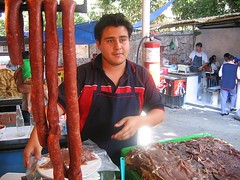
Butcher
Originally uploaded by sfllaw.
Sunday was the first day of actual talks. The night before, [info]ze_dinosaur had arrived and so we hunted for breakfast together. We walked out and found Jesus who was walking towards town. We opted to follow him to the mercado in the town just outside the side gate of the resort. We walked into the market and down some stairs. There are just little stalls where people were selling hats or CDs or pots or clothes. When we walked a bit further, we found a covered area where sweet-smelling smoke swirled everywhere. We sat down on a bench with a thin counter in front of us and someone came back with menus. I ordered a chorizo quesadilla and a glass of horchata. They were very fresh and very, very tasty. I went to the Torre Parlimentaria where the welcome speeches were happening. Mexico has been very warm and sunny, which means dehydration and sunburns. The tower is air-conditioned, so this was a very welcome environment.

Ice cream bar
Originally uploaded by sfllaw.
We sat through a talk where Simon Phipps from Sun announced work he's done with Sun to get more and more software opened. He seems to be very enthusiastic about Free Software, which he mentioned specifically, so I hope he does well with his persuasions within Sun. I no longer remember what I did after this. I think I might have walked around a bit before having the caterred lunch. I've been eating these sponsored meals for a couple of days and they've been rather substandard. Sure, they're edible and doesn't make anyone sick. But it's insipid, because they're trying to put out European style meals, which the kitchen doesn't know how to do. Since I'm travelling, I'm totally going to eat tasty local food, which I won't be able to get in Canada. At lunchtime, I bumped into Filipe whom I met at OLS last year. He introduced me to his Brazillian friends and we discovered that Tiego and Tassia who are studying in Montr al. I promised them that we'd get some Debian get-together in early June, before they leave.

Jesus Climent
Originally uploaded by sfllaw.
It's rather warm right now. The temperature goes about 30 C every day, but the humidity is always close to 30% so it doesn't get very sticky. But it does make such things like ice cream more important. Interestingly enough, lots of American products are for sale in Mexico, but under completely different brand names. After dinner, we went to the HackLab which is a building set up to encourage people to work with their computers. There are plenty of tables and chairs, with extension cords sprawled everywhere. I sat down for a game of Mao, and then got up several hours later. I wandered outside, where people were hanging out on the veranda, so I sat down on the grass in a circle and chatted with people until the early hours of the morning. Debconf, you're so bad for my health.

16 May 2006

Simon Law: Debconf 6, Day 0


Clouds
Originally uploaded by sfllaw.
I was staying over at [info]dcoombs's place on Friday night, which was very gracious with him. It also meant that I got a ride to the aeroport on Saturday morning, so that I could catch my 8:05 flight. After going through security, I waited for a bit and read a book. Then we boarded and waited on the tarmac for an oil filter change. No kidding. We took off and I soon fell asleep, as I was quite tired. By the time I woke up, we were flying over sunny Mexico. We landed at the aeroport, picked up my baggage, went through customs and ended up in the terminal. It was full of people with signs looking for their loved ones. I made my way past them and followed a sign that looked like it was for taxis. Along the way, I saw an HSBC and poked my head inside. I was slightly disappointed that nobody was speaking Chinese. I bought a flat-rate taxi fare to the Terminal de autobuses in Tasque a. The taxi driver, Bito, loaded my suitcase in the car and we were off. His English was non-existant so we spoke to each other with our hands. The rest of the time, I spent staring out the window.

Taxicab
Originally uploaded by sfllaw.
Mexico City is bright and colourful! Everything has vibrant splashes of colour. There are huge fleets of old Volkswagon Beatles driving around, many of them operating as green taxicabs. We drove past shops and stores and the signs were hand-painted and awesome. When we got to the poorer communities, I started seeing tags on buildings, but then we drove past these huge murals spray-painted on large walls. He let me off at the terminal and I bought a ticket to Oaxtepec. This was done through plenty of pointing and reading off of computer teminals. Then, I went out Gate 3 and walked into a mass of people. Now, I'm used to people queueing up, but this was not a common concept here. I tapped someone on the should and asked how I could get on my bus. Giacomo introduced himself and tried to explain the system. But he eventually just talked to the ticket collector who let me on the same coach. I discovered that he had family who lived in Hamilton and invited him to look me up if he ever visited Montr al. When we got to Oaxtepec, I staggered off the bus and picked up my luggage. Then I got un-carsick by sitting down on something stable. I was standing outside the front gates of the Centro vacacional Oaxtepec IMSS. I considered the long hike up a big hill, and then hired a cab that took me up to the Recepcion building where I got checked in. I dragged my luggage to the room and met Blars there. I picked out a bed amongst the five still available. I had finally arrived.

Benjamin Seidenberg: Hello, World!

So, thanks to Wouter Verhelst, I am now syndicated on Planet Debian, a site that aggregates the blogs of various people involved in Debian. To those who don’t know me yet, I am an 18 year old high school student (for a couple more weeks anyway) in the United States. I go by ‘astronut’ on IRC, and have completed my part of NM and am now patiently waiting for FD/DAM approval. I maintain easyh10 (manages the databases on the iRiver H10 music player), dav-text (simple ncurses based text editor), graphmonkey (a somewhat pointless graphing calculator that somehow has at least a few users according to popcon) and recently adopted pork (console AIM client). I also am an active member on the Debian Cyrus Packaging team (Cyrus is a pop/imap/nntp server). Comments are currently enabled, but moderated on the blog. I may have to go to some kind of turing test based system if planet opens me up to a flood of spam. So… Hello, to the word of Debian!

Barry Hawkins: A bit chilly in a hot place; a distributable Java JRE and JDK arrives

So it’s finally OK to mention it now; Java has made it explicitly possible (read legal) to distribute the Sun Java JRE/JDK on a GNU/Linux distrubtion. The new license is for Java SE 5 on Linux only, called the Operating System Distribution License for Java, or DLJ for short. You can read the license in text or pdf form. The FAQ for the DLJ is also available in text and pdf. Heck, go through the README for the JRE and JDK while you’re at it. So what does that mean? Well, GNU/Linux distrubtions like Debian can now package a Java runtime environment or Java development kit in their repositories. That was previously not possible due to restrictions present in Java licensing. Users still have to accept the Java SE 5 binary code license that is totally not free and has the same restrictions Java has always had, but this at least makes packaging and supporting Java less painful for distributions. Sun is coordinating the efforts via a java.net project, jdk-distros. This is an unprecedented level of cooperation from Sun with external parties in anything related to Java. I consider myself fortunate to have been a founding member of the project. It has been a pleasant and refreshing experience to meet a few optimistic and forward-thinking people from Sun who have a keen interest in Free Software; a big thanks to Simon Phipps and Tom Marble. I was encouraged that they allowed our contributions to be covered under the MIT license. If you would have told me that a month ago I would have laughed at you. The Debian announcment should be posted on the debian-devel-announce list today. I am sure this will draw both praise and ire from the Debian community. That’s cool, though; the rich diversity is part of what makes it such a vibrant organism.

Ian Murdock: apt-get install java (literally)

Simon Phipps: “Yes, you can now apt-get install sun-java5-jre and have it install without fuss on Debian and Ubuntu.” Great news. We’re one step closer to a Java/Linux combo that’s more than just Java bolted onto the side of Linux (admittedly, there’s still a bit of that here, though at least it’s attached with standard componentry now rather than the old bubble gum and bailing wire). Why is tighter integration important? Because the alternative, namely Windows and .NET, offers a tightly integrated combo that “just works”. The more a developer has to do (like, say, ship a bundled runtime because that runtime isn’t guaranteed to be available on a key platform), the more attractive the alternative looks. The real question is: Will this be enough? I’ve long contended that open-source Java is a red herring—the real challenge for Java on Linux is ubiquity, not licensing, and licensing is really only an issue because it gets in the way of ubiquity. Time will tell if this step represents the boost Java needs to become to Linux what .NET is to Windows. I don’t know though. For that to happen, the major Linux distributions have to not just add Java to the menu of available software, they have to add Java to the default configuration (much as Perl and Python are default components today), and I just don’t see Red Hat, Debian, or Ubuntu doing that till Java is open source. Still, I’m optimistic we’ll get there. Question is, will we get there in time? P.S. - How about making some of the Java platform components available via APT too? If I’m developing an application that uses, say, JavaMail, I have to go to the web, download it, figure out that it depends on the JavaBeans Activation Framework (JAF), download that, set up my classpath appropriately depending on where I downloaded them, etc. It would be great if I could just apt-get install javamail and have exactly the environment I need without additional effort.

Axel Beckert: Fixing server bugs on client side

On my new job at ETH Zurich I stumbled over a lot of HTTP requests in the web server log file, obviously trying to fetch the automatic proxy configuration file (usually called proxy.pac) but requesting it with the last character missing and therefore requesting the nonexistent file proxy.pa:
195.176.XX.AB - - [16/May/2006:11:12:56 +0200] "GET /proxy.pa HTTP/1.1" 404 5261 "-" "Mozilla/4.0 (compatible; MSIE 6.0; Win32)"
195.176.YY.CD - - [16/May/2006:11:16:32 +0200] "GET /proxy.pa HTTP/1.0" 404 5235 "-" "Mozilla/4.0 (compatible; MSIE 6.0; Win32)"
195.176.ZZ.EF - - [16/May/2006:11:18:38 +0200] "GET /proxy.pa HTTP/1.0" 404 5235 "-" "Mozilla/4.0 (compatible; MSIE 6.0; Win32)"
195.176.YY.CD - - [16/May/2006:11:24:16 +0200] "GET /proxy.pa HTTP/1.0" 404 5235 "-" "Mozilla/4.0 (compatible; MSIE 6.0; Win32)"
195.176.ZZ.GHI - - [16/May/2006:11:31:44 +0200] "GET /proxy.pa HTTP/1.0" 404 5235 "-" "Mozilla/4.0 (compatible; MSIE 6.0; Win32)"
195.176.XX.J - - [16/May/2006:11:33:35 +0200] "GET /proxy.pa HTTP/1.1" 404 5261 "-" "Mozilla/4.0 (compatible; MSIE 6.0; Win32)"
195.176.ZZ.LMN - - [16/May/2006:11:35:18 +0200] "GET /proxy.pa HTTP/1.1" 404 5261 "-" "Mozilla/4.0 (compatible; MSIE 6.0; Win32)"
WTF happend here? When I found a bunch of those request from a single host last night, I expected a local cut and waste typo on a single box. But during the day I got the same sort of defective requests from over 30 hosts in our network. So we looked at our dhcpd.conf, but all appearances of “proxy.pac” had its “c” at the right place. WTF is happening here? After googling for a moment I found this mail on the squid users mailing list, stating the following:
WPAD worked reasonably well for WindowsNT and Windows2000; however, there was a problem with the file name in Windows2000 and the initial release of WindowsXP. The Microsoft DHCP Service returned the wrong byte count for the string returned for option 252. The DHCP Client compensated for this by decrementing the string length. This resulted in the file name being truncated when the ISC DHCP daemon was used. The solution was to define a symlink proxy.pa –> proxy.pac.
So in other words: Microsoft worked around a off-by-one bug in their own DHCP server by patching their DHCP client to parse faulty configurations — and obviously only faulty configurations by expecting some length statement to be always off-by-one. *hrrrrng* Our solution was BTW to insert an appropriate Alias directive into our Apache web server hosting the file.

Wouter Verhelst: On huge ISPs and multi-level support requests.

Adam They just told you how to get past their front lines: Call their business support on the toll-free phone number she gave you. Here's my take at what happened: Really. Call them. You'll find that you will be talking to someone knowledgeable about what SMTP is, and who is able to put a request with SMTP administrators to fix this issue if that is required. Take it from someone who used to work at one of Belgium's largest ISP's (at least, it was that when I used to work there—they've lost some market share since).

Ted Walther: Report from Debconf, Day Two

Photography. My roommate Aigars is quite a photographer, he came with his digital SLR and several lenses, an item I've lusted after for some time. Large apertures and manual controls are what every real photographer demands, and digital SLR's deliver. I told him my idea for a small sky recording station so that people could make movies of the paths that the stars take, and how it changes over the year. Ultimately I want a network of these stations, all uploading their pictures so I can examine them for anamolies. This is a hard problem, because stars are so faint. Aigars said to take a picture of the whole sky, a 1000 millimeter lense and a $50 computer scanner with some modifications should be able to do the job.

Me and Andreas Schuldei
Programming. Finally made progress in programming, now that I know where everything is in Oaxtepec. My IRC bot didn't handle things gracefully when the server refused to let it log in, but that is fixed now. Tomorrow I hope to add multi-channel support. Reading through the new IRC RFC, I have the information I need to make a proper configuration file for the software. The design is sketched out and feels right, finally. Weekend vs. Weekday. Oaxtepec is much quieter today. Saturday and Sunday there were far more vendors on the street, and they stayed open much later. Today everything closed down around 6pm when the church bell tolled the summons to mass. I couldn't find the coconut man; maybe he only comes on weekends. Half the stalls at the mercado were empty. During the weekend, the resort was full of vacationers swimming, barbecuing, picnicing, playing soccer, or just sunbathing while the kids ran around. Everyone, young and old, but mostly young adult men and women, were running around in bathing trunks and bikinis. The happy noises were great to wake up to. This morning the sounds were quieter, but still present. The swimming pools here get a lot of use. During the weekend, there was a large tent where some ladies were giving body massages for $10. I didn't see them today. Probably they will be here again next weekend. Food. Tried a dish called "pancita" today. I saw people eating noodles and assumed pancita was a noodle dish, like the Filipino pancit. But no. It is a type of tomato soup filled with chopped up beef rind and chunks of fat. For only P31, I bought a small chicken. It was perfectly marinated and roasted, better than Kentucky Fried Chicken. I paid the money, and the shopkeeper brought out a pair of scissors and cut the chicken into all the appropriate pieces for easy eating, just like they do in Korea (viz the use of scissors) Church. Attended mass tonight, since the church was so close. The church is magnificent. It really is a cathedral inside; to see the ceiling you have to crane your neck. And when you do, you see paintings of angels playing instruments. I went into the nave to pray, and saw a giant depiction of the ark of the covenant. It was very realistic, with the cherubim covering it with their wings. And above it, was a painting of the wine and bread offering, which were offered on the altar daily. The priest was a black man from Illinois; after a bit of attempting to speak to each other in Spanish, we realized we both spoke English, and got on famously from then on. The cathedral opens at 10am, closes for lunch from 2pm-4pm, and then is open until mass is finished. This must be what the church was like in the beginning; a place where believers could drop in any time to be with others of their kind, to meet, eat, drink, discuss, and elevate each other to a higher plane. I am sad that we don't have this in Canada. Debian. There were some Debian talks and presentations, but nothing too interesting. Finally met Mark Shuttleworth, Anthony Towns, Manoj Srivastava, and Roblimo Miller. Clifford Beshers of Linspire almost convinced me to look into the Haskell computer language. I couldn't quite tell what Haskell has that LISP doesn't, apart from forcing strong types on you and being very fast and efficient in benchmarks tests. Marga didn't give me meal tickets before, so Graham printed some up for me today. By pure serendipity, I sat at dinner with the only other Canadian developers at the conference; Simon Law and Eric Dorland from Montreal. The drinking started at 11pm and is still going strong; the atmosphere is very convivial right now, but half of us are still tapping away at our keyboards.
Aigars Mahinovs: Debconf6 day 2: Java is non-free, at last!

The first session in the morning that I attended was the BOF about Python. After an introduction to the current state by the Python maintainer (Matthias Klose) and a few other people we run overtime and the BOF was extended into another time slot. Also the session was plagued by the room switch hanging which affected both the network and the recording. It really looks that that strange situation with a bunch of python-foo, python2.3-foo and python2.4-foo packages will be fixed. Later in the day guys from Intel gave a talk about some kind of data mining stuff they were doing with hardware database from Ubuntu. The tool was called Toppler (from Dilbert) and basically was a hardware database. They pondered about possibilities of getting some useful information from the huge pool of data, but the examples that they showed were just lame. For example they showed how you can get a list of 1234 reports relating to this wireless card, but that is not what I want to know - I want to know if it works and if it does not work, what can I do to fix it. The showed an example of an OEM entering his computers hardware configuration to see what distro works on that hardware - that is completely useless: as an OEM I at that point would already have chosen a distro and what I really would like to know is what will and what will not work from my hardware configuration in that distro, why it will not work and how to fix that. That would be approaching useful status - so far they only have a SQL DB with a simplistic web fronted. At the same time to give out that kind of information you would need much more datapoints to make a correlation - datapoints most of which can not be tested automatically and require user interaction on submitting. On the other hand the more user interaction they need, the less users will want to submit that data. They already have at least 10 times too many questions (there were 30 + options) if they really want this to be something that users will want to contribute to. Also there is no real direct motivation for users to contribute to that database - maybe OEM's have that kind of motivation, but they must decide to use Linux first. In short I only saw mountains of social and technical problems with this project and really little in terms of benefit. That's what you get when you have too much money to burn. After that there was a "yearly" Ubuntu report from Mark Shuttleworth. Most of what Mark said was already widely known if you followed Ubuntu's development a bit. Dapper will release on 1st of June and will be supported for 3 years on the desktop and 5 years on the servers. Edgy Eft will be a developer driven highly experimental release that will be done in 4 months and its planning will be done in Ubuntu conference in Paris (18th-23rd June). In Dapper KDE is given equal weight to Gnome and in Edgy the same will be done to XFCE. There is a graphical installer - Ubiquity and a graphical upgrader that works around strange things that APT has not been designed to handle. Mark can only guess what will be in Edgy as developers will decide this one, but most probably Xen and XGL will be integrated, startup will be reworked by adding paralel init scripts with dependencies and maybe even APT will be replaced by some kind of SMART tool. I have not heard anything about it before and Mark also gave no further detail. but in any case Edgy promises to be "the Ubuntu equivalent of a release of Debian experimental". Way to go not to stick into the enterprise stability. I am really looking forward to that. Another announcement came from Sun - thanks to hard work of many people the license of Sun Java was changed to allow it to be included in Debian non-free repository. FHS and Debian Policy compilant packages have been produced and are uploaded to Debian sid non-free. Congrats to all involved! Now we only to move it to main somehow. Unfortunately I missed two BOF that I wanted to see due to scheduling changes that I did not follow at the time: i18n BOF and Debian representation BOF. I have been doing quite a bit of both during last years, so I wanted to be there, but missed it. Doh. In the afternoon I was twice recruited by the organizers to do the group photo. Last year there was a huge collection of dSLR's around Debconf5, but this year either the dSLR owners did not come or did not want to lug their cameras across half the globe, so I with my Canon 350D and a few (cheap) lenses have become the de-fact photographer of the Debconf6. It was only natural that the group photo also had to be taken by the best camera around. I, naturally, am very honored by the opportunity even if that would mean that I myself am not on the group photo. I could just gimp myself into the corner of it after the fact :) In any case the place to take the picture had to be found. The amphitheater where the Debconf5 group photo was taken was a perfect place, but lacking that a trick all the way back from Debconf3 could be employed - standing at a high place and take the picture at a sharp angle down. The best place for this that I found around here is the 10m diving tower - there is a platform aprx. 8 meters from the ground where one can clearly see to the back area of the tower where a large grass area is located. I still need to confirm whether I can take the group photo from there with my best lens (Canon 50mm f/1.8 II) and what amount of light will we have on time point when we have the ability to actually take the picture (18:00). There will still be a bit of a chance with the weather, so an alternate group photo time should also be planned. There will be an announcement mail that will probably go public before this email will. Oh and later in the evening I found a guy (sorry, names escape me is seconds) who has a Canon 17-40mm f/4 L lens which I will borrow from him for the group photo. That will make the photo a lot sharper and make us much more flexible to the group size which is very helpful. Just before the dinner I want to see the saunas that i was told long ago. Basically it was a headed room 3x1 meter with a temperature control outside that was set to 0. Nobody uses the sauna here and that is no wonder - the whole place is like a large sauna. In the same club (just above the restaurant where we have all the meals now) there was a ping-pong table, two pool tables and a gym. In the gym I found a Mexican Gentoo spy who's mom was born in Riga, Latvia. The world is truly small. After the dinner I sent out the group photo announcement email and then took a look at the Joey Hess's BOF about debian-installer. I snook into the talk to take a few photos and watched the rest via the webcast. Unfortunately all the people spoke very quietly there, so it was hard to distinguish their voices from the background noise. Please, do not do that! Speak up, people! The tango practice took place between hacklabs tonight. Looked fun, but I would rather take a lot of pictures of it :) On a final note I witnessed a Mao game in Spanish. That was only a bit more disturbing then the same game in English. Even while I do not speak any Spanish. P.S. If you really like what I do with photos in this blog, it would be very nice if you would sponsor me a Pro account at Flickr. Otherwise my monthly traffic limit there (20 Mb) is nearly up with only select photos of two days of Debconf uploaded. I have now almost 2 Gb of photos stored on my laptop and the conference is only starting.

15 May 2006

Aigars Mahinovs: Debconf6 day 1: Intro

The day was started by a welcome speech from the organizers saying thanks to all (most) the helpers and sponsors. The tower room was almost full, I wonder how will it look like when the real talks start. The next talk is only planed after an hour and a half as no BOF claimed this time slot. Well - a bit more time for hacking, socializing and sunbathing. :) After an hour of working on a good tan I went to "Debian vs. Open Solaris" discussion. After a bit of time the discussion about CDDL broke out. Debian basically objects to choice of venue clause and there are also GPL-incompatibility problems that might go away with GPLv3. The core of the discussion was more of the explanation of why those clauses were placed there in the first place. The sense that I got for the discussion is that Sun would modify CDDL in a way that will most probably make it DFSG-free and compatible with at least GPLv3. Also it was told that in fact usually choice of venue only applies to court suites between multi-regional corporations with overlapping regions. The legal discussions went over my head more then once especially when GPLv2, GPLv3 and CDDL license interaction on one system and distribution of such where discussed. On the OpenSolaris front there is a move from indoor source control system to Subversion. So far there are only around 100 non-Sun commits to OpenSolaris, but a big jump is expected after the transition to SVN is complete. Joey Hess had a wiki talk in paralel, which I did not see. Off to lunch! At the lunch I got to sit at the one table with Paul Allen from Intel and Ted Walther. It was discovered that Ted is actually just coming out of fasting so he does not eat anything, but only drinks juices. Well, that's one way to avoid foreign food problems. On the way back from lunch I got a lead on my first mark. I will now start a separate article about the Assassins game that I will publish when the game is over. The second talk was from Enrico about waisting time. He waisted a lot of our time with that :). I loved vigor - a paper clip assistant for vi :D. xlaby - a labyrinth for your mouse pointer. Read the man page! On the later part of the day I was busy mourning my death, preparing and trying to print papers fr the travel reimbursement stuff, so I missed all BOFs between Enrico and dinner, but had a bit of time for some local tetrinet fun. While I was doing that Ted was at the marketplace and got me a few bags of fried grasshoppers - a great souvenirs, thanks! :) Some evening hacking in the hacklab after the dinner and I already wanted to go to bed when I saw in the IRC an announcement about Speaker training BOF. The event was very interesting - Meike Reichle showed and made us do us several nice things that will definitely improve our public speaking. After that I just could not go buy a group of people playing Mao and I immediately joined the game. Luckily they were not playing long so I got the rules in seconds. The game nearly imploded after one of the players was very inconsistent with his rules (he had to rethink them all the time), but then another winner just reset the game and it went on with a lot of fun from that point. The game had three newbies, so it was a lot of fun, but also a bit of waiting for people to catch up and pay attention. Well, off to bed now - tomorrow will be busy.

14 May 2006

Aigars Mahinovs: Deaths in Debconf

Debconf6 this year was also the venue of an Assasination game. The idea is that there are people playing the game who are ordered in a circle. Each of them only know the name of the person in front of them - the one they have to assassinate. The killing takes place by touching the marks upper body with a (clean) sock. The assassin must hold the sock in the moment of contact and nobody who is playing can see the event. If a player sees the assassination, it is void and must be repeated, but no sooner then on the next day. Before the death a killed assassin must utter the name of his mark, which then becomes the mark of the killer. My first mark was a guy that I did not know. I had to wait a day for him to arrive. I also had no idea how he looked because there is no available photo of him online. That made my job a bit harder. I tried to find him among people going from the lunch to the Enrico's speech, but missed him. And on the way back I was assassinated myself. Bugger. I think I can publish it now, because this information will not affect the game except maybe make people be a bit more careful when walking to the tower and back - it is a nice assassination spot. :P I guess being recognizable because of this blog is a big disadvantage in this game.

Gunnar Wolf: Thanks!

Debcamp was really stressing - It seemed we would not be able to get things to work for Debconf. And it would suck. I was quite down when I last wrote a blog entry - Not in mine, but in Debconf's. Things looked quite hellish, and I was _very_ annoyed - Well, I must say: Thanks to you all for the support. Mooch's request has been honored extensively, and it does help. Really.
Yesterday we had the Debian Day. About 50 Mexicans showed up, after we had to jump through some hoops with the Oaxtepec management people (thank you, thank you, you are great! Real dedication to your job, to make us feel welcome and important). The talks were interesting and well presented, and the people left happy - and some of them, left quite late. We had presence from at least one national newspaper (La Jornada and a magazine, Software Guru. Good.
Then, during the night, we were flooded by arriving foreigners. Boy, the hacklab was packed! Good thing we now will have both hacklabs running.
I have to thank most than to anybody else to my wife, Gaby a.k.a. Nadezhda - She has done all the ugly paperwork... Without her, we would all not be here. And later, I would probably be sitting in jail or something ;-)
Seems that the bugs are ironed out. Now I'll try to attend the "Sun and Debian: can we be friends?" round table.

Adam Rosi-Kessel: Comcast: Human or Automaton?

I’m not the first person with a story about the sad state of Comcast. Since I’m certain I’m never actually going to get a True Human to read my email at Comcast, I’ll just post my brief exchange regarding Comcast’s SMTP servers here. Maybe some future archaeologist of the Internet will point to this exchange as early evidence of the End of Email: I posted the following to Comcast’s website feedback form — apparently there is no publicly advertised email address for communicating with Comcast:
Please forward this email to an engineer responsible for Comcast’s SMTP service. I run an ISP. Email to @comcast.net addresses often bounces with a “556 null byte in data” rejection connecting to gateway-s.comcast. I use postfix from Debian Sarge. This is not a problem on my end. There are numerous reports of this problem in newsgroups (just google ‘556 null byte in data’ ‘comcast’). The problem is independent of mail user agent and ISP. Note that this is *not* an issue of my users attempting to connect to the Comcast SMTP server themselves—I understand there is some issue where Comcast only accepts SMTP/SSL/TLS now for its users. This is a *delivery* problem. I have seen some speculation that Comcast’s SMTP servers are rejecting email with this error because of either large attachments or attachments with long filenames. I have seen the problem occur where the attachments are very small (on the order of 10K), but I haven’t ruled out the latter explanation. Please let me know if there is anything I can do to fix this problem. My users would like to be able to email Comcast customers.
Comcast’s response:
Dear Adam KESSEL, Thank you for taking the time to write us. Comcast is aggressive about protecting its’ subscribers from unwanted and unauthorized emails. In keeping with industry standards and best practices some recent changes to our filters have been made.If you are attempting to send emails to legitimate recipients in the Comcast.net domain, and receive an error message there are 3 likely reasons: 1. Your mail server has been identified as a source of Spam. Our mail filters have been updated to reject all mail from your server until the administrator of your mail server contacts us to request the server be removed. 2. The source of your message has a dynamic email address. Anyone attempting to email into the Comcast domain directly from a Dynamic IP address will receive the following error message: Comcast does not support the direct connection to its mail servers from residential IPs. Your mail should be sent to comcast.net users through your ISP. Please contact your ISP or mail administrator for more information. 3. Your mail server has an invalid rDNS value. What this means is that our mail filters authenticate each message by checking the rDNS value to ensure its’ a legitimate domain and yours wasnot. The error or “bounce” message you receive will indicate which reason the message was rejected. Youwill either be given the address to request Blacklist removal or you will be directed to our rDNS FAQpage. If a domain administrator feels that their IP range has been blocked in error or they would like information on required steps to be removed from our black list, they can contact us at: blacklist_comcastnet@cable.comcast.com If you need assistance setting up email through your ISP?s mail servers please visit their support pages or contact their support group. If you need information on the rDNS block, please visit: http://www.comcast.net/help/faq/index.jsp?faq=Email118405 Thank you for the opportunity to assist you. If you need further assistance with any of your Comcast services please reply to this email and we will be happy to assist you. Thank you again for choosing Comcast we appreciate your business. To visit our local support page including links to contact us via Live Chat, as well as many downloadable forms,and FAQ pages, please visit: http://www.comcast.com/nesupport/ Did you know that Comcast offers its customers a variety of free benefits? These include McAfee Antivirus, Firewall and Privacy software as well the Comcast tool bar that lets you take Comcast.net with you while you surf, and the Desktop Doctor to help you restore lost settings…plus much more, please visit http://www.comcast.net/downloads/ to see all of the extras that we provide. Sincerely,
Irene Comcast Electronic Customer Care - New England You can email us anytime by replying to this email or by clicking the “Contact Comcast” link found on the bottom of all www.Comcast.net and www.Comcast.com webpages. Our Electronic Customer Support teams are available to assist you 24 hours a day 7 days a week. **************************************************
The response contained in this message is intended for the addressee only and may vary from other ponses depending on geography, promotional campaigns or other factors. If you are not the intended recipient of this response, please delete this message. Any unauthorized use or dissemination of the information contained in this message is prohibited.
**************************************************
The last bit about “unauthorized use” is a nice touch. My follow-up:
The 556 null byte SMTP error is *not* a spam or blocking related rejection. My mail server is (1) not a source of spam (2) does not have a dynamic IP address (I assume below whenyou wrote “dynamic email address” you meant “dynamic IP address”); it is not a residential IP but rather a commercial ISP that I run; and (3) the mail server has a valid reverse DNS lookup. To clarify: not every email is being rejected from the ISP’s IP address. In fact, the same sender can send from my ISP multiple times to a Comcast subscriber, and most messages will get through. There appears to be a bug in your SMTP delivery server whereby certain triggering events cause a 556 null byte error. There is at least some evidence that one such triggering event is an email with an attachment with a long filename. This is not a spam filter issue. This is a Comcast SMTP configuration issue. As you will see if you google “‘556 null byte in data’ comcast” this is awidespread problem that is entirely unrelated to Comcast’s zealous efforts to block unsolicited email. Please forward my email to an engineer or technician. Thanks,
Adam
Finally, Comcast’s witty retort:
Dear Adam Rosi-Kessel, Thank you for taking the time to write us. Commercial Email Accounts We have to apologize, but at this time you must contact our Commercial Business support team by calling one of the following toll free numbers 888-824-8105 or 888-824-8155, 1-888-737-8361 Thank you for the opportunity to assist you. If you need further assistance with any of your Comcastservices please reply to this email and we will be happy to assist you. Thank you again for choosingComcast we appreciate your business. To visit our local support page including links to contact us via Live Chat, as well as many downloadable forms,and FAQ pages, please visit: http://www.comcast.com/nesupport/ Did you know that Comcast offers its customers a variety of free benefits? These include McAfee Antivirus, Firewall and Privacy software as well the Comcast tool bar that lets you take Comcast.net with you while you surf, and the Desktop Doctor to help you restore lost settings…plus much more, please visit http://www.comcast.net/downloads/ to see all of the extras that we provide. Sincerely,
Ivonne Comcast Electronic Customer Care - New England You can email us anytime by replying to this email or by clicking the “Contact Comcast” link found onthe bottom of all www.Comcast.net and www.Comcast.com webpages. Our Electronic Customer Support teams are available to assist you 24 hours a day 7 days a week. **************************************************
The response contained in this message is intended for the addressee only and may vary from other responses depending on geography, promotional campaigns or other factors. If you are not the intended recipient of this response, please delete this message. Any unauthorized use or dissemination of the information contained in this message is prohibited.
**************************************************
If anyone has interesting ideas about how to get past Comcast’s front lines, I would like to know.

Julien Blache: Data recovery, or why I love XFS

So, here it is, the hard drive in my mother’s laptop (HP nx9105, 10 months old) just broke down this week, with some important data on it (I do have backups, but it broke down in between 2 backups with some important changes to the data - accounting and payroll). The laptop was running an AMD64 Sarge on an XFS filesystem. Fortunately, XFS shuts the filesystem down when the underlying block device fails, so the damages are quite limited. dd_rescue to the rescue, only 40 kB of the 40 GB partition couldn’t be recovered. An xfs_repair run later, the FS mounts with only 30 files in lost+found: 10 of them are device nodes, 10 are empty files, another 5 are sockets and the remaining 5 are mails from anacron. I just love this filesystem. SGI, you guys rock. All of this just went as planned when I installed the machine in July last year; I chose XFS for its ability to not screw up the FS when the underlying block device crashes and for the powerful and reliable set of maintenance tools that goes with it.

Andree Leidenfrost: Mondo Rescue RAID Support at Last

CeBIT Australia ate substantial amounts of my time for the last two weeks (and almost killed both my feet and my voice but was still interesting and fun), so things took a little longer in Mondo Rescue land. But at last, here it is: mindi-1.07-3 and mondo-2.07-2 are in incoming and add the much overdue RAID support for Debian!

What it does (from the shiny new NEWS.Debian file):
This is the first release supporting RAID via mdadm. It is supposed to work with all RAID levels/varieties supported by mdadm and the kernel.

The following limitations and oddities apply:
  • All information about existing RAID arrays is drawn from /proc/mdstat, the contents of an mdadm.conf file is ignored.
  • Using RAID for the boot device is currently untested. The system will likely be unbootable after a restore.
  • Using LVM in conjunction with RAID is currently untested. Restore will likely fail.
  • Building a RAID5 array may appear to hang the system because of extended screen inactivity. However, disk activity should be high and eventually the restore will continue.
  • The synchronisation progress bar and the formatting progress bar may overwrite each other leaving the screen somewhat garbled. Not nice but harmless.
I have intensely tested this with various RAID levels, chunk sizes, parity algorithms, with and without spare disks and so forth. In particular, I've done successful full archive and restore runs using NFS as storage media for the following:
  • amd64, RAID1, kernel 2.6.16-1-amd64-k8 (2.6.16-12)
  • amd64, RAID5, kernel 2.6.16-1-amd64-k8 (2.6.16-12)
  • amd64, RAID10, kernel 2.6.16-1-amd64-k8 (2.6.16-12)
  • i386, no RAID, kernel 2.6.16-1-k7-smp (2.6.16-10)
I'll post the patch to #325877 for reference purposes and will also commit to upstream SVN shortly. Bruno was kind enough to review that patch and likes it, so there shouldn't be a problem (other than some fiddling because I have worked off the Debian 2.07-1 package and not tracked upstream).

Apart from fixing issues with the above, I plan the next steps to be:
  • support for RAID boot partitions
  • getting LVM to work
However, I think I'll do a fresh install of Sid AMD64 before that, to ensure that d-i created systems work with Mondo Rescue.
.

Also, I am experiencing a strange behaviour with busybox on AMD64 in that I get the following message on virtual terminals (and no prompt):

./sh: Cannot set tty process group (Operation not permitted)

when I run:

./openvt 8 ./sh

(where ./openvt and ./sh are both links to ./busybox)

This happens with 1.00 as well but in either case only on amd64, i386 is fine. Also, it only happens if NFS support is enabled for busybox mount.

Matthew Palmer: Curious Perversions in Software Engineering

I've been ill with flu the last few days, so I've been doing very little other than sitting huddled in my recliner, with a large, warm blanket over me, and my hot water bottle (AKA the laptop) to work on. As a result, I've been doing a fair amount of random coding, and I've come away with a larger-than-average amount of... weird shit. It maybe the flu, the strong drugs I've been taking to keep the symptoms under control, or maybe just the phase of the moon, but I haven't coded up this much madness in quite a while. Let me take you through them. The Proctologist I've been writing some software which has to talk to an XML-RPC server. Not so weird. However, because the system lacks any inherent security, the (strongly) preferred method of communicating with this server is via a Unix socket. That's right, I'm doing XML-RPC over HTTP over... a Unix socket. That, you may think, is weird. Well, it is, but it isn't the curious perversion in and of itself -- for a start, I didn't write that monster, and I'm only blowing my own trumpet in this article. No, the perversity is in how I wrote *my* software to deal with it. See, I'm using Ruby for this software, and the standard Ruby XML-RPC client uses the built-in Net::HTTP library that comes with Ruby (which is a killer little HTTP library, BTW). Because the authors of Net::HTTP were lacking in imagination (or crack pipes) they didn't think to include the native ability to talk to Unix sockets. I mean, really -- isn't that the most important feature in a HTTP library? I think we all know the answer to that. Anyway, despite the lack of forward planning (and crack pipes) on the part of the Net::HTTP authors, I needed to get it to talk to a Unix socket. I could have done the long-winded thing and spend a pile of time putting in handling of pipe:// (crack or otherwise) URLs, but then I would have also had to add support for it to the XML-RPC client library (which did URL validation before passing it on -- good for it). And really, I don't think I could have handled the guffaws of laughter when I attempted to submit the patch upstream. Instead, I put Ruby to it's perfectly-suited use. I simply created the XML-RPC client object (which created the Net::HTTP object internally), then inserted my gloved finger and replaced the default TCP socket object in the Net::HTTP object with a specially crafted Unix socket object pointing to the correct place. "Dear god almighty!" I hear the practitioners of good software engineering practice exclaim. "Doesn't Ruby have protection against such atrocities?" Why, yes, it does. All of the objects I had to play with are private instance variables of their parents, and I can't get access to them normally. However, classes in Ruby are never closed, so I just reopened them and added accessor methods (which, in Ruby, is as simple as attr_accessor :http) so I could do my nasty little thing. I'm quite happy to take the heat for doing what I did. It breaks encapsulation, and makes everything that little bit more complex. But, on the other hand, it let me get the job done -- the language gives you full protection until you say "may I?" and then it gets out of your way. Personally, I reckon that's a nice tradeoff between C-style full control (where even the best programmers blow their foot off on a regular basis) and B&D; languages where you'll never shoot yourself in the foot, but instead you'll gnaw your leg off in frustration. Russian Dolls I'm doing a bunch of interesting things with the Xen hypervisor for work. Of course, you need to have a way to test all this stuff, and despite a number of hints, work still hasn't gotten me that fully-kitted out dual-core Opteron that I want to test (and transcode all my video <grin>) on that I always wanted. So, instead I've installed Linux in a qemu image, and then put Xen on that. Surprisingly, it's worked really well -- I've got Xen running quite happily in the virtual machine, and I can create and run Xen domUs (the guest VMs) in the usual fashion. Now all I need to do is install UML in a Xen domU, and then run some vservers inside that UML, and I'll have the full collection...

Gustavo Noronha Silva: 13 May 2006

So, I just finished the first "working draft" of the TurboGears 0.9 packaging. I've uploaded a tarball with all the source and binary packages involved. They should work on unstable; please send comments and error reports to my email (look at the maintainer of the turbogears package). The packaging for TurboGears 0.8.9 is also available, and in need of comments and testing. I'm hoping to be able to upload turbogears 0.8.9 and the modules I packaged to unstable this week, and TG 0.9 to experimental. You can see many of the packages are already available in the python-modules team subversion repository.

13 May 2006

Roland Mas: Traveling again

Currently sitting next to Josselin Mouette aboard flight AF 434, due to arrive in Mexico in about four hours (and Debconf 6 in Oaxtepec maybe two hours after that). The new battery I recently bought for my laptop means I can type this and not fear being interrupted after a few minutes, and so here I am, re-using the asynchronous blogging system I had set up last year for my world tour. Fond memories come to mind, except that this time I’m reasonably confident there will be network access. And I’m looking forward to hacking all day long for a week. Some of my packages could use some attention. Hm. The only games installed on this laptop are moon-buggy and bastet. I’ll have to get a few more in prevision for the return trip.

Next.

Previous.