
After reading
Julien Danjou's I found
out WSME (Web Service Made Easy) a Python framework which allows us to
easily create Web Services in Python. For
SILPA we needed a REST like interface and I thought
of giving it try as WSME readily advertised the Flask integration, and
this post was born when I read the documentation for Flask
integration.
First of all Flask is a nice framework which will right way allow
development of REST api for simple purposes, but my requirement was
bit complicated where I had to expose function in a separate python
modules through SILPA. I think detailed requirement can be part of
another post, so let me explain how to use WSME with Flask app.
WSME integration with Flask is done via decorator function
wsmeext.flask.signature which expects you to provide it with
signature of function to expose. And
here
is its documentation, basically signature of
signature function is
wsmeext.flask.signature(return_type, *arg_types, **options)
Yeah thats all docs have sadly.
So basically exposing is the only thing WSME handles for us here,
routing and other stuffs need to be done by Flask itself. So lets
consider a example, simple function to add as shown below.
def add(a, b):
    return a + b
For providing REST like service, all you need below code.
from flask import Flask
from wsmeext.flask import signature
app = Flask(__name__)
@app.route('/add')
@signature(int, int, int)
def add(a, b):
    return a + b
if __name__ == '__main__':
       app.run()
So first argument to
signature is return type of function and rest
arguments are the argument to function to be exposed. Now you can
access the newly exposed service by visiting
http://localhost:5000/add but don't forget to pass the arguments
either via query string or through post. You can restrict methods of
access via Flask's
route.
So what's the big deal of not having docs right?.. Well fun part began
when we use bit more complex return type like
dictionaries or
lists . Below is modified code I'm using to demonstrate problem I
faced during using
dict as return type.
from flask import Flask
from wsmeext.flask import signature
app = Flask(__name__)
@app.route('/add')
@signature(dict, int, int)
def add(a, b):
    return  "result": a + b
if __name__ == '__main__':
    app.run()
Basically I'm returning a dictionary containing result now, for
demonstration purpose. When I run the application boom python
barked at me with following message.
Traceback (most recent call last):
File "wsme_dummy.py", line 7, in <module>
 @signature(dict, int, int)
File "c:\Users\invakam2\.virtualenvs\wsmetest\lib\site-packages\wsmeext\flask.py", line 48, in decorator
 funcdef.resolve_types(wsme.types.registry)
File "c:\Users\invakam2\.virtualenvs\wsmetest\lib\site-packages\wsme\api.py", line 109, in resolve_types
 self.return_type = registry.resolve_type(self.return_type)
File "c:\Users\invakam2\.virtualenvs\wsmetest\lib\site-packages\wsme\types.py", line 739, in resolve_type
 type_ = self.register(type_)
File "c:\Users\invakam2\.virtualenvs\wsmetest\lib\site-packages\wsme\types.py", line 668, in register
 class_._wsme_attributes = None
TypeError: can't set attributes of built-in/extension type 'dict'
After going through code from files involved in above traces this is
what I found
- wsmeext.flask.signature inturn uses wsme.signature which is
just alias of wsme.api.signature.
- Link in documentation in sentence See @signature for parameter
documentation is broken and should actually link to
wsme.signature in docs.
- wsme.signature actually calls resolve_type to check on types of
return and arguments. This function checks if types are instance of
dict or list in such cases it creates instances of
wsme.type.DictType and wsme.type.ArrayType respectively with
values from the argument.
- When I just passed built-in type dict the control went to else
part which just passed the type to wsme.type.Register.registry
function which tries to set the attribute _wsme_attribute which
actually raises TypeError as we can't set attribute for built-in
types.
So by inspecting code of
wsme.type.Registry.resolve_type and
wsme.type.Registry.register its clear that what signature expects
when arguments or return type is dictionary/list is instance of
dictionary/list with
type of value in it. May be sentence is bit
vague but I'm not sure how to put it more clearly, as an example in
our case add function returns dictioanry with key as string and value
as int, so return type argument for signature will be
str:
int . Similarly if you return array with int values it will be
[int].
With above understanding our add function now looks like below.
@signature( str: int , int, int)
def add(a, b):
   return  'result': a + b
and now code worked just fine!. What I couldn't figure out here is
there is no way to have
tuple as return value or argument, but I
guess that is not big deal.
So immidiate task for me after finding this is fix the link in
documentation to point to
wsme.signature and probably put some note
some where in documentation about above finding.
 Please stop recommending that checking government-issued ID is a good way to verify someone's identity before signing their GPG key.
Have you been a US bartender before? Or held any other position where you've had to verify an ID? It's not an easy thing to do. People in those positions have books of valid IDs from different states. They have lights that show the security marks. They still get it wrong regularly. A very amateur fake ID, or borrowed real ID, will fool just about everyone in any informal context.
What's even worse is that people have a habit of happily looking at passports from other countries than their own, and nodding knowingly. It's fun, but be honest, you have no idea what you're doing.
How about just signing keys with people you would actually say you know well enough to trust? It's not the Web of Amateur ID Checking.
ID checking is at best ineffective against the threats it's supposed to address, and is probably actually damaging to the Web of Trust because of the false sense of security.
No idea what I'm talking about? Learn to encrypt your email by reading the FSF's new Email Self-Defense Guide, published in honor of today's Reset The Net effort.
 A new minor / bug fix release 4.300.8 of

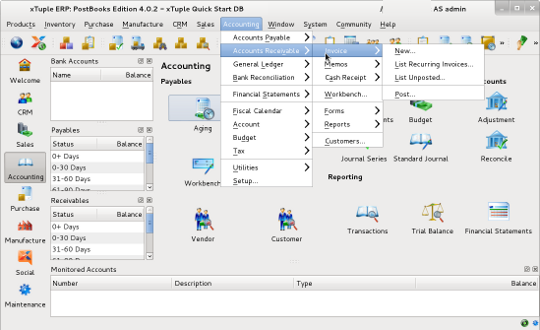 The new model provides an xTuple application server that can handle requests from web users and potentially other third-party apps too.
Who is it for?
Some people may feel that the web UI is intended to appeal to mobile users. While it is useful for mobile and tablet devices, this is not strictly the aim,
 gnome-screensaver isn't installed. gnome package doesn't seem to depend on that, and gnome-screensaver doesn't start up by default. If it's not running screensaver / lockscreen doesn't seem to appear.
Hmm.. how is it supposed to work ?
 The almost-yearly large KDE-sprint in Randa, Switzerland is doing a fundraiser to get this year s event running. See

 so, systemd now and teh world still turns...
So, two days ago I rebooted my wheezy system into systemd and what shall I say, it was+is like the last Debian stable updates: boring. It just works. Kudos for all those who made this happen!
I've one lazyweb question: what reasons are there for me to try out systemd from wheezy-backports?
Plus another observation from maintaining piuparts.d.o: currently
 For desktop users too
Many desktop users can also benefit from tel: URIs. If they have a modern telephone system in their office, the system administrator may have already added a tel: URI handler to their desktop.
Anyone with a software PBX or a SIP account can also potentially use the

 If you follow my blog closely, you noticed that I skipped all my usual monthly summaries in 2014. It s not that I stopped doing free software work, instead I was just too busy to be able to report about what I did. As an excuse, let me tell you that we just moved into a new house which was in construction since may last year.
The lack of visible activity on my blog resulted in a steady decrease of the amount of
 I also helped Sylvestre Ledru to finalize and close the


 From


 Until recently I was very happy with my console mail client,
