Search Results: "ed"

13 June 2014

Kees Cook: glibc select weakness fixed

In 2009, I reported this bug to glibc, describing the problem that exists when a program is using select, and has its open file descriptor resource limit raised above 1024 (FD_SETSIZE). If a network daemon starts using the FD_SET/FD_CLR glibc macros on fdset variables for descriptors larger than 1024, glibc will happily write beyond the end of the fdset variable, producing a buffer overflow condition. (This problem had existed since the introduction of the macros, so, for decades? I figured it was long over-due to have a report opened about it.) At the time, I was told this wasn t going to be fixed and every program using [select] must be considered buggy. 2 years later still more people kept asking for this feature and continued to be told no . But, as it turns out, a few months later after the most recent no , it got silently fixed anyway, with the bug left open as Won t Fix ! I m glad Florian did some house-cleaning on the glibc bug tracker, since I d otherwise never have noticed that this protection had been added to the ever-growing list of -D_FORTIFY_SOURCE=2 protections. I ll still recommend everyone use poll instead of select, but now I won t be so worried when I see requests to raise the open descriptor limit above 1024.

2014, Kees Cook. This work is licensed under a Creative Commons Attribution-ShareAlike 3.0 License.
Creative Commons License

Aigars Mahinovs: Going to Debconf14

It's that time of the year, again, when I lan to go to Debconf, reserve vacation, get visa waiver, book tickets. Let's hope nothing blocks me from attending this time. It has been too long. Now I just need to finish up photoriver before Debconf :) In fact it is quite close to being ready - I just need to finish up the GPS tagging feature, figure out why FLickr stopped working recently and optionally work on burst detection and/or FlashAir IP address autodetection in the network.

Steve Kemp: Amazon's Route53 API is nice.

It is unfortunate that some of the client libraries are inefficient, but I'm enjoying my exposure to Amazon's Route53 API. (This is unrelated to the previous post(s) about operating a DNS service..) For an idea of scale I host just over 170 zones at the moment. For the first 25 zones Amazon would charge $0.50 a month, then $0.10 after that. Which would mean:
25  * $0.50  +
150 * $0.10
             = $12.50
That seems reasonably .. reasonable.

Dirk Eddelbuettel: Introducing pkgKitten: Creating R Packages that purr

A new package pkgKitten is now on CRAN in its infant version 0.1.0. It does only one thing: create R packages that do not suck. Or at least not as much as those created by the (R default) function package.skeleton() which creates files which the very standard, and very recommended, R CMD check then complains about. That is silly. Because each time R CMD check complains, something bad happens to a kitten somewhere. So pkgKitten offers a wrapper function kitten() which creates neat little packages which do not upset R CMD check. A complete little demo is on the pkgKitten webpage which also has pointers to the pkgKitten GitHub repo.

This post by Dirk Eddelbuettel originated on his Thinking inside the box blog. Please report excessive re-aggregation in third-party for-profit settings.

12 June 2014

Jon Dowland: Spiral

March Of The Pigs March Of The Pigs
I stumbled across this whilst packing up my 7" records. It's one of my favourite 'features' on a blank side.

Matthew Palmer: GPG key transition

I m probably the last person on the planet to get around to doing this, but I figure it s probably about time my venerable old 1024D key was put out to pasture. My transition statement (signed, as usual, by both the old and new keys) is available. If you signed my old key, and still trust that I am who I think I am, I d appreciate it if you could sign my new key and fling the signatures at me or the keyserver networks.

11 June 2014

Bits from Debian: Introducing the Debian Continuous Integration project

Debian is a big system. At the time of writing, the unstable distribution has more than 20,000 source packages, building more then 40,000 binary packages on the amd64 architecture. The number of inter-dependencies between binary packages is mind-boggling: the entire dependency graph for the amd64 architecture contains a little more than 375,000 edges. If you want to expand the phrase "package A depends on package B", there are more than 375,000 pairs of packages A and B that can be used. Every one of these dependencies is a potential source of problems. A library changes the semantics of a function call, and then programs using that library that assumed the previous semantics can start to malfunction. A new version of your favorite programming language comes out, and a program written in it no longer works. The number of ways in which things can go wrong goes on and on. With an ecosystem as big as Debian, it is just impossible to stop these problems from happening. What we can do is trying to detect when they happen, and fix them as soon as possible. The Debian Continuous Integration project was created to address exactly this problem. It will continuously run test suites for source packages when any of their dependencies is updated, as well as when a new version of the package itself is uploaded to the unstable distribution. If any problems that can be detected by running an automated test suite arise, package maintainers can be notified in a matter of hours. Antonio Terceiro has posted on his blog an introduction to the project with a more detailed description of the project, its evolution since January 2014 when it was first introduced, an explanation of how the system works, and how maintainers can enable test suites for their packages. You might also want to check the documentation directly.

Yves-Alexis Perez: Debian, Xfce, policykit and permissions

So, it seems that for a lot of people using unstable, hardware-related permissions (shutdown/reboot, suspend/hibernate, devices mount/umount etc.) have been broken since some times. That's usually the case for people using GNOME with lightdm display manager, Xfce with either gdm or lightdm. It seems that recently, policykit (which is used by GNOME and Xfce) switched from consolekit backend to logind backend (yeah, systemd-logind). So applications using policykit needs to handle that correctly, and that means beeing sure a logind session is correctly setup, which is done by installing the package libpam-systemd. For now, it's still possible to not switch to systemd as init system, by installing the systemd-shim package before libpam-systemd. Be aware that (at least with the current state of affairs), this is only true with logind before 204. When systemd maintainers start transitionning to a later version, only systemd-sysv (so, systemd as init system) will work. For people reluctant to switch to systemd, they can use systemd-shim for now. Then when systemd 205+ enters the archive, either lose those hardware permissions, or try to improve systemd-shim to handle that situation. There's not much we (Xfce/LightDM maintainers) can do about that.

Daniel Pocock: Protest or Uber marketing stunt?

London's taxi "strike" today has been so successful that Uber claims to have had an 850% increase in new customer registrations this week. Well, that is a big success if you believe the strike may have been a guerrilla marketing tactic organised by Uber itself. No sympathy Personally, I have no sympathy for the taxi drivers. There is no city I have ever visited where I haven't encountered at least one taxi driver who tried to overcharge me. Honest drivers who give their customers value for money have less to fear from new technology than those who are unscrupulous. When I broke a leg a few years ago and was getting about on crutches for 6 weeks we decided to go out for dinner one night. This was the first time I went anywhere after having a long stint in hospital followed by a period of time I was confined to the house. The taxi driver deliberately skipped two turns leading directly to the restaurant, went another 1km past it and then followed a small street that winds back and forth and eventually demanded I pay him double what the fare should have been. This is exactly the type of abusive and despicable practice that is being eradicated by Uber's live GPS mapping technology. Although not every driver behaves so shamefully, this type of abuse of the weak or vulnerable is replicated in one way or another the world over. For example, in Melbourne, Australia, wheelchair taxis that have worked out they can make more money collecting families with suitcases at the airport leave genuine wheelchair users without a ride. Will Google be targeted next week? Google has just announced a step-change in plans to build their own self driving cars. Will Google offices around the world, including London be targetted by these crude blockades too? Political protest or anti-competitive mischief? Why were taxi drivers not arrested for their protest today? Given that the roads are the place where taxis and their competitors do business, can this blockade really be considered a political protest or is it an anti-competitive practice in blatant disregard of the law? Weapons of mass destruction Before even having breakfast you could probably find 10,000 cyclists in central London willing to sign a petition declaring taxis are a weapon of mass destruction. Once again, while there are honest drivers, there is a more than trivial number of taxi drivers who are a genuine danger to the lives of cyclists, scooters, motorcycles and occasionally pedestrians. I have personally experienced one of these thugs ramming my bicycle from behind (his hard-nosed insurer eventually paid up but without admitting liability). The police who attended the incident even told me they had seen so many accidents like this they wouldn't dare cycle themselves. The web is full of examples that appear to show malicious and criminal behavior by taxi drivers, thanks to Youtube and helmet cams: Will hotels protest about AirBNB? Now the taxi drivers have had their chance to cause mayhem, will hotel operators be next? What could they do though? Will they seek out AirBNB apartments and try to obstruct them somehow? Making mischief outside somebody's home is not a good way to make a point. Chances are, they would be prosecuted or served with restraining orders. So why do the taxi drivers get to jam up whole cities and get away with it? The Uber taxi meter loophole Will the courts decide that the Uber app is a taxi meter? This is actually a tough question. Even if courts rule against apps that perform live metering, Uber could simply remove all metering functions from the app itself and perform the metering calculations in the cloud. The app would just send start and finish locations to the cloud and the cloud would send a message back to the phone confirming the charge. The phone is then nothing more than a communication and positioning device. Remember the elevator man? When the automobile was first invented, laws were made requiring every car to be accompanied through public streets by a man carrying a flag. That job, like many others, no longer exists. elevator attendant In the good old days, every elevator had a man or woman who would sit on a stool and press buttons to operate the doors and motors. Some up-market department stores and hotels still have an elevator man to add a touch of nostalgia. The vast majority, however, have eliminated these jobs thanks to automatic elevators. Now, even aircraft can land automatically on a ship at sea. Look at all those people manning the deck in the video and contemplate how many of them might potentially be out of a job too in 50 years time as Terminator-style automated battleships patrol the seas. Technology, like the Terminator, is not going to stop.

Jonathan Carter: I m going to Debconf 14!

going-to-debconf14-sm Everything is set! The Debconf committee approved my accommodation sponsorship, my leave is confirmed and my airline tickets are booked, I m going to Debconf 14! It s going to be a 30 hour trip from Cape Town to Portland (I could shave off around 6 hours if I pay 120% more, doesn t seem worth it) and I ll be there for the full 9 days from 23 August to 31 August. I last attended Debconf 12 in Managua, Nicaragua and it was fun, educational and productive. I m really excited to see the Debian folk in person again and it will also be my first time in Portland. See you there!

10 June 2014

Maximilian Attems: xserver-xorg-video-intel 2.99.912 in experimental

With the release of xf86-video-intel 2.99.912 good sna support is expected for several generation of Intel devices. Again testing is very much appreciated: xserver-xorg-video-intel packages.

Steve Kemp: I did get a job

In my previous blog-post I mentioned, briefly, that I'd posted a couple of adverts on Reddit looking for work. To give more detail I did three things: The advertisement was set to be shown in /r/edinburgh (where I live), and /r/sysadmin (where I thought some people might look if they were struggling for help). The advertising on Reddit was painless to setup, and the traffic stats were interesting, but even though this worked out well I'm a little loathe to repeat the process - since the "non-sterling transaction fee" from my bank effectively doubled my budget. I received a few (private) emails and comments, along with the expected grammar corrections. The end result was that I received contact from an American company founder who seemed interested. He allowed me to write some code to solve a fun problem, appeared to enjoy the code I sent (Ruby code for dealing with (exim) email spam, that's as specific as I will be). The end result was a three month contract, which we obviously hope will lead to more permanent work. Anyway I thought this was an atypical route to find a work, and was about a million times nicer than working with recruiters, so .. consider this documentation! In other news it is now 10pm and I need to go to the gym and pub, in that order.

Steve Kemp: I'm still not a developer, but ..

Some coding updates: My templer static site generator has now been uploaded to CPAN, and is available as App::Templer. I've converted most of my Dockerfiles to work with docker 1.0.0, which is nice. I also hacked up a fun DNS-server for sharing JSON-encoded data, within a LAN or other environment: Finally I updated the blogspam-detecting site a little, on the back-end. The code is now running inside Docker containers which means I can redeploy more easily in the future. My blog post about looking for a job received some attention via a Reddit advert I posted to /r/edinburgh + /r/sysadmin, but thus far has mostly resulted in people wanting me to write code for them .. which is frustrating. For the moment I'm working on a fun challenge involving (email) spam-detection. That takes me back.

Dimitri John Ledkov: cross-compile go code, including cgo

By all means cross-compiling a new language/stack is not going to be pretty, but it didn't turn out that bad.

A few weeks back, I was told that go code which uses cgo (that is utilising C api calls to shared libraries exporting C interface) cannot be cross-compiled. Well, if it's just calling out a C compiler it should totally be easy to cross compile, since so much of our platform is.

So there we go, first I've picked a moderately small project which only does a couple cgo calls, and check that it compiles correctly:

$ sudo apt-get build-dep ubuntu-push-client
$ go get launchpad.net/ubuntu-push/...
$ cd $GOPATH/src/launchpad.net/ubuntu-push/
$ go build ubuntu-push-client.go
Well, when your gcc is all is easy.

I didn't want to polute my system, so I quickly created a chroot with go, build-dependencies in armhf architectures and cross-compiler:

# Get a chroot with build-dependencies installed, I am basing on top of a click-chroot
# one should be able to use any chroot which is armhf multiarch enabled.
$ sudo click chroot -aarmhf -fubuntu-sdk-14.04 -s utopic create
$ sudo click chroot -aarmhf -fubuntu-sdk-14.04 -s utopic maint apt-get install golang-go golang-go-linux-arm golang-go-dbus-dev golang-go-xdg-dev golang-gocheck-dev golang-gosqlite-dev golang-uuid-dev libgcrypt11-dev:armhf libglib2.0-dev:armhf libwhoopsie-dev:armhf libubuntuoneauth-2.0-dev:armhf libdbus-1-dev:armhf libnih-dbus-dev:armhf libsqlite3-dev:armhf crossbuild-essential-armhf
After that the tricky bit was advising go to cross-compile:

$ click chroot -aarmhf -fubuntu-sdk-14.04 -s utopic run CGO_ENABLED=1 GOARCH=arm GOARM=7 PKG_CONFIG_LIBDIR=/usr/lib/arm-linux-gnueabihf/pkgconfig:/usr/lib/pkgconfig:/usr/share/pkgconfig GOPATH=/usr/share/gocode/:~/go CC=arm-linux-gnueabihf-gcc go build -ldflags '-extld=arm-linux-gnueabihf-gcc' ubuntu-push-client.go
Ignoring the click chroot wrapper:
  • CGO_ENABLED=1 - by default cgo is disabled when cross-compiling, but really shouldn't be as compiler names are standard $(GNU_TRIPPLET) prefixed tools
  • GOARCH=arm - set the target arch
  • GOARM=7 - set ABI level
  • PKG_CONFIG_LIBDIR - the ugly beast to pass where pkg-config should search for .pc files. With autoconf one simply sets PKG_CONFIG environment variable pointing at a cross-pkg-config, $(GNU_TRIPPLET)-pkg-config but go tool doesn't support it. I've raised merge proposal to get that added https://codereview.appspot.com/104960043/
  • Next I just set GOPATH to where my packages are and CC as to which compiler to use
  • The last portion to the puzzle was to pash "-ldflags '-extld=$CC'" because the linker tool (5l) didn't use environmental variable CC and simply defaults to gcc. I'll raise a merge proposal for this.
Overall that's it. Given that all of above can be re-factored into standard variables (e.g. use $GNU_TRIPPLET prefix, and offer to override it), I see no reason why cross-compilation in go with cgo cannot eventually become a simple
GOARCH=arm go build

Gunnar Wolf: Tor: I'm shutting down my relay only after four days

Some days ago, I bit the bullet and accepted the Tor Challenge. Sadly, after only four days of having a Tor relay node happily sitting at home (and, of course, giving a nice function to this little friend). The inconveniences were too many. I understand anonimity can be used for many nefarious things, but I was surprised and saddened to see the amount of blocking services. Most notorious to me were the Freenode IRC network, friendly home to many free software projects, and the different Wikimedia projects, which ban editting from IP addresses idenitfied as Tor relays. I'm saddened to say that, while I could perfectly survive (and even be a bit proud about supporting a project I believe in) by jumping through some hoops (i.e. by setting up a SOCKS over ssh tunnel to my office to do my Wikipedia edits while at home), after only four days, I decided to shut down my relay. And the main reason... Was something I'm not going to fight against. And it's not even from a nice, friendly free software project. One thing I am not willing to part with is the one tool that keeps my wife well in contact with her friends and family back in Argentina. Yes, I know I could set up one or many different flavors of SIP or Jabber-based VoIP for her But it's also her parents, brother, sisters, and friends who use Skype. So, Skype's banning of Tor relay nodes made me decide to shut down my relay. Sigh... And for somebody obsessed with graphing stuff, this is the graph of the short lifespan of the "Lobazal" Tor node: [update] I will do another blog post. Good news: My Tor node is alive again! Just no longer as an exit relay, as properly pointed out by many, but as a Tor bridge.

AttachmentSize
tor-challenge-1.png23.97 KB
tor1.png27.84 KB
tor2.png18.3 KB

Russell Coker: Google Hardware Support

Ironically just 5 days after writing about how I choose Android devices for a long service life [1] my wife s Nexus 5 (with 32G of RAM (sorry Flash storage) to give it a long useful life) totally died. It reported itself as being fully charged and then 15 minutes later it was off and could not be revived. No combination of pushing the power button and connecting the power cable caused the screen to light up or any sound to be emitted. Google has a nice interactive support site for nexus devices that describes more ways of turning a phone on than any reasonable person could imagine. After trying to turn the phone on in various ways (plugged and unplugged etc) it gave me a link to get phone support. Clicking on that put me in the queue to RECEIVE a phone call and a minute later a lady who spoke English really well (which is unusual for telephone support) called me to talk me through the various options. Receiving a phone call is a much better experience than making a call. It meant that if the queue for phone support was long then I could do other things until the phone rings. It s impossible to be productive at other tasks while listening for hold music to stop and a person to start talking. The cost of doing this would be very tiny, while there would be some cost in hardware and software to have a web site that tells me how long I can expect to wait for a call a more basic implementation where I just submit my number and wait for a call would be very cheap to implement. The costs of calls from the US to Australia (and most places where people can afford a high end Android phone) are quite cheap for home users and are probably cheaper if you run a call center. If the average support call cost Google $1 and 3% of phones have support calls then that would be an extra cost of $0.03 per phone. I expect that almost everyone who buys a $450 phone would be happy to pay a lot more than $0.03 to avoid the possibility of listening to hold music! I received the phone call about a minute after requesting it, this was nice but I wonder how long I would have waited if I hadn t requested a call at 1AM Australian time (presumably during the day in a US call center). In any case getting a 1 minute response is great for any time of the day or night, lots of call centers can t do that. While the phone support is much better than most phone support, it would be nice if they added some extra options. I think it would be good to have webchat and SMS as options for support for the benefit of people who don t want to speak to strangers. This would be useful to a lot of people on the Autism Spectrum and probably others too. The phone call wasn t particularly productive, it merely confirmed that I had followed all the steps on the support website. Then I received an email telling me about the web site which was a waste of time as I d covered that in the phone call. I have just replied to their second email which asked for the IMEI of the phone to start the warranty return process. We could have saved more than 24 hours delay if this had been requested in the first email or the phone call. Google could have even requested the IMEI through the web site before starting the phone call. It would have been even easier if Google had included the device IMEI in the email they sent me to confirm the purchase as searching for old email is a lot easier than searching through my house for an old box. Another option for Google would be to just ask me for the Gmail account used for the purchase, as I only bought one Nexus 5 on that account they then have all the purchase details needed for a warranty claim. While the first call was a great experience the email support following that has been a waste of time. I m now wondering if they aim to delay the warranty process for a few days in the hope that the phone will just start working again.

Dirk Eddelbuettel: Introducing RcppRedis

RcppRedis, another new package of mine, appeared on CRAN a few weeks ago just in time for our annual R/Finance conference. And as of today, we also have Windows binaries thanks to generous help from John Buonagurio who help building the required 32- and 64-bit libraries for Windows, and Uwe Ligges who now installed them for the CRAN and win-builder machiness. Binaries for release 0.1.1 should be available within a day. To describe the package, I also just set up a page about RcppRedis so rather than repeating everything here I invite you to follow the link. The ever-so-brief NEWS entry for the two first uploads follows.
Changes in version 0.1.1 (2014-06-09)
  • Now with Windows support thanks to the installation of builds of the hiredis library (created by John Buonagurio) at CRAN / win-builder (thanks to Uwe Ligges)
  • Added support for new command zcount
Changes in version 0.1.0 (2014-05-10)
  • Initial CRAN upload

This post by Dirk Eddelbuettel originated on his Thinking inside the box blog. Please report excessive re-aggregation in third-party for-profit settings.

9 June 2014

Konstantinos Margaritis: SIMD book, second update!

From the Indiegogo page: https://www.indiegogo.com/projects/simd-engines-comparative-reference-guide/x/4966960#activity
  • Added titlepage (simple, but will do the job)
  • Reorganized ALL instructions to include both unsigned/signed in the same entity
  • Added Saturated Addition, Subtraction and Saturated Subtraction
  • Added ARMv8 NEON instructions taken from ARM infocenter draft
  • Fixed some instructions (added 64-bit arithmetic for NEON)
  • Added some special addition/subtraction, like add/sub with carry(vmx/vsx), addsub(SSE3/AVX)
  • Added some in-vector sum additions, sum reductions but no descriptions yet
  • Added diagram for 8-bit addition/subtraction (still need lots more).
  • Removed VMX128, couldn't find enough information, an email to some IBM toolchain developers was left unanswered, so I guess noone really will really care if that engine is left out, if enough people insist on it, please also be kind enough to provide some documentation on it.

Daniel Pocock: reSIProcate v1.9 with WebRTC now available for Fedora 20 users

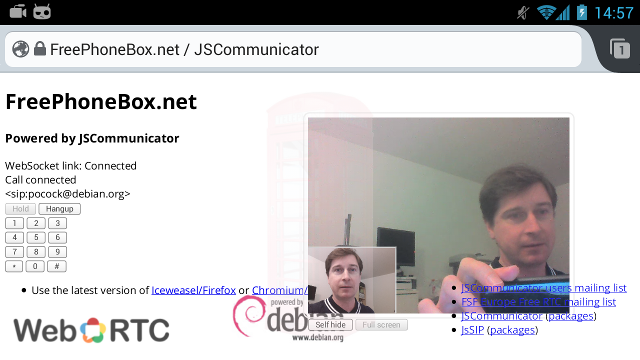
reSIProcate v1.9 has now moved from testing to stable and is available for Fedora 20 users. Version 1.9.7 has also propagated to Debian testing and wheezy-backports, delivering improved stability as discussed in my previous blog. Ready to try WebRTC? The quickest way to set up your own WebRTC trial is to install the repro (reSIProcate SIP proxy) packages for your preferred Linux distribution and then copy JSCommunicator into a directory on your web server. My earlier blog get WebRTC going faster gives specific examples of entries needed in repro.config.. WebRTC Calling from Android I've continued to have success making and receiving calls with both the Firefox and Chrome apps on Android. This is a great way to reach out to friends and family using free software for communication. More details and some screenshots are available in my earlier blog on Android WebRTC.

Floris Stoica-Marcu: GSoC 2014 Muon package and initial apt-listbugs integration [Week3]

Hello, The past week I ve finished the muon package, available @ git.debian.org/?p=pkg-kde/kde-extras/muon.git on the gsoc-floris-2014 branch (use at your own risk!) Also, I ve finished up the KAuth support when adding/removing repos (already pushed to the master of Muon). Most importantly, I ve started integrating apt-listbugs a most important component of Debian. What does this mean and how it will affect the end-user? Well, having apt-listbugs integrated means that the user will be warned when installing packages if the packages have some serious/grave/critical bugs! I am still working on making it async and I hope to be done by tonight. Also, some formatting work on the dialog is still needed. Check it out bellow: Apt-listbugs in action After I finish the apt-listbugs integration, I will get started on writing up some apt unit tests as suggested by Aleix. Also, I will work with Sune on updating the qapt package as well. In a nutshell: This week:
*muon package
*KAuth support implemented
*initial apt-listbugs integration Plans for next week:
*finish apt-listbugs integration (async, with pretty formatting!)
*apt unit tests
*update qapt package Thanks for reading, see you next week!
Floris.

Next.

Previous.