Search Results: "xam"

7 June 2021

Russell Coker: Dell PowerEdge T320 and Linux

I recently bought a couple of PowerEdge T320 servers, so now to learn about setting them up. They are a little newer than the R710 I recently setup (which had iDRAC version 6), they have iDRAC version 7. RAM Speed One system has a E5-2440 CPU with 2*16G DDR3 DIMMs and a Memtest86+ speed of 13,043MB/s, the other is essentially identical but with a E5-2430 CPU and 4*16G DDR3 DIMMs and a Memtest86+ speed of 8,270MB/s. I had expected that more DIMMs means better RAM performance but this isn t what happened. I firstly upgraded the BIOS, as I expected it didn t make a difference but it s a good thing to try first. On the E5-2430 I tried removing a DIMM after it was pointed out on Facebook that the CPU has 3 memory channels (here s a link to a great site with information on that CPU and many others [1]). When I did that I was prompted to disable advanced ECC (which treats pairs of DIMMs as a single unit for ECC allowing correcting more than 1 bit errors) and I had to move the 3 remaining DIMMS to different slots. That improved the performance to 13,497MB/s. I then put the spare DIMM into the E5-2440 system and the performance increased to 13,793MB/s, when I installed 4 DIMMs in the E5-2440 system the performance remained at 13,793MB/s and the E5-2430 went down to 12,643MB/s. This is a good result for me, I now have the most RAM and fastest RAM configuration in the system with the fastest CPU. I ll sell the other one to someone who doesn t need so much RAM or performance (it will be really good for a small office mail server and NAS). Firmware Update BIOS The first issue is updating the BIOS, unfortunately the first link I found to the Dell web site didn t have a link to download the Linux installer. It offered a Windows binary, an EFI program, and a DOS binary. I m not about to install Windows if there is any other option and EFI is somewhat annoying, so that leaves DOS. The first Google result for installing FreeDOS advised using unetbootin , that didn t work at all for me (created a USB image that the Dell BIOS didn t recognise as bootable) and even if it did it wouldn t have been a good solution. I went to the FreeDOS download page [2] and got the Lite USB zip file. That contained FD12LITE.img which I could just dd to a USB stick. I then used fdisk to create a second 32MB partition, used mkfs.fat to format it, and then copied the BIOS image file to it. I booted the USB stick and then ran the BIOS update program from drive D:. After the BIOS update this became the first system I ve seen get a totally green result from spectre-meltdown-checker ! I found the link to the Linux installer for the new Dell BIOS afterwards, but it was still good to play with FreeDOS. PERC Driver I probably didn t really need to update the PERC (PowerEdge Raid Controller) firmware as I m just going to run it in JBOD mode. But it was easy to do, a simple bash shell script to update it. Here are the perccli commands needed to access disks, it s all hot-plug so you can insert disks and do all this without a reboot:
# show overview
perccli show
# show controller 0 details
perccli /c0 show all
# show controller 0 info with less detail
perccli /c0 show
# clear all "foreign" RAID members
perccli /c0 /fall delete
# add a vd (RAID) of level RAID0 (r0) with the drive 32:0 (enclosure:slot from above command)
perccli /c0 add vd r0 drives=32:0
The perccli /c0 show command gives the following summary of disk ( PD in perccli terminology) information amongst other information. The EID is the enclosure, Slt is the slot (IE the bay you plug the disk into) and the DID is the disk identifier (not sure what happens if you have multiple enclosures). The allocation of device names (sda, sdb, etc) will be in order of EID:Slt or DID at boot time, and any drives added at run time will get the next letters available.
----------------------------------------------------------------------------------
EID:Slt DID State DG       Size Intf Med SED PI SeSz Model                     Sp 
----------------------------------------------------------------------------------
32:0      0 Onln   0  465.25 GB SATA SSD Y   N  512B Samsung SSD 850 EVO 500GB U  
32:1      1 Onln   1  465.25 GB SATA SSD Y   N  512B Samsung SSD 850 EVO 500GB U  
32:3      3 Onln   2   3.637 TB SATA HDD N   N  512B ST4000DM000-1F2168        U  
32:4      4 Onln   3   3.637 TB SATA HDD N   N  512B WDC WD40EURX-64WRWY0      U  
32:5      5 Onln   5 278.875 GB SAS  HDD Y   N  512B ST300MM0026               U  
32:6      6 Onln   6 558.375 GB SAS  HDD N   N  512B AL13SXL600N               U  
32:7      7 Onln   4   3.637 TB SATA HDD N   N  512B ST4000DM000-1F2168        U  
----------------------------------------------------------------------------------
The PERC controller is a MegaRAID with possibly some minor changes, there are reports of Linux MegaRAID management utilities working on it for similar functionality to perccli. The version of MegaRAID utilities I tried didn t work on my PERC hardware. The smartctl utility works on those disks if you tell it you have a MegaRAID controller (so obviously there s enough similarity that some MegaRAID utilities will work). Here are example smartctl commands for the first and last disks on my system. Note that the disk device node doesn t matter as all device nodes associated with the PERC/MegaRAID are equal for smartctl.
# get model number etc on DID 0 (Samsung SSD)
smartctl -d megaraid,0 -i /dev/sda
# get all the basic information on DID 0
smartctl -d megaraid,0 -a /dev/sda
# get model number etc on DID 7 (Seagate 4TB disk)
smartctl -d megaraid,7 -i /dev/sda
# exactly the same output as the previous command
smartctl -d megaraid,7 -i /dev/sdc
I have uploaded etbemon version 1.3.5-6 to Debian which has support for monitoring smartctl status of MegaRAID devices and NVMe devices. IDRAC To update IDRAC on Linux there s a bash script with the firmware in the same file (binary stuff at the end of a shell script). To make things a little more exciting the script insists that rpm be available (running apt install rpm fixes that for a Debian system). It also creates and runs other shell scripts which start with #!/bin/sh but depend on bash syntax. So I had to make /bin/sh a symlink to /bin/bash. You know you need this if you see errors like typeset: not found and [: -eq: unexpected operator and then the system reboots. Dell people, please test your scripts on dash (the Debian /bin/sh) or just specify #!/bin/bash. If the IDRAC update works it will take about 8 minutes. Lifecycle Controller The Lifecycle Controller is apparently for installing OS and firmware updates. I use Linux tools to update Linux and I generally don t plan to update the firmware after deployment (although I could do so from Linux if needed). So it doesn t seem to offer anything useful to me. Setting Up IDRAC For extra excitement I decided to try to setup IDRAC from the Linux command-line. To install the RAC setup tool you run apt install srvadmin-idracadm7 libargtable2-0 (because srvadmin-idracadm7 doesn t have the right dependencies).
# srvadmin-idracadm7 is missing a dependency
apt install srvadmin-idracadm7 libargtable2-0
# set the IP address, netmask, and gatewat for IDRAC
idracadm7 setniccfg -s 192.168.0.2 255.255.255.0 192.168.0.1
# put my name on the front panel LCD
idracadm7 set System.LCD.UserDefinedString "Russell Coker"
Conclusion This is a very nice deskside workstation/server. It s extremely quiet with hardly any fan noise and the case is strong enough to contain the noise of hard drives. When running with 3* 3.5 SATA disks and 2*10k 2.5 SAS disks on a wooden floor it wasn t annoyingly loud. Without the SAS disks it was as quiet as you can expect any PC to be, definitely not the volume you expect from a serious server! I bought the T320 systems loaded with SAS disks which made them quite loud, I immediately put the disks on ebay and installed SATA SSDs and hard drives which gives me more performance and more space than the SAS disks with less cost and almost no noise. 8*3.5 drive bays gives room for expansion. I currently have 2*SATA SSDs and 3*SATA disks, the SSDs are for the root filesystem (including /home) and the disks are for a separate filesystem for large files.

6 June 2021

Iustin Pop: Goodbye Travis, hello GitHub Actions

My very cyclical open-source work For some reason, I only manage to do coding at home every some months - mostly 6 months apart, so twice a year (even worse than my blogging frequency :P). As such, I missed the whole discussion about travis-ci (the .org version) going away, etc. So when I finally did some work on corydalis a few weeks ago, and had a travis build failure (restoring a large cache simply timed out, either travis or S3 has some hiccup - it cleared by itself a day later), I opened the travis-ci interface to see the scary banner ( travis-ci.org is shutting down ), and asked myself what s happening. The deadline was in less than a week even Long story short, Travis was a good home for many years, but they were bought and are doing significant changes to their OSS support, so it s time to move on. I anyway wanted to learn GitHub Actions for a while (ahem, free time intervened), so this was a good (forced) opportunity .

Proper composable CI The advantage of Travis infrastructure was that the build configuration was really simple. It had very few primitives: pre-steps (before_install), install steps, and the actual things to do to test, post-steps (after_sucess) and a few other small helpers (caching, apt packages, etc.) This made it really easy to just pick up and write a config, plus it had the advantage of allowing to test configs from the web UI without needing to push. This simplicity was unfortunately also its significant limiter: the way to do complex things in steps was simply to add more shell commands. GitHub actions, together with its marketplace, changes this entirely. There are no built-in actions, the language just defines the build/job/step hierarchy, and one glues together whatever steps they want. This has the disadvantage that even checking out the code needs to be explicitly written in all workflows (so boilerplate, if you don t need customisation), but it opens up a huge opportunity for composition, since it allows people to publish actions (steps) that you just import, encapsulating all the work. So, after learning how to write a moderately complicated workflow (complicated as in multiple Python version, some of them needing different OS version, and multi-OS), it was straightforward to port this to all my projects - just somewhat tedious. I ve now shutdown all builds on Travis, just can t find a way to delete my account

Better multi-OS, worse (missing) multi-arch In theory, Travis supports Linux, MacOS, FreeBSD and Windows, but I ve found that support for non-Linux is not quite as good. Maybe I missed things, but multi-version Python builds on MacOS were not as nicely supported as Linux; Windows is quite early, and very limited; and I haven t tested FreeBSD. GitHub is more restrictive - Linux, MacOS and Windows - but I found support for MacOS and Windows better for my use cases. If your use case is testing multiple MacOS versions, Travis wins, if it s more varied languages/etc. on the single available MacOS version, GitHub works better. On the multi-arch side, Travis wins hands-down. Four different native architectures, and enabling one more is just adding another key to the arch list. With GitHub, if I understand right, you either have to use docker+emulation, or use self-hosted runners. So here it really matters what is more important to you. Maybe in the future GitHub will support more arches, but right now, Travis wins for this use-case.

Summary For my specific use-case, GitHub Actions is a better fit right now. The marketplace has advantages (I ll explain better in a future post), the actions are a very nice way to encapsulate functionality, and it s still available/free (up to a limit) for open source projects. I don t know what the future of Travis for OSS will be, but all I heard so far is very concerning. However, I ll still miss a few things. For example, an overall dashboard for all my projects, like this one:
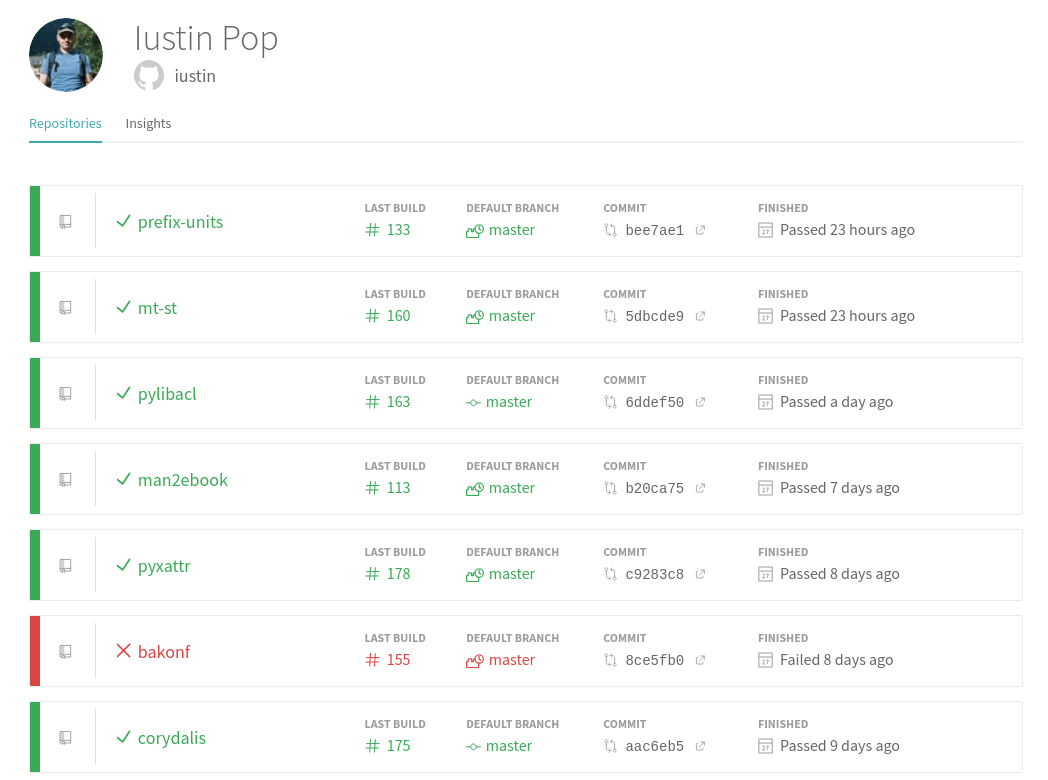
Travis dashboard Travis dashboard
I couldn t find any such thing on GitHub, so I just use my set of badges. Then cache management. Travis allows you to clear the cache, and it does auto-update the cache. GitHub caches are immutable once built, so you have to:
  • watch if changed dependencies/dependency chains result in things that are no longer cached;
  • if so, need to manually bump the cache key, resulting in a commit for purely administrative purposes.
For languages where you have a clean full chain of dependencies recorded (e.g. node s package-lock.json, stack s stack.yaml.lock), this is trivial to achieve, but gets complicated if you add OS dependencies, languages which don t record all this, etc. Hmm, maybe I should just embed the year/month in the cache name - cheating, but automated cheating. With all said and done, I think GHA is much less refined, but with more potential. Plus, the pace of innovation on Travis side was quite slow (likely money problems, hence them being bought, etc.) So one TODO done: learn GitHub Actions , even if a bit unplanned

Evgeni Golov: Controlling Somfy roller shutters using an ESP32 and ESPHome

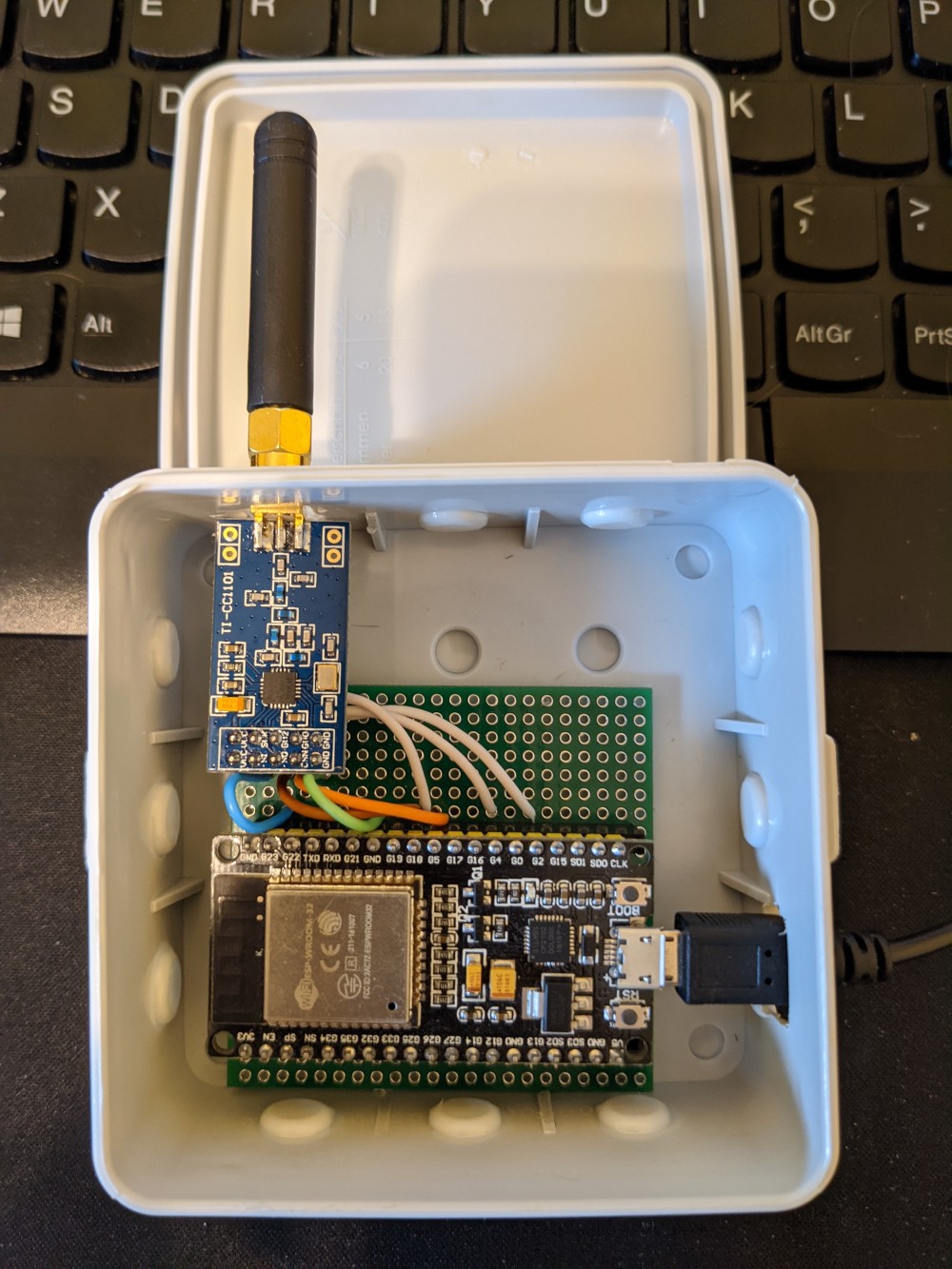
Our house has solar powered, remote controllable roller shutters on the roof windows, built by the German company named HEIM & HAUS. However, when you look closely at the remote control or the shutter motor, you'll see another brand name: SIMU. As the shutters don't have any wiring inside the house, the only way to control them is via the remote interface. So let's go on the Internet and see how one can do that, shall we? ;) First thing we learn is that SIMU remote stuff is just re-branded Somfy. Great, another name! Looking further we find that Somfy uses some obscure protocol to prevent (replay) attacks (spoiler: it doesn't!) and there are tools for RTL-SDR and Arduino available. That's perfect! Always sniff with RTL-SDR first! Given the two re-brandings in the supply chain, I wasn't 100% sure our shutters really use the same protocol. So the first "hack" was to listen and decrypt the communication using RTL-SDR:
$ git clone https://github.com/dimhoff/radio_stuff
$ cd radio_stuff
$ make -C converters am_to_ook
$ make -C decoders decode_somfy
$ rtl_fm -M am -f 433.42M -s 270K   ./am_to_ook -d 10 -t 2000 -    ./decode_somfy
<press some buttons on the remote>
The output contains the buttons I pressed, but also the id of the remote and the command counter (which is supposed to prevent replay attacks). At this point I could just use the id and the counter to send own commands, but if I'd do that too often, the real remote would stop working, as its counter won't increase and the receiver will drop the commands when the counters differ too much. But that's good enough for now. I know I'm looking for the right protocol at the right frequency. As the end result should be an ESP32, let's move on! Acquiring the right hardware Contrary to an RTL-SDR, one usually does not have a spare ESP32 with 433MHz radio at home, so I went shopping: a NodeMCU-32S clone and a CC1101. The CC1101 is important as most 433MHz chips for Arduino/ESP only work at 433.92MHz, but Somfy uses 433.42MHz and using the wrong frequency would result in really bad reception. The CC1101 is essentially an SDR, as you can tune it to a huge spectrum of frequencies. Oh and we need some cables, a bread board, the usual stuff ;) The wiring is rather simple: ESP32 wiring for a CC1101 And the end result isn't too beautiful either, but it works: ESP32 and CC1101 in a simple case Acquiring the right software In my initial research I found an Arduino sketch and was totally prepared to port it to ESP32, but luckily somebody already did that for me! Even better, it's explicitly using the CC1101. Okay, okay, I cheated, I actually ordered the hardware after I found this port and the reference to CC1101. ;) As I am using ESPHome for my ESPs, the idea was to add a "Cover" that's controlling the shutters to it. Writing some C++, how hard can it be? Turns out, not that hard. You can see the code in my GitHub repo. It consists of two (relevant) files: somfy_cover.h and somfy.yaml. somfy_cover.h essentially wraps the communication with the Somfy_Remote_Lib library into an almost boilerplate Custom Cover for ESPHome. There is nothing too fancy in there. The only real difference to the "Custom Cover" example from the documentation is the split into SomfyESPRemote (which inherits from Component) and SomfyESPCover (which inherits from Cover) -- this is taken from the Custom Sensor documentation and allows me to define one "remote" that controls multiple "covers" using the add_cover function. The first two params of the function are the NVS name and key (think database table and row), and the third is the rolling code of the remote (stored in somfy_secrets.h, which is not in Git). In ESPHome a Cover shall define its properties as CoverTraits. Here we call set_is_assumed_state(true), as we don't know the state of the shutters - they could have been controlled using the other (real) remote - and setting this to true allows issuing open/close commands at all times. We also call set_supports_position(false) as we can't tell the shutters to move to a specific position. The one additional feature compared to a normal Cover interface is the program function, which allows to call the "program" command so that the shutters can learn a new remote. somfy.yaml is the ESPHome "configuration", which contains information about the used hardware, WiFi credentials etc. Again, mostly boilerplate. The interesting parts are the loading of the additional libraries and attaching the custom component with multiple covers and the additional PROG switches:
esphome:
  name: somfy
  platform: ESP32
  board: nodemcu-32s
  libraries:
    - SmartRC-CC1101-Driver-Lib@2.5.6
    - Somfy_Remote_Lib@0.4.0
    - EEPROM
  includes:
    - somfy_secrets.h
    - somfy_cover.h
 
cover:
  - platform: custom
    lambda:  -
      auto somfy_remote = new SomfyESPRemote();
      somfy_remote->add_cover("somfy", "badezimmer", SOMFY_REMOTE_BADEZIMMER);
      somfy_remote->add_cover("somfy", "kinderzimmer", SOMFY_REMOTE_KINDERZIMMER);
      App.register_component(somfy_remote);
      return somfy_remote->covers;
    covers:
      - id: "somfy"
        name: "Somfy Cover"
      - id: "somfy2"
        name: "Somfy Cover2"
switch:
  - platform: template
    name: "PROG"
    turn_on_action:
      - lambda:  -
          ((SomfyESPCover*)id(somfy))->program();
  - platform: template
    name: "PROG2"
    turn_on_action:
      - lambda:  -
          ((SomfyESPCover*)id(somfy2))->program();
The switch to trigger the program mode took me a bit. As the Cover interface of ESPHome does not offer any additional functions besides movement control, I first wrote code to trigger "program" when "stop" was pressed three times in a row, but that felt really cumbersome and also had the side effect that the remote would send more than needed, sometimes confusing the shutters. I then decided to have a separate button (well, switch) for that, but the compiler yelled at me I can't call program on a Cover as it does not have such a function. Turns out, you need to explicitly cast to SomfyESPCover and then it works, even if the code becomes really readable, NOT. Oh and as the switch does not have any code to actually change/report state, it effectively acts as a button that can be pressed. At this point we can just take an existing remote, press PROG for 5 seconds, see the blinds move shortly up and down a bit and press PROG on our new ESP32 remote and the shutters will learn the new remote. And thanks to the awesome integration of ESPHome into HomeAssistant, this instantly shows up as a new controllable cover there too. Future Additional Work I started writing this post about a year ago And the initial implementation had some room for improvement More than one remote The initial code only created one remote and one cover element. Sure, we could attach that to all shutters (there are 4 of them), but we really want to be able to control them separately. Thankfully I managed to read enough ESPHome docs, and learned how to operate std::vector to make the code dynamically accept new shutters. Using ESP32's NVS The ESP32 has a non-volatile key-value storage which is much nicer than throwing bits at an emulated EEPROM. The first library I used for that explicitly used EEPROM storage and it would have required quite some hacking to make it work with NVS. Thankfully the library I am using now has a plugable storage interface, and I could just write the NVS backend myself and upstream now supports that. Yay open-source! Remaining issues Real state is unknown As noted above, the ESP does not know the real state of the shutters: a command could have been lost in transmission (the Somfy protocol is send-only, there is no feedback) or the shutters might have been controlled by another remote. At least the second part could be solved by listening all the time and trying to decode commands heard over the air, but I don't think this is worth the time -- worst that can happen is that a closed (opened) shutter receives another close (open) command and that is harmless as they have integrated endstops and know that they should not move further. Can't program new remotes with ESP only To program new remotes, one has to press the "PROG" button for 5 seconds. This was not exposed in the old library, but the new one does support "long press", I just would need to add another ugly switch to the config and I currently don't plan to do so, as I do have working remotes for the case I need to learn a new one.

3 June 2021

Jonathan McDowell: Digging into Kubernetes containers

Having build a single node Kubernetes cluster and had a poke at what it s doing in terms of networking the next thing I want to do is figure out what it s doing in terms of containers. You might argue this should have come before networking, but to me the networking piece is more non-standard than the container piece, so I wanted to understand that first. Let s start with a process listing on the host. ps faxno user,stat,cmd There are a number of processes from the host kernel we don t care about:

kernel processes
    USER STAT CMD
       0 S    [kthreadd]
       0 I<    \_ [rcu_gp]
       0 I<    \_ [rcu_par_gp]
       0 I<    \_ [kworker/0:0H-events_highpri]
       0 I<    \_ [mm_percpu_wq]
       0 S     \_ [rcu_tasks_rude_]
       0 S     \_ [rcu_tasks_trace]
       0 S     \_ [ksoftirqd/0]
       0 I     \_ [rcu_sched]
       0 S     \_ [migration/0]
       0 S     \_ [cpuhp/0]
       0 S     \_ [cpuhp/1]
       0 S     \_ [migration/1]
       0 S     \_ [ksoftirqd/1]
       0 I<    \_ [kworker/1:0H-kblockd]
       0 S     \_ [cpuhp/2]
       0 S     \_ [migration/2]
       0 S     \_ [ksoftirqd/2]
       0 I<    \_ [kworker/2:0H-events_highpri]
       0 S     \_ [cpuhp/3]
       0 S     \_ [migration/3]
       0 S     \_ [ksoftirqd/3]
       0 I<    \_ [kworker/3:0H-kblockd]
       0 S     \_ [kdevtmpfs]
       0 I<    \_ [netns]
       0 S     \_ [kauditd]
       0 S     \_ [khungtaskd]
       0 S     \_ [oom_reaper]
       0 I<    \_ [writeback]
       0 S     \_ [kcompactd0]
       0 SN    \_ [ksmd]
       0 SN    \_ [khugepaged]
       0 I<    \_ [kintegrityd]
       0 I<    \_ [kblockd]
       0 I<    \_ [blkcg_punt_bio]
       0 I<    \_ [edac-poller]
       0 I<    \_ [devfreq_wq]
       0 I<    \_ [kworker/0:1H-kblockd]
       0 S     \_ [kswapd0]
       0 I<    \_ [kthrotld]
       0 I<    \_ [acpi_thermal_pm]
       0 I<    \_ [ipv6_addrconf]
       0 I<    \_ [kstrp]
       0 I<    \_ [zswap-shrink]
       0 I<    \_ [kworker/u9:0-hci0]
       0 I<    \_ [kworker/2:1H-kblockd]
       0 I<    \_ [ata_sff]
       0 I<    \_ [sdhci]
       0 S     \_ [irq/39-mmc0]
       0 I<    \_ [sdhci]
       0 S     \_ [irq/42-mmc1]
       0 S     \_ [scsi_eh_0]
       0 I<    \_ [scsi_tmf_0]
       0 S     \_ [scsi_eh_1]
       0 I<    \_ [scsi_tmf_1]
       0 I<    \_ [kworker/1:1H-kblockd]
       0 I<    \_ [kworker/3:1H-kblockd]
       0 S     \_ [jbd2/sda5-8]
       0 I<    \_ [ext4-rsv-conver]
       0 S     \_ [watchdogd]
       0 S     \_ [scsi_eh_2]
       0 I<    \_ [scsi_tmf_2]
       0 S     \_ [usb-storage]
       0 I<    \_ [cfg80211]
       0 S     \_ [irq/130-mei_me]
       0 I<    \_ [cryptd]
       0 I<    \_ [uas]
       0 S     \_ [irq/131-iwlwifi]
       0 S     \_ [card0-crtc0]
       0 S     \_ [card0-crtc1]
       0 S     \_ [card0-crtc2]
       0 I<    \_ [kworker/u9:2-hci0]
       0 I     \_ [kworker/3:0-events]
       0 I     \_ [kworker/2:0-events]
       0 I     \_ [kworker/1:0-events_power_efficient]
       0 I     \_ [kworker/3:2-events]
       0 I     \_ [kworker/1:1]
       0 I     \_ [kworker/u8:1-events_unbound]
       0 I     \_ [kworker/0:2-events]
       0 I     \_ [kworker/2:2]
       0 I     \_ [kworker/u8:0-events_unbound]
       0 I     \_ [kworker/0:1-events]
       0 I     \_ [kworker/0:0-events]
There are various basic host processes, including my SSH connections, and Docker. I note it s using containerd. We also see kubelet, the Kubernetes node agent.
host processes
    USER STAT CMD
       0 Ss   /sbin/init
       0 Ss   /lib/systemd/systemd-journald
       0 Ss   /lib/systemd/systemd-udevd
     101 Ssl  /lib/systemd/systemd-timesyncd
       0 Ssl  /sbin/dhclient -4 -v -i -pf /run/dhclient.enx00e04c6851de.pid -lf /var/lib/dhcp/dhclient.enx00e04c6851de.leases -I -df /var/lib/dhcp/dhclient6.enx00e04c6851de.leases enx00e04c6851de
       0 Ss   /usr/sbin/cron -f
     104 Ss   /usr/bin/dbus-daemon --system --address=systemd: --nofork --nopidfile --systemd-activation --syslog-only
       0 Ssl  /usr/sbin/dockerd -H fd://
       0 Ssl  /usr/sbin/rsyslogd -n -iNONE
       0 Ss   /usr/sbin/smartd -n
       0 Ss   /lib/systemd/systemd-logind
       0 Ssl  /usr/bin/containerd
       0 Ss+  /sbin/agetty -o -p -- \u --noclear tty1 linux
       0 Ss   sshd: /usr/sbin/sshd -D [listener] 0 of 10-100 startups
       0 Ss    \_ sshd: root@pts/1
       0 Ss        \_ -bash
       0 R+            \_ ps faxno user,stat,cmd
       0 Ss    \_ sshd: noodles [priv]
    1000 S         \_ sshd: noodles@pts/0
    1000 Ss+           \_ -bash
       0 Ss   /lib/systemd/systemd --user
       0 S     \_ (sd-pam)
    1000 Ss   /lib/systemd/systemd --user
    1000 S     \_ (sd-pam)
       0 Ssl  /usr/bin/kubelet --bootstrap-kubeconfig=/etc/kubernetes/bootstrap-kubelet.conf --kubeconfig=/etc/kubernetes/kubelet.conf --config=/var/lib/kubelet/config.yaml --network-plugin=cni --pod-infra-container-image=k8s.gcr.io/pause:3.4.1
And that just leaves a bunch of container related processes:
container processes
       0 Sl   /usr/bin/containerd-shim-runc-v2 -namespace moby -id fd95c597ff3171ff110b7bf440229e76c5108d5d93be75ffeab54869df734413 -address /run/containerd/containerd.sock
       0 Ss    \_ /pause
       0 Sl   /usr/bin/containerd-shim-runc-v2 -namespace moby -id c2ff2c50f0bc052feda2281741c4f37df7905e3b819294ec645148ae13c3fe1b -address /run/containerd/containerd.sock
       0 Ss    \_ /pause
       0 Sl   /usr/bin/containerd-shim-runc-v2 -namespace moby -id 589c1545d9e0cdf8ea391745c54c8f4db49f5f437b1a2e448e7744b2c12f8856 -address /run/containerd/containerd.sock
       0 Ss    \_ /pause
       0 Sl   /usr/bin/containerd-shim-runc-v2 -namespace moby -id 6f417fd8a8c573a2b8f792af08cdcd7ce663457f0f7218c8d55afa3732e6ee94 -address /run/containerd/containerd.sock
       0 Ss    \_ /pause
       0 Sl   /usr/bin/containerd-shim-runc-v2 -namespace moby -id afa9798c9f663b21df8f38d9634469e6b4db0984124547cd472a7789c61ef752 -address /run/containerd/containerd.sock
       0 Ssl   \_ kube-scheduler --authentication-kubeconfig=/etc/kubernetes/scheduler.conf --authorization-kubeconfig=/etc/kubernetes/scheduler.conf --bind-address=127.0.0.1 --kubeconfig=/etc/kubernetes/scheduler.conf --leader-elect=true --port=0
       0 Sl   /usr/bin/containerd-shim-runc-v2 -namespace moby -id 4b3708b62f4d427690f5979848c59fce522dab6c62a9c53b806ffbaef3f88e62 -address /run/containerd/containerd.sock
       0 Ssl   \_ kube-controller-manager --authentication-kubeconfig=/etc/kubernetes/controller-manager.conf --authorization-kubeconfig=/etc/kubernetes/controller-manager.conf --bind-address=127.0.0.1 --client-ca-file=/etc/kubernetes/pki/ca.crt --cluster-name=kubernetes --cluster-signing-cert-file=/etc/kubernetes/pki/ca.crt --cluster-signing-key-file=/etc/kubernetes/pki/ca.key --controllers=*,bootstrapsigner,tokencleaner --kubeconfig=/etc/kubernetes/controller-manager.conf --leader-elect=true --port=0 --requestheader-client-ca-file=/etc/kubernetes/pki/front-proxy-ca.crt --root-ca-file=/etc/kubernetes/pki/ca.crt --service-account-private-key-file=/etc/kubernetes/pki/sa.key --use-service-account-credentials=true
       0 Sl   /usr/bin/containerd-shim-runc-v2 -namespace moby -id 89f35bf7a825eb97db7035d29aa475a3a1c8aaccda0860a46388a3a923cd10bc -address /run/containerd/containerd.sock
       0 Ssl   \_ kube-apiserver --advertise-address=192.168.53.147 --allow-privileged=true --authorization-mode=Node,RBAC --client-ca-file=/etc/kubernetes/pki/ca.crt --enable-admission-plugins=NodeRestriction --enable-bootstrap-token-auth=true --etcd-cafile=/etc/kubernetes/pki/etcd/ca.crt --etcd-certfile=/etc/kubernetes/pki/apiserver-etcd-client.crt --etcd-keyfile=/etc/kubernetes/pki/apiserver-etcd-client.key --etcd-servers=https://127.0.0.1:2379 --insecure-port=0 --kubelet-client-certificate=/etc/kubernetes/pki/apiserver-kubelet-client.crt --kubelet-client-key=/etc/kubernetes/pki/apiserver-kubelet-client.key --kubelet-preferred-address-types=InternalIP,ExternalIP,Hostname --proxy-client-cert-file=/etc/kubernetes/pki/front-proxy-client.crt --proxy-client-key-file=/etc/kubernetes/pki/front-proxy-client.key --requestheader-allowed-names=front-proxy-client --requestheader-client-ca-file=/etc/kubernetes/pki/front-proxy-ca.crt --requestheader-extra-headers-prefix=X-Remote-Extra- --requestheader-group-headers=X-Remote-Group --requestheader-username-headers=X-Remote-User --secure-port=6443 --service-account-issuer=https://kubernetes.default.svc.cluster.local --service-account-key-file=/etc/kubernetes/pki/sa.pub --service-account-signing-key-file=/etc/kubernetes/pki/sa.key --service-cluster-ip-range=10.96.0.0/12 --tls-cert-file=/etc/kubernetes/pki/apiserver.crt --tls-private-key-file=/etc/kubernetes/pki/apiserver.key
       0 Sl   /usr/bin/containerd-shim-runc-v2 -namespace moby -id 2dabff6e4f59c96d931d95781d28314065b46d0e6f07f8c65dc52aa465f69456 -address /run/containerd/containerd.sock
       0 Ssl   \_ etcd --advertise-client-urls=https://192.168.53.147:2379 --cert-file=/etc/kubernetes/pki/etcd/server.crt --client-cert-auth=true --data-dir=/var/lib/etcd --initial-advertise-peer-urls=https://192.168.53.147:2380 --initial-cluster=udon=https://192.168.53.147:2380 --key-file=/etc/kubernetes/pki/etcd/server.key --listen-client-urls=https://127.0.0.1:2379,https://192.168.53.147:2379 --listen-metrics-urls=http://127.0.0.1:2381 --listen-peer-urls=https://192.168.53.147:2380 --name=udon --peer-cert-file=/etc/kubernetes/pki/etcd/peer.crt --peer-client-cert-auth=true --peer-key-file=/etc/kubernetes/pki/etcd/peer.key --peer-trusted-ca-file=/etc/kubernetes/pki/etcd/ca.crt --snapshot-count=10000 --trusted-ca-file=/etc/kubernetes/pki/etcd/ca.crt
       0 Sl   /usr/bin/containerd-shim-runc-v2 -namespace moby -id 73fae81715b670255b66419a7959798b287be7bbb41e96f8b711fa529aa02f0d -address /run/containerd/containerd.sock
       0 Ss    \_ /pause
       0 Sl   /usr/bin/containerd-shim-runc-v2 -namespace moby -id 26d92a720c560caaa5f8a0217bc98e486b1c032af6c7c5d75df508021d462878 -address /run/containerd/containerd.sock
       0 Ssl   \_ /usr/local/bin/kube-proxy --config=/var/lib/kube-proxy/config.conf --hostname-override=udon
       0 Sl   /usr/bin/containerd-shim-runc-v2 -namespace moby -id 7104f65b5d92a56a2df93514ed0a78cfd1090ca47b6ce4e0badc43be6c6c538e -address /run/containerd/containerd.sock
       0 Ss    \_ /pause
       0 Sl   /usr/bin/containerd-shim-runc-v2 -namespace moby -id 48d735f7f44e3944851563f03f32c60811f81409e7378641404035dffd8c1eb4 -address /run/containerd/containerd.sock
       0 Ssl   \_ /usr/bin/weave-npc
       0 S<        \_ /usr/sbin/ulogd -v
       0 Sl   /usr/bin/containerd-shim-runc-v2 -namespace moby -id 36b418e69ae7076fe5a44d16cef223d8908016474cb65910f2fd54cca470566b -address /run/containerd/containerd.sock
       0 Ss    \_ /bin/sh /home/weave/launch.sh
       0 Sl        \_ /home/weave/weaver --port=6783 --datapath=datapath --name=12:82:8f:ed:c7:bf --http-addr=127.0.0.1:6784 --metrics-addr=0.0.0.0:6782 --docker-api= --no-dns --db-prefix=/weavedb/weave-net --ipalloc-range=192.168.0.0/24 --nickname=udon --ipalloc-init consensus=0 --conn-limit=200 --expect-npc --no-masq-local
       0 Sl        \_ /home/weave/kube-utils -run-reclaim-daemon -node-name=udon -peer-name=12:82:8f:ed:c7:bf -log-level=debug
       0 Sl   /usr/bin/containerd-shim-runc-v2 -namespace moby -id 534c0a698478599277482d97a137fab8ef4d62db8a8a5cf011b4bead28246f70 -address /run/containerd/containerd.sock
       0 Ss    \_ /pause
       0 Sl   /usr/bin/containerd-shim-runc-v2 -namespace moby -id 9ffd6b668ddfbf3c64c6783bc6f4f6cc9e92bfb16c83fb214c2cbb4044993bf0 -address /run/containerd/containerd.sock
       0 Ss    \_ /pause
       0 Sl   /usr/bin/containerd-shim-runc-v2 -namespace moby -id 4a30785f91873a7e6a191e86928a789760a054e4fa6dcd7048a059b42cf19edf -address /run/containerd/containerd.sock
       0 Ssl   \_ /coredns -conf /etc/coredns/Corefile
       0 Sl   /usr/bin/containerd-shim-runc-v2 -namespace moby -id 649a507d45831aca1de5231b49afc8ff37d90add813e7ecd451d12eedd785b0c -address /run/containerd/containerd.sock
       0 Ssl   \_ /coredns -conf /etc/coredns/Corefile
       0 Sl   /usr/bin/containerd-shim-runc-v2 -namespace moby -id 62b369de8d8cece4d33ec9fda4d23a9718379a8df8b30173d68f20bff830fed2 -address /run/containerd/containerd.sock
       0 Ss    \_ /pause
       0 Sl   /usr/bin/containerd-shim-runc-v2 -namespace moby -id 7cbb177bee18dbdeed21fb90e74378e2081436ad5bf116b36ad5077fe382df30 -address /run/containerd/containerd.sock
       0 Ss    \_ /bin/bash /usr/local/bin/run.sh
       0 S         \_ nginx: master process nginx -g daemon off;
   65534 S             \_ nginx: worker process
       0 Ss   /lib/systemd/systemd --user
       0 S     \_ (sd-pam)
       0 Sl   /usr/bin/containerd-shim-runc-v2 -namespace moby -id 6669168db70db4e6c741e8a047942af06dd745fae4d594291d1d6e1077b05082 -address /run/containerd/containerd.sock
       0 Ss    \_ /pause
       0 Sl   /usr/bin/containerd-shim-runc-v2 -namespace moby -id d5fa78fa31f11a4c5fb9fd2e853a00f0e60e414a7bce2e0d8fcd1f6ab2b30074 -address /run/containerd/containerd.sock
     101 Ss    \_ /usr/bin/dumb-init -- /nginx-ingress-controller --publish-service=ingress-nginx/ingress-nginx-controller --election-id=ingress-controller-leader --ingress-class=nginx --configmap=ingress-nginx/ingress-nginx-controller --validating-webhook=:8443 --validating-webhook-certificate=/usr/local/certificates/cert --validating-webhook-key=/usr/local/certificates/key
     101 Ssl       \_ /nginx-ingress-controller --publish-service=ingress-nginx/ingress-nginx-controller --election-id=ingress-controller-leader --ingress-class=nginx --configmap=ingress-nginx/ingress-nginx-controller --validating-webhook=:8443 --validating-webhook-certificate=/usr/local/certificates/cert --validating-webhook-key=/usr/local/certificates/key
     101 S             \_ nginx: master process /usr/local/nginx/sbin/nginx -c /etc/nginx/nginx.conf
     101 Sl                \_ nginx: worker process
     101 Sl                \_ nginx: worker process
     101 Sl                \_ nginx: worker process
     101 Sl                \_ nginx: worker process
     101 S                 \_ nginx: cache manager process
There s a lot going on there. Some bits are obvious; we can see the nginx ingress controller, our echoserver (the other nginx process hanging off /usr/local/bin/run.sh), and some things that look related to weave. The rest appears to be Kubernete s related infrastructure. kube-scheduler, kube-controller-manager, kube-apiserver, kube-proxy all look like core Kubernetes bits. etcd is a distributed, reliable key-value store. coredns is a DNS server, with plugins for Kubernetes and etcd. What does Docker claim is happening?
docker ps
CONTAINER ID   IMAGE                                 COMMAND                  CREATED      STATUS      PORTS     NAMES
d5fa78fa31f1   k8s.gcr.io/ingress-nginx/controller   "/usr/bin/dumb-init  "   3 days ago   Up 3 days             k8s_controller_ingress-nginx-controller-5b74bc9868-bczdr_ingress-nginx_4d7d3d81-a769-4de9-a4fb-04763b7c1605_0
6669168db70d   k8s.gcr.io/pause:3.4.1                "/pause"                 3 days ago   Up 3 days             k8s_POD_ingress-nginx-controller-5b74bc9868-bczdr_ingress-nginx_4d7d3d81-a769-4de9-a4fb-04763b7c1605_0
7cbb177bee18   k8s.gcr.io/echoserver                 "/usr/local/bin/run. "   3 days ago   Up 3 days             k8s_echoserver_hello-node-59bffcc9fd-8hkgb_default_c7111c9e-7131-40e0-876d-be89d5ca1812_0
62b369de8d8c   k8s.gcr.io/pause:3.4.1                "/pause"                 3 days ago   Up 3 days             k8s_POD_hello-node-59bffcc9fd-8hkgb_default_c7111c9e-7131-40e0-876d-be89d5ca1812_0
649a507d4583   296a6d5035e2                          "/coredns -conf /etc "   4 days ago   Up 4 days             k8s_coredns_coredns-558bd4d5db-flrfq_kube-system_f8b2b52e-6673-4966-82b1-3fbe052a0297_0
4a30785f9187   296a6d5035e2                          "/coredns -conf /etc "   4 days ago   Up 4 days             k8s_coredns_coredns-558bd4d5db-4nvrg_kube-system_1976f4d6-647c-45ca-b268-95f071f064d5_0
9ffd6b668ddf   k8s.gcr.io/pause:3.4.1                "/pause"                 4 days ago   Up 4 days             k8s_POD_coredns-558bd4d5db-flrfq_kube-system_f8b2b52e-6673-4966-82b1-3fbe052a0297_0
534c0a698478   k8s.gcr.io/pause:3.4.1                "/pause"                 4 days ago   Up 4 days             k8s_POD_coredns-558bd4d5db-4nvrg_kube-system_1976f4d6-647c-45ca-b268-95f071f064d5_0
36b418e69ae7   df29c0a4002c                          "/home/weave/launch. "   4 days ago   Up 4 days             k8s_weave_weave-net-mchmg_kube-system_b9af9615-8cde-4a18-8555-6da1f51b7136_1
48d735f7f44e   weaveworks/weave-npc                  "/usr/bin/launch.sh"     4 days ago   Up 4 days             k8s_weave-npc_weave-net-mchmg_kube-system_b9af9615-8cde-4a18-8555-6da1f51b7136_0
7104f65b5d92   k8s.gcr.io/pause:3.4.1                "/pause"                 4 days ago   Up 4 days             k8s_POD_weave-net-mchmg_kube-system_b9af9615-8cde-4a18-8555-6da1f51b7136_0
26d92a720c56   4359e752b596                          "/usr/local/bin/kube "   4 days ago   Up 4 days             k8s_kube-proxy_kube-proxy-6d8kg_kube-system_8bf2d7ec-4850-427f-860f-465a9ff84841_0
73fae81715b6   k8s.gcr.io/pause:3.4.1                "/pause"                 4 days ago   Up 4 days             k8s_POD_kube-proxy-6d8kg_kube-system_8bf2d7ec-4850-427f-860f-465a9ff84841_0
89f35bf7a825   771ffcf9ca63                          "kube-apiserver --ad "   4 days ago   Up 4 days             k8s_kube-apiserver_kube-apiserver-udon_kube-system_1af8c5f362b7b02269f4d244cb0e6fbf_0
afa9798c9f66   a4183b88f6e6                          "kube-scheduler --au "   4 days ago   Up 4 days             k8s_kube-scheduler_kube-scheduler-udon_kube-system_629dc49dfd9f7446eb681f1dcffe6d74_0
2dabff6e4f59   0369cf4303ff                          "etcd --advertise-cl "   4 days ago   Up 4 days             k8s_etcd_etcd-udon_kube-system_c2a3008c1d9895f171cd394e38656ea0_0
4b3708b62f4d   e16544fd47b0                          "kube-controller-man "   4 days ago   Up 4 days             k8s_kube-controller-manager_kube-controller-manager-udon_kube-system_1d1b9018c3c6e7aa2e803c6e9ccd2eab_0
fd95c597ff31   k8s.gcr.io/pause:3.4.1                "/pause"                 4 days ago   Up 4 days             k8s_POD_kube-scheduler-udon_kube-system_629dc49dfd9f7446eb681f1dcffe6d74_0
589c1545d9e0   k8s.gcr.io/pause:3.4.1                "/pause"                 4 days ago   Up 4 days             k8s_POD_kube-controller-manager-udon_kube-system_1d1b9018c3c6e7aa2e803c6e9ccd2eab_0
6f417fd8a8c5   k8s.gcr.io/pause:3.4.1                "/pause"                 4 days ago   Up 4 days             k8s_POD_kube-apiserver-udon_kube-system_1af8c5f362b7b02269f4d244cb0e6fbf_0
c2ff2c50f0bc   k8s.gcr.io/pause:3.4.1                "/pause"                 4 days ago   Up 4 days             k8s_POD_etcd-udon_kube-system_c2a3008c1d9895f171cd394e38656ea0_0
Ok, that s interesting. Before we dig into it, what does Kubernetes say? (I ve trimmed the RESTARTS + AGE columns to make things fit a bit better here; they weren t interesting).
noodles@udon:~$ kubectl get pods --all-namespaces
NAMESPACE       NAME                                        READY   STATUS
default         hello-node-59bffcc9fd-8hkgb                 1/1     Running
ingress-nginx   ingress-nginx-admission-create-8jgkt        0/1     Completed
ingress-nginx   ingress-nginx-admission-patch-jdq4t         0/1     Completed
ingress-nginx   ingress-nginx-controller-5b74bc9868-bczdr   1/1     Running
kube-system     coredns-558bd4d5db-4nvrg                    1/1     Running
kube-system     coredns-558bd4d5db-flrfq                    1/1     Running
kube-system     etcd-udon                                   1/1     Running
kube-system     kube-apiserver-udon                         1/1     Running
kube-system     kube-controller-manager-udon                1/1     Running
kube-system     kube-proxy-6d8kg                            1/1     Running
kube-system     kube-scheduler-udon                         1/1     Running
kube-system     weave-net-mchmg                             2/2     Running
So there are a lot more Docker instances running than Kubernetes pods. What s happening there? Well, it turns out that Kubernetes builds pods from multiple different Docker instances. If you think of a traditional container as being comprised of a set of namespaces (process, network, hostname etc) and a cgroup then a pod is made up of the namespaces and then each docker instance within that pod has it s own cgroup. Ian Lewis has a much deeper discussion in What are Kubernetes Pods Anyway?, but my takeaway is that a pod is a set of sort-of containers that are coupled. We can see this more clearly if we ask systemd for the cgroup breakdown:
systemd-cgls
Control group /:
-.slice
 user.slice 
   user-0.slice 
     session-29.scope 
        515899 sshd: root@pts/1
        515913 -bash
       3519743 systemd-cgls
       3519744 cat
     user@0.service  
       init.scope 
         515902 /lib/systemd/systemd --user
         515903 (sd-pam)
   user-1000.slice 
     user@1000.service  
       init.scope 
         2564011 /lib/systemd/systemd --user
         2564012 (sd-pam)
     session-110.scope 
       2564007 sshd: noodles [priv]
       2564040 sshd: noodles@pts/0
       2564041 -bash
 init.scope 
   1 /sbin/init
 system.slice 
   containerd.service  
       21383 /usr/bin/containerd-shim-runc-v2 -namespace moby -id fd95c597ff31 
       21408 /usr/bin/containerd-shim-runc-v2 -namespace moby -id c2ff2c50f0bc 
       21432 /usr/bin/containerd-shim-runc-v2 -namespace moby -id 589c1545d9e0 
       21459 /usr/bin/containerd-shim-runc-v2 -namespace moby -id 6f417fd8a8c5 
       21582 /usr/bin/containerd-shim-runc-v2 -namespace moby -id afa9798c9f66 
       21607 /usr/bin/containerd-shim-runc-v2 -namespace moby -id 4b3708b62f4d 
       21640 /usr/bin/containerd-shim-runc-v2 -namespace moby -id 89f35bf7a825 
       21648 /usr/bin/containerd-shim-runc-v2 -namespace moby -id 2dabff6e4f59 
       22343 /usr/bin/containerd-shim-runc-v2 -namespace moby -id 73fae81715b6 
       22391 /usr/bin/containerd-shim-runc-v2 -namespace moby -id 26d92a720c56 
       26992 /usr/bin/containerd-shim-runc-v2 -namespace moby -id 7104f65b5d92 
       27405 /usr/bin/containerd-shim-runc-v2 -namespace moby -id 48d735f7f44e 
       27531 /usr/bin/containerd-shim-runc-v2 -namespace moby -id 36b418e69ae7 
       27941 /usr/bin/containerd-shim-runc-v2 -namespace moby -id 534c0a698478 
       27960 /usr/bin/containerd-shim-runc-v2 -namespace moby -id 9ffd6b668ddf 
       28131 /usr/bin/containerd-shim-runc-v2 -namespace moby -id 4a30785f9187 
       28159 /usr/bin/containerd-shim-runc-v2 -namespace moby -id 649a507d4583 
      514667 /usr/bin/containerd-shim-runc-v2 -namespace moby -id 62b369de8d8c 
      514976 /usr/bin/containerd-shim-runc-v2 -namespace moby -id 7cbb177bee18 
      698904 /usr/bin/containerd-shim-runc-v2 -namespace moby -id 6669168db70d 
      699284 /usr/bin/containerd-shim-runc-v2 -namespace moby -id d5fa78fa31f1 
     2805479 /usr/bin/containerd
   systemd-udevd.service 
     2805502 /lib/systemd/systemd-udevd
   cron.service 
     2805474 /usr/sbin/cron -f
   docker.service  
     528 /usr/sbin/dockerd -H fd://
   kubelet.service 
     2805501 /usr/bin/kubelet --bootstrap-kubeconfig=/etc/kubernetes/bootstrap 
   systemd-journald.service 
     2805505 /lib/systemd/systemd-journald
   ssh.service 
     2805500 sshd: /usr/sbin/sshd -D [listener] 0 of 10-100 startups
   ifup@enx00e04c6851de.service 
     2805675 /sbin/dhclient -4 -v -i -pf /run/dhclient.enx00e04c6851de.pid -lf 
   rsyslog.service 
     2805488 /usr/sbin/rsyslogd -n -iNONE
   smartmontools.service 
     2805499 /usr/sbin/smartd -n
   dbus.service 
     527 /usr/bin/dbus-daemon --system --address=systemd: --nofork --nopidfile 
   systemd-timesyncd.service 
     2805513 /lib/systemd/systemd-timesyncd
   system-getty.slice 
     getty@tty1.service 
       536 /sbin/agetty -o -p -- \u --noclear tty1 linux
   systemd-logind.service 
     533 /lib/systemd/systemd-logind
 kubepods.slice 
   kubepods-burstable.slice 
     kubepods-burstable-pod1af8c5f362b7b02269f4d244cb0e6fbf.slice 
       docker-6f417fd8a8c573a2b8f792af08cdcd7ce663457f0f7218c8d55afa3732e6ee94.scope  
         21493 /pause
       docker-89f35bf7a825eb97db7035d29aa475a3a1c8aaccda0860a46388a3a923cd10bc.scope  
         21699 kube-apiserver --advertise-address=192.168.33.147 --allow-privi 
     kubepods-burstable-podf8b2b52e_6673_4966_82b1_3fbe052a0297.slice 
       docker-649a507d45831aca1de5231b49afc8ff37d90add813e7ecd451d12eedd785b0c.scope  
         28187 /coredns -conf /etc/coredns/Corefile
       docker-9ffd6b668ddfbf3c64c6783bc6f4f6cc9e92bfb16c83fb214c2cbb4044993bf0.scope  
         27987 /pause
     kubepods-burstable-podc2a3008c1d9895f171cd394e38656ea0.slice 
       docker-c2ff2c50f0bc052feda2281741c4f37df7905e3b819294ec645148ae13c3fe1b.scope  
         21481 /pause
       docker-2dabff6e4f59c96d931d95781d28314065b46d0e6f07f8c65dc52aa465f69456.scope  
         21701 etcd --advertise-client-urls=https://192.168.33.147:2379 --cert 
     kubepods-burstable-pod629dc49dfd9f7446eb681f1dcffe6d74.slice 
       docker-fd95c597ff3171ff110b7bf440229e76c5108d5d93be75ffeab54869df734413.scope  
         21491 /pause
       docker-afa9798c9f663b21df8f38d9634469e6b4db0984124547cd472a7789c61ef752.scope  
         21680 kube-scheduler --authentication-kubeconfig=/etc/kubernetes/sche 
     kubepods-burstable-podb9af9615_8cde_4a18_8555_6da1f51b7136.slice 
       docker-48d735f7f44e3944851563f03f32c60811f81409e7378641404035dffd8c1eb4.scope  
         27424 /usr/bin/weave-npc
         27458 /usr/sbin/ulogd -v
       docker-36b418e69ae7076fe5a44d16cef223d8908016474cb65910f2fd54cca470566b.scope  
         27549 /bin/sh /home/weave/launch.sh
         27629 /home/weave/weaver --port=6783 --datapath=datapath --name=12:82 
         27825 /home/weave/kube-utils -run-reclaim-daemon -node-name=udon -pee 
       docker-7104f65b5d92a56a2df93514ed0a78cfd1090ca47b6ce4e0badc43be6c6c538e.scope  
         27011 /pause
     kubepods-burstable-pod4d7d3d81_a769_4de9_a4fb_04763b7c1605.slice 
       docker-6669168db70db4e6c741e8a047942af06dd745fae4d594291d1d6e1077b05082.scope  
         698925 /pause
       docker-d5fa78fa31f11a4c5fb9fd2e853a00f0e60e414a7bce2e0d8fcd1f6ab2b30074.scope  
          699303 /usr/bin/dumb-init -- /nginx-ingress-controller --publish-ser 
          699316 /nginx-ingress-controller --publish-service=ingress-nginx/ing 
          699405 nginx: master process /usr/local/nginx/sbin/nginx -c /etc/ngi 
         1075085 nginx: worker process
         1075086 nginx: worker process
         1075087 nginx: worker process
         1075088 nginx: worker process
         1075089 nginx: cache manager process
     kubepods-burstable-pod1976f4d6_647c_45ca_b268_95f071f064d5.slice 
       docker-4a30785f91873a7e6a191e86928a789760a054e4fa6dcd7048a059b42cf19edf.scope  
         28178 /coredns -conf /etc/coredns/Corefile
       docker-534c0a698478599277482d97a137fab8ef4d62db8a8a5cf011b4bead28246f70.scope  
         27995 /pause
     kubepods-burstable-pod1d1b9018c3c6e7aa2e803c6e9ccd2eab.slice 
       docker-589c1545d9e0cdf8ea391745c54c8f4db49f5f437b1a2e448e7744b2c12f8856.scope  
         21489 /pause
       docker-4b3708b62f4d427690f5979848c59fce522dab6c62a9c53b806ffbaef3f88e62.scope  
         21690 kube-controller-manager --authentication-kubeconfig=/etc/kubern 
   kubepods-besteffort.slice 
     kubepods-besteffort-podc7111c9e_7131_40e0_876d_be89d5ca1812.slice 
       docker-62b369de8d8cece4d33ec9fda4d23a9718379a8df8b30173d68f20bff830fed2.scope  
         514688 /pause
       docker-7cbb177bee18dbdeed21fb90e74378e2081436ad5bf116b36ad5077fe382df30.scope  
         514999 /bin/bash /usr/local/bin/run.sh
         515039 nginx: master process nginx -g daemon off;
         515040 nginx: worker process
     kubepods-besteffort-pod8bf2d7ec_4850_427f_860f_465a9ff84841.slice 
       docker-73fae81715b670255b66419a7959798b287be7bbb41e96f8b711fa529aa02f0d.scope  
         22364 /pause
       docker-26d92a720c560caaa5f8a0217bc98e486b1c032af6c7c5d75df508021d462878.scope  
         22412 /usr/local/bin/kube-proxy --config=/var/lib/kube-proxy/config.c 
Again, there s a lot going on here, but if you look for the kubepods.slice piece then you can see our pods are divided into two sets, kubepods-burstable.slice and kubepods-besteffort.slice. Under those you can see the individual pods, all of which have at least 2 separate cgroups, one of which is running /pause. Turns out this is a generic Kubernetes image which basically performs the process reaping that an init process would do on a normal system; it just sits and waits for processes to exit and cleans them up. Again, Ian Lewis has more details on the pause container. Finally let s dig into the actual containers. The pause container seems like a good place to start. We can examine the details of where the filesystem is (may differ if you re not using the overlay2 image thingy). The hex string is the container ID listed by docker ps.
# docker inspect --format=' .GraphDriver.Data.MergedDir ' 6669168db70d
/var/lib/docker/overlay2/5a2d76012476349e6b58eb6a279bac400968cefae8537082ea873b2e791ff3c6/merged
# cd /var/lib/docker/overlay2/5a2d76012476349e6b58eb6a279bac400968cefae8537082ea873b2e791ff3c6/merged
# find .   sed -e 's;^./;;'
pause
proc
.dockerenv
etc
etc/resolv.conf
etc/hostname
etc/mtab
etc/hosts
sys
dev
dev/shm
dev/pts
dev/console
# file pause
pause: ELF 64-bit LSB executable, x86-64, version 1 (GNU/Linux), statically linked, for GNU/Linux 3.2.0, BuildID[sha1]=d35dab7152881e37373d819f6864cd43c0124a65, stripped
This is a nice, minimal container. The pause binary is statically linked, so there are no extra libraries required and it s just a basic set of support devices and files. I doubt the pieces in /etc are even required. Let s try the echoserver next:
# docker inspect --format=' .GraphDriver.Data.MergedDir ' 7cbb177bee18
/var/lib/docker/overlay2/09042bc1aff16a9cba43f1a6a68f7786c4748e989a60833ec7417837c4bfaacb/merged
# cd /var/lib/docker/overlay2/09042bc1aff16a9cba43f1a6a68f7786c4748e989a60833ec7417837c4bfaacb/merged
# find .   wc -l
3358
Wow. That s a lot more stuff. Poking /etc/os-release shows why:
# grep PRETTY etc/os-release
PRETTY_NAME="Ubuntu 16.04.2 LTS"
Aha. It s an Ubuntu-based image. We can cut straight to the chase with the nginx ingress container:
# docker exec d5fa78fa31f1 grep PRETTY /etc/os-release
PRETTY_NAME="Alpine Linux v3.13"
That s a bit more reasonable an image for a container; Alpine Linux is a much smaller distro. I don t feel there s a lot more poking to do here. It s not something I d expect to do on a normal Kubernetes setup, but I wanted to dig under the hood to make sure it really was just a normal container situation. I think the next steps involve adding a bit more complexity - that means building a pod with more than a single node, and then running an application that s a bit more complicated. That should help explore two major advantages of running this sort of setup; resilency from a node dying, and the ability to scale out beyond what a single node can do.

2 June 2021

Matthew Garrett: Producing a trustworthy x86-based Linux appliance

Let's say you're building some form of appliance on top of general purpose x86 hardware. You want to be able to verify the software it's running hasn't been tampered with. What's the best approach with existing technology?

Let's split this into two separate problems. The first is to do as much as we can to ensure that the software can't be modified without our consent[1]. This requires that each component in the boot chain verify that the next component is legitimate. We call the first component in this chain the root of trust, and in the x86 world this is the system firmware[2]. This firmware is responsible for verifying the bootloader, and the easiest way to do this on x86 is to use UEFI Secure Boot. In this setup the firmware contains a set of trusted signing certificates and will only boot executables with a chain of trust to one of these certificates. Switching the system into setup mode from the firmware menu will allow you to remove the existing keys and install new ones.

(Note: You shouldn't use the trusted certificate directly for signing bootloaders - instead, the trusted certificate should be used to sign another certificate and the key for that certificate used to sign your bootloader. This way, if you ever need to revoke the signing certificate, you can simply sign a new one with the trusted parent and push out a revocation update instead of having to provision new keys)

But what do you want to sign? In the general purpose Linux world, we use an intermediate bootloader called Shim to bridge from the Microsoft signing authority to a distribution one. Shim then verifies the signature on grub, and grub in turn verifies the signature on the kernel. This is a large body of code that exists because of the use cases that general purpose distributions need to support - primarily, booting on arbitrary off the shelf hardware, and allowing arbitrary and complicated boot setups. This is unnecessary in the appliance case, where the hardware target can be well defined, where there's no need for interoperability with the Microsoft signing authority, and where the boot configuration can be extremely static.

We can skip all of this complexity using systemd-boot's unified Linux image support. This has the format described here, but the short version is that it's simply a kernel and initramfs linked into a small EFI executable that will run them. Instructions for generating such an image are here, and if you follow them you'll end up with a single static image that can be directly executed by the firmware. Signing this avoids dealing with a whole host of problems associated with relying on shim and grub, but note that you'll be embedding the initramfs as well. Again, this should be fine for appliance use-cases, but you'll need your build system to support building the initramfs at image creation time rather than relying on it being generated on the host.

At this point we have a single image that can be verified by the firmware and will get us to the point of a running kernel and initramfs. Unless you've got enough RAM that you can put your entire workload in the initramfs, you're going to want a filesystem as well, and you're going to want to verify that that filesystem hasn't been tampered with. The easiest approach to this is to use dm-verity, a device-mapper layer that uses a hash tree to verify that the filesystem contents haven't been modified. The kernel needs to know what the root hash is, so this can either be embedded into your initramfs image or into the kernel command line. Either way, it'll end up in the signed boot image, so nobody will be able to tamper with it.

It's important to note that a dm-verity partition is read-only - the kernel doesn't have the cryptographic secret that would be required to generate a new hash tree if the partition is modified. So if you require the ability to write data or logs anywhere, you'll need to add a new partition for that. If this partition is unencrypted, an attacker with access to the device will be able to put whatever they want on there. You should treat any data you read from there as untrusted, and ensure that it's validated before use (ie, don't just feed it to a random parser written in C and expect that everything's going to be ok). On the other hand, if it's encrypted, remember that you can't just put the encryption key in the boot image - an attacker with access to the device is going to be able to dump that and extract it. You'll probably want to use a TPM-sealed encryption secret, which will be discussed later on.

At this point everything in the boot process is cryptographically verified, and so should be difficult to tamper with. Unfortunately this isn't really sufficient - on x86 systems there's typically no verification of the integrity of the secure boot database. An attacker with physical access to the system could attach a programmer directly to the firmware flash and rewrite the secure boot database to include keys they control. They could then replace the boot image with one that they've signed, and the machine would happily boot code that the attacker controlled. We need to be able to demonstrate that the system booted using the correct secure boot keys, and the only way we can do that is to use the TPM.

I wrote an introduction to TPMs a while back. The important thing to know here is that the TPM contains a set of Platform Configuration Registers that are large enough to contain a cryptographic hash. During boot, each component of the boot process will generate a "measurement" of other security critical components, including the next component to be booted. These measurements are a representation of the data in question - they may simply be a hash of the object being measured, or the hash of a structure containing various pieces of metadata. Each measurement is passed to the TPM, along with the PCR it should be measured into. The TPM takes the new measurement, appends it to the existing value, and then stores the hash of this concatenated data in the PCR. This means that the final PCR value depends not only on the measurement, but also on every previous measurement. Without breaking the hash algorithm, there's no way to set the PCR to an arbitrary value. The hash values and some associated data are stored in a log that's kept in system RAM, which we'll come back to later.

Different PCRs store different pieces of information, but the one that's most interesting to us is PCR 7. Its use is documented in the TCG PC Client Platform Firmware Profile (section 3.3.4.8), but the short version is that the firmware will measure the secure boot keys that are used to boot the system. If the secure boot keys are altered (such as by an attacker flashing new ones), the PCR 7 value will change.

What can we do with this? There's a couple of choices. For devices that are online, we can perform remote attestation, a process where the device can provide a signed copy of the PCR values to another system. If the system also provides a copy of the TPM event log, the individual events in the log can be replayed in the same way that the TPM would use to calculate the PCR values, and then compared to the actual PCR values. If they match, that implies that the log values are correct, and we can then analyse individual log entries to make assumptions about system state. If a device has been tampered with, the PCR 7 values and associated log entries won't match the expected values, and we can detect the tampering.

If a device is offline, or if there's a need to permit local verification of the device state, we still have options. First, we can perform remote attestation to a local device. I demonstrated doing this over Bluetooth at LCA back in 2020. Alternatively, we can take advantage of other TPM features. TPMs can be configured to store secrets or keys in a way that renders them inaccessible unless a chosen set of PCRs have specific values. This is used in tpm2-totp, which uses a secret stored in the TPM to generate a TOTP value. If the same secret is enrolled in any standard TOTP app, the value generated by the machine can be compared to the value in the app. If they match, the PCR values the secret was sealed to are unmodified. If they don't, or if no numbers are generated at all, that demonstrates that PCR 7 is no longer the same value, and that the system has been tampered with.

Unfortunately, TOTP requires that both sides have possession of the same secret. This is fine when a user is making that association themselves, but works less well if you need some way to ship the secret on a machine and then separately ship the secret to a user. If the user can simply download the secret via some API, so can an attacker. If an attacker has the secret, they can modify the secure boot database and re-seal the secret to the new PCR 7 value. That means having to add some form of authentication, along with a strong binding of machine serial number to a user (in order to avoid someone with valid credentials simply downloading all the secrets).

Instead, we probably want some mechanism that uses asymmetric cryptography. A keypair can be generated on the TPM, which will refuse to release an unencrypted copy of the private key. The public key, however, can be exported and stored. If it's acceptable for a verification app to connect to the internet then the public key can simply be obtained that way - if not, a certificate can be issued to the key, and this exposed to the verifier via a QR code. The app then verifies that the certificate is signed by the vendor, and if so extracts the public key from that. The private key can have an associated policy that only permits its use when PCR 7 has an appropriate value, so the app then generates a nonce and asks the user to type that into the device. The device generates a signature over that nonce and displays that as a QR code. The app verifies the signature matches, and can then assert that PCR 7 has the expected value.

Once we can assert that PCR 7 has the expected value, we can assert that the system booted something signed by us and thus infer that the rest of the boot chain is also secure. But this is still dependent on the TPM obtaining trustworthy information, and unfortunately the bus that the TPM sits on isn't really terribly secure (TPM Genie is an example of an interposer for i2c-connected TPMs, but there's no reason an LPC one can't be constructed to attack the sort usually used on PCs). TPMs do support encrypted communication channels, but bootstrapping those isn't straightforward without firmware support. The easiest way around this is to make use of a firmware-based TPM, where the TPM is implemented in software running on an ancillary controller. Intel's solution is part of their Platform Trust Technology and runs on the Management Engine, AMD run it on the Platform Security Processor. In both cases it's not terribly feasible to intercept the communications, so we avoid this attack. The downside is that we're then placing more trust in components that are running much more code than a TPM would and which have a correspondingly larger attack surface. Which is preferable is going to depend on your threat model.

Most of this should be achievable using Yocto, which now has support for dm-verity built in. It's almost certainly going to be easier using this than trying to base on top of a general purpose distribution. I'd love to see this become a largely push button receive secure image process, so might take a go at that if I have some free time in the near future.

[1] Obviously technologies that can be used to ensure nobody other than me is able to modify the software on devices I own can also be used to ensure that nobody other than the manufacturer is able to modify the software on devices that they sell to third parties. There's no real technological solution to this problem, but we shouldn't allow the fact that a technology can be used in ways that are hostile to user freedom to cause us to reject that technology outright.
[2] This is slightly complicated due to the interactions with the Management Engine (on Intel) or the Platform Security Processor (on AMD). Here's a good writeup on the Intel side of things.

comment count unavailable comments

1 June 2021

Russell Coker: Internode NBN with Arris CM8200 on Debian

I ve recently signed up for Internode NBN while using the Arris CM8200 device supplied by Optus (previously used for a regular phone service). I took the configuration mostly from Dean s great blog post on the topic [1]. One thing I changed was the /etc/networ/interfaces configuration, I used the following:
# VLAN ID 2 for Internode's NBN HFC.
auto eth1.2
iface eth1.2 inet manual
  vlan-raw-device eth1
auto nbn
iface nbn inet ppp
    pre-up /bin/ip link set eth1.2 up
    provider nbn
There is no need to have a section for eth1 when you have a section for eth1.2. IPv6 IPv6 for only one system With a line in /etc/ppp/options containing only ipv6 , you get an IPv6 address automatically for the ppp0 interface after starting pppd. IPv6 for your lan Internode has documented how to configure the WIDE DHCPv6 client to get an IPv6 prefix (subnet) [2]. Just install the wide-dhcpv6-client package and put your interface names in a copy of the Internode example config and that works. That gets you a /64 assigned to your local Ethernet. Here s an example of /etc/wide-dhcpv6/dhcp6c.conf:
interface ppp0  
    send ia-pd 0;
    script "/etc/wide-dhcpv6/dhcp6c-script";
 ;
id-assoc pd  
    prefix-interface br0  
        sla-id 0;
        sla-len 8;
     ;
 ;
For providing addresses to other systems on your LAN they recommend radvd version 1.1 or greater, Debian/Bullseye will ship with version 2.18. Here is an example /etc/radvd.conf that will work with it. It seems that you have to manually (or with a script) set the value to use in place of xxxx:xxxx:xxxx:xxxx from the value that is assigned to eth0 (or whichever interface you are using) by the wide-dhcpv6-client.
interface eth0   
        AdvSendAdvert on;
        MinRtrAdvInterval 3; 
        MaxRtrAdvInterval 10;
        prefix xxxx:xxxx:xxxx:xxxx::/64   
                AdvOnLink on; 
                AdvAutonomous on; 
                AdvRouterAddr on; 
         ;
 ;
Either the configuration of the wide dhcp client or radvd removes the default route from ppp0, so you need to run a command like
ip -6 route add default dev ppp0 to put it back. Probably having ipv6 , is the wrong thing to do when using wide-dhcp-client and radvd. On a client machine with bridging I needed to have net.ipv6.conf.br0.accept_ra=2 in /etc/sysctl.conf to allow it to accept route advisory messages on the interface (in this case eth0), for machines without bridging I didn t need that. Firewalling The default model for firewalling nowadays seems to be using NAT and only configuring specific ports to be forwarded to machines on the LAN. With IPv6 on the LAN every system can directly communicate with the rest of the world which may be a bad thing. The following lines in a firewall script will drop all inbound packets that aren t in response to packets that are sent out. This will give an equivalent result to the NAT firewall people are used to and you can always add more rules to allow specific ports in.
ip6tables -A FORWARD -i ppp+ -m state --state ESTABLISHED,RELATED -j ACCEPT
ip6tables -A FORWARD -i ppp+ -i DROP

Russ Allbery: Review: The Horse and His Boy

Review: The Horse and His Boy, by C.S. Lewis
Illustrator: Pauline Baynes
Series: Chronicles of Narnia #5
Publisher: Collier Books
Copyright: 1954
Printing: 1978
ISBN: 0-02-044200-9
Format: Mass market
Pages: 217
The Horse and His Boy was the fifth published book in the Chronicles of Narnia, but it takes place during the last chapter of The Lion, the Witch and the Wardrobe, in the midst of the golden age of Narnia. It's the only true side story of the series and it doesn't matter much where in sequence you read it, as long as it's after The Lion, the Witch and the Wardrobe and before The Last Battle (which would spoil its ending somewhat). MAJOR SPOILERS BELOW. The Horse and His Boy is also the only book of the series that is not a portal fantasy. The Pevensie kids make an appearance, but as the ruling kings and queens of Narnia, and only as side characters. The protagonists are a boy named Shasta, a girl named Aravis, and horses named Bree and Hwin. Aravis is a Calormene, a native of the desert (and extremely Orientalist, but more on that later) kingdom to the south of Narnia and Archenland. Shasta starts the book as the theoretically adopted son but mostly slave of a Calormene fisherman. The Horse and His Boy is the story of their journey from Calormen north to Archenland and Narnia, just in time to defend Narnia and Archenland from an invasion. This story starts with a great hook. Shasta's owner is hosting a passing Tarkaan, a Calormene lord, and overhears a negotiation to sell Shasta to the Tarkaan as his slave (and, in the process, revealing that he rescued Shasta as an infant from a rowboat next to a dead man). Shasta starts talking to the Tarkaan's horse and is caught by surprise when the horse talks back. He is a Talking Horse from Narnia, kidnapped as a colt, and eager to return to Narnia and the North. He convinces Shasta to attempt to escape with him. This has so much promise. For once, we're offered a story where one of the talking animals of Narnia is at least a co-protagonist and has some agency in the story. Bree takes charge of Shasta, teaches him to ride (or, mostly, how to fall off a horse), and makes most of the early plans. Finally, a story that recognizes that Narnia stories don't have to revolve around the humans! Unfortunately, Bree is an obnoxious, arrogant character. I wanted to like him, but he makes it very hard. This gets even worse when Shasta is thrown together with Aravis, a noble Calormene girl who is escaping an arranged marriage on her own talking mare, Hwin. Bree is a warhorse, Hwin is a lady's riding mare, and Lewis apparently knows absolutely nothing about horses, because every part of Bree's sexist posturing and Hwin's passive meekness is awful and cringe-worthy. I am not a horse person, so will link to Judith Tarr's much more knowledgeable critique at Tor.com, but suffice it to say that mares are not meekly deferential or awed by stallions. If Bree had behaved that way with a real mare, he would have gotten the crap beaten out of him (which might have improved his attitude considerably). As is, we have to put up with rather a lot of Bree's posturing and Hwin (who I liked much better) barely gets a line and acts disturbingly like she was horribly abused. This makes me sad, because I like Bree's character arc. He's spent his whole life being special and different from those around him, and while he wants to escape this country and return home, he's also gotten used to being special. In Narnia, he will just be a normal talking horse. To get everything else he wants, he also has to let go of the idea that he's someone special. If Lewis had done more with this and made Bree a more sympathetic character, this could have been very effective. As written, it only gets a few passing mentions (mostly via Bree being weirdly obsessed with whether talking horses roll) and is therefore overshadowed by Shasta's chosen one story and Bree's own arrogant behavior. The horses aside, this is a passable adventure story with some well-done moments. The two kids and their horses end up in Tashbaan, the huge Calormene capital, where they stumble across the Narnians and Shasta is mistaken for one of their party. Radagast, the prince of Calormen, is proposing marriage to Susan, and the Narnians are in the process of realizing he doesn't plan to take no for an answer. Aravis, meanwhile, has to sneak out of the city via the Tisroc's gardens, which results in her hiding behind a couch as she hears Radagast's plans to invade Archenland and Narnia to take Susan as his bride by force. Once reunited, Shasta, Aravis, and the horses flee across the desert to bring warning to Archenland and then Narnia. Of all the Narnia books, The Horse and His Boy leans the hardest into the personal savior angle of Christianity. Parts of it, such as Shasta's ride over the pass into Narnia, have a strong "Footprints" feel to them. Most of the events of the book are arranged by Aslan, starting with Shasta's early life. Readers of the series will know this when a lion shows up early to herd the horses where they need to go, or when a cat keeps Shasta company in the desert and frightens away jackals. Shasta only understands near the end. I remember this being compelling stuff as a young Christian reader. This personal attention and life shaping from God is pure Christian wish fulfillment of the "God has a plan for your life" variety, even more so than Shasta turning out to be a lost prince. As an adult re-reader, I can see that Lewis is palming the theodicy card rather egregiously. It's great that Aslan was making everything turn out well in the end, but why did he have to scare the kids and horses half to death in the process? They were already eager to do what he wanted, but it's somehow inconceivable that Aslan would simply tell them what to do rather than manipulate them. There's no obvious in-story justification why he couldn't have made the experience much less terrifying. Or, for that matter, prevented Shasta from being kidnapped as an infant in the first place and solved the problem of Radagast in a more direct way. This sort of theology takes as an unexamined assumption that a deity must refuse to use his words and instead do everything in weirdly roundabout and mysterious ways, which makes even less sense in Narnia than in our world given how directly and straightforwardly Aslan has acted in previous books. It was also obvious to me on re-read how unfair Lewis's strict gender roles are to Aravis. She's an excellent rider from the start of the book and has practiced many of the things Shasta struggles to do, but Shasta is the boy and Aravis is the girl, so Aravis has to have girl adventures involving tittering princesses, luxurious baths, and eavesdropping behind couches, whereas Shasta has boy adventures like riding to warn the king or bringing word to Narnia. There's nothing very objectionable about Shasta as a character (unlike Bree), but he has such a generic character arc. The Horse and Her Girl with Aravis and Hwin as protagonists would have been a more interesting story, and would have helpfully complicated the whole Narnia and the North story motive. As for that storyline, wow the racism is strong in this one, starting with the degree that The Horse and His Boy is deeply concerned with people's skin color. Shasta is white, you see, clearly marking him as from the North because all the Calormenes are dark-skinned. (This makes even less sense in this fantasy world than in our world because it's strongly implied in The Magician's Nephew that all the humans in Calormen came from Narnia originally.) The Calormenes all talk like characters from bad translations of the Arabian Nights and are shown as cruel, corrupt slavers with a culture that's a Orientalist mishmash of Arab, Persian, and Chinese stereotypes. Everyone is required to say "may he live forever" after referencing the Tisroc, which is an obvious and crude parody of Islam. This stereotype fest culminates in the incredibly bizarre scene that Aravis overhears, in which the grand vizier literally grovels on the floor while Radagast kicks him and the Tisroc, Radagast's father, talks about how Narnia's freedom offends him and the barbarian kingdom would be more profitable and orderly when conquered. The one point to Lewis's credit is that Aravis is also Calormene, tells stories in the same style, and is still a protagonist and just as acceptable to Aslan as Shasta is. It's not enough to overcome the numerous problems with Lewis's lazy world-building, but it makes me wish even more that Aravis had gotten her own book and more meaningful scenes with Aslan. I had forgotten that Susan appears in this book, although that appearance doesn't add much to the general problem of Susan in Narnia except perhaps to hint at Lewis's later awful choices. She is shown considering marriage to the clearly villainous Radagast, and then only mentioned later with a weird note that she doesn't ride to war despite being the best archer of the four. I will say again that it's truly weird to see the Pevensie kids as (young) adults discussing marriage proposals, international politics, and border wars while remembering they all get dumped back into their previous lives as British schoolkids. This had to have had dramatic effects on their lives that Lewis never showed. (I know, the real answer is that Lewis is writing these books according to childhood imaginary adventure logic, where adventures don't have long-term consequences of that type.) I will also grumble once more at how weirdly ineffectual Narnians are until some human comes to tell them what to do. Calormen is obviously a threat; Susan just escaped from an attempted forced marriage. Archenland is both their southern line of defense and is an ally separated by a mountain pass in a country full of talking eagles, among other obvious messengers. And yet, it falls to Shasta to ride to give warning because he's the human protagonist of the story. Everyone else seems to be too busy with quirky domesticity or endless faux-medieval chivalric parties. The Horse and His Boy was one of my favorites when I was a kid, but reading as an adult I found it much harder to tolerate Bree or read past the blatant racial and cultural stereotyping. The bits with Aslan also felt less magical to me than they did as a kid because I was asking more questions about why Aslan had to do everything in such an opaque and perilous way. It's still not a bad adventure; Aravis is a great character, the bits in Tashbaan are at least memorable, and I still love the Hermit of the Southern March and want to know more about him. But I would rank it below the top tier of Narnia books, alongside Prince Caspian as a book with some great moments and some serious flaws. Followed in original publication order by The Magician's Nephew. Rating: 7 out of 10

30 May 2021

Vincent Fourmond: QSoas quiz #2: averaging several Y values for the same X value

This second quiz may sound like the first one, but in fact, the approach used is completely different. The point is to gather some elementary statistics from a series of experiments performed under different conditions, but with several repeats at the same conditions.
Quiz You are given a file (which you can download there) that contains a series of pH value data: the X column is the pH, the Y column the result of the experiment at the given pH (let's say the measure of the catalytic rate of an enzyme). Your task is to take this data and produce a single dataset which contains, for each pH value, the pH, the average of the results at that pH and the standard deviation. The result should be identical to the following file, and should look like that:
There are several ways to do this, but all ways must rely on stats, and the more natural way in QSoas is to take advantage of split-on-values, which is a very powerful command but somehow hard to master, which is the point of this Quiz.
By the way, the data file is purely synthetic, if you look in the GitHub repository, you'll see how it was generated.

About QSoas QSoas is a powerful open source data analysis program that focuses on flexibility and powerful fitting capacities. It is released under the GNU General Public License. It is described in Fourmond, Anal. Chem., 2016, 88 (10), pp 5050 5052. Current version is 3.0. You can download its source code there (or clone from the GitHub repository) and compile it yourself, or buy precompiled versions for MacOS and Windows there.

29 May 2021

Shirish Agarwal: Planes, Pandemic and Medical Devices I

The Great Electric Airplane Race It took me quite sometime to write as have been depressed about things. Then a few days back saw Nova s The Great Electric Airplane Race. While it was fabulous and a pleasure to see and know that there are more than 200 odd startups who are in the race of making an electric airplane which works and has FAA certification. I was disappointed though that there no coverage of any University projects. From what little I know, almost all advanced materials which U.S. had made has been first researched in mostly Universities and when it is close to fruition then either spin-off as a startup or give to some commercial organization/venture to make it scalable and profitable. If they had, I am sure more people could be convinced to join sciences and engineering in college. I actually do want to come to this as part of both general medicine and vaccine development in U.S. but will come later. The idea that industry works alone should be discouraged, but that perhaps may require another article to articulate why I believe so.

Medical Device Ventilators in India Before the pandemic, probably most didn t know what a ventilator is and was, at least I didn t, although I probably used it during my somewhat brief hospital stay a couple of years ago. It entered into the Indian twitter lexicon more so in the second wave as the number of people who got infected became more and more and the ventilators which were serving them became less and less just due to sheer mismatch of numbers and requirements. Rich countries donated/gifted ventilators to India on which GOI put GST of 28%. Apparently, they are a luxury item, just like my hearing aid. Last week Delhi High Court passed a judgement that imposition of GST should not be on a gift like ventilators or oxygenators. The order can be found here. Even without reading the judgement the shout from the right was judicial activism while after reading it is a good judgement which touches on several points. The first, in itself, stating the dichotomy that if a commercial organization wanted to import a ventilator or an oxygenator the IGST payable is nil while for an individual it is 12%. The State (here State refers to State Government in this case Gujarat Govt.) did reduce the IGST for state from 12% to NIL IGST for federal states but that to till only 30.06.2021. No relief to individuals on that account. The Court also made use of Mr. Arvind Datar, as Amicus Curiae or friend of court. The petitioner, an 85-year-old gentleman who has put it up has put broad assertions under Article 21 (right to live) and the court in its wisdom also added Article 14 which enshrines equality of everyone before law. The Amicus Curiae, as his duty, guided the court into how the IGST law works and shared a brief history of the law and the changes happening before and after it. During his submissions, he also shared the Mega Exemption Notification no. 50/2017 under which several items are there which are exempted from putting IGST. The Amicus Curiae did note that such exemptions were also there before Mega Exemption Notification had come into play. However, DGFT (Directorate General of Foreign Trade) on 30-04-2021 issued notification No. 4/2015-2020 through which oxygenators had been exempted from Custom Duty/BCD (Basic Customs Duty. In another notification on no. 30/2021 dated 01.05.2021 it reduced IGST from 28% to 12% for personal use. If however the oxygenator was procured by a canalizing agency (bodies such as State Trading Corporation of India (STC) or/and Metals and Minerals Corporation (MMTC) and such are defined as canalising agents) then it will be fully exempted from paying any sort of IGST, albeit subject to certain conditions. What the conditions are were not shared in the open court. The Amicus Curiae further observed that it is contrary to practice where both BCD and IGST has been exempted for canalising agents and others, some IGST has to be paid for personal use. To share within the narrow boundaries of the topic, he shared entry no. 607A of General Exemption no.190 where duty and IGST in case of life-saving drugs are zero provided the life-saving drugs imported have been provided by zero cost from an overseas supplier for personal use. He further shared that the oxygen generator would fall in the same entry of 607A as it fulfills all the criteria as shared for life-saving medicines and devices. He also used the help of Drugs and Cosmetics Act 1940 which provides such a relief. The Amicus Curiae further noted that GOI amended its foreign trade policy (2015-2020) via notification no.4/2015-2020, dated 30.04.2021, issued by DGFT where Rakhi and life-saving drugs for personal use has been exempted from BCD till 30-07-2021. No reason not to give the same exemption to oxygenators which fulfill the same thing. The Amicus Curiae, further observes that there are exceptional circumstances provisions as adverted to in sub-section (2) of Section 25 of the Customs Act, whereby Covid-19 which is known and labelled as a pandemic where the distinctions between the two classes of individuals or agencies do not make any sense. While he did make the observation that exemption from duty is not a right, in the light of the pandemic and Article 14, it does not make sense to have distinctions between the two classes of importers. He further shared from Circular no. 9/2014-Customs, dated 19.08.2014 by CBEC (Central Board of Excise and Customs) which gave broad exemptions under Section 25 (2) of the same act in respect of goods and services imported for safety and rehabilitation of people suffering and effected by natural disasters and epidemics. He further submits that the impugned notification is irrational as there is no intelligible differentia rule applied or observed in classifying the import of oxygen concentrators into two categories. One, by the State and its agencies; and the other, by an individual for personal use by way of gift. So there was an absence of adequate determining principle . To bolster his argument, he shared the judgements of

a) Union of India vs. N.S. Rathnam & Sons, (2015) 10 SCC 681 (N.S. Ratnams and Sons Case) b) Shayara Bano vs. Union of India, (2017) 9 SCC 1 (Shayara Bano Case) The Amicus Curiae also rightly observed that the right to life also encompasses within it, the right to health. You cannot have one without the other and within that is the right to have affordable treatment. He further stated that the state does not only have a duty but a positive obligation is cast upon it to ensure that the citizen s health is secured. He again cited Navtej Singh Johars vs Union of India (Navtej Singh Johar Case) in defence of right to life. Mr. Datar also shared that unlike in normal circumstances, it is and should be enough to show distinct and noticeable burdensomeness which is directly attributable to the impugned/questionable tax. The gentleman cited Indian Express Newspapers (Bombay) Private Limited vs. Union of India, (1985) 1 SCC 641 (Indian Express case) 1985 which shared both about Article 19 (1) (a) and Article 21. Bloggers note At this juncture, I should point out which I am sharing the judgement and I would be sharing only the Amicus Curiae POV and then the judge s final observations. While I was reading it, I was stuck by the fact that the Amicus Curiae had cited 4 cases till now, 3 of them are pretty well known both in the legal fraternity and even among public at large. Another 3 which have been shared below which are also of great significance. Hence, felt the need to share the whole judgement. The Amicus Curiae further observed that this tax would have to be disproportionately will have to be paid by the old and the infirm, and they might find it difficult to pay the amounts needed to pay the customs duty/IGST as well as find the agent to pay in this pandemic. Blogger Note The situation with the elderly is something like this. Now there are a few things to note, only Central Govt. employees and pensioners get pensions which has been freezed since last year. The rest of the elderly population does not. The rate of interest has fallen to record lows from 5-6% in savings interest rate to 2% and on Fixed Deposits at 4.9% while the nominal inflation rate has up by 6% while CPI and real inflation rates are and would be much more. And this is when there is absolutely no demand in the economy. To add to all this, RBI shared a couple of months ago that fraud of 5 trillion rupees has been committed between 2015 and 2019 in banks. And this is different from the number of record NPA s that have been both in Public and Private Sector banks. To get out of this, the banks have squeezed their customers and are squeezing as well as asking GOI for bailouts. How much GOI is responsible for the frauds as well as NPA s would probably require its own space. And even now, RBI and banks have made heavy provisions as lockdowns are still a facet and are supposed to remain a facet till the end of the year or even next year (all depending upon when we get the vaccine). The Amicus Curiae further argued that the ventilators which are available locally are of bad quality. The result of all this has resulted in a huge amount of unsurmountable pressure on hospitals which they are unable to overcome. Therefore, the levy of IGST on oxygenators has direct impact on health of the citizen. So the examination of the law should not be by what intention it was but how it is affecting citizen rights now. For this he shared R.C.Cooper vs Union of India (another famous case R.C. Cooper vs Union of India) especially paragraph 49 and Federation of Hotel & Restaurant Association of India vs. Union of India, (1989) at paragraph 46 (Federation of Hotel Case) Mr. Datar further shared the Supreme Court order dated 18.12.2020, passed in Suo Moto Writ Petition(Civil) No.7/2020, to buttress the plea that the right to health includes the right to affordable treatment. Blogger s Note For those, who don t know Suo Moto is when the Court, whether Supreme Court or the High Courts take up a matter for public good. It could be in anything, law and order, Banking, Finance, Public Health etc. etc. This was the norm before 2014. The excesses of the executive were curtailed by both the Higher and the lower Judiciary. That is and was the reason that Judiciary is and was known as the third pillar of Indian democracy. A good characterization of Suo Moto can be found here. Before ending his submission, the learned Amicus Curiae also shared Jeeja Ghosh vs. Union of India, (2016) (Jeeja Ghosh Case, an outstanding case as it deals with people with disabilities and their rights and the observations made by the Division Bench of Hon ble Mr. Justice A. K. Sikri as well as Hon ble Mr. Justice R. K. Agrawal.) After Amicus Curiae completed his submissions, it was the turn of Mr. Sudhir Nandrajog, and he adopted the arguments and submissions made by the Amicus Curiae. The gentleman reiterated the facts of the case and how the impugned notification was violative of both Article 14 and 21 of the Indian Constitution. Blogger s Note The High Court s judgement which shows all the above arguments by the Amicus Curiae and the petitioner s lawyer also shared the State s view. It is only on page 24, where the Delhi High Court starts to share its own observations on the arguments of both sides. Judgement continued The first observation that the Court makes is that while the petitioner demonstrated that the impugned tax imposition would have a distinct and noticeable burdensomeness while the State did not state or share in any way how much of a loss it would incur if such a tax were let go and how much additional work would have to be done in order to receive this specific tax. It didn t need to do something which is down the wire or mathematically precise, but it didn t even care to show even theoretically how many people will be affected by the above. The counter-affidavit by the State is silent on the whole issue. The Court also contended that the State failed to prove how collecting IGST from the concerned individuals would help in fighting coronavirus in any substantial manner for the public at large. The High Court shared observations from the Navtej Singh Johar case where it is observed that the State has both negative and positive obligations to ensure that its citizens are able to enjoy the right to health. The High Court further made the point that no respectable person does like to be turned into a charity case. If the State contends that those who obey the law should pay the taxes then it is also obligatory on the state s part to lessen exactions such as taxes at the very least in times of war, famine, floods, epidemics and pandemics. Such an approach would lead a person to live a life of dignity which is part of Article 21 of the Constitution. Another point that was made by the State that only the GST council is able to make any changes as regards to exemptions rather than the State were found to be false as the State had made some exemptions without going to the GST council using its own powers under Section 25 of the Customs Act. The Court also points out that it does send a discriminatory pattern when somebody like petitioner has to pay the tax for personal use while those who are buying it for commercial use do not have to pay the tax. The Court agreed of the view of the Amicus Curiae, Mr. Datar that oxygenator should be taxed at NIL rate at IGST as it is part of life-saving drugs and oxygenator fits the bill as medical equipment as it is used in the treatment, mitigation and prevention of spread of Coronavirus. Mr. Datar also did show that oxygenator is placed at the same level as other life-saving drugs. The Court felt further emboldened as the observations by Supreme Court in State of Andhra Pradesh vs. Linde India Limited, 2020 ( State of Andhra Pradesh vs Linde Ltd.) The Court further shared many subsequent notifications from the State and various press releases by the State itself which does make the Court s point that oxygenators indeed are drugs as defined in the court case above. The State should have it as part of notification 190. This would preserve the start of the notification date from 03.05.2021 and the state would not have to issue a new notification. The Court further went to postulate that any persons similar to the petitioner could avail of the same, if they furnish a letter of undertaking to an officer designated by the State that the medical equipment would not be put to commercial use. Till the state does not do that, in the interim the importer could give the same undertaking to Joint Secretary, Customs or their nominee can hand over the same to custom officer. The Court also shared that it does not disagree with the State s arguments but the challenges which have arisen are in a unique time period/circumstances, so they are basing their judgement based on how the situation is. The Court also mentioned an order given by Supreme Court Diary No. 10669/2020 passed on 20.03.2020 where SC has taken pains to understand the issues faced by the citizens. The court also mentioned the Small Scale Industrial Manufactures Association Case (both of these cases I don t know) . So in conclusion, the Court holds the imposition of IGST on oxygenator which are imported by individuals as gifts from their relatives as unconstitutional. They also shared that any taxes taken by GOI in above scenario have to be returned. The relief to the state is they will not have to pay interest cost on the same. To check misuse of the same, the petitioner or people who are in similar circumstances would have to give a letter of undertaking to an officer designated by the State within 7 days of the state notifying the patient or anybody authorized by him/her to act on their behalf to share the letter of undertaking with the State. And till the State doesn t provide an officer, the above will continue. Hence, both the writ petition and the pending application are disposed off. The Registry is directed to release any money deposited by the petitioner along with any interest occurred on it (if any) . At the end they record appreciation of Mr. Arvind Datar, Mr. Zoheb Hossain, Mr. Sudhir Nandrajog as well as Mr. Siddharth Bambha. It is only due to their assistance that the court could reach the conclusion it did. For Delhi High Court RAJIV SHAKDHER, J. TALWANT SINGH, J. May 21, 2020 Blogger s Observations Now, after the verdict GOI does have few choices, either accept the verdict or appeal in the SC. A third choice is to make a committee and come to the same conclusions via the committee. GOI has done something similar in the past. If that happens and the same conclusions are reached as before, then the aggrieved may have no choice but to appear in the highest court of law. And this will put the aggrieved at a much more vulnerable place than before as SC court fees, lawyer fees etc. are quite high compared to High Courts. So, there is a possibility that the petitioner may not even approach unless and until some non-profit (NGO) does decide to fight and put it up as common cause or something similar. There is another judgement that I will share, probably tomorrow. Thankfully, that one is pretty short compared to this one. So it should be far more easier to read. FWIW, I did learn about the whole freeenode stuff and many channels who have shifted from freenode to libera. I will share my own experience of the same but that probably will take a day or two.
Zeeshan of IYC (India Youth Congress) along with Salman Khan s non-profit Being Human getting oxygenators
The above picture of Zeeshan. There have been a whole team of Indian Youth Congress workers (main opposition party to the ruling party) who have doing lot of relief effort. They have been buying Oxygenators from abroad with help of Being Human Foundation started by Salman Khan, an actor who works in A-grade movies in Bollywood.

28 May 2021

Jonathan McDowell: Trying to understand Kubernetes networking

I previously built a single node Kubernetes cluster as a test environment to learn more about it. The first thing I want to try to understand is its networking. In particular the IP addresses that are listed are all 10.* and my host s network is a 192.168/24. I understand each pod gets its own virtual ethernet interface and associated IP address, and these are generally private within the cluster (and firewalled out other than for exposed services). What does that actually look like?
$ ip route
default via 192.168.53.1 dev enx00e04c6851de
172.17.0.0/16 dev docker0 proto kernel scope link src 172.17.0.1 linkdown
192.168.0.0/24 dev weave proto kernel scope link src 192.168.0.1
192.168.53.0/24 dev enx00e04c6851de proto kernel scope link src 192.168.53.147
Huh. No sign of any way to get to 10.107.66.138 (the IP my echoserver from the previous post is available on directly from the host). What about network interfaces? (under the cut because it s lengthy)
ip addr
1: lo: <LOOPBACK,UP,LOWER_UP> mtu 65536 qdisc noqueue state UNKNOWN group default qlen 1000
    link/loopback 00:00:00:00:00:00 brd 00:00:00:00:00:00
    inet 127.0.0.1/8 scope host lo
       valid_lft forever preferred_lft forever
2: enx00e04c6851de: <BROADCAST,MULTICAST,UP,LOWER_UP> mtu 1500 qdisc pfifo_fast state UP group default qlen 1000
    link/ether 00:e0:4c:68:51:de brd ff:ff:ff:ff:ff:ff
    inet 192.168.53.147/24 brd 192.168.53.255 scope global dynamic enx00e04c6851de
       valid_lft 41571sec preferred_lft 41571sec
3: wlp1s0: <BROADCAST,MULTICAST> mtu 1500 qdisc noop state DOWN group default qlen 1000
    link/ether 74:d8:3e:70:3b:18 brd ff:ff:ff:ff:ff:ff
4: docker0: <NO-CARRIER,BROADCAST,MULTICAST,UP> mtu 1500 qdisc noqueue state DOWN group default
    link/ether 02:42:18:04:9e:08 brd ff:ff:ff:ff:ff:ff
    inet 172.17.0.1/16 brd 172.17.255.255 scope global docker0
       valid_lft forever preferred_lft forever
5: datapath: <BROADCAST,MULTICAST,UP,LOWER_UP> mtu 1376 qdisc noqueue state UNKNOWN group default qlen 1000
    link/ether d2:5a:fd:c1:56:23 brd ff:ff:ff:ff:ff:ff
7: weave: <BROADCAST,MULTICAST,UP,LOWER_UP> mtu 1376 qdisc noqueue state UP group default qlen 1000
    link/ether 12:82:8f:ed:c7:bf brd ff:ff:ff:ff:ff:ff
    inet 192.168.0.1/24 brd 192.168.0.255 scope global weave
       valid_lft forever preferred_lft forever
9: vethwe-datapath@vethwe-bridge: <BROADCAST,MULTICAST,UP,LOWER_UP> mtu 1376 qdisc noqueue master datapath state UP group default
    link/ether b6:49:88:d6:6d:84 brd ff:ff:ff:ff:ff:ff
10: vethwe-bridge@vethwe-datapath: <BROADCAST,MULTICAST,UP,LOWER_UP> mtu 1376 qdisc noqueue master weave state UP group default
    link/ether 6e:6c:03:1d:e5:0e brd ff:ff:ff:ff:ff:ff
11: vxlan-6784: <BROADCAST,MULTICAST,UP,LOWER_UP> mtu 65535 qdisc noqueue master datapath state UNKNOWN group default qlen 1000
    link/ether 9a:af:c5:0a:b3:fd brd ff:ff:ff:ff:ff:ff
13: vethwepl534c0a6@if12: <BROADCAST,MULTICAST,UP,LOWER_UP> mtu 1376 qdisc noqueue master weave state UP group default
    link/ether 1e:ac:f1:85:61:9a brd ff:ff:ff:ff:ff:ff link-netnsid 0
15: vethwepl9ffd6b6@if14: <BROADCAST,MULTICAST,UP,LOWER_UP> mtu 1376 qdisc noqueue master weave state UP group default
    link/ether 56:ca:71:2a:ab:39 brd ff:ff:ff:ff:ff:ff link-netnsid 1
17: vethwepl62b369d@if16: <BROADCAST,MULTICAST,UP,LOWER_UP> mtu 1376 qdisc noqueue master weave state UP group default
    link/ether e2:a0:bb:ee:fc:73 brd ff:ff:ff:ff:ff:ff link-netnsid 2
23: vethwepl6669168@if22: <BROADCAST,MULTICAST,UP,LOWER_UP> mtu 1376 qdisc noqueue master weave state UP group default
    link/ether f2:e7:e6:95:e0:61 brd ff:ff:ff:ff:ff:ff link-netnsid 3
That looks like a collection of virtual ethernet devices that are being managed by the weave networking plugin, and presumably partnered inside each pod. They re bridged to the weave interface (the master weave bit). Still no clues about the 10.* range. What about ARP?
ip neigh
192.168.53.1 dev enx00e04c6851de lladdr e4:8d:8c:35:98:d5 DELAY
192.168.0.4 dev datapath lladdr da:22:06:96:50:cb STALE
192.168.0.2 dev weave lladdr 66:eb:ce:16:3c:62 REACHABLE
192.168.53.136 dev enx00e04c6851de lladdr 00:e0:4c:39:f2:54 REACHABLE
192.168.0.6 dev weave lladdr 56:a9:f0:d2:9e:f3 STALE
192.168.0.3 dev datapath lladdr f2:42:c9:c3:08:71 STALE
192.168.0.3 dev weave lladdr f2:42:c9:c3:08:71 REACHABLE
192.168.0.2 dev datapath lladdr 66:eb:ce:16:3c:62 STALE
192.168.0.6 dev datapath lladdr 56:a9:f0:d2:9e:f3 STALE
192.168.0.4 dev weave lladdr da:22:06:96:50:cb STALE
192.168.0.5 dev datapath lladdr fe:6f:1b:14:56:5a STALE
192.168.0.5 dev weave lladdr fe:6f:1b:14:56:5a REACHABLE
Nope. That just looks like addresses on the weave managed bridge. Alright. What about firewalling?
nft list ruleset
table ip nat  
	chain DOCKER  
		iifname "docker0" counter packets 0 bytes 0 return
	 
	chain POSTROUTING  
		type nat hook postrouting priority srcnat; policy accept;
		 counter packets 531750 bytes 31913539 jump KUBE-POSTROUTING
		oifname != "docker0" ip saddr 172.17.0.0/16 counter packets 1 bytes 84 masquerade 
		counter packets 525600 bytes 31544134 jump WEAVE
	 
	chain PREROUTING  
		type nat hook prerouting priority dstnat; policy accept;
		 counter packets 180 bytes 12525 jump KUBE-SERVICES
		fib daddr type local counter packets 23 bytes 1380 jump DOCKER
	 
	chain OUTPUT  
		type nat hook output priority -100; policy accept;
		 counter packets 527005 bytes 31628455 jump KUBE-SERVICES
		ip daddr != 127.0.0.0/8 fib daddr type local counter packets 285425 bytes 17125524 jump DOCKER
	 
	chain KUBE-MARK-DROP  
		counter packets 0 bytes 0 meta mark set mark or 0x8000 
	 
	chain KUBE-MARK-MASQ  
		counter packets 0 bytes 0 meta mark set mark or 0x4000 
	 
	chain KUBE-POSTROUTING  
		mark and 0x4000 != 0x4000 counter packets 4622 bytes 277720 return
		counter packets 0 bytes 0 meta mark set mark xor 0x4000 
		 counter packets 0 bytes 0 masquerade 
	 
	chain KUBE-KUBELET-CANARY  
	 
	chain INPUT  
		type nat hook input priority 100; policy accept;
	 
	chain KUBE-PROXY-CANARY  
	 
	chain KUBE-SERVICES  
		meta l4proto tcp ip daddr 10.96.0.10  tcp dport 9153 counter packets 0 bytes 0 jump KUBE-SVC-JD5MR3NA4I4DYORP
		meta l4proto tcp ip daddr 10.107.66.138  tcp dport 8080 counter packets 1 bytes 60 jump KUBE-SVC-666FUMINWJLRRQPD
		meta l4proto tcp ip daddr 10.111.16.129  tcp dport 443 counter packets 0 bytes 0 jump KUBE-SVC-EZYNCFY2F7N6OQA2
		meta l4proto tcp ip daddr 10.96.9.41  tcp dport 443 counter packets 0 bytes 0 jump KUBE-SVC-EDNDUDH2C75GIR6O
		meta l4proto tcp ip daddr 192.168.53.147  tcp dport 443 counter packets 0 bytes 0 jump KUBE-XLB-EDNDUDH2C75GIR6O
		meta l4proto tcp ip daddr 10.96.9.41  tcp dport 80 counter packets 0 bytes 0 jump KUBE-SVC-CG5I4G2RS3ZVWGLK
		meta l4proto tcp ip daddr 192.168.53.147  tcp dport 80 counter packets 0 bytes 0 jump KUBE-XLB-CG5I4G2RS3ZVWGLK
		meta l4proto tcp ip daddr 10.96.0.1  tcp dport 443 counter packets 0 bytes 0 jump KUBE-SVC-NPX46M4PTMTKRN6Y
		meta l4proto udp ip daddr 10.96.0.10  udp dport 53 counter packets 0 bytes 0 jump KUBE-SVC-TCOU7JCQXEZGVUNU
		meta l4proto tcp ip daddr 10.96.0.10  tcp dport 53 counter packets 0 bytes 0 jump KUBE-SVC-ERIFXISQEP7F7OF4
		 fib daddr type local counter packets 3312 bytes 198720 jump KUBE-NODEPORTS
	 
	chain KUBE-NODEPORTS  
		meta l4proto tcp  tcp dport 31529 counter packets 0 bytes 0 jump KUBE-MARK-MASQ
		meta l4proto tcp  tcp dport 31529 counter packets 0 bytes 0 jump KUBE-SVC-666FUMINWJLRRQPD
		meta l4proto tcp ip saddr 127.0.0.0/8  tcp dport 30894 counter packets 0 bytes 0 jump KUBE-MARK-MASQ
		meta l4proto tcp  tcp dport 30894 counter packets 0 bytes 0 jump KUBE-XLB-EDNDUDH2C75GIR6O
		meta l4proto tcp ip saddr 127.0.0.0/8  tcp dport 32740 counter packets 0 bytes 0 jump KUBE-MARK-MASQ
		meta l4proto tcp  tcp dport 32740 counter packets 0 bytes 0 jump KUBE-XLB-CG5I4G2RS3ZVWGLK
	 
	chain KUBE-SVC-NPX46M4PTMTKRN6Y  
		 counter packets 0 bytes 0 jump KUBE-SEP-Y6PHKONXBG3JINP2
	 
	chain KUBE-SEP-Y6PHKONXBG3JINP2  
		ip saddr 192.168.53.147  counter packets 0 bytes 0 jump KUBE-MARK-MASQ
		meta l4proto tcp   counter packets 0 bytes 0 dnat to 192.168.53.147:6443
	 
	chain WEAVE  
		# match-set weaver-no-masq-local dst  counter packets 135966 bytes 8160820 return
		ip saddr 192.168.0.0/24 ip daddr 224.0.0.0/4 counter packets 0 bytes 0 return
		ip saddr != 192.168.0.0/24 ip daddr 192.168.0.0/24 counter packets 0 bytes 0 masquerade 
		ip saddr 192.168.0.0/24 ip daddr != 192.168.0.0/24 counter packets 33 bytes 2941 masquerade 
	 
	chain WEAVE-CANARY  
	 
	chain KUBE-SVC-JD5MR3NA4I4DYORP  
		  counter packets 0 bytes 0 jump KUBE-SEP-6JI23ZDEH4VLR5EN
		 counter packets 0 bytes 0 jump KUBE-SEP-FATPLMAF37ZNQP5P
	 
	chain KUBE-SEP-6JI23ZDEH4VLR5EN  
		ip saddr 192.168.0.2  counter packets 0 bytes 0 jump KUBE-MARK-MASQ
		meta l4proto tcp   counter packets 0 bytes 0 dnat to 192.168.0.2:9153
	 
	chain KUBE-SVC-TCOU7JCQXEZGVUNU  
		  counter packets 0 bytes 0 jump KUBE-SEP-JTN4UBVS7OG5RONX
		 counter packets 0 bytes 0 jump KUBE-SEP-4TCKAEJ6POVEFPVW
	 
	chain KUBE-SEP-JTN4UBVS7OG5RONX  
		ip saddr 192.168.0.2  counter packets 0 bytes 0 jump KUBE-MARK-MASQ
		meta l4proto udp   counter packets 0 bytes 0 dnat to 192.168.0.2:53
	 
	chain KUBE-SVC-ERIFXISQEP7F7OF4  
		  counter packets 0 bytes 0 jump KUBE-SEP-UPZX2EM3TRFH2ASL
		 counter packets 0 bytes 0 jump KUBE-SEP-KPHYKKPVMB473Z76
	 
	chain KUBE-SEP-UPZX2EM3TRFH2ASL  
		ip saddr 192.168.0.2  counter packets 0 bytes 0 jump KUBE-MARK-MASQ
		meta l4proto tcp   counter packets 0 bytes 0 dnat to 192.168.0.2:53
	 
	chain KUBE-SEP-4TCKAEJ6POVEFPVW  
		ip saddr 192.168.0.3  counter packets 0 bytes 0 jump KUBE-MARK-MASQ
		meta l4proto udp   counter packets 0 bytes 0 dnat to 192.168.0.3:53
	 
	chain KUBE-SEP-KPHYKKPVMB473Z76  
		ip saddr 192.168.0.3  counter packets 0 bytes 0 jump KUBE-MARK-MASQ
		meta l4proto tcp   counter packets 0 bytes 0 dnat to 192.168.0.3:53
	 
	chain KUBE-SEP-FATPLMAF37ZNQP5P  
		ip saddr 192.168.0.3  counter packets 0 bytes 0 jump KUBE-MARK-MASQ
		meta l4proto tcp   counter packets 0 bytes 0 dnat to 192.168.0.3:9153
	 
	chain KUBE-SVC-666FUMINWJLRRQPD  
		 counter packets 1 bytes 60 jump KUBE-SEP-LYLDBZYLHY4MT3AQ
	 
	chain KUBE-SEP-LYLDBZYLHY4MT3AQ  
		ip saddr 192.168.0.4  counter packets 0 bytes 0 jump KUBE-MARK-MASQ
		meta l4proto tcp   counter packets 1 bytes 60 dnat to 192.168.0.4:8080
	 
	chain KUBE-XLB-EDNDUDH2C75GIR6O  
		 fib saddr type local counter packets 0 bytes 0 jump KUBE-MARK-MASQ
		 fib saddr type local counter packets 0 bytes 0 jump KUBE-SVC-EDNDUDH2C75GIR6O
		 counter packets 0 bytes 0 jump KUBE-SEP-BLQHCYCSXY3NRKLC
	 
	chain KUBE-XLB-CG5I4G2RS3ZVWGLK  
		 fib saddr type local counter packets 0 bytes 0 jump KUBE-MARK-MASQ
		 fib saddr type local counter packets 0 bytes 0 jump KUBE-SVC-CG5I4G2RS3ZVWGLK
		 counter packets 0 bytes 0 jump KUBE-SEP-5XVRKWM672JGTWXH
	 
	chain KUBE-SVC-EDNDUDH2C75GIR6O  
		 counter packets 0 bytes 0 jump KUBE-SEP-BLQHCYCSXY3NRKLC
	 
	chain KUBE-SEP-BLQHCYCSXY3NRKLC  
		ip saddr 192.168.0.5  counter packets 0 bytes 0 jump KUBE-MARK-MASQ
		meta l4proto tcp   counter packets 0 bytes 0 dnat to 192.168.0.5:443
	 
	chain KUBE-SVC-CG5I4G2RS3ZVWGLK  
		 counter packets 0 bytes 0 jump KUBE-SEP-5XVRKWM672JGTWXH
	 
	chain KUBE-SEP-5XVRKWM672JGTWXH  
		ip saddr 192.168.0.5  counter packets 0 bytes 0 jump KUBE-MARK-MASQ
		meta l4proto tcp   counter packets 0 bytes 0 dnat to 192.168.0.5:80
	 
	chain KUBE-SVC-EZYNCFY2F7N6OQA2  
		 counter packets 0 bytes 0 jump KUBE-SEP-JYW326XAJ4KK7QPG
	 
	chain KUBE-SEP-JYW326XAJ4KK7QPG  
		ip saddr 192.168.0.5  counter packets 0 bytes 0 jump KUBE-MARK-MASQ
		meta l4proto tcp   counter packets 0 bytes 0 dnat to 192.168.0.5:8443
	 
 
table ip filter  
	chain DOCKER  
	 
	chain DOCKER-ISOLATION-STAGE-1  
		iifname "docker0" oifname != "docker0" counter packets 0 bytes 0 jump DOCKER-ISOLATION-STAGE-2
		counter packets 0 bytes 0 return
	 
	chain DOCKER-ISOLATION-STAGE-2  
		oifname "docker0" counter packets 0 bytes 0 drop
		counter packets 0 bytes 0 return
	 
	chain FORWARD  
		type filter hook forward priority filter; policy drop;
		iifname "weave"  counter packets 213 bytes 54014 jump WEAVE-NPC-EGRESS
		oifname "weave"  counter packets 150 bytes 30038 jump WEAVE-NPC
		oifname "weave" ct state new counter packets 0 bytes 0 log group 86 
		oifname "weave" counter packets 0 bytes 0 drop
		iifname "weave" oifname != "weave" counter packets 33 bytes 2941 accept
		oifname "weave" ct state related,established counter packets 0 bytes 0 accept
		 counter packets 0 bytes 0 jump KUBE-FORWARD
		ct state new  counter packets 0 bytes 0 jump KUBE-SERVICES
		ct state new  counter packets 0 bytes 0 jump KUBE-EXTERNAL-SERVICES
		counter packets 0 bytes 0 jump DOCKER-USER
		counter packets 0 bytes 0 jump DOCKER-ISOLATION-STAGE-1
		oifname "docker0" ct state related,established counter packets 0 bytes 0 accept
		oifname "docker0" counter packets 0 bytes 0 jump DOCKER
		iifname "docker0" oifname != "docker0" counter packets 0 bytes 0 accept
		iifname "docker0" oifname "docker0" counter packets 0 bytes 0 accept
	 
	chain DOCKER-USER  
		counter packets 0 bytes 0 return
	 
	chain KUBE-FIREWALL  
		 mark and 0x8000 == 0x8000 counter packets 0 bytes 0 drop
		ip saddr != 127.0.0.0/8 ip daddr 127.0.0.0/8  ct status dnat counter packets 0 bytes 0 drop
	 
	chain OUTPUT  
		type filter hook output priority filter; policy accept;
		ct state new  counter packets 527014 bytes 31628984 jump KUBE-SERVICES
		counter packets 36324809 bytes 6021214027 jump KUBE-FIREWALL
		meta l4proto != esp  mark and 0x20000 == 0x20000 counter packets 0 bytes 0 drop
	 
	chain INPUT  
		type filter hook input priority filter; policy accept;
		 counter packets 35869492 bytes 5971008896 jump KUBE-NODEPORTS
		ct state new  counter packets 390938 bytes 23457377 jump KUBE-EXTERNAL-SERVICES
		counter packets 36249774 bytes 6030068622 jump KUBE-FIREWALL
		meta l4proto tcp ip daddr 127.0.0.1 tcp dport 6784 fib saddr type != local ct state != related,established  counter packets 0 bytes 0 drop
		iifname "weave" counter packets 907273 bytes 88697229 jump WEAVE-NPC-EGRESS
		counter packets 34809601 bytes 5818213726 jump WEAVE-IPSEC-IN
	 
	chain KUBE-KUBELET-CANARY  
	 
	chain KUBE-PROXY-CANARY  
	 
	chain KUBE-EXTERNAL-SERVICES  
	 
	chain KUBE-NODEPORTS  
		meta l4proto tcp  tcp dport 32196 counter packets 0 bytes 0 accept
		meta l4proto tcp  tcp dport 32196 counter packets 0 bytes 0 accept
	 
	chain KUBE-SERVICES  
	 
	chain KUBE-FORWARD  
		ct state invalid counter packets 0 bytes 0 drop
		 mark and 0x4000 == 0x4000 counter packets 0 bytes 0 accept
		 ct state related,established counter packets 0 bytes 0 accept
		 ct state related,established counter packets 0 bytes 0 accept
	 
	chain WEAVE-NPC-INGRESS  
	 
	chain WEAVE-NPC-DEFAULT  
		# match-set weave-;rGqyMIl1HN^cfDki~Z$3]6!N dst  counter packets 14 bytes 840 accept
		# match-set weave-P.B !ZhkAr5q=XZ?3 tMBA+0 dst  counter packets 0 bytes 0 accept
		# match-set weave-Rzff h:=]JaaJl/G;(XJpGjZ[ dst  counter packets 0 bytes 0 accept
		# match-set weave-]B*(W?)t*z5O17G044[gUo#$l dst  counter packets 0 bytes 0 accept
		# match-set weave-iLgO^ o=U/*%KE[@=W:l~ 9T dst  counter packets 9 bytes 540 accept
	 
	chain WEAVE-NPC  
		ct state related,established counter packets 124 bytes 28478 accept
		ip daddr 224.0.0.0/4 counter packets 0 bytes 0 accept
		# PHYSDEV match --physdev-out vethwe-bridge --physdev-is-bridged counter packets 3 bytes 180 accept
		ct state new counter packets 23 bytes 1380 jump WEAVE-NPC-DEFAULT
		ct state new counter packets 0 bytes 0 jump WEAVE-NPC-INGRESS
	 
	chain WEAVE-NPC-EGRESS-ACCEPT  
		counter packets 48 bytes 3769 meta mark set mark or 0x40000 
	 
	chain WEAVE-NPC-EGRESS-CUSTOM  
	 
	chain WEAVE-NPC-EGRESS-DEFAULT  
		# match-set weave-s_+ChJId4Uy_$ G;WdH ~TK)I src  counter packets 0 bytes 0 jump WEAVE-NPC-EGRESS-ACCEPT
		# match-set weave-s_+ChJId4Uy_$ G;WdH ~TK)I src  counter packets 0 bytes 0 return
		# match-set weave-E1ney4o[ojNrLk.6rOHi;7MPE src  counter packets 31 bytes 2749 jump WEAVE-NPC-EGRESS-ACCEPT
		# match-set weave-E1ney4o[ojNrLk.6rOHi;7MPE src  counter packets 31 bytes 2749 return
		# match-set weave-41s)5vQ^o/xWGz6a20N:~?# E src  counter packets 0 bytes 0 jump WEAVE-NPC-EGRESS-ACCEPT
		# match-set weave-41s)5vQ^o/xWGz6a20N:~?# E src  counter packets 0 bytes 0 return
		# match-set weave-sui%__gZ kX~oZgI_Ttqp=Dp src  counter packets 0 bytes 0 jump WEAVE-NPC-EGRESS-ACCEPT
		# match-set weave-sui%__gZ kX~oZgI_Ttqp=Dp src  counter packets 0 bytes 0 return
		# match-set weave-nmMUaDKV*YkQcP5s?Q[R54Ep3 src  counter packets 17 bytes 1020 jump WEAVE-NPC-EGRESS-ACCEPT
		# match-set weave-nmMUaDKV*YkQcP5s?Q[R54Ep3 src  counter packets 17 bytes 1020 return
	 
	chain WEAVE-NPC-EGRESS  
		ct state related,established counter packets 907425 bytes 88746642 accept
		# PHYSDEV match --physdev-in vethwe-bridge --physdev-is-bridged counter packets 0 bytes 0 return
		fib daddr type local counter packets 11 bytes 640 return
		ip daddr 224.0.0.0/4 counter packets 0 bytes 0 return
		ct state new counter packets 50 bytes 3961 jump WEAVE-NPC-EGRESS-DEFAULT
		ct state new mark and 0x40000 != 0x40000 counter packets 2 bytes 192 jump WEAVE-NPC-EGRESS-CUSTOM
	 
	chain WEAVE-IPSEC-IN  
	 
	chain WEAVE-CANARY  
	 
 
table ip mangle  
	chain KUBE-KUBELET-CANARY  
	 
	chain PREROUTING  
		type filter hook prerouting priority mangle; policy accept;
	 
	chain INPUT  
		type filter hook input priority mangle; policy accept;
		counter packets 35716863 bytes 5906910315 jump WEAVE-IPSEC-IN
	 
	chain FORWARD  
		type filter hook forward priority mangle; policy accept;
	 
	chain OUTPUT  
		type route hook output priority mangle; policy accept;
		counter packets 35804064 bytes 5938944956 jump WEAVE-IPSEC-OUT
	 
	chain POSTROUTING  
		type filter hook postrouting priority mangle; policy accept;
	 
	chain KUBE-PROXY-CANARY  
	 
	chain WEAVE-IPSEC-IN  
	 
	chain WEAVE-IPSEC-IN-MARK  
		counter packets 0 bytes 0 meta mark set mark or 0x20000
	 
	chain WEAVE-IPSEC-OUT  
	 
	chain WEAVE-IPSEC-OUT-MARK  
		counter packets 0 bytes 0 meta mark set mark or 0x20000
	 
	chain WEAVE-CANARY  
	 
 
Wow. That s a lot of nftables entries, but it explains what s going on. We have a nat entry for:
meta l4proto tcp ip daddr 10.107.66.138 tcp dport 8080 counter packets 1 bytes 60 jump KUBE-SVC-666FUMINWJLRRQPD
which ends up going to KUBE-SEP-LYLDBZYLHY4MT3AQ and:
meta l4proto tcp counter packets 1 bytes 60 dnat to 192.168.0.4:8080
So packets headed for our echoserver are eventually ending up in a container that has a local IP address of 192.168.0.4. Which we can see in our routing table via the weave interface. Mystery explained. We can see the ingress for the externally visible HTTP service as well:
meta l4proto tcp ip daddr 192.168.33.147 tcp dport 80 counter packets 0 bytes 0 jump KUBE-XLB-CG5I4G2RS3ZVWGLK
which ends up redirected to:
meta l4proto tcp counter packets 0 bytes 0 dnat to 192.168.0.5:80
So from that we d expect the IP inside the echoserver pod to be 192.168.0.4 and the IP address instead our nginx ingress pod to be 192.168.0.5. Let s look:
root@udon:/# docker ps   grep echoserver
7cbb177bee18   k8s.gcr.io/echoserver                 "/usr/local/bin/run. "   3 days ago   Up 3 days             k8s_echoserver_hello-node-59bffcc9fd-8hkgb_default_c7111c9e-7131-40e0-876d-be89d5ca1812_0
root@udon:/# docker exec -it 7cbb177bee18 /bin/bash
root@hello-node-59bffcc9fd-8hkgb:/# awk '/32 host/   print f    f=$2 ' <<< "$(</proc/net/fib_trie)"   sort -u
127.0.0.1
192.168.0.4
It s a slightly awkward method of determining the local IPs addresses due to the stripped down nature of the container, but it clearly shows the expected 192.168.0.4 address. I ve touched here upon the ability to actually enter a container and have a poke around its running environment by using docker directly. Next step is to use that to investigate what containers have actually been spun up and what they re doing. I ll also revisit networking when I get to the point of building a multi-node cluster, to examine how the bridging between different hosts is done.

25 May 2021

Vincent Bernat: Jerikan+Ansible: a configuration management system for network

There are many resources for network automation with Ansible. Most of them only expose the first steps or limit themselves to a narrow scope. They give no clue on how to expand from that. Real network environments may be large, versatile, heterogeneous, and filled with exceptions. The lack of real-world examples for Ansible deployments, unlike Puppet and SaltStack, leads many teams to build brittle and incomplete automation solutions. We have released under an open-source license our attempt to tackle this problem: Here is a quick demo to configure a new peering:
This work is the collective effort of C dric Hasco t, Jean-Christophe Legatte, Lo c Pailhas, S bastien Hurtel, Tchadel Icard, and Vincent Bernat. We are the network team of Blade, a French company operating Shadow, a cloud-computing product. In May 2021, our company was bought by Octave Klaba and the infrastructure is being transferred to OVHcloud, saving Shadow as a product, but making our team redundant. Our network was around 800 devices, spanning over 10 datacenters with more than 2.5 Tbps of available egress bandwidth. The released material is therefore a substantial example of managing a medium-scale network using Ansible. We have left out the handling of our legacy datacenters to make the final result more readable while keeping enough material to not turn it into a trivial example.

Jerikan The first component is Jerikan. As input, it takes a list of devices, configuration data, templates, and validation scripts. It generates a set of configuration files for each device. Ansible could cover this task, but it has the following limitations:
  • it is slow;
  • errors are difficult to debug;1 and
  • the hierarchy to look up a variable is rigid.
Jerikan inputs and outputs
If you want to follow the examples, you only need to have Docker and Docker Compose installed. Clone the repository and you are ready!

Source of truth We use YAML files, versioned with Git, as the single source of truth instead of using a database, like NetBox, or a mix of a database and text files. This provides many advantages:
  • anyone can use their preferred text editor;
  • the team prepares changes in branches;
  • the team reviews changes using merge requests;
  • the merge requests expose the changes to the generated configuration files;
  • rollback to a previous state is easy; and
  • it is fast.
The first file is devices.yaml. It contains the device list. The second file is classifier.yaml. It defines a scope for each device. A scope is a set of keys and values. It is used in templates and to look up data associated with a device.
$ ./run-jerikan scope to1-p1.sk1.blade-group.net
continent: apac
environment: prod
groups:
- tor
- tor-bgp
- tor-bgp-compute
host: to1-p1.sk1
location: sk1
member: '1'
model: dell-s4048
os: cumulus
pod: '1'
shorthost: to1-p1
The device name is matched against a list of regular expressions and the scope is extended by the result of each match. For to1-p1.sk1.blade-group.net, the following subset of classifier.yaml defines its scope:
matchers:
  - '^(([^.]*)\..*)\.blade-group\.net':
      environment: prod
      host: '\1'
      shorthost: '\2'
  - '\.(sk1)\.':
      location: '\1'
      continent: apac
  - '^to([12])-[as]?p(\d+)\.':
      member: '\1'
      pod: '\2'
  - '^to[12]-p\d+\.':
      groups:
        - tor
        - tor-bgp
        - tor-bgp-compute
  - '^to[12]-(p ap)\d+\.sk1\.':
      os: cumulus
      model: dell-s4048
The third file is searchpaths.py. It describes which directories to search for a variable. A Python function provides a list of paths to look up in data/ for a given scope. Here is a simplified version:2
def searchpaths(scope):
    paths = [
        "host/ scope[location] / scope[shorthost] ",
        "location/ scope[location] ",
        "os/ scope[os] - scope[model] ",
        "os/ scope[os] ",
        'common'
    ]
    for idx in range(len(paths)):
        try:
            paths[idx] = paths[idx].format(scope=scope)
        except KeyError:
            paths[idx] = None
    return [path for path in paths if path]
With this definition, the data for to1-p1.sk1.blade-group.net is looked up in the following paths:
$ ./run-jerikan scope to1-p1.sk1.blade-group.net
[ ]
Search paths:
  host/sk1/to1-p1
  location/sk1
  os/cumulus-dell-s4048
  os/cumulus
  common
Variables are scoped using a namespace that should be specified when doing a lookup. We use the following ones:
  • system for accounts, DNS, syslog servers,
  • topology for ports, interfaces, IP addresses, subnets,
  • bgp for BGP configuration
  • build for templates and validation scripts
  • apps for application variables
When looking up for a variable in a given namespace, Jerikan looks for a YAML file named after the namespace in each directory in the search paths. For example, if we look up a variable for to1-p1.sk1.blade-group.net in the bgp namespace, the following YAML files are processed: host/sk1/to1-p1/bgp.yaml, location/sk1/bgp.yaml, os/cumulus-dell-s4048/bgp.yaml, os/cumulus/bgp.yaml, and common/bgp.yaml. The search stops at the first match. The schema.yaml file allows us to override this behavior by asking to merge dictionaries and arrays across all matching files. Here is an excerpt of this file for the topology namespace:
system:
  users:
    merge: hash
  sampling:
    merge: hash
  ansible-vars:
    merge: hash
  netbox:
    merge: hash
The last feature of the source of truth is the ability to use Jinja2 templates for keys and values by prefixing them with ~ :
# In data/os/junos/system.yaml
netbox:
  manufacturer: Juniper
  model: "~  model upper  "
# In data/groups/tor-bgp-compute/system.yaml
netbox:
  role: net_tor_gpu_switch
Looking up for netbox in the system namespace for to1-p2.ussfo03.blade-group.net yields the following result:
$ ./run-jerikan scope to1-p2.ussfo03.blade-group.net
continent: us
environment: prod
groups:
- tor
- tor-bgp
- tor-bgp-compute
host: to1-p2.ussfo03
location: ussfo03
member: '1'
model: qfx5110-48s
os: junos
pod: '2'
shorthost: to1-p2
[ ]
Search paths:
[ ]
  groups/tor-bgp-compute
[ ]
  os/junos
  common
$ ./run-jerikan lookup to1-p2.ussfo03.blade-group.net system netbox
manufacturer: Juniper
model: QFX5110-48S
role: net_tor_gpu_switch
This also works for structured data:
# In groups/adm-gateway/topology.yaml
interface-rescue:
  address: "~  lookup('topology', 'addresses').rescue  "
  up:
    - "~ip route add default via   lookup('topology', 'addresses').rescue ipaddr('first_usable')   table rescue"
    - "~ip rule add from   lookup('topology', 'addresses').rescue ipaddr('address')   table rescue priority 10"
# In groups/adm-gateway-sk1/topology.yaml
interfaces:
  ens1f0: "~  lookup('topology', 'interface-rescue')  "
This yields the following result:
$ ./run-jerikan lookup gateway1.sk1.blade-group.net topology interfaces
[ ]
ens1f0:
  address: 121.78.242.10/29
  up:
  - ip route add default via 121.78.242.9 table rescue
  - ip rule add from 121.78.242.10 table rescue priority 10
When putting data in the source of truth, we use the following rules:
  1. Don t repeat yourself.
  2. Put the data in the most specific place without breaking the first rule.
  3. Use templates with parsimony, mostly to help with the previous rules.
  4. Restrict the data model to what is needed for your use case.
The first rule is important. For example, when specifying IP addresses for a point-to-point link, only specify one side and deduce the other value in the templates. The last rule means you do not need to mimic a BGP YANG model to specify BGP peers and policies:
peers:
  transit:
    cogent:
      asn: 174
      remote:
        - 38.140.30.233
        - 2001:550:2:B::1F9:1
      specific-import:
        - name: ATT-US
          as-path: ".*7018$"
          lp-delta: 50
  ix-sfmix:
    rs-sfmix:
      monitored: true
      asn: 63055
      remote:
        - 206.197.187.253
        - 206.197.187.254
        - 2001:504:30::ba06:3055:1
        - 2001:504:30::ba06:3055:2
    blizzard:
      asn: 57976
      remote:
        - 206.197.187.42
        - 2001:504:30::ba05:7976:1
      irr: AS-BLIZZARD

Templates The list of templates to compile for each device is stored in the source of truth, under the build namespace:
$ ./run-jerikan lookup edge1.ussfo03.blade-group.net build templates
data.yaml: data.j2
config.txt: junos/main.j2
config-base.txt: junos/base.j2
config-irr.txt: junos/irr.j2
$ ./run-jerikan lookup to1-p1.ussfo03.blade-group.net build templates
data.yaml: data.j2
config.txt: cumulus/main.j2
frr.conf: cumulus/frr.j2
interfaces.conf: cumulus/interfaces.j2
ports.conf: cumulus/ports.j2
dhcpd.conf: cumulus/dhcp.j2
default-isc-dhcp: cumulus/default-isc-dhcp.j2
authorized_keys: cumulus/authorized-keys.j2
motd: linux/motd.j2
acl.rules: cumulus/acl.j2
rsyslog.conf: cumulus/rsyslog.conf.j2
Templates are using Jinja2. This is the same engine used in Ansible. Jerikan ships some custom filters but also reuse some of the useful filters from Ansible, notably ipaddr. Here is an excerpt of templates/junos/base.j2 to configure DNS and NTP servers on Juniper devices:
system  
  ntp  
 % for ntp in lookup("system", "ntp") % 
    server   ntp  ;
 % endfor % 
   
  name-server  
 % for dns in lookup("system", "dns") % 
      dns  ;
 % endfor % 
   
 
The equivalent template for Cisco IOS-XR is:
 % for dns in lookup('system', 'dns') % 
domain vrf VRF-MANAGEMENT name-server   dns  
 % endfor % 
!
 % for syslog in lookup('system', 'syslog') % 
logging   syslog   vrf VRF-MANAGEMENT
 % endfor % 
!
There are three helper functions provided:
  • devices() returns the list of devices matching a set of conditions on the scope. For example, devices("location==ussfo03", "groups==tor-bgp") returns the list of devices in San Francisco in the tor-bgp group. You can also omit the operator if you want the specified value to be equal to the one in the local scope. For example, devices("location") returns devices in the current location.
  • lookup() does a key lookup. It takes the namespace, the key, and optionally, a device name. If not provided, the current device is assumed.
  • scope() returns the scope of the provided device.
Here is how you would define iBGP sessions between edge devices in the same location:
 % for neighbor in devices("location", "groups==edge") if neighbor != device % 
   % for address in lookup("topology", "addresses", neighbor).loopback tolist % 
protocols bgp group IPV  address ipv  -EDGES-IBGP  
  neighbor   address    
    description "IPv  address ipv  : iBGP to   neighbor  ";
   
 
   % endfor % 
 % endfor % 
We also have a global key-value store to save information to be reused in another template or device. This is quite useful to automatically build DNS records. First, capture the IP address inserted into a template with store() as a filter:
interface Loopback0
 description 'Loopback:'
  % for address in lookup('topology', 'addresses').loopback tolist % 
 ipv  address ipv   address   address store('addresses', 'Loopback0') ipaddr('cidr')  
  % endfor % 
!
Then, reuse it later to build DNS records by iterating over store():4
 % for device, ip, interface in store('addresses') % 
   % set interface = interface replace('/', '-') replace('.', '-') replace(':', '-') % 
   % set name = ' . '.format(interface lower, device) % 
  name  . IN   'A' if ip ipv4 else 'AAAA'     ip ipaddr('address')  
 % endfor % 
Templates are compiled locally with ./run-jerikan build. The --limit argument restricts the devices to generate configuration files for. Build is not done in parallel because a template may depend on the data collected by another template. Currently, it takes 1 minute to compile around 3000 files spanning over 800 devices.
Jerikan outputs when building templates
Output of Jerikan after building configuration files for six devices
When an error occurs, a detailed traceback is displayed, including the template name, the line number and the value of all visible variables. This is a major time-saver compared to Ansible!
templates/opengear/config.j2:15: in top-level template code
    config.interfaces.  interface  .netmask   adddress   ipaddr("netmask")  
        continent  = 'us'
        device     = 'con1-ag2.ussfo03.blade-group.net'
        environment = 'prod'
        host       = 'con1-ag2.ussfo03'
        infos      =  'address': '172.30.24.19/21' 
        interface  = 'wan'
        location   = 'ussfo03'
        loop       = <LoopContext 1/2>
        member     = '2'
        model      = 'cm7132-2-dac'
        os         = 'opengear'
        shorthost  = 'con1-ag2'
_ _ _ _ _ _ _ _ _ _ _ _ _ _ _ _ _ _ _ _ _ _ _ _ _ _ _ _ _ _ _ _ _ _ _
value = JerkianUndefined, query = 'netmask', version = False, alias = 'ipaddr'
[ ]
        # Check if value is a list and parse each element
        if isinstance(value, (list, tuple, types.GeneratorType)):
            _ret = [ipaddr(element, str(query), version) for element in value]
            return [item for item in _ret if item]
>       elif not value or value is True:
E       jinja2.exceptions.UndefinedError: 'dict object' has no attribute 'adddress'
We don t have general-purpose rules when writing templates. Like for the source of truth, there is no need to create generic templates able to produce any BGP configuration. There is a balance to be found between readability and avoiding duplication. Templates can become scary and complex: sometimes, it s better to write a filter or a function in jerikan/jinja.py. Mastering Jinja2 is a good investment. Take time to browse through our templates as some of them show interesting features.

Checks Optionally, each configuration file can be validated by a script in the checks/ directory. Jerikan looks up the key checks in the build namespace to know which checks to run:
$ ./run-jerikan lookup edge1.ussfo03.blade-group.net build checks
- description: Juniper configuration file syntax check
  script: checks/junoser
  cache:
    input: config.txt
    output: config-set.txt
- description: check YAML data
  script: checks/data.yaml
  cache: data.yaml
In the above example, checks/junoser is executed if there is a change to the generated config.txt file. It also outputs a transformed version of the configuration file which is easier to understand when using diff. Junoser checks a Junos configuration file using Juniper s XML schema definition for Netconf.5 On error, Jerikan displays:
jerikan/build.py:127: RuntimeError
-------------- Captured syntax check with Junoser call --------------
P: checks/junoser edge2.ussfo03.blade-group.net
C: /app/jerikan
O:
E: Invalid syntax:  set system syslog archive size 10m files 10 word-readable
S: 1

Integration into GitLab CI The next step is to compile the templates using a CI. As we are using GitLab, Jerikan ships with a .gitlab-ci.yml file. When we need to make a change, we create a dedicated branch and a merge request. GitLab compiles the templates using the same environment we use on our laptops and store them as an artifact.
Merge requests in GitLab for a change
Merge request to add a new port in USSFO03. The templates were compiled successfully but approval from another team member is still required to merge.
Before approving the merge request, another team member looks at the changes in data and templates but also the differences for the generated configuration files:
Differences for generated configuration files
The change configures a port on the Juniper device, adds records to DNS, and updates NetBox with the new IP addresses (not shown).

Ansible After Jerikan has built the configuration files, Ansible takes over. It is also packaged as a Docker image to avoid the trouble to maintain the right Python virtual environment and ensure everyone is using the same versions.

Inventory Jerikan has generated an inventory file. It contains all the managed devices, the variables defined for each of them and the groups converted to Ansible groups:
ob1-n1.sk1.blade-group.net ansible_host=172.29.15.12 ansible_user=blade ansible_connection=network_cli ansible_network_os=ios
ob2-n1.sk1.blade-group.net ansible_host=172.29.15.13 ansible_user=blade ansible_connection=network_cli ansible_network_os=ios
ob1-n1.ussfo03.blade-group.net ansible_host=172.29.15.12 ansible_user=blade ansible_connection=network_cli ansible_network_os=ios
none ansible_connection=local
[oob]
ob1-n1.sk1.blade-group.net
ob2-n1.sk1.blade-group.net
ob1-n1.ussfo03.blade-group.net
[os-ios]
ob1-n1.sk1.blade-group.net
ob2-n1.sk1.blade-group.net
ob1-n1.ussfo03.blade-group.net
[model-c2960s]
ob1-n1.sk1.blade-group.net
ob2-n1.sk1.blade-group.net
ob1-n1.ussfo03.blade-group.net
[location-sk1]
ob1-n1.sk1.blade-group.net
ob2-n1.sk1.blade-group.net
[location-ussfo03]
ob1-n1.ussfo03.blade-group.net
[in-sync]
ob1-n1.sk1.blade-group.net
ob2-n1.sk1.blade-group.net
ob1-n1.ussfo03.blade-group.net
none
in-sync is a special group for devices which configuration should match the golden configuration. Daily and unattended, Ansible should be able to push configurations to this group. The mid-term goal is to cover all devices. none is a special device for tasks not related to a specific host. This includes synchronizing NetBox, IRR objects, and the DNS, updating the RPKI, and building the geofeed files.

Playbook We use a single playbook for all devices. It is described in the ansible/playbooks/site.yaml file. Here is a shortened version:
- hosts: adm-gateway:!done
  strategy: mitogen_linear
  roles:
    - blade.linux
    - blade.adm-gateway
    - done
- hosts: os-linux:!done
  strategy: mitogen_linear
  roles:
    - blade.linux
    - done
- hosts: os-junos:!done
  gather_facts: false
  roles:
    - blade.junos
    - done
- hosts: os-opengear:!done
  gather_facts: false
  roles:
    - blade.opengear
    - done
- hosts: none:!done
  gather_facts: false
  roles:
    - blade.none
    - done
A host executes only one of the play. For example, a Junos device executes the blade.junos role. Once a play has been executed, the device is added to the done group and the other plays are skipped. The playbook can be executed with the configuration files generated by the GitLab CI using the ./run-ansible-gitlab command. This is a wrapper around Docker and the ansible-playbook command and it accepts the same arguments. To deploy the configuration on the edge devices for the SK1 datacenter in check mode, we use:
$ ./run-ansible-gitlab playbooks/site.yaml --limit='edge:&location-sk1' --diff --check
[ ]
PLAY RECAP *************************************************************
edge1.sk1.blade-group.net  : ok=6    changed=0    unreachable=0    failed=0    skipped=3    rescued=0    ignored=0
edge2.sk1.blade-group.net  : ok=5    changed=0    unreachable=0    failed=0    skipped=1    rescued=0    ignored=0
We have some rules when writing roles:
  • --check must detect if a change is needed;
  • --diff must provide a visualization of the planned changes;
  • --check and --diff must not display anything if there is nothing to change;
  • writing a custom module tailored to our needs is a valid solution;
  • the whole device configuration is managed;6
  • secrets must be stored in Vault;
  • templates should be avoided as we have Jerikan for that; and
  • avoid duplication and reuse tasks.7
We avoid using collections from Ansible Galaxy, the exception being collections to connect and interact with vendor devices, like cisco.iosxr collection. The quality of Ansible Galaxy collections is quite random and it is an additional maintenance burden. It seems better to write roles tailored to our needs. The collections we use are in ci/ansible/ansible-galaxy.yaml. We use Mitogen to get a 10 speedup on Ansible executions on Linux hosts. We also have a few playbooks for operational purpose: upgrading the OS version, isolate an edge router, etc. We were also planning on how to add operational checks in roles: are all the BGP sessions up? They could have been used to validate a deployment and rollback if there is an issue. Currently, our playbooks are run from our laptops. To keep tabs, we are using ARA. A weekly dry-run on devices in the in-sync group also provides a dashboard on which devices we need to run Ansible on.

Configuration data and templates Jerikan ships with pre-populated data and templates matching the configuration of our USSFO03 and SK1 datacenters. They do not exist anymore but, we promise, all this was used in production back in the days!
Network architecture for Blade datacenter
The latest iteration of our network infrastructure for SK1, USSFO03, and future data centers. The production network is using BGPttH using a spine-leaf fabric. The out-of-band network is using a simple L2 design, using the spanning tree protocol, as well as a set of console servers.
Notably, you can find the configuration for:
our edge routers
Some are running on Junos, like edge2.ussfo03, the others on IOS-XR, like edge1.sk1. The implemented functionalities are similar in both cases and we could swap one for the other. It includes the BGP configuration for transits, peerings, and IX as well as the associated BGP policies. PeeringDB is queried to get the maximum number of prefixes to accept for peerings. bgpq3 and a containerized IRRd help to filter received routes. A firewall is added to protect the routing engine. Both IPv4 and IPv6 are configured.
our BGP-based fabric
BGP is used inside the datacenter8 and is extended on bare-metal hosts. The configuration is automatically derived from the device location and the port number.9 Top-of-the-rack devices are using passive BGP sessions for ports towards servers. They are also serving a provisioning network to let them boot using DHCP and PXE. They also act as a DHCP server. The design is multivendor. Some devices are running Cumulus Linux, like to1-p1.ussfo03, while some others are running Junos, like to1-p2.ussfo03.
our out-of-band fabric
We are using Cisco Catalyst 2960 switches to build an L2 out-of-band network. To provide redundancy and saving a few bucks on wiring, we build small loops and run the spanning-tree protocol. See ob1-p1.ussfo03. It is redundantly connected to our gateway servers. We also use OpenGear devices for console access. See con1-n1.ussfo03
our administrative gateways
These Linux servers have multiple purposes: SSH jump boxes, rescue connection, direct access to the out-of-band network, zero-touch provisioning of network devices,10 Internet access for management flows, centralization of the console servers using Conserver, and API for autoconfiguration of BGP sessions for bare-metal servers. They are the first servers installed in a new datacenter and are used to provision everything else. Check both the generated files and the associated Ansible tasks.

  1. Ansible does not even provide a line number when there is an error in a template. You may need to find the problem by bisecting.
    $ ansible --version
    ansible 2.10.8
    [ ]
    $ cat test.j2
    Hello   name  !
    $ ansible all -i localhost, \
    >  --connection=local \
    >  -m template \
    >  -a "src=test.j2 dest=test.txt"
    localhost   FAILED! =>  
        "changed": false,
        "msg": "AnsibleUndefinedVariable: 'name' is undefined"
     
    
  2. You may recognize the same concepts as in Hiera, the hierarchical key-value store from Puppet. At first, we were using Jerakia, a similar independent store exposing an HTTP REST interface. However, the lookup overhead is too large for our use. Jerikan implements the same functionality within a Python function.
  3. The list of available filters is mangled inside jerikan/jinja.py. This is a remain of the fact we do not maintain Jerikan as a standalone software.
  4. This is a bit confusing: we have a store() filter and a store() function. With Jinja2, filters and functions live in two different namespaces.
  5. We are using a fork with some modifications to be able to validate our configurations and exposing an HTTP service to reduce the time spent on each configuration check.
  6. There is a trend in network automation to automate a configuration subset, for example by having a playbook to create a new BGP session. We believe this is wrong: with time, your configuration will get out-of-sync with its expected state, notably hand-made changes will be left undetected.
  7. See ansible/roles/blade.linux/tasks/firewall.yaml and ansible/roles/blade.linux/tasks/interfaces.yaml. They are meant to be called when needed, using import_role.
  8. We also have some datacenters using BGP EVPN VXLAN at medium-scale using Juniper devices. As they are still in production today, we didn t include this feature but we may publish it in the future.
  9. In retrospect, this may not be a good idea unless you are pretty sure everything is uniform (number of switches for each layer, number of ports). This was not our case. We now think it is a better idea to assign a prefix to each device and write it in the source of truth.
  10. Non-linux based devices are upgraded and configured unattended. Cumulus Linux devices are automatically upgraded on install but the final configuration has to be pushed using Ansible: we didn t want to duplicate the configuration process using another tool.

24 May 2021

Antoine Beaupr : Leaving Freenode

The freenode IRC network has been hijacked. TL;DR: move to libera.chat or OFTC.net, as did countless free software projects including Gentoo, CentOS, KDE, Wikipedia, FOSDEM, and more. Debian and the Tor project were already on OFTC and are not affected by this.

What is freenode and why should I care? freenode is the largest remaining IRC network. Before this incident, it had close to 80,000 users, which is small in terms of modern internet history -- even small social networks are larger by multiple orders of magnitude -- but is large in IRC history. The IRC network is also extensively used by the free software community, being the default IRC network on many programs, and used by hundreds if not thousands of free software projects. I have been using freenode since at least 2006. This matters if you care about IRC, the internet, open protocols, decentralisation, and, to a certain extent, federation as well. It also touches on who has the right on network resources: the people who "own" it (through money) or the people who make it work (through their labor). I am biased towards open protocols, the internet, federation, and worker power, and this might taint this analysis.

What happened? It's a long story, but basically:
  1. back in 2017, the former head of staff sold the freenode.net domain (and its related company) to Andrew Lee, "American entrepreneur, software developer and writer", and, rather weirdly, supposedly "crown prince of Korea" although that part is kind of complex (see House of Yi, Yi Won, and Yi Seok). It should be noted the Korean Empire hasn't existed for over a century at this point (even though its flag, also weirdly, remains)
  2. back then, this was only known to the public as this strange PIA and freenode joining forces gimmick. it was suspicious at first, but since the network kept running, no one paid much attention to it. opers of the network were similarly reassured that Lee would have no say in the management of the network
  3. this all changed recently when Lee asserted ownership of the freenode.net domain and started meddling in the operations of the network, according to this summary. this part is disputed, but it is corroborated by almost a dozen former staff which collectively resigned from the network in protest, after legal threats, when it was obvious freenode was lost.
  4. the departing freenode staff founded a new network, irc.libera.chat, based on the new ircd they were working on with OFTC, solanum
  5. meanwhile, bot armies started attacking all IRC networks: both libera and freenode, but also OFTC and unrelated networks like a small one I help operate. those attacks have mostly stopped as of this writing (2021-05-24 17:30UTC)
  6. on freenode, however, things are going for the worse: Lee has been accused of taking over a channel, in a grotesque abuse of power; then changing freenode policy to not only justify the abuse, but also remove rules against hateful speech, effectively allowing nazis on the network (update: the change was reverted, but not by Lee)
Update: even though the policy change was reverted, the actual conversations allowed on freenode have already degenerated into toxic garbage. There are also massive channel takeovers (presumably over 700), mostly on channels that were redirecting to libera, but also channels that were still live. Channels that were taken over include #fosdem, #wikipedia, #haskell... Instead of working on the network, the new "so-called freenode" staff is spending effort writing bots and patches to basically automate taking over channels. I run an IRC network and this bot is obviously not standard "services" stuff... This is just grotesque. At this point I agree with this HN comment:
We should stop implicitly legitimizing Andrew Lee's power grab by referring to his dominion as "Freenode". Freenode is a quarter-century-old community that has changed its name to libera.chat; the thing being referred to here as "Freenode" is something else that has illegitimately acquired control of Freenode's old servers and user database, causing enormous inconvenience to the real Freenode.
I don't agree with the suggested name there, let's instead call it "so called freenode" as suggested later in the thread.

What now? I recommend people and organisations move away from freenode as soon as possible. This is a major change: documentation needs to be fixed, and the migration needs to be coordinated. But I do not believe we can trust the new freenode "owners" to operate the network reliably and in good faith. It's also important to use the current momentum to build a critical mass elsewhere so that people don't end up on freenode again by default and find an even more toxic community than your typical run-of-the-mill free software project (which is already not a high bar to meet). Update: people are moving to libera in droves. It's now reaching 18,000 users, which is bigger than OFTC and getting close to the largest, traditionnal, IRC networks (EFnet, Undernet, IRCnet are in the 10-20k users range). so-called freenode is still larger, currently clocking 68,000 users, but that's a huge drop from the previous count which was 78,000 before the exodus began. We're even starting to see the effects of the migration on netsplit.de. Update 2: the isfreenodedeadyet.com site is updated more frequently than netsplit and shows tons more information. It shows 25k online users for libera and 61k for so-called freenode (down from ~78k), and the trend doesn't seem to be stopping for so-called freenode. There's also a list of 400+ channels that have moved out. Keep in mind that such migrations take effect over long periods of time.

Where do I move to? The first thing you should do is to figure out which tool to use for interactive user support. There are multiple alternatives, of course -- this is the internet after all -- but here is a short list of suggestions, in preferred priority order:
  1. irc.libera.chat
  2. irc.OFTC.net
  3. Matrix.org, which bridges with OFTC and (hopefully soon) with libera as well, modern IRC alternative
  4. XMPP/Jabber also still exists, if you're into that kind of stuff, but I don't think the "chat room" story is great there, at least not as good as Matrix
Basically, the decision tree is this:
  • if you want to stay on IRC:
    • if you are already on many OFTC channels and few freenode channels: move to OFTC
    • if you are more inclined to support the previous freenode staff: move to libera
    • if you care about matrix users (in the short term): move to OFTC
  • if you are ready to leave IRC:
    • if you want the latest and greatest: move to Matrix
    • if you like XML and already use XMPP: move to XMPP
Frankly, at this point, everyone should seriously consider moving to Matrix. The user story is great, the web is a first class user, it supports E2EE (although XMPP as well), and has a lot of momentum behind it. It even bridges with IRC well (which is not the case for XMPP) so if you're worried about problems like this happening again. (Indeed, I wouldn't be surprised if similar drama happens on OFTC or libera in the future. The history of IRC is full of such epic controversies, takeovers, sabotage, attacks, technical flamewars, and other silly things. I am not sure, but I suspect a federated model like Matrix might be more resilient to conflicts like this one.) Changing protocols might mean losing a bunch of users however: not everyone is ready to move to Matrix, for example. Graybeards like me have been using irssi for years, if not decades, and would take quite a bit of convincing to move elsewhere. I have mostly kept my channels on IRC, and moved either to OFTC or libera. In retrospect, I think I might have moved everything to OFTC if I would have thought about it more, because almost all of my channels are there. But I kind of expect a lot of the freenode community to move to libera, so I am keeping a socket open there anyways.

How do I move? The first thing you should do is to update documentation, websites, and source code to stop pointing at freenode altogether. This is what I did for feed2exec, for example. You need to let people know in the current channel as well, and possibly shutdown the channel on freenode. Since my channels are either small or empty, I took the radical approach of:
  • redirecting the channel to ##unavailable which is historically the way we show channels have moved to another network
  • make the channel invite-only (which effectively enforces the redirection)
  • kicking everyone out of the channel
  • kickban people who rejoin
  • set the topic to announce the change
In IRC speak, the following commands should do all this:
/msg ChanServ set #anarcat mlock +if ##unavailable
/msg ChanServ clear #anarcat users moving to irc.libera.chat
/msg ChanServ set #anarcat restricted on
/topic #anarcat this channel has moved to irc.libera.chat
If the channel is not registered, the following might work
/mode #anarcat +if ##unavailable
Then you can leave freenode altogether:
/disconnect Freenode unacceptable hijack, policy changes and takeovers. so long and thanks for all the fish.
Keep in mind that some people have been unable to setup such redirections, because the new freenode staff have taken over their channel, in which case you're out of luck... Some people have expressed concern about their private data hosted at freenode as well. If you care about this, you can always talk to NickServ and DROP your nick. Be warned, however, that this assumes good faith of the network operators, which, at this point, is kind of futile. I would assume any data you have registered on there (typically: your NickServ password and email address) to be compromised and leaked. If your password is used elsewhere (tsk, tsk), change it everywhere. Update: there's also another procedure, similar to the above, but with a different approach. Keep in mind that so-called freenode staff are actively hijacking channels for the mere act of mentioning libera in the channel topic, so thread carefully there.

Last words This is a sad time for IRC in general, and freenode in particular. It's a real shame that the previous freenode staff have been kicked out, and it's especially horrible that if the new policies of the network are basically making the network open to nazis. I wish things would have gone out differently: now we have yet another fork in the IRC history. While it's not the first time freenode changes name (it was called OPN before), now the old freenode is still around and this will bring much confusion to the world, especially since the new freenode staff is still claiming to support FOSS. I understand there are many sides to this story, and some people were deeply hurt by all this. But for me, it's completely unacceptable to keep pushing your staff so hard that they basically all (except one?) resign in protest. For me, that's leadership failure at the utmost, and a complete disgrace. And of course, I can't in good conscience support or join a network that allows hate speech. Regardless of the fate of whatever we'll call what's left of freenode, maybe it's time for this old IRC thing to die already. It's still a sad day in internet history, but then again, maybe IRC will never die...

22 May 2021

Ritesh Raj Sarraf: Setting Up a Secure Webapp

As a person who prefers full access to data in the simplest format, while at the same time having it useful with latest technologies, my quest for trying things out is an ongoing activity. Earlier, I blogged about my needs of collating news feeds in a simple format, readily accessible offline, while still being useful and aligned with the modern paradigm. In today s age, the other common aspect of our life, is digitization of moments. With the advent of great technology and affordable economics, the world now has access to great devices to capture moments in digital form. Most people, these days, are equipped with smart devices, like mobile phones, that come with pretty good image capturing devices. Our lives, our societies, how we interact; a lot of it is now built around the assumption of smart devices and digital services. A lot of good things have happened of it. We are now able to send messages to people, securely, in a matter of seconds. We are now able to capture moments, which otherwise we d often miss; all thanks to devices like smart mobile phones that most of all carry almost all along with us. In this regard, we are quite indebted to the technology revolution that has improved life styles all over. Of course, like every coin has a flip side, thus too, too much of obsession with digital life, also has its drawbacks. A simple reminder to self should always be about what a human life is designed for and try to live by its rules.
Moments Given the tools general availability, we are all more used to capturing moments. Once upon a time, taking a photo meant going to a photo studio. Then came a generation where we d have personal devices with roll films, to which we captured the moments. And then get it processed from a photo developing service provider. And that is when we d know which all moments came out correct and which ones were spoilt. In such cases, there s always the wish I could have that moment again. Thankfully, now, in our current generation, we have the liberty to take pictures and validate them almost immediately. We also have the flexibility to take multiple shots of the moment and do the filtering later. There s also many intelligent and invasive services, all mostly provided free, to help you organize these moments; at a small cost of keeping an eye on your life activity. In a summary, mankind, now, generates lots and lots of data. So much lot that now even mammoths like Google are forced to make a call whether it is more profitable to sniff user activity while providing them a service for free, or ask people to pay otherwise too.

Privacy Many of us are wary of the amount of personal data we generate, which is our asset; and how the big tech giants want a piece of it in the name of free services. And in such quest, free aside, there s always a lookout for privacy savvy tools that can help us draw a bold line in between Public and Private

Google Photos Google Photos has been a great tool. The way it organizes, siphons and present your data is simply amazing. No good would have been the photos taken, if they weren t easily searchable, organized, annotated, and presented. But Google Photos is proprietary and invasive. The amount of information they have access to should be a concern to all people. For services that invade so much, the world needs Free Services.

PhotoPrism I only came across this project around a month ago, while the project has been around since 2019. So far, in my exploration, this is one of the best Free Software tools to manage and organize my digital photos. The other favorite tool that I regularly depend on is Digikam and it still is a gem. In a gist, PhotoPrism aims to be the equivalent of Google Photos, for the privacy savvy people. As of date, it has a decent list of features available. And for some of the missing ones, I ve come up with a fairly okay workflow with other tools, which is one of the reasons of this blog post. PhotoPrism is a web app, written in the Go Programming Language. Its layout and workflow as a Photo Management application is similar to Google Photos. It is very performant compared to other applications. Since it is a Progressive Web App, access through a Laptop, Tablet or Mobile is almost the same. It uses Google TensorFlow for some of its features and thus you feel like using Google Photos in some regard. Some shortcomings and workarounds
  • Facial Recognition: To date, facial recognition is a planned feature. But this was easy to tackle given that Digikam has pretty solid facial recognition. So I use Digikam to detect, recognize and annotate faces. And then PhotoPrism is happy enough to use those annotations and present relevant data.
  • HTTP Web App: The upstream project has done a good job of making use of Docker container technology in presenting this web app solution. A software solution, the equivalent of a Google Photos, does need a heavyweight config. In free software, it is all about reusing available tools. PhotoPrism makes use of tools like MySQL, Vue.js, TensorFlow, GoLang, GoLibs and strives to provide a single package solution, all thanks to Docker containers.
In its current offering, PhotoPrism is run as a HTTP Web App. I wanted to have an added layer of security on top of it. And thus run an nginx reverse proxy on top of it. Along with it, I run the proxy service on HTTPS, thus making all traffic from clients to the proxy encrypted. I also wanted an added layer of HTTP AUTH on top, so I explored some options and finally settled down with http-auth-digest Also, in the current implementation, PhotoPrism doesn t have a strong notion of normal and private photos in its data organization. I wanted normal photos available under a standard auth realm and private photos under a different realm. And along with a different realm, I also wanted some added security directives for it. So far, it looks like I ve put together a decent solution with the help of nginx.
  • First of all, since the port from the host is forwarded to the docker instance, that needed to be controlled. Instead of the default of listening on all interfaces, I changed it to loopback only. Because my primary and only interface is going to be the nginx reverse proxy
  • Setup nginx with a self-signed certificate to have all communication encrypted.
  • Setup nginx as a reverse proxy to talk to PhotoPrism.
    server  
       listen 80;
       listen [::]:80;
       server_name lenovo;
       return 302 https://$host$request_uri;
       rewrite ^ https://$http_host$request_uri? permanent;    # force redirect http to https
        server_tokens off;
     
    server  
    listen 443 ssl http2 default_server;
    listen [::]:443 ssl http2 default_server;
    ssl_certificate_key /etc/ssl/private/ssl-cert-snakeoil.key;
    ssl_certificate /etc/ssl/certs/ssl-cert-snakeoil.pem;
    server_tokens off;
    server_name lenovo;
    client_max_body_size 500M;
        auth_digest_expires 900s;
        auth_digest_evasion_time 5s;
        auth_digest_replays 500;
    location /private  
        auth_digest 'abc';
        auth_digest_user_file /etc/nginx/htdigest;
        auth_digest_expires 900s;
        auth_digest_evasion_time 5s;
        auth_digest_replays 500;
        proxy_pass http://localhost:2342/private;
     
    location /discover  
        auth_digest 'abc';
        auth_digest_user_file /etc/nginx/htdigest;
        auth_digest_expires 900s;
        auth_digest_evasion_time 5s;
        auth_digest_replays 500;
        proxy_pass http://localhost:2342/discover;
     
    location /  
        proxy_set_header X-Forwarded-For $proxy_add_x_forwarded_for;
        proxy_set_header Host $host;
        proxy_buffering off;
        proxy_http_version 1.1;
        proxy_set_header Upgrade $http_upgrade;
        proxy_set_header Connection "upgrade";
        proxy_pass http://localhost:2342;
          
        auth_basic "Priv";
        auth_basic_user_file /etc/nginx/htpasswd;


  • nginx packaging: I was so happy to see the simplicity of the nginx packaging in Debian. Becuase http-auth-digest is not upstream, it needs to be pulled in separately and compiled. I was happy to see how simple the packaging structure of nginx in Debian is. It was just a matter of putting in the module in the right modules location, which as structured such in the packaging falls under the debian/ packaging sub-folder, that any future upgrades will be quite easy to manage.
  • http-auth-digest: I d love to see http-auth-digest module be part of the upstream package. While I m a web n00b, I felt this module perfect for my use case. From what I ve understood, set up and tested so far, this module fills in all my requirements; which is more of like a session management.
With the combined setup in place, https://host is authenticated with a different set of credentials. On the other hand, https://host/discover and /private get covered with a different set of credentials and policies. While, this will continue to be an ongoing effort and audit of the services that I build, so far now, I feel this is in decent shape that I can use it as my daily driver. The end result is:
nginx auth prompt
nginx auth prompt
PhotoPrism Photo List
PhotoPrism Menu
PhotoPrism Menu

Updates
  • Things can really get frustrating at times. These days, it is Google that contributes to it. https://bugs.chromium.org/p/chromium/issues/detail?id=544244
    • It is is now fair to say that Google is big enough to rewrite all the standards. Or at least break them. Or best, their arrogance of it. This bug report is a fine example of what other ways it could have been dealt.

20 May 2021

Jonathan McDowell: Losing control to Kubernetes

GMK NucBox Kubernetes is about giving up control. As someone who likes to understand what s going on that s made it hard for me to embrace it. I ve also mostly been able to ignore it, which has helped. However I m aware it s incredibly popular, and there s some infrastructure at work that uses it. While it s not my responsibility I always find having an actual implementation of something is useful in understanding it generally, so I decided it was time to dig in and learn something new. First up, I should say I understand the trade-off here about handing a bunch of decisions off to Kubernetes about the underlying platform allowing development/deployment to concentrate on a nice consistent environment. I get the analogy with the shipping container model where you can abstract out both sides knowing all you have to do is conform to the TEU API. In terms of the underlying concepts I ve got some virtualisation and container experience, so I m not coming at this as a complete newcomer. And I understand multi-site dynamically routed networks. That said, let s start with a basic goal. I d like to understand k8s (see, I can be cool and use the short name) enough to be comfortable with what s going on under the hood and be able to examine a running instance safely (i.e. enough confidence about pulling logs, probing state etc without fearing I might modify state). That ll mean when I come across such infrastructure I have enough tools to be able to hopefully learn from it. To do this I figure I ll need to build myself a cluster and deploy some things on it, then poke it. I ll start by doing so on bare metal; that removes variables around cloud providers and virtualisation and gives me an environment I know is isolated from everything else. I happen to have a GMK NucBox available, so I ll use that. As a first step I m aiming to get a single node cluster deployed running some sort of web accessible service that is visible from the rest of my network. That should mean I ve covered the basics of a Kubernetes install, a running service and actually making it accessible. Of course I m running Debian. I ve got a Bullseye (Debian 11) install - not yet released as stable, but in freeze and therefore not a moving target. I wanted to use packages from Debian as much as possible but it seems that the bits of Kubernetes available in main are mostly just building blocks and not a great starting point for someone new to Kubernetes. So to do the initial install I did the following:
# Install docker + nftables from Debian
apt install docker.io nftables
# Add the Kubernetes repo and signing key
curl -s https://packages.cloud.google.com/apt/doc/apt-key.gpg > /etc/apt/k8s.gpg
cat > /etc/apt/sources.list.d/kubernetes.list <<EOF
deb [signed-by=/etc/apt/k8s.gpg] https://apt.kubernetes.io/ kubernetes-xenial main
EOF
apt update
apt install kubelet kubeadm kubectl
That resulted in a 1.21.1-00 install, which is current at the time of writing. I then used kubeadm to create the cluster:
kubeadm init --apiserver-advertise-address 192.168.53.147 --apiserver-cert-extra-sans udon.mynetwork
The extra parameters were to make the API server externally accessible from the host. I don t know if that was a good idea or not at this stage kubeadm spat out a bunch of instructions but the key piece was about copying the credentials to my user account. So I did:
mkdir ~noodles/.kube
cp -i /etc/kubernetes/admin.conf ~noodles/.kube/config
chown -R noodles ~noodles/.kube/
I then was able to see my pod:
noodles@udon:~$ kubectl get nodes
NAME   STATUS     ROLES                  AGE     VERSION
udon   NotReady   control-plane,master   4m31s   v1.21.1
Ooooh. But why s it NotReady? Seems like it s a networking issue and I need to install a networking provider. The documentation on this is appalling. Flannel gets recommended as a simple option but then turns out to need a --pod-network-cidr option passed to kubeadm and I didn t feel like cleaning up and running again (I ve omitted all the false starts it took me to get to this point). Another pointer was to Weave so I decided to try that with the following magic runes:
mkdir -p /var/lib/weave
head -c 16 /dev/urandom   shasum -a 256   cut -d " " -f1 > /var/lib/weave/weave-passwd
kubectl create secret -n kube-system generic weave-passwd --from-file=/var/lib/weave/weave-passwd
kubectl apply -f "https://cloud.weave.works/k8s/net?k8s-version=$(kubectl version   base64   tr -d '\n')&password-secret=weave-passwd&env.IPALLOC_RANGE=192.168.0.0/24"
(I believe what that s doing is the first 3 lines create a password and store it into the internal Kubernetes config so the weave pod can retrieve it. The final line then grabs a YAML config from Weaveworks to configure up weave. My intention is to delve deeper into what s going on here later; for now the primary purpose is to get up and running.) As I m running a single node cluster I then had to untaint my control node so I could use it as a worker node too:
kubectl taint nodes --all node-role.kubernetes.io/master-
And then:
noodles@udon:~$ kubectl get nodes
NAME   STATUS   ROLES                  AGE   VERSION
udon   Ready    control-plane,master   15m   v1.21.1
Result. What s actually running? Nothing except the actual system stuff, so we need to ask for all namespaces:
noodles@udon:~$ kubectl get pods --all-namespaces
NAMESPACE     NAME                           READY   STATUS    RESTARTS   AGE
kube-system   coredns-558bd4d5db-4nvrg       1/1     Running   0          18m
kube-system   coredns-558bd4d5db-flrfq       1/1     Running   0          18m
kube-system   etcd-udon                      1/1     Running   0          18m
kube-system   kube-apiserver-udon            1/1     Running   0          18m
kube-system   kube-controller-manager-udon   1/1     Running   0          18m
kube-system   kube-proxy-6d8kg               1/1     Running   0          18m
kube-system   kube-scheduler-udon            1/1     Running   0          18m
kube-system   weave-net-mchmg                2/2     Running   1          3m26s
These are all things I m going to have to learn about, but for now I ll nod and smile and pretend I understand. Now I want to actually deploy something to the cluster. I ended up with a simple HTTP echoserver (though it s not entirely clear that s actually the source for what I ended up pulling):
$ kubectl create deployment hello-node --image=k8s.gcr.io/echoserver:1.10
deployment.apps/hello-node created
$ kubectl get pod
NAME                          READY   STATUS    RESTARTS   AGE
hello-node-59bffcc9fd-8hkgb   1/1     Running   0          36s
$ kubectl expose deployment hello-node --type=NodePort --port=8080
$ kubectl get services
NAME         TYPE        CLUSTER-IP      EXTERNAL-IP   PORT(S)          AGE
hello-node   NodePort    10.107.66.138   <none>        8080:31529/TCP   1m
Looks good. And to test locally:
curl http://10.107.66.138:8080/

Hostname: hello-node-59bffcc9fd-8hkgb
Pod Information:
	-no pod information available-
Server values:
	server_version=nginx: 1.13.3 - lua: 10008
Request Information:
	client_address=192.168.53.147
	method=GET
	real path=/
	query=
	request_version=1.1
	request_scheme=http
	request_uri=http://10.107.66.138:8080/
Request Headers:
	accept=*/*
	host=10.107.66.138:8080
	user-agent=curl/7.74.0
Request Body:
	-no body in request-
Neat. But my external network is 192.168.53.0/24 and that s a 10.* address so how do I actually make it visible to other hosts? What I seem to need is an Ingress Controller which provide some sort of proxy between the outside world and pods within the cluster. Let s pick nginx because at least I have some vague familiarity with that and it seems like it should be able to do a bunch of HTTP redirection to different pods depending on the incoming request.
kubectl apply -f https://raw.githubusercontent.com/kubernetes/ingress-nginx/controller-v0.46.0/deploy/static/provider/cloud/deploy.yaml
I then want to expose the hello-node to the outside world and I finally had to write some YAML:
cat > hello-ingress.yaml <<EOF
apiVersion: networking.k8s.io/v1
kind: Ingress
metadata:
  name: example-ingress
  annotations:
    nginx.ingress.kubernetes.io/rewrite-target: /$1
spec:
  rules:
    - host: udon.mynetwork
      http:
        paths:
          - path: /
            pathType: Prefix
            backend:
              service:
                name: hello-node
                port:
                  number: 8080
EOF
i.e. incoming requests to http://udon.mynetwork/ should go to the hello-node on port 8080. I applied this:
$ kubectl apply -f hello-ingress.yaml
ingress.networking.k8s.io/example-ingress created
$ kubectl get ingress
NAME              CLASS    HOSTS            ADDRESS   PORTS   AGE
example-ingress   <none>   udon.mynetwork             80      3m8s
No address? What have I missed? Let s check the nginx service, which apparently lives in the ingress-nginx namespace:
noodles@udon:~$ kubectl get services -n ingress-nginx
NAME                                 TYPE           CLUSTER-IP      EXTERNAL-IP   PORT(S)                    AGE
ingress-nginx-controller             LoadBalancer   10.96.9.41      <pending>     80:32740/TCP,443:30894/TCP 13h
ingress-nginx-controller-admission   ClusterIP      10.111.16.129   <none>        443/TCP                    13h
<pending> does not seem like something I want. Digging around it seems I need to configure the external IP. So I do:
kubectl patch svc ingress-nginx-controller -n ingress-nginx -p \
	' "spec":  "type": "LoadBalancer", "externalIPs":["192.168.53.147"] '
and things look happier:
noodles@udon:~$ kubectl get services -n ingress-nginx
NAME                                 TYPE           CLUSTER-IP      EXTERNAL-IP      PORT(S)                 AGE
ingress-nginx-controller             LoadBalancer   10.96.9.41      192.168.53.147   80:32740/TCP,443:30894/TCP   14h
ingress-nginx-controller-admission   ClusterIP      10.111.16.129   <none>           443/TCP                 14h
noodles@udon:~$ kubectl get ingress
NAME              CLASS    HOSTS           ADDRESS          PORTS   AGE
example-ingress   <none>   udon.mynetwork  192.168.53.147   80      14h
Let s try a curl from a remote host:
curl http://udon.mynetwork/

Hostname: hello-node-59bffcc9fd-8hkgb
Pod Information:
	-no pod information available-
Server values:
	server_version=nginx: 1.13.3 - lua: 10008
Request Information:
	client_address=192.168.0.5
	method=GET
	real path=/
	query=
	request_version=1.1
	request_scheme=http
	request_uri=http://udon.mynetwork:8080/
Request Headers:
	accept=*/*
	host=udon.mynetwork
	user-agent=curl/7.64.0
	x-forwarded-for=192.168.53.136
	x-forwarded-host=udon.mynetwork
	x-forwarded-port=80
	x-forwarded-proto=http
	x-real-ip=192.168.53.136
	x-request-id=6aaef8feaaa4c7d07c60b2d05c45f75c
	x-scheme=http
Request Body:
	-no body in request-
Ok, so that seems like success. I ve got a single node cluster running a single actual application pod (the echoserver) and exporting it to the outside world. That s enough to start poking under the hood. Which is for another post, as this one is already getting longer than I d like. I ll just leave some final thoughts of things I need to work out:

17 May 2021

Dominique Dumont: Important bug fix for OpenSsh cme config editor

The new release of Config::Model::OpenSsh fixes a bugs that impacted experienced users: the order of Hosts or Match sections is now preserved when writing back ~/.ssh/config file. Why does this matter ? Well, the beginning of ssh_config man page mentions that For each parameter, the first obtained value will be used. and Since the first obtained value for each parameter is used, more host-specific declarations should be given near the beginning of the file, and general defaults at the end. . Looks like I missed these statements when I designed the model for OpenSsh configuration: the Host section was written back in a neat, but wrong, alphabetical order. This does not matter except when there an overlap between the specifications of the Host (or Match) sections like in the example below:
Host foo.company.com
Port 22
Host *.company.com
Port 10022
With this example, ssh connection to foo.company.com is done using port 22 and connection to bar.company.com with port 10022. If the Host sections are written back in reverse order:
Host *.company.com
Port 10022
Host foo.company.com
Port 22
Then, ssh would be happy to use the first matching section for foo.company.com , i.e. *.company.com and would use the wrong port (10022) This is now fixed with Config::Model::OpenSsh 2.8.4.3 which is available on cpan and in Debian/experimental. While I was at it, I ve also updated Managing OpenSsh configuration with cme wiki page. All the best

16 May 2021

Vincent Fourmond: Tutorial: analyze redox inactivations/reactivations

Redox-dependent inactivations are actually rather common in the field of metalloenzymes, and electrochemistry can be an extremely powerful tool to study them, providing one can analyze the data quantitatively. The point of this point is to teach the reader how to do so using QSoas. For more general information about redox inactivations and how to study them using electrochemical techniques, the reader is invited to read the review del Barrio and Fourmond, ChemElectroChem 2019. This post is a tutorial to learn the analysis of data coming from the study of the redox-dependent substrate inhibition of periplasmic nitrate reductase NapAB, which has the advantage of being relatively simple. The whole processed is discussed in Jacques et al, BBA, 2014. What you need to know in order to follow this tutorial is the following: You can download the data files from the GitHub repository. Before fitting the data to determine the values of the rate constants at the potentials of the experiment, we will first subtract the background current, assuming that the respective contributions of faradaic and non-faradaic currents is additive. Start QSoas, go to the directory where you saved the files, and load both the data file and the blank file thus:
QSoas> cd
QSoas> load 27.oxw
QSoas> load 27-blanc.oxw
QSoas> S 1 0
(after the first command, you have to manually select the directory in which you downloaded the data files). The S 1 0 command just subtracts the dataset 1 (the first loaded) from the dataset 0 (the last loaded), see more there. blanc is the French for blank... Then, we remove a bit of the beginning and the end of the data, corresponding to one half of the steps at \(E_0\), which we don't exploit much here (they are essentially only used to make sure that the irreversible loss is taken care of properly). This is done using strip-if:
QSoas> strip-if x<30 x>300
Then, we can fit ! The fit used is called fit-linear-kinetic-system, which is used to fit kinetic models with only linear reactions (like here) and steps which change the values of the rate constants but do not instantly change the concentrations. The specific command to fit the data is:
QSoas> fit-linear-kinetic-system /species=2 /steps=0,1,2,1,0
The /species=2 indicates that there are two species (A and I). The /steps=0,1,2,1,0 indicates that there are 5 steps, with three different conditions (0 to 2) in order 0,1,2,1,0. This fits needs a bit of setup before getting started. The species are numbered, 1 and 2, and the conditions (potentials) are indicated by #0, #1 and #2 suffixes. For the sake of simplicity, you can also simply load the starting-parameters.params parameters to have all setup the correct way. Then, just hit Fit, enjoy this moment when QSoas works and you don't have to... The screen should now look like this:
Now, it's done ! The fit is actually pretty good, and you can read the values of the inactivation and reactivation rate constants from the fit parameters. You can train also on the 21.oxw and 21-blanc.oxw files. Usually, re-loading the best fit parameters from other potentials as starting parameters work really well. Gathering the results of several fits into a real curve of rate constants as a function of potentials is left as an exercise for the reader (or maybe a later post), although you may find these series of posts useful in this context !
About QSoas QSoas is a powerful open source data analysis program that focuses on flexibility and powerful fitting capacities. It is released under the GNU General Public License. It is described in Fourmond, Anal. Chem., 2016, 88 (10), pp 5050 5052. Current version is 3.0. You can download its source code there (or clone from the GitHub repository) and compile it yourself, or buy precompiled versions for MacOS and Windows there.

14 May 2021

Jelmer Vernooij: Ognibuild

The Debian Janitor is an automated system that commits fixes for (minor) issues in Debian packages that can be fixed by software. It gradually started proposing merges in early December. The first set of changes sent out ran lintian-brush on sid packages maintained in Git. This post is part of a series about the progress of the Janitor. The FOSS world uses a wide variety of different build tools; given a git repository or tarball, it can be hard to figure out how to build and install a piece of software. Humans will generally know what build tool a project is using when they check out a project from git, or they can read the README. And even then, the answer may not always be straightforward to everybody. For automation, there is no obvious place to figure out how to build or install a project.

Debian For Debian packages, Debian maintainers generally will have determined that the appropriate tools to invoke are, and added appropriate invocations to debian/rules. This is really nice when rebuilding all of Debian - one can just invoke debian/rules - a consistent interface - and it will in turn invoke the right tools to build the package, meeting a long list of requirements. With newer versions of debhelper and most common build systems, debhelper can figure a lot of this out automatically - the maintainer just has to add the appropriate build and run time dependencies. However, debhelper needs to be consistent in its behaviour per compat level - otherwise builds might start failing with different versions of debhelper, when the autodetection logic is changed. debhelper can also only do the right thing if all the necessary dependencies are present. debhelper also only functions in the context of a Debian package.
Ognibuild Ognibuild is a new tool that figures out the build system in use by an upstream project, as well as the other dependencies it needs. This information can then be used to invoke said build system, or to e.g. add missing build dependencies to a Debian package. Ognibuild uses a variety of techniques to work out what the dependencies for an upstream package are:
  • Extracting dependencies and other requirements declared in build system metadata (e.g. setup.py)
  • Attempting builds and parsing build logs for missing dependencies (repeating until the build succeeds), calling out to buildlog-consultant
Once it is determined which dependencies are missing, they can be resolved in a variety of ways. Apt can be invoked to install missing dependencies on Debian systems (optionally in a chroot) or ecosystem-specific tools can be used to do so (e.g. pypi or cpan). Instead of installing packages, the tool can also simply inform the user about the missing packages and commands to install them, or update a Debian package appropriately (this is what deb-fix-build does). The target audience of ognibuild are people who need to (possibly from automation) build a variety of projects from different ecosystems or users who are looking to just install a project from source. Developers who are just hacking on e.g. a Python project are better off directly invoking the ecosystem-native tools rather than a wrapper like ognibuild.
Supported ecosystems (Partially) supported ecosystems currently include:
  • Combinations of make and autoconf, automake or CMake
  • Python, including fetching packages from pypi
  • Perl, including fetching packages from cpan
  • Haskell, including fetching from hackage
  • Ninja/Meson
  • Maven
  • Rust, including fetching packages from crates.io
  • PHP Pear
  • R, including fetching packages from CRAN and Bioconductor
For a full list, see the README.
Usage Ognibuild provides a couple of top-level subcommands that will seem familiar to anybody who has used a couple of other build systems:
  • ogni clean - remove build artifacts
  • ogni dist - create a dist tarball
  • ogni build - build the project in the current directory
  • ogni test - run the test suite
  • ogni install - install the project somewhere
  • ogni info - display project information including discovered build system and dependencies
  • ogni exec - run an arbitrary command but attempt to resolve issues like missing dependencies
These tools all take a couple of common options:
resolve=apt auto native Specifies how to resolve any missing dependencies:
  • apt: install the appropriate dependency using apt
  • native: install dependencies using native tools like pip or cpan
  • auto: invoke either apt or native package install, depending on whether the current user is allowed to invoke apt
schroot=name Run inside of a schroot.
explain do not make any changes but tell the user which native on apt packages they could install. There are also subcommand-specific options, e.g. to install to a specific directory on restrict which tests are run.
Examples
Creating a dist tarball
1
2
3
4
5
6
7
8
9
% git clone https://github.com/dulwich/dulwich
% cd dulwich
% ogni --schroot=unstable-amd64-sbuild dist
 
Writing dulwich-0.20.21/setup.cfg
creating dist
Creating tar archive
removing 'dulwich-0.20.21' (and everything under it)
Found new tarball dulwich-0.20.21.tar.gz in /var/run/schroot/mount/unstable-amd64-sbuild-974d32d7-6f10-4e77-8622-b6a091857e85/build/tmpucazj7j7/package/dist.
Installing ldb from source, resolving dependencies using apt
1
2
3
4
5
6
7
8
9
% wget https://download.samba.org/pub/ldb/ldb-2.3.0.tar.gz
% tar xvfz ldb-2.3.0.tar.gz
% cd ldb-2.3.0
% ogni install --prefix=/tmp/ldb
 
+ install /tmp/ldb/include/ldb.h (from include/ldb.h)
 
Waf: Leaving directory  /tmp/ldb-2.3.0/bin/default'
'install' finished successfully (11.395s)
Running all tests from XML::LibXML::LazyBuilder
1
2
3
4
5
6
% wget  https://cpan.metacpan.org/authors/id/T/TO/TORU/XML-LibXML-LazyBuilder-0.08.tar.gz _ <https://cpan.metacpan.org/authors/id/T/TO/TORU/XML-LibXML-LazyBuilder-0.08.tar.gz> _
% tar xvfz XML-LibXML-LazyBuilder-0.08.tar.gz
Cd XML-LibXML-LazyBuilder-0.08
% ogni test
 
Current Status ognibuild is still in its early stages, but works well enough that it can detect and invoke the build system for most of the upstream projects packaged in Debian. If there are buildsystems that it currently lacks support for or other issues, then I d welcome any bug reports.

13 May 2021

Shirish Agarwal: Population, Immigration, Vaccines and Mass-Surveilance.

The Population Issue and its many facets Another couple of weeks passed. A Lot of things happening, lots of anger and depression in folks due to handling in pandemic, but instead of blaming they are willing to blame everybody else including the population. Many of them want forced sterilization like what Sanjay Gandhi did during the Emergency (1975). I had to share So Long, My son . A very moving tale of two families of what happened to them during the one-child policy in China. I was so moved by it and couldn t believe that the Chinese censors allowed it to be produced, shot, edited, and then shared worldwide. It also won a couple of awards at the 69th Berlin Film Festival, silver bear for the best actor and the actress in that category. But more than the award, the theme, and the concept as well as the length of the movie which was astonishing. Over a 3 hr. something it paints a moving picture of love, loss, shame, relief, anger, and asking for forgiveness. All of which can be identified by any rational person with feelings worldwide.

Girl child What was also interesting though was what it couldn t or wasn t able to talk about and that is the Chinese leftover men. In fact, a similar situation exists here in India, only it has been suppressed. This has been more pronounced more in Asia than in other places. One big thing in this is human trafficking and mostly women trafficking. For the Chinese male, that was happening on a large scale from all neighboring countries including India. This has been shared in media and everybody knows about it and yet people are silent. But this is not limited to just the Chinese, even Indians have been doing it. Even yesteryear actress Rupa Ganguly was caught red-handed but then later let off after formal questioning as she is from the ruling party. So much for justice. What is and has been surprising at least for me is Rwanda which is in the top 10 of some of the best places in equal gender. It, along with other African countries have also been in news for putting quite a significant amount of percentage of GDP into public healthcare (between 20-10%), but that is a story for a bit later. People forget or want to forget that it was in Satara, a city in my own state where 220 girls changed their name from nakusha or unwanted to something else and that had become a piece of global news. One would think that after so many years, things would have changed, the only change that has happened is that now we have two ministries, The Ministry of Women and Child Development (MoWCD) and The Ministry of Health and Welfare (MoHFW). Sadly, in both cases, the ministries have been found wanting, Whether it was the high-profile Hathras case or even the routine cries of help which given by women on the twitter helpline. Sadly, neither of these ministries talks about POSH guidelines which came up after the 2012 gangrape case. For both these ministries, it should have been a pinned tweet. There is also the 1994 PCPNDT Act which although made in 1994, actually functioned in 2006, although what happens underground even today nobody knows  . On the global stage, about a decade ago, Stephen J. Dubner and Steven Levitt argued in their book Freakonomics how legalized abortion both made the coming population explosion as well as expected crime rates to be reduced. There was a huge pushback on the same from the conservatives and has become a matter of debate, perhaps something that the Conservatives wanted. Interestingly, it hasn t made them go back but go forward as can be seen from the Freakonomics site.

Climate Change Another topic that came up for discussion was repeatedly climate change, but when I share Shell s own 1998 Confidential report titled Greenhouse effect all become strangely silent. The silence here is of two parts, there probably is a large swathe of Indians who haven t read the report and there may be a minority who have read it and know what already has been shared with U.S. Congress. The Conservative s argument has been for it is jobs and a weak we need to research more . There was a partial debunk of it on the TBD podcast by Matt Farell and his brother Sean Farell as to how quickly the energy companies are taking to the coming change.

Health Budget Before going to Covid stories. I first wanted to talk about Health Budgets. From the last 7 years the Center s allocation for health has been between 0.34 to 0.8% per year. That amount barely covers the salaries to the staff, let alone any money for equipment or anything else. And here by allocation I mean, what is actually spent, not the one that is shared by GOI as part of budget proposal. In fact, an article on Wire gives a good breakdown of the numbers. Even those who are on the path of free markets describe India s health business model as a flawed one. See the Bloomberg Quint story on that. Now let me come to Rwanda. Why did I chose Rwanda, I could have chosen South Africa where I went for Debconf 2016, I chose because Rwanda s story is that much more inspiring. In many ways much more inspiring than that South Africa in many ways. Here is a country which for decades had one war or the other, culminating into the Rwanda Civil War which ended in 1994. And coincidentally, they gained independence on a similar timeline as South Africa ending Apartheid in 1994. What does the country do, when it gains its independence, it first puts most of its resources in the healthcare sector. The first few years at 20% of GDP, later than at 10% of GDP till everybody has universal medical coverage. Coming back to the Bloomberg article I shared, the story does not go into the depth of beyond-expiry date medicines, spurious medicines and whatnot. Sadly, most media in India does not cover the deaths happening in rural areas and this I am talking about normal times. Today what is happening in rural areas is just pure madness. For last couple of days have been talking with people who are and have been covering rural areas. In many of those communities, there is vaccine hesitancy and why, because there have been whatsapp forwards sharing that if you go to a hospital you will die and your kidney or some other part of the body will be taken by the doctor. This does two things, it scares people into not going and getting vaccinated, at the same time they are prejudiced against science. This is politics of the lowest kind. And they do it so that they will be forced to go to temples or babas and what not and ask for solutions. And whether they work or not is immaterial, they get fixed and property and money is seized. Sadly, there are not many Indian movies of North which have tried to show it except for oh my god but even here it doesn t go the distance. A much more honest approach was done in Trance . I have never understood how the South Indian movies are able to do a more honest job of story-telling than what is done in Bollywood even though they do in 1/10th the budget that is needed in Bollywood. Although, have to say with OTT, some baggage has been shed but with the whole film certification rearing its ugly head through MEITY orders, it seems two steps backward instead of forward. The idea being simply to infantilize the citizens even more. That is a whole different ball-game which probably will require its own space.

Vaccine issues One good news though is that Vaccination has started. But it has been a long story full of greed by none other than GOI (Government of India) or the ruling party BJP. Where should I start with. I probably should start with this excellent article done by Priyanka Pulla. It is interesting and fascinating to know how vaccines are made, at least one way which she shared. She also shared about the Cutter Incident which happened in the late 50 s. The response was on expected lines, character assassination of her and the newspaper they published but could not critique any of the points made by her. Not a single point that she didn t think about x or y. Interestingly enough, in January 2021 Bharati Biotech was supposed to be share phase 3 trial data but hasn t been put up in public domain till May 2021. In fact, there have been a few threads raised by both well-meaning Indians as well as others globally especially on twitter to which GOI/ICMR (Indian Council of Medical Research) is silent. Another interesting point to note is that Russia did say in its press release that it is possible that their vaccine may not be standard (read inactivation on their vaccines and another way is possible but would take time, again Brazil has objected, but India hasn t till date.) What also has been interesting is the homegrown B.1.617 lineage or known as double mutant . This was first discovered from my own state, Maharashtra and then transported around the world. There is also B.1.618 which was found in West Bengal and is same or supposed to be similar to the one found in South Africa. This one is known as Triple mutant . About B.1.618 we don t know much other than knowing that it is much more easily transferable, much more infectious. Most countries have banned flights from India and I cannot fault them anyway. Hell, when even our diplomats do not care for procedures to be followed during the pandemic then how a common man is supposed to do. Of course, now for next month, Mr. Modi was supposed to go and now will not attend the G7 meeting. Whether, it is because he would have to face the press (the only Prime Minister and the only Indian Prime Minister who never has faced free press.) or because the Indian delegation has been disinvited, we would never know.

A good article which shares lots of lows with how things have been done in India has been an article by Arundhati Roy. And while the article in itself is excellent and shares a bit of the bitter truth but is still incomplete as so much has been happening. The problem is that the issue manifests in so many ways, it is difficult to hold on. As Arundhati shared, should we just look at figures and numbers and hold on, or should we look at individual ones, for e.g. the one shared in Outlook India. Or the one shared by Dr. Dipshika Ghosh who works in Covid ICU in some hospital
Dr. Dipika Ghosh sharing an incident in Covid Ward

Interestingly as well, while in the vaccine issue, Brazil Anvisa doesn t know what they are doing or the regulator just isn t knowledgeable etc. (statements by various people in GOI, when it comes to testing kits, the same is an approver.)

ICMR/DGCI approving internationally validated kits, Press release.

Twitter In the midst of all this, one thing that many people have forgotten and seem to have forgotten that Twitter and other tools are used by only the elite. The reason why the whole thing has become serious now than in the first phase is because the elite of India have also fallen sick and dying which was not the case so much in the first phase. The population on Twitter is estimated to be around 30-34 million and people who are everyday around 20 odd million or so, which is what 2% of the Indian population which is estimated to be around 1.34 billion. The other 98% don t even know that there is something like twitter on which you can ask help. Twitter itself is exclusionary in many ways, with both the emoticons, the language and all sorts of things. There is a small subset who does use Twitter in regional languages, but they are too small to write anything about. The main language is English which does become a hindrance to lot of people.

Censorship Censorship of Indians critical of Govt. mishandling has been non-stop. Even U.S. which usually doesn t interfere into India s internal politics was forced to make an exception. But of course, this has been on deaf ears. There is and was a good thread on Twitter by Gaurav Sabnis, a friend, fellow Puneite now settled in U.S. as a professor.
Gaurav on Trump-Biden on vaccination of their own citizens
Now just to surmise what has been happened in India and what has been happening in most of the countries around the world. Most of the countries have done centralization purchasing of the vaccine and then is distributed by the States, this is what we understand as co-operative federalism. While last year, GOI took a lot of money under the shady PM Cares fund for vaccine purchase, donations from well-meaning Indians as well as Industries and trade bodies. Then later, GOI said it would leave the states hanging and it is they who would have to buy vaccines from the manufacturers. This is again cheap politics. The idea behind it is simple, GOI knows that almost all the states are strapped for cash. This is not new news, this I have shared a couple of months back. The problem has been that for the last 6-8 months no GST meeting has taken place as shared by Punjab s Finance Minister Amarinder Singh. What will happen is that all the states will fight in-between themselves for the vaccine and most of them are now non-BJP Governments. The idea is let the states fight and somehow be on top. So, the pandemic, instead of being a public health issue has become something of on which politics has to played. The news on whatsapp by RW media is it s ok even if a million or two also die, as it is India is heavily populated. Although that argument vanishes for those who lose their dear and near ones. But that just isn t the issue, the issue goes much more deeper than that Oxygen:12%
Remedisivir:12%
Sanitiser:12%
Ventilator:12%
PPE:18%
Ambulances 28% Now all the products above are essential medical equipment and should be declared as essential medical equipment and should have price controls on which GST is levied. In times of pandemic, should the center be profiting on those. States want to let go and even want the center to let go so that some relief is there to the public, while at the same time make them as essential medical equipment with price controls. But GOI doesn t want to. Leaders of opposition parties wrote open letters but no effect. What is sad to me is how Ambulances are being taxed at 28%. Are they luxury items or sin goods ? This also reminds of the recent discovery shared by Mr. Pappu Yadav in Bihar. You can see the color of ambulances as shared by Mr. Yadav, and the same news being shared by India TV news showing other ambulances. Also, the weak argument being made of not having enough drivers. Ideally, you should have 2-3 people, both 9-1-1 and Chicago Fire show 2 people in ambulance but a few times they have also shown to be flipped over. European seems to have three people in ambulance, also they are also much more disciplined as drivers, at least an opinion shared by an American expat.
Pappu Yadav, President Jan Adhikar Party, Bihar May 11, 2021
What is also interesting to note is GOI plays this game of Health is State subject and health is Central subject depending on its convenience. Last year, when it invoked the Epidemic and DMA Act it was a Central subject, now when bodies are flowing down the Ganges and pyres being lit everywhere, it becomes a State subject. But when and where money is involved, it again becomes a Central subject. The States are also understanding it, but they are fighting on too many fronts.
Snippets from Karnataka High Court hearing today, 13th March 2021
One of the good things is most of the High Courts have woken up. Many of the people on the RW think that the Courts are doing Judicial activism . And while there may be an iota of truth in it, the bitter truth is that many judges or relatives or their helpers have diagnosed and some have even died due to Covid. In face of the inevitable, what can they do. They are hauling up local Governments to make sure they are accountable while at the same time making sure that they get access to medical facilities. And I as a citizen don t see any wrong in that even if they are doing it for selfish reasons. Because, even if justice is being done for selfish reasons, if it does improve medical delivery systems for the masses, it is cool. If it means that the poor and everybody else are able to get vaccinations, oxygen and whatever they need, it is cool. Of course, we are still seeing reports of patients spending in the region of INR 50k and more for each day spent in hospital. But as there are no price controls, judges cannot do anything unless they want to make an enemy of the medical lobby in the country. A good story on medicines and what happens in rural areas, see no further than Laakhon mein ek.
Allahabad High Court hauling Uttar Pradesh Govt. for lack of Oxygen is equal to genocide, May 11, 2021
The censorship is not just related to takedown requests on twitter but nowadays also any articles which are critical of the GOI s handling. I have been seeing many articles which have shared facts and have been critical of GOI being taken down. Previously, we used to see 404 errors happen 7-10 years down the line and that was reasonable. Now we see that happen, days weeks or months. India seems to be turning more into China and North Korea and become more anti-science day-by-day

Fake websites Before going into fake websites, let me start with a fake newspaper which was started by none other than the Gujarat CM Mr. Modi in 2005 .
Gujarat Satya Samachar 2005 launched by Mr. Modi.
And if this wasn t enough than on Feb 8, 2005, he had invoked Official Secrets Act
Mr. Modi invoking Official Secrets Act, Feb 8 2005 Gujarat Samachar
The headlines were In Modi s regime press freedom is in peril-Down with Modi s dictatorship. So this was a tried and tested technique. The above information was shared by Mr. Urvish Kothari, who incidentally also has his own youtube channel. Now cut to 2021, and we have a slew of fake websites being done by the same party. In fact, it seems they started this right from 2011. A good article on BBC itself tells the story. Hell, Disinfo.eu which basically combats disinformation in EU has a whole pdf chronicling how BJP has been doing it. Some of the sites it shared are

Times of New York
Manchester Times
Times of Los Angeles
Manhattan Post
Washington Herald
and many more. The idea being take any site name which sounds similar to a brand name recognized by Indians and make fool of them. Of course, those of who use whois and other such tools can easily know what is happening. Two more were added to the list yesterday, Daily Guardian and Australia Today. There are of course, many features which tell them apart from genuine websites. Most of these are on shared hosting rather than dedicated hosting, most of these are bought either from Godaddy and Bluehost. While Bluehost used to be a class act once upon a time, both the above will do anything as long as they get money. Don t care whether it s a fake website or true. Capitalism at its finest or worst depending upon how you look at it. But most of these details are lost on people who do not know web servers, at all and instead think see it is from an exotic site, a foreign site and it chooses to have same ideas as me. Those who are corrupt or see politics as a tool to win at any cost will not see it as evil. And as a gentleman Raghav shared with me, it is so easy to fool us. An example he shared which I had forgotten. Peter England which used to be an Irish brand was bought by Aditya Birla group way back in 2000. But even today, when you go for Peter England, the way the packaging is done, the way the prices are, more often than not, people believe they are buying the Irish brand. While sharing this, there is so much of Naom Chomsky which comes to my mind again and again

Caste Issues I had written about caste issues a few times on this blog. This again came to the fore as news came that a Hindu sect used forced labor from Dalit community to make a temple. This was also shared by the hill. In both, Mr. Joshi doesn t tell that if they were volunteers then why their passports have been taken forcibly, also I looked at both minimum wage prevailing in New Jersey as a state as well as wage given to those who are in the construction Industry. Even in minimum wage, they were giving $1 when the prevailing minimum wage for unskilled work is $12.00 and as Mr. Joshi shared that they are specialized artisans, then they should be paid between $23 $30 per hour. If this isn t exploitation, then I don t know what is. And this is not the first instance, the first instance was perhaps the case against Cisco which was done by John Doe. While I had been busy with other things, it seems Cisco had put up both a demurrer petition and a petition to strike which the Court stayed. This seemed to all over again a type of apartheid practice, only this time applied to caste. The good thing is that the court stayed the petition. Dr. Ambedkar s statement if Hindus migrate to other regions on earth, Indian caste would become a world problem given at Columbia University in 1916, seems to be proven right in today s time and sadly has aged well. But this is not just something which is there only in U.S. this is there in India even today, just couple of days back, a popular actress Munmun Dutta used a casteist slur and then later apologized giving the excuse that she didn t know Hindi. And this is patently false as she has been in the Bollywood industry for almost now 16-17 years. This again, was not an isolated incident. Seema Singh, a lecturer in IIT-Kharagpur abused students from SC, ST backgrounds and was later suspended. There is an SC/ST Atrocities Act but that has been diluted by this Govt. A bit on the background of Dr. Ambedkar can be found at a blog on Columbia website. As I have shared and asked before, how do we think, for what reason the Age of Englightenment or the Age of Reason happened. If I were a fat monk or a priest who was privileges, would I have let Age of Enlightenment happen. It broke religion or rather Church which was most powerful to not so powerful and that power was more distributed among all sort of thinkers, philosophers, tinkers, inventors and so on and so forth.

Situation going forward I believe things are going to be far more complex and deadly before they get better. I had to share another term called Comorbidities which fortunately or unfortunately has also become part of twitter lexicon. While I have shared what it means, it simply means when you have an existing ailment or condition and then Coronavirus attacks you. The Virus will weaken you. The Vaccine in the best case just stops the damage, but the damage already done can t be reversed. There are people who advise and people who are taking steroids but that again has its own side-effects. And this is now, when we are in summer. I am afraid for those who have recovered, what will happen to them during the Monsoons. We know that the Virus attacks most the lungs and their quality of life will be affected. Even the immune system may have issues. We also know about the inflammation. And the grant that has been given to University of Dundee also has signs of worry, both for people like me (obese) as well as those who have heart issues already. In other news, my city which has been under partial lockdown since a month, has been extended for another couple of weeks. There are rumors that the same may continue till the year-end even if it means economics goes out of the window.There is possibility that in the next few months something like 2 million odd Indians could die
The above is a conversation between Karan Thapar and an Oxford Mathematician Dr. Murad Banaji who has shared that the under-counting of cases in India is huge. Even BBC shared an article on the scope of under-counting. Of course, those on the RW call of the evidence including the deaths and obituaries in newspapers as a narrative . And when asked that when deaths used to be in the 20 s or 30 s which has jumped to 200-300 deaths and this is just the middle class and above. The poor don t have the money to get wood and that is the reason you are seeing the bodies in Ganges whether in Buxar Bihar or Gajipur, Uttar Pradesh. The sights and visuals makes for sorry reading
Pandit Ranjan Mishra son on his father s death due to unavailability of oxygen, Varanasi, Uttar Pradesh, 11th May 2021.
For those who don t know Pandit Ranjan Mishra was a renowned classical singer. More importantly, he was the first person to suggest Mr. Modi s name as a Prime Ministerial Candidate. If they couldn t fulfil his oxygen needs, then what can be expected for the normal public.

Conclusion Sadly, this time I have no humorous piece to share, I can however share a documentary which was shared on Feluda . I have shared about Feluda or Prodosh Chandra Mitter a few times on this blog. He has been the answer of James Bond from India. I have shared previously about The Golden Fortress . An amazing piece of art by Satyajit Ray. I watched that documentary two-three times. I thought, mistakenly that I am the only fool or fan of Feluda in Pune to find out that there are people who are even more than me. There were so many facets both about Feluda and master craftsman Satyajit Ray that I was unaware about. I was just simply amazed. I even shared few of the tidbits with mum as well, although now she has been truly hooked to Korean dramas. The only solace from all the surrounding madness. So, if you have nothing to do, you can look up his books, read them and then see the movies. And my first recommendation would be the Golden Fortress. The only thing I would say, do not have high hopes. The movie is beautiful. It starts slow and then picks up speed, just like a train. So, till later. Update The Mass surveillance part I could not do justice do hence removed it at the last moment. It actually needs its whole space, article. There is so much that the Govt. is doing under the guise of the pandemic that it is difficult to share it all in one article. As it is, the article is big

10 May 2021

Russell Coker: Echo Chambers vs Epistemic Bubbles

C Thi Nguyen wrote an interesting article about the difficulty of escaping from Echo Chambers and also mentions Epistemic Bubbles [1]. An Echo Chamber is a group of people who reinforce the same ideas and who often preemptively strike against opposing ideas (for example the right wing denigrating mainstream media to prevent their followers from straying from their approved message). An Epistemic Bubble is a group of people who just happen to not have contact with certain different ideas. When reading that article I wondered about what bubbles I and the people I associate with may be in. One obvious issue is that I have little communication with people who don t write in English and also little communication with people who are poor. So people who are poor and who can t write in English (which means significant portions of the population of India and Africa) are out of communication range for me. There are many situations that are claimed to be bubbles such as white people who are claimed to be innocent of racial issues because they only associate with other white people and men in the IT industry who are claimed to be innocent of sexism because they don t associate with women in the IT industry. But I think they are more of an echo chamber issue, if a white American doesn t access any of the variety of English language media produced by Afro Americans and realise that there s a racial problem it s because they don t want to see it and deliberately avoid looking at evidence. If a man in the IT industry doesn t access any of the media produced by women in tech and realise there are problems with sexism then it s because they don t want to see it. When is it OK to Reject a Group? The Ad Hominem Wikipedia page has a good analysis of different types of Ad Hominem arguments [2]. But the criteria for refuting a point in a debate are very different to the criteria used to determine which sources you should trust when learning about a topic. For example it s theoretically possible for someone to be good at computer science while also thinking the world is flat. In a debate about some aspect of computer programming it would be a fallacious Ad Hominem argument to say you think the Earth is flat therefore you can t program a computer . But if you do a Google search for information on computer programming and one of the results is from earthisflat.com then it would probably save time to skip reading that one. If only one person supports an idea then it s quite likely to be wrong. Good ideas tend to be supported by multiple people and for any good idea you will find a supporter who doesn t appear to have any ideas that are obviously wrong. One of the problems we have as a society now is determining the quality of data (ideas, claims about facts, opinions, communication/spam, etc). When humans have to do that it takes time and energy. Shortcuts can make things easier. Some shortcuts I use are that mainstream media articles are usually more reliable than social media posts (even posts by my friends) and that certain media outlets are untrustworthy (like Breitbart). The next step is that anyone who cites a bad site like Breitbart as factual (rather than just an indication of what some extremists believe) is unreliable. For most questions that you might search for on the Internet there is a virtually endless supply of answers, the challenge is not finding an answer but finding a correct answer. So eliminating answers that are unlikely to be correct is an important part of the search. If someone is citing references to support their argument and they can only cite fringe or extremist sites then I won t be convinced. Now someone could turn that argument around and claim that a site I reference such as the New York Times is wrong. If I find that my ideas were based on a claim that can only be found on the NYT then I will reconsider the issue. While I think that the NYT is generally accurate they are capable of making mistakes and if they are the sole source for claims that go against other claims then I will be hesitant to accept such claims. Newspapers often have exclusive articles based on their own research, but such articles always inspire investigation from other newspapers so other articles appear either supporting or questioning the claims in the exclusive. Saving Time When Interacting With Members of Echo Chambers Convincing a member of a cult or echo chamber of anything is not likely. When in discussions with them the focus should be on the audience and on avoiding wasting much time while also not giving them the impression that you agree with them. A common thing that members of echo chambers say is I don t have time to read about that when you ask if they have read a research paper or a news article. I don t have time to listen to people who can t or won t learn before speaking, there just isn t any value in that. Also if someone has a list of memes that takes more than 15 minutes to recite then they have obviously got time for reading things, just not reading outside their echo chamber. Conversations with members of echo chambers seem to be state free. They make a claim and you reject it, but regardless of the logical flaws you point out or the counter evidence you cite they make the same claim again the next time you speak to them. This seems to be evidence supporting the claim that evangelism is not about converting other people but alienating cult members from the wider society [3] (the original Quora text seems unavailable so I ve linked to a Reddit copy). Pointing out that they had made a claim previously and didn t address the issues you had with it seems effective, such discussions seem to be more about performance so you want to perform your part quickly and efficiently. Be aware of false claims about etiquette. It s generally regarded as polite not to disagree much with someone who invites you to your home or who has done some favour for you, but that is no reason for tolerating an unwanted lecture about their echo chamber. Anyone who tries to create a situation where it seems rude of you not to listen to them saying things that they know will offend you is being rude, much ruder than telling them you are sick of it. Look for specific claims that can be disproven easily. The claim that the Roman Salute is different from the Hitler Salute is one example that is easy to disprove. Then they have to deal with the issue of their echo chamber being wrong about something.

Russell Coker: More EVM

This is another post about EVM/IMA which has it s main purpose providing useful web search results for problems. However if reading it on a planet feed inspires someone to play with EVM/IMA then that s good too, it s interesting technology. When using EVM/IMA in the Linux kernel if dmesg has errors like op=appraise_data cause=missing-HMAC the missing-HMAC means that the error code in the kernel source is INTEGRITY_NOLABEL which has a comment No security.evm xattr . You can check for the xattr on a file with the following command (this example has the security.evm xattr):
# getfattr -d -m - /etc/fstab 
getfattr: Removing leading '/' from absolute path names
# file: etc/fstab
security.evm=0sAwICqGOsfwCAvgE9y9OP74QxJ/I+3eOSF2n2dM51St98z/7LYHFd9rfGTvssvhTSYL9G8cTdRAH8ozggJu7VCzggW1REoTjnLcPeuMJsrMbW3DwVrB6ldDmJzyenLMjnIHmRDDeK309aRbLVn2ueJZ07aMDcSr+sxhOOAQ/GIW4SW8L1AKpKn4g=
security.ima=0sAT+Eivfxl+7FYI+Hr9K4sE6IieZ+
security.selinux="system_u:object_r:etc_t:s0"
If dmesg has errors like op=appraise_data cause=invalid-HMAC the invalid-HMAC means that the error code in the kernel source is INTEGRITY_FAIL which has a comment Invalid HMAC/signature . These errors are from the evm_verifyxattr() function in Linux kernel 5.11.14. The error evm: HMAC key is not set means that the evm key is not initialised, this means the key needs to be loaded into the kernel and EVM is initialised by the command echo 1 > /sys/kernel/security/evm (or possibly some equivalent from a utility like evmctl). When the key is loaded the kernel gives the message evm: key initialized and after that /sys/kernel/security/evm is read-only. If there is something wrong with the key the kernel gives the message evm: key initialization failed , it seems that the way to determine if your key is good is to try writing 1 to /sys/kernel/security/evm and see what happens. After that the command cat /sys/kernel/security/evm should return 3 . The Gentoo wiki has good documentation on how to create and load the keys which has to be done before initialising EVM [1]. I ll write more about that in another post.

Next.

Previous.