Search Results: "will"

9 January 2024

Louis-Philippe V ronneau: 2023 A Musical Retrospective

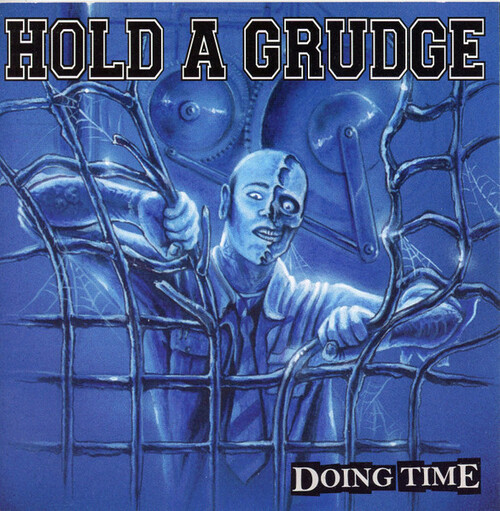
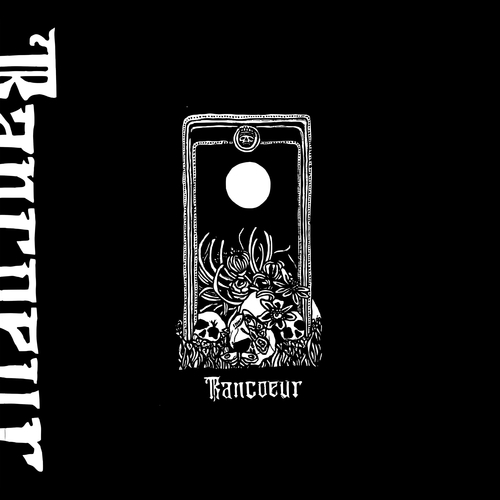
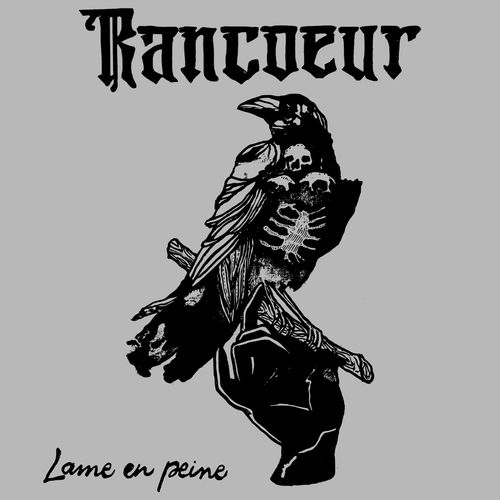
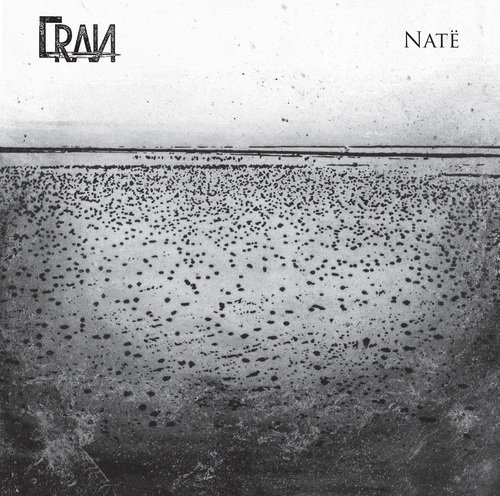
I ended 2022 with a musical retrospective and very much enjoyed writing that blog post. As such, I have decided to do the same for 2023! From now on, this will probably be an annual thing :) Albums In 2023, I added 73 new albums to my collection nearly 2 albums every three weeks! I listed them below in the order in which I acquired them. I purchased most of these albums when I could and borrowed the rest at libraries. If you want to browse though, I added links to the album covers pointing either to websites where you can buy them or to Discogs when digital copies weren't available. Once again this year, it seems that Punk (mostly O !) and Metal dominate my list, mostly fueled by Angry Metal Guy and the amazing Montr al Skinhead/Punk concert scene. Concerts A trend I started in 2022 was to go to as many concerts of artists I like as possible. I'm happy to report I went to around 80% more concerts in 2023 than in 2022! Looking back at my list, April was quite a busy month... Here are the concerts I went to in 2023: Although metalfinder continues to work as intended, I'm very glad to have discovered the Montr al underground scene has departed from Facebook/Instagram and adopted en masse Gancio, a FOSS community agenda that supports ActivityPub. Our local instance, askapunk.net is pretty much all I could ask for :) That's it for 2023!

8 January 2024

Antoine Beaupr : Last year on this blog

So this blog is now celebrating its 21st birthday (or 20 if you count from zero, or 18 if you want to be pedantic), and I figured I would do this yearly thing of reviewing how that went.

Number of posts 2022 was the official 20th anniversary in any case, and that was one of my best years on record, with 46 posts, surpassed only by the noisy 2005 (62) and matching 2006 (46). 2023, in comparison, was underwhelming: a feeble 11 posts! What happened! Well, I was busy with other things, mostly away from keyboard, that I will not bore you with here... The other thing that happened is that the one-liner I used to collect stats was broken (it counted folders and other unrelated files) and wildly overestimated 2022! Turns out I didn't write that much then:
anarc.at$ ls blog   grep '^[0-9][0-9][0-9][0-9].*.md'   se
d s/-.*//   sort   uniq -c    sort -n -k2
     57 2005
     43 2006
     20 2007
     20 2008
      7 2009
     13 2010
     16 2011
     11 2012
     13 2013
      5 2014
     13 2015
     18 2016
     29 2017
     27 2018
     17 2019
     18 2020
     14 2021
     28 2022
     10 2023
      1 2024
But even that is inaccurate because, in ikiwiki, I can tag any page as being featured on the blog. So we actually need to process the HTML itself because we don't have much better on hand without going through ikiwiki's internals:
anarcat@angela:anarc.at$ curl -sSL https://anarc.at/blog/   grep 'href="\./'   grep -o 20[0-9][0-9]   sort   uniq -c 
     56 2005
     42 2006
     19 2007
     18 2008
      6 2009
     12 2010
     15 2011
     10 2012
     11 2013
      3 2014
     15 2015
     32 2016
     50 2017
     37 2018
     19 2019
     19 2020
     15 2021
     28 2022
     13 2023
Which puts the top 10 years at:
$ curl -sSL https://anarc.at/blog/   grep 'href="\./'   grep -o 20[0-9][0-9]   sort   uniq -c    sort -nr   head -10
     56 2005
     50 2017
     42 2006
     37 2018
     32 2016
     28 2022
     19 2020
     19 2019
     19 2007
     18 2008
Anyway. 2023 is certainly not a glorious year in that regard, in any case.

Visitors In terms of visits, however, we had quite a few hits. According to Goatcounter, I had 122 300 visits in 2023! 2022, in comparison, had 89 363, so that's quite a rise.

What you read I seem to have hit the Hacker News front page at least twice. I say "seem" because it's actually pretty hard to tell what the HN frontpage actually is on any given day. I had 22k visits on 2023-03-13, in any case, and you can't see me on the front that day. We do see a post of mine on 2023-09-02, all the way down there, which seem to have generated another 10k visits. In any case, here were the most popular stories for you fine visitors:
  • Framework 12th gen laptop review: 24k visits, which is surprising for a 13k words article "without images", as some critics have complained. 15k referred by Hacker News. Good reference and time-consuming benchmarks, slowly bit-rotting. That is, by far, my most popular article ever. A popular article in 2021 or 2022 was around 6k to 9k, so that's a big one. I suspect it will keep getting traffic for a long while.
  • Calibre replacement considerations: 15k visits, most of which without a referrer. Was actually an old article, but I suspect HN brought it back to light. I keep updating that wiki page regularly when I find new things, but I'm still using Calibre to import ebooks.
  • Hacking my Kobo Clara HD: is not new but always gathering more and more hits, it had 1800 hits in the first year, 4600 hits last year and now brought 6400 visitors to the blog! Not directly related, but this iFixit battery replacement guide I wrote also seem to be quite popular
Everything else was published before 2023. Replacing Smokeping with Prometheus is still around and Looking at Wayland terminal emulators makes an entry in the top five.

Where you've been People send less and less private information when they browse the web. The number of visitors without referrers was 41% in 2021, it rose to 44% in 2023. Most of the remaining traffic comes from Google, but Hacker News is now a significant chunk, almost as big as Google. In 2021, Google represented 23% of my traffic, in 2022, it was down to 15% so 18% is actually a rise from last year, even if it seems much smaller than what I usually think of.
Ratio Referrer Visits
18% Google 22 098
13% Hacker News 16 003
2% duckduckgo.com 2 640
1% community.frame.work 1 090
1% missing.csail.mit.edu 918
Note that Facebook and Twitter do not appear at all in my referrers.

Where you are Unsurprisingly, most visits still come from the US:
Ratio Country Visits
26% United States 32 010
14% France 17 046
10% Germany 11 650
6% Canada 7 425
5% United Kingdom 6 473
3% Netherlands 3 436
Those ratios are nearly identical to last year, but quite different from 2021, where Germany and France were more or less reversed. Back in 2021, I mentioned there was a long tail of countries with at least one visit, with 160 countries listed. I expanded that and there's now 182 countries in that list, almost all of the 193 member states in the UN.

What you were Chrome's dominance continues to expand, even on readers of this blog, gaining two percentage points from Firefox compared to 2021.
Ratio Browser Visits
49% Firefox 60 126
36% Chrome 44 052
14% Safari 17 463
1% Others N/A
It seems like, unfortunately, my Lynx and Haiku users have not visited in the past year. It seems like trying to read those metrics is like figuring out tea leaves... In terms of operating systems:
Ratio OS Visits
28% Linux 34 010
23% macOS 28 728
21% Windows 26 303
17% Android 20 614
10% iOS 11 741
Again, Linux and Mac are over-represented, and Android and iOS are under-represented.

What is next I hope to write more next year. I've been thinking about a few posts I could write for work, about how things work behind the scenes at Tor, that could be informative for many people. We run a rather old setup, but things hold up pretty well for what we throw at it, and it's worth sharing that with the world... So anyway, thanks for coming, faithful reader, and see you in the coming 2024 year...

Russ Allbery: Review: The Faithless

Review: The Faithless, by C.L. Clark
Series: Magic of the Lost #2
Publisher: Orbit
Copyright: March 2023
ISBN: 0-316-54283-0
Format: Kindle
Pages: 527
The Faithless is the second book in a political fantasy series that seems likely to be a trilogy. It is a direct sequel to The Unbroken, which you should read first. As usual, Orbit made it unnecessarily hard to get re-immersed in the world by refusing to provide memory aids for readers who read books as they come out instead of only when the series is complete, but this is not the fault of Clark or the book and you've heard me rant about this before. The Unbroken was set in Qaz l (not-Algeria). The Faithless, as readers of the first book might guess from the title, is set in Balladaire (not-France). This is the palace intrigue book. Princess Luca is fighting for her throne against her uncle, the regent. Touraine is trying to represent her people. Whether and to what extent those interests are aligned is much of the meat of this book. Normally I enjoy palace intrigue novels for the competence porn: watching someone navigate a complex political situation with skill and cunning, or upend the entire system by building unlikely coalitions or using unexpected routes to power. If you are similar, be warned that this is not what you're going to get. Touraine is a fish out of water with no idea how to navigate the Balladairan court, and does not magically become an expert in the course of this novel. Luca has the knowledge, but she's unsure, conflicted, and largely out-maneuvered. That means you will have to brace for some painful scenes of some of the worst people apparently getting what they want. Despite that, I could not put this down. It was infuriating, frustrating, and a much slower burn than I prefer, but the layers of complex motivations that Clark builds up provided a different sort of payoff. Two books in, the shape of this series is becoming clearer. This series is about empire and colonialism, but with considerably more complexity than fantasy normally brings to that topic. Power does not loosen its grasp easily, and it has numerous tools for subtle punishment after apparent upstart victories. Righteous causes rarely call banners to your side; instead, they create opportunities for other people to maneuver to their own advantage. Touraine has some amount of power now, but it's far from obvious how to use it. Her life's training tells her that exercising power will only cause trouble, and her enemies are more than happy to reinforce that message at every opportunity. Most notable to me is Clark's bitingly honest portrayal of the supposed allies within the colonial power. It is clear that Luca is attempting to take the most ethical actions as she defines them, but it's remarkable how those efforts inevitably imply that Touraine should help Luca now in exchange for Luca's tenuous and less-defined possible future aid. This is not even a lie; it may be an accurate summary of Balladairan politics. And yet, somehow what Balladaire needs always matters more than the needs of their abused colony. Underscoring this, Clark introduces another faction in the form of a populist movement against the Balladairan monarchy. The details of that setup in another fantasy novel would make them allies of the Qaz l. Here, as is so often the case in real life, a substantial portion of the populists are even more xenophobic and racist than the nobility. There are no easy alliances. The trump card that Qaz l holds is magic. They have it, and (for reasons explored in The Unbroken) Balladaire needs it, although that is a position held by Luca's faction and not by her uncle. But even Luca wants to reduce that magic to a manageable technology, like any other element of the Balladairan state. She wants to understand it, harness it, and bring it under local control. Touraine, trained by Balladaire and facing Balladairan political problems, has the same tendency. The magic, at least in this book, refuses not in the flashy, rebellious way that it would in most fantasy, but in a frustrating and incomprehensible lack of predictable or convenient rules. I think this will feel like a plot device to some readers, and that is to some extent true, but I think I see glimmers of Clark setting up a conflict of world views that will play out in the third book. I think some people are going to bounce off this book. It's frustrating, enraging, at times melodramatic, and does not offer the cathartic payoff typically offered in fantasy novels of this type. Usually these are things I would be complaining about as well. And yet, I found it satisfyingly challenging, engrossing, and memorable. I spent a lot of the book yelling "just kill him already" at the characters, but I think one of Clark's points is that overcoming colonial relationships requires a lot more than just killing one evil man. The characters profoundly fail to execute some clever and victorious strategy. Instead, as in the first book, they muddle through, making the best choice that they can see in each moment, making lots of mistakes, and paying heavy prices. It's realistic in a way that has nothing to do with blood or violence or grittiness. (Although I did appreciate having the thin thread of Pruett's story and its highly satisfying conclusion.) This is also a slow-burn romance, and there too I think opinions will differ. Touraine and Luca keep circling back to the same arguments and the same frustrations, and there were times that this felt repetitive. It also adds a lot of personal drama to the politics in a way that occasionally made me dubious. But here too, I think Clark is partly using the romance to illustrate the deeper political points. Luca is often insufferable, cruel and ambitious in ways she doesn't realize, and only vaguely able to understand the Qaz l perspective; in short, she's the pragmatic centrist reformer. I am dubious that her ethics would lead her to anything other than endless compromise without Touraine to push her. To Luca's credit, she also realizes that and wants to be a better person, but struggles to have the courage to act on it. Touraine both does and does not want to manipulate her; she wants Luca's help (and more), but it's not clear Luca will give it under acceptable terms, or even understand how much she's demanding. It's that foundational conflict that turns the romance into a slow burn by pushing them apart. Apparently I have more patience for this type of on-again, off-again relationship than one based on artificial miscommunication. The more I noticed the political subtext, the more engaging I found the romance on the surface. I picked this up because I'd read several books about black characters written by white authors, and while there was nothing that wrong with those books, the politics felt a little too reductionist and simplified. I wanted a book that was going to force me out of comfortable political assumptions. The Faithless did exactly what I was looking for, and I am definitely here for the rest of the series. In that sense, recommended, although do not go into this book hoping for adroit court maneuvering and competence porn. Followed by The Sovereign, which does not yet have a release date. Content warnings: Child death, attempted cultural genocide. Rating: 7 out of 10

7 January 2024

Valhalla's Things: A Corset or Two

Posted on January 7, 2024
Tags: madeof:atoms, craft:sewing, period:victorian, FreeSoftWear
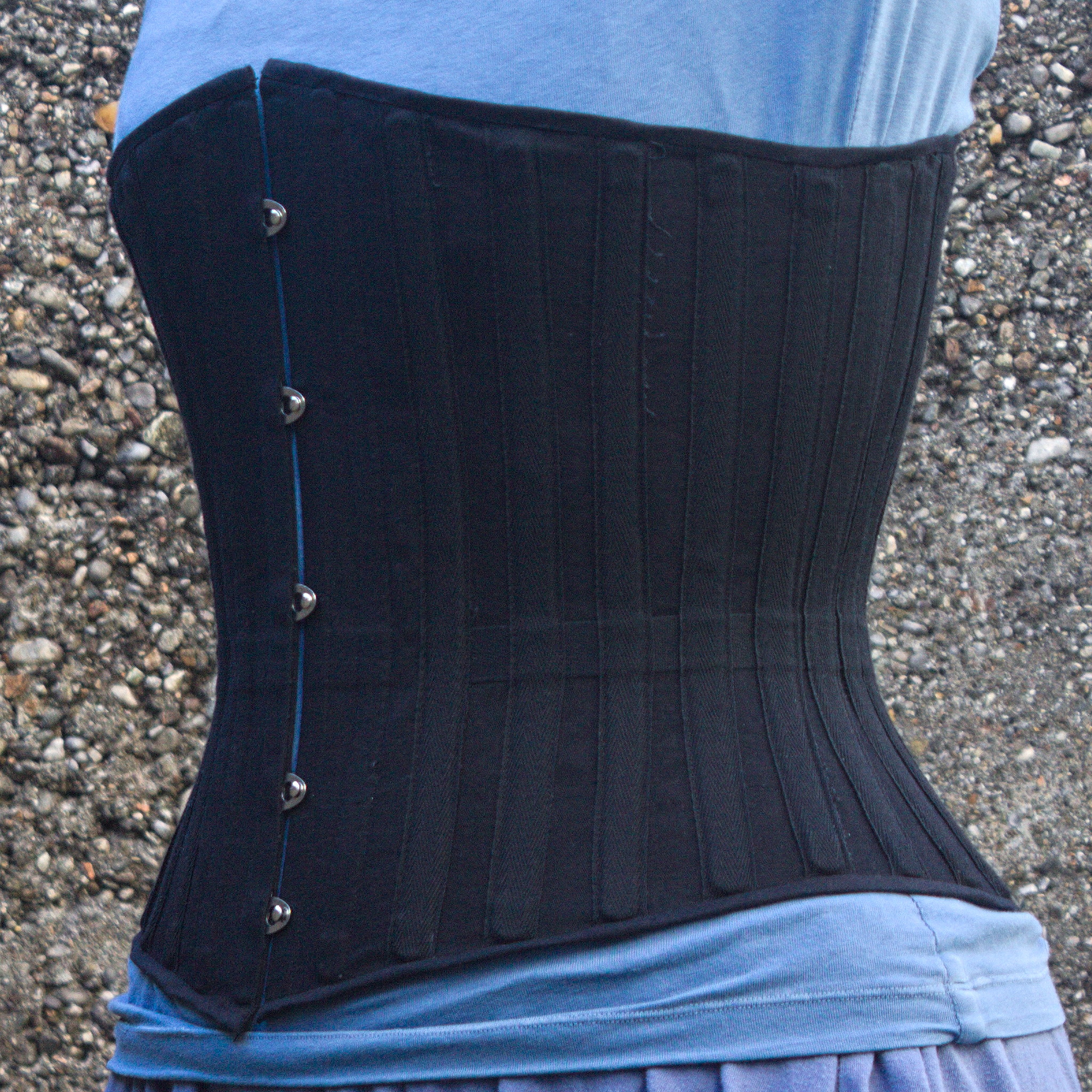
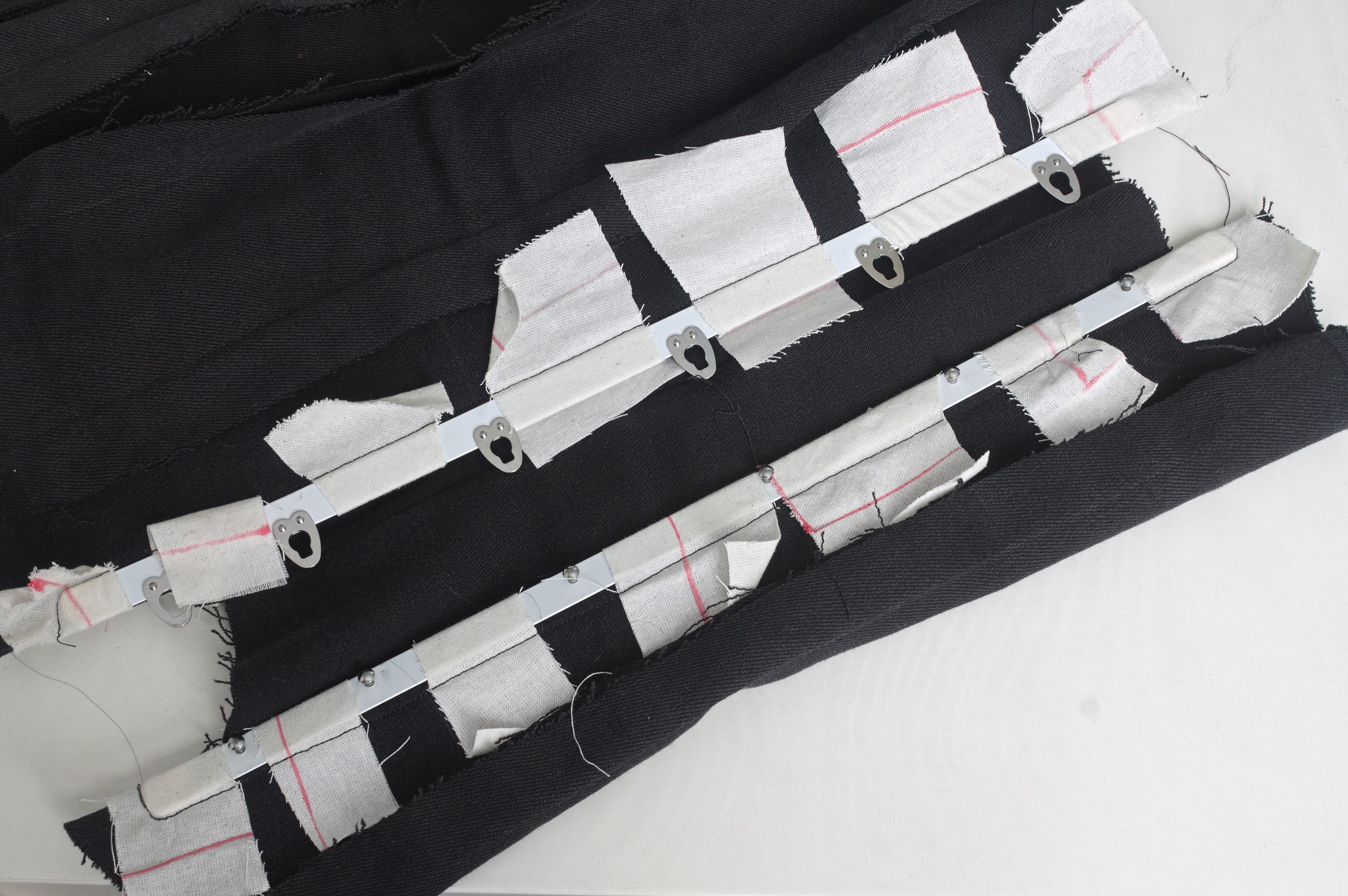
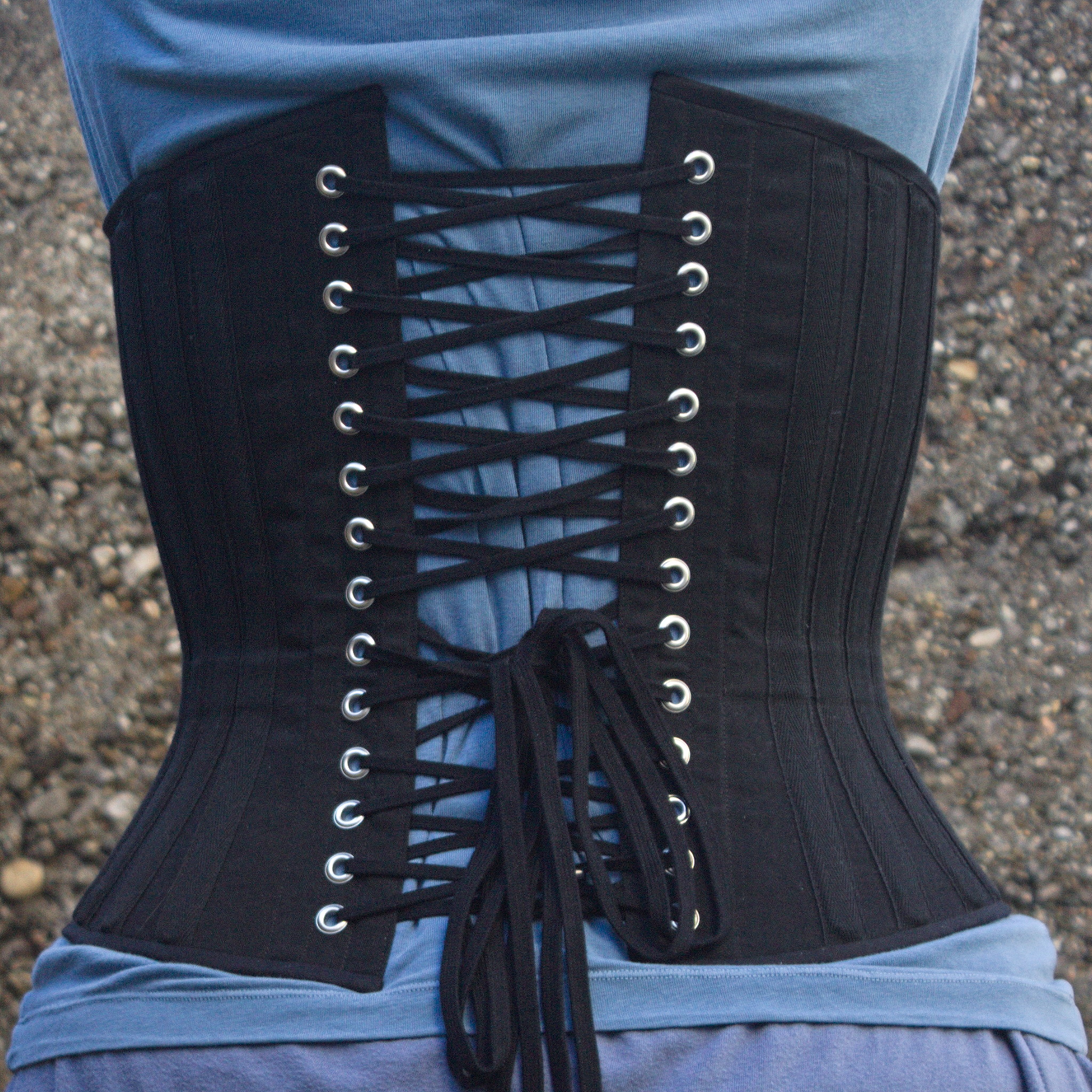
a black coutil midbust corset, from a 3/4 front view, showing the busk closure, a waist tape and external boning channels made of the same twill tape and placed about 1-2 cm from each other at waist level. CW for body size change mentions I needed a corset, badly. Years ago I had a chance to have my measurements taken by a former professional corset maker and then a lesson in how to draft an underbust corset, and that lead to me learning how nice wearing a well-fitted corset feels. Later I tried to extend that pattern up for a midbust corset, with success. And then my body changed suddenly, and I was no longer able to wear either of those, and after a while I started missing them. Since my body was still changing (if no longer drastically so), and I didn t want to use expensive materials for something that had a risk of not fitting after too little time, I decided to start by making myself a summer lightweight corset in aida cloth and plastic boning (for which I had already bought materials). It fitted, but not as well as the first two ones, and I ve worn it quite a bit. I still wanted back the feeling of wearing a comfy, heavy contraption of coutil and steel, however. After a lot of procrastination I redrafted a new pattern, scrapped everything, tried again, had my measurements taken by a dressmaker [#dressmaker], put them in the draft, cut a first mock-up in cheap cotton, fixed the position of a seam, did a second mock-up in denim [#jeans] from an old pair of jeans, and then cut into the cheap herringbone coutil I was planning to use. And that s when I went to see which one of the busks in my stash would work, and realized that I had used a wrong vertical measurement and the front of the corset was way too long for a midbust corset. a corset busk basted to a mock-up with scraps of fabric between each stud / loop. Luckily I also had a few longer busks, I basted one to the denim mock up and tried to wear it for a few hours, to see if it was too long to be comfortable. It was just a bit, on the bottom, which could be easily fixed with the Power Tools1. Except, the more I looked at it the more doing this felt wrong: what I needed most was a midbust corset, not an overbust one, which is what this was starting to be. I could have trimmed it down, but I knew that I also wanted this corset to be a wearable mockup for the pattern, to refine it and have it available for more corsets. And I still had more than half of the cheap coutil I was using, so I decided to redo the pattern and cut new panels. And this is where the or two comes in: I m not going to waste the overbust panels: I had been wanting to learn some techniques to make corsets with a fashion fabric layer, rather than just a single layer of coutil, and this looks like an excellent opportunity for that, together with a piece of purple silk that I know I have in the stash. This will happen later, however, first I m giving priority to the underbust. Anyway, a second set of panels was cut, all the seam lines marked with tailor tacks, and I started sewing by inserting the busk. And then realized that the pre-made boning channel tape I had was too narrow for the 10 mm spiral steel I had plenty of. And that the 25 mm twill tape was also too narrow for a double boning channel. On the other hand, the 18 mm twill tape I had used for the waist tape was good for a single channel, so I decided to put a single bone on each seam, and then add another piece of boning in the middle of each panel. Since I m making external channels, making them in self fabric would have probably looked better, but I no longer had enough fabric, because of the cutting mishap, and anyway this is going to be a strictly underwear only corset, so it s not a big deal. Once the boning channel situation was taken care of, everything else proceeded quite smoothly and I was able to finish the corset during the Christmas break, enlisting again my SO to take care of the flat steel boning while I cut the spiral steels myself with wire cutters. The same corset straight from the front: the left side is a few mm longer than the right side I could have been a bit more precise with the binding, as it doesn t align precisely at the front edge, but then again, it s underwear, nobody other than me and everybody who reads this post is going to see it and I was in a hurry to see it finished. I will be more careful with the next one. The same corset from the back, showing cross lacing with bunny ears at the waist and a lacing gap of about 8 cm. I also think that I haven t been careful enough when pressing the seams and applying the tape, and I ve lost about a cm of width per part, so I m using a lacing gap that is a bit wider than I planned for, but that may change as the corset gets worn, and is still within tolerance. Also, on the morning after I had finished the corset I woke up and realized that I had forgotten to add garter tabs at the bottom edge. I don t know whether I will ever use them, but I wanted the option, so maybe I ll try to add them later on, especially if I can do it without undoing the binding. The next step would have been flossing, which I proceeded to postpone until I ve worn the corset for a while: not because there is any reason for it, but because I still don t know how I want to do it :) What was left was finishing and uploading the pattern and instructions, that are now on my sewing pattern website as #FreeSoftWear, and finally I could post this on the blog.

  1. i.e. by asking my SO to cut and sand it, because I m lazy and I hate doing that part :D

6 January 2024

Valhalla's Things: Blog updates

Posted on January 6, 2024
Tags: madeof:bits, meta
After just a tiny1 delay I ve finally added support for tags to this blog. In the next few days I may go back and add / change tags to the older posts, or I may not, I ll decide. Also, I still need to render a tag cloud somewhere; maybe it will happen soon, maybe it will take another year. :D I hope I ve also succesfully worked around the bug in Friendica where the src for images got deleted instead of properly converted. The logo of this blog, just to see whether a random image is shown on Friendica and the Fediverse.

  1. less than one year!

4 January 2024

Michael Ablassmeier: Migrating a system to Hetzner cloud using REAR and kexec

I needed to migrate an existing system to an Hetzner cloud VPS. While it is possible to attach KVM consoles and custom ISO images to dedicated servers, i didn t find any way to do so with regular cloud instances. For system migrations i usually use REAR, which has never failed me. (and also has saved my ass during recovery multiple times). It s an awesome utility! It s possible to do this using the Hetzner recovery console too, but using REAR is very convenient here, because it handles things like re-creating the partition layout and network settings automatically! The steps are:

Example To create a rescue image on the source system:
apt install rear
echo OUTPUT=ISO > /etc/rear/local.conf
rear mkrescue -v
[..]
Wrote ISO image: /var/lib/rear/output/rear-debian12.iso (185M)
My source system had a 128 GB disk, so i registered an instance on Hetzner cloud with greater disk size to make things easier: image Now copy the ISO image to the newly created instance and extract its data:
 apt install kexec-tools
 scp rear-debian12.iso root@49.13.193.226:/tmp/
 modprobe loop
 mount -o loop rear-debian12.iso /mnt/
 cp /mnt/isolinux/kernel /tmp/
 cp /mnt/isolinux/initrd.cgz /tmp/
Install kexec if not installed already:
 apt install kexec-tools
Note down the current gateway configuration, this is required later on to make the REAR recovery console reachable via SSH:
root@testme:~# ip route
default via 172.31.1.1 dev eth0
172.31.1.1 dev eth0 scope link
Reboot the running VPS instance into the REAR recovery image using somewhat the same kernel cmdline:
root@testme:~# cat /proc/cmdline
BOOT_IMAGE=/boot/vmlinuz-6.1.0-13-amd64 root=UUID=5174a81e-5897-47ca-8fe4-9cd19dc678c4 ro consoleblank=0 systemd.show_status=true console=tty1 console=ttyS0
kexec --initrd /tmp/initrd.cgz --command-line="consoleblank=0 systemd.show_status=true console=tty1 console=ttyS0" /tmp/kernel
Connection to 49.13.193.226 closed by remote host.
Connection to 49.13.193.226 closed
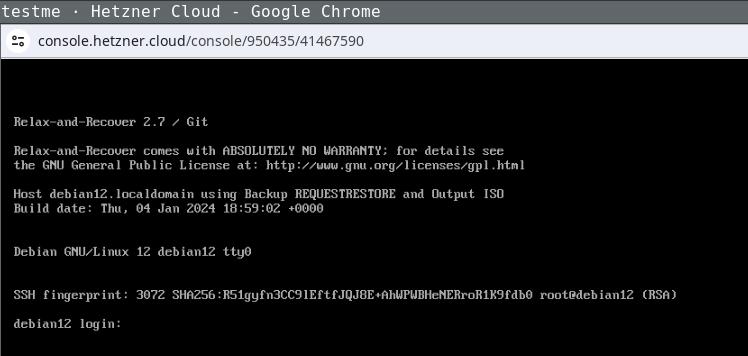
Now watch the system on the Console booting into the REAR system: image Login the recovery console (root without password) and fix its default route to make it reachable:
ip addr
[..]
2: enp1s0
..
$ ip route add 172.31.1.1 dev enp1s0
$ ip route add default via 172.31.1.1
ping 49.13.193.226
64 bytes from 49.13.193.226: icmp_seq=83 ttl=52 time=27.7 ms
The network configuration might differ, the source system in this example used DHCP, as the target does. If REAR detects changed static network configuration it guides you through the setup pretty nicely. Login via SSH (REAR will store your ssh public keys in the image) and start the recovery process, follow the steps as suggested by REAR:
ssh -l root 49.13.193.226
Welcome to Relax-and-Recover. Run "rear recover" to restore your system !
RESCUE debian12:~ # rear recover
Relax-and-Recover 2.7 / Git
Running rear recover (PID 673 date 2024-01-04 19:20:22)
Using log file: /var/log/rear/rear-debian12.log
Running workflow recover within the ReaR rescue/recovery system
Will do driver migration (recreating initramfs/initrd)
Comparing disks
Device vda does not exist (manual configuration needed)
Switching to manual disk layout configuration (GiB sizes rounded down to integer)
/dev/vda had size 137438953472 (128 GiB) but it does no longer exist
/dev/sda was not used on the original system and has now 163842097152 (152 GiB)
Original disk /dev/vda does not exist (with same size) in the target system
Using /dev/sda (the only available of the disks) for recreating /dev/vda
Current disk mapping table (source => target):
  /dev/vda => /dev/sda
Confirm or edit the disk mapping
1) Confirm disk mapping and continue 'rear recover'
[..]
User confirmed recreated disk layout
[..]
This step re-recreates your original disk layout and mounts it to /mnt/local/ (this example uses a pretty lame layout, but usually REAR will handle things like lvm/btrfs just nicely):
mount
/dev/sda3 on /mnt/local type ext4 (rw,relatime,errors=remount-ro)
/dev/sda1 on /mnt/local/boot type ext4 (rw,relatime)
Now clone your source systems data to /mnt/local/ with whatever utility you like to use and exit the recovery step. After confirming everything went well, REAR will setup the bootloader (and all other config details like fstab entries and adjusted network configuration) for you as required:
rear> exit
Did you restore the backup to /mnt/local ? Are you ready to continue recovery ? yes
User confirmed restored files
Updated initramfs with new drivers for this system.
Skip installing GRUB Legacy boot loader because GRUB 2 is installed (grub-probe or grub2-probe exist).
Installing GRUB2 boot loader...
Determining where to install GRUB2 (no GRUB2_INSTALL_DEVICES specified)
Found possible boot disk /dev/sda - installing GRUB2 there
Finished 'recover'. The target system is mounted at '/mnt/local'.
Exiting rear recover (PID 7103) and its descendant processes ...
Running exit tasks
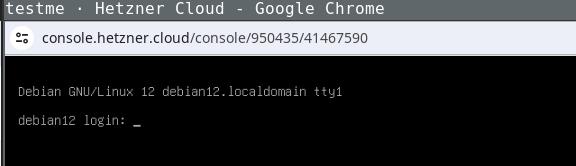
Now reboot the recovery console and watch it boot into your target systems configuration: image Being able to use this procedure for complete disaster recovery within Hetzner cloud VPS (using off-site backups) gives me a better feeling, too.

3 January 2024

John Goerzen: Live Migrating from Raspberry Pi OS bullseye to Debian bookworm

I ve been getting annoyed with Raspberry Pi OS (Raspbian) for years now. It s a fork of Debian, but manages to omit some of the most useful things. So I ve decided to migrate all of my Pis to run pure Debian. These are my reasons:
  1. Raspberry Pi OS has, for years now, specified that there is no upgrade path. That is, to get to a newer major release, it s a reinstall. While I have sometimes worked around this, for a device that is frequently installed in hard-to-reach locations, this is even more important than usual. It s common for me to upgrade machines for a decade or more across Debian releases and there s no reason that it should be so much more difficult with Raspbian.
  2. As I noted in Consider Security First, the security situation for Raspberry Pi OS isn t as good as it is with Debian.
  3. Raspbian lags behind Debian often times by 6 months or more for major releases, and days or weeks for bug fixes and security patches.
  4. Raspbian has no direct backports support, though Raspberry Pi 3 and above can use Debian s backports (per my instructions as Installing Debian Backports on Raspberry Pi)
  5. Raspbian uses a custom kernel without initramfs support
It turns out it is actually possible to do an in-place migration from Raspberry Pi OS bullseye to Debian bookworm. Here I will describe how. Even if you don t have a Raspberry Pi, this might still be instructive on how Raspbian and Debian packages work.

WARNINGS Before continuing, back up your system. This process isn t for the neophyte and it is entirely possible to mess up your boot device to the point that you have to do a fresh install to get your Pi to boot. This isn t a supported process at all.

Architecture Confusion Debian has three ARM-based architectures:
  • armel, for the lowest-end 32-bit ARM devices without hardware floating point support
  • armhf, for the higher-end 32-bit ARM devices with hardware float (hence hf )
  • arm64, for 64-bit ARM devices (which all have hardware float)
Although the Raspberry Pi 0 and 1 do support hardware float, they lack support for other CPU features that Debian s armhf architecture assumes. Therefore, the Raspberry Pi 0 and 1 could only run Debian s armel architecture. Raspberry Pi 3 and above are capable of running 64-bit, and can run both armhf and arm64. Prior to the release of the Raspberry Pi 5 / Raspbian bookworm, Raspbian only shipped the armhf architecture. Well, it was an architecture they called armhf, but it was different from Debian s armhf in that everything was recompiled to work with the more limited set of features on the earlier Raspberry Pi boards. It was really somewhere between Debian s armel and armhf archs. You could run Debian armel on those, but it would run more slowly, due to doing floating point calculations without hardware support. Debian s raspi FAQ goes into this a bit. What I am going to describe here is going from Raspbian armhf to Debian armhf with a 64-bit kernel. Therefore, it will only work with Raspberry Pi 3 and above. It may theoretically be possible to take a Raspberry Pi 2 to Debian armhf with a 32-bit kernel, but I haven t tried this and it may be more difficult. I have seen conflicting information on whether armhf really works on a Pi 2. (If you do try it on a Pi 2, ignore everything about arm64 and 64-bit kernels below, and just go with the linux-image-armmp-lpae kernel per the ARMMP page) There is another wrinkle: Debian doesn t support running 32-bit ARM kernels on 64-bit ARM CPUs, though it does support running a 32-bit userland on them. So we will wind up with a system with kernel packages from arm64 and everything else from armhf. This is a perfectly valid configuration as the arm64 like x86_64 is multiarch (that is, the CPU can natively execute both the 32-bit and 64-bit instructions). (It is theoretically possible to crossgrade a system from 32-bit to 64-bit userland, but that felt like a rather heavy lift for dubious benefit on a Pi; nevertheless, if you want to make this process even more complicated, refer to the CrossGrading page.)

Prerequisites and Limitations In addition to the need for a Raspberry Pi 3 or above in order for this to work, there are a few other things to mention. If you are using the GPIO features of the Pi, I don t know if those work with Debian. I think Raspberry Pi OS modified the desktop environment more than other components. All of my Pis are headless, so I don t know if this process will work if you use a desktop environment. I am assuming you are booting from a MicroSD card as is typical in the Raspberry Pi world. The Pi s firmware looks for a FAT partition (MBR type 0x0c) and looks within it for boot information. Depending on how long ago you first installed an OS on your Pi, your /boot may be too small for Debian. Use df -h /boot to see how big it is. I recommend 200MB at minimum. If your /boot is smaller than that, stop now (or use some other system to shrink your root filesystem and rearrange your partitions; I ve done this, but it s outside the scope of this article.) You need to have stable power. Once you begin this process, your pi will mostly be left in a non-bootable state until you finish. (You did make a backup, right?)

Basic idea The basic idea here is that since bookworm has almost entirely newer packages then bullseye, we can just switch over to it and let the Debian packages replace the Raspbian ones as they are upgraded. Well, it s not quite that easy, but that s the main idea.

Preparation First, make a backup. Even an image of your MicroSD card might be nice. OK, I think I ve said that enough now. It would be a good idea to have a HDMI cable (with the appropriate size of connector for your particular Pi board) and a HDMI display handy so you can troubleshoot any bootup issues with a console.

Preparation: access The Raspberry Pi OS by default sets up a user named pi that can use sudo to gain root without a password. I think this is an insecure practice, but assuming you haven t changed it, you will need to ensure it still works once you move to Debian. Raspberry Pi OS had a patch in their sudo package to enable it, and that will be removed when Debian s sudo package is installed. So, put this in /etc/sudoers.d/010_picompat:
pi ALL=(ALL) NOPASSWD: ALL
Also, there may be no password set for the root account. It would be a good idea to set one; it makes it easier to log in at the console. Use the passwd command as root to do so.

Preparation: bluetooth Debian doesn t correctly identify the Bluetooth hardware address. You can save it off to a file by running hcitool dev > /root/bluetooth-from-raspbian.txt. I don t use Bluetooth, but this should let you develop a script to bring it up properly.

Preparation: Debian archive keyring You will next need to install Debian s archive keyring so that apt can authenticate packages from Debian. Go to the bookworm download page for debian-archive-keyring and copy the URL for one of the files, then download it on the pi. For instance:
wget http://http.us.debian.org/debian/pool/main/d/debian-archive-keyring/debian-archive-keyring_2023.3+deb12u1_all.deb
Use sha256sum to verify the checksum of the downloaded file, comparing it to the package page on the Debian site. Now, you ll install it with:
dpkg -i debian-archive-keyring_2023.3+deb12u1_all.deb

Package first steps From here on, we are making modifications to the system that can leave it in a non-bootable state. Examine /etc/apt/sources.list and all the files in /etc/apt/sources.list.d. Most likely you will want to delete or comment out all lines in all files there. Replace them with something like:
deb http://deb.debian.org/debian/ bookworm main non-free-firmware contrib non-free
deb http://security.debian.org/debian-security bookworm-security main non-free-firmware contrib non-free
deb https://deb.debian.org/debian bookworm-backports main non-free-firmware contrib non-free
(you might leave off contrib and non-free depending on your needs) Now, we re going to tell it that we ll support arm64 packages:
dpkg --add-architecture arm64
And finally, download the bookworm package lists:
apt-get update
If there are any errors from that command, fix them and don t proceed until you have a clean run of apt-get update.

Moving /boot to /boot/firmware The boot FAT partition I mentioned above is mounted at /boot by Raspberry Pi OS, but Debian s scripts assume it will be at /boot/firmware. We need to fix this. First:
umount /boot
mkdir /boot/firmware
Now, edit fstab and change the reference to /boot to be to /boot/firmware. Now:
mount -v /boot/firmware
cd /boot/firmware
mv -vi * ..
This mounts the filesystem at the new location, and moves all its contents back to where apt believes it should be. Debian s packages will populate /boot/firmware later.

Installing the first packages Now we start by installing the first of the needed packages. Eventually we will wind up with roughly the same set Debian uses.
apt-get install linux-image-arm64
apt-get install firmware-brcm80211=20230210-5
apt-get install raspi-firmware
If you get errors relating to firmware-brcm80211 from any commands, run that install firmware-brcm80211 command and then proceed. There are a few packages that Raspbian marked as newer than the version in bookworm (whether or not they really are), and that s one of them.

Configuring the bootloader We need to configure a few things in /etc/default/raspi-firmware before proceeding. Edit that file. First, uncomment (or add) a line like this:
KERNEL_ARCH="arm64"
Next, in /boot/cmdline.txt you can find your old Raspbian boot command line. It will say something like:
root=PARTUUID=...
Save off the bit starting with PARTUUID. Back in /etc/default/raspi-firmware, set a line like this:
ROOTPART=PARTUUID=abcdef00
(substituting your real value for abcdef00). This is necessary because the microSD card device name often changes from /dev/mmcblk0 to /dev/mmcblk1 when switching to Debian s kernel. raspi-firmware will encode the current device name in /boot/firmware/cmdline.txt by default, which will be wrong once you boot into Debian s kernel. The PARTUUID approach lets it work regardless of the device name.

Purging the Raspbian kernel Run:
dpkg --purge raspberrypi-kernel

Upgrading the system At this point, we are going to run the procedure beginning at section 4.4.3 of the Debian release notes. Generally, you will do:
apt-get -u upgrade
apt full-upgrade
Fix any errors at each step before proceeding to the next. Now, to remove some cruft, run:
apt-get --purge autoremove
Inspect the list to make sure nothing important isn t going to be removed.

Removing Raspbian cruft You can list some of the cruft with:
apt list '~o'
And remove it with:
apt purge '~o'
I also don t run Bluetooth, and it seemed to sometimes hang on boot becuase I didn t bother to fix it, so I did:
apt-get --purge remove bluez

Installing some packages This makes sure some basic Debian infrastructure is available:
apt-get install wpasupplicant parted dosfstools wireless-tools iw alsa-tools
apt-get --purge autoremove

Installing firmware Now run:
apt-get install firmware-linux

Resolving firmware package version issues If it gives an error about the installed version of a package, you may need to force it to the bookworm version. For me, this often happened with firmware-atheros, firmware-libertas, and firmware-realtek. Here s how to resolve it, with firmware-realtek as an example:
  1. Go to https://packages.debian.org/PACKAGENAME for instance, https://packages.debian.org/firmware-realtek. Note the version number in bookworm in this case, 20230210-5.
  2. Now, you will force the installation of that package at that version:
    apt-get install firmware-realtek=20230210-5
    
  3. Repeat with every conflicting package until done.
  4. Rerun apt-get install firmware-linux and make sure it runs cleanly.
Also, in the end you should be able to:
apt-get install firmware-atheros firmware-libertas firmware-realtek firmware-linux

Dealing with other Raspbian packages The Debian release notes discuss removing non-Debian packages. There will still be a few of those. Run:
apt list '?narrow(?installed, ?not(?origin(Debian)))'
Deal with them; mostly you will need to force the installation of a bookworm version using the procedure in the section Resolving firmware package version issues above (even if it s not for a firmware package). For non-firmware packages, you might possibly want to add --mark-auto to your apt-get install command line to allow the package to be autoremoved later if the things depending on it go away. If you aren t going to use Bluetooth, I recommend apt-get --purge remove bluez as well. Sometimes it can hang at boot if you don t fix it up as described above.

Set up networking We ll be switching to the Debian method of networking, so we ll create some files in /etc/network/interfaces.d. First, eth0 should look like this:
allow-hotplug eth0
iface eth0 inet dhcp
iface eth0 inet6 auto
And wlan0 should look like this:
allow-hotplug wlan0
iface wlan0 inet dhcp
    wpa-conf /etc/wpa_supplicant/wpa_supplicant.conf
Raspbian is inconsistent about using eth0/wlan0 or renamed interface. Run ifconfig or ip addr. If you see a long-named interface such as enx<something> or wlp<something>, copy the eth0 file to the one named after the enx interface, or the wlan0 file to the one named after the wlp interface, and edit the internal references to eth0/wlan0 in this new file to name the long interface name. If using wifi, verify that your SSIDs and passwords are in /etc/wpa_supplicant/wpa_supplicant.conf. It should have lines like:
network= 
   ssid="NetworkName"
   psk="passwordHere"
 
(This is where Raspberry Pi OS put them).

Deal with DHCP Raspberry Pi OS used dhcpcd, whereas bookworm normally uses isc-dhcp-client. Verify the system is in the correct state:
apt-get install isc-dhcp-client
apt-get --purge remove dhcpcd dhcpcd-base dhcpcd5 dhcpcd-dbus

Set up LEDs To set up the LEDs to trigger on MicroSD activity as they did with Raspbian, follow the Debian instructions. Run apt-get install sysfsutils. Then put this in a file at /etc/sysfs.d/local-raspi-leds.conf:
class/leds/ACT/brightness = 1
class/leds/ACT/trigger = mmc1

Prepare for boot To make sure all the /boot/firmware files are updated, run update-initramfs -u. Verify that root in /boot/firmware/cmdline.txt references the PARTUUID as appropriate. Verify that /boot/firmware/config.txt contains the lines arm_64bit=1 and upstream_kernel=1. If not, go back to the section on modifying /etc/default/raspi-firmware and fix it up.

The moment arrives Cross your fingers and try rebooting into your Debian system:
reboot
For some reason, I found that the first boot into Debian seems to hang for 30-60 seconds during bootstrap. I m not sure why; don t panic if that happens. It may be necessary to power cycle the Pi for this boot.

Troubleshooting If things don t work out, hook up the Pi to a HDMI display and see what s up. If I anticipated a particular problem, I would have documented it here (a lot of the things I documented here are because I ran into them!) So I can t give specific advice other than to watch boot messages on the console. If you don t even get kernel messages going, then there is some problem with your partition table or /boot/firmware FAT partition. Otherwise, you ve at least got the kernel going and can troubleshoot like usual from there.

John Goerzen: Consider Security First

I write this in the context of my decision to ditch Raspberry Pi OS and move everything I possibly can, including my Raspberry Pi devices, to Debian. I will write about that later. But for now, I wanted to comment on something I think is often overlooked and misunderstood by people considering distributions or operating systems: the huge importance of getting security updates in an automated and easy way.

Background Let s assume that these statements are true, which I think are well-supported by available evidence:
  1. Every computer system (OS plus applications) that can do useful modern work has security vulnerabilities, some of which are unknown at any given point in time;
  2. During the lifetime of that computer system, some of these vulnerabilities will be discovered. For a (hopefully large) subset of those vulnerabilities, timely patches will become available.
Now then, it follows that applying those timely patches is a critical part of having a system that it as secure as possible. Of course, you have to do other things as well good passwords, secure practices, etc but, fundamentally, if your system lacks patches for known vulnerabilities, you ve already lost at the security ballgame.

How to stay patched There is something of a continuum of how you might patch your system. It runs roughly like this, from best to worst:
  1. All components are kept up-to-date automatically, with no intervention from the user/operator
  2. The operator is automatically alerted to necessary patches, and they can be easily installed with minimal intervention
  3. The operator is automatically alerted to necessary patches, but they require significant effort to apply
  4. The operator has no way to detect vulnerabilities or necessary patches
It should be obvious that the first situation is ideal. Every other situation relies on the timeliness of human action to keep up-to-date with security patches. This is a fallible situation; humans are busy, take trips, dismiss alerts, miss alerts, etc. That said, it is rare to find any system living truly all the way in that scenario, as you ll see.

What is your system ? A critical point here is: what is your system ? It includes:
  • Your kernel
  • Your base operating system
  • Your applications
  • All the libraries needed to run all of the above
Some OSs, such as Debian, make little or no distinction between the base OS and the applications. Others, such as many BSDs, have a distinction there. And in some cases, people will compile or install applications outside of any OS mechanism. (It must be stressed that by doing so, you are taking the responsibility of patching them on your own shoulders.)

How do common systems stack up?
  • Debian, with its support for unattended-upgrades, needrestart, debian-security-support, and such, is largely category 1. It can automatically apply security patches, in most cases can restart the necessary services for the patch to take effect, and will alert you when some processes or the system must be manually restarted for a patch to take effect (for instance, a kernel update). Those cases requiring manual intervention are category 2. The debian-security-support package will even warn you of gaps in the system. You can also use debsecan to scan for known vulnerabilities on a given installation.
  • FreeBSD has no way to automatically install security patches for things in the packages collection. As with many rolling-release systems, you can t automate the installation of these security patches with FreeBSD because it is not safe to blindly update packages. It s not safe to blindly update packages because they may bring along more than just security patches: they may represent major upgrades that introduce incompatibilities, etc. Unlike Debian s practice of backporting fixes and thus producing narrowly-tailored patches, forcing upgrades to newer versions precludes a minimal intervention install. Therefore, rolling release systems are category 3.
  • Things such as Snap, Flatpak, AppImage, Docker containers, Electron apps, and third-party binaries often contain embedded libraries and such for which you have no easy visibility into their status. For instance, if there was a bug in libpng, would you know how many of your containers had a vulnerability? These systems are category 4 you don t even know if you re vulnerable. It s for this reason that my Debian-based Docker containers apply security patches before starting processes, and also run unattended-upgrades and friends.

The pernicious library problem As mentioned in my last category above, hidden vulnerabilities can be a big problem. I ve been writing about this for years. Back in 2017, I wrote an article focused on Docker containers, but which applies to the other systems like Snap and so forth. I cited a study back then that Over 80% of the :latest versions of official images contained at least one high severity vulnerability. The situation is no better now. In December 2023, it was reported that, two years after the critical Log4Shell vulnerability, 25% of apps were still vulnerable to it. Also, only 21% of developers ever update third-party libraries after introducing them into their projects. Clearly, you can t rely on these images with embedded libraries to be secure. And since they are black box, they are difficult to audit. Debian s policy of always splitting libraries out from packages is hugely beneficial; it allows finegrained analysis of not just vulnerabilities, but also the dependency graph. If there s a vulnerability in libpng, you have one place to patch it and you also know exactly what components of your system use it. If you use snaps, or AppImages, you can t know if they contain a deeply embedded vulnerability, nor could you patch it yourself if you even knew. You are at the mercy of upstream detecting and remedying the problem a dicey situation at best.

Who makes the patches? Fundamentally, humans produce security patches. Often, but not always, patches originate with the authors of a program and then are integrated into distribution packages. It should be noted that every security team has finite resources; there will always be some CVEs that aren t patched in a given system for various reasons; perhaps they are not exploitable, or are too low-impact, or have better mitigations than patches. Debian has an excellent security team; they manage the process of integrating patches into Debian, produce Debian Security Advisories, maintain the Debian Security Tracker (which maintains cross-references with the CVE database), etc. Some distributions don t have this infrastructure. For instance, I was unable to find this kind of tracker for Devuan or Raspberry Pi OS. In contrast, Ubuntu and Arch Linux both seem to have active security teams with trackers and advisories.

Implications for Raspberry Pi OS and others As I mentioned above, I m transitioning my Pi devices off Raspberry Pi OS (Raspbian). Security is one reason. Although Raspbian is a fork of Debian, and you can install packages like unattended-upgrades on it, they don t work right because they use the Debian infrastructure, and Raspbian hasn t modified them to use their own infrastructure. I don t see any Raspberry Pi OS security advisories, trackers, etc. In short, they lack the infrastructure to support those Debian tools anyhow. Not only that, but Raspbian lags behind Debian in both new releases and new security patches, sometimes by days or weeks. Live Migrating from Raspberry Pi OS bullseye to Debian bookworm contains instructions for migrating Raspberry Pis to Debian.

Jacob Adams: Fixing My Shell

For an embarassingly long time, my shell has unnecessarily tried to initialize a console font in every kind of interactive terminal. This leaves the following error message in my terminal:
Couldn't get a file descriptor referring to the console.
It even shows up twice when running tmux! Clearly I ve done something horrible to my configuration, and now I ve got to clean it up.

How does Shell Initialization Work? The precise files a shell reads at start-up is somewhat complex, and defined by this excellent chart 1: Shell Startup Flowchart For the purposes of what I m trying to fix, there are two paths that matter.
  • Interactive login shell startup
  • Interactive non-login shell startup
As you can see from the above, trying to distinguish these two paths in bash is an absolute mess. zsh, in contrast, is much cleaner and allows for a clear distinction between these two cases, with login shell configuration files as a superset of configuration files used by non-login shells.

How did we get here? I keep my configuration files in a config repository. Some time ago I got quite frustrated at this whole shell initialization thing, and just linked everything together in one profile file:
.mkshrc -> config/profile
.profile -> config/profile
This appears to have created this mess.

Move to ZSH I ve wanted to move to zsh for a while, and took this opportunity to do so. So my new configuration files are .zprofile and .zshrc instead of .mkshrc and .profile (though I m going to retain those symlinks to allow my old configurations to continue working). mksh is a nice simple shell, but using zsh here allows for more consistency between my home and $WORK environments, and will allow a lot more powerful extensions.

Updating my Prompt ZSH prompts use a totally different configuration via variable expansion. However, it also uses the PROMPT variable, so I set that to the needed values for zsh. There s an excellent ZSH prompt generator at https://zsh-prompt-generator.site that I used to get these variables, though I m sure they re in the zsh documentation somewhere as well. I wanted a simple prompt with user (%n), host (%m), and path (%d). I also wanted a % at the end to distinguish this from other shells.
PROMPT="%n@%m%d%% "

Fixing mksh prompts This worked but surprisingly mksh also looks at PROMPT, leaving my mksh prompt as the literal prompt string without expansion. Fixing this requires setting up a proper shrc and linking it to .mkshrc and .zshrc. I chose to move my existing aliases script to this file, as it also broke in non-login shells when moved to profile. Within this new shrc file we can check what shell we re running via $0:
if [ "$0" = "/bin/zsh" ]   [ "$0" = "zsh" ]   [ "$0" = "-zsh" ]
I chose to add plain zsh here in case I run it manually for whatever reason. I also added -zsh to support tmux as that s what it presents as $0. This also means you ll need to be careful to quote $0 or you ll get fun shell errors. There s probably a better way to do this, but I couldn t find something that was compatible with POSIX shell, which is what most of this has to be written in to be compatible with mksh and zsh2. We can then setup different prompts for each:
if [ "$0" = "/bin/zsh" ]   [ "$0" = "zsh" ]   [ "$0" = "-zsh" ]
then
	PROMPT="%n@%m%d%% "
else
	# Borrowed from
	# http://www.unixmantra.com/2013/05/setting-custom-prompt-in-ksh.html
	PS1='$(id -un)@$(hostname -s)$PWD$ '
fi

Setting Console Font in a Better Way I ve been setting console font via setfont in my .profile for a while. I m not sure where I picked this up, but it s not the right way. I even tried to only run this in a console with -t but that only checks that output is a terminal, not specifically a console.
if [ -t 1 ]
then
	setfont /usr/share/consolefonts/Lat15-Terminus20x10.psf.gz
fi
This also only runs once the console is logged into, instead of initializing it on boot. The correct way to set this up, on Debian-based systems, is reconfiguring console-setup like so:
dpkg-reconfigure console-setup
From there you get a menu of encoding, character set, font, and then font size to configure for your consoles.

VIM mode To enable VIM mode for ZSH, you simply need to set:
bindkeys -v
This allows you to edit your shell commands with basic VIM keybinds.

Getting back Ctrl + Left Arrow and Ctrl + Right Arrow Moving around one word at a time with Ctrl and the arrow keys is broken by vim mode unfortunately, so we ll need to re-enable it:
bindkey "^[[1;5C" forward-word
bindkey "^[[1;5D" backward-word

Why did it show up twice for tmux? Because tmux creates a login shell. Adding:
echo PROFILE
to profile and:
echo SHRC
to shrc confirms this with:
PROFILE
SHRC
SHRC
For now, profile sources shrc so that running twice is expected. But after this exploration and diagram, it s clear we don t need that for zsh. Removing this will break remote bash shells (see above diagram), but I can live without those on my development laptop. Removing that line results in the expected output for a new terminal:
SHRC
And the full output for a new tmux session or console:
PROFILE
SHRC
So finally we re back to a normal state! This post is a bit unfocused but I hope it helps someone else repair or enhance their shell environment. If you liked this4, or know of any other ways to manage this I could use, let me know at fixmyshell@tookmund.com.
  1. This chart comes from the excellent Shell Startup Scripts article by Peter Ward. I ve generated the SVG from the graphviz source linked in the article.
  2. Technically it has be compatible with Korn shell, but a quick google seems to suggest that that s actually a subset of POSIX shell.
  3. I use oh-my-zsh at $WORK but for now I m going to simplify my personal configuration. If I end up using a lot of plugins I ll reconsider this.
  4. Or if you ve found any typos or other issues that I should fix.

2 January 2024

Matthew Garrett: Dealing with weird ELF libraries

Libraries are collections of code that are intended to be usable by multiple consumers (if you're interested in the etymology, watch this video). In the old days we had what we now refer to as "static" libraries, collections of code that existed on disk but which would be copied into newly compiled binaries. We've moved beyond that, thankfully, and now make use of what we call "dynamic" or "shared" libraries - instead of the code being copied into the binary, a reference to the library function is incorporated, and at runtime the code is mapped from the on-disk copy of the shared object[1]. This allows libraries to be upgraded without needing to modify the binaries using them, and if multiple applications are using the same library at once it only requires that one copy of the code be kept in RAM.

But for this to work, two things are necessary: when we build a binary, there has to be a way to reference the relevant library functions in the binary; and when we run a binary, the library code needs to be mapped into the process.

(I'm going to somewhat simplify the explanations from here on - things like symbol versioning make this a bit more complicated but aren't strictly relevant to what I was working on here)

For the first of these, the goal is to replace a call to a function (eg, printf()) with a reference to the actual implementation. This is the job of the linker rather than the compiler (eg, if you use the -c argument to tell gcc to simply compile to an object rather than linking an executable, it's not going to care about whether or not every function called in your code actually exists or not - that'll be figured out when you link all the objects together), and the linker needs to know which symbols (which aren't just functions - libraries can export variables or structures and so on) are available in which libraries. You give the linker a list of libraries, it extracts the symbols available, and resolves the references in your code with references to the library.

But how is that information extracted? Each ELF object has a fixed-size header that contains references to various things, including a reference to a list of "section headers". Each section has a name and a type, but the ones we're interested in are .dynstr and .dynsym. .dynstr contains a list of strings, representing the name of each exported symbol. .dynsym is where things get more interesting - it's a list of structs that contain information about each symbol. This includes a bunch of fairly complicated stuff that you need to care about if you're actually writing a linker, but the relevant entries for this discussion are an index into .dynstr (which means the .dynsym entry isn't sufficient to know the name of a symbol, you need to extract that from .dynstr), along with the location of that symbol within the library. The linker can parse this information and obtain a list of symbol names and addresses, and can now replace the call to printf() with a reference to libc instead.

(Note that it's not possible to simply encode this as "Call this address in this library" - if the library is rebuilt or is a different version, the function could move to a different location)

Experimentally, .dynstr and .dynsym appear to be sufficient for linking a dynamic library at build time - there are other sections related to dynamic linking, but you can link against a library that's missing them. Runtime is where things get more complicated.

When you run a binary that makes use of dynamic libraries, the code from those libraries needs to be mapped into the resulting process. This is the job of the runtime dynamic linker, or RTLD[2]. The RTLD needs to open every library the process requires, map the relevant code into the process's address space, and then rewrite the references in the binary into calls to the library code. This requires more information than is present in .dynstr and .dynsym - at the very least, it needs to know the list of required libraries.

There's a separate section called .dynamic that contains another list of structures, and it's the data here that's used for this purpose. For example, .dynamic contains a bunch of entries of type DT_NEEDED - this is the list of libraries that an executable requires. There's also a bunch of other stuff that's required to actually make all of this work, but the only thing I'm going to touch on is DT_HASH. Doing all this re-linking at runtime involves resolving the locations of a large number of symbols, and if the only way you can do that is by reading a list from .dynsym and then looking up every name in .dynstr that's going to take some time. The DT_HASH entry points to a hash table - the RTLD hashes the symbol name it's trying to resolve, looks it up in that hash table, and gets the symbol entry directly (it still needs to resolve that against .dynstr to make sure it hasn't hit a hash collision - if it has it needs to look up the next hash entry, but this is still generally faster than walking the entire .dynsym list to find the relevant symbol). There's also DT_GNU_HASH which fulfills the same purpose as DT_HASH but uses a more complicated algorithm that performs even better. .dynamic also contains entries pointing at .dynstr and .dynsym, which seems redundant but will become relevant shortly.

So, .dynsym and .dynstr are required at build time, and both are required along with .dynamic at runtime. This seems simple enough, but obviously there's a twist and I'm sorry it's taken so long to get to this point.

I bought a Synology NAS for home backup purposes (my previous solution was a single external USB drive plugged into a small server, which had uncomfortable single point of failure properties). Obviously I decided to poke around at it, and I found something odd - all the libraries Synology ships were entirely lacking any ELF section headers. This meant no .dynstr, .dynsym or .dynamic sections, so how was any of this working? nm asserted that the libraries exported no symbols, and readelf agreed. If I wrote a small app that called a function in one of the libraries and built it, gcc complained that the function was undefined. But executables on the device were clearly resolving the symbols at runtime, and if I loaded them into ghidra the exported functions were visible. If I dlopen()ed them, dlsym() couldn't resolve the symbols - but if I hardcoded the offset into my code, I could call them directly.

Things finally made sense when I discovered that if I passed the --use-dynamic argument to readelf, I did get a list of exported symbols. It turns out that ELF is weirder than I realised. As well as the aforementioned section headers, ELF objects also include a set of program headers. One of the program header types is PT_DYNAMIC. This typically points to the same data that's present in the .dynamic section. Remember when I mentioned that .dynamic contained references to .dynsym and .dynstr? This means that simply pointing at .dynamic is sufficient, there's no need to have separate entries for them.

The same information can be reached from two different locations. The information in the section headers is used at build time, and the information in the program headers at run time[3]. I do not have an explanation for this. But if the information is present in two places, it seems obvious that it should be able to reconstruct the missing section headers in my weird libraries? So that's what this does. It extracts information from the DYNAMIC entry in the program headers and creates equivalent section headers.

There's one thing that makes this more difficult than it might seem. The section header for .dynsym has to contain the number of symbols present in the section. And that information doesn't directly exist in DYNAMIC - to figure out how many symbols exist, you're expected to walk the hash tables and keep track of the largest number you've seen. Since every symbol has to be referenced in the hash table, once you've hit every entry the largest number is the number of exported symbols. This seemed annoying to implement, so instead I cheated, added code to simply pass in the number of symbols on the command line, and then just parsed the output of readelf against the original binaries to extract that information and pass it to my tool.

Somehow, this worked. I now have a bunch of library files that I can link into my own binaries to make it easier to figure out how various things on the Synology work. Now, could someone explain (a) why this information is present in two locations, and (b) why the build-time linker and run-time linker disagree on the canonical source of truth?

[1] "Shared object" is the source of the .so filename extension used in various Unix-style operating systems
[2] You'll note that "RTLD" is not an acryonym for "runtime dynamic linker", because reasons
[3] For environments using the GNU RTLD, at least - I have no idea whether this is the case in all ELF environments

comment count unavailable comments

Thomas Koch: Waiting for a STATE folder in the XDG basedir spec

Posted on February 18, 2014
The XDG Basedirectory specification proposes default homedir folders for the categories DATA (~/.local/share), CONFIG (~/.config) and CACHE (~/.cache). One category however is missing: STATE. This category has been requested several times but nothing happened. Examples for state data are: The missing STATE category is especially annoying if you re managing your dotfiles with a VCS (e.g. via VCSH) and you care to keep your homedir tidy. If you re as annoyed as me about the missing STATE category, please voice your opinion on the XDG mailing list. Of course it s a very long way until applications really use such a STATE directory. But without a common standard it will never happen.

1 January 2024

Russ Allbery: 2023 Book Reading in Review

In 2023, I finished and reviewed 53 books, continuing a trend of year-over-year increases and of reading the most books since 2012 (the last year I averaged five books a month). Reviewing continued to be uneven, with a significant slump in the summer and smaller slumps in February and November, and a big clump of reviews finished in October in addition to my normal year-end reading and reviewing vacation. The unevenness this year was mostly due to finishing books and not writing reviews immediately. Reviews are much harder to write when the finished books are piling up, so one goal for 2024 is to not let that happen again. I enter the new year with one book finished and not yet reviewed, after reading a book about every day and a half during my December vacation. I read two all-time favorite books this year. The first was Emily Tesh's debut novel Some Desperate Glory, which is one of the best space opera novels I have ever read. I cannot improve on Shelley Parker-Chan's blurb for this book: "Fierce and heartbreakingly humane, this book is for everyone who loved Ender's Game, but Ender's Game didn't love them back." This is not hard science fiction but it is fantastic character fiction. It was exactly what I needed in the middle of a year in which I was fighting a "burn everything down" mood. The second was Night Watch by Terry Pratchett, the 29th Discworld and 6th Watch novel. Throughout my Discworld read-through, Pratchett felt like he was on the cusp of a truly stand-out novel, one where all the pieces fit and the book becomes something more than the sum of its parts. This was that book. It's a book about ethics and revolutions and governance, but also about how your perception of yourself changes as you get older. It does all of the normal Pratchett things, just... better. While I would love to point new Discworld readers at it, I think you do have to read at least the Watch novels that came before it for it to carry its proper emotional heft. This was overall a solid year for fiction reading. I read another 15 novels I rated 8 out of 10, and 12 that I rated 7 out of 10. The largest contributor to that was my Discworld read-through, which was reliably entertaining throughout the year. The run of Discworld books between The Fifth Elephant (read late last year) and Wintersmith (my last of this year) was the best run of Discworld novels so far. One additional book I'll call out as particularly worth reading is Thud!, the Watch novel after Night Watch and another excellent entry. I read two stand-out non-fiction books this year. The first was Oliver Darkshire's delightful memoir about life as a rare book seller, Once Upon a Tome. One of the things I will miss about Twitter is the regularity with which I stumbled across fascinating people and then got to read their books. I'm off Twitter permanently now because the platform is designed to make me incoherently angry and I need less of that in my life, but it was very good at finding delightfully quirky books like this one. My other favorite non-fiction book of the year was Michael Lewis's Going Infinite, a profile of Sam Bankman-Fried. I'm still bemused at the negative reviews that this got from people who were upset that Lewis didn't turn the story into a black-and-white morality play. Bankman-Fried's actions were clearly criminal; that's not in dispute. Human motivations can be complex in ways that are irrelevant to the law, and I thought this attempt to understand that complexity by a top-notch storyteller was worthy of attention. Also worth a mention is Tony Judt's Postwar, the first book I reviewed in 2023. A sprawling history of post-World-War-II Europe will never have the sheer readability of shorter, punchier books, but this was the most informative book that I read in 2023. 2024 should see the conclusion of my Discworld read-through, after which I may return to re-reading Mercedes Lackey or David Eddings, both of which I paused to make time for Terry Pratchett. I also have another re-read similar to my Chronicles of Narnia reviews that I've been thinking about for a while. Perhaps I will start that next year; perhaps it will wait for 2025. Apart from that, my intention as always is to read steadily, write reviews as close to when I finished the book as possible, and make reading time for my huge existing backlog despite the constant allure of new releases. Here's to a new year full of more new-to-me books and occasional old favorites. The full analysis includes some additional personal reading statistics, probably only of interest to me.



Petter Reinholdtsen: Welcome out of prison, Mickey, hope you find some freedom!

Today, the animation figure Mickey Mouse finally was released from the corporate copyright prison, as the 1928 movie Steamboat Willie entered the public domain in USA. This movie was the first public appearance of Mickey Mouse. Sadly the figure is still on probation, thanks to trademark laws and a the Disney corporations powerful pack of lawyers, as described in the 2017 article in "How Mickey Mouse Evades the Public Domain" from Priceonomics. On the positive side, the primary driver for repeated extentions of the duration of copyright has been Disney thanks to Mickey Mouse and the 2028 movie, and as it now in the public domain I hope it will cause less urge to extend the already unreasonable long copyright duration. The first book I published, the 2004 book "Free Culture" by Lawrence Lessig, published 2015 in English, French and Norwegian Bokm l, touch on the story of Disney pushed for extending the copyright duration in USA. It is a great book explaining problems with the current copyright regime and why we need Creative Commons movement, and I strongly recommend everyone to read it. This movie (with IMDB ID tt0019422) is now available from the Internet Archive. Two copies have been uploaded so far, one uploaded 2015-11-04 (torrent) and the other 2023-01-01 (torrent) - see VLC bittorrent plugin for streaming the video using the torrent link. I am very happy to see the number of public domain movies increasing. I look forward to when those are the majority. Perhaps it will reduce the urge of the copyright industry to control its customers. A more comprehensive list of works entering the public domain in 2024 is available from the Public Domain Review. As usual, if you use Bitcoin and want to show your support of my activities, please send Bitcoin donations to my address 15oWEoG9dUPovwmUL9KWAnYRtNJEkP1u1b.

Tim Retout: Prevent DOM-XSS with Trusted Types - a smarter DevSecOps approach

It can be incredibly easy for a frontend developer to accidentally write a client-side cross-site-scripting (DOM-XSS) security issue, and yet these are hard for security teams to detect. Vulnerability scanners are slow, and suffer from false positives. Can smarter collaboration between development, operations and security teams provide a way to eliminate these problems altogether? Google claims that Trusted Types has all but eliminated DOM-XSS exploits on those of their sites which have implemented it. Let s find out how this can work!

DOM-XSS vulnerabilities are easy to write, but hard for security teams to catch It is very easy to accidentally introduce a client-side XSS problem. As an example of what not to do, suppose you are setting an element s text to the current URL, on the client side:
// Don't do this
para.innerHTML = location.href;
Unfortunately, an attacker can now manipulate the URL (and e.g. send this link in a phishing email), and any HTML tags they add will be interpreted by the user s browser. This could potentially be used by the attacker to send private data to a different server. Detecting DOM-XSS using vulnerability scanning tools is challenging - typically this requires crawling each page of the website and attempting to detect problems such as the one above, but there is a significant risk of false positives, especially as the complexity of the logic increases. There are already ways to avoid these exploits developers should validate untrusted input before making use of it. There are libraries such as DOMPurify which can help with sanitization.1 However, if you are part of a security team with responsibility for preventing these issues, it can be complex to understand whether you are at risk. Different developer teams may be using different techniques and tools. It may be impossible for you to work closely with every developer so how can you know that the frontend team have used these libraries correctly?

Trusted Types closes the DevSecOps feedback loop for DOM-XSS, by allowing Ops and Security to verify good Developer practices Trusted Types enforces sanitization in the browser2, by requiring the web developer to assign a particular kind of JavaScript object rather than a native string to .innerHTML and other dangerous properties. Provided these special types are created in an appropriate way, then they can be trusted not to expose XSS problems. This approach will work with whichever tools the frontend developers have chosen to use, and detection of issues can be rolled out by infrastructure engineers without requiring frontend code changes.

Content Security Policy allows enforcement of security policies in the browser itself Because enforcing this safer approach in the browser for all websites would break backwards-compatibility, each website must opt-in through Content Security Policy headers. Content Security Policy (CSP) is a mechanism that allows web pages to restrict what actions a browser should execute on their page, and a way for the site to receive reports if the policy is violated. Diagram showing a browser communicating with a web server. Content-Security-Policy headers are returned by the URL &ldquo;/&rdquo;, and the browser reports any security violations to &ldquo;/csp&rdquo;. Figure 1: Content-Security-Policy browser communication This is revolutionary, because it allows servers to receive feedback in real time on errors that may be appearing in the browser s console.

Trusted Types can be rolled out incrementally, with continuous feedback Web.dev s article on Trusted Types explains how to safely roll out the feature using the features of CSP itself:
  • Deploy a CSP collector if you haven t already
  • Switch on CSP reports without enforcement (via Content-Security-Policy-Report-Only headers)
  • Iteratively review and fix the violations
  • Switch to enforcing mode when there are a low enough rate of reports
Static analysis in a continuous integration pipeline is also sensible you want to prevent regressions shipping in new releases before they trigger a flood of CSP reports. This will also give you a chance of finding any low-traffic vulnerable pages.

Smart security teams will use techniques like Trusted Types to eliminate entire classes of bugs at a time Rather than playing whack-a-mole with unreliable vulnerability scanning or bug bounties, techniques such as Trusted Types are truly in the spirit of Secure by Design build high quality in from the start of the engineering process, and do this in a way which closes the DevSecOps feedback loop between your Developer, Operations and Security teams.

  1. Sanitization libraries are especially needed when the examples become more complex, e.g. if the application must manipulate the input. DOMPurify version 1.0.9 also added Trusted Types support, so can still be used to help developers adopt this feature.
  2. Trusted Types has existed in Chrome and Edge since 2020, and should soon be coming to Firefox as well. However, it s not necessary to wait for Firefox or Safari to add support, because the large market share of Chrome and Edge will let you identify and fix your site s DOM-XSS issues, even if you do not set enforcing mode, and users of all browsers will benefit. Even so, it is great that Mozilla is now on board.

31 December 2023

Chris Lamb: Favourites of 2023

This post should have marked the beginning of my yearly roundups of the favourite books and movies I read and watched in 2023. However, due to coming down with a nasty bout of flu recently and other sundry commitments, I wasn't able to undertake writing the necessary four or five blog posts In lieu of this, however, I will simply present my (unordered and unadorned) highlights for now. Do get in touch if this (or any of my previous posts) have spurred you into picking something up yourself

Books

Peter Watts: Blindsight (2006) Reymer Banham: Los Angeles: The Architecture of Four Ecologies (2006) Joanne McNeil: Lurking: How a Person Became a User (2020) J. L. Carr: A Month in the Country (1980) Hilary Mantel: A Memoir of My Former Self: A Life in Writing (2023) Adam Higginbotham: Midnight in Chernobyl (2019) Tony Judt: Postwar: A History of Europe Since 1945 (2005) Tony Judt: Reappraisals: Reflections on the Forgotten Twentieth Century (2008) Peter Apps: Show Me the Bodies: How We Let Grenfell Happen (2021) Joan Didion: Slouching Towards Bethlehem (1968)Erik Larson: The Devil in the White City (2003)

Films Recent releases

Unenjoyable experiences included Alejandro G mez Monteverde's Sound of Freedom (2023), Alex Garland's Men (2022) and Steven Spielberg's The Fabelmans (2022).
Older releases (Films released before 2022, and not including rewatches from previous years.) Distinctly unenjoyable watches included Ocean's Eleven (1960), El Topo (1970), L olo (1992), Hotel Mumbai (2018), Bulworth (1998) and and The Big Red One (1980).

Iustin Pop: Happy New Year!

Happy New Year everyone! Goodbye 2023: you were a difficult year. Along multiple axes. Learned new things, learned not pleasant things, and mostly failed at becoming better. Hello 2024: I m hoping I can do better in the coming year. We ll see. My goal list is quite long, and ambitious. But all plans meet reality at one point, so who knows where 2024 will end. In any case - wishing all good people health, wisdom, and a good year.

30 December 2023

Riku Voipio: Adguard DNS, or how to reduce ads without apps/extensions

Looking at the options for blocking ads, people usually first look at browser extensions. Google's plan is to disable adblock extensions in 2024. The alternative is usually an app (on phones) or a "VPN" that does filtering for you. All these methods are quite heavyweight, and require installing software on your phone or PC. What is less known, is that you can you DNS-over-TLS or DNS-over-HTTPS for ad blocking.
What is DNS-over-TLS and DNS-over-HTTPS
Since Android 9, Google has provided a setting calledPrivate DNS. Traditional DNS is unencrypted UDP so anyone can monitor your requests and/or return false records. With private DNS, DNS-over-TLS or DNS-over-HTTPS is used to guarantee the DNS request is sent to the server you configured. Which Google hopes is of course Google's own public servers. If you do so, your ISP and hotspot providers no longer can monitor, monetize and enshittify your DNS requests - only Google can do so.
Subverting private DNS for ad blocking
This is where AdGuard DNS comes useful. By setting the AdGuard DNS server as your "private DNS" server following the instructions,you can start blocking right away. Note, on PC you can also configure the Adguard DNS server on the Browser settings (Firefox -> Enable secure DNS and Chrome -> Use Secure DNS) instead of configuring a system-wide DNS server. Blocking via DNS, of course, limits effectiveness to ads distributed from 3rd party servers.
Other uses for AdGuard DNS
If you register for Adguard DNS, you get your "own", customizable DNS server address to point to. You can, for example, create your own /etc/hosts style records that are now available to all you devices you have connected to the Adguard DNS server - whether your a are home or not. Of course, you choose to use the personal DNS server, your DNS query privacy is in the hands of AdGuard.
Going further
What else is ruining the web than Ads? Well commercial social media. An article ("Ei n in! Algoritmi hky") from the latest Finnish Magazine SKROLLI (mainos: jos luet suomeksi, Tilaa skrolli!) hit a chord for me. The algorithms of social media sites are designed not to serve you, but to addict you. For example, If you stop to watch a hateful meme image, the algorithm will record "The user spent time watching this, show more of the same!". It doesn't help block or mute - yeah that spefic hate engager will be blocked, but all the dozens similar hate pages will still be shown to you. Worse, the social media sites are being overrun by AI-generated crap. Unfortunately the addictive nature of the algorithms works. You reload in vain, hoping this time the algorithmic god will show something your friends share. How do you cure addiction? By blocking yourself out:
Epilogue
I didn't block myself out of Fediverse - yet. It's not engineered to be addictive, which is also probably why it isn't as popular as the commercial alternatives...

Valhalla's Things: I've been influenced

Posted on December 30, 2023
Tags: madeof:atoms
A woman wearing a red sleeveless dress; from the waist up it is fitted, while the skirt flares out. There is a white border with red embroidery and black fringe at the hem and a belt of the same material at the waist. By the influencers on the famous proprietary video platform1. When I m crafting with no powertools I tend to watch videos, and this autumn I ve seen a few in a row that were making red wool dresses, at least one or two medieval kirtles. I don t remember which channels they were, and I ve decided not to go back and look for them, at least for a time. A woman wearing a red shirt with wide sleeves, a short yoke, a small collar band and 3 buttons in the front. Anyway, my brain suddenly decided that I needed a red wool dress, fitted enough to give some bust support. I had already made a dress that satisfied the latter requirement and I still had more than half of the red wool faille I ve used for the Garibaldi blouse (still not blogged, but I will get to it), and this time I wanted it to be ready for this winter. While the pattern I was going to use is Victorian, it was designed for underwear, and this was designed to be outerwear, so from the very start I decided not to bother too much with any kind of historical details or techniques. A few meters of wool-imitation fringe trim rolled up; the fringe is black and is attached to a white band with a line of lozenge outlines in red and brown. I knew that I didn t have enough fabric to add a flounce to the hem, as in the cotton dress, but then I remembered that some time ago I fell for a piece of fringed trim in black, white and red. I did a quick check that the red wasn t clashing (it wasn t) and I knew I had a plan for the hem decoration. Then I spent a week finishing other projects, and the more I thought about this dress, the more I was tempted to have spiral lacing at the front rather than buttons, as a nod to the kirtle inspiration. It may end up be a bit of a hassle, but if it is too much I can always add a hidden zipper on a side seam, and only have to undo a bit of the lacing around the neckhole to wear the dress. Finally, I could start working on the dress: I cut all of the main pieces, and since the seam lines were quite curved I marked them with tailor s tacks, which I don t exactly enjoy doing or removing, but are the only method that was guaranteed to survive while manipulating this fabric (and not leave traces afterwards). A shaped piece of red fabric with the long edges bound in navy blue bias tape and all the seamlines marked with basting thread. While cutting the front pieces I accidentally cut the high neck line instead of the one I had used on the cotton dress: I decided to go for it also on the back pieces and decide later whether I wanted to lower it. Since this is a modern dress, with no historical accuracy at all, and I have access to a serger, I decided to use some dark blue cotton voile I ve had in my stash for quite some time, cut into bias strip, to bind the raw edges before sewing. This works significantly better than bought bias tape, which is a bit too stiff for this. A bigger piece of fabric with tailor's tacks for the seams and darts; at the top edge there is a strip of navy blue fabric sewn to a wide seaming allowance, with two rows of cording closest to the center front line. For the front opening, I ve decided to reinforce the areas where the lacing holes will be with cotton: I ve used some other navy blue cotton, also from the stash, and added two lines of cording to stiffen the front edge. So I ve cut the front in two pieces rather than on the fold, sewn the reinforcements to the sewing allowances in such a way that the corded edge was aligned with the center front and then sewn the bottom of the front seam from just before the end of the reinforcements to the hem. The front opening being worked on: on one side there are hand sewn eyelets in red silk that matches the fabric, on the other side the position for more eyelets are still marked with pins. There is also still basting to keep the folded allowance in place. The allowances are then folded back, and then they are kept in place by the worked lacing holes. The cotton was pinked, while for the wool I used the selvedge of the fabric and there was no need for any finishing. Behind the opening I ve added a modesty placket: I ve cut a strip of red wool, a strip of cotton, folded the edge of the strip of cotton to the center, added cording to the long sides, pressed the allowances of the wool towards the wrong side, and then handstitched the cotton to the wool, wrong sides facing. This was finally handstitched to one side of the sewing allowance of the center front. I ve also decided to add real pockets, rather than just slits, and for some reason I decided to add them by hand after I had sewn the dress, so I ve left opening in the side back seams, where the slits were in the cotton dress. I ve also already worn the dress, but haven t added the pockets yet, as I m still debating about their shape. This will be fixed in the near future. Another thing that will have to be fixed is the trim situation: I like the fringe at the bottom, and I had enough to also make a belt, but this makes the top of the dress a bit empty. I can t use the same fringe tape, as it is too wide, but it would be nice to have something smaller that matches the patterned part. And I think I can make something suitable with tablet weaving, but I m not sure on which materials to use, so it will have to be on hold for a while, until I decide on the supplies and have the time for making it. Another improvement I d like to add are detached sleeves, both matching (I should still have just enough fabric) and contrasting, but first I want to learn more about real kirtle construction, and maybe start making sleeves that would be suitable also for a real kirtle. Meanwhile, I ve worn it on Christmas (over my 1700s menswear shirt with big sleeves) and may wear it again tomorrow (if I bother to dress up to spend New Year s Eve at home :D )
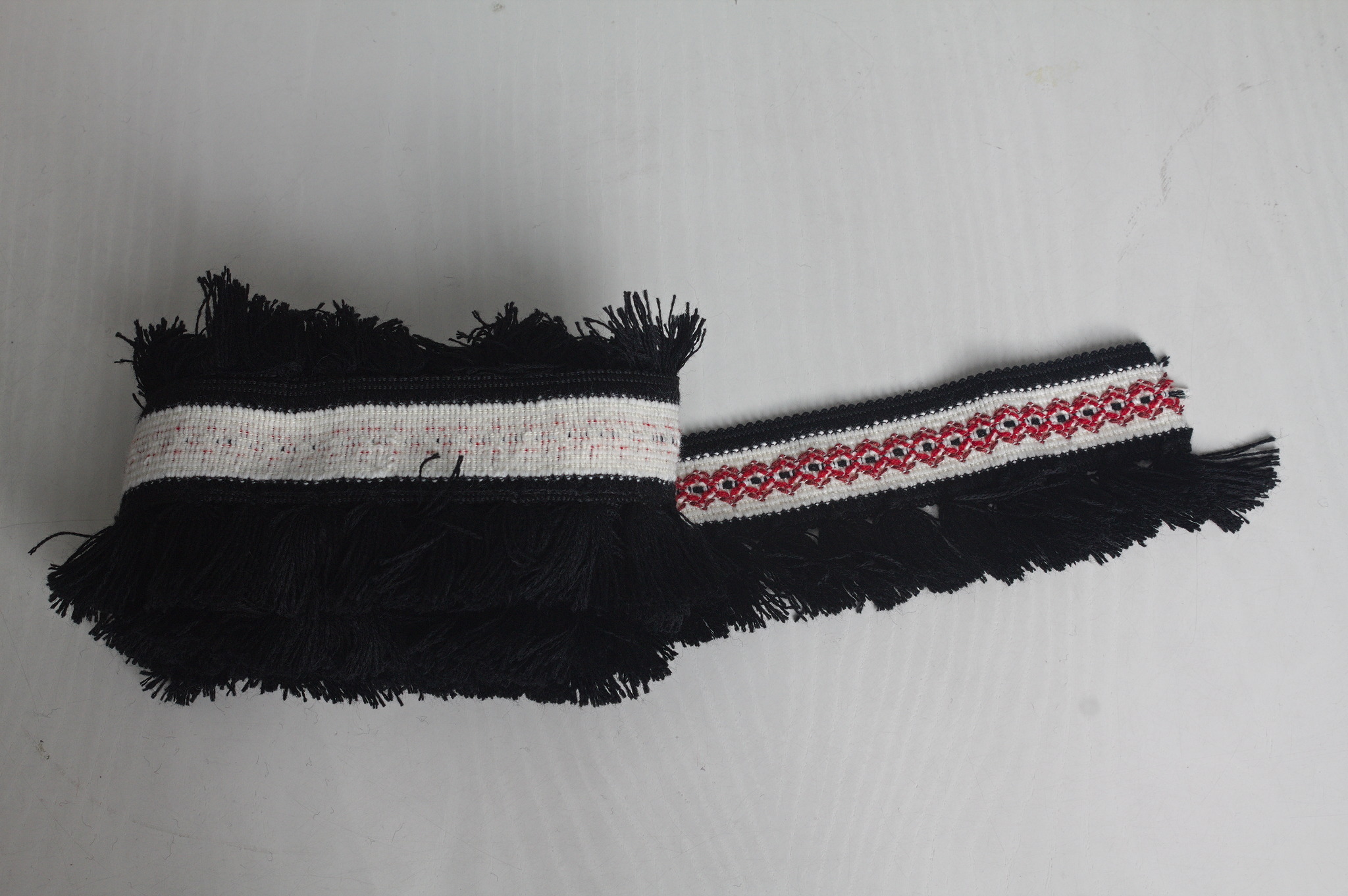
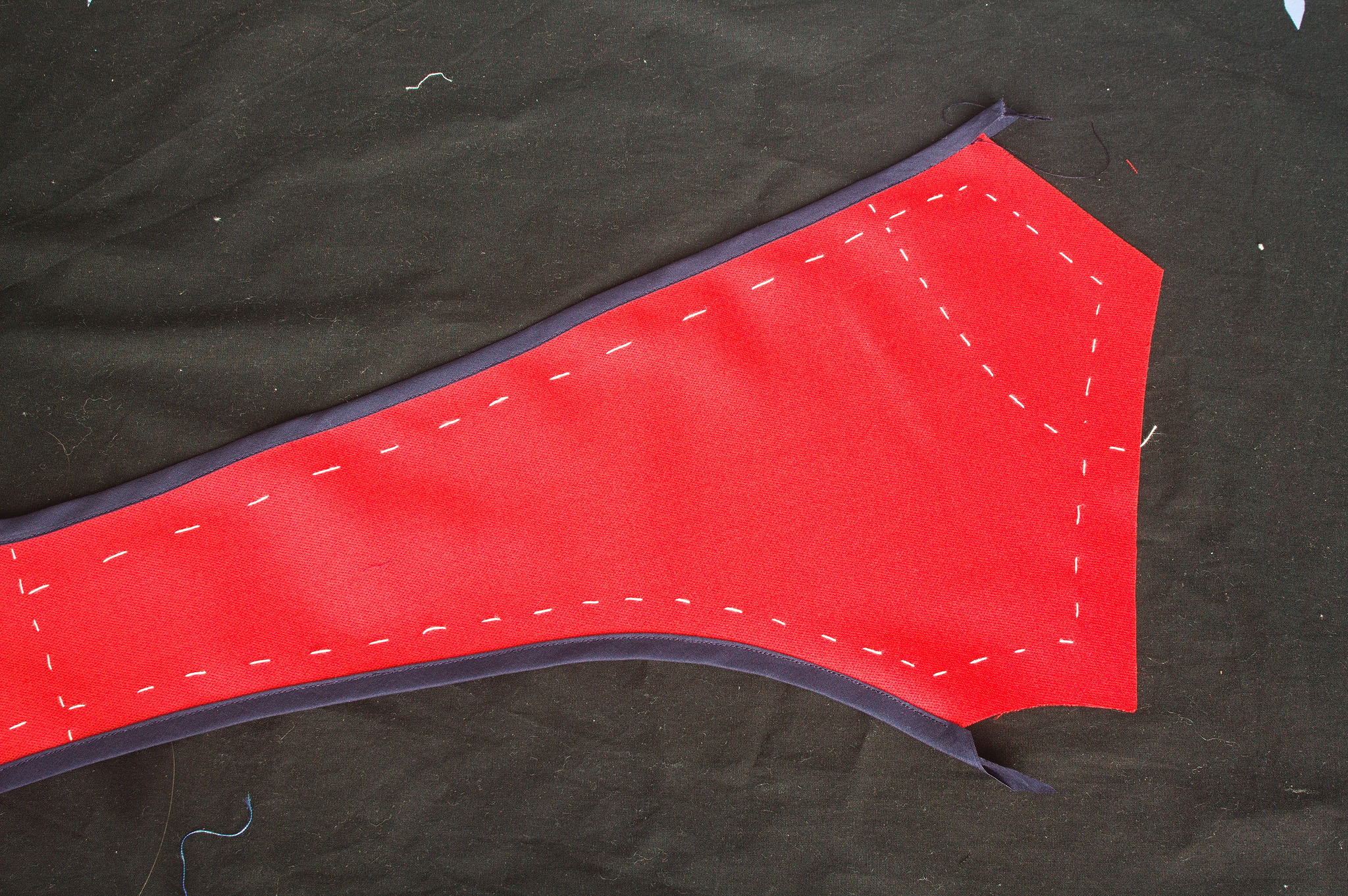
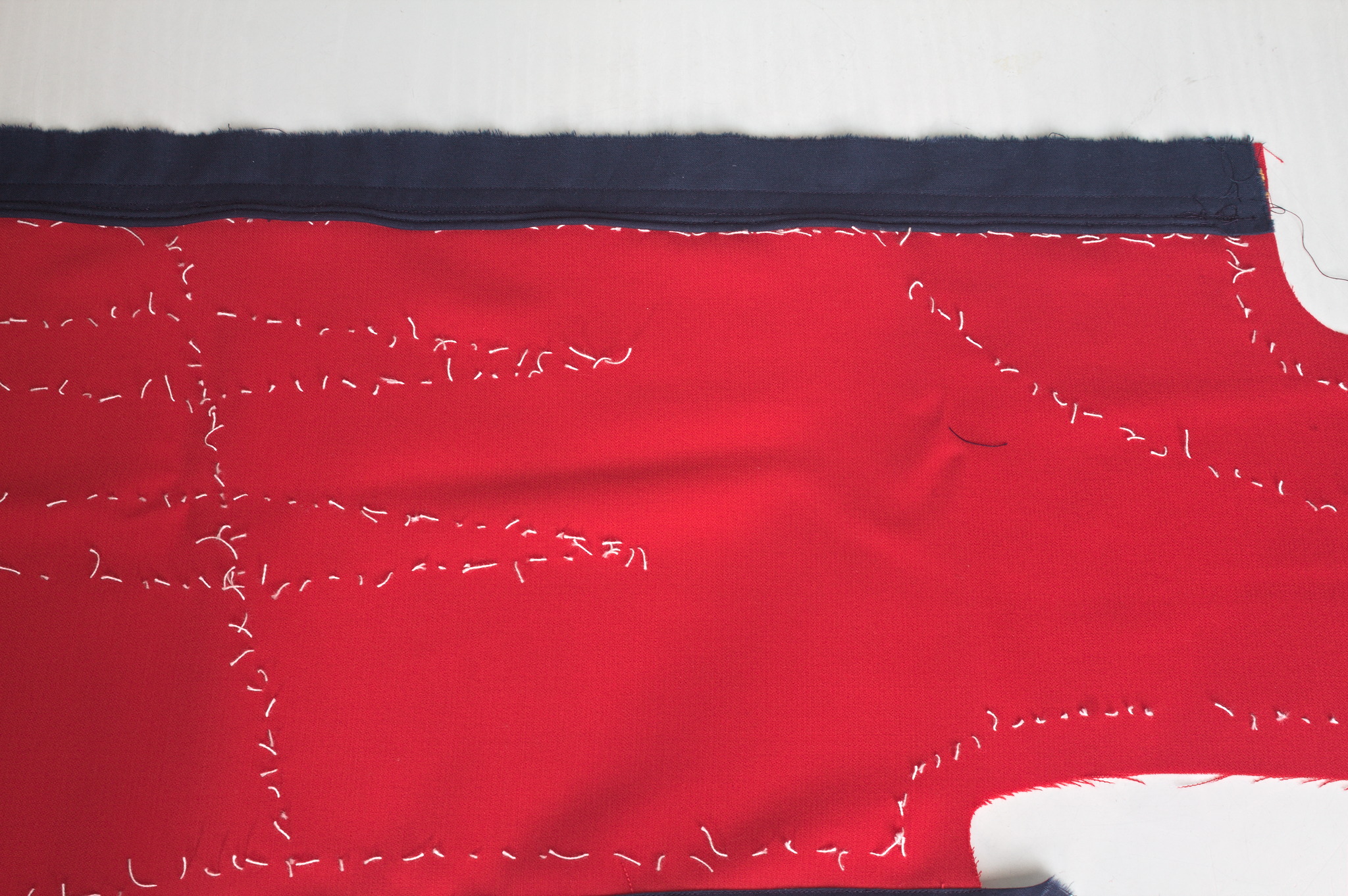
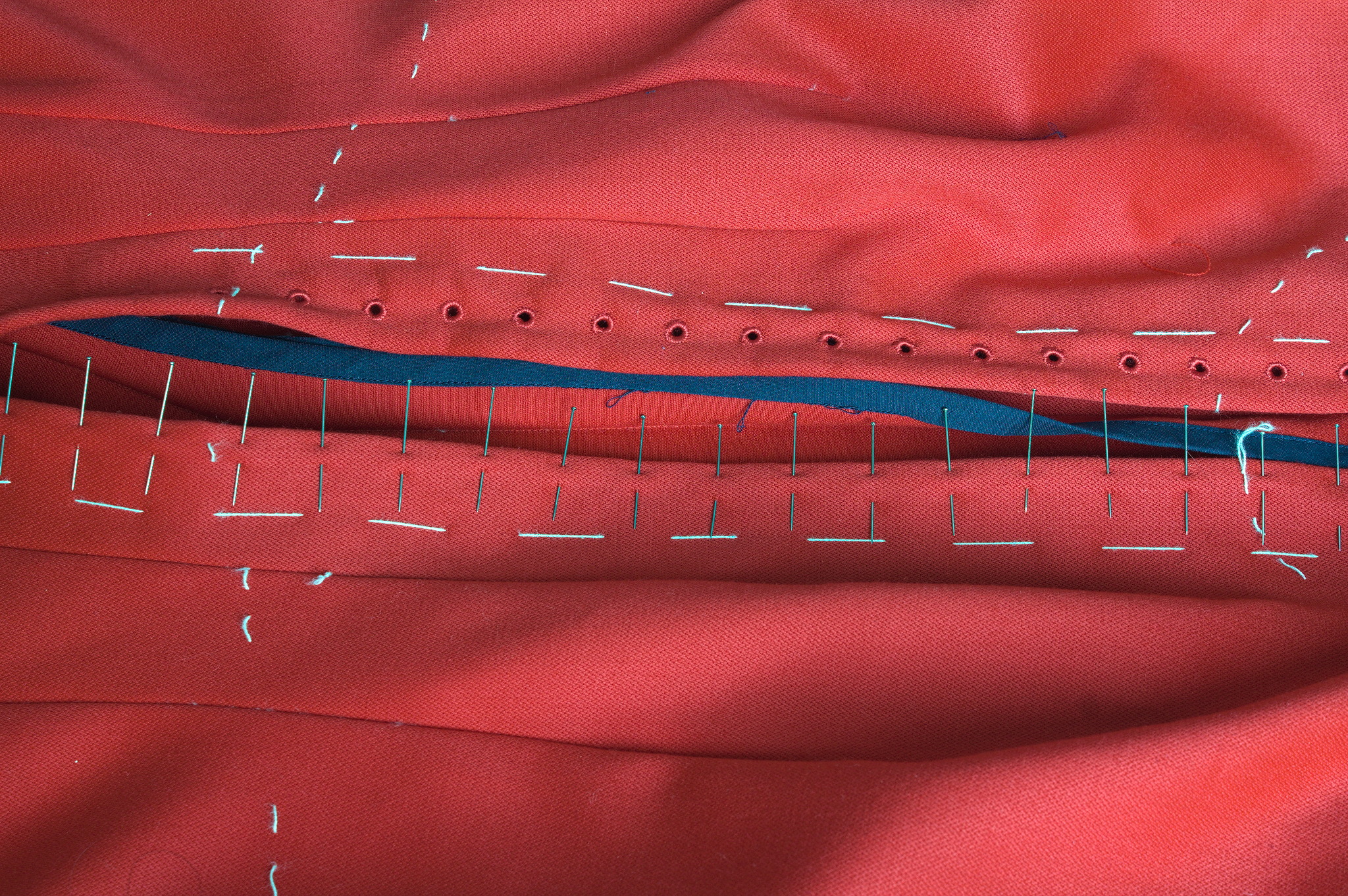
  1. yep, that s YouTube, of course.

29 December 2023

Ulrike Uhlig: How do kids conceive the internet? - part 4

Read all parts of the series Part 1 // Part 2 // Part 3 // Part 4 I ve been wanting to write this post for over a year, but lacked energy and time. Before 2023 is coming to an end, I want to close this series and share some more insights with you and hopefully provide you with a smile here and there. For this round of interviews, four more kids around the ages of 8 to 13 were interviewed, 3 of them have a US background these 3 interviews were done by a friend who recorded these interviews for me, thank you! As opposed to the previous interviews, these four kids have parents who have a more technical professional background. And this seems to make a difference: even though none of these kids actually knew much better how the internet really works than the other kids that I interviewed, specifically in terms of physical infrastructures, they were much more confident in using the internet, they were able to more correctly name things they see on the internet, and they had partly radical ideas about what they would like to learn or what they would want to change about the internet! Looking at these results, I think it s safe to say that social reproduction is at work and that we need to improve education for kids who do not profit from this type of social and cultural wealth at home. But let s dive into the details.

The boy and the aliens (I ll be mostly transribing the interview, which was short, and which I find difficult to sum up because some of the questions are written in a way to encourage the kids to tell a story, and this particular kid had a thing going on with aliens.) He s a 13 year old boy living in the US. He has his own computer, which technically belongs to his school but can be used by him freely and he can also take it home. He s the first kid saying he s reading the news on the internet; he does not actually use social media, besides sometimes watching TikTok. When asked: Imagine that aliens land and come to you and say: We ve heard about this internet thing you all talk about, what is it? What do you tell them? he replied:
Well, I mean they re aliens, so I don t know if I wanna tell them much.
(Parents laughing in the background.) Let s assume they re friendly aliens.
Well, I would say you can look anything up and play different games. And there are alien games. But mostly the enemies are aliens which you might be a little offended by. And you can get work done, if you needed to spy on humans. There s cameras, you can film yourself, yeah. And you can text people and call people who are far away
And what would be in a drawing that would explain the internet? Google, an alien using Twitch, Google search results, and the interface of an IM software on an iPhone drawn by a 13 year old boy And here s what he explains about his drawing:
First, I would draw what I see when you open a new tab, Google.
On the right side of the drawing we see something like Twitch.
I don t wanna offend the aliens, but you can film yourself playing a game, so here is the alien and he s playing a game.
And then you can ask questions like: How did aliens come to the Earth? And the answer will be here (below). And there ll be different websites that you can click on.
And you can also look up Who won the alien contest? And that would be Usmushgagu, and that guy won the alien contest.
Do you think the information about alien intergalactic football is already on the internet?
Yeah! That s how fast the internet is.
On the bottom of the drawing we see an iPhone and an instant messaging software.
There s also a device called an iPhone and with it you can text your friends. So here s the alien asking: How was ur day? and the friend might answer IDK [I don t know].
Imagine that a wise and friendly dragon could teach you one thing about the internet that you ve always wanted to know. What would you ask the dragon to teach you about?
Is there a way you don t have to pay for any channels or subscriptions and you can get through any firewall?
Imagine you could make the internet better for everyone. What would you do first?
Well you wouldn t have to pay for it [paywalls].
Can you describe what happens between your device and a website when you visit a website?
Well, it takes 0.025 seconds. [ ] It s connecting.
Wow, that s indeed fast! We were not able to obtain more details about what is that fast thing that s happening exactly

The software engineer s kid This kid identifies as neither boy nor girl, is 10 years old and lives in Germany. Their father works as a software engineer, or in the words of the child:
My dad knows everything.
The kid has a laptop and a mobile phone, both with parental control they don t think that the controlling is fair. This kid uses the internet foremostly for listening to music and watching prank channels on Youtube but also to work with Purple Mash (a teaching platform for the computing curriculum used at their school), finding 3d printing models (that they ask their father to print with them because they did not manage to use the printer by themselves yet). Interestingly, and very differently from the non-tech-parent kids, this kid insists on using Firefox and Signal - the latter is not only used by their dad to tell them to come downstairs for dinner, but also to call their grandmother. This kid also shops online, with the help of the father who does the actual shopping for them using money that the kid earned by reading books. If you would need to explain to an alien who has landed on Earth what the internet is, what would you tell them?
The internet is something where you search, for example, you can look for music. You can also watch videos from around the world, and you can program stuff.
Like most of the kids interviewed, this kid uses the internet mostly for media consumption, but with the difference that they also engage with technology by way of programming using Purple Mash. drawing of the internet by a 10 year old showing a Youtube prank channel, an external device trackpad, and headphones In their drawing we see a Youtube prank channel on a screen, an external trackpad on the right (likely it s not a touch screen), and headphones. Notice how there is no keyboard, or maybe it s folded away. If you could ask a nice and friendly dragon anything you d like to learn about the internet, what would it be?
How do I shutdown my dad s computer forever?
And what is it that he would do to improve the internet for everyone? Contrary to the kid living in the US, they think that
It takes too much time to load stuff!
I wonder if this kid experiences the internet as being slow because they use the mobile network or because their connection somehow gets throttled as a way to control media consumption, or if the German internet infrastructure is just so much worse in certain regions If you could improve the internet for everyone, what would you do first? I d make a new Firefox app that loads the internet much faster.

The software engineer s daughter This girl is only 8 years old, she hates unicorns, and her dad is also a software engineer. She uses a smartphone, controlled by her parents. My impression of the interview is that at this age, kids slightly mix up the internet with the devices that they use to access the internet. drawing of the internet by an 8 year old girl, Showing Google and the interface to call and text someone In her drawing, we see again Google - it s clearly everywhere - and also the interfaces for calling and texting someone. To explain what the internet is, besides the fact that one can use it for calling and listening to music, she says:
[The internet] is something that you can [use to] see someone who is far away, so that you don t need to take time to get to them.
Now, that s a great explanation, the internet providing the possibility for communication over a distance :) If she could ask a friendly dragon something she always wanted to know, she d ask how to make her phone come alive:
that it can talk to you, that it can see you, that it can smile and has eyes. It s like a new family member, you can talk to it.
Sounds a bit like Siri, Alexa, or Furby, doesn t it? If you could improve the internet for everyone, what would you do first? She d have the phone be able to decide over her free time, her phone time. That would make the world better, not for the kids, but certainly for the parents.

The antifascist kid This German boy s dad has a background in electrotechnical engineering. He s 10 years old and he told me he s using the internet a lot for searching things for example about his passion: the firefighters. For him, the internet is:
An invisible world. A virtual world. But there s also the darknet.
He told me he always watches that German show on public TV for kids that explains stuff: Checker Tobi. (In 2014, Checker Tobi actually produced an episode about the internet, which I d criticize for having only male characters, except for one female character: a secretary Google, a nice and friendly woman guiding the way through the huge library that s the internet ) This kid was the only one interviewed who managed to actually explain something about the internet, or rather about the hypertextual structure of the web. When I asked him to draw the internet, he made a drawing of a pin board. He explained:
Many items are attached to the pin board, and on the top left corner there s a computer, for example with Youtube and one can navigate like that between all the items, and start again from the beginning when done.
hypertext structure representing the internet drawn by a kid When I asked if he knew what actually happens between the device and a website he visits, he put forth the hypothesis of the existence of some kind of
Waves, internet waves - all this stuff somehow needs to be transmitted.
What he d like to learn:
How to get into the darknet? How do you become a Whitehat? I ve heard these words on the internet, the internet makes me clever.
And what would he change on the internet if he could?
I want that right wing extreme stuff is not accessible anymore, or at least, that it rains turds ( Kackw rste ) whenever people watch such stuff. Or that people are always told: This video is scum.
I suspect that his father has been talking with him about these things, and maybe these are also subjects he heard about when listening to punk music (he told me he does), or browsing Youtube.

Future projects To me this has been pretty insightful. I might share some more internet drawings by adults in the future, which I think are also really interesting, as they show very different things depending on the age of the person. I ve been using the information gathered to work on a children s book which I hope to be able to share with you next year.

Russ Allbery: Review: The Afterward

Review: The Afterward, by E.K. Johnston
Publisher: Dutton Books
Copyright: February 2019
Printing: 2020
ISBN: 0-7352-3190-7
Format: Kindle
Pages: 339
The Afterward is a standalone young adult high fantasy with a substantial romance component. The title is not misspelled. Sir Erris and her six companions, matching the number of the new gods, were successful in their quest for the godsgem. They defeated the Old God and destroyed Him forever, freeing King Dorrenta from his ensorcellment, and returned in triumph to Cadrium to live happily ever after. Or so the story goes. Sir Erris and three of the companions are knights. Another companion is the best mage in the kingdom. Kalanthe Ironheart, who distracted the Old God at a critical moment and allowed Sir Erris to strike, is only an apprentice due to her age, but surely will become a great knight. And then there is Olsa Rhetsdaughter, the lowborn thief, now somewhat mockingly called Thief of the Realm for all the good that does her. The reward was enough for her to buy her freedom from the Thief's Court. It was not enough to pay for food after that, or enough for her to change her profession, and the Thief's Court no longer has any incentive to give her easy (or survivable) assignments. Kalanthe is in a considerably better position, but she still needs a good marriage. Her reward paid off half of her debt, which broadens her options, but she's still a debt-knight, liable for the full cost of her training once she reaches the age of nineteen. She's mostly made her peace with the decisions she made given her family's modest means, but marriages of that type are usually for heirs, and Kalanthe is not looking forward to bearing a child. Or, for that matter, sleeping with a man. Olsa and Kalanthe fell in love during the Quest. Given Kalanthe's debt and the way it must be paid, and her iron-willed determination to keep vows, neither of them expected their relationship to survive the end of the Quest. Both of them wish that it had. The hook is that this novel picks up after the epic fantasy quest is over and everyone went home. This is not an entirely correct synopsis; chapters of The Afterward alternate between "After" and "Before" (and one chapter delightfully titled "More or less the exact moment of"), and by the end of the book we get much of the story of the Quest. It's not told from the perspective of the lead heroes, though; it's told by following Kalanthe and Olsa, who would be firmly relegated to supporting characters in a typical high fantasy. And it's largely told through the lens of their romance. This is not the best fantasy novel I've read, but I had a fun time with it. I am now curious about the intended audience and marketing, though. It was published by a YA imprint, and both the ages of the main characters and the general theme of late teenagers trying to chart a course in an adult world match that niche. But it's also clearly intended for readers who have read enough epic fantasy quests that they will both be amused by the homage and not care that the story elides a lot of the typical details. Anyone who read David Eddings at an impressionable age will enjoy the way Johnston pokes gentle fun at The Belgariad (this book is dedicated to David and Leigh Eddings), but surely the typical reader of YA fantasy these days isn't also reading Eddings. I'm therefore not quite sure who this book was for, but apparently that group included me. Johnston thankfully is not on board with the less savory parts of Eddings's writing, as you might have guessed from the sapphic romance. There is no obnoxious gender essentialism here, although there do appear to be gender roles that I never quite figured out. Knights are referred to as sir, but all of the knights in this story are women. Men still seem to run a lot of things (kingdoms, estates, mage colleges), but apart from the mage, everyone on the Quest was female, and there seems to be an expectation that women go out into the world and have adventures while men stay home. I'm not sure if there was an underlying system that escaped me, or if Johnston just mixed things up for the hell of it. (If the latter, I approve.) This book does suffer a bit from addressing some current-day representation issues without managing to fold them naturally into the story or setting. One of the Quest knights is transgender, something that's revealed in a awkward couple of paragraphs and then never mentioned again. Two of the characters have a painfully earnest conversation about the word "bisexual," complete with a strained attempt at in-universe etymology. Racial diversity (Olsa is black, and Kalanthe is also not white) seemed to be handled a bit better, although I am not the reader to notice if the discussions of hair maintenance were similarly awkward. This is way better than no representation and default-white characters, to be clear, but it felt a bit shoehorned in at times and could have used some more polish. These are quibbles, though. Olsa was the heart of the book for me, and is exactly the sort of character I like to read about. Kalanthe is pure stubborn paladin, but I liked her more and more as the story continued. She provides a good counterbalance to Olsa's natural chaos. I do wish Olsa had more opportunities to show her own competence (she's not a very good thief, she's just the thief that Sir Erris happened to know), but the climax of the story was satisfying. My main grumble is that I badly wanted to dwell on the happily-ever-after for at least another chapter, ideally two. Johnston was done with the story before I was. The writing was serviceable but not great and there are some bits that I don't think would stand up to a strong poke, but the characters carried the story for me. Recommended if you'd like some sapphic romance and lightweight class analysis complicating your Eddings-style quest fantasy. Rating: 7 out of 10

Next.

Previous.