Search Results: "tg"

9 August 2010

Gustavo Noronha Silva: WebKitGTK+ and the Web Inspector

When I started working on WebKitGTK+ I was a web developer, writing IT applications using Python and Django, and building features for content portals running Plone (argh). Even though I was an Epiphany user ever since it was forked off Galeon, I still had to use Firefox for my work, because I couldn t really live without Firebug. It should come as no surprise, then, that one of my first patches to WebKitGTK+ was actually making the awesome Web Inspector work in our port. After the initial support, though, not a lot has been done to further improve it, partly because it was already good enough for many uses, partly because I somehow started doing non-web development again ;). These last weeks, through my R&D efforts in Collabora, I have been able to push Web Inspector features and integration a bit further. A simple change that boosts the Inspector s usability quite a bit is having the nodes that are being hovered highlighted. Along with that, the ability to attach the inspector to Epiphany s window should make it easier to use for poking the DOM. The Web Inspector has a number of settings that control its behaviour. Since, for instance, enabling javascript debugging may slow down javascript performance, the inspector usually has it disabled by default, and provides a button to enable it. It also provides an option for always enabling that feature, but that does not work right now, because we are not saving/restoring the relevant settings. A solution to that is in the works using the GSettings infrastructure that was recently merged into glib. Here s a simple screencast, showing these improvements in action (click the video to check it out in full size): <video controls="controls" src="http://kov.eti.br/media/webkit/inspector.ogv" width="400"></video>

6 August 2010

Thorsten Glaser: FrOSCon 2010 and other sundries

The FrOSCon 5 - 21./22. August 2010 booth plans have finalised, I am rather content:

	               I   STANDPLAN FROSCON 2010
	  F reeWRT
	 
	  M irBSD
	    
	 
	  D ebian
	                     C = Collectd
	 
	 C     G rml


This is especially good, as XTaran will be shared among (at least) Debian, Grml, FreeWRT; same for me plus of course MirBSD; kimnotyze is FreeWRT but may help with MirBSD; benz and gecko2 probably are MirBSD but gecko2 could help with FreeWRT, tokkee was interested in FreeWRT too anyway.

Some days, you just love software.

	Aug  6 13:55:01 blau firesomething-bin: stack overflow
	    in function VFY_EndWithSignature
	Aug  6 13:55:01 blau /bsd: signal 6 received by
	    (firesomething-bi:1146) UID(2999) EUID(2999),
	    parent (sh:9059) UID(2999) EUID(2999)
 

Thus, let me re terate it for all of you:
(removed from Planet Debian) Well, now that the Debian Release Managers have sent their freezing bits around *shudder* Squeeze is frozen. Well, at least everything I have my hands in has migrated. I m still not persuaded. I also can t decide which looks worse (KDE 4 or Win 7), tending towards KDE 4 (Read on for more controverse/questionable statements.)

29 July 2010

Matthew Garrett: Kmart Android tablets and the GPL

The Augen Android tablet being sold in Kmart stores at the moment is (shockingly) running a 2.6.29 kernel and Android 2.1 on top of that. It's also (shockingly) currently impossible to get hold of the source code for the kernel - Augen (whose corporate address is a small unit in Florida) say that the software comes installed on the units by the OEM and they don't have any access to the source either. This isn't an excuse, of course, and they say that they hope to have it on their website within the next few days - but even so, it seems that the Android device GPL violation trend is still on course. It'll be interesting to see what the long-term outcome of this kind of violation is, especially with these devices increasingly being sold by mainstream stores.

25 July 2010

Thorsten Glaser: FrOSCon 2010 ( Birthday FrOSCon ) approaching

FrOSCon 5 - 21./22. August 2010 is approaching rapidly. I m a bit envious at some of the tracks (I mean, really, geocaching (ok, I did the surrounging caches over the last years but still), learning python by means of game programming, etc. really sounds interesting and I know people who could benefit from a non-kids version of that as well) but this year s FrOSCon is nothing for me to curse about either: I managed to get both a booth for The MirOS Project (MirBSD, mksh and other subprojects) as well as one for Waldemar s FreeWRT (although wbx@ if he comes won t join there since he forked his own fork since its conception). Booth staff are, currently: tg@ and bsiegert@ (Developer), gecko2@ (Staff) for MirOS, tg@ and XTaran abe@ (Developer), kimnotyze (Hacker) for FreeWRT. (XTaran will probably be helping Debian/Grml too.) This year, it ll be my job (after 2 years of aptituz) to keep the Altbier-Fraktion watered, I m thinking one crate of Schl sser Alt and one crate of Hannen Alt? Have a look at the Program and don t tell me you won t come! It will rock! (Except there won t be Formorer s Chilli, but that s no reason, there s enough other stuff in manageable distance.) Besides interesting booths and talks, FrOSCon is still looking for helpers who will not only get free entrance but also catering during operation.

Russell Coker: SE Linux audit2allow -R and Milter policy

Since the earliest days there has been a command named audit2allow that takes audit messages of operations that SE Linux denied and produces policy that will permit those operations. A lesser known option for this program is the -R option to use the interfaces from the Reference Policy (the newer version of the policy that was introduced a few years ago). I have updated my SE Linux repository for Lenny [1] with new packages of policy and python-sepolgen that fix some bugs that stopped this from being usable. To use the -R option you have to install the selinux-policy-dev package and then run the command sepolgen-ifgen to generate the list of interfaces (for Squeeze I will probably make the postinst script of selinux-policy-dev do this). Doing this on Lenny requires selinux-policy-default version 0.0.20080702-20 or better and doing this on Debian/Unstable now requires selinux-policy-default version 0.2.20100524-2 (which is now in Testing) or better. Would it be useful if I maintained my own repository of SE Linux packages from Debian/Unstable that can be used with Debian/Testing? You can use preferences to get a few packages from Unstable with the majority from Testing, but that s inconvenient and anyone who wants to test the latest SE Linux stuff would need to include all SE Linux related packages to avoid missing an important update. If I was to use my own repository I would only include packages that provide a significant difference and let the trivial changes migrate through Testing in the normal way. The new Lenny policy includes a back-port of the new Milter policy from Unstable, this makes it a lot easier to write policy for milters. Here is an example of the basic policy for two milters, it allows the milters (with domains foo_milter_t and bar_milter_t) to start, to receive connections from mail servers, and to create PID files and Unix domain sockets. policy_module(localmilter,1.0.0)

milter_template(foo)
files_pid_filetrans(foo_milter_t, foo_milter_data_t, sock_file file )

milter_template(bar)
files_pid_filetrans(bar_milter_t, bar_milter_data_t, sock_file file )
allow bar_milter_t self:process signull;
type bar_milter_tmp_t;
files_tmp_file(bar_milter_tmp_t)
files_tmp_filetrans(bar_milter_t, bar_milter_tmp_t, file)
manage_files_pattern(bar_milter_t, tmp_t, bar_milter_tmp_t) After generating that policy I ran a test system in permissive mode and sent a test message. I ran audit2allow on the resulting AVC messages from /var/log/audit/audit.log and got the following output: #============= bar_milter_t ==============
allow bar_milter_t bin_t:dir search;
allow bar_milter_t bin_t:file getattr;
allow bar_milter_t home_root_t:dir search;
allow bar_milter_t ld_so_cache_t:file read getattr ;
allow bar_milter_t lib_t:file execute;
allow bar_milter_t mysqld_port_t:tcp_socket name_connect;
allow bar_milter_t net_conf_t:file read getattr ioctl ;
allow bar_milter_t self:process signal;
allow bar_milter_t self:tcp_socket read write create connect setopt ;
allow bar_milter_t unlabeled_t:association recvfrom sendto ;
allow bar_milter_t unlabeled_t:packet recv send ;
allow bar_milter_t urandom_device_t:chr_file read;
allow bar_milter_t usr_t:file read getattr ioctl ;
allow bar_milter_t usr_t:lnk_file read;
#============= foo_milter_t ==============
allow foo_milter_t ld_so_cache_t:file read getattr ;
allow foo_milter_t lib_t:file execute;
allow foo_milter_t mysqld_port_t:tcp_socket name_connect;
allow foo_milter_t net_conf_t:file read getattr ;
allow foo_milter_t self:capability setuid setgid ;
allow foo_milter_t self:tcp_socket write setopt shutdown read create connect ;
allow foo_milter_t unlabeled_t:association recvfrom sendto ;
allow foo_milter_t unlabeled_t:packet recv send ; Running the audit2allow command with the -R option gives the following output, it includes the require section that is needed for generating policy modules:
require
type sshd_t;
type ld_so_cache_t;
type bar_milter_t;
type foo_milter_t;
class process signal;
class tcp_socket setopt read create write connect shutdown ;
class capability setuid setgid ;
class fd use;
class file read getattr ;

#============= bar_milter_t ==============
allow bar_milter_t ld_so_cache_t:file read getattr ;
allow bar_milter_t self:process signal;
allow bar_milter_t self:tcp_socket read write create connect setopt ;
corecmd_getattr_sbin_files(bar_milter_t)
corecmd_search_sbin(bar_milter_t)
corenet_sendrecv_unlabeled_packets(bar_milter_t)
corenet_tcp_connect_mysqld_port(bar_milter_t)
dev_read_urand(bar_milter_t)
files_read_usr_files(bar_milter_t)
files_read_usr_symlinks(bar_milter_t)
files_search_home(bar_milter_t)
kernel_sendrecv_unlabeled_association(bar_milter_t)
libs_exec_lib_files(bar_milter_t)
sysnet_read_config(bar_milter_t)
#============= foo_milter_t ==============
allow foo_milter_t ld_so_cache_t:file read getattr ;
allow foo_milter_t self:capability setuid setgid ;
allow foo_milter_t self:tcp_socket write setopt shutdown read create connect ;
corenet_sendrecv_unlabeled_packets(foo_milter_t)
corenet_tcp_connect_mysqld_port(foo_milter_t)
kernel_sendrecv_unlabeled_association(foo_milter_t)
libs_exec_lib_files(foo_milter_t)
sysnet_read_config(foo_milter_t) To get this working I removed the require lines for foo_milter_t and bar_milter_t as it s not permitted to both define a type and require it in the same module. Then I replaced the set of tcp_socket operations write setopt shutdown read create connect with create_socket_perms as it s easiest to allow all the operations in that set and doesn t give any security risks. Finally I replaced the mysql lines such as corenet_tcp_connect_mysqld_port(foo_milter_t) with sections such as the following:
mysql_tcp_connect(foo_milter_t)
optional_policy(
mysql_stream_connect(foo_milter_t)
) This gives it all the access it needs and additionally the optional policy will allow Unix domain socket connections for the case where the mysqld is running on localhost.

23 July 2010

Kees Cook: Achievement Unlocked

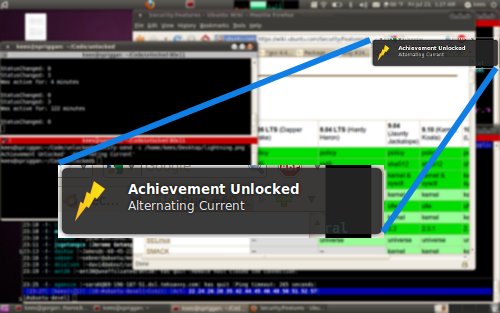
I think it would be fun to add an achievement system to the Ubuntu Desktop, like is done on Steam and XBox. The tricky part is tracking various events and finding amusing correlations. For example, if your screen-saver kicks in 40 times in a single 24 hour period, you could earn the Alternating Current achievement, indicating that you re being repeatedly interrupted all day long: achievement unlocked: alternating current There are all kind of things to track and correlate. Miles moved with the mouse, clicks taken, keys pressed, files opened, applications installed, buddies added, IMs received, sent, etc. There are all kinds of achievements that could be designed that could be used to help people discover how to use Ubuntu, or for just plain humor. Achievement Unlocked: Application Deficit Disorder when you uninstall 100 applications you installed in the prior week. I ve been told this might all be very easy to implement with the Gnome Activity Journal (Zeitgeist), but I haven t had a chance to investigate further. UPDATE: I can easily imagine this being tracked in CouchDB, synced between systems via UbuntuOne, and could be linked to any other remote APIs that people could dream up, including Launchpad, Forums, REVU, Identi.ca, etc.

21 July 2010

Thorsten Glaser: What s with mksh bugs at the moment?

Well, I suppose I should be happy that mksh is actually used That s OpenADK (Waldemar s fork of FreeWRT, which is Waldemar s fork of OpenWrt), and Red Hat Enterprise Linux, respectively. Popcon in Debian and its derivates is also pleasant. I could use some help bugfixing this though:
	(sleep 3; exit 12) &
	bgprocpid=$!
	sleep 6
	# background process is done by now
	wait $bgprocpid
	# POSIX mandates that, since $! was asked
	# for, wait is to reply its errorlevel
Somehow, JF_KNOWN is never set and I can t debug this with gdb(1). (There s also a dashism in some *buntu start scripts that does pretty much the same except it uses wait %1 there. In fact it doesn t even seem to use $! no idea whether we can support that at all in a POSIX shell which dash clearly isn t without keeping track of background processes forever.)

19 July 2010

Wouter Verhelst: Monty at it again...

Apparently Michael Widenius isn't quite about to give up on his quest against Oracle. The latest news is that he's appealing the EC decision. Wonder what the use of that is, since the merger seems pretty final already. I also don't think it's a very good cause, at any rate. After all, the worst that can happen is that MySQL will fork. Or that Oracle will pour some resources in it, and actually make it a database, rather than the POS toy it currently is. Or that it dies out, and that the world switches over to PostgreSQL or Firebird for Free Software database requirements. Wouldn't be a big loss, would it? Give up already, Monty!

16 July 2010

Gustavo Noronha Silva: WebKitGTK+ 1.2.2 and 1.2.3 released!

Some of you may have noticed WebKitGTK+ 1.2.2 and 1.2.3 have been uploaded recently. Here s their announcement =). A quick summary: if you re running the 1.2.x series upgrade to 1.2.3. Here s some information regarding 1.2.2: 1.2.2 is an update to the 1.2.x stable series; along with a lot of crash, and misc fixes the biggest changes are: 1) the inclusion of a new API from the development branch (webkit_back_forward_list_clear()),
because it s simple and will help with fixing a problem in Epiphany stable, and 2) lots of drag and drop, and clipboard related work by Martin Robinson. Despite not being strictly fixes, we believe the stable series has a lot to gain from this work; a couple examples should illustrate this better: the changes included fix both a crash when dragging links from WebKit into other browsers, and the annoying bug that made the cursor get stuck in a grab when dragging, sometimes.
http://webkitgtk.org/webkit-1.2.2.tar.gz
MD5: 40338001324a38b977c163291e8816d3
Here s some information regarding 1.2.3: To some such a quick succession in releases may look like a brown paper bag was in order. Not strictly, but indeed 1.2.3 aims to fix some oversights with easy fixes. First of all, WebKit was not buildable with ICU 4.4.1, but thankfully a fix had already been checked in to trunk, so 1.2.3 includes that fix. Secondly, Debian s Michael Gilbert has done a great job going through all CVEs released about WebKit, and including patches in the Debian package. 1.2.3 includes all of the commits from trunk to fix those, too.
http://webkitgtk.org/webkit-1.2.3.tar.gz
MD5: 0ab5c478a6f5b74a1ae96bf13a456662
You can read some more details, including the list of CVEs that were addressed, in the NEWS file:
http://gitorious.org/webkitgtk/stable/blobs/master/WebKit/gtk/NEWS
Enjoy!

14 July 2010

Mike Hommey: I/O patterns on ELF binary initialization

[ I meant to finish this article much earlier, but i had to leave it in a half-written draft state for quite some time due to other activities ] One particular issue that arises with big binary files is that of I/O patterns. It looks like it is not something under the usual scope for both ld.so and programs/libraries, but it can have a dramatic influence on startup times. My analysis is far from complete, would need to be improved by actually investigating ld.so code further, and so far has been limited to libxul.so built from mozilla-central, with the help of icegrind, on x86-64 linux. As I wrote recently, icegrind allows to track memory accesses within mmap()ed memory ranges. As ld.so does mmap() the program and library binaries, tracking the memory accesses within these mmap()s allows to get a better idea at I/O patterns when an ELF binary is initialized. I only focused on local accesses within a single given binary file (libxul.so) because the case of Firefox loading many files at startup is already being scrutinized, and because most of the non-Firefox files being read at Firefox startup (system and GNOME libraries) are most likely already in the page cache. I also focused on that because it was an interesting case that could be helpful to understand how big (and maybe less big) binaries may be affected by the toolchain (compiler, linker and dynamic linker) and possibly by some coding practices. For the record, what I did to get these results is to use icegrind and elflog, with further additions to the sections file with some output from objdump -h : I added sections that elflog wouldn t give (such as .plt, .hash, .dynsym, etc.), and even down to the entry level for the .rela.dyn section. The latter is particularly interesting because icegrind only outputs the first access for any given section. To see sequential accesses within that section, you need to split it in smaller pieces, which I did for .rela.dyn entries (each one being 24 bytes on x86-64). Uncommenting some parts of the icegrind code was also useful to track where some accesses were made from, code-wise. Now, the interesting data: One of the first accesses is a nullification of a few variables within the .bss section. The .bss section is usually an anonymous piece of memory, that is, a range of mmap()ed memory that is not backed by a file, and filled with zeroes by the kernel (I think it even does that lazily). It is used for e.g. variables that are initialized with zeroes in the code, and obviously, any code accessing these variables would be addressing at some offset of the .bss section. It means the section needs to start in memory at the offset it has been assigned by the linker at build time. This is actually where problems begin. When the .bss section offset as assigned by the linker doesn t align on a page (usually 4KB), the mmap()ed .bss can t be at that location, and really starts on the next page. The remainder is still mmap()ed from the binary file, and ld.so will itself fill that part. As the .bss section doesn t start on a page boundary, any write at this location will trigger the kernel reading the entire page. This means one of the first set of data being read from the file is the end of the section preceding .bss, and the beginning of the following one. Most likely, respectively the .data and .comment sections. While this probably doesn t matter much when the binary file is small, when it is big enough, reading in a non sequential manner will trigger hard disk seeks, and we all know how they can hurt performance. Although thankfully, cheap SSDs should be coming some day, in the meanwhile, we still need to cope with the bad performance. The interesting part is, the .bss section is really empty in the binary file, so its virtual memory address could be anywhere. Why the linker wouldn t align it at a page boundary without having to resort to a linker script is beyond me. The next accesses go back and forth between .dynamic, .gnu.hash, .dynstr, .gnu.version_r, .gnu.version and .dynsym. These are probably all related to symbol version resolution and DT_NEEDED library loading. While most of these sections are at the beginning of the file (not necessarily in the order they are read from), the .dynamic section is much nearer to the end, but way before .data, so that it won t even have been loaded as a by-product of the .bss section loading. After that, the .rela.dyn section is read, and for each relocation entry it contains, the relocations are being applied. Relocations is one of the mechanisms by which position independent code (PIC) is made possible. When a library is loaded in memory, it is not necessarily loaded at the same address every time. The code and data contained in the library thus need to cope with that constraint. Fortunately, while the base address where the library is mmap()ed in memory is not necessary constant, the offsets of the various sections are still as codified in the binary. The library code can thus directly access data at the right offset if it knows the base offset of the library (which is what is done on the x86 ABI), or if it knows where the current instruction is located (which is what is done on the x86-64 ABI). Static data (initialized in e.g. a const or a global variable, or, in C++ case, vtables), on the other hand, may contain pointers to other locations. This is where relocation enters the scene. The .rela.dyn section contains a set of rules describing where in the binary some pointers need to be adjusted depending on the base library offset (or some other information), and how they should be updated. ld.so thus reads all .rela.dyn entries, and applies each relocation, which means that while .rela.dyn is being read sequentially, reads and writes are also performed at various places of the binary, depending on the content of the .rela.dyn entries. This is where this gets ugly for Firefox: there are near 200000 such relocations. On x86-64 an entry is 24 bytes (12 on x86), and each of these is going to read/write a pointer (8 bytes on x86-64, 4 on x86) at some random (though mostly ordered) location. The whole .rela.dyn section not being read ahead, what actually happens is that it is read in small batches, with seeks and reads of other data at various locations in between. In libxul.so case, this spreads over .ctors, .data.rel.ro, .got, and .data. The relocation entries are somehow ordered by address to be rewritten, though they occasionally jump backwards. Some of these relocations also appear to be touching to .gnu.version, .dynsym and .dynstr, because their type involves a symbol resolution. Once .rela.dyn relocation have been dealt with comes .rela.plt s turn. The principle is the same for this section: entries describe what kind of relocation must be done where, and how the result must be calculated. The scope of this section, though, is apparently limited to .got.plt. But before explaining these relocations, I ll explain what happens with the PLT. The PLT (Procedure Linkage Table) is used when calling functions from external libraries. For example, in a Hello World example, the PLT would be used for calls to the puts function. The function making the call would in fact call the corresponding PLT location. The PLT itself, on x86 and x86-64, at least, consists of 3 instructions (I ll skip the gory details, especially for x86, where the caller needs to also set some register before calling the PLT). The first instruction is the only one to be called most of the time: it reads the final destination in the .got.plt section, and jumps there. That final destination, obviously, is not fixed in the library file, since it needs to be resolved by its symbol. This is why the two subsequent instructions exist : originally, the destination stored in the .got.plt section points back to the second instruction ; the first instruction will effectively be a nop (no operation), and the following instructions will be executed. They will jump into code responsible for symbol resolution, update of the .got.plt entry for the next call, and call of the real function. But pointing back to the second instruction is like the pointers in static data we saw above : it s not possible in position independent code. So, the .rela.plt relocations are actually filling the .got.plt section with these pointers back to the PLT. There are a tad more than 3000 such relocations. All these relocations should be going away when prelinking the binaries, but from my several experimentations, it looks like prelinking only avoids relative relocations, and not the others, while it technically could skip all of them. prelink even properly applies all the relocations in the binary, but executing the binary rewrites the same information at startup for all but relative relocations. That could well be a bug in either ld.so not skipping enough relocations or prelink not marking enough relocations to be skipped. I haven t dug deep enough in the code to know how prelinking works exactly. Anyways, prelinking is not a perfect solution, as it also breaks ASLR. Sure, prelink can randomize library locations, but it relies on the user or a cron job doing so at arbitrary times, but that s far from satisfying. An interesting thing to note, though, is that a good part of the relocations prelinking doesn t rid us of in libxul.so (more than 25000) are due to the __cxa_pure_virtual symbol, which is used for, well, pure virtual methods. In other words, virtual methods that don t have an implementation in a given class. The __cxa_pure_virtual function is set as method in the corresponding field(s) of the class VTABLE in the .data.rel.ro section. This function is provided by libstdc++, and as such, is dynamically linked. But this function is just a dummy function, doing nothing. Defining an empty __cxa_pure_virtual function to be included in libxul.so makes these relocations become relative, thus taken care of by prelinking. After all relocations occur, the library initialization itself can begin, and the content of the .init section is executed. That section, indirectly, executes all functions stored in the .ctors section. This includes static initializers, which are unfortunately called backwards, as Taras pointed out already. Each of these static initializers are also accessing various locations in the .data or .bss sections, which may or may not have already been loaded during the relocation phase. The execution of these initializers will also (obviously) read various pieces of the .text section (despite its name, it contains executable sections, i.e. functions code). The initialization of the library ends there, and no access should happen until a function from the library is called. In libxul.so case, XRE_main is first called, then many other functions, but that s another story. All that needs to be remembered about the startup process past this point is that the .text section will be read heavily, as well as the various data, got, plt and dynamic symbol sections, in a very scattered way. While most of these sections may have been retrieved in memory already, as a byproduct of the various initialization processes described above, some may have not, increasing even more the need to seek at all places in the binary file. Now the main problem with all these I/O patterns at startup, is that it seems the only way reorganizing the binary layout may have a visible impact is by considering all the above, and not only a part of it, because only addressing a part of it is very likely to only move part of the problem to a different layer. All in all, making sure the relevant sections of libxul.so are read by the kernel before ld.so enters the game is a good short-term solution to avoid many seeks at startup.

12 July 2010

Thorsten Glaser: On ASLR (Address Space Layout Randomisation)

I ve got some interesting results using r1.1 of an example test programme (r1.2 got cleaned up and more output) on various systems, regarding ASLR. The 1.1 revision tests everything mksh R40+ will use (except there will probably no larger than page sized allocations) for its LCG PRNG. On OpenBSD (MirBSD, rieBSD) malloc(3) uses in fact mmap(2), which is randomised. (Though -pie doesn t yet work as it s supposed to.) Some OSes are better than others but look for yourself. (Read on to continue, not part of the RSS for size reasons. This wlog entry may be updated with bumped date unperiodically.)

11 July 2010

Thorsten Glaser: Back home

Bordeaux was very nice (and towards the end much cooler it s actually hotter here at more than 50 north too warm to think, or do anything) but the LSM/RMLL was very french. They ll be in Stra burg and L ttich the next two years so we can probably be expected to attend. I don t think I can eat duck (which, in south-west france, is a vegetable) or like all that classic french multi-course food so much, but I had enough Couscous Merguez and Th la menthe fra che and similar good stuff. Many people spoke English and actually asked me whether I do (probably they couldn t bear me trying to spea^W^W^Wbutchering the language of the Grande Nation) and in general were a friendly bunch. I did see some people with machine guns in the city on the last day, though. No idea what/why didn t dare asking Just another reason to boycott flying: Mario Lang (one of the speakers) was apparently held on the airport and treated as a terrorist due to his Braille line they thought it was a bomb or somesuch thing.

Read on for more

10 July 2010

Enrico Zini: Importing OSM nodes into Spatialite

Importing OSM nodes into Spatialite Second step of my SoTM10 pet project: creating a searchable database with the points. What a fantastic opportunity to learn Spatialite. Learning Spatialite is easy. For example, you can use the two tutorials with catchy titles that assume your best wish in life is to create databases out of shapefiles using a pre-built, i386-only executable GUI binary downloaded over an insecure HTTP connection. To be fair, the second of those tutorials is called "An almost Idiot's Guide", thus expliciting the requirement of being an almost idiot in order to happily acquire and run software in that way. Alternatively, you can use A quick tutorial to SpatiaLite which is so quick it has examples that lead you to write SQL queries that trigger all sorts of vague exceptions at insert time. But at least it brought me a long way forward, at which point I could just cross reference things with PostGIS documentation to find out the right way of doing things. So, here's the importer script, which will probably become my reference example for how to get started with Spatialite, and how to use Spatialite from Python:
#!/usr/bin/python
#
# poiimport - import nodes from OSM into a spatialite DB
#
# Copyright (C) 2010  Enrico Zini <enrico@enricozini.org>
#
# This program is free software; you can redistribute it and/or modify
# it under the terms of the GNU General Public License as published by
# the Free Software Foundation; either version 2 of the License, or
# (at your option) any later version.
#
# This program is distributed in the hope that it will be useful,
# but WITHOUT ANY WARRANTY; without even the implied warranty of
# MERCHANTABILITY or FITNESS FOR A PARTICULAR PURPOSE.  See the
# GNU General Public License for more details.
#
# You should have received a copy of the GNU General Public License
# along with this program; if not, write to the Free Software
# Foundation, Inc., 59 Temple Place, Suite 330, Boston, MA  02111-1307  USA
#
import xml.sax
import xml.sax.handler
from pysqlite2 import dbapi2 as sqlite
import simplejson
import sys
import os
class OSMPOIReader(xml.sax.handler.ContentHandler):
    '''
    Filter SAX events in a OSM XML file to keep only nodes with names
    '''
    def __init__(self, consumer):
        self.consumer = consumer
    def startElement(self, name, attrs):
        if name == "node":
            self.attrs = attrs
            self.tags = dict()
        elif name == "tag":
            self.tags[attrs["k"]] = attrs["v"]
    def endElement(self, name):
        if name == "node":
            lat = float(self.attrs["lat"])
            lon = float(self.attrs["lon"])
            id = int(self.attrs["id"])
            #dt = parse(self.attrs["timestamp"])
            uid = self.attrs.get("uid", None)
            uid = int(uid) if uid is not None else None
            user = self.attrs.get("user", None)
            self.consumer(lat, lon, id, self.tags, user=user, uid=uid)
class Importer(object):
    '''
    Create the spatialite database and populate it
    '''
    TAG_WHITELIST = set(["amenity", "shop", "tourism", "place"])
    def __init__(self, filename):
        self.db = sqlite.connect(filename)
        self.db.enable_load_extension(True)
        self.db.execute("SELECT load_extension('libspatialite.so')")
        self.db.execute("SELECT InitSpatialMetaData()")
        self.db.execute("INSERT INTO spatial_ref_sys (srid, auth_name, auth_srid,"
                        " ref_sys_name, proj4text) VALUES (4326, 'epsg', 4326,"
                        " 'WGS 84', '+proj=longlat +ellps=WGS84 +datum=WGS84"
                        " +no_defs')")
        self.db.execute("CREATE TABLE poi (id int not null unique primary key,"
                        " name char, data text)")
        self.db.execute("SELECT AddGeometryColumn('poi', 'geom', 4326, 'POINT', 2)")
        self.db.execute("SELECT CreateSpatialIndex('poi', 'geom')")
        self.db.execute("CREATE TABLE tag (id integer primary key autoincrement,"
                        " name char, value char)")
        self.db.execute("CREATE UNIQUE INDEX tagidx ON tag (name, value)")
        self.db.execute("CREATE TABLE poitag (poi int not null, tag int not null)")
        self.db.execute("CREATE UNIQUE INDEX poitagidx ON poitag (poi, tag)")
        self.tagid_cache = dict()
    def tagid(self, k, v):
        key = (k, v)
        res = self.tagid_cache.get(key, None)
        if res is None:
            c = self.db.cursor()
            c.execute("SELECT id FROM tag WHERE name=? AND value=?", key)
            for row in c:
                self.tagid_cache[key] = row[0]
                return row[0]
            self.db.execute("INSERT INTO tag (id, name, value) VALUES (NULL, ?, ?)", key)
            c.execute("SELECT last_insert_rowid()")
            for row in c:
                res = row[0]
            self.tagid_cache[key] = res
        return res
    def __call__(self, lat, lon, id, tags, user=None, uid=None):
        # Acquire tag IDs
        tagids = []
        for k, v in tags.iteritems():
            if k not in self.TAG_WHITELIST: continue
            for val in v.split(";"):
                tagids.append(self.tagid(k, val))
        # Skip elements that don't have the tags we want
        if not tagids: return
        geom = "POINT(%f %f)" % (lon, lat)
        self.db.execute("INSERT INTO poi (id, geom, name, data)"
                        "     VALUES (?, GeomFromText(?, 4326), ?, ?)",
                (id, geom, tags["name"], simplejson.dumps(tags)))
        for tid in tagids:
            self.db.execute("INSERT INTO poitag (poi, tag) VALUES (?, ?)", (id, tid))
    def done(self):
        self.db.commit()
# Get the output file name
filename = sys.argv[1]
# Ensure we start from scratch
if os.path.exists(filename):
    print >>sys.stderr, filename, "already exists"
    sys.exit(1)
# Import
parser = xml.sax.make_parser()
importer = Importer(filename)
handler = OSMPOIReader(importer)
parser.setContentHandler(handler)
parser.parse(sys.stdin)
importer.done()
Let's run it:
$ ./poiimport pois.db < pois.osm 
SpatiaLite version ..: 2.4.0    Supported Extensions:
        - 'VirtualShape'        [direct Shapefile access]
        - 'VirtualDbf'          [direct Dbf access]
        - 'VirtualText'         [direct CSV/TXT access]
        - 'VirtualNetwork'      [Dijkstra shortest path]
        - 'RTree'               [Spatial Index - R*Tree]
        - 'MbrCache'            [Spatial Index - MBR cache]
        - 'VirtualFDO'          [FDO-OGR interoperability]
        - 'SpatiaLite'          [Spatial SQL - OGC]
PROJ.4 Rel. 4.7.1, 23 September 2009
GEOS version 3.2.0-CAPI-1.6.0
$ ls -l --si pois*
-rw-r--r-- 1 enrico enrico 17M Jul  9 23:44 pois.db
-rw-r--r-- 1 enrico enrico 37M Jul  9 16:20 pois.osm
$ spatialite pois.db
SpatiaLite version ..: 2.4.0    Supported Extensions:
        - 'VirtualShape'        [direct Shapefile access]
        - 'VirtualDbf'          [direct DBF access]
        - 'VirtualText'         [direct CSV/TXT access]
        - 'VirtualNetwork'      [Dijkstra shortest path]
        - 'RTree'               [Spatial Index - R*Tree]
        - 'MbrCache'            [Spatial Index - MBR cache]
        - 'VirtualFDO'          [FDO-OGR interoperability]
        - 'SpatiaLite'          [Spatial SQL - OGC]
PROJ.4 version ......: Rel. 4.7.1, 23 September 2009
GEOS version ........: 3.2.0-CAPI-1.6.0
SQLite version ......: 3.6.23.1
Enter ".help" for instructions
spatialite> select id from tag where name="amenity" and value="fountain";
24
spatialite> SELECT poi.name, poi.data, X(poi.geom), Y(poi.geom) FROM poi, poitag WHERE poi.rowid IN (SELECT pkid FROM idx_poi_geom WHERE (xmin >= 2.56 AND xmax <= 2.90 AND ymin >= 41.84 AND ymax <= 42.00) ) AND poitag.tag = 24 AND poitag.poi = poi.id;
Font Picant de la Cellera "amenity": "fountain", "name": "Font Picant de la Cellera" 2.616045 41.952449
Font de Can Pla "amenity": "fountain", "name": "Font de Can Pla" 2.622354 41.974724
Font de Can Ribes "amenity": "fountain", "name": "Font de Can Ribes" 2.62311 41.979193
It's impressive: I've got all sort of useful information for the whole of Spain in just 17Mb! Let's put it to practice: I'm thirsty, is there any water fountain nearby?
spatialite> SELECT count(1) FROM poi, poitag WHERE poi.rowid IN (SELECT pkid FROM idx_poi_geom WHERE (xmin >= 2.80 AND xmax <= 2.85 AND ymin >= 41.97 AND ymax <= 42.00) ) AND poitag.tag = 24 AND poitag.poi = poi.id;
0
Ouch! No water fountains mapped in Girona... yet. Problem 2 solved: now on to the next step, trying to show the results in some usable way.

9 July 2010

Francois Marier: Improving the performance of Request Tracker by reducing latency

Request Tracker is a really neat support tool, but one of the common complaints I heard from people using it during a previous project was that it was pretty slow.

There wasn't much we could do about the (overloaded) server it was running on, but I found that enabling mod_deflate really helped.

After watching this great video though, I was inspired to look into it a bit more, focussing this time on latency.

Description of tests
Also note that I was looking for the "best case" for each of the different configurations and so each screenshot was taken after reloading the homepage 10-20 times to maximize cache hits (thanks in large part to mod_expires).

(Is there a nice automated way of measuring average latency?)

Stock RT 3.6Using the default apache2-modperl2 config file (as supplied by RT), here's what the homepage (logged in as root) looked like before I changed anything:


The purple section here indicates the time spent waiting for the server. This shows that the server (running Mason inside mod_perl) is doing quite a bit of processing, including a lot more work than you'd expect while serving static files. It's quite impressive to see how fast the images are being served (directly by Apache) in comparison with the Javascript and the CSS files (which go through Mason).

The reason while Javascript and CSS files have to be served by mod_perl is that they are in fact templates. They contain a few Mason variables which must be substituted before being served.

Looking into it further though, all of these replacements have to do with variables defined in RT_SiteConfig.pm (mostly the install path). Here's an example:
var path = "" ? "" : "/";
which gets turned into:
var path = "/rt" ? "/rt" : "/";
So as long as these paths don't change, then there is no need to re-generate these files.

Static Javascript and CSSThis next diagram was produced after configuring Apache to serve all Javascript and CSS files directly from Apache:


The way I did that (without modifying any of the original files) was by saving the Javascript/CSS sent to the browser and using mod_rewrite rules to serve these files instead of the original templated ones:

# Serve static files directly
RewriteRule ^/usr/share/request-tracker3.6/html/NoAuth/js/ahah.js$ /var/www/rt/ahah.js
RewriteRule ^/usr/share/request-tracker3.6/html/NoAuth/js/cascaded.js$ /var/www/rt/cascaded.js
RewriteRule ^/usr/share/request-tracker3.6/html/NoAuth/js/class.js$ /var/www/rt/class.js
RewriteRule ^/usr/share/request-tracker3.6/html/NoAuth/js/combobox.js$ /var/www/rt/combobox.js
RewriteRule ^/usr/share/request-tracker3.6/html/NoAuth/js/list.js$ /var/www/rt/list.js
RewriteRule ^/usr/share/request-tracker3.6/html/NoAuth/js/titlebox-state.js$ /var/www/rt/titlebox-state.js
RewriteRule ^/usr/share/request-tracker3.6/html/NoAuth/js/util.js$ /var/www/rt/util.js
RewriteRule ^/usr/share/request-tracker3.6/html/NoAuth/css/3.5-default/main-squished.css$ /var/www/rt/main-squished.css
RewriteRule ^/usr/share/request-tracker3.6/html/NoAuth/css/print.css$ /var/www/rt/print.css
RewriteRule ^/usr/share/request-tracker3.6/html/NoAuth/webrtfm.css$ /var/www/rt/webrtfm.css

Removing unnecessary images

Finally, one thing I noticed from this last graph is that the rounded corners in the theme require a number of small images. While these don't take a whole lot of bandwidth, they do require quite a bit of back and forth between the browser and the server.

So I replaced all of the "rounded corner" images in the main-squished.css file with the following CSS attributes:

-moz-border-radius-topleft: 8px;
-moz-border-radius-topright: 8px;
-moz-border-radius-bottomleft: 8px;
-moz-border-radius-bottomright: 8px;
-webkit-border-top-left-radius: 8px;
-webkit-border-top-right-radius: 8px;
-webkit-border-bottom-left-radius: 8px;
-webkit-border-bottom-right-radius: 8px;

(yes, Internet Explorer users probably don't get the rounded corners... oh well)

This eliminated a number of roundtrips and shaved off a few more milliseconds:


Merging CSS and Javascript filesBy this stage, the pages are pretty snappy so there is not much to be gained anymore, but I figured I'd try to reduce the latency a bit more by combining all Javascript files into one (and doing the same for CSS files with the exception of print.css). This is what I got:


(Note that I also took the opportunity to minify both squished files to reduce the filesize.)

Not a huge improvement and I unfortunately had to copy quite a few Mason templates from /usr/share/request-tracker3.6/html/ to /usr/local/share/request-tracker3.6/html/ and then replace all of the script tags with a single one in html/Elements/Header.

Others things to look intoI've stopped here, but there might be ways to further reduce the processing time on the server (hence the latency) by tuning mod_perl/Mason or Postgres. The RT wiki also has a few pointers.

Replacing Apache with Nginx (which means moving to FastCGI) was something I considered, but after trying it out, it turned out that it would add about 100ms of extra latency.

Feel free to leave a comment if you've found something else that makes a big difference on your site.

7 July 2010

Gerfried Fuchs: Grossstadtgefluester, 2010

This Monday I was again at concert of Grossstadtgefl ster, and it was again one of the best concerts I've visited. Their new album again has again great songs on it like the former two, and their live performance is truly worth it. Besides they are charming like hell offstage, too. Jen, Raphi and Chriz, I simply love you! It's hard to choose which songs to put here because there are way too many great ones, so feel free to dig around yourself if you like them: Enjoy!

5 July 2010

Thorsten Glaser: LSM/RMLL; mksh R40, R41 plans

The current version of mksh had use of arc4random(3) removed, including set -o arc4random , to speed it up (on some architectures, a lot) this will break some existing scripts (such as /etc/rc *cough* on MirBSD ). Hence I decided to publish the next version of mksh(1) as R40 based upon current development, and defer plans for associative arrays (and multidimensional arrays) for mksh R41. There s also already the change to Build.sh arguments, so this suits me quite fine. (Read: if running MirBSD, don t upgrade mksh at the moment.) There will be a new MirBSD snapshot once this is fixed, maybe a few more changes to the shell for better POSuX compliance, and the recently mentioned patent on LFNs (long filename) in FAT will be taken into account with a patch to msdosfs. I ll travel to LSM/RMLL 2010, the Libre Software Meeting (Rencontres Mondiales du Logiciel Libre) tomorrow until the weekend, to hack some on FusionForge (this is worktime for me), visit XTaran, Uriel, and maybe a couple of other usual people . Thundersday, between 10:00 UTC and 12:00 UTC, eurynome will be shut down by gecko2@ due to power supply maintenance on the host system data centre. We have a new mirror in the Americas, thanks a lot to Mike 'Fuzzy' Partin! Benny will mention it on the webpages once it s working.

Marco T&uacute;lio Gontijo e Silva: Immix on GHC Summer of Code weekly report #8

My project. This post assumes that the reader has read my last post. This week I could get my focus on the project again, since most of my classes are already over. I ve investigated the segfault that was happening in GHC with +RTS -w -DS, and I noticed that the code in rts/sm/Sanity.c assumed that all objects in the allocated area of the block are being used.
    for (; bd != NULL; bd = bd->link)  
	p = bd->start;
	while (p < bd->free)  
	    nat size = checkClosure((StgClosure *)p);
	    /* This is the smallest size of closure that can live in the heap */
	    ASSERT( size >= MIN_PAYLOAD_SIZE + sizeofW(StgHeader) );
	    p += size;
	    /* skip over slop */
	    while (p < bd->free &&
		   (*p < 0x1000   !LOOKS_LIKE_INFO_PTR(*p)))   p++;  
	 
     
Since this is true for copy collection and mark compact, it was only with mark sweep that the error happened. The only way I could manage to make the segfault disappear by now was marking the swept blocks with a new flag, and avoid running this code in them. So I went back to my old problem with the allocation of memory in lines. I noticed that (one of) the problem(s) may be that the object that is allocated in the free line is not scavenged after the evacuation. When the object is allocated in a block, using the current allocation method, it will eventually be scavenged, because all blocks that were being used to allocation are scavenged. I m planning to implement a list of lines that need to be scavenged and code to scavenge the lines in this list, and the current line. It ll be very similar to the code that does this with blocks.

3 July 2010

Petter Reinholdtsen: Lenny->Squeeze upgrades, apt vs aptitude with the Gnome desktop

Here is a short update on my my Debian Lenny->Squeeze upgrade testing. Here is a summary of the difference for Gnome when it is upgraded by apt-get and aptitude. I'm not reporting the status for KDE, because the upgrade crashes when aptitude try because of missing conflicts (#584861 and #585716). At the end of the upgrade test script, dpkg -l is executed to get a complete list of the installed packages. Based on this I see these differences when I did a test run today. As usual, I do not really know what the correct set of packages would be, but thought it best to publish the difference. Installed using apt-get, missing with aptitude
at-spi cpp-4.3 finger gnome-spell gstreamer0.10-gnomevfs libatspi1.0-0 libcupsys2 libeel2-data libgail-common libgdl-1-common libgnomeprint2.2-data libgnomeprintui2.2-common libgnomevfs2-bin libgtksourceview-common libpt-1.10.10-plugins-alsa libpt-1.10.10-plugins-v4l libservlet2.4-java libxalan2-java libxerces2-java openoffice.org-writer2latex openssl-blacklist p7zip python-4suite-xml python-eggtrayicon python-gtkhtml2 python-gtkmozembed svgalibg1 xserver-xephyr zip
Installed using apt-get, removed with aptitude
bluez-utils dhcdbd djvulibre-desktop epiphany-gecko gnome-app-install gnome-mount gnome-vfs-obexftp gnome-volume-manager libao2 libavahi-compat-libdnssd1 libavahi-core5 libbind9-50 libbluetooth2 libcamel1.2-11 libcdio7 libcucul0 libcurl3 libdirectfb-1.0-0 libdvdread3 libedata-cal1.2-6 libedataserver1.2-9 libeel2-2.20 libepc-1.0-1 libepc-ui-1.0-1 libexchange-storage1.2-3 libfaad0 libgd2-noxpm libgda3-3 libgda3-common libggz2 libggzcore9 libggzmod4 libgksu1.2-0 libgksuui1.0-1 libgmyth0 libgnome-desktop-2 libgnome-pilot2 libgnomecups1.0-1 libgnomeprint2.2-0 libgnomeprintui2.2-0 libgpod3 libgraphviz4 libgtkhtml2-0 libgtksourceview1.0-0 libgucharmap6 libhesiod0 libicu38 libisccc50 libisccfg50 libiw29 libkpathsea4 libltdl3 liblwres50 libmagick++10 libmagick10 libmalaga7 libmtp7 libmysqlclient15off libnautilus-burn4 libneon27 libnm-glib0 libnm-util0 libopal-2.2 libosp5 libparted1.8-10 libpisock9 libpisync1 libpoppler-glib3 libpoppler3 libpt-1.10.10 libraw1394-8 libsensors3 libsmbios2 libsoup2.2-8 libssh2-1 libsuitesparse-3.1.0 libswfdec-0.6-90 libtalloc1 libtotem-plparser10 libtrackerclient0 libvoikko1 libxalan2-java-gcj libxerces2-java-gcj libxklavier12 libxtrap6 libxxf86misc1 libzephyr3 mysql-common swfdec-gnome totem-gstreamer wodim
Installed using aptitude, missing with apt-get
gnome gnome-desktop-environment hamster-applet python-gnomeapplet python-gnomekeyring python-wnck rhythmbox-plugins xorg xserver-xorg-input-all xserver-xorg-input-evdev xserver-xorg-input-kbd xserver-xorg-input-mouse xserver-xorg-input-synaptics xserver-xorg-video-all xserver-xorg-video-apm xserver-xorg-video-ark xserver-xorg-video-ati xserver-xorg-video-chips xserver-xorg-video-cirrus xserver-xorg-video-dummy xserver-xorg-video-fbdev xserver-xorg-video-glint xserver-xorg-video-i128 xserver-xorg-video-i740 xserver-xorg-video-mach64 xserver-xorg-video-mga xserver-xorg-video-neomagic xserver-xorg-video-nouveau xserver-xorg-video-nv xserver-xorg-video-r128 xserver-xorg-video-radeon xserver-xorg-video-radeonhd xserver-xorg-video-rendition xserver-xorg-video-s3 xserver-xorg-video-s3virge xserver-xorg-video-savage xserver-xorg-video-siliconmotion xserver-xorg-video-sis xserver-xorg-video-sisusb xserver-xorg-video-tdfx xserver-xorg-video-tga xserver-xorg-video-trident xserver-xorg-video-tseng xserver-xorg-video-vesa xserver-xorg-video-vmware xserver-xorg-video-voodoo
Installed using aptitude, removed with apt-get
deskbar-applet xserver-xorg xserver-xorg-core xserver-xorg-input-wacom xserver-xorg-video-intel xserver-xorg-video-openchrome
I was told on IRC that the xorg-xserver package was changed in git today to try to get apt-get to not remove xorg completely. No idea when it hits Squeeze, but when it does I hope it will reduce the difference somewhat.

1 July 2010

Petter Reinholdtsen: Caching password, user and group on a roaming Debian laptop

For a laptop, centralized user directories and password checking is a bit troubling. Laptops are typically used also when not connected to the network, and it is vital for a user to be able to log in or unlock the screen saver also when a central server is unavailable. This is possible by caching passwords and directory information (user and group attributes) locally, and the packages to do so are available in Debian. Here follow two recipes to set this up in Debian/Squeeze. It is also possible to set up in Debian/Lenny, but require more manual setup there because pam-auth-update is missing in Lenny. LDAP/Kerberos + nscd + libpam-ccreds + libpam-mklocaluser/pam_mkhomedir This is the traditional method with a twist. The password caching is provided by libpam-ccreds (version 10-4 or later is needed on Squeeze), and the directory caching is done by nscd. The directory lookup and password checking is done using LDAP. If one want to use Kerberos for password checking the libpam-ldapd package can be replaced with libpam-krb5 or libpam-heimdal. If one is happy having a local home directory with the path listed in LDAP, one can use the pam_mkhomedir module from pam-modules to make this happen instead of using libpam-mklocaluser. A setup for pam-auth-update to enable pam_mkhomedir will have to be written until a fix for bug #568577 is in the archive. Because I believe it is a bad idea to have local home directories using misleading paths like /site/server/partition/, I prefer to create a local user with the home directory in /home/. This is done using the libpam-mklocaluser package. These packages need to be installed and configured
libnss-ldapd libpam-ldapd nscd libpam-ccreds libpam-mklocaluser
The ldapd packages will ask for LDAP connection information, and one have to fill in the values that fits ones own site. Make sure the PAM part uses encrypted connections, to make sure the password is not sent in clear text to the LDAP server. I've been unable to get TLS certificate checking for a self signed certificate working, which make LDAP authentication unsafe for Debian Edu (nslcd is not checking if it is talking to the correct LDAP server), and very much welcome feedback on how to get this working. Because nscd do not have a default configuration fit for offline caching until bug #485282 is fixed, this configuration should be used instead of the one currently in /etc/nscd.conf. The changes are in the fields reload-count and positive-time-to-live, and is based on the instructions I found in the LDAP for Mobile Laptops instructions by Flyn Computing.
	debug-level		0
	reload-count		unlimited
	paranoia		no
	enable-cache		passwd		yes
	positive-time-to-live	passwd		2592000
	negative-time-to-live	passwd		20
	suggested-size		passwd		211
	check-files		passwd		yes
	persistent		passwd		yes
	shared			passwd		yes
	max-db-size		passwd		33554432
	auto-propagate		passwd		yes
	enable-cache		group		yes
	positive-time-to-live	group		2592000
	negative-time-to-live	group		20
	suggested-size		group		211
	check-files		group		yes
	persistent		group		yes
	shared			group		yes
	max-db-size		group		33554432
	auto-propagate		group		yes
	enable-cache		hosts		no
	positive-time-to-live	hosts		2592000
	negative-time-to-live	hosts		20
	suggested-size		hosts		211
	check-files		hosts		yes
	persistent		hosts		yes
	shared			hosts		yes
	max-db-size		hosts		33554432
	enable-cache		services	yes
	positive-time-to-live	services	2592000
	negative-time-to-live	services	20
	suggested-size		services	211
	check-files		services	yes
	persistent		services	yes
	shared			services	yes
	max-db-size		services	33554432
While we wait for a mechanism to update /etc/nsswitch.conf automatically like the one provided in bug #496915, the file content need to be manually replaced to ensure LDAP is used as the directory service on the machine. /etc/nsswitch.conf should normally look like this:
passwd:         files ldap
group:          files ldap
shadow:         files ldap
hosts:          files mdns4_minimal [NOTFOUND=return] dns mdns4
networks:       files
protocols:      files
services:       files
ethers:         files
rpc:            files
netgroup:       files ldap
The important parts are that ldap is listed last for passwd, group, shadow and netgroup. With these changes in place, any user in LDAP will be able to log in locally on the machine using for example kdm, get a local home directory created and have the password as well as user and group attributes cached. LDAP/Kerberos + nss-updatedb + libpam-ccreds + libpam-mklocaluser/pam_mkhomedir Because nscd have had its share of problems, and seem to have problems doing proper caching, I've seen suggestions and recipes to use nss-updatedb to copy parts of the LDAP database locally when the LDAP database is available. I have not tested such setup, because I discovered sssd. LDAP/Kerberos + sssd + libpam-mklocaluser A more flexible and robust setup than the nscd combination mentioned earlier that has shown up recently, is the sssd package from Redhat. It is part of the FreeIPA project to provide a Active Directory like directory service for Linux machines. The sssd system combines the caching of passwords and user information into one package, and remove the need for nscd and libpam-ccreds. It support LDAP and Kerberos, but not NIS. Version 1.2 do not support netgroups, but it is said that it will support this in version 1.5 expected to show up later in 2010. Because the sssd package was missing in Debian, I ended up co-maintaining it with Werner, and version 1.2 is now in testing. These packages need to be installed and configured to get the roaming setup I want
libpam-sss libnss-sss libpam-mklocaluser
The complete setup of sssd is done by editing/creating /etc/sssd/sssd.conf.
[sssd]
config_file_version = 2
reconnection_retries = 3
sbus_timeout = 30
services = nss, pam
domains = INTERN
[nss]
filter_groups = root
filter_users = root
reconnection_retries = 3
[pam]
reconnection_retries = 3
[domain/INTERN]
enumerate = false
cache_credentials = true
id_provider = ldap
auth_provider = ldap
chpass_provider = ldap
ldap_uri = ldap://ldap
ldap_search_base = dc=skole,dc=skolelinux,dc=no
ldap_tls_reqcert = never
ldap_tls_cacert = /etc/ssl/certs/ca-certificates.crt
I got the same problem here with certificate checking. Had to set "ldap_tls_reqcert = never" to get it working. With the libnss-sss package in testing at the moment, the nsswitch.conf file is update automatically, so there is no need to modify it manually. If you want to help out with implementing this for Debian Edu, please contact us on debian-edu@lists.debian.org.

30 June 2010

Ingo Juergensmann: Getting hit by a spammer with Exim

Yesterday I was warned by Nagios that something is going on with my server. The number of processes has been gone beyond the limit. The reason for this were a bunch of Exim processes trying to deliver a lot of mails. Apparently a spammer made it happen to send spams via my server. How could this happen? I was seeing a lot of those log entries:
2010-06-28 16:29:25 1OTFKt-0004cZ-1R <= vsvc@euhu.com H=(qknlvj.com) [58.212.194.230] P=esmtpa A=cram_md5:inna S=1455 id=0ec5ff00b06c43369e2582fc4269839e@e12c17c51ec546bf9e7a23e6f9875941
2010-06-28 16:29:27 1OTFKw-0004cZ-KZ <= ebms@ylmdbm.com H=(qknlvj.com) [58.212.194.230] P=esmtpa A=cram_md5:inna S=1520 id=58913c34bde64e908310db7e1280eff5@2dc8ed5998b64e8485c472cae5ef98c3
2010-06-28 16:29:28 1OTFKy-0004cZ-1p <= wiyscy@hegyogz.com H=(qknlvj.com) [58.212.194.230] P=esmtpa A=cram_md5:inna S=1436 id=814a7bdcbe85447a9283d4a0a074830b@0ada3cde4a4c41c38c65bc912639afb6
Apparently the spammer has successfully found a way to bypass the authenticators in Exim. By default only authenticated users can send mails via my mailserver, of course. But this spammer found a way around that problem. A user "inna" is not known, so the spammer shouldn't be able to send mails at all. But he can. Something is broken apparently. The spammer sent an empty password ('') and the database didn't find an user by this name and returned an empty resultset (''). Both sides of the comparison matches and the mail is allowed in. Let's have a look at my Exim config:
cram_md5:
server_debug_print = "running smtp auth $1 $2"
driver = cram_md5
public_name = CRAM-MD5
server_secret = $ lookup pgsql select clear from passwd where passwd.usr='$1' limit 1 $value
server_set_id = $1
On #exim@freenode there was just another user with the very same problem with exactly the same spammer. Apparently the lookup is true for empty passwords or users. The solution is to add a "fail" in the lookup statement:
server_secret = $ lookup pgsql select clear from passwd where passwd.usr='$1' limit 1 $value fail
That's pretty all to do to prevent the spamming. But how could this happen at all? Back then when I was configuring my mailserver (around 2003 or so) I can remember that I tried a "fail" statement in the server_secret as it is described in the Exim documentation, but it didn't work as expected. So I ended up with no "fail". This worked fairly well over the years and I remember that I tested this lookup by trying to send with user/password combinations of all different sorts. So it went into "production". Apparently it doesn't work anymore today. The other guy on the #exim channel said that he found no database lookup example with "fail" at all. Even the example in one of his books was without "fail". So I believe that something changed either in Exim or in PostgreSQL to make submitting an empty password string a positive match for bypassing authentication nowadays. For the records: the spammer send approx. >10.000 mails. Another bunch of 8000 mails were rejected, but this is just slightly over the daily average.

Next.

Previous.