Search Results: "sten"

13 November 2016

Thorsten Glaser: I don t like computers

cnuke@ spotted something on the internet, and shared. Do read this, including the comments. It s so true. (My car is 30 years old, I use computers mostly for sirc, lynx and ssh, and I especially do not buy any product that needs to be online to work.) Nice parts of the internet, to offset this, though, do exist. IRC as a way of cheap (affordable), mostly reliant, communication that s easy enough to do with TELNET.EXE if necessary. Fanfiction; easy proliferation of people s art (literature, in this case). Fast access to documentation and source code; OpenBSD s AnonCVS was a first, nowadays almost everything (not Tom Dickey s projects (lynx, ncurses, xterm, cdk, ), nor GNU bash, though) is on a public version control system repository. (Now people need to learn to not rewrite history, just commit whatever shit they do, to record thought process, not produce the perfect-looking patch.) Livestreams too, I guess, but ever since live365.com went dead due to a USA law change on 2016-01-02, it got bad.

Andrew Cater: Debian MiniConf, ARM, Cambridge 11/11/16 - Day 2 post 2

It's raining cats and dogs in Cambridge.

Just listening to Lars Wirzenius - who shared an office with Linus Torvalds, owned the computer that first ran Linux, founded the Linux Documentation Project. Living history in more than one sense :)

Live streaming is also happening.

Building work is also happening - so there may be random noise happening occasionally.

Andrew Cater: Debian Miniconf ARM Cambridge - 11/11/16 - Day 2 post 1

Lots of chatting at various points - a couple of extra folk have joined us today.

I've been fighting UEFI network booting: found inconsistencies on various Wiki pages - then found that the laptop I was intending to boot was just too old to support UEFI properly. In the meantime, the person I was intending to help has moved on and hit something else ...

Release team have managed to hammer out a couple of points: various other progress from the video team. It's all going fairly well.

Lunch - and coffee - excellent once again.

Thanks to front desk folks - and ARM folks - who are tolerating the end of their working week being invaded by Debian folk.

12 November 2016

Andrew Cater: Debian Miniconf ARM Cambridge Day 3 12/11/16 - post 2

Steve Capper on Java.

Room quiet - lots of folk listening and typing simultaneously.

A couple of folk behind me are writing for later in the day.

Thanks to all for their help (and what is it with me and typing dates this week) :)

9 November 2016

Russ Allbery: Some thoughts on the US elections

I apparently am not going to get anything done today until I write this. Some thoughts, in no particular order. I don't have any profound conclusions. I'm honestly pretty upset. And pretty scared. But we have to talk to each other. And we have to listen to each other. And we have to persaude each other. And we have to be willing to be persuaded. And please go tell someone this morning that you have their back.

8 November 2016

Jonathan Carter: A few impressions of DebConf 16 in Cape Town

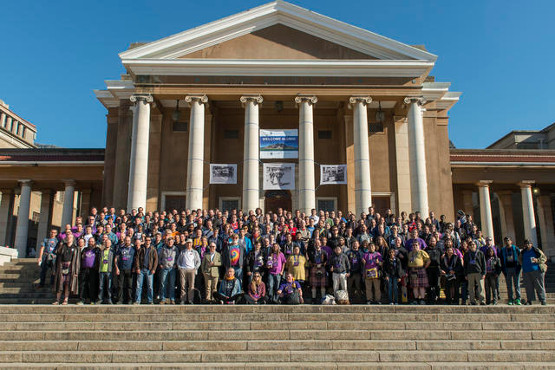
DebConf16 Group Photo

DebConf16 Group Photo by Jurie Senekal.

DebConf16 Firstly, thanks to everyone who came out and added their own uniqueness and expertise to the pool. The feedback received so far has been very positive and I feel that the few problems we did experience was dealt with very efficiently. Having a DebConf in your hometown is a great experience, consider a bid for hosting a DebConf in your city! DebConf16 Open Festival (5 August) The Open Festival (usually Debian Open Day) turned out pretty good. It was a collection of talks, a job fair, and some demos of what can be done with Debian. I particularly liked Hetzner s stand. I got to show off some 20 year old+ Super Mario skills and they had some fun brain teasers as well. It s really great to see a job stand that s so interactive and I think many companies can learn from them. The demo that probably drew the most attention was from my friend Georg who demoed some LulzBot Mini 3D Printers. They really seem to love Debian which is great! DebConf (6 August to 12 August) If I try to write up all my thoughts and feeling about DC16, I ll never get this post finished. Instead, here as some tweets from DebConf that other have written:


Day Trip We had 3 day trips: Brought to you by
orga

DebConf16 Orga Team.

See you in Montr al! DebConf17 dates: The DC17 sponsorship brochure contains a good deal of information, please share it with anyone who might be interested in sponsoring DebConf! Media

6 November 2016

Russ Allbery: Review: Digger

Review: Digger, by Ursula Vernon
Publisher: Sofawolf
Copyright: October 2013
ISBN: 1-936689-32-4
Format: Graphic novel
Pages: 837
As Digger opens, the eponymous wombat is digging a tunnel. She's not sure why, or where to, since she hit a bad patch of dirt. It happens sometimes, underground: pockets of cave gas and dead air that leave one confused and hallucinating. But this one was particularly bad, it's been days, she broke into a huge cave system, and she's thoroughly lost. Tripping on an ammonite while running from voices in the dark finally helps her come mostly to her senses and start tunneling up, only to break out at the feet of an enormous statue of Ganesh. A talking statue of Ganesh. Digger is a web comic that ran from 2005 to 2011. The archives are still on the web, so you can read the entire saga for free. Reviewed here is the complete omnibus edition, which collects the entire strip (previously published in six separate graphic novels containing two chapters each), a short story, a bonus story that was published in volume one, a bunch of random illustrated bits about the world background, author's notes from the web version, and all of the full-color covers of the series chapters (the rest of the work is in black and white). Publication of the omnibus was originally funded by a Kickstarter, but it's still available for regular sale. (I bought it normally via Amazon long after the Kickstarter finished.) It's a beautiful and durable printing, and I recommend it if you have the money to buy things you can read for free. This was a very long-running web comic, but Digger is a single story. It has digressions, of course, but it's a single coherent work with a beginning, middle, and end. That's one of the impressive things about it. Another is that it's a fantasy work involving gods, magic, oracles, and prophecies, but it's not about a chosen one, and it's not a coming of age story. Digger (Digger-of-Needlessly-Convoluted-Tunnels, actually, but Digger will do) is an utterly pragmatic wombat who considers magic to be in poor taste (as do all right-thinking wombats), gods to be irritating underground obstacles that require care and extra bracing, and prophecies to not be worth the time spent listening to them. It's a bit like the famous Middle Earth contrast between the concerns of the hobbits and the affairs of the broader world, if the hobbits were well aware of the broader world, able to deal with it, but just thought all the magic was tacky and irritating. Magic and gods do not, of course, go away just because one is irritated by them, and Digger eventually has to deal with quite a lot of magic and mythology while trying to figure out where home is and how to get back to it. However, she is drawn into the plot less by any grand danger to the world and more because she keeps managing to make friends with everyone, even people who hate each other. It's not really an explicit goal, but Digger is kind-hearted, sensible, tries hard to do the right thing, and doesn't believe in walking away from problems. In this world, that's a recipe for eventual alliances from everything from warrior hyenas to former pirate shrews, not to mention a warrior cult, a pair of trolls, and a very confused shadow... something. All for a wombat who would rather be digging out a good root cellar. (She does, at least, get a chance to dig out a good root cellar.) The characters are the best part, but I love everything about this story. Vernon's black and white artwork isn't as detailed as, say, Dave Sim at his best, and some of the panels (particularly mostly dark ones) seemed a bit scribbly. But it's mostly large-panel artwork with plenty of room for small touches and Easter eggs (watch for the snail, and the cave fish graffiti that I missed until it was pointed out by the author's notes), and it does the job of telling the story. Honestly, I like the black and white panels better than the color chapter covers reproduced in the back. And the plot is solid and meaty, with a satisfying ending and some fantastic detours (particularly the ghosts). I think my favorite bits, though, are the dialogue.
"Do you have any idea how long twelve thousand years is?"
"I know it's not long enough to make a good rock."
Digger is snarky in all the right ways, and sees the world in terms of tunnels, digging, and geology. Vernon is endlessly creative in how she uses that to create comebacks, sayings, analysis, and an entire culture. This is one of the best long-form comics I've read: a solid fantasy story with great characters, reliably good artwork, a coherent plot arc, wonderful dialogue, a hard-working and pragmatic protagonist (who happens to be female), and a wonderfully practical sense of morality and ethics. I'm sorry it's over. If you've not already read it, I highly recommend it. Remember tunnel 17! Rating: 9 out of 10

3 November 2016

Simon Josefsson: Why I don t Use 2048 or 4096 RSA Key Sizes

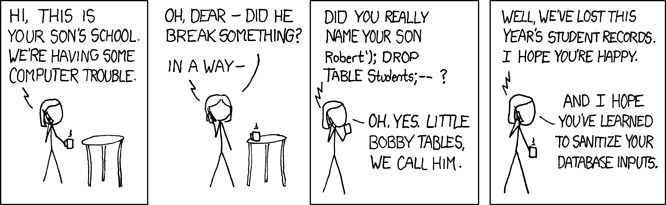
I have used non-standard RSA key size for maybe 15 years. For example, my old OpenPGP key created in 2002. With non-standard key sizes, I mean a RSA key size that is not 2048 or 4096. I do this when I generate OpenPGP/SSH keys (using GnuPG with a smartcard like this) and PKIX certificates (using GnuTLS or OpenSSL, e.g. for XMPP or for HTTPS). People sometimes ask me why. I haven t seen anyone talk about this, or provide a writeup, that is consistent with my views. So I wanted to write about my motivation, so that it is easy for me to refer to, and hopefully to inspire others to think similarily. Or to provoke discussion and disagreement that s fine, and hopefully I will learn something. Before proceeding, here is some context: When building new things, it is usually better to use the Elliptic Curve technology algorithm Ed25519 instead of RSA. There is also ECDSA which has had a comparatively slow uptake, for a number of reasons that is widely available and is a reasonable choice when Ed25519 is not available. There are also post-quantum algorithms, but they are newer and adopting them today requires a careful cost-benefit analysis. First some background. RSA is an asymmetric public-key scheme, and relies on generating private keys which are the product of distinct prime numbers (typically two). The size of the resulting product, called the modulus n, is usually expressed in bit length and forms the key size. Historically RSA key sizes used to be a couple of hundred bits, then 512 bits settled as a commonly used size. With better understanding of RSA security levels, the common key size evolved into 768, 1024, and later 2048. Today s recommendations (see keylength.com) suggest that 2048 is on the weak side for long-term keys (5+ years), so there has been a trend to jump to 4096. The performance of RSA private-key operations starts to suffer at 4096, and the bandwidth requirements is causing issues in some protocols. Today 2048 and 4096 are the most common choices. My preference for non-2048/4096 RSA key sizes is based on the simple and na ve observation that if I would build a RSA key cracker, there is some likelihood that I would need to optimize the implementation for a particular key size in order to get good performance. Since 2048 and 4096 are dominant today, and 1024 were dominent some years ago, it may be feasible to build optimized versions for these three key sizes. My observation is a conservative decision based on speculation, and speculation on several levels. First I assume that there is an attack on RSA that we don t know about. Then I assume that this attack is not as efficient for some key sizes than others, either on a theoretical level, at implementation level (optimized libraries for certain characteristics), or at an economic/human level (decision to focus on common key sizes). Then I assume that by avoiding the efficient key sizes I can increase the difficulty to a sufficient level. Before analyzing whether those assumptions even remotely may make sense, it is useful to understand what is lost by selecting uncommon key sizes. This is to understand the cost of the trade-off. A significant burden would be if implementations didn t allow selecting unusual key sizes. In my experience, enough common applications support uncommon key sizes, for example GnuPG, OpenSSL, OpenSSH, FireFox, and Chrome. Some applications limit the permitted choices; this appears to be rare, but I have encountered it once. Some environments also restrict permitted choices, for example I have experienced that LetsEncrypt has introduced a requirement for RSA key sizes to be a multiples of 8. I noticed this since I chose a RSA key size of 3925 for my blog and received a certificate from LetsEncrypt in December 2015 however during renewal in 2016 it lead to an error message about the RSA key size. Some commercial CAs that I have used before restrict the RSA key size to one of 1024, 2048 or 4096 only. Some smart-cards also restrict the key sizes, sadly the YubiKey has this limitation. So it is not always possible, but possible often enough for me to be worthwhile. Another cost is that RSA signature operations are slowed down. This is because the exponentiation function is faster than multiplication, and if the bit pattern of the RSA key is a 1 followed by several 0 s, it is quicker to compute. I have not done benchmarks, but I have not experienced that this is a practical problem for me. I don t notice RSA operations in the flurry of all of other operations (network, IO) that is usually involved in my daily life. Deploying this on a large scale may have effects, of course, so benchmarks would be interesting. Back to the speculation that leads me to this choice. The first assumption is that there is an attack on RSA that we don t know about. In my mind, until there are proofs that the currently known attacks (GNFS-based attacks) are the best that can be found, or at least some heuristic argument that we can t do better than the current attacks, the probability for an unknown RSA attack is therefor, as strange as it may sound, 100%. The second assumption is that the unknown attack(s) are not as efficient for some key sizes than others. That statement can also be expressed like this: the cost to mount the attack is higher for some key sizes compared to others. At the implementation level, it seems reasonable to assume that implementing a RSA cracker for arbitrary key sizes could be more difficult and costlier than focusing on particular key sizes. Focusing on some key sizes allows optimization and less complex code. At the mathematical level, the assumption that the attack would be costlier for certain types of RSA key sizes appears dubious. It depends on the kind of algorithm the unknown attack is. For something similar to GNFS attacks, I believe the same algorithm applies equally for a RSA key size of 2048, 2730 and 4096 and that the running time depends mostly on the key size. Other algorithms that could crack RSA, such as some approximation algorithms, does not seem likely to be thwarted by using non-standard RSA key sizes either. I am not a mathematician though. At the economical or human level, it seems reasonable to say that if you can crack 95% of all keys out there (sizes 1024, 2048, 4096) then that is good enough and cracking the last 5% is just diminishing returns of the investment. Here I am making up the 95% number. Currently, I would guess that more than 95% of all RSA key sizes on the Internet are 1024, 2048 or 4096 though. So this aspect holds as long as people behave as they have done. The final assumption is that by using non-standard key sizes I raise the bar sufficiently high to make an attack impossible. To be honest, this scenario appears unlikely. However it might increase the cost somewhat, by a factor or two or five. Which might make someone target a lower hanging fruit instead. Putting my argument together, I have 1) identified some downsides of using non-standard RSA Key sizes and discussed their costs and implications, and 2) mentioned some speculative upsides of using non-standard key sizes. I am not aware of any argument that the odds of my speculation is 0% likely to be true. It appears there is some remote chance, higher than 0%, that my speculation is true. Therefor, my personal conservative approach is to hedge against this unlikely, but still possible, attack scenario by paying the moderate cost to use non-standard RSA key sizes. Of course, the QA engineer in me also likes to break things by not doing what everyone else does, so I end this with an ObXKCD.

Guido G nther: Debian Fun in October 2016

Debian LTS October marked the eighteenth month I contributed to Debian LTS under the Freexian umbrella. I spent 10 hours (out of allocated 9) Other Debian stuff Some other Free Software activities

Jan Wagner: Container Orchestration Thoughts

Container Orchestration ThoughtsSince some time everybody (read developer) want to run his new microservice stacks in containers. I can understand that building and testing an application is important for developers.
One of the benefits of containers is, that developer (in theory) can put their new version of applications into production on their own. This is the point where operations is affected and operations needs to evaluate, if that might evolve into better workflow. For yolo^WdevOps people there are some challenges that needs to be solved, or at least mitigated, when things needs to be done in large(r) scale.

Orchestration Engine Running Docker, which is actual the most preferred container solution, on a single host with docker command line client is something you can do, but there you leave the gap between dev and ops.

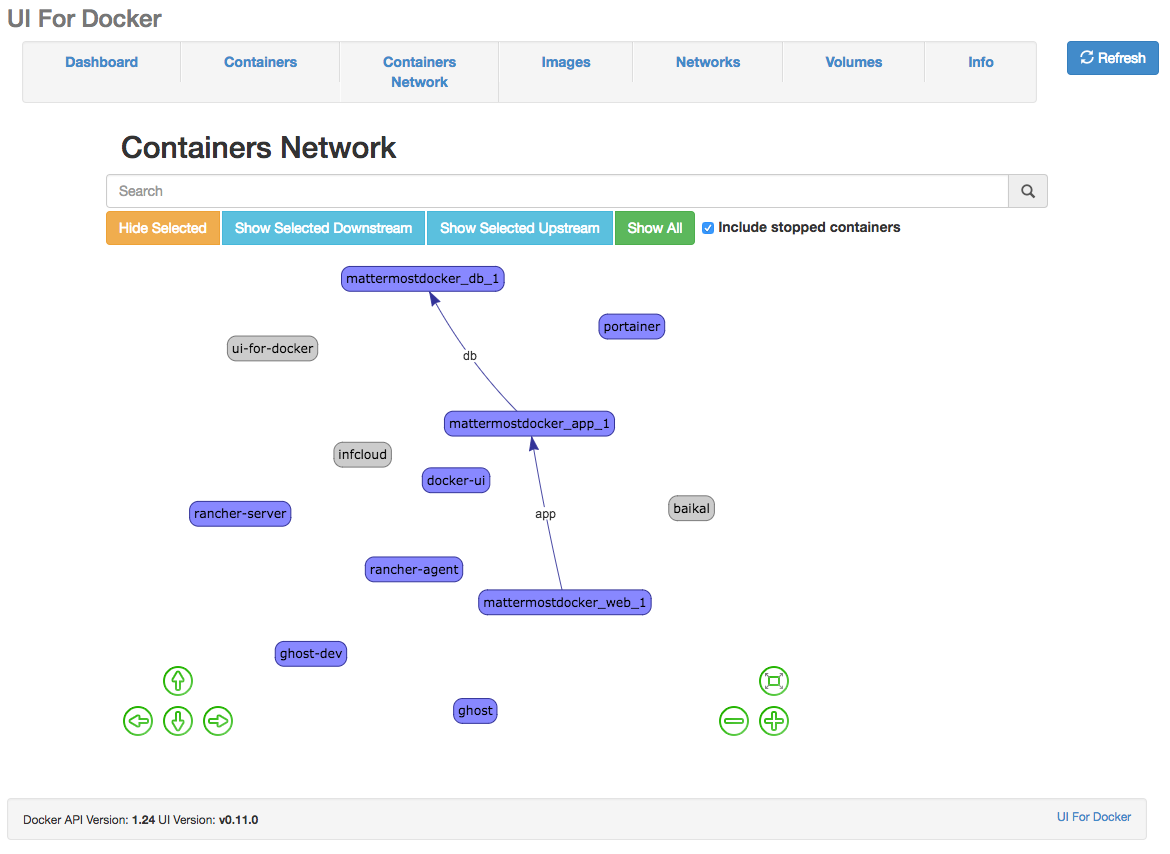
UI For Docker Since some time there is UI For Docker available for visualizing and managing containers on a single docker node. It's pretty awesome and the best feature so far is the Container Network view, which also shows the linked container. Container Orchestration Thoughts

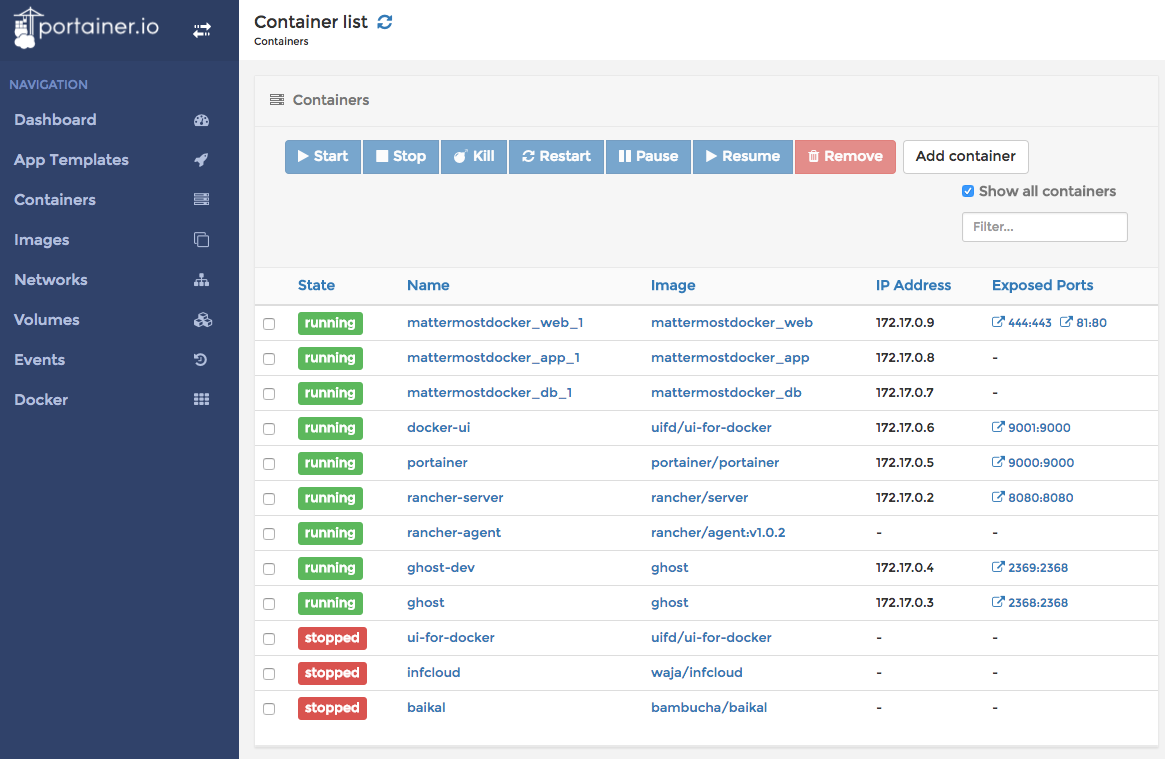
Portainer Portainer is pretty new and it can be deployed as easy as UI For Docker. But the (first) great advantage: it can handle Docker Swarm. Beside that it has many other great features. Container Orchestration Thoughts

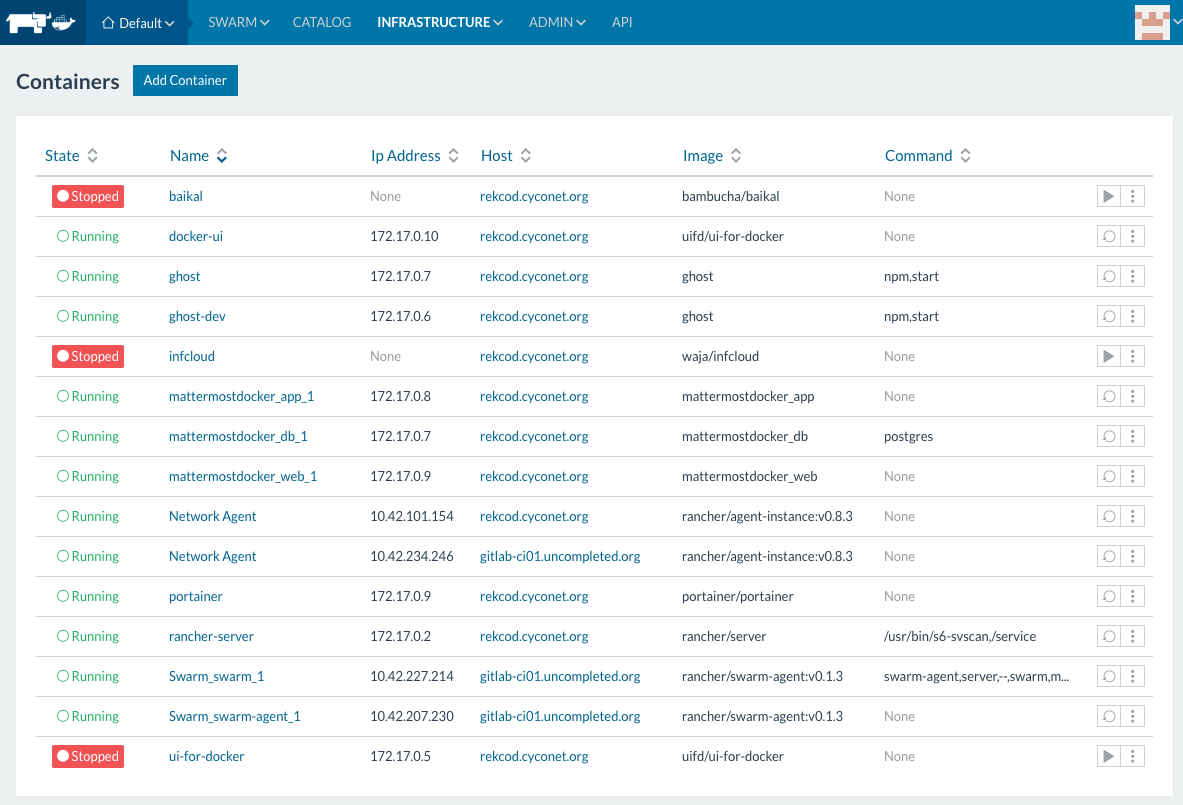
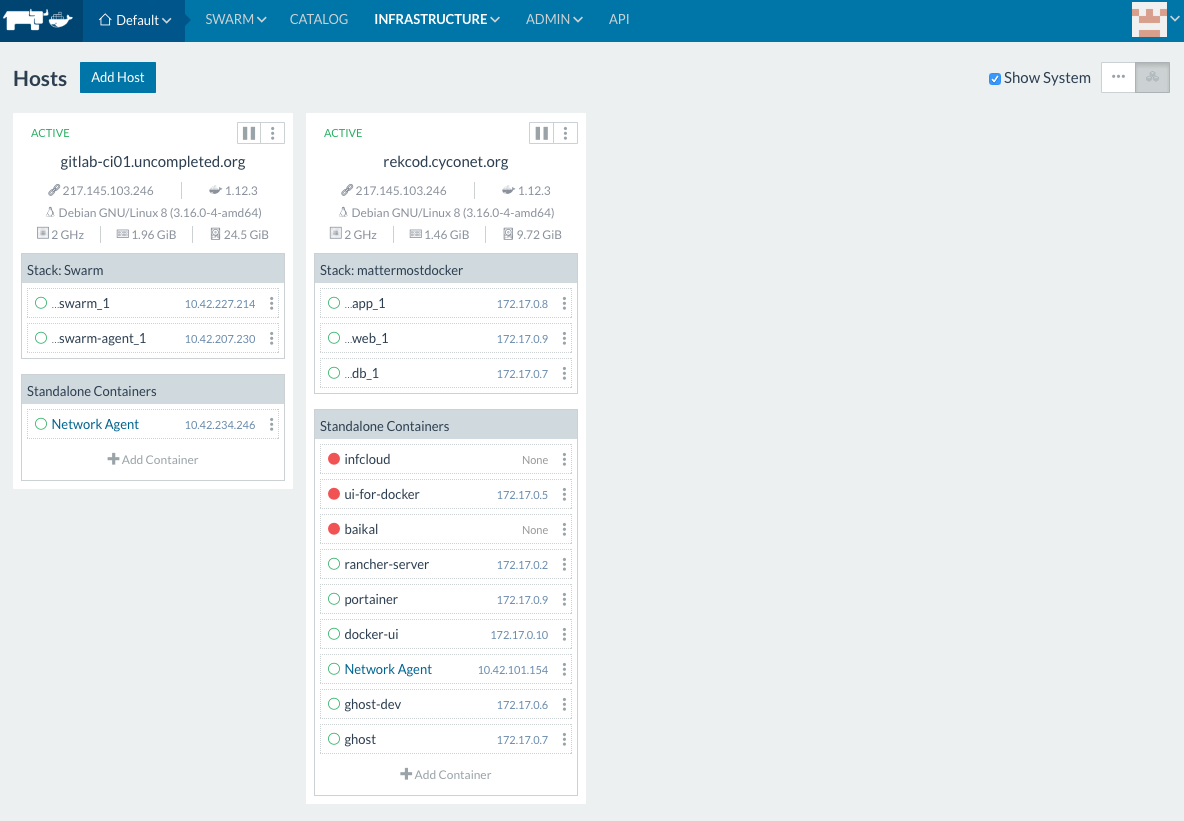
Rancher Rancher describes themselves as 'container management platform' that 'supports and manages all of your Kubernetes, Mesos, and Swarm clusters'. This is great because this are all of the relevant docker cluster orchestrations at the market actually. Container Orchestration Thoughts For the use cases, we are facing, Kubernetes and Mesos seems both like bloated beasts. Usman Ismail has written a really good comparison of Orchestration Engine options which goes into details. Container Orchestration Thoughts

Docker Swarm As there is actually no clear defacto standard/winner of the (container) orchestration wars, I would prevent to be in a vendor lock-in situation (yet). Docker swarm seems to be evolving and is getting more nice features other competitors doesn't provide.
Due the native integration into the docker framework and great community I believe Docker Swarm will be the Docker Orchestration of the choice on the long run. This should be supported by Rancher 1.2 which is not released yet.
From this point of view it looks very reasonable that Docker Swarm in combination with Rancher (1.2) might be a good strategy to maintain your container farms in the future. If you think to put Docker Swarm into production in the actual state, I recommend to read Docker swarm mode: What to know before going live on production by Panjamapong Sermsawatsri.

Persistent Storage While it is a best practice to use data volume container these days, providing persistent storage across multiple hosts for shared volumes seems to be tricky. In theory you can mount a shared-storage volume as a data volume and there are several volume plugins which supports shared storage. For example you can use the convoy plugin which gives you:
  • thin provisioned volumes
  • snapshots of volumes
  • backup of snapshots
  • restore volumes
As backend you can use:
  • Device Mapper
  • Virtual File System(VFS)/Network File System(NFS)
  • Amazon Elastic Block Store(EBS)
The good thing is, that convoy is integrated into Rancher. For more information I suggest to read Setting Up Shared Volumes with Convoy-NFS, which also mentions some limitations. If you want test Persistent Storage Service, Rancher provides some documentation. Actually I did not evaluate shared-storage volumes yet, but I don't see a solution I would love to use in production (at least on-premise) without strong downsides. But maybe things will go further and there might be a great solution for this caveats in the future.

Keeping base images up-to-date Since some time there are many projects that tries to detect security problems in your container images in several ways.
Beside general security considerations you need to deal somehow with issues in your base images that you build your applications on. Of course, even if you know you have a security issue in your application image, you need to fix it, which depends on the way how you based your application upon.

Ways to base your application image
  • You can build your application image entire from scratch, which leaves all the work to your development team and I wouldn't recommend it that way.
  • You also can create one (or more) intermediate image(s) that will be used by your development team.
  • The development team might ground their work on images in public available or private (for example the one bundled to your gitlab CI/CD solution) registries.

Whats the struggle with the base image? If you are using images being not (well) maintained by other people, you have to wait for them to fix your base image. Using external images might also lead into trust problems (can you trust those people in general?).
In an ideal world, your developers have always fresh base images with fixed security issues. This can probably be done by rebuilding every intermediate image periodically or when the base image changes.

Paradigm change Anyway, if you have a new application image available (with no known security issues), you need to deploy it to production. This is summarized by Jason McKay in his article Docker Security: How to Monitor and Patch Containers in the Cloud:
To implement a patch, update the base image and then rebuild the application image. This will require systems and development teams to work closely together.
So patching security issues in the container world changes workflow significant. In the old world operation teams mostly rolled security fixes for the base systems independent from development teams.
Now hitting containers the production area this might change things significant.

Bringing updated images to production Imagine your development team doesn't work steady on a project, cause the product owner consider it feature complete. The base image is provided (in some way) consistently without security issues. The application image is build on top of that automatically on every update of the base image.
How do you push in such a scenario the security fixes to production? From my point of view you have two choices:
  • Let the development team require to test the resulting application image and put it into production
  • Push the new application image without review by the development team into production
The first scenario might lead into a significant delay until the fixes hit production created by the probably infrequent work of the development team. The latter one brings your security fixes early to production by the notable higher risk to break your application. This risk can be reduced by implementing massive tests into CI/CD pipelines by the development team. Rolling updates provided by Docker Swarm might also reduce the risk of ending with a broken application. When you are implementing an update process of your (application) images to production, you should consider Watchtower that provides Automatic Updates for Docker Containers.

Conclusion Not being a product owner or the operations part of an application that is facing a widely adopted usage that would compensate the actual tradeoffs we are still facing I tend not to move large scale production projects into a container environment.
This means not that this might be a bad idea for others, but I'd like to sort out some of the caveats before. I'm still interested to put smaller projects into production, being not scared to reimplement or move them on a new stack.
For smaller projects with a small number of hosts Portainer looks not bad as well as Rancher with the Cattle orchestration engine if you just want to manage a couple of nodes. Things are going to be interesting if Rancher 1.2 supports Docker swarm cluster out of the box. Let's see what the future will bring us to the container world and how to make a great stack out of it.

Update I suggest to read Docker in Production: A History of Failure and the answer Docker in Production: A retort to understand the actual challenges when running Docker in larger scale production environments.

1 November 2016

Jonathan Wiltshire: Reflecting on a year of regular, public IRC meetings

The release team first started holding a regular, public planning and status meeting a little over a year ago, in September 2015. At that time, FTP masters had experimented along similar lines and I took some inspiration from that, including the keeping of proper minutes that anyone can look at. I wanted to open up our discussion processes and allow other developers and users to see (and perhaps influence) our plans for the release taking shape month by month, and how we reached certain decisions with a lot of mature discussion and not just on a whim. A secondary aim, since we are quite geographically distributed and getting together for same-room meetings is hard, was to bring more accountability to ourselves when we decided something ought to happen; if it s in the minutes, there s no escaping someone asking so what happened to ? . That s worked better for us on some topics than on others. Finally, public minutes mean that anyone who might be interested in joining the team can see easily what we re up to and how we shape the release throughout the cycle. That might help lower the barrier to entry, which can only be good for the team. I had hoped that regular meetings would inspire other teams to do similar; I haven t seen any indication of that to date (though perhaps it s just down to awareness). The Reproducible Builds contributors held fortnightly meetings for a period in 2015, though not inspired by ours, and I heard recent talk of starting those again. I still think that there is plenty of scope to improve the transparency of core teams in general in Debian, but also that regular meetings aren t going to work for every team. A regular slot which is not varied except when absolutely necessary, is essential for avoiding the temptation to just push it back another week when things are busy. In our office we have an allegedly-regular Thursday afternoon slot for technical demonstrations, which has suffered from exactly that problem for a long time now, and I wanted to avoid that issue. We have a calendar to remind us when each meeting is due, along with other important events like freeze milestones. Our slot is the fourth Wednesday of the month, a fairly arbitrary choice which seems to have worked out quite well. Time zones are more of an issue, even within Europe. We have mostly used a European evening time, but that s not very helpful further West where it s in the middle of the working day, or the middle of the night if you re further East (that one fortunately isn t an issue for us so far). Even within Europe it s difficult, as we have to try and balance commuting time in the UK with dinner on the continent, or dinner with late evening, or adjust for saving changes, or you get the idea. If we gained a far-eastern team member one day, this would be a real issue. We use Meetbot for recording the minutes. I have heard criticism that it publicly archives IRC logs to the web essentially forever, but for us that s the whole point. With a little practice and discipline it does generate really nice minutes, with a bullet summary of the important parts, a summary of actions agreed and a log of the conversation for detailed reference. Anybody reading them can see how we reached a conclusion, and I m of the view that goes some way to avoiding a reputation for cabal-ism. It does pay to use the #info, #agree and #action tags liberally, but other things are slightly unnatural like always remembering to use a URL at the beginning of a line and not in the middle of a sentence, or Meetbot doesn t notice it. Practice goes a long way. I ve naturally fallen into chairing most meetings, for better or worse the consistency seems beneficial, but I worry that I m dominating the discussion sometimes. Discipline in making sure everybody has been included is something I ve had to get better at. It s essential to have a public agenda and to stick to it, and it should include some stock items at the start and end (including making sure the URL to the previous minutes has been given, reviewing outstanding actions, and arranging the next meeting before ending the current one). There is some skill in judging the agenda length and deciding which items can be deferred to make sure it doesn t drag on too late we ve found anything more than an hour is far too long, and between 45 and 60 minutes is pushing it. Getting some easy topics out of the way before starting one which is more contentious can be helpful to avoid having to defer them later. I circulate the URL to the minutes and the date of the next meeting publicly on the mailing list immediately after each meeting, or as soon as possible. With little feedback, I have no idea if our meetings are helpful to those outside the team or not. We do still hold in-person meetings from time to time when we re all together, because they re useful for some circumstances (like some genuinely private topics we occasionally need to discuss, or for sprinting). I would hope that public meetings inspire confidence that we re on top of the release process, that they show we have a mature and transparent decision making process (for example, in deciding to move the freeze date to accommodate an external release schedule as a one-off, and subsequently deciding to not move it back when circumstances changed), and mostly that other teams might benefit for the same reasons. But I can also see that they make more sense in a team with a defined project cycle than they might in one which is more administrative or where work is more sporadic (no point holding a meeting for the sake of it, after all).

Thorsten Alteholz: My Debian Activities in October 2016

FTP assistant This month I caught up from last month and marked 317 packages for accept and rejected 23 packages. I also sent 5 emails to maintainers asking questions. Debian LTS This was my twenty-eighth month that I did some work for the Debian LTS initiative, started by Raphael Hertzog at Freexian. This month my all in all workload has been 13h. During that time I did uploads of The second upload of bind was an embargoed one. Other stuff I uploaded a new version of greylistd and fixed RC bug #837501. A new version of highlight.js fixed RC bug #830189. With a new upstream version of chktex I could close bugs #782342, #782343 and #819885. I also uploaded the new package node-random-bytes and new upstream versions of alljoyn-core-1604 and duktape Finally, after about 4 years, I managed to upload entropybroker and instantly had to deal with #840018, #840019 and #840020. One cannot overemphasize the importance of our QA stuff! I also uploaded a new version of libctl to solve the -fPIC issue but was asked short time after to revert that again :-(. As already mentioned some days ago I adopted libmatthew-java. At that time about 956 package were orphaned and I asked everybody to adopt one of these packages. Unfortunately now there are 982 package orphaned. I guess I have to clear up a misunderstanding. You should adopt those packages and not oprhan more of them!

30 October 2016

Iain R. Learmonth: Powers to Investigate

The Communication Data Bill was draft legislation introduced first in May 2012. It sought to compel ISPs to store details of communications usage so that it can later be used for law enforcement purposes. In 2013 the passage of this bill into law had been blocked and the bill was dead. In 2014 we saw the Data Retention and Investigatory Powers Act 2014 appear. This seemed to be in response to the Data Retention Directive being successfully challenged at the European Court of Justice by Digital Rights Ireland on human rights grounds, with a judgment given in 2014. It essentially reimplemented the Data Retention Directive along with a whole load of other nasty things. The Data Retention and Investigatory Powers Act contained a sunset clause with a date set for 2016. This brings us to the Investigatory Powers Bill which it looks will be passing into law shortly. Among a range of nasty powers, this legislation will be able to force ISPs to record metadata about every website you visit, every connection you make to a server on the Internet. This is sub-optimal for the privacy minded, with my primary concern being that this is a treasure trove of data and it s going to be abused by someone. It s going to be too much for someone to resist. The existence of this power in the bill seemed to confuse the House of Lords:
It is not for me to explain why the Government want in the Bill a power that currently does not exist, because internet connection records do not exist, and which the security services say they do not want but which the noble and learned Lord says might be needed in the future. It is not for me to justify this power; I am saying to the House why I do not believe it is justified. The noble and learned Lord and the noble Lord, Lord Rosser, made the point that this is an existing power, but how can you have an existing power to acquire something that will not exist until the Bill is enacted? Lord Paddick (link)
Of course, the internet connection records are meaningless when your traffic is routed via a proxy or VPN, and there is a Kickstarter in progress that I would love to succeed: OnionDSL. The premise of OnionDSL is that instead of having an IPv4/IPv6 connection to the Internet, you join a private network that does not provide any routing to the global Internet and instead provides only a Tor bridge. I cannot think of anything that I do from home that I cannot do via Tor and have been considering switching to Qubes OS as the operating system on my day-to-day laptop to allow me to direct basically everything through Tor. The idea of provisioning a non-IP service via DSL is not new to me, I ve come across it before with cjdns which provides an encrypted IPv6 network using public key cryptography for network address allocation and a distributed hash table for routing. Peering between cjdns nodes can be performed over Ethernet and cjdns over Ethernet could be provisioned in place of the traditional PPP over Ethernet (PPPoE) to provide access directly to cjdns without providing any routing to the global Internet. If OnionDSL is funded, I think it s very likely I would be considering becoming a customer. (Assuming the government doesn t attempt to also outlaw Tor).

28 October 2016

Russ Allbery: Term::ANSIColor 4.06

A small maintenance release to my Perl module for generating and manipulating ANSI color escape sequences. In 4.00, I added 256-color support, using ansi0 through ansi15 for the colors that match the normal 16 colors and then rgbNNN and greyN names for the RGB and greyscale colors. One module user requested the ability to address all of the colors via ansi0 through ansi255 so that there's a consistent naming scheme for all the colors. This release adds that. (The more specific names are still returned by uncolor() when reversing escape sequences.) This module tends to get included all over the place, so I did spend a bit of time when preparing this release trying to determine if adding a bunch more entries to various internal hash tables and arrays would noticably increase memory usage, since Perl is notoriously bad about memory consumption. It does cause a small increase, but it's on the order of about 100KB, and a minimum Perl program to load the module requires about 5.5MB of memory (aie), so it wasn't enough for me to do anything about. It does look like if I lazily added entries to the built-in hash tables and instead added some more code to calculate escape sequences on the fly, I could save about 300KB of memory usage in the module. Not sure if it's worth it given how small the memory usage is compared to Perl itself, but maybe I'll look at that later when I'm feeling like fiddling with the module again. (Oh, and all the documentation was regenerated by DocKnot, since I'm still having fun with that. It needed a few new features, which will be in an upcoming 1.01 release.) You can get the latest version from the Term::ANSIColor distribution page.

27 October 2016

Russ Allbery: DocKnot 1.00

I'm a bit of a perfectionist about package documentation, and I'm also a huge fan of consistency. As I've slowly accumulated more open source software packages (alas, fewer new ones these days since I have less day-job time to work on them), I've developed a standard format for package documentation files, particularly the README in the package and the web pages I publish. I've iterated on these, tweaking them and messing with them, trying to incorporate all my accumulated wisdom about what information people need. Unfortunately, this gets very tedious, since I have dozens of packages at this point and rarely want to go through the effort of changing every one of them every time I come up with a better way of phrasing something or change some aspect of my standard package build configuration. I also have the same information duplicated in multiple locations (the README and the web page for the package). And there's a lot of boilerplate that's common for all of my packages that I don't want to keep copying (or changing when I do things like change all eyrie.org URLs to HTTPS). About three years ago, I started seriously brainstorming ways of automating this process. I made a start on it during one self-directed day at my old job at Stanford, but only got it far enough to generate a few basic files. Since then, I keep thinking about it, keep wishing I had it, and keep not putting the work into finishing it. During this vacation, after a week and a half of relaxing and reading, I finally felt like doing a larger development project and finally started working on this for long enough to build up some momentum. Two days later, and this is finally ready for an initial release. DocKnot uses metadata (which I'm putting in docs/metadata) that's mostly JSON plus some documentation fragments and generates README, the web page for the package (in thread, the macro language I use for all my web pages), and (the other thing I've wanted to do and didn't want to tackle without this tool) README.md, a Markdown version of README that will look nice on GitHub. The templates that come with the package are all rather specific to me, particularly the thread template which would be unusable by anyone else. I have no idea if anyone else will want to use this package (and right now the metadata format is entirely undocumented). But since it's a shame to not release things as free software, and since I suspect I may need to upload it to Debian since, technically, this tool is required to "build" the README file distributed with my packages, here it is. I've also uploaded it to CPAN (it's my first experiment with the App::* namespace for things that aren't really meant to be used as a standalone Perl module). You can get the latest version from the DocKnot distribution page (which is indeed generated with DocKnot). Also now generated with DocKnot are the rra-c-util and C TAP Harness distribution pages. Let me know if you see anything weird; there are doubtless still a few bugs.

25 October 2016

Julian Andres Klode: Introducing DNS66, a host blocker for Android

ic_launcher I m proud (yes, really) to announce DNS66, my host/ad blocker for Android 5.0 and newer. It s been around since last Thursday on F-Droid, but it never really got a formal announcement. DNS66 creates a local VPN service on your Android device, and diverts all DNS traffic to it, possibly adding new DNS servers you can configure in its UI. It can use hosts files for blocking whole sets of hosts or you can just give it a domain name to block (or multiple hosts files/hosts). You can also whitelist individual hosts or entire files by adding them to the end of the list. When a host name is looked up, the query goes to the VPN which looks at the packet and responds with NXDOMAIN (non-existing domain) for hosts that are blocked. You can find DNS66 here: F-Droid is the recommended source to install from. DNS66 is licensed under the GNU GPL 3, or (mostly) any later version. Implementation Notes DNS66 s core logic is based on another project, dbrodie/AdBuster, which arguably has the cooler name. I translated that from Kotlin to Java, and cleaned up the implementation a bit: All work is done in a single thread by using poll() to detect when to read/write stuff. Each DNS request is sent via a new UDP socket, and poll() polls over all UDP sockets, a Device Socket (for the VPN s tun device) and a pipe (so we can interrupt the poll at any time by closing the pipe). We literally redirect your DNS servers. Meaning if your DNS server is 1.2.3.4, all traffic to 1.2.3.4 is routed to the VPN. The VPN only understands DNS traffic, though, so you might have trouble if your DNS server also happens to serve something else. I plan to change that at some point to emulate multiple DNS servers with fake IPs, but this was a first step to get it working with fallback: Android can now transparently fallback to other DNS servers without having to be aware that they are routed via the VPN. We also need to deal with timing out queries that we received no answer for: DNS66 stores the query into a LinkedHashMap and overrides the removeEldestEntry() method to remove the eldest entry if it is older than 10 seconds or there are more than 1024 pending queries. This means that it only times out up to one request per new request, but it eventually cleans up fine.
Filed under: Android, Uncategorized

Russ Allbery: Review: Lord of Emperors

Review: Lord of Emperors, by Guy Gavriel Kay
Series: Sarantine Mosaic #2
Publisher: Eos
Copyright: 2000
Printing: February 2001
ISBN: 0-06-102002-8
Format: Mass market
Pages: 560
Lord of Emperors is the second half of a work that began with Sailing to Sarantium and is best thought of as a single book split for publishing reasons. You want to read the two together and in order. As is typical for this sort of two-part work, it's difficult to review the second half without spoilers. I'll be more vague about the plot and the characters than normal, and will mark one bit that's arguably a bit of a spoiler (although I don't think it would affect the enjoyment of the book). At the end of Sailing to Sarantium, we left Crispin in the great city, oddly and surprisingly entangled with some frighteningly powerful people and some more mundane ones (insofar as anyone is mundane in a Guy Gavriel Kay novel, but more on that in a bit). The opening of Lord of Emperors takes a break from the city to introduce a new people, the Bassanids, and a new character, Rustem of Karakek. While Crispin is still the heart of this story, the thread that binds the entirety of the Sarantine Mosaic together, Rustem is the primary protagonist for much of this book. I had somehow forgotten him completely since my first read of this series many years ago. I have no idea how. I mentioned in my review of the previous book that one of the joys of reading this series is competence porn: watching the work of someone who is extremely good at what they do, and experiencing vicariously some of the passion and satisfaction they have for their work. Kay's handling of Crispin's mosaics is still the highlight of the series for me, but Rustem's medical practice (and Strumosus, and the chariot races) comes close. Rustem is a brilliant doctor by the standards of the time, utterly frustrated with the incompetence of the Sarantine doctors, but also weaving his own culture's belief in omens and portents into his actions. He's more reserved, more laconic than Crispin, but is another character with focused expertise and a deep internal sense of honor, swept unexpectedly into broader affairs and attempting to navigate them by doing the right thing in each moment. Kay fills this book with people like that, and it's compelling reading. Rustem's entrance into the city accidentally sets off a complex chain of events that draws together all of the major characters of Sailing to Sarantium and adds a few more. The stakes are no less than war and control of major empires, and here Kay departs firmly from recorded history into his own creation. I had mentioned in the previous review that Justinian and Theodora are the clear inspirations for this story; that remains true, and many other characters are easy to map, but don't expect history to go here the way that it did in our world. Kay's version diverges significantly, and dramatically. But one of the things I love the most about this book is its focus on the individual acts of courage, empathy, and ethics of each of the characters, even when those acts do not change the course of empires. The palace intrigue happens, and is important, but the individual acts of Kay's large cast get just as much epic narrative attention even if they would never appear in a history book. The most globally significant moment of the book is not the most stirring; that happens slightly earlier, in a chariot race destined to be forgotten by history. And the most touching moment of the book is a moment of connection between two people who would never appear in history, over the life of a third, that matters so much to the reader only because of the careful attention to individual lives and personalities Kay has shown over the course of a hundreds of pages. A minor spoiler follows in the next paragraph, although I don't think it affects the reading of the book. One brilliant part of Kay's fiction is that he doesn't have many villains, and goes to some lengths to humanize the actions of nearly everyone in the book. But sometimes the author's deep dislike of one particular character shows through, and here it's Pertennius (the clear analogue of Procopius). In a way, one could say the entirety of the Sarantine Mosaic is a rebuttal of the Secret History. But I think Kay's contrast between Crispin's art (and Scortius's, and Strumosus's) and Pertennius's history has a deeper thematic goal. I came away from this book feeling like the Sarantine Mosaic as a whole stands in contrast to a traditional history, stands against a reduction of people to dates and wars and buildings and governments. Crispin's greatest work attempts to capture emotion, awe, and an inner life. The endlessly complex human relationships shown in this book running beneath the political events occasionally surface in dramatic upheavals, but in Kay's telling the ones that stay below the surface are just as important. And while much of the other art shown in this book differs from Crispin's in being inherently ephemeral, it shares that quality of being the art of life, of complexity, of people in dynamic, changing, situational understanding of the world, exercising competence in some area that may or may not be remembered. Kay raises to the level of epic the bits of history that don't get recorded, and, in his grand and self-conscious fantasy epic style, encourages the reader to feel those just as deeply as the ones that will have later historical significance. The measure of people, their true inner selves, is often shown in moments that Pertennius would dismiss and consider unworthy of recording in his history. End minor spoiler. I think Lord of Emperors is the best part of the Sarantine Mosaic duology. It keeps the same deeply enjoyable view of people doing things they are extremely good at while correcting some of the structural issues in the previous book. Kay continues to use a large cast, and continues to cut between viewpoint characters to show each event from multiple angles, but he has a better grasp of timing and order here than in Sailing to Sarantium. I never got confused about the timeline, thanks in part to more frequent and more linear scene cuts. And Lord of Emperors passes, with flying colors, the hardest test of a novel with a huge number of viewpoint characters: when Kay cuts to a new viewpoint, my reaction is almost always "yes, I wanted to see what they were thinking!" and almost never "wait, no, go back!". My other main complaint about Sailing to Sarantium was the treatment of women, specifically the irresistibility of female sexual allure. Kay thankfully tones that down a lot here. His treatment of women is still a bit odd one notices that five women seem to all touch the lives of the same men, and little room is left for Platonic friendship between the genders but they're somewhat less persistently sexualized. And the women get a great deal of agency in this book, and a great deal of narrative respect. That said, Lord of Emperors is also emotionally brutal. It's beautifully done, and entirely appropriate to the story, and Kay does provide a denouement that takes away a bit of the sting. But it's still very hard to read in spots if you become as invested in the characters and in the world as I do. Kay is writing epic that borders on tragedy, and uses his full capabilities as a writer to make the reader feel it. I love it, but it's not a book that I want to read too often. As with nearly all Kay, the Sarantine Mosaic as a whole is intentional, deliberate epic writing, wearing its technique on its sleeve and making no apologies. There is constant foreshadowing, constant attempts to draw larger conclusions or reveal great principles of human nature, and a very open, repeated stress on the greatness and importance of events while they're being described. This works for me, but it doesn't work for everyone. If it doesn't work for you, the Sarantine Mosaic is unlikely to change your mind. But if you're in the mood for that type of story, I think this is one of Kay's best, and Lord of Emperors is the best half of the book. Rating: 10 out of 10

24 October 2016

Daniel Silverstone: Gitano - Approaching Release - Deprecated commands

As mentioned previously I am working toward getting Gitano into Stretch. Last time we spoke about lace, on which a colleague and friend of mine (Richard Maw) did a large pile of work. This time I'm going to discuss deprecation approaches and building more capability out of fewer features. First, a little background -- Gitano is written in Lua which is a deliberately small language whose authors spend more time thinking about what they can remove from the language spec than they do what they could add in. I first came to Lua in the 3.2 days, a little before 4.0 came out. (The authors provide a lovely timeline in case you're interested.) With each of the releases of Lua which came after 3.2, I was struck with how the authors looked to take a number of features which the language had, and collapse them into more generic, more powerful, smaller, fewer features. This approach to design stuck with me over the subsequent decade, and when I began Gitano I tried to have the smallest number of core features/behaviours, from which could grow the power and complexity I desired. Gitano is, at its core, a set of files in a single format (clod) stored in a consistent manner (Git) which mediate access to a resource (Git repositories). Some of those files result in emergent properties such as the concept of the 'owner' of a repository (though that can simply be considered the value of the project.owner property for the repository). Indeed the concept of the owner of a repository is a fiction generated by the ACL system with a very small amount of collusion from the core of Gitano. Yet until recently Gitano had a first class command set-owner which would alter that one configuration value.
[gitano]  set-description ---- Set the repo's short description (Takes a repo)
[gitano]         set-head ---- Set the repo's HEAD symbolic reference (Takes a repo)
[gitano]        set-owner ---- Sets the owner of a repository (Takes a repo)
Those of you with Gitano installations may see the above if you ask it for help. Yet you'll also likely see:
[gitano]           config ---- View and change configuration for a repository (Takes a repo)
The config command gives you access to the repository configuration file (which, yes, you could access over git instead, but the config command can be delegated in a more fine-grained fashion without having to write hooks). Given the config command has all the functionality of the three specific set-* commands shown above, it was time to remove the specific commands.

Migrating If you had automation which used the set-description, set-head, or set-owner commands then you will want to switch to the config command before you migrate your server to the current or any future version of Gitano. In brief, where you had:
ssh git@gitserver set-FOO repo something
You now need:
ssh git@gitserver config repo set project.FOO something
It looks a little more wordy but it is consistent with the other features that are keyed from the project configuration, such as:
ssh git@gitserver config repo set cgitrc.section Fooble Section Name
And, of course, you can see what configuration is present with:
ssh git@gitserver config repo show
Or look at a specific value with:
ssh git@gitserver config repo show specific.key
As always, you can get more detailed (if somewhat cryptic) help with:
ssh git@gitserver help config
Next time I'll try and touch on the new PGP/GPG integration support.

22 October 2016

Matthew Garrett: Fixing the IoT isn't going to be easy

A large part of the internet became inaccessible today after a botnet made up of IP cameras and digital video recorders was used to DoS a major DNS provider. This highlighted a bunch of things including how maybe having all your DNS handled by a single provider is not the best of plans, but in the long run there's no real amount of diversification that can fix this - malicious actors have control of a sufficiently large number of hosts that they could easily take out multiple providers simultaneously.

To fix this properly we need to get rid of the compromised systems. The question is how. Many of these devices are sold by resellers who have no resources to handle any kind of recall. The manufacturer may not have any kind of legal presence in many of the countries where their products are sold. There's no way anybody can compel a recall, and even if they could it probably wouldn't help. If I've paid a contractor to install a security camera in my office, and if I get a notification that my camera is being used to take down Twitter, what do I do? Pay someone to come and take the camera down again, wait for a fixed one and pay to get that put up? That's probably not going to happen. As long as the device carries on working, many users are going to ignore any voluntary request.

We're left with more aggressive remedies. If ISPs threaten to cut off customers who host compromised devices, we might get somewhere. But, inevitably, a number of small businesses and unskilled users will get cut off. Probably a large number. The economic damage is still going to be significant. And it doesn't necessarily help that much - if the US were to compel ISPs to do this, but nobody else did, public outcry would be massive, the botnet would not be much smaller and the attacks would continue. Do we start cutting off countries that fail to police their internet?

Ok, so maybe we just chalk this one up as a loss and have everyone build out enough infrastructure that we're able to withstand attacks from this botnet and take steps to ensure that nobody is ever able to build a bigger one. To do that, we'd need to ensure that all IoT devices are secure, all the time. So, uh, how do we do that?

These devices had trivial vulnerabilities in the form of hardcoded passwords and open telnet. It wouldn't take terribly strong skills to identify this at import time and block a shipment, so the "obvious" answer is to set up forces in customs who do a security analysis of each device. We'll ignore the fact that this would be a pretty huge set of people to keep up with the sheer quantity of crap being developed and skip straight to the explanation for why this wouldn't work.

Yeah, sure, this vulnerability was obvious. But what about the product from a well-known vendor that included a debug app listening on a high numbered UDP port that accepted a packet of the form "BackdoorPacketCmdLine_Req" and then executed the rest of the payload as root? A portscan's not going to show that up[1]. Finding this kind of thing involves pulling the device apart, dumping the firmware and reverse engineering the binaries. It typically takes me about a day to do that. Amazon has over 30,000 listings that match "IP camera" right now, so you're going to need 99 more of me and a year just to examine the cameras. And that's assuming nobody ships any new ones.

Even that's insufficient. Ok, with luck we've identified all the cases where the vendor has left an explicit backdoor in the code[2]. But these devices are still running software that's going to be full of bugs and which is almost certainly still vulnerable to at least half a dozen buffer overflows[3]. Who's going to audit that? All it takes is one attacker to find one flaw in one popular device line, and that's another botnet built.

If we can't stop the vulnerabilities getting into people's homes in the first place, can we at least fix them afterwards? From an economic perspective, demanding that vendors ship security updates whenever a vulnerability is discovered no matter how old the device is is just not going to work. Many of these vendors are small enough that it'd be more cost effective for them to simply fold the company and reopen under a new name than it would be to put the engineering work into fixing a decade old codebase. And how does this actually help? So far the attackers building these networks haven't been terribly competent. The first thing a competent attacker would do would be to silently disable the firmware update mechanism.

We can't easily fix the already broken devices, we can't easily stop more broken devices from being shipped and we can't easily guarantee that we can fix future devices that end up broken. The only solution I see working at all is to require ISPs to cut people off, and that's going to involve a great deal of pain. The harsh reality is that this is almost certainly just the tip of the iceberg, and things are going to get much worse before they get any better.

Right. I'm off to portscan another smart socket.

[1] UDP connection refused messages are typically ratelimited to one per second, so it'll take almost a day to do a full UDP portscan, and even then you have no idea what the service actually does.

[2] It's worth noting that this is usually leftover test or debug code, not an overtly malicious act. Vendors should have processes in place to ensure that this isn't left in release builds, but ha well.

[3] My vacuum cleaner crashes if I send certain malformed HTTP requests to the local API endpoint, which isn't a good sign

comment count unavailable comments

19 October 2016

Raphaël Hertzog: Freexian s report about Debian Long Term Support, September 2016

A Debian LTS logoLike each month, here comes a report about the work of paid contributors to Debian LTS. Individual reports In September, about 152 work hours have been dispatched among 13 paid contributors. Their reports are available: Evolution of the situation The number of sponsored hours reached 172 hours per month thanks to maxcluster GmbH joining as silver sponsor and RHX Srl joining as bronze sponsor. We only need a couple of supplementary sponsors now to reach our objective of funding the equivalent of a full time position. The security tracker currently lists 39 packages with a known CVE and the dla-needed.txt file 34. It s a small bump compared to last month but almost all issues are affected to someone. Thanks to our sponsors New sponsors are in bold.

No comment Liked this article? Click here. My blog is Flattr-enabled.

Next.

Previous.