Search Results: "pa"

20 May 2025

Arturo Borrero Gonz lez: Wikimedia Cloud VPS: IPv6 support

Cape Town (ZA), Sea Point, Nachtansicht Dietmar Rabich, Cape Town (ZA), Sea Point, Nachtansicht 2024 1867-70 2, CC BY-SA 4.0 This post was originally published in the Wikimedia Tech blog, authored by Arturo Borrero Gonzalez. Wikimedia Cloud VPS is a service offered by the Wikimedia Foundation, built using OpenStack and managed by the Wikimedia Cloud Services team. It provides cloud computing resources for projects related to the Wikimedia movement, including virtual machines, databases, storage, Kubernetes, and DNS. A few weeks ago, in April 2025, we were finally able to introduce IPv6 to the cloud virtual network, enhancing the platform s scalability, security, and future-readiness. This is a major milestone, many years in the making, and serves as an excellent point to take a moment to reflect on the road that got us here. There were definitely a number of challenges that needed to be addressed before we could get into IPv6. This post covers the journey to this implementation. The Wikimedia Foundation was an early adopter of the OpenStack technology, and the original OpenStack deployment in the organization dates back to 2011. At that time, IPv6 support was still nascent and had limited implementation across various OpenStack components. In 2012, the Wikimedia cloud users formally requested IPv6 support. When Cloud VPS was originally deployed, we had set up the network following some of the upstream-recommended patterns: In order for us to be able to implement IPv6 in a way that aligned with our architectural goals and operational requirements, pretty much all the elements in this list would need to change. First of all, we needed to migrate from nova-networks into Neutron, a migration effort that started in 2017. Neutron was the more modern component to implement software-defined networks in OpenStack. To facilitate this transition, we made the strategic decision to backport certain functionalities from nova-networks into Neutron, specifically the dmz_cidr mechanism and some egress NAT capabilities. Once in Neutron, we started to think about IPv6. In 2018 there was an initial attempt to decide on the network CIDR allocations that Wikimedia Cloud Services would have. This initiative encountered unforeseen challenges and was subsequently put on hold. We focused on removing the previously backported nova-networks patches from Neutron. Between 2020 and 2021, we initiated another significant network refresh. We were able to introduce the cloudgw project, as part of a larger effort to rework the Cloud VPS edge network. The new edge routers allowed us to drop all the custom backported patches we had in Neutron from the nova-networks era, unblocking further progress. Worth mentioning that the cloudgw router would use nftables as firewalling and NAT engine. A pivotal decision in 2022 was to expose the OpenStack APIs to the internet, which crucially enabled infrastructure management via OpenTofu. This was key in the IPv6 rollout as will be explained later. Before this, management was limited to Horizon the OpenStack graphical interface or the command-line interface accessible only from internal control servers. Later, in 2023, following the OpenStack project s announcement of the deprecation of the neutron-linuxbridge-agent, we began to seriously consider migrating to the neutron-openvswitch-agent. This transition would, in turn, simplify the enablement of tenant networks a feature allowing each OpenStack project to define its own isolated network, rather than all virtual machines sharing a single flat network. Once we replaced neutron-linuxbridge-agent with neutron-openvswitch-agent, we were ready to migrate virtual machines to VXLAN. Demonstrating perseverance, we decided to execute the VXLAN migration in conjunction with the IPv6 rollout. We prepared and tested several things, including the rework of the edge routing to be based on BGP/OSPF instead of static routing. In 2024 we were ready for the initial attempt to deploy IPv6, which failed for unknown reasons. There was a full network outage and we immediately reverted the changes. This quick rollback was feasible due to our adoption of OpenTofu: deploying IPv6 had been reduced to a single code change within our repository. We started an investigation, corrected a few issues, and increased our network functional testing coverage before trying again. One of the problems we discovered was that Neutron would enable the enable_snat configuration flag for our main router when adding the new external IPv6 address. Finally, in April 2025, after many years in the making, IPv6 was successfully deployed. Compared to the network from 2011, we would have: Over time, the WMCS team has skillfully navigated numerous challenges to ensure our service offerings consistently meet high standards of quality and operational efficiency. Often engaging in multi-year planning strategies, we have enabled ourselves to set and achieve significant milestones. The successful IPv6 deployment stands as further testament to the team s dedication and hard work over the years. I believe we can confidently say that the 2025 Cloud VPS represents its most advanced and capable iteration to date. This post was originally published in the Wikimedia Tech blog, authored by Arturo Borrero Gonzalez.

19 May 2025

Melissa Wen: A Look at the Latest Linux KMS Color API Developments on AMD and Intel

This week, I reviewed the last available version of the Linux KMS Color API. Specifically, I explored the proposed API by Harry Wentland and Alex Hung (AMD), their implementation for the AMD display driver and tracked the parallel efforts of Uma Shankar and Chaitanya Kumar Borah (Intel) in bringing this plane color management to life. With this API in place, compositors will be able to provide better HDR support and advanced color management for Linux users. To get a hands-on feel for the API s potential, I developed a fork of drm_info compatible with the new color properties. This allowed me to visualize the display hardware color management capabilities being exposed. If you re curious and want to peek behind the curtain, you can find my exploratory work on the drm_info/kms_color branch. The README there will guide you through the simple compilation and installation process. Note: You will need to update libdrm to match the proposed API. You can find an updated version in my personal repository here. To avoid potential conflicts with your official libdrm installation, you can compile and install it in a local directory. Then, use the following command: export LD_LIBRARY_PATH="/usr/local/lib/" In this post, I invite you to familiarize yourself with the new API that is about to be released. You can start doing as I did below: just deploy a custom kernel with the necessary patches and visualize the interface with the help of drm_info. Or, better yet, if you are a userspace developer, you can start developing user cases by experimenting with it. The more eyes the better.

KMS Color API on AMD The great news is that AMD s driver implementation for plane color operations is being developed right alongside their Linux KMS Color API proposal, so it s easy to apply to your kernel branch and check it out. You can find details of their progress in the AMD s series. I just needed to compile a custom kernel with this series applied, intentionally leaving out the AMD_PRIVATE_COLOR flag. The AMD_PRIVATE_COLOR flag guards driver-specific color plane properties, which experimentally expose hardware capabilities while we don t have the generic KMS plane color management interface available. If you don t know or don t remember the details of AMD driver specific color properties, you can learn more about this work in my blog posts [1] [2] [3]. As driver-specific color properties and KMS colorops are redundant, the driver only advertises one of them, as you can see in AMD workaround patch 24. So, with the custom kernel image ready, I installed it on a system powered by AMD DCN3 hardware (i.e. my Steam Deck). Using my custom drm_info, I could clearly see the Plane Color Pipeline with eight color operations as below:
 "COLOR_PIPELINE" (atomic): enum  Bypass, Color Pipeline 258  = Bypass
     Bypass
     Color Pipeline 258
         Color Operation 258
             "TYPE" (immutable): enum  1D Curve, 1D LUT, 3x4 Matrix, Multiplier, 3D LUT  = 1D Curve
             "BYPASS" (atomic): range [0, 1] = 1
             "CURVE_1D_TYPE" (atomic): enum  sRGB EOTF, PQ 125 EOTF, BT.2020 Inverse OETF  = sRGB EOTF
         Color Operation 263
             "TYPE" (immutable): enum  1D Curve, 1D LUT, 3x4 Matrix, Multiplier, 3D LUT  = Multiplier
             "BYPASS" (atomic): range [0, 1] = 1
             "MULTIPLIER" (atomic): range [0, UINT64_MAX] = 0
         Color Operation 268
             "TYPE" (immutable): enum  1D Curve, 1D LUT, 3x4 Matrix, Multiplier, 3D LUT  = 3x4 Matrix
             "BYPASS" (atomic): range [0, 1] = 1
             "DATA" (atomic): blob = 0
         Color Operation 273
             "TYPE" (immutable): enum  1D Curve, 1D LUT, 3x4 Matrix, Multiplier, 3D LUT  = 1D Curve
             "BYPASS" (atomic): range [0, 1] = 1
             "CURVE_1D_TYPE" (atomic): enum  sRGB Inverse EOTF, PQ 125 Inverse EOTF, BT.2020 OETF  = sRGB Inverse EOTF
         Color Operation 278
             "TYPE" (immutable): enum  1D Curve, 1D LUT, 3x4 Matrix, Multiplier, 3D LUT  = 1D LUT
             "BYPASS" (atomic): range [0, 1] = 1
             "SIZE" (atomic, immutable): range [0, UINT32_MAX] = 4096
             "LUT1D_INTERPOLATION" (immutable): enum  Linear  = Linear
             "DATA" (atomic): blob = 0
         Color Operation 285
             "TYPE" (immutable): enum  1D Curve, 1D LUT, 3x4 Matrix, Multiplier, 3D LUT  = 3D LUT
             "BYPASS" (atomic): range [0, 1] = 1
             "SIZE" (atomic, immutable): range [0, UINT32_MAX] = 17
             "LUT3D_INTERPOLATION" (immutable): enum  Tetrahedral  = Tetrahedral
             "DATA" (atomic): blob = 0
         Color Operation 292
             "TYPE" (immutable): enum  1D Curve, 1D LUT, 3x4 Matrix, Multiplier, 3D LUT  = 1D Curve
             "BYPASS" (atomic): range [0, 1] = 1
             "CURVE_1D_TYPE" (atomic): enum  sRGB EOTF, PQ 125 EOTF, BT.2020 Inverse OETF  = sRGB EOTF
         Color Operation 297
             "TYPE" (immutable): enum  1D Curve, 1D LUT, 3x4 Matrix, Multiplier, 3D LUT  = 1D LUT
             "BYPASS" (atomic): range [0, 1] = 1
             "SIZE" (atomic, immutable): range [0, UINT32_MAX] = 4096
             "LUT1D_INTERPOLATION" (immutable): enum  Linear  = Linear
             "DATA" (atomic): blob = 0
Note that Gamescope is currently using AMD driver-specific color properties implemented by me, Autumn Ashton and Harry Wentland. It doesn t use this KMS Color API, and therefore COLOR_PIPELINE is set to Bypass. Once the API is accepted upstream, all users of the driver-specific API (including Gamescope) should switch to the KMS generic API, as this will be the official plane color management interface of the Linux kernel.

KMS Color API on Intel On the Intel side, the driver implementation available upstream was built upon an earlier iteration of the API. This meant I had to apply a few tweaks to bring it in line with the latest specifications. You can explore their latest work here. For a more simplified handling, combining the V9 of the Linux Color API, Intel s contributions, and my necessary adjustments, check out my dedicated branch. I then compiled a kernel from this integrated branch and deployed it on a system featuring Intel TigerLake GT2 graphics. Running my custom drm_info revealed a Plane Color Pipeline with three color operations as follows:
 "COLOR_PIPELINE" (atomic): enum  Bypass, Color Pipeline 480  = Bypass
     Bypass
     Color Pipeline 480
         Color Operation 480
             "TYPE" (immutable): enum  1D Curve, 1D LUT, 3x4 Matrix, 1D LUT Mult Seg, 3x3 Matrix, Multiplier, 3D LUT  = 1D LUT Mult Seg
             "BYPASS" (atomic): range [0, 1] = 1
             "HW_CAPS" (atomic, immutable): blob = 484
             "DATA" (atomic): blob = 0
         Color Operation 487
             "TYPE" (immutable): enum  1D Curve, 1D LUT, 3x4 Matrix, 1D LUT Mult Seg, 3x3 Matrix, Multiplier, 3D LUT  = 3x3 Matrix
             "BYPASS" (atomic): range [0, 1] = 1
             "DATA" (atomic): blob = 0
         Color Operation 492
             "TYPE" (immutable): enum  1D Curve, 1D LUT, 3x4 Matrix, 1D LUT Mult Seg, 3x3 Matrix, Multiplier, 3D LUT  = 1D LUT Mult Seg
             "BYPASS" (atomic): range [0, 1] = 1
             "HW_CAPS" (atomic, immutable): blob = 496
             "DATA" (atomic): blob = 0
Observe that Intel s approach introduces additional properties like HW_CAPS at the color operation level, along with two new color operation types: 1D LUT with Multiple Segments and 3x3 Matrix. It s important to remember that this implementation is based on an earlier stage of the KMS Color API and is awaiting review.

A Shout-Out to Those Who Made This Happen I m impressed by the solid implementation and clear direction of the V9 of the KMS Color API. It aligns with the many insightful discussions we ve had over the past years. A huge thank you to Harry Wentland and Alex Hung for their dedication in bringing this to fruition! Beyond their efforts, I deeply appreciate Uma and Chaitanya s commitment to updating Intel s driver implementation to align with the freshest version of the KMS Color API. The collaborative spirit of the AMD and Intel developers in sharing their color pipeline work upstream is invaluable. We re now gaining a much clearer picture of the color capabilities embedded in modern display hardware, all thanks to their hard work, comprehensive documentation, and engaging discussions. Finally, thanks all the userspace developers, color science experts, and kernel developers from various vendors who actively participate in the upstream discussions, meetings, workshops, each iteration of this API and the crucial code review process. I m happy to be part of the final stages of this long kernel journey, but I know that when it comes to colors, one step is completed for new challenges to be unlocked. Looking forward to meeting you in this year Linux Display Next hackfest, organized by AMD in Toronto, to further discuss HDR, advanced color management, and other display trends.

Simon Quigley: Coffee and Adapting to your Environment

This morning, I went to make my usual cup of coffee. I was given an espresso machine for Christmas, and I ve developed this technique for making a warm drink that hits the spot every time.I ll start by turning on my espresso machine and starting a single shot of espresso. It dispenses and drips while I m working on the other parts.I then grab a coffee cup. Usually one of the taller ones. For maybe the bottom inch or two of the cup, that gets sugar and chocolate milk. Microwave for 45 seconds, pour in the espresso, then wash out the actual espresso from the metal cup with milk. Pour all of that in, another 45 seconds in the microwave, a few quick stirs, and you re all set.To the actual baristas out there, that probably sounds horrible. It probably sounds like the worst possible recommendation for a morning coffee ever.But, you know what? It works.So, I went to put my coffee into the microwave today, and I realized that someone else had put the glass plate for the microwave into the sink after accidentally spilling their breakfast on it.Instead of saying, well, I m not going to have my coffee this morning, I grabbed a large plate. I remembered the physics of levers from high school, and I understood that if I balanced everything just right, it would heat my coffee up.And well, here I am. With an un-spilled coffee and a story to tell.My point here is actually pretty simple, and this is before I even read any messages for the day. People with much more formal educations sometimes look at the guy engineering coffee with his microwave and think, what is this guy doing?!? All I m doing is making a really good cup of coffee. And to be honest, it tastes amazing.That s all. Have a wonderful day.

Simon Quigley: Toolboxes and Hammers Be You

Toolboxes and Hammers Be YouEveryone has a story. We all started from somewhere, and we re all going somewhere.Ten years ago this summer, I first heard of Ubuntu. It took me time to learn how to properly pronounce the word, although I m glad I learned that early on. I was less fortunate when it came to the pronunciation of the acronym for the Ubuntu Code of Conduct. I had spent time and time again breaking my computer, and I d wanted to start fresh.I ve actually talked about this in an interview before, which you can find here (skip to 5:02 6:12 for my short explanation, I m in orange):https://medium.com/media/ad59becdbd06d230b875fb1512df1921/hrefI ve also done a few interviews over the years, here are some of the more recent ones:https://medium.com/media/83bda448d5f2a979f848e17f04376aa6/hrefAsk Noah Show 377Lastly, I did a few talks at SCaLE 21x (which the Ubuntu community donation funds helped me attend, thank you for that!):https://medium.com/media/0fbde7ef0ed83c2272a8653a5ea38b67/hrefhttps://medium.com/media/4d18f1770dc7eed6c7a9d711ff6a6e89/hrefMy story is fairly simple to summarize, if you don t have the time to go through all the clips.I started in the Ubuntu project at 13 years old, as a middle school student living in Green Bay, WI. I m now 23 years old, still living in Green Bay, but I became an Ubuntu Core Developer, Lubuntu s Release Manager, and worked up to a very great and comfortable spot.So, Simon, what advice would you give to someone at 13 who wants to do the same thing? Here are a few tips * Don t be afraid to be yourself. If you put on a mask, it hinders your growth, and you ll end up paying for it later anyway.
* Find a mentor. Someone who is okay working with someone your age, and ideally someone who works well with people your age (quick shoutout to Aaron Prisk and Walter Lapchynski for always being awesome to me and other folks starting out at high school.) This is probably the most important part.
* Ask questions. Tons of them. Ask questions until you re blue in the face. Ask questions until you get a headache so bad that your weekend needs to come early. Okay, maybe don t go that far, but at the very least, always stay curious.
* Own up to your mistakes. Even the most experienced people you know have made tons of mistakes. It s not about the mistake itself, it s about how you handle it and grow as a person.Now, after ten years, I ve seen many people come and go in Ubuntu. I was around for the transition from upstart to systemd. I was around for the transition from Unity to GNOME. I watched Kubuntu as a flavor recover from the arguments only a few years before I first started, only to jump in and help years later when the project started to trend downwards again.I have deep love, respect, and admiration for Ubuntu and its community. I also have deep love, respect, and admiration for Canonical as a company. It s all valuable work. That being said, I need to recognize where my own limits are, and it s not what you d think. This isn t some big burnout rant.Some of you may have heard rumors about an argument between me and the Ubuntu Community Council. I refuse to go into the private details of that, but what I ll tell you is this in retrospect, it was in good faith. The entire thing, from both my end and theirs, was to try to either help me as a person, or the entire community. If you think any part of this was bad faith from either side, you re fooling yourself. Plus, tons of great work and stories actually came out of this.The Ubuntu Community Council really does care. And so does Mark Shuttleworth.Now, I won t go into many specifics. If you want specifics, I d direct you to the Ubuntu Community Council who would be more than happy to answer any questions (actually they d probably stay silent. Nevermind.) That being said, I can t really talk about any of this without mentioning how great Mark has become.Remember, I was around for a few different major changes within the project. I ve heard and seen stories about Mark that actually match what Reddit says about him. But in 2025, out of the bottom of my heart, I m here to tell you that you re all wrong now.See, Mark didn t just side with somebody and be done with it. He actually listened, and I could tell, he cares very very deeply. I really enjoyed reading ogra s recent blog post, you should seriously check it out. Of course, I m only 23 years old, but I have to say, my experiences with Mark match that too.Now, as for what happens from here. I m taking a year off from Ubuntu. I talked this over with a wide variety of people, and I think it s the right decision. People who know me personally know that I m not one to make a major decision like this without a very good reason to. Well, I d like to share my reasons with you, because I think they d help.People who contribute time to open source find it to be very rewarding. Sometimes so rewarding, in fact, that no matter how many economics and finance books they read, they still haven t figured out how to balance that with a job that pays money. I m sure everyone deeply involved in this space has had the urge to quit their job at least once or twice to pursue their passions.Here s the other element too I ve had a handful of romantic relationships before, and they ve never really panned out. I found the woman that I truly believe I m going to marry. Is it going to be a rough road ahead of us? Absolutely, and to be totally honest, there is still a (small, at this point) chance it doesn t work out.That being said I remain optimistic. I m not taking a year off because I m in some kind of trouble. I haven t burned any bridge here except for one.You know who you are. You need help. I d be happy to reconnect with you once you realize that it s not okay to do what you did. An apology letter is all I want. I don t want Mutually Assured Destruction, I don t want to sit and battle on this for years on end. Seriously dude, just back off. Please.I hate having to take out the large hammer. But sometimes, you just have to do it. I ve quite enjoyed Louis Rossmann s (very not-safe-for-work) videos on BwE.https://medium.com/media/ab64411c41e65317f271058f56bb2aba/hrefI genuinely enjoy being nice to people. I want to see everyone be successful and happy, in that order (but with both being very important). I m not perfect, I m a 23-year-old who just happened to stumble into this space at the right time.To this specific person only, I tell you, please, let me go take my year off in peace. I don t wish you harm, and I won t make anything public, including your name, if you just back off.Whew. Okay. Time to be happy again.Again, I want to see people succeed. That goes for anyone in Ubuntu, Lubuntu, Kubuntu, Canonical, you name it. I m going to remain detached from Ubuntu for at least a year. If circumstances change, or if I feel the timing just isn t right, I ll wait longer. My point is, I ll be back, the when of it will just never be public before it happens.In the meantime, you re welcome to reach out to me. It ll take me some time to bootstrap things, more than I originally thought, but I m hoping it ll be quick. After all, I ve had practice.I m also going to continue writing. About what? I don t know yet.But, I ll just keep writing. I want to share all of the useful tips I ve learned over the years. If you actually liked this post, or if you ve enjoyed my work in the Ubuntu project, please do subscribe to my personal blog, which will be here on Medium (unless someone can give me an open source alternative with a funding model). This being said, while I d absolutely take any donations people would like to provide, at the end of the day, I don t do this for the money. I do this for the people just like me, out of love.So you, just like me, can make your dreams happen.Don t give up, it ll come. Just be patient with yourself.As for me, I have business to attend to. What business is that, exactly? Read Walden, and you ll find out.I wish you all well, even the person I called out. I sincerely hope you find what you re looking for in life. It takes time. Sometimes you have to listen to some music to pass the time, so I created a conceptual mixtape if you want to listen to some of the same music as me.I ll do another blog post soon, don t worry.Be well. Much, much more to come.

17 May 2025

Andrew Cater: Debian 12.11 - testing completed, images being signed and we'll be back for the next point release on ???

All finished and wrapping up. The bug I thought was fixed has been identified on two distinct sets of hardware. There are workarounds: the most sensible is *not* to use i386 without a modeset parameter but to just use amd64 instead. amd64 works on the identical problematic hardware in question - just use 64 bit.

Russell Coker: DDR4 RAM Size

I ve been looking at computer hardware on AliExpress a lot recently and I saw an advert for a motherboard which can take 256G DDR4 RDIMMs (presumably LRDIMMs). Most web pages about DDR4 state that 128G is the largest possible. The Wikipedia page for DDR4 doesn t state that 128G is the maximum but does have 128G as the largest size mentioned on the page. Recently I ve been buying 32G DDR4 RDIMMs for between $25 and $30 each. A friend can get me 64G modules for about $70 at the lowest price. If I hadn t already bought a heap of 32G modules I d buy some 64G modules right now at that price as it s worth paying 40% extra to allow better options for future expansion. Apparently the going rate for 128G modules is $300 each which is within the range for a hobbyist who has a real need for RAM. 256G modules are around $1200 each which is starting to get a big expensive. But at that price I could buy 2TB of RAM for $9600 and the computer containing it still wouldn t be the most expensive computer I ve bought the laptop that cost $5800 in 1998 takes that honour when inflation is taken into account. DDR5 RDIMMs are currently around $10/GB compared to DDR4 for $1/GB for 32G modules and DDR3 for $0.50/GB. DDR6 is supposed to be released late this year or early next year so hopefully enterprise grade systems with DDR5 RAM and DDR5 RDIMMs will be getting cheaper on ebay by the end of next year.

John Goerzen: How to Use SSH with FIDO2/U2F Security Keys

For many years now, I ve been using an old YubiKey along with the free tier of Duo Security to add a second factor to my SSH logins. This is klunky, and has a number of drawbacks (dependency on a cloud service and Internet among them). I decided it was time to upgrade, so I recently bought a couple of YubiKey 5 series security keys. These support FIDO2/U2F, which make it so much easier to integrate with ssh. But in researching how to do this, I found a lot of pages online with poor instructions. Either they didn t explain what was going on very well, or suggested what I came to learn were insecure practices, or most often both. It turns out this whole process is quite easy. But I wanted to understand how it worked. So, I figured it out, set it up myself, and then put up a new, comprehensive page on my website: https://www.complete.org/easily-using-ssh-with-fido2-u2f-hardware-security-keys/. I hope it helps!

Daniel Lange: Polkitd (Policy Kit Daemon) in Trixie ... getting rid of "Authentication is required to create a color profile"

On the way to Trixie, polkitd (Policy Kit Daemon) has lost the functionality to evaluate its .pkla (Polkit Local Authority) files.
$ zcat /usr/share/doc/polkitd/NEWS.Debian.gz 
policykit-1 (121+compat0.1-2) experimental; urgency=medium
  This version of polkit changes the syntax used for local policy rules:
  it is now the same JavaScript-based format used by the upstream polkit
  project and by other Linux distributions.
  System administrators can override the default security policy by
  installing local policy overrides into /etc/polkit-1/rules.d/*.rules,
  which can either make the policy more restrictive or more
  permissive. Some sample policy rules can be found in the
  /usr/share/doc/polkitd/examples directory. Please see polkit(8) for
  more details.
  Some Debian packages include security policy overrides, typically to
  allow members of the sudo group to carry out limited administrative
  actions without re-authenticating. These packages should install their
  rules as /usr/share/polkit-1/rules.d/*.rules. Typical examples can be
  found in packages like flatpak, network-manager and systemd.
  Older Debian releases used the "local authority" rules format from
  upstream version 0.105 (.pkla files with an .desktop-like syntax,
  installed into subdirectories of /etc/polkit-1/localauthority
  or /var/lib/polkit-1/localauthority). The polkitd-pkla package
  provides compatibility with these files: if it is installed, they
  will be processed at a higher priority than most .rules files. If the
  polkitd-pkla package is removed, .pkla files will no longer be used.
 -- Simon McVittie   Wed, 14 Sep 2022 21:33:22 +0100
This applies now to the polkitd version 126-2 destined for Trixie. The most prominent issue is that you will get an error message: "Authentication is required to create a color profile" asking for the root(!) password every time you remotely log into a Debian Trixie system via RDP, x2go or the like. This used to be mendable with a .pkla file dropped into /etc/polkit-1/localauthority/50-local.d/ ... but these .pkla files are void now and need to be replace with a Javascript "rules" file. The background to his is quite a fascinating read ... 13 years later:
https://davidz25.blogspot.com/2012/06/authorization-rules-in-polkit.html The solution has been listed in DevAnswers as other distros (Fedora, ArchLinux, OpenSuse) have been faster to depreciate the .pkla files and require .rules files. I amended the solution given there with checking for root to be automatically authenticated, too. So, create a 50-color-manager.rules file in /etc/polkit-1/rules.d/:
polkit.addRule(function(action, subject)
if (action.id.startsWith("org.freedesktop.color-manager.") && (subject.isInGroup("users") (subject.user == "root")))
return polkit.Result.YES;

);
and run systemctl restart polkit. You should be good until polkit is rewritten in Rust.

16 May 2025

Michael Prokop: Grml 2025.05 codename Nudlaug

Debian hard freeze on 2025-05-15? We bring you a new Grml release on top of that! 2025.05 codename Nudlaug. There s plenty of new stuff, check out our official release announcement for all the details. But I d like to highlight one feature that I particularly like: SSH service announcement with Avahi. The grml-full flavor ships Avahi, and when you enable SSH, it automatically announces the SSH service on your local network. So when f.e. booting Grml with boot option ssh=debian , you should be able to login on your Grml live system with ssh grml@grml.local and password debian :
% insecssh grml@grml.local
Warning: Permanently added 'grml.local' (ED25519) to the list of known hosts.
grml@grml.local's password: 
Linux grml 6.12.27-amd64 #1 SMP PREEMPT_DYNAMIC Debian 6.12.27-1 (2025-05-06) x86_64
Grml - Linux for geeks
grml@grml ~ %
Hint: grml-zshrc provides that useful shell alias insecssh , which is aliased to ssh -o StrictHostKeyChecking=no -o UserKnownHostsFile=/dev/null . Using those options, you aren t storing the SSH host key of the (temporary) Grml live system (permanently) in your UserKnownHostsFile. BTW, you can run avahi-browse -d local _ssh._tcp resolve -t to discover the SSH services on your local network. Happy Grml-ing!

Reproducible Builds (diffoscope): diffoscope 296 released

The diffoscope maintainers are pleased to announce the release of diffoscope version 296. This version includes the following changes:
[ Chris Lamb ]
* Don't rely on zipdetails' --walk functionality to be available; only add
  that argument after testing for a new enough versions.
  (Closes: reproducible-builds/diffoscope#408)
* Disable and then re-enable failing on stable-bpo.
* Update copyright years.
[ Omair Majid ]
* Add NuGet package support.
You find out more by visiting the project homepage.

Freexian Collaborators: Monthly report about Debian Long Term Support, April 2025 (by Roberto C. S nchez)

Like each month, have a look at the work funded by Freexian s Debian LTS offering.

Debian LTS contributors In April, 22 contributors have been paid to work on Debian LTS, their reports are available:
  • Adrian Bunk did 56.25h (out of 56.25h assigned).
  • Andreas Henriksson did 15.0h (out of 20.0h assigned), thus carrying over 5.0h to the next month.
  • Andrej Shadura did 10.0h (out of 6.0h assigned and 4.0h from previous period).
  • Bastien Roucari s did 31.5h (out of 31.5h assigned).
  • Ben Hutchings did 8.0h (out of 0.0h assigned and 12.0h from previous period), thus carrying over 4.0h to the next month.
  • Carlos Henrique Lima Melara did 11.0h (out of 12.0h assigned), thus carrying over 1.0h to the next month.
  • Chris Lamb did 18.0h (out of 18.0h assigned).
  • Daniel Leidert did 26.0h (out of 26.0h assigned).
  • Emilio Pozuelo Monfort did 30.0h (out of 39.25h assigned and 0.25h from previous period), thus carrying over 9.5h to the next month.
  • Guilhem Moulin did 8.5h (out of 3.25h assigned and 11.75h from previous period), thus carrying over 6.5h to the next month.
  • Jochen Sprickerhof did 12.5h (out of 20.75h assigned and 9.25h from previous period), thus carrying over 17.5h to the next month.
  • Lee Garrett did 26.25h (out of 7.75h assigned and 31.75h from previous period), thus carrying over 13.25h to the next month.
  • Lucas Kanashiro did 50.0h (out of 0.0h assigned and 52.0h from previous period), thus carrying over 2.0h to the next month.
  • Markus Koschany did 39.5h (out of 39.5h assigned).
  • Roberto C. S nchez did 9.0h (out of 0.0h assigned and 12.0h from previous period), thus carrying over 3.0h to the next month.
  • Santiago Ruano Rinc n did 12.5h (out of 7.5h assigned and 7.5h from previous period), thus carrying over 2.5h to the next month.
  • Sean Whitton did 7.0h (out of 7.0h assigned).
  • Stefano Rivera did 0.5h (out of 0.0h assigned and 10.0h from previous period), thus carrying over 9.5h to the next month.
  • Sylvain Beucler did 39.5h (out of 39.25h assigned and 0.25h from previous period).
  • Thorsten Alteholz did 15.0h (out of 15.0h assigned).
  • Tobias Frost did 12.0h (out of 7.75h assigned and 4.25h from previous period).
  • Utkarsh Gupta did 2.0h (out of 2.0h assigned).

Evolution of the situation In April, we released 46 DLAs.
  • Notable security updates:
    • jetty9, prepared by Markus Koschany, fixes an information disclosure and potential remote code execution vulnerability
    • zabbix, prepared by Tobias Frost, fixes several vulnerabilities, encompassing denial of service, information disclosure or remote code inclusion
    • glibc, prepared by Sean Whitton, fixes a buffer overflow vulnerability
  • Notable non-security updates:
    • tzdata, prepared by Emilio Pozuelo Monfort, brings the latest timezone database release
    • php-horde-editor and php-horde-imp, prepared by Sylvain Beucler, have been updated to switch from CKEditor v3, which is EOL, to CKEditor v4; this builds upon work done last month by Sylvain and Bastien for the complete removal of ckeditor3
    • distro-info-data, prepared by Stefano Rivera, adds information concerning future Debian and Ubuntu releases
The LTS team continues to welcome the collaboration of maintainers and other interested parties from outside the regular team. In April, we had external updates contributed by: Yadd - lemonldap-ng and Moritz Schlarb - libapache2-mod-auth-openidc A point release of the current stable Debian 12 (codename bookworm ) is planned for mid-May and several LTS contributors have prepared packages for this update, many of them prepared in conjunction with related LTS updates of the same packages:
  • glib2.0, haproxy, imagemagick, poppler, and python-h11, prepared by Adrian Bunk
  • rubygems, prepared by Lucas Kanashiro
  • ruby3.1 (in collaboration with Lucas Kanashiro), twitter-bootstrap3, twitterboot-strap4, wpa, and erlang, prepared by Bastien Roucari s (corresponding updates of twitter-bootstrap3 and twitter-bootstrap4 were also uploaded to Debian unstable)
  • abseil, prepared by Tobias Frost (a corresponding update was also uploaded to Debian unstable)
  • vips, prepared by Guilhem Moulin
Additional updates of ruby3.3 and rubygems were prepared for Debian unstable by Lucas Kanashiro. And finally, a highlight of our continued commitment to enhancing long term support efforts in upstream projects. Freexian, as the primary entity behind the management and execution of the LTS project, has partnered with Invisible Things Lab to extend the upstream security support of Xen 4.17, which is shipped in Debian 12 bookworm (the current stable release). This partnership will result in significantly improved lifecycle support for users of Xen on bookworm, and members of the LTS team will play a part in this endeavour. The Freexian announcement has additional details.

Thanks to our sponsors Sponsors that joined recently are in bold.

15 May 2025

Yves-Alexis Perez: New laptop: Lenovo Thinkpad X13 Gen 5

After more than ten years on my trusted X250, and with a lot of financial help for Debian (which I really thank, more on that later), I finally jumped on a new ThinkPad, an X13 Gen 5. The migration path was really easy: I'm doing daily backups with borg of the whole filesystems on an encrypted USB drive, so I just had to boot a live USB key on the new laptop, plug the USB drive, create the partitioning (encryption, LVM etc.) and then run borg extract. Since I'm using LABEL in the various fstab I didn't have much to change. I actually had a small hiccup because my daily backup scripts used ProtectKernelModules and besides preventing loading modules into the running kernel, it also prevents access to /usr/lib/modules. So when restoring I didn't have any modules for the installed kernels. No big deal, I reinstalled the kernel package from the chroot and it did work just fine. All in all it was pretty smooth. I've started a similar page as the X250 for the X13G5 but honestly I don't think I'll have to document a lot of stuff because everything basically works out of the box. It's not really a surprise because we went a long way since 2015 and Linux kernels are really tested on a lot of hardware, including laptops these days, and Intel laptops are the most standard stuff you can find. I guess it's still rocky for ARM64 laptops (and especially Apple hardware) but the point was less to do porting work for Debian and rather beeing more efficient for the current stuff I maintain (and sometimes struggle with). As said above, the laptop has been funded by Debian and I really thank the DPL and the Debian France treasurer for authorizing it and beeing really fast on the reimbursement. I had already posted a long time ago about hardware funding for Debian developers. It took me quite a while but I finally managed to ask for help because I couldn't afford the hardware at this point and it was becoming problematic. This is not something which should be done lightly (Debian wouldn't have the funds) but this is definitely something which should be done if needed. Don't hesitate to ask your fellow Debian developpers about advice on this.

14 May 2025

Jonathan McDowell: Local Voice Assistant Step 3: A Detour into Tensorflow

To build our local voice satellite on a Debian system rather than using the ATOM Echo device we need something that can handle the wake word component; the piece that means we only send audio to the Home Assistant server for processing by whisper.cpp when we ve detected someone is trying to talk to us. openWakeWord seems to be one of the better ways to do this, and is well supported. However. It relies on TensorFlow Lite (now LiteRT) which is a complicated mess of machine learning code. tflite-runtime is available from PyPI, but that s prebuilt and we re trying to avoid that. Despite, on initial impressions, it looking quite complicated to deal with building TensorFlow - Bazel is an immediate warning - it turns out to be incredibly simple to build your own .deb:
$ wget -O tensorflow-v2.15.1.tar.gz https://github.com/tensorflow/tensorflow/archive/refs/tags/v2.15.1.tar.gz
 
$ tar -axf tensorflow-v2.15.1.tar.gz
$ cd tensorflow-2.15.1/
$ BUILD_NUM_JOBS=$(nproc) BUILD_DEB=y tensorflow/lite/tools/pip_package/build_pip_package_with_cmake.sh
 
$ find . -name *.deb
./tensorflow/lite/tools/pip_package/gen/tflite_pip/python3-tflite-runtime-dbgsym_2.15.1-1_amd64.deb
./tensorflow/lite/tools/pip_package/gen/tflite_pip/python3-tflite-runtime_2.15.1-1_amd64.deb
This is hiding an awful lot of complexity, however. In particular the number of 3rd party projects that are being downloaded in the background (and compiled, to be fair, rather than using binary artefacts). We can build the main C++ wrapper .so directly with cmake, allowing us to investigate a bit more:
mkdir tf-build
cd tf-build/
cmake \
    -DCMAKE_C_FLAGS="-I/usr/include/python3.11" \
    -DCMAKE_CXX_FLAGS="-I/usr/include/python3.11" \
    ../tensorflow-2.15.1/tensorflow/lite/
cmake --build . -t _pywrap_tensorflow_interpreter_wrapper
 
[100%] Built target _pywrap_tensorflow_interpreter_wrapper
$ ldd _pywrap_tensorflow_interpreter_wrapper.so
    linux-vdso.so.1 (0x00007ffec9588000)
    libm.so.6 => /lib/x86_64-linux-gnu/libm.so.6 (0x00007f22d00d0000)
    libstdc++.so.6 => /lib/x86_64-linux-gnu/libstdc++.so.6 (0x00007f22cf600000)
    libgcc_s.so.1 => /lib/x86_64-linux-gnu/libgcc_s.so.1 (0x00007f22d00b0000)
    libc.so.6 => /lib/x86_64-linux-gnu/libc.so.6 (0x00007f22cf81f000)
    /lib64/ld-linux-x86-64.so.2 (0x00007f22d01d1000)
Looking at the output we can see that pthreadpool, FXdiv, FP16 + PSimd are all downloaded, and seem to have ways to point to a local copy. That seems positive. However, there are even more hidden dependencies, which we can see if we look in the _deps/ subdirectory of the build tree. These don t appear to be as easy to override, and not all of them have packages already in Debian. First, the ones that seem to be available: abseil-cpp, cpuinfo, eigen, farmhash, flatbuffers, gemmlowp, ruy + xnnpack (lots of credit to the Debian Deep Learning Team for these, and in particular Mo Zhou) Dependencies I couldn t see existing packages for are: OouraFFT, ml_dtypes & neon2sse. At this point I just used the package I built with the initial steps above. I live in hope someone will eventually package this properly for Debian, or that I ll find the time to try and help out, but that s not going to be today. I wish upstream developers made it easier to use system copies of their library dependencies. I wish library developers made it easier to build and install system copies of their work. pkgconf is not new tech these days (pkg-config appears to date back to 2000), and has decent support in CMake. I get that there can be issues with incompatibilities even in minor releases, or awkwardness in doing builds of multiple connected projects, but at least give me the option to do so.

Sven Hoexter: Disable Firefox DRM Plugin Infobar

... or how I spent my lunch break today. An increasing amount of news outlets (hello heise.de) start to embed bullshit which requires DRM playback. Since I keep that disabled I now get an infobar that tells me that I need to enable it for this page. Pretty useless and a pain in the back because it takes up screen space. Here's the quick way how to get rid of it:
  1. Go to about:config and turn on toolkit.legacyUserProfileCustomizations.stylesheets.
  2. Go to your Firefox profile folder (e.g. ~/.mozilla/firefox/<random-value>.default/) and mkdir chrome && touch chrome/userChrome.css.
  3. Add the following to your userChrome.css file:
     .infobar[value="drmContentDisabled"]  
       display: none !important;
      
    
  4. Restart Firefox and read news again with full screen space.

Jonathan Dowland: Orbital

Orbital at NX, Newcastle in 2023 Orbital at NX, Newcastle in 2023
I'm on a bit of an Orbital kick at the moment. Last year they re-issued their 1991 debut album with 43 extra tracks. Later this month they're doing the same for their 1993 sophomore album. I thought I'd try to narrow down some tracks to recommend. I seem to have settled on roughly 5 in previous posts (for Underworld, The Cure, Coil and Gazelle Twin). This time I've done 6 (I borrowed one from Underworld) As always it's a hard choice. I've tried to select some tracks I really enjoy that don't often come up on best-of compilation albums. For a more conventional choice of best-of tracks, I recommend the recent-ish 30 something "compilation" (of sorts, previously written about)
  1. The Naked and the Dead (1992) The Naked and the Dead by Orbital From an early EP Radiccio, which is being re-issued this month. Digital versions of the re-issue will feature a new recording "Deepest" featuring Tilda Swinton. Sadly this isn't making it onto the pressed version. She performed with them live at Glastonbury 2024. That entire performance was a real pick-me-up during my convolescence, and is recommended. Anyway I've now written more about a song I haven't recommended than the one I did
  2. Remind (1993) Remind by Orbital From the Brown Album, I first heard this as the Encore from their "final show", for John Peel, when they split up in 2004. "Remind" wasn't broadcast, but an audience recording was circulated on fan site Loopz. Remarkably, 21 years on, it's still there. In writing this I discovered that it's a re-working of a remix Orbital did for Meat Beat Manifesto: MindStream (Mind The Bend The Mind)
  3. You Lot (2004) From the unfairly-maligned "final" Blue album. Featuring a sample of pre-Doctor Who Christoper Eccleston, from another Russell T Davies production, Second Coming.
  4. Beached (2000) Beached (Long version) by Orbital, Angelo Badalamenti Co-written by Angelo Badalamenti, it's built around a sample of Badalamenti's score for the movie "The Beach". Orbital's re-work adds some grit to the orchestral instrumentation and opens with a monologue, delivered by Leonardo Di Caprio, sampled from the movie.
  5. Spare Parts Express (1999) Spare Parts Express by Orbital Critics had started to be quite unfair to Orbital by this point. The band themselves said that they'd ran out of ideas (pointing at album closer "Style", built around a Stylophone melody, as proof). Their malaise continued right up to the Blue Album, at which point the split up; ostensibly for good, before regrouping 8 years later. Spare Parts Express is a hatchet job of various bits that they didn't develop into full songs on their own. Despite this I think it works. I love long-form electronica, and this clocks in at 10:07. My favourite segment (06:37) is adjacent to a reference (05:05) to John Baker's theme for the BBC children's program Newsround (sadly they aren't using it today. Here's a rundown of Newsround themes over time)
  6. Attached (1994) Attached by Orbital This originally debuted on a Peel session before appearing on the subsequent album Snivilisation a few months later. An album closer, and a good come-down song to close this list.

Evgeni Golov: running modified containers with podman

Everybody (who runs containers) knows this situation: you've been running happycontainer:stable for a while and it's been great but now something external changed and you need to adjust the code while there is still no release with the patch. I've encountered exactly this when our Home-Assistant stopped showing the presence of our cat correctly, but we've also been discussing this at work recently. Now the most obvious (to me?) solution would be to build a new container, based on the original one, and perform the modifications at build time. Something like this:

FROM happycontainer:stable
RUN curl     patch -p1
But that's not interactive, and if you don't have a patch readily available, that's not what you want. (And I'll save you the idea of RUNing sed and friends to alter files!) You could run vim inside the container, but that requires vim to be installed there in the first place. And a reasonable configuration. And Well, turns out podman can mount the root fs of a running container.
[root@sai ~]# podman mount homeassistant
/var/lib/containers/storage/overlay/f3ac502d97b5681989dff
And if you're running as non-root, you'll get an error:
[container@sai ~]$ podman mount homeassistant
Error: cannot run command "podman mount" in rootless mode, must execute  podman unshare  first
Luckily the solution is in the error message - use podman unshare
[container@sai ~]$ podman unshare
[root@sai ~]# podman mount homeassistant
/home/container/.local/share/containers/storage/overlay/95d3809d53125e4d40ad05e52efaa5a48e6e61fe9b8a8478416ff44459c7eb31/merged
So in both cases (root and rootless) we get a path, which is the mounted root fs and we can edit things in there as we like.
[root@sai ~]# vi /home/container/.local/share/containers/storage/overlay/95d3809d53125e4d40ad05e52efaa5a48e6e61fe9b8a8478416ff44459c7eb31/merged/usr/src/homeassistant/homeassistant/components/surepetcare/binary_sensor.py
Once done, the container can be unmounted again, and the namespace left
[root@sai ~]# podman umount homeassistant
homeassistant
[root@sai ~]# exit
[container@sai ~]$
At this point we have modified the code inside the container, but the running process is still using the old code. If we restart the container now to restart the process, our changes will be lost. Instead, we can commit the changes as a new layer and tag the result.
[container@sai ~]$ podman commit homeassistant docker.io/homeassistant/home-assistant:stable
And now, when we restart the container, it will use the new code with our changes
[container@sai ~]$ systemctl --user restart homeassistant
Is this the best workflow you can get? Probably not. Does it work? Hell yeah!

13 May 2025

Ben Hutchings: Report for Debian BSP near Leuven in April 2025

On 26th and 27th April we held a Debian bug-squashing party near Leuven, Belgium. Several longstanding and new Debian contributors gathered to work through some of the highest priority bugs affecting the upcoming release of Debian 13 trixie . We were hosted by the Familia community centre in Tildonk. As this venue currently does not have an Internet connection, we brought a mobile hotspot and a local Debian mirror. In attendance were: The new contributors were variously using Arch, Fedora, and Ubuntu, and the DDs spent some some time setting them up with Debian dvelopment environments. The bugs we worked on included:
Ravi Dwivedi: KDE India Conference 2025

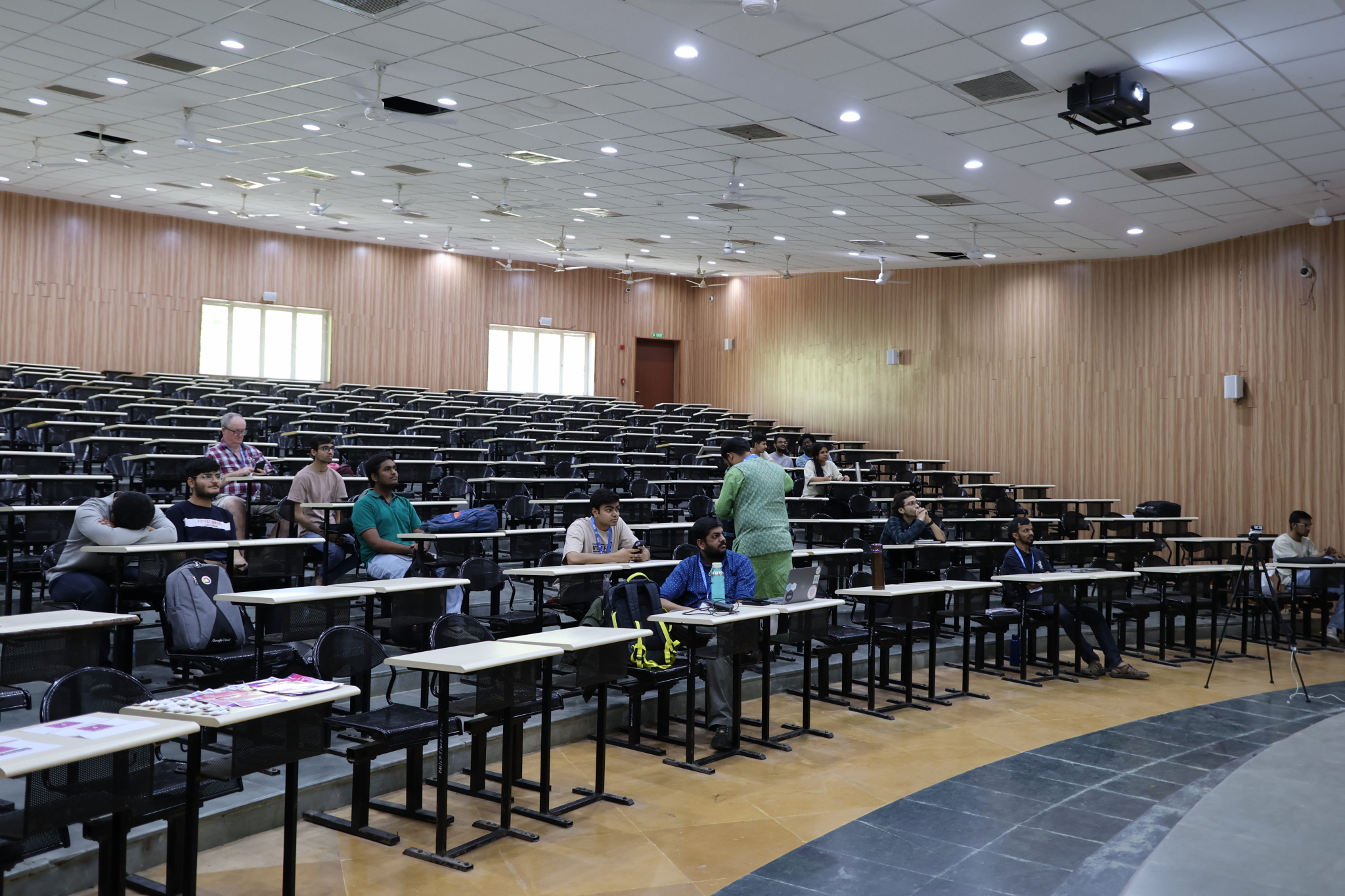
Last month, I attended the KDE India conference in Gandhinagar, Gujarat from the 4th to the 6th of April. I made my mind to attend when Sahil told me about his plans to attend and giving a talk. A day after my talk submission, the organizer Bhushan contacted me on Matrix and informed me that my talk had been accepted. I was also informed that KDE will cover my travel and accommodation expenses. So, I planned to attend the conference at this point. I am a longtime KDE user, so why not ;) I arrived in Ahmedabad, the twin city of Gandhinagar, a day before the conference. The first thing that struck me as soon as I came out of the Ahmedabad airport was the heat. I felt as if I was being cooked exactly how Bhushan put it earlier in the group chat. I took a taxi to get to my hotel, which was close to the conference venue. Later that afternoon, I met Bhushan and Joseph. Joseph lived in Germany. Bhushan was taking him to get a SIM card, so I tagged along and got to roam around. Joseph was unsure about where to go after the conference, so I asked him what he wanted out of his trip and had conversations along that line. Later, Vishal convinced him to go to Lucknow. Since he was adamant about taking the train, I booked a Tatkal train ticket for him to Lucknow. He was curious about how Tatkal booking works and watched me in amusement while I was booking the ticket. The 4th of April marked the first day of the conference, with around 25 attendees. Bhushan started the day with an overview of KDE conferences in India, followed by Vishal, who discussed FOSS United s activities. After the lunch, Joseph gave an overview of his campaign to help people switch from Windows to GNU/Linux due to environmental and security reasons. He continued his session in detail the next day.
Conference hall Conference hall
A key takeaway for me from Joseph s session was the idea pointed out by Adwaith: marketing GNU/Linux as a cheap alternative may not attract as much attention as marketing it as a status symbol. He gave the example of how the Tata Nano didn t do well in the Indian market due to being perceived as a poor person s car. My talk was scheduled for the evening of the first day. I hadn t prepared any slides because I wanted to make my session interactive. During my talk, I did an activity with the attendees to demonstrate the federated nature of XMPP messaging, of which Prav is a part. After the talk, I got a lot of questions, signalling engagement. The audience was cooperative (just like Prav ;)), contrary to my expectations (I thought they will be tired and sleepy). On the third day, I did a demo on editing OpenStreetMap (referred to as OSM in short) using the iD editor. It involved adding points to OSM based on the students suggestions. Since my computer didn t have an HDMI port, I used Subin s computer, and he logged into his OSM account for my session. Therefore, any mistakes I made will be under Subin s name. :) On the third day, I attended Aaruni s talk about backing up a GNU/Linux system. This was the talk that resonated with me the most. He suggested formatting the system with the btrfs file system during the installation, which helps in taking snapshots of the system and provides an easy way to roll back to a previous version if, for example, a file is accidentally deleted. I have tried many backup techniques, including this one, but I never tried backing up on the internal disk. I ll certainly give this a try. A conference is not only about the talks, that s why we had a Prav table as well ;) Just kidding. What I really mean is that a conference is more about interactions than talks. Since the conference was a three-day affair, attendees got plenty of time to bond and share ideas.
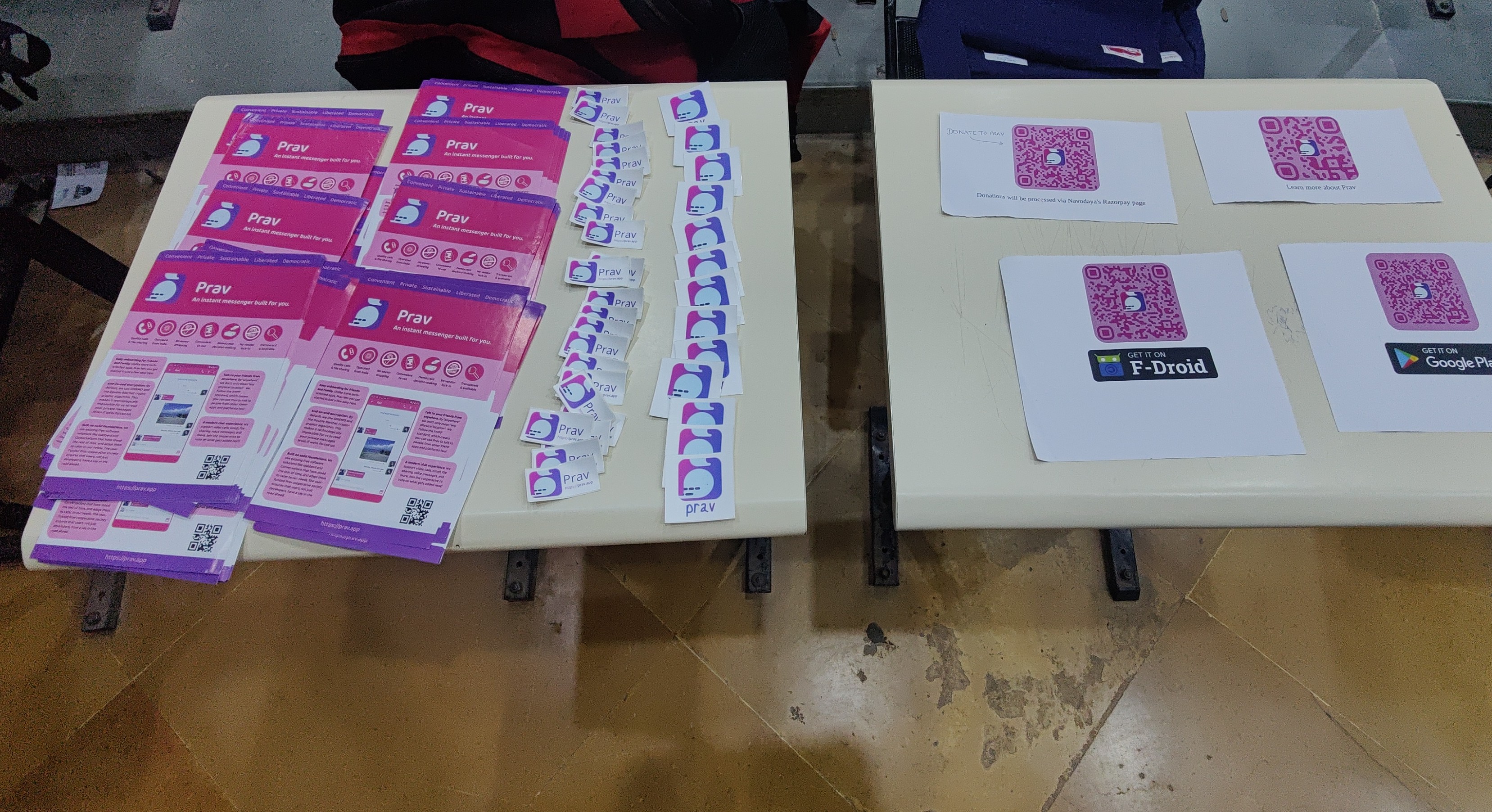
Prav stall at the conference Prav stall at the conference
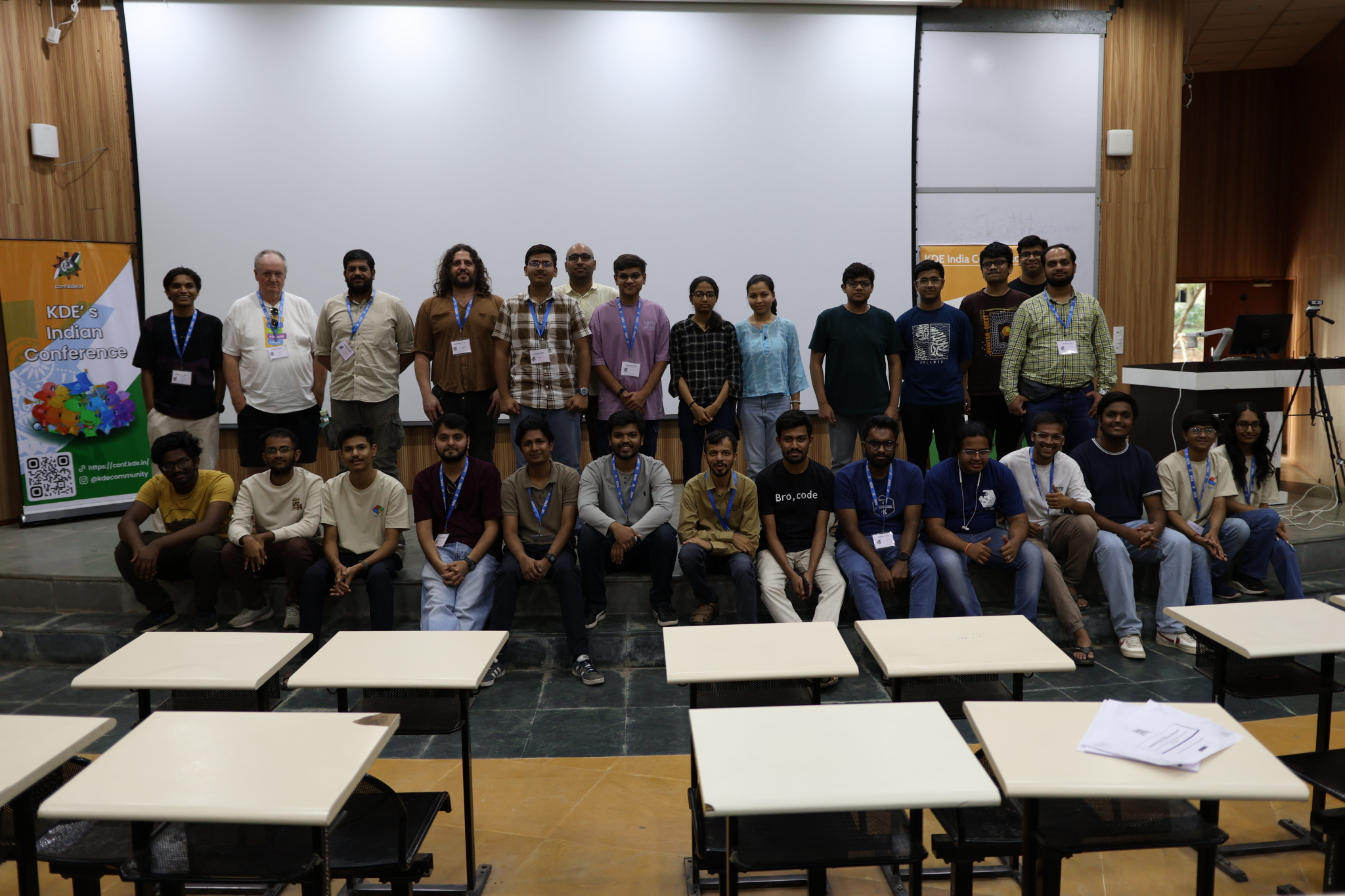
Conference group photo Conference group photo
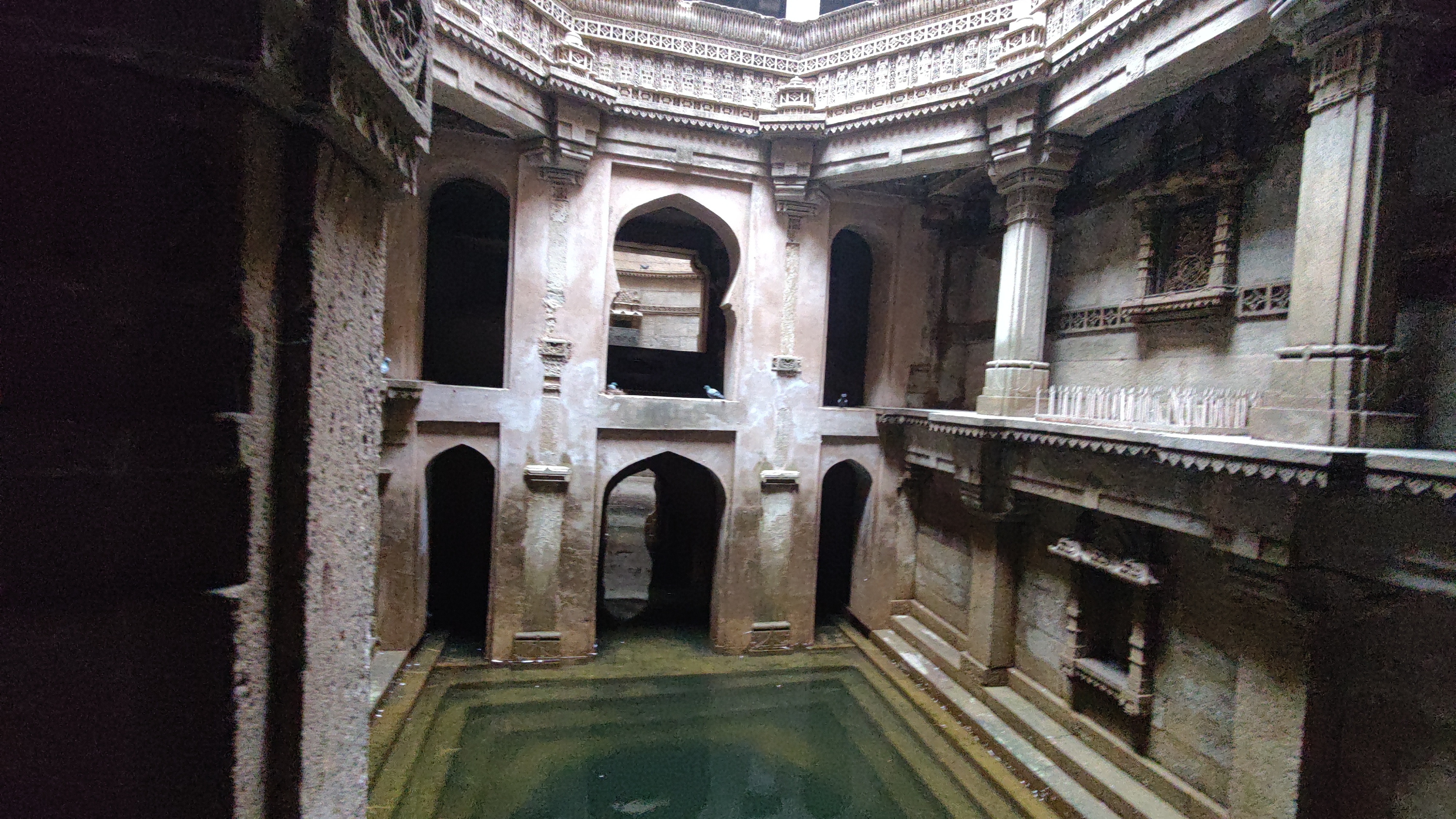
After the conference, Bhushan took us to Adalaj Stepwell, an attraction near Gandhinagar. Upon entering the complex, we saw a park where there were many langurs. Going further, there were stairs that led down to a well. I guess this is why it is called a stepwell.
Adalaj Stepwell Adalaj Stepwell
Later that day, we had Gujarati Thali for dinner. It was an all-you-can-eat buffet and was reasonably priced at 300 rupees per plate. Aamras (Mango juice) was the highlight for me. This was the only time we had Gujarati food during this visit. After the dinner, Aaruni dropped Sahil and I off at the airport. The hospitality was superb - for instance, in addition to Aaruni dropping us, Bhushan also picked up some of the attendees from the airport. Finally, I would like to thank KDE for sponsoring my travel and accommodation costs. Let s wrap up this post here and meet you in the next one. Thanks to contrapunctus and Joseph for proofreading.

Sergio Talens-Oliag: Running dind with sysbox

When I configured forgejo-actions I used a docker-compose.yaml file to execute the runner and a dind container configured to run using privileged mode to be able to build images with it; as mentioned on my post about my setup, the use of the privileged mode is not a big issue for my use case, but reduces the overall security of the installation. On a work chat the other day someone mentioned that the GitLab documentation about using kaniko says it is no longer maintained (see the kaniko issue #3348) so we should look into alternatives for kubernetes clusters. I never liked kaniko too much, but it works without privileged mode and does not need a daemon, which is a good reason to use it, but if it is deprecated it makes sense to look into alternatives, and today I looked into some of them to use with my forgejo-actions setup. I was going to try buildah and podman but it seems that they need to adjust things on the systems running them:
  • When I tried to use buildah inside a docker container in Ubuntu I found the problems described on the buildah issue #1901 so I moved on.
  • Reading the podman documentation I saw that I need to export the fuse device to run it inside a container and, as I found other option, I also skipped it.
As my runner was already configured to use dind I decided to look into sysbox as a way of removing the privileged flag to make things more secure but have the same functionality.

Installing the sysbox packageAs I use Debian and Ubuntu systems I used the .deb packages distributed from the sysbox release page to install it (in my case I used the one from the 0.6.7 version). On the machine running forgejo (a Debian 12 server) I downloaded the package, stopped the running containers (it is needed to install the package and the only ones running where the ones started by the docker-compose.yaml file) and installed the sysbox-ce_0.6.7.linux_amd64.deb package using dpkg.

Updating the docker-compose.yaml fileTo run the dind container without setting the privileged mode we set sysbox-runc as the runtime on the dind container definition and set the privileged flag to false (it is the same as removing the key, as it defaults to false):
--- a/docker-compose.yml
+++ b/docker-compose.yml
@@ -2,7 +2,9 @@ services:
   dind:
     image: docker:dind
     container_name: 'dind'
-    privileged: 'true'
+    # use sysbox-runc instead of using privileged mode
+    runtime: 'sysbox-runc'
+    privileged: 'false'
     command: ['dockerd', '-H', 'unix:///dind/docker.sock', '-G', '$RUNNER_GID']
     restart: 'unless-stopped'
     volumes:

Testing the changesAfter applying the changes to the docker-compose.yaml file we start the containers and to test things we re-run previously executed jobs to see if things work as before. In my case I re-executed the build-image-from-tag workflow #18 from the oci project and everything worked as expected.

ConclusionFor my current use case (docker + dind) seems that sysbox is a good solution but I m not sure if I ll be installing it on kubernetes anytime soon unless I find a valid reason to do it (last time we talked about it my co workers said that they are evaluating buildah and podman for kubernetes and probably we will use them to replace kaniko in our gitlab-ci pipelines and for those tools the use of sysbox seems an overkill).

12 May 2025

Reproducible Builds: Reproducible Builds in April 2025

Welcome to our fourth report from the Reproducible Builds project in 2025. These monthly reports outline what we ve been up to over the past month, and highlight items of news from elsewhere in the increasingly-important area of software supply-chain security. Lastly, if you are interested in contributing to the Reproducible Builds project, please visit our Contribute page on our website. Table of contents:
  1. reproduce.debian.net
  2. Fifty Years of Open Source Software Supply Chain Security
  3. 4th CHAINS Software Supply Chain Workshop
  4. Mailing list updates
  5. Canonicalization for Unreproducible Builds in Java
  6. OSS Rebuild adds new TUI features
  7. Distribution roundup
  8. diffoscope & strip-nondeterminism
  9. Website updates
  10. Reproducibility testing framework
  11. Upstream patches

reproduce.debian.net The last few months have seen the introduction, development and deployment of reproduce.debian.net. In technical terms, this is an instance of rebuilderd, our server designed monitor the official package repositories of Linux distributions and attempt to reproduce the observed results there. This month, however, we are pleased to announce that reproduce.debian.net now tests all the Debian trixie architectures except s390x and mips64el. The ppc64el architecture was added through the generous support of Oregon State University Open Source Laboratory (OSUOSL), and we can support the armel architecture thanks to CodeThink.

Fifty Years of Open Source Software Supply Chain Security Russ Cox has published a must-read article in ACM Queue on Fifty Years of Open Source Software Supply Chain Security. Subtitled, For decades, software reuse was only a lofty goal. Now it s very real. , Russ article goes on to outline the history and original goals of software supply-chain security in the US military in the early 1970s, all the way to the XZ Utils backdoor of 2024. Through that lens, Russ explores the problem and how it has changed, and hasn t changed, over time. He concludes as follows:
We are all struggling with a massive shift that has happened in the past 10 or 20 years in the software industry. For decades, software reuse was only a lofty goal. Now it s very real. Modern programming environments such as Go, Node and Rust have made it trivial to reuse work by others, but our instincts about responsible behaviors have not yet adapted to this new reality. We all have more work to do.

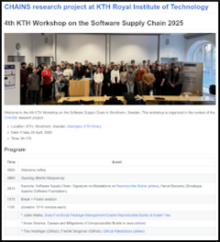
4th CHAINS Software Supply Chain Workshop Convened as part of the CHAINS research project at the KTH Royal Institute of Technology in Stockholm, Sweden, the 4th CHAINS Software Supply Chain Workshop occurred during April. During the workshop, there were a number of relevant workshops, including: The full listing of the agenda is available on the workshop s website.

Mailing list updates On our mailing list this month:
  • Luca DiMaio of Chainguard posted to the list reporting that they had successfully implemented reproducible filesystem images with both ext4 and an EFI system partition. They go on to list the various methods, and the thread generated at least fifteen replies.
  • David Wheeler announced that the OpenSSF is building a glossary of sorts in order that they consistently use the same meaning for the same term and, moreover, that they have drafted a definition for reproducible build . The thread generated a significant number of replies on the definition, leading to a potential update to the Reproducible Build s own definition.
  • Lastly, kpcyrd posted to the list with a timely reminder and update on their repro-env tool. As first reported in our July 2023 report, kpcyrd mentions that:
    My initial interest in reproducible builds was how do I distribute pre-compiled binaries on GitHub without people raising security concerns about them . I ve cycled back to this original problem about 5 years later and built a tool that is meant to address this. [ ]

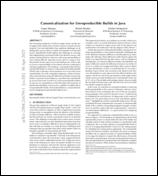
Canonicalization for Unreproducible Builds in Java Aman Sharma, Benoit Baudry and Martin Monperrus have published a new scholarly study related to reproducible builds within Java. Titled Canonicalization for Unreproducible Builds in Java, the article s abstract is as follows:
[ ] Achieving reproducibility at scale remains difficult, especially in Java, due to a range of non-deterministic factors and caveats in the build process. In this work, we focus on reproducibility in Java-based software, archetypal of enterprise applications. We introduce a conceptual framework for reproducible builds, we analyze a large dataset from Reproducible Central and we develop a novel taxonomy of six root causes of unreproducibility. We study actionable mitigations: artifact and bytecode canonicalization using OSS-Rebuild and jNorm respectively. Finally, we present Chains-Rebuild, a tool that raises reproducibility success from 9.48% to 26.89% on 12,283 unreproducible artifacts. To sum up, our contributions are the first large-scale taxonomy of build unreproducibility causes in Java, a publicly available dataset of unreproducible builds, and Chains-Rebuild, a canonicalization tool for mitigating unreproducible builds in Java.
A full PDF of their article is available from arXiv.

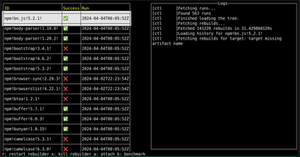
OSS Rebuild adds new TUI features OSS Rebuild aims to automate rebuilding upstream language packages (e.g. from PyPI, crates.io and npm registries) and publish signed attestations and build definitions for public use. OSS Rebuild ships a text-based user interface (TUI) for viewing, launching, and debugging rebuilds. While previously requiring ownership of a full instance of OSS Rebuild s hosted infrastructure, the TUI now supports a fully local mode of build execution and artifact storage. Thanks to Giacomo Benedetti for his usage feedback and work to extend the local-only development toolkit. Another feature added to the TUI was an experimental chatbot integration that provides interactive feedback on rebuild failure root causes and suggests fixes.

Distribution roundup In Debian this month:
  • Roland Clobus posted another status report on reproducible ISO images on our mailing list this month, with the summary that all live images build reproducibly from the online Debian archive .
  • Debian developer Simon Josefsson published another two reproducibility-related blog posts this month, the first on the topic of Verified Reproducible Tarballs. Simon sardonically challenges the reader as follows: Do you want a supply-chain challenge for the Easter weekend? Pick some well-known software and try to re-create the official release tarballs from the corresponding Git checkout. Is anyone able to reproduce anything these days? After that, they also published a blog post on Building Debian in a GitLab Pipeline using their multi-stage rebuild approach.
  • Roland also posted to our mailing list to highlight that there is now another tool in Debian that generates reproducible output, equivs . This is a tool to create trivial Debian packages that might Depend on other packages. As Roland writes, building the [equivs] package has been reproducible for a while, [but] now the output of the [tool] has become reproducible as well .
  • Lastly, 9 reviews of Debian packages were added, 10 were updated and 10 were removed this month adding to our extensive knowledge about identified issues.
The IzzyOnDroid Android APK repository made more progress in April. Thanks to funding by NLnet and Mobifree, the project was also to put more time into their tooling. For instance, developers can now easily run their own verification builder in less than 5 minutes . This currently supports Debian-based systems, but support for RPM-based systems is incoming.
  • The rbuilder_setup tool can now setup the entire framework within less than five minutes. The process is configurable, too, so everything from just the basics to verify builds up to a fully-fledged RB environment is also possible.
  • This tool works on Debian, RedHat and Arch Linux, as well as their derivates. The project has received successful reports from Debian, Ubuntu, Fedora and some Arch Linux derivates so far.
  • Documentation on how to work with reproducible builds (making apps reproducible, debugging unreproducible packages, etc) is available in the project s wiki page.
  • Future work is also in the pipeline, including documentation, guidelines and helpers for debugging.
NixOS defined an Outreachy project for improving build reproducibility. In the application phase, NixOS saw some strong candidates providing contributions, both on the NixOS side and upstream: guider-le-ecit analyzed a libpinyin issue. Tessy James fixed an issue in arandr and helped analyze one in libvlc that led to a proposed upstream fix. Finally, 3pleX fixed an issue which was accepted in upstream kitty, one in upstream maturin, one in upstream python-sip and one in the Nix packaging of python-libbytesize. Sadly, the funding for this internship fell through, so NixOS were forced to abandon their search. Lastly, in openSUSE news, Bernhard M. Wiedemann posted another monthly update for their work there.

diffoscope & strip-nondeterminism diffoscope is our in-depth and content-aware diff utility that can locate and diagnose reproducibility issues. This month, Chris Lamb made the following changes, including preparing and uploading a number of versions to Debian:
  • Use the --walk argument over the potentially dangerous alternative --scan when calling out to zipdetails(1). [ ]
  • Correct a longstanding issue where many >-based version tests used in conditional fixtures were broken. This was used to ensure that specific tests were only run when the version on the system was newer than a particular number. Thanks to Colin Watson for the report (Debian bug #1102658) [ ]
  • Address a long-hidden issue in the test_versions testsuite as well, where we weren t actually testing the greater-than comparisons mentioned above, as it was masked by the tests for equality. [ ]
  • Update copyright years. [ ]
In strip-nondeterminism, however, Holger Levsen updated the Continuous Integration (CI) configuration in order to use the standard Debian pipelines via debian/salsa-ci.yml instead of using .gitlab-ci.yml. [ ]

Website updates Once again, there were a number of improvements made to our website this month including:
  • Aman Sharma added OSS-Rebuild s stabilize tool to the Tools page. [ ][ ]
  • Chris Lamb added a configure.ac (GNU Autotools) example for using SOURCE_DATE_EPOCH. [ ]. Chris also updated the SOURCE_DATE_EPOCH snippet and move the archive metadata to a more suitable location. [ ]
  • Denis Carikli added GNU Boot to our ever-evolving Projects page.

Reproducibility testing framework The Reproducible Builds project operates a comprehensive testing framework running primarily at tests.reproducible-builds.org in order to check packages and other artifacts for reproducibility. In April, a number of changes were made by Holger Levsen, including:
  • reproduce.debian.net-related:
    • Add armel.reproduce.debian.net to support the armel architecture. [ ][ ]
    • Add a new ARM node, codethink05. [ ][ ]
    • Add ppc64el.reproduce.debian.net to support testing of the ppc64el architecture. [ ][ ][ ]
    • Improve the reproduce.debian.net front page. [ ][ ]
    • Make various changes to the ppc64el nodes. [ ][ ]9[ ][ ]
    • Make various changes to the arm64 and armhf nodes. [ ][ ][ ][ ]
    • Various changes related to the rebuilderd-worker entry point. [ ][ ][ ]
    • Create and deploy a pkgsync script. [ ][ ][ ][ ][ ][ ][ ][ ]
    • Fix the monitoring of the riscv64 architecture. [ ][ ]
    • Make a number of changes related to starting the rebuilderd service. [ ][ ][ ][ ]
  • Backup-related:
    • Backup the rebuilder databases every week. [ ][ ][ ][ ]
    • Improve the node health checks. [ ][ ]
  • Misc:
    • Re-use existing connections to the SSH proxy node on the riscv64 nodes. [ ][ ]
    • Node maintenance. [ ][ ][ ]
In addition:
  • Jochen Sprickerhof fixed the risvc64 host names [ ] and requested access to all the rebuilderd nodes [ ].
  • Mattia Rizzolo updated the self-serve rebuild scheduling tool, replacing the deprecated SSO -style authentication with OpenIDC which authenticates against salsa.debian.org. [ ][ ][ ]
  • Roland Clobus updated the configuration for the osuosl3 node to designate 4 workers for bigger builds. [ ]

Upstream patches The Reproducible Builds project detects, dissects and attempts to fix as many currently-unreproducible packages as possible. We endeavour to send all of our patches upstream where appropriate. This month, we wrote a large number of such patches, including:

Finally, if you are interested in contributing to the Reproducible Builds project, please visit our Contribute page on our website. However, you can get in touch with us via:

Next.

Previous.