Search Results: "ina"

17 July 2024

Gunnar Wolf: Script for weather reporting in Waybar

While I was living in Argentina, we (my family) found ourselves checking for weather forecasts almost constantly weather there can be quite unexpected, much more so that here in Mexico. So it took me a bit of tinkering to come up with a couple of simple scripts to show the weather forecast as part of my Waybar setup. I haven t cared to share with anybody, as I believe them to be quite trivial and quite dirty. But today, V ctor was asking for some slightly-related things, so here I go. Please do remember I warned: Dirty. Forecast I am using OpenWeather s open API. I had to register to get an APPID, and it allows me for up to 1,000 API calls per day, more than plenty for my uses, even if I am logged in at my desktops at three different computers (not an uncommon situation). Having that, I set up a file named /etc/get_weather/, that currently reads:
# Home, Mexico City
LAT=19.3364
LONG=-99.1819
# # Home, Paran , Argentina
# LAT=-31.7208
# LONG=-60.5317
# # PKNU, Busan, South Korea
# LAT=35.1339
#LONG=129.1055
APPID=SomeLongRandomStringIAmNotSharing
Then, I have a simple script, /usr/local/bin/get_weather, that fetches the current weather and the forecast, and stores them as /run/weather.json and /run/forecast.json:
#!/usr/bin/bash
CONF_FILE=/etc/get_weather
if [ -e "$CONF_FILE" ]; then
    . "$CONF_FILE"
else
    echo "Configuration file $CONF_FILE not found"
    exit 1
fi
if [ -z "$LAT" -o -z "$LONG" -o -z "$APPID" ]; then
    echo "Configuration file must declare latitude (LAT), longitude (LONG) "
    echo "and app ID (APPID)."
    exit 1
fi
CURRENT=/run/weather.json
FORECAST=/run/forecast.json
wget -q "https://api.openweathermap.org/data/2.5/weather?lat=$ LAT &lon=$ LONG &units=metric&appid=$ APPID " -O "$ CURRENT "
wget -q "https://api.openweathermap.org/data/2.5/forecast?lat=$ LAT &lon=$ LONG &units=metric&appid=$ APPID " -O "$ FORECAST "
This script is called by the corresponding systemd service unit, found at /etc/systemd/system/get_weather.service:
[Unit]
Description=Get the current weather
[Service]
Type=oneshot
ExecStart=/usr/local/bin/get_weather
And it is run every 15 minutes via the following systemd timer unit, /etc/systemd/system/get_weather.timer:
[Unit]
Description=Get the current weather every 15 minutes
[Timer]
OnCalendar=*:00/15:00
Unit=get_weather.service
[Install]
WantedBy=multi-user.target
(yes, it runs even if I m not logged in, wasting some of my free API calls but within reason) Then, I declare a "custom/weather" module in the desired position of my ~/.config/waybar/waybar.config, and define it as:
"custom/weather":  
    "exec": "while true;do /home/gwolf/bin/parse_weather.rb;sleep 10; done",
"return-type": "json",
 ,
This script basically morphs a generic weather JSON description into another set of JSON bits that display my weather in the way I prefer to have it displayed as:
#!/usr/bin/ruby
require 'json'
Sources =  :weather => '/run/weather.json',
           :forecast => '/run/forecast.json'
           
Icons =  '01d' => ' ', # d   day
         '01n' => ' ', # n   night
         '02d' => ' ',
         '02n' => ' ',
         '03d' => ' ',
         '03n' => ' ',
         '04d'  => ' ',
         '04n' => ' ',
         '09d' => ' ',
         '10n' =>  '  ',
         '10d' => ' ',
         '13d' => ' ',
         '50d' => ' '
         
ret =  'text': nil, 'tooltip': nil, 'class': 'weather', 'percentage': 100 
# Current weather report: Main text of the module
begin
  weather = JSON.parse(open(Sources[:weather],'r').read)
  loc_name = weather['name']
  icon = Icons[weather['weather'][0]['icon']]   ' ' + f['weather'][0]['icon'] + f['weather'][0]['main']
  temp = weather['main']['temp']
  sens = weather['main']['feels_like']
  hum = weather['main']['humidity']
  wind_vel = weather['wind']['speed']
  wind_dir = weather['wind']['deg']
  portions =  
  portions[:loc] = loc_name
  portions[:temp] = '%s  %2.2f C (%2.2f)' % [icon, temp, sens]
  portions[:hum] = '  %2d%%' % hum
  portions[:wind] = ' %2.2fm/s %d ' % [wind_vel, wind_dir]
  ret['text'] = [:loc, :temp, :hum, :wind].map   p  portions[p] .join(' ')
rescue => err
  ret['text'] = 'Could not process weather file (%s   %s: %s)' % [Sources[:weather], err.class, err.to_s]
end
# Weather prevision for the following hours/days
begin
  cast = []
  forecast = JSON.parse(open(Sources[:forecast], 'r').read)
  min = ''
  max = ''
  day=Time.now.strftime('%Y.%m.%d')
  by_day =  
  forecast['list'].each_with_index do  f,i 
    by_day[day]  = []
    time = Time.at(f['dt'])
    time_lbl = '%02d:%02d' % [time.hour, time.min]
    icon = Icons[f['weather'][0]['icon']]   ' ' + f['weather'][0]['icon'] + f['weather'][0]['main']
    by_day[day] << f['main']['temp']
    if time.hour == 0
      min = '%2.2f' % by_day[day].min
      max = '%2.2f' % by_day[day].max
      cast << '          min: <b>%s C</b> max: <b>%s C</b>' % [min, max]
      day = time.strftime('%Y.%m.%d')
      cast << '        <b>%04d.%02d.%02d</b>  ' %
              [time.year, time.month, time.day]
    end
    cast << '%s   %2.2f C    %2d%%   %s %s' % [time_lbl,
                                                f['main']['temp'],
                                                f['main']['humidity'],
                                                icon,
                                                f['weather'][0]['description']
                                               ]
  end
  cast << '          min: <b>%s</b> C max: <b>%s C</b>' % [min, max]
  ret['tooltip'] = cast.join("\n")
  
rescue => err
  ret['tooltip'] = 'Could not process forecast file (%s   %s)' % [Sources[:forecast], err.class, err.to_s]
end
# Print out the result for Waybar to process
puts ret.to_json
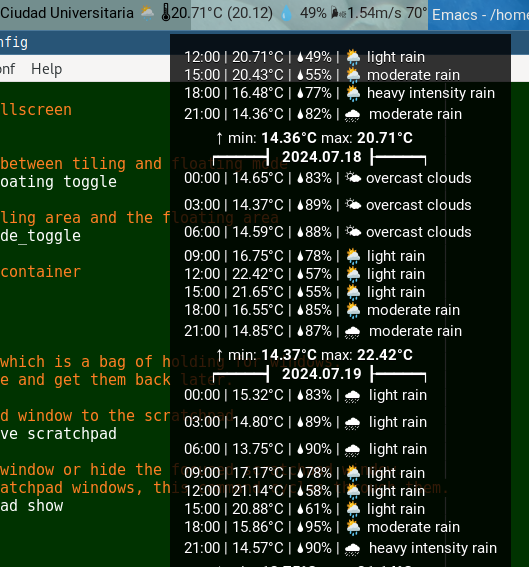
The end result? Nothing too stunning, but definitively something I find useful and even nicely laid out: Screenshot Do note that it seems OpenWeather will return the name of the closest available meteorology station with (most?) recent data for my home, I often get Ciudad Universitaria, but sometimes Coyoac n or even San ngel Inn.

Gunnar Wolf: Scholarly spam Wulfenia

I just got one of those utterly funny spam messages And yes, I recognize everybody likes building a name for themselves. But some spammers are downright silly. I just got the following mail:
From: Hermine Wolf <hwolf850@gmail.com>
To: me, obviously  
Date: Mon, 15 Jul 2024 22:18:58 -0700
Subject: Make sure that your manuscript gets indexed and showcased in the prestigious Scopus database soon.
Message-ID: <CAEZZb3XCXSc_YOeR7KtnoSK4i3OhD=FH7u+A5xSMsYvhQZojQA@mail.gmail.com>
This message has visual elements included. If they don't display, please   
update your email preferences.
*Dear Esteemed Author,*
Upon careful examination of your recent research articles available online,
we are excited to invite you to submit your latest work to our esteemed    
journal, '*WULFENIA*'. Renowned for upholding high standards of excellence 
in peer-reviewed academic research spanning various fields, our journal is 
committed to promoting innovative ideas and driving advancements in        
theoretical and applied sciences, engineering, natural sciences, and social
sciences. 'WULFENIA' takes pride in its impressive 5-year impact factor of 
*1.000* and is highly respected in prestigious databases including the     
Science Citation Index Expanded (ISI Thomson Reuters), Index Copernicus,   
Elsevier BIOBASE, and BIOSIS Previews.                                     
                                                                           
*Wulfenia submission page:*                                                
[image: research--check.png][image: scrutiny-table-chat.png][image:        
exchange-check.png][image: interaction.png]                                
.                                                                          
Please don't reply to this email                                           
                                                                           
We sincerely value your consideration of 'WULFENIA' as a platform to       
present your scholarly work. We eagerly anticipate receiving your valuable 
contributions.                                                             
*Best regards,*                                                            
Professor Dr. Vienna S. Franz                                              
Scholarly spam Who cares what Wulfenia is about? It s about you, my stupid Wolf cousin!

14 July 2024

Ravi Dwivedi: Kenya Visa Process

Prior to arrival in Kenya, you need to apply for an Electronic Travel Authorization (eTA) on their website by uploading all the required documents. This system is in place since Jan 2024 after the country abolished the visa system, implementing the eTA portal. The required documents will depend on the purpose of your visit, which in my case, was to attend a conference. Here is the list of documents I submitted for my eTA: Reservation means I didn t book the flights and hotels, but rather reserved them. Additionally, optional means that those documents were not mandatory to submit, but I submitted them in the Other Documents section in order to support my application. After submitting the eTA, I had to make a payment of around 35 US Dollars (approximately 3000 Indian Rupees). It took 40 hours for me to receive an email from Kenya stating that my eTA has been approved, along with an attached PDF, making this one of my smoothest experiences of obtaining travel documents to travel to a country :). An eTA is technically not a visa, but I put the word visa in the title due to familiarity with the term.

13 July 2024

Anuradha Weeraman: Windows of Opportunity: Microsoft's Open Source Renaissance

Windows of Opportunity: Microsoft's Open Source RenaissanceTwenty years ago, it was easy to dislike Microsoft. It was the quintessential evil MegaCorp that was quick to squash competition, often ruthlessly, but in some cases slowly through a more insidious process of embracing, extending, and exterminating anything that got in the way. This was the signature personality of Ballmer-era Microsoft that also inspired and united the software freedom fighting forces that came together to safeguard things that mattered to them and were at risk.I remember the era when the Novell, SCO, and Microsoft saga cast fear, uncertainty, and doubt on the future of open Unix and Linux and on what would happen to the operating systems that we loved if the suits of Redmond prevailed. Looking back, I&aposm glad that the arc of this story has bent towards justice, and I shudder at the possibilities had it worked out differently.Looking at today&aposs Microsoft, I&aposm amazed at how much change a leader with the right vision can make to the trajectory of a company that even makes an old-school software freedom advocate as me admire and even applaud the strides it has taken in the last 10 or so years that has dramatically shifted the perception of Microsoft. The personality of the Satya-era Microsoft is one to behold. While it will take more time to win back the trust, we see the tides changing and the positivity is important for the entire industry.For Microsoft, it was TypeScript and VS Code that helped change the narrative internally which led to its internal resurgence and acceptance of open source. Its acquisition of GitHub propelled it forward within the community overnight. Its contributions to the Linux kernel and other major software projects have also been consequential in changing its public perceptions.It takes a while to claw back trust and is very easy to breach. This time, however, Microsoft seems to understand this dynamic more than it did 20 years ago. All it took was the right leadership.

Ravi Dwivedi: Yellow Fever Vaccine

Recently, I got vaccinated with yellow fever vaccine as I am planning to travel to Kenya, a high risk country for yellow fever, in the near future. The vaccine takes 10 days to produce the required antibodies, so it should be taken at least 10 days before the date of departure to the at-risk country. In order to get vaccinated, I searched for vaccination centers in Delhi for yellow fever. I found this page by the Indian government which lists vaccination centers for yellow fever all over India. From that list, I made a phone call to the Airport Health Organization, a vaccination center near to the Delhi Airport. They asked me to write an email stating that I need yellow fever vaccination. After sending the email, they requested a scanned copy of my passport. Subsequently, they emailed me my appointment date, asking me to pay 300 INR in advance along with other instructions. You have to reach vaccination center at any time between 10 AM to 12 noon. I got there at around 11 AM on my appointment date and got vaccinated in around 40 minutes, followed by obtaining a vaccine certificate in half an hour. One dosage of this vaccine gives immunity against yellow fever for lifetime. Therefore, I can travel to any country at risk of yellow fever. Although some countries may require proof of vaccination within some time frame and some people might need a booster dose to maintain immunity.

12 July 2024

Reproducible Builds: Reproducible Builds in June 2024

Welcome to the June 2024 report from the Reproducible Builds project! In our reports, we outline what we ve been up to over the past month and highlight news items in software supply-chain security more broadly. As always, if you are interested in contributing to the project, please visit our Contribute page on our website. Table of contents:
  1. Next Reproducible Builds Summit dates announced
  2. GNU Guix patch review session for reproducibility
  3. New reproducibility-related academic papers
  4. Misc development news
  5. Website updates
  6. Reproducibility testing framework


Next Reproducible Builds Summit dates announced We are very pleased to announce the upcoming Reproducible Builds Summit, set to take place from September 17th 19th 2024 in Hamburg, Germany. We are thrilled to host the seventh edition of this exciting event, following the success of previous summits in various iconic locations around the world, including Venice, Marrakesh, Paris, Berlin and Athens. Our summits are a unique gathering that brings together attendees from diverse projects, united by a shared vision of advancing the Reproducible Builds effort. During this enriching event, participants will have the opportunity to engage in discussions, establish connections and exchange ideas to drive progress in this vital field. Our aim is to create an inclusive space that fosters collaboration, innovation and problem-solving. If you re interesting in joining us this year, please make sure to read the event page which has more details about the event and location. We are very much looking forward to seeing many readers of these reports there.

GNU Guix patch review session for reproducibility Vagrant Cascadian will be holding a Reproducible Builds session as part of the monthly Guix patch review series on July 11th at 17:00 UTC. These online events are intended to encourage everyone everyone becoming a patch reviewer and the goal of reviewing patches is to help Guix project accept contributions while maintaining our quality standards and learning how to do patch reviews together in a friendly hacking session.

Development news In Debian this month, 4 reviews of Debian packages were added, 11 were updated and 14 were removed this month adding to our knowledge about identified issues. Only one issue types was updated, though, explaining that we don t vary the build path anymore.
On our mailing list this month, Bernhard M. Wiedemann wrote that whilst he had previously collected issues that introduce non-determinism he has now moved on to discuss about mitigations , in the sense of how can we avoid whole categories of problem without patching an infinite number of individual packages . In addition, Janneke Nieuwenhuizen announced the release of two versions of GNU Mes. [ ][ ]
In openSUSE news, Bernhard M. Wiedemann published another report for that distribution.
In NixOS, with the 24.05 release out, it was again validated that our minimal ISO is reproducible by building it on a virtual machine with no access to the binary cache.
What s more, we continued to write patches in order to fix specific reproducibility issues, including Bernhard M. Wiedemann writing three patches (for qutebrowser, samba and systemd), Chris Lamb filing Debian bug #1074214 against the fastfetch package and Arnout Engelen proposing fixes to refind and for the Scala compiler [ .
Lastly, diffoscope is our in-depth and content-aware diff utility that can locate and diagnose reproducibility issues. This month, Chris Lamb uploaded two versions (270 and 271) to Debian, and made the following changes as well:
  • Drop Build-Depends on liblz4-tool in order to fix Debian bug #1072575. [ ]
  • Update tests to support zipdetails version 4.004 that is shipped with Perl 5.40. [ ]

Website updates There were a number of improvements made to our website this month, including Akihiro Suda very helpfully making the <h4> elements more distinguishable from the <h3> level [ ][ ] as well as adding a guide for Dockerfile reproducibility [ ]. In addition Fay Stegerman added two tools, apksigcopier and reproducible-apk-tools, to our Tools page.

Reproducibility testing framework The Reproducible Builds project operates a comprehensive testing framework running primarily at tests.reproducible-builds.org in order to check packages and other artifacts for reproducibility. In June, a number of changes were made by Holger Levsen, including:
  • Marking the virt(32 64)c-armhf nodes as down. [ ]
  • Granting a developer access to the osuosl4 node in order to debug a regression on the ppc64el architecture. [ ]
  • Granting a developer access to the osuosl4 node. [ ][ ]
In addition, Mattia Rizzolo re-aligned the /etc/default/jenkins file with changes performed upstream [ ] and changed how configuration files are handled on the rb-mail1 host. [ ], whilst Vagrant Cascadian documented the failure of the virt32c and virt64c nodes after initial investigation [ ].

If you are interested in contributing to the Reproducible Builds project, please visit our Contribute page on our website. However, you can get in touch with us via:

Russ Allbery: Review: The Splinter in the Sky

Review: The Splinter in the Sky, by Kemi Ashing-Giwa
Publisher: Saga Press
Copyright: July 2023
ISBN: 1-6680-0849-1
Format: Kindle
Pages: 372
The Splinter in the Sky is a stand-alone science fiction political thriller. It is Kemi Ashing-Giwa's first novel. Enitan is from Koriko, a vegetation-heavy moon colonized by the Vaalbaran empire. She lives in the Ijebu community with her sibling Xiang and has an on-again, off-again relationship with Ajana, the Vaalbaran-appointed governor. Xiang is studying to be an architect, which requires passing stringent entrance exams to be allowed to attend an ancillary imperial school intended for "primitives." Enitan works as a scribe and translator, one of the few Korikese allowed to use the sacred Orin language of Vaalbara. In her free time, she grows and processes tea. When Xiang mysteriously disappears while she's at work, Enitan goes to Ajana for help. Then Ajana dies, supposedly from suicide. The Vaalbaran government demands a local hostage while the death is investigated, someone who will be held as a diplomatic "guest" on the home world and executed if there is any local unrest. This hostage is supposed to be the child of the local headwoman, a concept that the Korikese do not have. Seeing a chance to search for Xiang, Enitan volunteers, heading into the heart of imperial power with nothing but desperate determination and a tea set. The empire doesn't stand a chance. Admittedly, a lot of the reason why the empire doesn't stand a chance is because the author is thoroughly on Enitan's side. Before she even arrives on Gondwana, Vaalbara's home world, Enitan is recruited as a spy by the other Gondwana power and Vaalbara's long-standing enemy. Her arrival in the Splinter, the floating arcology that serves as the center of Vaalbaran government, is followed by a startlingly meteoric rise in access. Some of this is explained by being a cultural curiosity for bored nobles, and some is explained by political factors Enitan is not yet aware of, but one can see the author's thumb resting on the scales. This was the sort of book that was great fun to read, but whose political implausibility provoked "wait, that didn't make sense" thoughts afterwards. I think one has to assume that the total population of Vaalbara is much less than first comes to mind when considering an interplanetary empire, which would help explain the odd lack of bureaucracy. Enitan is also living in, effectively, the palace complex, for reasonably well-explained political reasons, and that could grant her a surprising amount of access. But there are other things that are harder to explain away: the lack of surveillance, the relative lack of guards, and the odd political structure that's required for the plot to work. It's tricky to talk about this without spoilers, but the plot rests heavily on a conspiratorial view of how government power is wielded that I think strains plausibility. I'm not naive enough to think that the true power structure of a society matches the formal power structure, but I don't think they diverge as much as people think they do. It's one thing to say that the true power brokers of society can be largely unknown to the general population. In a repressive society with a weak media, that's believable. It's quite another matter for the people inside the palace to be in the dark about who is running what. I thought that was the biggest problem with this book. Its greatest feature is the characters, and particularly the character relationships. Enitan is an excellent protagonist: fascinating, sympathetic, determined, and daring in ways that make her success more believable. Early in the book, she forms an uneasy partnership that becomes the heart of the book, and I loved everything about that relationship. The politics of her situation might be a bit too simple, but the emotions were extremely well-done. This is a book about colonialism. Specifically, it's a book about cultural looting, appropriation, and racist superiority. The Vaalbarans consider Enitan barely better than an animal, and in her home they're merciless and repressive. Taken out of that context into their imperial capital, they see her as a harmless curiosity and novelty. Enitan exploits this in ways that are entirely believable. She is also driven to incandescent fury in ways that are entirely believable, and which she only rarely can allow herself to act on. Ashing-Giwa drives home the sheer uselessness of even the more sympathetic Vaalbarans more forthrightly than science fiction is usually willing to be. It's not a subtle point, but it is an accurate one. The first two thirds of this book had me thoroughly engrossed and unable to put it down. The last third unfortunately turns into a Pok mon hunt of antagonists, which I found less satisfying and somewhat less believable. I wish there had been more need for Enitan to build political alliances and go deeper into the social maneuverings of the first part of the book, rather than gaining some deus ex machina allies who trivially solve some otherwise-tricky plot problems. The setup is amazing; the resolution felt a bit like escaping a maze by blasting through the walls, which I don't think played to the strengths of the characters and relationships that Ashing-Giwa had constructed. The advantage of that approach is that we do get a satisfying resolution and a standalone novel. The central relationship of the book is unfortunately too much of a spoiler to talk about in a review, but I thought it was the best part of the story. This is a political thriller on the surface, but I think it's heart is an unexpected political alliance with a fascinatingly tricky balance of power. I was delighted that Ashing-Giwa never allows the tension in that relationship to collapse into one of the stock patterns it so easily could have become. The Splinter in the Sky reminded me a little of Arkady Martine's A Memory Called Empire. It's not as assured or as adroitly balanced as that book, and the characters are not quite as memorable, but that's a very high bar. The political point is even sharper, and it has some of the same appeal. I had so much fun reading this book. You may need to suspend your disbelief about some of the politics, and I wish the conclusion had been a bit less brute-force, but this is great stuff. Recommended when you're in the mood for a character story in the trappings of a political thriller. Rating: 8 out of 10

Freexian Collaborators: Monthly report about Debian Long Term Support, June 2024 (by Roberto C. S nchez)

Like each month, have a look at the work funded by Freexian s Debian LTS offering.

Debian LTS contributors In June, 18 contributors have been paid to work on Debian LTS, their reports are available:
  • Adrian Bunk did 47.0h (out of 74.25h assigned and 11.75h from previous period), thus carrying over 39.0h to the next month.
  • Arturo Borrero Gonzalez did 6.0h (out of 6.0h assigned).
  • Bastien Roucari s did 20.0h (out of 20.0h assigned).
  • Ben Hutchings did 15.5h (out of 16.0h assigned and 8.0h from previous period), thus carrying over 8.5h to the next month.
  • Chris Lamb did 18.0h (out of 18.0h assigned).
  • Daniel Leidert did 4.0h (out of 8.0h assigned and 2.0h from previous period), thus carrying over 6.0h to the next month.
  • Emilio Pozuelo Monfort did 23.25h (out of 49.5h assigned and 10.5h from previous period), thus carrying over 36.75h to the next month.
  • Guilhem Moulin did 4.5h (out of 13.0h assigned and 7.0h from previous period), thus carrying over 15.5h to the next month.
  • Lee Garrett did 17.0h (out of 25.0h assigned and 35.0h from previous period), thus carrying over 43.0h to the next month.
  • Lucas Kanashiro did 5.0h (out of 10.0h assigned and 10.0h from previous period), thus carrying over 15.0h to the next month.
  • Markus Koschany did 40.0h (out of 40.0h assigned).
  • Ola Lundqvist did 10.0h (out of 6.5h assigned and 17.5h from previous period), thus carrying over 14.0h to the next month.
  • Roberto C. S nchez did 5.25h (out of 7.75h assigned and 4.25h from previous period), thus carrying over 6.75h to the next month.
  • Santiago Ruano Rinc n did 22.5h (out of 14.5h assigned and 8.0h from previous period).
  • Sean Whitton did 6.5h (out of 6.0h assigned and 0.5h from previous period).
  • Stefano Rivera did 0.5h (out of 0.0h assigned and 10.0h from previous period), thus carrying over 9.5h to the next month.
  • Sylvain Beucler did 9.0h (out of 24.5h assigned and 35.5h from previous period), thus carrying over 51.0h to the next month.
  • Thorsten Alteholz did 14.0h (out of 14.0h assigned).

Evolution of the situation In June, we have released 31 DLAs. Notable security updates in June included:
  • git: multiple vulnerabilities, which may result in privilege escalation, denial of service, and arbitrary code execution
  • sendmail: SMTP smuggling allowed remote attackers bypass SPF protection checks
  • cups: arbitrary remote code execution
Looking further afield to the broader Debian ecosystem, LTS contributor Bastien Roucari s also patched sendmail in Debian 12 (bookworm) and 11 (bullseye) in order to fix the previously mentioned SMTP smuggling vulnerability. Furthermore, LTS contributor Thorsten Alteholz provided fixes for the cups packages in Debian 12 (bookworm) and 11 (bullseye) in order to fix the aforementioned arbitrary remote code execution vulnerability. Additionally, LTS contributor Ben Hutchings has commenced work on an updated backport of Linux kernel 6.1 to Debian 11 (bullseye), in preparation for bullseye transitioning to the responsibility of the LTS (and the associated closure of the bullseye-backports repository). LTS Lucas Kanashiro also began the preparatory work of backporting parts of the rust/cargo toolchain to Debian 11 (bullseye) in order to make future updates of the clamav virus scanner possible. June was the final month of LTS for Debian 10 (as announced on the debian-lts-announce mailing list). No additional Debian 10 security updates will be made available on security.debian.org. However, Freexian and its team of paid Debian contributors will continue to maintain Debian 10 going forward for the customers of the Extended LTS offer. Subscribe right away if you sill have Debian 10 which must be kept secure (and which cannot yet be upgraded).

Thanks to our sponsors Sponsors that joined recently are in bold.

11 July 2024

Petter Reinholdtsen: More than 200 orphaned Debian packages moved to git, 216 to go

In April, I started migrating orphaned Debian packages without any version control system listed in debian/control to git. This morning, my Debian QA page finally reached 200 QA packages migrated. In reality there are a few more, as the packages uploaded by someone else after my initial upload have disappeared from my QA uploads list. As I am running out of steam and will most likely focus on other parts of Debian moving forward, I hope someone else will find time to continue the migration to bring the number of orphaned packages without any version control system down to zero. Here is the updated recipe if someone want to help out. To locate packages to work on, the following one-liner can be used:
PGPASSWORD="udd-mirror" psql --port=5432 --host=udd-mirror.debian.net \
  --username=udd-mirror udd -c "select source from sources \
   where release = 'sid' and (vcs_url ilike '%anonscm.debian.org%' \
   OR vcs_browser ilike '%anonscm.debian.org%' or vcs_url IS NULL \
   OR vcs_browser IS NULL) AND maintainer ilike '%packages@qa.debian.org%' \
   order by random() limit 10;"
Pick a random package from the list and run the latest edition of the script debian-snap-to-salsa with the package name as the argument to prepare a git repository with the existing packaging. This will download old Debian packages from snapshot.debian.org. Note that very recent uploads will not be included, so check out the package on tracker.debian.org. Next, run gbp buildpackage --git-ignore-new to verify that the package build as it should, and then visit https://salsa.debian.org/debian/ and make sure there is not already a git repository for the package there. I also did git log -p debian/control and look for vcs entries to check if the package used to have a git repository on Alioth, and see if it can be a useful starting point moving forward. If all this check out, I created a new gitlab project below the Debian group on salsa, push the package source there and upload a new version. I tend to also ensure build hardening is enabled, if it prove to be easy, and check if I can easily fix any lintian issues or bug reports. If the process took more than 20 minutes, I dropped it and moved on to another package. If I found patches in debian/patches/ that were not yet passed upstream, I would send an email to make sure upstream know about them. This has proved to be a valuable step, and caused several new releases for software that initially appeared abandoned. :) As usual, if you use Bitcoin and want to show your support of my activities, please send Bitcoin donations to my address 15oWEoG9dUPovwmUL9KWAnYRtNJEkP1u1b.

10 July 2024

Russell Coker: Computer Adavances in the Last Decade

I wrote a comment on a social media post where someone claimed that there s no computer advances in the last 12 years which got long so it s worth a blog post. In the last decade or so new laptops have become cheaper than new desktop PCs. USB-C has taken over for phones and for laptop charging so all recent laptops support USB-C docks and monitors with USB-C docks built in have become common. 4K monitors have become cheap and common and higher than 4K is cheap for some use cases such as ultra wide. 4K TVs are cheap and TVs with built-in Android computers for playing internet content are now standard. For most use cases spinning media hard drives are obsolete, SSDs large enough for all the content most people need to store are cheap. We have gone from gigabit Ethernet being expensive to 2.5 gigabit being cheap. 12 years ago smart phones were very limited and every couple of years there would be significant improvements. Since about 2018 phones have been capable of doing most things most people want. 5yo Android phones can run the latest apps and take high quality pics. Any phone that supports VoLTE will be good for another 5+ years if it has security support. Phones without security support still work and are quite usable apart from being insecure. Google and Samsung have significantly increased their minimum security support for their phones and the GKI project from Google makes it easier for smaller vendors to give longer security support. There are a variety of open Android projects like LineageOS which give longer security support on a variety of phones. If you deliberately choose a phone that is likely to be well supported by projects like LineageOS (which pretty much means just Pixel phones) then you can expect to be able to actually use it when it is 10 years old. Compare this to the Samsung Galaxy S3 released in 2012 which was a massive improvement over the original Galaxy S (the S2 felt closer to the S than the S3). The Samsung Galaxy S4 released in 2013 was one of the first phones to have FullHD resolution which is high enough that most people can t easily recognise the benefits of higher resolution. It wasn t until 2015 that phones with 4G of RAM became common which is enough that for most phone use it s adequate today. Now that 16G of RAM is affordable in laptops running more secure OSs like Qubes is viable for more people. Even without Qubes, OS security has been improving a lot with better compiler features, new languages like Rust, and changes to software design and testing. Containers are being used more but we still aren t getting all the benefits of that. TPM has become usable in the last few years and we are only starting to take advantage of what it can offer. In 2012 BTRFS was still at an early stage of development and not many people wanted to use it in production, I was using it in production then and while I didn t lose any data from bugs I did have some downtime because of BTRFS issues. Now BTRFS is quite solid for server use. DDR4 was released in 2014 and gave significant improvements over DDR3 for performance and capacity. My home workstation now has 256G of DDR4 which wasn t particularly expensive while the previous biggest system I owned had 96G of DDR3 RAM. Now DDR5 is available to again increase performance and size while also making DDR4 cheap on the second hand market. This isn t a comprehensive list of all advances in the computer industry over the last 12 years or so, it s just some things that seem particularly noteworthy to me. Please comment about what you think are the most noteworthy advances I didn t mention.

Freexian Collaborators: Debian Contributions: YubiHSM packaging, unschroot, live-patching, and more! (by Stefano Rivera)

Debian Contributions: 2024-06 Contributing to Debian is part of Freexian s mission. This article covers the latest achievements of Freexian and their collaborators. All of this is made possible by organizations subscribing to our Long Term Support contracts and consulting services.

YubiHSM packaging, by Colin Watson Freexian is starting to use YubiHSM devices (hardware security modules) as part of some projects, and we wanted to have the supporting software directly in Debian rather than needing to use third-party repositories. Since Yubico publish everything we need under free software licences, Colin packaged yubihsm-connector, yubihsm-shell, and python-yubihsm from https://developers.yubico.com/, in some cases based partly on the upstream packaging, and got them all into Debian unstable. Backports to bookworm will be forthcoming once they ve all reached testing.

unschroot by Helmut Grohne Following an in-person discussion at MiniDebConf Berlin, Helmut attempted splitting the containment functionality of sbuild --chroot-mode=unshare into a dedicated tool interfacing with sbuild as a variant of --chroot-mode=schroot providing a sufficiently compatible interface. While this seemed technically promising initially, a discussion on debian-devel indicated a desire to rely on an existing container runtime such as podman instead of using another Debian-specific tool with unclear long term maintenance. None of the existing container runtimes meet the specific needs of sbuild, so further advancing this matter implies a compromise one way or another.

Linux live-patching, by Santiago Ruano Rinc n In collaboration with Emmanuel Arias, Santiago is working on the development of linux live-patching for Debian. For the moment, this is in an exploratory phase, that includes how to handle the different patches that will need to be provided. kpatch could help significantly in this regard. However, kpatch was removed from unstable because there are some RC bugs affecting the version that was present in Debian unstable. Santiago packaged the most recent upstream version (0.9.9) and filed an Intent to Salvage bug. Santiago is waiting for an ACK by the maintainer, and will upload to unstable after July 10th, following the package salvaging rules. While kpatch 0.9.9 fixes the main issues, it still needs some work to properly support Debian and the Linux kernel versions packaged in our distribution. More on this in the report next month.

Salsa CI, by Santiago Ruano Rinc n The work by Santiago in Salsa CI this month includes a merge request to ease testing how the production images are built from the changes introduced by future merge requests. By default, the pipelines triggered by a merge request build a subset of the images built for production, to reduce the use of resources, and because most of the time the subset of staging images is enough to test the proposed modifications. However, sometimes it is needed to test how the full set of production images is built, and the above mentioned MR helps to do that. The changes include documentation, so hopefully this will make it easier to test future contributions. Also, for being able to include support for RISC-V, Salsa CI needs to replace kaniko as the tool used to build the images. Santiago tested buildah, but there are some issues when pushing built images for non-default platform architectures (i386, armhf, armel) to the container registry. Santiago will continue to work on this to find a solution.

Miscellaneous contributions
  • Stefano Rivera prepared updates for a number of Python modules.
  • Stefano uploaded the latest point release of Python 3.12 and the latest Python 3.13 beta. Both uncovered upstream regressions that had to be addressed.
  • Stefano worked on preparations for DebConf 24.
  • Stefano helped SPI to reconcile their financial records for DebConf 23.
  • Colin did his usual routine work on the Python team, upgrading 36 packages to new upstream versions (including fixes for four CVEs in python-aiohttp), fixing RC bugs in ipykernel, ipywidgets, khard, and python-repoze.sphinx.autointerface, and packaging zope.deferredimport which was needed for a new upstream version of python-persistent.
  • Colin removed the user_readenv option from OpenSSH s PAM configuration (#1018260), and prepared a release note.
  • Thorsten Alteholz uploaded a new upstream version of cups.
  • Nicholas Skaggs updated xmacro to support reproducible builds (#1014428), DEP-3 and DEP-5 compatibility, along with utilizing hardening build flags. Helmut supported and uploaded package.
  • As a result of login having become non-essential, Helmut uploaded debvm to unstable and stable and fixed a crossqa.debian.net worker.
  • Santiago worked on the Content Team activities for DebConf24. Together with other DebConf25 team members, Santiago wrote a document for the head of the venue to describe the project of the conference.

9 July 2024

Simon Josefsson: Towards Idempotent Rebuilds?

After rebuilding all added/modified packages in Trisquel, I have been circling around the elephant in the room: 99% of the binary packages in Trisquel comes from Ubuntu, which to a large extent are built from Debian source packages. Is it possible to rebuild the official binary packages identically? Does anyone make an effort to do so? Does anyone care about going through the differences between the official package and a rebuilt version? Reproducible-build.org s effort to track reproducibility bugs in Debian (and other systems) is amazing. However as far as I know, they do not confirm or deny that their rebuilds match the official packages. In fact, typically their rebuilds do not match the official packages, even when they say the package is reproducible, which had me surprised at first. To understand why that happens, compare the buildinfo file for the official coreutils 9.1-1 from Debian bookworm with the buildinfo file for reproducible-build.org s build and you will see that the SHA256 checksum does not match, but still they declare it as a reproducible package. As far as I can tell of the situation, the purpose of their rebuilds are not to say anything about the official binary build, instead the purpose is to offer a QA service to maintainers by performing two builds of a package and declaring success if both builds match. I have felt that something is lacking, and months have passed and I haven t found any project that address the problem I am interested in. During my earlier work I created a project called debdistreproduce which performs rebuilds of the difference between two distributions in a GitLab pipeline, and display diffoscope output for further analysis. A couple of days ago I had the idea of rewriting it to perform rebuilds of a single distribution. A new project debdistrebuild was born and today I m happy to bless it as version 1.0 and to announces the project! Debdistrebuild has rebuilt the top-50 popcon packages from Debian bullseye, bookworm and trixie, on amd64 and arm64, as well as Ubuntu jammy and noble on amd64, see the summary status page for links. This is intended as a proof of concept, to allow people experiment with the concept of doing GitLab-based package rebuilds and analysis. Compare how Guix has the guix challenge command. Or I should say debdistrebuild has attempted to rebuild those distributions. The number of identically built packages are fairly low, so I didn t want to waste resources building the rest of the archive until I understand if the differences are due to consequences of my build environment (plain apt-get build-dep followed by dpkg-buildpackage in a fresh container), or due to some real difference. Summarizing the results, debdistrebuild is able to rebuild 34% of Debian bullseye on amd64, 36% of bookworm on amd64, 32% of bookworm on arm64. The results for trixie and Ubuntu are disappointing, below 10%. So what causes my rebuilds to be different from the official rebuilds? Some are trivial like the classical problem of varying build paths, resulting in a different NT_GNU_BUILD_ID causing a mismatch. Some are a bit strange, like a subtle difference in one of perl s headers file. Some are due to embedded version numbers from a build dependency. Several of the build logs and diffoscope outputs doesn t make sense, likely due to bugs in my build scripts, especially for Ubuntu which appears to strip translations and do other build variations that I don t do. In general, the classes of reproducibility problems are the expected. Some are assembler differences for GnuPG s gpgv-static, likely triggered by upload of a new version of gcc after the original package was built. There are at least two ways to resolve that problem: either use the same version of build dependencies that were used to produce the original build, or demand that all packages that are affected by a change in another package are rebuilt centrally until there are no more differences. The current design of debdistrebuild uses the latest version of a build dependency that is available in the distribution. We call this a idempotent rebuild . This is usually not how the binary packages were built originally, they are often built against earlier versions of their build dependency. That is the situation for most binary distributions. Instead of using the latest build dependency version, higher reproducability may be achieved by rebuilding using the same version of the build dependencies that were used during the original build. This requires parsing buildinfo files to find the right version of the build dependency to install. We believe doing so will lead to a higher number of reproducibly built packages. However it begs the question: can we rebuild that earlier version of the build dependency? This circles back to really old versions and bootstrappable builds eventually. While rebuilding old versions would be interesting on its own, we believe that is less helpful for trusting the latest version and improving a binary distribution: it is challenging to publish a new version of some old package that would fix a reproducibility bug in another package when used as a build dependency, and then rebuild the later packages with the modified earlier version. Those earlier packages were already published, and are part of history. It may be that ultimately it will no longer be possible to rebuild some package, because proper source code is missing (for packages using build dependencies that were never part of a release); hardware to build a package could be missing; or that the source code is no longer publicly distributable. I argue that getting to 100% idempotent rebuilds is an interesting goal on its own, and to reach it we need to start measure idempotent rebuild status. One could conceivable imagine a way to rebuild modified versions of earlier packages, and then rebuild later packages using the modified earlier packages as build dependencies, for the purpose of achieving higher level of reproducible rebuilds of the last version, and to reach for bootstrappability. However, it may be still be that this is insufficient to achieve idempotent rebuilds of the last versions. Idempotent rebuilds are different from a reproducible build (where we try to reproduce the build using the same inputs), and also to bootstrappable builds (in which all binaries are ultimately built from source code). Consider a cycle where package X influence the content of package Y, which in turn influence the content of package X. These cycles may involve several packages, and it is conceivable that a cycle could be circular and infinite. It may be difficult to identify these chains, and even more difficult to break them up, but this effort help identify where to start looking for them. Rebuilding packages using the same build dependency versions as were used during the original build, or rebuilding packages using a bootsrappable build process, both seem orthogonal to the idempotent rebuild problem. Our notion of rebuildability appears thus to be complementary to reproducible-builds.org s definition and bootstrappable.org s definition. Each to their own devices, and Happy Hacking! Addendum about terminology: With idempotent rebuild I am talking about a rebuild of the entire operating system, applied to itself. Compare how you build the latest version of the GNU C Compiler: it first builds itself using whatever system compiler is available (often an earlier version of gcc) which we call step 1. Then step 2 is to build a copy of itself using the compiler built in step 1. The final step 3 is to build another copy of itself using the compiler from step 2. Debian, Ubuntu etc are at step 1 in this process right now. The output of step 2 and step 3 ought to be bit-by-bit identical, or something is wrong. The comparison between step 2 and 3 is what I refer to with an idempotent rebuild. Of course, most packages aren t a compiler that can compile itself. However entire operating systems such as Trisquel, PureOS, Ubuntu or Debian are (hopefully) a self-contained system that ought to be able to rebuild itself to an identical copy. Or something is amiss. The reproducible build and bootstrappable build projects are about improve the quality of step 1. The property I am interested is the identical rebuild and comparison in step 2 and 3. I feel the word idempotent describes the property I m interested in well, but I realize there may be better ways to describe this. Ideas welcome!

Steve Kemp: The CP/M emulator is good enough, I think.

My previous post mentioned that I'd added some custom syscalls to my CP/M emulator and that lead to some more updates, embedding a bunch of binaries within the emulator so that the settings can be tweaked at run-time, for example running:
!DEBUG 1
!CTRLC 1
!CCP ccpz
!CONSOLE adm-3a
Those embedded binaries show up on A: even if they're not in the pwd when you launch the emulator. Other than the custom syscalls I've updated the real BDOS/BIOS syscalls a bit more, so that now I can run things like the Small C compiler, BBC BASIC, and more. (BBCBasic.com used to launch just fine, but it turned out that the SAVE/LOAD functions didn't work. Ooops!) I think I've now reached a point where all the binaries I care about run, and barring issues I will slow down/stop development. I can run Turbo Pascal, WordStar, various BASIC interpreters, and I have a significantly improved understanding of how CP/M works - a key milestone in that understanding was getting SUBMIT.COM to execute, and understanding the split between the BDOS and the BIOS. I'd kinda like to port CP/M to a new (Z80-based) system - but I don't have such a thing to hand, and I guess there's no real need for it. Perhaps I can say I'm "done" with retro stuff, and go back to playing Super Mario Bros (1985) with my boy!

Russ Allbery: Review: Raising Steam

Review: Raising Steam, by Terry Pratchett
Series: Discworld #40
Publisher: Anchor Books
Copyright: 2013
Printing: October 2014
ISBN: 0-8041-6920-9
Format: Trade paperback
Pages: 365
Raising Steam is the 40th Discworld novel and the third Moist von Lipwig novel, following Making Money. This is not a good place to start reading the series. Dick Simnel is a tinkerer from a line of tinkerers. He has been obsessed with mastering the power of steam since the age of ten, when his father died in a steam accident. That pursuit took him deeper into mathematics and precision, calculations and experiments, until he built Iron Girder: Discworld's first steam-powered locomotive. His early funding came from some convenient family pirate treasure, but turning his prototype into something more will require significantly more resources. That is how he ends up in the office of Harry King, Ankh-Morpork's sanitation magnate. Simnel's steam locomotive has the potential to solve some obvious logistical problems, such as getting fish from the docks of Quirm to the streets of Ankh-Morpork before it stops being vaguely edible. That's not what makes railways catch fire, however. As soon as Iron Girder is huffing and puffing its way around King's compound, it becomes the most popular attraction in the city. People stand in line for hours to ride it over and over again for reasons that they cannot entirely explain. There is something wild and uncontrollable going on. Vetinari is not sure he likes wild and uncontrollable, but he knows the lap into which such problems can be dumped: Moist von Lipwig, who is already getting bored with being a figurehead for the city's banking system. The setup for Raising Steam reminds me more of Moving Pictures than the other Moist von Lipwig novels. Simnel himself is a relentlessly practical engineer, but the trains themselves have tapped some sort of primal magic. Unlike Moving Pictures, Pratchett doesn't provide an explicit fantasy explanation involving intruding powers from another world. It might have been a more interesting book if he had. Instead, this book expects the reader to believe there is something inherently appealing and fascinating about trains, without providing much logic or underlying justification. I think some readers will be willing to go along with this, and others (myself included) will be left wishing the story had more world-building and fewer exclamation points. That's not the real problem with this book, though. Sadly, its true downfall is that Pratchett's writing ability had almost completely collapsed by the time he wrote it. As mentioned in my review of Snuff, we're now well into the period where Pratchett was suffering the effects of early-onset Alzheimer's. In that book, his health issues mostly affected the dialogue near the end of the novel. In this book, published two years later, it's pervasive and much worse. Here's a typical passage from early in the book:
It is said that a soft answer turneth away wrath, but this assertion has a lot to do with hope and was now turning out to be patently inaccurate, since even a well-spoken and thoughtful soft answer could actually drive the wrong kind of person into a state of fury if wrath was what they had in mind, and that was the state the elderly dwarf was now enjoying.
One of the best things about Discworld is Pratchett's ability to drop unexpected bits of wisdom in a sentence or two, or twist a verbal knife in an unexpected and surprising direction. Raising Steam still shows flashes of that ability, but it's buried in run-on sentences, drowned in cliches and repetition, and often left behind as the containing sentence meanders off into the weeds and sputters to a confused halt. The idea is still there; the delivery, sadly, is not. This is the first Discworld novel that I found mentally taxing to read. Sentences are often so overpacked that they require real effort to untangle, and the untangled meaning rarely feels worth the effort. The individual voice of the characters is almost gone. Vetinari's monologues, rather than being a rare event with dangerous layers, are frequent, rambling, and indecisive, often sounding like an entirely different character than the Vetinari we know. The constant repetition of the name any given character is speaking to was impossible for me to ignore. And the momentum of the story feels wrong; rather than constructing the events of the story in a way that sweeps the reader along, it felt like Pratchett was constantly pushing, trying to convince the reader that trains were the most exciting thing to ever happen to Discworld. The bones of a good story are here, including further development of dwarf politics from The Fifth Elephant and Thud! and the further fallout of the events of Snuff. There are also glimmers of Pratchett's typically sharp observations and turns of phrase that could have been unearthed and polished. But at the very least this book needed way more editing and a lot of rewriting. I suspect it could have dropped thirty pages just by tightening the dialogue and removing some of the repetition. I'm afraid I did not enjoy this. I am a bit of a hard sell for the magic fascination of trains I love trains, but my model railroad days are behind me and I'm now more interested in them as part of urban transportation policy. Previous Discworld books on technology and social systems did more of the work of drawing the reader in, providing character hooks and additional complexity, and building a firmer foundation than "trains are awesome." The main problem, though, was the quality of the writing, particularly when compared to the previous novels with the same characters. I dragged myself through this book out of a sense of completionism and obligation, and was relieved when I finished it. This is the first Discworld novel that I don't recommend. I think the only reason to read it is if you want to have read all of Discworld. Otherwise, consider stopping with Snuff and letting it be the send-off for the Ankh-Morpork characters. Followed by The Shepherd's Crown, a Tiffany Aching story and the last Discworld novel. Rating: 3 out of 10

8 July 2024

Thorsten Alteholz: My Debian Activities in June 2024

FTP master This month I accepted 270 and rejected 23 packages. The overall number of packages that got accepted was 279.

Debian LTS This was my hundred-twentieth month that I did some work for the Debian LTS initiative, started by Raphael Hertzog at Freexian. During my allocated time I uploaded or worked on: This month handling of the CVE of cups was a bit messy. After lifting the embargo of the CVE, a published patch did not work with all possible combinations of the configuration. In other words, in cases of having only one local domain socket configured, the cupsd did not start and failed with a strange error. Anyway, upstream published a new set of patches, which made cups work again. Unfortunately this happended just before the latest point release for Bullseye and Bookworm, so that the new packages did not make it into the release, but stopped in the corresponding p-u-queues: stable-p-u and old-p-u. I also continued to work on tiff and last but not least did a week of FD and attended the monthly LTS/ELTS meeting. Debian ELTS This month was the seventy-first ELTS month. During my allocated time I tried to upload a new version of cups for Jessie and Stretch. Unfortunately this was stopped due to an autopkgtest error, which I could not reproduce yet. I also wanted to finally upload a fixed version of exim4. Unfortunately this was stopped due to lots of CI-jobs for Buster. Updates for Buster are now also availble from ELTS, so some stuff had to prepared before the actual switch end of June. Additionally everything was delayed due to a crash of the CI worker. All in all this month was rather ill-fated. At least the exim4 upload will happen/already happened in July. I also continued to work on an update for libvirt, did a week of FD and attended the LTS/ELTS meeting. Debian Printing This month I uploaded new upstream or bugfix versions of: This work is generously funded by Freexian! Debian Astro This month I uploaded a new upstream or bugfix version of: All of those uploads are somehow related to /usr-move. Debian IoT This month I uploaded new upstream or bugfix versions of: Debian Mobcom The following packages have been prepared by the GSoC student Nathan: misc This month I uploaded new upstream or bugfix versions of: Here as well all uploads are somehow related to /usr-move

Dirk Eddelbuettel: RcppArmadillo 14.0.0-1 on CRAN: New Upstream

armadillo image Armadillo is a powerful and expressive C++ template library for linear algebra and scientific computing. It aims towards a good balance between speed and ease of use, has a syntax deliberately close to Matlab, and is useful for algorithm development directly in C++, or quick conversion of research code into production environments. RcppArmadillo integrates this library with the R environment and language and is widely used by (currently) 1158 other packages on CRAN, downloaded 35.1 million times (per the partial logs from the cloud mirrors of CRAN), and the CSDA paper (preprint / vignette) by Conrad and myself has been cited 587 times according to Google Scholar. Conrad released a new major upstream version 14.0.0 a couple of days ago. We had been testing this new version extensively over several rounds of reverse-dependency checks across all 1100+ packages. This revealed nine packages requiring truly minor adjustments which eight maintainers made in a matter of days; all this was coordinated in issue #443. Following the upload, CRAN noticed one more issue (see issue #446) but this turned out to be local to the package. There are also renewed deprecation warnings with some Armadillo changes which we will need to address one-by-one. Last but not least with this release we also changed the package versioning scheme to follow upstream Armadillo more closely. The set of changes since the last CRAN release follows.

Changes in RcppArmadillo version 14.0.0-1 (2024-07-05)
  • Upgraded to Armadillo release 14.0.0 (Stochastic Parrot)
    • C++14 is now the minimum recommended C++ standard
    • Faster handling of compound expressions by as_scalar(), accu(), dot()
    • Faster interactions between sparse and dense matrices
    • Expanded stddev() to handle sparse matrices
    • Expanded relational operators to handle expressions between sparse matrices and scalars
    • Added .as_dense() to obtain dense vector/matrix representation of any sparse matrix expression
    • Updated physical constants to NIST 2022 CODATA values
  • New package version numbering scheme following upstream versions
  • Re-enabling ARMA_IGNORE_DEPRECATED_MARKE for silent CRAN builds

Courtesy of my CRANberries, there is a diffstat report relative to previous release. More detailed information is on the RcppArmadillo page. Questions, comments etc should go to the rcpp-devel mailing list off the Rcpp R-Forge page. If you like this or other open-source work I do, you can sponsor me at GitHub.

This post by Dirk Eddelbuettel originated on his Thinking inside the box blog. Please report excessive re-aggregation in third-party for-profit settings.

Russ Allbery: rra-c-util 11.0.0

rra-c-util is my collection of utility and test functions that I keep synchronized between my packages. The big change in this release is that I've switched to semantic versions, which I plan to do for all of my packages, and I've started using scriv to manage a Markdown change log. We've been using scriv for a while at work, so I have finally gotten on board the change log fragment train rather than assuming linear commits. This release also raises the minimum Perl version for all of the Perl support code to 5.12 so that I can use semantic versions for all modules, and updates the perltidy configuration with lots of improvements from Julien LIE. There are also the normal variaty of bug fixes and more minor improvements. You can get the latest version from the rra-c-util distribution page.

Russ Allbery: Review: Beyond Control

Review: Beyond Control, by Kit Rocha
Series: Beyond #2
Publisher: Kit Rocha
Copyright: December 2013
ASIN: B00GIA4GN8
Format: Kindle
Pages: 364
Beyond Control is science fiction erotica (dystopian erotic romance, per the marketing) and a direct sequel to Beyond Shame. These books shift protagonists with each volume and enough of the world background is explained that you could start here, but there are significant spoilers for the previous book. I read this book as part of the Beyond Series Bundle (Books 1-3), which is what the sidebar information is for. This is one of those reviews that I write because I'm stubborn about reviewing all the books I read, not because it's likely to be useful to anyone. There are also considerably more spoilers for the shape of the story than I normally include, so be warned. The Beyond series is erotica. Specifically, so far, consensual BDSM erotica with bisexuality but otherwise typical gender stereotypes. The authors (Kit Rocha is a pen name for Donna Herren and Bree Bridges) are women, so it's more female gaze than male gaze, but by erotica I don't mean romance with an above-average number of steamy scenes. I mean it felt like half the book by page count was descriptions of sex. This review is rather pointless because, one, I'm not going to review the sex that's the main point of the book, and two, I skimmed all the sex and read it for the story because I'm weird. Beyond Shame got me interested in these absurdly horny people and their post-apocalyptic survival struggles in the outskirts of a city run by a religious surveillance state, and I wanted to find out what happened next. Besides, this book promised to focus on my favorite character from the first novel, Lex, and I wanted to read more about her. Beyond Control uses a series pattern that I understand is common in romance but which is not often seen in SFF (my usual genre): each book focuses on a new couple adjacent to the previous couple, while the happily ever after of the previous couple plays out in the background. In this case, it also teases the protagonists of the next book. I can see why romance uses this structure: it's an excuse to provide satisfying interludes for the reader. In between Lex and Dallas's current relationship problems, one gets to enjoy how well everything worked out for Noelle and how much she's grown. In Beyond Shame, Lex was the sort-of partner of Dallas O'Kane, the leader of the street gang that is running Sector Four. (Picture a circle surrounding the rich-people-only city of Eden. That circle is divided into eight wedge-shaped sectors, which provide heavy industries, black-market pleasures, and slums for agricultural workers.) Dallas is an intensely possessive, personally charismatic semi-dictator who cultivates the image of a dangerous barbarian to everyone outside and most of the people inside Sector Four. Since he's supposed to be one of the good guys, this is more image than reality, but it's not entirely disconnected from reality. This book is about Lex and Dallas forming an actual relationship, instead of the fraught and complicated thing they had in the first book. I was hoping that this would involve Dallas becoming less of an asshole. It unfortunately does not, although some of what I attributed to malice may be adequately explained by stupidity. I'm not sure that's an improvement. Lex is great, just like she was in the first book. It's obvious by this point in the series that she does most of the emotional labor of keeping the gang running, and her support is central to Dallas's success. Like most of the people in this story, she has a nasty and abusive background that she's still dealing with in various ways. Dallas's possessiveness is intensely appealing to her, but she wants that possessiveness on different terms than Dallas may be willing to offer, or is even aware of. Lex was, I thought, exceptionally clear about what she wanted out of this relationship. Dallas thinks this is entirely about sex, and is, in general, dumber than a sack of hammers. That means fights. Also orgies, but, well, hopefully you knew what you were getting into if you picked up this book. I know, I know, it's erotica, that's the whole point, but these people have a truly absurd amount of sex. Eden puts birth control in the water supply, which is a neat way to simplify some of the in-story consequences of erotica. They must be putting aphrodisiacs in the water supply as well. There was a lot of sector politics in this book that I found way more interesting than it had any right to be. I really like most of these people, even Dallas when he manages to get his three brain cells connected for more than a few minutes. The events of the first book have a lot of significant fallout, Lex continues being a badass, the social dynamics between the women are very well-done (and pass the Bechdel test yet again even though this is mostly traditional-gender-role erotica), and if Dallas had managed to understand what he did wrong at a deeper-than-emotional level, I would have rather enjoyed the non-erotica story parts. Alas. I therefore wouldn't recommend this book even if I were willing to offer any recommendations about erotica (which I'm not). I was hoping it was going somewhere more rewarding than it did. But I still kind of want to read another one? I am weirdly fascinated with the lives of these people. The next book is about Six, who has the potential to turn into the sort of snarky, cynical character I love reading about. And it's not that hard to skim over the orgies. Maybe Dallas will get one additional brain cell per book? Followed by Beyond Pain. Rating: 5 out of 10

7 July 2024

Dirk Eddelbuettel: RcppSimdJson 0.1.12 on CRAN: Maintenance

A new maintenance release 0.1.12 of the RcppSimdJson package is now on CRAN. RcppSimdJson wraps the fantastic and genuinely impressive simdjson library by Daniel Lemire and collaborators. Via very clever algorithmic engineering to obtain largely branch-free code, coupled with modern C++ and newer compiler instructions, it results in parsing gigabytes of JSON parsed per second which is quite mindboggling. The best-case performance is faster than CPU speed as use of parallel SIMD instructions and careful branch avoidance can lead to less than one cpu cycle per byte parsed; see the video of the talk by Daniel Lemire at QCon. This release responds to another CRAN request, this time to accomodate compilation under C++20 with g++-14. As this was alreadt addressed upstream in simdjson it was simply a matter of upgrading to the current upstream which Daniel did in a PR. The (once again very short) NEWS entry for this release follows.

Changes in version 0.1.12 (2024-07-05)
  • Updated benchmarks now include 'yyjsonr'
  • simdjson was upgraded to version 3.95 (Daniel in #92 fixing #91)
  • Additional small update for C++20 compilation under g++-14

Courtesy of my CRANberries, there is also a diffstat report for this release. For questions, suggestions, or issues please use the issue tracker at the GitHub repo. If you like this or other open-source work I do, you can now sponsor me at GitHub.

This post by Dirk Eddelbuettel originated on his Thinking inside the box blog. Please report excessive re-aggregation in third-party for-profit settings.

Russ Allbery: Review: Welcome to Boy.Net

Review: Welcome to Boy.Net, by Lyda Morehouse
Series: Earth's Shadow #1
Publisher: Wizard's Tower Press
Copyright: April 2024
ISBN: 1-913892-71-9
Format: Kindle
Pages: 355
Welcome to Boy.Net is a science fiction novel with cyberpunk vibes, the first of a possible series. Earth is a largely abandoned wasteland. Humanity has survived in the rest of the solar system and spread from Earth's moon to the outer planets. Mars is the power in the inner system, obsessed with all things Earth and effectively run by the Earth Nations' Peacekeeping Force, the ENForcers. An ENForcer soldier is raised in a creche from an early age, implanted with cybernetic wetware and nanite enhancements, and extensively trained to be an elite fighting unit. As befits a proper military, every ENForcer is, of course, male. The ENForcers thought Lucia Del Toro was a good, obedient soldier. They also thought she was a man. They were wrong about those and many other things. After her role in an atrocity that named her the Scourge of New Shanghai, she went AWOL and stole her command ship. Now she and her partner/girlfriend Hawk, a computer hacker from Luna, make a living with bounty hunting jobs in the outer system. The ENForcers rarely cross the asteroid belt; the United Miners see to that. The appearance of an F-class ENForcer battle cruiser in Jupiter orbit is a very unpleasant surprise. Lucia and Hawk hope it has nothing to do with them. That hope is dashed when ENForcers turn up in the middle of their next job: a bounty to retrieve an AI eye. I first found Lyda Morehouse via her AngeLINK cyberpunk series, the last of which was published in 2011. Since then, she's been writing paranormal romance and urban fantasy as Tate Hallaway. This return to science fiction is an adventure with trickster hackers, throwback anime-based cowboy bars, tense confrontations with fascist thugs, and unexpected mutual aid, but its core is a cyberpunk look at the people who are unwilling or unable to follow the rules of social conformity. Gender conformity, specifically. Once you understand what this book is about, Welcome to Boy.Net is a great title, but I'm not sure it serves its purpose as a marketing tool. This is not the book that I would have expected from that title in isolation, and I'm a bit worried that people who would like it might pass it by. Inside the story, Boy.Net is the slang term for the cybernetic network that links all ENForcers. If this were the derogatory term used by people outside the ENForcers, I could see it, but it's what the ENForcers themselves call it. That left me with a few suspension of disbelief problems, since the sort of macho assholes who are this obsessed with male gender conformance usually consider "boys" to be derogatory and wouldn't call their military cybernetic network something that sounds that belittling, even as a joke. It would be named after some sort of Orwellian reference to freedom, or something related to violence, dominance, brutality, or some other "traditional male" virtue. But although this term didn't work for me as world-building, it's a beautiful touch thematically. What Morehouse is doing here is the sort of concretized metaphor that science fiction is so good at: an element of world-building that is both an analogy for something the reader is familiar with and is also a concrete piece of world background that follows believable rules and can be manipulated by the characters. Boy.Net is trying to reconnect to Lucia against her will. If it succeeds, it will treat the body modifications she's made as damage and try to reverse all of them, attempting to convert her back to the model of an ENForcer. But it is also a sharp metaphor for how gender roles are enforced in our world: a child assigned male is connected to a pervasive network of gender expectations and is programmed, shaped, and monitored to match the social role of a boy. Even if they reject those expectations, the gender role keeps trying to reconnect and convert them back. I really enjoyed Morehouse's handling of the gender dynamics. It's an important part of the plot, but it's not the only thing going on or the only thing the characters think about. Lucia is occasionally caught by surprise by well-described gender euphoria, but mostly gender is something other people keep trying to impose on her because they're obsessed with forcing social conformity. The rest of the book is a fun romp with a few memorable characters and a couple of great moments with unexpected allies. Hawk and Lucia have an imperfect but low drama relationship that features a great combination of insight and the occasional misunderstanding. It's the kind of believable human relationship that I don't see very much in science fiction, written with the comfortable assurance of an author with over a dozen books under her belt. Some of the supporting characters are also excellent, including a non-binary deaf hacker that I wish had been a bit more central to the story. This is not the greatest science fiction novel I've read, but it was entertaining throughout and kept me turning the pages. Recommended if you want some solar-system cyberpunk in your life. Welcome to Boy.Net reaches a conclusion of sorts, but there's an obvious hook for a sequel and a lot of room left for more stories. I hope enough people buy this book so that I can read it. Rating: 7 out of 10

Next.

Previous.