
Search Results: "cts"

27 October 2022

Michael Ablassmeier: fun with pygame

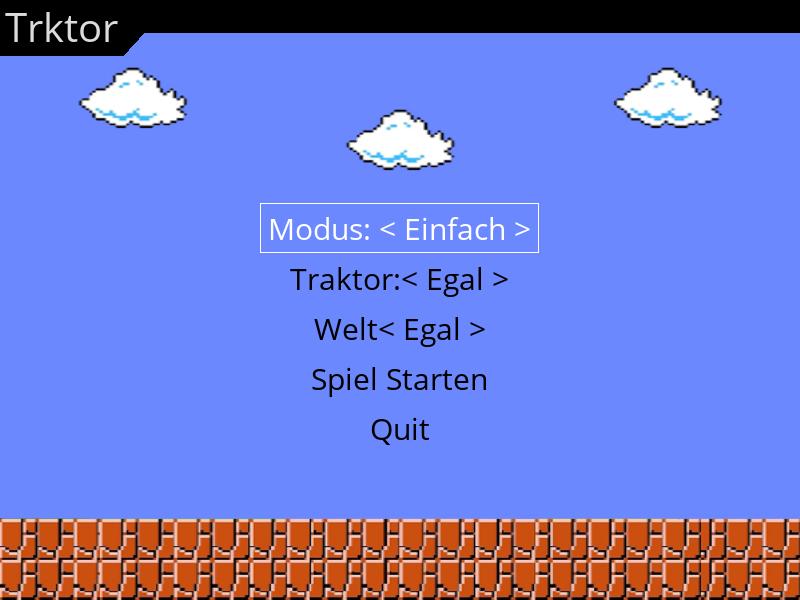
Next year my son will turn 4. I have quit playing computer games for a pretty long time now, but recently i questioned myself: what will be the first computer game hes going to play? Why not create a simple game by myself? Living on the landside, his attention has been drawn to farming machines for quite some time now and that topic never grows old for him, which makes for a perfect game setting. The game logic should be pretty simple: A tiling 2d jump game where you have to make an tractor jump over appearing objects. Different vehicles and backgrounds to choose and a set of lives with randomly generated coins which you have to catch to undo happened failures. Never having done anything related to pygame the learning curve has been quite good so far :-) The part i spent most time with was searching for free assets and pixel art which im able to use. Gimp also made me lose quite some hair while failing to canvas/crop images to the right size so the placements within the different maps matched.. I used pyinstaller to make it somewhat portable (needs to run on windows too) and building the artifacts using github actions was quite a nice experience.. Lets see where this goes next, lots of ideas come to my mind :) image image image image https://github.com/abbbi/trktor

26 October 2022

Russ Allbery: Review: The Golden Enclaves

Review: The Golden Enclaves, by Naomi Novik
Series: The Scholomance #3
Publisher: Del Rey
Copyright: 2022
ISBN: 0-593-15836-9
Format: Kindle
Pages: 408
The Golden Enclaves is the third and concluding book of the Scholomance trilogy and picks up literally the instant after the end of The Last Graduate. The three books form a coherent and complete story that under absolutely no circumstances should be read out of order. This is an impossible review to write because everything is a spoiler. You're only going to read this book if you've read and liked the first two, and in that case you do not want to know a single detail about this book before you read it. The timing of revelations was absolutely perfect; I repeatedly figured out what was going on at exactly the same time that El did, which rarely happens in a book. (And from talking to friends I am not the only one.) If you're still deciding whether to read the series, or are deciding how to prioritize the third book, here are the things you need to know:
  1. Novik nails the ending. Absolutely knocks it out of the park.
  2. Everything is explained, and the explanation was wholly satisfying.
  3. There is more Liesel, and she's even better in the third book.
  4. El's relationship with her mother still works perfectly.
  5. Holy shit.
You can now stop reading this review here and go read, assured that this is the best work of Novik's career to date and has become my favorite fantasy series of all time, something I do not say lightly. For those who want some elaboration, I'll gush some more about this book, but the above is all you need to know. There are so many things that I loved about this series, but the most impressive to me is how each book broadens the scope of the story while maintaining full continuity with the characters and plot. Novik moves from individuals to small groups to, in this book, systems and social forces without dropping a beat and without ever losing the characters. She could have written a series only about El and her friends and it still would have been amazing, but each book takes a risky leap into a broader perspective and she pulls it off every time. This is also one of the most enjoyable first-person perspectives that I have ever read. (I think only Code Name Verity competes, and that's my favorite novel of all time.) Whether you like this series at all will depend on whether you like El, because you spend the entire series inside her head. I loved every moment of it. Novik not infrequently pauses the action to give the reader a page or four of El's internal monologue, and I not only didn't mind, I thought those were the best parts of the book. El is such a deep character: stubborn, thoughtful, sarcastic, impulsive, but also ethical and self-aware in a grudging sort of way that I found utterly compelling to read. And her friends! The friendship dynamics are so great. We sadly don't see as much of Liu in this book (for very good reasons, but I would gladly read an unnecessary sequel novella that existed just to give Liu more time with her friends), but everyone else is here, and in exchange we get much more of Liesel. There should be an Oscar for best supporting character in a novel just so that Liesel can win it. Why are there not more impatient, no-nonsense project managers in fiction? There are a couple of moments between El and Liesel that are among my favorite character interactions in fiction. This is also a series in which the author understands what the characters did in the previous books and the bonds that experience would form, and lets that influence how they interact with the rest of the world. I won't be more specific to avoid spoilers, but the characters worked so hard and were on edge for so long, and I felt like Novik understood the types of relationships that would create in a far deeper and more complex way than most novels. There are several moments in The Golden Enclaves where I paused in reading to admire how perfect the character reactions were, and how striking the contrast was with people who hadn't been through what they went through. The series as a whole is chosen-one fantasy, and if you'd told me that before I read it, I would have grimaced. But this is more evidence (which I should have learned from the romance genre) that tropes, even ones that have been written many times, do not wear out, no matter what critics will try to tell you. There's always room for a great author to pick up the whole idea, turn it sideways, and say "try looking at it from this angle." This is boarding schools, chosen one, and coming of age, with the snarky first-person voice of urban fantasy, and it respects all of those story shapes, is aware of earlier work, and turns them all into something original, often funny, startlingly insightful, and thoroughly engrossing. I am aware that anything I like this much is probably accidentally aimed at my favorite ideas as a reader and my reaction may be partly idiosyncratic. I am not at all objective, and I'm sure not everyone will like it as much as I did. But wow did I ever like this book and this series. Just the best thing I've read in a very, very long time. Highly, highly recommended. (Start at the beginning!) Rating: 10 out of 10

Dirk Eddelbuettel: RQuantLib 0.4.17 on CRAN: Maintenance

A new release 0.4.17 of RQuantLib arrived at CRAN earlier today, and has been uploaded to Debian as well. QuantLib is a very comprehensice free/open-source library for quantitative finance; RQuantLib connects it to the R environment and language. The release of RQuantLib comes five months after the previous maintenance, and brings a somewhat humurous upgrade from a default C++ standard of C++11 to C++14. We waited so long for C++11 to become available for R (which happened eventually when g++ 4.9 was no longer the default on Windows) and now it has become a constraint!! QuantLib 1.28, released today actually switched to C++14 as a minimum required. R also supports this as the default, but we still had C++11 hardwired so this quick maintenance release does away with that.

Changes in RQuantLib version 0.4.17 (2022-10-25)
  • Switch compilation to C++14 which is required by QuantLib 1.28 and, while standard with R 4.2.*, may be needed for R 4.1.*

Courtesy of my CRANberries, there is also a diffstat report for the this release. As always, more detailed information is on the RQuantLib page. Questions, comments etc should go to the new rquantlib-devel mailing list. Issue tickets can be filed at the GitHub repo. If you like this or other open-source work I do, you can now sponsor me at GitHub.

This post by Dirk Eddelbuettel originated on his Thinking inside the box blog. Please report excessive re-aggregation in third-party for-profit settings.

25 October 2022

Arturo Borrero Gonz lez: Netfilter Workshop 2022 summary

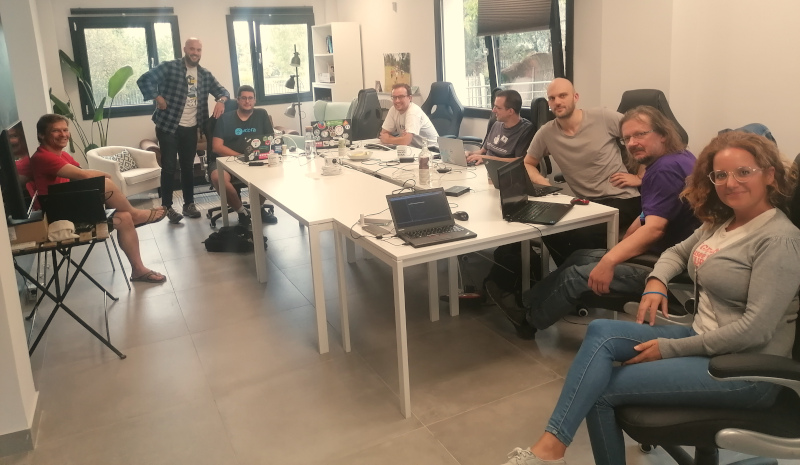
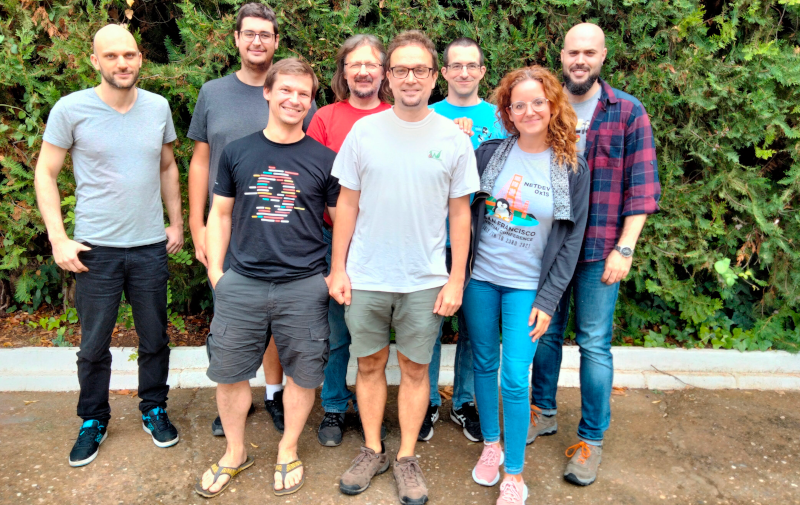
Netfilter logo This is my report from the Netfilter Workshop 2022. The event was held on 2022-10-20/2022-10-21 in Seville, and the venue was the offices of Zevenet. We started on Thursday with Pablo Neira (head of the project) giving a short welcome / opening speech. The previous iteration of this event was in virtual fashion in 2020, two years ago. In the year 2021 we were unable to meet either in person or online. This year, the number of participants was just eight people, and this allowed the setup to be a bit more informal. We had kind of an un-conference style meeting, in which whoever had something prepared just went ahead and opened a topic for debate. In the opening speech, Pablo did a quick recap on the legal problems the Netfilter project had a few years ago, a topic that was settled for good some months ago, in January 2022. There were no news in this front, which was definitely a good thing. Moving into the technical topics, the workshop proper, Pablo started to comment on the recent developments to instrument a way to perform inner matching for tunnel protocols. The current implementation supports VXLAN, IPIP, GRE and GENEVE. Using nftables you can match packet headers that are encapsulated inside these protocols. He mentioned the design and the goals, that was to have a kernel space setup that allows adding more protocols by just patching userspace. In that sense, more tunnel protocols will be supported soon, such as IP6IP, UDP, and ESP. Pablo requested our opinion on whether if nftables should generate the matching dependencies. For example, if a given tunnel is UDP-based, a dependency match should be there otherwise the rule won t work as expected. The agreement was to assist the user in the setup when possible and if not, print clear error messages. By the way, this inner thing is pure stateless packet filtering. Doing inner-conntracking is an open topic that will be worked on in the future. Pablo continued with the next topic: nftables automatic ruleset optimizations. The times of linear ruleset evaluation are over, but some people have a hard time understanding / creating rulesets that leverage maps, sets, and concatenations. This is where the ruleset optimizations kick in: it can transform a given ruleset to be more optimal by using such advanced data structures. This is purely about optimizing the ruleset, not about validating the usefulness of it, which could be another interesting project. There were a couple of problems mentioned, however. The ruleset optimizer can be slow, O(n!) in worst case. And the user needs to use nested syntax. More improvements to come in the future. Next was Stefano Brivio s turn (Red Hat engineer). He had been involved lately in a couple of migrations to nftables, in particular libvirt and KubeVirt. We were pointed to https://libvirt.org/firewall.html, and Stefano walked us through the 3 or 4 different virtual networks that libvirt can create. He evaluated some options to generate efficient rulesets in nftables to instrument such networks, and commented on a couple of ideas: having a null matcher in nftables set expression. Or perhaps having kind of subsets, something similar to a view in a SQL database. The room spent quite a bit of time debating how the nft_lookup API could be extended to support such new search operations. We also discussed if having intermediate facilities such as firewalld could provide the abstraction levels that could make developers more comfortable. Using firewalld also may have the advantage that coordination between different system components writing ruleset to nftables is handled by firewalld itself and developers are freed of the responsibility of doing it right. Next was Fernando F. Mancera (Red Hat engineer). He wanted to improve error reporting when deleting table/chain/rules with nftables. In general, there are some inconsistencies on how tables can be deleted (or flushed). And there seems to be no correct way to make a single table go away with all its content in a single command. The room agreed in that the commands destroy table and delete table should be defined consistently, with the following meanings: This topic diverted into another: how to reload/replace a ruleset but keep stateful information (such as counters). Next was Phil Sutter (Netfilter coreteam member and Red Hat engineer). He was interested in discussing options to make iptables-nft backward compatible. The use case he brought was simple: What happens if a container running iptables 1.8.7 creates a ruleset with features not supported by 1.8.6. A later container running 1.8.6 may fail to operate. Phil s first approach was to attach additional metadata into rules to assist older iptables-nft in decoding and printing the ruleset. But in general, there are no obvious or easy solutions to this problem. Some people are mixing different tooling version, and there is no way all cases can be predicted/covered. iptables-nft already refuses to work in some of the most basic failure scenarios. An other way to approach the issue could be to introduce some kind of support to print raw expressions in iptables-nft, like -m nft xyz. Which feels ugly, but may work. We also explored playing with the semantics of release version numbers. And another idea: store strings in the nft rule userdata area with the equivalent matching information for older iptables-nft. In fact, what Phil may have been looking for is not backwards but forward compatibility. Phil was undecided which path to follow, but perhaps the most common-sense approach is to fall back to a major release version bump (2.x.y) and declaring compatibility breakage with older iptables 1.x.y. That was pretty much it for the first day. We had dinner together and went to sleep for the next day. The room The second day was opened by Florian Westphal (Netfilter coreteam member and Red Hat engineer). Florian has been trying to improve nftables performance in kernels with RETPOLINE mitigations enabled. He commented that several workarounds have been collected over the years to avoid the performance penalty of such mitigations. The basic strategy is to avoid function indirect calls in the kernel. Florian also described how BPF programs work around this more effectively. And actually, Florian tried translating nf_hook_slow() to BPF. Some preliminary benchmarks results were showed, with about 2% performance improvement in MB/s and PPS. The flowtable infrastructure is specially benefited from this approach. The software flowtable infrastructure already offers a 5x performance improvement with regards the classic forwarding path, and the change being researched by Florian would be an addition on top of that. We then moved into discussing the meeting Florian had with Alexei in Zurich. My personal opinion was that Netfilter offers interesting user-facing interfaces and semantics that BPF does not. Whereas BPF may be more performant in certain scenarios. The idea of both things going hand in hand may feel natural for some people. Others also shared my view, but no particular agreement was reached in this topic. Florian will probably continue exploring options on that front. The next topic was opened by Fernando. He wanted to discuss Netfilter involvement in Google Summer of Code and Outreachy. Pablo had some personal stuff going on last year that prevented him from engaging in such projects. After all, GSoC is not fundamental or a priority for Netfilter. Also, Pablo mentioned the lack of support from others in the project for mentoring activities. There was no particular decision made here. Netfilter may be present again in such initiatives in the future, perhaps under the umbrella of other organizations. Again, Fernando proposed the next topic: nftables JSON support. Fernando shared his plan of going over all features and introduce programmatic tests from them. He also mentioned that the nftables wiki was incomplete and couldn t be used as a reference for missing tests. Phil suggested running the nftables python test-suite in JSON mode, which should complain about missing features. The py test suite should cover pretty much all statements and variations on how the nftables expression are invoked. Next, Phil commented on nftables xtables support. This is, supporting legacy xtables extensions in nftables. The most prominent problem was that some translations had some corner cases that resulted in a listed ruleset that couldn t be fed back into the kernel. Also, iptables-to-nftables translations can be sloppy, and the resulting rule won t work in some cases. In general, nft list ruleset nft -f may fail in rulesets created by iptables-nft and there is no trivial way to solve it. Phil also commented on potential iptables-tests.py speed-ups. Running the test suite may take very long time depending on the hardware. Phil will try to re-architect it, so it runs faster. Some alternatives had been explored, including collecting all rules into a single iptables-restore run, instead of hundreds of individual iptables calls. Next topic was about documentation on the nftables wiki. Phil is interested in having all nftables code-flows documented, and presented some improvements in that front. We are trying to organize all developer-oriented docs on a mediawiki portal, but the extension was not active yet. Since I worked at the Wikimedia Foundation, all the room stared at me, so at the end I kind of committed to exploring and enabling the mediawiki portal extension. Note to self: is this perhaps https://www.mediawiki.org/wiki/Portals ? Next presentation was by Pablo. He had a list of assorted topics for quick review and comment. Following this, a new topic was introduced by Stefano. He wanted to talk about nft_set_pipapo, documentation, what to do next, etc. He did a nice explanation of how the pipapo algorithm works for element inserts, lookups, and deletion. The source code is pretty well documented, by the way. He showed performance measurements of different data types being stored in the structure. After some lengthly debate on how to introduce changes without breaking usage for users, he declared some action items: writing more docs, addressing problems with non-atomic set reloads and a potential rework of nft_rbtree. After that, the next topic was kubernetes & netfilter , also by Stefano. Actually, this topic was very similar to what we already discussed regarding libvirt. Developers want to reduce packet matching effort, but also often don t leverage nftables most performant features, like sets, maps or concatenations. Some Red Hat developers are already working on replacing everything with native nftables & firewalld integrations. But some rules generators are very bad. Kubernetes (kube-proxy) is a known case. Developers simply won t learn how to code better ruleset generators. There was a good question floating around: What are people missing on first encounter with nftables? The Netfilter project doesn t have a training or marketing department or something like that. We cannot force-educate developers on how to use nftables in the right way. Perhaps we need to create a set of dedicated guidelines, or best practices, in the wiki for app developers that rely on nftables. Jozsef Kadlecsik (Netfilter coreteam) supported this idea, and suggested going beyond: such documents should be written exclusively from the nftables point of view: stop approaching the docs as a comparison to the old iptables semantics. Related to that last topic, next was Laura Garc a (Zevenet engineer, and venue host). She shared the same information as she presented in the Kubernetes network SIG in August 2020. She walked us through nftlb and kube-nftlb, a proof-of-concept replacement for kube-proxy based on nftlb that can outperform it. For whatever reason, kube-nftlb wasn t adopted by the upstream kubernetes community. She also covered latest changes to nftlb and some missing features, such as integration with nftables egress. nftlb is being extended to be a full proxy service and a more robust overall solution for service abstractions. In a nutshell, nftlb uses a templated ruleset and only adds elements to sets, which is exactly the right usage of the nftables framework. Some other projects should follow its example. The performance numbers are impressive, and from the early days it was clear that it was outperforming classical LVS-DSR by 10x. I used this opportunity to bring a topic that I wanted to discuss. I ve seen some SRE coworkers talking about katran as a replacement for traditional LVS setups. This software is a XDP/BPF based solution for load balancing. I was puzzled about what this software had to offer versus, for example, nftlb or any other nftables-based solutions. I commented on the highlighs of katran, and we discussed the nftables equivalents. nftlb is a simple daemon which does everything using a JSON-enabled REST API. It is already packaged into Debian, ready to use, whereas katran feels more like a collection of steps that you need to run in a certain order to get it working. All the hashing, caching, HA without state sharing, and backend weight selection features of katran are already present in nftlb. To work on a pure L3/ToR datacenter network setting, katran uses IPIP encapsulation. They can t just mangle the MAC address as in traditional DSR because the backend server is on a different L3 domain. It turns out nftables has a nft_tunnel expression that can do this encapsulation for complete feature parity. It is only available in the kernel, but it can be made available easily on the userspace utility too. Also, we discussed some limitations of katran, for example, inability to handle IP fragmentation, IP options, and potentially others not documented anywhere. This seems to be common with XDP/BPF programs, because handling all possible network scenarios would over-complicate the BPF programs, and at that point you are probably better off by using the normal Linux network stack and nftables. In summary, we agreed that nftlb can pretty much offer the same as katran, in a more flexible way. Group photo Finally, after many interesting debates over two days, the workshop ended. We all agreed on the need for extending it to 3 days next time, since 2 days feel too intense and too short for all the topics worth discussing. That s all on my side! I really enjoyed this Netfilter workshop round.
Russ Allbery: Review: A Spaceship Repair Girl Supposedly Named Rachel

Review: A Spaceship Repair Girl Supposedly Named Rachel, by Richard Roberts
Publisher: Mystique Press
Copyright: 2022
ISBN: 1-63789-763-4
Format: Kindle
Pages: 353
Rachel had snuck out of the house to sit on the hill, to write and draw in rare peace and quiet, when a bus fell out of the sky like a meteor and plowed into the ground in front of her. This is quickly followed by a baffling encounter with a seven-foot-tall man with a blunderbuss, two misunderstandings and a storytelling lie, and a hurried invitation to get into the bus and escape before they're both infected by math. That's how Rachel discovers that she's able to make on-the-fly repairs to bicycle-powered spaceships, and how she ends up at the Lighthouse of Ceres. The title comes from Rachel's initial hesitation to give her name, which propagates through the book to everyone she meets as certainty that Rachel isn't really her name. I enjoyed this running gag way more than I expected to. I don't read enough young adult and middle-grade books to be entirely clear on the boundaries, but this felt very middle-grade. It has a headlong plot, larger-than-life characters, excitingly imaginative scenery (such as a giant space lighthouse dwarfing the asteroid that it's attached to), a focus on friendship, and no romance. This is, to be clear, not a complaint. But it's a different feel than my normal fare, and there were a few places where I was going one direction and the book went another. The conceit of this book is that Earth is unique in the solar system in being stifled by the horrific weight of math, which infects anyone who visits and makes the routine wonders of other planets impossible. Other planets have their own styles and mythos (Saturn is full of pirates, the inhabitants of Venus are space bunnies with names like Passionfruit Nectar Ecstasy), but throughout the rest of the solar system, belief, style, and story logic reign supreme. That means Rachel's wild imagination and reflexive reliance on tall tales makes her surprisingly powerful. The first wild story she tells, to the man who crashed on earth, shapes most of the story. She had written in her sketchbook that it was the property of the Witch Queen of Eloquent Verbosity and Grandiose Ornamentation, and when challenged on it, says that she stole it to cure her partner. Much to her surprise, everyone outside of Earth takes this completely seriously. Also much to her surprise, her habit of sketching spaceships and imaginative devices makes her a natural spaceship mechanic, a skill in high demand. Some of the story is set on Ceres, a refuge for misfits with hearts of gold. That's where Rachel meets Wrench, a kobold who is by far my favorite character of the book and the one relationship that I thought had profound emotional depth. Rachel's other adventures are set off by the pirate girl Violet (she's literally purple), who is the sort of plot-provoking character that I think only works in middle-grade fiction. By normal standards, Violet's total lack of respect for other people's boundaries or consent would make her more of a villain. Here, while it often annoys Rachel, it's clear that both Rachel and the book take Violet's steamroller personality in good fun, more like the gentle coercion between neighborhood friends trying to pull each other into games. I still got rather tired of Violet, though, which caused me a few problems around the middle of the book. There's a bit of found family here (some of it quite touching), a lot of adventures, a lot of delightful spaceship repair, and even some more serious plot involving the actual Witch Queen of Charon. There is a bit of a plot arc to give some structure to the adventures, but this is not the book to read if you're looking for complex plotting or depth. I thought the story fell apart a bit at the tail end, with a conflict that felt like it was supposed to be metaphorical and then never resolved for me into something concrete. I was expecting Rachel to eventually have to do more introspection and more direct wrestling with her identity, but the resolution felt a bit superficial and unsatisfying. Reading this as an adult, I found it odd but fun. I wanted more from the ending, and I was surprised that Roberts does not do more to explain to the reader why Rachel does not regret leaving Earth and her family behind. It feels like something Rachel will have to confront eventually, but this is not the book for it. Instead we get some great friendships (some of which I agreed with wholeheartedly, and some of which I found annoying) and an imaginative, chaotic universe that Rachel takes to like a fish to water. The parts of the story focused on her surprising competence (and her delight in her own competence) were my favorites. The book this most reminds me of is Norton Juster's The Phantom Tollbooth. It is, to be clear, nowhere near as good as The Phantom Tollbooth, which is a very high bar, and it's not as focused on puns. But it has the same sense of internal logic and the same tendency to put far more weight on belief and stories than our world does, and to embrace the resulting chaos. I'm not sure this will be anyone's favorite book (although I'm also not the target age), but I enjoyed reading it. It was a great change of pace after Nona the Ninth. Recommended if you're in the mood for some space fantasy that doesn't take itself seriously. Rating: 7 out of 10

Dirk Eddelbuettel: nanotime 0.3.7 on CRAN: Enhancements

A new version of our nanotime package arrived at CRAN today as version 0.3.7. nanotime relies on the RcppCCTZ package (as well as the RcppDate package for additional C++ operations) and offers efficient high(er) resolution time parsing and formatting up to nanosecond resolution, and the bit64 package for the actual integer64 arithmetic. Initially implemented using the S3 system, it has benefitted greatly from a rigorous refactoring by Leonardo who not only rejigged nanotime internals in S4 but also added new S4 types for periods, intervals and durations. This release adds a few more operators, plus some other fixes, that were contributed in several PRs by Trevor Davis. The NEWS snippet has the full details.

Changes in version 0.3.7 (2022-10-23)
  • Update mkdocs for material docs generator (Dirk in #102)
  • Use inherits() instead comparing to class() (Trevor Davis in #104)
  • Set default arguments in nanoduration() (Trevor Davis in #105)
  • Add as.nanoduration.difftime() support (Trevor Davis in #106)
  • Add +/- methods for nanotime and difftime objects (Trevor Davis in #110 closing #108, #107)

Thanks to my CRANberries there is also a diff to the previous version. More details and examples are at the nanotime page; code, issue tickets etc at the GitHub repository and all documentation is provided at the nanotime documentation site. If you like this or other open-source work I do, you can now sponsor me at GitHub.

This post by Dirk Eddelbuettel originated on his Thinking inside the box blog. Please report excessive re-aggregation in third-party for-profit settings.

24 October 2022

Russ Allbery: Review: Nona the Ninth

Review: Nona the Ninth, by Tamsyn Muir
Series: The Locked Tomb #3
Publisher: Tordotcom
Copyright: 2022
ISBN: 1-250-85412-1
Format: Kindle
Pages: 480
Nona the Ninth is the third book of the Locked Tomb series and entirely pointless to read if you have not read the series to date. It completely spoils the previous books, assuming you would be able to figure out who these people were and why you should care about them. This is only for readers who are already invested. This series was originally supposed to be a trilogy, and this book was supposed to be Alecto the Ninth. Muir says in the acknowledgments, and has said at more length elsewhere, that Nona changed all of her plans and demanded her own book. Hence this book, postponing the end of the series and lengthening it to four books. After reading it, I understand why Muir decided to write a whole book about Nona. She's an interesting character in ways that wouldn't have come out if she was a small part of the concluding book. Unfortunately, it's also obvious that this book wasn't part of the plan. It's not entirely correct to say that Nona the Ninth is devoid of series plot, but the plot advances very little, and mostly at the end. Instead, we get Nona, who is physically a teenager who acts like someone several years younger, most of the time. She lives with her family (who I won't name to avoid spoilers for Harrow the Ninth), helps at a local school (although her level of understanding is about that of the students), and is a member of a kid's gang. She also has dreams every night about a woman with a painted face, dreams her family are very interested in. This sounds weirdly normal for this series, but Nona and her family live in a war-torn city full of fighting, refugees, and Blood of Eden operatives. The previous books of the series took place in the rarefied spaces of the Houses. Here we see a bit of the rest of the universe, although it's not obvious at first what we're looking at and who these people are. Absolutely no concession is made to the reader's fading memory, so expect to need either a re-read, help from friends with better memories, or quality time with a wiki. And, well, good luck with the latter if you've not already read this book, since the Locked Tomb Wiki has now been updated with spoilers for Nona. The other challenge, besides memory for the plot, is that this book is told from a tight third-person focus on Nona, and Nona is not a very reliable narrator. She doesn't lie, exactly, but she mostly doesn't understand what's going on, often doesn't care, and tends not to focus on what the reader is the most interested in. Nona is entirely uninterested in developing the series plot. Her focus is on her child friends (who are moderately interesting but not helpful if you're trying to figure out the rest of the story) and the other rhythms of a strange life that's normal to her. For me at least, that meant the first half of this book involved a lot of "what the heck is going on and why do I care about any of this?" I liked Harrow the Ninth a lot, despite how odd and ambiguous it was, but I was ready for revelations and plot coherence and was not thrilled by additional complexity, odd allusions, and half-revealed details. I didn't mind the layers of complexity added on by Harrow, but for me Nona was a bit too much and I started getting frustrated rather than intrigued. We do, at last, get most of the history of this universe, including the specific details of how John became God Emperor and how the Houses were founded. That happens in odd interludes with a forced and somewhat artificial writing style, but it's more straightforward and comprehensible than I feared at first. The pace of the story picks up considerably towards the end of the book, finally providing the plot momentum that I was hoping for. Unfortunately, it also gets more cryptic at the end of the book in ways that I didn't enjoy. The epilogue, which is vital to understanding the climax of the novel, took me three readings before I think I understood what happened. If you preferred the clarity of Gideon the Ninth, be warned that Nona is more like Harrow and Muir seems to be making the plot more cryptic as she goes. I am hoping this trend reverses in Alecto the Ninth. This book made me grumpy. Nona is okay as a character, but the characters in this series that I really like mostly do not appear or appear in heavily damaged and depressing forms. Muir does bring back a couple of my favorite characters, but then does something to them that's a major spoiler but that I think was intended to be a wonderful moment for them and instead left me completely cold and unhappy. There are still some great moments of humor, but overall it felt more strained. That said, I still had tons of fun discussing this book and its implications with friends who were reading it at the same time. I think that is the best way to read this series. Muir is being intentionally confusing and is inserting a blizzard of references. Some of them are pop culture jokes, but some of them are deep plot clues, and I'm not up to deciphering them all by myself. Working through them with other people is much more fun. (It also gives me an opportunity to feel smug about guessing correctly what was happening at the end of Harrow the Ninth, when I'm almost never the person who makes correct guesses about that sort of thing.) I think your opinion of this one will depend on how much you like Nona as a character, how much patience you have for the postponement of plot resolution, and how much tolerance you have for even more cryptic references. I'm still invested in this series until the end, but this was not my favorite installment. I suspect it (and the rest of the series) would benefit immensely from re-reading, but life is short and my reading backlog is long. What Muir is doing is interesting and has a lot of depth, but she's asking quite a lot of the reader. Content warning: Nona has an eating disorder, which occupied rather more of my mental space while reading this book than I was comfortable with. Followed by Alecto the Ninth, which does not have a publication date scheduled as of this writing. Rating: 7 out of 10

19 October 2022

Petter Reinholdtsen: Managing and using ONVIF IP cameras with Linux

Recently I have been looking at how to control and collect data from a handful IP cameras using Linux. I both wanted to change their settings and to make their imagery available via a free software service under my control. Here is a summary of the tools I found. First I had to identify the cameras and their protocols. As far as I could tell, they were using some SOAP looking protocol and their internal web server seem to only work with Microsoft Internet Explorer with some proprietary binary plugin, which in these days of course is a security disaster and also made it impossible for me to use the camera web interface. Luckily I discovered that the SOAP looking protocol is actually following the ONVIF specification, which seem to be supported by a lot of IP cameras these days. Once the protocol was identified, I was able to find what appear to be the most popular way to configure ONVIF cameras, the free software Windows tool named ONVIF Device Manager. Lacking any other options at the time, I tried unsuccessfully to get it running using Wine, but was missing a dotnet 40 library and I found no way around it to run it on Linux. The next tool I found to configure the cameras were a non-free Linux Qt client ONVIF Device Tool. I did not like its terms of use, so did not spend much time on it. To collect the video and make it available in a web interface, I found the Zoneminder tool in Debian. A recent version was able to automatically detect and configure ONVIF devices, so I could use it to set up motion detection in and collection of the camera output. I had initial problems getting the ONVIF autodetection to work, as both Firefox and Chromium refused the inter-tab communication being used by the Zoneminder web pages, but managed to get konqueror to work. Apparently the "Enhanced Tracking Protection" in Firefox cause the problem. I ended up upgrading to the Bookworm edition of Zoneminder in the process to try to fix the issue, and believe the problem might be solved now. In the process I came across the nice Linux GUI tool ONVIF Viewer allowing me to preview the camera output and validate the login passwords required. Sadly its author has grown tired of maintaining the software, so it might not see any future updates. Which is sad, as the viewer is sightly unstable and the picture tend to lock up. Note, this lockup might be due to limitations in the cameras and not the viewer implementation. I suspect the camera is only able to provide pictures to one client at the time, and the Zoneminder feed might interfere with the GUI viewer. I have asked for the tool to be included in Debian. Finally, I found what appear to be very nice Linux free software replacement for the Windows tool, named libonvif. It provide a C library to talk to ONVIF devices as well as a command line and GUI tool using the library. Using the GUI tool I was able to change the admin passwords and update other settings of the cameras. I have asked for the package to be included in Debian. As usual, if you use Bitcoin and want to show your support of my activities, please send Bitcoin donations to my address 15oWEoG9dUPovwmUL9KWAnYRtNJEkP1u1b. Update 2022-10-20: Since my initial publication of this text, I got several suggestions for more free software Linux tools. There is a ONVIF python library (already requested into Debian) and a python 3 fork using a different SOAP dependency. There is also support for ONVIF in Home Assistant, and there is an alternative to Zoneminder called Shinobi. The latter two are not included in Debian either. I have not tested any of these so far.

18 October 2022

Dirk Eddelbuettel: digest 0.6.30 on CRAN: More Package Maintenance

Release 0.6.30 of the digest package arrived at CRAN earlier today, and was just uploaded to Debian as well. digest creates hash digests of arbitrary R objects (using the md5, sha-1, sha-256, sha-512, crc32, xxhash32, xxhash64, murmur32, spookyhash, and blake3 algorithms) permitting easy comparison of R language objects. It is a mature and widely-used as many tasks may involve caching of objects for which it provides convenient general-purpose hash key generation to quickly identify the various objects. This release contains two tiny changes on old standard C code to appease the new / upcoming clang-15 release now used by CRAN in their forward-looking checks. My CRANberries provides the usual summary of changes to the previous version. For questions or comments use the issue tracker off the GitHub repo. If you like this or other open-source work I do, you can now sponsor me at GitHub.

This post by Dirk Eddelbuettel originated on his Thinking inside the box blog. Please report excessive re-aggregation in third-party for-profit settings.

16 October 2022

Colin Watson: Reproducible man-db databases

I ve released man-db 2.11.0 (announcement, NEWS), and uploaded it to Debian unstable. The biggest chunk of work here was fixing some extremely long-standing issues with how the database is built. Despite being in the package name, man-db s database is much less important than it used to be: most uses of man(1) haven t required it in a long time, and both hardware and software improvements mean that even some searches can be done by brute force without needing prior indexing. However, the database is still needed for the whatis(1) and apropos(1) commands. The database has a simple format - no relational structure here, it s just a simple key-value database using old-fashioned DBM-like interfaces and composing a few fields to form values - but there are a number of subtleties involved. The issues tend to amount to this: what does a manual page name mean? At first glance it might seem simple, because you have file names that look something like /usr/share/man/man1/ls.1.gz and that s obviously ls(1). Some pages are symlinks to other pages (which we track separately because it makes it easier to figure out which entries to update when the contents of the file system change), and sometimes multiple pages are even hard links to the same file. The real complications come with whatis references . Pages can list a bunch of names in their NAME section, and the historical expectation is that it should be possible to use those names as arguments to man(1) even if they don t also appear in the file system (although Debian policy has deprecated relying on this for some time). Not only does that mean that man(1) sometimes needs to consult the database, but it also means that the database is inherently more complicated, since a page might list something in its NAME section that conflicts with an actual file name in the file system, and now you need a priority system to resolve ambiguities. There are some other possible causes of ambiguity as well. The people working on reproducible builds in Debian branched out to the related challenge of reproducible installations some time ago: can you take a collection of packages, bootstrap a file system image from them, and reproduce that exact same image somewhere else? This is useful for the same sorts of reasons that reproducible builds are useful: it lets you verify that an image is built from the components it s supposed to be built from, and doesn t contain any other skulduggery by accident or design. One of the people working on this noticed that man-db s database files were an obstacle to that: in particular, the exact contents of the database seemed to depend on the order in which files were scanned when building it. The reporter proposed solving this by processing files in sorted order, but I wasn t keen on that approach: firstly because it would mean we could no longer process files in an order that makes it more efficient to read them all from disk (still valuable on rotational disks), but mostly because the differences seemed to point to other bugs. Having understood this, there then followed several late nights of very fiddly work on the details of how the database is maintained. None of this was conceptually difficult: it mainly amounted to ensuring that we maintain a consistent well-order for different entries that we might want to insert for a given database key, and that we consider the same names for insertion regardless of the order in which we encounter files. As usual, the tricky bit is making sure that we have the right data structures to support this. man-db is written in C which is not very well-supplied with built-in data structures, and originally much of the code was written in a style that tried to minimize memory allocations; this came at the cost of ownership and lifetime often being rather unclear, and it was often difficult to make changes without causing leaks or double-frees. Over the years I ve been gradually introducing better encapsulation to make things easier to follow, and I had to do another round of that here. There were also some problems with caching being done at slightly the wrong layer: we need to make use of a trace of the chain of links followed to resolve a page to its ultimate source file, but we were incorrectly caching that trace and reusing it for any link to the same file, with incorrect results in many cases. Oh, and after doing all that I found that the on-disk representation of a GDBM database is insertion-order-dependent, so I ended up having to manually reorganize the database at the end by reading it all in and writing it all back out in sorted order, which feels really weird to me coming from spending most of my time with PostgreSQL these days. Fortunately the database is small so this takes negligible time. None of this is particularly glamorous work, but it paid off:
# export SOURCE_DATE_EPOCH="$(date +%s)"
# mkdir emptydir disorder
# disorderfs --multi-user=yes --shuffle-dirents=yes --reverse-dirents=no emptydir disorder
# export TMPDIR="$(pwd)/disorder"
# mmdebstrap --variant=standard --hook-dir=/usr/share/mmdebstrap/hooks/merged-usr \
      unstable out1.tar
# mmdebstrap --variant=standard --hook-dir=/usr/share/mmdebstrap/hooks/merged-usr \
      unstable out2.tar
# cmp out1.tar out2.tar
# echo $?
0

14 October 2022

Simon Josefsson: On language bindings & Relaunching Guile-GnuTLS

The Guile bindings for GnuTLS has been part of GnuTLS since spring 2007 when Ludovic Court s contributed it after some initial discussion. I have been looking into getting back to do GnuTLS coding, and during a recent GnuTLS meeting one topic was Guile bindings. It seemed like a fairly self-contained project to pick up on. It is interesting to re-read the old thread when this work was included: some of the concerns brought up there now have track record to be evaluated on. My opinion that the cost of introducing a new project per language binding today is smaller than the cost of maintaining language bindings as part of the core project. I believe the cost/benefit ratio has changed during the past 15 years: introducing a new project used to come with a significant cost but this is no longer the case, as tooling and processes for packaging have improved. I have had similar experience with Java, C# and Emacs Lisp bindings for GNU Libidn as well, where maintaining them centralized slow down the pace of updates. Andreas Metzler pointed to a similar conclusion reached by Russ Allbery. There are many ways to separate a project into two projects; just copying the files into a new git repository would have been the simplest and was my original plan. However Ludo mentioned git-filter-branch in an email, and the idea of keeping all git history for some of the relevant files seemed worth pursuing to me. I quickly found git-filter-repo which appears to be the recommend approach, and experimenting with it I found a way to filter out the GnuTLS repo into a small git repository that Guile-GnuTLS could be based on. The commands I used were the following, if you want to reproduce things.
$ git clone https://gitlab.com/gnutls/gnutls.git guile-gnutls
$ cd guile-gnutls/
$ git checkout f5dcbdb46df52458e3756193c2a23bf558a3ecfd
$ git-filter-repo --path guile/ --path m4/guile.m4 --path doc/gnutls-guile.texi --path doc/extract-guile-c-doc.scm --path doc/cha-copying.texi --path doc/fdl-1.3.texi
I debated with myself back and forth whether to include some files that would be named the same in the new repository but would share little to no similar lines, for example configure.ac, Makefile.am not to mention README and NEWS. Initially I thought it would be nice to preserve the history for all lines that went into the new project, but this is a subjective judgement call. What brought me over to a more minimal approach was that the contributor history and attribution would be quite strange for the new repository: Should Guile-GnuTLS attribute the work of the thousands of commits to configure.ac which had nothing to do with Guile? Should the people who wrote that be mentioned as contributor of Guile-GnuTLS? I think not. The next step was to get a reasonable GitLab CI/CD pipeline up, to make sure the project builds on some free GNU/Linux distributions like Trisquel and PureOS as well as the usual non-free distributions like Debian and Fedora to have coverage of dpkg and rpm based distributions. I included builds on Alpine and ArchLinux as well, because they tend to trigger other portability issues. I wish there were GNU Guix docker images available for easy testing on that platform as well. The GitLab CI/CD rules for a project like this are fairly simple. To get things out of the door, I tagged the result as v3.7.9 and published a GitLab release page for Guile-GnuTLS that includes OpenPGP-signed source tarballs manually uploaded built on my laptop. The URLs for these tarballs are not very pleasant to work with, and discovering new releases automatically appears unreliable, but I don t know of a better approach. To finish this project, I have proposed a GnuTLS merge request to remove all Guile-related parts from the GnuTLS core. Doing some GnuTLS-related work again felt nice, it was quite some time ago so thank you for giving me this opportunity. Thoughts or comments? Happy hacking!

Gunnar Wolf: Learning some Rust with Lars!

A couple of weeks ago, I read a blog post by former Debian Developer Lars Wirzenius offering a free basic (6hr) course on the Rust language to interested free software and open source software programmers. I know Lars offers training courses in programming, and besides knowing him for ~20 years and being proud to consider us to be friends, have worked with him in a couple of projects (i.e. he is upstream for vmdb2, which I maintain in Debian and use for generating the Raspberry Pi Debian images) He is a talented programmer, and a fun guy to be around. I was admitted to the first cohort of students of this course (please note I m not committing him to run free courses ever again! He has said he would consider doing so, specially to offer a different time better suited for people in Asia). I have wanted to learn some Rust for quite some time. About a year ago, I bought a copy of The Rust Programming Language, the canonical book for learning the language, and started reading it But lacked motivation and lost steam halfway through, and without having done even a simple real project beyond the simple book exercises. How has this been? I have enjoyed the course. I must admit I did expect it to be more hands-on from the beginning, but Rust is such a large language and it introduces so many new, surprising concepts. Session two did have two somewhat simple hands-on challenges; by saying they were somewhat simple does not mean we didn t have to sweat to get them to compile and work correctly! I know we will finish this Saturday, and I ll still be a complete newbie to Rust. I know the only real way to wrap my head around a language is to actually have a project that uses it And I have some ideas in mind. However, I don t really feel confident to approach an already existing project and start meddling with it, trying to contribute. What does Rust have that makes it so different? Bufff Variable ownership (borrow checking) and values lifetimes are the most obvious salient idea, but they are relatively simple, as you just cannot forget about them. But understanding (and adopting) idiomatic constructs such as the pervasive use of enums, understanding that errors always have to be catered for by using expect() and Result<T,E> It will take some time to be at ease developing in it, if I ever reach that stage! Oh, FWIW Interested related reading. I am halfway through an interesting article, published in March in the Communications of the ACM magazine, titled Here We Go Again: Why Is It Difficult for Developers to Learn Another Programming Language? , that presents an interesting point we don t always consider: If I m a proficient programmer in the X programming language and want to use the Y programming language, learning it Should be easier for me than for the casual bystander, or not? After all, I already have a background in programming! But it happens that mental constructs we build for a given language might hamper our learning of a very different one. This article presents three interesting research questions:

  1. Does cross-language interference occur?
  2. How do experienced programmers learn new languages?
  3. What do experienced programmers find confusing in new languages?
I m far from reaching the conclusions, but so far, it s been a most interesting read. Anyway, to wrap up Thanks Lars! I am learning (although at a pace that is not magically quick But I am aware of the steep learning curve of the language) quite a bit of a very interesting topic, and I m also enjoying the time I spend in front of my computer on Saturday.

7 October 2022

Reproducible Builds: Reproducible Builds in September 2022

Welcome to the September 2022 report from the Reproducible Builds project! In our reports we try to outline the most important things that we have been up to over the past month. As a quick recap, whilst anyone may inspect the source code of free software for malicious flaws, almost all software is distributed to end users as pre-compiled binaries. If you are interested in contributing to the project, please visit our Contribute page on our website.
David A. Wheeler reported to us that the US National Security Agency (NSA), Cybersecurity and Infrastructure Security Agency (CISA) and the Office of the Director of National Intelligence (ODNI) have released a document called Securing the Software Supply Chain: Recommended Practices Guide for Developers (PDF). As David remarked in his post to our mailing list, it expressly recommends having reproducible builds as part of advanced recommended mitigations . The publication of this document has been accompanied by a press release.
Holger Levsen was made aware of a small Microsoft project called oss-reproducible. Part of, OSSGadget, a larger collection of tools for analyzing open source packages , the purpose of oss-reproducible is to:
analyze open source packages for reproducibility. We start with an existing package (for example, the NPM left-pad package, version 1.3.0), and we try to answer the question, Do the package contents authentically reflect the purported source code?
More details can be found in the README.md file within the code repository.
David A. Wheeler also pointed out that there are some potential upcoming changes to the OpenSSF Best Practices badge for open source software in relation to reproducibility. Whilst the badge programme has three certification levels ( passing , silver and gold ), the gold level includes the criterion that The project MUST have a reproducible build . David reported that some projects have argued that this reproducibility criterion should be slightly relaxed as outlined in an issue on the best-practices-badge GitHub project. Essentially, though, the claim is that the reproducibility requirement doesn t make sense for projects that do not release built software, and that timestamp differences by themselves don t necessarily indicate malicious changes. Numerous pragmatic problems around excluding timestamps were raised in the discussion of the issue.
Sonatype, a pioneer of software supply chain management , issued a press release month to report that they had found:
[ ] a massive year-over-year increase in cyberattacks aimed at open source project ecosystems. According to early data from Sonatype s 8th annual State of the Software Supply Chain Report, which will be released in full this October, Sonatype has recorded an average 700% jump in repository attacks over the last three years.
More information is available in the press release.
A number of changes were made to the Reproducible Builds website and documentation this month, including Chris Lamb adding a redirect from /projects/ to /who/ in order to keep old or archived links working [ ], Jelle van der Waa added a Rust programming language example for SOURCE_DATE_EPOCH [ ][ ] and Mattia Rizzolo included Protocol Labs amongst our project-level sponsors [ ].

Debian There was a large amount of reproducibility work taking place within Debian this month:
  • The nfft source package was removed from the archive, and now all packages in Debian bookworm now have a corresponding .buildinfo file. This can be confirmed and tracked on the associated page on the tests.reproducible-builds.org site.
  • Vagrant Cascadian announced on our mailing list an informal online sprint to help clear the huge backlog of reproducible builds patches submitted by performing NMU (Non-Maintainer Uploads). The first such sprint took place on September 22nd with the following results:
    • Holger Levsen:
      • Mailed #1010957 in man-db asking for an update and whether to remove the patch tag for now. This was subsequently removed and the maintainer started to address the issue.
      • Uploaded gmp to DELAYED/15, fixing #1009931.
      • Emailed #1017372 in plymouth and asked for the maintainer s opinion on the patch. This resulted in the maintainer improving Vagrant s original patch (and uploading it) as well as filing an issue upstream.
      • Uploaded time to DELAYED/15, fixing #983202.
    • Vagrant Cascadian:
      • Verify and updated patch for mylvmbackup (#782318)
      • Verified/updated patches for libranlip. (#788000, #846975 & #1007137)
      • Uploaded libranlip to DELAYED/10.
      • Verified patch for cclive. (#824501)
      • Uploaded cclive to DELAYED/10.
      • Vagrant was unable to reproduce the underlying issue within #791423 (linuxtv-dvb-apps) and so the bug was marked as done .
      • Researched #794398 (in clhep).
    The plan is to repeat these sprints every two weeks, with the next taking place on Thursday October 6th at 16:00 UTC on the #debian-reproducible IRC channel.
  • Roland Clobus posted his 13th update of the status of reproducible Debian ISO images on our mailing list. During the last month, Roland ensured that the live images are now automatically fed to openQA for automated testing after they have been shown to be reproducible. Additionally Roland asked on the debian-devel mailing list about a way to determine the canonical timestamp of the Debian archive. [ ]
  • Following up on last month s work on reproducible bootstrapping, Holger Levsen filed two bugs against the debootstrap and cdebootstrap utilities. (#1019697 & #1019698)
Lastly, 44 reviews of Debian packages were added, 91 were updated and 17 were removed this month adding to our knowledge about identified issues. A number of issue types have been updated too, including the descriptions of cmake_rpath_contains_build_path [ ], nondeterministic_version_generated_by_python_param [ ] and timestamps_in_documentation_generated_by_org_mode [ ]. Furthermore, two new issue types were created: build_path_used_to_determine_version_or_package_name [ ] and captures_build_path_via_cmake_variables [ ].

Other distributions In openSUSE, Bernhard M. Wiedemann published his usual openSUSE monthly report.

diffoscope diffoscope is our in-depth and content-aware diff utility. Not only can it locate and diagnose reproducibility issues, it can provide human-readable diffs from many kinds of binary formats. This month, Chris Lamb prepared and uploaded versions 222 and 223 to Debian, as well as made the following changes:
  • The cbfstools utility is now provided in Debian via the coreboot-utils package so we can enable that functionality within Debian. [ ]
  • Looked into Mach-O support.
  • Fixed the try.diffoscope.org service by addressing a compatibility issue between glibc/seccomp that was preventing the Docker-contained diffoscope instance from spawning any external processes whatsoever [ ]. I also updated the requirements.txt file, as some of the specified packages were no longer available [ ][ ].
In addition Jelle van der Waa added support for file version 5.43 [ ] and Mattia Rizzolo updated the packaging:
  • Also include coreboot-utils in the Build-Depends and Test-Depends fields so that it is available for tests. [ ]
  • Use pep517 and pip to load the requirements. [ ]
  • Remove packages in Breaks/Replaces that have been obsoleted since the release of Debian bullseye. [ ]

Reprotest reprotest is our end-user tool to build the same source code twice in widely and deliberate different environments, and checking whether the binaries produced by the builds have any differences. This month, reprotest version 0.7.22 was uploaded to Debian unstable by Holger Levsen, which included the following changes by Philip Hands:
  • Actually ensure that the setarch(8) utility can actually execute before including an architecture to test. [ ]
  • Include all files matching *.*deb in the default artifact_pattern in order to archive all results of the build. [ ]
  • Emit an error when building the Debian package if the Debian packaging version does not patch the Python version of reprotest. [ ]
  • Remove an unneeded invocation of the head(1) utility. [ ]

Upstream patches The Reproducible Builds project detects, dissects and attempts to fix as many currently-unreproducible packages as possible. We endeavour to send all of our patches upstream where appropriate. This month, we wrote a large number of such patches, including:

Testing framework The Reproducible Builds project runs a significant testing framework at tests.reproducible-builds.org in order to check packages and other artifacts for reproducibility. This month, however, the following changes were made:
  • Holger Levsen:
    • Add a job to build reprotest from Git [ ] and use the correct Git branch when building it [ ].
  • Mattia Rizzolo:
    • Enable syncing of results from building live Debian ISO images. [ ]
    • Use scp -p in order to preserve modification times when syncing live ISO images. [ ]
    • Apply the shellcheck shell script analysis tool. [ ]
    • In a build node wrapper script, remove some debugging code which was messing up calling scp(1) correctly [ ] and consquently add support to use both scp -p and regular scp [ ].
  • Roland Clobus:
    • Track and handle the case where the Debian archive gets updated between two live image builds. [ ]
    • Remove a call to sudo(1) as it is not (or no longer) required to delete old live-build results. [ ]

Contact As ever, if you are interested in contributing to the Reproducible Builds project, please visit our Contribute page on our website. However, you can get in touch with us via:

6 October 2022

Matthew Garrett: Cloud desktops aren't as good as you'd think

Fast laptops are expensive, cheap laptops are slow. But even a fast laptop is slower than a decent workstation, and if your developers want a local build environment they're probably going to want a decent workstation. They'll want a fast (and expensive) laptop as well, though, because they're not going to carry their workstation home with them and obviously you expect them to be able to work from home. And in two or three years they'll probably want a new laptop and a new workstation, and that's even more money. Not to mention the risks associated with them doing development work on their laptop and then drunkenly leaving it in a bar or having it stolen or the contents being copied off it while they're passing through immigration at an airport. Surely there's a better way?

This is the thinking that leads to "Let's give developers a Chromebook and a VM running in the cloud". And it's an appealing option! You spend far less on the laptop, and the VM is probably cheaper than the workstation - you can shut it down when it's idle, you can upgrade it to have more CPUs and RAM as necessary, and you get to impose all sorts of additional neat security policies because you have full control over the network. You can run a full desktop environment on the VM, stream it to a cheap laptop, and get the fast workstation experience on something that weighs about a kilogram. Your developers get the benefit of a fast machine wherever they are, and everyone's happy.

But having worked at more than one company that's tried this approach, my experience is that very few people end up happy. I'm going to give a few reasons here, but I can't guarantee that they cover everything - and, to be clear, many (possibly most) of the reasons I'm going to describe aren't impossible to fix, they're simply not priorities. I'm also going to restrict this discussion to the case of "We run a full graphical environment on the VM, and stream that to the laptop" - an approach that only offers SSH access is much more manageable, but also significantly more restricted in certain ways. With those details mentioned, let's begin.

The first thing to note is that the overall experience is heavily tied to the protocol you use for the remote display. Chrome Remote Desktop is extremely appealing from a simplicity perspective, but is also lacking some extremely key features (eg, letting you use multiple displays on the local system), so from a developer perspective it's suboptimal. If you read the rest of this post and want to try this anyway, spend some time working with your users to find out what their requirements are and figure out which technology best suits them.

Second, let's talk about GPUs. Trying to run a modern desktop environment without any GPU acceleration is going to be a miserable experience. Sure, throwing enough CPU at the problem will get you past the worst of this, but you're still going to end up with users who need to do 3D visualisation, or who are doing VR development, or who expect WebGL to work without burning up every single one of the CPU cores you so graciously allocated to their VM. Cloud providers will happily give you GPU instances, but that's going to cost more and you're going to need to re-run your numbers to verify that this is still a financial win. "But most of my users don't need that!" you might say, and we'll get to that later on.

Next! Video quality! This seems like a trivial point, but if you're giving your users a VM as their primary interface, then they're going to do things like try to use Youtube inside it because there's a conference presentation that's relevant to their interests. The obvious solution here is "Do your video streaming in a browser on the local system, not on the VM" but from personal experience that's a super awkward pain point! If I click on a link inside the VM it's going to open a browser there, and now I have a browser in the VM and a local browser and which of them contains the tab I'm looking for WHO CAN SAY. So your users are going to watch stuff inside their VM, and re-compressing decompressed video is going to look like shit unless you're throwing a huge amount of bandwidth at the problem. And this is ignoring the additional irritation of your browser being unreadable while you're rapidly scrolling through pages, or terminal output from build processes being a muddy blur of artifacts, or the corner case of "I work for Youtube and I need to be able to examine 4K streams to determine whether changes have resulted in a degraded experience" which is a very real job and one that becomes impossible when you pass their lovingly crafted optimisations through whatever codec your remote desktop protocol has decided to pick based on some random guesses about the local network, and look everyone is going to have a bad time.

The browser experience. As mentioned before, you'll have local browsers and remote browsers. Do they have the same security policy? Who knows! Are all the third party services you depend on going to be ok with the same user being logged in from two different IPs simultaneously because they lost track of which browser they had an open session in? Who knows! Are your users going to become frustrated? Who knows oh wait no I know the answer to this one, it's "yes".

Accessibility! More of your users than you expect rely on various accessibility interfaces, be those mechanisms for increasing contrast, screen magnifiers, text-to-speech, speech-to-text, alternative input mechanisms and so on. And you probably don't know this, but most of these mechanisms involve having accessibility software be able to introspect the UI of applications in order to provide appropriate input or expose available options and the like. So, I'm running a local text-to-speech agent. How does it know what's happening in the remote VM? It doesn't because it's just getting an a/v stream, so you need to run another accessibility stack inside the remote VM and the two of them are unaware of each others existence and this works just as badly as you'd think. Alternative input mechanism? Good fucking luck with that, you're at best going to fall back to "Send synthesized keyboard inputs" and that is nowhere near as good as "Set the contents of this text box to this unicode string" and yeah I used to work on accessibility software maybe you can tell. And how is the VM going to send data to a braille output device? Anyway, good luck with the lawsuits over arbitrarily making life harder for a bunch of members of a protected class.

One of the benefits here is supposed to be a security improvement, so let's talk about WebAuthn. I'm a big fan of WebAuthn, given that it's a multi-factor authentication mechanism that actually does a good job of protecting against phishing, but if my users are running stuff inside a VM, how do I use it? If you work at Google there's a solution, but that does mean limiting yourself to Chrome Remote Desktop (there are extremely good reasons why this isn't generally available). Microsoft have apparently just specced a mechanism for doing this over RDP, but otherwise you're left doing stuff like forwarding USB over IP, and that means that your USB WebAuthn no longer works locally. It also doesn't work for any other type of WebAuthn token, such as a bluetooth device, or an Apple TouchID sensor, or any of the Windows Hello support. If you're planning on moving to WebAuthn and also planning on moving to remote VM desktops, you're going to have a bad time.

That's the stuff that comes to mind immediately. And sure, maybe each of these issues is irrelevant to most of your users. But the actual question you need to ask is what percentage of your users will hit one or more of these, because if that's more than an insignificant percentage you'll still be staffing all the teams that dealt with hardware, handling local OS installs, worrying about lost or stolen devices, and the glorious future of just being able to stop worrying about this is going to be gone and the financial benefits you promised would appear are probably not going to work out in the same way.

A lot of this falls back to the usual story of corporate IT - understand the needs of your users and whether what you're proposing actually meets them. Almost everything I've described here is a corner case, but if your company is larger than about 20 people there's a high probability that at least one person is going to fall into at least one of these corner cases. You're going to need to spend a lot of time understanding your user population to have a real understanding of what the actual costs are here, and I haven't seen anyone do that work before trying to launch this and (inevitably) going back to just giving people actual computers.

There are alternatives! Modern IDEs tend to support SSHing out to remote hosts to perform builds there, so as long as you're ok with source code being visible on laptops you can at least shift the "I need a workstation with a bunch of CPU" problem out to the cloud. The laptops are going to need to be more expensive because they're also going to need to run more software locally, but it wouldn't surprise me if this ends up being cheaper than the full-on cloud desktop experience in most cases.

Overall, the most important thing to take into account here is that your users almost certainly have more use cases than you expect, and this sort of change is going to have direct impact on the workflow of every single one of your users. Make sure you know how much that's going to be, and take that into consideration when suggesting it'll save you money.

comment count unavailable comments

Jonathan Dowland: git worktrees

I work on OpenJDK backports: taking a patch that was committed to a current version of JDK, and adapting it to an older one. There are four main OpenJDK versions that I am concerned with: the current version ("jdk"), 8, 11 and 17. These are all maintained in separate Git(Hub) repositories. It's very useful to have access to the other JDKs when working on any particular version. For example, to backport a patch from the latest version to 17, where the delta is not too big, a lot of the time you can cherry-pick the patch unmodified. To do git cherry-pick <some-commit> in a git repository tracking JDK17, where <some-commit> is in "jdk", I need the "jdk" repository configured as a remote for my local jdk17 repository. Maintaining completely separate local git repositories for all four JDK versions, with each of them having a subset of the others added as remotes, adds up to a lot of duplicated data on local storage. For a little while I was exploring using shared clones: a local clone of another local git repository which share some local metadata. This saves on some disc space, but it does not share the configuration for remotes: so I still have to add any other JDK versions I want as remotes in each shared clone (even if the underlying objects already exist in the shared metadata) Then I discovered git worktree. The git repositories that I've used up until now have had exactly zero (for a bare clone) or one worktree: in other words, the check-out, the actual source code files. Git does actually support having more than one worktree, which can be achieved like so:
git worktree add --checkout \
    -b jdk8u-master \
    ../jdk.worktree.jdk8u \
    jdk8u-dev/master
The result (in this example) is a new checkout, in this case of a new local branch named jdk8u-master at the sibling directory path jdk.worktree.jdk8u, tracking the remote branch jdk8u-dev/master. Within that checkout, there is a file .git which contains a pointer to (indirectly) the main local repository path:
gitdir: /home/jon/rh/git/jdk/.git/worktrees/jdk.worktree.jdk8u-dev
The directory itself behaves exactly like the real one, in that I can see all the configured remotes, and other checked out branches in other worktree paths:
$ git branch
  JDK-8214520-11u                               + 8284977-jdk11u-dev
  JDK-8268362-11u                               + master
  8231111-jdk11u-merged                         * 8237479-jdk8u-dev
Above, you can see that the current worktree is the branch 8237479-jdk8u-dev, marked (as usual) by the prefix *, and two other branches are checked out in other worktrees, marked by the prefix +. I only need to configure one local git repository with all of the remotes I am concerned about; I can inspect, compare, cherry-pick, check out, etc. any objects from any of those branches from any of my work trees; there's only one .git directory with all the configuration and storage for the git blobs across all the versions.

5 October 2022

Dirk Eddelbuettel: RVowpalWabbit 0.0.17: Maintenance

Almost to the week one year since the last maintenance release, we can announce another maintenance release, now at version 0.0.17, of the RVowpalWabbit package. The CRAN maintainers kindly and politly pointed out that I was (cough, cough) apparently the last maintainer who had packages that set StagedInstall: no. Guilty as charged. RVowpalWabbit is one the two packages; the other one will hopefully follow shortly . And while I long suspected linking aspects to drive this (this is an old package, newer R packaging of the awesome VowpalWabbit is in rvw, I was plain wrong here. The cause was an absolute path to an included dataset, computed in an example, which then gets serialized. As Tomas Kalibera suggested, we can replace the constant with a function and all is well. So here is 0.0.17. As noted before, there is a newer package rvw based on the excellent GSoC 2018 and beyond work by Ivan Pavlov (mentored by James and myself) so if you are into VowpalWabbit from R go check it out. CRANberries provides a summary of changes to the previous version. More information is on the RVowpalWabbit page. Issues and bugreports should go to the GitHub issue tracker. If you like this or other open-source work I do, you can now sponsor me at GitHub.

This post by Dirk Eddelbuettel originated on his Thinking inside the box blog. Please report excessive re-aggregation in third-party for-profit settings.

4 October 2022

Russ Allbery: Review: The Dragon Never Sleeps

Review: The Dragon Never Sleeps, by Glen Cook
Publisher: Night Shade Books
Copyright: 1988
Printing: 2008
ISBN: 1-59780-099-6
Format: MOBI
Pages: 449
Canon Space is run, in a way, by the noble mercantile houses, who spread their cities, colonies, and mines through the mysterious Web that allows faster-than-light interstellar travel. The true rulers of Canon Space, though, are the Guardships: enormous, undefeatable starships run by crews who have become effectively immortal by repeated uploading and reincarnation. Or, in the case of the Deified, without reincarnation, observing, ordering, advising, and meddling from an entirely virtual existence. The Guardships have enforced the status quo for four thousand years. House Tregesser thinks they have the means to break the stranglehold of the Guardships. They have contact with Outsiders from beyond Canon Space who can provide advanced technology. They have their own cloning technology, which they use to create backup copies of their elites. And they have Lupo Provik, a quietly brilliant schemer who has devoted his life to destroying Guardships. This book was so bad. A more sensible person than I would have given up after the first hundred pages, but I was too stubborn. The stubbornness did not pay off. Sometimes I pick up an older SFF novel and I'm reminded of how much the quality bar in the field has been raised over the past twenty years. It's not entirely fair to treat The Dragon Never Sleeps as typical of 1980s science fiction: Cook is far better known for his Black Company military fantasy series, this is one of his minor novels, and it's only been intermittently in print. But I'm dubious this would have been published at all today. First, the writing is awful. It's choppy, cliched, awkward, and has no rhythm or sense of beauty. Here's a nearly random paragraph near the beginning of the book as a sample:
He hurled thunders and lightnings with renewed fury. The whole damned universe was out to frustrate him. XII Fulminata! What the hell? Was some malign force ranged against him? That was his most secret fear. That somehow someone or something was using him the way he used so many others.
(Yes, this is one of the main characters throwing a temper tantrum with a special effects machine.) In a book of 450 pages, there are 151 chapters, and most chapters switch viewpoint characters. Most of them also end with a question or some vaguely foreboding sentence to try to build tension, and while I'm willing to admit that sometimes works when used sparingly, every three pages is not sparingly. This book is also weirdly empty of description for its size. We get a few set pieces, a few battles, and a sentence or two of physical description of most characters when they're first introduced, but it's astonishing how little of a mental image I had of this universe after reading the whole book. Cook probably describes a Guardship at some point in this book, but if he does, it completely failed to stick in my memory. There are aliens that everyone recognizes as aliens, so presumably they look different than humans, but for most of them I have no idea how. Very belatedly we're told one important species (which never gets a name) has a distinctive smell. That's about it. Instead, nearly the whole book is dialogue and scheming. It's clear that Cook is intending to write a story of schemes and counter-schemes and jousting between brilliant characters. This can work if the dialogue is sufficiently sharp and snappy to carry the story. It is not.
"What mischief have you been up to, Kez Maefele?" "Staying alive in a hostile universe." "You've had more than your share of luck." "Perhaps luck had nothing to do with it, WarAvocat. Till now." "Luck has run out. The Ku Question has run its course. The symbol is about to receive its final blow."
There are hundreds of pages of this sort of thing. The setting is at least intriguing, if not stunningly original. There are immortal warships oppressing human space, mysterious Outsiders, great house politics, and an essentially immortal alien warrior who ends up carrying most of the story. That's material for a good space opera if the reader slowly learns the shape of the universe, its history, and its landmarks and political factions. Or the author can decline to explain any of that. I suppose that's also a choice. Here are some things that you may have been curious about after reading my summary, and which I'm still curious about after having finished the book: What laws do the Guardships impose and what's the philosophy behind those laws? How does the economic system work? Who built the Guardships originally, and how? How do the humans outside of Canon Space live? Who are the Ku? Why did they start fighting the humans? How many other aliens are there? What do they think of this? How does the Canon government work? How have the Guardships remained technologically superior for four thousand years? Even where the reader gets a partial explanation, such as what Web is and how it was built, it's an unimportant aside that's largely devoid of a sense of wonder. The one piece of world-building that this book is interested in is the individual Guardships and the different ways in which they've handled millennia of self-contained patrol, and even there we only get to see a few of them. There is a plot with appropriately epic scope, but even that is undermined by the odd pacing. Five, ten, or fifty years sometimes goes by in a sentence. A war starts, with apparently enormous implications for Canon Space, and then we learn that it continues for years without warranting narrative comment. This is done without transitions and without signposts for the reader; it's just another sentence in the narration, mixed in with the rhetorical questions and clumsy foreshadowing. I would like to tell you that at least the book has a satisfying ending that resolves the plot conflict that it finally reveals to the reader, but I had a hard time understanding why the ending even mattered. The plot was so difficult to follow that I'm sure I missed something, but it's not difficult to follow in the fun way that would make me want to re-read it. It's difficult to follow because Cook doesn't seem able to explain the plot in his head to the reader in any coherent form. I think the status quo was slightly disrupted? Maybe? Also, I no longer care. Oh, and there's a gene-engineered sex slave in this book, who various male characters are very protective and possessive of, who never develops much of a personality, and who has no noticeable impact on the plot despite being a major character. Yay. This was one of the worst books I've read in a long time. In retrospect, it was an awful place to start with Glen Cook. Hopefully his better-known works are also better-written, but I can't say I feel that inspired to find out. Rating: 2 out of 10

3 October 2022

Shirish Agarwal: Death Certificate, Legal Heir, Succession Certificate, and Indian Bureaucracy.

Death Certificate After waiting for almost two, two, and a half months, I finally got mum s death certificate last week. A part of me was saddened as it felt like I was nailing her or putting nails to the coffin or whatever it is, (even though I m an Agarwal) I just felt sad and awful. I was told just get a death certificate and your problems will be over. Some people wanted me to give some amount under the table or something which I didn t want to party of and because of that perhaps it took a month, month and a half more as I came to know later that it had been issued almost a month and a half back. The inflation over the last 8 years of the present Govt. has made the corrupt even more corrupt, all the while projecting and telling others that the others are corrupt. There had been also a few politicians who were caught red-handed but then pieces of evidence & witnesses vanish overnight. I don t really wanna go in that direction as it would make for an unpleasant reading with no solutions at all unless the present Central Govt. goes out.

Intestate and Will I came to know the word Intestate. This was a new word/term for me. A lookup told me that intestate means a person dying without putting a will. That legal term comes from U.K. law. I had read a long long time back that almost all our laws have and were made or taken from U.K. law. IIRC, massive sections of the CRPC Act even today have that colonial legacy. While in its (BJP) manifesto that had been shared with the public at the time of the election, they had shared that they will remove a whole swathe of laws that don t make sense in today s environment. But when hard and good questions were asked, they trimmed a few, modified a few, and left most of them as it is. Sadly, most of the laws that they did modify increased Government control over people instead of decreasing, It s been 8 years and yet we still don t have a Privacy law. They had made something but it was too vague and would have invited suits from day 1 so pretty much on backburner :(. A good insight into what I mean is an article in the Hindu I read a few days back. Once you read that article, I am sure you will have as many questions as I have but sadly no answers. Law is not supposed to be partisan but today it is. I could cite examples from both the U.S. and UK courts about progressive judgments or the way they go about it, but then again when our people think they know better  But this again does not help me apart from setting some kind of background of where we are.) I have on this blog also shared how Africans have been setting new records in transparency and they did it almost 5 years back. For those new to the blog, African countries have been now broadcasting proceedings of their SC for almost 5 years now. I noticed it when privacy law was being debated and a few handles that I follow on Twitter and elsewhere had gone and given their submission in their SC. It was fascinating to not only hear but also read about the case from multiple viewpoints. And just to remind people, I am sharing all of this from Pune, Maharashtra which is the second-biggest city in Maharashtra that has something like six million people and probably a million or more transitory students, and casual laborers but then again that doesn t help me other than providing a kind of context to what I m sharing.. Now a couple of years back or more I had asked mum to make a will. If she wanted to bequeath something to somebody else she could do that, had shared about that. There was some article in Indian Express or elsewhere that told people what they should be doing, especially if they had cost the barrier of age 60. Now for reasons best known to her, she refused and now I have to figure out what is the right way to go about doing things.

Twitter Experiences Now before Twitter, a few people had been asking me about having a legal heir certificate, while others are asking about a succession certificate and some claim a Death Certificate is enough. Now I asked the same question on Twitter hoping at the max of 5-10 responses but was overwhelmed by the response. I got something like 50-60 odd replies. Probably, one of the better responses was given by Dr. Paras Jain who shared the following

Answer is qualified Movable assets nothing required Bank LIC flat with society nomination done nothing required except death certificate. However, each will insist on a notarized indemnity bond If the nomination is not done. Depends on whims & fancy of each mind legal heir certificate,+ all Dr. Paras Jain. (cleared up the grammar a little, otherwise, views are of Dr. Paras.) What was interesting for me is that most people just didn t give me advice, many of them also shared their own experiences or what they did or went through. I was surprised to learn e.g. that a succession certificate can take up to 6 months or more. Part of me isn t surprised to learn that as do know we have a huge pendency of cases in High Courts, District Courts leading all the way to the Supreme Court. India Today shared a brief article sharing the same and similar issues. Such delays have become far too common now

Supertech Demolition and Others Over the last couple of months, a number of high-profile demolitions have taken place and in most cases, the loss has been of homebuyers. See for e.g. the case of Supertech. A much more detailed article was penned by Moneylife. There were a few Muslims whose homes were demolished just a couple of months back that were being celebrated, but now just 2-3 days back a politician by the name of Shrikant Tyagi, a BJP leader, his flat was partly demolished and there was a lot of hue and cry. Although we shouldn t be discussing on the basis of religion but legality, somehow the idea has been put that there are two kinds of laws, one for the majority, the other for the minority. And this has been going on for the last 8 odd years, hence you see different reactions to the same incidents instead of similar reactions. In all the cases, no strictures are passed either against the Municipality or against lenders. The most obvious question, let s say for argument s sake, I was a homeowner in Supertech. I bought a flat for say 10 lakhs in 2012. According to the courts, today I am supposed to get 22 lakhs at 12% simple interest for 10 years. Let s say even if the builder was in a position and does honor the order, the homeowner will not get a house in the same area as the circle rate would probably have quadrupled by then at the very least. The circle rate alone might be the above amount. The reason is very simple, a builder buys land on the cheap when there is no development around. His/her/their whole idea is once development happens due to other builders also building flats, the whole area gets developed and they are able to sell the flats at a premium. Even Circle rates get affected as the builder pays below the table and asks the officers of the municipal authority to hike the circle rate every few months. Again, wouldn t go into much depth as the whole thing is rotten to the core. There are many such projects. I have shared Krishnaraj Rao s videos on this blog a few times. I am sure there are a few good men like him. At the end, sadly this is where we are  P.S. I haven t shared any book reviews this week as this post itself has become too long. I probably may blog about a couple of books in the next couple of days, till later.

2 October 2022

Dirk Eddelbuettel: RcppArmadillo 0.11.4.0.1 on CRAN: Updates

armadillo image Armadillo is a powerful and expressive C++ template library for linear algebra and scientific computing. It aims towards a good balance between speed and ease of use, has a syntax deliberately close to Matlab, and is useful for algorithm development directly in C++, or quick conversion of research code into production environments. RcppArmadillo integrates this library with the R environment and language and is widely used by (currently) 1023 packages other packages on CRAN, downloaded 26.4 million times (per the partial logs from the cloud mirrors of CRAN), and the CSDA paper (preprint / vignette) by Conrad and myself has been cited 497 times according to Google Scholar. This release reflect as new upstream release 11.4.0 Conrad made recently. It turns out that it triggered warnings under g++-12 for about five packages in the fortify mode default for Debian builds. Conrad then kindly addressed this with a few fixes. The full set of changes (since the last CRAN release 0.11.2.4.0) follows.

Changes in RcppArmadillo version 0.11.4.0.1 (2022-10-01
  • Upgraded to Armadillo release 11.4.0 (Ship of Theseus)
    • faster handling of compound expressions by sum()
    • extended pow() with various forms of element-wise power operations
    • added find_nan() to find indices of NaN elements
  • Also applied fixes to avoid g++-12 warnings affecting just a handful of CRAN packages.

Courtesy of my CRANberries, there is a diffstat report relative to previous release. More detailed information is on the RcppArmadillo page. Questions, comments etc should go to the rcpp-devel mailing list off the R-Forge page. If you like this or other open-source work I do, you can sponsor me at GitHub.

This post by Dirk Eddelbuettel originated on his Thinking inside the box blog. Please report excessive re-aggregation in third-party for-profit settings.

29 September 2022

Antoine Beaupr : Detecting manual (and optimizing large) package installs in Puppet

Well this is a mouthful. I recently worked on a neat hack called puppet-package-check. It is designed to warn about manually installed packages, to make sure "everything is in Puppet". But it turns out it can (probably?) dramatically decrease the bootstrap time of Puppet bootstrap when it needs to install a large number of packages.

Detecting manual packages On a cleanly filed workstation, it looks like this:
root@emma:/home/anarcat/bin# ./puppet-package-check -v
listing puppet packages...
listing apt packages...
loading apt cache...
0 unmanaged packages found
A messy workstation will look like this:
root@curie:/home/anarcat/bin# ./puppet-package-check -v
listing puppet packages...
listing apt packages...
loading apt cache...
288 unmanaged packages found
apparmor-utils beignet-opencl-icd bridge-utils clustershell cups-pk-helper davfs2 dconf-cli dconf-editor dconf-gsettings-backend ddccontrol ddrescueview debmake debootstrap decopy dict-devil dict-freedict-eng-fra dict-freedict-eng-spa dict-freedict-fra-eng dict-freedict-spa-eng diffoscope dnsdiag dropbear-initramfs ebtables efibootmgr elpa-lua-mode entr eog evince figlet file file-roller fio flac flex font-manager fonts-cantarell fonts-inconsolata fonts-ipafont-gothic fonts-ipafont-mincho fonts-liberation fonts-monoid fonts-monoid-tight fonts-noto fonts-powerline fonts-symbola freeipmi freetype2-demos ftp fwupd-amd64-signed gallery-dl gcc-arm-linux-gnueabihf gcolor3 gcp gdisk gdm3 gdu gedit gedit-plugins gettext-base git-debrebase gnome-boxes gnote gnupg2 golang-any golang-docker-credential-helpers golang-golang-x-tools grub-efi-amd64-signed gsettings-desktop-schemas gsfonts gstreamer1.0-libav gstreamer1.0-plugins-base gstreamer1.0-plugins-good gstreamer1.0-plugins-ugly gstreamer1.0-pulseaudio gtypist gvfs-backends hackrf hashcat html2text httpie httping hugo humanfriendly iamerican-huge ibus ibus-gtk3 ibus-libpinyin ibus-pinyin im-config imediff img2pdf imv initramfs-tools input-utils installation-birthday internetarchive ipmitool iptables iptraf-ng jackd2 jupyter jupyter-nbextension-jupyter-js-widgets jupyter-qtconsole k3b kbtin kdialog keditbookmarks keepassxc kexec-tools keyboard-configuration kfind konsole krb5-locales kwin-x11 leiningen lightdm lintian linux-image-amd64 linux-perf lmodern lsb-base lvm2 lynx lz4json magic-wormhole mailscripts mailutils manuskript mat2 mate-notification-daemon mate-themes mime-support mktorrent mp3splt mpdris2 msitools mtp-tools mtree-netbsd mupdf nautilus nautilus-sendto ncal nd ndisc6 neomutt net-tools nethogs nghttp2-client nocache npm2deb ntfs-3g ntpdate nvme-cli nwipe obs-studio okular-extra-backends openstack-clients openstack-pkg-tools paprefs pass-extension-audit pcmanfm pdf-presenter-console pdf2svg percol pipenv playerctl plymouth plymouth-themes popularity-contest progress prometheus-node-exporter psensor pubpaste pulseaudio python3-ldap qjackctl qpdfview qrencode r-cran-ggplot2 r-cran-reshape2 rake restic rhash rpl rpm2cpio rs ruby ruby-dev ruby-feedparser ruby-magic ruby-mocha ruby-ronn rygel-playbin rygel-tracker s-tui sanoid saytime scrcpy scrcpy-server screenfetch scrot sdate sddm seahorse shim-signed sigil smartmontools smem smplayer sng sound-juicer sound-theme-freedesktop spectre-meltdown-checker sq ssh-audit sshuttle stress-ng strongswan strongswan-swanctl syncthing system-config-printer system-config-printer-common system-config-printer-udev systemd-bootchart systemd-container tardiff task-desktop task-english task-ssh-server tasksel tellico texinfo texlive-fonts-extra texlive-lang-cyrillic texlive-lang-french texlive-lang-german texlive-lang-italian texlive-xetex tftp-hpa thunar-archive-plugin tidy tikzit tint2 tintin++ tipa tpm2-tools traceroute tree trocla ucf udisks2 unifont unrar-free upower usbguard uuid-runtime vagrant-cachier vagrant-libvirt virt-manager vmtouch vorbis-tools w3m wamerican wamerican-huge wfrench whipper whohas wireshark xapian-tools xclip xdg-user-dirs-gtk xlax xmlto xsensors xserver-xorg xsltproc xxd xz-utils yubioath-desktop zathura zathura-pdf-poppler zenity zfs-dkms zfs-initramfs zfsutils-linux zip zlib1g zlib1g-dev
157 old: apparmor-utils clustershell davfs2 dconf-cli dconf-editor ddccontrol ddrescueview decopy dnsdiag ebtables efibootmgr elpa-lua-mode entr figlet file-roller fio flac flex font-manager freetype2-demos ftp gallery-dl gcc-arm-linux-gnueabihf gcolor3 gcp gdu gedit git-debrebase gnote golang-docker-credential-helpers golang-golang-x-tools gtypist hackrf hashcat html2text httpie httping hugo humanfriendly iamerican-huge ibus ibus-pinyin imediff input-utils internetarchive ipmitool iptraf-ng jackd2 jupyter-qtconsole k3b kbtin kdialog keditbookmarks keepassxc kexec-tools kfind konsole leiningen lightdm lynx lz4json magic-wormhole manuskript mat2 mate-notification-daemon mktorrent mp3splt msitools mtp-tools mtree-netbsd nautilus nautilus-sendto nd ndisc6 neomutt net-tools nethogs nghttp2-client nocache ntpdate nwipe obs-studio openstack-pkg-tools paprefs pass-extension-audit pcmanfm pdf-presenter-console pdf2svg percol pipenv playerctl qjackctl qpdfview qrencode r-cran-ggplot2 r-cran-reshape2 rake restic rhash rpl rpm2cpio rs ruby-feedparser ruby-magic ruby-mocha ruby-ronn s-tui saytime scrcpy screenfetch scrot sdate seahorse shim-signed sigil smem smplayer sng sound-juicer spectre-meltdown-checker sq ssh-audit sshuttle stress-ng system-config-printer system-config-printer-common tardiff tasksel tellico texlive-lang-cyrillic texlive-lang-french tftp-hpa tikzit tint2 tintin++ tpm2-tools traceroute tree unrar-free vagrant-cachier vagrant-libvirt vmtouch vorbis-tools w3m wamerican wamerican-huge wfrench whipper whohas xdg-user-dirs-gtk xlax xmlto xsensors xxd yubioath-desktop zenity zip
131 new: beignet-opencl-icd bridge-utils cups-pk-helper dconf-gsettings-backend debmake debootstrap dict-devil dict-freedict-eng-fra dict-freedict-eng-spa dict-freedict-fra-eng dict-freedict-spa-eng diffoscope dropbear-initramfs eog evince file fonts-cantarell fonts-inconsolata fonts-ipafont-gothic fonts-ipafont-mincho fonts-liberation fonts-monoid fonts-monoid-tight fonts-noto fonts-powerline fonts-symbola freeipmi fwupd-amd64-signed gdisk gdm3 gedit-plugins gettext-base gnome-boxes gnupg2 golang-any grub-efi-amd64-signed gsettings-desktop-schemas gsfonts gstreamer1.0-libav gstreamer1.0-plugins-base gstreamer1.0-plugins-good gstreamer1.0-plugins-ugly gstreamer1.0-pulseaudio gvfs-backends ibus-gtk3 ibus-libpinyin im-config img2pdf imv initramfs-tools installation-birthday iptables jupyter jupyter-nbextension-jupyter-js-widgets keyboard-configuration krb5-locales kwin-x11 lintian linux-image-amd64 linux-perf lmodern lsb-base lvm2 mailscripts mailutils mate-themes mime-support mpdris2 mupdf ncal npm2deb ntfs-3g nvme-cli okular-extra-backends openstack-clients plymouth plymouth-themes popularity-contest progress prometheus-node-exporter psensor pubpaste pulseaudio python3-ldap ruby ruby-dev rygel-playbin rygel-tracker sanoid scrcpy-server sddm smartmontools sound-theme-freedesktop strongswan strongswan-swanctl syncthing system-config-printer-udev systemd-bootchart systemd-container task-desktop task-english task-ssh-server texinfo texlive-fonts-extra texlive-lang-german texlive-lang-italian texlive-xetex thunar-archive-plugin tidy tipa trocla ucf udisks2 unifont upower usbguard uuid-runtime virt-manager wireshark xapian-tools xclip xserver-xorg xsltproc xz-utils zathura zathura-pdf-poppler zfs-dkms zfs-initramfs zfsutils-linux zlib1g zlib1g-dev
Yuck! That's a lot of shit to go through. Notice how the packages get sorted between "old" and "new" packages. This is because popcon is used as a tool to mark which packages are "old". If you have unmanaged packages, the "old" ones are likely things that you can uninstall, for example. If you don't have popcon installed, you'll also get this warning:
popcon stats not available: [Errno 2] No such file or directory: '/var/log/popularity-contest'
The error can otherwise be safely ignored, but you won't get "help" prioritizing the packages to add to your manifests. Note that the tool ignores packages that were "marked" (see apt-mark(8)) as automatically installed. This implies that you might have to do a little bit of cleanup the first time you run this, as Debian doesn't necessarily mark all of those packages correctly on first install. For example, here's how it looks like on a clean install, after Puppet ran:
root@angela:/home/anarcat# ./bin/puppet-package-check -v
listing puppet packages...
listing apt packages...
loading apt cache...
127 unmanaged packages found
ca-certificates console-setup cryptsetup-initramfs dbus file gcc-12-base gettext-base grub-common grub-efi-amd64 i3lock initramfs-tools iw keyboard-configuration krb5-locales laptop-detect libacl1 libapparmor1 libapt-pkg6.0 libargon2-1 libattr1 libaudit-common libaudit1 libblkid1 libbpf0 libbsd0 libbz2-1.0 libc6 libcap-ng0 libcap2 libcap2-bin libcom-err2 libcrypt1 libcryptsetup12 libdb5.3 libdebconfclient0 libdevmapper1.02.1 libedit2 libelf1 libext2fs2 libfdisk1 libffi8 libgcc-s1 libgcrypt20 libgmp10 libgnutls30 libgpg-error0 libgssapi-krb5-2 libhogweed6 libidn2-0 libip4tc2 libiw30 libjansson4 libjson-c5 libk5crypto3 libkeyutils1 libkmod2 libkrb5-3 libkrb5support0 liblocale-gettext-perl liblockfile-bin liblz4-1 liblzma5 libmd0 libmnl0 libmount1 libncurses6 libncursesw6 libnettle8 libnewt0.52 libnftables1 libnftnl11 libnl-3-200 libnl-genl-3-200 libnl-route-3-200 libnss-systemd libp11-kit0 libpam-systemd libpam0g libpcre2-8-0 libpcre3 libpcsclite1 libpopt0 libprocps8 libreadline8 libselinux1 libsemanage-common libsemanage2 libsepol2 libslang2 libsmartcols1 libss2 libssl1.1 libssl3 libstdc++6 libsystemd-shared libsystemd0 libtasn1-6 libtext-charwidth-perl libtext-iconv-perl libtext-wrapi18n-perl libtinfo6 libtirpc-common libtirpc3 libudev1 libunistring2 libuuid1 libxtables12 libxxhash0 libzstd1 linux-image-amd64 logsave lsb-base lvm2 media-types mlocate ncurses-term pass-extension-otp puppet python3-reportbug shim-signed tasksel ucf usr-is-merged util-linux-extra wpasupplicant xorg zlib1g
popcon stats not available: [Errno 2] No such file or directory: '/var/log/popularity-contest'
Normally, there should be unmanaged packages here. But because of the way Debian is installed, a lot of libraries and some core packages are marked as manually installed, and are of course not managed through Puppet. There are two solutions to this problem:
  • really manage everything in Puppet (argh)
  • mark packages as automatically installed
I typically chose the second path and mark a ton of stuff as automatic. Then either they will be auto-removed, or will stop being listed. In the above scenario, one could mark all libraries as automatically installed with:
apt-mark auto $(./bin/puppet-package-check   grep -o 'lib[^ ]*')
... but if you trust that most of that stuff is actually garbage that you don't really want installed anyways, you could just mark it all as automatically installed:
apt-mark auto $(./bin/puppet-package-check)
In my case, that ended up keeping basically all libraries (because of course they're installed for some reason) and auto-removing this:
dh-dkms discover-data dkms libdiscover2 libjsoncpp25 libssl1.1 linux-headers-amd64 mlocate pass-extension-otp pass-otp plocate x11-apps x11-session-utils xinit xorg
You'll notice xorg in there: yep, that's bad. Not what I wanted. But for some reason, on other workstations, I did not actually have xorg installed. Turns out having xserver-xorg is enough, and that one has dependencies. So now I guess I just learned to stop worrying and live without X(org).

Optimizing large package installs But that, of course, is not all. Why make things simple when you can have an unreadable title that is trying to be both syntactically correct and click-baity enough to flatter my vain ego? Right. One of the challenges in bootstrapping Puppet with large package lists is that it's slow. Puppet lists packages as individual resources and will basically run apt install $PKG on every package in the manifest, one at a time. While the overhead of apt is generally small, when you add things like apt-listbugs, apt-listchanges, needrestart, triggers and so on, it can take forever setting up a new host. So for initial installs, it can actually makes sense to skip the queue and just install everything in one big batch. And because the above tool inspects the packages installed by Puppet, you can run it against a catalog and have a full lists of all the packages Puppet would install, even before I even had Puppet running. So when reinstalling my laptop, I basically did this:
apt install puppet-agent/experimental
puppet agent --test --noop
apt install $(./puppet-package-check --debug \
    2>&1   grep ^puppet\ packages 
      sed 's/puppet packages://;s/ /\n/g'
      grep -v -e onionshare -e golint -e git-sizer -e github-backup -e hledger -e xsane -e audacity -e chirp -e elpa-flycheck -e elpa-lsp-ui -e yubikey-manager -e git-annex -e hopenpgp-tools -e puppet
) puppet-agent/experimental
That massive grep was because there are currently a lot of packages missing from bookworm. Those are all packages that I have in my catalog but that still haven't made it to bookworm. Sad, I know. I eventually worked around that by adding bullseye sources so that the Puppet manifest actually ran. The point here is that this improves the Puppet run time a lot. All packages get installed at once, and you get a nice progress bar. Then you actually run Puppet to deploy configurations and all the other goodies:
puppet agent --test
I wish I could tell you how much faster that ran. I don't know, and I will not go through a full reinstall just to please your curiosity. The only hard number I have is that it installed 444 packages (which exploded in 10,191 packages with dependencies) in a mere 10 minutes. That might also be with the packages already downloaded. In any case, I have that gut feeling it's faster, so you'll have to just trust my gut. It is, after all, much more important than you might think.

Similar work The blueprint system is something similar to this:
It figures out what you ve done manually, stores it locally in a Git repository, generates code that s able to recreate your efforts, and helps you deploy those changes to production
That tool has unfortunately been abandoned for a decade at this point. Also note that the AutoRemove::RecommendsImportant and AutoRemove::SuggestsImportant are relevant here. If it is set to true (the default), a package will not be removed if it is (respectively) a Recommends or Suggests of another package (as opposed to the normal Depends). In other words, if you want to also auto-remove packages that are only Suggests, you would, for example, add this to apt.conf:
AutoRemove::SuggestsImportant false;
Paul Wise has tried to make the Debian installer and debootstrap properly mark packages as automatically installed in the past, but his bug reports were rejected. The other suggestions in this section are also from Paul, thanks!

Next.

Previous.