Search Results: "bod"

31 January 2017

Benjamin Mako Hill: Supporting children in doing data science

As children use digital media to learn and socialize, others are collecting and analyzing data about these activities. In school and at play, these children find that they are the subjects of data science. As believers in the power of data analysis, we believe that this approach falls short of data science s potential to promote innovation, learning, and power. Motivated by this fact, we have been working over the last three years as part of a team at the MIT Media Lab and the University of Washington to design and build a system that attempts to support an alternative vision: children as data scientists. The system we have built is described in a new paper Scratch Community Blocks: Supporting Children as Data Scientists that will be published in the proceedings of CHI 2017. Our system is built on top of Scratch, a visual, block-based programming language designed for children and youth. Scratch is also an online community with over 15 million registered members who share their Scratch projects, remix each others work, have conversations, provide feedback, bookmark or love projects they like, follow other users, and more. Over the last decade, researchers including us have used the Scratch online community s database to study the youth using Scratch. With Scratch Community Blocks, we attempt to put the power to programmatically analyze these data into the hands of the users themselves. To do so, our new system adds a set of new programming primitives (blocks) to Scratch so that users can access public data from the Scratch website from inside Scratch. Blocks in the new system gives users access to project and user metadata, information about social interaction, and data about what types of code are used in projects. The full palette of blocks to access different categories of data is shown below.

Project metadata
User metadata
Site-wide statistics
The new blocks allow users to programmatically access, filter, and analyze data about their own participation in the community. For example, with the simple script below, we can find whether we have followers in Scratch who report themselves to be from Spain, and what their usernames are.
Simple demonstration of Scratch Community Blocks
In designing the system, we had two primary motivations. First, we wanted to support avenues through which children can engage in curiosity-driven, creative explorations of public Scratch data. Second, we wanted to foster self-reflection with data. As children looked back upon their own participation and coding activity in Scratch through the project they and their peers made, we wanted them to reflect on their own behavior and learning in ways that shaped their future behavior and promoted exploration. After designing and building the system over 2014 and 2015, we invited a group of active Scratch users to beta test the system in early 2016. Over four months, 700 users created more than 1,600 projects. The diversity and depth of users creativity with the new blocks surprised us. Children created projects that gave the viewer of the project a personalized doughnut-chart visualization of their coding vocabulary on Scratch, rendered the viewer s number of followers as scoops of ice-cream on a cone, attempted to find whether love-its for projects are more common on Scratch than favorites , and told users how talkative they were by counting the cumulative string-length of project titles and descriptions. We found that children, rather than making canonical visualizations such as pie-charts or bar-graphs, frequently made information representations that spoke to their own identities and aesthetic sensibilities. A 13-year-old girl had made a virtual doll dress-up game where the player s ability to buy virtual clothes and accessories for the doll was determined by the level of their activity in the Scratch community. When we asked about her motivation for making such a project, she said:
I was trying to think of something that somebody hadn t done yet, and I didn t see that. And also I really like to do art on Scratch and that was a good opportunity to use that and mix the two [art and data] together.
We also found at least some evidence that the system supported self-reflection with data. For example, after seeing a project that showed its viewers a visualization of their past coding vocabulary, a 15-year-old realized that he does not do much programming with the pen-related primitives in Scratch, and wrote in a comment, epic! looks like we need to use more pen blocks. :D.
Doughnut visualization
Ice-cream visualization
Data-driven doll dress up
Additionally, we noted that that as children made and interacted with projects made with Scratch Community Blocks, they started to critically think about the implications of data collection and analysis. These conversations are the subject of another paper (also being published in CHI 2017). In a 1971 article called Teaching Children to be Mathematicians vs. Teaching About Mathematics , Seymour Papert argued for the need for children doing mathematics vs. learning about it. He showed how Logo, the programming language he was developing at that time with his colleagues, could offer children a space to use and engage with mathematical ideas in creative and personally motivated ways. This, he argued, enabled children to go beyond knowing about mathematics to doing mathematics, as a mathematician would. Scratch Community Blocks has not yet been launched for all Scratch users and has several important limitations we discuss in the paper. That said, we feel that the projects created by children in our the beta test demonstrate the real potential for children to do data science, and not just know about it, provide data for it, and to have their behavior nudged and shaped by it.
This blog post and the paper it describes are collaborative work with Sayamindu Dasgupta. We have also received support and feedback from members of the Scratch team at MIT (especially Mitch Resnick and Natalie Rusk), as well as from Hal Abelson. Financial support came from the US National Science Foundation. The paper itself is open access so anyone can read the entire paper here. This blog post was also posted on Sayamindu Dasgupta s blog, on the Community Data Science Collective blog, and in several other places.

30 January 2017

Michal Čihař: See you at FOSDEM

This has become sort of tradition for me, but still worth mentioning - I'm going to to FOSDEM this weekend. This time I have no talk (I somehow failed to submit anything in time), but still I'm there to meet people and listen to some talks. As I've agreed to help Software Freedom Conservancy on stand (in the H building), it's quite likely that you will find me there. You will also have unique chance to grab phpMyAdmin stickers at this stand. Also if you spot somebody wearing Weblate t-shirt, then it's most likely me ;-).

Filed under: Debian English phpMyAdmin SUSE Weblate 1 comments

Shirish Agarwal: Different strokes

Delhi Metro - courtesy wikipedia.org Statutory warning It s a long read. I start by sharing I regret, I did not hold onto the Budget and Economics 101 blog post for one more day. I had been holding/thinking on to it for almost couple of weeks before posting, if I had just waited a day more, I would have been able to share an Indian Express story . While I thought that the work for the budget starts around 3 months before the budget, I came to learn from that article that it takes 6 months. As can be seen in the article, it is somewhat of a wasted opportunity, part of it probably due to the Government (irrespective of any political party, dynasty etc.) mismanagement. What has not been stated in the article is what I had shared earlier, reading between the lines, it seems that the Government isn t able to trust what it hears from its advisers and man on the street. Unlike Chanakya and many wise people before him who are credited with advising about good governance, that a good king is one who goes out in disguise, learns how his/er subjects are surviving, seeing what ills them and taking or even not taking corrective steps after seeing the problem from various angles. Of course it s easier said then done, though lot of Indian kings did try and ran successful provinces. There were also some who were more interested in gambling, women and threw/frittered away their kingdoms. The 6-month things while not being said in the Express article is probably more about checking and re-checking figures and sources to make sure they are able to read whatever pattern the various Big Businesses, Industry, Social Welfare schemes and people are saying I guess. And unless mass digitalization as well as overhaul of procedures, Right to Information (RTI) happens, don t see any improvement in the way the information is collected, interpreted and shared with the public at large. It would also require people who are able to figure out how things work sharing the inferences (right or wrong) through various media so there is discussion about figures and policy-making. Such researchers and their findings are sadly missing in Indian public discourses and only found in glossy coffee table books :(. One of the most basic question for instance is, How much of any policy should be based on facts and figures and how much giving fillip to products and services needed in short to medium term ? Also how much morality should play a part in Public Policy ? Surprisingly, or probably not, most Indian budgets are populist by nature with some scientific basis but most of the times there is no dialog about how the FM came to some conclusion or Policy-making. I am guessing a huge part of that has also to do with basic illiteracy as well as Economic and Financial Illiteracy. Just to share a well-known world-over example, one of the policies where the Government of India has been somewhat lethargic is wired broadband penetration. As have shared umpteen times, while superficially broadband penetration is happening, most of the penetration is the unreliable and more expensive mobile broadband penetration. While this may come as a shock to many of the users of technology, BSNL, a Government company who provides broadband for almost 70-80% of the ADSL wired broadband subscribers gives 50:1 contention ratio to its customers. One can now understand the pathetic speeds along with very old copper wiring (20 odd years) on which the network is running. The idea/idiom of running network using duct-tape seems pretty apt in here  Now, the Government couple of years ago introduced FFTH Fiber-to-the-home but because the charges are so high, it s not going anywhere. The Government could say 10% discount in your Income Tax rates if you get FFTH. This would force people to get FFTH and would also force BSNL to clean up its act. It has been documented that a percentage increase in broadband equals a similar percentage rise in GDP. Having higher speeds of broadband would mean better quality of streaming video as well as all sorts of remote teaching and sharing of ideas which will give a lot of fillip to all sorts of IT peripherals in short, medium and long-term as well. Not to mention, all the software that will be invented/coded to take benefit of all that speed. Although, realistically speaking I am cynical that the Government would bring something like this  Moving on Behind a truck - Courtesy TheEconomist.com Another interesting story which I had shared was a bit about World History Now the Economist sort of confirmed how things are in Pakistan. What is and was interesting that the article is made by a politically left-leaning magazine which is for globalization, business among other things . So, there seem to be only three options, either I and the magazine are correct or we both are reading it wrong. The third and last option is that the United States realize that Pakistan can no longer be trusted as Pakistan is siding more and more with Chinese and Russians, hence the article. Atlhough it seems a somewhat far-fetched idea as I don t see the magazine getting any brownie points with President Trump. Unless, The Economist becomes more hawkish, more right-wingish due to the new establishment. I can t claim to have any major political understanding or expertise but it does seem that Pakistan is losing friends. Even UAE have been cautiously building bridges with us. Now how this will play out in the medium to long-term depends much on the personal equations of the two heads of state, happenings in geopolitics around the world and the two countries, decisions they take, it is a welcome opportunity as far they (the Saudis) have funds they want to invest and India can use those investments to make new infrastructure. Now, I need a bit of help of Java and VCS (Version control system) experts . There is a small game project called Mars-Sim. I asked probably a few more questions than I should have and the result was that I was made a member of the game team even though I had shared with them that I m a non-coder. I think such a game is important as it s foss. Both the game itself is foss as well as its build-tools with a basic wiki. Such a game would be useful not only to Debian but all free software distributions. Journeying into the game Unfortunately, the game as it is currently, doesn t work with openjdk8 but private conversations with the devs. have shared they will work on getting it to work on OpenJDK 9 which though is sometime away. Now as it is a game, I knew it would have multiple multimedia assets. It took me quite sometime to figure out where most of the multimedia assets are. I was shocked to find that there aren t any tool/s in Debian as well a GNU/Linux to know about types of content is there inside a directory and its sub-directories. I framed it in a query and found a script as an answer . I renamed the script to file-extension-information.sh (for lack of imagination of better name). After that, I downloaded a snapshot of the head of the project from https://sourceforge.net/p/mars-sim/code/HEAD/tree/ where it shows a link to download the snapshot. https://sourceforge.net/code-snapshots/svn/m/ma/mars-sim/code/mars-sim-code-3847-trunk.zip unzipped it and then ran the script on it [$] bash file-extension-information.sh mars-sim-code-3846-trunk
theme: 1770
dtd: 31915
py: 10815
project: 5627
JPG: 762476
fxml: 59490
vm: 876
dat: 15841044
java: 13052271
store: 1343
gitignore: 8
jpg: 3473416
md: 5156
lua: 57
gz: 1447
desktop: 281
wav: 83278
1: 2340
css: 323739
frag: 471
svg: 8948591
launch: 9404
index: 11520
iml: 27186
png: 3268773
json: 1217
ttf: 2861016
vert: 712
ogg: 12394801
prefs: 11541
properties: 186731
gradle: 611
classpath: 8538
pro: 687
groovy: 2711
form: 5780
txt: 50274
xml: 794365
js: 1465072
dll: 2268672
html: 1676452
gif: 38399
sum: 23040
(none): 1124
jsx: 32070
It gave me some idea of what sort of file were under the repository. I do wish the script defaulted to showing file-sizes in KB if not MB to better assess how the directory is made up but not a big loss . The above listing told me that at the very least theme, JPG, dat, wav, png, ogg and lastly gif files. For lack of better tools and to get an overview of where those multimedia assets used ncdu [shirish@debian] - [~/games/mars-sim-code-3846-trunk] - [10210]
[$] ncdu mars-sim/
--- /home/shirish/games/mars-sim-code-3846-trunk/mars-sim --------------------------------------------------------------------------------------
46.2 MiB [##########] /mars-sim-ui
15.2 MiB [### ] /mars-sim-mapdata
8.3 MiB [# ] /mars-sim-core
2.1 MiB [ ] /mars-sim-service
500.0 KiB [ ] /mars-sim-main
188.0 KiB [ ] /mars-sim-android
72.0 KiB [ ] /mars-sim-network
16.0 KiB [ ] pom.xml
12.0 KiB [ ] /.settings
4.0 KiB [ ] mars-sim.store
4.0 KiB [ ] mars-sim.iml
4.0 KiB [ ] .project
I found that all the media is distributed randomly and posted a ticket about it. As I m not even a java newbie, could somebody look at mokun s comment and help out please ? On the same project, there has been talk of migrating to github.com Now whatever little I know of git, it makes a copy of the whole repository under .git/ folder/directory so having multimedia assets under git is a bad, bad idea, as each multimedia binary format file would be unique and no possibility of diff. between two binary files even though they may be the same file with some addition or subtraction from earlier version. I did file a question but am unhappy with the answers given. Can anybody give some definitive answers if they have been able to do how I am proposing , if yes, how did they go about it ? And lastly Immigrants of the United States in 2000 by country of birth America was founded by immigrants. Everybody knows the story about American Indians, the originals of the land were over-powered by the European settlers. So any claim, then and now that immigration did not help United States is just a lie. This came due to a conversation on #debconf by andrewsh
[18:37:06] I d be more than happy myself to apply for an US tourist not transit visa when I really need it, as a transit visa isn t really useful, is just as costly as a tourist visa, and nearly as difficult to get as a tourist visa
[18:37:40] I m not entirely sure I wish to transit through the US in its Trumplandia incarnation either
[18:38:07] likely to be more difficult and unfun
FWIW I am in complete agreement with Andrew s assessment of how it might be with foreigners. It has been on my mind and thoughts for quite some time although andrewsh put it eloquently. But as always I m getting ahead of myself. The conversation is because debconf this year would be in Canada. For many a cheap flight, one of the likely layovers/stopover can be the United States. I actually would have gone one step further, even if it was cheap transit visa, it would equally be unfun as it would discriminate. About couple of years back, a friend of mine while explaining what visa is, put it rather succinctly the visa officer looks at only 3 things a. Your financial position something which tells that you can take care of your financial needs if things go south b. You are not looking to settle there unlawfully c. You are not a criminal. While costs do matter, what is disturbing more is the form of extremism being displayed therein. While Indians from the South Asian continent in US have been largely successful, love to be in peace (one-off incidents do and will happen anywhere) if I had to take a transit or tourist visa in this atmosphere, it would leave a bad taste in the mouth. When one of my best friends is a Muslim, 20% of the population in India is made of Muslims and 99% of the time both of us co-exist in peace I simply can t take any alternative ideology. Even in Freakonomics 2.0 the authors when they shared that it s less than 0.1 percent of Muslims who are engaged in terrorist activities, if they were even 1 percent than all the world s armed forces couldn t fight them and couldn t keep anyone safe. Which simply means that 99.99% of even all Muslims are good. This resonates strongly with me for number of reasons. One of my uncles in early to late 80 s had an opportunity for work to visit Russia for official work. He went there and there were Secret Police after him all the time. While he didn t know it, I later read it, that it was SOP (Standard Operating Procedure) when all and any foreigners came visiting the country, and not just foreigners, they had spies for their own citizens. Russka a book I read several years ago explained the paranoia beautifully. While U.S. in those days was a more welcoming place for him. I am thankful as well as find it strange that Canada and States have such different visa procedures. While Canada would simply look at the above things, probably discreetly inquire about you if you have been a bad boy/girl in any way and then make a decision which is fine. For United States, even for a transit visa I probably would have to go to Interview where my world view would probably be in conflict with the current American world view. Interestingly, while I was looking at conversations on the web and one thing that is missing there is that nobody has talked about intelligence community. What Mr. Trump is saying in not so many words is that our intelligence even with all the e-mails we monitor and everything we do, we still can t catch you. It almost seems like giving a back-handed compliment to the extremists saying you do a better job than our intelligence community. This doesn t mean that States doesn t have interesting things to give to the world, Star Trek conventions, Grand Canyon (which probably would require me more than a month or more to explore even a little part), NASA, Intel, AMD, SpaceX, CES (when it s held) and LPC (Linux Plumber s conference where whose who come to think of roadmap for GNU/Linux). What I wouldn t give to be a fly in the wall when LPC, CES happens in the States. What I actually found very interesting is that in the current Canadian Government, if what I read and heard is true, then Justin Trudeau, the Prime Minister of Canada made 50 of his cabinet female. Just like in the article, studies even in Indian parliament have shown that when women are in power, questions about social justice, equality, common good get asked and policies made. If I do get the opportunity to be part of debconf, I would like to see, hear, watch, learn how the women cabinet is doing things. I am assuming that reporting and analysis standards of whatever decisions are more transparent and more people are engaged in the political process to know what their elected representatives are doing. Mountain biking in British Columbia, Canada - source wikipedia.org One another interesting point I came to know is that Canada is home to bicycling paths. While I stopped bicycling years ago  as it has been becoming more and more dangerous to bicycle here in Pune as there is no demarcation for cyclists, I am sure lot of Canadians must be using this opportunity fully. Lastly, on the debconf preparation stage, things have started becoming a bit more urgent and hectic. From a monthly IRC meet, it has now become a weekly meet. Both the wiki and the website are slowly taking up shape. http://deb.li/dc17kbp is a nice way to know/see progress of the activities happening . One important decision that would be taken today is where people would stay during debconf. There are options between on-site and two places around the venue, one 1.9 km around, the other 5 km. mark. Each has its own good and bad points. It would be interesting to see which place gets selected and why.
Filed under: Miscellenous Tagged: #budget, #Canada, #debconf organization, #discrimination, #Equal Opportunity, #Fiber, #svn, #United States, #Version Control, Broadband, Git, Pakistan, Subversion

Francois Marier: Creating a home music server using mpd

I recently setup a music server on my home server using the Music Player Daemon, a cross-platform free software project which has been around for a long time.

Basic setup Start by installing the server and the client package:
apt install mpd mpc
then open /etc/mpd.conf and set these:
music_directory    "/path/to/music/"
bind_to_address    "192.168.1.2"
bind_to_address    "/run/mpd/socket"
zeroconf_enabled   "yes"
password           "Password1"
before replacing the alsa output:
audio_output  
   type    "alsa"
   name    "My ALSA Device"
 
with a pulseaudio one:
audio_output  
   type    "pulse"
   name    "Pulseaudio Output"
 
In order for the automatic detection (zeroconf) of your music server to work, you need to prevent systemd from creating the network socket:
systemctl stop mpd.service
systemctl stop mpd.socket
systemctl disable mpd.socket
otherwise you'll see this in /var/log/mpd/mpd.log:
zeroconf: No global port, disabling zeroconf
Once all of that is in place, start the mpd daemon:
systemctl start mpd.service
and create an index of your music files:
MPD_HOST=Password1@/run/mpd/socket mpc update
while watching the logs to notice any files that the mpd user doesn't have access to:
tail -f /var/log/mpd/mpd.log

Enhancements I also added the following in /etc/logcheck/ignore.server.d/local-mpd to silence unnecessary log messages in logcheck emails:
^\w 3  [ :0-9] 11  [._[:alnum:]-]+ systemd\[1\]: Started Music Player Daemon.$
^\w 3  [ :0-9] 11  [._[:alnum:]-]+ systemd\[1\]: Stopped Music Player Daemon.$
^\w 3  [ :0-9] 11  [._[:alnum:]-]+ systemd\[1\]: Stopping Music Player Daemon...$
and created a cronjob in /etc/cron.d/mpd-francois to update the database daily and stop the music automatically in the evening:
# Refresh DB once a day
5 1 * * *  mpd  MPD_HOST=Password1@/run/mpd/socket /usr/bin/mpc --quiet update
# Think of the neighbours
0 22 * * 0-4  mpd  MPD_HOST=Password1@/run/mpd/socket /usr/bin/mpc --quiet stop
0 23 * * 5-6  mpd  MPD_HOST=Password1@/run/mpd/socket /usr/bin/mpc --quiet stop

Clients To let anybody on the local network connect, I opened port 6600 on the firewall (/etc/network/iptables.up.rules since I'm using Debian's iptables-apply):
-A INPUT -s 192.168.1.0/24 -p tcp --dport 6600 -j ACCEPT
Then I looked at the long list of clients on the mpd wiki.

Desktop The official website suggests two clients which are available in Debian and Ubuntu: Both of them work well, but haven't had a release since 2011, even though there is some activity in 2013 and 2015 in their respective source control repositories. Ario has a simpler user interface but gmpc has cover art download working out of the box, which is why I might stick with it. In both cases, it is possible to configure a polipo proxy so that any external resources are fetched via Tor.

Android On Android, I got these two to work: I picked M.A.L.P. since it includes a nice widget for the homescreen.

iOS On iOS, these are the most promising clients I found: since MPoD and MPaD don't appear to be available on the AppStore anymore.

29 January 2017

Dimitri John Ledkov: 2017 is the new 1984

1984: Library EditionNovel by George Orwell, cover picture by Google Search result
I am scared.
I am petrified.
I am confused.
I am sad.
I am furious.
I am angry.

28 days later I shall return from NYC.

I hope.

Elena 'valhalla' Grandi: One Liberated Laptop

One Liberated Laptop

Immagine/fotohttp://social.gl-como.it/photos/valhalla/image/5a480cd2d5842101fc8975d927d030f3

After many days of failed attempts, yesterday @Diego Roversi finally managed to setup SPI on the BeagleBone White , and that means that today at our home it was Laptop Liberation Day!

We took the spare X200, opened it, found the point we were on in the tutorial installing libreboot on x200 https://libreboot.org/docs/install/x200_external.html, connected all of the proper cables on the clip and did some reading tests of the original bios.

Immagine/fotohttp://social.gl-como.it/photos/valhalla/image/77e61745d9c43833b7c0a4a919d17222

While the tutorial mentioned a very conservative setting (512kHz), just for fun we tried to read it at different speed and all results up to 16384 kHz were equal, with the first failure at 32784 kHz, so we settled on using 8192 kHz.

Then it was time to customize our libreboot image with the right MAC address, and that's when we realized that the sheet of paper where we had written it down the last time had been put in a safe place somewhere

Luckily we also had taken a picture, and that was easier to find, so we checked the keyboard map , followed the instructions to customize the image https://libreboot.org/docs/hcl/gm45_remove_me.html#ich9gen, flashed the chip, partially reassembled the laptop, started it up and a black screen, some fan noise and nothing else.

We tried to reflash the chip (nothing was changed), tried the us keyboard image, in case it was the better tested one (same results) and reflashed the original bios, just to check that the laptop was still working (it was).

It was lunchtime, so we stopped our attempts. As soon as we started eating, however, we realized that this laptop came with 3GB of RAM, and that surely meant "no matching pairs of RAM", so just after lunch we reflashed the first image, removed one dimm, rebooted and finally saw a gnu-hugging penguin!

We then tried booting some random live usb key https://tails.boum.org/ we had around (failed the first time, worked the second and further one with no changes), and then proceeded to install Debian.

Running the installer required some attempts and a bit of duckduckgoing: parsing the isolinux / grub configurations from the libreboot menu didn't work, but in the end it was as easy as going to the command line and running:


linux (usb0)/install.amd/vmlinuz
initrd (usb0)/install.amd/initrd.gz
boot


From there on, it was the usual debian installation and a well know environment, and there were no surprises. I've noticed that grub-coreboot is not installed (grub-pc is) and I want to investigate a bit, but rebooting worked out of the box with no issue.

Next step will be liberating my own X200 laptop, and then if you are around the @Gruppo Linux Como area and need a 16 pin clip let us know and we may bring everything to one of the LUG meetings

yes, white, and most of the instructions on the interwebz talk about the black, which is extremely similar to the white except where it isn't

wait? there are keyboard maps? doesn't everybody just use the us one regardless of what is printed on the keys? Do I *live* with somebody who doesn't? :D

the breadboard in the picture is only there for the power supply, the chip on it is a cheap SPI flash used to test SPI on the bone without risking the laptop :)

disclaimer: it worked for us. it may not work on *your* laptop. it may brick it. it may invoke a tentacled monster, it may bind your firstborn son to a life of servitude to some supernatural being. Whatever happens, it's not our fault.

(edit: added tags)

#coreboot #libreboot

28 January 2017

Noah Meyerhans: Call for testing: Stretch cloud images on AWS

Following up on Steve McIntyre's writeup of the Debian Cloud Sprint that took place in Seattle this past November, I'm pleased to announce the availability of preliminary Debian stretch AMIs for Amazon EC2. Pre-generated images are available in all public AWS regions, or you can use FAI with the fai-cloud-images configuration tree to generate your own images. The pre-generated AMIs were created on 25 January, shortly after Linux 4.9 entered stretch, and their details follow:
ami-6d017002 ap-south-1
ami-cc5540a8 eu-west-2
ami-43401925 eu-west-1
ami-870edfe9 ap-northeast-2
ami-812266e6 ap-northeast-1
ami-932e4aff sa-east-1
ami-34ce7350 ca-central-1
ami-9f6dd8fc ap-southeast-1
ami-829295e1 ap-southeast-2
ami-42448a2d eu-central-1
ami-98c9348e us-east-1
ami-57361332 us-east-2
ami-03386563 us-west-1
ami-7a27991a us-west-2
As with the current jessie images, these use a default username of 'admin', with access controlled by the ssh key named in the ec2 run-instances invocation. They're intended to provide a reasonably complete Debian environment without too much bloat. IPv6 addressing should be supported in an appropriately configured VPC environment. These images were build using Thomas Lange's FAI, which has been used for over 15 years for provisioning all sorts of server, workstation, and VM systems, but which only recently was adapted for use generating cloud disk images. It has proven to be well suited to this task though, and image creation is straightforward and flexible. I'll describe in a followup post the steps you can follow to create and customize your own AMIs based on our recipes. In the meantime, please do test these images! You can submit bug reports to the cloud.debian.org metapackage, and feedback is welcome via the debian-cloud mailing list or #debian-cloud on IRC.

27 January 2017

Russ Allbery: Review: Summer in Orcus

Review: Summer in Orcus, by T. Kingfisher
Publisher: Red Wombat Studio
Copyright: 2016
ASIN: B01N26G2I0
Format: Web serial
Pages: 268
In September, Ursula Vernon started posting Summer in Orcus as a web serial, funded by her Patreon supporters. The entire story is now complete and available on-line for free, which is how I read it, but it's also available as an ebook from the expected places if you prefer to read it that way. The ebook publication lists T. Kingfisher as the author, Vernon's pen name for her books for adults. While I would have been happy to read this book as a kid, it does have one fairly gruesome chapter, which is probably the reason for that choice. Summer is eleven, and her mother loves her very much. So much so that she's never allowed to do anything even slightly risky, and she spends quite a lot of her time and emotional energy reassuring her mother, dealing with the burden of that suffocating love, and helping her through her bad days. Then, one day, a house with giant chicken feet walks into the alley behind her house. Summer in Orcus is a portal fantasy. It's the story of how Summer meets Baba Yaga and asks for her heart's desire, finds herself in the magical country of Orcus, and is desperately moved by the plight of a frog tree. It has a talking weasel and a werehouse and antelope women who are not to be trusted, and it's about Summer making friends her mother would never have approved of and learning what she's capable of, and about doing what one can to put things right. Even though it may appear that way at times, Summer in Orcus is not really a book about large things. It's not a saving the world sort of portal fantasy. And it's not really a wish fulfillment portal fantasy, because heart's desires are complicated and subtle. It's a story about being scared and tired and lost, and about making friends, and doing the things one can do rather than learning how to be a completely different person. The plot itself is not particularly complex, but the joy of this story is in all the small things. Vernon's writing is an absolute delight. Summer in Orcus is packed with sentences and paragraphs that I just want to read again and again and quote at people.
Summer had never had a father, and wasn t entirely sure what you did with one, and certainly her mother never had anything good to say about the one Summer didn t have.
Or:
The house lifted its back end up and inched forward a little, like a dog wanting to play. This must have made the floors tilt inside, because Summer heard a banging and sliding of furniture and Baba Yaga yelled, "Fool house! I ll trade you in for one with turtle feet and a three-car garage!" The house sank back down, but wiggled forward a little more, until the front door was only a few feet away.
Vernon mentions in her author notes at the end that Summer in Orcus started as a place to put a whole bunch of fragmentary ideas that she'd come up with but that didn't seem to fit into other stories, and it does have a bit of a grand tour feel to it. But unlike a lot of grand tour figures, the protagonist is not at all bland. Summer is entirely believable and very sympathetic, torn between wanting a grand adventure and being afraid of circumstance and danger entirely outside of her limited experience. She channels the reader's awe and delight, but is still very much her own person, trying to figure out who she wants to be and believe in without the stifling presence of her mother. The tour nature of the story does mean that some things weren't explored as deeply as I would have liked. I would dearly love to read more about the dogs, for instance. I also have to admit that Zultan's motives never made sense to me, even after they were explained, and I found him an odd and weirdly random character to the end. But Glorious is, well, glorious, and I utterly adored the bits with the Forester. The ending is highly unusual for a story of this sort, and I thought it was wonderful, with a great symbolic tie back to the start of the story. The aftermath is even better, including Summer standing firm against one of the tropes of portal fantasies that I dislike the most. This is a great story, with some excellent writing. If you're anything like me, once you read the first chapter you won't want to stop (and since it's all available on the web for free, there's no reason to stop). Recommended. Rating: 8 out of 10

26 January 2017

John Goerzen: What is happening to America?

I still remember vividly my first visit to Europe, back in 2010. I had just barely gotten off a plane in Hamburg and on to a bus to Lubeck, and struck up a conversation with a friendly, well-educated German classical musician next to me. We soon started to discuss politics and religion. Over the course of the conversation, in response to his questions, I explained I had twice voted against George W. Bush, that I opposed the war in Iraq for many reasons, that I did thought there was an ethical imperative to work to defeat climate change, that I viewed health care as an important ethical and religious issue, that I thought evolution was well-established, and that I am a Christian. Finally, without any hint of insult intended, and rather a lot of surprise written all over his face, he said: Wow. You re an American, and a Christian, and you re so . normal! This, it seems to me, has a lot to do with Trump. Ouch It felt like a punch to the gut. The day after the election, having known that a man that appeared to stand for everything that honorable people are against won the election, like people all around the world, I was trying to make sense of how could this happen? As I ve watched since, as he stacks government with wealthy cronies with records nearly as colorful as his own, it is easy to feel even more depressed. Based on how Trump spoke and acted, it would be easy to conclude that the deplorables won the day that he was elected by a contingent of sexists or racists ascendent in power. But that would be too simple an explanation. This is, after all, the same country that elected Barack Obama twice. There are a many people that voted twice for a black man, and then for Trump. Why? Racism, while doubtless a factor, can t explain it all. How Trump could happen Russ Allbery made some excellent points recently:
[Many Americans are] hurt, and they re scared, and they feel like a lot of the United States just slammed the door in their faces. The status quo is not working for people. Technocratic government by political elites is not working for people. Business as usual is not working for people. Minor tweaks to increasingly arcane systems is not working for people. People are feeling lost in bureaucracy, disaffected by elections that do not present a clear alternate vision, and depressed by a slow slide into increasingly dismal circumstances. Government is not doing what we want it to do for us. And people are getting left behind. The left in the United States (of which I m part) has for many years been very concerned about the way blacks and other racial minorities are systematically pushed to the margins of our economy, and how women are pushed out of leadership roles. Those problems are real. But the loss of jobs in the industrial heartland, the inability of a white, rural, working-class man to support his family the way his father supported him, the collapse of once-vibrant communities into poverty and despair: those problems are real too. The status quo is not working for anyone except for a few lucky, highly-educated people on the coasts. People, honestly, like me, and like many of the other (primarily white and male) people who work in tech. We are one of the few beneficiaries of a system that is failing the vast majority of people in this country.
Russ is, of course, right. The Democrats have been either complicit in policies damaging to many, or ineffective in preventing them. They have often appeared unconcerned with the plight of people outside cities (even if that wasn t really the case). And it goes deeper. When s the last time you visited Kansas? I live in Kansas. The nearest paved road is about a 3-mile drive from my home. The nearest town, population 600, is a 6-mile drive. My governor whom I did not vote for cut taxes on the wealthy so much that our excellent local schools have been struggling for years. But my community is amazing, full of loving and caring people, the sort of people who you know you ll be living with for 40 years, and so you make sure you get along well with. I have visited tourist sites in Berlin, enjoyed an opera and a Broadway show in New York, taken a train across the country to Portland, explored San Francisco. I ve enjoyed all of them. Many rural people do get out and experience the world. I have been in so many conversations where I try to explain where I live to people that simply cannot fathom it. I have explained how the 18 acres I own is a very small amount where I am. How, yes, I do actually have electricity and Internet. How a bad traffic day is one where I have to wait for three cars to go past before turning onto the paved road. How I occasionally find a bull in my front yard, how I can walk a quarter mile and be at the creek on the edge of my property, how I can get to an airport faster than most New Yorkers and my kids can walk out the front door and play in a spot more peaceful than Central Park, and how all this is way cheaper than a studio apartment in a bad part of San Francisco. It is rare indeed to see visitors actually traveling to Kansas as a destination. People have no concept of the fact that my mechanic would drop everything and help me get my broken-down car to the shop for no charge, that any number of neighbors or uncles would bring a tractor and come plow the snow off my 1/4-mile driveway out of sheer kindness, that people around here really care for each other in a way you don t see in a city. There are people that I know see politics way differently than me, but I know them to be good people. They would also do anything for a person in need, no matter who they are. I may find the people that they vote for to be repugnant, but I cannot say I ve looked this person in the eyes and they are nothing but deplorable. And so, people in rural areas feel misunderstood. And they are right. Some perspectives on Trump As I ve said, I do find Trump to be deplorable, but not everyone that voted for him is. How, then, do people wind up voting for him? The New Yorker had an excellent story about a man named Mark Frisbie, owner of a welding and fab shop. The recession had been hard on his business. His wife s day-care center also closed. Health care was hard to find, and the long, slow decline had spanned politicians of every stripe. Mark and his wife supposedly did everything they were supposed to: they worked hard, were honest, were entrepreneurial, and yet he had lost his business, his family house, his health coverage, everything. He doesn t want a handout. He wants to be able to earn a living. Asked who he d vote for, he said, Is none of the above an option? The Washington Post had another insightful article, about a professor from Madison, WI interviewing people in rural areas. She said people would often say: All the decisions are made in Madison and Milwaukee and nobody s listening to us. Nobody s paying attention, nobody s coming out here and asking us what we think. Decisions are made in the cities, and we have to abide by them. She pushed back, hard, on the idea that Trump supporters are ignorant, and added that liberals that push that line of thinking are only making the problem worse. I would agree; seeing all the talk about universities dis-inviting speakers that don t hew to certain political views doesn t help either. A related article talks about the lack of empathy for Trump voters. And then we have a more recent CNN article: Where Tump support and Obamacare use soar together, explaining in great detail how it can be logical for someone to be on Obamacare but not like it. We can all argue that the Republicans may have as much to do with that as anything, but the problem exists. And finally, a US News article makes this point:
His supporters realize he s a joke. They do not care. They know he s authoritarian, nationalist, almost un-American, and they love him anyway, because he disrupts a broken political process and beats establishment candidates who ve long ignored their interests. When you re earning $32,000 a year and haven t had a decent vacation in over a decade, it doesn t matter who Trump appoints to the U.N., or if he poisons America s standing in the world, you just want to win again, whoever the victim, whatever the price. According to the Republican Party, the biggest threat to rural America was Islamic terrorism. According to the Democratic Party it was gun violence. In reality it was prescription drug abuse and neither party noticed until it was too late.
Are we leaving people out? All this reminded me of reading about Donald Knuth, the famous computer scientist and something of the father of modern computing, writing about his feelings of trepidation about sharing with his university colleagues that he was working on a project related to the Bible. I am concerned about the complaints about the PC culture , because I think it is good that people aren t making racist or anti-semitic jokes in public anymore. But, as some of these articles point out, in many circles, making fun of Christians and conservatives is still one of the accepted targets. Does that really help anything? (And as a Christian that is liberal, have all of you that aren t Christians so quickly forgotten how churches like the Episcopals blazed the way for marriage equality many years ago already?) But they don t get a free pass I have found a few things, however, absolutely scary. One was an article from December showing that Trump voters actually changed their views on Russia after Trump became the nominee. Another one from just today was a study on how people reacted when showed inauguration crowd photos. NPR ran a story today as well, on how Trump is treating journalists like China does. Chilling stuff indeed. Conclusion So where does this leave us? Heading into uncertain times, for sure, but perhaps just maybe with a greater understanding of our neighbors. Perhaps we will all be able to see past the rhetoric and polarization, and understand that there is something, well, normal about each other. Doing that is going to be the only way we can really take our country back.

24 January 2017

Shirish Agarwal: Budget and Economics 101

The Budget The story which I wanted to share is there are few friends (from Debian as well as elsewhere) who shared that they didn t get the whole demonetisation play or what the Government is/was trying to do. As budget is just round the corner (India will be presenting its yearly budget on 1st of February), thought it is prudent to share at least some basics, ideas and theories of what goals the Finance Minister would be looking at when presenting his budget. I would NOT talk of Inflation targeting or some such exotica as those topics would require their own blog-posts altogether. I would mainly be talking a bit about Taxation and in that Personal Income Tax. I would also not use words like Receivables and like which thought bit more accurate are not used in everyday language. Just like Private Companies and increasingly public utilities, The Government of the day has two-three different aims when it is presenting a budget a. The first is to give an update about how things went last year. Did all the incomes that were projected, did it happen or was there a short-fall ? If there was a short-fall what were the reasons for the shortfall. Similarly, did all the budgeted expenditure earmarked for the year was spent and were it spent under the heads they were supposed to ? If not what went wrong there ? There is usually a tussle between Planned and Unplanned expenditure and one of the hallmarks of good governance is that unplanned expenditure is kept at minimum, while planned expenditure and projects completion or/and assets coming on-line were within the estimated time-frames. So these updates are given to the Parliament and hence public at large. The second and the more interesting part are the plans for the immediate future, 1 year down-the-line. Based on the performance last year, a bit of crystal-ball gazing of external and internal conditions of the country, the Finance Minister along with her/his colleagues of Finance Ministry. Trivia There hasn t been a female finance minister till date in India. The Finance Ministry as a whole also holds consultations with most sections of the society before sharing/putting his Fiscal Policy (Planned Expenditure) for debate and passage in form of the Budget. While the budget itself is a technical exercise, it is also a Political exercise as both the budget and the finance bill (which contains the taxation proposals) need to be passed in Lok Sabha (Lower house). After passing scrutiny of Lok Sabha (Lower House having people s representatives directly elected) and Rajya Sabha (Upper House, indirectly elected), the taxation proposals becomes the law. It isn t that simple but for our understanding, keeping it simple. This Political model of governance with two houses is modeled under the British (Westminister) model since 1947. The Government, just like any other Organization gives a similar Profit and Loss Account and a Balance Sheet.
How A country's budget is made.

How A country s budget is made. A representational and simplified version of how things flow was made using Graphviz. Click on it to see image in detail.

I am a newbie to graphviz. The graph was made like this
graph Budget
subgraph tier1
node [color="limegreen",style="filled",group="tier1"]
Country_Budget

......
Country_Budget -- Profit_and_Loss_Account [type=s];
It might be possible to make the graph much better than it is currently . The Profit and Loss Account of the Government tells what Incomes it is projected to earn in the upcoming year and whatever Expenditures it hopes to do this year. The Income and Expenditure independently can be bifurcated into two, Revenue Income and Capital Income and Revenue Expenditure and Capital Expenditure.
Indian Railways EMU local train

Indian Railways EMU local train

The simplest example of such planned expenditure which comes to my mind is the Indian Railways Budget which is all planned expenditure. As can be seen even with ample funds Railways were able to spent only 50% of the total amount disbursed last year. Similarly income generation for Railways was far below the target. Examples of Revenue Income include taxes of all sorts, while Capital Income are rare, like divestment/stake sale of a company owned by the Government. These are usually one-off events. Examples of Capital Expenditure is when the Government makes a road, makes a bridge etc. Usually large expenditures come under Capital Expenditure while salaries to Government employees and routine expenditures are known as Revenue Expenditure. There was a statement by the present Government that the last 6-7 years the budgets has been more or less static as far as numbers are concerned. This hampers Government s ability to take up any new work. The Revenue income earned by the Government can again be bifurcated primarily into two Direct Taxes and Indirect Taxes.
INR 2000 Rupees

INR 2000 Rupees

Direct Taxes are those which the Government earns through Personal Income Tax and Corporate Tax. As only 1 percent of Indians pay Personal income tax, the rest Government tries to raise by Hence the Government of the day is in fix. It needs to have more money if it wants to invest into infrastructure, defence spending, social spending such as health and education and so on and so forth. It cannot Another point is that unlike China which is a Large State-backed Enterprises Export-led Economy which has its own problems, India s economy is much more consumption-based, hence any large tinkering upwards may possibly stall whatever little spending the middle-class does, similar to the stall in consumer durables which has been happening over the last few years. There are a couple of short-term solutions that the Government may do While both seem to be attractive ways, but both have their disadvantages also, both have costs associated for them. In the first one, like any other scheme, when any scheme is launched, it needs to be underwritten by GOI which means even if it s not a success they would have to service all and any obligations towards investors. Also they have to be careful how much they are borrowing as excessive borrowing for today could lead to a Greece-like meltdown situation, whether internal or external borrowers. With external borrowers they also usually like to have a guarantee that the Rupee will not slide beyond a point otherwise the Government will have to pay all and any losses but this is going beyond what I wanted to share. Printing excess money in the system could lead to loss in the value of the money itself as well as leading to inflationary pressures which leads to more problems for the poor and greater inequality between the classes among other things. So while the Government may use all of the above ways in varying degrees, the present Government had the idea that if we were to reduce black money or hidden economy (AFAIK no country can claim to completely eliminate it) we would be able to raise the finance we need without a major cost associated to it. For instance, I was reading that even in Canada, it is expected that 20% of black money/shadow economy works and that assessment is by their own taxation authorities. So While doing demonetization, it came out with an equivalent Black Money Declaration Scheme (IDS). The idea is simple, even if 1 percent of the population comes in the traditional tax net the Government of the day would be able to enhance budgets to various expenditure. Now while the idea is good in theory, implementation has been the Achilees heel. While the Government s expected something like 15% of the whole economy was black money or shadow money, almost 95% of the money in circulation came back in Banks during demonetization ( These are unofficial figures, Finance Ministry/RBI would be disclosing the real figures on 1st of February 2017 so we will know). It is suspected that 10% of money in Banks is black money. There are considerable costs to search analyze, prove in the court of law that it is so. There are and would be considerable costs to train new officers as existing Income Tax Officers are already burdened with Advance Tax being paid by Corporates and small business-man paying round the year (every 3 months), The existing Income Tax Officers already have their hands full. Also till Governments don t fix up realty sector/real-estate sector and other places where the black money/shadow economy may prevail. Hence all the training, salary, buildings where new Income Tax Officers could work, infrastructure, new buildings where suspect cases have to be tried and lawyers for those. As have shared a few times on this blog, India has almost 29 million court cases pending in the lower judiciary alone. Unless any such cases are not successfully tried within time by the Government, it would be a waste. Now whether the Government knew of these issues or not would probably be never known. Lastly, there is a voluntary part that the Government hopes, that they will by themselves join the mainstream tax-paying public. This might happen but any such happening will happen over years. People make their own choices. And unless there are not any stick and carrot approach to the Government s Policies people will tend to go back to their old ways. I would share an example from the demonetisation process which would help prove my point During demonetization, there was a great push towards doing digital transaction either via smartphones or greater usage of debit and credit cards etc. For the first 60 days till 31st December 2016, you could do digital transactions without paying any transaction fee. During that period, I used my Debit card to shop, to eat at restaurants or/and even small shops. But come 1st January 2017, the charges for digital transactions are anything between 1.5% to 3% of transactions. Naturally, I stopped using them and use them very sparingly where cash won t work. So at the end, while the Government made the whole demonetization drive to drive out shadow economy, terror financing etc. While terror financing has been hurt quite a bit, the same cannot be said of the shadow/black economy. It seems that the Government would need to close many more doors and windows before people join the mainstream. While Politically it was risky, socially it was also a bit risky move as it was uncertain how and where things will move. Venezuela tried the same thing and fell flat on its face. All said and done, if and when people become part of the tax-paying class/people, The most optimistic idea that the Government has that everybody will go cashless and it would be far easier to find out who s not paying taxes. As shared before, I don t think this will happen unless the charges for cashless is at 0.05% or something similar. Even IF people do join the mainstream, it is very much possible that the present Govt. will not enjoy fruits of this labour as fruits might come in 2018/19 or even later even if they do come. So whether the decision had the right affect or not, we may never come to know. Governments tend to tinker around with the figures as well. But I hope some idea of how things happen is known now.
Filed under: Miscellenous Tagged: #demonetization, #Government Budget, #graphviz, #Limitations, #Profit and Loss Account, #Taxation

22 January 2017

Shirish Agarwal: Debian contributions and World History

Beware, this would be slightly longish. Debian Contributions In the last couple of weeks, was lucky to put up a patch against debian-policy which had been bothering me for a long-long time. The problem statement is simple, man-pages historically were made by software engineers for software-engineers. The idea, probably then was you give the user some idea of what the software does and the rest the software engineer would garner from reading the source-code. But over period of time, the audience has changed. While there are still software engineers who use GNU/Linux for the technical excellence, the man-pages have not kept up with this new audience who perhaps are either not technically so sound that or they do not want to take the trouble to reading the source-code to understand how things flow. An example or examples in a man-page gives us (the lesser mortals) some insight as how the command works, how the logic flows. A good example of a man-page is the ufw man-page
EXAMPLES
Deny all access to port 53: ufw deny 53 Allow all access to tcp port 80: ufw allow 80/tcp Allow all access from RFC1918 networks to this host: ufw allow from 10.0.0.0/8
ufw allow from 172.16.0.0/12
ufw allow from 192.168.0.0/16 Deny access to udp port 514 from host 1.2.3.4: ufw deny proto udp from 1.2.3.4 to any port 514 Allow access to udp 1.2.3.4 port 5469 from 1.2.3.5 port 5469: ufw allow proto udp from 1.2.3.5 port 5469 to 1.2.3.4 port 5469
Now if we had man-pages like the above which give examples, then the user at least can try to accomplish whatever s/he is trying to do. I truly believe not having examples in a man-page kills 50% of your audience and people who could potentially use your tool. Personal wishlist The only thing (and this might be my failure) is we need a good way to search through a man-page. The only way I know is using / and try to give a pattern. Lots of times it fails because I, the user doesn t know the exact keyword which the documenter was using. What would be nice, great if we do have some sort of parser where I tell it, $this is what I m looking for and the parser tries the pattern + all its synonyms and whatever seems to be most relevant passage from the content, in this case a manpage it tells me. It would make my life a lot easier while at the same time force people to document more and more. I dunno if there has been any research or study of the relationship between good documentation and popularity of a program. I know there are lots of different tiny bits which make or break a program, one of which would definitely be documentation and in that a man-page IF it s a command-line tool. A query on Quora gives some indication https://www.quora.com/How-comprehensible-do-you-find-Unix-Linux-Man-pages although the low response rate tells its own story. there have been projects like man2html and man2pdf and others which try to make the content more accessible to people who are not used to the man-page interface but till you don t have Examples the other things can work only so far. Also if anybody talks about X project which claims to solve this problem they will have to fight manpages who have been around like forever. As can be seen in the patch, did some rookie mistakes as can be seen. I also filed a lintian bug at the same time. Hope the patch does get merged at some point in debian-policy and then a check introduced in lintian in some future release. I do agree with anarcat s assertion that it should be at the level of the manpage missing level. I am no coder but finding 14,000 binary packages without a manpage left me both shocked and surprised. I came to know about manpage-alert from the devscripts package to know which all binary packages that have been installed but not have man-pages. I hope to contribute a manpage or two if I across a package I m somewhat comfortable with. I have made a beginning of sorts by running manpage alert and putting the output in a .txt file which I would grep through manually and see if something interesting jumps at me. The learning garnered from putting the patch to the debian package resulted in another patch but this time for an upstream project altogether. As can be seen all are just baby-steps that even a non-coder can take. Another couple of bugs I filed which were fixed were of a sim called unknown-horizons . A 2D realtime strategy simulation. I had filed three bugs, two of which were fixed in 2 days, the 3rd I hope is also fixed soonish. Lastly, I spent most of the week-end poring over packages who have left files in /etc/bash_completion.d/ . I spent almost 4-5 odd hours as each package in question as well as entries found in /etc/bash-completion.d/$filename I had to find which package it belonged to first

[$] dpkg -S /etc/bash_completion.d/git-prompt
git: /etc/bash_completion.d/git-prompt
I know that dpkg-query also does the same
[$] dpkg-query -S /etc/bash_completion.d/git-prompt
git: /etc/bash_completion.d/git-prompt
But I am used to plain dpkg although do know that dpkg-query can do lot more intimate searching in various ways than dpkg can. Once the package name was established, first simulate the purge [$] sudo aptitude -s purge git

[sudo] password for shirish:
The following packages will be REMOVED:
git p
0 packages upgraded, 0 newly installed, 1 to remove and 14 not upgraded.
Need to get 0 B of archives. After unpacking 29.5 MB will be freed.
The following packages have unmet dependencies:
libgit-wrapper-perl : Depends: git but it is not going to be installed
git-extras : Depends: git (>= 1.7.0) but it is not going to be installed
bup : Depends: git but it is not going to be installed
git-remote-gcrypt : Depends: git but it is not going to be installed
git-svn : Depends: git (> 1:2.11.0) but it is not going to be installed
Depends: git ( 1:2.11.0) but it is not going to be installed
Depends: git (= 1:1.8.1) but it is not going to be installed
git-core : Depends: git (> 1:1.7.0.2) but it is not going to be installed
The following actions will resolve these dependencies:
Remove the following packages:
1) bup [0.29-2 (now, testing, unstable)]
2) fdroidserver [0.7.0-1 (now, testing, unstable)]
3) git-annex [6.20161012-1 (now, testing)]
4) git-core [1:2.11.0-2 (now, testing, unstable)]
5) git-extras [4.2.0-1 (now, testing, unstable)]
6) git-remote-gcrypt [1.0.1-1 (now, testing, unstable)]
7) git-repair [1.20151215-1 (now, unstable)]
8) git-svn [1:2.11.0-2 (now, testing, unstable)]
9) gitk [1:2.11.0-2 (now, testing, unstable)]
10) libgit-wrapper-perl [0.047-1 (now, testing, unstable)]
11) python3-git [2.1.0-1 (now, testing, unstable)]
12) svn2git [2.4.0-1 (now, testing, unstable)] Leave the following dependencies unresolved:
13) devscripts recommends libgit-wrapper-perl
14) dh-make-perl recommends git
15) fdroidserver recommends git
16) git-annex recommends git-remote-gcrypt (>= 0.20130908-6)
17) gplaycli recommends fdroidserver
18) python-rope recommends git-core
Accept this solution? [Y/n/q/?] q
Abandoning all efforts to resolve these dependencies.
Abort.
Then I made a note of all the packages being affected, saw purging all of them wouldn t call others (the Package dependency Hell), made the purge and then reinstalled anew. The reason I did this is that many a times during upgrade, either during update/upgrade sometimes the correct action doesn t happen. To take the git s example itself, there were two files git-extras and git-prompt which were in /etc/bash_completion.d/ both of which were showing their source as git. Purging git and installing git afresh removed git-extras file and git-prompt is the only one remaining. While blogging about the package, did try to grep through changelog.Debian.gz and changelog.gz in git

[shirish@debian] - [/usr/share/doc/git] - [10046]
[$] zless changelog.gz
and similarly

[shirish@debian] - [/usr/share/doc/git] - [10046]
[$] zless changelog.Debian.gz
But failed to find any mention of the now gone git-extras. Doing this with all the packages took considerable time as didn t want to deal with any potential fallout later on. For instance, ufw (uncomplicated firewall) also had an entry in /etc/bash_completion.d/, hence before purging ufw, took backup of all the rules I have made, did a successful simulation

[$] sudo aptitude -s purge ufw gufw


The following packages will be REMOVED:
gufw p ufw p
0 packages upgraded, 0 newly installed, 2 to remove and 14 not upgraded.
Need to get 0 B of archives. After unpacking 4,224 kB will be freed.
Note: Using 'Simulate' mode.
Do you want to continue? [Y/n/?] y
Would download/install/remove packages.
purged the packages, reinstalled it and then re-added all the rules. Doing it all for various sundry packages, had to do it manually as there is no one size fits all solution. A sensitive one was grub which still has an entry in /etc/bash_completion.d/grub. Doing it wrong could have resulted in a non-bootable situation. There are workarounds for that, but it would have taken quite a bit of time, energy, notes and bit of recall factor what I did the last time something like that happened. Doing it manually, being present meant I could do it rightly the first time. So, was it worth it It would be if the package maintainers do the needful and the remaining entries are moved out of /etc/bash_completion.d/ to /usr/share/bash-completions and some to my favourite /usr/share/zsh/vendor-completions/ for instance

[shirish@debian] - [/usr/share/zsh/vendor-completions] - [10064]
[$] ll -h _youtube-dl
-rw-r--r-- 1 root root 3.2K 2016-12-01 08:48 _youtube-dl But trying to get all or even major packages to use zsh-completions would be hard work and would take oodles of time and this concerns upstream stuff, also very much outside what I was sharing. World History Before, during and even after South-African experience, I was left wondering why India and South Africa, two countries who had similar histories at least the last couple of hundred years or more, the final result of Independence was so different for both the countries. It took me quite sometime to articulate that in a form of question , while the answers were interesting, from what little I know of India itself, if I were an Englishman I would never leave Hindustan . What the people answering failed to take into account was that in that era it was Hindustan or un-divided India.
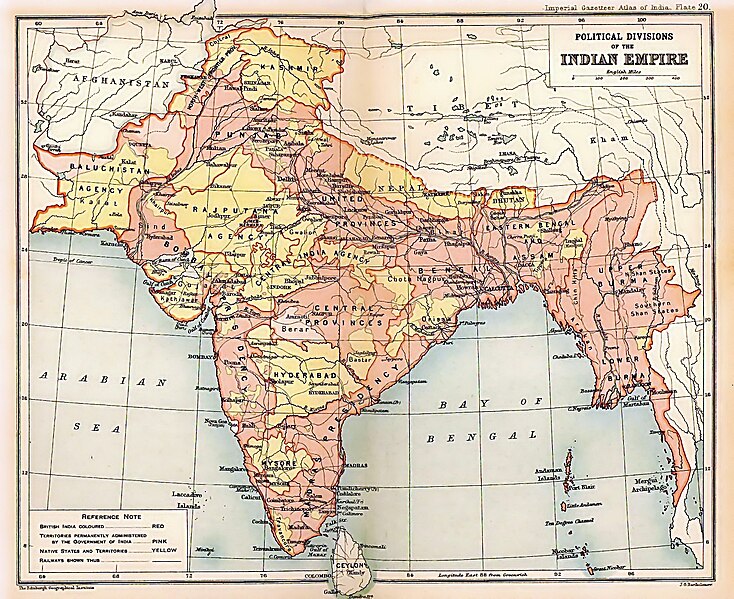
Pre-partition map of India

Pre-partition map of India

This map can be found at https://commons.wikimedia.org/wiki/File:British_Indian_Empire_1909_Imperial_Gazetteer_of_India.jpg and is part of quite a few Indian articles. I would urge people to look at the map in-depth. Except for the Central India Agency and Central India Provinces, most of the other regions were quite comfortable weather-wise. Hence I can t help but feel the assertion that Britishers didn t like India (as to live here) slightly revolting. See the excerpt/take on Dale Kennedy s The Magic Mountains: Hill Stations and the British Raj. Berkeley: University of California Press, 1996. xv + 264 pp. . A look at the list of hill stations of divided India is enough to tell that there were lot of places which either were founded by the Britishers or they chose to live there. And this is not all, there are supposed to lot of beautiful places even in Pakistan, especially in North East Frontier, Swat for instance. While today it s infamous for Taliban and Islamic Terrorism, there was a time it was known for its beauty.
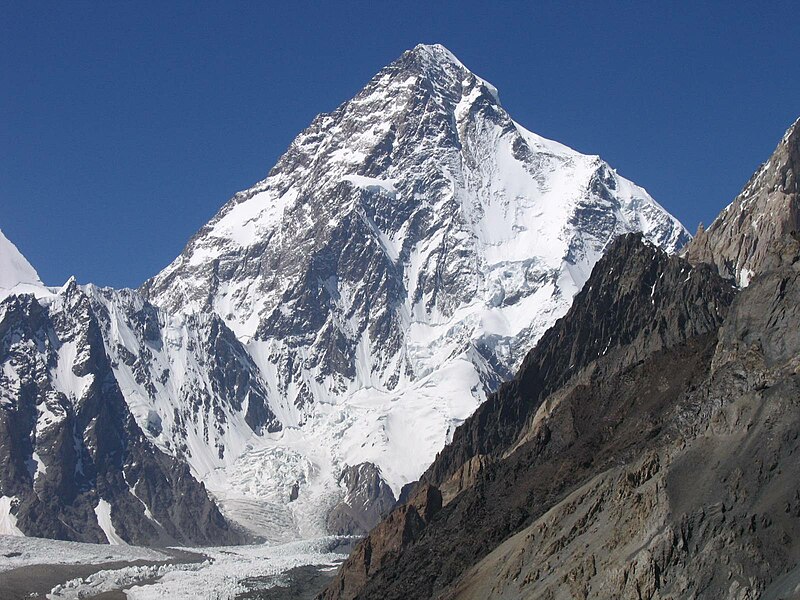
The second most difficult mountain in the world - K2, Pakistan

The second most difficult mountain in the world K2, Pakistan

Trivia After Everest, K2 is the smaller one although whatever I have read of people s accounts, most people who ascended all 14 8,000 metre peaks say K2 is technically more tougher than Everest and after Everest has the highest casualty rate. Also places like the disputed North half of Pakistan Occupied Kashmir, Gilgit Baltistan, Extreme northern Punjab of Pakistan , Northern half of Khyber-Pakhtunkhawa province and Northern Balochistan all of these places would have been more than conducive to the Britishers as it is near to the British climate (snow and pleasant weather all year round). It really is a pity that Pakistan chose to become a terrorist state where it could have become one of the more toured places of Asia. I really feel nauseous and sad at the multiple chances that Pakistan frittered away, it could have been something else.
Filed under: Miscellenous Tagged: #bash-completion, #British Raj, #contributions, #debian, #debian-policy, #Debian-QA, #Hill Stations, #India Independance Movement, #lintian, #obsolete-conffiles, #unknown-horizons, #weather, #World History, adequate, Pakistan, tourism

21 January 2017

Dirk Eddelbuettel: Updated Example Repo for RMarkdown and Metropolis/Mtheme

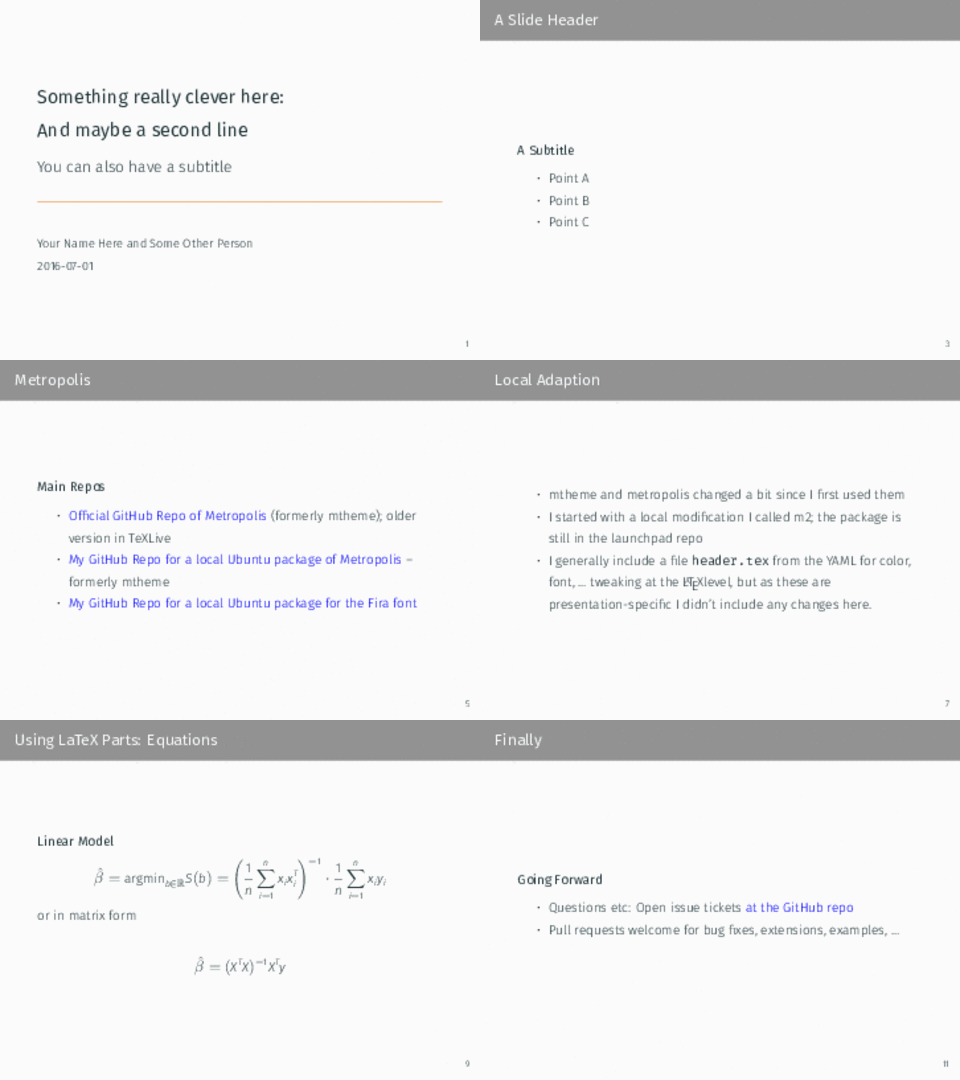
During useR! 2016, Nick Tierney had asked on Twitter about rmarkdown and metropolis and whether folks had used RMarkdown-driven LaTeX Beamer presentations. My firm hell yeah answer, based on having used mtheme outright or in local mods for quite some time (see my talks page), lead to this blog post of mine describing this GitHub repo I had quickly set up during breaks at useR! 2016. The corresponding blog post and the repo have some more details on how I do this, in particular about local packages (also with sources on GitHub) for the non-standard fonts I use. This week I got around to updating the repo / example a little by making the default colours (in my example) a little less awful, and a page on blocks and, most importantly, turning the example into the animated gif below:
And thanks to the beautiful tint package -- see its repo and CRAN package --- I now know how to create a template package. So if there is interest (and spare time), we could build a template package for RStudio too. With that, may I ask a personal favour of anybody still reading the post? Please do not hit my twitter handle with questions for support. All my code is an GitHub, and issue tickets there are much preferred. Larger projects like Rcpp also have their own mailing lists, and it is much better to use those. And if you like neither, maybe ask on StackOverflow. But please don't spam my Twitter handle. Thank you.

20 January 2017

Michal Čihař: Weblate 2.10.1

This is first security bugfix release for Weblate. This has to come at some point, fortunately the issue is not really severe. But Weblate got it's first CVE ID today, so it's time to address it in a bugfix release. Full list of changes: If you are upgrading from older version, please follow our upgrading instructions. You can find more information about Weblate on https://weblate.org, the code is hosted on Github. If you are curious how it looks, you can try it out on demo server. You can login there with demo account using demo password or register your own user. Weblate is also being used on https://hosted.weblate.org/ as official translating service for phpMyAdmin, OsmAnd, Aptoide, FreedomBox, Weblate itself and many other projects. Should you be looking for hosting of translations for your project, I'm happy to host them for you or help with setting it up on your infrastructure. Further development of Weblate would not be possible without people providing donations, thanks to everybody who have helped so far!

Filed under: Debian English SUSE Weblate 0 comments

19 January 2017

Matthew Garrett: Android apps, IMEIs and privacy

There's been a sudden wave of people concerned about the Meitu selfie app's use of unique phone IDs. Here's what we know: the app will transmit your phone's IMEI (a unique per-phone identifier that can't be altered under normal circumstances) to servers in China. It's able to obtain this value because it asks for a permission called READ_PHONE_STATE, which (if granted) means that the app can obtain various bits of information about your phone including those unique IDs and whether you're currently on a call.

Why would anybody want these IDs? The simple answer is that app authors mostly make money by selling advertising, and advertisers like to know who's seeing their advertisements. The more app views they can tie to a single individual, the more they can track that user's response to different kinds of adverts and the more targeted (and, they hope, more profitable) the advertising towards that user. Using the same ID between multiple apps makes this easier, and so using a device-level ID rather than an app-level one is preferred. The IMEI is the most stable ID on Android devices, persisting even across factory resets.

The downside of using a device-level ID is, well, whoever has that data knows a lot about what you're running. That lets them tailor adverts to your tastes, but there are certainly circumstances where that could be embarrassing or even compromising. Using the IMEI for this is even worse, since it's also used for fundamental telephony functions - for instance, when a phone is reported stolen, its IMEI is added to a blacklist and networks will refuse to allow it to join. A sufficiently malicious person could potentially report your phone stolen and get it blocked by providing your IMEI. And phone networks are obviously able to track devices using them, so someone with enough access could figure out who you are from your app usage and then track you via your IMEI. But realistically, anyone with that level of access to the phone network could just identify you via other means. There's no reason to believe that this is part of a nefarious Chinese plot.

Is there anything you can do about this? On Android 6 and later, yes. Go to settings, hit apps, hit the gear menu in the top right, choose "App permissions" and scroll down to phone. Under there you'll see all apps that have permission to obtain this information, and you can turn them off. Doing so may cause some apps to crash or otherwise misbehave, whereas newer apps may simply ask for you to grant the permission again and refuse to do so if you don't.

Meitu isn't especially rare in this respect. Over 50% of the Android apps I have handy request your IMEI, although I haven't tracked what they all do with it. It's certainly something to be concerned about, but Meitu isn't especially rare here - there are big-name apps that do exactly the same thing. There's a legitimate question over whether Android should be making it so easy for apps to obtain this level of identifying information without more explicit informed consent from the user, but until Google do anything to make it more difficult, apps will continue making use of this information. Let's turn this into a conversation about user privacy online rather than blaming one specific example.

comment count unavailable comments

Daniel Pocock: Which movie most accurately forecasts the Trump presidency?

Many people have been scratching their heads wondering what the new US president will really do and what he really stands for. His alternating positions on abortion, for example, suggest he may simply be telling people what he thinks is most likely to win public support from one day to the next. Will he really waste billions of dollars building a wall? Will Muslims really be banned from the US? As it turns out, several movies provide a thought-provoking insight into what could eventuate. What's more, these two have a creepy resemblance to the Trump phenomenon and many of the problems in the world today. Countdown to Looking Glass On the classic cold war theme of nuclear annihilation, Countdown to Looking Glass is probably far more scary to watch on Trump eve than in the era when it was made. Released in 1984, the movie follows a series of international crises that have all come to pass: the assassination of a US ambassador in the middle east, a banking crisis and two superpowers in an escalating conflict over territory. The movie even picked a young Republican congressman for a cameo role: he subsequently went on to become speaker of the house. To relate it to modern times, you may need to imagine it is China, not Russia, who is the adversary but then you probably won't be able to sleep after watching it. cleaning out the swamp? The Omen Another classic is The Omen. The star of this series of four horror movies, Damien Thorn, appears to have a history that is eerily reminiscent of Trump: born into a wealthy family, a series of disasters befall every honest person he comes into contact with, he comes to control a vast business empire acquired by inheritance and as he enters the world of politics in the third movie of the series, there is a scene in the Oval Office where he is flippantly advised that he shouldn't lose any sleep over any conflict of interest arising from his business holdings. Did you notice Damien Thorn and Donald Trump even share the same initials, DT?

17 January 2017

Ritesh Raj Sarraf: Linux Tablet-Mode Usability

In my ongoing quest to get Tablet-Mode working on my Hybrid machine, here's how I've been living with it so far. My intent is to continue using Free Software for both use cases. My wishful thought is to use the same software under both use cases.
  • Browser: On the browser front, things are pretty decent. Chromium has good support for Touchscreen input. Most of the Touchscreen use cases work well with Chromium. On the Firefox side, after a huge delay, finally, Firefox seems to be catching up. Hopefully, with Firefox 51/52, we'll have a much more usable Touchscreen browser.
  • Desktop Shell: One of the reason of migrating to GNOME was its touch support. From what I've explored so far, GNOME is the only desktop shell that has touch support natively done. The feature isn't complete yet, but is fairly well usable.
    • Given that GNOME has touchscreen support native, it is obvious to be using GNOME equivalent of tools for common use cases. Most of these tools inherit the touchscreen capabilities from the underneath GNOME libraries.
    • File Manager: Nautilus has decent support for touch, as a file manager. The only annoying bit is a right-click equivalent. Or in touch input sense, a long-press.
    • Movie Player: There's a decent movie player, based on GNOME libs; GNOME MPV. In my limited use so far, this interface seems to have good support. Other contenders are:
      • SMPlayer is based on Qt libs. So initial expectation would be that Qt based apps would have better Touch support. But I'm yet to see any serious Qt application with Touch input support. Back to SMPlayer, the dev is pragmatic enough to recognize tablet-mode users and as such has provided a so called "Tablet Mode" view for SMPlayer (The tooltip did not get captured in the screenshot).
      • MPV doesn't come with a UI but has basic management with OSD. And in my limited usage, the OSD implementation does seem capable to take touch input.
  • Books / Documents: GNOME Documents/Books is very basic in what it has to offer, to the point that it is not much useful. But since it is based on the same GNOME libraries, it enjoys native touch input support. Calibre, on the other hand, is feature rich. But it is based on (Py)Qt. Touch input is told to work for Windows. For Linux, there's no support yet. The good thing about Calibre is that it has its own UI, which is pretty decent in a Tablet-Mode Touch workflow.
  • Photo Management: With compact digital devices commonly available, digital content (Both Photos and Videos) is on the rise. The most obvious names that come to mind are Digikam and Shotwell.
    • Shotwell saw its reincarnation in the recent past. From what I recollect, it does have touch support but was lacking quite a bit in terms of features, as compared to Digikam.
    • Digikam is an impressive tool for digital content management. While Digikam is a KDE project, thankfully it does a great job in keeping its KDE dependencies to a bare minimum. But given that Digikam builds on KDE/Qt libs, I haven't had any much success in getting a good touch input solution for Tablet Mode. To make it barely usable in Table-Mode, one could choose a theme preference with bigger toolbars, labels and scrollbars. This helps in making a touch input workaround use case. As you can see, I've configured the Digikam UI with Text alongside Icons for easy touch input.
  • Email: The most common use case. With Gmail and friends, many believe standalone email clients are no more a need. But there always are users like us who prefer emails offline, encrypted emails and prefer theis own email domains. Many of these are still doable with free services like Gmail, but still.
    • Thunderbird shows its age at times. And given the state of Firefox in getting touch support (and GTK3 port), I see nothing happening with TB.
    • KMail was something I discontinued while still being on KDE. The debacle that KDEPIM was, is something I'd always avoid, in the future. Complete waste of time/resource in building, testing, reporting and follow-ups.
    • Geary is another email client that recently saw its reincarnation. I recently had explored Geary. It enjoys similar benefits like the rest applications using GNOME libraries. There was one touch input bug I found, but otherwise Geary's featureset was limited in comparison to Evolution.
    • Migration to Evolution, when migrating to GNOME, was not easy. GNOME's philosophy is to keep things simple and limited. In doing that, they restrict possible flexibilities that users may find obvious. This design philosophy is easily visible across all applications of the GNOME family. Evolution is no different. Hence, coming from TB to E was a small unlearning + newLearning curve. And since Evolution is using the same GNOME libraries, it enjoys similar benefits. Touch input support in Evolution is fairly good. The missing bit is the new Toolbar and Menu structure that many have noticed in the newer GNOME applications (Photos, Documents, Nautilus etc). If only Evolution (and the GNOME family) had the option of customization beyond the developer/project's view, there wouldn't be any wishful thoughts.
      • Above is a screenshot of 2 windows of Evoluiton. In its current form too, Evolution is a gem at times. For my RSS feeds, they are stored in a VFolder in Evolution, so that I can read them when offline. RSS feeds are something I read up in Tablet-mode. On the right is an Evolution window with larger fonts, while on the left, Evoltuion still retains its default font size. This current behavior helps me get Table-Mode Touch working to an extent. In my wishful thoughts, I wish if Evolution provided flexibility to change Toolbar icon sizes. That'd really help easily touch the delete button when in Tablet Mode. A simple button, Tablet Mode, like what SMPlayer has done, would keep users sticky with Evolution.
My wishful thought is that people write (free) software, thinking more about usability across toolkits and desktop environments. Otherwise, the year of the Linux desktop, laptop, tablet; in my opinion, is yet to come. And please don't rip apart tools, in porting them to newer versions of the toolkits. When you rip a tool, you also rip all its QA, Bug Reporting and Testing, that was done over the years. Here's an example of a tool (Goldendict), so well written. Written in Qt, Running under GNOME, and serving over the Chromium interface. In this whole exercise of getting a hybrid working setup, I also came to realize that there does not seem to be a standardized interface, yet, to determine the current operating mode of a running hybrid machine. From what we explored so far, every product has its own way to doing it. Most hybrids come pre-installed and supported with Windows only. So, their mode detection logic seems to be proprietary too. In case anyone is awaer of a standard interface, please drop a note in the comments.

Categories:

Keywords:

Like:

14 January 2017

Russ Allbery: Review: Enchanters' End Game

Review: Enchanters' End Game, by David Eddings
Series: The Belgariad #5
Publisher: Del Rey
Copyright: December 1984
Printing: February 1990
ISBN: 0-345-33871-5
Format: Mass market
Pages: 372
And, finally, the conclusion towards which everything has been heading, and the events for which Castle of Wizardry was the preparation. (This is therefore obviously not the place to start with this series.) Does it live up to all the foreshadowing and provide a satisfactory conclusion? I'd say mostly. The theology is a bit thin, but Eddings does a solid job of bringing all the plot threads together and giving each of the large cast a moment to shine. Enchanters' End Game (I have always been weirdly annoyed by that clunky apostrophe) starts with more of Garion and Belgarath, and, similar to the end of Castle of Wizardry, this feels like them rolling on the random encounter table. There is a fairly important bit with Nadraks at the start, but the remaining detour to the north is a mostly unrelated bit of world-building. Before this re-read, I didn't remember how extensive the Nadrak parts of this story were; in retrospect, I realize a lot of what I was remembering is in the Mallorean instead. I'll therefore save my commentary on Nadrak gender roles for an eventual Mallorean re-read, since there's quite a lot to dig through and much of it is based on information not available here. After this section, though, the story leaves Garion, Belgarath, and Silk for nearly the entire book, returning to them only for the climax. Most of this book is about Ce'Nedra, the queens and kings of the west, and what they're doing while Garion and his small party are carrying the Ring into Mordor er, you know what I mean. And this long section is surprisingly good. We first get to see the various queens of the west doing extremely well managing the kingdoms while the kings are away (see my previous note about how Eddings does examine his stereotypes), albeit partly by mercilessly exploiting the sexism of their societies. The story then picks up with Ce'Nedra and company, including all of the rest of Garion's band, being their snarky and varied selves. There are some fairly satisfying set pieces, some battle tactics, some magical tactics, and a good bit of snarking and interplay between characters who feel like old friends by this point (mostly because of Eddings's simple, broad-strokes characterization). And Ce'Nedra is surprisingly good here. I would say that she's grown up after the events of the last book, but sadly she reverts to being awful in the aftermath. But for the main section of the book, partly because she's busy with other things, she's a reasonable character who experiences some actual consequences and some real remorse from one bad decision she makes. She's even admirable in how she handles events leading up to the climax of the book. Eddings does a good job showing every character in their best light, putting quite a lot of suspense (and some dramatic rescues) into this final volume, and providing a final battle that's moderately interesting. I'm not sure I entirely bought the theological ramifications of the conclusion (the bits with Polgara do not support thinking about too deeply), but the voice in Garion's head continues to be one of the better characters of the series. And Errand is a delight. After the climax, the aftermath sadly returns to Eddings's weird war between the sexes presentation of all gender relationships in this series, and it left me with a bit of a bad taste in my mouth. (There is absolutely no way that some of these relationships would survive in reality.) Eddings portrays nearly every woman as a manipulative schemer, sometimes for good and sometimes for evil, and there is just so much gender stereotyping throughout this book for both women and men. You can tell he's trying with the queens, but women are still only allowed to be successful at politics and war within a very specific frame. Even Polgara gets a bit of the gender stereotyping, although she remains mostly an exception (and one aspect of the ending is much better than it could have been). Ah well. One does not (or at least probably should not) read this series without being aware that it has some flaws. But it has a strange charm as well, mostly from its irreverence. The dry wise-cracking of these characters rings more true to me than the epic seriousness of a lot of fantasy. This is how people behave under stress, and this is how quirky people who know each other extremely well interact. It also keeps one turning the pages quite effectively. I stayed up for several late nights finishing it, and was never tempted to put it down and stop reading. This is not great literature, but it's still fun. It wouldn't sustain regular re-reading for me, but a re-read after twenty years or so was pretty much exactly the experience I was hoping for: an unchallenging, optimistic story with amusing characters and a guaranteed happy ending. There's a place for that. Followed, in a series sense, by the Mallorean, the first book of which is The Guardians of the West. But this is a strictly optional continuation; the Belgariad comes to a definite end here. Rating: 7 out of 10

13 January 2017

Elena 'valhalla' Grandi: Modern XMPP Server

Modern XMPP Server

I've published a new HOWTO on my website 'http://www.trueelena.org/computers/howto/modern_xmpp_server.html':

http://www.enricozini.org/blog/2017/debian/modern-and-secure-instant-messaging/ already wrote about the Why (and the What, Who and When), so I'll just quote his conclusion and move on to the How.

I now have an XMPP setup which has all the features of the recent fancy chat systems, and on top of that it runs, client and server, on Free Software, which can be audited, it is federated and I can self-host my own server in my own VPS if I want to, with packages supported in Debian.


How

I've decided to install https://prosody.im/, mostly because it was recommended by the RTC QuickStart Guide http://rtcquickstart.org/; I've heard that similar results can be reached with https://www.ejabberd.im/ and other servers.

I'm also targeting https://www.debian.org/ stable (+ backports); as I write this is jessie; if there are significant differences I will update this article when I will upgrade my server to stretch. Right now, this means that I'm using prosody 0.9 (and that's probably also the version that will be available in stretch).

Installation and prerequisites

You will need to enable the https://backports.debian.org/ repository and then install the packages prosody and prosody-modules.

You also need to setup some TLS certificates (I used Let's Encrypt https://letsencrypt.org/); and make them readable by the prosody user; you can see Chapter 12 of the RTC QuickStart Guide http://rtcquickstart.org/guide/multi/xmpp-server-prosody.html for more details.

On your firewall, you'll need to open the following TCP ports:


The latter two are needed to enable some services provided via http(s), including rich media transfers.

With just a handful of users, I didn't bother to configure LDAP or anything else, but just created users manually via:

prosodyctl adduser alice@example.org

In-band registration is disabled by default (and I've left it that way, to prevent my server from being used to send spim https://en.wikipedia.org/wiki/Messaging_spam).

prosody configuration

You can then start configuring prosody by editing /etc/prosody/prosody.cfg.lua and changing a few values from the distribution defaults.

First of all, enforce the use of encryption and certificate checking both for client2server and server2server communications with:


c2s_require_encryption = true
s2s_secure_auth = true


and then, sadly, add to the whitelist any server that you want to talk to and doesn't support the above:


s2s_insecure_domains = "gmail.com"


virtualhosts

For each virtualhost you want to configure, create a file /etc/prosody/conf.avail/chat.example.org.cfg.lua with contents like the following:


VirtualHost "chat.example.org"
enabled = true
ssl =
key = "/etc/ssl/private/example.org-key.pem";
certificate = "/etc/ssl/public/example.org.pem";


For the domains where you also want to enable MUCs, add the follwing lines:


Component "conference.chat.example.org" "muc"
restrict_room_creation = "local"


the "local" configures prosody so that only local users are allowed to create new rooms (but then everybody can join them, if the room administrator allows it): this may help reduce unwanted usages of your server by random people.

You can also add the following line to enable rich media transfers via http uploads (XEP-0363):


Component "upload.chat.trueelena.org" "http_upload"

The defaults are pretty sane, but see https://modules.prosody.im/mod_http_upload.html for details on what knobs you can configure for this module

Don't forget to enable the virtualhost by linking the file inside /etc/prosody/conf.d/.

additional modules

Most of the other interesting XEPs are enabled by loading additional modules inside /etc/prosody/prosody.cfg.lua (under modules_enabled); to enable mod_something just add a line like:


"something";

Most of these come from the prosody-modules package (and thus from https://modules.prosody.im/ ) and some may require changing when prosody 0.10 will be available; when this is the case it is mentioned below.


@Gruppo Linux Como @LIFO

12 January 2017

Ritesh Raj Sarraf: Laptop Mode Tools 1.71

I am pleased to announce the 1.71 release of Laptop Mode Tools. This release includes some new modules, some bug fixes, and there are some efficiency improvements too. Many thanks to our users; most changes in this release are contributions from our users. A filtered list of changes in mentioned below. For the full log, please refer to the git repository. Source tarball, Feodra/SUSE RPM Packages available at:
https://github.com/rickysarraf/laptop-mode-tools/releases Debian packages will be available soon in Unstable. Homepage: https://github.com/rickysarraf/laptop-mode-tools/wiki
Mailing List: https://groups.google.com/d/forum/laptop-mode-tools
1.71 - Thu Jan 12 13:30:50 IST 2017
    * Fix incorrect import of os.putenv
    * Merge pull request #74 from Coucouf/fix-os-putenv
    * Fix documentation on where we read battery capacity from
    * cpuhotplug: allow disabling specific cpus
    * Merge pull request #78 from aartamonau/cpuhotplug
    * runtime-pm: refactor listed_by_id()
    * wireless-power: Use iw and fallback to iwconfig if it not available
    * Prefer available AC supply information over battery state to determine ON_AC
    * On startup, we want to force the full execution of LMT.
    * Device hotplugs need a forced execution for LMT to apply the proper settings
    * runtime-pm: Refactor list_by_type()
    * kbd-backlight: New module to control keyboard backlight brightness
    * Include Transmit power saving in wireless cards
    * Don't run in a subshell
    * Try harder to check battery charge
    * New module: vgaswitcheroo
    * Revive bluetooth module. Use rfkill primarily. Also don't unload (incomplete list of) kernel modules
What is Laptop Mode Tools
Description: Tools for Power Savings based on battery/AC status
 Laptop mode is a Linux kernel feature that allows your laptop to save
 considerable power, by allowing the hard drive to spin down for longer
 periods of time. This package contains the userland scripts that are
 needed to enable laptop mode.
 .
 It includes support for automatically enabling laptop mode when the
 computer is working on batteries. It also supports various other power
 management features, such as starting and stopping daemons depending on
 power mode, automatically hibernating if battery levels are too low, and
 adjusting terminal blanking and X11 screen blanking
 .
 laptop-mode-tools uses the Linux kernel's Laptop Mode feature and thus
 is also used on Desktops and Servers to conserve power

Categories:

Keywords:

Like:

9 January 2017

Shirish Agarwal: The Great Indian Digital Tamasha

Indian Railways This is an extension to last month s article/sharing where I had shared the changes that had transpired in the last 2-3 months. Now am in a position to share the kind of issues a user can go through in case he is looking for support from IRCTC to help him/her go cashless. If you a new user to use IRCTC services you wouldn t go through this trouble. For those who might have TL;DR issues it s about how hard it can become to get digital credentials fixed in IRCTC (Indian Railway Catering and Tourism Corporation) a. 2 months back Indian Prime Minister gave a call incentivizing people to use digital means to do any commercial activities. One of the big organizations which took/takes part is IRCTC which handles the responsibility for e-ticketing millions of Rail tickets for common people. In India, a massive percentage moves by train as it s cheaper than going by Air. A typical fare from say Pune Delhi (capital of India) by second class sleeper would be INR 645/- for a distance of roughly 1600 odd kms and these are monopoly rates, there are no private trains and I m not suggesting anything of that sort, just making sure that people know. An economy class ticket by Air for the same distance would be anywhere between INR 2500-3500/- for a 2 hour flight between different airlines. Last I checked there are around 8 mainstream airlines including flag-carrier Air India. About 30% of the population live on less than a dollar and a half a day which would come around INR 100/-. There was a comment some six months back on getting more people out of the poverty line. But as there are lots of manipulations in numbers for who and what denotes above poor and below poor in India and lot of it has to do with politics it s not something which would be easily fixable. There are lots to be said in that arena but this article is not an appropriate blog-post for that. All in all, it s only 3-5% of the population at the most who can travel via Air if situation demands and around 1-2% who might be frequent, business or leisure travellers. Now while I can thankfully afford an Air Ticket if the situation so demands, my mother gets motion sickness so while together we can only travel by train. b. With the above background, I had registered with IRCTC few years ago with another number (dual-SIM) I had purchased and was thinking that I would be using this long-term (seems to my first big mistake, hindsight 50:50) . This was somewhere in 2006/2007. c. Few months later I found that the other service provider wasn t giving good service or was not upto mark. I was using IDEA (the main mobile operator) throughout those times. d. As I didn t need the service that much, didn t think to inform them that I want to change to another service provider at that point in time (possibly the biggest mistake, hindsight 50:50) e. In July 2016 itself IRCTC cut service fees, f. This was shared as a NEW news item/policy decision at November-end 2016 . g. While I have done all that has been asked by irctc-care haven t still got the issues resolved  IRCTC s e-mail id care@irctc.co.in Now in detail This is my first e-mail sent to IRCTC in June 2016
Dear Customer care, I had applied and got username and password sometime back . The
number I had used to register with IRCTC was xxxxxxxxxx (BSNL mobile number not used anymore) . My mobile was lost and along with that the number was also lost. I had filed a complaint with the police and stopped that number as well. Now I have an another mobile number but have forgotten both the password and the security answer that I had given when I had registered . I do have all the conversations I had both with the ticketadmn@irctc.co.in as well as care@irctc.co.in if needed to prove my identity. The new number I want to tie it with is xxxxxxxxxx (IDEA number in-use for last 10 years) I see two options :- a. Tie the other number with my e-mail address b. Take out the e-mail address from the database so that I can fill in
as a new applicant. Looking forward to hear from you.
There was lot of back and forth with various individuals on IRCTC and after a lot of back and forth, this is the final e-mail I got from them somewhere in August 2016, he writes
Dear Customer, We request you to send mobile bill of your mobile number if it is post paid or if it is prepaid then contact to your service provider and they will give you valid proof of your mobile number or they will give you in written on company head letter so that we may update your mobile number to update so that you may reset your password through mobile OTP.
and Kindly inform you that you can update your profile by yourself also. 1.login on IRCTC website
2.after login successfully move courser on my profile tab.
3.then click on update profile
4.re-enter your password then you can update your profile
5.click on user-profile then email id.
6. click on update. Still you face any problem related to update profile please revert to us with the screen shots of error message which you will get at the time of update profile . Thanks & Regards Parivesh Patel
Executive, Customer Care
care@irctc.co.in
http://www.irctc.co.in
[#3730034]
IRCTC s response seemed responsible, valid and thought it would be a cake-walk as private providers are supposed to be much more efficient than public ones. The experience proved how wrong was I trust them with doing the right thing 1. First I tried the twitter handle to see how IDEA uses their twitter handle. 2. The idea customer care twitter handle was mild in its response. 3. After sometime I realized that the only way out of this quagmire would perhaps be to go to a brick-mortar shop and get it resolved face-to-face. I went twice or thrice but each time something or the other would happen. On the fourth and final time, I was able to get to the big Official shop only to be told they can t do anything about this and I would have to the appellate body to get the reply. The e-mail address which they shared (and I found it later) was wrong. I sent a somewhat longish e-mail sharing all the details and got bounce-backs. The correct e-mail address for the IDEA Maharashtra appellate body is appellette.mh@idea.aditybirla.com I searched online and after a bit of hit and miss finally got the relevant address. Then finally on 30th December, 2016 wrote a short email to the service provider as follows
Dear Sir,
I have been using prepaid mobile connection number xxxxxxx taken from IDEA for last 10 odd years. I want to register myself with IRCTC for online railway booking using
my IDEA mobile number. Earlier, I was having a BSNL connection which I discontinued 4 years back, For re-registering myself with IRCTC, I have to fulfill their latest
requirements as shown in the email below . It is requested that I please be issued a letter confirming my
credentials with your esteemed firm. I contacted your local office at corner of Law College Road and
Bhandarkar Road, Pune (reference number Q1 84786060793) who
refused to provide me any letter and have advised me to contact on the
above e-mail address, hence this request is being forwarded to you. Please do the needful at your earliest.
Few days later I got this short e-mail from them
Dear Customer, Greetings for the day! This is with reference to your email regarding services. Please accept our apologies for the inconvenience caused to you and delay in response. We regret to inform you that we are unable to provide demographic details from our end as provision for same is not available with us. Should you need any further assistance, please call our Customer Service help line number 9822012345 or email us at customercare@idea.adityabirla.com by mentioning ten digit Idea mobile number in subject line. Thanks & Regards, Javed Khan Customer Service Team IDEA Cellular Limited- Maharashtra & Goa Circle.
Now I was at almost my wit s end. Few days before, I had re-affirmed my e-mail address to IDEA . I went to the IDEA care site, registered with my credentials. While the https connection to the page is weak, but let s not dwell on that atm. I logged into the site, I went through all the drop-down menus and came across My Account > Raise a request link which I clicked on . This came to a page where I could raise requests for various things. One of the options given there was Bill Delivery. As I wasn t a postpaid user but a prepaid user didn t know if that would work or not I still clicked on it. It said it would take 4 days for that to happen. I absently filed it away as I was somewhat sure that nothing would happen from my previous experience with IDEA. But this time the IDEA support staff came through and shared a toll-free SMS number and message format that I could use to generate call details from the last 6 months. The toll-free number from IDEA is 12345 and the message format is EBILL MON (short-form for month so if it s January would be jan, so on and so forth). After gathering all the required credentials, sent my last mail to IRCTC about a week, 10 days back
Dear Mr. Parivesh Patel, I was out-of-town and couldn t do the needful so sorry for the delay.
Now that I m back in town, I have been able to put together my prepaid
bills of last 6 months which should make it easy to establish my
identity. As had shared before, I don t remember my old password and the old
mobile number (BSNL number) is no longer accessible so can t go
through that route. Please let me know the next steps in correcting the existing IRCTC
account (which I haven t operated ever) so I can start using it to
book my tickets. Look forward to hearing from you.
Haven t heard anything them from them, apart from a generated token number, each time you send a reply happens. This time it was #4763548 The whole sequence of events throws a lot of troubling questions a. Could IRCTC done a better job of articulating their need to me instead of the run-around I was given ? b. Shouldn t there be a time limit to accounts from which no transactions have been done ? I hadn t done a single transaction since registering. When cell service providers including BSNL takes number out after a year of not using a number, why is that account active for so long ? c. As that account didn t have OTP at registration, dunno if it s being used for illegal activities or something. Update This doesn t seem to be a unique thing at all. Just sampling some of the tweets by people at @IRCTC_LTD https://twitter.com/praveen4al/status/775614978258718721 https://twitter.com/vis_nov25/status/786062572390932480 https://twitter.com/ShubhamDevadiya/status/794241443950948352 https://twitter.com/rajeshhindustan/status/798028633759584256 https://twitter.com/ameetsangita/status/810081624343908352 https://twitter.com/grkisback/status/813733835213078528 https://twitter.com/gbalaji_/status/804230235625394177 https://twitter.com/chandhu_nr/status/800675627384721409 , all of this just goes to show how un-unique the situation really is.
Filed under: Miscellenous Tagged: #customer-service, #demonetization, #IDEA-aditya birla, #IRCTC, #web-services, rant

Next.

Previous.