Search Results: "bab"

24 June 2020

Raphaël Hertzog: Freexian s report about Debian Long Term Support, May 2020

A Debian LTS logo Like each month, here comes a report about the work of paid contributors to Debian LTS. Individual reports In May, 198 work hours have been dispatched among 14 paid contributors. Their reports are available: Evolution of the situation In May 2020 we had our second (virtual) contributors meeting on IRC, Logs and minutes are available online. Then we also moved our ToDo from the Debian wiki to the issue tracker on salsa.debian.org.
Sadly three contributors went inactive in May: Adrian Bunk, Anton Gladky and Dylan A ssi. And while there are currently still enough active contributors to shoulder the existing work, we like to use this opportunity that we are always looking for new contributors. Please mail Holger if you are interested.
Finally, we like to remind you for a last time, that the end of Jessie LTS is coming in less than a month!
In case you missed it (or missed to act), please read this post about keeping Debian 8 Jessie alive for longer than 5 years. If you expect to have Debian 8 servers/devices running after June 30th 2020, and would like to have security updates for them, please get in touch with Freexian. The security tracker currently lists 6 packages with a known CVE and the dla-needed.txt file has 30 packages needing an update. Thanks to our sponsors New sponsors are in bold. With the upcoming start of Jessie ELTS, we are welcoming a few new sponsors and others should join soon.

No comment Liked this article? Click here. My blog is Flattr-enabled.

22 June 2020

Evgeni Golov: mass-migrating modules inside an Ansible Collection

Im the Foreman project, we've been maintaining a collection of Ansible modules to manage Foreman installations since 2017. That is, 2 years before Ansible had the concept of collections at all. For that you had to set library (and later module_utils and doc_fragment_plugins) in ansible.cfg and effectively inject our modules, their helpers and documentation fragments into the main Ansible namespace. Not the cleanest solution, but it worked quiet well for us. When Ansible started introducing Collections, we quickly joined, as the idea of namespaced, easily distributable and usable content units was great and exactly matched what we had in mind. However, collections are only usable in Ansible 2.8, or actually 2.9 as 2.8 can consume them, but tooling around building and installing them is lacking. Because of that we've been keeping our modules usable outside of a collection. Until recently, when we decided it's time to move on, drop that compatibility (which costed a few headaches over the time) and release a shiny 1.0.0. One of the changes we wanted for 1.0.0 is renaming a few modules. Historically we had the module names prefixed with foreman_ and katello_, depending whether they were designed to work with Foreman (and plugins) or Katello (which is technically a Foreman plugin, but has a way more complicated deployment and currently can't be easily added to an existing Foreman setup). This made sense as long as we were injecting into the main Ansible namespace, but with collections the names be became theforemam.foreman.foreman_ <something> and while we all love Foreman, that was a bit too much. So we wanted to drop that prefix. And while at it, also change some other names (like ptable, which became partition_table) to be more readable. But how? There is no tooling that would rename all files accordingly, adjust examples and tests. Well, bash to the rescue! I'm usually not a big fan of bash scripts, but renaming files, searching and replacing strings? That perfectly fits! First of all we need a way map the old name to the new name. In most cases it's just "drop the prefix", for the others you can have some if/elif/fi:
prefixless_name=$(echo $ old_name   sed -E 's/^(foreman katello)_//')
if [[ $ old_name  == 'foreman_environment' ]]; then
  new_name='puppet_environment'
elif [[ $ old_name  == 'katello_sync' ]]; then
  new_name='repository_sync'
elif [[ $ old_name  == 'katello_upload' ]]; then
  new_name='content_upload'
elif [[ $ old_name  == 'foreman_ptable' ]]; then
  new_name='partition_table'
elif [[ $ old_name  == 'foreman_search_facts' ]]; then
  new_name='resource_info'
elif [[ $ old_name  == 'katello_manifest' ]]; then
  new_name='subscription_manifest'
elif [[ $ old_name  == 'foreman_model' ]]; then
  new_name='hardware_model'
else
  new_name=$ prefixless_name 
fi
That defined, we need to actually have a $ old_name . Well, that's a for loop over the modules, right?
for module in $ BASE /foreman_*py $ BASE /katello_*py; do
  old_name=$(basename $ module  .py)
   
done
While we're looping over files, let's rename them and all the files that are associated with the module:
# rename the module
git mv $ BASE /$ old_name .py $ BASE /$ new_name .py
# rename the tests and test fixtures
git mv $ TESTS /$ old_name .yml $ TESTS /$ new_name .yml
git mv tests/fixtures/apidoc/$ old_name .json tests/fixtures/apidoc/$ new_name .json
for testfile in $ TESTS /fixtures/$ old_name -*.yml; do
  git mv $ testfile  $(echo $ testfile   sed "s/$ old_name /$ new_name /")
done
Now comes the really tricky part: search and replace. Let's see where we need to replace first:
  1. in the module file
    1. module key of the DOCUMENTATION stanza (e.g. module: foreman_example)
    2. all examples (e.g. foreman_example: )
  2. in all test playbooks (e.g. foreman_example: )
  3. in pytest's conftest.py and other files related to test execution
  4. in documentation
sed -E -i "/^(\s+$ old_name  module):/ s/$ old_name /$ new_name /g" $ BASE /*.py
sed -E -i "/^(\s+$ old_name  module):/ s/$ old_name /$ new_name /g" tests/test_playbooks/tasks/*.yml tests/test_playbooks/*.yml
sed -E -i "/'$ old_name '/ s/$ old_name /$ new_name /" tests/conftest.py tests/test_crud.py
sed -E -i "/ $ old_name  / s/$ old_name /$ new_name /g' README.md docs/*.md
You've probably noticed I used $ BASE and $ TESTS and never defined them Lazy me. But here is the full script, defining the variables and looping over all the modules.
#!/bin/bash
BASE=plugins/modules
TESTS=tests/test_playbooks
RUNTIME=meta/runtime.yml
echo "plugin_routing:" > $ RUNTIME 
echo "  modules:" >> $ RUNTIME 
for module in $ BASE /foreman_*py $ BASE /katello_*py; do
  old_name=$(basename $ module  .py)
  prefixless_name=$(echo $ old_name   sed -E 's/^(foreman katello)_//')
  if [[ $ old_name  == 'foreman_environment' ]]; then
    new_name='puppet_environment'
  elif [[ $ old_name  == 'katello_sync' ]]; then
    new_name='repository_sync'
  elif [[ $ old_name  == 'katello_upload' ]]; then
    new_name='content_upload'
  elif [[ $ old_name  == 'foreman_ptable' ]]; then
    new_name='partition_table'
  elif [[ $ old_name  == 'foreman_search_facts' ]]; then
    new_name='resource_info'
  elif [[ $ old_name  == 'katello_manifest' ]]; then
    new_name='subscription_manifest'
  elif [[ $ old_name  == 'foreman_model' ]]; then
    new_name='hardware_model'
  else
    new_name=$ prefixless_name 
  fi
  echo "renaming $ old_name  to $ new_name "
  git mv $ BASE /$ old_name .py $ BASE /$ new_name .py
  git mv $ TESTS /$ old_name .yml $ TESTS /$ new_name .yml
  git mv tests/fixtures/apidoc/$ old_name .json tests/fixtures/apidoc/$ new_name .json
  for testfile in $ TESTS /fixtures/$ old_name -*.yml; do
    git mv $ testfile  $(echo $ testfile   sed "s/$ old_name /$ new_name /")
  done
  sed -E -i "/^(\s+$ old_name  module):/ s/$ old_name /$ new_name /g" $ BASE /*.py
  sed -E -i "/^(\s+$ old_name  module):/ s/$ old_name /$ new_name /g" tests/test_playbooks/tasks/*.yml tests/test_playbooks/*.yml
  sed -E -i "/'$ old_name '/ s/$ old_name /$ new_name /" tests/conftest.py tests/test_crud.py
  sed -E -i "/ $ old_name  / s/$ old_name /$ new_name /g' README.md docs/*.md
  echo "    $ old_name :" >> $ RUNTIME 
  echo "      redirect: $ new_name " >> $ RUNTIME 
  git commit -m "rename $ old_name  to $ new_name " $ BASE  tests/ README.md docs/ $ RUNTIME 
done
As a bonus, the script will also generate a meta/runtime.yml which can be used by Ansible 2.10+ to automatically use the new module names if the playbook contains the old ones. Oh, and yes, this is probably not the nicest script you'll read this year. Maybe not even today. But it got the job nicely done and I don't intend to need it again anyways.

Junichi Uekawa: The situation is getting better in some ways because we are opening up in Tokyo.

The situation is getting better in some ways because we are opening up in Tokyo. However fear remains the same. The fear of going out vs the business as usual. I'm spending more time on home network than ever before and I am learning about ipv6 more than before. I can probably explain MAP-E or dslite to you like I never could before.

20 June 2020

Dima Kogan: OpenCV C API transition. A rant.

I just went through a debugging exercise that was so ridiculous, I just had to write it up. Some of this probably should go into a bug report instead of a rant, but I'm tired. And clearly I don't care anymore. OK, so I'm doing computer vision work. OpenCV has been providing basic functions in this area, so I have been using them for a while. Just for really, really basic stuff, like projection. The C API was kinda weird, and their error handling is a bit ridiculous (if you give it arguments it doesn't like, it asserts!), but it has been working fine for a while. At some point (around OpenCV 3.0) somebody over there decided that they didn't like their C API, and that this was now a C++ library. Except the docs still documented the C API, and the website said it supported C, and the code wasn't actually removed. They just kinda stopped testing it and thinking about it. So it would mostly continue to work, except some poor saps would see weird failures; like this and this, for instance. OpenCV 3.2 was the last version where it was mostly possible to keep using the old C code, even when compiling without optimizations. So I was doing that for years. So now, in 2020, Debian is finally shipping a version of OpenCV that definitively does not work with the old code, so I had to do something. Over time I stopped using everything about OpenCV, except a few cvProjectPoints2() calls. So I decided to just write a small C++ shim to call the new version of that function, expose that with =extern "C"= to the rest of my world, and I'd be done. And normally I would be, but this is OpenCV we're talking about. I wrote the shim, and it didn't work. The code built and ran, but the results were wrong. After some pointless debugging, I boiled the problem down to this test program:
#include <opencv2/calib3d.hpp>
#include <stdio.h>
int main(void)
 
    double fx = 1000.0;
    double fy = 1000.0;
    double cx = 1000.0;
    double cy = 1000.0;
    double _camera_matrix[] =
          fx,  0, cx,
          0,  fy, cy,
          0,   0,  1  ;
    cv::Mat camera_matrix(3,3, CV_64FC1, _camera_matrix);
    double pp[3] =  1., 2., 10. ;
    double qq[2] =  444, 555 ;
    int N=1;
    cv::Mat object_points(N,3, CV_64FC1, pp);
    cv::Mat image_points (N,2, CV_64FC1, qq);
    // rvec,tvec
    double _zero3[3] =  ;
    cv::Mat zero3(1,3,CV_64FC1, _zero3);
    cv::projectPoints( object_points,
                       zero3,zero3,
                       camera_matrix,
                       cv::noArray(),
                       image_points,
                       cv::noArray(), 0.0);
    fprintf(stderr, "manually-projected no-distortion: %f %f\n",
            pp[0]/pp[2] * fx + cx,
            pp[1]/pp[2] * fy + cy);
    fprintf(stderr, "opencv says: %f %f\n", qq[0], qq[1]);
    return 0;
 
This is as trivial as it gets. I project one point through a pinhole camera, and print out the right answer (that I can easily compute, since this is trivial), and what OpenCV reports:
$ g++ -I/usr/include/opencv4 -o tst tst.cc -lopencv_calib3d -lopencv_core && ./tst
manually-projected no-distortion: 1100.000000 1200.000000
opencv says: 444.000000 555.000000
Well that's no good. The answer is wrong, but it looks like it didn't even write anything into the output array. Since this is supposed to be a thin shim to C code, I want this thing to be filling in C arrays, which is what I'm doing here:
double qq[2] =  444, 555 ;
int N=1;
cv::Mat image_points (N,2, CV_64FC1, qq);
This is how the C API has worked forever, and their C++ API works the same way, I thought. Nothing barfed, not at build time, or run time. Fine. So I went to figure this out. In the true spirit of C++, the new API is inscrutable. I'm passing in cv::Mat, but the API wants cv::InputArray for some arguments and cv::OutputArray for others. Clearly cv::Mat can be coerced into either of those types (and that's what you're supposed to do), but the details are not meant to be understood. You can read the snazzy C++-style documentation. Clicking on "OutputArray" in the doxygen gets you here. Then I guess you're supposed to click on "_OutputArray", and you get here. Understand what's going on now? Me neither. Stepping through the code revealed the problem. cv::projectPoints() looks like this:
void cv::projectPoints( InputArray _opoints,
                        InputArray _rvec,
                        InputArray _tvec,
                        InputArray _cameraMatrix,
                        InputArray _distCoeffs,
                        OutputArray _ipoints,
                        OutputArray _jacobian,
                        double aspectRatio )
 
    ....
    _ipoints.create(npoints, 1, CV_MAKETYPE(depth, 2), -1, true);
    ....
I.e. they're allocating a new data buffer for the output, and giving it back to me via the OutputArray object. This object already had a buffer, and that's where I was expecting the output to go. Instead it went to the brand-new buffer I didn't want. Issues: Well that's just super. I can call the C++ function, copy the data into the place it's supposed to go to, and then deallocate the extra buffer. Or I can pull out the meat of the function I want into my project, and then I can drop the OpenCV dependency entirely. Clearly that's the way to go. So I go poking back into their code to grab what I need, and here's what I see:
static void cvProjectPoints2Internal( const CvMat* objectPoints,
                  const CvMat* r_vec,
                  const CvMat* t_vec,
                  const CvMat* A,
                  const CvMat* distCoeffs,
                  CvMat* imagePoints, CvMat* dpdr CV_DEFAULT(NULL),
                  CvMat* dpdt CV_DEFAULT(NULL), CvMat* dpdf CV_DEFAULT(NULL),
                  CvMat* dpdc CV_DEFAULT(NULL), CvMat* dpdk CV_DEFAULT(NULL),
                  CvMat* dpdo CV_DEFAULT(NULL),
                  double aspectRatio CV_DEFAULT(0) )
 
...
 
Looks familiar? It should. Because this is the original C-API function they replaced. So in their quest to move to C++, they left the original code intact, C API and everything, un-exposed it so you couldn't call it anymore, and made a new, shitty C++ wrapper for people to call instead. CvMat is still there. I have no words. Yes, this is a massive library, and maybe other parts of it indeed did make some sort of non-token transition, but this thing is ridiculous. In the end, here's the function I ended up with (licensed as OpenCV; see the comment)
// The implementation of project_opencv is based on opencv. The sources have
// been heavily modified, but the opencv logic remains. This function is a
// cut-down cvProjectPoints2Internal() to keep only the functionality I want and
// to use my interfaces. Putting this here allows me to drop the C dependency on
// opencv. Which is a good thing, since opencv dropped their C API
//
// from opencv-4.2.0+dfsg/modules/calib3d/src/calibration.cpp
//
// Copyright (C) 2000-2008, Intel Corporation, all rights reserved.
// Copyright (C) 2009, Willow Garage Inc., all rights reserved.
// Third party copyrights are property of their respective owners.
//
// Redistribution and use in source and binary forms, with or without modification,
// are permitted provided that the following conditions are met:
//
//   * Redistribution's of source code must retain the above copyright notice,
//     this list of conditions and the following disclaimer.
//
//   * Redistribution's in binary form must reproduce the above copyright notice,
//     this list of conditions and the following disclaimer in the documentation
//     and/or other materials provided with the distribution.
//
//   * The name of the copyright holders may not be used to endorse or promote products
//     derived from this software without specific prior written permission.
//
// This software is provided by the copyright holders and contributors "as is" and
// any express or implied warranties, including, but not limited to, the implied
// warranties of merchantability and fitness for a particular purpose are disclaimed.
// In no event shall the Intel Corporation or contributors be liable for any direct,
// indirect, incidental, special, exemplary, or consequential damages
// (including, but not limited to, procurement of substitute goods or services;
// loss of use, data, or profits; or business interruption) however caused
// and on any theory of liability, whether in contract, strict liability,
// or tort (including negligence or otherwise) arising in any way out of
typedef union
 
    struct
     
        double x,y;
     ;
    double xy[2];
  point2_t;
typedef union
 
    struct
     
        double x,y,z;
     ;
    double xyz[3];
  point3_t;
void project_opencv( // outputs
                     point2_t* q,
                     point3_t* dq_dp,               // may be NULL
                     double* dq_dintrinsics_nocore, // may be NULL
                     // inputs
                     const point3_t* p,
                     int N,
                     const double* intrinsics,
                     int Nintrinsics)
 
    const double fx = intrinsics[0];
    const double fy = intrinsics[1];
    const double cx = intrinsics[2];
    const double cy = intrinsics[3];
    double k[12] =  ;
    for(int i=0; i<Nintrinsics-4; i++)
        k[i] = intrinsics[i+4];
    for( int i = 0; i < N; i++ )
     
        double z_recip = 1./p[i].z;
        double x = p[i].x * z_recip;
        double y = p[i].y * z_recip;
        double r2      = x*x + y*y;
        double r4      = r2*r2;
        double r6      = r4*r2;
        double a1      = 2*x*y;
        double a2      = r2 + 2*x*x;
        double a3      = r2 + 2*y*y;
        double cdist   = 1 + k[0]*r2 + k[1]*r4 + k[4]*r6;
        double icdist2 = 1./(1 + k[5]*r2 + k[6]*r4 + k[7]*r6);
        double xd      = x*cdist*icdist2 + k[2]*a1 + k[3]*a2 + k[8]*r2+k[9]*r4;
        double yd      = y*cdist*icdist2 + k[2]*a3 + k[3]*a1 + k[10]*r2+k[11]*r4;
        q[i].x = xd*fx + cx;
        q[i].y = yd*fy + cy;
        if( dq_dp )
         
            double dx_dp[] =   z_recip, 0,       -x*z_recip  ;
            double dy_dp[] =   0,       z_recip, -y*z_recip  ;
            for( int j = 0; j < 3; j++ )
             
                double dr2_dp = 2*x*dx_dp[j] + 2*y*dy_dp[j];
                double dcdist_dp = k[0]*dr2_dp + 2*k[1]*r2*dr2_dp + 3*k[4]*r4*dr2_dp;
                double dicdist2_dp = -icdist2*icdist2*(k[5]*dr2_dp + 2*k[6]*r2*dr2_dp + 3*k[7]*r4*dr2_dp);
                double da1_dp = 2*(x*dy_dp[j] + y*dx_dp[j]);
                double dmx_dp = (dx_dp[j]*cdist*icdist2 + x*dcdist_dp*icdist2 + x*cdist*dicdist2_dp +
                                k[2]*da1_dp + k[3]*(dr2_dp + 4*x*dx_dp[j]) + k[8]*dr2_dp + 2*r2*k[9]*dr2_dp);
                double dmy_dp = (dy_dp[j]*cdist*icdist2 + y*dcdist_dp*icdist2 + y*cdist*dicdist2_dp +
                                k[2]*(dr2_dp + 4*y*dy_dp[j]) + k[3]*da1_dp + k[10]*dr2_dp + 2*r2*k[11]*dr2_dp);
                dq_dp[i*2 + 0].xyz[j] = fx*dmx_dp;
                dq_dp[i*2 + 1].xyz[j] = fy*dmy_dp;
             
         
        if( dq_dintrinsics_nocore )
         
            dq_dintrinsics_nocore[(Nintrinsics-4)*(2*i + 0) + 0] = fx*x*icdist2*r2;
            dq_dintrinsics_nocore[(Nintrinsics-4)*(2*i + 1) + 0] = fy*(y*icdist2*r2);
            dq_dintrinsics_nocore[(Nintrinsics-4)*(2*i + 0) + 1] = fx*x*icdist2*r4;
            dq_dintrinsics_nocore[(Nintrinsics-4)*(2*i + 1) + 1] = fy*y*icdist2*r4;
            if( Nintrinsics-4 > 2 )
             
                dq_dintrinsics_nocore[(Nintrinsics-4)*(2*i + 0) + 2] = fx*a1;
                dq_dintrinsics_nocore[(Nintrinsics-4)*(2*i + 1) + 2] = fy*a3;
                dq_dintrinsics_nocore[(Nintrinsics-4)*(2*i + 0) + 3] = fx*a2;
                dq_dintrinsics_nocore[(Nintrinsics-4)*(2*i + 1) + 3] = fy*a1;
                if( Nintrinsics-4 > 4 )
                 
                    dq_dintrinsics_nocore[(Nintrinsics-4)*(2*i + 0) + 4] = fx*x*icdist2*r6;
                    dq_dintrinsics_nocore[(Nintrinsics-4)*(2*i + 1) + 4] = fy*y*icdist2*r6;
                    if( Nintrinsics-4 > 5 )
                     
                        dq_dintrinsics_nocore[(Nintrinsics-4)*(2*i + 0) + 5] = fx*x*cdist*(-icdist2)*icdist2*r2;
                        dq_dintrinsics_nocore[(Nintrinsics-4)*(2*i + 1) + 5] = fy*y*cdist*(-icdist2)*icdist2*r2;
                        dq_dintrinsics_nocore[(Nintrinsics-4)*(2*i + 0) + 6] = fx*x*cdist*(-icdist2)*icdist2*r4;
                        dq_dintrinsics_nocore[(Nintrinsics-4)*(2*i + 1) + 6] = fy*y*cdist*(-icdist2)*icdist2*r4;
                        dq_dintrinsics_nocore[(Nintrinsics-4)*(2*i + 0) + 7] = fx*x*cdist*(-icdist2)*icdist2*r6;
                        dq_dintrinsics_nocore[(Nintrinsics-4)*(2*i + 1) + 7] = fy*y*cdist*(-icdist2)*icdist2*r6;
                        if( Nintrinsics-4 > 8 )
                         
                            dq_dintrinsics_nocore[(Nintrinsics-4)*(2*i + 0) + 8] = fx*r2; //s1
                            dq_dintrinsics_nocore[(Nintrinsics-4)*(2*i + 1) + 8] = fy*0; //s1
                            dq_dintrinsics_nocore[(Nintrinsics-4)*(2*i + 0) + 9] = fx*r4; //s2
                            dq_dintrinsics_nocore[(Nintrinsics-4)*(2*i + 1) + 9] = fy*0; //s2
                            dq_dintrinsics_nocore[(Nintrinsics-4)*(2*i + 0) + 10] = fx*0;//s3
                            dq_dintrinsics_nocore[(Nintrinsics-4)*(2*i + 1) + 10] = fy*r2; //s3
                            dq_dintrinsics_nocore[(Nintrinsics-4)*(2*i + 0) + 11] = fx*0;//s4
                            dq_dintrinsics_nocore[(Nintrinsics-4)*(2*i + 1) + 11] = fy*r4; //s4


This does only the stuff I need: projection only (no geometric transformation), and gradients in respect to the point coordinates and distortions only. Gradients in respect to fxy and cxy are trivial, and I don't bother reporting them. So now I don't compile or link against OpenCV, my code builds and runs on Debian/sid and (surprisingly) it runs much faster than before. Apparently there was a lot of pointless overhead happening. Alright. Rant over.

19 June 2020

Russell Coker: Storage Trends

In considering storage trends for the consumer side I m looking at the current prices from MSY (where I usually buy computer parts). I know that other stores will have slightly different prices but they should be very similar as they all have low margins and wholesale prices are the main factor. Small Hard Drives Aren t Viable The cheapest hard drive that MSY sells is $68 for 500G of storage. The cheapest SSD is $49 for 120G and the second cheapest is $59 for 240G. SSD is cheaper at the low end and significantly faster. If someone needed about 500G of storage there s a 480G SSD for $97 which costs $29 more than a hard drive. With a modern PC if you have no hard drives you will notice that it s quieter. For anyone who s buying a new PC spending an extra $29 is definitely worthwhile for the performance, low power use, and silence. The cheapest 1TB disk is $69 and the cheapest 1TB SSD is $159. Saving $90 on the cost of a new PC probably isn t worth while. For 2TB of storage the cheapest options are Samsung NVMe for $339, Crucial SSD for $335, or a hard drive for $95. Some people would choose to save $244 by getting a hard drive instead of NVMe, but if you are getting a whole system then allocating $244 to NVMe instead of a faster CPU would probably give more benefits overall. Computer stores typically have small margins and computer parts tend to quickly either become cheaper or be obsoleted by better parts. So stores don t want to stock parts unless they will sell quickly. Disks smaller than 2TB probably aren t going to be profitable for stores for very long. The trend of SSD and NVMe becoming cheaper is going to make 2TB disks non-viable in the near future. NVMe vs SSD M.2 NVMe devices are at comparable prices to SATA SSDs. For some combinations of quality and capacity NVMe is about 50% more expensive and for some it s slightly cheaper (EG Intel 1TB NVMe being cheaper than Samsung EVO 1TB SSD). Last time I checked about half the motherboards on sale had a single M.2 socket so for a new workstation that doesn t need more than 2TB of storage (the largest NVMe that MSY sells) it wouldn t make sense to use anything other than NVMe. The benefit of NVMe is NOT throughput (even though NVMe devices can often sustain over 4GB/s), it s low latency. Workstations can t properly take advantage of this because RAM is so cheap ($198 for 32G of DDR4) that compiles etc mostly come from cache and because most filesystem writes on workstations aren t synchronous. For servers a large portion of writes are synchronous, for example a mail server can t acknowledge receiving mail until it knows that it s really on disk, so there s a lot of small writes that block server processes and the low latency of NVMe really improves performance. If you are doing a big compile on a workstation (the most common workstation task that uses a lot of disk IO) then the writes aren t synchronised to disk and if the system crashes you will just do all the compilation again. While NVMe doesn t give a lot of benefit over SSD for workstation use (I ve uses laptops with SSD and NVMe and not noticed a great difference) of course I still want better performance. ;) Last time I checked I couldn t easily buy a PCIe card that supported 2*NVMe cards, I m sure they are available somewhere but it would take longer to get and probably cost significantly more than twice as much. That means a RAID-1 of NVMe takes 2 PCIe slots if you don t have an M.2 socket on the motherboard. This was OK when I installed 2*NVMe devices on a server that had 18 disks and lots of spare PCIe slots. But for some systems PCIe slots are an issue. My home server has all PCIe slots used by a video card and Ethernet cards and the BIOS probably won t support booting from NVMe. It s a Dell server so I can t just replace the motherboard with one that has more PCIe slots and M.2 on the motherboard. As it s running nicely and doesn t need replacing any time soon I won t be using NVMe for home server stuff. Small Servers Most servers that I am responsible for have less than 2TB of storage. For my clients I now only recommend SSD storage for small servers and am recommending SSD for replacing any failed disks. My home server has 2*500G SSDs in a BTRFS RAID-1 for the root filesystem, and 3*4TB disks in a BTRFS RAID-1 for storing big files. I bought the SSDs when 500G SSDs were about $250 each and bought 2*4TB disks when they were about $350 each. Currently that server has about 3.3TB of space used and I could probably get it down to about 2.5TB if I deleted things I don t really need. If I was getting storage for that server now I d use 2*2TB SSDs and 3*1TB hard drives for the stuff that doesn t fit on SSDs (I have some spare 1TB disks that came with servers). If I didn t have spare hard drives I d get 3*2TB SSDs for that sort of server which would give 3TB of BTRFS RAID-1 storage. Last time I checked Dell servers had a card for supporting M.2 as an optional extra so Dells probably won t boot from NVMe without extra expense. Ars Technica has an informative article about WD selling SMR disks as NAS disks [1]. The Shingled Magnetic Recording technology allows greater storage density on a platter which leads to either larger capacity or cheaper disks but at the cost of lower write performance and apparently extremely bad latency in some situations. NAS disks are supposed to be low latency as the expectation is that they will be used in a RAID array and kicked out of the array if they have problems. There are reports of ZFS kicking SMR disks from RAID sets. I think this will end the use of hard drives for small servers. For a server you don t want to deal with this sort of thing, by definition when a server goes down multiple people will stop work (small server implies no clustering). Spending extra to get SSDs just to avoid the risk of unexpected SMR would be a good plan. Medium Servers The largest SSD and NVMe devices that are readily available are 2TB but 10TB disks are commodity items, there are reports of 20TB hard drives being available but I can t find anyone in Australia selling them. If you need to store dozens or hundreds of terabytes than hard drives have to be part of the mix at this time. There s no technical reason why SSDs larger than 10TB can t be made (the 2.5 SATA form factor has more than 5* the volume of a 2TB M.2 card) and it s likely that someone sells them outside the channels I buy from, but probably at a price higher than what my clients are willing to pay. If you want 100TB of affordable storage then a mid range server like the Dell PowerEdge T640 which can have up to 18*3.5 disks is good. One of my clients has a PowerEdge T630 with 18*3.5 disks in the 8TB-10TB range (we replace failed disks with the largest new commodity disks available, it used to have 6TB disks). ZFS version 0.8 introduced a Special VDEV Class which stores metadata and possibly small data blocks on faster media. So you could have some RAID-Z groups on hard drives for large storage and the metadata on a RAID-1 on NVMe for fast performance. For medium size arrays on hard drives having a find / operation take hours is not uncommon, for large arrays having it take days isn t that uncommon. So far it seems that ZFS is the only filesystem to have taken the obvious step of storing metadata on SSD/NVMe while bulk data is on cheap large disks. One problem with large arrays is that the vibration of disks can affect the performance and reliability of nearby disks. The ZFS server I run with 18 disks was originally setup with disks from smaller servers that never had ZFS checksum errors, but when disks from 2 small servers were put in one medium size server they started getting checksum errors presumably due to vibration. This alone is a sufficient reason for paying a premium for SSD storage. Currently the cost of 2TB of SSD or NVMe is between the prices of 6TB and 8TB hard drives, and the ratio of price/capacity for SSD and NVMe is improving dramatically while the increase in hard drive capacity is slow. 4TB SSDs are available for $895 compared to a 10TB hard drive for $549, so it s 4* more expensive on a price per TB. This is probably good for Windows systems, but for Linux systems where ZFS and special VDEVs is an option it s probably not worth considering. Most Linux user cases where 4TB SSDs would work well would be better served by smaller NVMe and 10TB disks running ZFS. I don t think that 4TB SSDs are at all popular at the moment (MSY doesn t stock them), but prices will come down and they will become common soon enough. Probably by the end of the year SSDs will halve in price and no hard drives less than 4TB will be viable. For rack mounted servers 2.5 disks have been popular for a long time. It s common for vendors to offer 2 versions of a rack mount server for 2.5 and 3.5 disks where the 2.5 version takes twice as many disks. If the issue is total storage in a server 4TB SSDs can give the same capacity as 8TB HDDs. SMR vs Regular Hard Drives Rumour has it that you can buy 20TB SMR disks, I haven t been able to find a reference to anyone who s selling them in Australia (please comment if you know who sells them and especially if you know the price). I expect that the ZFS developers will soon develop a work-around to solve the problems with SMR disks. Then arrays of 20TB SMR disks with NVMe for special VDEVs will be an interesting possibility for storage. I expect that SMR disks will be the majority of the hard drive market by 2023 if hard drives are still on the market. SSDs will be large enough and cheap enough that only SMR disks will offer enough capacity to be worth using. I think that it is a possibility that hard drives won t be manufactured in a few years. The volume of a 3.5 disk is significantly greater than that of 10 M.2 devices so current technology obviously allows 20TB of NVMe or SSD storage in the space of a 3.5 disk. If the price of 16TB NVMe and SSD devices comes down enough (to perhaps 3* the price of a 20TB hard drive) almost no-one would want the hard drive and it wouldn t be viable to manufacture them. It s not impossible that in a few years time 3D XPoint and similar fast NVM technologies occupy the first level of storage (the ZFS special VDEV , OS swap device, log device for database servers, etc) and NVMe occupies the level for bulk storage with no space left in the market for spinning media. Computer Cases For servers I expect that models supporting 3.5 storage devices will disappear. A 1RU server with 8*2.5 storage devices or a 2RU server with 16*2.5 storage devices will probably be of use to more people than a 1RU server with 4*3.5 or a 2RU server with 8*3.5 . My first IBM PC compatible system had a 5.25 hard drive, a 5.25 floppy drive, and a 3.5 floppy drive in 1988. My current PC is almost a similar size and has a DVD drive (that I almost never use) 5 other 5.25 drive bays that have never been used, and 5*3.5 drive bays that I have never used (I have only used 2.5 SSDs). It would make more sense to have PC cases designed around 2.5 and maybe 3.5 drives with no more than one 5.25 drive bay. The Intel NUC SFF PCs are going in the right direction. Many of them only have a single storage device but some of them have 2*M.2 sockets allowing RAID-1 of NVMe and some of them support ECC RAM so they could be used as small servers. A USB DVD drive costs $36, it doesn t make sense to have every PC designed around the size of an internal DVD drive that will probably only be used to install the OS when a $36 USB DVD drive can be used for every PC you own. The only reason I don t have a NUC for my personal workstation is that I get my workstations from e-waste. If I was going to pay for a PC then a NUC is the sort of thing I d pay to have on my desk.

16 June 2020

Ritesh Raj Sarraf: Kodi PS3 BD Remote

Setting up a Sony PS3 Blu-Ray Disc Remote Controller with Kodi TLDR; Since most of the articles on the internet were either obsolete or broken, I ve chosen to write these notes down in the form of a blog post so that it helps me now and in future, and hopefully others too.

Raspberry Pi All this time, I have been using the Raspberry Pi for my HTPC needs. The first RPi I acquired was in 2014 and I have been very very happy with the amount of support in the community and quality of the HTPC offering it has. I also appreciate the RPi s form factor and the power consumption limits. And then, to add more sugar to it, it uses a derivative of Debian, Raspbian, which was very familiar and feel good to me.

Raspberry Pi Issues So primarily, I use my RPi with Kodi. There are a bunch of other (daemon) services but the primary use case is HTPC only. RPi + Kodi has a very very annoying issue wherein it loses its audio pitch during video playback. The loss is so bad that the audio is barely audible. The workaround is to seek the video playback either way and then it comes back to its actual audio level, just to fade again in a while. My suspicion was that it may be a problem with Kodi. Or at least, Kodi would have a workaround in software. But unfortunately, I wasted a lot of time in dealing with my suspicion with no fruitful result. This started becoming a PITA over time. And it seems the issue is with the hardware itself because after I moved my setup to a regular laptop, the audio loss is gone.

Laptop with Kodi Since I had my old Lenovo Yoga 2 13 lying on all the time, it made sense to make some more use of it, using as the HTPC. This machine comes with a Micro-HDMI Out port, so it felt ideal for my High Definition video rendering needs. It comes stock with just Intel HD Video with good driver support in Linux, so it was quite quick and easy getting Kodi charged up and running on it. And as I mentioned above, the sound issues are not seen on this setup. Some added benefits are that I get to run stock Debian on this machine. And I must say a big THANK YOU to the Debian Multimedia Maintainers, who ve done a pretty good job maintaining Kodi under Debian.

HDMI CEC Only after I decommissioned my RPi, I came to notice how convenient the HDMI CEC functionality is. Turns out no standard laptops ship CEC functionality onto them. Even the case of my laptop, which has a Micro HDMI Out port, but still no CEC capabilities. As far as I know, the RPi came with the Pulse-Eight CEC module, so obvious first thought was to opt for a compatible external module of the same; but it comes with a nice price tag, me not willing to spend.

WiFi Remotes Kodi has very well implemented network interface for almost all its features. One could take the Yatse or Music Pump Kodi Remote Android applications that work very very well with Kodi. But wifi can be flaky some times. Especially, my experience with the Realtek network devices hasn t been very good. The driver support in Linux is okay but there are many firmware bugs to deal with. In my case, the machine will lose wifi signal/network every once in a while. And it turns out, for this machine, with this network device type, I m not the only one running into such problems. And to add to that, this is an UltraBook, which means it doesn t have an Ethernet port. So I ve had not much choice other than to live and suffer deal with it. The WiFi chip also provides the Bluetooth module, which so far I had not used much. From my /etc/modprobe.d/blacklist-memstick.conf, all relevant BT modules were added to the blacklist, all this time.
rrs@lenovo:~$ cat /etc/modprobe.d/blacklist-memstick.conf 
blacklist memstick
blacklist rtsx_usb_ms
# And bluetooth too
#blacklist btusb
#blacklist btrtl
#blacklist btbcm
#blacklist btintel
#blacklist bluetooth
21:21            
Also to keep in mind is that the driver for my card gives a very misleading kernel message, which is one of the many reasons for this blog post, so that I don t forget it a couple of months later. The missing firmware error message is okay to ignore, as per this upstream comment.
Jun 14 17:17:08 lenovo kernel: usbcore: registered new interface driver btusb
Jun 14 17:17:08 lenovo systemd[1]: Mounted /boot/efi.
Jun 14 17:17:08 lenovo kernel: Bluetooth: hci0: RTL: examining hci_ver=06 hci_rev=000b lmp_ver=06 lmp_subver=8723
Jun 14 17:17:08 lenovo kernel: Bluetooth: hci0: RTL: rom_version status=0 version=1
Jun 14 17:17:08 lenovo kernel: Bluetooth: hci0: RTL: loading rtl_bt/rtl8723b_fw.bin
Jun 14 17:17:08 lenovo kernel: bluetooth hci0: firmware: direct-loading firmware rtl_bt/rtl8723b_fw.bin
Jun 14 17:17:08 lenovo kernel: Bluetooth: hci0: RTL: loading rtl_bt/rtl8723b_config.bin
Jun 14 17:17:08 lenovo kernel: bluetooth hci0: firmware: failed to load rtl_bt/rtl8723b_config.bin (-2)
Jun 14 17:17:08 lenovo kernel: firmware_class: See https://wiki.debian.org/Firmware for information about missing firmware
Jun 14 17:17:08 lenovo kernel: bluetooth hci0: Direct firmware load for rtl_bt/rtl8723b_config.bin failed with error -2
Jun 14 17:17:08 lenovo kernel: Bluetooth: hci0: RTL: cfg_sz -2, total sz 22496
This device s network + bt are on the same chip.
01:00.0 Network controller: Realtek Semiconductor Co., Ltd. RTL8723BE PCIe Wireless Network Adapter
And then, when the btusb module is initialed (along with the misleading driver message), you ll get the following in your USB device listing
Bus 002 Device 005: ID 0bda:b728 Realtek Semiconductor Corp. Bluetooth Radio

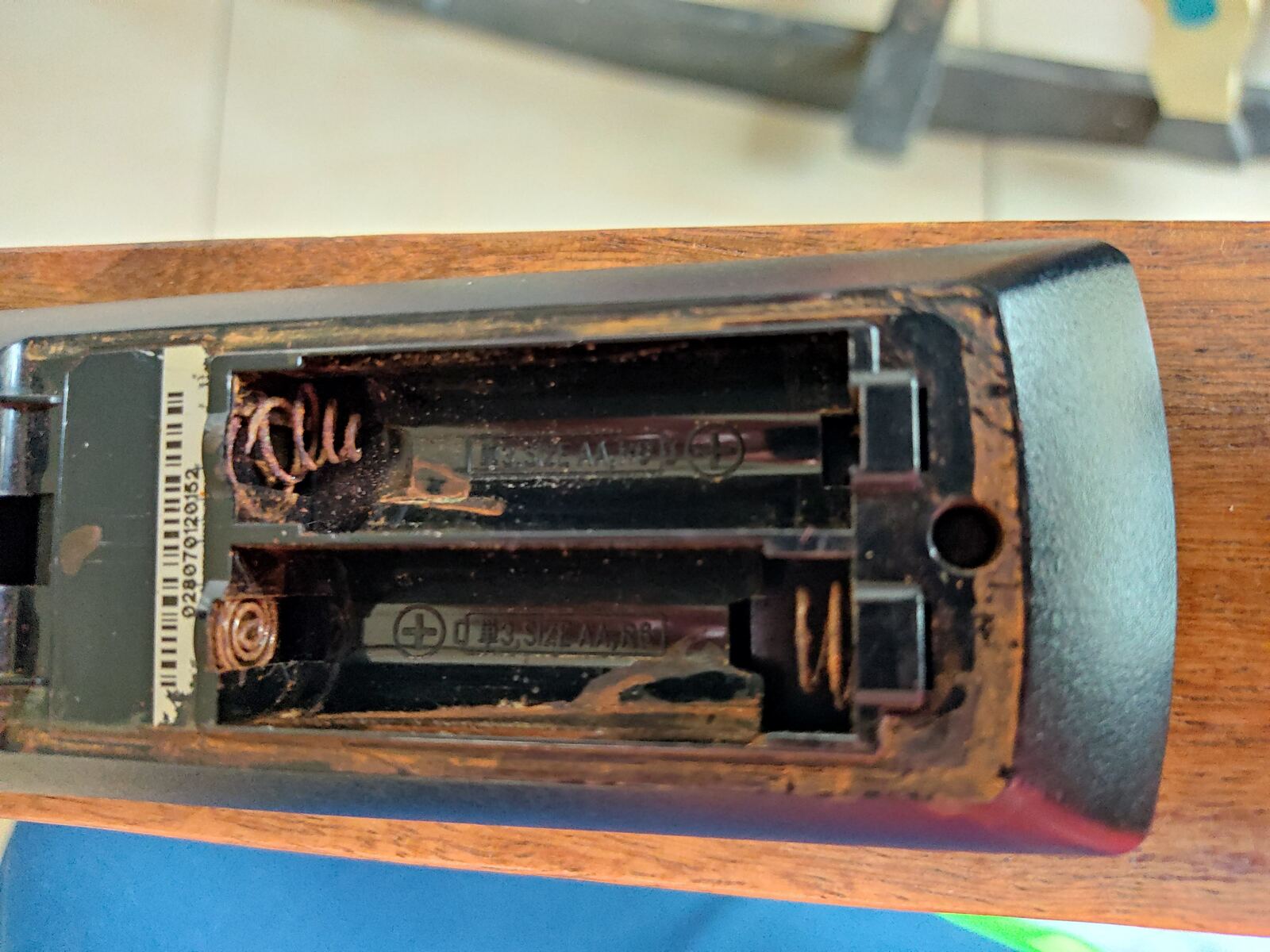
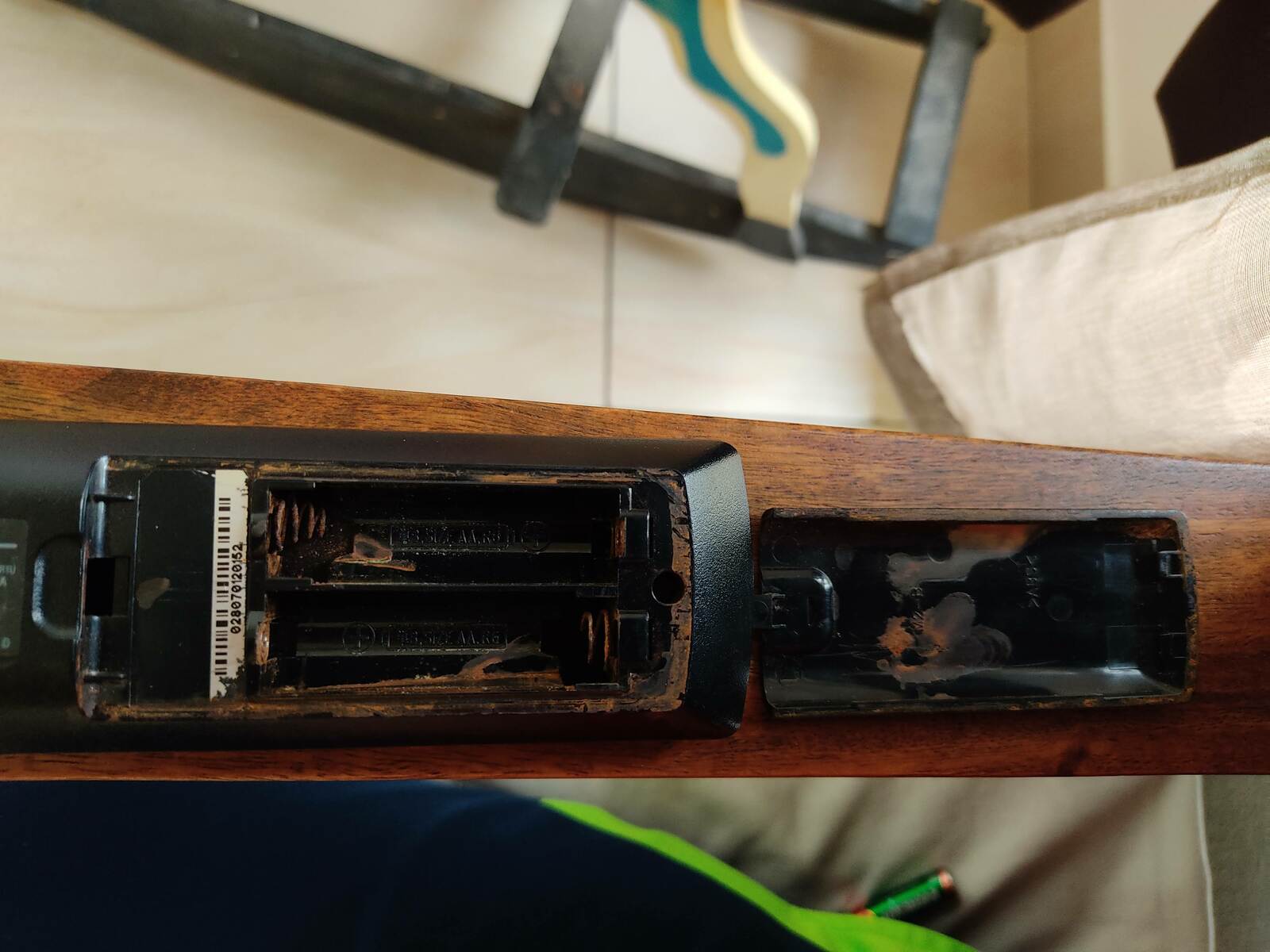
Sony PlayStation 3 BD Remote Almost 10 years ago, I bought the PS3 and many of its accessories. The remote has just been rotting in the shelf. It had rusted so bad that it is better described with these pics.
Rusted inside
Rusted inside
Rusted inside and cover
Rusted spring
Rusted spring
The rust was so much that the battery holding spring gave up. A little bit scrubbing and cleaning has gotten it working. I hope it lasts for some time before I find time to open it up and give it a full clean-up.

Pairing the BD Remote to laptop Honestly, with the condition of the hardware and software on both ends, I did not have much hopes of getting this to work. And in all the years on my computer usage, I hardly recollect much days when I ve made use of BT. Probably, because the full BT stack wasn t that well integrated in Linux, earlier. And I mostly used to disable them in hardware and software to save on battery. All yielded results from the internet talked about tools/scripts that were either not working, pointing to broken links etc. These days, bluez comes with a nice utility, bluetoothctl. It was a nice experience using it. First, start your bluetooth service and ensure that the device talks well with the kernel
rrs@lenovo:~$ systemctl status bluetooth                                                                                                          
  bluetooth.service - Bluetooth service                                                                                                           
     Loaded: loaded (/lib/systemd/system/bluetooth.service; enabled; vendor preset: enabled)                                                      
     Active: active (running) since Mon 2020-06-15 12:54:58 IST; 3s ago                                                                           
       Docs: man:bluetoothd(8)                                                                                                                    
   Main PID: 310197 (bluetoothd)                                                                                                                  
     Status: "Running"                                                                                                                            
      Tasks: 1 (limit: 9424)                                                                                                                      
     Memory: 1.3M                                                                                                                                 
     CGroup: /system.slice/bluetooth.service                                                                                                      
              310197 /usr/lib/bluetooth/bluetoothd                                                                                               
                                                                                                                                                  
Jun 15 12:54:58 lenovo systemd[1]: Starting Bluetooth service...                                                                                  
Jun 15 12:54:58 lenovo bluetoothd[310197]: Bluetooth daemon 5.50                                                                                  
Jun 15 12:54:58 lenovo systemd[1]: Started Bluetooth service.                                                                                     
Jun 15 12:54:58 lenovo bluetoothd[310197]: Starting SDP server                                                                                    
Jun 15 12:54:58 lenovo bluetoothd[310197]: Bluetooth management interface 1.15 initialized                                                        
Jun 15 12:54:58 lenovo bluetoothd[310197]: Sap driver initialization failed.                                                                      
Jun 15 12:54:58 lenovo bluetoothd[310197]: sap-server: Operation not permitted (1)                                                                
12:55                                                                                                                                       
Next, then is to discover and connect to your device
rrs@lenovo:~$ bluetoothctl 
Agent registered
[bluetooth]# devices
Device E6:3A:32:A4:31:8F MI Band 2
Device D4:B8:FF:43:AB:47 MI RC
Device 00:1E:3D:10:29:0F BD Remote Control
[CHG] Device 00:1E:3D:10:29:0F Connected: yes
[BD Remote Control]# info 00:1E:3D:10:29:0F
Device 00:1E:3D:10:29:0F (public)
        Name: BD Remote Control
        Alias: BD Remote Control
        Class: 0x0000250c
        Paired: no
        Trusted: yes
        Blocked: no
        Connected: yes
        LegacyPairing: no
        UUID: Human Interface Device... (00001124-0000-1000-8000-00805f9b34fb)
        UUID: PnP Information           (00001200-0000-1000-8000-00805f9b34fb)
        Modalias: usb:v054Cp0306d0100
[bluetooth]# 
In case of the Sony BD Remote, there s no need to pair. In fact, trying to pair fails. It prompts for the PIN code, but neither 0000 or 1234 are accepted. So, the working steps so far are to Trust the device and then Connect the device. For the sake of future use, I also populated /etc/bluetooth/input.conf based on suggestions on the internet. Note: The advertised keymappings in this config file do not work. Note: I m only using it for the power saving measures in instructing the BT connection to sleep after 3 minutes.
rrs@priyasi:/tmp$ cat input.conf 
# Configuration file for the input service
# This section contains options which are not specific to any
# particular interface
[General]
# Set idle timeout (in minutes) before the connection will
# be disconnect (defaults to 0 for no timeout)
IdleTimeout=3
# Enable HID protocol handling in userspace input profile
# Defaults to false (HIDP handled in HIDP kernel module)
#UserspaceHID=true
# Limit HID connections to bonded devices
# The HID Profile does not specify that devices must be bonded, however some
# platforms may want to make sure that input connections only come from bonded
# device connections. Several older mice have been known for not supporting
# pairing/encryption.
# Defaults to false to maximize device compatibility.
#ClassicBondedOnly=true
# LE upgrade security
# Enables upgrades of security automatically if required.
# Defaults to true to maximize device compatibility.
#LEAutoSecurity=true
#
#[00:1E:3D:10:29:0F]
[2c:33:7a:8e:d6:30]
[PS3 Remote Map]
# When the 'OverlayBuiltin' option is TRUE (the default), the keymap uses
# the built-in keymap as a starting point.  When FALSE, an empty keymap is
# the starting point.
#OverlayBuiltin = TRUE
#buttoncode = keypress    # Button label = action with default key mappings
#OverlayBuiltin = FALSE
0x16 = KEY_ESC            # EJECT = exit
0x64 = KEY_MINUS          # AUDIO = cycle audio tracks
0x65 = KEY_W              # ANGLE = cycle zoom mode
0x63 = KEY_T              # SUBTITLE = toggle subtitles
0x0f = KEY_DELETE         # CLEAR = delete key
0x28 = KEY_F8             # /TIME = toggle through sleep
0x00 = KEY_1              # NUM-1
0x01 = KEY_2              # NUM-2
0x02 = KEY_3              # NUM-3
0x03 = KEY_4              # NUM-4
0x04 = KEY_5              # NUM-5
0x05 = KEY_6              # NUM-6
0x06 = KEY_7              # NUM-7
0x07 = KEY_8              # NUM-8
0x08 = KEY_9              # NUM-9
0x09 = KEY_0              # NUM-0
0x81 = KEY_F2             # RED = red
0x82 = KEY_F3             # GREEN = green
0x80 = KEY_F4             # BLUE = blue
0x83 = KEY_F5             # YELLOW = yellow
0x70 = KEY_I              # DISPLAY = show information
0x1a = KEY_S              # TOP MENU = show guide
0x40 = KEY_M              # POP UP/MENU = menu
0x0e = KEY_ESC            # RETURN = back/escape/cancel
0x5c = KEY_R              # TRIANGLE/OPTIONS = cycle through recording options
0x5d = KEY_ESC            # CIRCLE/BACK = back/escape/cancel
0x5f = KEY_A              # SQUARE/VIEW = Adjust Playback timestretch
0x5e = KEY_ENTER          # CROSS = select
0x54 = KEY_UP             # UP = Up/Skip forward 10 minutes
0x56 = KEY_DOWN           # DOWN = Down/Skip back 10 minutes
0x57 = KEY_LEFT           # LEFT = Left/Skip back 5 seconds
0x55 = KEY_RIGHT          # RIGHT = Right/Skip forward 30 seconds
0x0b = KEY_ENTER          # ENTER = select
0x5a = KEY_F10            # L1 = volume down
0x58 = KEY_J              # L2 = decrease the play speed
0x51 = KEY_HOME           # L3 = commercial skip previous
0x5b = KEY_F11            # R1 = volume up
0x59 = KEY_U              # R2 = increase the play speed
0x52 = KEY_END            # R3 = commercial skip next
0x43 = KEY_F9             # PS button = mute
0x50 = KEY_M              # SELECT = menu (as per PS convention)
0x53 = KEY_ENTER          # START = select / Enter (matches terminology in mythwelcome)
0x30 = KEY_PAGEUP         # PREV = jump back (default 10 minutes)
0x76 = KEY_J              # INSTANT BACK (newer RCs only) = decrease the play speed
0x75 = KEY_U              # INSTANT FORWARD (newer RCs only) = increase the play speed
0x31 = KEY_PAGEDOWN       # NEXT = jump forward (default 10 minutes)
0x33 = KEY_COMMA          # SCAN BACK =  decrease scan forward speed / play
0x32 = KEY_P              # PLAY = play/pause
0x34 = KEY_DOT            # SCAN FORWARD decrease scan backard speed / increase playback speed; 3x, 5, 10, 20, 30, 60, 120, 180
0x60 = KEY_LEFT           # FRAMEBACK = Left/Skip back 5 seconds/rewind one frame
0x39 = KEY_P              # PAUSE = play/pause
0x38 = KEY_P              # STOP = play/pause
0x61 = KEY_RIGHT          # FRAMEFORWARD = Right/Skip forward 30 seconds/advance one frame
0xff = KEY_MAX
21:48                 
I have not spent much time finding out why not all the key presses work. Especially, given that most places on the internet mention these mappings. For me, some of the key scan codes aren t even reported. For keys like L1, L2, L3, R1, R2, R3, Next_Item, Prev_Item, they generate no codes in the kernel. If anyone has suggestions, ideas or fixes, I d appreciate if you can drop a comment or email me privately. But given my limited use to get a simple remote ready, to be usable with Kodi, I was apt with only some of the keys working.

Mapping the keys in Kodi With the limited number of keys detected, mapping those keys to what Kodi could use was the next step. Kodi has a very nice and easy to use module, Keymap Editor. It is very simple to use and map detected keys to functionalities you want. With it, I was able to get a functioning remote to use with my Kodi HTPC setup.

Update: Wed Jun 17 11:38:20 2020 One annoying problem that breaks the overall experience is the following bug on the driver side, that results in connections not being established instantly. Once the device goes into sleep mode, in random attempts, waking up and re-establishing a BT connection can be multi-poll affair. This can last from a couple of seconds to well over minute. Random suggestions on the internet mention disabling the autosuspend functionality for the device in the driver with btusb.enable_autosuspend=n, but that did not help in this case. Given that this device is enumberated over the USB Bus, it probably needs this feature applied to the whole USB tree of the device s chain. Something to investigate over the weekend.
Jun 16 20:41:23 lenovo kernel: Bluetooth: hci0: ACL packet for unknown connection handle 7
Jun 16 20:41:43 lenovo kernel: Bluetooth: hci0: ACL packet for unknown connection handle 8
Jun 16 20:41:59 lenovo kernel: Bluetooth: hci0: ACL packet for unknown connection handle 9
Jun 16 20:42:18 lenovo kernel: input: BD Remote Control as /devices/pci0000:00/0000:00:14.0/usb1/1-7/1-7:1.0/bluetooth/hci0/hci0:10/0005:054C:030>
Jun 16 20:42:18 lenovo kernel: sony 0005:054C:0306.0006: input,hidraw1: BLUETOOTH HID v1.00 Gamepad [BD Remote Control] on 2c:33:7a:8e:d6:30
Jun 16 20:51:59 lenovo kernel: input: BD Remote Control as /devices/pci0000:00/0000:00:14.0/usb1/1-7/1-7:1.0/bluetooth/hci0/hci0:11/0005:054C:030>
Jun 16 20:51:59 lenovo kernel: sony 0005:054C:0306.0007: input,hidraw1: BLUETOOTH HID v1.00 Gamepad [BD Remote Control] on 2c:33:7a:8e:d6:30
Jun 16 21:05:55 lenovo rtkit-daemon[1723]: Supervising 3 threads of 1 processes of 1 users.
Jun 16 21:05:55 lenovo rtkit-daemon[1723]: Successfully made thread 32747 of process 1646 owned by '1000' RT at priority 5.
Jun 16 21:05:55 lenovo rtkit-daemon[1723]: Supervising 4 threads of 1 processes of 1 users.
Jun 16 21:05:56 lenovo kernel: Bluetooth: hci0: ACL packet for unknown connection handle 12
Jun 16 21:06:12 lenovo kernel: Bluetooth: hci0: ACL packet for unknown connection handle 1
Jun 16 21:06:34 lenovo kernel: Bluetooth: hci0: ACL packet for unknown connection handle 2
Jun 16 21:06:59 lenovo kernel: input: BD Remote Control as /devices/pci0000:00/0000:00:14.0/usb1/1-7/1-7:1.0/bluetooth/hci0/hci0:3/0005:054C:0306>
Jun 16 21:06:59 lenovo kernel: sony 0005:054C:0306.0008: input,hidraw1: BLUETOOTH HID v1.00 Gamepad [BD Remote Control] on 2c:33:7a:8e:d6:30

Others There s a package, kodi-eventclients-ps3, which can be used to talk to the BD Remote. Unfortunately, it isn t up-to-date. When trying to make use of it, I ran into a couple of problems. First, the easy one is:
rrs@lenovo:~/ps3pair$ kodi-ps3remote localhost 9777
usr/share/pixmaps/kodi//bluetooth.png
Traceback (most recent call last):
  File "/usr/bin/kodi-ps3remote", line 220, in <module>
  File "/usr/bin/kodi-ps3remote", line 208, in main
    xbmc.connect(host, port)
    packet = PacketHELO(self.name, self.icon_type, self.icon_file)
  File "/usr/lib/python3/dist-packages/kodi/xbmcclient.py", line 285, in __init__
    with open(icon_file, 'rb') as f:
11:16         => 1  
This one was simple as it was just a broken path. The second issue with the tool is a leftover from python2 to python3 conversion.
rrs@lenovo:/etc/bluetooth$ kodi-ps3remote localhost
/usr/share/pixmaps/kodi//bluetooth.png
Searching for BD Remote Control
(Hold Start + Enter on remote to make it discoverable)
Redmi (E8:5A:8B:73:57:44) in range
Living Room TV (E4:DB:6D:24:23:E9) in range
Could not find BD Remote Control. Trying again...
Searching for BD Remote Control
(Hold Start + Enter on remote to make it discoverable)
Living Room TV (E4:DB:6D:24:23:E9) in range
Redmi (E8:5A:8B:73:57:44) in range
Could not find BD Remote Control. Trying again...
Searching for BD Remote Control
(Hold Start + Enter on remote to make it discoverable)
BD Remote Control (00:1E:3D:10:29:0F) in range
Found BD Remote Control with address 00:1E:3D:10:29:0F
Attempting to pair with remote
Remote Paired.
Traceback (most recent call last):
  File "/usr/bin/kodi-ps3remote", line 221, in <module>
    main()
  File "/usr/bin/kodi-ps3remote", line 212, in main
    if process_keys(remote, xbmc):
  File "/usr/bin/kodi-ps3remote", line 164, in process_keys
    keycode = data.encode("hex")[10:12]
AttributeError: 'bytes' object has no attribute 'encode'
11:24         => 1  
Fixing that too did not give me the desired result on using the BD Remote in the way I want. So eventually, I gave up and used Kodi s Keymap Editor instead.

Next Next in line, when I can manage to get some free time, is to improve the Kodi Video Scraper to have a fallback mode. Currently, for files where it cannot determine the content, it reject the file resulting in those files not showing up in your collection at all. A better approach would have been to have a fallback mode, that when the scraper cannot determine the content, it should fallback to using the filename scraper

15 June 2020

Russ Allbery: Radical haul

Along with the normal selection of science fiction and fantasy, a few radical publishers have done book giveaways due to the current political crisis in the United States. I've been feeling for a while like I've not done my homework on diverse political theory, so I downloaded those. (That's the easy part; making time to read them is the hard part, and we'll see how that goes.) Yarimar Bonilla & Marisol LeBr n (ed.) Aftershocks of Disaster (non-fiction anthology)
Jordan T. Camp & Christina Heatherton (ed.) Policing the Planet (non-fiction anthology)
Zachary D. Carter The Price of Peace (non-fiction)
Justin Akers Chac n & Mike Davis No One is Illegal (non-fiction)
Grace Chang Disposable Domestics (non-fiction)
Suzanne Collins The Ballad of Songbirds and Snakes (sff)
Angela Y. Davis Freedom is a Constant Struggle (non-fiction)
Danny Katch Socialism... Seriously (non-fiction)
Naomi Klein The Battle for Paradise (non-fiction)
Naomi Klein No is Not Enough (non-fiction)
Naomi Kritzer Catfishing on CatNet (sff)
Derek K nsken The Quantum Magician (sff)
Rob Larson Bit Tyrants (non-fiction)
Michael L wy Ecosocialism (non-fiction)
Joe Macar , Maya Schenwar, et al. (ed.) Who Do You Serve, Who Do You Protect? (non-fiction anthology)
Tochi Onyebuchi Riot Baby (sff)
Sarah Pinsker A Song for a New Day (sff)
Lina Rather Sisters of the Vast Black (sff)
Marta Russell Capitalism and Disbility (non-fiction)
Keeanga-Yamahtta Taylor From #BlackLivesMatter to Black Liberation (non-fiction)
Keeanga-Yamahtta Taylor (ed.) How We Get Free (non-fiction anthology)
Linda Tirado Hand to Mouth (non-fiction)
Alex S. Vitale The End of Policing (non-fiction)
C.M. Waggoner Unnatural Magic (sff)
Martha Wells Network Effect (sff)
Kai Ashante Wilson Sorcerer of the Wildeeps (sff)

14 June 2020

Evgeni Golov: naked pings 2020

ajax' post about "ping" etiquette is over 10 years old, but holds true until this day. So true, that my IRC client at work has a script, that will reply with a link to it each time I get a naked ping. But IRC is not the only means of communication. There is also mail, (video) conferencing, and GitHub/GitLab. Well, at least in the software engineering context. Oh and yes, it's 2020 and I still (proudly) have no Slack account. Thankfully, (naked) pings are not really a thing for mail or conferencing, but I see an increasing amount of them on GitHub and it bothers me, a lot. As there is no direct messaging on GitHub, you might rightfully ask why, as there is always context in form of the issue or PR the ping happened in, so lean back an listen ;-) notifications become useless While there might be context in the issue/PR, there is none (besides the title) in the notification mail, and not even the title in the notification from the Android app (which I have installed as I use it lot for smaller reviews). So the ping will always force a full context switch to open the web view of the issue in question, removing the possibility to just swipe away the notification/mail as "not important right now". even some context is not enough context Even after visiting the issue/PR, the ping quite often remains non-actionable. Do you want me to debug/fix the issue? Review the PR? Merge it? Close it? I don't know! The only actionable ping is when the previous message is directed at me and has an actionable request in it and the ping is just a reminder that I have to do it. And even then, why not write "hey @evgeni, did you have time to process my last question?" or something similar? BTW, this is also what I dislike about ajax' minimal example "ping re bz 534027" - what am I supposed to do with that BZ?! why me anyways?! Unless I am the only maintainer of a repo or the author of the issue/PR, there is usually no reason to ping me directly. I might be sick, or on holiday, or currently not working on that particular repo/topic or whatever. Any of that will result in you thinking that your request will be prioritized, while in reality it won't. Even worse, somebody might come across it, see me mentioned and think "ok, that's Evgeni's playground, I'll look elsewhere". Most organizations have groups of people working on specific topics. If you know the group name and have enough permissions (I am not exactly sure which, just that GitHub have limits to avoid spam, sorry) you can ping @organization/group and everyone in that group will get a notification. That's far from perfect, but at least this will get the attention of the right people. Sometimes there is also a bot that will either automatically ping a group of people or you can trigger to do so. Oh, and I'm getting paid for work on open source. So if you end up pinging me in a work-related repository, there is a high chance I will only process that during work hours, while another co-worker might have been available to help you out almost immediately. be patient Unless we talked on another medium before and I am waiting for it, please don't ping directly after creation of the issue/PR. Maintainers get notifications about new stuff and will triage and process it at some point. conclusion If you feel called out, please don't take it personally. Instead, please try to provide as much actionable information as possible and be patient, that's the best way to get a high quality result. I will ignore pings where I don't immediately know what to do, and so should you. one more thing Oh, and if you ping me on IRC, with context, and then disconnect before I can respond In the past you would sometimes get a reply by mail. These days the request will be most probably ignored. I don't like talking to the void. Sorry.

11 June 2020

Antoine Beaupr : CVE-2020-13777 GnuTLS audit: be scared

So CVE-2020-13777 came out while I wasn't looking last week. The GnuTLS advisory (GNUTLS-SA-2020-06-03) is pretty opaque so I'll refer instead to this tweet from @FiloSottile (Go team security lead):
PSA: don't rely on GnuTLS, please. CVE-2020-13777 Whoops, for the past 10 releases most TLS 1.0 1.2 connection could be passively decrypted and most TLS 1.3 connections intercepted. Trivially. Also, TLS 1.2 1.0 session tickets are awful.
You are reading this correctly: supposedly encrypted TLS connections made with affected GnuTLS releases are vulnerable to passive cleartext recovery attack (and active for 1.3, but who uses that anyways). That is extremely bad. It's pretty close to just switching everyone to HTTP instead of HTTPS, more or less. I would have a lot more to say about the security of GnuTLS in particular -- and security in general -- but I am mostly concerned about patching holes in the roof right now, so this article is not about that. This article is about figuring out what, exactly, was exposed in our infrastructure because of this.

Affected packages Assuming you're running Debian, this will show a list of packages that Depends on GnuTLS:
apt-cache --installed rdepends libgnutls30   grep '^ '   sort -u
This assumes you run this only on hosts running Buster or above. Otherwise you'll need to figure out a way to pick machines running GnuTLS 3.6.4 or later. Note that this list only first level dependencies! It is perfectly possible that another package uses GnuTLS without being listed here. For example, in the above list I have libcurl3-gnutls, so the be really thorough, I would actually need to recurse down the dependency tree. On my desktop, this shows an "interesting" list of targets:
  • apt
  • cadaver - AKA WebDAV
  • curl & wget
  • fwupd - another attack on top of this one
  • git (through the libcurl3-gnutls dependency)
  • mutt - all your emails
  • weechat - your precious private chats
Arguably, fetchers like apt, curl, fwupd, and wget rely on HTTPS for "authentication" more than secrecy, although apt has its own OpenPGP-based authentication so that wouldn't matter anyways. Still, this is truly distressing. And I haven't mentioned here things like gobby, network-manager, systemd, and others - the scope of this is broad. Hell, even good old lynx links against GnuTLS. In our infrastructure, the magic command looks something like this:
cumin -o txt -p 0  'F:lsbdistcodename=buster' "apt-cache --installed rdepends libgnutls30   grep '^ '   sort -u"   tee gnutls-rdepds-per-host   awk ' print $NF '   sort   uniq -c   sort -n
There, the result is even more worrisome, as those important packages seem to rely on GnuTLS for their transport security:
  • mariadb - all MySQL traffic and passwords
  • mandos - full disk encryption
  • slapd - LDAP passwords
mandos is especially distressing although it's probably not vulnerable because it seems it doesn't store the cleartext -- it's encrypted with the client's OpenPGP public key -- so the TLS tunnel never sees the cleartext either. Other reports have also mentioned the following servers link against GnuTLS and could be vulnerable:
  • exim
  • rsyslog
  • samba
  • various VNC implementations

Not affected Those programs are not affected by this vulnerability:
  • apache2
  • gnupg
  • python
  • nginx
  • openssh
This list is not exhaustive, naturally, but serves as an example of common software you don't need to worry about. The vulnerability only exists in GnuTLS, as far as we know, so programs linking against other libraries are not vulnerable. Because the vulnerability affects session tickets -- and those are set on the server side of the TLS connection -- only users of GnuTLS as a server are vulnerable. This means, for example, that while weechat uses GnuTLS, it will only suffer from the problem when acting as a server (which it does, in relay mode) or, of course, if the remote IRC server also uses GnuTLS. Same with apt, curl, wget, or git: it is unlikely to be a problem because it is only used as a client; the remote server is usually a webserver -- not git itself -- when using TLS.

Caveats Keep in mind that it's not because a package links against GnuTLS that it uses it. For example, I have been told that, on Arch Linux, if both GnuTLS and OpenSSL are available, the mutt package will use the latter, so it's not affected. I haven't confirmed that myself nor have I checked on Debian. Also, because it relies on session tickets, there's a time window after which the ticket gets cycled and properly initialized. But that is apparently 6 hours by default so it is going to protect only really long-lasting TLS sessions, which are uncommon, I would argue. My audit is limited. For example, it might have been better to walk the shared library dependencies directly, instead of relying on Debian package dependencies.

Other technical details It seems the vulnerability might have been introduced in this merge request, itself following a (entirely reasonable) feature request to make it easier to rotate session tickets. The merge request was open for a few months and was thoroughly reviewed by a peer before being merged. Interestingly, the vulnerable function (_gnutls_initialize_session_ticket_key_rotation), explicitly says:
 * This function will not enable session ticket keys on the server side. That is done
 * with the gnutls_session_ticket_enable_server() function. This function just initializes
 * the internal state to support periodical rotation of the session ticket encryption key.
In other words, it thinks it is not responsible for session ticket initialization, yet it is. Indeed, the merge request fixing the problem unconditionally does this:
memcpy(session->key.initial_stek, key->data, key->size);
I haven't reviewed the code and the vulnerability in detail, so take the above with a grain of salt. The full patch is available here. See also the upstream issue 1011, the upstream advisory, the Debian security tracker, and the Redhat Bugzilla.

Moving forward The impact of this vulnerability depends on the affected packages and how they are used. It can range from "meh, someone knows I downloaded that Debian package yesterday" to "holy crap my full disk encryption passwords are compromised, I need to re-encrypt all my drives", including "I need to change all LDAP and MySQL passwords". It promises to be a fun week for some people at least. Looking ahead, however, one has to wonder whether we should follow @FiloSottile's advice and stop using GnuTLS altogether. There are at least a few programs that link against GnuTLS because of the OpenSSL licensing oddities but that has been first announced in 2015, then definitely and clearly resolved in 2017 -- or maybe that was in 2018? Anyways it's fixed, pinky-promise-I-swear, except if you're one of those weirdos still using GPL-2, of course. Even though OpenSSL isn't the simplest and secure TLS implementation out there, it could preferable to GnuTLS and maybe we should consider changing Debian packages to use it in the future. But then again, the last time something like this happened, it was Heartbleed and GnuTLS wasn't affected, so who knows... It is likely that people don't have OpenSSL in mind when they suggest moving away from GnuTLS and instead think of other TLS libraries like mbedtls (previously known as PolarSSL), NSS, BoringSSL, LibreSSL and so on. Not that those are totally sinless either... "This is fine", as they say...

Holger Levsen: 20200611-stress-management

Stress management I've got a note hanging in my kitchen which is from an unknown source. So while I still can share it happily, I sadly cannot give proper credit. (Update: it was pointed out to me privately that the story is probably coming from Kathy Hadley, a life coach. Thanks for sharing, Kathy!) It reads:
A psychologist walked around a room while teaching stress management to an
audience. As she raised a glass of water, everyone expected they'd be asked
the "half empty or half full' question. Instead, with a smile on her face, she
inquired: "How heavy is this glass of water?"
Answers called out ranged from 8oz to 20oz.
She replied, "The absolute weight doesn't matter. It depends on how long I
hold it. If I hold it for a minute, it's not a problem. If I hold if for an
hour, I'll have an ache in my arm. If I hold it for a day, my arm will feel
numb and paralyzed. In each case, the weight of the glass doesn't change, but
the longer I hold it, the heavier it becomes."
She continued, "The stresses and worries in life are like that glass of water.
Think about them for a while and nothing happens. Think about them a bit
longer and they will begin to hurt. And if you think about them all day long,
you will feel paralyzed - incapable of doing anything."
Remember to put the glass down.
Especially in times like these, do remember to put the glass down!

10 June 2020

Joey Hess: bracketing and async exceptions in haskell

I've been digging into async exceptions in haskell, and getting more and more concerned. In particular, bracket seems to be often used in ways that are not async exception safe. I've found multiple libraries with problems. Here's an example:
withTempFile a = bracket setup cleanup a
  where
    setup = openTempFile "/tmp" "tmpfile"
    cleanup (name, h) = do
        hClose h
        removeFile name
This looks reasonably good, it makes sure to clean up after itself even when the action throws an exception. But, in fact that code can leave stale temp files lying around. If the thread receives an async exception when hClose is running, it will be interrupted before the file is removed. We normally think of bracket as masking exceptions, but it doesn't prevent async exceptions in all cases. See Control.Exception on "interruptible operations", which can receive async exceptions even when other exceptions are masked. It's a bit surprising, but hClose is such an interruptable operation, because it flushes the write buffer. The only way to know is to read the code. It can be quite hard to determine if an operation is interruptable, since it can come down to whether it retries a STM transaction, or uses a MVar that is not always full. I've been auditing libraries and I often have to look at code several dependencies away, and even then may not be sure if a library has this problem. So far, around half of the libraries I've looked at, that use bracket or onException or the like probably have this problem. What can libraries do? My impression of the state of things now is that you should be very cautious using race or cancel or withAsync or the like, unless the thread is small and easy to audit for these problems. Kind of a shame, since I had wanted to be able to cancel a thread that is big and sprawling and uses all the libraries mentioned above.
This work was sponsored by Jake Vosloo and Graham Spencer on Patreon.

Jonathan Dowland: Template Haskell and Stream-processing programs

I've written about what Template Haskell is, and given an example of what it can be used for, it's time to explain why I was looking at it in the context of my PhD work. Encoding stream-processing programs StrIoT is an experimental distributed stream-processing system that myself and others are building in order to explore our research questions. A user of StrIoT writes a stream-processing program, using a set of 8 functional operators provided for the purpose. A simple example is
streamFn :: Stream Int -> Stream Int
streamFn = streamFilter (<15)
         . streamFilter (>5)
         . streamMap (*2)
Our system is distributed: we take a stream-processing program and partition it into sub-programs, which are distributed to and run on separate nodes (perhaps cloud instances, or embedded devices like Raspberry Pis etc.). In order to do that, we need to be able to manipulate the stream-processing program as data. We've initially opted for a graph data-structure, with the vertices in the graph defined as
data StreamVertex = StreamVertex
      vertexId   :: Int
    , operator   :: StreamOperator
    , parameters :: [String]
    , intype     :: String
    , outtype    :: String
      deriving (Eq,Show)
A stream-processing program encoded this way, equivalent to the first example
path [ StreamVertex 0 Map    ["(*2)"]  "Int" "Int"
     , StreamVertex 1 Filter ["(>5)"]  "Int" "Int"
     , StreamVertex 2 Filter ["(<15)"] "Int" "Int"
     ]
We can easily manipulate instances of such types, rewrite them, partition them and generate code from them. Unfortunately, this is quite a departure from the first simple code example from the perspective of a user writing their program. Template Haskell gives us the ability to manipulate code as a data structure, and also to inspect names to gather information about them (their type, etc.). I started looking at TH to see if we could build something where the user-supplied program was as close to that first case as possible. TH limitations There are two reasons that we can't easily manipulate a stream-processing definition written as in the first example. The following expressions are equivalent, in some sense, but are not equal, and so yield completely different expression trees when quasi-quoted:
[  streamFilter (<15) . streamFilter (>5) . streamMap (*2)  ]
  \s -> streamFilter (<15) (streamFilter (>5) (streamMap (*2) s))  ]
[  streamMap (*2) >>> streamFilter (>5) >>> streamFilter (<15)  ]
[  \s -> s & streamMap (*2) & streamFilter (>5) & streamFilter (<15)  ]
[  streamFn  ] -- a named expression, defined outside the quasi-quotes
In theory, reify can give you the definition of a function from its name, but in practice it doesn't, because this was never implemented. So at the very least we would need to insist that a user included the entirety of a stream-processing program within quasi-quotes, and not split it up into separate bits, with some bits defined outside the quotes and references within (as in the last case above). We would probably have to insist on a consistent approach for composing operators together, such as always use (.) and never >>>, &, etc. which is limiting. Incremental approach After a while ruminating on this, and before moving onto something else, I thought I'd try approaching it from the other side. Could I introduce some TH into the existing approach, and improve it? The first thing I've tried is to change the parameters field to TH's ExpQ, meaning the map instance example above would be
StreamVertex 0 Map [ [  (*2)  ] ] "Int" "Int"
I worked this through. It's an incremental improvement ease and clarity for the user writing a stream-processing program. It catches a class of programming bugs that would otherwise slip through: the expressions in the brackets have to be syntactically valid (although they aren't type checked). Some of the StrIoT internals are also much improved, particularly the logical operator. Here's an excerpt from a rewrite rule that involves composing code embedded in strings, dealing with all the escaping rules and hoping we've accounted for all possible incoming expression encodings:
let f' = "(let f = ("++f++"); p = ("++p++"); g = ("++g++") in\
         \ \\ (a,b) v -> (f a v, if p v a then g b v else b))"
    a' = "("++a++","++b++")"
    q' = "(let p = ("++p++"); q = ("++q++") in \\v (y,z) -> p v y && q v z)"
And the same section after, manipulating ExpQ types:
let f' = [  \ (a,b) v -> ($(f) a v, if $(p) v a then $(g) b v else b)  ]
    a' = [  ($(a), $(b))  ]
    q' = [  \v (y,z) -> $(p) v y && $(q) v z  ]
I think the code-generation part of StrIoT could be radically refactored to take advantage of this change but I have not made huge inroads into that. Next steps This is, probably, where I am going to stop. This work is very interesting to me but not the main thrust of my research. But incrementally improving the representation gave me some ideas of what I could try next: The type would have collapsed down to
data StreamVertex = StreamVertex
      vertexId   :: Int
    , opAndParams :: ExpQ
      deriving (Eq,Show)
Example instances might be
StreamVertex 0 [  streamMap (*2)  ]
StreamVertex 1 [  streamExpand  ]
StreamVertex 2 [  streamScan (\c _ -> c+1) 0  ]
The vertexId field is a bit of wart, but we require that due to the graph data structure that we are using. A change there could eliminate it, too. By this point we are not that far away from where we started, and certainly much closer to the "pure" function application in the very first example.

Evgeni Golov: show your desk

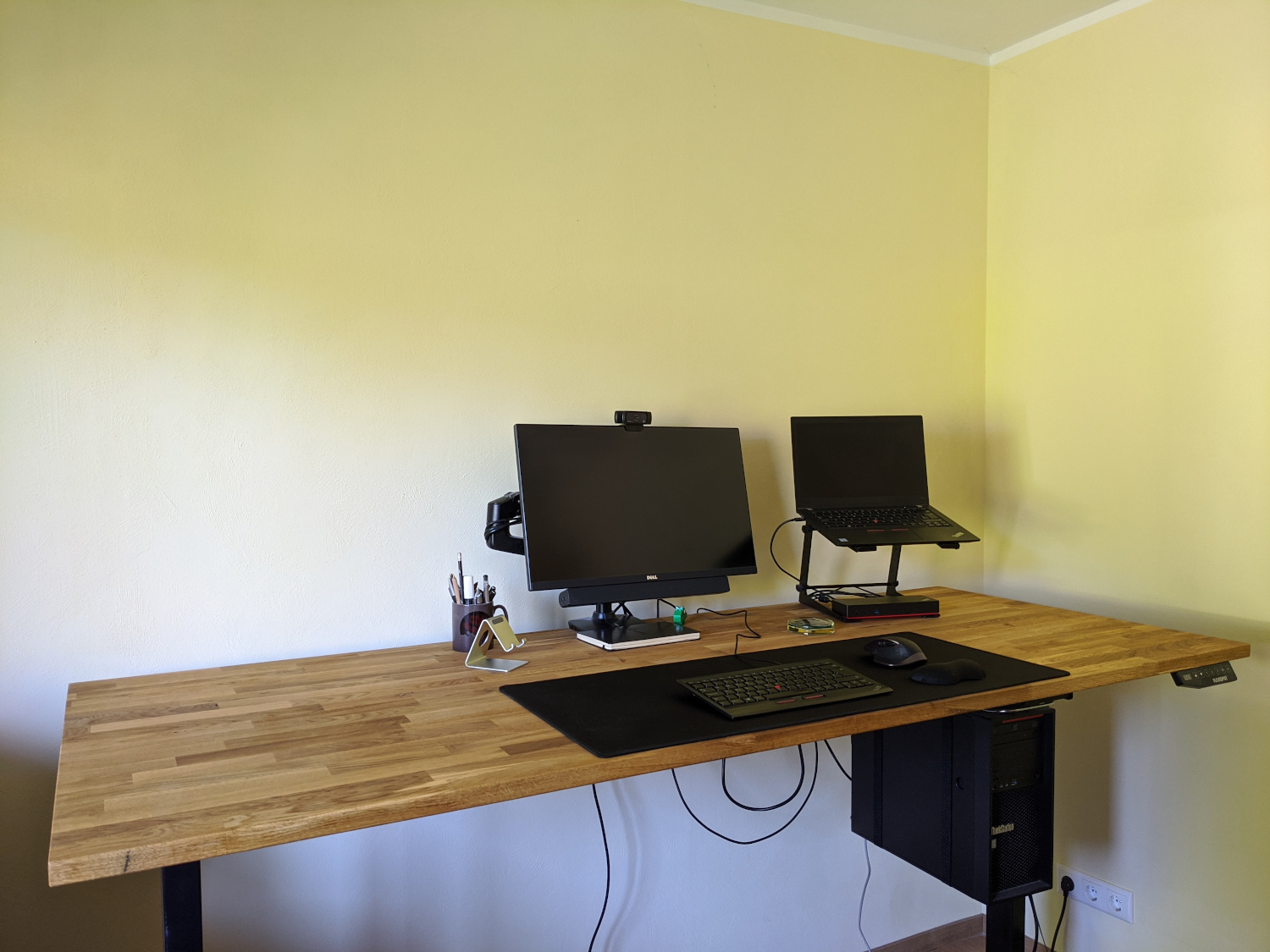
Some days ago I posted a picture of my desk on Mastodon and Twitter. standing desk with a monitor, laptop etc After that I got multiple questions about the setup, so I thought "Michael and Michael did posts about their setups, you could too!" And well, here we are ;-) desk The desk is a Flexispot E5B frame with a 200 80 2.6cm oak table top. The Flexispot E5 (the B stands for black) is a rather cheap (as in not expensive) standing desk frame. It has a retail price of 379 , but you can often get it as low as 299 on sale. Add a nice table top from a local store (mine was like 99 ), a bit of wood oil and work and you get a nice standing desk for less than 500 . The frame has three memory positions, but I only use two: one for sitting, one for standing, and a "change position" timer that I never used so far. The table top has a bit of a swing when in standing position (mine is at 104cm according to the electronics in the table), but not enough to disturb typing on the keyboard or thinking. I certainly wouldn't place a sewing machine up there, but that was not a requirement anyways ;) To compare: the IKEA Bekant table has a similar, maybe even slightly stronger swing. chair Speaking of IKEA The chair is an IKEA Volmar. They don't seem to sell it since mid 2019 anymore though, so no link here. hardware laptop A Lenovo ThinkPad T480s, i7-8650U, 24GB RAM, running Fedora 32 Workstation. Just enough power while not too big and heavy. Full of stickers, because I stickers! It's connected to a Lenovo ThinkPad Thunderbolt 3 Dock (Gen 1). After 2 years with that thing, I'm still not sure what to think about it, as I had various issues with it over the time:
  • the internal USB hub just vanishing from existence until a full power cycle of the dock was performed, but that might have been caused by my USB-switch which I recently removed.
  • the NIC negotiating at 100MBit/s instead of 1000MBit/s and then keeping on re-negotiating every few minutes, disconnecting me from the network, but I've not seen that since the Fedora 32 upgrade.
  • the USB-attached keyboard not working during boot as it needs some Thunderbolt magic.
The ThinkPad stands on a Adam Hall Stands SLT001E, a rather simple stand for laptops and other equipment (primarily made for DJs I think). The Dock fits exactly between the two feet of the stand, so that is nice and saves space on the table. Using the stand I can use the laptop screen as a second screen when I want it - but most often I do not and have the laptop lid closed while working. workstation A Lenovo ThinkStation P410, Xeon E5-2620 v4, 96GB RAM, running Fedora 32 Workstation. That's my VM playground. Having lots of RAM really helps if you need/want to run many VMs with Foreman/Katello or Red Hat Satellite as they tend to be a bit memory hungry and throwing hardware at problems tend to be an easy solution for many of them. The ThinkStation is also connected to the monitor, and I used to have an USB switch to flip my keyboard, mouse and Yubikey from the laptop to the workstation and back. But as noted above, this switch somehow made the USB hub in the laptop dock unhappy (maybe because I was switching too quickly after resume or so), so it's currently removed from the setup and I use the workstation via SSH only. It's mounted under the table using a ROLINE PC holder. You won't get any design awards with it, but it's easy to assemble and allows the computer to move with the table, minimizing the number of cables that need to have a flexible length. monitor The monitor is an older Dell UltraSharp U2515H - a 25" 2560 1440 model. It sits on an Amazon Basics Monitor Arm (which is identical to an Ergotron LX to the best of my knowledge) and is accompanied by a Dell AC511 soundbar. I don't use the adjustable arm much. It's from the time I had no real standing desk and would use the arm and a cardboard box to lift the monitor and keyboard to a standing level. If you don't want to invest in a standing desk, that's the best and cheapest solution! The soundbar is sufficient for listening to music while working and for chatting with colleagues. webcam A Logitech C920 Pro, what else? Works perfectly under Linux with the UVC driver and has rather good microphones. Actually, so good that I never use a headset during video calls and so far nobody complained about bad audio. keyboard A ThinkPad Compact USB Keyboard with TrackPoint. The keyboard matches the one in my T480s, so my brain doesn't have to switch. It was awful when I still had the "old" model and had to switch between the two. UK layout. Sue me. I like the big return key. mouse A Logitech MX Master 2. I got the MX Revolution as a gift a long time ago, and at first I was like: WTF, why would anyone pay hundred bucks for a mouse?! Well, after some time I knew, it's just that good. And when it was time to get a new one (the rubber coating gets all slippery after some time) the decision was rather easy. I'm pondering if I should try the MX Ergo or the MX Vertical at some point, but not enough to go and buy one of them yet. other notepad I'm terrible at remembering things, so I need to write them down. And I'm terrible at remembering to look at my notes, so they need to be in my view. So there is a regular A5 notepad on my desk, that gets filled with check boxes and stuff, page after page. coaster It's a wooden table, you don't want to have liquids on it, right? Thankfully a friend of mine once made coasters out of old Xeon CPUs and epoxy. He gave me one in exchange for a busted X41 ThinkPad. I still think I made the better deal ;) yubikey Keep your secrets safe! Mine is used as a GnuPG smart card for both encryption and SSH authentication, U2F on various pages and 2FA for VPN. headphones I own a pair of Bose QuietComfort 25 with an aftermarket Bluetooth adapter and Anker SoundBuds Slim+. Both are used rather seldomly while working, as my office is usually quiet and no one is disturbed when I listen to music without headphones. what's missing? light I want to add more light to the setup, noth to have a better picture during video calls but also to have better light when doing something else on the table - like soldering. The plan is to add an IKEA Tertial with some Tr dfri smart LED in it, but the Tertial is currently not available for delivery at IKEA and I'm not going to visit one in the current situation. bigger monitor Currently pondering getting a bigger (27+ inch) 4K monitor. Still can't really decide which one to get. There are so many, and they all differ in some way. But it seems no affordable one is offering an integrated USB switch and sufficient amount of USB ports, so I'll probably get whatever can get me a good picture without any extra features at a reasonable price. Changing the monitor will probably also mean rethinking the sound output, as I'm sure mounting the Dell soundbar to anything but the designated 5 year old monitor won't work too well.

9 June 2020

Julian Andres Klode: Review: Chromebook Duet

Sporting a beautiful 10.1 1920x1200 display, the Lenovo IdeaPad Duet Chromebook or Duet Chromebook, is one of the latest Chromebooks released, and one of the few slate-style tablets, and it s only about 300 EUR (300 USD). I ve had one for about 2 weeks now, and here are my thoughts.

Build & Accessories The tablet is a fairly Pixel-style affair, in that the back has two components, one softer blue one housing the camera and a metal feeling gray one. Build quality is fairly good. The volume and power buttons are located on the right side of the tablet, and this is one of the main issues: You end up accidentally pressing the power button when you want to turn your volume lower, despite the power button having a different texture. Alongside the tablet, you also find a kickstand with a textile back, and a keyboard, both of which attach via magnets (and pogo pins for the keyboard). The keyboard is crammed, with punctuation keys being halfed in size, and it feels mushed compared to my usual experiences of ThinkPads and Model Ms, but it s on par with other Chromebooks, which is surprising, given it s a tablet attachment.
fully assembled chromebook duet fully assembled chromebook duet
I mostly use the Duet as a tablet, and only attach the keyboard occasionally. Typing with the keyboard on your lap is suboptimal. My first Duet had a few bunches of dead pixels, so I returned it, as I had a second one I could not cancel ordered as well. Oh dear. That one was fine!

Hardware & Connectivity The Chromebook Duet is powered by a Mediatek Helio P60T SoC, 4GB of RAM, and a choice of 64 or 128 GB of main storage. The tablet provides one USB-C port for charging, audio output (a 3.5mm adapter is provided in the box), USB hub, and video output; though, sadly, the latter is restricted to a maximum of 1080p30, or 1440x900 at 60 Hz. It can be charged using the included 10W charger, or use up to I believe 18W from a higher powered USB-C PD charger. I ve successfully used the Chromebook with a USB-C monitor with attached keyboard, mouse, and DAC without any issues. On the wireless side, the tablet provides 2x2 Wifi AC and Bluetooth 4.2. WiFi reception seemed just fine, though I have not done any speed testing, missing a sensible connection at the moment. I used Bluetooth to connect to my smartphone for instant tethering, and my Sony WH1000XM2 headphones, both of which worked without any issues. The screen is a bright 400 nit display with excellent viewing angles, and the speakers do a decent job, meaning you can use easily use this for watching a movie when you re alone in a room and idling around. It has a resolution of 1920x1200. The device supports styluses following the USI standard. As of right now, the only such stylus I know about is an HP one, and it costs about 70 or so. Cameras are provided on the front and the rear, but produce terrible images.

Software: The tablet experience The Chromebook Duet runs Chrome OS, and comes with access to Android apps using the play store (and sideloading in dev mode) and access to full Linux environments powered by LXD inside VMs. The screen which has 1920x1200 is scaled to a ridiculous 1080x675 by default which is good for being able to tap buttons and stuff, but provides next to no content. Scaling it to 1350x844 makes things more balanced. The Linux integration is buggy. Touches register in different places than where they happened, and the screen is cut off in full screen extremetuxracer, making it hard to recommend for such uses. Android apps generally work fine. There are some issues with the back gesture not registering, but otherwise I have not found issues I can remember. One major drawback as a portable media consumption device is that Android apps only work in Widevine level 3, and hence do not have access to HD content, and the web apps of Netflix and co do not support downloading. Though one of the Duets actually said L1 in check apps at some point (reported in issue 1090330). It s also worth noting that Amazon Prime Video only renders in HD, unless you change your user agent to say you are Chrome on Windows - bad Amazon! The tablet experience also lags in some other ways, as the palm rejection is overly extreme, causing it to reject valid clicks close to the edge of the display (reported in issue 1090326). The on screen keyboard is terrible. It only does one language at a time, forcing me to switch between German and English all the time, and does not behave as you d expect it when editing existing words - it does not know about them and thinks you are starting a new one. It does provide a small keyboard that you can move around, as well as a draw your letters keyboard, which could come in handy for stylus users, I guess. In any case, it s miles away from gboard on Android. Stability is a mixed bag right now. As of Chrome OS 83, sites (well only Disney+ so far ) sometimes get killed with SIGILL or SIGTRAP, and the device rebooted on its own once or twice. Android apps that use the DRM sometimes do not start, and the Netflix Android app sometimes reports it cannot connect to the servers.

Performance Performance is decent to sluggish, with micro stuttering in a lot of places. The Mediatek CPU is comparable to Intel Atoms, and with only 4GB of RAM, and an entire Android container running, it s starting to show how weak it is. I found that Google Docs worked perfectly fine, as did websites such as Mastodon, Twitter, Facebook. Where the device really struggled was Reddit, where closing or opening a post, or getting a reply box could take 5 seconds or more. If you are looking for a Reddit browsing device, this is not for you. Performance in Netflix was fine, and Disney+ was fairly slow but still usable. All in all, it s acceptable, and given the price point and the build quality, probably the compromise you d expect.

Summary tl;dr:
  • good: Build quality, bright screen, low price, included accessories
  • bad: DRM issues, performance, limited USB-C video output, charging speed, on-screen keyboard, software bugs
The Chromebook Duet or IdeaPad Duet Chromebook is a decent tablet that is built well above its price point. It s lackluster performance and DRM woes make it hard to give a general recommendation, though. It s not a good laptop. I can see this as the perfect note taking device for students, and as a cheap tablet for couch surfing, or as your on-the-go laptop replacement, if you need it only occasionally. I cannot see anyone using this as their main laptop, although I guess some people only have phones these days, so: what do I know? I can see you getting this device if you want to tinker with Linux on ARM, as Chromebooks are quite nice to tinker with, and a tablet is super nice.

2 June 2020

Olivier Berger: Mixing NRELab s Antidote and Eclipse Che on the same k8s cluster

You may have heard of my search for Cloud solutions to run labs in an academic context, with a focus on free an open source solutions . You may read previous installments of this blog, or for a shorter, check the presentation I ve recorded last week. I ve become quite interested, in the latest month, in 2 projects: NRELab s Antidote and Eclipse Che. Antidote is the software that powers NRELabs, a labs platform for learning network automation, which runs on top of Kubernetes (k8s). The interesting thing is that for each learner, there can be a dedicated k8s namespace with multiple virtual nodes running on a separate network. This can be used in the context of virtual classes/labs where our students will perform network labs in parallel on the same cluster. Eclipse Che powers Eclipse on the Cloud , making available software development environments, for developers, on a Kubernetes Cloud. Developers typically work from a Web page instead of installing local development tools. Both projects seem quite complementary. For one, we both teach networks and software developments. So that would naturally appeal for many professors. Furthermore, Eclipse Che provides a few features that Antidote is lacking : authenticating users (with keycloak), and persisting their work in workspaces, between work sessions. Typically what we need in our academic context where students will work on the same labs during scheduled classes, week after week, during or off-hours. Thus it would be great to have more integration between the 2 environments. I intend to work on that front, but that takes time, as running stuff on Kubernetes isn t exactly trivial, at least when you re like me and want to use a vanilla kubernetes. I ve mainly relied on running k8s inside VMs using Vagrant and/or minikube so far. A first milestone I ve achieved is making sure that Antidote and Eclipse Che aren t incompatible. Antidote s selfmedicate script was actually running inside a Vagrant VM, where I had difficulties installing Eclipse Che (probably because of old software, or particular networking setup details). I ve overcome this hurdle, as I m now able to install both environments on a single Kubernetes VM (using my own Vagrant setup). Running Eclipse Che (alongsite Antidote) on a k8s Vagrant VM. This proves only that there s no show stopper there, but a lot of work remains. Stay tuned. Update: I ve finally managed to get it to work on the antidote-selfmedicate base too. See my branch at: https://github.com/olberger/antidote-selfmedicate/tree/che

Sylvestre Ledru: Debian rebuild with clang 10 + some patches

Because of the lock-down in France and thanks to Lucas, I have been able to make some progress rebuilding Debian with clang instead of gcc.

TLDR Instead of patching clang itself, I used a different approach this time: patching Debian tools or implementing some workaround to mitigate an issue.
The percentage of packages failing drop from 4.5% to 3.6% (1400 packages to 1110 - on a total of 31014). I focused on two classes of issues:

Qmake As I have no intention to merge the patch upstream, I used a very dirty workaround. I overwrote the g++ qmake file by clang's:
https://salsa.debian.org/lucas/collab-qa-tools/-/blob/master/modes/clang10#L44-47 I dropped the number of this failure to 0, making some packages build flawlessly (example: qtcreator, chessx, fwbuilder, etc). However, some packages are still failing later and therefore increasing the number of failures in some other categories like link error. For example, qtads fails because of ordered comparison between pointer and zero or oscar fails on a -Werror,-Wdeprecated-copy error. Breaking the build later also highlighted some new classes of issues which didn't occur with clang < 10.
For example, warnings related to C++ range loop or implicit int float conversion (I fixed a bunch of them in Firefox) .

Symbol differences Historically, symbol management for C++ in Debian has been a pain. Russ Allbery wrote a blog post in 2012 explaining the situation. AFAIK, it hasn't changed much.
Once more, I took the dirty approach: if there new or missing symbols, don't fail the build.
The rational is the following: Packages in the Debian archive are supposed to build without any issue. If there is new or missing symbols, it is probably clang generating a different library but this library is very likely working as expected (and usable by a program compiled with g++ or clang). It is purely a different approach taken by the compiler developer. In order to mitigate this issue, before the build starts, I am modifying dpkg-gensymbols to transform the error into a warning.
So, the typical Debian error some new symbols appeared in the symbols file or some symbols or patterns disappeared in the symbols file will NOT fail the build. Unsurprisingly, all but one package (libktorrent) build. Even if I am pessimistic, I reported a bug on dpkg-dev to evaluate if we could improve dpkg-gensymbol not to fail on these cases.

Next steps The next offender is Imake.tmpl:2243:10: fatal error: ' X11 .rules' file not found with more than an hundred occurrences, reported upstream quite sometime ago. Then, the big issues are going to be much harder to fix as they are real issues/warnings (with -Werror) in the code of the packages. Example: -Wc++11-narrowing & Wreserved-user-defined-literal... The list is long.
I will probably work on that when llvm/clang 11 are in RC phase.

For maintainers & upstream Maintainer of Debian/Ubuntu packages? I am providing a list of failing packages per maintainer: https://clang.debian.net/maintainers.php
For upstream, it is also easy to test with clang. Usually, apt install clang && CC=clang CXX=clang++ <build step> is good enough.

Conclusion With these two changes, I have been able to fix about 290 packages. I think I will be able to get that down a bit more but we will soon reach a plateau as many warnings/issues will have to fix in the C/C++ code itself.

29 May 2020

Keith Packard: picolibc-string-float

Float/String Conversion in Picolibc Exact conversion between strings and floats seems like a fairly straightforward problem. There are two related problems:
  1. String to Float conversion. In this case, the goal is to construct the floating point number which most closely approximates the number represented by the string.
  2. Float to String conversion. Here, the goal is to generate the shortest string which, when fed back into the String to Float conversion code, exactly reproduces the original value.
When linked together, getting from float to string and back to float is a round trip , and an exact pair of algorithms does this for every floating point value. Solutions for both directions were published in the proceedings of the ACM SIGPLAN 1990 conference on Programming language design and implementation, with the string-to-float version written by William Clinger and the float-to-string version written by Guy Steele and Jon White. These solutions rely on very high precision integer arithmetic to get every case correct, with float-to-string requiring up to 1050 bits for the 64-bit IEEE floating point format. That's a lot of bits. Newlib Float/String Conversion The original newlib code, written in 1998 by David M. Gay, has arbitrary-precision numeric code for these functions to get exact results. However, it has the disadvantages of performing numerous memory allocations, consuming considerable space for the code, and taking a long time for conversions. The first disadvantage, using malloc during conversion, ended up causing a number of CVEs because the results of malloc were not being checked. That's bad on all platforms, but especially bad for embedded systems where reading and writing through NULL pointers may have unknown effects. Upstream newlib applied a quick fix to check the allocations and call abort. Again, on platforms with an OS, that at least provides a way to shut down the program and let the operating environment figure out what to do next. On tiny embedded systems, there may not be any way to log an error message or even restart the system. Ok, so we want to get rid of the calls to abort and have the error reported back through the API call which caused the problem. That's got two issues, one mere technical work, and another mere re-interpretation of specifications. Let's review the specification issue. The libc APIs involved here are: Input: Output: Scanf and printf are both documented to set errno to ENOMEM when they run out of memory, but none of the other functions takes that possibility into account. So we'll make some stuff up and hope it works out: Now, looking back at the technical challenge. That's a simple matter of inserting checks at each allocation, or call which may result in an allocation, and reporting failure back up the call stack, unwinding any intermediate state to avoid leaking memory. Testing Every Possible Allocation Failure There are a lot of allocation calls in the newlib code. And the call stack can get pretty deep. A simple visual inspection of the code didn't seem sufficient to me to validate the allocation checking code. So I instrumented malloc, making it count the number of allocations and fail at a specific one. Now I can count the total number of allocations done over the entire test suite run for each API involved and then run the test suite that many times, failing each allocation in turn and checking to make sure we recover correctly. By that, I mean: There were about 60000 allocations to track, so I ran the test suite that many times, which (with the added malloc tracing enabled) took about 12 hours. Bits Pushed to the Repository With the testing complete, I'm reasonably confident that the code is now working, and that these CVEs are more completely squashed. If someone is interested in back-porting the newlib fixes upstream to newlib, that would be awesome. It's not completely trivial as this part of picolibc has diverged a bit due to the elimination of the reent structure. Picolibc's Tinystdio Float/String Conversion Picolibc contains a complete replacement for stdio which was originally adopted from avr libc. That's a stdio implementation designed to run on 8-bit Atmel processors and focuses on very limited memory use and small code size. It does this while maintaining surprisingly complete support for C99 printf and scanf support. However, it also does this without any arbitrary precision arithmetic, which means it doesn't get the right answer all of the time. For most embedded systems, this is usually a good trade off -- floating point input and output are likely to be largely used for diagnostics and debugging, so mostly correct answers are probably sufficient. The original avr-libc code only supports 32-bit floats, as that's all the ABI on those processors has. I extended that to 64-, 80- and 128- bit floats to cover double and long double on x86 and RISC-V processors. Then I spent a bunch of time adjusting the code to get it to more accurately support C99 standards. Tinystdio also had strtod support, but it was missing ecvt, fcvt and gcvt. For those, picolibc was just falling back to the old newlib code, which introduced all of the memory allocation issues we've just read about. Fixing that so that tinystdio was self-contained and did ecvt, fcvt and gcvt internally required writing those functions in terms of the float-to-string primitives already provided in tinystdio to support printf. gcvt is most easily supported by just calling sprintf. Once complete, the default picolibc build, using tinystdio, no longer does any memory allocation for float/string conversions.

26 May 2020

Russell Coker: Cruises and Covid19

Problems With Cruises GQ has an insightful and detailed article about Covid19 and the Diamond Princess [1], I recommend reading it. FastCompany has a brief article about bookings for cruises in August [2]. There have been many negative comments about this online. The first thing to note is that the cancellation policies on those cruises are more lenient than usual and the prices are lower. So it s not unreasonable for someone to put down a deposit on a half price holiday in the hope that Covid19 goes away (as so many prominent people have been saying it will) in the knowledge that they will get it refunded if things don t work out. Of course if the cruise line goes bankrupt then no-one will get a refund, but I think people are expecting that won t happen. The GQ article highlights some serious problems with the way cruise ships operate. They have staff crammed in to small cabins and the working areas allow transmission of disease. These problems can be alleviated, they could allocate more space to staff quarters and have more capable air conditioning systems to put in more fresh air. During the life of a cruise ship significant changes are often made, replacing engines with newer more efficient models, changing the size of various rooms for entertainment, installing new waterslides, and many other changes are routinely made. Changing the staff only areas to have better ventilation and more separate space (maybe capsule-hotel style cabins with fresh air piped in) would not be a difficult change. It would take some money and some dry-dock time which would be a significant expense for cruise companies. Cruises Are Great People like social environments, they want to have situations where there are as many people as possible without it becoming impossible to move. Cruise ships are carefully designed for the flow of passengers. Both the layout of the ship and the schedule of events are carefully planned to avoid excessive crowds. In terms of meeting the requirement of having as many people as possible in a small area without being unable to move cruise ships are probably ideal. Because there is a large number of people in a restricted space there are economies of scale on a cruise ship that aren t available anywhere else. For example the main items on the menu are made in a production line process, this can only be done when you have hundreds of people sitting down to order at the same time. The same applies to all forms of entertainment on board, they plan the events based on statistical knowledge of what people want to attend. This makes it more economical to run than land based entertainment where people can decide to go elsewhere. On a ship a certain portion of the passengers will see whatever show is presented each night, regardless of whether it s singing, dancing, or magic. One major advantage of cruises is that they are all inclusive. If you are on a regular holiday would you pay to see a singing or dancing show? Probably not, but if it s included then you might as well do it and it will be pretty good. This benefit is really appreciated by people taking kids on holidays, if kids do things like refuse to attend a performance that you were going to see or reject food once it s served then it won t cost any extra. People Who Criticise Cruises For the people who sneer at cruises, do you like going to bars? Do you like going to restaurants? Live music shows? Visiting foreign beaches? A cruise gets you all that and more for a discount price. If Groupon had a deal that gave you a cheap hotel stay with all meals included, free non-alcoholic drinks at bars, day long entertainment for kids at the kids clubs, and two live performances every evening how many of the people who reject cruises would buy it? A typical cruise is just like a Groupon deal for non-stop entertainment from 8AM to 11PM. Will Cruises Restart? The entertainment options that cruises offer are greatly desired by many people. Most cruises are aimed at budget travellers, the price is cheaper than a hotel in a major city. Such cruises greatly depend on economies of scale, if they can t get the ships filled then they would need to raise prices (thus decreasing demand) to try to make a profit. I think that some older cruise ships will be scrapped in the near future and some of the newer ships will be sold to cruise lines that cater to cheap travel (IE P&O may scrap some ships and some of the older Princess ships may be transferred to them). Overall I predict a decrease in the number of middle-class cruise ships. For the expensive cruises (where the cheapest cabins cost over $1000US per person per night) I don t expect any real changes, maybe they will have fewer passengers and higher prices to allow more social distancing or something. I am certain that cruises will start again, but it s too early to predict when. Going on a cruise is about as safe as going to a concert or a major sporting event. No-one is predicting that sporting stadiums will be closed forever or live concerts will be cancelled forever, so really no-one should expect that cruises will be cancelled forever. Whether companies that own ships or stadiums go bankrupt in the mean time is yet to be determined. One thing that s been happening for years is themed cruises. A group can book out an entire ship or part of a ship for a themed cruise. I expect this to become much more popular when cruises start again as it will make it easier to fill ships. In the past it seems that cruise lines let companies book their ships for events but didn t take much of an active role in the process. I think that the management of cruise lines will look to aggressively market themed cruises to anyone who might help, for starters they could reach out to every 80s and 90s pop group those fans are all old enough to be interested in themed cruises and the musicians won t be asking for too much money. Conclusion Humans are social creatures. People want to attend events with many other people. Covid 19 won t be the last pandemic, and it may not even be eradicated in the near future. The possibility of having a society where no-one leaves home unless they are in a hazmat suit has been explored in science fiction, but I don t think that s a plausible scenario for the near future and I don t think that it s something that will be caused by Covid 19.

Christian Kastner: Curved Monitor

It's been two weeks since I purchased my first curved monitor. Switching away from a flat panel proved to be a novel and unusual experience so much, in fact, that within the first five minutes, I already wanted to return it. Nevertheless, I gave it a try, and I'm glad I did, because not only did I eventually get over the initially perceived issues, I'm now extremely satisfied with it.
Shifted Perspective My sole motivation for the switch was that I had become irritated (to a probably irrational degree) by reading and writing text in whatever window tile was on the left side of my desktop. Even though my previous monitor wasn't a particularly large one with 24", the shift in perspective on the far side of that window always made me feel as if I were reading something to the side of me, rather than in front of me even if I turned to face it directly. It was time to try out a curved monitor.
Process Purchasing something like a monitor is always a pain; there's just so much choice. I would have preferred something with an IPS panel, 4K resolution, and either a 27" or 32" size, and would compromise for a VA panel and WQHD resolution. On geizhals.at, an Austrian price comparison site, ~50 monitors satisfied those criteria. Further limiting the list to reputable brands and reasonable prices still left me with more than two dozen options. Without going into the details why (I was just glad to be done with it), I eventually settled for an MSI Optix MAG271CQR, a 27" WQHD monitor with a VA panel. Once the new monitor arrived, I removed the old monitor from my VESA desk mount, installed the new one, booted, and gave it a try. Within the first five minutes of use, I made three key observations:
  1. My shifted perspective issue on the sides was solved (great!), and
  2. I had gained quite a bit of screen real estate (great!), but
  3. Because of the curvature, the bottom task bar now looked bent (Oh Noes).
Now, point (3) might not sound like that big of an issue, but when you're willing to change your monitor just because vim looks kind of weird to you when it's window is on the left side of the desktop, then a bent-looking task bar is a deal-breaker. I decided that I had to return it. However, that meant: removing it, re-boxing it, shipping it back, etc. Tedious work. As it was already mounted and connected, a friend encouraged me to give it a day or two anyway, just in case. That turned out to be great advice. I would never have expected this, but I got over the bent-looking task bar issue pretty fast. The pleasure of a corrected perspective on either side (everything just looks "right" now) more than makes up for the bent-looking tar bar at the bottom; I don't even notice it anymore. And the added screen real estate is a bonus I hadn't planned for. The MAG271CQR targets the gaming demographic, and thus comes loaded with various features. My new favorite is "Reader Mode", which has an effect quite similar to "Night Mode" on mobile devices (reduced brightness, blue light filter). My eyes barely tire anymore, even after a long day's use. It also has a Picture-in-Picture mode for a second input which I haven't tried yet, but should come in handy for SBCs and the like.

Russ Allbery: Review: The Ten Thousand Doors of January

Review: The Ten Thousand Doors of January, by Alix E. Harrow
Publisher: Redhook
Copyright: September 2019
ISBN: 0-316-42198-7
Format: Kindle
Pages: 373
In 1901, at the age of seven, January found a Door. It was barely more than a frame in a ruined house in a field in Kentucky, but she wrote a story about opening it, and then did.
Once there was a brave and temeraryous (sp?) girl who found a Door. It was a magic Door that's why it has a capital D. She opened the Door.
The Door led to a bluff over the sea and above a city, a place very far from Kentucky, and she almost stayed, but she came back through the Door when her guardian, Mr. Locke, called. The adventure cost her a diary, several lectures, days of being locked in her room, and the remnants of her strained relationship with her father. When she went back, the frame of the Door was burned to the ground. That was the end of Doors for January for some time, and the continuation of a difficult childhood. She was cared for by her father's employer as a sort of exotic pet, dutifully attempting to obey, grateful for Mr. Locke's protection, and convinced that he was occasionally sneaking her presents through a box in the Pharaoh Room out of some hidden kindness. Her father appeared rarely, said little, and refused to take her with him. Three things helped: the grocery boy who smuggled her stories, an intimidating black woman sent by her father to replace her nurse, and her dog.
Once upon a time there was a good girl who met a bad dog, and they became the very best of friends. She and her dog were inseparable from that day forward.
I will give you a minor spoiler that I would have preferred to have had, since it would have saved me some unwarranted worry and some mental yelling at the author: The above story strains but holds. January's adventure truly starts the day before her seventeenth birthday, when she finds a book titled The Ten Thousand Doors in the box in the Pharaoh Room. As you may have guessed from the title, The Ten Thousand Doors of January is a portal fantasy, but it's the sort of portal fantasy that is more concerned with the portal itself than the world on the other side of it. (Hello to all of you out there who, like me, have vivid memories of the Wood between the Worlds.) It's a book about traveling and restlessness and the possibility of escape, about the ability to return home again, and about the sort of people who want to close those doors because the possibility of change created by people moving around freely threatens the world they have carefully constructed. Structurally, the central part of the book is told by interleaving chapters of January's tale with chapters from The Ten Thousand Doors. That book within a book starts with the framing of a scholarly treatment but quickly becomes a biography of a woman: Adelaide Lee Larson, a half-wild farm girl who met her true love at the threshold of a Door and then spent much of her life looking for him. I am not a very observant reader for plot details, particularly for books that I'm enjoying. I read books primarily for the emotional beats and the story structure, and often miss rather obvious story clues. (I'm hopeless at guessing the outcomes of mysteries.) Therefore, when I say that there are many things January is unaware of that are obvious to the reader, that's saying a lot. Even more clues were apparent when I skimmed the first chapter again, and a more observant reader would probably have seen them on the first read. Right down to Mr. Locke's name, Harrow is not very subtle about the moral shape of this world. That can make the early chapters of the book frustrating. January is being emotionally (and later physically) abused by the people who have power in her life, but she's very deeply trapped by false loyalty and lack of external context. Winning free of that is much of the story of the book, and at times it has the unpleasantness of watching someone make excuses for her abuser. At other times it has the unpleasantness of watching someone be abused. But this is the place where I thought the nested story structure worked marvelously. January escapes into the story of The Ten Thousand Doors at the worst moments of her life, and the reader escapes with her. Harrow uses the desire to switch scenes back to the more adventurous and positive story to construct and reinforce the emotional structure of the book. For me, it worked extremely well. It helps that the ending is glorious. The payoff is worth all the discomfort and tension-building in the first half of the book. Both The Ten Thousand Doors and the surrounding narrative reach deeply satisfying conclusions, ones that are entangled but separate in just the ways that they need to be. January's abilities, actions, and decisions at the end of the book were just the outcome that I needed but didn't entirely guess in advance. I could barely put down the last quarter of this story and loved every moment of the conclusion. This is the sort of book that can be hard to describe in a review because its merits don't rest on an original twist or easily-summarized idea. The elements here are all elements found in other books: portal fantasy, the importance of story-telling, coming of age, found family, irrepressible and indomitable characters, and the battle of the primal freedom of travel and discovery and belief against the structural forces that keep rulers in place. The merits of this book are in the small details: the way that January's stories are sparse and rare and sometimes breathtaking, the handling of tattoos, the construction of other worlds with a few deft strokes, and the way Harrow embraces the emotional divergence between January's life and Adelaide's to help the reader synchronize the emotional structure of their reading experience with January's.
She writes a door of blood and silver. The door opens just for her.
The Ten Thousand Doors of January is up against a very strong slate for both the Nebula and the Hugo this year, and I suspect it may be edged out by other books, although I wouldn't be unhappy if it won. (It probably has a better shot at the Nebula than the Hugo.) But I will be stunned if Harrow doesn't walk away with the Mythopoeic Award. This seems like exactly the type of book that award was created for. This is an excellent book, one of the best I've read so far this year. Highly recommended. Rating: 9 out of 10

Next.

Previous.