I had planned to do some work on NBD while here at debcamp. Here's a progress report:
Task
Concept
Code
Tested
Change init script so it uses /etc/nbdtab rather than /etc/nbd-client for configuration
Change postinst so it converts existing /etc/nbd-client files to /etc/nbdtab
Change postinst so it generates /etc/nbdtab files from debconf
Create systemd unit for nbd based on /etc/nbdtab
Write STARTTLS support for client and/or server
The first four are needed to fix Debian bug #796633, of which "writing
the systemd unit" was the one that seemed hardest. The good thing about
debcamp, however, is that experts are aplenty (thanks
Tollef), so that part's done now.
What's left:
Testing the init script modifications that I've made, so as to support
those users who dislike systemd. They're fairly straightforward, and I
don't anticipate any problems, but it helps to make sure.
Migrating the /etc/nbd-client configuration file to an nbdtab(5)
one. This should be fairly straightforward, it's just a matter of
Writing The Code(TM).
Changing the whole debconf setup so it writes (and/or updates) an
nbdtab(5) file rather than a /etc/nbd-client shell snippet. This
falls squarely into the "OMFG what the F*** was I thinking when I wrote
that debconf stuff 10 years ago" area. I'll probably deal with it
somehow. I hope. Not so sure how to do so yet, though.
If I manage to get all of the above to work and there's time left, I'll
have a look at implementing STARTTLS support into nbd-client and
nbd-server. A spec for that exists already, there's an alternative
NBD implementation which has already implemented it,
and preliminary patches exist for the reference implementation, so it's
known to work; I just need to spend some time slapping the pieces
together and making it work.
Ah well. Good old debcamp.
I tend to save up my vacation time to use in summer for family activities, and today was one of those days.
Yesterday, Jacob and Oliver enjoyed planning what they were going to do with me. They ruled out all sorts of things nearby, but they decided they would like to fly to Ponca City, explore the oil museum there, then eat at Enrique s before flying home.
Of course, it is not particularly hard to convince me to fly somewhere. So off we went today for some great father-son time.
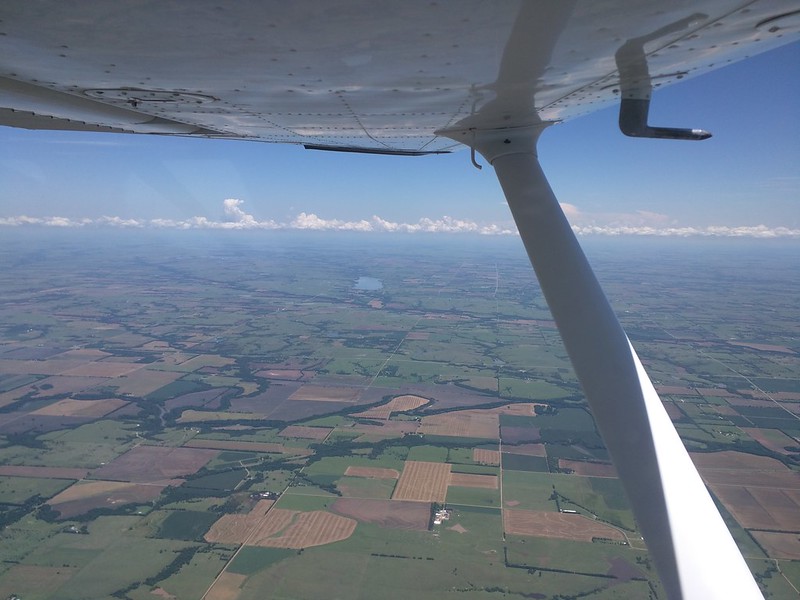
The weather on the way was just gorgeous. We cruised along at about a mile above ground, which gave us pleasantly cool air through the vents and a smooth ride. Out in the distance, a few clouds were trying to form.
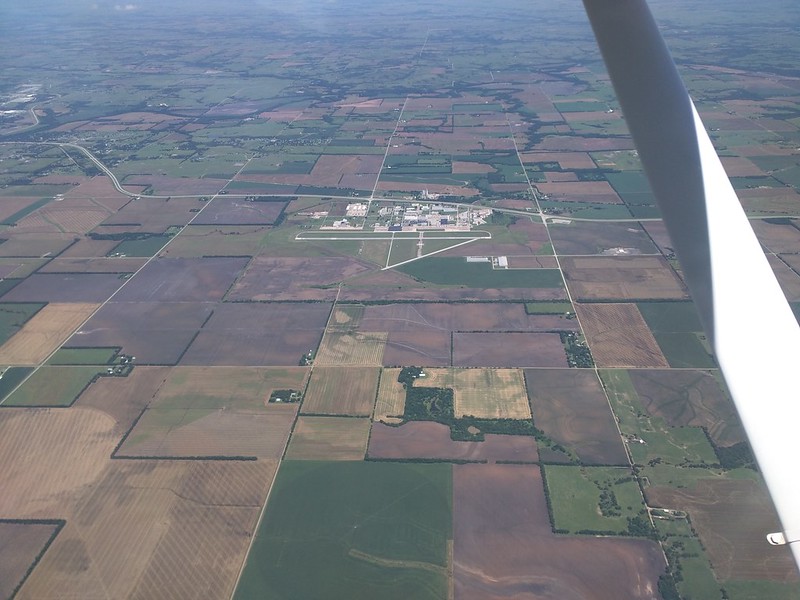
Whether I m flying or driving, a pilot is always happy to pass a small airport. Here was the Winfield, KS airport (KWLD):
This is a beautiful time of year in Kansas. The freshly-cut wheat fields are still a vibrant yellow. Other crops make a bright green, and colors just pop from the sky. A camera can t do it justice.
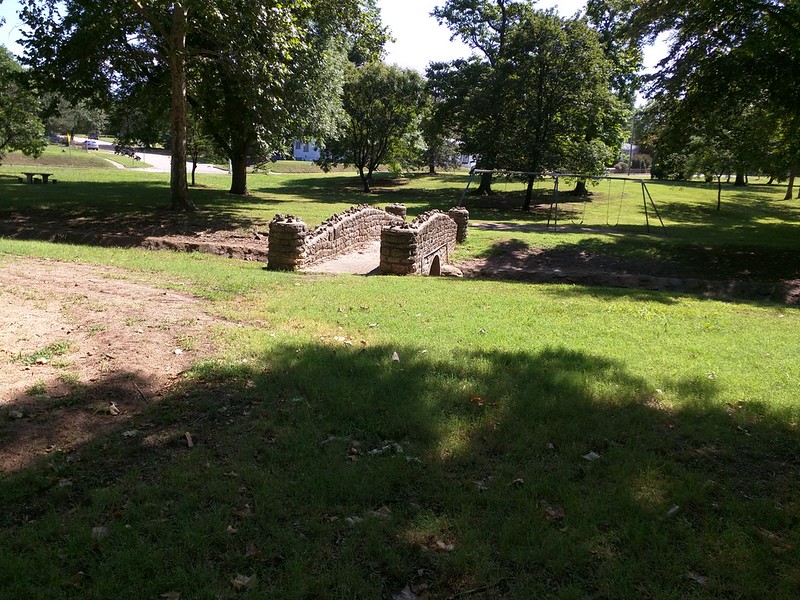
They enjoyed the museum, and then Oliver wanted to find something else to do before we returned to the airport for dinner. A little exploring yielded the beautiful and shady Garfield Park, complete with numerous old stone bridges.
Of course, the hit of any visit to Enrique s is their ice cream tacos (sopapillas with ice cream). Here is Oliver polishing off his.
They had both requested sightseeing from the sky on our way back, but both fell asleep so we opted to pass on that this time. Oliver slept through the landing, and I had to wake him up when it was time to go. I always take it as a compliment when a 6-year-old sleeps through a landing!
Most small airports have a bowl of candy setting out somewhere. Jacob and Oliver have become adept at finding them, and I will usually let them talk me into a piece of candy at one of them. Today, after we got back, they were intent at exploring the small gift shop back home, and each bought a little toy helicopter for $1.25. They may have been too tired to enjoy it though.
They ve been in bed for awhile now, and I m still smiling about the day. Time goes fast when you re having fun, and all three of us were. It is fun to see them inheriting my sense of excitement at adventure, and enjoying the world around them as they go.
The lady at the museum asked how we had heard about them, and noticed I drove up in an airport car (most small airports have an old car you can borrow for a couple hours for free if you re a pilot). I told the story briefly, and she said, So you flew out to this small town just to spend some time here? Yep. Wow, that s really neat. I don t think we ve ever had a visitor like you before. Then she turned to the boys and said, You boys are some of the luckiest kids in the world.
And I can t help but feel like the luckiest dad in the world.
A while back, I saw a Kickstarter
for one of the most well designed and pretty sleep trackers on the market. I
fell in love with it, and it has stuck with me since.
A few months ago, I finally got my hands on one and started to track my data.
Naturally, I now want to store this new data with the rest of the data I have
on myself in my own databases.
I went in search of an API, but I found that the Sense API hasn't been published
yet, and is being worked on by the team. Here's hoping it'll land soon!
After some subdomain guessing, I hit on api.hello.is.
So, naturally, I went to take a quick look at their Android app and network
traffic, lo and behold, there was a pretty nicely designed API.
This API is clearly an internal API, and as such, it's something that
should not be considered stable. However, I'm OK with a fragile API,
so I've published a quick and dirty API wrapper for the Sense API
to my GitHub..
I've published it because I've found it useful, but I can't promise the world,
(since I'm not a member of the Sense team at Hello!), so here are a few ground
rules of this wrapper:
I make no claims to the stability or completeness.
I have no documentation or assurances.
I will not provide the client secret and ID. You'll have to find them on
your own.
This may stop working without any notice, and there may even be really nasty
bugs that result in your alarm going off at 4 AM.
Send PRs! This is a side-project for me.
This module is currently Python 3 only. If someone really needs Python 2
support, I'm open to minimally invasive patches to the codebase using
six to support Python 2.7.
Working with the API:
First, let's go ahead and log in using python -m sense.
$ python -m sense
Sense OAuth Client ID: xxxxxxxx-xxxx-xxxx-xxxx-xxxxxxxxxxxx
Sense OAuth Client Secret: xxxxxxxx-xxxx-xxxx-xxxx-xxxxxxxxxxxx
Sense email: paultag@gmail.com
Sense password:
Attempting to log into Sense's APISuccess!Attempting to query the Sense APIThe humidity is **just right**.The air quality is **just right**.The light level is **just right**.It's **pretty hot** in here.
The noise level is **just right**.
Success!
Now, let's see if we can pull up information on my Sense:
>>>fromsenseimportSense>>>sense=Sense()>>>sense.devices()'senses':[ 'id':'xxxxxxxxxxxxxxxx','firmware_version':'11a1','last_updated':1466991060000,'state':'NORMAL','wifi_info':'rssi':0,'ssid':'Pretty Fly for a WiFi (2.4 GhZ)','condition':'GOOD','last_updated':1462927722000 ,'color':'BLACK' ],'pills':[ 'id':'xxxxxxxxxxxxxxxx','firmware_version':'2','last_updated':1466990339000,'battery_level':87,'color':'BLUE','state':'NORMAL' ]
Neat! Pretty cool. Look, you can even see my WiFi AP! Let's try some more
and pull some trends out.
I plan to keep maintaining it as long as it's needed, so I welcome
co-maintainers, and I'd love to see what people build with it! So far, I'm
using it to dump my room data into InfluxDB, pulling information on my room
into Grafana. Hopefully more to come!
Happy hacking!
This isn't actually answering the question, but it's close. It's also horrible, so whoever adopts
Enrico's script should also
completely rewrite this or burn it along with the stack of pizza boxes and the grand piano.
Input:
Review wiki RecentChanges since my bookmark.
Usual spam reporting.
Mention microG on #debian-mobile.
Answer pkg-config question on #debian-mentors.
Suggest using UUIDs in response to a debian-arm query.
Reported Debian bug #828103 against needrestart.
A giant yellow SOS crane between the balcony hacklab and a truly misty city.
Locate the 2014 Debian & stuff podcast on archive.org.
Poke the SPARC porters in response to a suggestion on debian-www.
Mention systemctl daemon-reload wrt buildd service changes.
Automate updating some extension lists from check-all-the-things.
Reported wishlist Debian bug #828128 against debsources.
Engage lizard mode! Wish for better display technology.
Nice vegetarian food with nice folks and
interesting discussions with interesting locals.
Polish and release check-all-the-things.
Close bugs I forgot to close in the changelog.
Add link to debian-boot on Debootstrap wiki page.
Notice first mockup of a theme for Debian stretch.
Answer a question about package naming on #debian-mentors.
Discuss the future of cross compilation on Debian.
Notice a talk about FOSSology & update a wiki page.
Mention AsteroidOS and MaruOS on the mobile wiki page.
Contemplate how close to the FSDG Debian might be
and approaches to improving that.
Here comes my journey till the mid-term (June 21st) as a blog to share my experience.
I have previously worked on some social related projects such as smart guidance for blind and sensor based wireless controller . I have been selected as a speaker for FOSSASIA-16 (Asia s premier technological event)to talk on the project smart guidance for blind .FOSSASIA speakers. It was a great experience participating in the technological event in Singapore science centre.Got an opportunity to meet open source contributors from all over the world(even though it is an Asian event, participation was all over from the world). There were pre-meetups for FOSSASIA on the day before three-day event.I have attended the one organised by RedHat, Singapore.Discussed on many topics related to open source.
Three days of FOSSASIA event was a great experience.It was the second time as a speaker in an international conference.My talk was on the second day.Sharing is the best way to increase your knowledge. Talks and workshops were brainstorming.Learnt many new things and got the courage to contribute to the open source.Met Daniel Pocock in Debian exhibition table.Meeting awesome people can be the turning point of life.Had a discussion about the Debian projects and it motivated me for open source software.We have discussed about the Real Time Communication and was encouraged to apply for GSoC (Google Summer of Code). As per our discussion, prepared the project proposal on improving voice,video and chat communication with free software and submitted it for GSoC. I have been selected to contribute for Debian with stipend from Google.
This was my first application for GSoC and I have been selected to contribute for open source and free software. I would like to thank Google and Debian for giving this amazing experience.
Learning and coding have begun.Updated my laptop with Jessie, latest version of Debian.Get acquainted with the new platform.Got to learn many things about Real Time Communication.Learnt more about SIP, XMPP, peer-to-peer technology to work on my project.It s always better to be clear with theory before coding.When it comes to voice and video over IP, most people nowadays are quick to use Skype, Whatsapp, or Viber. My main goals of the project are helping people to avoid using proprietary communications tools like Skype, Viber and WhatsApp and simplifying the setup of free alternatives like Jitsi, Linphone, Ekiga, Tox (qtox), Mumble.Downloaded some of the already available open source VoIP to find the problems behind it and improve it further.Bootstrapping any business relevant network based on these free alternatives is still hard.
Would you like to list the senders, receivers and date of the messages in the inbox of your mail.Python has a library file IMAP which can be used to connect to an email account, examine every message in every folder and look at the To , From and CC headers of every email message in the folder.
Do you have phone numbers and other contact details in old emails? Would you like a quick way to data-mine your inbox to find them and help migrate them to your address book? Got the help from phonenumbers library for parsing, formatting, and validating international phone numbers.I would like to share how I imported this library file into my coding.Download the given library file and open the file in the terminal.Type
$ python setup.py install
to install the library file.Now you can call the functions by importing phonenumbers.
You can go through the code in my GitHub profile here.(Recently started committing my projects in GitHub)
Iain R. Learmonth joined my journey as a mentor.Helped in solving some issues in my coding through GitHub.
It was a wonderful journey till now.Will be working further to improve voice, video and chat communication with free software.Stay connected to know more about my further journey through GSoC.
Debian:
I am very late on post due to travel, Flu, jetlag sorry!
choqok:
https://bugs.debian.org/cgi-bin/bugreport.cgi?bug=825322
For this I was able to come up with a patch for kconfig_compiler to encode generated files to utf-8.
Review request is here:
https://git.reviewboard.kde.org/r/128102/
This has been approved and I will be pushing it as soon as I patch the qt5 frameworks version.
Both kde4libs and kf5 kconfig has been pushed upstream kde.
kxmlgui:
WIP this has been a steep learning curve, according to the notes it was an easy embedded kernel version, that was not the case! After grueling hours of
trying to sort out randomness in debug output I finally narrowed it down to cases where QStringLiteral was used and there were non letter characters eg. ( <")
These were causing debug symbols to generate with ( lambda() ) which caused unreproducible symbol/debug files. It is now a case of fixing all of these in the code to use QString::fromUtf8 seems to fix this. I am working on a mega patch for upstream and it should be ready early in the week.
This last week I spent a large portion making my through a mega patch for kxmlgui, when it was suggested to me to write a small qt app
to test QStringLiteral isolated and sure enough two build were byte for byte identical. So this means that QStringLiteral may not be the issue at all. With some
more assistance I am to expand my test app with several QStringLiterals of varying lengths, we have suspicion it is a padding issue, which complicates things.
I am still fighting with this one, will set aside to simmer for now, as I have no idea how to fix padding issues.
extra-cmake-modules:
I am testing a patch to fix umask issues for anyone that uses the kapptemplate generation macro. Thank you Simon for pointing me to this.
known affected:
plasma-framework
kdevplatform:
The kapptemplate generation users/groups and umask patch has been pushed upstream.
https://bugs.kde.org/show_bug.cgi?id=363615
KDE Randa!:
Despite managing to get a terrible Flu I accomplished more than I would have at home without awesome devs to help me out!
I have delegated the windows backend to Hannah and Kevin, if emerge is successful with Windows we will implement it on OSX as well.
Android docker image is up and running.
Several snappy packages done. Improved the snapcraft.yaml creation automation scripts started by Harald. Got help from
David ( he even made a patch! ) with some issues we were facing with kio.
KDE CI DSL adjustments for 5 new platforms
Port tools/* python scripts to python3
CI TODO:
Python automation scripts can no longer find projects except qt5 Need to get help from Ben as these are originally his.
Finish yaml CI files
Randa as usual was an amazing experience. Yes it is very hard work, but you have the beauty of the Swiss Alps at your fingertips! Not to mention all the
friendly faces and collaboration. A big thank you to all supporters and the Randa team!
Please help make KDE better by supporting the very important Randa Sprint:
https://www.kde.org/fundraisers/randameetings2016/
Have a great day.
I bought some awful WiFi lightbulbs a few months ago. The short version: they introduced terrible vulnerabilities on your network, they violated the GPL and they were also just bad at being lightbulbs. Since then I've bought some other Internet of Things devices, and since people seem to have a bizarre level of fascination with figuring out just what kind of fractal of poor design choices these things frequently embody, I thought I'd oblige.
Today we're going to be talking about the KanKun SP3, a plug that's been around for a while. The idea here is pretty simple - there's lots of devices that you'd like to be able to turn on and off in a programmatic way, and rather than rewiring them the simplest thing to do is just to insert a control device in between the wall and the device andn ow you can turn your foot bath on and off from your phone. Most vendors go further and also allow you to program timers and even provide some sort of remote tunneling protocol so you can turn off your lights from the comfort of somebody else's home.
The KanKun has all of these features and a bunch more, although when I say "features" I kind of mean the opposite. I plugged mine in and followed the install instructions. As is pretty typical, this took the form of the plug bringing up its own Wifi access point, the app on the phone connecting to it and sending configuration data, and the plug then using that data to join your network. Except it didn't work. I connected to the plug's network, gave it my SSID and password and waited. Nothing happened. No useful diagnostic data. Eventually I plugged my phone into my laptop and ran adb logcat, and the Android debug logs told me that the app was trying to modify a network that it hadn't created. Apparently this isn't permitted as of Android 6, but the app was handling this denial by just trying again. I deleted the network from the system settings, restarted the app, and this time the app created the network record and could modify it. It still didn't work, but that's because it let me give it a 5GHz network and it only has a 2.4GHz radio, so one reset later and I finally had it online.
The first thing I normally do to one of these things is run nmap with the -O argument, which gives you an indication of what OS it's running. I didn't really need to in this case, because if I just telnetted to port 22 I got a dropbear ssh banner. Googling turned up the root password ("p9z34c") and I was logged into a lightly hacked (and fairly obsolete) OpenWRT environment.
It turns out that here's a whole community of people playing with these plugs, and it's common for people to install CGI scripts on them so they can turn them on and off via an API. At first this sounds somewhat confusing, because if the phone app can control the plug then there clearly is some kind of API, right? Well ha yeah ok that's a great question and oh good lord do things start getting bad quickly at this point.
I'd grabbed the apk for the app and a copy of jadx, an incredibly useful piece of code that's surprisingly good at turning compiled Android apps into something resembling Java source. I dug through that for a while before figuring out that before packets were being sent, they were being handed off to some sort of encryption code. I couldn't find that in the app, but there was a native ARM library shipped with it. Running strings on that showed functions with names matching the calls in the Java code, so that made sense. There were also references to AES, which explained why when I ran tcpdump I only saw bizarre garbage packets.
But what was surprising was that most of these packets were substantially similar. There were a load that were identical other than a 16-byte chunk in the middle. That plus the fact that every payload length was a multiple of 16 bytes strongly indicated that AES was being used in ECB mode. In ECB mode each plaintext is split up into 16-byte chunks and encrypted with the same key. The same plaintext will always result in the same encrypted output. This implied that the packets were substantially similar and that the encryption key was static.
Some more digging showed that someone had figured out the encryption key last year, and that someone else had written some tools to control the plug without needing to modify it. The protocol is basically ascii and consists mostly of the MAC address of the target device, a password and a command. This is then encrypted and sent to the device's IP address. The device then sends a challenge packet containing a random number. The app has to decrypt this, obtain the random number, create a response, encrypt that and send it before the command takes effect. This avoids the most obvious weakness around using ECB - since the same plaintext always encrypts to the same ciphertext, you could just watch encrypted packets go past and replay them to get the same effect, even if you didn't have the encryption key. Using a random number in a challenge forces you to prove that you actually have the key.
At least, it would do if the numbers were actually random. It turns out that the plug is just calling rand(). Further, it turns out that it never calls srand(). This means that the plug will always generate the same sequence of challenges after a reboot, which means you can still carry out replay attacks if you can reboot the plug. Strong work.
But there was still the question of how the remote control works, since the code on github only worked locally. tcpdumping the traffic from the server and trying to decrypt it in the same way as local packets worked fine, and showed that the only difference was that the packet started "wan" rather than "lan". The server decrypts the packet, looks at the MAC address, re-encrypts it and sends it over the tunnel to the plug that registered with that address.
That's not really a great deal of authentication. The protocol permits a password, but the app doesn't insist on it - some quick playing suggests that about 90% of these devices still use the default password. And the devices are all based on the same wifi module, so the MAC addresses are all in the same range. The process of sending status check packets to the server with every MAC address wouldn't take that long and would tell you how many of these devices are out there. If they're using the default password, that's enough to have full control over them.
There's some other failings. The github repo mentioned earlier includes a script that allows arbitrary command execution - the wifi configuration information is passed to the system() command, so leaving a semicolon in the middle of it will result in your own commands being executed. Thankfully this doesn't seem to be true of the daemon that's listening for the remote control packets, which seems to restrict its use of system() to data entirely under its control. But even if you change the default root password, anyone on your local network can get root on the plug. So that's a thing. It also downloads firmware updates over http and doesn't appear to check signatures on them, so there's the potential for MITM attacks on the plug itself. The remote control server is on AWS unless your timezone is GMT+8, in which case it's in China. Sorry, Western Australia.
It's running Linux and includes Busybox and dnsmasq, so plenty of GPLed code. I emailed the manufacturer asking for a copy and got told that they wouldn't give it to me, which is unsurprising but still disappointing.
The use of AES is still somewhat confusing, given the relatively small amount of security it provides. One thing I've wondered is whether it's not actually intended to provide security at all. The remote servers need to accept connections from anywhere and funnel decent amounts of traffic around from phones to switches. If that weren't restricted in any way, competitors would be able to use existing servers rather than setting up their own. Using AES at least provides a minor obstacle that might encourage them to set up their own server.
Overall: the hardware seems fine, the software is shoddy and the security is terrible. If you have one of these, set a strong password. There's no rate-limiting on the server, so a weak password will be broken pretty quickly. It's also infringing my copyright, so I'd recommend against it on that point alone.
Time passes. I had left several (too many?) pending things to be done un the quiet weeks between the end of the lective semestre and the beginning of muy Summer trip to Winter. But Saturday gets closer every moment... And our long trip to the South begins.
Among many other things, I wanted to avance with some Deb an stuff - both packaging and WRT keyring analysis. I want to contacto some people I left pending interactions with, but honestly, that will only come face to face un Capetown.
As to "real life", I hace too many pending issues at work to even begin with; I hope to get some time at South frica todo do some decent UNAM sysadmining. Also, I want to play the idea of using Git for my students' workflow (handing in projects and assignments, at least)... This can be interesting to talk with the Deb an colleagues about, actually.
As a Masters student, I'm making good advances, and will probably finish muy class work next semester, six months ahead of schedule, but muy thesis work so far has progressed way slower than what I'd like. I have at least a better defined topic and approach, so I'll start the writing phase soon.
And the personal life? Family? I am more complete and happy than ever before. My life su completely different from two years ago. Yes, that was obvious. But it's also the only thing I can come up with. Having twin babies (when will they make the transition from "babies" to "kids"? No idea... We will find out as it comes) is more than beautiful, more than great. Our life has changed in every possible aspect. And yes, I admire my loved Regina for all of the energy and love she puts on the babies... Life is asymetric, I am out for most of the day... Mommy is always there.
As I said, happier than ever before.
This year a significant number of students are working on RTC-related projects as part of Google Summer of Code, under the umbrella of the Debian Project. You may have already encountered some of them blogging on Planet or participating in mailing lists and IRC.
WebRTC plugins for popular CMS and web frameworks
There are already a range of pseudo-WebRTC plugins available for CMS and blogging platforms like WordPress, unfortunately, many of them are either not releasing all their source code, locking users into their own servers or requiring the users to download potentially untrustworthy browser plugins (also without any source code) to use them.
Mesut is making plugins for genuinely free WebRTC with open standards like SIP. He has recently created the WPCall plugin for WordPress, based on the highly successful DruCall plugin for WebRTC in Drupal.
Keerthana has started creating a similar plugin for MediaWiki.
What is great about these plugins is that they don't require any browser plugins and they work with any server-side SIP infrastructure that you choose. Whether you are routing calls into a call center or simply using them on a personal blog, they are quick and convenient to install. Hopefully they will be made available as packages, like the DruCall packages for Debian and Ubuntu, enabling even faster installation with all dependencies.
Would you like to try running these plugins yourself and provide feedback to the students? Would you like to help deploy them for online communities using Drupal, WordPress or MediaWiki to power their web sites? Please come and discuss them with us in the Free-RTC mailing list.
You can read more about how to run your own SIP proxy for WebRTC in the RTC Quick Start Guide.
Finding all the phone numbers and ham radio callsigns in old emails
Do you have phone numbers and other contact details such as ham radio callsigns in old emails? Would you like a quick way to data-mine your inbox to find them and help migrate them to your address book?
Jaminy is working on Python scripts to do just that. Her project takes some inspiration from the Telify plugin for Firefox, which detects phone numbers in web pages and converts them to hyperlinks for click-to-dial. The popular libphonenumber from Google, used to format numbers on Android phones, is being used to help normalize any numbers found. If you would like to test the code against your own mailbox and address book, please make contact in the #debian-data channel on IRC.
A truly peer-to-peer alternative to SIP, XMPP and WebRTC
The team at Savoir Faire Linux has been busy building the Ring softphone, a truly peer-to-peer solution based on the OpenDHT distribution hash table technology.
Several students (Simon, Olivier, Nicolas and Alok) are actively collaborating on this project, some of them have been fortunate enough to participate at SFL's offices in Montreal, Canada. These GSoC projects have also provided a great opportunity to raise Debian's profile in Montreal ahead of DebConf17 next year.
Linux Desktop Telepathy framework and reSIProcate
Another group of students, Mateus, Udit and Balram have been busy working on C++ projects involving the Telepathy framework and the reSIProcate SIP stack. Telepathy is the framework behind popular softphones such as GNOME Empathy that are installed by default on the GNU/Linux desktop.
I previously wrote about starting a new SIP-based connection manager for Telepathy based on reSIProcate. Using reSIProcate means more comprehensive support for all the features of SIP, better NAT traversal, IPv6 support, NAPTR support and TLS support. The combined impact of all these features is much greater connectivity and much greater convenience.
The students are extending that work, completing the buddy list functionality, improving error handling and looking at interaction with XMPP.
Streamlining provisioning of SIP accounts
Currently there is some manual effort for each user to take the SIP account settings from their Internet Telephony Service Provider (ITSP) and transpose these into the account settings required by their softphone.
Pranav has been working to close that gap, creating a JAR that can be embedded in Java softphones such as Jitsi, Lumicall and CSipSimple to automate as much of the provisioning process as possible. ITSPs are encouraged to test this client against their services and will be able to add details specific to their service through Github pull requests.
The project also hopes to provide streamlined provisioning mechanisms for privately operated SIP PBXes, such as the Asterisk and FreeSWITCH servers used in small businesses.
Improving SIP support in Apache Camel and the Jitsi softphone
Apache Camel's SIP component and the widely known Jitsi softphone both use the JAIN SIP library for Java.
Nik has been looking at issues faced by SIP users in both projects, adding support for the MESSAGE method in camel-sip and looking at why users sometimes see multiple password prompts for SIP accounts in Jitsi.
If you are trying either of these projects, you are very welcome to come and discuss them on the mailing lists, Camel users and Jitsi users.
GSoC students at DebConf16 and DebConf17 and other events
Many of us have been lucky to meet GSoC students attending DebConf, FOSDEM and other events in the past. From this year, Google now expects the students to complete GSoC before they become eligible for any travel assistance. Some of the students will still be at DebConf16 next month, assisted by the regular travel budget and the diversity funding initiative. Nik and Mesut were already able to travel to Vienna for the recent MiniDebConf / LinuxWochen.at
As mentioned earlier, several of the students and the mentors at Savoir Faire Linux are based in Montreal, Canada, the destination for DebConf17 next year and it is great to see the momentum already building for an event that promises to be very big.
Explore the world of Free Real-Time Communications (RTC)
If you are interesting in knowing more about the Free RTC topic, you may find the following resources helpful:
Try Lumicall and Ring apps for Android with your freinds
RTC mentoring team 2016
We have been very fortunate to build a large team of mentors around the RTC-themed projects for 2016. Many of them are first time GSoC mentors and/or new to the Debian community. Some have successfully completed GSoC as students in the past. Each of them brings unique experience and leadership in their domain.
Helping GSoC projects in 2016 and beyond
Not everybody wants to commit to being a dedicated mentor for a GSoC student. In fact, there are many ways to help without being a mentor and many benefits of doing so.
Simply looking out for potential applicants for future rounds of GSoC and referring them to the debian-outreach mailing list or an existing mentor helps ensure we can identify talented students early and design projects around their capabilities and interests.
Testing the projects on an ad-hoc basis, greeting the students at DebConf and reading over the student wikis to find out where they are and introduce them to other developers in their area are all possible ways to help the projects succeed and foster long term engagement.
Google gives Debian a USD $500 grant for each student who completes a project successfully this year. If all 2016 students pass, that is over $10,000 to support Debian's mission.
Git is a version control system which is very common among developers. I m not going to explain how git works, because there are plenty of great introductory tutorials on the internet for that. However, I would like to documment the commands I frequently use
1. First, we initialize a git repo. Take care to ensure that you initialise the repo in the folder where all the files you want to commit exists.
git init
2. To see all the branches in the current repo along with the current branch :
git branch
To create a new branch :
git branch <branch_name>
3. To change branches :
git checkout <branch_name>
If the branch doesn t exist, it can be created by using :
git checkout -b <branch_name>
4. To see the status of the files, ie. if there are uncommitted changes, files to save etc.. use :
git status
5. To stage the changes in the directory for the next commit, use :
git add <filename>
To stage all files in a directory
git add .
6. To commit the staged changes in the directory, use :
git commit -m "<commit_message>"
7. To create a new connection to a remote repo, especially to push existing code to a Github repo :
git remote add <connection_name> <connection_url>
8. To push the code into the remote repo
git push -u <connection_name> <branch_name>
9. To get the contents of a repo
git clone <path>
10. To merge another branch to the current (Example: a side branch to the master)
git merge <branch_name>
For a more detailed list of git commands for easy access check out this nifty cheat sheet. Happy coding!
Deux jours restants
Il reste deux jours avant mon d part pour le Cape, en Afrique du sud. C est
pour assister l v nement debconf ( Debian conference ), organis par
Debian, que je me rends l . Cet v nement est organis chaque ann e et,
l ann e prochaine, c est Montr al que a aura lieu !
J ai tr s h te de vivre cette exp rience qui sera sans doute innoubliable.
Debian est une organisation pioni re du monde du logiciel libre. Je rencontrerai
des gens tr s d vou s et partageant avec moi beaucoup d int r ts pour le
logiciel libre et sa philosophie.
L Afrique du sud
Ce sera la premi re fois que je prendrai l avion et je ferai une escale
Amsterdam, une ville que j aimerais bien visiter un jour. Ahhhh Jacques
Brel.
Je suis tr s heureux que le continent d Afrique soit la premi re destination me
permettant de sortir du continent d Am rique pour la premi re fois. J ai bien
h te de vivre l ambiance du Cape.
As some of the world knows full well by now, I've been noodling with Go
for a few years, working through its pros, its cons, and thinking a lot
about how humans use code to express thoughts and ideas. Go's got a lot of
neat use cases, suited to particular problems, and used in the right place,
you can see some clear massive wins.
I've started writing Debian tooling in Go, because it's a pretty natural fit.
Go's fairly tight, and overhead shouldn't be taken up by your operating system.
After a while, I wound up hitting the usual blockers, and started to build up
abstractions. They became pretty darn useful, so, this blog post is announcing
(a still incomplete, year old and perhaps API changing) Debian package for Go.
The Go importable name is pault.ag/go/debian. This contains a lot of utilities
for dealing with Debian packages, and will become an edited down "toolbelt"
for working with or on Debian packages.
Module Overview
Currently, the package contains 4 major sub packages. They're a changelog
parser, a control file parser, deb file format parser, dependency parser
and a version parser. Together, these are a set of powerful building blocks
which can be used together to create higher order systems with reliable
understandings of the world.
changelog
The first (and perhaps most incomplete and least tested) is a changelog file
parser.. This provides the
programmer with the ability to pull out the suite being targeted in the
changelog, when each upload was, and the version for each. For example, let's
look at how we can pull when all the uploads of Docker to sid took place:
funcmain()resp,err:=http.Get("http://metadata.ftp-master.debian.org/changelogs/main/d/docker.io/unstable_changelog")iferr!=nilpanic(err)allEntries,err:=changelog.Parse(resp.Body)iferr!=nilpanic(err)for_,entry:=rangeallEntriesfmt.Printf("Version %s was uploaded on %s\n",entry.Version,entry.When)
The output of which looks like:
Version 1.8.3~ds1-2 was uploaded on 2015-11-04 00:09:02 -0800 -0800
Version 1.8.3~ds1-1 was uploaded on 2015-10-29 19:40:51 -0700 -0700
Version 1.8.2~ds1-2 was uploaded on 2015-10-29 07:23:10 -0700 -0700
Version 1.8.2~ds1-1 was uploaded on 2015-10-28 14:21:00 -0700 -0700
Version 1.7.1~dfsg1-1 was uploaded on 2015-08-26 10:13:48 -0700 -0700
Version 1.6.2~dfsg1-2 was uploaded on 2015-07-01 07:45:19 -0600 -0600
Version 1.6.2~dfsg1-1 was uploaded on 2015-05-21 00:47:43 -0600 -0600
Version 1.6.1+dfsg1-2 was uploaded on 2015-05-10 13:02:54 -0400 EDT
Version 1.6.1+dfsg1-1 was uploaded on 2015-05-08 17:57:10 -0600 -0600
Version 1.6.0+dfsg1-1 was uploaded on 2015-05-05 15:10:49 -0600 -0600
Version 1.6.0+dfsg1-1~exp1 was uploaded on 2015-04-16 18:00:21 -0600 -0600
Version 1.6.0~rc7~dfsg1-1~exp1 was uploaded on 2015-04-15 19:35:46 -0600 -0600
Version 1.6.0~rc4~dfsg1-1 was uploaded on 2015-04-06 17:11:33 -0600 -0600
Version 1.5.0~dfsg1-1 was uploaded on 2015-03-10 22:58:49 -0600 -0600
Version 1.3.3~dfsg1-2 was uploaded on 2015-01-03 00:11:47 -0700 -0700
Version 1.3.3~dfsg1-1 was uploaded on 2014-12-18 21:54:12 -0700 -0700
Version 1.3.2~dfsg1-1 was uploaded on 2014-11-24 19:14:28 -0500 EST
Version 1.3.1~dfsg1-2 was uploaded on 2014-11-07 13:11:34 -0700 -0700
Version 1.3.1~dfsg1-1 was uploaded on 2014-11-03 08:26:29 -0700 -0700
Version 1.3.0~dfsg1-1 was uploaded on 2014-10-17 00:56:07 -0600 -0600
Version 1.2.0~dfsg1-2 was uploaded on 2014-10-09 00:08:11 +0000 +0000
Version 1.2.0~dfsg1-1 was uploaded on 2014-09-13 11:43:17 -0600 -0600
Version 1.0.0~dfsg1-1 was uploaded on 2014-06-13 21:04:53 -0400 EDT
Version 0.11.1~dfsg1-1 was uploaded on 2014-05-09 17:30:45 -0400 EDT
Version 0.9.1~dfsg1-2 was uploaded on 2014-04-08 23:19:08 -0400 EDT
Version 0.9.1~dfsg1-1 was uploaded on 2014-04-03 21:38:30 -0400 EDT
Version 0.9.0+dfsg1-1 was uploaded on 2014-03-11 22:24:31 -0400 EDT
Version 0.8.1+dfsg1-1 was uploaded on 2014-02-25 20:56:31 -0500 EST
Version 0.8.0+dfsg1-2 was uploaded on 2014-02-15 17:51:58 -0500 EST
Version 0.8.0+dfsg1-1 was uploaded on 2014-02-10 20:41:10 -0500 EST
Version 0.7.6+dfsg1-1 was uploaded on 2014-01-22 22:50:47 -0500 EST
Version 0.7.1+dfsg1-1 was uploaded on 2014-01-15 20:22:34 -0500 EST
Version 0.6.7+dfsg1-3 was uploaded on 2014-01-09 20:10:20 -0500 EST
Version 0.6.7+dfsg1-2 was uploaded on 2014-01-08 19:14:02 -0500 EST
Version 0.6.7+dfsg1-1 was uploaded on 2014-01-07 21:06:10 -0500 EST
control
Next is one of the most complex, and one of the oldest parts of go-debian,
which is the control file parser
(otherwise sometimes known as deb822). This module was inspired by the way
that the json module works in Go, allowing for files to be defined in code
with a struct. This tends to be a bit more declarative, but also winds up
putting logic into struct tags, which can be a nasty anti-pattern if used too
much.
The first primitive in this module is the concept of a Paragraph, a struct
containing two values, the order of keys seen, and a map of string to string.
All higher order functions dealing with control files will go through this
type, which is a helpful interchange format to be aware of. All parsing of
meaning from the Control file happens when the Paragraph is unpacked into
a struct using reflection.
The idea behind this strategy that you define your struct, and let the Control
parser handle unpacking the data from the IO into your container, letting you
maintain type safety, since you never have to read and cast, the conversion
will handle this, and return an Unmarshaling error in the event of failure.
Additionally, Structs that define an anonymous member of control.Paragraph
will have the raw Paragraph struct of the underlying file, allowing the
programmer to handle dynamic tags (such as X-Foo), or at least, letting
them survive the round-trip through go.
The default decoder
contains an argument, the ability to verify the input control file using an
OpenPGP keyring, which is exposed to the programmer through the
(*Decoder).Signer() function. If the passed argument is nil, it will not
check the input file signature (at all!), and if it has been passed, any
signed data must be found or an error will fall out of the NewDecoder call.
On the way out, the opposite happens, where the struct is introspected,
turned into a control.Paragraph, and then written out to the io.Writer.
Here's a quick (and VERY dirty) example showing the basics of reading and
writing Debian Control files with go-debian.
packagemainimport("fmt""io""net/http""strings""pault.ag/go/debian/control")typeAllowedPackagestructPackagestringFingerprintstringfunc(a*AllowedPackage)UnmarshalControl(instring)errorin=strings.TrimSpace(in)chunks:=strings.SplitN(in," ",2)iflen(chunks)!=2returnfmt.Errorf("Syntax sucks: '%s'",in)a.Package=chunks[0]a.Fingerprint=chunks[1][1:len(chunks[1])-1]returnniltypeDMUAstructFingerprintstringUidstringAllowedPackages[]AllowedPackage control:"Allow" delim:"," funcmain()resp,err:=http.Get("http://metadata.ftp-master.debian.org/dm.txt")iferr!=nilpanic(err)decoder,err:=control.NewDecoder(resp.Body,nil)iferr!=nilpanic(err)fordmua:=DMUAiferr:=decoder.Decode(&dmua);err!=niliferr==io.EOFbreakpanic(err)fmt.Printf("The DM %s is allowed to upload:\n",dmua.Uid)for_,allowedPackage:=rangedmua.AllowedPackagesfmt.Printf(" %s [granted by %s]\n",allowedPackage.Package,allowedPackage.Fingerprint)
Output (truncated!) looks a bit like:
...
The DM Allison Randal <allison@lohutok.net> is allowed to upload:
   parrot [granted by A4F455C3414B10563FCC9244AFA51BD6CDE573CB]
...
The DM Benjamin Barenblat <bbaren@mit.edu> is allowed to upload:
   boogie [granted by 3224C4469D7DF8F3D6F41A02BBC756DDBE595F6B]
   dafny [granted by 3224C4469D7DF8F3D6F41A02BBC756DDBE595F6B]
   transmission-remote-gtk [granted by 3224C4469D7DF8F3D6F41A02BBC756DDBE595F6B]
   urweb [granted by 3224C4469D7DF8F3D6F41A02BBC756DDBE595F6B]
...
The DM     <aelmahmoudy@sabily.org> is allowed to upload:
   covered [granted by 41352A3B4726ACC590940097F0A98A4C4CD6E3D2]
   dico [granted by 6ADD5093AC6D1072C9129000B1CCD97290267086]
   drawtiming [granted by 41352A3B4726ACC590940097F0A98A4C4CD6E3D2]
   fonts-hosny-amiri [granted by BD838A2BAAF9E3408BD9646833BE1A0A8C2ED8FF]
   ...
...
deb
Next up, we've got the deb module. This contains code to handle reading
Debian 2.0 .deb files. It contains a wrapper that will parse the control
member, and provide the data member through the
archive/tar interface.
Here's an example of how to read a .deb file, access some metadata, and
iterate over the tar archive, and print the filenames of each of the
entries.
dependency
The dependency package provides an interface to parse and compute
dependencies. This package is a bit odd in that, well, there's no other
library that does this. The issue is that there are actually two different
parsers that compute our Dependency lines, one in Perl (as part of dpkg-dev)
and another in C (in dpkg).
To date, this has resulted in me filing
threedifferentbugs.
I also found a broken package in the
archive,
which actually resulted in another bug being (totally accidentally)
already fixed.
I hope to continue to run the archive through my parser in hopes of finding
more bugs! This package is a bit complex, but it basically just returns what
amounts to be an AST
for our Dependency lines. I'm positive there are bugs, so file them!
funcmain()dep,err:=dependency.Parse("foo bar, baz, foobar [amd64] bazfoo [!sparc], fnord:armhf [gnu-linux-sparc]")iferr!=nilpanic(err)anySparc,err:=dependency.ParseArch("sparc")iferr!=nilpanic(err)for_,possi:=rangedep.GetPossibilities(*anySparc)fmt.Printf("%s (%s)\n",possi.Name,possi.Arch)
Gives the output:
foo (<nil>)
baz (<nil>)
fnord (armhf)
version
Right off the bat, I'd like to thank
Michael Stapelberg for letting me graft this
out of dcs and into the go-debian package.
This was nearly entirely his work (with a one or two line function I added
later), and was amazingly helpful to have. Thank you!
This module implements Debian version comparisons and parsing, allowing for
sorting in lists, checking to see if it's native or not, and letting the
programmer to implement smart(er!) logic based on upstream (or Debian)
version numbers.
This module is extremely easy to use and very straightforward, and not worth
writing an example for.
Final thoughts
This is more of a "Yeah, OK, this has been useful enough to me at this point
that I'm going to support this" rather than a "It's stable!" or even
"It's alive!" post. Hopefully folks can report bugs and help iterate on
this module until we have some really clean building blocks to build
solid higher level systems on top of. Being able to have multiple libraries
interoperate by relying on go-debian will be a massive ease.
I'm in need of more documentation, and to finalize some parts of the older
sub package APIs, but I'm hoping to be at a "1.0" real soon now.
I wanted to write this blogpost since April, and even announced it in two previous posts, but never got to actually write it until now. And with the recent events in Snappy and Flatpak land, I can not defer this post any longer (unless I want to answer the same questions over and over on IRC ^^).
As you know, I develop the Limba 3rd-party software installer since 2014 (see this LWN article explaining the project better then I could do ) which is a spiritual successor to the Listaller project which was in development since roughly 2008. Limba got some competition by Flatpak and Snappy, so it s natural to ask what the projects next steps will be.
Meeting with the competition
At last FOSDEM and at the GNOME Software sprint this year in April, I met with Alexander Larsson and we discussed the rather unfortunate situation we got into, with Flatpak and Limba being in competition.
Both Alex and I have been experimenting with 3rd-party app distribution for quite some time, with me working on Listaller and him working on Glick and Glick2. All these projects never went anywhere. Around the time when I started Limba, fixing design mistakes done with Listaller, Alex started a new attempt at software distribution, this time with sandboxing added to the mix and a new OSTree-based design of the software-distribution mechanism. It wasn t at all clear that XdgApp, later to be renamed to Flatpak, would get huge backing by GNOME and later Red Hat, becoming a very promising candidate for a truly cross-distro software distribution system.
The main difference between Limba and Flatpak is that Limba allows modular runtimes, with things like the toolkit, helper libraries and programs being separate modules, which can be updated independently. Flatpak on the other hand, allows just one static runtime and enforces everything that is not in the runtime already to be bundled with the actual application. So, while a Limba bundle might depend on multiple individual other bundles, Flatpak bundles only have one fixed dependency on a runtime. Getting a compromise between those two concepts is not possible, and since the modular vs. static approach in Limba and Flatpak where fundamental, conscious design decisions, merging the projects was also not possible.
Alex and I had very productive discussions, and except for the modularity issue, we were pretty much on the same page in every other aspect regarding the sandboxing and app-distribution matters.
Sometimes stepping out of the way is the best way to achieve progress
So, what to do now? Obviously, I can continue to push Limba forward, but given all the other projects I maintain, this seems to be a waste of resources (Limba eats a lot of my spare time). Now with Flatpak and Snappy being available, I am basically competing with Canonical and Red Hat, who can make much more progress faster then I can do as a single developer. Also, Flatpaks bigger base of contributors compared to Limba is a clear sign which project the community favors more.
Furthermore, I started the Listaller and Limba projects to scratch an itch. When being new to Linux, it was very annoying to me to see some applications only being made available in compiled form for one distribution, and sometimes one that I didn t use. Getting software was incredibly hard for me as a newbie, and using the package-manager was also unusual back then (no software center apps existed, only package lists). If you wanted to update one app, you usually needed to update your whole distribution, sometimes even to a development version or rolling-release channel, sacrificing stability.
So, if now this issue gets solved by someone else in a good way, there is no point in pushing my solution hard. I developed a tool to solve a problem, and it looks like another tool will fix that issue now before mine does, which is fine, because this longstanding problem will finally be solved. And that s the thing I actually care most about.
I still think Limba is the superior solution for app distribution, but it is also the one that is most complex and requires additional work by upstream projects to use it properly. Which is something most projects don t want, and that s completely fine.
And that being said: I think Flatpak is a great project. Alex has much experience in this matter, and the design of Flatpak is sound. It solves many issues 3rd-party app development faces in a pretty elegant way, and I like it very much for that. Also the focus on sandboxing is great, although that part will need more time to become really useful. (Aside from that, working with Alexander is a pleasure, and he really cares about making Flatpak a truly cross-distributional, vendor independent project.)
Moving forward
So, what I will do now is not to stop Limba development completely, but keep it going as a research project. Maybe one can use Limba bundles to create Flatpak packages more easily. We also discussed having Flatpak launch applications installed by Limba, which would allow both systems to coexist and benefit from each other. Since Limba (unlike Listaller) was also explicitly designed for web-applications, and therefore has a slightly wider scope than Flatpak, this could make sense.
In any case though, I will invest much less time in the Limba project. This is good news for all the people out there using the Tanglu Linux distribution, AppStream-metadata-consuming services, PackageKit on Debian, etc. those will receive more attention
An integral part of Limba is a web service called LimbaHub to accept new bundles, do QA on them and publish them in a public repository. I will likely rewrite it to be a service using Flatpak bundles, maybe even supporting Flatpak bundles and Limba bundles side-by-side (and if useful, maybe also support AppImageKit and Snappy). But this project is still on the drawing board.
Let s see
P.S: If you come to Debconf in Cape Town, make sure to not miss my talks about AppStream and bundling
What happened in the Reproducible
Builds effort between June 5th and June 11th 2016:
Media coverage
Ed Maste gave a talk at BSDCan 2016 on
reproducible builds
(slides,
video).
GSoC and Outreachy updates
Weekly reports by our participants:
Scarlett Clark
worked on making some packages reproducible, focusing on KDE backend and
utility programs.
Ceridwen
published an initial design for the interface for reprotest, including a
discussion on different types of build variations and the difficulties of
specifying certain types of variations.
Valerie Young improved documentation for
building our tests website, began migrating Debian-specific pages into a new
namespace, and planned future work around its navigation.
Documentation update
- Ximin Luo proposed a modification
to our SOURCE_DATE_EPOCH spec explaining FORCE_SOURCE_DATE.
Some upstream build tools (e.g. TeX, see below) have expressed a desire to
control which cases of embedded timestamps should obey SOURCE_DATE_EPOCH.
They were not convinced by our arguments on why this is a bad idea, so we
agreed on an environment variable FORCE_SOURCE_DATE for them to implement
their desired behaviour - named generically, so that at least we can set it
centrally. For more details, see the text just linked. However, we strongly
urge most build tools not to use this, and instead obey SOURCE_DATE_EPOCHunconditionally in all cases.
Toolchain fixes
TeX Live 2016 released
with SOURCE_DATE_EPOCH support for all engines except LuaTeX and original TeX.
Continued discussion
(alternative archive)
with TeX upstream, about SOURCE_DATE_EPOCH corner cases, eventually
resulting in the FORCE_SOURCE_DATE proposal from above.
gcc-5/5.4.0-4 by Matthias Klose now avoids storing
-fdebug-prefix-map in DW_AT_producer, thanks to original patch by
Daniel Kahn Gillmor.
sphinx/1.4.3-1 by Dmitry Shachnev now drops Debian-specific patches
relating to SOURCE_DATE_EPOCH applied upstream, original patch by Alexis
Bienven e.
asciidoctor/1.5.4-2 by C dric Boutillier now supports
SOURCE_DATE_EPOCH, thanks to original patch by Alexis Bienven e.
dh-python/1.5.4-2 by Piotr O arowski now behaves better in some
cases, thanks to original patch by Chris Lamb.
Andrew Ayer uploaded strip-nondeterminism/0.018-2 fixing #826700, a packaging improvement for Multi-Arch to ease cross-build
situations.
2 days later Andrew released strip-nondeterminism/0.019; now
strip-nondeterminism is able to:
recursively normalize JAR files embedded within JAR files (#823917)
clamp the timestamp, the same way tar >=1.28-2.2 can (for now available only for gzip archives)
disorderfs development
Andrew Ayer released disorderfs/0.4.3, fixing a issue with umask handling (#826891)
tests.reproducible-builds.org
Valerie Young namespaced the Debian-specific pages to /debian/
namespace, with redirects to
for the previous URLs.
Holger Levsen improved the reliability of build jobs: the availability of
both build nodes (for a given build) is now being tested when a build job is
started, to better cope when one of the 25 build nodes go down for some reason.
Ximin Luo improved the index of identified
issues to
include the total popcon scores of each issue, which is now also used for
sorting that page.
Misc.
Steven Chamberlain submitted a patch to FreeBSD's
makefs
to allow reproducible builds of the kfreebsd installer.
Ed Maste committed a patch to FreeBSD's
binutils to
enable determinstic archives by default in GNU ar.
Helmut Grohne
experimentedwith
cross+native reproductions of dash with some success, using
rebootstrap.
This week's edition was written by Ximin Luo, Chris Lamb, Holger Levsen, Mattia
Rizzolo and reviewed by a bunch of Reproducible builds folks on IRC.
This has been approved and I will be pushing it as soon as I patch the qt5 frameworks version.
kxmlgui:
WIP this has been a steep learning curve, according to the notes it was an easy embedded kernel version, that was not the case! After grueling hours of
trying to sort out randomness in debug output I finally narrowed it down to cases where QStringLiteral was used and there were non letter characters eg. ( <")
These were causing debug symbols to generate with ( lambda() ) which caused unreproducible symbol/debug files. It is now a case of fixing all of these in the code to use QString::fromUtf8 seems to fix this. I am working on a mega patch for upstream and it should be ready early in the week.
This last week I spent a large portion making my through a mega patch for kxmlgui, when it was suggested to me to write a small qt app
to test QStringLiteral isolated and sure enough two build were byte for byte identical. So this means that QStringLiteral may not be the issue at all. With some
more assistance I am to expand my test app with several QStringLiterals of varying lengths, we have suspicion it is a padding issue, which complicates things.
KDE:
On the KDE front, I have arrived safe and sound in Randa and aside from some major jetlag, reproducible builds, I have been quite busy with the KDE CI. I am reworking
my DSL to use friendly yaml files to generate jobs for all platforms ( linux, android, osx, windows, snappy, flatpak ) and can easily be extended later.
Major workpoints so far for Randa:
I have delegated the windows backend to Hannah
Andreas has provided a docker build for Android, and upon initial testing it will work great.
I have recruited several nice folks to assist me with my snappy efforts.
A longish blog post, please bear, a second part of the blog post would be published in few days from now. My fixed visa finally arrived, yeah But this story doesn t start here, it starts about a year back. While I have been contributing to Debian in my free time over the years, and sometimes paid time as well, I had never thought of going overseas as the experiences I knew from friends and relatives, it isn t easy to get all the permissions and paperwork done to say the least (bureaucracy @ work). But last year, when Debconf 15 was being launched, there are/were 2-3 friends of mine who are studying, doing their Ph.D. in some computer/web stuff, living in Germany currently that they goaded me to apply. The first few times I gave some standard excuses, but when they kept on for a while, just to shut them up I applied to the debconf team applying for food, accommodation and travel sponsorship.
I didn t have high hopes as there obviously are many more talented peers around me who understand FOSS and Debian at a much more fundamental, philosophical as well as technical level than me. Much to my surprise though, about a month (and around two or three weeks just before the event was about to take place) I got the bursary/sponsorships for food, accommodation as well as travel. I was unsure that the remaining time was enough to get a visa hence declined that time around.
That whole episode gave me the confidence that perhaps my application would be accepted if I applied again. Using my previous years understanding, decided to give it a shot again as this would also enable me to get a feel of visa bureaucracy as well as gain a bit of novice understanding about what factors go in choosing a flight and believe me the latter part proved to be pretty confusing. While the visa business seems easy, the form at least is easy and what they ask, it can be troublesome as far as visa-processing process is concerned. It took a better part of the month to get the visa which I needed. The in-between time is and can be a bit stressful as you have committed funds for travel i.e. the airline tickets and are in a limbo as you didn t know that if the visa is cancelled for some reason, your tickets would be refunded or not. A little history is needed and hopefully is helpful for anybody who s applying for a short-stay Visa in South Africa.
Exactly, A month and day back I had applied for visa. The visa I had applied for is 17 days as the flights within my budget was for those days only. The visa I got was for 10 days only which was ending in the middle of the conference. I tried many avenues to get information and was told that I needed to write a correction letter telling/sharing the information about the correct time period and dates in BOLD with a heavier weight/point which is what I did and gave to VFS office without any further payment on my part. It took a bit more time than the first time around but the consulate co-operated. While I can understand the oversight as they probably get more visas requests along with special and urgent requests so such occurrences can happen. I am and was happy that there was a recourse rather than starting from scratch which probably would have made me more anxious due to the first experience .
Apparently I was lucky that I had done with Qatar Airways as later came to know that there are other airways which don t refund money even after visa rejection . This information I got to know pretty late in the game otherwise I wouldn t have been much stressed. As had committed knew had to go the whole hog and whatever barriers are there, have overcome at least as far as the visa part/process is concerned.
Now after few days, will probably start to worry about the actual travel, part nervousness, part excitement, nervousness as it will be an alien land, am obese so traveling economy on 787-8 and 777-300 ER will be tricky. The 787-8 will probably be a rough ride as it s a 9 hr. journey and the seat are a mere 18 , the cattle class as shared by one of our esteemed politicians. This blame has to do with Boeing 787 rather than anybody else. Hopefully, if there is a next time, would make better choices.
Anyways,have selected an aisle seat so that will be able to walk every hr. or so to get the circulation in legs going as leg room in economy is not much from my domestic air travel experiences. If I do survive the travel, then will see South Africa and try to get some free time and explore South Africa and try to figure out how are they able to get one and half time tourists while we get around half figure for a whole year even though we are bigger (area-wise) to South Africa. I did find something positive for us as well, it s not all doldrums all around.
Now, I had been thinking about if I know any South African music and movies. I had explored djembe while growing up in teens but other than that, not much. The only music I have heard is Harry Belafonte . So I hope to bring some Indian movies and music with me so that people if they have not explored Bollywood as well as Indian classical music could explore some of it, of course it will be pale imitation of what Sawai Gandharva Music Festival for instance gives. I also hope to hear and get some music and movies to learn more about South Africa. Filed under: Miscellenous Tagged: #bollywood, #Debconf Germany 2015, #Debconf South Africa 2016, #Debconf15, #Debconf16, #djembe, #South-African consulate, music, tourism, visa
As nearly anyone who's worked with me will attest to, I've long since
touted nedbat's talk
Pragmatic Unicode, or, How do I stop the pain?
as one of the most foundational talks, and required watching for all programmers.
The reason is because netbat hits on something bigger - something more
fundamental than how to handle Unicode -- it's how to handle data which is
relative.
For those who want the TL;DR, the argument is as follows:
Facts of Life:
Computers work with Bytes. Bytes go in, Bytes go out.
Relative Data
I've started to think more about why we do the things we do when we write
code, and one thing that continues to be a source of morbid schadenfreude
is watching code break by failing to handle Unicode right. It's hard! However,
watching what breaks lets you gain a bit of insight into how the author
thinks, and what assumptions they make.
When you send someone Unicode, there are a lot of assumptions that have to be
made. Your computer has to trust what you (yes, you!) entered into your web
browser, your web browser has to pass that on over the network (most of the
time without encoding information), to a server which reads that bytestream,
and makes a wild guess at what it should be. That server might save it to a
database, and interpolate it into an HTML template in a different encoding
(called Mojibake), resulting
in a bad time for everyone involved.
Everything's awful, and the fact our computers can continue to display
text to us is a goddamn miracle. Never forget that.
When it comes down to it, when I see a byte sitting on a page, I don't know
(and can't know!) if it's Windows-1252, UTF-8, Latin-1, or EBCDIC. What's
a poem to me is terminal garbage to you.
Over the years, hacks have evolved. We have
magic numbers,
and plain ole' hacks to just guess based on the content. Of course, like
all good computer programs, this has lead to its fair share of hilarious
bugs,
and there's nothing stopping files from (validly!) being multiple things at the
same time.
Like many things, it's all in the eye of the beholder.
Timezones
Just like Unicode, this is a word that can put your friendly neighborhood
programmer into a series of profanity laden tirades. Go find one in the wild,
and ask them about what they think about timezone handling bugs they've seen.
I'll wait. Go ahead.
Rants are funny things. They're fun to watch. Hilarious to give. Sometimes
just getting it all out can help. They can tell you a lot about the true
nature of problems.
It's funny to consider the isomorphic nature of Unicode rants and Timezone
rants.
I don't think this is an accident.
U n i c o d e timezone Sandwich
Ned's Unicode Sandwich applies -- As early as we can, in the lowest level
we can (reading from the database, filesystem, wherever!), all datetimes
must be timezone qualified with their correct timezone. Always. If you mean
UTC, say it's in UTC.
Treat any unqualified datetimes as "bytes". They're not to be trusted.
Never, never, never trust 'em. Don't
process any datetimes until you're sure they're in the right timezone.
This lets the delicious inside of your datetime sandwich handle timezones
with grace, and finally, as late as you can, turn it back into bytes
(if at all!). Treat locations as tzdb entries, and qualify datetime
objects into their absolute timezone (EST, EDT, PST, PDT)
It's not until you want to show the datetime to the user again should you
consider how to re-encode your datetime to bytes. You should think about
what flavor of bytes, what encoding -- what timezone -- should I be
encoding into?
TEST
Just like Unicode, testing that your code works with datetimes is important.
Every time I think about how to go about doing this, I think about that
one time that mjg59 couldn't book a flight
starting Tuesday from AKL, landing in HNL on Monday night, because
United couldn't book the last leg to SFO. Do you ever assume dates only go
forward as time goes on? Remember timezones.
Construct test data, make sure someone in New Zealand's
+13:45 can correctly talk with
their friends in
Baker Island's -12:00,
and that the events sort right.
Just because it's Noon on New Years Eve in England doesn't mean it's not
1 AM the next year in New Zealand. Places a few miles apart may go on Daylight
savings different days. Indian Standard Time is not even aligned on the hour
to GMT (+05:30)!
Test early, and test often. Memorize a few timezones, and challenge
your assumptions when writing code that has to do with time. Don't use
wall clocks to mean monotonic time. Remember there's a whole world out there,
and we only deal with part of it.
It's also worth remembering, as Andrew Pendleton
pointed out to me, that it's possible that a datetime isn't even unique for a
place, since you can never know if 2016-11-06 01:00:00 in America/New_York
(in the tzdb) is the first one, or second one. Storing EST or EDT along
with your datetime may help, though!
Pitfalls
Improper handling of timezones can lead to some interesting things, and failing
to be explicit (or at least, very rigid) in what you expect will lead to an
unholy class of bugs we've all come to hate. At best, you have confused
users doing math, at worst, someone misses a critical event, or our
security code fails.
I recently found what I regard to be a pretty bad
bug in apt (which David has prepared a
fix
for and is pending upload, yay! Thank you!), which boiled down to documentation
and code expecting datetimes in a timezone, but accepting any timezone, and
silently treating it as UTC.
The solution is to hard-fail, which is an interesting choice to me (as a vocal
fan of timezone aware code), but at the least it won't fail by
misunderstanding what the server is trying to communicate, and I do understand
and empathize with the situation the apt maintainers are in.
Final Thoughts
Overall, my main point is although most modern developers know how to deal
with Unicode pain, I think there is a more general lesson to learn -- namely,
you should always know what data you have, and always remember what it is.
Understand assumptions as early as you can, and always store them with the data.
After introducing ourselves to the community, we start contributing to the open and free source software. Since this is the first week, I have went through theories which would help me in coding. Before coding it is always safer to refer to theories so that we don t need to spare time in debugging.
The following were my week 1-4 plans:
Getting familiar with Python and coding for connecting to an email account (using IMAP) and examines every message in every folder.
Writing a basic Python script to look at the To , From and CC headers of every email message in the folder. Identifying all the names and email addresses and writing them in a CSV file.
Scanning the body of each message looking for phone numbers.(for messages in plain text format)
Cleaning up the phone numbers and write them in international format and putting those in the CSV file too.(Telify recognizes phone numbers on web pages or in email messages and converts them into clickable links. This works with many CTI applications, SIP clients, Skype, Netmeeting, snom phones, the AGFEO TK-Suite client, SerVonic IXI-PCS and others. In general, all telephony software, devices or interfaces which can be controlled by using a URL, will most likely enable you to call a phone number directly from your browser or email client.
These two weeks I have completed my first two tasks in the list.I have committed and pushed my works in GitHub.https://github.com/Jaminy/GSoC
Successfully logged into the email account using IMAP and examined each folders.Examined inbox to extract To , From and CC of the last message received.Trying to extract all message details to put in CSV file.
April 23rd to May 23rd
The period of introducing ourselves to the Debian community. I have updated my debian wiki page to introduce more about myself to the Debian community.
https://wiki.debian.org/SummerOfCode2016/StudentApplications/Jaminy
There was a webRTC session of MiniDebconf through Jitsi on 3oth April to know more about the Debian resources.
During this period I have updated my PC with the Debian latest version, Jessie and got practised with the new platform.I have also learnt some basic theories on my project such as VoIP and IMAP. I was assigned by my mentor Daniel Pocock to work on telepathy reSIProcate.
Steps to install reSIProcate
System used
Debian GNU/Linux 8.3 (jessie)
Ubuntu 14.04.4 LTS (trusty)
Telepathy-Qt
First you have to configure the telepathy-qt library properly to be able to install reSIProcate. It s important to notice that you shouldn t install telepathy-qt from apt-get because in this way it wont have the telepathy-qt4-service shared library.
$ mkdir ~/telepathy-qt-stuff
$ cd ~/telepathy-qt-stuff
$ git clone https://github.com/dpocock/telepathy-qt-debian
$ cd telepathy-qt-debian
$ git checkout jessie-build-all-shared
$ cd ..
 I had planned to do some work on NBD while here at debcamp. Here's a progress report:


 A while back, I saw a
 This isn't actually answering the question, but it's close. It's also horrible, so whoever adopts



 I bought some
 Time passes. I had left several (too many?) pending things to be done un the quiet weeks between the end of the lective semestre and the beginning of muy Summer trip to Winter. But Saturday gets closer every moment... And our long trip to the South begins.
Among many other things, I wanted to avance with some Deb an stuff - both packaging and WRT keyring analysis. I want to contacto some people I left pending interactions with, but honestly, that will only come face to face un Capetown.
As to "real life", I hace too many pending issues at work to even begin with; I hope to get some time at South frica todo do some decent UNAM sysadmining. Also, I want to play the idea of using Git for my students' workflow (handing in projects and assignments, at least)... This can be interesting to talk with the Deb an colleagues about, actually.
As a Masters student, I'm making good advances, and will probably finish muy class work next semester, six months ahead of schedule, but muy thesis work so far has progressed way slower than what I'd like. I have at least a better defined topic and approach, so I'll start the writing phase soon.
And the personal life? Family? I am more complete and happy than ever before. My life su completely different from two years ago. Yes, that was obvious. But it's also the only thing I can come up with. Having twin babies (when will they make the transition from "babies" to "kids"? No idea... We will find out as it comes) is more than beautiful, more than great. Our life has changed in every possible aspect. And yes, I admire my loved Regina for all of the energy and love she puts on the babies... Life is asymetric, I am out for most of the day... Mommy is always there.
As I said, happier than ever before.



 Je suis tr s heureux que le continent d Afrique soit la premi re destination me
permettant de sortir du continent d Am rique pour la premi re fois. J ai bien
h te de vivre l ambiance du Cape.

 ) which is a spiritual successor to the Listaller project which was in development since roughly 2008. Limba got some competition by
 P.S: If you come to Debconf in Cape Town, make sure to not miss my talks about AppStream and bundling
 A longish blog post, please bear, a second part of the blog post would be published in few days from now. My fixed visa finally arrived, yeah
 But this story doesn t start here, it starts about a year back. While I have been contributing to Debian in my free time over the years, and sometimes paid time as well, I had never thought of going overseas as the experiences I knew from friends and relatives, it isn t easy to get all the permissions and paperwork done to say the least (bureaucracy @ work). But last year, when Debconf 15 was being launched, there are/were 2-3 friends of mine who are studying, doing their Ph.D. in some computer/web stuff, living in Germany currently that they goaded me to apply. The first few times I gave some standard excuses, but when they kept on for a while, just to shut them up I applied to the debconf team applying for food, accommodation and travel sponsorship.
I didn t have high hopes as there obviously are many more talented peers around me who understand FOSS and Debian at a much more fundamental, philosophical as well as technical level than me. Much to my surprise though, about a month (and around two or three weeks just before the event was about to take place) I got the bursary/sponsorships for food, accommodation as well as travel. I was unsure that the remaining time was enough to get a visa hence declined that time around.
That whole episode gave me the confidence that perhaps my application would be accepted if I applied again. Using my previous years understanding, decided to give it a shot again as this would also enable me to get a feel of visa bureaucracy as well as gain a bit of novice understanding about what factors go in choosing a flight and believe me the latter part proved to be pretty confusing. While the visa business seems easy, the form at least is easy and what they ask, it can be troublesome as far as visa-processing process is concerned. It took a better part of the month to get the visa which I needed. The in-between time is and can be a bit stressful as you have committed funds for travel i.e. the airline tickets and are in a limbo as you didn t know that if the visa is cancelled for some reason, your tickets would be refunded or not. A little history is needed and hopefully is helpful for anybody who s applying for a short-stay Visa in South Africa.
Exactly, A month and day back I had applied for visa. The visa I had applied for is 17 days as the flights within my budget was for those days only. The visa I got was for 10 days only which was ending in the middle of the conference. I tried many avenues to get information and was told that I needed to write a correction letter telling/sharing the information about the correct time period and dates in BOLD with a heavier weight/point which is what I did and gave to VFS office without any further payment on my part. It took a bit more time than the first time around but the consulate co-operated. While I can understand the oversight as they probably get more visas requests along with special and urgent requests so such occurrences can happen. I am and was happy that there was a recourse rather than starting from scratch which probably would have made me more anxious due to the first experience .
Apparently I was lucky that I had done with Qatar Airways as later came to know that there are other airways which don t refund money even after visa rejection . This information I got to know pretty late in the game otherwise I wouldn t have been much stressed. As had committed knew had to go the whole hog and whatever barriers are there, have overcome at least as far as the visa part/process is concerned.
Now after few days, will probably start to worry about the actual travel, part nervousness, part excitement, nervousness as it will be an alien land, am obese so traveling economy on 787-8 and 777-300 ER will be tricky. The 787-8 will probably be a rough ride as it s a 9 hr. journey and the seat are a mere 18 , the cattle class as shared by


