Search Results: "tim"

8 February 2011

Lars Wirzenius: Growing the Debian development community

In an article about gender issues among American atheists, Sharon Moss and Lyz Liddell give a list of things to consider to be better community, not just for women:
  • Be a leader. Take responsibility for the tone of your group. If potential new members are being made to feel uncomfortable and aren t coming back, you re doing it wrong. As a leader, it is your job to prioritize the comfort of your attendees in programs, group dynamics, and communications. Try to put yourself in other members shoes and also ask for feedback.
  • Promote a sense of community. Take the time to socialize and get to know each other. If you re group isn t primarily a social group, thinking about adding some social time. Go to breakfast before the protest, compose your letters to the editor over coffee, or grab a pizza and beer after that lecture. When you know each other, you have each others backs. Being a jerk isn t tolerated.
  • Moderate discussions. Make sure everyone has the opportunity to participate- new people, quiet people, etc. Don t let conversation be dominated by one or two people who must win.
  • Embrace and accept different ways of communicating. Whether someone is an aggressive debater or not, make sure they re still welcome. The other atheist in the room isn t your enemy.
  • Encourage subgroups. Every event your group hosts doesn t need to appeal to your entire membership. Many women appreciate women-only space to express their nonbelief and to connect with other atheist women. Here at the Humanist Community of Central Ohio, we started a subgroup book club called Reasonable Women. When it grew to have about 25 regular members and was beginning to be a little too large and unwieldy to function as a book club, we created a second group, Heathen Chicks, which is just a social group that meets at a local cafe. It isn t just about creating women only space, for us, this has been a way to draw more women into other events our group hosts.
  • Foster women in leadership. Groups with women in leadership positions tend to have more women. Encourage women in your group to be visible in leadership.
These should work pretty well for Debian as well. I mean for the project in general, for getting all kinds of new people in, and getting them to stay, not just women, even if the gender imbalance is perhaps the biggest glaring problem we have. As a concrete suggestion, maybe it would be a good idea to continue the Debian party line that Joey set up for the squeeze release. We already have IRC, but having an audio chat with your Debian peers might be a nice addition. Specifically a social one, instead of something intended to boost productivity.

Jonathan McDowell: My Squeeze upgrade notes

I did my first upgrade of a lenny box to squeeze today; a test server in work. All went pretty smoothly but I had a handful of things I had to frob manually that I thought I'd write up here: I think that's pretty smooth overall; kudos to all those involved. I've a few more boxes to upgrade, but they're all more likely to have people complaining at me if there are hiccups so they'll have to wait until I have a suitable block of time set aside.

Michal Čihař: Upgrading to Squeeze

Squeeze was released this weekend and it's time to slowly migrate servers to it. The first to upgrade came the ones backing up phpMyAdmin demo server. Reason for trying them first is they have mostly same setup as other, while definitely not being critical to run all the time. For simple reasons that users break them time to time as well :-). Everything went surprisingly smoothly, the only problematic thing being no availability of MariaDB packages for Squeeze right now. But it does not matter that much, as Lenny packages still work fine. There should be no visible changes on the servers, but in case there is something broken, please let me know. While having experience with upgrading database servers, I went to production database server and it is now running Squeeze as well. What still remains is the server doing virtualization, but I prefer to do this in time when I can quickly get to the housing, in case something goes wrong with the reboot.

Filed under: Debian English Phpmyadmin 0 comments Flattr this!

Richard Darst: Debian latex-beamer theme

A while ago, I gave a presentation on Debian, and made a latex-beamer color scheme for it. Over time I improved it some. Eventually, I grabbed the colors from the new debian website, since they are much nicer (lighter) than the old colors, and thus fit in a presentation better. Last year, I wanted to write this up so that others could use the scheme.The theme can be found here, and there are examples in this gallery. This is distributed as a few color lines you need to copy and paste into your presentation (it is not much, and I thought that was better than an external dependency). You need to select your own layout theme from those included in beamer, for examples see the gallery. The theme page lists many credits for ideas, in particular zack for the idea of the logo on the background, and some other useful links. I would welcome others to improve this theme and make it more distributable.As a reminder, there is another Debian wiki page for collecting presentations people have given, and it has some other useful links on it.

7 February 2011

Vincent Sanders: It is a bit breezy

The weather has been a bit odd round here for a while now. The snow storms in December and early January were a mild inconvenience for me but as I work from home the advice not to travel was not too much of a problem.

It seems however that now February is here and the snow is gone we are in for some pretty strong storms. This actually affected me today when my neighbours garden wall was blown over!

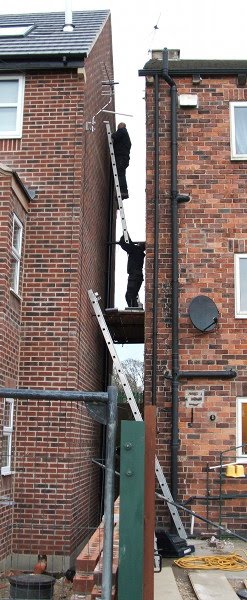
As you can see my nice new IP camera captured the event, well OK the frame before and after but you get the idea. Unfortunately for my neighbour the wall collapsed onto his pickup causing extensive damage.

A short time later when my weather station was recording gusts well over 50mph nearby drains started flowing the wrong way and it became a case of water, water everywhere!

It seems that when the new buildings were erected a few years ago that the architect while maximising used space on the building plot may have inadvertently created something of a wind tunnel.

The Gap between our properties is on a parallel (north to south) to the valley below. The wind seems to travel along the crest of the valley and be funnelled through any spaces between the houses. Fortunately the rest of the properties on green lane are pretty old and the spacing between is very generous and the funnelling effect is minimal.

I wonder if we could fit a wind turbine in there? Alas it was too much for my secondary anemometer which is now smashed in three parts.

Also gaining access to the gable end wall of my property has become somewhat perilous (Hence the wonky APT antenna I cannot get fixed). Yes that really is a guy balancing on a ladder 10m high in a strong wind. And indeed the platform the ladder is resting on is built from scaffolding board wedged between the houses.

I guess the hospital emergency room being 300m away means medical assistance is on hand, even so he is braver than I am. So my weather satellite imagery will just have to come from the internet like everyone else's for a while.

Ana Beatriz Guerrero Lopez: post and pre-release fun

The last weeks before a Debian release are usually boring with respect to working on new stuff since unstable is pretty much closed to development. Now that the release is finished, this fun is back \o/ I have been in an upload frenzy since yesterday night and I have updated some packages in unstable: KOffice[1] and KOffice-l10n 2.3.1, yakuake, rsibreak and tintin++. Another of my packages, kid3, got magically updated itself in unstable before I had time to look at it, the magic of having active co-maintainers. [1] Thanks for the gentle push to update this, Pino :) I also emailed one of my upstream maintainers to ask him about the KDE 4 version of his application and he will likely make a release soon. One of the goals for wheezy is remove completely KDE 3 and Qt 3. If you are maintaining a KDE 3 or Qt 3 based application, we are about to start annoying you about this! See http://wiki.debian.org/kdelibs4c2aRemoval and http://wiki.debian.org/qt3-x11-freeRemoval The last 2 weeks before the release I had some fun watching how the Squeeze release countdown banner I published at http://news.debian.net spread to a lot of websites, personal blogs, community sites, forums to news portals.
The traffic has been increasing little by little through the 2 weeks the banner has been online and currently is still moderately high, since people keeps retweeting the news item about the Debian release. While writing these lines, the banner has been served 449575 times to a total of 244975 unique IP addresses!

Matthew Garrett: Hardware vexation

My laptop (an HP 2530p) gets quite a lot of abuse. It's been with me enough to have done the equivalent of going round the world 4 or 5 times, and it's typically just thrown in a bag without any particular care or attention being given to its care or wellbeing. It's been dropped a couple of times with the only damage being some corners that aren't really as even as they should be. All in all, it's survived amazingly well. But it recently started refusing to boot, merely flashing its LEDs. After finally finding a list of what these mean, I narrowed it down to the memory. Taking it apart and putting it back together again got things working for a while, but then it happened again. And again. So, since I have one memory module and two slots, I decided to just move the RAM in the hope that there's something physically wrong with the slot. It worked! Until I got to the BIOS splash and it informed me that Intel AMT requires that there be memory in slot 0. And didn't give me an opportunity to continue without AMT.

My hardware is conspiring against me.

Torsten Werner: You are uploading too fast

This is my first blog post on my new tarent blog which I am using as a replacement for blogspot. We had 451 new source packages in the NEW queue tonight. It is nice to know that Debian is the largest free software distribution but it will take some time until we (the ftp team) have processed all those new packages as we need the check every single package. I wanted to work on dak (the Debian archive kit) again after we have released Squeeze but I ll give NEW processing a higher priority. My next plan for dak is generating the contents files in dak directly instead of using apt-ftparchive. Contents generation is the slowest part of apt-ftparchive and having the package contents in dak s database is quite useful.

Michal Čihař: Photo of a week 5

Picture this week is a little bit later because of time spent on FOSDEM and traveling there. It was taken last Wednesday from Vy ehrad, the Prague castle is disappearing in morning fog. Foggy morning in Prague

Filed under: English Photography 0 comments Flattr this!

Mike Hommey: Yet another clarification about Iceweasel

I m glad that 5 years after the facts, people are still not getting them straight. The Firefox logo was not under a free copyright license. Therefore, Debian was using the Firefox name with the earth logo (without the fox), which was and still is under a free copyright license. Then Mozilla didn t want the Firefox name associated to an icon that is not the Firefox icon, for trademark reasons. Fair enough. Although at the time Debian had concerns with the trademark policy, there was no point arguing over it, since Debian was not going to use the logo under a non-free copyright license anyway. Now, it happens that the logo has turned to a free copyright license. Request for a trademark license was filed a few weeks after we found out about the good news, and we are still waiting for an agreement draft from Mozilla to hopefully go forward. It is still not certain that this will actually lead to Debian shipping something called Firefox some day, but things are progressing, even if at a rather slow pace, and I have good hope (discussions are promising). By the way, thank you for the nice words, Daniel.

Alexander Reichle-Schmehl: What a night! What a day!

Wow, that was a night. I'm still quite tired from the weekend. Someone told me, that ~ 1 000 people subscribed to our live denting via identi.ca, and about 12 000 via twitter. And that does not even include those, who followed us via the respective web interfaces! While it was quite exhausting (we tried to watch about 7 irc channels for the important stuff, I partly had ~80 windows in my irssi (which is especially bad, since I only have keyboard shortcuts for the first 40) and there whas also a constant need to watch for mails and due to translations also our spamfilters), it was also very nice to think that somewhere there are release parties going on with people looking at our dents, maybe even having them running on a big monitor or projector ;) One thing that remains to be done, are the left-over dents we prepared as time killers: Since the release process went quite smoothly (and we didn't have the time to check all our dents for the limit of 140 chars ;) we still have some of them left. Since some of them where requested (and I poked other people to get me the numbers) here are the remaining dents: I especially like the one about debian-curiosa ;) Update 1: The 600 USD where collected during DebConf5, not DebConf3. Update 2: Small clarification about the number of subscriptions on identi.ca and twitter: They didn't followed a live-stream channel, but they do follow our general channel. We are not sure, how many people where subribed before we announced the live denting; some saw 700 subscribers on identi.ca, which would mean ~200 seem to have subscribed for the release dents (still not including the ones just following us the old fashioned way via a browser).

Matt Zimmerman: A diversity statement for Ubuntu

The Ubuntu website states that we aim to make Ubuntu a wonderful place to participate . We developed the Ubuntu Code of Conduct to set a standard for participants to accept each other in the spirit of cooperation, and have improved it over time to state these principles more clearly. It is implicit in our philosophy that these and other Ubuntu values should hold equally true for everyone. I would like to propose that we upgrade this to an explicit statement on behalf of the project. I have spoken with many people who were interested in joining a free software project, but were put off because they felt unwelcome. I know various people who participate in Ubuntu today, but sometimes face difficult social obstacles in order to do so. Going forward, I would like for us, as members of the Ubuntu community, to make the extra effort to accept all kinds of people. This may sound simple, but it can be very difficult to put into practice. People often don t even notice they ve gotten it wrong, until the offended party points it out to them. We need tools and guidance to make this a reality. To that end, I would like to propose a diversity statement for Ubuntu. This draft has already received support from a majority of the Community Council, but I d like to take it a step further. Because I want this to be a commitment that we can all stand behind, I m also calling for support from the community as a whole. Please give this issue your consideration, and let me know in the comments if you can get on board with an official statement like this. The more support we have, the more real this commitment can be. Here s the text. Many thanks to Mary Gardiner, Valerie Aurora and Benjamin Mako Hill for their review and input.
The Ubuntu project welcomes and encourages participation by everyone. We are committed to being a community that everyone feels good about joining. Although we may not be able to satisfy everyone, we will always work to treat everyone well. Standards for behavior in the Ubuntu community are detailed in the Code of Conduct and Leadership Code of Conduct. We expect participants in our community to meet these standards in all their interactions and to help others to do so as well. Whenever any participant has made a mistake, we expect them to take responsibility for it. If someone has been harmed or offended, it is our responsibility to listen carefully and respectfully, and do our best to right the wrong. Although this list cannot be exhaustive, we explicitly honor diversity in age, culture, ethnicity, genotype, gender identity or expression, language, national origin, neurotype, phenotype, political beliefs, profession, race, religion, sexual orientation, socio-economic status, subculture, and technical ability. Some of the ideas and wording for this statement were based on diversity statements from the Python community and Dreamwidth Studios (CC-BY-SA 3.0).

Michal Čihař: New phpMyAdmin themes

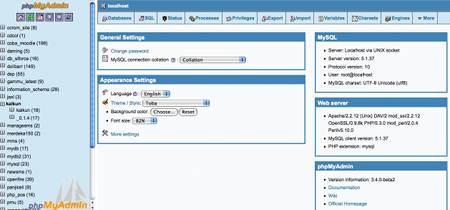
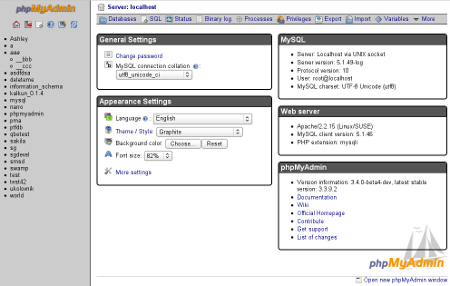
Today, I've made available two new themes for phpMyAdmin on our demo server. First one is Toba theme which was contributed by Azhari Harahap: Toba theme Second one is Graphite theme which I've started during Hackweek and finished during free time around FOSDEM: Graphite theme And we're still waiting for more contributions to our Theme contest. PS: Forgot to mention that new themes are only for 3.4 branch and won't work with others.

Filed under: English Phpmyadmin Suse 0 comments Flattr this!

Jonathan McDowell: Why Linux? (Part 6: Freedom)

(This is part of a series of posts on Why Linux?) I think of myself as reasonably pragmatic in my approach to Free/Open Source software. I don't get worked up over which set of language people want to use. I use devices that require binary firmware to be downloaded to them (because just because I can't see it doesn't mean it doesn't exist). I have non-free in my sources.list. And yet, talking to other Linux users these days, I realize I'm much more of a Freedom nut job than average. I want the source, be it for a driver, a minor widget, or a full app. I don't buy nVidia. I will sacrifice a degree of functionality in order to get Free. And while I think WINE is an excellent piece of software, I think the best end result is that it's no longer necessary, not that it's a perfect implementation of the ABI. How does any of this help justify my use of Linux in the work place? As previously mentioned, I'm a developer. Most developers don't operate in a vacuum; they have to inter-operate with other ecosystems. And usually somewhere along the line there's a failure to document exactly how something is handled, or an ambiguity about what exact choice might be taken. If I have access to the source then I can check that out for myself. If I don't, I have to guess. As an example, a long time ago I was involved in writing a serial console driver for QNX. There came a point where the behaviour wasn't quite as we'd expect. Although the organisation had a license for the source, I wasn't allowed to look at it. Instead I had to come up with a series of suitable questions that someone who could look at the source could answer without violating any NDAs. If I'd been able to look at the source directly we'd have all saved a lot of time. And that's an example where someone could look at the source, rather than having to make a bunch of guesses and instrument tests to see which was right. Access to the Linux source has helped me in other commercial contexts too. At Black Cat we were able to take advantage of patches like grsecurity in order to tighten up shell account boxes. I wrote the IPv6 support for l2tpns, because we had access to the source and could. I've been able to look at the source to understand exactly what SCSI responses are sent in certain circumstances too (or understand exactly what the error that a user land test program was getting back meant). Also I'm a big believe in Linus' Law. I do think that good Free software is much better than proprietary software (there's some really bad Free software out there though, I'm not disputing that). The fact that smart people can look at it and scratch whatever their itch is means that we get a gradual process of improvement that can't be ignored. Equally as long as someone has an interest in the software, end users can't be left high and dry by organisations abandoning still users applications. I think that should be a powerful driver to business to look towards Free software. (Before my more astute readers point it out; yes, I am employed writing non-free software. See the first sentence. One day I'll find a job working on Free software that ticks enough of the other boxes to be viable.)

6 February 2011

Vincent Fourmond: Doxygen and Ruby...

I've been using Doxygen for a while now, and, no surprises, I find it fantastic ! The only thing that is really missing there is a decent support for Ruby... Allright, Ruby already has a documentation system, rdoc, but using only one for everything has its charms, and Doxygen is doubtlessly much more evolved than rdoc. Maybe when I have time, I'll have a look at writing it. (but that won't be before a long time...). Update: I finally had some time to write and publish this patch. It is available on github

Vincent Fourmond: Doxygen for Ruby, first working draft !

Quite some time ago, I complained about the lack of support of Ruby in doxygen, the ultimate code documentation generator (at least for me). Time has passed, and I had some time and motivation to look into it and write a patch. The code is now reasonably mature to be used, altough it still lacks many features, and, most importantly, testing. That's why I pushed my git-svn private repository to github today, in order to get enough testing to integrate it into mainstream doxygen. It's current features: You can get an opinion of how it looks on the code of ctioga2. The doxygen configuration file can be found there.

Christian Perrier: Squeeze released

This is the gazillionth entry on Planet Debian about Squeeze being released. If I had to say one thing about it, it would be that I think the way it was handled this time has been really great. The debian-publicity team, lead by the tireless Reichles, did great job in doing as many buzz as possible around that release....but managed to do it in the "spirit" of free software (pushing release parties, animating a feed on identi.ca, preparing press releases, etc.). The Release Team did a tremendous job during the 6 months of the freeze, by carefully balancing between conservatism and liberalism in accepting (or denying) our gazillion of request for freeze exceptions The FTP, CD, installer, website, documentation teams organized things really well for their respective fields of responsibility. A special mention to the tremendous effort done about the release notes, release announcements documents (and of course, their translators). I'm currently busy upgrading my servers (at home and at work) and things are going smoothly (except the first two I did without carefully reading warnings about missing firmwares...they're now waiting for me to provide them with the right non free firmware packages, 30km away from here). And, for myself, I celebrated the release this morning by squashing my personal best time on an half-marathon (officials races excepted) by nearly 7 minutes, bringing it just below 1h45 (PB in official races is 1h37). Release power! :) And, during that afternoon, I also had the please of having my pet package (geneweb) and my most important package (samba) having their first release in unstable, targeted for wheezy. Squeeeeeeze meeeeeeeeeeeee!

Lars Wirzenius: Idea: addsysuser

Debian got squeeze released, and ideas are brewing for what to do during the next release cycle. Here's an idea I had lying around. I'm throwing it out there, since I won't have time to do anything about it for at least a little while, but perhaps someone else thinks it's a good idea? Or, better yet, you can all tell me in comments why this is a bad idea, or at least why it should be designed in a different way.
NAME
       addsysuser, delsysuser - create and remove systems user in Debian pack 
       ages
SYNOPSIS
       addsysuser [options] username
       delsysuser [options] username
DESCRIPTION
       addsysuser creates a system user, and delsysuser removes it.  The  pur 
       puse  of these tools is to make it easier for Debian packages to create
       and remove system users as  the  pacakges  are  installed  and  purged.
       These are wrappers around adduser(8) and deluser(8).
       addsysuser  will  create the system user, unless it already exists.  If
       the user already exists, it does nothing.
       delsysuser removes the user.  However,  the  system  administrator  may
       configure  it  to  never remove the user, or to remove only some users.
       Use the /etc/adduser.conf for the settings:
       DELETESYSTEMUSERS
          Set to true or false  depending  on  whether  delsysuser  should
          remove the system user or not.  Defaults to true.
OPTIONS
       -p, --packagePACKAGE
          Record the user as being used by a specific package.  Many pack 
          ages can use the same user.  delsysuser  will  only  remove  the
          user when no packages are using it anymore.
       --no-act
          Only  pretend  to call adduser or deluser without actually doing
          so.  This allows easier testing of command lines.
FILES
       /etc/adduser.conf
          Configuration file for addsysuser and delsysuser.
EXAMPLE
       In the postinst script:
          addsysuser --package hello hellouser
       In the postrm script:
          delsysuser --package hello hellouser
SEE ALSO
       adduser(8), deluser(8).

Benjamin Mako Hill: Editor-to-Reader Ratios on Wikipedia

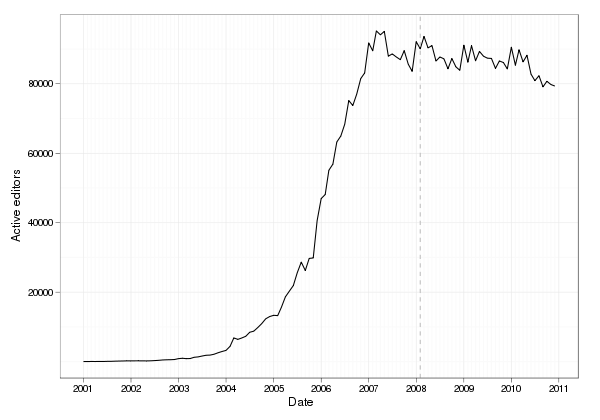
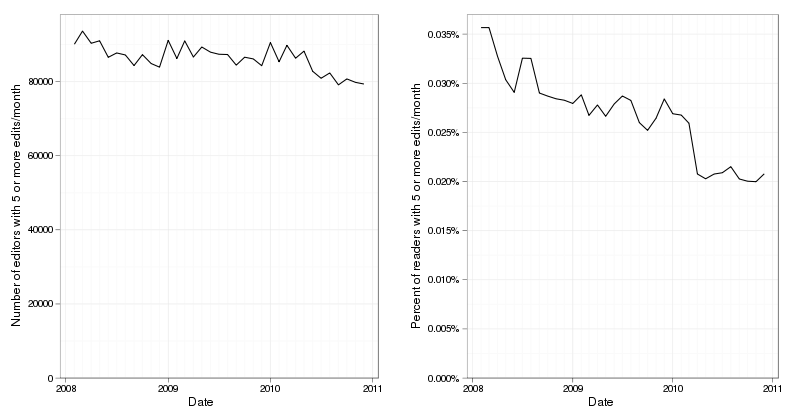
It's been reported for some time now that the number of active editors on Wikipedia (usually defined as people who have edited at least 5 times in a given month) peaked in 2007 and has been mostly stable since then. A graph of the total number of active editors in every month since Wikipedia's founding is shown below. The graph shows the aggregate numbers for all language Wikipedias. English Wikipedia is the largest component of this and is generally more variable. That said, very similar patterns exist for most larger languages. /copyrighteous/images/active_editors_all_wikpiedia.png Felipe Ortega, who has provided many of these statistics, has warned against fatalist claims. Although there seems to be a decrease in the total number of active editors over the last two years, the situation seems to have somewhat stabilized in most languages. New editors in Wikipedia are replacing folks at almost the rate that they are leaving. It is also widely known that the number of readers of Wikipedia has been increasing during this period. According to the report cards released by the foundation using comScore data, the number of unique visitors to Wikipedia each month has increased by 61 million people in the last year -- over 17%. This discrepancy between rising readership and stable or sinking editorship should raise major concern. After all, the Wikimedia Foundation's mission is two part: (1) to empower and engage people around the world to collect and develop educational content and (2) to disseminate it effectively and globally. Although the Foundation report cards include measures of raw levels of editorship, a better metric of engagement and empowerment might be the proportion of readers who engage in editing. I could not find reliable data on the number of unique readers reached each month for more than a few months in the last year. What is available, however, is wonderful data on page views each month going back to 2008. Analysis of the data from available report cards show that, at least during the last year, there is a very stable ratio of 35 page views per unique visitor, as estimated by comScore. Using that measure, we can do a back of the envelope estimation on the proportion of users that are editors for the period where page view data is available, dating back from February 2008 ( marked with the grey dashed lined above). The graphs below show the very different results you get when you consider the change in the number of Wikipedia editors and the change in the editor-to-reader ratio. Once again, these data are combined data for all language Wikipedias although graphs look very similar for most larger languages. The results are striking. Although there has been a 12% decrease between February 2008 and December 2010 in the number of active editors, there is a 42% decrease in the proportion of readers who edit at least five times a month. We can see that fulfilling the first half of the Wikimedia mission remains a struggle. /copyrighteous/images/wikipedia_editors_combined_graph.png Although the graphs above do not say anything directly about the most active core contributors to Wikipedia, the fact that Wikipedia is being maintained by a tiny -- and shrinking -- proportion of its readership does mean that the idea behind Wikipedia is under threat. Although none are as big as Wikipedia, there are lots of good encyclopedias out there. The reason Wikipedia is different, interesting, and important is because -- unlike all those others -- Wikipedia is the encyclopedia that anyone can edit. Wikipedia is powerful because it allow its users to transcend their role as consumers of the information they use to understand the world. Wikipedia allows users to define the reference works that define their understanding of the their environment and each other. But 99.98% of the time, readers do not transcend that role. I think that's a problem. Worse, that the number is growing. The Wikimedia Foundation recently ran a major successful effort to attract donations in its annual fundraiser. Jimmy Wales' smiling mug is apparently enough in the way of motivation to get something like 1% of its readers to donate money to support the project. I think that's very good news. If the Wikimedia community can entice even half of those people to contribute through an increased involvement in the projects themselves, they might do more than ensure Wikipedia's continued growth. They would help take a step toward the empowerment and engagement of those users in sharing their own knowledge, and the continued fulfillment of a critically important mission.

Erich Schubert: Debian Squeeze released!

Debian GNU/Linux 6.0 "squeeze" has been released today.
Congratulations to everyone involved in ironing the last few bugs out.
(My own involvement had been a bit limited recently, but I at least kept my few remaining packages in a ready-to-release state and helped with the occasional bug report and patch.)
Some people think that Ubuntu is the better Debian - I do NOT. Debian is a fun place, has great people working on it and is true to its aims at creating a truly free and high-quality distribution. The long release cycles of Debian are a feature, not a bug. Stable is for production systems, not toy projects.
The proper way of attributing Debian stable is conservative and sustainable, but not outdated. It actually can do everything you need - and will do so in 10 years.
If you have been using Open Source for as long as me (say 15+ years) you will probably have seen software hypes come and go. The one thing that has been always the same was Debian: dead reliable. There was a time when everyone was crazy about enlightement for it's shiny pretty UI. Almost like Compiz-Beryl just two years ago. It came, as a matter of fact Debian also had it, but it also went.
I also remember how people complained that Debian didn't ship Xgl back in 2006 when this was the latest hype (there was no Debian release in 2006). Well, Xgl died in 2008. The features remained, but done in a much nicer way, and also found their way into Debian. In fact, I also ran Xgl at least once, on Debian, but just not on "stable". One could say that Xgl never was quite "stable", was it?
Debian stable is good the way it is: an administrators choice. Of course, developers might have different needs, but there also is testing, unstable and experimental. Just make sure to align your choice with your needs. And sometimes, also rethink your needs: there is no "latest beta versions" and "stable platform" at the same time.

Next.

Previous.