Search Results: "tim"

14 February 2011

Bernd Zeimetz: debian buildds still fail on complex dependencies

Not only that it took 4 years to fix #403246 (sbuild dependancy resolution fails when b-dep on A B ; A uninstallable), but our lovely Debian buildds still don't accept packages which use such a dependency due to running too old sbuild versions. Time to get rid of this annoying bug finally!

John Goerzen: How do you hire programmers and sysadmins? How should employers evaluate you?

Reading job listings for any sort of IT job is depressing. It s been quite some time since I ve had to do that, but how many times have you seen something like this: I could go on and on. As a job seeker, that sort of thing is fundamentally devaluing to someone who has strengths in being adaptable and quickly learning new tools, languages, or even entire environments. As an employer, it sends a message that you re not interested in more than a surface look at someone s strengths, and probably don t care to hire the best and the brightest. After all, would you turn away a rockstar programmer simply because he or she had been writing filesystem code in C the last 3 years instead of the latest whizbang Java web widget that will probably be obsolete in a year and unsupported in two? I am quite certain that there are plenty of managers that do. Even if you are a company large enough to have an entire team of people that do nothing but work on that whizbang app, don t you still want the best you can find, realizing that some of the best people to work on that app may not have even heard of it yet? (And that when the app goes obsolete in 5 years, you d rather not have to lay off a large team of single-skill people) Some of you may know that I work in IT at a manufacturing company. We have a small IT team here, about seven people, and are a heavy Debian shop. And we have a vacancy open up in our development/Linux admin group. I m the manager of that group, which is why I m thinking about this right now. We re too small for single-subject specialists to make sense, yet we re big enough to appreciate skill, experience, flexibility, and rigor. Consequently, when the occasion arises for me to look for new employees, I don t prepare a laundry list of things we use in-house and would like experience with. The list of almost-required things generally begins with Linux and ends with experienced , and has nothing else in between. In other words, I d like it if I don t have to explain to you what a symlink or a hardlink is, but I d be willing to do so if I think you d internalize it quickly. On the experienced side, it would be nice if you already have a well-developed sense of fear at running rm when you re root, or have designed a storage infrastructure for a network before, or are paranoid about security. But again, if people can pick up those traits on the job, we are usually still interested. If learning how to package up software for Debian, fix bugs in software you ve never seen in a language you ve never heard of, raise good questions about things you may not have lots of experience with, and write documentation for it all on a wiki sounds like fun, then that s probably the kind of person I want, even if you ve never used our particular tools before. If I were to judge based on the stuff I normally see in job postings, I guess you might conclude I m nuts. I don t think I am, but then again I m also the only person I know that formats his own resume in hand-crafted LaTeX. What do you all think? The next question is: how should one evaluate candidates given this sort of philosophy? I m not a fan of canned tests, or even whiteboard tests that tend to be some sort of canned topic that may test the applicant s specific knowledge base more than overall skill and flexibility. Similarly, as an applicant in years past, I ve struggled with how to present the I ve never used $LANGUAGE, but I know I could pick it up quickly and do it very well vibe. To certain people, that might sound like BS. To the more geeky managers, perhaps it sounds like what they want. We ve built a fairly diverse team on the back of this approach, and it s worked out well for us so far. I m interested to hear your thoughts. Oh, and if you d like to work for us, you should probably be sending me an email. No, I m not going to list the address here on this blog post. If you can t figure it out, I don t want to hear from you <grin>

Julien Blache: QLogic QLE73xx InfiniBand adapters, QDR, ib_qib, OFED 1.5.2 and Debian Squeeze

A few weeks ago, I ve had to look into getting a QLogic QLE7342 InfiniBand adapter working on a Debian Squeeze system, with OFED 1.5.2. This post will probably save quite some time to anyone trying to do the same; it applies to all the QLogic adapters supported by the ib_qib kernel module. Note: on the ibverbs side of things, the adapters are supported by the ipath plugin, just like older QLogic adapters (that use the ib_ipath kernel module). First of all: grab a recent version of the ofa-kernel package. The ib_qib module in ofa-kernel from OFED 1.5.2 did not work at all for me. I used the ofa-kernel snapshot from 20110203. There are two things to know about the QLogic adapters: QLogic offers a complete IB stack based on OFED and dubbed QLogic OFED+ . The complete package weighs in at over 500 MB and contains the QLogic-blessed drivers, OFED stack, libraries and, of utmost importance to us, the QLogic-specific utilities. Unfortunately, as simple as the QLogic utilities are, they don t come with source. The package also only exists for RedHat 4 and 5. So, go to the QLogic support website, select your hardware and download the QLogic OFED+ Host Software for RHEL 5 package. In the tarball, one directory contains the OFED stack and another contains all the utilities (QLogic-Tools.*). For setting the adapter speed, you ll want the iba_portconfig utility along with the initscript (shipped as iba_portconfig.sh). The desired adapter speed is set in the initscript by choosing the proper arguments to iba_portconfig (-s 1 for SDR, -s 2 for DDR, -s 4 for QDR or any combination thereof). The iba_portconfig initscript must run after the drivers have been loaded. Which brings us to loading the driver and mounting the ipathfs. This is all handled by the openibd initscript provided in ofa-kernel (under ofed_scripts/) and its companion script dedicated to QLogic adapters, truescale.cmds. This initscript will load the OFED stack and drivers; if a QLogic adapter is present, it ll mount the ipathfs in the right place. Voila, once this is done, the adapter should happily report itself ACTIVE/LinkUp.

Rapha&#235;l Hertzog: Debian Cleanup Tip #3: get rid of third-party packages

Last week, we learned how to get rid of obsolete packages. This time, we re going to learn how to bring back your computer to a state close to a pure Ubuntu/Debian installation. Thanks to the power of APT, it s easy to add new external repositories and install supplementary software. Unfortunately some of those are not very well maintained. They might contain crappy packages or they might simply not be updated. An external package which was initially working well, can become a burden on system maintenance because it will be interfering with regular updates (for example by requiring a package that should be removed in newer versions of the system). So my goal for today is to teach you how to identify the packages on your system that are not coming from Debian or Ubuntu. So that you can go through them from time to time and keep only those that you really need. Obsolete packages are a subset of those, but I ll leave them alone. We took care of them last week. Each (well-formed) APT repository comes with a Release file describing it (example). They provide some values that can be used by APT to identify packages contained in the repository. All official Debian repositories are documented with Origin=Debian (and Origin=Ubuntu for Ubuntu). You can verify the origin value associated to each repository (if any) in the output of apt-cache policy:
[...]
 500 http://ftp.debian.org/debian/ lenny/main i386 Packages
     release v=5.0.8,o=Debian,a=stable,n=lenny,l=Debian,c=main
     origin ftp.debian.org
[...]
From there on, we can simply ask aptitude to compute a list of packages which are both installed and not available in an official Debian repository:
$ aptitude search '?narrow(?installed, !?origin(Debian))!?obsolete'
or
$ aptitude search '~S ~i !~ODebian !~o'
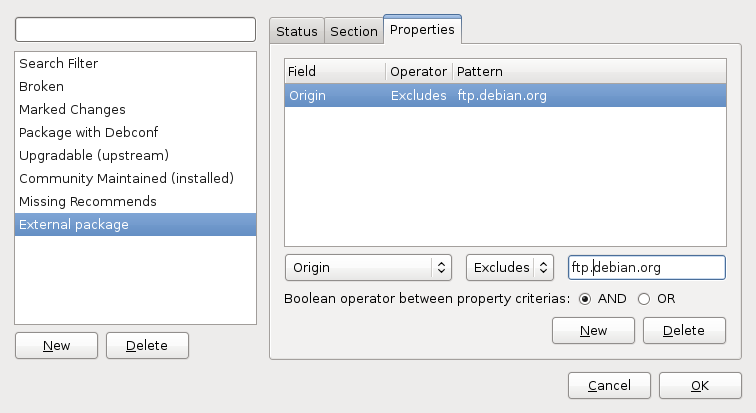
You can replace search with purge or remove if you want to get rid of all the packages listed. But you re more likely to want to remove only a subset of carefully chosen packages you re probably still using some of the software that you installed from external repositories. With synaptic, you can also browse the content of each repository. Click on the Origin button and you have a list of repositories. You can go through the non-Debian repositories and look which packages are installed and up-to-date. But you can do better, you can create a custom view. Click on the menu entry Settings > Filter . Click on New to create a new filter and name it External packages . Unselect everything in the Status tab and keep only Installed . Go in the Properties tab and here add a new entry Origin Excludes ftp.debian.org . In fact you must replace ftp.debian.org with the hostname of your Debian/Ubuntu mirror. The one that appears on the origin line in the output of apt-cache policy (see the excerpt quoted above in this article). Note that the term Origin is used to refer to two different things, a field in the release file but also the name of the host for an APT repository. It s a bit confusing if you don t pay attention. Close the filters window with OK. You now have a new listing of External packages under the Custom Filters screen. You can see which packages are installed and up-to-date and decide whether you really want to keep it. If the package is also provided by Debian/Ubuntu and you want to go back to the version provided by your distribution, you can use the Package > Force version menu entry.
Click here to subscribe to my free newsletter and get my monthly analysis on what s going on in Debian and Ubuntu. Or just follow along via the RSS feed, Identi.ca, Twitter or Facebook.

8 comments Liked this article? Click here. My blog is Flattr-enabled.

John Goerzen: Lots of Snow, Being Stuck, and Fun

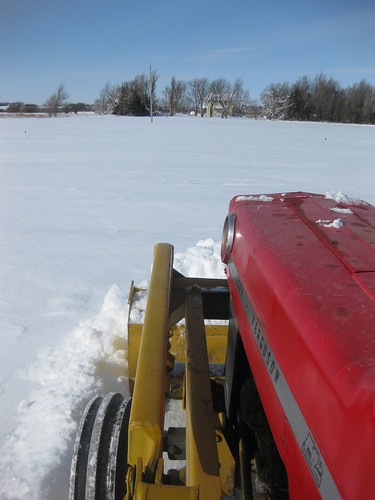
Those of you that watch my twitter know that we got dumped on with snow recently. The final estimate reported by local papers is 17 to 19 inches. IMG_5301.JPG That s my car. You might understand why I went home at 1PM Tuesday and worked from home the rest of the afternoon. The county didn t get the roads opened until 5:30PM Wednesday, so we were stuck. Terah s dad kindly opened the driveway for us though. Without that, we wouldn t have even known where it was. marla-IMG_4180.JPG Jacob and Oliver loved playing in the snow. It was a HUGE hit for them. Both of them hated to go back inside when it was time. Oliver had trouble walking, or even standing up, but that didn t stop him from begging for more every chance he got. IMG_5345.JPG On Saturday, I took Jacob outside to play. We had in mind building a snow tunnel. We went to one of the big piles of snow left by the tractor after our driveway was cleared, and I dug out a space underneath it that Jacob could crawl through. He got a little scoop (he insisted on calling it my shovel ) and helped dig too. He had a great time with it. He was very anxious to go inside, and it probably didn t help his eagerness that the cats could freely walk through it long before he could. They were around and taking a great interest in the proceedings. One of then stretched out on my back while I was stretched out pulling snow out from the pile. Finally Jacob got to go through. He had a little trouble because it wasn t tall enough for him to crawl like he usually does (though still plenty big for him to get through with lots of room to spare), but he came out beaming. I then went and got the camera and got some photos of his second trip through. IMG_5424.JPG You d think that this might be the highlight of a 4-year-old s snow excursion. And given his excitement, you might be very convinced of that. But you d be wrong. What Jacob really wanted was a snow train. So I drew some train track-sized lines in the snow with my shovel. Then I was supposed to draw a train engine. He had been planning this for hours before we even went outside, and I knew very well what was supposed to go on the engine: a snowball for a headlight. We then added passenger cars and a coal car, because apparently that s what you do with snow trains. And the result: IMG_5445.JPG When we went inside, Terah asked Jacob about his snow experience. Jacob was very happy, until she asked him if his snow train was a real train or a drawing of a train. Then he became very sad when he said it was a drawing of a train, and decided it was not what he wanted AT ALL. So today we went out again. This time I built a snow train that stands up, complete with snowballs for wheels. I asked him if it was right, and he kept saying, No, I want a REAL train. Finally I asked him what the difference between a real snow train and this one was. Apparently a real train would be on tracks, move around, make noise, and take us places. Fortunately he didn t dwell too long when I explained I couldn t build one of those. And then today s highlight was writing JACOB in the snow. He had started by drawing larger and larger J letters with his arm, and finally asked me to make one. I made footprints in the shape of a very large J, which he loved. He had me make another one, and then the rest of the letters in his name.

13 February 2011

Martin-&#201;ric Racine: X.org video driver Geode 2.11.12

Today we published version 2.11.12 of the X.org Geode driver, code-named "Squeezing the Wheezy out of Debian" in honor of the recent Debian stable release. 2.11.12 is yet another minor bug-fixing release, this time featuring yet another EXA fix for the LX component, courtesy of the OLPC team, plus the removal of an obsolete V4L1 include that was preventing the building of the ztv video input component of our driver since Linux kernel 2.6.38 - thanks to the Fedora and Ubuntu teams for spotting this!

Steve McIntyre: Dad ill again

A few years ago, I mentioned my dad's fight with cancer. He survived that, and has carried on for several more years since. He had a replacement hip fitted last year to improve his mobility, and was looking set to enjoy a good long retirement. Until... Just before Christmas symptoms suggested that the cancer had returned, and with a vengeance. Tests confirmed it. We were hoping that Dad would fight on and win through again this time, and I was looking forwards to him being at my wedding this September. But there have been a lot of unexpected complications this time and it's just not going to happen. I spoke to him last on Tuesday this week, but he was delirious at the time. He hasn't really been conscious in any meaningful way since. I'm composing this message in the hospital in Southport where I'm now waiting for my dad to die. We've been told by his doctors that it's not going to be long now, but they said that on Wednesday too. My dad has always been stubborn, always a fighter; we know that this is a fight he can't win, but that isn't stopping him from trying his hardest. At least he's being kept comfortable for his last few days, with plenty of strong painkillers on hand when needed. Please let it end soon.

Christian Perrier: Fonts week-end

I spent most of the week-end working in the pkg-fonts team SVN repository and uploading font packages. The main goal was implementing "Build-Depends:fontforge-nox fontforge" to make the build of fonts easier and faster when they're built from FontForge source files. While doing this, I updated a few of these fonts. I also completely revamped the linux-libertine package which was left pending for quite some time in our SVN (after initial work by Rog rio Brito). I also definitely adopted the ttf-sinhala-lklug font package (the only fonts we have for Sinhala language, so far). Finally, I started going through the list of packages that still depend on defoma. I prodded maintainers for several of these, the most outdated ones....to propose adopting the package under the team's umbrella. We'll see what happens. Quite productive week-end, indeed (and I even managed to watch the three 6 nations rugby games, plus running around 30 kilometers...doh).

Evgeni Golov: Mustek PoweMust 1000 USB on Debian Squeeze

Some (long) time ago, I wrote an article how to setup a Mustek PowerMust 1000 USB on Debian Sarge. Since then Etch, Lenny and now Squeeze were released and the machine the UPS was attached to was replaced.Yesterday I have upgraded this machine from Lenny to Squeeze and of course nut has kicked me in the nuts, telling me it can t connect to the UPS.When I replaced the old machine, I had to connect the UPS via USB instead of serial, as the new machine has only one serial port and that one is needed for the serial console to my Sun Netra T1. On Lenny, I was using the megatec_usb driver which seems borked on Squeeze and is superseeded by the blazer_usb one. So here is my nut setup on Squeeze:nut.conf:
MODE=standalone
UPSD_OPTIONS=""
UPSMON_OPTIONS=""
ups.conf:
[powermust]
    driver = blazer_usb
    port = schrank
    vendorid = 0665
    productid = 5161
    desc = "Mustek PowerMust 1000"
Yes, port has to be set, but can be any random string.upsd.conf:
ACL all 0.0.0.0/0
ACL localhost 127.0.0.1/32
ACCEPT localhost
REJECT all
upsmon.conf:
RUN_AS_USER nut
MONITOR powermust@localhost 1 nut nut master
MINSUPPLIES 1
SHUTDOWNCMD "/sbin/shutdown -h +0"
POLLFREQ 5
POLLFREQALERT 5
HOSTSYNC 15
DEADTIME 15
POWERDOWNFLAG /etc/killpower
RBWARNTIME 43200
NOCOMMWARNTIME 300
FINALDELAY 5
upssched.conf:
CMDSCRIPT /upssched-cmd
I hope this helps someone ;)

Sjoerd Simons: Just one of those days

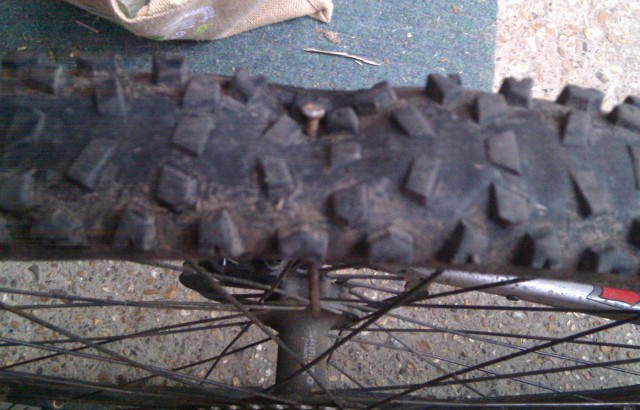
Sometimes life has its own way of telling you that you should have just stayed in bed. For instance the following might happen when you're cycling back after doing some sunday afternoon groceries. Rear tire piercing Oh well, guess it's time for a nice walk to get some fresh new inner tubes.

Andrew Pollock: [life] Zoe at nine months

(The requisite "I have no time any more, it's 10 days late") It certainly feels like 3 months has passed since I last reflected on her development. It feels like forever. As usual, we've managed to do a fair bit in 3 months. She's doing very well. Growing nicely. Still around the 25th percentile for weight, but now up to the 50th percentile for height. We just had to upgrade her from an infant car seat to a "big kid" car seat, because she was maxing it out on height, not weight. She seems to have handled the transition okay, but we haven't done any long car trips since making the change. She's now sitting really well, and pulling herself up into a standing position. She's cruising around on furniture a bit (and sporting various bruises to show for it). She started crawling at six and a half months, and now there's no stopping her. She's into everything. No more teeth have appeared yet. Her top teeth have been looking like they want to do something for ages. I think, given a recent uptick in fussiness, their appearance may be imminent. On the food front, she's eating all sorts of things. We've got a few infant/toddler cookbooks, so we still are predominantly feeding her either a combination of pureed fruits and vegetables, or a few pureed dishes that I've prepared (mainly vegetable stews or risotto). She also enjoys bread, toast and has taken to Vegemite on toast, like a good little Aussie. The other night we ate out at our local Italian restaurant, and she had some garlic bread and some penne pasta with marinara sauce. She's definitely enjoying finger food. We went back to Australia for a couple of weeks recently, and she handled the flights extremely well, and had an absolute ball back in Australia. She'd just started sleeping through the night a few times before we left for the trip, and didn't sleep as well while we were in Australia, but got back into the swing of things in under a week of getting back to the US. She's so much fun at this age. She laughs, she plays. She gets so excited when I get home from work in the evenings. I love her and being a Dad so much. Zoe at 9 months

Norbert Tretkowski: MySQL source tree available in Debian as binary package

MySQL supports a plugin interface since 5.1, which enables creation of server components. Plugins can be loaded at server startup, or loaded and unloaded at runtime without restarting the server. Most of these plugins require the full MySQL source tree during their build, which was not available in Debian as a binary package until I uploaded 5.1.54-2 to unstable last week. I had this item on my TODO list since MySQL 5.1 was uploaded to Debian unstable, because it is not possible for a Debian source package to build-depend on another source package. Thankfully, Clint Byrum from Ubuntu sent me a small patch which added the new binary package.

The first package making use of the new mysql-source-5.1 package is HandlerSocket, a NoSQL plugin for MySQL. It is currently waiting in Debian's NEW queue for approval, and I am sure we will see more plugins/packages (XtraBackup from Percona is another well known candidate) making use of the new binary package in Debian soon.

Wouter Verhelst: PMW uploaded

Earlier today (or, well, last night, since it's fairly late alrady) I uploaded pmw (about which I blogged previously). In preparation for that, I've also uploaded aspic, which is required to build pmw's documentation. While I'm quite fond of pmw already, and intend to maintain it inside Debian for quite some time, my interest in aspic is limited to the fact that I need it for pmw. So if anyone seems interested in adopting it... be my guest. But do talk to me, first. In my previous blog post, I've raved about how I like pmw much more than I do lilypond. I had two reasons for that, at the time: Now, I have a third:
wouter@celtic:~$ grep-available --eregex -FPackage -sInstalled-Size -sPackage '(pmw lilypond)'
Installed-Size: 1916
Package: pmw
Installed-Size: 7048
Package: lilypond-data
Installed-Size: 392344
Package: lilypond-doc
Installed-Size: 896
Package: pmw-doc
Installed-Size: 4184
Package: lilypond
Less than two megs for pmw, versus over ten for lilypond and lilypond-data combined; and less than a megabyte for complete documentation plus examples for pmw, versus several hundred megs for lilypond-doc. And it's not because pmw is less flexible, or has less features, or is less well documented, or anything of the sorts. It does have less output options; but then it's not like it's hard to convert PostScript into something else or anything.

12 February 2011

Tim Retout: Gnash and cookies

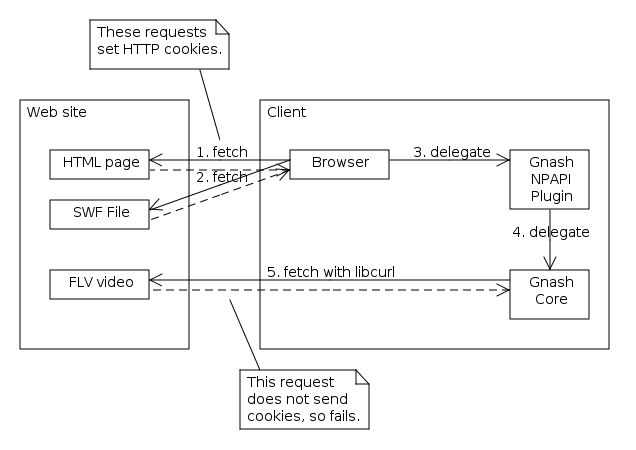
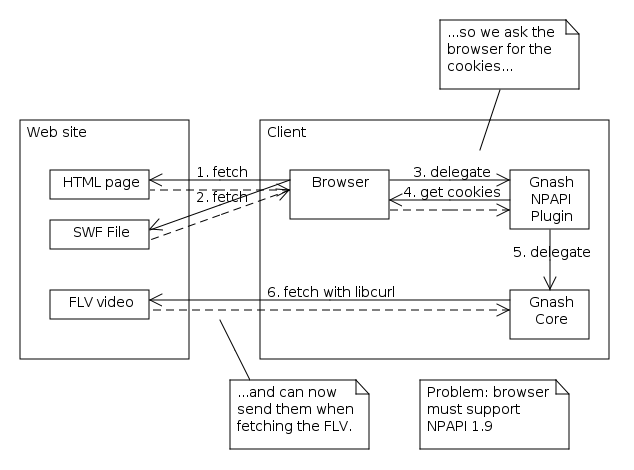
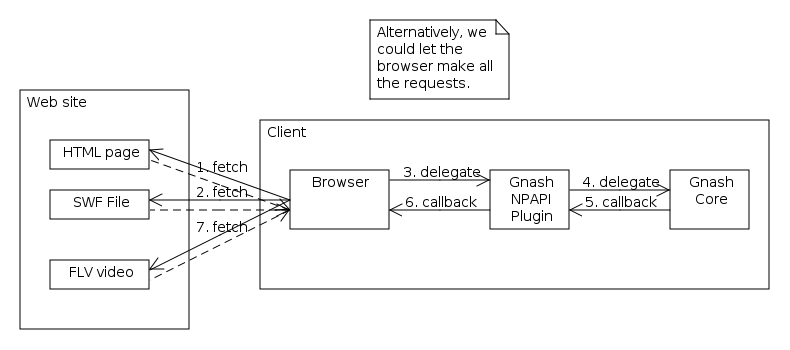
A new release of Gnash, version 0.8.9, is due in the near future. Plenty of bugs have been fixed, but some users are still going to have problems playing YouTube videos. Here's a short explanation. At some point last year, YouTube started setting HTTP cookies in your web browser, to keep track of which of their video servers is nearest to your machine. This lets them provide a better experience for you (I guess). Here's a diagram of what goes on in your browser: Diagram showing browser fetching HTML and SWF files, and Gnash core fetching FLV video independently. As of Gnash 0.8.8, a workaround was added, calling an NPAPI function NPN_GetValueForURL to ask the web browser for the relevant cookies. New diagram: Diagram showing Gnash core asking browser for cookies, and still fetching FLV video independently. The downside is that this function was only added in NPAPI version 1.9. This means: What does Adobe's plugin do? I imagine it's something like the following: Diagram showing browser making all HTTP requests, and Gnash core requesting data through the Gnash plugin So, the good news is, this problem should almost certainly get fixed over the coming Debian release cycle, if only because all the browsers will get updated. In the meantime, disabling cookies (and removing stale ones from YouTube) is a workaround.

Evgeni Golov: Privacy-over-IP does not exist

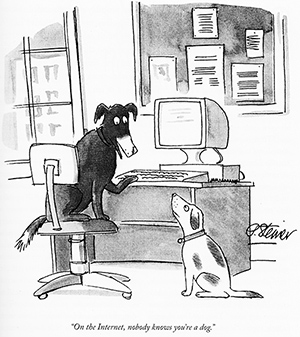
Did not exist.Will never exist.There was quite a lot of buzz about privacy with that new IPv6 thingy. Some say it is bad, as you will have a static address. Some say the privacy extensions will fix everything. I say: lemme rant ;)First of all, that was the internet, when I started using it back in 1999:

 [  New Yorker Magazine, March 1993] On the Internet nobody knows that you are a dog'
[ New Yorker Magazine, March 1993] On the Internet nobody knows that you are a dog And that s the internet today:

robcottingham.ca - How the hell does Facebook know I'm a dog?
[ robcottingham.ca] How the hell does Facebook know I m a dog?

Well, I d say that s not correct. Even in 1999 facebook could know you are a dog (if you ignore the fact, that there was no facebook in 1999), it s just noone really cared about it. But let s start from the beginning :)An IP-address is a 32-bit integer

An IP-address is technically a 32-bit integer, formatted into 4 8-bit parts (you can read more about IPv4 at Wikipedia), which makes a total of 4,294,967,296 possible IP-addresses. Your ISP has a range in this address-space it can give to its customers (you). My ISP (Unitymedia) owns about 300,000 IP-addresses (based on the RIPE database), which is about 0.007% of the whole address-space. If you look at the RIPE page, you see two common netname prefixes (DE-KNRW and DE-IESY-HFC) which match two regions of Germany where my ISP has its customers (Unitymedia is a merge of ish and iesy). What does that mean? It means one can map a Unitymedia customer into one of these regions, even if he would change his IP-address (Unitymedia uses DHCP with high lease-times, so this does not happen actually). It does not map the customer to a dog yet, but I bet real GeoIP databases can map them correctly to a city (I didn t try much, but this site suggests it works: http://www.ip-adress.com/?lc=en at least they map me correctly to Duesseldorf).Dynamic IP-addresses do not improve privacy

Given the above facts, even if Unitymedia would give me a new IP-address every X hours (many DSL-providers have X=24), it is still possible to map me into a set of about 150,000 users (here user means customer, there still may be multiple computers connected via the same line). I would even go further and say the set is much smaller, as I think I am not able to get every free IP-address from DE-KNRW-*, as these should be bound to cities/regions (GeoIP databases exist, you rememember?) and I do not move with my line.Routers and reverse DNS kill privacy

Currently, my IP-address is 62.143.232.104, which has a reverse DNS entry ip-62-143-232-104.unitymediagroup.de and does not say anything about me or my location, besides of the obvious Unitymedia customer . But look at the traceroute:

4  7111A-MX960-01-ae5.frankfurt.unity-media.net (80.81.192.181)
5  13NOC-MX960-01-ae8.kerpen.unity-media.net (80.69.107.26)
6  1411G-MX960-01-ae9.neuss.unity-media.net (80.69.107.2)
7  1411J-MX960-01-ae1.bilk.unity-media.net (80.69.107.70)
8  PH-1411J-uBR10k-06-Te-1-2-0.bilk.unity-media.net (80.69.102.106)
Frankfurt is about 250km from here, Kerpen about 60, Neuss about 10 and Bilk is a part of the city I live in, about 4km away from my home. I guess you get the idea :)Browsers kill privacy tooDo I have to say more than a link to https://panopticlick.eff.org/? My Chromium scores one in 1,400,000. How much IP-addresses did I have to hide in again?We are at the dog level now, dogs use BoneOS with FireBark, not Linux with Chromium :)IPv6 kills cute kittensOh, and privacy, because with IPv6, there are 2^128 IPv6-addresses out there, of which your provider will maybe own a /32 (2^96 addresses) and give you a /48 (2^80 addresses) or (more likely) /64 (2^64 addresses). Then you enable the great IPv6 privacy extensions (RFC4941) and happily hide in your own assigned subnet, still being a customer of your ISP, still living in the same city and using your old browser It s just about mapping subnets instead of individual IP-addresses then. And we can t get lower as the dog levelPeople can annoy meI did not write all this to teach you, you can do yourself with Wikipedia and RFCs. There is a person out there, who thinks using a random name, mail address and twitter account could fool me into thinking that s a new, yet unknown, person to me. Well, I am not stupid, sorry. When you comment on my blog, your IP-address is logged, when I approve the comment, I often look at the reverse DNS and the whois entry of that IP-address (sorry, I AM paranoid). I even might check my webserver logs (or Piwik) where did you come from (Google etc), writing accidentally in your comment does not help :) Also, if you are trying to fool me, don t use your own computer, running Windows 7 and Firefox which I installed. Oh, and probably do not use your home line which I used to login into my admin-area using my unique Chromium ;)Sorry Hanna Lena, the chicken has just eaten her own eggs And yes, one can track down a single person on this big thing called internet, IPv6 will not change this (in any direction).

Joey Hess: d-i is ten

I just realized that the Debian Installer is ten years old! It actually got started ten years ago last summer, but now is also an apt anniversary -- ten years ago, I successfully booted d-i for the first time. It's amazing that d-i has been around as long as Debian Developers who have "been with the project longer than most". (Many of whom have been long-time contributors to d-i themselves.) Astonishing that my basic design has held up and remains relevant. And every time I boot up the Debian kFreeBSD installer, or run the graphical installer, or hear someone raving about how easy Ubuntu was for them to install (and know d-i was underneath), I'm amazed at the places people have taken d-i. The code has recently moved to git. As changes like ext4 by default start to flow in to d-i, with Wheezy development starting up, I hope to see more people enticed into working on d-i. Anyone can do like Matthew Palmer has done with netcfg -- pick a component of d-i that interests you, check out its git repository, and take it from being reasonably well team-maintained to awesomely you-maintained. In five or ten years Matthew will be able to look back at all the people who have used d-i to install over IPv6, and on WPA wireless, and with his other netcfg improvements. Trust me, it's a great feeling. Previously: d-i retrospective (better written than the above & well worth a re-read)

Julien Blache: forked-daapd: future directions

I ve got a few mails lately enquiring about the lack of visible activity on forked-daapd in recent times. Well, for one, I ve been busy with other things, but there s also been some non-public activity. So, here s what should happen in the next few months, in no particular order: The database overhaul will bring a much-needed speedup on small devices and big libraries. It s being worked on, but it ground to a halt with new year and all. Hopefully it ll resume soon. I m also giving up on ffmpeg for metadata extraction. It doesn t work well at all (as everybody knows by now) and it s actually getting worse and worse. With the ffmpeg takeover/fork (call it whatever you want) it s unclear what s going to happen on this front. So I m giving up and the metadata scanner will probably switch to using TagLib (one more dependency, yay). Last, but definitely not least, the libdispatch codebase should finally see the light at the end of the tunnel in the coming months. I ve been working on this since July last year, moving away from libevent. If you never heard about libdispatch, or Grand Central Dispatch, read my previous post on the subject. I ll talk about it in more details at a later date. Finally, as far as Squeeze is concerned, I plan to provide forked-daapd backports as long as it ll be practical to do so. This is it for now. I don t have a one more thing in my sleeve, sorry. Time is at a premium right now, so big things have to wait.

David Welton: Book Review: Start Small, Stay Small, A Developer's Guide to Launching a Startup

<iframe frameborder="0" marginheight="0" marginwidth="0" scrolling="no" src="http://rcm.amazon.com/e/cm?lt1=_blank&amp;bc1=000000&amp;IS2=1&amp;bg1=FFFFFF&amp;fc1=000000&amp;lc1=0000FF&amp;t=dedasys-20&amp;o=1&amp;p=8&amp;l=as4&amp;m=amazon&amp;f=ifr&amp;asins=B003YH9MMI" style="width: 120px; height: 240px; float: left; margin-right: 10px;"></iframe> I tend to be a sucker for business books, to the point where I created (and later sold) a site to discuss them. Part of the motivation for creating that site was that a lot of them tend to contain one good idea, and an inordinate amount of fluff. This book does not - it's good material that could not easily be summarized because it's full of information. I think it's actually one of the more relevant books I've ever read in that, for my situation, the idea behind it really speaks to me. I work as a consultant during the days, and I like it a lot. Rather than working on the same old thing year after year, I get to meet new people, new clients, new situations, and help them out, which is motivating. However, consulting has its downsides too, in that it doesn't create a great deal of long-term value. Once you've finished up a project, it's on to the next one, or no money comes in. I'm also a bit older and more set in my ways: I did my time in the California Bay Area, and I don't relish going back and working like mad on a "Real Startup" with VC backing, crazy hours, and having the thing consume my life. The idea behind "Start Small, Stay Small" is to find and create really niche products: stuff that will earn you some extra money as a developer, but also niches that are small enough to not really be interesting to larger companies that need a lot of income to justify a forray into a particular market segment. This, then, becomes your 'competitive advantage': Microsoft, or even 37 Signals, simply isn't going to chase after a market that is worth 20,000 dollars a year. And yet for someone working on their own, if you manage to set up something that brings in that money, and mostly automate it so that it's not a second job, it's a tidy extra bit of money. Several projects like that might even be enough to live on, depending on your lifestyle. With that in mind, the authors, Rob Walling and Mike Taper, delve into the details of how to go about doing so. The whole thing is done under the assumption that you don't have a lot of time or money to throw at things that don't bring in concrete results in relatively short order. Various subjects discussed in detail include how to find a niche, how to create a sales web site, how to measure market demand, conversion rates, how to productively outsource less critical portions of your business, and much more. They also discuss what sorts of numbers to look at for various aspects of the business, and anchor the discussion with real numbers for many things, rather than just giving you a hand-wavy phrase that's not that useful in the real world. It's not a 'timeless' book as all the concrete numbers and techniques reference technologies, sites, and the market dynamics of 2011, but after all, that's part of what makes it good. Other things I didn't like so much were being sold on their for-pay "micropreneur community", and the relatively high price of the book but I think it's worth it given the real advice you get. If you don't like marketing, and think that products succeed or fail on their merits alone, of course the book will leave you cold, but of course you're wrong about that anyway!

Wouter Verhelst: Ten years of Debian

My first ever Linux installation was done in the late nineties 1998 or thereabouts but was a RedHat 4.5 installation rather than a Debian one. The reason for that was fairly simple: the Infomagick sixpack CD set that I'd bought contained RedHat, Debian, and Slackware, but the RedHat installation was the only one that could be installed directly from CD the other two required me to write floppies and boot from those to start the installation, and I wasn't very fond of that idea. It was only a few years and a few broken RedHat upgrades later that I saw the light and considered trying out this Debian thing that some of my classmates were talking about. The fact that I'd just bought my own computer (rather than having to compete for time with my siblings on my parents' computer) was a good reason to do a fresh Linux installation. I'd been planning to install Linux From Scratch, but as what was still known as the LFS HOWTO told me you'd need a working Linux installation to do that, I considered my options. Since I'd developed a strong dislike of RedHat, I wasn't interested in doing another RedHat anymore. So, I downloaded the most recent version of Debian at the time (Potato Test Cycle III), wrote it to a CD, and installed. I've probably still got the CD lying around somewhere. A few months later, I found these "Linux Gazette" packages in the archive, with the latest packaged issue being 47, but the latest upstream version being much higher. Trying to figure out what was going on, I mailed the maintainer, Adrian Bridgett, who encouraged me to take over maintenance. Thus began my life of actively contributing to Open Source software. In November 2000, I applied to become a Debian Developer. In January 2001, Martin Michlmayr was assigned to be my AM. And in early February 2001, now just over ten years ago, I'd become a Debian Developer. Yes, that was fast, and no, I probably wasn't really ready yet, at the time. Originally, I only cared much about these Linux Gazette packages. But, as time went on, I started looking around, too. A friend passed me an old Macintosh Centris 610. As I tried to install Debian on it, I found that it didn't actually run very well. This turned out to be due to it having a broken 68LC040 processor, so I bought me another m68k-based mac, one with a full 68040 processor (a Centris 650). Thus I became involved in the m68k port and buildd maintenance. As these old machines came with 80MB or 250MB SCSI hard disks of which I had none laying around, and a then-recent Debian installation had minimum requirements of about 200MB, I was in need of network storage to be able to do anything useful with the mac. NFS didn't work as expected; the RTC implementation on m68k mac hardware was reverse engineered and didn't work too well at the time, which meant that the clock would run slower if the machine was under load, and that in turn would mean that make would get confused about timestamps, since they would suddenly appear to originate from the future (in NFS, it's the server that assigns time stamps, not the client). There was a simple solution, however; Pavel Macheck had written this neat 'Network Block Device', which would let the client do its own filesystem on network storage. Only it wasn't packaged; but then, that was easy to fix. Thus I started maintaining the single piece of software that I've worked the most on, to date. A few years later, Pavel lost interest in maintaining NBD, and handed over upstream maintenance to me and maintenance of the kernel side to Paul Clements. Thus began my life in upstream work. And while I originally joined Debian with the intent of using it as a learning experience and stepping stone on my way to more "important" free software, I found that it wasn't as satisfying as was my work for Debian. Over the years, there's been this duality where I've felt like I was doing too much and not enough at the same time. Too much, because the things I was doing would eat up much of my spare time, leaving little time left for other hobbies. Not enough, because I witnessed other people doing much more for Debian than I did, and I wanted to make a difference. As the years passed by, many things have changed. Not only in Debian, but also besides it. I became an independent contractor, focusing mostly on supporting people in using Debian (although I support them with other distributions, too). The importance of a port went from 'something which these weird porter people are doing, and that we should probably help them with if it doesn't work, but is their problem really' to 'something that I really really really have to make sure works for my packages', and back for the port that I cared about most. After several years of trying, I finally managed to explain to my parents what this Debian thing is, why it matters, and what my role in the whole thing is. We did a few releases, some taking longer than I would've liked. People joined the project, and left again. Some of my friends died. My fame in the project rose, even though I wasn't aware of it initially; and thus I was rather surprised when someone asked me whether I was "the Wouter Verhelst" at a key signing party. Recently, I've started looking back, and considered the things which Debian has meant to me. Ten years ago, I was 22, still in college, and had way too much spare time on my hands. I'd recently gotten my first Internet installation, and all these online communities were very new to me. Yes, that was all probably rather late. Debian has changed my life in many ways; it has allowed me to meet various kinds of people, both online and in meatspace. I've been to Helsinki, Edinburgh, Mar del Plata, C ceres, and New York City, places that I might otherwise not have visited. Each of these trips was an incredible experience that I have fond memories of; and while the most fond ones originate from Helsinki, I cherish the memories of each of these trips as some of the best trips I've ever done. Working on Debian has forced me to learn about the inner workings of a Linux-based system, which is knowledge that has helped me tremendously professionally, too. And finally, working on Debian has given me a unique perspective on this whole FOSS community, which has helped shape my ethics and my view of the world. While I believe that I would've subscribed to most of that ideology at any rate, I'm not sure that the details of my beliefs and understanding would've been exactly the same. And while I don't agree on every position that the project subscribes to as a whole, I do believe that the philosophies that lie at the core of this project contain just the right mix of pragmatism and ideology that makes it possible for our project to thrive in a changing world of not only a growing group of people who subscribe unconditionally to the free software ideals, but also business people who care mostly about money. Over the years, somehow I moved from "one of the recent batch of new Debian Developers" to "someone who's been with the project longer than most". It still feels weird to see people shut up because you've built up a reputation in some area, and you give your gut opinion on some subject without researching it too much. I try not to let that happen too often. Today, ten years and just over a week ago, my life as a Debian Developer started, and it would change the way I looked at the world, the things I would do in my spare time, and the people I would meet. I wouldn't have it any other way. Thanks, Debian, for what's been a blast; may the next ten years be as inspiring to me and everyone as the past ten!

Erich Schubert: Joerg Schilling stilly spreading FUD

J rg Schilling is still spreading FUD (currently on an openSuSE list):
There is a social issue with Debian that attacks OSS projects _because_ they use the GPL. Please do not follow these attacks without asking a lawyer.
The removal of cdrecord has been the best reaction to these issues, since apparently working with him is impossible. In this thread, he again manages to accuse everybody else of lying and being incompetent. This clearly shows that you cannot work with him, and the only viable way is ignoring him as far as possible.
It also speaks of a hurt ego in a probably narcisstic person (after all, he seems to think everybody else is incompetent and lying - but I am not a psychologist, so this is not a diagnosis!).
Let me just point out one fact:
By not shipping his current cdrecord, we can obviously not violate any even just potentially invalid license. The way Debian is dealing with this issue is legally undoubtedly correct: obviously, we are not oblieged to include his software.
On the long run, I assume that Debian will also get rid of cdrkit/wodim. In my opinion, this is just a legacy code until we can switch to libburnia entirely, and we should now try to drop cdrkit/wodim as well in order to ship "wheezy" without it.
Since we cannot work with J rg, the only sane way is to try to completely remove any code he wrote from our systems so we have no reason whatsoever to communicate with him.
cdrecord is dead, long live libburnia.
I expect to see lots of FUD from him in the post comments any time soon ... but I do not care: I don't use his software. My current laptop doesn't even have a CD drive ... and despite his claims, the Debian versions of cdrecord and wodim worked perfectly for me when I was still burning CDs.
My only advice to you is to ignore him as far as possible. It will not get you anywhere, it is just a waste of time. In fact, I shouldn't have wasted the time it took me to write this blog post.

Next.

Previous.