Search Results: "ag"

18 December 2013

Joey Hess: what charlie's missing about bitcoin

(Posted as a comment to Charles Stross's blog post about bitcoin) Bitcoin is a piece of software which tries to implement a particular SFnal future. One in which the world currency is de-centralized, deflationary, all early bitcoin adopters own their own planetoids, and all visitors are automatically charged for the air they breath. Thing is, the real world is more complicated than that. Assuming Bitcoin did manage to become an important currency, countries would naturally try to regulate it. In 30 years, by the time bitcoin mining has slowed right down, the legal system will be fully caught up to the internet. Bitcoin tries to make its code the law (as Lessig used to say), but the law can certainly affect its code. The law could, for example, require that bitcoin be changed to stop increasing the difficulty of mining new blocks. Then bitcoin is suddenly an inflationary currency. This would be a hard fork in the block chain, but one enforced by financial regulators. Miners would be tracked down and forced to comply. Some would perhaps go underground and run the deflationary bitcoin network on TOR hidden services. Lots of possible ways it could play out. That's only one scenario, covering one of the many problems with Bitcoin that make Charlie hate it. So it seems to me that Bitcoin should be a gold mine for Science Fiction authors, if nothing else..

Daniel Pocock: Embedding Python in multi-threaded C++ applications

Embedding Python into other applications to provide a scripting mechanism is a popular practice. Ganglia can run user-supplied Python scripts for metric collection and the Blender project does it too, allowing users to develop custom tools and use script code to direct their animations. There are various reasons people choose Python:
  • Modern, object orientated style of programming
  • Interpreted language (no need to compile things, just edit and run the code)
  • Python has a vast array of modules providing many features such as database and network access, data processing, etc
The bottom line is that the application developer who chooses to embed Python in their existing application can benefit from the product of all this existing code multiplied by the imagination of their users. Enter repro repro is the SIP proxy of the reSIProcate project. reSIProcate is an advanced SIP implementation developed in C++. repro is a multi-threaded process. repro's most serious competitor is the Kamailio SIP proxy. Kamailio has its own bespoke scripting language that it has inherited from the SIP Express Router (SER) family of projects. repro has always been far more rigid in its capabilities than Kamailio. On the other hand, while Kamailio has given users great flexibility, it has also come at a cost: users can easily build configurations that are not valid or may not do what they really intend if they don't understand the intricacies of the SIP protocol. Here is an example of the Kamailio configuration script (from Daniel's excellent blog about building a Skype-like service in less than an hour) Kamailio also has a wide array of plugins for things like database and LDAP access. repro only had embedded bdb and MySQL support. Embedding Python into repro appears to be a quick way to fill many of these gaps and allow users to combine the power of the reSIProcate stack with their own custom routing logic. On the other hand, it is not simply copying the Kamailio scripting solution: rather, it provides a distinctive alternative. Starting the integration Embedding Python is such a popular practice that there is even dedicated documentation on the subject. As well as looking there, I also looked over the example provided by the embedded Python module for Ganglia. Looking over the Ganglia mod_python code I noticed a lot of boilerplate code for reference counting and other tedious activities. Given that reSIProcate is C++ code, I thought I would look for a C++ solution to this and I came across PyCXX. PyCXX is licensed under BSD-like terms similar to reSIProcate itself so it is a good fit. There is also the alternative Boost.Python API, however, reSIProcate has been built without Boost dependencies so I decided to stick with PyCXX. I looked over the PyCXX examples and the documentation and was able to complete a first cut of the embedded Python scripting feature very quickly. Using PyCXX One unusual thing I noticed about PyCXX is that the Debian package, python-cxx-dev does not provide any shared library. Instead, some uncompiled source files are provided and each project using PyCXX must compile them and link them statically itself. Here is how I do that in the Makefile.am for pyroute in repro:
AM_CXXFLAGS = -I $(top_srcdir)
reproplugin_LTLIBRARIES = libpyroute.la
libpyroute_la_SOURCES = PyRoutePlugin.cxx
libpyroute_la_SOURCES += PyRouteWorker.cxx
libpyroute_la_SOURCES += $(PYCXX_SRCDIR)/cxxextensions.c
libpyroute_la_SOURCES += $(PYCXX_SRCDIR)/cxx_extensions.cxx
libpyroute_la_SOURCES += $(PYCXX_SRCDIR)/cxxsupport.cxx
libpyroute_la_SOURCES += $(PYCXX_SRCDIR)/../IndirectPythonInterface.cxx
libpyroute_la_CPPFLAGS = $(DEPS_PYTHON_CFLAGS)
libpyroute_la_LDFLAGS = -module -avoid-version
libpyroute_la_LDFLAGS += $(DEPS_PYTHON_LIBS)
EXTRA_DIST = example.py
noinst_HEADERS = PyRouteWorker.hxx
noinst_HEADERS += PyThreadSupport.hxx
The value PYCXX_SRCDIR must be provided on the configure command line. On Debian, it is /usr/share/python2.7/CXX/Python2 Going multi-threaded My initial implementation simply invoked the Python method from the main routing thread of the repro SIP proxy. This meant that it would only be suitable for executing functions that complete quickly, ruling out the use of any Python scripts that talk to network servers or other slow activities. When the proxy becomes heavily loaded, it is important that it can complete many tasks asynchronously, such as forwarding chat messages between users in real-time. Therefore, it was essential to extend the solution to run the Python scripts in a pool of worker threads. At this point, I had an initial feeling that there may be danger in just calling the Python methods from some other random threads started by my own code. I went to see the manual and I came across this specific documentation about the subject. It looks quite easy, just wrap the call to the user-supplied Python code in something like this:
PyGILState_STATE gstate;
gstate = PyGILState_Ensure();
/* Perform Python actions here. */
result = CallSomeFunction();
/* evaluate result or handle exception */
/* Release the thread. No Python API allowed beyond this point. */
PyGILState_Release(gstate);
Unfortunately, I found that this would not work and that one of two problems occur when using this code:
  • The thread blocks on the call to PyGILState_Ensure()
  • The program crashes with a segmentation fault when the call to a Python method was invoked
Exactly which of these outcomes I experienced seemed to depend on whether I tried to explicitly call PyEval_ReleaseThread() from the main thread after doing the Py_Initialize() and other setup tasks. I tried various permutations of using PyGILState_Ensure()PyGILState_Release() and/or PyEval_SaveThread()/PyEval_ReleaseThread() but I always had one of the same problems. The next thing that occurred to me is that maybe PyCXX provides some framework for thread integration: I had a look through the code and couldn't find any reference to the threading functionality from the C API. I went looking for more articles and mailing list discussions and found implementation notes such as this one in Linux Journal and this wiki from the Blender developers. Most of them just appeared to be repeating what was in the manual, with a few subtle differences, but none of this provided an immediate solution. Eventually, I discovered this other blog about concurrency with embedded Python and it suggests something not highlighted in any of the other resources: calling PyThreadState_New(m_interpreterState) in each thread after it starts and before it does anything else. Combining this with the use of PyEval_SaveThread()/PyEval_ReleaseThread() fixed the problem: the use of PyThreadState_New() was not otherwise mentioned in the relevant section of the Python guide. I decided to take this solution a step further and create a convenient C++ class to encapsulate the logic, you can see this in PyThreadSupport.hxx:
class PyExternalUser
 
   public:
      PyExternalUser(PyInterpreterState* interpreterState)
       : mInterpreterState(interpreterState),
         mThreadState(PyThreadState_New(mInterpreterState))  ;
   class Use
    
      public:
         Use(PyExternalUser& user)
          : mUser(user)
           PyEval_RestoreThread(mUser.getThreadState());  ;
         ~Use()   mUser.setThreadState(PyEval_SaveThread());  ;
      private:
         PyExternalUser& mUser;
    ;
   friend class Use;
   protected:
      PyThreadState* getThreadState()   return mThreadState;  ;
      void setThreadState(PyThreadState* threadState)   mThreadState = threadState;  ;
   private:
      PyInterpreterState* mInterpreterState;
      PyThreadState* mThreadState;
 ;
and the way to use it is demonstrated in the PyRouteWorker class. Observe how PyExternalUser::Use is instantiated in the PyRouteWorker::process() method: when it goes out of scope (either due to a normal return, an error or an exception) the necessary call to PyEval_SaveThread() is made in the PyExternalUser::Use::~Use() destructor. Using other Python modules and DSO problems All of the above worked for basic Python such as this trivial example script:
def on_load():
    '''Do initialisation when module loads'''
    print 'example: on_load invoked'
def provide_route(method, request_uri, headers):
    '''Process a request URI and return the target URI(s)'''
    print 'example: method = ' + method
    print 'example: request_uri = ' + request_uri
    print 'example: From = ' + headers["From"]
    print 'example: To = ' + headers["To"]
    routes = list()
    routes.append('sip:bob@example.org')
    routes.append('sip:alice@example.org')
    return routes
However, it needs a more credible and useful test: using the python-ldap module to try and query an LDAP server appears like a good choice. Upon trying to use import ldap in the Python script, repro would refuse to load the Python script, choking on an error like this:
Traceback (most recent call last):
  File "/usr/lib/python2.7/dist-packages/ldap/__init__.py", line 22, in 
    import _ldap
ImportError: /usr/lib/python2.7/dist-packages/_ldap.so: undefined symbol: PyExc_SystemError
I looked at the file _ldap.so and discovered that it is linked with the LDAP libraries but not explicitly linked to any version of the Python runtime libraries. It expects the application hosting it to provide the Python symbols globally. In my own implementation, my embedded Python encapsulation code is provide as a DSO plugin, similar to the way plugins are loaded in Ganglia or Apache. The DSO links to Python: the DSO is loaded by a dlopen() call from the main process. The main repro binary has no direct link to Python libraries. Adding RTLD_GLOBAL to the top-level dlopen() call for loading the plugin is one way to ensure the Python symbols are made available to the Python modules loaded indirectly by the Python interpreter. This solution may be suitable for applications that don't mix and match many different components. Doing something useful with it Now it was all working nicely, I took a boilerplate LDAP Python example and used it for making a trivial script that converts sip:user@example.org to something like sip:9001@pbx.example.org, assuming that 9001 is the telephoneNumber associated with the user@ email address in LDAP. It is surprisingly simple and easily adaptable to local requirements depending upon the local LDAP structures:
import ldap
from urlparse import urlparse
def on_load():
    '''Do initialisation when module loads'''
    #print 'ldap router: on_load invoked'
def provide_route(method, request_uri, headers):
    '''Process a request URI and return the target URI(s)'''
    #print 'ldap router: request_uri = ' + request_uri
    _request_uri = urlparse(request_uri)
    routes = list()
    
    # Basic LDAP server parameters:
    server_uri = 'ldaps://ldap.example.org'
    base_dn = "dc=example,dc=org"
    # this domain will be appended to the phone numbers when creating
    # the target URI:
    phone_domain = 'pbx.example.org'
    # urlparse is not great for "sip:" URIs,
    # the user@host portion is in the 'path' element:
    filter = "(&(objectClass=inetOrgPerson)(mail=%s))" % _request_uri.path
    #print "Using filter: %s" % filter
    try:
        con = ldap.initialize(server_uri)
        scope = ldap.SCOPE_SUBTREE
        retrieve_attributes = None
        result_id = con.search(base_dn, scope, filter, retrieve_attributes)
        result_set = []
        while 1:
            timeout = 1
            result_type, result_data = con.result(result_id, 0, None)
            if (result_data == []):
                break
            else:
                if result_type == ldap.RES_SEARCH_ENTRY:
                    result_set.append(result_data)
        if len(result_set) == 0:
            #print "No Results."
            return routes
        for i in range(len(result_set)):
            for entry in result_set[i]:
                if entry[1].has_key('telephoneNumber'):
                    phone = entry[1]['telephoneNumber'][0]
                    routes.append('sip:' + phone + '@' + phone_domain)
    except ldap.LDAPError, error_message:
        print "Couldn't Connect. %s " % error_message
    return routes
Embedded Python opens up a world of possibilities After Ganglia 3.1.0 introduced an embedded Python scripting facility, dozens of new modules started appearing in github. Python scripting lowers the barrier for new contributors to a project and makes it much easier to fine tune free software projects to meet local requirements: hopefully we will see similar trends with the repro SIP proxy and other projects that choose Python. The code is committed here in the reSIProcate repository. These features will appear in the next beta release of reSIProcate and Debian packages will be available in unstable in a few days.

C.J. Adams-Collier: Maxine is now running on mariadb

So back when I was working for MySQL AB as support manager for MaxDB, I created an IRC bot to help manage the #maxdb channel on Freenode. We didn t get a lot of traffic, and Daniel De Graaf mentioned that he could use a bot to help manage some iptables factoids over on #netfilter. So I had her join. He taught her all sorts of interesting things. She stored these factoids in a MySQL database. I have just migrated from MySQL to MariaDB which I compiled from source. Here are the packages: http://www.colliertech.org/~cjac/debian/
cjac@mariadb:~$ mysql -u root -p
Enter password: 
Welcome to the MariaDB monitor.  Commands end with ; or \g.
Your MariaDB connection id is 5322
Server version: 5.5.32-MariaDB-1-log (Debian)
Copyright (c) 2000, 2013, Oracle, Monty Program Ab and others.
Type 'help;' or '\h' for help. Type '\c' to clear the current input statement.
MariaDB [(none)]> use maxine;
Reading table information for completion of table and column names
You can turn off this feature to get a quicker startup with -A
Database changed
MariaDB [maxine]> 
15:22 < cj> maxine: iptables?
15:22 < maxine> hmmm... iptables is a generic table structure for the 
                definition of rulesets. Each rule within a chain consists of a 
                number of classifiers (iptables matches) and one optional 
                connected action (iptables target).

Ingo Juergensmann: Debian donation to m68k arrived

The Debian m68k port has been entitled by the DPL to receive a donation of five memory expansion cards for the m68k autobuilders. The cards arrived two weeks ago and are now being shipped to the appropriate buildd admins. Adding those 256 MB memory expansion will have a huge effect to the m68k buildds, because most of them are Amigas that are currently running with "just" 128 MB. The problem with those expansion cards is to make use of them. Sounds strange but this is the story behind it.... Those memory expansion cards, namely it is the BigRamPlus from Individual Computers, are Zorro III bus cards, which has some speed limitations. The Amiga memory model is best described in the Amiga Hardware Reference Manual. For Zorro III based Amigas this is described in the section "A3000 memory map", where you can see that the memory model is divided into different address space. The most important address space is the "Coprocessor Slot Expansion" space, starting at $0800 0000. This is where the memory on the CPU accelerator cards will be found and which runs at full CPU speed. The BigRamPlus, however, is located within "Zorro III Expansion" address space at $1000 0000 and will have transfer rates of about 13 MB/s. Then again there's still the motherboard expansion memory and others like Zorro II expansion memory. Unfortunately the current kernel does not support SPARSEMEM on m68k, but is using DISCONTIGMEM as Geert Uytterhoven explained. In short: we need SPARSEMEM support to easily make use of all available memory chunks that can be found. To make it a little more difficult, Amigas do use some kind of memory priority. Memory on accelerator cards usually has a priority of 40, motherboard expansion memory has a priority of, let's say, 20 and chip memory a pri of 0. This priority usually is equivalent to speed of memory. So, we want to have the kernel loaded to accelerator memory, of course. Basically we could do that by using a memfile and define the different memory chunks in the appropriate priority list like this one:
2097152
0x08000000 67108864
0x07400000 12582912
0x05000000 268435424
Would be an easy solution, right? Except that this doesn't work out. Currently the kernel will be loaded into the first memory chunk that is defined and ignore all memory chunks before that address space. As you can see 0x07400000 and 0x05000000 would be ignored because of this. Getting confused? No problem! It will get worse! ;) There's another method of accessing memory for Amigas: it's called z2ram and will use Zorro II as, let's say, swapping area. But maybe you guessed it: z2ram does not work for Zorro III memory (yet). So, this won't work either. Geert suggested to use that Zorro III memory as mtd device and finally this worked out! You'll need these modules in your kernel:
CONFIG_MTD=m
CONFIG_MTD_CMDLINE_PARTS=m
CONFIG_MTD_BLKDEVS=m
CONFIG_MTD_SWAP=m
CONFIG_MTD_MAP_BANK_WIDTH_1=y
CONFIG_MTD_MAP_BANK_WIDTH_2=y
CONFIG_MTD_MAP_BANK_WIDTH_4=y
CONFIG_MTD_CFI_I1=y
CONFIG_MTD_CFI_I2=y
CONFIG_MTD_SLRAM=m
CONFIG_MTD_PHRAM=m
Then you just need to create the mtd device and configure it as swap space:
/sbin/modprobe phram phram=bigram0,0x50000000,0xfffffe0
/sbin/modprobe mtdblock
/sbin/mkswap /dev/mtdblock0
/sbin/swapon -p 5 /dev/mtdblock0
And then you're done:
# swapon -s
Filename Type Size Used Priority
/dev/sda3 partition 205932 8 1
/dev/sdb3 partition 875536 16 1
/dev/mtdblock0 partition 262136 53952 5
To make it even worse (yes, there's still room for that! ;)) you can put two memory expansion cards into one box:
# lszorro -v
00: MacroSystems USA Warp Engine 40xx [Accelerator, SCSI Host Adapter and RAM Expansion]
40000000 (512K) 01: Unknown device 0e3b:20:00
50000000 (256M) 02: Village Tronic Picasso II/II+ RAM [Graphics Card]
00200000 (2M) 03: Village Tronic Picasso II/II+ [Graphics Card]
00e90000 (64K) 04: Hydra Systems Amiganet [Ethernet Card]
00ea0000 (64K) 05: Unknown device 0e3b:20:00
60000000 (256M)
The two "Unknown device" entries are the two BigRamPlus cards. As you can see card #1 starts at 0x50000000 and card #2 starts at 0x60000000. Unfortunately the phram kernel module can be loaded twice with different start addresses, but the idea to start at 0x50000000 with a size of 512M won't work either as there seems to be a reserved 0x20 bytes a range at the beginning of each card. Anyway... So, to make a very long and weird story short: the donated memory cards from Debian can now be used as additional and fast swap space for the buildds as long as it takes to get SPARSEMEM support working. Thanks again for donating the money for those memory expansion cards for the good old m68k port. Once done SPARSEMEM support in the m68k will benefit not only these cards in Amigas but Ataris as well.
Kategorie:

Daniel Kahn Gillmor: automatically have uscan check signatures

If you maintain software in debian, one of your regular maintenance tasks is checking for new upstream versions, reviewing them, and preparing them for debian if appropriate. One of those steps is often to verify the cryptographic signature on the upstream source archive. At the moment, most maintainers do the cryptographic check manually, or maybe even don't bother to do it at all. For the common case of detached OpenPGP signatures, though, uscan can now do it for you automatically (as of devscripts version 2.13.3). You just need to tell uscan what keys you expect upstream to be signing with, and how to find the detached signature. So, for example, Damien Miller recently announced his new key that he will be using to sign OpenSSH releases (his new key has OpenPGP fingerprint 59C2 118E D206 D927 E667 EBE3 D3E5 F56B 6D92 0D30 -- you can verify it has been cross-signed by his older key, and his older key has been revoked with the indication that it was superceded by this one). Having done a reasonable verification of Damien's key, if i was the openssh package maintainer, i'd do the following:
cd ~/src/openssh/
gpg --export '59C2 118E D206 D927 E667  EBE3 D3E5 F56B 6D92 0D30' >> debian/upstream-signing-key.pgp
And then upon noticing that the signature files are named with a simple .asc suffix on the upstream distribution site, we can use the following pgpsigurlmangle option in debian/watch:
version=3
opts=pgpsigurlmangle=s/$/.asc/ ftp://ftp.openbsd.org/pub/OpenBSD/OpenSSH/portable/openssh-(.*)\.tar\.gz 
I've filed this specific example as debian bug #732441. If you notice a package with upstream signatures that aren't currently being checked by uscan (or if you are upstream, you sign your packages, and you want your debian maintainer to verify them), you can file similar bugs. Or, if you maintain a package for debian, you can just fix up your package so that this check is there on the next upload. If you maintain a package whose upstream doesn't sign their releases, ask them why not -- wouldn't upstream prefer that their downstream users can verify that each release wasn't tampered with? Of course, none of these checks take the the place of the real work of a debian package maintainer: reviewing the code and the changelogs, thinking about what changes have happened, and how they fit into the broader distribution. But it helps to automate one of the basic safeguards we should all be using. Let's eliminate the possibility that the file was tampered with at the upstream distribution mirror or while in transit over the network. That way, the maintainer's time and energy can be spent where they're more needed.Tags: crypto, devscripts, openpgp, package maintenance, signatures, uscan

Russ Allbery: lbcd 3.4.2

lbcd is the daemon run on individual systems that participate in DNS-based load-balanced pools using lbnamed. This is a portability release that (finally) switches the default API for user login information over to getutxent from getutent (required for Mac OS X) and enables building on FreeBSD and Debian GNU/kFreeBSD systems. Note that lbcd will only work on FreeBSD systems if the Linux-compatible /proc file system is mounted, but this appears to be a common configuration. You can get the latest release from the lbcd distribution page.

17 December 2013

C.J. Adams-Collier: Gotta get em all.

And now I have them all. Maybe I can reduce the load on my wan pipe by setting up a mirror for the island. Gotta' get 'em all

Joey Hess: completely linux distribution-independent packaging

Sometimes it makes sense to ship a program to linux users in ready-to-run form that will work no matter what distribution they are using. This is hard. Often a commerical linux game will bundle up a few of the more problimatic libraries, and ship a dynamic executable that still depends on other system libaries. These days they're building and shipping entire Debian derivatives instead, to avoid needing to deal with that. There have been a few efforts to provide so-called one click install package systems that AFAIK, have not been widely used. I don't know if they generally solved the problem. More modern appoaches seem to be things like docker, which move the application bundle into a containerized environment. I have not looked at these, but so far it does not seem to have spread widely enough to be a practical choice if you're wanting to provide something that will work for a majority of linux users. So, I'm surprised that I seem to have managed to solve this problem using nothing more than some ugly shell scripts. My standalone tarballs of git-annex now seem fairly good at running on a very wide variety of systems. For example, I unpacked the tarball into the Debian-Installer initramfs and git-annex could run there. I can delete all of /usr and it keeps working! All it needs is a basic sh, which even busybox provides. Looks likely that the new armel standalone tarball of git-annex will soon be working on embedded systems as odd as the Synology NAS, and it's already been verified to work on Raspbian. (I'm curious if it would work on Android, but that might be a stretch.) Currently these tarballs are built for a specific architecture, but there's no particular reason a single one couldn't combine binaries built for each supported architecture. technical details The main trick is to ship a copy of ld-linux.so, as well as all the glibc libraries and associated files, and of course every other library and file the application needs. Shipping ld-linux.so lets a shell script wrapper be made around each binary, that runs ld-linux.so and passes it the library directories to search. This way the binary can be run, bypassing the system's own dynamic linker (which might not like it) and using the included glibc. For example a shell script that runs the git binary from the bundle:
exec "$GIT_ANNEX_LINKER" --library-path "$GIT_ANNEX_LD_LIBRARY_PATH" "$GIT_ANNEX_SHIMMED/git/git" "$@"
I have to set quite a lot of environment variables, to avoid using any files from the system and instead use ones from my tarball. One important one is GCONV_PATH. Note that LD_LIBRARY_PATH does not have to be set, and this is nice because it allows running a few programs from the host system, such as its web browser. worse is better Of course I'll take a proper distribution package anytime over this. Still, it seems to work quite well, in all the horrible cases that require it.

16 December 2013

Russ Allbery: krb5-strength 2.2

krb5-strength provides a plugin and external password checking program implementation of password strength checking for Kerberos KDCs. Management at Stanford has decided that we want to impose different character class restrictions by length, with longer passwords having fewer required character classes. This release therefore adds more comprehensive character class requirement support, including the ability to set varying requirements based on the length of the password. This release also improves the cdbmake-wordlist utility, adding support for removing words longer than a maximum length and filtering out words that match a user-provided regular expression. It can also be run in filter mode to generate a new wordlist instead of a CDB file. Finally, a file descriptor and memory leak in the embedded version of CrackLib has been fixed. (This was already fixed in the regular CrackLib release.) You can get the latest version from the krb5-strength distribution page.

Erich Schubert: Java Hotspot Compiler - a heavily underappreciated technology

When I had my first contacts with Java, probably around Java 1.1 or Java 1.2, it felt all clumsy and slow. And this is still the reputation that Java has to many developers: bloated source code and slow performance.
The last years I've worked a lot with Java; it would not have been my personal first choice, but as this is usually the language the students know best, it was the best choice for this project, the data mining framework ELKI.
I've learned a lot on Java since, also on debugging and optimizing Java code. ELKI contains a number of tasks that require a good number chrunching performance; something where Java particularly had the reputation of being slow.
I must say, this is not entirely fair. Sure, the pure matrix multiplication performance of Java is not up to Fortran (BLAS libraries are usually implemented in Fortran, and many tools such as R or NumPy will use them for the heavy lifting). But there are other tasks than matrix multiplication, too!
There is a number of things where Java could be improved a lot. Some of this will be coming with Java 8, others is still missing. I'd particularly like to see native BLAS support and multi-valued on-stack returns (to allow intrinsic sincos, for example).

In this post, I want to emphasize that usually the Hotspot compiler does an excellent job.
A few years ago, I have always been laughing at those that claimed "Java code can even be faster than C code"; because the Java JVM is written in C. Having had a deeper look at what the hotspot compiler does, I'm now saying: I'm not surprised that quite often, reasonably good Java code outperforms reasonably good C code.
In fact, I'd love to see a "hotspot" optimizer for C.
So what is it what makes Hotspot so fast? In my opinion, the key ingredient to hotspot performance is aggressive inlining. And this is exactly why "reasonably well written" Java code can be faster than C code written at a similar level.
Let me explain this at an example. Assuming we want to compute a pariwise distance matrix; but we want the code to be able to support arbitrary distance functions. The code will roughly look like this (not heavily optimized):
for (int i = 0; i < size; i++)  
  for (int j = i + 1; j < size; j++)  
    matrix[i][j] = computeDistance(data[i], data[j]);
   
 
In C, if you want to be able to choose computeDistance at runtime, you would likely make it a function pointer, or in C++ use e.g. boost::function or a virtual method. In Java, you would use an interface method instead, i.e. distanceFunction.distance().
In C, your compiler will most likely emit a jmp *%eax instruction to jump to the method to compute the distance; with virtual methods in C++, it would load the target method from the vtable and then jmp there. Technically, it will likely be a "register-indirect absolute jump". Java will, however, try to inline this code at runtime, i.e. it will often insert the actual distance function used at the location of this call.
Why does this make a difference? CPUs have become quite good at speculative execution, prefetching and caching. Yet, it can still pay off to save those jmps as far as I can tell; and if it is just to allow the CPU to apply these techniques to predict another branch better. But there is also a second effect: the hotspot compiler will be optimizing the inlined version of the code, whereas the C compiler has to optimize the two functions independently (as it cannot know they will be only used in this combination).
Hotspot can be quite aggressive there. It will even inline and optimize when it is not 100% sure that these assumptions are correct. It will just add simple tests (e.g. adding some type checks) and jump back to the interpreter/compiler when these assumptions fail and then reoptimize again.
You can see the inlining effect in Java when you use the -Xcomp flag, telling the Java VM to compile everything at load time. It cannot do as much speculative inlining there, as it does not know which method will be called and which class will be seen. Instead, it will have to compile the code using virtual method invocations, just like C++ would use for executing this. Except that in Java, every single method will be virtual (in C++, you have to be explicit). You will likely see a substantial performance drop when using this flag, it is not recommended to use. Instead, let hotspot perform its inlining magic. It will inline a lot by default - in particular tiny methods such as getters and setters.
I'd love to see something similar in C or C++. There are some optimizations that can only be done at runtime, not at compile time. Maybe not even at linking time; but only with runtime type information, and that may also change over time (e.g. the user first computes a distance matrix for Euclidean distance, then for Manhattan distance).

Don't get me wrong. I'm not saying Java is perfect. There are a lot of common mistakes, such as using java.util.Collections for primitive types, which comes at a massive memory cost and garbage collection overhead. The first thing to debug when optimizing Java applications is to check for memory usage overhead. But all in all, good Java code can indeed perform well, and may even outperform C code, due to the inlining optimization I just discussed; in particular on large projects where you cannot fine-tune inlining in C anymore.

Sometimes, Hotspot may also fail. Which is largely why I've been investigating these issues recently. In ELKI 0.6.0 I'm facing a severe performance regression with linear scans (which is actually the simpler codepath, not using indexes but using a simple loop as seen above). I had this with 0.5.0 before, but back then I was able to revert back to an earlier version that still performed good (even though the code was much more redundant). This time, I would have had to revert a larger refactoring that I wanted to keep, unfortunately.
Because the regression was quite severe - from 600 seconds to 1500-2500 seconds (still clearly better than -Xcomp) - I first assumed I was facing an actual programming bug. Careful inspection down to the assembler code produced by the hotspot VM did not reveal any such error. Then I tried Java 8, and the regression was gone.
So apparently, it is not a programming error, but Java 7 failed at optimizing it remotely as good as it did with the previous ELKI version!
If you are an Java guru, interested at tracking down this regression, feel free to contact me. It's in an open source project, ELKI. I'd be happy to have good performance even for linear-scans, and Java 7. But I don't want to waste any more hours on this, but instead plan to move on to Java 8 for other reasons (lambda expressions, which will greatly reduce the amount of glue coded needed), too. Plus, Java 8 is faster in my benchmarks.

Dirk Eddelbuettel: RProtoBuf 0.3.2

A new version 0.3.2 of RProtoBuf, is now on CRAN. RProtoBuf provides GNU R bindings for the Google Protobuf data encoding library used and released by Google. As for the last few releases, Murray took charge of most changes. The NEWS file entry follows:
Changes in RProtoBuf version 0.3.2 (2013-12-15)
  • Fixed a bug that erroneously prevented users from setting raw byte fields in protocol buffers under certain circumstances.
  • Give a user friendly error message when seting an extension to a message of the wrong type instead of causing a C++ check failure that terminates the Rsession.
  • Change object table lookup slightly to allow users to use the <<- operator in code using RProtoBuf without hitting a stop() error in the lookup routine.
  • Add missing enum_type method and improve show method for EnumValueDescriptors.
  • Improve documentation and tests for all of the above.
  • Rewrote tests/ script calling RUnit tests
CRANberries also provides a diff to the previous release 0.3.1. More information is at the RProtoBuf page which has a draft package vignette, a 'quick' overview vignette and a unit test summary vignette. Questions, comments etc should go to the rprotobuf mailing list off the RProtoBuf page at R-Forge.

This post by Dirk Eddelbuettel originated on his Thinking inside the box blog. Please report excessive re-aggregation in third-party for-profit settings.

Craig Small: Debian s procps 3.3.9

While the upstream procps which was released last week has a new pidof, the Debian package will continue to not have that binary and the Debian sysvint-utils package will continue to have that file. That stops any messy procps splits and putting one part into Essential etc. This may mean that one distributions pidof doesn t quite work like anothers, but that has been like that already; which is why when I discussed the change as upstream I wondered where they found some of those flags I don t have.

Craig Small: Debian s procps 3.3.9

While the upstream procps which was released last week has a new pidof, the Debian package will continue to not have that binary and the Debian sysvint-utils package will continue to have that file. That stops any messy procps splits and putting one part into Essential etc. This may mean that one distributions pidof doesn t quite work like anothers, but that has been like that already; which is why when I discussed the change as upstream I wondered where they found some of those flags I don t have.

Craig Sanders: shopping online whinge of the day

There are numerous benefits to shopping online you can order stuff and pay for it from the comfort of your own home and it ll arrive on your doorstep in just a few days. wonderful, and so many words have been written about the benefits over the years that there s no need to belabour the point, But there are some things about it that really suck and make me NOT want to order stuff online most of the time my distaste for the privacy and delivery problems is enough to dissauade me from buying anything, helped by the fact that I live a fairly non-consumerist lifestyle (and for a geek, I have an almost non-existent gadget-fetish) but occasionally I want or need something that isn t available locally or which my ill-health makes impractical to buy in person (i ve been effectively housebound or in hospital for most of the year) so here are the things that piss me off most about shopping online.
  1. Loss of anonymity and privacy. You can walk into any shop and pay cash for whatever you want, they don t need to know who you are or where you live, and they don t get to accidentally add you to a mailing list against your express wishes oh, we didn t realise that when you said DO NOT SPAM ME, you actually meant DO NOT SPAM ME we ll just keep spamming you for another six months until we get around to processing your removal request . partial solution: use a different email address with each online shop. boycott the shop and destroy the address if they spam. what sucks is that this is actually necessary. it doesn t matter how loudly I say DO NOT SPAM ME. DO NOT ADD ME TO ANY MAILING LISTS. DO NOT ASK ME TO COMPLETE A SURVEY. DO NOT CONTACT ME FOR ANY REASON NOT DIRECTLY RELATED TO DELIVERING MY ORDER. MY PERSONAL INFORMATION IS PROVIDED SOLELY SO THAT YOU CAN SHIP MY ORDER TO ME AND MAY NOT BE USED FOR ANY OTHER PURPOSE. FAILURE TO RESPECT MY PRIVACY WILL RESULT IN IMMEDIATE AND PERMANENT BOYCOTT (yes, that IS the text I use in the comments/instructions field of every order I place), marketing vermin will decide that I really want their spam after all because their spam is super interesting and important and isn t really spam at all.
  2. nosy demands for unneccessary information. OK, they need your addresss to ship your parcel but they don t need your phone number, and they don t need to tie your order to your facebook or other bullshit social-spam account. most online order forms have phone number as a required field. Fortunately, they usually accept 0000000 or some other bogus non-phone number as a valid number .if not, i give them their own phone number.
  3. the thing that really shits me the most about online shopping is that both couriers and australia post suck. the lazy fuckers usually don t even bother attempting to deliver to residential addressess. at best, they just stick a non-delivery card in your letterbox without even attempting to knock on the door ..and sometimes they don t even bother doing that. the delivery driver just files a bogus failed to deliver or recipient refused delivery with their office.
i ve made four online purchases in the last month and a half. only one of them was delivered correctly to my door, even though I was sitting at my desk in the front room of the house, a few feet from my front door, and regularly monitoring the parcel s tracking web page so I knew it was arriving. parcel 1 (Nov 16): DHL from NZ to AU. delivered perfectly. delivered in about two days for $17. order value: around $35. parcel 2 (Nov 20): Aust Post from WA to Vic, Express Post (costs a few bucks more than standard post). order value: around $80. lazy driver didn t bother to attempt delivery. left card in letter box. i had to pick it up 2 days later from a post office the next suburb over (it wasn t there yet on the first attempt to pick up, the next day). Aust Post offered to maybe put me in touch with their re-delivery people who might possibly be able to re-deliver the parcel next week sometime maybe, if they felt like it. knowing that I had another hospital appt the next week, I declined (if i hadn t, it would have been an absolute certainty that they would try to deliver it while i was out). parcel 3 (nov 29): DHL from NZ to AU. order value: around $85. lazy courier didn t even bother to leave a card, just logged it as Recipient refused delivery . This refused delivery lie infuriated me when i saw it on the tracking page so i phoned and yelled at them a lot. DHL delivered it later the same day. if they hadn t I would have had to get myself over to the other side of town during business hours and pick it up from their South Melbourne depot. parcel 4 (today, Dec 16): Aust Post from NSW to Vic, Express Post . order value: around $160. lazy driver didn t even bother to leave a card, just logged it as Attempted delivery being carded to Australia Post outlet . Complete bullshit. There was no delivery attempt, not even a card in the letterbox, let alone a knock on the door with my parcel. Rang Aust Post on 8847 9045 (a phone number curiously absent from their tracking page, but which I had written down after their failure to deliver on Nov 20) and complained. they claim that they will try to deliver it today. i ll believe it when I see it. UPDATE @4.30pm: no, it s not going to be delivered today. they say they might choose to deliver it tomorrow or sometime in the future, if the delivery center manager feels like it. i told them that this is not an option my parcel WILL be delivered, it is what they were paid to do so it is what they ARE going to do. btw, the tracking page says that they attempted delivery at 12.15 today (they didn t not even a card in the letterbox), but the tracking page wasn t updated with that until about 2.30pm. by a complete non-coincidence their delivery center allegedly closes at 2pm, so it s impossible to complain about non-delivery in time for the complaint to do any good. Score so far: DHL 50% delivery rate. Aust Post: 100% failure rate. Annoyance Rate: extremely high. Desire to repeat the experience: non-existent. The Australia Post delivery problems are particularly annoying. I ve always thought of the network of local post offices to be a huge advantage for parcel delivery if i m not home, my parcel will go to a local post office and I can pick it up from there. And this is a great advantage. I used to take advantage of it when I was well enough to work. In fact, I d insist on delivery by Aust. Post rather than by a courier for exactly this reason, a local post office is far more convenient than some courier s depot on the other side of town or out in some far outer-suburban hellhole. But when it s used as an excuse to not even bother attempting delivery, it sucks. I m not well, and I should have been lying in bed reading or sleeping today, not wasting what little energy I have waiting for a parcel that never arrived and I certainly shouldn t have to phone Aust Post or DHL to yell at them for failing to do the job that they have been paid to do. shopping online whinge of the day is a post from: Errata

15 December 2013

Alessandro Ghedini: Building Debian packages using Linux namespaces

In the past few days I have been messing around with Linux namespaces, and developed a little tool (pflask) that automates the creation of simple Linux containers based on them (a sort of chroot(8) on steroids if you will). While the whole raison d' tre behind this project was "just because", and many more mature solutions exist, I decided that it'd be nice to find an actual use case for this (otherwise I tend to lose interest pretty quickly) so I wrote a lil (and rather dumb) pbuilder clone that uses pflask instead of chroot. The nice thing about pflask is that, differently from e.g. LXC, it doesn't need any pre-configuration and can be used directly on a vanilla debootstrap(8)ed Debian system:
$ sudo mkdir -p /var/cache/pflask
$ sudo debootstrap --variant=buildd $DIST /var/cache/pflask/base-$DIST-$ARCH
Where $DIST and $ARCH are e.g. unstable and amd64. Once that's done just run pflask-debuild on the package sources:
$ apt-get source somepackage
$ cd somepackage-XYX
$ pflask-debuild
The script will take care of creating a new container, chroot(2)ing into it, installing all the required dependencies, building and signing the package (it also runs lintian!). The main difference from pbuilder is that pflask will mount a copy-on-write filesystem (using AuFS) on the / of the container so that any modification (e.g. installation of packages) can be easily discarded once the container terminates (similarly to what cowbuilder(8) does, modulo the hardlinks hack). Additionally, thanks to the mount namespace created inside the container, all of this will be isolated from the host system and other containers, so that multiple packages can be built simultaneously on the same base debootstrapped directory. Another possibility would be that of disabling the network inside the container using a network namespace, in order to prevent the package build system from downloading stuff from Internet while at the same time maintaining the network active on the host system, but I haven't done any experiment in this direction yet. Note though that all of this is rather crude and experimental, but as a little hack it seems to work rather well (YMMV).

Chris Lamb: Developing responsive websites using the Awesome window manager

Responsive web design is a techinique for offering the optimal user experience across different browser devices without the overhead of separate "mobile" sites or native applications. Whilst there are hundreds of browser plugins that can make it easier to test responsive websites by resizing your browser window, this can also be achieved with a scriptable window manager such as Awesome:
resize = function(width, height, text)
  return function(c)
    local w = capi.screen[c.screen].workarea
    local geo = c:geometry()
    awful.client.floating.set(c, true)
    -- Float before raising
    c:raise()
    naughty.notify(  text = text, timeout = 0.5  )
    c:geometry( 
      x = geo.x,
      -- Constrain Y to workspace or it can start too high
      y = (w.y > geo["y"]) and w.y or geo["y"],
      width = width,
      height = height,
     )
  end
end
resize_reset = function (c)
  awful.client.floating.set(c, false)
end
clientkeys = awful.util.table.join(
  -- [..]
  awful.key(  modkey  , "1", resize( 460, 650, "Extra small")),
  awful.key(  modkey  , "2", resize( 780, 750, "Small")),
  awful.key(  modkey  , "3", resize(1024, 800, "Medium")),
  awful.key(  modkey  , "4", resize(1250, 850, "Large")),
  awful.key(  modkey  , "5", resize_reset)
)
Alt+ 1,2,3,4 will then float and resize the current window to various common device sizes (mine are based on the Bootstrap 3 breakpoints) and Alt+5 will reset it. Not being a plugin has many advantages: not only is it a browser-agnostic solution and one can use keyboard shortcuts not available to plugin developers, it also feels more aesthetically pleasing to solve a problem at the correct abstraction layer.

Daniel Pocock: A bias against Bitcoin?

A statement from the European Banking Authority is warning people about the risks of using Bitcoin for payment and investment/speculation. The press notes that the EBA paper stops short of telling people not to use the digital currency. Many of the points made in the warning appear to be well founded on the facts: however, exactly the same points could be made about everything from gift vouchers to bullion. It is not clear why Bitcoin should be singled out for special attention like this. Yes, gold and silver bullion are not issued by any central authority. Bullion values rise and fall many times in each day. When bullion values dipped earlier in 2013, some short term speculators sold at a loss: but for every scared seller, there was also somebody else willing to buy. Has anybody seen any stories of disgruntled investors throwing their gold out with the rubbish when the market moved? A more interesting example is that of the gift vouchers offered by many chains of retail stores. With many stores going through restructuring and liquidation in recent years, customers holding the vouchers have been left high and dry. Unlike temporary dips in bullion or Bitcoin values, the vouchers have often become truly worthless. The story has been repeated again and again around the world, including HMV in the UK and Mothercare in Australia. Community sense When retailers enter bankruptcy, it is usually at the instigation of a single person such as a prominent shareholder or the lender. Bitcoin and bullion, on the other hand, are arguably much harder for any single person or small group to pull the plug on so dramatically. Their value depends on their widespread acceptance around the globe rather than any single point of failure. Bitcoin's future I'm yet to see any evidence that Bitcoin is a long term store of value. Even the most knowledgeable proponents of Bitcoin agree that it is not technically perfect, due to the lack of true anonymity. When a truly anonymous solution is found, it will be interesting to see if the industry migrates away from Bitcoin. On the other hand, the threat of a truly anonymous community cryptocurrency is a scary thing for governments in the surveillance age. It could be argued that governments may become active players in the Bitcoin market in order to keep more anonymous solutions from gaining market share. For example, if a government was to accept remittence of taxes by Bitcoin or if smaller countries were to use Bitcoin to facilitate foreign exchange (bypassing the use of US dollars) this would make the currency far more credible for other mainstream purposes.

Hideki Yamane: my Desktop Environment broken - any help?


Recently, my GNOME environment was broken suddenly. Startup GNOME Shell cause segfault and die. I cannot use GDM3 at all.

henrich@hp:~ $ grep gnome-shell /var/log/syslog
Dec 15 10:51:12 hp kernel: [34944.969581] gnome-shell[10054]: segfault at 84 ip 00007f6c6186a7b9 sp 00007fff59f1dbc0 error 4 in libcogl.so.12.1.1[7f6c61821000+97000]
Dec 15 10:51:12 hp gnome-session[9565]: WARNING: Application 'gnome-shell.desktop' killed by signal 11
Dec 15 10:51:14 hp kernel: [34946.429046] gnome-shell[10202]: segfault at 84 ip 00007ffa2ae877b9 sp 00007fff2bc5c7d0 error 4 in libcogl.so.12.1.1[7ffa2ae3e000+97000]
Dec 15 10:51:14 hp gnome-session[9565]: WARNING: Application 'gnome-shell.desktop' killed by signal 11
Dec 15 10:51:14 hp gnome-session[9565]: WARNING: App 'gnome-shell.desktop' respawning too quickly
So, I've switched to KDM, and install xfce4. However, I faced to another problem - it cannot show any icons (desktop and panel).


Odd Chromium window (why red?).


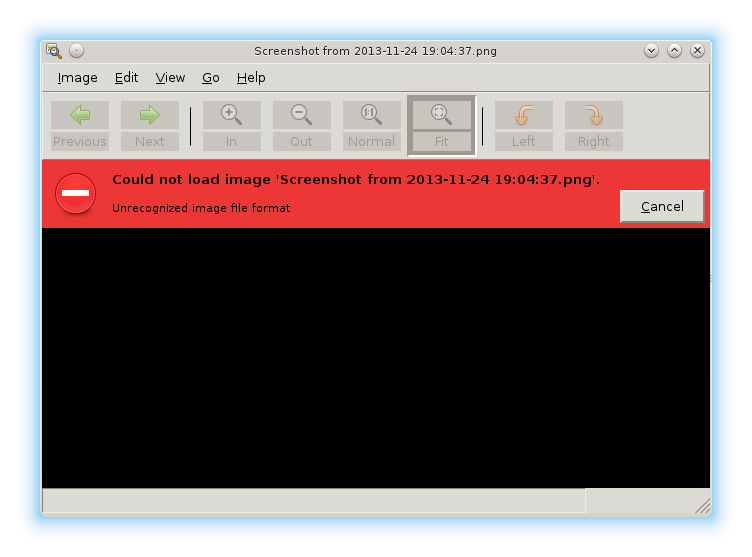
Also eog says "Could not load image" "Unrecognized image file format" - Well, why? It's just a .png file. (screenshot on KDE4)
Shotwell cause segfault, too :-( (and some other GTK applications)

I cannot point out broken component. Dear lazyweb, could you tell me how to fix this situation, please?


14 December 2013

Dirk Eddelbuettel: RcppDE 0.1.2

A maintenance release (now at version 0.1.2) of my RcppDE package (previously described in these two posts) is now CRAN. More details about the package are available in the vignette also included in the RcppDE R package. Changes were minimal and driven mostly by some CRAN Policy changes which now prefer vignette sources files in (top-level) directory vignettes/ Courtesy of CRANberries, there is also a diffstat report for the most recent release. Current and previous releases are available here as well as on CRAN.

This post by Dirk Eddelbuettel originated on his Thinking inside the box blog. Please report excessive re-aggregation in third-party for-profit settings.

Dirk Eddelbuettel: random 0.2.2

A maintenance release of my random package for truly (hardware-based) random numbers (pulled from random.org) is now on CRAN. It's been a while since previous releases. The package is described in a detailed vignette as well as in a essay by Mads Haahr. Changes were minimal and driven mostly by some CRAN Policy changes which now prefer vignette sources files in (top-level) directory vignettes/ Courtesy of CRANberries, there is also a diffstat report for the most recent release. Current and previous releases are available here as well as on CRAN.

This post by Dirk Eddelbuettel originated on his Thinking inside the box blog. Please report excessive re-aggregation in third-party for-profit settings.

Next.

Previous.