Search Results: "sto"

11 January 2008

Holger Levsen: about Debian on the OLPC and OLPC Europe and more

Originally I planned to post this with the title "Last night I slept with 300 people" but this night happened two weeks ago... It was the night before the fourth and last day of the 24C3 were I slept in the gym :-) Actually I also planned to blog on the third day but then this day turned out to be really busy... and then I arrived home on new years eve and suddenly it was a week later and now it's the 10th of January. Time flies when you're having fun. And as you might have noticed it's not even the 10th anymore...

Timewarp back to the chaos communication congress! I think it's safe to say that the Debian booth at the 24C3 was a success. It was a nice meeting (and storage) point for Debian people, we collected quite some donations for t-shirts and stuff (the exact amount needs to be examined still) and we were able to help various users and contributors answering Debian specific questions of both kinds: how to install/configure/fix foo and packaging and other development questions from a number of people.. And we had a babelbox setup which was much better understood and perceived, once I added a sign explaining it :-)

Thanks a lot to the 24C3 organizers and the angels (thats how the congress volunteers are called) for making such a smooth and interesting conference as well as giving such a great space to the Debian booth! And equally thanks a lot to all the people operating our booth! For those who are interested to attend next year: roughly 64 talks were held in english, and 26 in german. I saw about five events live...


The sign hung for about an hour unmodified...

On the third day of the congress we had an OLPC.de meeting, which was quite productive and resulted in us founding OLPC Germany this monday. In the aftermath of this meeting I came up with the idea of having an OLPC Europe event at FOSDEM in Brussels in February, which by now has been accepted and scheduled by the FOSDEM organizers. Yay! So if you are in Europe and involved or interested in the OLPC, please mark the 23rd of February 15-17 localtime in your calendar :-) The idea of these projects is probably best summarized with "think global, act local and global", for more detail please read our vision. (And keep in mind this is in its very early stages.) OLPC Europe should also become an interface for all those european OLPC efforts which have been popping up recently and which all take up ressources in Cambridge, the OLPC "mothership", taking ressources away from the children of the world.

Then on the last day of the 24C3 congress I also gave the DebConf7 "thank you, Sponsor"-package to those four people from the freifunk community, who helped us out with accesspoints for Edinburgh. Much to my surprise and joy, they were really happy about it! Funnily two of those four are also among the three OpenWRT developers who ported OpenWRT to the OLPC laptop, which I borrowed to them somewhat in return :-) And now we work together in OLPC.de and .eu. Networking is sometimes really really fun.

Fast forward to 2008. Two days ago I finanlly had the time to to run etch, lenny and sid on the OLPC laptop (with wireless (including WPA), xorg and sound working and dualbooting with the original fedora install) and then yesterday I've created a usbstick which successfully booted a "d-i prototype". Yay! And best of all (for me), most of the actual work was done by other people, I just had to collect the pieces. My next steps will be documenting what I did and prepare a d-i image which actually works. I don't have pics yet (it's Debian running on a laptop, I guess you can imagine this), so for now I will just post another picture I received some three months ago and which made me incredibly happy at that time:


When I have a working d-i running on it, I'll post more pics.

Joey Hess: my first terabyte

I bought one of the new terabyte drives, to double the storage space on my home network. I put it in a Thecus, so I have a terabyte of storage in a computer about the size of my first computer's floppy disk drive.

Felipe Augusto van de Wiel: 11 Jan 2008

Bits from the Debian i18n meeting (Extremadura 2007)
From December 12th to December 15th, Junta de Extremadura hosted another one of the Debian Meetings; five i18n guys shared ideas, food, buses and fun with the Debian KDE maintainers. We would like to thank Extremadura for hosting us during the Hispalinux Meeting 2007, the event was held at Universad de Derecho (Law University) in Caceres, Spain.

These are the minutes, results and notes from our work, it is a brief description but hopefully complete of what we have done and what is still missing/pending.

Thanks to Cesar (cek) we had the chance to work on churro (i18n.debian.net) locally; the server is still running a 2.4 kernel because of some "tick" problems with 2.6 series, the last one tried was 2.6.21 and we should try newer ones, in order to support upgrades and not get stuck with 2.4, we hope Cesar will find time to test new Debian kernels.

First, let me introduce everybody to the services, robots and resources being hosted by i18n.d.n:

  • MoinMoin wiki for local and simple reference documentation, it contains all the links to the below resources. (http://i18n.debian.net/wiki/)
  • Pootle experimental server
  • dl10n scripts, aka dl10n robots (codename Lion), these scripts are responsible for the status of pseudo URLs used by some translation teams, by the Project Smith and by the NMU Priority List for i18n NMU Campaign
  • Synchronization of the i18n material used by the Debian website to generate translation statistics about PO and PO-debconf
  • Generation of Compendium PO files per-language
  • Different types of statistics
  • Other non user-visible services like a full source mirror for stable, testing, unstable and experimental, used by the scripts and robots.
  • DDTP, Debian Descriptions Translation Project
  • DDTSS, The Debian Distributed Translation Server Satellite, a web front-end for DDTP, now integrated to DDTP to use the Database back-end instead of the e-mail interface.


And, at some point, we found important to state clear the acronyms and names used in related DDTP projects/tools:
  • DDTS, Debian Description Translation Server, this is the main "back-end" used in DDTP, it tends to be the interface between translator tools (present and future ones) and the database;
  • ddt.cgi is a CGI interface that is able to provide info for specific packages or translations, including diffs, related packages and active/inactive descriptions.
  • DDTC which is the old (and still functional) command line client for DDTP.


We took the chance to organize a few things on churro, old accounts were cleaned out and removed, we moved from /org to /srv and got more GBs of space to the "playground". Old files were also removed and some are schedule to deletion on early 2008. With the reallocation of /org we also find some more space to /home and /var, we reorganize some of the links on the web space (specially to remove services from people's accounts), and we changed the mirror script to also synchronize the Packages and Contents files.

Grisu and Martijn worked mainly on DDTP and DDTSS integration. DDTSS now provides statistics for stable, testing and unstable, we are also working with Debian Med to provide support and infrastructure to a specific audience, like packages related to Medicine. The conversion to talk directly with DDTP/DDTS database also provided:

  • Fetching new translations is almost instantaneous and marks translation as requested (avoiding duplicated works via the e-mail interface).
  • After sufficient reviews occurred, the upload is instant
  • Committed DDTS / DDTSS / DDTP website generation into SVN
    • Added READMEs for the above directories


DDTSS now announces the user using authentication because of its integration with the Database backend used by DDTP. Quick trivia: DDTP is now a compound of 25 languages occupying 18 GBytes.

A few days before the meeting we had the offer to use "AUTOBYHAND" to upload a package with the Translation-* files. The package is now called 'ddtp-translations' and we worked during the meeting to create scripts to build the package and to test it on the archive side. This approach allow Debian i18n Team to upload new translations and remove old ones (or inactive ones) without bother FTP Master Team. Special thanks to Anthony Town, he has been working with us to prove tips, fixes and info on how to produce the package and the scripts. The code is available in the debian-l10n SVN under pkg-ddtp-translations:
http://svn.debian.org/viewsvn/debian-l10n/pkg-ddtp-translations

In our case, "BYHAND" processing consists of a simple tarball of the main,contrib,non-free /i18n/Translation-*, we decide to work on a set of scripts to make it easier to create new packages (ddtp-translations) in a consistent way and keeping debian/changelog up-to-date. We also made some suggestions to the script what will run on the archive side to check the tarball structure, base on the examples of debian-maintainers and debtags (tags-override).

One of our initial targets for the meeting with regards to Pootle and Debian was to try big PO files per language, fortunately, Nicolas and Friedel were able to increase Pootle performance enough to get a few languages from DDTP loaded in Pootle. Using the upstream Pootle-diet branch, which uses a database back-end for the generation of statistics, the time to browse the DDTP POs of a language (~20.000 files) went down to a dozen of seconds.

Speaking about Pootle, Friedel gave us a good picture of what is coming next in terms of Pootle's development. There are improvements planned in the areas of permissions and rights delegation, as well as file management (for projects and templates). Improved management of terminology projects is also planned.

Improvements in the QA capabilities of the translate toolkit and Pootle are planned to help with the "false positives" of the pofilter checks. Better reuse of existing translations will become possible by using better translation memory techniques. There is also work planned on formats and converters involving, for example, XLIFF, TMX, TRADOS and WordFast.

Another pending task for quite a while was the CVS migration to SVN, it is now done, with a new layout. Commits to the CVS were disabled and every single script or resource depending on CVS should be changed to use SVN. For now, we are publishing (via HTTP) the status files generated by the pseudo-urls robots until we can fix the scripts to re-enable the commit of the files. You can find them here: http://i18n.debian.net/debian-l10n/status/

We are pretty happy with the changes and results of the work during those days, but we still have some items pending on our TODO list:

  • More advertisement and usage information about PO Compendiums
    There are two use cases are identified:
    • Filling new PO files.
    • QA work to find inconsistent translations.
    Maybe Eddy would love to do that? :-)
  • Extend the duration of the statistics history. (Nekral)
  • Debian packages of the services running on churro
    • DDTP (Grisu)
    • DDTSS (Martijn)
    • dl10n (Nekral)
  • DDTP: add some scripts to handle packages with version in the description (e.g. kernel and kernel modules) (Martijn)
  • DDTP: Standard generation of the translation tarballs (faw)
  • DDTP: document the bracketed stats on the main page (faw)
  • DDTC: should be updated to match the current features. Documentation to ease integration with procmail. (Nekral - low priority)
  • Implement mail service for translation teams with their own robots (e.g. Dutch) (faw)
  • Collect data from http://www.debian.org/devel/website/stats/ (Nekral)
  • http://www.debian.org/intl/l10n/po/,
    http://www.debian.org/intl/l10n/po-debconf/
    are built based on the churro material. It would make more sense to build these statistics on churro (Nekral)
    • We could "fork" the page and add some fancy new features on these pages (Nekral)
    • Add information from the coordination page to indicate that a translation is ongoing. (Nekral)
  • Pootle: missing review indication. Hard with PO back-end. (Friedel)


There are a couple more reports to be sent but they are more focused on i18n specific questions, tools and plans for 2008. So, probably those will be sent only to debian-i18n mail list. If you are interested, please, stay tuned. :-)
Posted on d-d-a: http://lists.debian.org/debian-devel-announce/2008/01/msg00002.html
And a big thanks to Nicolas François (aka nekral), he helped me a lot making notes, preparing the text and reviewing it; and was patient enough to wait for the report while I was solving some personal problems.

Neil McGovern: A quick comparison of top news stories

SwedenUK
  1. Victory for topless bathers
  2. Court gives thumbs up to anal massage technique
  3. Postcard arrives 25 years late
  4. Swedish prostitution: gone or just hidden?
  5. Ninety pythons left to die in Swedish cottage
  1. Parted-at-birth twins 'married'
  2. Pound at record low against euro
  3. Vomiting bug 'hits three million'
  4. Mr Potato Head makes octopus pal
  5. Ngugi laments Kenya violence

10 January 2008

Christine Spang: MIT Athena: Not Dead Yet

(Disclaimer: I work for MIT Information Services & Technology blah blah blah I am a student blah blah these are only my words and do not represent the opinion(s) of my employer.) Way back in the day in 1983, MIT started something it called Project Athena, which had the goal of investigating how computers could be used to enhance education at MIT. This project became the origin of such pieces of software as the X Window System and Kerberos, as well as a campus-wide network of workstations all running similar software. In 1991, Project Athena ended, but the Athena system continued on, taken over by MIT Information Systems. It’s 2008, and Athena still exists at MIT—walk into a computing cluster, and chances are all the machines will be running Athena software. (Unless that particular cluster has been taken over be Athena’s evil sibling, often referenced as “WinAthena”, which often seems to be maintained by no one, and whose existence is sometimes denied by those who maintain and support Real Athena. Not many machines have suffered this agonizing fate, luckily.) Unfortunately, as the years have progressed recently, fewer and fewer resources have been put into the development of Athena. In many ways it is no longer on the cutting edge of things as it has been in the past, though it is certainly still useful. Some students these days, however, even think of Athena as only “their MIT email” or maybe use it occasionally to print something in a cluster on the way to class. I’ve seen people grow frustrated and storm out of a cluster due to things like instructions for using a flash drive that involve more steps than just plugging it in. While on the one hand it’s easy to laugh at people for a lack of patience or being open to a computing system that is not either Windows or Mac and perhaps a bit more complicated on the surface, on the other hand, some of these things really should just work by now, and on other UNIX-based systems they do—but Athena has lagged behind. When you log into an Athena workstation for the first time, you are confronted with what looks like this: Clean MIT Athena login That’s GNOME 2.8, and it looks kind of like the GNOME 2.8 default but uglier. When you look under the hood, there are pieces of the system that obviously originated in a time where nothing better existed and so something new had to be created—the “xlogin” login system doesn’t support PAM, and the login path involves a hairy maze of scripts that perform various tasks. Under the hood, the base OS is currently RHEL 4 or Solaris 10. I still can’t remember what the right options are to feed RPM whenever I need some information that I think I should be able to get from it. These things were once necessary but today just look crufty. Some people have tossed around the idea that everyone has a laptop these days and thus clusters are uselessly expensive, but it’s been met with a lot of resistance. I’m all for progress, but I use clusters all the time! They’re one thing that makes it an easy choice for me to have a really portable laptop, because when I really need computing power or screen space on campus away from my room, there is always a cluster nearby. They’re also nice isolated places that can be associated with “work mode”, which is good for productivity. Beyond all this, Athena provides a common platform that all technical classes can depend on, from providing standard and specialized academic software to standing as a baseline of “make sure your code works on this before handing it in because that is how it will be graded”. At any rate, things are finally happening on this front. Athena can’t stay RHEL 4 forever—while AFS allows non-system software to be easily updated for all machines without requiring any OS release, hardware moves on and compatibility is lost, and the rest of the world is coming up with new awesome things that Athena machines are missing out on. A student group that I am vaguely involved with, SIPB, took the early initiative with this and created DebAthena, which takes stock Debian and Ubuntu and allows it to closely resemble an Athena environment. We even run a campus Linux dialup using the packages. (I won’t claim to have done much work on DebAthena myself because, well, I didn’t.) Amazingly, the Athena release team has decided to work with the SIPB on the next release of Athena. So, what I really just wasted over 600 words prepping for is to say that Athena 10 will be based on Ubuntu. This is only relatively new news, but I am lame about finishing blog posts. There are a variety of reasons why Ubuntu was chosen over Debian. Some of them are lame and some of them are not. Even so, I am excited about this prospect—and it should be possible to peripherally support Debian in such a way that was not possible with Athena 9.4. I really like Athena. Even coming to MIT with a background in Linux there has been a steep learning curve, though, and I think that things could be better. Lots of people here have their first encounter with a ‘nix system in the form of Athena, and we should strive to make that experience as good as possible. I’m kind of skeptical on the expected release date of this upcoming summer, but as long as it happens soon it will be a big step forward. In some ways it’s kind of sad that I’m excited about a big part of a research institution catching up with others—but inertia is a strong force, and dealing with thousands of workstations is no trivial task. I kind of long for the exciting days of creating new big pieces of free software like X. I bet I imagine those days as being better than they actually were.

Andrew Pollock: [tech] What ever happened to glue records?

One of the things I noticed when I was fiddling around with daedalus the other week, was that when I had everything stopped, linux.org.au seemed to stop resolving (and therefore semi-important things like ftp.au.debian.org, which is a CNAME to mirror.linux.org.au This made me very sad, because I'm always harping on about BCP 16 when I see other sites go down because all of their name servers are on the same subnet. Now that wasn't the reason for this particular "outage", though. It seems that because one of the name servers is russell.linux.org.au, and there's no glue record for this host on any of the .org.au name servers, I don't think russell is seeing any DNS traffic at all (perhaps only from resolvers that somehow already happened to have a cached entry for it obtained through other means than an NS query for linux.org.au) So before I go doing any further disruptive maintenance on daedalus I guess I'll be needing to get a glue record for russell.linux.org.au. I'm surprised that searching Enetica's knowledge-base for "glue" didn't raise a mention of it. I would have almost thought that they could detect the need for a glue record when you're adjusting a domain's delegation, so I wonder if it's a failure of their domain management system, or a complete oversight. Maybe people just don't go sticking their name servers in the domain they're hosting any more.

Alexander Schmehl: About Apache, Basic Authentication, Location and regular expressions

The other day, I had an interesting problem, regarding Apache, the LocationMatch directive and regular expressions. I'll put it here, so I'll be able to find it again... Actually it was a quite simple problem: A simple web page, where all web pages are protected with a password. No big Problem: Use a <location /> and AuthType basic, problem solved.... or isn't it? Some documents might be needed to be available without the authentication... for example robots.txt... or the funky custom error document, which explains how to get the authentication data, in case the authentication fails. Looking at the documentation, found a solution: LocationMatch exists, where you specify a regular expression, which must match, for the following configuration to apply. What isn't mentioned in the documentation, that the obvious solution... something like <LocationMatch !"^/(robots.txt my401handler.html"> doesn't work. See apache bug 10932. Needed quite some time, to find this out... Luckily Meike found the bug report above, which has a workaround for that problem: Use <LocationMatch "^/(?!robots.txt my401handler.html)"> Oh... and if your customized error handler references some pictures or style sheets, don't forget to add them to the regular expression above, too.

9 January 2008

Tollef Fog Heen: Choosing a nonce in CTR mode

I am currently working on implementing a cryptographic file system using FUSE. It is different from EncFS and similar in that it just mirrors a normal directory tree, but encrypts the contents of the files as they are read or decrypted as they are written. My use case is backups. I have some machines where I and only I have access, machines which may contain proprietary information, personal emails and so on. Of course, I want backups of those, so when the hard drives stop working, I don't lose any data. The machine(s) I am backing up to, however are not always machines where I trust all the people with physical access to not make a copy of my data. In addition, I don't want broken hard drives returned under warranty to contain unencrypted data. This use case is the reason for why I'm encrypting on read rather than on write. I have chosen to use CTR (counter) mode together with AES which should give acceptable security. One of the requirements CTR needs to work well is a nonce, typically 64 bits (for 128 bit AES) which must not ever be used twice. If you use it twice, you leak information about your plaintext, which is, for obvious reasons, bad. My current design headache is how to choose a good nonce. Ideally, I believe it should be persistent for each version of the file and unique per file. Using the inode number takes up 64 bits (on AMD64 at any take, or when using -D_FILE_OFFSET_BITS=64 on 32 bit platforms). So while this gives me the latter, it doesn't give me the former at all. I am wondering if I should use the inode number modulo 2^32 (effectively choosing the lower 32 bits of the inode number) and then something which is fairly sure to never be the same, such as mtime (or at least the lower 32 bits of it, when time_t becomes 64 bit). The reason for not just choosing a completely random value is I don't want a command like diff file1 file1 to claim there are differences in the file. My hope was I'd get a great idea on how to solve the problem as part of writing it down. Alas, that hasn't happened, so if you happen to come across a great solution (or a reason to avoid a particular choice), feel free to email me

Andrew Pollock: [life] Post-op, Day 6

Discharged! Sarah was discharged almost bang on 11am, the advertised discharge time, which is less than 6 full days after she got out of surgery. Pretty amazing stuff, and not a moment too soon, if you ask Sarah. She had a final chest x-ray this morning, and that was about it. We took a non-highway route home, and stopped via the supermarket to get a few things and get her prescriptions filled, so we got home at about 12:20pm. The rest of her recovery can be followed on her blog. We both feel forever indebted to the wonderful doctors and nursing staff at Stanford Hospital. Being in a hospital is certainly a lot better when you're not grieving, and the outcome is positive.

Eddy Petri&#537;or: Updates: NSLU2, Andrew S. Tanenbaum in .ro

Last weekend was as hectic as my life has been lately: I have been trying to restore sanity into my NSLU2, I went to a lecture from Andrew S. Tanenbaum and I made a 2.5 hours drive to my parents in about 4 hours because of the fog.

First, my slug:
  • refuses to recognise the USB NIC I have been using until the latest incidents (it either says 'not accepting address, error -71' or 'device descriptor read/64, error -71')
  • sometimes reboots when I insert the USB NIC
  • either doesn't boot at all or boots really slowly when the USB NIC is inserted
  • (obviously) doesn't show the NIC in lsusb listing when is not recognised
Since the USB NIC works on my laptop, I suspect a hardware problem with the slug. Bummer!

Dear no-so-lazyweb, is there a way to install Debian on an ASUS WL-500G Premium router without loosing wireless ability? Or, is there a way to make use of my USB NIC with the ASUS router?


Second, Andrew S. Tanenbaum visited Romania and lectured Friday at the University Politehnica Bucharest.

He presented Minix3's architecture and the advantages it has over monolithic OSes. I attended the lecture (although I am not a student anymore) and found it quite nice and well prepared, but I had the feeling that sometimes he was trying to avoid or to bash topics that were not putting Minix into a good light or challenged its title of being the first open[0] OS based on a micro-kernel architecture[1]. In spite of that, I found him to be a really good speaker and I liked the overall presentation, although, I also expected some on the spot demos or at least some recordings.

The things that I remember:
  • 2.4 millions subtle code alterations in drivers with only 80000 driver crashes (of course, no kernel crashes)
  • simulation of network driver repeated crashes at different time intervals and how it affects performance - a 30% degradation at crashes that occur once every second and an insignificant degradation at crashes occurring at each 10 seconds
  • every driver has a set of rights assigned to it; it was difficult for them to define this - this sounds a lot like SELinux issues
  • messages have a fixed length
  • there is no dynamic memory allocation within the kernel
  • the kernel is 5000 lines of code (all drivers are in user space)
  • really secure system
  • there were performance comparisons with Minix2 and the hit was about 20%; still, is said that L4 has only an approximate 2-5% performance hit because of the micro-kernel architecture
  • apparently the FreeBSD kernel has only 3 bugs /1000 lines of code
  • Minix uses a BSD license
I also got a Minix live CD (which is more like the Gentoo Linux install CD - just console in the live system) and made an installation of Minix in a qemu machine[2]. Unfortunately, I don't think I'll have the time to dwell into the source.

I was thinking, would it worth the effort to try to make a GNU/Hurd/Minix system (i.e. replace Mach with Minix's micro-kernel)? BTW, is Debian GNU/Hurd now based on L4 or does it still uses Mach?


Note: Some of my work colleagues suggested that the presentation was the same as one he made at linux.conf.au last year, but I can't confirm/infirm that since I didn't saw the recording.


I won't write about the "fog drive", but I'll just say it wasn't pleasant at all, and I felt I was in driving in The Twilight Zone for the whole Friday evening.


[0] he gave credit to QNX
[1] For instance, I tried to ask him twice if he felt that GNU Hurd was violating the micro-kernel paradigm or if he can compare it to Minix' architecture. I had the impression that both times he avoided to answer and started the usual Hurd bashing, "they have been developing it for 20+ years, but got nothing working", meanwhile "Minix is here". After the lecture/presentation somebody told me that AST shortly said that they "were similar, but different". I didn't catch that line.
[2] thanks to qemu-launcher it is trivial to create and manage multiple qemu virtual machines

Eddy Petri&#537;or: my laptop is back

Yesterday I got my laptop back. It was in service since the 6th of December.

They replaced the battery, and although it looked like the built-in charge indicator was defect, actually the button on this battery is buried deeper than it was on the previous one and I have to press really hard on it to trigger it.

According to the tests made yesterday night, this battery holds for about 2.5-3 hours when playing music. Also it has 96% of its designed capacity. I guess is OK enough since I don't want to be spared from my laptop anymore.

Next on the agenda:
  • restore data sanity (I did clean up most of the data from the HDD before handing down the laptop for the case when I was forced to hand it over; lucky for me, I managed to keep the HDD)
  • install armel Debian on my new[1] NSLU2, Kinder (more news on that later ;-) )
  • fix my local network chaos triggered by the problems that hit Ritter (my older NSLU2)
  • finish the wiki theme
  • work a little more on svn-buildpackage and kill more of its bugs
  • walk through my (game) packages' bugs and try to fix them, answer, etc.
  • try to make bluetooth transfers to work from and to my laptop
BTW, I still hold to my opinion that Dell and Emag suck, although I might buy desktops from Dell, laptops are a no-no until they fix their broken batteries and their broken "1-year warranty for batteries" policy.

[1] I bought a new NSLU2 after I left my laptop in service and it has been waiting since then to run the Debian Arm EABI (armel) port

8 January 2008

Simon Huggins: Books (part 2)

[ Apologies for Debian planet readers expecting something pithy and Debian related. This isn't. But then pkg-xfce packaging just continues. We get more bugs, we fix some of them (if you have a dual-headed setup and want to help us fix or reproduce more we'd love to hear from you). Corsac became a DD at last and has made me more or less redundant in a good way. I should probably investigate libburnia again and prod George Danchev about #450873 since basically it seems to just need the ubuntu packaging brought across into Debian to replace libburn etc. But anyway, on with the irrelevant stuff... ] Books part 1 was back in April and I've since found myself with some time on my hands before I get a new job so here we go again.
Making Money - Terry Pratchett
This was a Christmas present and I quite enjoyed it and enjoyed the character but didn't really think it lived up to the laugh a minute Pratchett books that I remembered from the good old days.
The Lovely Bones - Alice Seebold
This is quite a weird concept for a book given that it's from the point of view of a dead girl in heaven but it seems to work. It's very well done and I enjoyed it.
Alex Rider series - Anthony Horowitz
I had seen Stormbreaker and wanted to read some more of these as light holiday reading. They work well for that. There's enough plot to keep me interested but not enough to make them at all hard to read. I read a couple of them in French when I was in France (in between traipsing between different bits of Paris since the m tro workers were on strike). I wish they'd been around when I was younger.
My Sister's Keeper - Jodi Picoult
Ooh this is a really, really good book. I loved it except perhaps for the very end but I can forgive it that. The idea is that she's suing her parents for the rights to her own body because she was conceived as a donor for her sister to fight off her sister's leukaemia. It's a very thought provoking read with several interesting characters with their own stories woven together.
The Language Instinct - Steven Pinker
This book is fascinating to me. It takes ideas mainly from linguistics, evolution and psychology and explains a theory that seems to hold together and is well illustrated and explained. The central point is that we all are born with the ability to develop a universal grammar from an early age which can be adapted to any human language and which sticks around in the young child and then disappears. If you have any interest in language at all read this book.
A Spot of Bother - Mark Haddon
I found this a bit hard to get into as essentially it's about the normal lives of a family (albeit quite a special family). It doesn't really grab you. Towards the end though I was interested to find out how it would all unravel and was pleased with it.
The Mephisto Club - Tess Gerritsen
This is a nice, honest thriller that does what you expect. It keeps you flicking the pages wanting to know what happens next.
The God Delusion - Richard Dawkins
I quite enjoyed this and did find new arguments against religion but I don't think he's going to convert anyone with this book. Of course I'd recommend anyone read it because it raises lots of interesting points but it's polemic essentially.
The Blind Watchmaker - Richard Dawkins
I enjoyed this though it builds on previous work I'd read. I guess if you're just interested in evolution then read this and not the God Delusion.
The Raw Shark Texts - Steven Hall
I was recommended this by a friend. It's very surreal possibly a bit too surreal for me but I enjoyed it nonetheless.
Do Androids Dream of Electric Sheep? - Philip K Dick
I hadn't read the book and saw it at a friend's and borrowed it. You probably all know what it's like. I'm glad I read it because of the references to it but it's not my normal reading material.
Harry Potter and the Deathly Hallows - J K Rowling
I had to read this of course to finish off the series but I thought it was a lot better than some of the others. I think I enjoyed the first, the one with the tri-wizarding championship and this one the most.
Love in Idleness - Charlotte Mendelson
This is well written and you really get into the character that's painted for you. I really liked some of the descriptions of justifying things to yourself and coping with boredom.
Blood, Sweat & Tea - Tom Reynolds
This was an interesting look at the life of a paramedic and if you don't already read Random acts of reality then read the book first and start reading the blog.
Telling Lies - Paul Ekman
This came from my Blink/Tipping Point reading and I found it hard going. It was interesting but quite detailed and not really a book for late night reading. The theories in it are very interesting though and explain why you probably aren't as good at detecting things as you think you might be and how to look for factors that will help you.
The Man Who Mistook His Wife for a Hat - Oliver Sacks
I read this ages ago and it was fascinating. It's about a number of different cases of problems with the brain. Often physical defects in various areas of the brain that cause odd problems and how it sheds light on how things relate. I really enjoyed it.
As always, do please punt your own recommendations at me.

7 January 2008

David Nusinow: Finally

A few years back I asked Branden Robinson for access to the X Strike Force SVN repository in order to improve the X server's autodetection, with the goal of stealing what I could from knoppix. At the time, users were constantly wandering in to #debian saying that they had used knoppix to create an XF86Config-4 and then they used that file on their Debian installations. They were also constantly whining about how Debian wasn't doing as good a job. So I decided to do something about it, and took a look at what knoppix was actually doing so much better than us, and I was surprised to find that they pretty much just wrote a skeleton configuration file and let the X server fill in the details. I had no idea the server was capable of such things. So Branden graciously gave me SVN access and I began comparing the knoppix method to the script called by "dpkg-reconfigure xserver-xfree86" and realized that we probably couldn't adopt the same method because we had tons of checks for portability. So I put the problem on the backburner for few weeks and worked on something else for a while.

Well, somewhere in between then and now I got sucked in to transitioning Debian to X.org (using the aforementioned SVN access) and then working on all the things that went along with maintaining X in Debian, some well and others less so. Between transitioning to Xorg, and then transitioning to a modular Xorg, even with the ability to steal Ubuntu's packages it still took about two full years with me being a rookie and all that. There were tons of people who worked on this with me, but it was just a damn big job. Eventually though, etch released with modular X packages, and we were running at a pretty good pace with upstream, so it was time to revisit the problem of configuration again after the two year detour.

The problem of configuration had been reframed for me by having looked at what knoppix was doing and discussions with upstream. Upstream was starting to come to the conclusion that we shouldn't have a config file at all, and that the server should be smart enough to do everything by itself. It was already partially there, it just needed a push in the right direction. This was a major shift in how I thought of it. Coming from a Debian background, where the answer is to always just regenerate or edit your config file, having the server work things out for you was a totally alien idea. But I have my deepest roots in the Macintosh world, so immediately fell in love with it. The problem was that the server had a whole body of code to use if you had no config file at all, and another, with far less automagic goodness, if you had a config file, even if it was a 0 byte file. The goal became to have the server work really well with a minimal config file, so you could override what you don't like in the defaults and let the server figure things out for itself at boot. The way forward was to translate as much of the logic in our configure script in to the X server itself as possible.

Ubuntu had put in a lot of work in to the configuration setup that we automatically benefitted from, so given that most users were happy with things as they were, I was able to carve away at the problem without disrupting anything. And there was a lot to carve out, as the script that runs the config is an absolute mess that was slated by Branden for a rewrite all those years ago. Early on I picked off the low hanging fruits like the font path and modules. Similarly, Redhat's Adam Jackson had also been working on this problem, and he killed off the ServerLayout section as well as putting in lots of critical fixes all over the place elsewhere. More recently, I've gone and cut explicit modesetting out of the configure script. Hardcoding this information is generally a bad idea in the randr 1.2 world, and most of the drivers will do as good or better job of figuring out the modes than our config script would. This let us jettison using the xresprobe program to ask the monitor for the settings to use. This cut out a lot of the code that we had to deal with, simplifying the configure script and letting us all benefit from upstream's work. This leaves a big gaping hole in user configuration, which is something I'm looking to address in a few weeks, but for now there are workarounds like editing your xorg.conf manually to make things work.

Finally, yesterday I was able to upload a version of the script that no longer uses the discover program to figure out what driver to load. I've patched the server to do this at runtime. If there's no driver listed it simply scans the PCI bus, picks out your primary video card, and loads the first driver that claims to support that PCI ID. This let us jettison the last external dependency that the configure script had, so now we have a relatively small chunk of shell script with no external C code and a simplified setup. At this point we're now shipping a more skeletal config file than knoppix ever did simply because it wasn't possible to ship something like this before and have the server work at all. This is a huge milestone for me because finally, after over three years, the problem I originally set out to work on with X is done. There's still bugs to uncover and fix with all of this, but I'm convinced that what we have now is superior to our old method. Eventually, with any luck, xorg.conf will just fade away for most people. There's a lot to work on before that happens though, but I'm happy to have finally gotten here.

Michal &#268;iha&#345;: Back in Japan

After two weeks being back in Czech and mostly offline, I got back to Japan this weekend. The travel went quite okay, the only thing I really don't understand is why Japanese customs always want to check my luggage. There must be something special on it or I probably look like drugs smuggler, but he did not answer my question why they always select me for checking things :-). Anyway I already processed most of email backlog, only about 100 mails remain, I hope to read and reply them during this week.

Peter Eisentraut: Problems with newer kernels

It has become apparent to me that the Linux kernels in Debian testing and unstable (2.6.2x) have all kinds of problems compared to the one in stable (2.6.18), especially when it comes to working with virtualization. I have been trouble booting newer kernels as guest systems in VirtualBox (bug #434723) and QEMU (and bug #449085). There is some chatter in the Gentoo forums to the same effect. I have also had trouble compiling the host system kernel modules of VMPlayer and VirtualBox with newer kernels. If your job requires regular juggling of virtual machines and operating systems, this creates big problems. Plus my UMTS card stopped working (bug #433750), also confirmed by Gentoo chatter. :) I have also tried to build pure upstream kernels myself, but they have the same problems. So my advice to those running Debian post-stable is to stick to kernel 2.6.18 from stable if you are seeing funny issues.

Russell Coker: Oaks on Market

A few days ago I stayed in an apartment at the Oaks on Market [1] hotel which I booked through www.WotIf.com. The WotIf price was $159 per night - the list price was $376 per night. It was possible to get extra beds for $30 each per night if you wanted to get more people in the room. All rooms are of the Suite / Apartment [2] style. The room was a basic (twin or queen) room, it was quite large and well equipped. The TV in the room was quite large and TFT, it had a range of inputs which seemed to include everything other than VGA and DVI (if I was running a hotel every TV would have VGA or DVI input for laptops). All the basic kitchen facilities were there, including a microwave oven, a stove, and a toaster. There was even dish-washing liquid! The hotel pool (indoor and heated) is 25M long and 1.2M deep, there is a spa and a sauna. The pool isn’t cleaned as well as it might be, there was a band-aid stuck on a wall and sand and other stuff on the floor of the pool (including a hair elastic with a rusty clip - it had apparently been in the pool long enough to rust). The hotel is a short tram ride from the LCA venue, walking to LCA would be possible too (I walked further than that when at Dunedin). I can’t claim that this hotel is better than others, but it would do. Having a pool is a good thing, I recommend that all delegates bring their bathers for pool parties - the weather will probably demand such things.

6 January 2008

Dirk Eddelbuettel: NAS'ed

I had been eyeing an inexpensive network-storage device -- for the non-geeks: think of a hard disk with an ethernet port and some controlling software -- for some time. I was aware of some of the hacking efforts around a few of these but somehow nothing really appealed. I was sort-of looking for nslu2-with-a-disk, and preferably not too expensive. Lo and behold, that's what I saw today in my techbargains feed: a Buffalo LinkStation Live which contains a 500gb SATA for $199 after rebates. Some quick googling lead to these wiki pages which looked promising: anything from enhancing the stock Linux setup by enabling a few more services to a custom Linux distro (similar to my wrt54 router running linux) to reportedly some work-in-progress for a native Debian installation. Nice! So off I went, ordered the thingie for local pickup for an additional 5% off and picked it up a little later at the local Circuit City (where visits are seemingly a recurring event these days). The documentation is very brief and insist that you install something on Windows -- just to find that the little box autoconfigures itself just fine. Presumably some network discovery is going to find the assigned dhcp address which is needed for the web interface. A few minutes later, a new (fixed) IP address was assigned, ntp was enabled and that was about that. After dinner, I quickly followed this tutorial to get the box a bit more Unixy without going too far (yet) from the default: start up telnet via a simple Java command-line tool, login, then enable ssh, set it up in /etc/init.d, add some extra binaries. All very quick and simple [ with the caveat that the addons.tar didn't want to get there via the Java tool, so manual scp once 'inside' did the trick ]. NFS, which I like for shuffling files around, appears to be little trickier for this ARM-based LinkStation Live. So at least for now I am content with simple rsync'ing of my backup directories on the few machines here. Much better than the current setup with mutual backups between workstations and semi-permanently being out of space. All in all a rather pleasant gadget and recommended at the price. The extra $100 in rebates are valid from today to the 12th.

Christoph Berg: mutt-patched

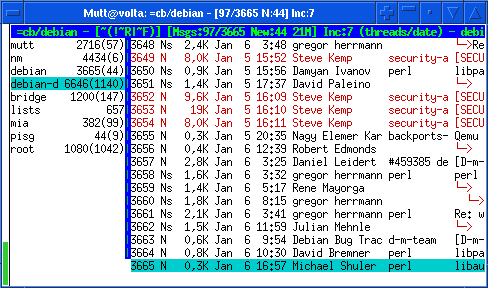
There have been several long-term wishlist bugs on Mutt to include the (in?)famous "sidebar" patch. It adds a panel on the left side of the screen to list mailboxes with message counts. We do ship several patches with Debian's Mutt package that are not considered for inclusion by the upstream authors, but this one is different. It touches the core of the UI renderer and adds extensive counting of messages. There's been quite a hype about the patch, it was even included in the (now discontinued [1]) mutt-ng fork. Unfortunately, the patch was technically questionable, it was written for the Mutt tarballs and didn't easily apply to CVS, and most versions floating around contained lots of cruft like backup files and temporary editor files. Furthermore, it is far from bug-free and even segfaults occasionally. Some months ago we decided we would build a second binary package to put the patch in so we don't destabilize the standard package. Thanks Dann Frazier, we got a clean patch, Adeodato had the right idea on how to build two binaries from the same, differently-patched source (make install would run havoc, the trick was to build the patched version before the regular one), and I resolved some more involved conflicts with the maildir-mtime patch. So, finally, there it is: mutt-patched. Disclaimer: As said, there are bugs. YMMV. On related news, there's now also a -dbg package now for the victims of the IMAP and header cache segfaults that we still see sometimes. Update: The sidebar patch was not the reason for the creation of mutt-ng, but many mutt-ng users were using it because of this patch. Update 2008-01-08: [1] mutt-ng used to be a Mutt fork. It is now maintained as a patch collection for Mutt.

Christian Perrier: Number of bugs reported in Debian per year

This week-end, among other things, I played a little to get the number of bugs reported overs years in the Debian BTS. Here are the results:
2007: 53337
2006: 59665
2005: 57436
2004: 62327
2003: 50836
2002: 47618
2001: 46289
2000: 27181
1999: 22448
1998: 15002
1997:  9987
1996:  4205
1995: 2158
First bug for each year:
2008: 458489 Petter Reinholdtsen -> sysqrd Closed (in unstable)
2007: 405152 Martin-Eric Racine -> myspell-lv Closed
2006: 345487 Erich Schubert -> lintian Opened
2005: 288051 Nick Sillik -> gstreamer-misc Closed
2004: 225724 Peter van Rossum -> mldonkey-server Closed
2003: 174888 Chris Garguzi -> hotkeys Closed
2002: 127270 root@ttimo.net ->libapache-mod-auth-pam Closed
2001: 80981  William Steve Applegate -> php4 Closed
2000: 53800  Hamish Moffatt -> sattrack Closed
1999: 31352  Richard Stallman -> dselect Opened LOOK THIS ONE
1998: 16350  Joey Hess -> xbase-clients Closed
1997:  6363  Andreas Jellinghaus -> mgetty-fax Closed
1996:  2158  Ian Jackson -> ncurses3.0 Closed
1995:   563  Ian Jackson -> tar Closed
A few interesting things there:
  • apparently the rate is now staging between 50,000 and 60,000 per year
  • stats are less precise for the early years as many bugs are no more in the BTS (apparently that stops in 1999)
  • I can't find the date where the Debian BTS was launched (-devel archives go back to July 1995 only)
  • It bringed me the silly idea to check what are the oldest still opened bugs...next stupid blog entry, then !
Anyone feeling like doing the same for Launchpad? And, for those who wonder, I of course did all this by hand. No fancy automated script, just my hands and some (little) hammering of the BTS.

4 January 2008

Sven Mueller: User configuration

Anthony Towns wrote about user configuration (i.e. ~/.foo) and the XDG spec/proposal versus his own (and according to him) simpler version. The main goal of all this is to get rid of all the ~/.foo directories and files in a users home directory. Apart from technically minor differences, I don’t see why AJs proposal would be simpler than the XDG approach. All it does is hardcoding the values which are adjustable in XDG via XDG_*_DIRS. There is one notable difference though: AJ proposes fallback values which are compatible with existing application paths (i.e. HOME_ETC/XDG_CONFIG_HOME should default to ~/ - resulting in ~/.foo files/dirs). This is a good proposal in a way: If you patch an existing application to strictly follow the proposal made by AJ, it still finds its old configuration (and other files) if the new environment variables are not set. No need to move anything around. However, I think the XDG approach is better since it makes sure that compliant applications don’t clutter ~/ anymore. They do need some mechanism to move existing configurations and data around though if the XDG-compliant stuff isn’t already there, but an old style config exists. All in all, I think it is worth following the XDG spec, even if it is slightly more complex than AJs proposal. For one, it already exists for a while and I think that some applications already started following that spec. It also makes slightly more sense to me to have the system fully configurable as to where the apps store data as opposed to the hardcoded fallback/default values AJ proposes (even if we would change AJs proposal to use “$HOME-cleaning” default values).

Next.

Previous.

