Search Results: "ag"

23 December 2013

Russell Coker: Political Advocacy in Clubs

One topic that often gets discussed when it s near election time is whether clubs and societies should be political . Some organisations are limited in what they can do, for example in some jurisdictions religious organisations can theoretically lose their tax exempt status if they advocate for one party. In practice any organisation that has a wide membership will have a variety of political views represented so a policy of directly supporting one candidate or party is likely to lose some members. A common practice among some clubs is to send questionnaires to parties before elections. This might cause a policy change in the parties that do whatever it takes to get votes (as opposed to the parties who devise policy based on principle). But it also provides members a list of how the parties compare on the basis of the criteria that matter to the club. I think that organisations such as Linux Australia [1] and the Linux Users of Victoria [2] should send such questionnaires and publish an analysis of the results. I previously suggested a few questions that could be asked [3], the last one received some negative comments for being too tabloid but the others got some agreement. But obviously there would need to be some discussion about which questions are in scope and how they should be asked. Such a discussion would take a while and would need to be started well before an election was called, I think if we start now we should be able to get it done before the next federal election is called. There is one Australian political party that has a consistent record of having IT policies that are in line with the general aims of Linux Australia and which also has policies that meet the social standards that are generally agreed by most of the membership (EG opposing discrimination). But I know that there are some members of the Linux community who advocate various forms of discrimination and would vote accordingly so advocating for that party would get some negative reactions. But if someone wants to vote for a party that advocates discrimination against minority groups I don t think that there s any harm in providing information to allow them to vote for a pro-discrimination party that has a reasonable IT policy. In any case it doesn t seem likely that we can get most of the membership of an organisation like Linux Australia to agree on what parties are unacceptable, so sending a questionnaire to all parties avoids that debate. I would like to see this sort of thing done by LUGs for all state and territory elections. I will be involved in the process with LUV for the Victorian elections, but I have to just hope that my blog posts inspire people in other states and territories if anyone has already started on this then please let me know. I will also be involved with getting this done for the federal elections with Linux Australia, hopefully this post will help get people interested in that.
Russell Coker: The Nexus 5

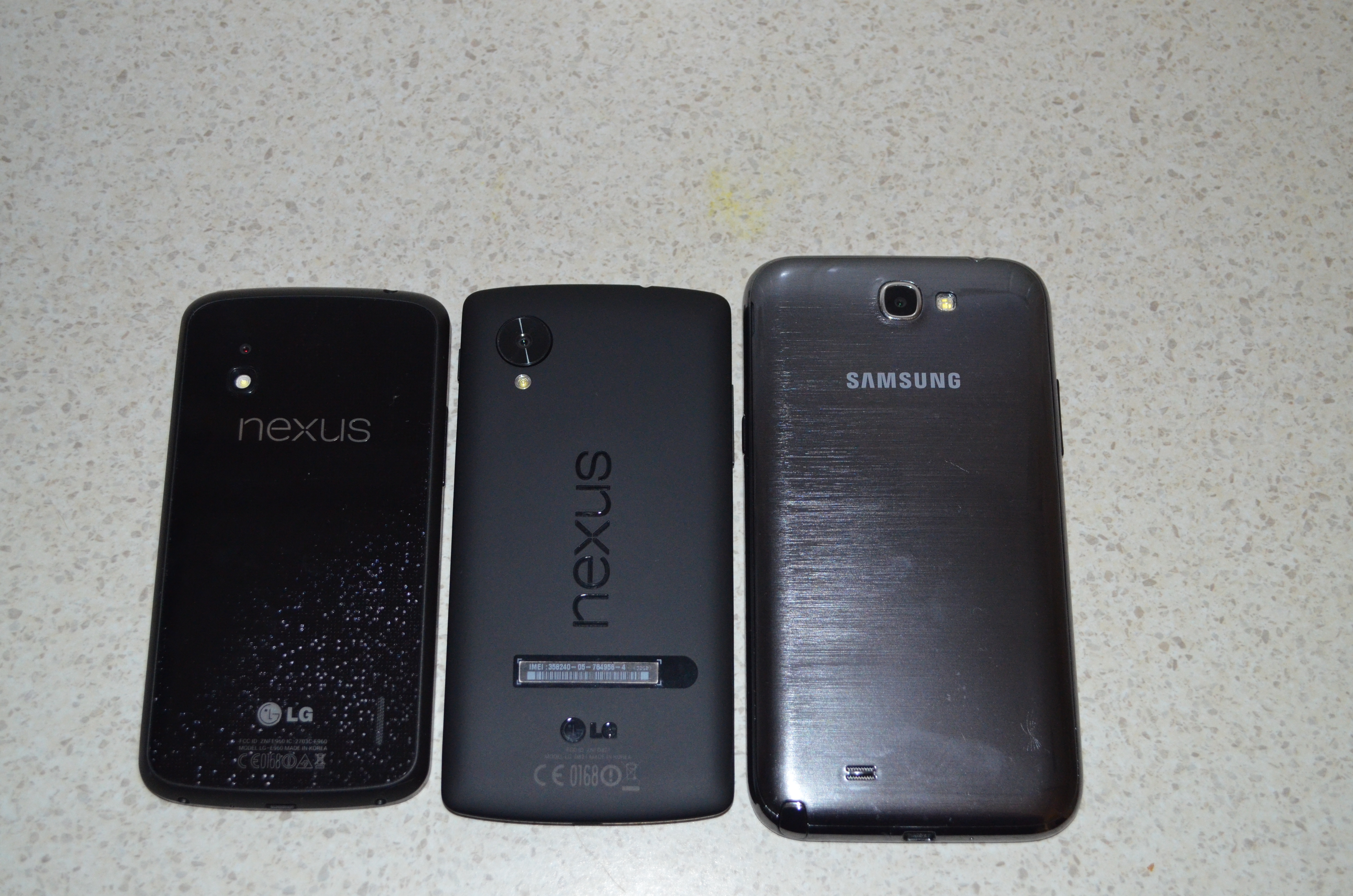
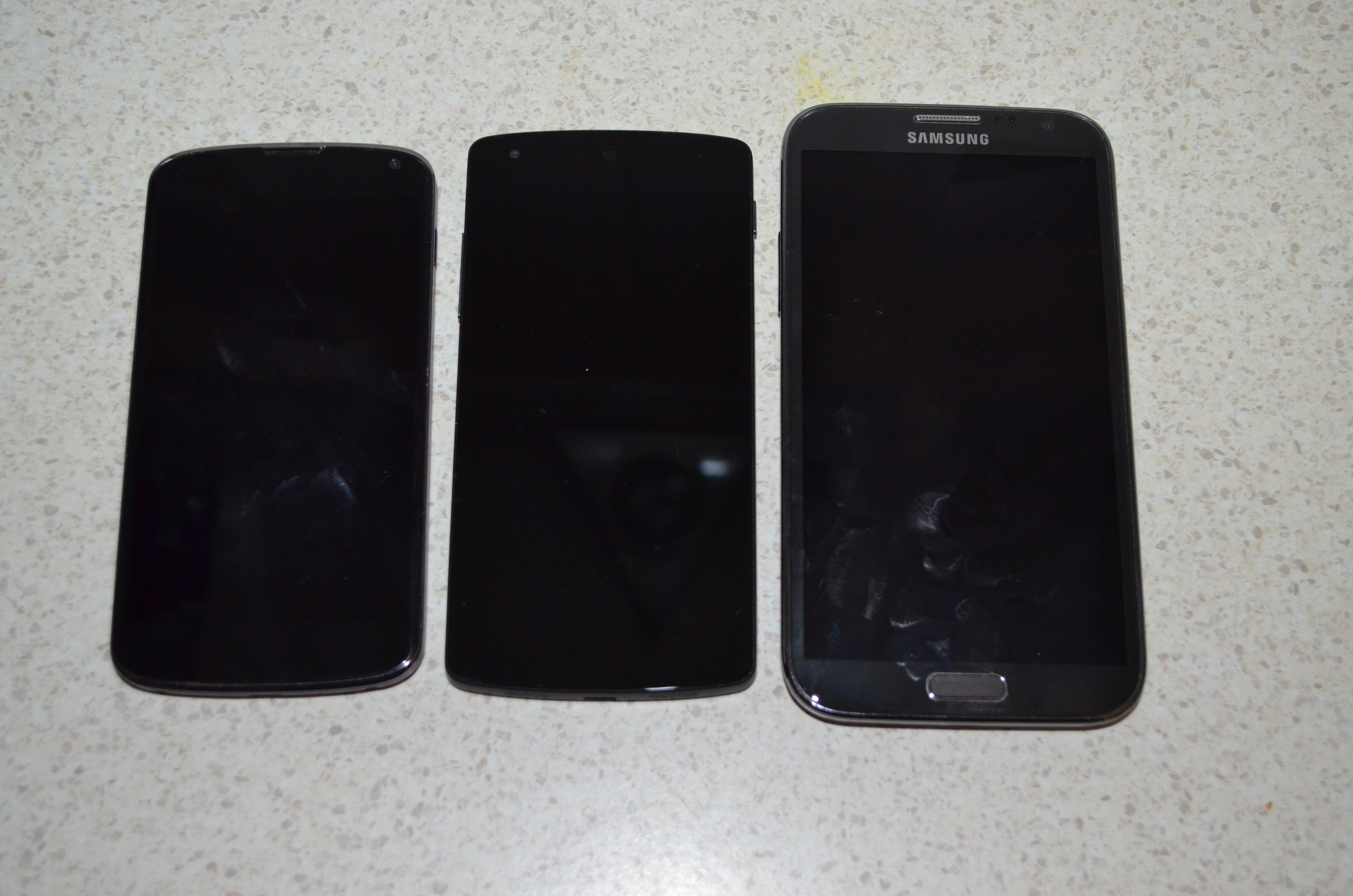
The Nexus 5 is the latest Android phone to be endorsed by Google (and manufactured by LG). It s getting good reviews and the price is good for the specs. I just bought one for my wife, I got her the 32G version because when I bought her a Nexus 4 at the start of the year [1] I chose the 8G version and regretted it ever since. The size of apps is always increasing (some Android games need more than 1G of storage) and higher resolution screens drives the use of high resolution video. Appearance back of Nexus 4, Nexus 5, and Samsung Galaxy Note 2front of Nexus 4, Nexus 5, and Samsung Galaxy Note 2 Above I have pictures of the Nexus 4, the Nexus 5, and the Samsung Galaxy Note 2. The photo of the phone backs captures part of the sparkling pattern on the back of the Nexus 4 and it looks much better in real life (IMHO) because it shimmers as you move the phone. The Nexus 4 looks so good that there s even a transparent case specifically designed to show off the rear panel [2]. It doesn t seem likely that anyone will design such a transparent case for the Nexus 5, it s a good phone to cover up IMHO. The Note 2 isn t the most attractive phone, but I think it has a streamlined elegance of being optimised for it s function. The Nexus 5 has it s camera sticking out, it would be better if they had just made the entire phone thicker and given it a bigger battery but for people who don t want good battery life I guess it s a way of providing a better focal length without making the phone thicker. Sticking the IMEI number on the back of the phone will be useful on rare occasions (and might be a security issue on more occasions) but it definitely makes the phone less attractive. Full HD The quality of the Full HD (1920*1080) display is obvious. The text is slightly clearer when viewing maps and the graphics in Ingress look nicer. Before I used the Nexus 5 I didn t think that there would be any benefit in having such a high resolution in a phone but now I realise that I was wrong. The higher resolution is clearly better. Chris Chavez wrote an article for Phandroid about a rumored Samsung phone with a 2560*1440 display [3]. If such a device had a 6.6 display (IE a new version of the Galaxy Mega) then it would have the same dot-pitch as the Nexus 5. If such a device had a 5.5 display (like the Galaxy Note 3) then it would have a 15% greater DPI than the Nexus 5. It seems that a higher DPI provides a real benefit and this is probably the biggest reason to choose the Nexus 5 over the Nexus 4 and most other Android devices. Comparing with the Nexus 4 The Nexus 5 has the same amount of RAM (2G), a slightly larger display (4.95 vs 4.7 ), higher resolution (a big deal), faster CPU and GPU, and optical zoom. Faster CPU isn t usually going to be a big deal (apart from the fact that more CPU power is needed as well as more GPU power to drive the higher resolution display). The Nexus 5 can come with 16G or 32G of storage while the Nexus 4 has options of 8G and 16G. If you want more than 16G of storage then that s a real benefit for the Nexus 5, but if you only need 16G then it s not an issue. It seems that when playing Ingress on a Nexus 5 it s more likely that running another program (such as Google Hangouts) will cause Ingress to be reloaded than it does on a Nexus 4 or a Galaxy Note 2. While I haven t done a good comparison of the Nexus 4 and the Nexus 5 in this regard I ve compared the Galaxy Note 2 and the Nexus 5 well. My Galaxy Note 2 (which has many daemons running) is much less likely to cause a reload of Ingress (IE have run low on memory and terminated Ingress) than the Nexus 5 my wife is using (which has very little running). So it seems that the OS build on the Nexus 5 uses more memory than the Galaxy Note 2. The Nexus 5 has Gorilla Glass 3 vs Gorilla Glass 2 on the Nexus 4. As my older Android phones with Gorilla Glass 1 (Galaxy S and Sony Ericsson Xperia X10i) didn t get any scratches that matter I don t think this is a benefit for me. Maybe if I lived near a beach I d care more about this. I think that the most significant benefit of the Nexus 5 over the Nexus 4 is the higher resolution display. The optical zoom should provide a theoretical benefit when taking photos, whether that results in better pictures in practice would probably depend on how you hold your phone, the available light, and other factors. I think that if it was possible to buy a Nexus 4 at a sensible price (IE something less than the $250 that Google last charged) then for most people the Nexus 4 would be a better choice than the Nexus 5. But as ebay is full of Nexus 4 phones selling for a higher prices than the Nexus 5 it seems that buying a Nexus 5 is the only option. The range of phones that Kogan sells [4] doesn t have anything for the same price that compares on features. Heat The heat produced by the Nexus 5 is significant and noticable. After some light Ingress playing on a cold day my Galaxy Note 2 with a gel case (that keeps it warm) reported itself as having a battery temperature of 34C. My wife s Nexus 5 reported a temperature of 43C. While the thermometer in the phone might not be the most accurate I don t think there was an accuracy problem, holding my wife s phone was unpleasant and felt like it could burn my hand if I held it tight (40C is the minimum temperature for burns). It seems that a Nexus 5 isn t a good choice if you want to play Ingress in a warm part of the world (EG most of Australia in summer). Also heat dissipated is directly proportional to power use which is going to be a problem for a phone that doesn t permit replacing it s battery. Conclusion I m quite disappointed with the Nexus 5. I expected it to be at least as good as the Nexus 4 in every way and better in many ways. Instead it s not always as good as the Nexus 4 and the ways that it is better won t necessarily provide benefits for everyone. The heat and power use problems are really going to hurt the use of it. But I guess we can always hope that Google release a new Android build that reduces the power use, they might even have a new build that uses less RAM too. I would not consider getting a Nexus 5 for my own use. For my use the Note 2 is clearly more suitable, the larger screen more than compensates for the clarity that the Nexus 5 gets from it s high resolution display. Also I REALLY like having a hardware home button. I ll probably get a Note 3 when the price drops, I m not interested in paying $649 for a phone and I m also not interested in replacing a phone that s less than a year old. So maybe I ll get a Note 3 in the second half of next year.

22 December 2013

Kai Wasserb ch: Still alive!

Even though I've been largely offline for the past year and a half, I'm still alive an plan on getting back to do more work for Debian in 2014 and onwards. As a first token of this I've updated the unofficial Debian Wine packages to follow the current Debian packaging and built upstream version 1.7.9. See you soon!

Francois Marier: Creating a Linode-based VPN setup using OpenVPN on Debian or Ubuntu

Using a Virtual Private Network is a good way to work-around geoIP restrictions but also to protect your network traffic when travelling with your laptop and connecting to untrusted networks. While you might want to use Tor for the part of your network activity where you prefer to be anonymous, a VPN is a faster way to connect to sites that already know you. Here are my instructions for setting up OpenVPN on Debian / Ubuntu machines where the VPN server is located on a cheap Linode virtual private server. They are largely based on the instructions found on the Debian wiki. An easier way to setup an ad-hoc VPN is to use sshuttle but for some reason, it doesn't seem work on Linode or Rackspace virtual servers.

Generating the keys Make sure you run the following on a machine with good entropy and not a VM! I personally use a machine fitted with an Entropy Key. The first step is to install the required package:
sudo apt-get install openvpn
Then, copy the following file in your home directory (no need to run any of this as root):
mkdir easy-rsa
cp -ai /usr/share/doc/openvpn/examples/easy-rsa/2.0/ easy-rsa/
cd easy-rsa/2.0
and put something like this in your ~/easy-rsa/2.0/vars:
export KEY_SIZE=2084
export KEY_COUNTRY="NZ"
export KEY_PROVINCE="AKL"
export KEY_CITY="Auckland"
export KEY_ORG="fmarier.org"
export KEY_EMAIL="francois@fmarier.org"
export KEY_CN=hafnarfjordur.fmarier.org
export KEY_NAME=hafnarfjordur.fmarier.org
export KEY_OU=VPN
Create this symbolic link:
ln -s openssl-1.0.0.cnf openssl.cnf
and generate the keys:
. ./vars
./clean-all
./build-ca
./build-key-server server  # press ENTER at every prompt, no password
./build-key akranes  # "akranes" as Name, no password
./build-dh
/usr/sbin/openvpn --genkey --secret keys/ta.key

Configuring the server On my server, a Linode VPS called hafnarfjordur.fmarier.org, I installed the openvpn package:
apt-get install openvpn
and then copied the following files from my high-entropy machine:
cp ca.crt dh2048.pem server.key server.crt ta.key /etc/openvpn/
chown root:root /etc/openvpn/*
chmod 600 /etc/openvpn/ta.key /etc/openvpn/server.key
Then I took the official configuration template:
cp /usr/share/doc/openvpn/examples/sample-config-files/server.conf.gz /etc/openvpn/
gunzip /etc/openvpn/server.conf.gz
and set the following in /etc/openvpn/server.conf:
dh dh2048.pem
push "redirect-gateway def1 bypass-dhcp"
push "dhcp-option DNS 74.207.241.5"
push "dhcp-option DNS 74.207.242.5"
tls-auth ta.key 0
cipher AES-128-CBC
user nobody
group nogroup
(These DNS servers are the ones I found in /etc/resolv.conf on my Linode VPS.) Finally, I added the following to these configuration files:
  • /etc/sysctl.conf:
    net.ipv4.ip_forward=1
    
  • /etc/rc.local (just before exit 0):
    iptables -t nat -A POSTROUTING -s 10.8.0.0/24 -o eth0 -j MASQUERADE
    
  • /etc/default/openvpn:
    AUTOSTART="all"
    
and ran sysctl -p before starting OpenVPN:
/etc/init.d/openvpn start
If the server has a firewall, you'll need to open up this port:
iptables -A INPUT -p udp --dport 1194 -j ACCEPT

Configuring the client The final piece of this solution is to setup my laptop, akranes, to connect to hafnarfjordur by installing the relevant Network Manager plugin:
apt-get install network-manager-openvpn-gnome
The laptop needs these files from the high-entropy machine:
cp ca.crt akranes.crt akranes.key ta.key /etc/openvpn/
chown root:francois /etc/openvpn/akranes.key /etc/openvpn/ta.key
chmod 640 /etc/openvpn/ta.key /etc/openvpn/akranes.key
and my own user needs to have read access to the secret keys. To create a new VPN, right-click on Network-Manager and add a new VPN connection of type "OpenVPN":
  • Gateway: hafnarfjordur.fmarier.org
  • Type: Certificates (TLS)
  • User Certificate: /etc/openvpn/akranes.crt
  • CA Certificate: /etc/openvpn/ca.crt
  • Private Key: /etc/openvpn/akranes.key
  • Available to all users: NO
then click the "Avanced" button and set the following:
  • General
    • Use LZO data compression: YES
  • Security
    • Cipher: AES-128-CBC
    • HMAC Authentication: Default
  • TLS Authentication
    • Subject Match: server
    • Verify peer (server) certificate usage signature: YES
    • Remote peer certificate TLS type: Server
    • Use additional TLS authentication: YES
    • Key File: /etc/openvpn/ta.key
    • Key Direction: 1

Debugging If you run into problems, simply take a look at the logs while attempting to connect to the server:
tail -f /var/log/syslog
on both the server and the client. In my experience, searching for the error messages you find in there is usually enough to solve the problem.

Next steps The next thing I'm going to add to this VPN setup is a local unbound DNS resolver that will be offered to all clients. Is there anything else you have in your setup and that I should consider adding to mine?

Russ Allbery: Review: They Had to Go Out

Review: They Had to Go Out, by Gary J. Hudson
Publisher: Xlibris
Copyright: 2008
ISBN: 1-4363-8132-0
Format: Trade paperback
Pages: 165
They Had to Go Out, as noted on the cover, is the story of the tragedy of the Triumph and the Mermaid, a marine incident that occurred off the Oregon coast of the United States near the mouth of the Columbia River on January 12, 1961. But it's also much more than that. It's a detailed and thoroughly-researched account of a Coast Guard rescue operation, starting with background on the two coastal lifeboat stations and the types of ships involved. It covers everything from crew backgrounds to equipment issues to the general shape of the subsequent inquiry, and in the process provides a wealth of detailed information about the nature of Coast Guard rescue operations and the technology and equipment available at the time. But, beyond that, it's a gripping story, in part because of the authenticity of the authorial voice. Gary Hudson spent twenty years in the Coast Guard, ten on coastal lifeboat stations like the ones in this book, and was assigned to Point Adams (the primary station involved in this story) until 12 days before the incident, when he transferred to a light station for unrelated reasons. The writing is rough, the paragraphs are not always well-organized, the punctuation doesn't always end up in the right place, and it could have used an editor (Xlibris is a printing service company for self-publishing). But he understands the subject matter completely, and he clearly spent years of effort putting together all the details of the story. The first few chapters, where he establishes the necessary background and tells a few related stories, feel quite rough, but once he gets into the heart of the story, the rough prose stops mattering. Obviously, one of the things that makes this story so appealing is that it's a gripping human story, with the unconstructed and unexpected twists and turns of reality rather than a plot. Hudson has lived the life of the people he's writing about and can put many of their fears and thoughts into words. He captures some of what it would feel like to be out on the water in the middle of the worst seas that most of them had ever seen. And reality is unpredictable. I'm avoiding giving the exact details of what happened and I would recommend not researching the incident on Google if you plan to read this book; there's a lot of drama here, and spoilers are possible. Hudson's factual, detailed narrative style gives the reader a lot of material with which to build mental pictures, and he preserves the drama and the human impact of the story by telling it in straight chronological order. The writing is rough, but he shows a talent for pacing and perspective in the way he weaves together the viewpoints of multiple Coast Guard stations and ship crews. This is also a case study and an accident report, put together with extensive research and scope, but made approachable for the average reader. Hudson takes out the dryness and technical language and weaves the events into a narrative, but he doesn't lose much of the detail. You can know nothing at all about ships or Coast Guard operations and come away from this book with strong opinions about self-righting capabilities (and, more to the point, accurate communication to crews of the capabilities of their vessels). And, by showing a full day of Coast Guard operations (admittedly, a very unusual and difficult day), Hudson also provides the previously unfamiliar reader with a great "day in the life" picture of what Coast Guard lifesaving operations at their most dangerous look like (or at least looked like; one also gets a sense of just how much has improved, and how important the improvements are, in the final chapters). Finally, unlike most accident reports, Hudson carries the story through to the immediate family impact (which may well bring you to tears) and then, given forty years of hindsight, some of the subsequent effects on the people involved. I really liked this. One of the aspects of stories like this that often gets short shrift is that the people involved carry the incident with them for the rest of their lives, often with profound impact. Unlike a movie, where the movie ends and the characters disappear as soon as the primary action is complete, real life has messy and lingering endings, and I think Hudson manages to capture some of that feeling. Some of the best non-fiction books are not written by professional writers. Instead, they're written by people who have both expertise and passion for a particular topic and who know or teach themselves enough about telling a story to manage to get that expertise and passion out on paper. Hudson puts every aspect of this day into the book, from the people to the family impact, from the questionable decisions to the equipment failures and shortages, from the initial conditions through the inquiry and up to the subsequent impact on the lives of the people involved (including, sadly, the Coast Guard's lack of understanding of how to help people with traumatic stress). Some of the paragraphs clunk, some of the sentence construction is awkward, and some of the short biographies are a bit lost in details, but Hudson's desire to tell the complete truth as he was able to reconstruct it, and his deep empathy and understanding of how it felt to the people involved, shine through and carry this book. This is great stuff, and worth seeking out. Recommended. Rating: 9 out of 10

21 December 2013

Russell Coker: Links December 2013

Andres Lozano gave an interesting TED talk about the use of electrodes inside the brain (deep brain stimulation) to treat Alzheimers disease, Parkinson s disease, and depression [1]. Daniel Pocock wrote an interesting post commenting on some bad political decisions being made in Australia titled Evacuating Australia [2]. You can read that as a suggestion to leave Australia or to try and make Australia better. Marco Tempest gave an interesting TED talk about Nikola Tesla [3]. The presentation method is one that I ve never seen before so I recommend watching the talk even if you already know all about Tesla. Charmian Gooch gave an interesting TED talk about global corruption [4]. I think we need people to send the information on shell company ownership to organisations like Wikileaks. The punishment for leaking such information would be a lot less than Chelsea Manning is getting and the chance of getting caught is also low. Rich Mogul wrote an interesting and insightful article for Macworld about the Apple approach to security problems [5]. To avoid the problem of users disabling security features they work to make the secure way of doing things EASIER for the user. That won t work with all security problems but it s something we need to think about when working on computer security. Ray Raphael gave an interesting TED talk about the parts of the US revolution that don t appear in history books [6]. He warns the listener to beware of the narrative forms, but another way to interpret his talk is that you should present your version of history in the narrative form that is best accepted. That lesson is well known and it s easy to see history being deliberately distorted in most media outlets. Will Wright gave an interesting TED talk about how he designed the game Spore and his ideas about games in general [7]. Spore is a really good game. Chris Lintott gave an interesting TED talk about crowd-sourced astronomy titled How to Discover a Planet from Your Sofa [8]. He referenced the Zooniverse.org site which lists many crowd-sourced science projects [9]. Jake Socha gave an interesting TED talk about flying snakes, you have to see this to believe it [10]. Nikita Bier gave an interesting TED talk about his webapp to analyse economic policies [11]. Apparently 60% of people were going to vote in their best economic interest before seeing his site and 66% would do so afterwards that could change an election result. Anya Kamenetz wrote an interesting article for Salon about The Iliad Project which aims to use Indigogo to help identify new anti-biotics [12]. The current ways of discovering anti-biotics aren t working, lets hope this one does. Peter Finocchiaro wrote an interesting Salon article about how right-wing politicians in the US were opposed to Nelson Mandela [13] racism meets anti-communism. Katie McDonough wrote an interesting Salon article about Rick Santorum and Bill O Reilly comparing Obamacare to apartheid while supposedly honoring Nelson Mandela [14], Katie also notes that Nelson enshrined universal healthcare in the South African constitution something all countries should do. Mary Elizabeth Williams wrote a Salon article about Susan Boyle s announcement about being diagnosed with Asperger Syndrome [15]. Not a surprise though, some people can be diagnosed with Autism by merely watching them on TV. Amelia Hill wrote an article for The Guardian/The Observer about the educational results of Home Schooling [16]. Apparently Home-Schooled kids learn significantly more and home-educated children of working-class parents achieved considerably higher marks in tests than the children of professional, middle-class parents and that gender differences in exam results disappear among home-taught children . Wow, Home Schooling beats gender and class problems! I m sure it s even better for GLBT kids too. Robert Reich wrote an interesting Salon article about the way rich people in the US give tax-deductable (taxpayer supported) donations to charities that benefit themselves [17]. Dan Savage wrote a very funny review of Sarah Palin s latest Christmas book, one classic quote is why should I have to read the whole thing? Lord knows Sarah Palin didn t write the whole thing [18]. He makes a good point that we should use the term happy holidays instead of happy Christmas just to show that we aren t assholes.

Daniel Kahn Gillmor: Kevin M. Igoe should step down from CFRG Co-chair

I've said recently that pervasive surveillance is wrong. I don't think anyone from the NSA should have a leadership position in the development or deployment of Internet communications, because their interests are at odds with the interest of the rest of the Internet. But someone at the NSA is in exactly such a position. They ought to step down. Here's the background: The Internet Research Task Force (IRTF) is a body tasked with research into underlying concepts, themes, and technologies related to the Internet as a whole. They act as a research organization that cooperates and complements the engineering and standards-setting activities of the Internet Engineering Task Force (IETF). The IRTF is divided into issue-specific research groups, each of which has a Chair or Co-Chairs who have "wide discretion in the conduct of Research Group business", and are tasked with organizing the research and discussion, ensuring that the group makes progress on the relevant issues, and communicating the general sense of the results back to the rest of the IRTF and the IETF. One of the IRTF's research groups specializes in cryptography: the Crypto Forum Research Group (CFRG). There are two current chairs of the CFRG: David McGrew <mcgrew@cisco.com> and Kevin M. Igoe <kmigoe@nsa.gov>. As you can see from his e-mail address, Kevin M. Igoe is affiliated with the National Security Agency (NSA). The NSA itself actively tries to weaken cryptography on the Internet so that they can improve their surveillance, and one of the ways they try to do so is to "influence policies, standards, and specifications". On the CFRG list yesterday, Trevor Perrin requested the removal of Kevin M. Igoe from his position as Co-chair of the CFRG. Trevor's specific arguments rest heavily on the technical merits of a proposed cryptographic mechanism called Dragonfly key exchange, but I think the focus on Dragonfly itself is the least of the concerns for the IRTF. I've seconded Trevor's proposal, and asked Kevin directly to step down and to provide us with information about any attempts by the NSA to interfere with or subvert recommendations coming from these standards bodies. Below is my letter in full:
From: Daniel Kahn Gillmor <dkg@fifthhorseman.net>
To: cfrg@ietf.org, Kevin M. Igoe <kmigoe@nsa.gov>
Date: Sat, 21 Dec 2013 16:29:13 -0500
Subject: Re: [Cfrg] Requesting removal of CFRG co-chair
On 12/20/2013 11:01 AM, Trevor Perrin wrote:
> I'd like to request the removal of Kevin Igoe from CFRG co-chair.
Regardless of the conclusions that anyone comes to about Dragonfly
itself, I agree with Trevor that Kevin M. Igoe, as an employee of the
NSA, should not remain in the role of CFRG co-chair.
While the NSA clearly has a wealth of cryptographic knowledge and
experience that would be useful for the CFRG, the NSA is apparently
engaged in a series of attempts to weaken cryptographic standards and
tools in ways that would facilitate pervasive surveillance of
communication on the Internet.
The IETF's public position in favor of privacy and security rightly
identifies pervasive surveillance on the Internet as a serious problem:
https://www.ietf.org/media/2013-11-07-internet-privacy-and-security.html
The documents Trevor points to (and others from similar stories)
indicate that the NSA is an organization at odds with the goals of the IETF.
While I want the IETF to continue welcoming technical insight and
discussion from everyone, I do not think it is appropriate for anyone
from the NSA to be in a position of coordination or leadership.
----
Kevin, the responsible action for anyone in your position is to
acknowledge the conflict of interest, and step down promptly from the
position of Co-Chair of the CFRG.
If you happen to also subscribe to the broad consensus described in the
IETF's recent announcement -- that is, if you care about privacy and
security on the Internet -- then you should also reveal any NSA activity
you know about that attempts to subvert or weaken the cryptographic
underpinnings of IETF protocols.
Regards,
	--dkg
I'm aware that an abdication by Kevin (or his removal by the IETF chair) would probably not end the NSA's attempts to subvert standards bodies or weaken encryption. They could continue to do so by subterfuge, for example, or by private influence on other public members. We may not be able to stop them from doing this in secret, and the knowledge that they may do so seems likely to cast a pall of suspicion over any IETF and IRTF proceedings in the future. This social damage is serious and troubling, and it marks yet another cost to the NSA's reckless institutional disregard for civil liberties and free communication. But even if we cannot rule out private NSA influence over standards bodies and discussion, we can certainly explicitly reject any public influence over these critical communications standards by members of an institution so at odds with the core principles of a free society. Kevin M. Igoe, please step down from the CFRG Co-chair position. And to anyone (including Kevin) who knows about specific attempts by the NSA to undermine the communications standards we all rely on: please blow the whistle on this kind of activity. Alert a friend, a colleague, or a journalist. Pervasive surveillance is an attack on all of us, and those who resist it are heroes.

Niels Thykier: Getting out of the way

I have decided to step down as main maintainer of Lintian and pass the baton to Bastien Roucari s. This is actually fairly old news, since I announced this almost a month ago. However, I was not very vocal about it until now (so do not be surprised if you had not heard of this before). In the past month, I never once regretted having stepped down. If anything, I should probably have done it a bit earlier. Beyond the lack of motivation, I also realised that I had become an all talk and no do -maintainer. The kind that I have been advocating against publicly. This may sound weird to a lot of people, who knows me as the Lintian guy or Mr. Lintian (or whatever Lintian-related nickname people gave me). But the fact is that Bastien has done more for Lintian in the past month than I have in the past two. Despite stepping down as main developer, I have not left Lintian completely. I am still around for helping/explaining, uploading and keeping lintian.debian.org running.

Christian Perrier: [life] Running update December 21st 2013

Last time I blogged about my running activities was after DebConf 13 in Switzerland, back in August. At that time, I just completed two great moutain races in one month (Mont-Blanc Marathon, then EDF Cenis Tour, one being 42km and 2500m positive climb and the other one being 50km and 2700m). EDF Cenis Tour was my best result overall in a trail race, being ranked 40th out of more than 300 runners and 3rd in my age category (men 50-59). So, in late August, I was preparing for my "autumn challenge", a succession of 3 long distance races in a row: Quite a challenge, indeed, to run 3 long distance events in a row, with only 3 weeks between them. Preparation for all this was mostly piling up kilometers over kilometers. First in road and flat training, when the goal was the marathon. So, after piking to 471 kilometers in August (more than 15km/day), I ran 452 in September and again 420 in October. During that preparation, I also broke my personal best in half-marathon, down to 1h34. I therefore was perfectly fit for the Toulouse Marathon and, indeed, unsurprisingly, I achieved my first goal by breaking my personal best down to.....3h25' and a few seconds. Really a great achievement and something that gives me a little hope of being able to qualify for Boston Marathon (though chances are a bit low again: I can apply because I'm below 3h30 but the chances that I get a seat are not very big). Recovery from the marathon was easy, thanks to the big preparation and then the second race came very quickly: Le Puy-Firminy. My third participation to this night race, organised by a cousin of mine. I completed the first one in 9h15....then, last year, the second one in 8h25. And, this year, well......7h15 and 26th out of over 200 runners. Huge, great and stunning performance for me, really. Everything went so well that I can't remember any moment where I had any doubt. And I will indeed remember the last kilometer ran along with my sister (who is also a runner) and where she.....couldn't follow me while I was sprinting at about 14km/h after 68 kilometers. Definitely my best race this year. And then came the last challenge: Saint lyon. If you never saw it, you have no idea. While Le Puy-Firminy features 200 runners and 150 walkers over 68 kilometers, this one features 6000 runners for 75 kilometers. Six THOUSAND. The vision of a light snake, kilometers long, over the hills in St-Etienne neighbourhood, was stunning. Moreover, we ran that one, with snow, ice and cold (down to -10 C at the highest point of the race). So, here, the goal was running with my friend and share the joy of the race with her, all along...and eventually beat her personal best on this race (11h15 last year, while the race was 5km shorter). We made it really well, despite the crowd and the fact that it doesn't allow running one's real speed. Despite the ice and snow that makes downhills really.....interesting. Despite dolors I had in my legs at the end of the race. We completed the race in 10h38, quite away from our secret goal (9h30) but that one was really ambitious...:-). And we crossed the finish line together, hand in hand, for the third time of our running life. And we shared tears at the end of the race. And we shared many great moments over that week-end. Moments that let one remember what the definition of "friendship" is. I found my "running sister" in Sabine and this is something we really appreciate and is hard to explain. All this would make a great conclusion if.....I hadn't injured my leg with this accumulation. Indeed, as one might expect after such a hard challenge, I discovered during the days that followed the last race, that I have a fatigue fracture on my left tibia. As a consequence, I need to stop running for about 6 weeks....which you can understand is kinda hard for me. But, guess what? I'm allowed to bike...:-). So, well, I repaired my old moutain bike and now, I'm biking instead of running...:-) Finally, 2013 has been my greatest running year, again. 4700 kilometers ran over the year, nearly 13km/day in average. 14 races (3 road races and 11 trail races). 463 hours spent running and 72,000meters climbed (about 8 Sagarmatha, aka Everest, climbed). 2 Personal Best performances. 2 long distance races which I ran in more than 1 hour less then last year. 2 new moutain races. And first running injury...:-) 2014 will be different. I will run again some races I alreay ran such as Paris 80km Ecotrail or Le Puy Firminy (4th time in a row). But I also hope to be able to run one of the Ultra Tour du Mont-Blanc races in late August in Chamonix (need to be picked up at the bib lottery for this to happen). And probably some other interesting challenges such as running the Paris Marathon dressed as SpongeBob....one week after running the 80km Ecotrail....:-) But you'll see that in my next running update, of course. Merry New Year and Happy Christmas!

Christian Perrier: So, what's up with bubulle in Debian?

This is the end of the year and time for me to look back and summarize what happened to my Debian life during 2013. In short, it clearly seems that this year is the "year after peak of involvment" year. Up to 2010 included, my involvment in Debian constantly increased. 2011 and 2012 have seen some kind of stagnation with still some high involvment in some areas (i18n obviously, DebConf-related stuff, font packaging...) but already some reduction in others (D-I for instance...where the overall involvment of Debian developers is nos quite low, Kibi excepted). But, clearly, in 2013, something changed. And, indeed, it's easy to see what happened. In 2007, I started to motivate myself to resume my practice of sports (I used to be a well-trained volleyball player back in 80's) and I started running. More and more and more and more. 992km in 2008, 1700km in 2009 (and my first marathon), 2200km in 2010 (and my first ultras), 2500km in 2011 (and my first 80km), 2900km in 2012 (and more ultras) and....about 4700km in 2013 (with many many firsts). What changed is now obvious. Running and sports (and related activites such as a lot of socializing with other runners) took over free software activities. Last summer and autumn made it clear, indeed. While I was attending my 10th DebConf in a row (I think we're very few people to have achieved this), it was not my summer's "peak". I spent some great time in Switzerland, still enjoyed a lot meeting again with old and new friends from all over the world. I did some good hacking and achived quite some good things over there. But, still, that was not what I will keep from this summer because.....I had two great moutain races in July and August and *this* is what I'll keep. So, here we are: I'm reducing my involvment in Debian, obviously. Some things are handed over to other people, formally or informally. Some other things will indeed wait for someone to pick them up....or might slowly die as it sometimes happens in this project. I will very probably not attend DebConf14 in Portland even though I have been among the people who were enthusiastic when we picked that bid. But the dates conflict with the Ultra Tour du Mont-Blanc races in Chamonix, where I'll hopefully try to complete my first "over 100km" race in moutains. I will probably decline being part of the Debconf bids team for DC15 as well as the sponsoring team. I nearly stopped working on Samba packages and will not attend SambaXP in May. That's my challenge now. I don't want to completely quit this project and it's indeed harder than it seems, when one's involvment is going down. I'm currently trying to find the right balance to still stay involved in what has been a great part of my life in the last 15-20 years. For instance, I'll try to successfully mentor two applicants from the Outreach Program for Women. Or still continue to work occasionnally on font packages. Or still continue to manage D-I i18n. But you'll be seeing (and hearing) me less. The challenge is to still continue seeing and hearing me about Debian and free software and it's indeed less easy than it seems. I hope I'll succeed.

Kees Cook: DOM scraping

For a long time now I ve used mechanize (via either Perl or Python) for doing website interaction automation. Stuff like playing web games, checking the weather, or reviewing my balance at the bank. However, as the use of javascript continues to increase, it s getting harder and harder to screen-scrape without actually processing DOM events. To do that, really only browsers are doing the right thing, so getting attached to an actual browser DOM is generally the only way to do any kind of web interaction automation. It seems the thing furthest along this path is Selenium. Initially, I spent some time trying to make it work with Firefox, but gave up. Instead, this seems to work nicely with Chrome via the Chrome WebDriver. And even better, all of this works out of the box on Ubuntu 13.10 via python-selenium and chromium-chromedriver. Running /usr/lib/chromium-browser/chromedriver2_server from chromium-chromedriver starts a network listener on port 9515. This is the WebDriver API that Selenium can talk to. When requests are made, chromedriver2_server spawns Chrome, and all the interactions happen against that browser. Since I prefer Python, I avoided the Java interfaces and focused on the Python bindings:
#!/usr/bin/env python
import sys
from selenium import webdriver
from selenium.common.exceptions import NoSuchElementException
from selenium.webdriver.common.keys import Keys
caps = webdriver.DesiredCapabilities.CHROME
browser = webdriver.Remote("http://localhost:9515", caps)
browser.get("https://bank.example.com/")
assert "My Bank" in browser.title
try:
    elem = browser.find_element_by_name("userid")
    elem.send_keys("username")
    elem = browser.find_element_by_name("password")
    elem.send_keys("wheee my password" + Keys.RETURN)
except NoSuchElementException:
    print "Could not find login elements"
    sys.exit(1)
assert "Account Balances" in browser.title
xpath = "//div[text()='Balance']/../../td[2]/div[contains(text(),'$')]"
balance = browser.find_element_by_xpath(xpath).text
print balance
browser.close()
This would work pretty great, but if you need to save any state between sessions, you ll want to be able to change where Chrome stores data (since by default in this configuration, it uses an empty temporary directory via --user-data-dir=). Happily, various things about the browser environment can be controlled, including the command line arguments. This is configurable by expanding the desired capabilities variable:
caps = webdriver.DesiredCapabilities.CHROME
caps["chromeOptions"] =  
        "args": ["--user-data-dir=/home/user/somewhere/to/store/your/session"],
     
A great thing about this is that you get to actually watch the browser do its work. However, in cases where this interaction is going to be fully automated, you likely won t have a Xorg session running, so you ll need to wrap the WebDriver in one (since it launches Chrome). I used Xvfb for this:
#!/bin/bash
# Start WebDriver under fake X and wait for it to be listening
xvfb-run /usr/lib/chromium-browser/chromedriver2_server &
pid=$!
while ! nc -q0 -w0 localhost 9515; do
    sleep 1
done
the-chrome-script
rc=$?
# Shut down WebDriver
kill $pid
exit $rc
Alternatively, all of this could be done in the python script too, but I figured it s easier to keep the support infrastructure separate from the actual test script itself. I actually leave the xvfb-run call external too, so it s easier to debug the browser in my own X session. One bug I encountered was that the WebDriver s cache of the browser s DOM can sometimes get out of sync with the actual browser s DOM. I didn t find a solution to this, but managed to work around it. I m hoping later versions fix this. :)

2013, Kees Cook. This work is licensed under a Creative Commons Attribution-ShareAlike 3.0 License.
Creative Commons License

20 December 2013

Lars Wirzenius: Configuring gitano

I recently set up a Gitano instance as http://git.liw.fi/. Gitano is a very nice git server, which adds user and group management and access control in front of git itself, and keeps all configuration in git, where it's traceable and auditable nicely. It's also a command line based thing, rather than a slow, resource-hungry web application, and so much more to my liking. Daniel, the Gitano upstream, has a "gitano-all" source tree for creating an unofficial Gitano Debian package, which includes cgit, a fast git web interface. This is not ever going to be accepted in Debian, of course, but it makes it easier to install Gitano on your server. This hanky-panky is needed because Gitano and cgit both use libgit2, and that's a library without a stable API at this time. This makes is difficult to package for Debian. cgit seems to embed other such projects as well. Anyway, once you've installed the Gitano software (and cgit, if you want that), there's the matter of setting up a Gitano instance. Each Gitano instance is its own Unix user, accessed over ssh. Thus, one machine can host any number of Gitano instances, and they'll be nicely isolated from each other by normal Unix setup. Each instance manages its own set of Gitano users and group, which only exist within that instance. Users are identified by ssh public keys: there are no passwords. Here's my slightly edited checklist for setting up a Gitano instance. It assumes Gitano and cgit and their dependencies are installed. Setup Gitano itself: Setup a git daemon for public git repositories:
git stream tcp nowait nobody /usr/bin/git 
git daemon --inetd 
--interpolated-path=/home/git/repos/%D /home/git/repos
Setup cgit and Apache:
# CGIT stuff
DirectoryIndex /cgi-bin/cgit/cgit.cgi
Alias /cgit.png /usr/share/cgit/htdocs/cgit.png
Alias /cgit.css /usr/share/cgit/htdocs/cgit.css
<Directory "/home/git/repos">
    Options FollowSymlinks Indexes
    Allow from all
    AllowOverride none
    Order allow,deny
</Directory>
# Enable caching of up to 1000 output entriess
cache-size=1000
# Specify some default clone prefixes
clone-prefix=git://testgit
# Specify the css url
css=/cgit.css
# Specify the logo url
logo=/cgit.png
# Show extra links for each repository on the index page
enable-index-links=1
# Show number of affected files per commit on the log pages
enable-log-filecount=1
# Show number of added/removed lines per commit on the log pages
enable-log-linecount=1
# Set the title and heading of the repository index page
root-title=testgit
root-desc=Lars's test git repositories
# Allow download of tar.gz, tar.bz2 and zip-files
snapshots=tar.gz
#source-filter=/usr/lib/cgit/filters/syntax-highlighting.sh
remove-suffix=1
enable-git-config=1
strict-export=git-daemon-export-ok
scan-path=/home/git/repos
##
## List of common mimetypes
##
mimetype.git=image/git
mimetype.html=text/html
mimetype.jpg=image/jpeg
mimetype.pdf=application/pdf
mimetype.png=image/png
mimetype.svg=image/svg+xml
Finally, you should review, and possibly alter, Gitano access control rules. Some Gitano commands: Happy hacking. PS. I wrote a yarn test suite for my Gitano ACL, which may be interesting if you're new to Gitano.

Riku Voipio: Replicant on Galaxy S3

I recently got my self and Galaxy S3 for testing out Replicant, an android image made out of only open source components. Why Galaxy S3? It is well supported in Replicant, almost every driver is already open source. The hardware specs are acceptable, 1.4Ghz quad core, 1GB ram, microsd, and all the peripheral chips one expects for a phone. Galaxy S3 has sold insanely (50 million units supposedly), meaning I won't run out of accessories and aftermarket spare parts any time soon. The massive installed base also means a huge potential user community. S3 is still available as new, with two years of warranty. Why notWhile the S3 is still available new, it is safe to assume production is ending already - 1.5 year old product is ancient history in mobile world! It remains to be seen how much the massive user base will defend against the obsolescence. Upstream kernel support for "old" cpu is open question, replicant is still basing kernel on vendor kernel. Bootloader is unlocked, but it can't be changed due to trusted^Wtreacherous computing, preventing things like boot from sd card. Finally, not everything is open source, the GPU (mali) driver while being reverse engineered, is taking it's time - and the GPS hasn't been reversed yet. Installing replicant Before install, from the original installation, you might want to take a copy of firmware files (since replicant won't provide them). enable developer mode on the S3 and:
sudo apt-get install android-tools
mkdir firmware
adb pull /system/vendor/firmware/
adb pull /system/etc/wifi
After then, just follow official replicant install guide for S3. If you don't mind closed source firmwares, post-install you need to push the firmware files back:

adb shell
mount -o remount,rw /system
adb push . /system/vendor/firmware
Here was my first catch, the wifi firmwares from jelly bean based image were not compatible with older ICS based replicant. Using replicant
Booting to replicant is fast, few seconds to the pin screen. You are treated with the standard android lockscreen, usual slide/pin/pattern options are available. Basic functions like phone, sms and web browsing have icons from the homescreen and work without a hitch. Likewise camera seems to work, really the only smartphone feature missing is GPS. Sidenote - this image looks a LOT better on the S3 than on my thinkpad. No wonder people are flocking to phones and tablets when laptop makers use such crappy components.
The grid menu has the standard android AOSP opensource applications in the ICS style menu with the extra of f-droid icon - which is the installer for open source applications. F-droid is it's own project that complements replicant project by maintaining a catalog of Free Software.
F-droid brings hundreds of open source applications not only for replicant, but for any other android users, including platforms with android compatibility, such as Jolla's Sailfish OS. Of course f-droid client is open source, like the f-droid server (in Debian too). F-droid server is not just repository management, it can take care of building and deploying android apps.
The WebKit based android browser renders web sites without issues, and if you are not happy with, you can download Firefox from f-droid. Many websites will notice you are mobile, and provide mobile web sites, which is sometimes good and sometimes annoying. Worse, some pages detect you are android and only offer you to load their closed android app for viewing the page. OTOH I am already viewing their closed source website, so using closed source app to view it isn't much worse. This keyboard is again the android standard one, but for most unixy people the hacker's keyboard with arrow buttons and ctrl/alt will probably be the one you want. Closing thoughts While using replicant has been very smooth, the lack of GPS is becoming a deal-breaker. I could just copy the gpsd from cyanogen, like some have done, but it kind of beats the purpose of having replicant on the phone. So it might be that I move back to cyanogen, unless I find time to help reverse engineering the BCM4751 GPS.

Christoph Egger

Greetings from the FAU Security Team (FAUST), the Uni Erlangen CTF group. We were participating in the RuCTFe competition and made it to 4th place. Following is my write-up on the nsaless service, the main crypto challenge in the competition. nsaless is a nodejs webservice providing a short message service. People can post messages and their followers receive the message encrypted to their individual RSA key.

About the gameserver protocol
The gameserver created groups of 8 users on the service 7 were just following the first user (and authorized by the first user to do so) while the first user sent a tweet containing the flag. The service used 512bit RSA with 7 as public exponent. While RSA512 is certainly weak, it's strong enough to make it unfeasible to break directly.

Attacking RSA
There are some known attacks against RSA with small exponents if no proper padding is done. The most straightforward version just takes the e-th root of the cipher-text and, if the clear message was small enough, outputs that root as plain-text. As the flag was long enough to make this attack impossible, we need a somewhat improved Attack.

H stad's Broadcast Attack
Reminder:
  • In RSA, given a plain-text A, the sender computes A mod N to build the cipher-text B.
  • Given simultaneous congruences we can efficiently compute a x such that x satisfies all congruences using the Chinese remainder theorem.
For NSAless we actually get several such B for different N (each belonging to different users receiving the tweet because they follow the poster). This effectively means we get A in mod N for different N. Using the Chinese remainder theorem we can now compute a x A mod N . If we use at least e different B for this we are guaranteed that x actually equals A (in ): A needs to be smaller than N for all N used (otherwise we lose information during encryption), therefore A needs to be smaller than N . Computing now the e-th root of x we get the plain-text A the flag.

Fix
Fixing your service is easy enough, just increase e to an suitable number > 8. At the end of the contest 5 Teams had fixed this vulnerability by either using 17 or 65537.

EXPLOIT
The basic exploit is shown below. Unfortunately it needs to retrieve all tweets for all users the compute the flags which just takes too long to be feasible (at least at the end of the competition where tons of users already existed) so you would need some caching to make it actually work. Would have been a great idea to have users expire after an hour or two in the service!
#!/usr/bin/python
import httplib
import urllib
import re
import json
import pprint
import gmpy
import sys
userparse_re = re.compile('<a [^>]*>([^<]*)</a></div>\s*<div>([^<]*)</div>')
tweetparse_re = re.compile("<div id='last_tweet'>([0-9]+)</div>")
followingparse_re = re.compile('<div><a href="/[0-9]+">([0-9]+)</a></div>')
def my_parse_number(number):
    string = "%x" % number
    if len(string) != 64:
        return ""
    erg = []
    while string != '':
        erg = erg + [chr(int(string[:2], 16))]
        string = string[2:]
    return ''.join(erg)
def extended_gcd(a, b):
    x,y = 0, 1
    lastx, lasty = 1, 0
    while b:
        a, (q, b) = b, divmod(a,b)
        x, lastx = lastx-q*x, x
        y, lasty = lasty-q*y, y
    return (lastx, lasty, a)
def chinese_remainder_theorem(items):
  N = 1
  for a, n in items:
    N *= n
  result = 0
  for a, n in items:
    m = N/n
    r, s, d = extended_gcd(n, m)
    if d != 1:
      raise "Input not pairwise co-prime"
    result += a*s*m
  return result % N, N
def get_tweet(uid):
    try:
        conn = httplib.HTTPConnection("%s:48879" % sys.argv[1], timeout=60)
        conn.request("GET", "/%s" % uid)
        r1 = conn.getresponse()
        data = r1.read()
        tweet = re.findall(tweetparse_re, data)
        if len(tweet) != 1:
            return None
        followers = re.findall(followingparse_re, data)
        return tweet[0], followers
    except:
        return None
def get_users():
    conn = httplib.HTTPConnection("%s:48879" % sys.argv[1], timeout=60)
    conn.request("GET", "/users")
    r1 = conn.getresponse()
    data1 = r1.read(1024 * 1024)
    data = dict()
    for i in re.findall(userparse_re, data1)[:100]:
        userinfo = get_tweet(i[0])
        if userinfo != None:
            data[i[0]] = (json.loads(i[1].replace('&quot;', '"'))['n'], userinfo)
    return data
users = get_users()
allusers = users.keys()
masters = [ user for user in allusers if len(users[user][1][1]) > 0 ]
for test in masters:
    try:
        followers = users[test][1][1]
        data = []
        for fol in followers:
            n = int(users[fol][0])
            tweet = int(users[fol][1][0])
            data = data + [(tweet, n)]
        x, n = chinese_remainder_theorem(data)
        realnum = gmpy.mpz(x).root(7)[0].digits()
        print my_parse_number(int(realnum))
    except:
        pass

Matthew Palmer: I am officially smarter than the Internet

Yes, the title is just a scootch self-aggrandising, but I m rather chuffed with myself at the moment, so please forgive me. It all started with my phone (a regular Samsung Galaxy S3) suddenly refusing to boot, stuck at the initial splash screen ( Samsung Galaxy SIII GT-I9300 ). After turning it off and on again a few times (I know my basic problem-solving strategies) and clearing the cache, I decided to start looking deeper. In contrast to pretty much every other Android debugging experience ever, I almost immediately found a useful error message in the recovery system:
E:Failed to mount /efs (Invalid Argument)
Excellent! , thought I. An error message. Google will tell me how to fix this! Nope. The combined wisdom of the Internet, distilled from a great many poorly-spelled forum posts, unhelpful blog posts, and thoroughly pointless articles, was simple: You re screwed. Send it back for service. I tried that. Suffice it to say that I will never, ever buy anything from Kogan ever again. I have learnt my lesson. Trying to deal with their support people was an exercise in frustration, and ultimately fruitless. In the end, I decided I d have some fun trying to fix it myself after all, it s a failure at the base Linux level. I know a thing or two about troubleshooting Linux, if I do say so myself. If I really couldn t fix it, I d just go buy a new phone. It turned out be relatively simple. Here s the condensed version of my notes, in case someone wants to follow in my footsteps. If you d like expansion, feel free to e-mail me. Note that these instructions are specifically for my Galaxy S3 (GT-I9300), but should work with some degree of adaptation on pretty much any Android phone, as far as I can determine, within the limits of the phone s willingness to flash a custom recovery.
  1. Using heimdall, flash the TeamWin recovery onto your phone (drop into download mode first hold VolDown+Home+Power):
    heimdall flash --recovery twrp.img
    
  2. Boot into recovery (VolUp+Home+Power), select Advanced -> Terminal , and take an image of the EFS partition onto the external SD card you should have already in the phone:
    dd if=/dev/block/mmcblk0p3 of=/external_sd/efs.img
    
  3. Shutdown the phone, mount the SD card on your computer, then turn your EFS partition image into a loopback device and fsck it:
    sudo losetup -f .../efs.img
    sudo fsck -f /dev/loop0
    
    With a bit of luck, the partition won t be a complete write-off and you ll be able to salvage the contents of the files, if not the exact filesystem structure. Incidentally, if the filesystem was completely stuffed, you could get someone else s EFS partition and change the IMEI and MAC addresses and you d probably be golden, but that would quite possibly be illegal or something, so don t do that.
  4. Now comes the fun part putting the filesystem back together. After fscking, mount the image somewhere on your computer:
    mount /dev/loop0 /mnt
    
    In my case, I had about a dozen files living in lost+found, and I figured that wasn t a positive outcome. I did try, just in case, writing the fsck d filesystem image back to the phone, in the hope that it just needed to mount the filesystem to boot, but no dice. Instead, I had to find out where these lost soul^Wfiles were supposed to live. Luckily, a colleague of mine also has an S3 (the ever-so-slightly-different GT-I9300T), and he was kind enough to let me take a copy of his EFS partition, and use that as a file location template. Using a combination of file sizes, permissions/ownerships, and inode numbers (I knew the -i option to ls would come in handy someday!), I was able to put all the lost files back where they should be.
  5. Unmount all those EFS filesystems, losetup -d /dev/loop0, and put the fixed up EFS partition image back onto your SD card for the return trip to the phone.
  6. Now, with a filesystem image that looks reasonable, it s time to write it back onto the phone and see what happens. Copy it onto the SD card, boot up into recovery again, get a shell, and a bit more dd:
    dd if=/external_sd/efs.img of=/dev/block/mmcblk0p3
    
  7. With a bit of luck, your phone may just boot back up now. In my case, I d done so many other things to my phone trying to get it back up and running (including flashing custom ROMs and what have you) that I needed to flash Cyanogen, boot it, and wait at the boot screen for about 15 minutes (I shit you not, 15 minutes of Gah is my phone going to work?!? ) before it came up and lo! I had a working phone again. And about 27 SMSes. Sigh, back to work
So, yeah, neener-neener to the collected wisdom of the tubes. I fixed my EFS partition, and in the great, grand scheme of things, it wasn t even all that difficult. For any phone which (a) allows you to flash a custom recovery and (b) you can find another of the same model to play with, EFS corruption doesn t necessarily mean a fight with tech support. Incidentally, if you happen to have an S3 exhibiting this problem, but you re not comfortable fiddling with it, I m happy to put your EFS back together again if you pay shipping both ways. It s about a 5 minute job now I know how to do it. E-mail me.

Dirk Eddelbuettel: New RcppEigen release 0.3.2.0.1 -- and a new maintainer

In a recent email to the Rcpp and lme4 mailing lists, Doug Bates announced that was turning away from R, Rcpp, lme4 and hence also RcppEigen for which he had been both the primary author and maintainer. This is huge loss for the R community. I have known Doug since the 1990s. He has been a fairly central figure around R during all those years in which I got more and more involved with R. I have learned a lot from him, and enjoyed the work together---initially on the Debian R package (which I took over from him), and all the way to joint work on Rcpp and RcppEigen, including our JSS paper. I am certain to miss him around R. Now, in order to keep RcppEigen viable within CRAN and the R ecosystem, I have offered to maintain it. A first new upload is now on CRAN (and I also uploaded it to Debian where I started to maintain it too as a depedency for lme4). I have also started to make a few minor changes such as tightening Suggests: a little, and editing a few descriptive files. Details are in the Github repo. Questions, comments etc about RcppEigen should go to the rcpp-devel mailing list off the R-Forge page.

This post by Dirk Eddelbuettel originated on his Thinking inside the box blog. Please report excessive re-aggregation in third-party for-profit settings.

19 December 2013

Joachim Breitner: My contribution to XKCD s #949 is not needed

A few hours ago I posted about share-file, a small tool to make a local file available at a public URL so that it is transferred from my machine, without being stored at some central server. I wanted to create something like FileTea, but usable from the command line. My post made it to HackerNews (which brought my server to its knees for a while; let s say I had the opportunity to find out what setting for apache s MaxClient option works on my machine...), where the comments (besides some misunderstanding about the notable features of share-file) contained interesting links related to solving #949:

Chris Lamb: Quickly switching between imperial and metric units on Strava

British triathletes are quite schizophrenic about their units: not "European" enough to bike using metric units yet not "American" enough to run using their imperial counterparts. Garmin GPS units seem happy enough to accomodate this contradiction but Strava only has a single global setting. Switching units would normally involve visiting your settings page inconvenient when viewing lots of run and bike pages so I wrote a Chrome extension that toggles between the different unit types via a Strava icon in the address bar: https://chris-lamb.co.uk/wp-content/2013/strava-1.png I considered a solution that actually converted the values displayed on the page but the illusion would always be shattered by Javascript elements which would require monkey-patching to ensure the desired unit was rendered: https://chris-lamb.co.uk/wp-content/2013/strava-2.png Source code is available, which should also serve as a template for similar extensions.

Joachim Breitner: My contribution to XKCD s #949

Randall Munroe rightly put shame on all the geeks in the world when he pointed out that transferring files over the internet is still an unsolved problem. I am a big fan of FileTea s approach to transferring files, where they are streamed from browser to browser, without registration and without being stored on some central server, and where closing the browser tab reliably cleans up the transfer. But I wanted something that works from the command line, so I created a small tool called share-file that will use SSH port forwarding to serve the files from a local, embedded web server at a publicly available port, as shown in these screenshots:
It works without additional dependencies (but better with python-magic installed) and requires a publicly available SSH server configured with GatewayPorts clientspecified. For more details, see the README, and to try it out, simply fetch it with git clone git://git.nomeata.de/share-file.git. BTW, if someone implements a command line client for FileTea, I ll happily dump share-file for it.

Keith Packard: Altos1.3

AltOS 1.3 TeleMega and EasyMini support Bdale and I are pleased to announce the release of AltOS version 1.3. AltOS is the core of the software for all of the Altus Metrum products. It consists of firmware for our cc1111, STM32L151, LPC11U14 and ATtiny85 based electronics and Java-based ground station software. This is a major release of AltOS as it includes support for both of our brand new flight computers, TeleMega and EasyMini. AltOS Firmware New hardware, new features and fixes Our new advanced flight computer, TeleMega, required a lot of new firmware features, including: Our new easy-to-use flight computer, EasyMini also uses a new processor, the LPC11U14, which is an ARM Cortex-M0 part. For our existing cc1111 devices, there are some minor bug fixes for the flight software, so you should plan on re-flashing flight units at some point. However, there aren t any incompatible changes, so you don t have to do it all at once. Bug fixes: AltosUI Redesigned for TeleMega and EasyMini support AltosUI has also seen quite a bit of work for the 1.3 release, but almost all of that was a massive internal restructuring necessary to support flight computers with a wide range of sensors. From the user s perspective, it s pretty similar with a few changes:

Next.

Previous.


