Search Results: "tim"

20 October 2024

Bits from Debian: Ada Lovelace Day 2024 - Interview with some Women in Debian

Alt Ada Lovelace portrait Ada Lovelace Day was celebrated on October 8 in 2024, and on this occasion, to celebrate and raise awareness of the contributions of women to the STEM fields we interviewed some of the women in Debian. Here we share their thoughts, comments, and concerns with the hope of inspiring more women to become part of the Sciences, and of course, to work inside of Debian. This article was simulcasted to the debian-women mail list. Beatrice Torracca 1. Who are you? I am Beatrice, I am Italian. Internet technology and everything computer-related is just a hobby for me, not my line of work or the subject of my academic studies. I have too many interests and too little time. I would like to do lots of things and at the same time I am too Oblomovian to do any. 2. How did you get introduced to Debian? As a user I started using newsgroups when I had my first dialup connection and there was always talk about this strange thing called Linux. Since moving from DR DOS to Windows was a shock for me, feeling like I lost the control of my machine, I tried Linux with Debian Potato and I never strayed away from Debian since then for my personal equipment. 3. How long have you been into Debian? Define "into". As a user... since Potato, too many years to count. As a contributor, a similar amount of time, since early 2000 I think. My first archived email about contributing to the translation of the description of Debian packages dates 2001. 4. Are you using Debian in your daily life? If yes, how? Yes!! I use testing. I have it on my desktop PC at home and I have it on my laptop. The desktop is where I have a local IMAP server that fetches all the mails of my email accounts, and where I sync and back up all my data. On both I do day-to-day stuff (from email to online banking, from shopping to taxes), all forms of entertainment, a bit of work if I have to work from home (GNU R for statistics, LibreOffice... the usual suspects). At work I am required to have another OS, sadly, but I am working on setting up a Debian Live system to use there too. Plus if at work we start doing bioinformatics there might be a Linux machine in our future... I will of course suggest and hope for a Debian system. 5. Do you have any suggestions to improve women's participation in Debian? This is a tough one. I am not sure. Maybe, more visibility for the women already in the Debian Project, and make the newcomers feel seen, valued and welcomed. A respectful and safe environment is key too, of course, but I think Debian made huge progress in that aspect with the Code of Conduct. I am a big fan of promoting diversity and inclusion; there is always room for improvement. Ileana Dumitrescu (ildumi) 1. Who are you? I am just a girl in the world who likes cats and packaging Free Software. 2. How did you get introduced to Debian? I was tinkering with a computer running Debian a few years ago, and I decided to learn more about Free Software. After a search or two, I found Debian Women. 3. How long have you been into Debian? I started looking into contributing to Debian in 2021. After contacting Debian Women, I received a lot of information and helpful advice on different ways I could contribute, and I decided package maintenance was the best fit for me. I eventually became a Debian Maintainer in 2023, and I continue to maintain a few packages in my spare time. 4. Are you using Debian in your daily life? If yes, how? Yes, it is my favourite GNU/Linux operating system! I use it for email, chatting, browsing, packaging, etc. 5. Do you have any suggestions to improve women's participation in Debian? The mailing list for Debian Women may attract more participation if it is utilized more. It is where I started, and I imagine participation would increase if it is more engaging. Kathara Sasikumar (kathara) 1. Who are you? I'm Kathara Sasikumar, 22 years old and a recent Debian user turned Maintainer from India. I try to become a creative person through sketching or playing guitar chords, but it doesn't work! xD 2. How did you get introduced to Debian? When I first started college, I was that overly enthusiastic student who signed up for every club and volunteered for anything that crossed my path just like every other fresher. But then, the pandemic hit, and like many, I hit a low point. COVID depression was real, and I was feeling pretty down. Around this time, the FOSS Club at my college suddenly became more active. My friends, knowing I had a love for free software, pushed me to join the club. They thought it might help me lift my spirits and get out of the slump I was in. At first, I joined only out of peer pressure, but once I got involved, the club really took off. FOSS Club became more and more active during the pandemic, and I found myself spending more and more time with it. A year later, we had the opportunity to host a MiniDebConf at our college. Where I got to meet a lot of Debian developers and maintainers, attending their talks and talking with them gave me a wider perspective on Debian, and I loved the Debian philosophy. At that time, I had been distro hopping but never quite settled down. I occasionally used Debian but never stuck around. However, after the MiniDebConf, I found myself using Debian more consistently, and it truly connected with me. The community was incredibly warm and welcoming, which made all the difference. 3. How long have you been into Debian? Now, I've been using Debian as my daily driver for about a year. 4. Are you using Debian in your daily life? If yes, how? It has become my primary distro, and I use it every day for continuous learning and working on various software projects with free and open-source tools. Plus, I've recently become a Debian Maintainer (DM) and have taken on the responsibility of maintaining a few packages. I'm looking forward to contributing more to the Debian community Rhonda D'Vine (rhonda) 1. Who are you? My name is Rhonda, my pronouns are she/her, or per/pers. I'm 51 years old, working in IT. 2. How did you get introduced to Debian? I was already looking into Linux because of university, first it was SuSE. And people played around with gtk. But when they packaged GNOME and it just didn't even install I looked for alternatives. A working colleague from back then gave me a CD of Debian. Though I couldn't install from it because Slink didn't recognize the pcmcia drive. I had to install it via floppy disks, but apart from that it was quite well done. And the early GNOME was working, so I never looked back. 3. How long have you been into Debian? Even before I was more involved, a colleague asked me whether I could help with translating the release documentation. That was my first contribution to Debian, for the slink release in early 1999. And I was using some other software before on my SuSE systems, and I wanted to continue to use them on Debian obviously. So that's how I got involved with packaging in Debian. But I continued to help with translation work, for a long period of time I was almost the only person active for the German part of the website. 4. Are you using Debian in your daily life? If yes, how? Being involved with Debian was a big part of the reason I got into my jobs since a long time now. I always worked with maintaining Debian (or Ubuntu) systems. Privately I run Debian on my laptop, with occasionally switching to Windows in dual boot when (rarely) needed. 5. Do you have any suggestions to improve women's participation in Debian? There are factors that we can't influence, like that a lot of women are pushed into care work because patriarchal structures work that way, and don't have the time nor energy to invest a lot into other things. But we could learn to appreciate smaller contributions better, and not focus so much on the quantity of contributions. When we look at longer discussions on mailing lists, those that write more mails actually don't contribute more to the discussion, they often repeat themselves without adding more substance. Through working on our own discussion patterns this could create a more welcoming environment for a lot of people. Sophie Brun (sophieb) 1. Who are you? I'm a 44 years old French woman. I'm married and I have 2 sons. 2. How did you get introduced to Debian? In 2004 my boyfriend (now my husband) installed Debian on my personal computer to introduce me to Debian. I knew almost nothing about Open Source. During my engineering studies, a professor mentioned the existence of Linux, Red Hat in particular, but without giving any details. I learnt Debian by using and reading (in advance) The Debian Administrator's Handbook. 3. How long have you been into Debian? I've been a user since 2004. But I only started contributing to Debian in 2015: I had quit my job and I wanted to work on something more meaningful. That's why I joined my husband in Freexian, his company. Unlike most people I think, I started contributing to Debian for my work. I only became a DD in 2021 under gentle social pressure and when I felt confident enough. 4. Are you using Debian in your daily life? If yes, how? Of course I use Debian in my professional life for almost all the tasks: from administrative tasks to Debian packaging. I also use Debian in my personal life. I have very basic needs: Firefox, LibreOffice, GnuCash and Rhythmbox are the main applications I need. Sruthi Chandran (srud) 1. Who are you? A feminist, a librarian turned Free Software advocate and a Debian Developer. Part of Debian Outreach team and DebConf Committee. 2. How did you get introduced to Debian? I got introduced to the free software world and Debian through my husband. I attended many Debian events with him. During one such event, out of curiosity, I participated in a Debian packaging workshop. Just after that I visited a Tibetan community in India and they mentioned that there was no proper Tibetan font in GNU/Linux. Tibetan font was my first package in Debian. 3. How long have you been into Debian? I have been contributing to Debian since 2016 and Debian Developer since 2019. 4. Are you using Debian in your daily life? If yes, how? I haven't used any other distro on my laptop since I got introduced to Debian. 5. Do you have any suggestions to improve women's participation in Debian? I was involved with actively mentoring newcomers to Debian since I started contributing myself. I specially work towards reducing the gender gap inside the Debian and Free Software community in general. In my experience, I believe that visibility of already existing women in the community will encourage more women to participate. Also I think we should reintroduce mentoring through debian-women. T ssia Cam es Ara jo (tassia) 1. Who are you? T ssia Cam es Ara jo, a Brazilian living in Canada. I'm a passionate learner who tries to push myself out of my comfort zone and always find something new to learn. I also love to mentor people on their learning journey. But I don't consider myself a typical geek. My challenge has always been to not get distracted by the next project before I finish the one I have in my hands. That said, I love being part of a community of geeks and feel empowered by it. I love Debian for its technical excellence, and it's always reassuring to know that someone is taking care of the things I don't like or can't do. When I'm not around computers, one of my favorite things is to feel the wind on my cheeks, usually while skating or riding a bike; I also love music, and I'm always singing a melody in my head. 2. How did you get introduced to Debian? As a student, I was privileged to be introduced to FLOSS at the same time I was introduced to computer programming. My university could not afford to have labs in the usual proprietary software model, and what seemed like a limitation at the time turned out to be a great learning opportunity for me and my colleagues. I joined this student-led initiative to "liberate" our servers and build LTSP-based labs - where a single powerful computer could power a few dozen diskless thin clients. How revolutionary it was at the time! And what an achievement! From students to students, all using Debian. Most of that group became close friends; I've married one of them, and a few of them also found their way to Debian. 3. How long have you been into Debian? I first used Debian in 2001, but my first real connection with the community was attending DebConf 2004. Since then, going to DebConfs has become a habit. It is that moment in the year when I reconnect with the global community and my motivation to contribute is boosted. And you know, in 20 years I've seen people become parents, grandparents, children grow up; we've had our own child and had the pleasure of introducing him to the community; we've mourned the loss of friends and healed together. I'd say Debian is like family, but not the kind you get at random once you're born, Debian is my family by choice. 4. Are you using Debian in your daily life? If yes, how? These days I teach at Vanier College in Montr al. My favorite course to teach is UNIX, which I have the pleasure of teaching mostly using Debian. I try to inspire my students to discover Debian and other FLOSS projects, and we are happy to run a FLOSS club with participation from students, staff and alumni. I love to see these curious young minds put to the service of FLOSS. It is like recruiting soldiers for a good battle, and one that can change their lives, as it certainly did mine. 5. Do you have any suggestions to improve women's participation in Debian? I think the most effective way to inspire other women is to give visibility to active women in our community. Speaking at conferences, publishing content, being vocal about what we do so that other women can see us and see themselves in those positions in the future. It's not easy, and I don't like being in the spotlight. It took me a long time to get comfortable with public speaking, so I can understand the struggle of those who don't want to expose themselves. But I believe that this space of vulnerability can open the way to new connections. It can inspire trust and ultimately motivate our next generation. It's with this in mind that I publish these lines. Another point we can't neglect is that in Debian we work on a volunteer basis, and this in itself puts us at a great disadvantage. In our societies, women usually take a heavier load than their partners in terms of caretaking and other invisible tasks, so it is hard to afford the free time needed to volunteer. This is one of the reasons why I bring my son to the conferences I attend, and so far I have received all the support I need to attend DebConfs with him. It is a way to share the caregiving burden with our community - it takes a village to raise a child. Besides allowing us to participate, it also serves to show other women (and men) that you can have a family life and still contribute to Debian. My feeling is that we are not doing super well in terms of diversity in Debian at the moment, but that should not discourage us at all. That's the way it is now, but that doesn't mean it will always be that way. I feel like we go through cycles. I remember times when we had many more active female contributors, and I'm confident that we can improve our ratio again in the future. In the meantime, I just try to keep going, do my part, attract those I can, reassure those who are too scared to come closer. Debian is a wonderful community, it is a family, and of course a family cannot do without us, the women. These interviews were conducted via email exchanges in October, 2024. Thanks to all the wonderful women who participated in this interview. We really appreciate your contributions in Debian and to Free/Libre software.

Russell Coker: MG4 Review

In the past I haven t had a high opinion of MG cars, decades ago they were small and expensive and didn t seem to offer anything I wanted. As there s a conveniently located MG dealer I decided to try out an MG electric car and see if they are any good. I brought two friends along who are also interested in new technology. I went to the MG dealer without any preconceptions or much prior knowledge of the MG electric cars apart from having vaguely noticed that they were significantly cheaper than Teslas. I told the salesperson that I didn t have a model in mind and I just wanted to see what MG offers, so they offered me a test driver of a MG4 64 EXCITE . The MG web site isn t very good and doesn t give an indication of what this model costs, my recollection is that it s something like $40,000, the base model is advertised at $30,990. I m not particularly interested in paying for extras above the base model and the only really desirable feature that the Excite 64 offers over the Excite 51 is the extra range (the numbers 51 and 64 represent the battery capacity in KWh). The base model has a claimed range of 350KM which is more than I drive in a typical week, generally there are only about 4 days a year when I need to drive more than 300KM in a day and on those rare days I can spend a bit of time at a charging station without much inconvenience. The experience of driving an MG4 is not much different from other EVs I ve driven, the difference between that and the Genesis GV60 (which was advertised at $117,000) [1] isn t significant. The Genesis has some nice camera features giving views from all directions and showing a view of the side on the dash when you put your turn indicator on. Also some models of Genesis (not the one I test drove) have cameras instead of side mirrors. The MG4 lacks most of those cameras but has a very effective reversing camera which estimates the distance to an obstacle behind you in cm. Some of the MG electric cars have a sunroof or moonroof (sunroof that just opens to transparent glass not open to the air), the one I tested didn t have them and I didn t feel I was missing much. While a moonroof is a nice feature I probably won t want to pay as much extra as they will demand for it. The dash of the MG4 doesn t have any simulation of the old fashioned dash unlike the Genesis GV60 which had a display in the same location as is traditionally used which displays analogue instruments (except when the turn indicators are on). The MG4 has two tablets, a big one in the middle of the front for controlling heating/cooling and probably other things like the radio and a small one visible through the steering wheel which has the instruments. I didn t have to think about the instruments, they just did the job which is great. For second hand cars I looked at AutoTrader which seems to be the only Australian site for second hand cars that allows specifying electric as a search criteria [2]. For the EVs advertised on that site the cheapest are around $13,000 for cars about 10 years old and $21,000 for a 5yo LEAF. If you could only afford to spend $21,000 on a car then a 5yo LEAF would definitely be better than nothing, but when comparing a 5yo car for $21,000 and a new car for $31,000 the new car is the obvious choice if you can afford it. There was an Australian company importing used LEAFs and other EVs and selling them over the web for low prices, if they were still around and still selling LEAFs for $15,000 then that would make LEAF vs MG3 a difficult decision for me. But with the current prices for second hand LEAFs the decision is easy. When I enrolled for the test drive the dealer took my email address and sent me an automated message with details about the test drive and an email address to ask for more information. The email address they used bounced all mail, even from my gmail account. They had a contact form on their web site but that also doesn t get a response. MG really should periodically test their dealer s email addresses, they are probably losing sales because of this. On the same day I visited a Hyundai dealer to see what they had to offer. A salesman there said that the cheapest Hyundai was $60,000 and suggested that I go elsewhere if I am prepared to buy a lesser car to save money. I don t need to get negged by a car dealer and I really don t think there s much scope for a car to be significantly better than the MG3 while also not competing with the Genesis cars. Genesis is a Hyundai brand and their cars are very nice, but the prices are well outside the range I m prepared to pay. Next I have to try the BYD. From what I ve heard they are mostly selling somewhat expensive cars in Australia (a colleague recently got one which was about $60,000 which he is extremely happy with) but hopefully they have some of the cheaper ones available too. I don t want to flex on my neighbors, I just want a reliable and moderately comfortable car that doesn t cost too much.

16 October 2024

Sahil Dhiman: 25, A Quarter of a Century Later

25 the number says well into adulthood. Aviral pointed that I have already passed 33% mark in my life, which does hits different. I had to keep reminding myself about my upcoming birthday. It didn t felt like birthday month, week or the day itself. My writings took a long hiatus starting this past year. The first post came out in May and quite a few people asked about the break. Hiatus had its own reasons, but restarting became harder each passing day afterward. Preparations for DebConf24 helped push DebConf23 (first post this year) out of the door, after which things were more or less back on track on the writing front. Recently, I have picked the habit of reading monthly magazines. When I was a child, I used to fancy seeing all the magazines on stationary and bookshops and thought of getting many when I m older. Seems like that was the connection, and now I m heavily into monthly magazines and order many each month (including Hindi ones). They re fun short reads and cover a wide spectrum of topics. Travelling has become the new found love. I got the opportunity to visit a few new cities like Jaipur, Meerut, Seoul and Busan. My first international travel showed me how a society which cares about the people s overall wellbeing turns out to be. Going in foreign land, expanded the concept of everything for me. It showed the beauty of silence in public places. Also, re-visited Bengaluru, which felt good with its good weather and food. It has become almost become tradition to attend a few events. Jashn-e-Rekhta, DebConf, New Delhi World Book Fair, IndiaFOSS and FoECon. It s always great talking to new and old folks, sharing and learning about ideas. It s hard for an individual to learn, grow and understand the world in a silo. Like I keep on saying about Free Software projects, it s all about the people, it s always about the people. Good and interesting people keep the project going and growing. (Side Note - it s fine if a project goes. Things are not meant to last a perpetuity. Closing and moving on is fine). Similarly, I have been trying to attend Jaipur Literature Festival since a while but failing. Hopefully, I would this time around. Expanding my Free Software Mirror to India was a big highlight this year. The mirror project now has 3 nodes in India and 1 in Germany, serving almost 3-4 TB of mirror traffic daily. Increasing the number of Software mirrors in India was and still is one of my goals. Hit me up if you want to help or setup one yourself. It s not that hard now actually, projects that require more mirrors and hosting setup has already been figured out. One realization I would like to mention was to amplify/support people who re already doing (a better job) at it, rather than reinventing the wheel. A single person might not be able to change the world, but a bunch of people experimenting and trying to make a difference certainly would. Writing 25 was felt harder than all previous years. It was a traditional year with much internal growth due to experiencing different perspectives and travelling. To infinity and beyond!

15 October 2024

Andrew Cater: Mini-DebConf Cambridge 20241013 1300

LATE NEWS I haven't blogged until now: I should have done from Thursday onwards.

It's a joy to be here in Cambridge at ARM HQ. Lots of people I recognise from last year here: lots *not* here because this mini-conference is a month before the next one in Toulouse and many people can't attend both.

Two days worth of chatting, working on bits and pieces, chatting and informal meetings was a very good and useful way to build relationships and let teams find some space for themselves.

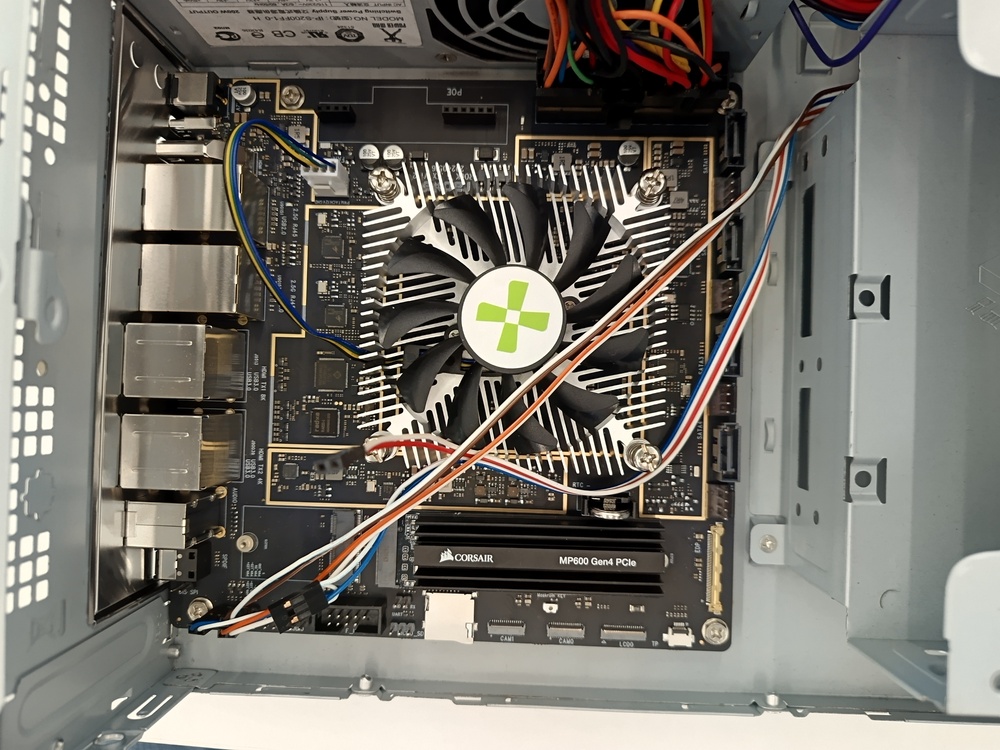
Lots of quiet hacking going on - a few loud conversations. A new ARM machine in mini-ITX format - see Steve McIntyre's blog on planet.debian.org about Rock 5 ITX.

Two days worth of talks for Saturday and Sunday. For some people, this is a first time. Lightning talks are particularly good to break down barriers - three slides and five minutes (and the chance for a bit of gamesmanship to break the rules creatively).

Longer talks: a couple from Steve Capper of ARM were particularly helpful to those interested in upcoming development. A couple of the talks in the schedule are traditional: if the release team are here, they tell us what they are doing, for example.

ARM are main sponsors and have been very generous in giving us conference and facilities space. Fast network, coffee and interested people - what's not to like :)[EDIT/UPDATE - And my talk is finished and went fairly well: slides have now been uploaded and the talk is linked from the Mini-DebConf pages]

Jonathan Dowland: Whisper (pipewire tool)

It's time to mint a new blog tag I want to write to pour praise on some software I recently discovered. I'm not up to speed on Pipewire the latest piece of Linux plumbing related to audio nor how it relates to the other bits (Pulseaudio, ALSA, JACK, what else?). I recently tried to plug something into the line-in port on my external audio interface, and wished to hear it on the machine. A simple task, you'd think. I'll refrain from writing about the stuff that didn't work well and focus on the thing that did: A little tool called Whisper, which is designed to let you listen to a microphone through your speakers.
_Whisper_'s UI. Screenshot from upstream. Whisper's UI. Screenshot from upstream.
Whisper does a great job of hiding the complexity of what lies beneath and asking two questions: which microphone, and which speakers? In my case this alone was not quite enough, as I was presented with two identically-named "SB Live Extigy" "microphone" devices, but that's easily resolved with trial and error. More stuff like this please!

Lukas M rdian: Waiting for a Linux system to be online

Designed by Freepik

What is an online system? Networking is a complex topic, and there is lots of confusion around the definition of an online system. Sometimes the boot process gets delayed up to two minutes, because the system still waits for one or more network interfaces to be ready. Systemd provides the network-online.target that other service units can rely on, if they are deemed to require network connectivity. But what does online actually mean in this context, is a link-local IP address enough, do we need a routable gateway and how about DNS name resolution? The requirements for an online network interface depend very much on the services using an interface. For some services it might be good enough to reach their local network segment (e.g. to announce Zeroconf services), while others need to reach domain names (e.g. to mount a NFS share) or reach the global internet to run a web server. On the other hand, the implementation of network-online.target varies, depending on which networking daemon is in use, e.g. systemd-networkd-wait-online.service or NetworkManager-wait-online.service. For Ubuntu, we created a specification that describes what we as a distro expect an online system to be. Having a definition in place, we are able to tackle the network-online-ordering issues that got reported over the years and can work out solutions to avoid delayed boot times on Ubuntu systems. In essence, we want systems to reach the following networking state to be considered online:
  1. Do not wait for optional interfaces to receive network configuration
  2. Have IPv6 and/or IPv4 link-local addresses on every network interface
  3. Have at least one interface with a globally routable connection
  4. Have functional domain name resolution on any routable interface

A common implementation NetworkManager and systemd-networkd are two very common networking daemons used on modern Linux systems. But they originate from different contexts and therefore show different behaviours in certain scenarios, such as wait-online. Luckily, on Ubuntu we already have Netplan as a unification layer on top of those networking daemons, that allows for common network configuration, and can also be used to tweak the wait-online logic. With the recent release of Netplan v1.1 we introduced initial functionality to tweak the behaviour of the systemd-networkd-wait-online.service, as used on Ubuntu Server systems. When Netplan is used to drive the systemd-networkd backend, it will emit an override configuration file in /run/systemd/system/systemd-networkd-wait-online.service.d/10-netplan.conf, listing the specific non-optional interfaces that should receive link-local IP configuration. In parallel to that, it defines a list of network interfaces that Netplan detected to be potential global connections, and waits for any of those interfaces to reach a globally routable state. Such override config file might look like this:
[Unit]
ConditionPathIsSymbolicLink=/run/systemd/generator/network-online.target.wants/systemd-networkd-wait-online.service

[Service]
ExecStart=
ExecStart=/lib/systemd/systemd-networkd-wait-online -i eth99.43:carrier -i lo:carrier -i eth99.42:carrier -i eth99.44:degraded -i bond0:degraded
ExecStart=/lib/systemd/systemd-networkd-wait-online --any -o routable -i eth99.43 -i eth99.45 -i bond0
In addition to the new features implemented in Netplan, we reached out to upstream systemd, proposing an enhancement to the systemd-networkd-wait-online service, integrating it with systemd-resolved to check for the availability of DNS name resolution. Once this is implemented upstream, we re able to fully control the systemd-networkd backend on Ubuntu Server systems, to behave consistently and according to the definition of an online system that was lined out above.

Future work The story doesn t end there, because Ubuntu Desktop systems are using NetworkManager as their networking backend. This daemon provides its very own nm-online utility, utilized by the NetworkManager-wait-online systemd service. It implements a much higher-level approach, looking at the networking daemon in general instead of the individual network interfaces. By default, it considers a system to be online once every autoconnect profile got activated (or failed to activate), meaning that either a IPv4 or IPv6 address got assigned. There are considerable enhancements to be implemented to this tool, for it to be controllable in a fine-granular way similar to systemd-networkd-wait-online, so that it can be instructed to wait for specific networking states on selected interfaces.

A note of caution Making a service depend on network-online.target is considered an antipattern in most cases. This is because networking on Linux systems is very dynamic and the systemd target can only ever reflect the networking state at a single point in time. It cannot guarantee this state to be remained over the uptime of your system and has the potentially to delay the boot process considerably. Cables can be unplugged, wireless connectivity can drop, or remote routers can go down at any time, affecting the connectivity state of your local system. Therefore, instead of wondering what to do about network.target, please just fix your program to be friendly to dynamically changing network configuration. [source].

Iustin Pop: Optical media lifetime - one data point

Way back (more than 10 years ago) when I was doing DVD-based backups, I knew that normal DVDs/Blu-Rays are no long-term archival solutions, and that if I was real about doing optical media backups, I need to switch to M-Disc. I actually bought a (small stack) of M-Disc Blu-Rays, but never used them. I then switched to other backups solutions, and forgot about the whole topic. Until, this week, while sorting stuff, I happened upon a set of DVD backups from a range of years, and was very curious whether they are still readable after many years. And, to my surprise, there were no surprises! Went backward in time, and: I also found stack of dual-layer DVD+R from 2012-2014, some for sure Verbatim, and some unmarked (they were intended to be printed on), but likely Verbatim as well. All worked just fine. Just that, even at ~8GiB per disk, backing up raw photo files took way too many disks, even in 2014 . At this point I was happy that all 12+ DVDs I found, ranging from 10 to 14 years, are all good. Then I found a batch of 3 CDs! Here the results were mixed: I think the takeaway is that for all explicitly selected media - TDK, JVC and Verbatim - they hold for 10-20 years. Valid reads from summer 2003 is mind boggling for me, for (IIRC) organic media - not sure about the TDK metallic substrate. And when you just pick whatever ( Creation ), well, the results are mixed. Note that in all this, it was about CDs and DVDs. I have no idea how Blu-Rays behave, since I don t think I ever wrote a Blu-Ray. In any case, surprising to me, and makes me rethink a bit my backup options. Sizes from 25 to 100GB Blu-Rays are reasonable for most critical data. And they re WORM, as opposed to most LTO media, which is re-writable (and to some small extent, prone to accidental wiping). Now, I should check those M-Disks to see if they can still be written to, after 10 years

14 October 2024

Scarlett Gately Moore: Kubuntu 24.10 Released, KDE Snaps at 24.08.2, and I lived to tell you about it!

Happy 28th birthday KDE!Happy 28th Birthday KDE!
Sorry my blog updates have been MIA. Let me tell you a story As some of you know, 3 months ago I was in a no fault car accident. Thankfully, the only injury was I ended up with a broken arm. ER sends me home in a sling and tells me it was a clean break and it will mend itself in no time. After a week of excruciating pain I went to my follow up doctor appointment, and with my x-rays in hand, the doc tells me it was far from a clean break and needs surgery. So after a week of my shattered bone scraping my nerves and causing pain I have never felt before, I finally go in for surgery! They put in a metal plate with screws to hold the bone in place so it can properly heal. The nerve pain was gone, so I thought I was on the mend. Some time goes by and the swelling still has not subsided, the doctors are not as concerned about this as I am, so I carry on until it becomes really inflamed and developed fever blisters. After no success in reaching the doctors office my husband borrows the neighbors car and rushes me to the ER. Good thing too, I had an infection. So after a 5 day stay in the hospital, they sent us home loaded with antibiotics and trained my husband in wound packing. We did everything right, kept the place immaculate, followed orders with the wound care, took my antibiotics, yet when they ran out there was still no sign of relief, or healing. Went to doctors and they gave me another month supply of antibiotics. Two days after my final dose my arm becomes inflamed again and with extra spectacular levels of pain to go with it. I call the doctor office They said to come in on my appointment day ( 4 days away ). I asked, You aren t concerned with this inflammation? , to which they replied, No. . Ok, maybe I am over reacting and it s all in my head, I can power through 4 more days. The following morning my husband observed fever blisters and the wound site was clearly not right, so once again off we go to the ER. Well thankfully we did. I was in Sepsis and could have died After deliberating with the doctor on the course of action for treatment, the doctor accepted our plea to remove the plate, rather than tighten screws and have me drive 100 miles to hospital everyday for iv antibiotics (Umm I don t have a car!?) So after another 4 day stay I am released into the world, alive and well. I am happy to report, the swelling is almost gone, the pain is minimal, and I am finally healing nicely. I am still in a sling and I have to be super careful and my arm was not fully knitted. So with that I am bummed to say, no traveling for me, no Ubuntu Summit  I still need help with that car, if it weren t for our neighbor, this story would have ended much differently. https://gofund.me/00942f47 Despite my tragic few months for my right arm, my left arm has been quite busy. Thankfully I am a lefty! On to my work progress report. Kubuntu:
With Plasma 6! A big thank you to the Debian KDE/QT team and Rik Mills, could not have done it without you!
KDE Snaps: All release service snaps are done! Save a few problematic ones still WIP.. I have released 24.08.2 which you can find here: https://snapcraft.io/publisher/kde I completed the qt6 and KDE frameworks 6 content packs for core24 Snapcraft: I have a PR in for kde-neon-6 extension core24 support. That s all for now. Thanks for stopping by!

Philipp Kern: Touch Notifications for YubiKeys

When setting up your YubiKey you have the option to require the user to touch the device to authorize an operation (be it signing, decrypting, or authenticating). While web browsers often provide clear prompts for this, other applications like SSH or GPG will not. Instead the operation will just hang without any visual indication that user input is required. The YubiKey itself will blink, but depending on where it is plugged in that is not very visible.

yubikey-touch-detector (fresh in unstable) solves this issue by providing a way for your desktop environment to signal the user that the device is waiting for a touch. It provides an event feed on a socket that other components can consume. It comes with libnotify support and there are some custom integrations for other environments.For GNOME and KDE libnotify support should be sufficient, however you still need to turn it on:
$ mkdir -p ~/.config/yubikey-touch-detector
$ sed -e 's/^YUBIKEY_TOUCH_DETECTOR_LIBNOTIFY=.*/YUBIKEY_TOUCH_DETECTOR_LIBNOTIFY=true/' \
  < /usr/share/doc/yubikey-touch-detector/examples/service.conf.example \
  > ~/.config/yubikey-touch-detector/service.conf
$ systemctl --user restart yubikey-touch-detector
I would still have preferred a more visible, more modal prompt. I guess that would be an exercise for another time, listening to the socket and presenting a window. But for now, desktop notifications will do for me.PS: I have not managed to get SSH's no-touch-required to work with YubiKey 4, while it works just fine with a YubiKey 5.

13 October 2024

Andy Simpkins: The state of the art

A long time ago . A long time ago a computer was a woman (I think almost exclusively a women, not a man) who was employed to do a lot of repetitive mathematics typically for accounting and stock / order processing. Then along came Lyons, who deployed an artificial computer to perform the same task, only with fewer errors in less time. Modern day computing was born we had entered the age of the Digital Computer. These computers were large, consumed huge amounts of power but were precise, and gave repeatable, verifiable results. Over time the huge mainframe digital computers have shrunk in size, increased in performance, and consume far less power so much so that they often didn t need the specialist CFC based, refrigerated liquid cooling systems of their bigger mainframe counterparts, only requiring forced air flow, and occasionally just convection cooling. They shrank so far and became cheep enough that the Personal Computer became to be, replacing the mainframe with its time shared resources with a machine per user. Desktop or even portable laptop computers were everywhere. We networked them together, so now we can share information around the office, a few computers were given specialist tasks of being available all the time so we could share documents, or host databases these servers were basically PCs designed to operate 24 7, usually more powerful than their desktop counterparts (or at least with faster storage and networking). Next we joined these networks together and the internet was born. The dream of a paperless office might actually become realised we can now send email (and documents) from one organisation (or individual) to another via email. We can make our specialist computers applications available outside just the office and web servers / web apps come of age. Fast forward a few years and all of a sudden we need huge data-halls filled with Rack scale machines augmented with exotic GPUs and NPUs again with refrigerated liquid cooling, all to do the same task that we were doing previously without the magical buzzword that has been named AI; because we all need another dot com bubble or block chain band waggon to jump aboard. Our AI enabled searches take slightly longer, consume magnitudes more power, and best of all the results we are given may or may not be correct . Progress, less precise answers, taking longer, consuming more power, without any verification and often giving a different result if you repeat your question AND we still need a personal computing device to access this wondrous thing. Remind me again why we are here? (time lines and huge swaves of history simply ignored to make an attempted comic point this is intended to make a point and not be scholarly work)
Taavi V n nen: Bulk downloading Wikimedia Commons categories

Wikimedia Commons, the Wikimedia project for freely licensed media files, also contains a bunch of photos by me and photos of me at various events. While I don't think Commons is going away anytime soon, I would still like to have a local copy of those images available on my own storage hardware. Obviously this requires some way to query for photos you want to download. I'm using Commons categories for this, since that's easy to implement and works for both use cases. The Commons community tends to come up with very specific categories that you can use, and if not, you can usually categorize the files yourself.
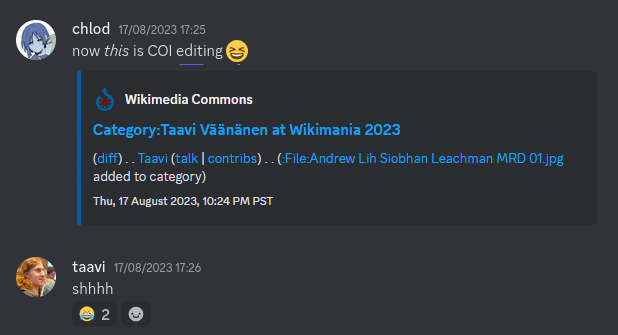
Me replying 'shh' to a Discord message showing myself categorizing photos about me and accusing me of COI editing
thankfully Commons has no such thing as a Conflict of interest (COI) policy
There is almost an existing tool for this: Sam Wilson's mwcli project has support for exporting images one has uploaded to Commons. However I couldn't use that to upload photos of me others have uploaded, plus it's written in PHP and I don't exactly want to deal with the problem of figuring out how to package it in a way I could neatly install it on my NAS. So I wrote my own tool for it, called comload. It's written in Python because Python is easy to deploy (I can just throw it in a .deb and upload it to my internal repository), and because I did not find a Go library to handle Action API pagination for me. The basic usage is like this:
$ comload --subcats "Taavi V n nen"
This will download any files in Category:Taavi V n nen and its sub-categories to the current directory. Former image versions, as well as the image description and SDC data, if any, is also included. And it's smart enough to not download any files that are already there on future runs, so you can just throw it in a systemd timer to get any future files. I'd still like it to handle moved files without creating a duplicate copy, but otherwise I'm really happy with the current state. comload is available from PyPI and from my Git server directly, and is licensed under the GPLv3.

12 October 2024

Jonathan Dowland: Code formatting in documents

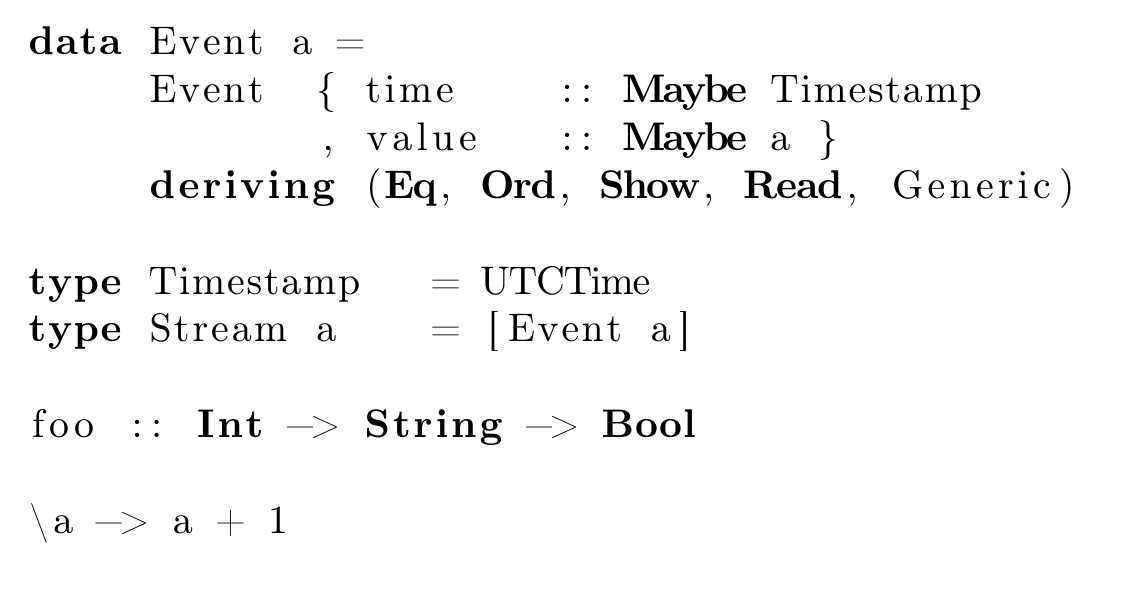
I've been exploring typesetting and formatting code within text documents such as papers, or my thesis. Up until now, I've been using the listings package without thinking much about it. By default, some sample Haskell code processed by listings looks like this (click any of the images to see larger, non-blurry versions):
default output of listings on a Haskell code sample
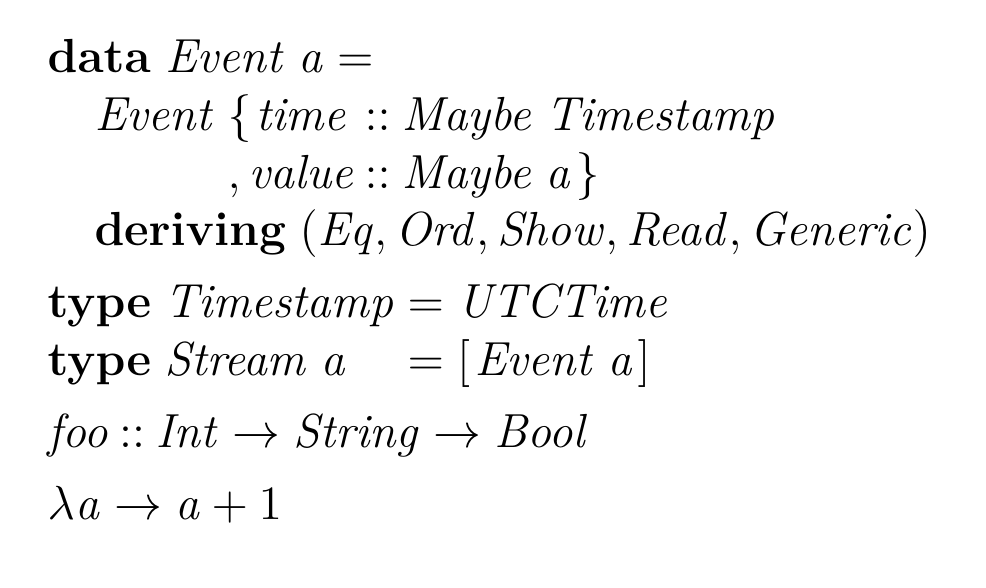
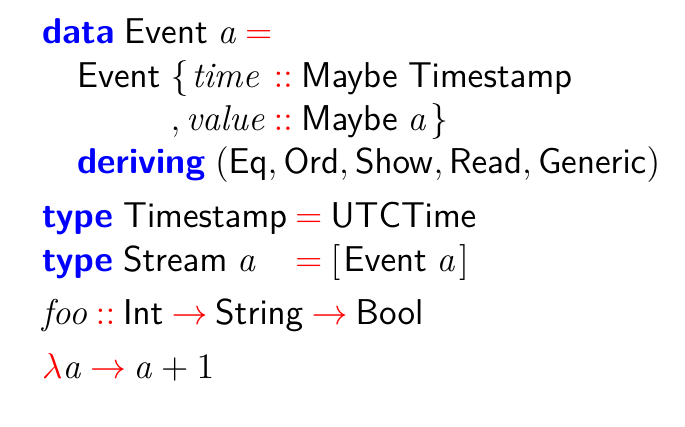
It's formatted with a monospaced font, with some keywords highlighted, but not syntactic symbols. There are several other options for typesetting and formatting code in LaTeX documents. For Haskell in particular, there is the preprocessor lhs2tex, The default output of which looks like this:
default output of lhs2tex on a Haskell code sample
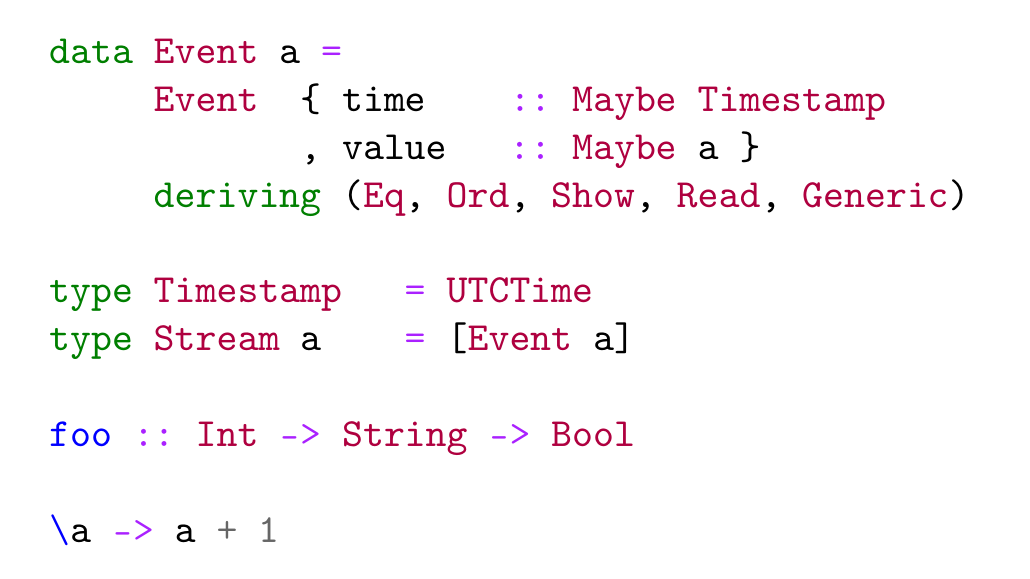
A proportional font, but it's taken pains to preserve vertical alignment, which is syntactically significant for Haskell. It looks a little cluttered to me, and I'm not a fan of nearly everything being italic. Again, symbols aren't differentiated, but it has substituted them for more typographically pleasing alternatives: -> has become , and \ is now . Another option is perhaps the newest, the LaTeX package minted, which leverages the Python Pygments program. Here's the same code again. It defaults to monospace (the choice of font seems a lot clearer to me than the default for listings), no symbolic substitution, and liberal use of colour:
default output of minted on a Haskell code sample
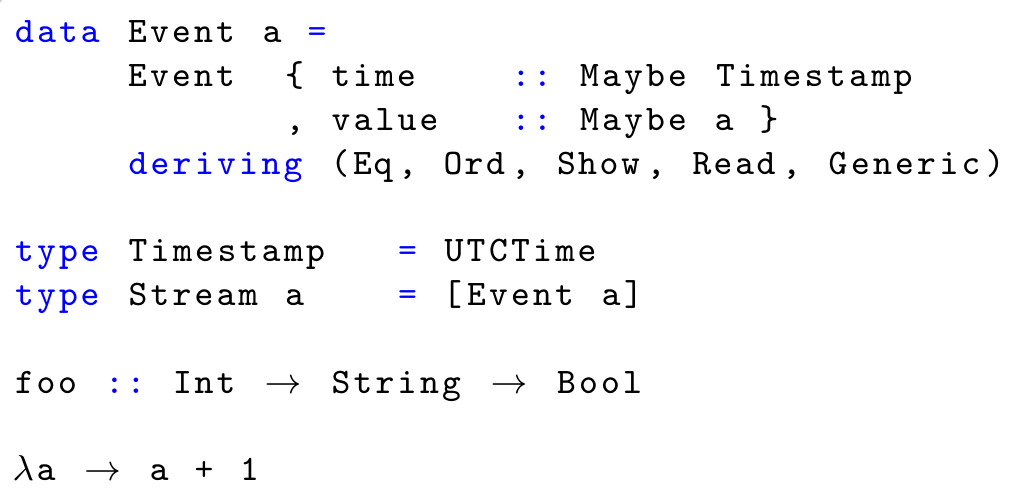
An informal survey of the samples so far showed that the minted output was the most popular. All of these packages can be configured to varying degrees. Here are some examples of what I've achieved with a bit of tweaking
_listings_ adjusted with colour and some symbols substituted (but sadly not the two together) listings adjusted with colour and some symbols substituted (but sadly not the two together)
_lhs2tex_ adjusted to be less italic, sans-serif and use some colour lhs2tex adjusted to be less italic, sans-serif and use some colour
All of this has got me wondering whether there are straightforward empirical answers to some of these questions of style. Firstly, I'm pretty convinced that symbolic substitution is valuable. When writing Haskell, we write ->, \, /= etc. not because it's most legible, but because it's most practical to type those symbols on the most widely available keyboards and popular keyboard layouts.1 Of the three options listed here, symbolic substitution is possible with listings and lhs2tex, but I haven't figured out if minted can do it (which is really the question: can pygments do it?) I'm unsure about proportional versus monospaced fonts. We typically use monospaced fonts for editing computer code, but that's at least partly for historical reasons. Vertical alignment is often very important in source code, and it can be easily achieved with monospaced text; it's also sometimes important to have individual characters (., etc.) not be de-emphasised by being smaller than any other character. lhs2tex, at least, addresses vertical alignment whilst using proportional fonts. I guess the importance of identifying individual significant characters is just as true in a code sample within a larger document as it is within plain source code. From a (brief) scan of research on this topic, it seems that proportional fonts result in marginally quicker reading times for regular prose. It's not clear whether those results carry over into reading computer code in particular, and the margin is slim in any case. The drawbacks of monospaced text mostly apply when the volume of text is large, which is not the case for the short code snippets I am working with. I still have a few open questions:

  1. The Haskell package Data.List.Unicode lets the programmer use a range of unicode symbols in place of ASCII approximations, such as instead of elem, instead of /=. Sadly, it's not possible to replace the denotation for an anonymous function, \, with this way.

11 October 2024

Steve McIntyre: Rock 5 ITX

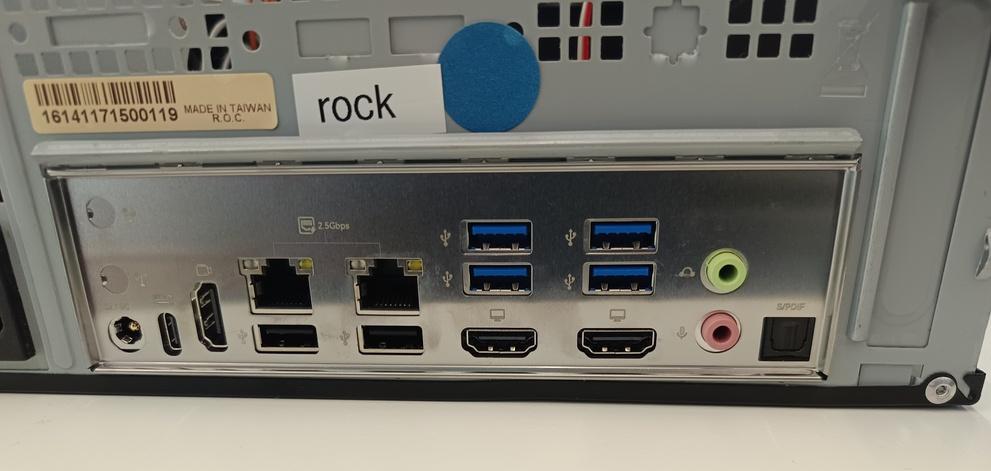
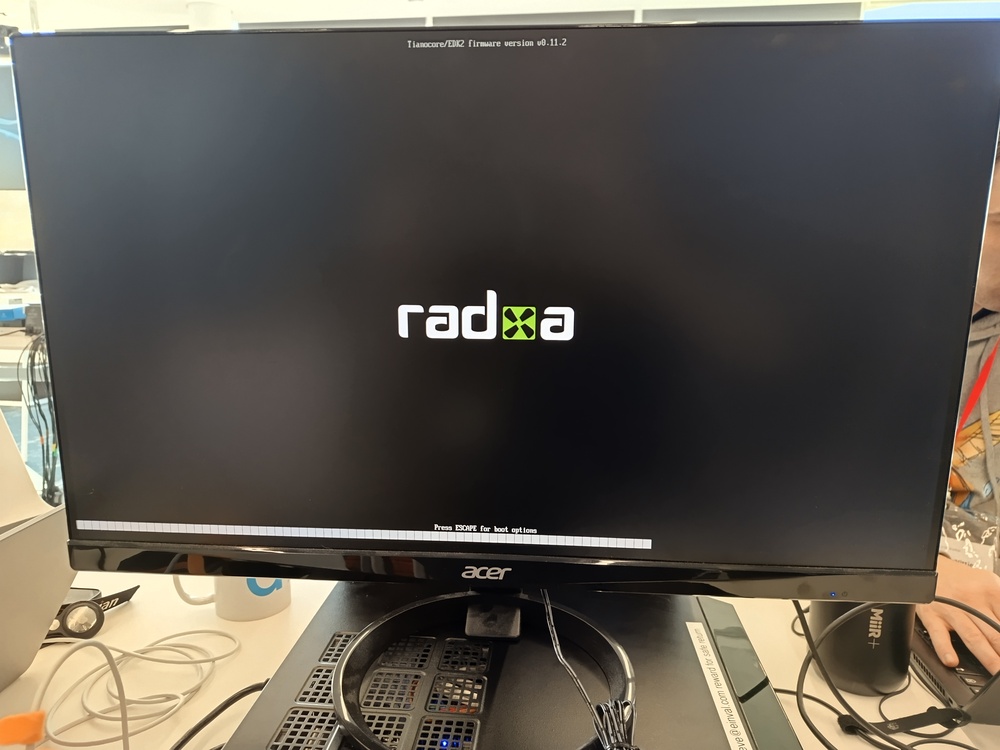
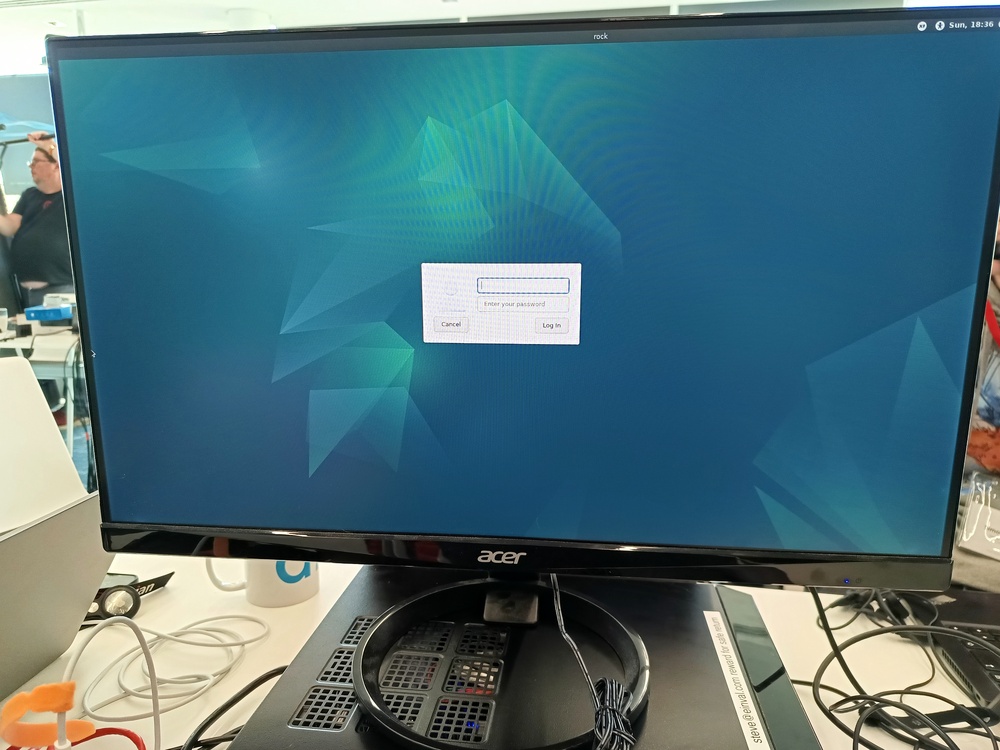
It's been a while since I've posted about arm64 hardware. The last machine I spent my own money on was a SolidRun Macchiatobin, about 7 years ago. It's a small (mini-ITX) board with a 4-core arm64 SoC (4 * Cortex-A72) on it, along with things like a DIMM socket for memory, lots of networking, 3 SATA disk interfaces. The Macchiatobin was a nice machine compared to many earlier systems, but it took quite a bit of effort to get it working to my liking. I replaced the on-board U-Boot firmware binary with an EDK2 build, and that helped. After a few iterations we got a new build including graphical output on a PCIe graphics card. Now it worked much more like a "normal" x86 computer. I still have that machine running at home, and it's been a reasonably reliable little build machine for arm development and testing. It's starting to show its age, though - the onboard USB ports no longer work, and so it's no longer useful for doing things like installation testing. :-/ So... I was involved in a conversation in the #debian-arm IRC channel a few weeks ago, and diederik suggested the Radxa Rock 5 ITX. It's another mini-ITX board, this time using a Rockchip RK3588 CPU. Things have moved on - the CPU is now an 8-core big.LITTLE config: 4*Cortex A76 and 4*Cortex A55. The board has NVMe on-board, 4*SATA, built-in Mali graphics from the CPU, soldered-on memory. Just about everything you need on an SBC for a small low-power desktop, a NAS or whatever. And for about half the price I paid for the Macchiatobin. I hit "buy" on one of the listed websites. :-) A few days ago, the new board landed. I picked the version with 24GB of RAM and bought the matching heatsink and fan. I set it up in an existing case borrowed from another old machine and tried the Radxa "Debian" build. All looked OK, but I clearly wasn't going to stay with that. Onwards to running a native Debian setup! I installed an EDK2 build from https://github.com/edk2-porting/edk2-rk3588 onto the onboard SPI flash, then rebooted with a Debian 12.7 (Bookworm) arm64 installer image on a USB stick. How much trouble could this be? I was shocked! It Just Worked (TM) I'm running a standard Debian arm64 system. The graphical installer ran just fine. I installed onto the NVMe, adding an Xfce desktop for some simple tests. Everything Just Worked. After many years of fighting with a range of different arm machines (from simple SBCs to desktops and servers), this was without doubt the most straightforward setup I've ever done. Wow! It's possible to go and spend a lot of money on an Ampere machine, and I've seen them work well too. But for a hobbyist user (or even a smaller business), the Rock 5 ITX is a lovely option. Total cost to me for the board with shipping fees, import duty, etc. was just over 240. That's great value, and I can wholeheartedly recommend this board! The two things that are missing compared to the Macchiatobin? This is soldered-on memory (but hey, 24G is plenty for me!) It also doesn't have a PCIe slot, but it has sufficient onboard network, video and storage interfaces that I think it will cover most people's needs. Where's the catch? It seems these are very popular right now, so it can be difficult to find these machines in stock online. FTAOD, I should also point out: I bought this machine entirely with my own money, for my own use for development and testing. I've had no contact with the Radxa or Rockchip folks at all here, I'm just so happy with this machine that I've felt the need to shout about it! :-) Here's some pictures... Rock 5 ITX top view Rock 5 ITX back panel view Rock 5 EDK2 startuo Rock 5 xfce login Rock 5 ITX running Firefox
Freexian Collaborators: Monthly report about Debian Long Term Support, September 2024 (by Roberto C. S nchez)

Like each month, have a look at the work funded by Freexian s Debian LTS offering.

Debian LTS contributors In September, 18 contributors have been paid to work on Debian LTS, their reports are available:
  • Abhijith PA did 7.0h (out of 0.0h assigned and 14.0h from previous period), thus carrying over 7.0h to the next month.
  • Adrian Bunk did 51.75h (out of 9.25h assigned and 55.5h from previous period), thus carrying over 13.0h to the next month.
  • Arturo Borrero Gonzalez did 10.0h (out of 0.0h assigned and 10.0h from previous period).
  • Bastien Roucari s did 20.0h (out of 20.0h assigned).
  • Ben Hutchings did 20.0h (out of 12.0h assigned and 12.0h from previous period), thus carrying over 4.0h to the next month.
  • Chris Lamb did 18.0h (out of 18.0h assigned).
  • Daniel Leidert did 23.0h (out of 26.0h assigned), thus carrying over 3.0h to the next month.
  • Emilio Pozuelo Monfort did 23.5h (out of 22.25h assigned and 37.75h from previous period), thus carrying over 36.5h to the next month.
  • Guilhem Moulin did 22.25h (out of 20.0h assigned and 2.5h from previous period), thus carrying over 0.25h to the next month.
  • Lucas Kanashiro did 10.0h (out of 5.0h assigned and 15.0h from previous period), thus carrying over 10.0h to the next month.
  • Markus Koschany did 40.0h (out of 40.0h assigned).
  • Ola Lundqvist did 6.5h (out of 14.5h assigned and 9.5h from previous period), thus carrying over 17.5h to the next month.
  • Roberto C. S nchez did 24.75h (out of 21.0h assigned and 3.75h from previous period).
  • Santiago Ruano Rinc n did 19.0h (out of 19.0h assigned).
  • Sean Whitton did 0.75h (out of 4.0h assigned and 2.0h from previous period), thus carrying over 5.25h to the next month.
  • Sylvain Beucler did 16.0h (out of 42.0h assigned and 18.0h from previous period), thus carrying over 44.0h to the next month.
  • Thorsten Alteholz did 11.0h (out of 11.0h assigned).
  • Tobias Frost did 17.0h (out of 7.5h assigned and 9.5h from previous period).

Evolution of the situation In September, we have released 52 DLAs. September marked the first full month of Debian 11 bullseye under the responsibility of the LTS Team and the team immediately got to work, publishing more than 4 dozen updates. Some notable updates include ruby2.7 (denial-of-service, information leak, and remote code execution), git (various arbitrary code execution vulnerabilities), firefox-esr (multiple issues), gnutls28 (information disclosure), thunderbird (multiple issues), cacti (cross site scripting and SQL injection), redis (unauthorized access, denial of service, and remote code execution), mariadb-10.5 (arbitrary code execution), cups (arbitrary code execution). Several LTS contributors have also contributed package updates which either resulted in a DSA (a Debian Security Announcement, which applies to Debian 12 bookworm) or in an upload that will be published at the next stable point release of Debian 12 bookworm. This list of packages includes cups, cups-filters, booth, nghttp2, puredata, python3.11, sqlite3, and wireshark. This sort of work, contributing fixes to newer Debian releases (and sometimes even to unstable), helps to ensure that upgrades from a release in the LTS phase of its lifecycle to a newer release do not expose users to vulnerabilities which have been closed in the older release. Looking beyond Debian, LTS contributor Bastien Roucari s has worked with the upstream developers of apache2 to address regressions introduced upstream by some recent vulnerability fixes and he has also reached out to the community regarding a newly discovered security issue in the dompurify package. LTS contributor Santiago Ruano Rinc n has undertaken the work of triaging and reproducing nearly 4 dozen CVEs potentially affecting the freeimage package. The upstream development of freeimage appears to be dormant and some of the issues have languished for more than 5 years. It is unclear how much can be done without the aid of upstream, but we will do our best to provide as much help to the community as we can feasibly manage. Finally, it is sometimes necessary to limit or discontinue support for certain packages. The transition of a release from being under the responsibility of the Debian Security Team to that of the LTS Team is an occasion where we assess any pending decisions in this area and formalize them. Please see the announcement for a complete list of packages which have been designated as unsupported.

Thanks to our sponsors Sponsors that joined recently are in bold.

10 October 2024

Gunnar Wolf: Started a guide to writing FUSE filesystems in Python

As DebConf22 was coming to an end, in Kosovo, talking with Eeveelweezel they invited me to prepare a talk to give for the Chicago Python User Group. I replied that I m not really that much of a Python guy But would think about a topic. Two years passed. I meet Eeveelweezel again for DebConf24 in Busan, South Korea. And the topic came up again. I had thought of some ideas, but none really pleased me. Again, I do write some Python when needed, and I teach using Python, as it s the language I find my students can best cope with. But delivering a talk to ChiPy? On the other hand, I have long used a very simplistic and limited filesystem I ve designed as an implementation project at class: FIUnamFS (for Facultad de Ingenier a, Universidad Nacional Aut noma de M xico : the Engineering Faculty for Mexico s National University, where I teach. Sorry, the link is in Spanish but you will find several implementations of it from the students ). It is a toy filesystem, with as many bad characteristics you can think of, but easy to specify and implement. It is based on contiguous file allocation, has no support for sub-directories, and is often limited to the size of a 1.44MB floppy disk. As I give this filesystem as a project to my students (and not as a mere homework), I always ask them to try and provide a good, polished, professional interface, not just the simplistic menu I often get. And I tell them the best possible interface would be if they provide support for FIUnamFS transparently, usable by the user without thinking too much about it. With high probability, that would mean: Use FUSE. Python FUSE But, in the six semesters I ve used this project (with 30-40 students per semester group), only one student has bitten the bullet and presented a FUSE implementation. Maybe this is because it s not easy to understand how to build a FUSE-based filesystem from a high-level language such as Python? Yes, I ve seen several implementation examples and even nice web pages (i.e. the examples shipped with thepython-fuse module Stavros passthrough filesystem, Dave Filesystem based upon, and further explaining, Stavros , and several others) explaining how to provide basic functionality. I found a particularly useful presentation by Matteo Bertozzi presented ~15 years ago at PyCon4 But none of those is IMO followable enough by itself. Also, most of them are very old (maybe the world is telling me something that I refuse to understand?). And of course, there isn t a single interface to work from. In Python only, we can find python-fuse, Pyfuse, Fusepy Where to start from? So I setup to try and help. Over the past couple of weeks, I have been slowly working on my own version, and presenting it as a progressive set of tasks, adding filesystem calls, and being careful to thoroughly document what I write (but maybe my documentation ends up obfuscating the intent? I hope not and, read on, I ve provided some remediation). I registered a GitLab project for a hand-holding guide to writing FUSE-based filesystems in Python. This is a project where I present several working FUSE filesystem implementations, some of them RAM-based, some passthrough-based, and I intend to add to this also filesystems backed on pseudo-block-devices (for implementations such as my FIUnamFS). So far, I have added five stepwise pieces, starting from the barest possible empty filesystem, and adding system calls (and functionality) until (so far) either a read-write filesystem in RAM with basicstat() support or a read-only passthrough filesystem. I think providing fun or useful examples is also a good way to get students to use what I m teaching, so I ve added some ideas I ve had: DNS Filesystem, on-the-fly markdown compiling filesystem, unzip filesystem and uncomment filesystem. They all provide something that could be seen as useful, in a way that s easy to teach, in just some tens of lines. And, in case my comments/documentation are too long to read, uncommentfs will happily strip all comments and whitespace automatically! So I will be delivering my talk tomorrow (2024.10.10, 18:30 GMT-6) at ChiPy (virtually). I am also presenting this talk virtually at Jornadas Regionales de Software Libre in Santa Fe, Argentina, next week (virtually as well). And also in November, in person, at nerdear.la, that will be held in Mexico City for the first time. Of course, I will also share this project with my students in the next couple of weeks And hope it manages to lure them into implementing FUSE in Python. At some point, I shall report! Update: After delivering my ChiPy talk, I have uploaded it to YouTube: A hand-holding guide to writing FUSE-based filesystems in Python, and after presenting at Jornadas Regionales, I present you the video in Spanish here: Aprendiendo y ense ando a escribir sistemas de archivo en espacio de usuario con FUSE y Python.

Freexian Collaborators: Debian Contributions: Packaging Pydantic v2, Reworking of glib2.0 for cross bootstrap, Python archive rebuilds and more! (by Anupa Ann Joseph)

Debian Contributions: 2024-09 Contributing to Debian is part of Freexian s mission. This article covers the latest achievements of Freexian and their collaborators. All of this is made possible by organizations subscribing to our Long Term Support contracts and consulting services.

Pydantic v2, by Colin Watson Pydantic is a useful library for validating data in Python using type hints: Freexian uses it in a number of projects, including Debusine. Its Debian packaging had been stalled at 1.10.17 in testing for some time, partly due to needing to make sure everything else could cope with the breaking changes introduced in 2.x, but mostly due to needing to sort out packaging of its new Rust dependencies. Several other people (notably Alexandre Detiste, Andreas Tille, Drew Parsons, and Timo R hling) had made some good progress on this, but nobody had quite got it over the line and it seemed a bit stuck. Colin upgraded a few Rust libraries to new upstream versions, packaged rust-jiter, and chased various failures in other packages. This eventually allowed getting current versions of both pydantic-core and pydantic into testing. It should now be much easier for us to stay up to date routinely.

Reworking of glib2.0 for cross bootstrap, by Helmut Grohne Simon McVittie (not affiliated with Freexian) earlier restructured the libglib2.0-dev such that it would absorb more functionality and in particular provide tools for working with .gir files. Those tools practically require being run for their host architecture (practically this means running under qemu-user) which is at odds with the requirements of architecture cross bootstrap. The qemu requirement was expressed in package dependencies and also made people unhappy attempting to use libglib2.0-dev for i386 on amd64 without resorting to qemu. The use of qemu in architecture bootstrap is particularly problematic as it tends to not be ready at the time bootstrapping is needed. As a result, Simon proposed and implemented the introduction of a libgio-2.0-dev package providing a subset of libglib2.0-dev that does not require qemu. Packages should continue to use libglib2.0-dev in their Build-Depends unless involved in architecture bootstrap. Helmut reviewed and tested the implementation and integrated the necessary changes into rebootstrap. He also prepared a patch for libverto to use the new package and proposed adding forward compatibility to glib2.0. Helmut continued working on adding cross-exe-wrapper to architecture-properties and implemented autopkgtests later improved by Simon. The cross-exe-wrapper package now provides a generic mechanism to a program on a different architecture by using qemu when needed only. For instance, a dependency on cross-exe-wrapper:i386 provides a i686-linux-gnu-cross-exe-wrapper program that can be used to wrap an ELF executable for the i386 architecture. When installed on amd64 or i386 it will skip installing or running qemu, but for other architectures qemu will be used automatically. This facility can be used to support cross building with targeted use of qemu in cases where running host code is unavoidable as is the case for GObject introspection. This concludes the joint work with Simon and Niels Thykier on glib2.0 and architecture-properties resolving known architecture bootstrap regressions arising from the glib2.0 refactoring earlier this year.

Analyzing binary package metadata, by Helmut Grohne As Guillem Jover (not affiliated with Freexian) continues to work on adding metadata tracking to dpkg, the question arises how this affects existing packages. The dedup.debian.net infrastructure provides an easy playground to answer such questions, so Helmut gathered file metadata from all binary packages in unstable and performed an explorative analysis. Some results include: Guillem also performed a cursory analysis and reported other problem categories such as mismatching directory permissions for directories installed by multiple packages and thus gained a better understanding of what consistency checks dpkg can enforce.

Python archive rebuilds, by Stefano Rivera Last month Stefano started to write some tooling to do large-scale rebuilds in debusine, starting with finding packages that had already started to fail to build from source (FTBFS) due to the removal of setup.py test. This month, Stefano did some more rebuilds, starting with experimental versions of dh-python. During the Python 3.12 transition, we had added a dependency on python3-setuptools to dh-python, to ease the transition. Python 3.12 removed distutils from the stdlib, but many packages were expecting it to still be available. Setuptools contains a version of distutils, and dh-python was a convenient place to depend on setuptools for most package builds. This dependency was never meant to be permanent. A rebuild without it resulted in mass-filing about 340 bugs (and around 80 more by mistake). A new feature in Python 3.12, was to have unittest s test runner exit with a non-zero return code, if no tests were run. We added this feature, to be able to detect tests that are not being discovered, by mistake. We are ignoring this failure, as we wouldn t want to suddenly cause hundreds of packages to fail to build, if they have no tests. Stefano did a rebuild to see how many packages were affected, and found that around 1000 were. The Debian Python community has not come to a conclusion on how to move forward with this. As soon as Python 3.13 release candidate 2 was available, Stefano did a rebuild of the Python packages in the archive against it. This was a more complex rebuild than the others, as it had to be done in stages. Many packages need other Python packages at build time, typically to run tests. So transitions like this involve some manual bootstrapping, followed by several rounds of builds. Not all packages could be tested, as not all their dependencies support 3.13 yet. The result was around 100 bugs in packages that need work to support Python 3.13. Many other packages will need additional work to properly support Python 3.13, but being able to build (and run tests) is an important first step.

Miscellaneous contributions
  • Carles prepared the update of python-pyaarlo package to a new upstream release.
  • Carles worked on updating python-ring-doorbell to a new upstream release. Unfinished, pending to package a new dependency python3-firebase-messaging RFP #1082958 and its dependency python3-http-ece RFP #1083020.
  • Carles improved po-debconf-manager. Main new feature is that it can open Salsa merge requests. Aiming for a lightning talk in MiniDebConf Toulouse (November) to be functional end to end and get feedback from the wider public for this proof of concept.
  • Carles helped one translator to use po-debconf-manager (added compatibility for bullseye, fixed other issues) and reviewed 17 package templates.
  • Colin upgraded the OpenSSH packaging to 9.9p1.
  • Colin upgraded the various YubiHSM packages to new upstream versions, enabled more tests, fixed yubihsm-shell build failures on some 32-bit architectures, made yubihsm-shell build reproducibly, and fixed yubihsm-connector to apply udev rules to existing devices when the package is installed. As usual, bookworm-backports is up to date with all these changes.
  • Colin fixed quite a bit of fallout from setuptools 72.0.0 removing setup.py test, backported a large upstream patch set to make buildbot work with SQLAlchemy 2.0, and upgraded 25 other Python packages to new upstream versions.
  • Enrico worked with Jakob Haufe to get him up to speed for managing sso.debian.org
  • Rapha l did remove spam entries in the list of teams on tracker.debian.org (see #1080446), and he applied a few external contributions, fixing a rendering issue and replacing the DDPO link with a more useful alternative. He also gave feedback on a couple of merge requests that required more work. As part of the analysis of the underlying problem, he suggested to the ftpmasters (via #1083068) to auto-reject packages having the too-many-contacts lintian error, and he raised the severity of #1076048 to serious to actually have that 4 year old bug fixed.
  • Rapha l uploaded zim and hamster-time-tracker to fix issues with Python 3.12 getting rid of setuptools. He also uploaded a new gnome-shell-extension-hamster to cope with the upcoming transition to GNOME 47.
  • Helmut sent seven patches and sponsored one upload for cross build failures.
  • Helmut uploaded a Nagios/Icinga plugin check-smart-attributes for monitoring the health of physical disks.
  • Helmut collaborated on sbuild reviewing and improving a MR for refactoring the unshare backend.
  • Helmut sent a patch fixing coinstallability of gcc-defaults.
  • Helmut continued to monitor the evolution of the /usr-move. With more and more key packages such as libvirt or fuse3 fixed. We re moving into the boring long-tail of the transition.
  • Helmut proposed updating the meson buildsystem in debhelper to use env2mfile.
  • Helmut continued to update patches maintained in rebootstrap. Due to the work on glib2.0 above, rebootstrap moves a lot further, but still fails for any architecture.
  • Santiago reviewed some Merge Request in Salsa CI, such as: !478, proposed by Otto to extend the information about how to use additional runners in the pipeline and !518, proposed by Ahmed to add support for Ubuntu images, that will help to test how some debian packages, including the complex MariaDB are built on Ubuntu. Santiago also prepared !545, which will make the reprotest job more consistent with the result seen on reproducible-builds.
  • Santiago worked on different tasks related to DebConf 25. Especially he drafted the fundraising brochure (which is almost ready).
  • Thorsten Alteholz uploaded package libcupsfilter to fix the autopkgtest and a dependency problem of this package. After package splix was abandoned by upstream and OpenPrinting.org adopted its maintenance, Thorsten uploaded their first release.
  • Anupa published posts on the Debian Administrators group in LinkedIn and moderated the group, one of the tasks of the Debian Publicity Team.
  • Anupa helped organize DebUtsav 2024. It had over 100 attendees with hand-on sessions on making initial contributions to Linux Kernel, Debian packaging, submitting documentation to Debian wiki and assisting Debian Installations.

9 October 2024

Ben Hutchings: FOSS activity in September 2024

8 October 2024

Thorsten Alteholz: My Debian Activities in September 2024

FTP master This month I accepted 441 and rejected 29 packages. The overall number of packages that got accepted was 448. I couldn t believe my eyes, but this month I really accepted the same number of packages as last month. Debian LTS This was my hundred-twenty-third month that I did some work for the Debian LTS initiative, started by Raphael Hertzog at Freexian. During my allocated time I uploaded or worked on: Despite the announcement the package libppd in Debian is not affected by the CVEs related to CUPS. By pure chance there is an unrelated package with the same name in Debian. I also answered some question about the CUPS related uploads. Due to the CUPS issues, I postponed my work on other packages to October. Last but not least I did a week of FD this month and attended the monthly LTS/ELTS meeting. Debian ELTS This month was the seventy-fourth ELTS month. During my allocated time I uploaded or worked on: I also started to work on updates for cups in Buster, Stretch and Jessie, but their uploads will happen only in October. I also did a week of FD and attended the monthly LTS/ELTS meeting. Debian Printing This month I uploaded Last but not least I tried to prepare an update for hplip. Unfortunately this is a nerve-stretching task and I need some more time. This work is generously funded by Freexian! Debian Matomo This month I even found some time to upload packages that are dependencies of Matomo This work is generously funded by Freexian! Debian Astro This month I uploaded a new upstream or bugfix version of: Most of the uploads were related to package migration to testing. As some of them are in non-free or contrib, one has to build all binary versions. From my point of view handling packages in non-free or contrib could be very much improved, but well, they are not part of Debian Anyway, starting in December there is an Outreachy project that takes care of automatic updates of these packages. So hopefully it will be much easier to keep those package up to date. I will keep you informed. Debian IoT This month I uploaded new upstream or bugfix versions of: Debian Mobcom This month I did source uploads of all the packages that were prepared last month by Nathan and started the transition. It went rather smooth except for a few packages where the new version did not propagate to the tracker and they got stuck in old failing autopkgtest. Anyway, in the end all packages migrated to testing. I also uploaded new upstream releases or fixed bugs in: misc This month I uploaded new upstream or bugfix versions of: Most of those uploads were needed to help packages to migrate to testing.

7 October 2024

Reproducible Builds: Reproducible Builds in September 2024

Welcome to the September 2024 report from the Reproducible Builds project! Our reports attempt to outline what we ve been up to over the past month, highlighting news items from elsewhere in tech where they are related. As ever, if you are interested in contributing to the project, please visit our Contribute page on our website. Table of contents:
  1. New binsider tool to analyse ELF binaries
  2. Unreproducibility of GHC Haskell compiler 95% fixed
  3. Mailing list summary
  4. Towards a 100% bit-for-bit reproducible OS
  5. Two new reproducibility-related academic papers
  6. Distribution work
  7. diffoscope
  8. Other software development
  9. Android toolchain core count issue reported
  10. New Gradle plugin for reproducibility
  11. Website updates
  12. Upstream patches
  13. Reproducibility testing framework

New binsider tool to analyse ELF binaries Reproducible Builds developer Orhun Parmaks z has announced a fantastic new tool to analyse the contents of ELF binaries. According to the project s README page:
Binsider can perform static and dynamic analysis, inspect strings, examine linked libraries, and perform hexdumps, all within a user-friendly terminal user interface!
More information about Binsider s features and how it works can be found within Binsider s documentation pages.

Unreproducibility of GHC Haskell compiler 95% fixed A seven-year-old bug about the nondeterminism of object code generated by the Glasgow Haskell Compiler (GHC) received a recent update, consisting of Rodrigo Mesquita noting that the issue is:
95% fixed by [merge request] !12680 when -fobject-determinism is enabled. [ ]
The linked merge request has since been merged, and Rodrigo goes on to say that:
After that patch is merged, there are some rarer bugs in both interface file determinism (eg. #25170) and in object determinism (eg. #25269) that need to be taken care of, but the great majority of the work needed to get there should have been merged already. When merged, I think we should close this one in favour of the more specific determinism issues like the two linked above.

Mailing list summary On our mailing list this month:
  • Fay Stegerman let everyone know that she started a thread on the Fediverse about the problems caused by unreproducible zlib/deflate compression in .zip and .apk files and later followed up with the results of her subsequent investigation.
  • Long-time developer kpcyrd wrote that there has been a recent public discussion on the Arch Linux GitLab [instance] about the challenges and possible opportunities for making the Linux kernel package reproducible , all relating to the CONFIG_MODULE_SIG flag. [ ]
  • Bernhard M. Wiedemann followed-up to an in-person conversation at our recent Hamburg 2024 summit on the potential presence for Reproducible Builds in recognised standards. [ ]
  • Fay Stegerman also wrote about her worry about the possible repercussions for RB tooling of Debian migrating from zlib to zlib-ng as reproducibility requires identical compressed data streams. [ ]
  • Martin Monperrus wrote the list announcing the latest release of maven-lockfile that is designed aid building Maven projects with integrity . [ ]
  • Lastly, Bernhard M. Wiedemann wrote about potential role of reproducible builds in combatting silent data corruption, as detailed in a recent Tweet and scholarly paper on faulty CPU cores. [ ]

Towards a 100% bit-for-bit reproducible OS Bernhard M. Wiedemann began writing on journey towards a 100% bit-for-bit reproducible operating system on the openSUSE wiki:
This is a report of Part 1 of my journey: building 100% bit-reproducible packages for every package that makes up [openSUSE s] minimalVM image. This target was chosen as the smallest useful result/artifact. The larger package-sets get, the more disk-space and build-power is required to build/verify all of them.
This work was sponsored by NLnet s NGI Zero fund.

Distribution work In Debian this month, 14 reviews of Debian packages were added, 12 were updated and 20 were removed, all adding to our knowledge about identified issues. A number of issue types were updated as well. [ ][ ] In addition, Holger opened 4 bugs against the debrebuild component of the devscripts suite of tools. In particular:
  • #1081047: Fails to download .dsc file.
  • #1081048: Does not work with a proxy.
  • #1081050: Fails to create a debrebuild.tar.
  • #1081839: Fails with E: mmdebstrap failed to run error.
Last month, an issue was filed to update the Salsa CI pipeline (used by 1,000s of Debian packages) to no longer test for reproducibility with reprotest s build_path variation. Holger Levsen provided a rationale for this change in the issue, which has already been made to the tests being performed by tests.reproducible-builds.org. This month, this issue was closed by Santiago R. R., nicely explaining that build path variation is no longer the default, and, if desired, how developers may enable it again. In openSUSE news, Bernhard M. Wiedemann published another report for that distribution.

diffoscope diffoscope is our in-depth and content-aware diff utility that can locate and diagnose reproducibility issues. This month, Chris Lamb made the following changes, including preparing and uploading version 278 to Debian:
  • New features:
    • Add a helpful contextual message to the output if comparing Debian .orig tarballs within .dsc files without the ability to fuzzy-match away the leading directory. [ ]
  • Bug fixes:
    • Drop removal of calculated os.path.basename from GNU readelf output. [ ]
    • Correctly invert X% similar value and do not emit 100% similar . [ ]
  • Misc:
    • Temporarily remove procyon-decompiler from Build-Depends as it was removed from testing (via #1057532). (#1082636)
    • Update copyright years. [ ]
For trydiffoscope, the command-line client for the web-based version of diffoscope, Chris Lamb also:
  • Added an explicit python3-setuptools dependency. (#1080825)
  • Bumped the Standards-Version to 4.7.0. [ ]

Other software development disorderfs is our FUSE-based filesystem that deliberately introduces non-determinism into system calls to reliably flush out reproducibility issues. This month, version 0.5.11-4 was uploaded to Debian unstable by Holger Levsen making the following changes:
  • Replace build-dependency on the obsolete pkg-config package with one on pkgconf, following a Lintian check. [ ]
  • Bump Standards-Version field to 4.7.0, with no related changes needed. [ ]

In addition, reprotest is our tool for building the same source code twice in different environments and then checking the binaries produced by each build for any differences. This month, version 0.7.28 was uploaded to Debian unstable by Holger Levsen including a change by Jelle van der Waa to move away from the pipes Python module to shlex, as the former will be removed in Python version 3.13 [ ].

Android toolchain core count issue reported Fay Stegerman reported an issue with the Android toolchain where a part of the build system generates a different classes.dex file (and thus a different .apk) depending on the number of cores available during the build, thereby breaking Reproducible Builds:
We ve rebuilt [tag v3.6.1] multiple times (each time in a fresh container): with 2, 4, 6, 8, and 16 cores available, respectively:
  • With 2 and 4 cores we always get an unsigned APK with SHA-256 14763d682c9286ef .
  • With 6, 8, and 16 cores we get an unsigned APK with SHA-256 35324ba4c492760 instead.

New Gradle plugin for reproducibility A new plugin for the Gradle build tool for Java has been released. This easily-enabled plugin results in:
reproducibility settings [being] applied to some of Gradle s built-in tasks that should really be the default. Compatible with Java 8 and Gradle 8.3 or later.

Website updates There were a rather substantial number of improvements made to our website this month, including:

Upstream patches The Reproducible Builds project detects, dissects and attempts to fix as many currently-unreproducible packages as possible. We endeavour to send all of our patches upstream where appropriate. This month, we wrote a large number of such patches, including:

Reproducibility testing framework The Reproducible Builds project operates a comprehensive testing framework running primarily at tests.reproducible-builds.org in order to check packages and other artifacts for reproducibility. In September, a number of changes were made by Holger Levsen, including:
  • Debian-related changes:
    • Upgrade the osuosl4 node to Debian trixie in anticipation of running debrebuild and rebuilderd there. [ ][ ][ ]
    • Temporarily mark the osuosl4 node as offline due to ongoing xfs_repair filesystem maintenance. [ ][ ]
    • Do not warn about (very old) broken nodes. [ ]
    • Add the risc64 architecture to the multiarch version skew tests for Debian trixie and sid. [ ][ ][ ]
    • Mark the virt 32,64 b nodes as down. [ ]
  • Misc changes:
    • Add support for powercycling OpenStack instances. [ ]
    • Update the fail2ban to ban hosts for 4 weeks in total [ ][ ] and take care to never ban our own Jenkins instance. [ ]
In addition, Vagrant Cascadian recorded a disk failure for the virt32b and virt64b nodes [ ], performed some maintenance of the cbxi4a node [ ][ ] and marked most armhf architecture systems as being back online.

Finally, If you are interested in contributing to the Reproducible Builds project, please visit our Contribute page on our website. However, you can get in touch with us via:

6 October 2024

Bits from Debian: Bits from the DPL

Dear Debian community, this are my bits from DPL for September. New lintian maintainer I'm pleased to welcome Louis-Philippe V ronneau as a new Lintian maintainer. He humorously acknowledged his new role, stating, "Apparently I'm a Lintian maintainer now". I remain confident that we can, and should, continue modernizing our policy checker, and I see this as one important step toward that goal. SPDX name / license tools There was a discussion about deprecating the unique names for DEP-5 and migrating to fully compliant SPDX names. Simon McVittie wrote: "Perhaps our Debian-specific names are better, but the relevant question is whether they are sufficiently better to outweigh the benefit of sharing effort and specifications with the rest of the world (and I don't think they are)." Also Charles Plessy sees the value of deprecating the Debian ones and align on SPDX. The thread on debian-devel list contains several practical hints for writing debian/copyright files. proposal: Hybrid network stack for Trixie There was a very long discussion on debian-devel list about the network stack on Trixie that started in July and was continued in end of August / beginning of September. The discussion was also covered on LWN. It continued in a "proposal: Hybrid network stack for Trixie" by Lukas M rdian. Contacting teams I continued reaching out to teams in September. One common pattern I've noticed is that most teams lack a clear strategy for attracting new contributors. Here's an example snippet from one of my outreach emails, which is representative of the typical approach: Q: Do you have some strategy to gather new contributors for your team? A: No. Q: Can I do anything for you? A: Everything that can help to have more than 3 guys :-D Well, only the first answer, "No," is typical. To help the JavaScript team, I'd like to invite anyone with JavaScript experience to join the team's mailing list and offer to learn and contribute. While I've only built a JavaScript package once, I know this team has developed excellent tools that are widely adopted by others. It's an active and efficient team, making it a great starting point for those looking to get involved in Debian. You might also want to check out the "Little tutorial for JS-Team beginners". Given the lack of a strategy to actively recruit new contributors--a common theme in the responses I've received--I recommend reviewing my talk from DebConf23 about teams. The Debian Med team would have struggled significantly in my absence (I've paused almost all work with the team since becoming DPL) if I hadn't consistently focused on bringing in new members. I'm genuinely proud of how the team has managed to keep up with the workload (thank you, Debian Med team!). Of course, onboarding newcomers takes time, and there's no guarantee of long-term success, but if you don't make the effort, you'll never find out. OS underpaid The Register, in its article titled "Open Source Maintainers Underpaid, Swamped by Security, Going Gray", summarizes the 2024 State of the Open Source Maintainer Report. I find this to be an interesting read, both in general and in connection with the challenges mentioned in the previous paragraph about finding new team members. Kind regards Andreas.

Next.

Previous.