Search Results: "rul"

2 April 2015

Rudy Godoy: No SSH for you how to fix OpenRG routers

I find interesting when faced a taken-for-granted situation, in particular in the tech world. This time s history is about an Internet ADSL connection that allows all traffic but SSH. Yes, you read it correctly. It was very bizarre confirming such event was a real-life situation. I don t claim to be a networking expert but at least I want to think I m well educated. After few minutes I ve focused my efforts on dealing with the ADSL router/modem s networking configuration. The device is provided by Movistar (formerly Telefonica) and it runs OpenRG. I ve discovered that other people have experienced the same issue and what Movistar did was basically replacing the device. Of course the problem is gone after that. So, this post is dedicated to those who don t give up. Following the steps below will allow SSH outbound traffic for a OpenRG-based device. OpenRG device specs
Software Version: 6.0.18.1.110.1.52 Upgrade
Release Date: Oct 7 2014
Diagnostic When you do the command below, it shows nothing but timeout. Even when you SSH the router it doesn t establish connection to it.
ssh -vv host.somewhere.com
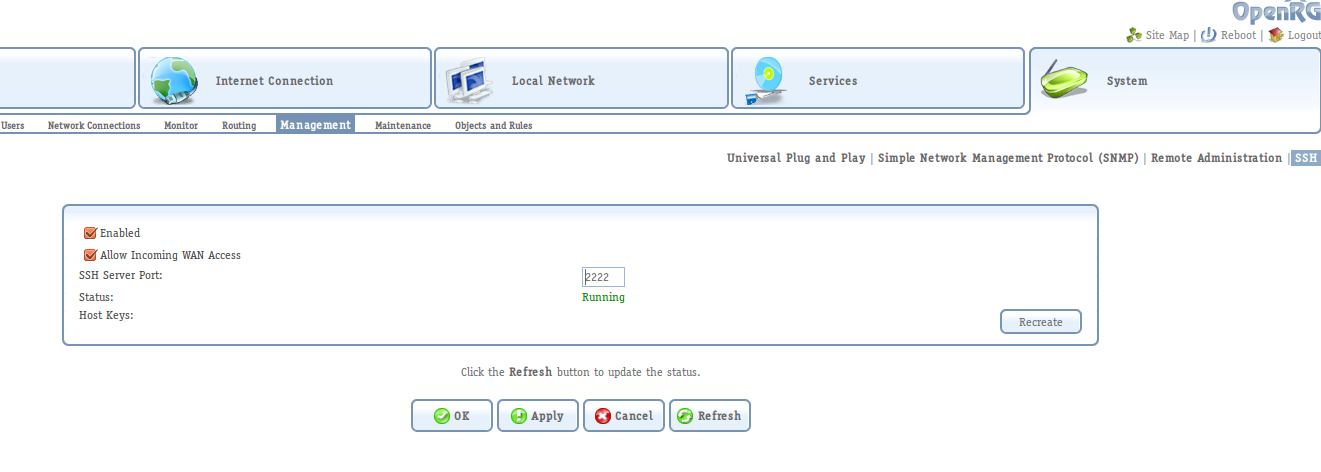
Solution Change router s SSH service port. This step will allow you to access the console-based configuration for the router (since I haven t found any way to do the steps described below from the web management interface). To do so, go to System > Management > SSH. Update the service port to something else than 22, for instance 2222.
OpenRG SSH service configuration

OpenRG SSH service configuration

Connect to the SSH interface Once you have changed the SSH service port, you can access it from a SSH client.
ssh -p 2222 admin@192.168.1.1
admin@192.168.1.1's password: 
OpenRG>
Once you have the console prompt, issue the following commands to allow SSH outbound traffic coming from the LAN and Wifi networks. After the last command, which saves and updates the device s configuration, you should be able to do SSH from any computer in your network to the Internet (thanks to tips from inkhorn).
OpenRG> conf set fw/policy/0/chain/fw_br0_in/rule/0/enabled 0
Returned 0
OpenRG> conf set fw/policy/0/chain/fw_br1_in/rule/0/enabled 0
Returned 0
OpenRG> conf reconf 1
Returned 0

18 March 2015

Mario Lang: Call for Help: BMC -- Braille Music Compiler

Since 2009, I am persuing a personal programming project. As I am not a professional programmer, I have spent quite a lot of that time exploring options. I have thrown out about three or four prototype implementations already. My last implementation seems to contain enough accumulated wisdom to be actually useful. I am far from finished, but the path I am walking now seems relatively sound. So, what is this project about? I have set myself a rather ambitious goal: I am trying to implement a two-way bridge between visual music notation and braille music code. It is called BMC (Braille Music Compiler). My problem: I am, as some of you might remember, 100% blind. So I am trying to write a translator between something I will never see directly, and its counterpart representation in a tactile encoding I had to learn from scratch to be able to work on this project. Braille music code is probably the most cryptic thing I have ever tried to learn. It basically is a method to represent a 2-dimensional structure like staff-notation as a stream of characters encoded in 6-dot braille. As the goal above states, I am ultimately trying to implement a converter that works both ways. One of my prototypes already implemented reading digital staff notation (MusicXML) and transcribing it to Braille. However, to be able to actually understand all the concepts involved, I ended up starting from the other end of the spectrum with my new implementation: parsing braille music code and emitting digital staff notation (LilyPond and MusicXML). This is a rather unique feature, since while there is commercial (and very expensive) software out there to convert MusicXML to braille music code, there is, as far as I know, no system that allows to input un-annotated braille music code and have it automatically converted to sighted music notation. So the current state of things is, that we are able to read certain braille music code formats, and output either reformatted (to new line-width) braille music code, LilyPond or MusicXML. The ultimate goal is to also implement a MusicXML reader, and convert the data to something that can be output as braille music code. While the initial description might not sound very hard, there are a lot of complications arising from how braille music code works, which make this quite a programming challenge. For one, braille music note and rest values are ambigious. A braille music note or rest that looks like a whole can mean a whole or 16th. A braille music note or rest that looks like a half can mean a half or a 32nd. And so on. So each braille music code value can have two meanings. The actual value can be caluclated with a recursive algorithm that I have worked out from scratch over the years. The original implementation was inspired by Samuel Thibault (thanks!) and has since then evolved into something that does what we need, while trying to do that very fast. Most input documents can be processed in almost no time, however, time signatures with a value > 1 (such as 12/8) tend to make the number of possible choices exploed quite heavily. I have found so far one piece from J.S. Bach (BWV988 Variation 3) which takes about 1.5s on my 3GHz AMD (and the code is already using several CPU cores). Additionally, braille music code supports a form of "micro"-repetitions which are not present in visual staff notation which effectively allow certain musical patterns to be compressed if represented in braille. Another algorithmically interesting part of BMC that I have started to taclke just recently is the linebreaking problem. Braille music code has some peculiar rules when it comes to breaking a measure of musical material into several lines. I ended up adapting Donald E. Knuth's algorithm from Breaking Paragraphs into Lines for fixed-width text. In other words, I am ignoring the stretch/shrink factors, while making use of different penalty values to find the perfect solution for the problem of breaking a paragraph of braille music code into several lines. One thing that I have learnt from my perivous prototype (which was apparently useful enough to already acquire some users) is that it is not enough to just transcribe one format to another. I ultimately want to store meta information about the braille that is presented to the user such that I can implement interactive querying and editing features. Braille music code is complicated, and one of the original motivations to work on software to deal with it was to ease the learning curve. A user of BMC should be able to ask the system for a description of a character at a certain position. The user interface (not implemented yet) should allow to play a certain note interactively, or play the measure under the cursor, or play the whole document, and if possible, have the cursor scroll along while playback plays notes. These features are not implemented in BMC yet, but they have been impleemnted in the previous prototype and their usefulness is apparent. Also, when viewing a MusicXML document in braille music code, certain non-structural changes like adding/removing fingering annotations should be possible while preserving unhandled features of the original MusicXML document. This also has been implemented in the previous prototype, and is a goal for BMC.
I need your help The reason why I am explaining all of this here is that I need your help for this project to succeed. Helping the blind to more easily work with traditional music notation is a worthwhile goal to persue. There is no free system around that really tries to adhere to the braille music code standard, and aims to cover converting both ways. I have reached a level of conformance that surpasses every implementation of the same problem that I have seen so far on the net. However, the primary audience of this software is going to be using Windows. We desperately need a port to that OS, and a user interface resembling NotePad with a lot fewer menu entires. We also need a GTK interface that does the same thing on Linux. wxWindows is unfortunately out of question, since it does not provide the same level of Accessibility on all the platforms it supports. Ideally, we'd also have a Cocoa interface for OS X. I am afraid there is no platform independent GUI framework that offers the same level of Accessibility on all supported platforms. And since much of our audience is going to rely on working Accessibility, it looks like we need to implement three user interfaces to achieve this goal :-(. I also desperately need code reviews and inspiration from fellow programmers. BMC is a C++11 project heavily making use of Boost. If you are into one of these things, please give it a whirl, and emit pull requests, no matter how small they are. While I have learnt a lot in the last years, I am sure there are many places that could use some fresh winds of thought by people that are not me. I am suffering from what I call "the lone coder syndrome". I also need (technical) writers to help me complete the pieces of documentation that are already lying around. I have started to write a braille music tutorial based on the underlying capabilities of BMC. In other words, the tutorial includes examples which are being typeset in braille and staff notation, using LilyPond as a rendering engine. However, something like a user manual is missing, basically, because the user interface is missing. BMC is currently "just" a command-line tool (well enough for me) that transcribes input files to STDOUT. This is very good for testing the backend, which is all that has been important to me in the last years. However, BMC has reached a stage now where its functionality is likely useful enough to be exposed to users. While I try to improve things steadily as I can, I realize that I really need to put out this call for help to make any useful progress in a foreseeable time. If you think it is a worthwhile goal to help the blind to more easily work with music notation, and also enable communication between blind and sighted musicians in both ways, please take the time and consider how you could help this project to advance. My email address can be found on my GitHub page. Oh, and while you are over at GitHub, make sure to star BMC if you think it is a nice project. It would be nice if we could produce a end-user oriented release before the end of this year.

16 March 2015

Bits from Debian: Debian is now welcoming applicants for Outreachy and GSoC Summer 2015

We'd like to reshare a post from Nicolas Dandrimont. Hi all, I am delighted to announce that Debian will be participating in the next round of Outreachy and GSoC, and that we are currently welcoming applications! Outreachy logo Outreachy helps people from groups underrepresented in free and open source software get involved. The current round of internships is open to women (cis and trans), trans men, genderqueer people, and all participants of the Ascend Project regardless of gender. GSoC 2015 logo Google Summer of Code is a global program, sponsored by Google, that offers post-secondary student developers ages 18 and older stipends to write code for various open source software projects. Interns for both programs are granted a $5500 stipend (in three installments) allowing them to dedicate their summer to working full-time on Debian. Our amazing team of mentors has listed their project ideas on the Debian wiki, and we are now welcoming applicants for both programs. If you want to apply for an internship with Debian this summer, please fill out the template for either Outreachy or GSoC. If you re eligible to both programs, we ll encourage you to apply to both (using the same application), as Debian only has funds for a single Outreachy intern this round. Don t wait up! The application period for Outreachy ends March 24th, and the GSoC application period ends March 27th. We really want applicants to start contributing to their project before making our selection, so that mentors can get a feel of how working with their intern will be like for three months. The small task is a requirement for Outreachy, and we re strongly encouraging GSoC applicants to abide by that rule too. To contribute in the best conditions, you shouldn t wait for the last minute to apply :-) I hope we ll work with a lot of great interns this summer. If you think you re up for the challenge, it s time to apply! If you have any doubts, or any question, drop us a line on the soc-coordination mailing list or come by on our IRC channel (#debian-soc on irc.debian.org) and we ll do our best to guide you.

14 March 2015

Bits from Debian: apt install dpl-candidate: Neil McGovern

0. Who are you and what's your history with Debian Project? My name's Neil, I've been involved with Debian for over 10 years now. I've held a variety of roles, from the SPI board, writing policy and secure testing team, to being one of the Release Managers for Squeeze and Wheezy. 1. What's your most proud moment as Debian Developer? Probably the release of Squeeze, my first as RM. It was the end of a great effort to get the release out. I particularly remember at the end of DebConf 10 in New York going to the local Disney store and buying every single small squeeze plush toy they had, so I could send a thank you gift to the rest of the release team! Another perhaps was when I first got my Debian kilt. 2. In your opinion what is the strongest part of Debian Project? I think this is our social contract. It guides us, and is what we all agree on. This is our promise to ourselves, to the wider open source community and to our users. 3. And what is the weakest part of Debian Project? At a push, I'd say it's the variety of packages we have in the archive. I'm not sure it's weakness, but it's certainly a challenge. It becomes exponentially harder to ensure that everything integrates well as you add more packages. To have made it do so this far is quite impressive. 4. How do you intend to resolve the weakest part? Well, see the section in my platform on PPAs, and modernising our build and infrastructure system Wouldn't it be great if you could stage a package against all of stable, testing and unstable, and see what fails to build and where, with live build logs on all architectures? 5. DPL term lasts for one year - what would you challenge during that term and what have you learned from previous DPL's? I think my primary role as DPL for 2015 would be to get a great start of development for Stretch. The start of a new release cycle is the exact time to implement wide changes that are potentially disruptive. Every couple of years we seem to relax after the release, rather than get geared up for the next one, and then time passes, and plans slip, and before we know it, the freeze is fast approaching. If we start planning /now/, then we can hopefully enter the freeze with fewer RC bugs, which should be great news for everyone! For the second part, I've talked to a lot of the previous DPLs, and worked with them in one role or another. The main thing I was told was that I shouldn't try and do everything I planned on. It's hard work, and all sorts of things pop up that derail your original plans. 6. What motivates you to work in Debian and run for DPL? The people involved. I've met and worked with some of my greatest friends due to the project. The work, dedication and commitment of those over the years is outstanding. Most of these people are still with us, and unfortunately, a few are not. Whenever I'm feeling disheartened or annoyed, usually due to a giant flame-war then I simply remember that what we're doing is truly remarkable, and the effort that everyone has put in over the years isn't something that should be taken for granted.

6 March 2015

Raphaël Hertzog: My Free Software Activities in February 2015

My monthly report covers a large part of what I have been doing in the free software world. I write it for my donators (thanks to them!) but also for the wider Debian community because it can give ideas to newcomers and it s one of the best ways to find volunteers to work with me on projects that matter to me. Debian LTS This month I have been paid to work 14.5 hours on Debian LTS. I worked mostly on CVE triage (41 commits in the security tracker) and organizational issues. One maintainer complained that he had not been kept in the loop for an LTS update of his package. After some discussion, I decided to change the way I did CVE triage so that any time that I add a package to our list of packages needing an update, I also send a mail to the maintainer, thus offering him the opportunity to step in. To make this sustainable, I wrote a small helper script that will generate a mail out of a template. And to kickstart the process I mailed all maintainers of packages that were already listed in our queue of packages to update. To improve the email generated, I requested a JSON export of the security tracker data (see discussions in #761859). In the mean time, Holger worked on this already and after a few iterations we did converge on an output format that will be really useful both for my needs in terms of CVE triage but also for the Package Tracker to be able to display the list of security vulnerabilities affecting each release (see #761730). Last but not least, I don t want to be the only one doing CVE triage for our LTS release so I documented the process in our wiki page. As a side note, I sponsored an e2fsprogs update prepared by Nguyen Cong and I sent the DLA for the embargoed samba update that had been prepared by Ivo de Decker (thanks to both of them!). Tryton Like last month, I invested again a copious amount of time on Tryton, fixing some bugs that were affecting me and improving the French chart of accounts to properly manage purchases and sales within the European Union. Here are some links for more details: Debian I did some work on Distro Tracker, I fixed #777453 (password reset not working because the generated email was using an invalid From email) and #779247 (obsolete build reproducibility action items were not dropped). I also started to work on restructuring the mail handling in distro-tracker (cf #754913) but it s not public yet. While I have no plans to stop contributing to Debian (it s part of my day job!), I reduced my non-work related involvement by officially recognizing that I was no longer properly assuming some of my responsibilities and that I was following too many mailing lists and RSS feeds. The most notable changes are that I removed myself from the maintenance of dpkg, developers-reference, quilt, sql-ledger, and a few perl/python modules. Misc Voting software. Part of the reason why I m reducing my involvement in Debian is that I got more involved in Nouvelle Donne (a French political party) and in particular in the handling of its digital infrastructure (currently running on Ubuntu, doh!). As part of this, I was looking for free software to handle secure votes and elections (and if possible adhering to the principles of liquid democracy). There s no perfect solution and no clear winner. That said I started following the evolution of AgoraVoting because it seems to have a good momentum and has some interesting features (it already supports votes with ranked choices, supports good crypto, has been used for elections involving large numbers of voters in the context of Podemos in Spain). But it still has some ways to go to establish itself as a truly international and community-backed project. GDM bug. Due to my work on Kali, I filed a bug against GDM (this one has been quickly fixed upstream, it s still open in Debian) and another one against accountsservice to request the possibility to define the default graphical session. Dirvish formula for Salt. I contributed another formula to manage backups with dirvish. Thanks See you next month for a new summary of my activities.

One comment Liked this article? Click here. My blog is Flattr-enabled.

2 March 2015

Michal Čihař: Gammu 1.35.0

Gammu 1.35.0 has been just released. This is just bugfix release to fix some major issues introduced in 1.34.0. Full list of changes: You can download it from http://wammu.eu/download/. I will not make any promises for future releases (if there will be any) as the tool is not really in active development.

Filed under: English Gammu Wammu 0 comments Flattr this!

28 February 2015

Ben Hutchings: Debian LTS work, February 2015

This was my third month working on Debian LTS, and the first where I actually uploaded packages. I also worked on userland packages for the first time. In the middle of February I finished and uploaded a security update for the kernel package (linux-2.6 version 2.6.32-48squeeze11, DLA 155-1). I decided not to include the fix for CVE-2014-9419 and the large FPU/MMX/SSE/AVX state management changes it depends on, as they don't seem to be worth the risk. The old patch system used in linux-2.6 in squeeze still frustrates me, but I committed a script in the kernel subversion repository to simplify adding patches to it. This might be useful to any other LTS team members working on it. In the past week I uploaded security updates for cups (version 1.4.4-7+squeeze7, DLA 159-1) and sudo (1.7.4p4-2.squeeze.5, DLA 160-1). My work on the cups package was slowed down by its reliance on dpatch, which thankfully has been replaced in later versions. sudo is a more modern quilt/debhelper package, but upstream has an odd way of building manual pages. In the version used in squeeze the master format is Perl POD, while in wheezy it's mandoc, but in both cases the upstream source includes pre-generated manual pages and doesn't rebuild them by default. debian/rules is supposed to fix this but doesn't (#779363), so I had to regenerate 'by hand' and fold the changes into the respective patches. Finally, I started work on addressing the many remaining security issues in eglibc. Most of the patches applied to wheezy were usable with minimal adjustment, but I didn't have time left to perform any meaningful testing. I intend to upload what I've done to people.debian.org for testing by interested parties and then make an upload early in March (or let someone else on the LTS or glibc team do so). Update: I sent mail about the incomplete eglibc update to the debian-lts list.

16 February 2015

Julien Danjou: Hacking Python AST: checking methods declaration

A few months ago, I wrote the definitive guide about Python method declaration, which had quite a good success. I still fight every day in OpenStack to have the developers declare their methods correctly in the patches they submit. Automation plan The thing is, I really dislike doing the same things over and over again. Furthermore, I'm not perfect either, and I miss a lot of these kind of problems in the reviews I made. So I decided to replace me by a program a more scalable and less error-prone version of my brain. In OpenStack, we rely on flake8 to do static analysis of our Python code in order to spot common programming mistakes. But we are really pedantic, so we wrote some extra hacking rules that we enforce on our code. To that end, we wrote a flake8 extension called hacking. I really like these rules, I even recommend to apply them in your own project. Though I might be biased or victim of Stockholm syndrome. Your call. Anyway, it's pretty clear that I need to add a check for method declaration in hacking. Let's write a flake8 extension! Typical error The typical error I spot is the following:
class Foo(object):
# self is not used, the method does not need
# to be bound, it should be declared static
def bar(self, a, b, c):
return a + b - c

That would be the correct version:
class Foo(object):
@staticmethod
def bar(a, b, c):
return a + b - c

This kind of mistake is not a show-stopper. It's just not optimized. Why you have to manually declare static or class methods might be a language issue, but I don't want to debate about Python misfeatures or design flaws. Strategy We could probably use some big magical regular expression to catch this problem. flake8 is based on the pep8 tool, which can do a line by line analysis of the code. But this method would make it very hard and error prone to detect this pattern. Though it's also possible to do an AST based analysis on on a per-file basis with pep8. So that's the method I pick as it's the most solid. AST analysis I won't dive deeply into Python AST and how it works. You can find plenty of sources on the Internet, and I even talk about it a bit in my book The Hacker's Guide to Python. To check correctly if all the methods in a Python file are correctly declared, we need to do the following: Flake8 plugin In order to register a new plugin in flake8 via hacking, we just need to add an entry in setup.cfg:
[entry_points]
flake8.extension =
[ ]
H904 = hacking.checks.other:StaticmethodChecker
H905 = hacking.checks.other:StaticmethodChecker

We register 2 hacking codes here. As you will notice later, we are actually going to add an extra check in our code for the same price. Stay tuned. The next step is to write the actual plugin. Since we are using an AST based check, the plugin needs to be a class following a certain signature:
@core.flake8ext
class StaticmethodChecker(object):
def __init__(self, tree, filename):
self.tree = tree

def run(self):
pass

So far, so good and pretty easy. We store the tree locally, then we just need to use it in run() and yield the problem we discover following pep8 expected signature, which is a tuple of (lineno, col_offset, error_string, code). This AST is made for walking The ast module provides the walk function, that allow to iterate easily on a tree. We'll use that to run through the AST. First, let's write a loop that ignores the statement that are not class definition.
@core.flake8ext
class StaticmethodChecker(object):
def __init__(self, tree, filename):
self.tree = tree

def run(self):
for stmt in ast.walk(self.tree):
# Ignore non-class
if not isinstance(stmt, ast.ClassDef):
continue

We still don't check for anything, but we know how to ignore statement that are not class definitions. The next step need to be to ignore what is not function definition. We just iterate over the attributes of the class definition.
for stmt in ast.walk(self.tree):
# Ignore non-class
if not isinstance(stmt, ast.ClassDef):
continue
# If it's a class, iterate over its body member to find methods
for body_item in stmt.body:
# Not a method, skip
if not isinstance(body_item, ast.FunctionDef):
continue

We're all set for checking the method, which is body_item. First, we need to check if it's already declared as static. If so, we don't have to do any further check and we can bail out.
for stmt in ast.walk(self.tree):
# Ignore non-class
if not isinstance(stmt, ast.ClassDef):
continue
# If it's a class, iterate over its body member to find methods
for body_item in stmt.body:
# Not a method, skip
if not isinstance(body_item, ast.FunctionDef):
continue
# Check that it has a decorator
for decorator in body_item.decorator_list:
if (isinstance(decorator, ast.Name)
and decorator.id == 'staticmethod'):
# It's a static function, it's OK
break
else:
# Function is not static, we do nothing for now
pass

Note that we use the special for/else form of Python, where the else is evaluated unless we used break to exit the for loop.
for stmt in ast.walk(self.tree):
# Ignore non-class
if not isinstance(stmt, ast.ClassDef):
continue
# If it's a class, iterate over its body member to find methods
for body_item in stmt.body:
# Not a method, skip
if not isinstance(body_item, ast.FunctionDef):
continue
# Check that it has a decorator
for decorator in body_item.decorator_list:
if (isinstance(decorator, ast.Name)
and decorator.id == 'staticmethod'):
# It's a static function, it's OK
break
else:
try:
first_arg = body_item.args.args[0]
except IndexError:
yield (
body_item.lineno,
body_item.col_offset,
"H905: method misses first argument",
"H905",
)
# Check next method
continue

We finally added some check! We grab the first argument from the method signature. Unless it fails, and in that case, we know there's a problem: you can't have a bound method without the self argument, therefore we raise the H905 code to signal a method that misses its first argument. Now you know why we registered this second pep8 code along with H904 in setup.cfg. We have here a good opportunity to kill two birds with one stone. The next step is to check if that first argument is used in the code of the method.
for stmt in ast.walk(self.tree):
# Ignore non-class
if not isinstance(stmt, ast.ClassDef):
continue
# If it's a class, iterate over its body member to find methods
for body_item in stmt.body:
# Not a method, skip
if not isinstance(body_item, ast.FunctionDef):
continue
# Check that it has a decorator
for decorator in body_item.decorator_list:
if (isinstance(decorator, ast.Name)
and decorator.id == 'staticmethod'):
# It's a static function, it's OK
break
else:
try:
first_arg = body_item.args.args[0]
except IndexError:
yield (
body_item.lineno,
body_item.col_offset,
"H905: method misses first argument",
"H905",
)
# Check next method
continue
for func_stmt in ast.walk(body_item):
if six.PY3:
if (isinstance(func_stmt, ast.Name)
and first_arg.arg == func_stmt.id):
# The first argument is used, it's OK
break
else:
if (func_stmt != first_arg
and isinstance(func_stmt, ast.Name)
and func_stmt.id == first_arg.id):
# The first argument is used, it's OK
break
else:
yield (
body_item.lineno,
body_item.col_offset,
"H904: method should be declared static",
"H904",
)

To that end, we iterate using ast.walk again and we look for the use of the same variable named (usually self, but if could be anything, like cls for @classmethod) in the body of the function. If not found, we finally yield the H904 error code. Otherwise, we're good. Conclusion I've submitted this patch to hacking, and, finger crossed, it might be merged one day. If it's not I'll create a new Python package with that check for flake8. The actual submitted code is a bit more complex to take into account the use of abc module and include some tests. As you may have notice, the code walks over the module AST definition several times. There might be a couple of optimization to browse the AST in only one pass, but I'm not sure it's worth it considering the actual usage of the tool. I'll let that as an exercise for the reader interested in contributing to OpenStack. Happy hacking!
The Hacker's Guide to Python
A book I wrote talking about designing Python applications, state of the art, advice to apply when building your application, various Python tips, etc. Interested? Check it out.

13 February 2015

Jonathan Carter: Debconf 2016 to be hosted in Cape Town

Table Mountain, an icon of Cape Town Long story short, we put in a bid to host Debconf 16 in Cape Town, and we got it! Back at Debconf 12 (Nicaragua), many people asked me when we re hosting a Debconf in South Africa. I just laughed and said Who knows, maybe some day . During the conference I talked to Stefano Rivera (tumbleweed) who said that many people asked him too. We came to the conclusion that we d both really really want to do it but just didn t have enough time at that stage. I wanted to get to a point where I could take 6 months off for it and suggested that we prepare a bid for 2019. Stefano thought that this was quite funny, I think at some point we managed to get that estimate down to 2017-2018. That date crept back even more with great people like Allison Randal and Bernelle Verster joining our team, along with other locals Graham Inggs, Raoul Snyman, Adrianna Pi ska, Nigel Kukard, Simon Cross, Marc Welz, Neill Muller, Jan Groenewald, and our international mentors such as Nattie Mayer-Hutchings, Martin Krafft and Hannes von Haugwitz. Now, we re having that Debconf next year. It s almost hard to believe, not sure how I ll sleep tonight, we ve waited so long for this and we ve got a mountain of work ahead of us, but we ve got a strong team and I think Debconf 2016 attendees are in for a treat! Since I happened to live close to Montr al back in 2012, I supported the idea of a Debconf bid for Montr al first, and then for Cape Town afterwards. Little did I know then that the two cities would be the only two cities bidding against each other 3 years later. I think both cities are superb locations to host a Debconf, and I m supporting Montr al s bid for 2017. Want to get involved? We have a mailing list and IRC channel: #debconf16-capetown on oftc. Thanks again for all the great support from everyone involved so far!

12 February 2015

Daniel Leidert: Setting up a network buildd with pbuilder ... continued

Last year I'd described my setup of a local network-buildd using pbuilder, ccache, inoticoming and NFS. One then-still-open goal was to support different Debian releases. This is especially necessary for backports of e.g. bluefish. The rules to contribute backports require to include all changelog entries since the last version on debian-backports or since stable if it's the first version in an uploaded package. Therefor one needs to know the last version in e.g. wheezy-backports. Because I'm not typing the command (the source package only gets uploaded and inoticoming starts the build process) I was looking for a way to automatically retrieve that version and add the relevant -vX.Y-Z switch to dpkg-buildpackage.The solution I found requires aptitude and a sources.list entry for the relevant release. If you are only interested in the solution, just jump to the end :)I'm going to add the version switch to the DEBBUILDOPTS variable of pbuilder. In my setup I have a common (shared) snippet called /etc/pbuilderrc.inc and one configuration file per release and architecture, say /etc/pbuilderrc.amd64.stable. Now the first already contains ...
DEBBUILDOPTS="-us -uc -j2"
... and DEBBUILDOPTS can be extended in the latter:
DEBBUILDOPTS+="..."
Because the config file is parsed pretty early in the process the package name has not yet been assigned to any variable. The last argument to pbuilder is the .dsc file. So I use the last argument and parse the file to retrieve the source package name.
cat $ @: -1    grep -e ^Source   awk -F\  '  print $2  '
The solution above works, because pbuilder is a BASH script. Otherwise it maybe needs some tweaking. I use the source package name, because it is unique and there is just one :) Now with this name I check for all versions in wheezy* and stable* and sort them. The sort order of aptitude is from low to high, so the last line shopuld contain the highest version. This covers the possibility that there has not yet been a backport or that there is one:
aptitude versions -F '%p' --show-package-names=never --group-by=none --sort=version \
"?narrow(?source-package(^PACKAGE\$), ?or(?archive(^wheezy.*), ?archive(^stable.*)))" \
tail -n 1 sed -e 's#~bpo.*$##g'
The sed-part is necessary because otherwise dh_genchanges will add a superfluous changelog entry (the last one of the last upload). To make things easier, I assign the name and version to variables. So this is the complete solution:

[..]
MYPACKAGE=" cat $ @: -1 grep -e ^Source awk -F\ ' print $2 ' "
MYBPOVERS=" aptitude versions -F '%p' --show-package-names=never --group-by=none --sort=version "?narrow(?source-package(^$MYPACKAGE\$), ?or(?archive(^wheezy.*), ?archive(^stable.*)))" tail -n 1 sed -e 's#~bpo.*$##g' "

log "I: Package is $MYPACKAGE and last stable/bpo version is $MYBPOVERS"

DEBBUILDOPTS+=" -v$MYBPOVERS"
[..]
ExamplesI've recently built a new bluefish backport. The last backport version is 2.2.6-1~bpo70+1. There is also the stable version 2.2.3-4. So the version I need is 2.2.6-1 (2.2.6-1~bpo70+1 < 2.2.6-1!!). Checking the log it works:
I: Package is bluefish and last stable/bpo version is 2.2.6-1
A different example is rsync. I've recently locally rebuilt it for a stable system (wanted to make use of the --chown switch). There is not yet a backport. So the version I (would) need is 3.0.9-4. Checking the logs again and works too:
I: Package is rsync and last stable/bpo version is 3.0.9-4
Feedback appreciated ... Links

11 February 2015

John Goerzen: Reactions to Has modern Linux lost its way? and the value of simplicity

Apparently I touched a nerve with my recent post about the growing complexity of issues. There were quite a few good comments, which I ll mention here. It s provided me some clarity on the problem, in fact. I ll try to distill a few more thoughts here. The value of simplicity and predictability The best software, whether it s operating systems or anything else, is predictable. You read the documentation, or explore the interface, and you can make a logical prediction that when I do action X, the result will be Y. grep and cat are perfect examples of this. The more complex the rules in the software, the more hard it is for us to predict. It leads to bugs, and it leads to inadvertant security holes. Worse, it leads to people being unable to fix things themselves one of the key freedoms that Free Software is supposed to provide. The more complex software is, the fewer people will be able to fix it by themselves. Now, I want to clarify: I hear a lot of talk about ease of use. Gnome removes options in my print dialog box to make it easier to use. (This is why I do not use Gnome. It actually makes it harder to use, because now I have to go find some obscure way to just make the darn thing print.) A lot of people conflate ease of use with ease of learning, but in reality, I am talking about neither. I am talking about ease of analysis. The Linux command line may not have pointy-clicky icons, but at least at one time once you understood ls -l and how groups, users, and permission bits interacted, you could fairly easily conclude who had access to what on a system. Now we have a situation where the answer to this is quite unclear in terms of desktop environments (apparently some distros ship network-manager so that all users on the system share the wifi passwords they enter. A surprise, eh?) I don t mind reading a manpage to learn about something, so long as the manpage was written to inform. With this situation of dbus/cgmanager/polkit/etc, here s what it feels like. This, to me, is the crux of the problem: It feels like we are in a twisty maze, every passage looks alike, and our flashlight ran out of battieries in 2013. The manpages, to the extent they exist for things like cgmanager and polkit, describe the texture of the walls in our cavern, but don t give us a map to the cave. Therefore, we are each left to piece it together little bits at a time, but there are traps that keep moving around, so it s slow going. And it s a really big cave. Other user perceptions There are a lot of comments on the blog about this. It is clear that the problem is not specific to Debian. For instance: This stuff is really important, folks. People being able to maintain their own software, work with it themselves, etc. is one of the core reasons that Free Software exists in the first place. It is a fundamental value of our community. For decades, we have been struggling for survival, for relevance. When I started using Linux, it was both a question and an accomplishment to have a useable web browser on many platforms. (Netscape Navigator was closed source back then.) Now we have succeeded. We have GPL-licensed and BSD-licensed software running on everything from our smartphones to cars. But we are snatching defeat from the jaws of victory, because just as we are managing to remove the legal roadblocks that kept people from true mastery of their software, we are erecting technological ones that make the step into the Free Software world so much more difficult than it needs to be. We no longer have to craft Modelines for X, or compile a kernel with just the right drivers. This is progress. Our hardware is mostly auto-detected and our USB serial dongles work properly more often on Linux than on Windows. This is progress. Even our printers and scanners work pretty darn well. This is progress, too. But in the place of all these things, now we have userspace mucking it up. We have people with mysterious errors that can t be easily assisted by the elders in the community, because the elders are just as mystified. We have bugs crop up that would once have been shallow, but are now non-obvious. We are going to leave a sour taste in people s mouth, and stir repulsion instead of interest among those just checking it out. The ways out It s a nasty predicament, isn t it? What are your ways out of that cave without being eaten by a grue? Obviously the best bet is to get rid of the traps and the grues. Somehow the people that are working on this need to understand that elegance is a feature a darn important feature. Sadly I think this ship may have already sailed. Software diagnosis tools like Enrico Zini s seat-inspect idea can also help. If we have something like an ls for polkit that can reduce all the complexity to something more manageable, that s great. The next best thing is a good map good manpages, detailed logs, good error messages. If software would be more verbose about the permission errors, people could get a good clue about where to look. If manpages for software didn t just explain the cavern wall texture, but explain how this room relates to all the other nearby rooms, it would be tremendously helpful. At present, I am unsure if our problem is one of very poor documentation, or is so bad that good documentation like this is impossible because the underlying design is so complex it defies being documented in something smaller than a book (in which case, our ship has not just sailed but is taking on water). Counter-argument: progress One theme that came up often in the comments is that this is necessary for progress. To a certain extent, I buy that. I get why udev is important. I get why we want the DE software to interact well. But here s my thing: this already worked well in wheezy. Gnome, XFCE, and KDE software all could mount/unmount my drives. I am truly still unsure what problem all this solved. Yes, cloud companies have demanding requirements about security. I work for one. Making security more difficult to audit doesn t do me any favors, I can assure you. The systemd angle To my surprise, systemd came up quite often in the discussion, despite the fact that I mentioned I wasn t running systemd-sysv. It seems like the new desktop environemt ecosystem is the systemd ecosystem in a lot of people s minds. I m not certain this is justified; systemd was not my first choice, but as I said in an earlier blog post, jessie will still boot . A final note I still run Debian on all my personal boxes and I m not going to change. It does awesome things. For under $100, I built a music-playing system, with Raspberry Pis, fully synced throughout my house, using a little scripting and software. The same thing from Sonos would have cost thousands. I am passionate about this community and its values. Even when jessie releases with polkit and all the rest, I m still going to use it, because it is still a good distro from good people.

10 February 2015

John Goerzen: Has modern Linux lost its way? (Some thoughts on jessie)

For years, I used to run Debian sid (unstable) on all my personal machines. Laptops, workstations, sometimes even my personal servers years ago ran sid. Sid was, as its name implies, unstable. Sometimes things broke. But it wasn t a big deal, because I could always get in there and fix it fairly quickly, whatever it was. It was the price I paid for the latest and greatest. For the last number of months, I ve dealt with a small but annoying issue in jessie: None of Nautilus, Thunar, or digikam (yes, that represents Gnome, XFCE, and KDE) can mount USB drives I plug in anymore. I just get Not authorized to perform operation. I can, of course, still mount -o uid=1000 /dev/sdc1 /mnt, but I miss the convenience of doing it this way. One jessie system I switched to systemd specifically to get around this problem. It worked, but I don t know why. I haven t had the time to switch my workstation, and frankly I am concerned about it. Here s the crux of the issue: I don t even know where to start looking. I ve googled this issue, and found all sorts of answers pointing to polkit, or dbus, or systemd-shim, or cgmanager, or lightdm, or XFCE, or I found a bug report of this exact problem Debian #760281, but it s marked fixed, and nobody replied to my comment that I m still seeing it. Nowhere is it documented that a Digikam mounting issue should have me looking in polkit, let alone cgmanager. And even once I find those packages, their documentation suffers from Bad Unix Documentation Disease: talking about the nitty-gritty weeds view of something, without bothering to put it in context. Here is the mystifying heading for the cgmanager(8) manpage:
cgmanager is a daemon to manage cgroups. Programs and users can make D-Bus requests to administer cgroups over which they have privilege. To ensure that users may not exceed their privilege in manipulating cgroups, the cgroup manager accepts regular D-Bus requests only from tasks within its own process-id and user namespaces. For tasks in private namespaces (such as containers), SCM-enhanced D-Bus calls are available. Using these manually is not recommended. Rather, each container is advised to run a cgproxy, which will forward plain D-Bus requests as SCM-enhanced D-Bus requests to the host cgmanager.
That s about as comprehensible as Vogon poetry to me. How is cgmanager started? What does SCM-enhanced mean? And I even know what a cgroup is. This has been going on for months, which has me also wondering: is it only me? (Google certainly suggests it s not, and there are plenty of hits for this exact problem with many distros, and some truly terrible advice out there to boot.) And if not, why is something so basic and obvious festering for so long? Have we built something that s too complex to understand and debug? This is, in my mind, orthogonal to the systemd question. I used to be able to say Linux was clean, logical, well put-together, and organized. I can t really say this anymore. Users and groups are not really determinitive for permissions, now that we have things like polkit running around. (Yes, by the way, I am a member of plugdev.) Error messages are unhelpful (WHY was I not authorized?) and logs are nowhere to be found. Traditionally, one could twiddle who could mount devices via /etc/fstab lines and perhaps some sudo rules. Granted, you had to know where to look, but when you did, it was simple; only two pieces to fit together. I ve even spent time figuring out where to look and STILL have no idea what to do. systemd may help with some of this, and may hurt with some of it; but I see the problem more of an attitude of desktop environments to add features fast without really thinking of the implications. There is something to be said for slower progress if the result is higher quality. Then as I was writing this, of course, my laptop started insisting that it needed the root password to suspend when I close the lid. And it s running systemd. There s another quagmire Update: Part 2 with some reactions to this and further thoughts is now available.

6 February 2015

Antoine Beaupr : Migrating from Drupal to Ikiwiki

TLPL; j'ai chang de logiciel pour la gestion de mon blog. TLDR; I have changed my blog from Drupal to Ikiwiki. Note: since this post uses ikiwiki syntax (i just copied it over here), you may want to read the original version instead of this one. will continue operating for a while to
give a chance to feed aggregators to catch that article. It will also
give time to the Internet archive to catchup with the static
stylesheets (it turns out it doesn't like Drupal's CSS compression at
all!) An archive will therefore continue being available on the
internet archive for people that miss the old stylesheet. Eventually, I will simply redirect the anarcat.koumbit.org URL to
the new blog location, . This will likely be my
last blog post written on Drupal, and all new content will be
available on the new URL. RSS feed URLs should not change.

Why I am migrating away from Drupal because it is basically impossible to
upgrade my blog from Drupal 6 to Drupal 7. Or if it is, I'll have to
redo the whole freaking thing again when Drupal 8 comes along. And frankly, I don't really need Drupal to run a blog. A blog was
originally a really simple thing: a web blog. A set of articles
written on the corner of a table. Now with Drupal, I can add
ecommerce, a photo gallery and whatnot to my blog, but why would I do
that? and why does it need to be a dynamic CMS at all, if I get so
little comments? So I'm switching to ikiwiki, for the following reason:
  • no upgrades necessary: well, not exactly true, i still need to
    upgrade ikiwiki, but that's covered by the Debian package
    maintenance and I only have one patch to it, and there's no data migration! (the last such migration in ikiwiki was in 2009 and was fully supported)
  • offline editing: this is a a big thing for me: i can just note
    things down and push them when I get back online
  • one place for everything: this blog is where I keep my notes, it's
    getting annoying to have to keep track of two places for that stuff
  • future-proof: extracting content from ikiwiki is amazingly
    simple. every page is a single markdown-formatted file. that's it.
Migrating will mean abandoning the
barlow theme, which was
seeing a declining usage anyways.

What So what should be exported exactly. There's a bunch of crap in the old
blog that i don't want: users, caches, logs, "modules", and the list
goes on. Maybe it's better to create a list of what I need to extract:
  • nodes
    • title ([[ikiwiki/directive/meta]] title and guid tags, guid to avoid flooding aggregators)
    • body (need to check for "break comments")
    • nid (for future reference?)
    • tags (should be added as \[[!tag foo bar baz]] at the bottom)
    • URL (to keep old addresses)
    • published date ([[ikiwiki/directive/meta]] date directive)
    • modification date ([[ikiwiki/directive/meta]] updated directive)
    • revisions?
    • attached files
  • menus
    • RSS feed
    • contact
    • search
  • comments
    • author name
    • date
    • title
    • content
  • attached files
    • thumbnails
    • links
  • tags
    • each tag should have its own RSS feed and latest posts displayed

When Some time before summer 2015.

Who Well me, who else. You probably really don't care about that, so let'S
get to the meat of it.

How How to perform this migration... There are multiple paths:
  • MySQL commandline: extracting data using the commandline mysql tool (drush sqlq ...)
  • Views export: extracting "standard format" dumps from Drupal and
    parse it (JSON, XML, CSV?)
Both approaches had issues, and I found a third way: talk directly to
mysql and generate the files directly, in a Python script. But first,
here are the two previous approaches I know of.

MySQL commandline LeLutin switched using MySQL requests,
although he doesn't specify how content itself was migrated. Comments
importing is done with that script:
echo "select n.title, concat('  [[!comment  format=mdwn  username=\"', c.name, '\"  ip=\"', c.hostname, '\"  subject=\"', c.subject, '\"  date=\"', FROM_UNIXTIME(c.created), '\"  content=\"\"\" ', b.comment_body_value, ' \"\"\"]]') from node n, comment c, field_data_comment_body b where n.nid=c.nid and c.cid=b.entity_id;"   drush sqlc   tail -n +2   while read line; do if [ -z "$i" ]; then i=0; fi; title=$(echo "$line"   sed -e 's/[    ]\+ .*//' -e 's/ /_/g' -e 's/[:(),?/+]//g'); body=$(echo "$line"   sed 's/[^ ]*  //'); mkdir -p ~/comments/$title; echo -e "$body" &gt; ~/comments/$title/comment_$i._comment; i=$((i+1)); done
Kind of ugly, but beats what i had before (which was "nothing"). I do think it is the good direction to take, to simply talk to the
MySQL database, maybe with a native Python script. I know the Drupal
database schema pretty well (still! this is D6 after all) and it's
simple enough that this should just work.

Views export [[!img 2015-02-03-233846_1440x900_scrot.png class="align-right" size="300x" align="center" alt="screenshot of views 2.x"]] mvc recommended views data export on Lelutin's
blog. Unfortunately, my experience with the views export interface has
been somewhat mediocre so far. Yet another reason why I don't like
using Drupal anymore is this kind of obtuse dialogs: I clicked through those for about an hour to get JSON output that
turned out to be provided by views bonus instead of
views_data_export. And confusingly enough, the path and
format_name fields are null in the JSON output
(whyyy!?). views_data_export unfortunately only supports XML,
which seems hardly better than SQL for structured data, especially
considering I am going to write a script for the conversion anyways. Basically, it doesn't seem like any amount of views mangling will
provide me with what i need. Nevertheless, here's the [[failed-export-view.txt]] that I was able to
come up with, may it be useful for future freedom fighters.

Python script I ended up making a fairly simple Python script to talk directly to
the MySQL database. The script exports only nodes and comments, and nothing else. It makes
a bunch of assumptions about the structure of the site, and is
probably only going to work if your site is a simple blog like mine,
but could probably be improved significantly to encompass larger and
more complex datasets. History is not preserved so no interaction is
performed with git.

Generating dump First, I imported the MySQL dump file on my local mysql server for easier
development. It is 13.9MiO!!
mysql -e 'CREATE DATABASE anarcatblogbak;'
ssh aegir.koumbit.net "cd anarcat.koumbit.org ; drush sql-dump"   pv   mysql anarcatblogbak
I decided to not import revisions. The majority (70%) of the content has
1 or 2 revisions, and those with two revisions are likely just when
the node was actually published, with minor changes. ~80% have 3
revisions or less, 90% have 5 or less, 95% 8 or less, and 98% 10 or
less. Only 5 articles have more than 10 revisions, with two having the
maximum of 15 revisions. Those stats were generated with:
SELECT title,count(vid) FROM anarcatblogbak.node_revisions group
by nid;
Then throwing the output in a CSV spreadsheet (thanks to
mysql-workbench for the easy export), adding a column numbering the
rows (B1=1,B2=B1+1), another for generating percentages
(C1=B1/count(B$2:B$218)) and generating a simple graph with
that. There were probably ways of doing that more cleanly with R,
and I broke my promise to never use a spreadsheet again, but then
again it was Gnumeric and it's just to get a rough idea. There are 196 articles to import, with 251 comments, which means an
average of 1.15 comment per article (not much!). Unpublished articles
(5!) are completely ignored. Summaries are also not imported as such (break comments are
ignored) because ikiwiki doesn't support post summaries.

Calling the conversion script The script is in [[drupal2ikiwiki.py]]. It is called with:
./drupal2ikiwiki.py -u anarcatblogbak -d anarcatblogbak blog -vv
The -n and -l1 have been used for first tests as well. Use this
command to generate HTML from the result without having to commit and
push all:
ikiwiki --plugin meta --plugin tag --plugin comments --plugin inline  . ../anarc.at.html
More plugins are of course enabled in the blog, see the setup file for
more information, or just enable plugin as you want to unbreak
things. Use the --rebuild flag on subsequent runs. The actual
invocation I use is more something like:
ikiwiki --rebuild --no-usedirs --plugin inline --plugin calendar --plugin postsparkline --plugin meta --plugin tag --plugin comments --plugin sidebar  . ../anarc.at.html
I had problems with dates, but it turns out that I wasn't setting
dates in redirects... Instead of doing that, I started adding a
"redirection" tag that gets ignored by the main page.

Files and old URLs The script should keep the same URLs, as long as pathauto is enabled
on the site. Otherwise, some logic should be easy to add to point to
node/N. To redirect to the new blog, rewrite rules, on original blog, should
be as simple as:
Redirect / http://anarc.at/blog/
When we're sure:
Redirect permanent / http://anarc.at/blog/
Now, on the new blog, some magic needs to happen for files. Both
/files and /sites/anarcat.koumbit.org/files need to resolve
properly. We can't use symlinks because
ikiwiki drops symlinks on generation. So I'll just drop the files in /blog/files directly, the actual
migration is:
cp $DRUPAL/sites/anarcat.koumbit.org/files $IKIWIKI/blog/files
rm -r .htaccess css/ js/ tmp/ languages/
rm foo/bar # wtf was that.
rmdir *
sed -i 's#/sites/anarcat.koumbit.org/files/#/blog/files/#g' blog/*.mdwn
sed -i 's#http://anarcat.koumbit.org/blog/files/#/blog/files/#g' blog/*.mdwn
chmod -R -x blog/files
sudo chmod -R +X blog/files
A few pages to test images:
  • http://anarcat.koumbit.org/node/157
  • http://anarcat.koumbit.org/node/203
There are some pretty big files in there, 10-30MB MP3s - but those are
already in this wiki! so do not import them! Running fdupes on the result helps find oddities. The meta guid directive is used to keep the aggregators from finding
duplicate feed entries. I tested it with Liferea, but it may freak out
some other sites.

Remaining issues
  • postsparkline and calendar archive disrespect meta(date)
  • merge the files in /communication with the ones in /blog/files
    before import
  • import non-published nodes
  • check nodes with a format different than markdown (only a few 3=Full
    HTML
    found so far)
  • replace links to this wiki in blog posts with internal links
More progress information in [[the script drupal2ikiwiki.py]] itself.

Gunnar Wolf: On the number of attempts on brute-force login attacks

I would expect brute-force login attacks to be more common. And yes, at some point I got tired of ssh scans, and added rate-limiting firewall rules, even switched the daemon to a nonstandard port... But I have very seldom received an IMAP brute-force attack. I have received countless phishing scams on my users, and I know some of them have bitten because the scammers then use their passwords on my servers to send tons of spam. Activity is clearly atypical. Anyway, yesterday we got a brute-force attack on IMAP. A very childish atack, attempted from an IP in the largest ISP in Mexico, but using only usernames that would not belong in our culture (mosty English firstnames and some usual service account names). What I find interesting to see is that each login was attempted a limited (and different) amount of times: Four account names were attempted only once, eight were attempted twice, and so on following this pattern:
 1  
 2  
 3  
 4  
 5  
 6  
 7  
 8  
 9  
10  
11  
12  
13  
14  
15  
16  
17  
18  
19  
20  
21  
22  
(each dot represents four attempts) So... What's significant in all this? Very little, if anything at all. But for such a na ve login attack, it's interesting to see the number of attempted passwords per login varies so much. Yes, 273 (over of the total) did 22 requests, and another 200 were 18 and more. The rest... Fell quite shorter. In case you want to play with the data, you can grab the list of attempts with the number of requests. I filtered out all other data, as i was basically meaningless. This file is the result of:
  1. $ grep LOGIN /var/log/syslog.1
  2. grep FAILED.*201.163.94.42
  3. awk ' print $7 " " $8 '
  4. sort uniq -c
AttachmentSize
logins.txt27.97 KB

30 January 2015

Rapha&#235;l Hertzog: My Free Software Activities for January 2015

My monthly report covers a large part of what I have been doing in the free software world. I write it for my donators (thanks to them!) but also for the wider Debian community because it can give ideas to newcomers and it s one of the best ways to find volunteers to work with me on projects that matter to me. Debian LTS This month I have been paid to work 12 hours on Debian LTS. I did the following tasks: I want to expand on two cases that I stumbled upon in my CVE triage work and that took quite long to investigate each. While my after-the-fact description is rather straightforward, the real process involved more iterations and data gathering that I do not mention here. First I was investigating CVE-2012-6685 on libnokogiri-ruby and the upstream bug discussion revealed that libxml2 could also be part of the problem. Using the tests cases submitted there, I confirmed that libxml2 was also affected by an issue of its own then I started to analyze the history of CVE of libxml2 to find out whether that issue got a CVE assigned: yes, that was CVE-2014-0191 (although the CVE description is unrelated). But this CVE was marked as fixed in all releases. Why? It turns out that the upstream fix for this CVE is just the complement of another commit that was merged way earlier (and that was used as a basis for the commit as the copy/paste of the comment shows). When the security teams integrated the upstream patch in wheezy/squeeze, they were probably not aware that a full fix required to also include something else. In the end, I thus reopened CVE-2014-0191 on our tracker (commit here). The second problematic case was pound. Thijs Kinkhorst added pound related data on the multiple (high profile) SSL related issues. So it appeared on my radar of new vulnerable package in Squeeze because it was marked that CVE-2009-3555 was fixed in version 2.6-2 while Squeeze has 2.5-1. There was no bug reference in the security tracker and the Debian changelog for that version only mentioned an anti_beast patch which is yet another issue (CVE-2011-3389). I had to dig a bit deeper in the end I discovered that the above patch also has provisions for the CVE that was of interest to me, except that Brian May recently reported in #765649 that the package was still vulnerable to this issue I tried to understand where the above patch was failing and thus submitted my findings to the bug. And I updated the tracker data with my newly gained knowledge (commit 31751 and 31752). Tryton For me, January is always the month where I try to close the accounting books of Freexian. This year is no exception except that it s the first year where I do this with Tryton. I first upgraded to Tryton 3.4 to have the latest version. Despite this I discovered multiple problems while doing so since I don t want to have those problems next year, I reported them and prepared fixes for those related to the French chart of accounts: Saltstack I mentioned this idea last month setting up and maintaining a lot of sbuild chroots can be tiresome so I wanted to automate this as much as possible. To achieve this I created three Salt formulas and got them added to the official Saltstack repository: Each one builds on top of the former. debootstrap-formula creates chroots with debootstrap or cdebootstrap. schroot-formula does the same and registers those chroots in schroot. And sbuild-formula does the same as schroot-formula but with different defaults that are more suited to sbuild chroots (and obviously ensures that sbuild is installed and that generated chroots are buildd chroots). With the sbuild formula I can put this in pillar data:
sbuild:
  chroots:
    wheezy:
      architectures: [amd64, i386]
      extra_dists:
        - wheezy-backports
        - wheezy-security
      extra_aliases:
        - wheezy-backports
        - stable-security
        - wheezy-security
    jessie:
    [...]
And then a simple salt-call state.highstate (I m running in standalone mode) will ensure that I have all the chroots properly setup. Misc packaging I packaged new upstream releases of Django in experimental and opened a pre-approval request to get the latest 1.7.x in jessie (#775892). It seems to be a difficult sell for the release team, which is a pity because we have active Debian developers, active upstream developers, and everybody is well aware of the no-new features rule to avoid regressions. Where is the risk? I also filed an unblock request for Dolibarr (on the request of the security team which wants to see the CVE fix reach Jessie). I did small contributions to two bugs that were of special interest to some of my donators (#751339 and #774811), they were not under my responsibility but I tried to get them moving by pinging the relevant people. I prepared a security upload for Django in Wheezy (python-django_1.4.5-1+deb7u9) and sent it to the security team. While doing this I discovered a small problem in their backported patch that I reported upstream in Django s ticket #24239. Debian France With the new year, it s again time to organize a general assembly with the election of a third of its board. So we solicited candidacies among the members and I m pleased to see that we got 6 candidacies for the 3 seats. It s a good sign that we still have enough persons caring about the association. One of them is even speaking of Debconf 17 in France great plans! On my side, I announced that I would not candidate to be president for the next year. I will stay on the board though to ensure we have a smooth transition. Thanks See you next month for a new summary of my activities.

One comment Liked this article? Click here. My blog is Flattr-enabled.

29 January 2015

Craig Small: Juniper Firewalls and IPv6

A little firewall I found an interesting side-effect of the Juniper firewalls when you introduce IPv6. In hindsight it appears perfectly reasonable but if you are not aware of it in the first place you may have a much more permissive firewall than you thought. My setup is such that my internet address changes every time I connect to an ISP. I have services behind the Juniper that I want to expose onto the Internet, in this case a mailserver. Most of the documentation states to have a reasonably open firewall rule and a nat rule.
[edit security nat]
destination  
    pool mailserver-smtp  
        address 10.1.1.1/32 port 25;
     
 
[edit security policies]
from-zone Internet to-zone Internal  
    policy Mailserver  
        match  
            source-address any;
            destination-address any;
            application smtp;
         
        then  
             permit;


Pretty standard stuff and its documented in plenty of places. We cannot set a destination address because its dynamic, so set it to all. My next step was, ok my mailserver is on IPv4 and IPv6, how do I let the IPv6 connections in? Any means ANY That s where I noticed I had a problem, they could already get in. In fact anyone could get to the mailserver (good) and anything else that had an open SMTP port on my network and used IPv6 (bad). It seems that any destination address means ANY IPv4 or IPv6 address. Both myself and the writers of the documentation hadn t initially thought of what happens when you add IPv6. The solution is to not let any destination, but any IPv4 and the specific mailserver destination. First create an addressbook entry for the IPv6 address of the mailserver.
[edit security address-book global]
address mailserver-ipv6 2001:Db8:1111:2222::100/128;
then adjust the rule
[edit security policies]
from-zone Internet to-zone Internal  
    policy Mailserver  
        match  
            source-address any;
            destination-address [ any-ipv4 mailserver-ipv6];
            application smtp;
         
        then  
             permit;


That way there is access to the mailserver using either IPv4 or IPv6. I m also going to try to see if I adjust the rule so the destination only includes the mailserver address (both IPv4 and IPv6) even though the IPv4 is NATed and see if that works.

23 January 2015

Michael Prokop: check-mk: monitor switches for GBit links

For one of our customers we are using the Open Monitoring Distribution which includes Check_MK as monitoring system. We re monitoring the switches (Cisco) via SNMP. The switches as well as all the servers support GBit connections, though there are some systems in the wild which are still operating at 100MBit (or even worse on 10MBit). Recently there have been some performance issues related to network access. To make sure it s not the fault of a server or a service we decided to monitor the switch ports for their network speed. By default we assume all ports to be running at GBit speed. This can be configured either manually via:
cat etc/check_mk/conf.d/wato/rules.mk
[...]
checkgroup_parameters.setdefault('if', [])
checkgroup_parameters['if'] = [
  (  'speed': 1000000000 , [], ['switch1', 'switch2', 'switch3', 'switch4'], ALL_SERVICES,  'comment': u'GBit links should be used as default on all switches'  ),
] + checkgroup_parameters['if']
or by visting Check_MK s admin web-interface at WATO Configuration -> Host & Service Parameters -> Parameters for Inventorized Checks -> Networking -> Network interfaces and switch ports and creating a rule for the Explicit hosts switch1, switch2, etc and setting Operating speed to 1 GBit/s there. So far so straight forward and this works fine. Thanks to this setup we could identify several systems which used 100Mbit and 10MBit links. Definitely something to investigate on the according systems with their auto-negotiation configuration. But to avoid flooding the monitoring system and its notifications we want to explicitly ignore those systems in the monitoring setup until those issues have been resolved. First step: identify the checks and their format by either invoking cmk -D switch2 or looking at var/check_mk/autochecks/switch2.mk:
OMD[synpros]:~$ cat var/check_mk/autochecks/switch2.mk
[
  ("switch2", "cisco_cpu", None, cisco_cpu_default_levels),
  ("switch2", "cisco_fan", 'Switch#1, Fan#1', None),
  ("switch2", "cisco_mem", 'Driver text', cisco_mem_default_levels),
  ("switch2", "cisco_mem", 'I/O', cisco_mem_default_levels),
  ("switch2", "cisco_mem", 'Processor', cisco_mem_default_levels),
  ("switch2", "cisco_temp_perf", 'SW#1, Sensor#1, GREEN', None),
  ("switch2", "if64", '10101',  'state': ['1'], 'speed': 1000000000 ),
  ("switch2", "if64", '10102',  'state': ['1'], 'speed': 1000000000 ),
  ("switch2", "if64", '10103',  'state': ['1'], 'speed': 1000000000 ),
  [...]
  ("switch2", "snmp_info", None, None),
  ("switch2", "snmp_uptime", None,  ),
]
OMD[synpros]:~$
Second step: translate this into the according format for usage in etc/check_mk/main.mk:
checks = [
  ( 'switch2', 'if64', '10105',  'state': ['1'], 'errors': (0.01, 0.1), 'speed': None ), # MAC: 00:42:de:ad:be:af,  10MBit
  ( 'switch2', 'if64', '10107',  'state': ['1'], 'errors': (0.01, 0.1), 'speed': None ), # MAC: 00:23:de:ad:be:af, 100MBit
  ( 'switch2', 'if64', '10139',  'state': ['1'], 'errors': (0.01, 0.1), 'speed': None ), # MAC: 00:42:de:ad:be:af, 100MBit
  [...]
]
Using this configuration we ignore the operation speed on ports 10105, 10107 and 10139 of switch2 using the the if64 check. We kept the state setting untouched where sensible ( 1 means that the expected operational status of the interface is to be up ). The errors settings specifies the error rates in percent for warnings (0.01%) and critical (0.1%). For further details refer to the online documentation or invoke cmk -M if64 . Final step: after modifying the checks configuration make sure to run cmk -IIu switch2 ; cmk -R to renew the inventory for switch2 and apply the changes. Do not forget to verify the running configuration by invoking cmk -D switch2 : Screenshot of 'cmk -D switch2' execution

15 January 2015

Noah Meyerhans: Spamassassin updates

If you're running Spamassassin on Debian or Ubuntu, have you enabled automatic rule updates? If not, why not? If possible, you should enable this feature. It should be as simple as setting "CRON=1" in /etc/default/spamassassin. If you choose not to enable this feature, I'd really like to hear why. In particular, I'm thinking about changing the default behavior of the Spamassassin packages such that automatic rule updates are enabled, and I'd like to know if (and why) anybody opposes this. Spamassassin hasn't been providing rules as part of the upstream package for some time. In Debian, we include a snapshot of the ruleset from an essentially arbitrary point in time in our packages. We do this so Spamassassin will work "out of the box" on Debian systems. People who install spamassassin from source must download rules using spamassassin's updates channel. The typical way to use this service is to use cron or something similar to periodically check for rule changes via this service. This allows the anti-spam community to quickly adapt to changes in spammer tactics, and for you to actually benefit from their work by taking advantage of their newer, presumably more accurate, rules. It also allows for quick reaction to issues such as the one described in bug 738872 and 774768. If we do change the default, there are a couple of possible approaches we could take. The simplest would be to simply change the default value of the CRON variable in /etc/default/spamassassin. Perhaps a cleaner approach would be to provide a "spamassassin-autoupdates" package that would simply provide the cron job and a simple wrapper program to perform the updates. The Spamassassin package would then specify a Recommends relationship with this package, thus providing the default enabled behavior while still providing a clear and simple mechanism to disable it.

9 January 2015

Dirk Eddelbuettel: random 0.2.3

A new release of my random package for truly (hardware-based) random numbers as provided by random.org is now on CRAN. The main change is a switch to the curl() function from the eponymous package by Jeroen Ooms. This was caused by random.org now using https instead of http, annd the fact that te url() function from R does not cope well with the redirect. Besides this (enforced) change, everything else remains the same. Courtesy of CRANberries comes a diffstat report for this release. Current and previous releases are available here as well as on CRAN.

This post by Dirk Eddelbuettel originated on his Thinking inside the box blog. Please report excessive re-aggregation in third-party for-profit settings.

6 January 2015

Russ Allbery: Review: Code Complete, Second Edition

Review: Code Complete, Second Edition, by Steve McConnell
Publisher: Microsoft
Copyright: June 2004
ISBN: 0-7356-1967-0
Format: Kindle
Pages: 960
As mentioned in the title, this is a review of the second edition of Code Complete, published in 2004. There doesn't appear to be a later edition at the time of this writing. I should say, as a prefix to this review, that I'm the sort of person who really likes style guides. When learning a language, a style guide is usually the second or third document I read. I enjoy debates over the clearest way to express a concept in code, trying to keep all the code in a large project consistent, and discussing the subtle trade-offs that sit on the boundary between mechanical style issues and the expressiveness of programming. I try to spend some time reading good code and getting better at expressing myself in code. Presumably, therefore, I'm the target audience for this book. It sounded good from the descriptions, so I picked it up during one of the Microsoft Press sales. The stated goal of Code Complete is to collect in one place as much as possible of the oral tradition and lore of the programming field, to try to document and communicate the techniques and approaches that make someone a good programmer. The table of contents sounds like a style guide, with entire sections on variables and statements in addition to topics like how to improve existing code and how to design a new program. If you're starting to think that a 960 page style guide sounds like a bad idea, you're wiser than I. (In my defense, I grabbed this as an ebook and didn't realize how large it was before I bought it.) I have not actually finished this book. I hate to do this: I don't like reviewing books I haven't finished (this will be the first), and I hate starting books and not finishing them. (This is probably not particularly wise, since some books aren't worth finishing, but I've gotten into a rhythm of reading and reviewing that works for me, so I try not to mess with it.) But I've been trying to finish this book off and on for about a year, I don't think it's worth the time investment, and I think I've gotten far enough in it to provide some warnings by others who are deceived by the very high ratings that it gets on Amazon and other places. The primarily problem with Code Complete is its sheer, mind-numbing comprehensiveness. It tries to provide a set of guidelines and a checklist to think about at each level of writing code. This is one of those ideas that might sound good on paper, but which completely doesn't work for me. There is no way I'm going to keep this many rules in my head, in the form of rules, while programming. Much of good style has to be done by feel, and the book I'm looking for is one that improves my feel and my sense of taste for code. What Code Complete seems to provide instead is a compilation of every thought that McConnell has ever had about programming. There's a lot of basic material, a few thoughtful statements, a ton of style advice, an endless compilation of trade-offs and concepts that one should keep in mind, and just a massive, overwhelming pile of stuff. Each chapter (and there are a lot of chapters) ends in a checklist of things that you should think about when doing a particular programming task. To give you a feel for the overwhelming level of trivia here, this is the checklist at the end of the chapter where I stopped reading, on quality assurance in software. This is one picked at random; a lot of them are longer than this.
  • Have you identified specific quality characteristics that are important to your project?
  • Have you made others aware of the project's quality objectives?
  • Have you differentiated between external and internal quality characteristics?
  • Have you thought about the ways in which some characteristics might compete with or complement others?
  • Does your project call for the use of several different error-detection techniques suited to finding several different kinds of errors?
  • Does your project include a plan to take steps to assure software quality during each stage of software development?
  • Is the quality measured in some way so that you can tell whether it's improving or degrading?
  • Does management understand that quality assurance incurs additional costs up front in order to save costs later?
I'm not saying those are bad things to think about with quality assurance, but you may notice a few issues immediately. They're very general and vague, they're not phrased in a particularly compelling or memorable way, and there are a lot of them. This falls between two stools: it's too much for the programmer who is thinking about quality as part of an overall project but not focusing on it (particularly when you consider that the book is full of checklists like this for everything from variable naming to how to structuring if statements to program debugging), but it's not nearly specific or actionable enough for someone who is focusing on quality assurance. It's not that the information isn't organized: there's a lot of structure here. And there are bits and pieces here that are occasionally interesting. McConnell is very data-driven and tries to back up recommendations with research on error rates and similar concrete measurements. It's just insufficiently filtered and without elegant or memorable summary. There is far too much here, an overwhelming quantity, and hopelessly mixed between useful tidbits and obvious observations that anyone who has been programming for a while would pick up, all presented in the same earnest but dry tone. It didn't help that there's a lot here I didn't agree with. Some of that is to be expected: I've never agreed completely with any style guide. But McConnell kept advocating variable and function naming conventions that I find rather ugly and tedious, and the general style of code he advocates feels very "bureaucratic" to me. It's not exactly wrong, but one of the things that I look for in style discussions is to be inspired by the elegant and simple way someone finds to phrase something in code. A lot of the code in this book just felt mind-numbing. It's functional, but uninteresting; perfectly adequate for a large project, but not the sort of discussion that inspires me to improve the quality of my craft. So, I didn't finish this. I gave up about halfway through. It's frustrating, since I was occasionally finding an interesting nugget of information. But they were too few and far between, and the rest of the book was mostly... boring. It's possible that I just know too much about programming to be the person for whom that McConnell was writing this book. It's certainly true that the book has not aged particularly well; it's focused on fairly old-school languages (C, C++, Java, and Visual Basic) and says almost nothing about modern language techniques, although it does have a bit about extreme programming. But whatever the reason is, it didn't work for me at all. I would rate it as one of the worst books about programming I've tried to read. And that's notably different enough from its reviews that it seems worth throwing this out there as a warning. I'm quite disappointed, since I'd heard nothing but praise for this book before picking it up. But it's not for me, and I'm now dubious of its value for any programmer outside of a fairly narrow, large-team, waterfall development process involving large numbers of people writing very large quantities of code in languages that aren't very expressive. And, well, in that situation I think one would get more benefit from changing that environment than reading this book. Rating: unfinished

Next.

Previous.