Search Results: "rra"

11 August 2014

Juliana Louback: JSCommunicator - Setup and Architecture

Preface During Google Summer of Code 2014, I got to work on the Debian WebRTC portal under the mentorship of Daniel Pocock. Now I had every intention of meticulously documenting my progress at each step of development in this blog, but I was a bit late in getting the blog up and running. I ll now be publishing a series of posts to recap all I ve done during GSoC. Better late than never. Intro JSCommunicator is a SIP communication tool developed in HTML and JavaScript. The code was designed to make integrating JSCommunicator with a website or web app as simple as possible. It s quite easy, really. However, I do think a more detailed explanation on how to set things up and a guide to the JSCommunicator architecture could be of use, particularly for those wanting to modify the code in any way. Setup To begin, please fork the JSCommunicator repo. If you are new to git, feel free to follow the steps in section Setup and Clone in this post. If you read the README file (which you always should), you ll see that JSCommunicator needs a SIP proxy that supports SIP over Websockets transport. Some options are: I didn t find a tutorial for Kamailio setup, I did find one for repro setup. And bonus, here you have a great tutorial on how to setup and configure your SIP proxy AND your TURN server. In your project s root directory, you ll see a file named config-sample.js. Make a copy of that file named config.js. The config-sample.js file has comments that are very instructive. In sum, the only thing you have to modify is the turn_servers property and the websocket property. In my case, debrtc.org was the domain registered for testing my project, so my config file has:
turn_servers: [
	  server:"turn:debrtc.org"       
],
Note that unlike the sample, I didn t set a username and password so SIP credentials will be used. Now fill in the websocket property here we use sip5060.net.
websocket:  
    servers: 'wss://ws.sip5060.net',
    connection_recovery_min_interval: 2,
    connection_recovery_max_interval: 30,
   ,
I m pretty sure you can set the connection_recovery properties to whatever you like. Everything else is optional. If you set the user property, specifically display_name and uri, that will be used to fill in the Login form and takes preference over any Remember me data. If you also set sip_auth_password, JSCommunicator will automatically log in. All the other properties are for other optional functionalities and are well explained. You ll need some third-party javascript that is not included in the JSCommunicator git repo. Namely jQuery version 1.4 or higher and ArbiterJS version 1.0. Download jQuery here and ArbiterJS here and place the .js files in your project s root directory. Do make sure that you are including the correct filename in your html file. For example, in phone-dev.shtml, a file named jquery.js is included. The file you downloaded will likely have version numbers in it s file name. So rename the downloaded file or change the content of src in your includes. This is uber trivial, but I ve made the mistake several times. You ll also need JsSIP.js which can be downloaded here. Same naming care must be taken as is the case for jQuery and ArbiterJS. The recently added Instant Messaging component and some of the new features need jQuery-UI - so far version 1.11.* is known to work. From the downloaded .zip all you need is the jquery-ui-...js file and the jquery-ui-...css file, also to be placed in the project s root directory. If you ll be using the internationalization support you ll also need jquery.i18n.properties.js. To try out JSCommunicator, deploy the website locally by copying your project directory to the apache document root directory (provided you are using apache, which is a good idea.). You ll likely have to restart your server before this works. Now the demo .shtml pages only have a header with all the necessary includes, then a Server Side Include for the body of the page, with all the JSCommunicator html. The html content is in the file jscommunicator.inc. You can enable SSI on apache, OR you can simply copy and paste the content of jscommunicator.inc into phone-dev.shmtl. Start up apache, open a browser and navigate to localhost/jscommunicator/phone-dev.shmtl and you should see: jscommunicatorRaw Actually, pending updates to JSCommunicator, you should see a brand new UI! But all the core stuff will be the same. Architecture Disclaimer: I m explaining my view of the JSCommunicator architecture, which currently may not be 100% correct. But so far it s been enough for me to make my modifications and additions to the code, so it could be of use. One I get a JSCommunicator Founding Father s stamp of approval, I ll be sure to confirm the accuracy. Now to explain how the JSCommunicator code interacts, the use of each code item is described, ignoring all the html and css which will vary according to how you choose to use JSCommunicator. I m also not going to explain jQuery which is a dependency but not specific to WebRTC. The core JSCommunicator code is the following: Each of these files will be presented in what I hope is an intuitive order. The next three files could be considered utils : These two are where the magic happens: Now for some extras: Third party code: Here s a diagram of sorts to help you visualize how the code interacts: jscommArch In sum, 1 - JSCommUI.js handles what is displayed in the UI and feeds data to JSCommManager.js; 2 - JSCommManager.js actually does stuff, feeding data to be displayed to JSCommUI.js; 3 - JSCommManager.js calls functions from the three utils , parseuri.js, webrtc-check.js and jssip-helpher.js which organizes the data from config.js; 4 - JSCommManager.js initializes a SIP User Agent based on the implementation in Arbiter.js. When making any changes to JSCommunicator, you will likely only be working with JSCommUI.js and JSCommManager.js.


10 August 2014

Russ Allbery: Orphaning some software packages

As mentioned in my previous message, I'm orphaning various software packages that I was maintaining as part of my job at Stanford, or that for some other reason I'm no longer using directly. My goal is to free up some time and space for new work projects at my new employer, for other hobbies, and to take better care of other projects that I'm not orphaning. The following software packages are now orphaned, and marked as such on their web pages: I'm also stepping down from Debian package maintenance for the OpenAFS and Shibboleth packages, and have already notified the relevant communities. For the Debian packages, and for the above software packages, I will continue to provide security support until someone else can take them over. WebAuth is going to be in a state of transition as noted on its page: My successor at Stanford will be continuing maintenance and development, but that person hasn't been hired yet, and it will take some time for them to ramp up and start making new releases (although there may be at least one interim release with work that I'm finishing now). It's therefore not strictly orphaned, but it's noted that way on my software pages until someone else at Stanford picks it up. Development of the other packages that I maintain should continue as normal, with a small handful of exceptions. The following packages are currently in limbo, since I'm not sure if I'll have continued use for them: I'm not very happy with the current design of either kadmin-remctl or wallet, so if I do continue to maintain them (and have time to work on them), I am likely to redesign them considerably. For all of my packages, I've been adding clones of the repository to GitHub as an additional option besides my personal Git repository server. I'm of two minds about using (and locking myself into) more of the GitHub infrastructure, but repository copies on GitHub felt like it might be useful for anyone who wanted to fork or take over maintenance. I will be adding links to the GitHub repositories to the software packages for things that are in Git. If you want to take over any of the orphaned software packages, feel free. When you're ready for the current software pages to redirect to its new home, let me know.

6 August 2014

Chris Lamb: Strava Enhancement Suite update

https://chris-lamb.co.uk/wp-content/2014/strava/chrome_web_store.png I've been told I don't blog about my projects often enough, so here's a feature update on my Chrome Extension that adds various improvements to the Strava.com fitness tracker. All the features are optional and can be individually enabled in the options panel.

Repeated segments This adds aggregate data (fastest, slowest, average, etc.) when segments are repeated within an activity. It's particularly useful for laps or like this Everesting attempt hill repeats: https://chris-lamb.co.uk/wp-content/2014/strava/repeated_segments3.png

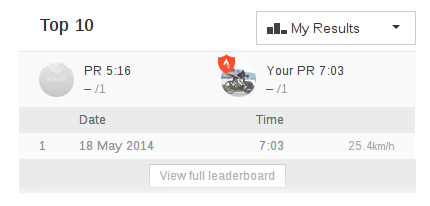
Leaderboard default Changes the default leaderboard away from "Overall" when viewing a segment effort. The most rewarding training often comes from comparing your own past performances rather than those of others, so viewing your own results by default can make more sense. You can select any of Men, Women, I'm Following or My Results: https://chris-lamb.co.uk/wp-content/2014/strava/leaderboard_default.png

Hide feed entries Hides various entry types in the activity feed that can get annoying. You currently have the option of hiding challenges, route creations, goals created or club memberships: https://chris-lamb.co.uk/wp-content/2014/strava/hide_challenge_feed_entries.png

Variability Index Calculates a Variability Index (VI) from the weighted average power and the average power, an indication of how "smooth" a ride was. Required a power meter. A VI of 1.0 would mean a ride was paced "perfectly", with very few surges of effort: https://chris-lamb.co.uk/wp-content/2014/strava/variability_index.png

Infinite scroll Automatically loads more dashboard entries when reaching the bottom, saving a tedious click on the "More" button: https://chris-lamb.co.uk/wp-content/2014/strava/infinite_scroll.png

Running TSS Estimates a run's Training Stress Score (TSS) from its Grade Adjusted Pace distribution, a measure of that workout's duration and intensity relative to the athletes's capability, providing an insight into correct recovery time and overall training load over time: https://chris-lamb.co.uk/wp-content/2014/strava/running_tss.png

Hide "find friends" Hides social networking buttons, including invitations to invite or find further friends: https://chris-lamb.co.uk/wp-content/2014/strava/hide_invite_friends.png

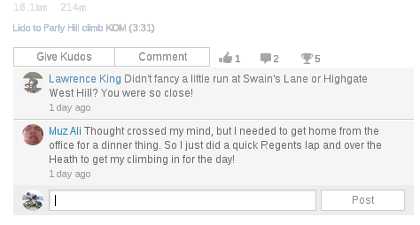
"Enter" posts comment Immediately posts comment when pressing Enter/Return key in the edit box rather than adding a newline: https://chris-lamb.co.uk/wp-content/2014/strava/comment_post_on_enter.png

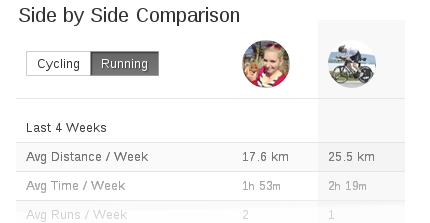
Compare running Changes the default sport for the "Side by Side comparison" module to running when viewing athlete profiles: https://chris-lamb.co.uk/wp-content/2014/strava/side_by_side_running.png

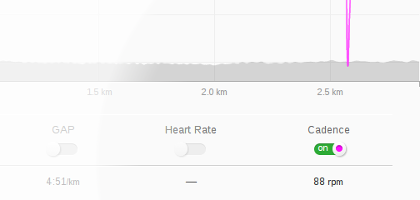
Running cadence Shows running cadence by default in the elevation profile: https://chris-lamb.co.uk/wp-content/2014/strava/running_cadence.png

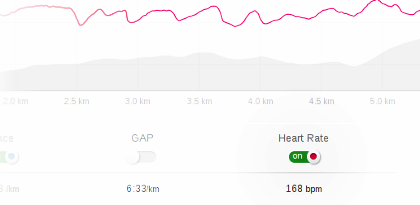
Running heart rate Shows running heart rate by default in elevation profile: https://chris-lamb.co.uk/wp-content/2014/strava/running_heart_rate.png

Estimated FTP Selects "Show Estimated FTP" by default on the Power Curve page: https://chris-lamb.co.uk/wp-content/2014/strava/estimated_ftp.png

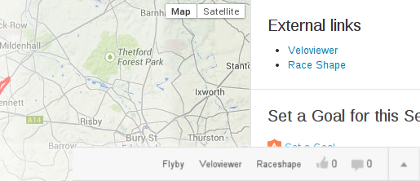
Standard Google map Prefer the "Standard" Google map over the "Terrain" view: https://chris-lamb.co.uk/wp-content/2014/strava/standard_google_map.png

Let me know if you have any comments, suggestions or if you have any other feedback. If you find this software useful, please consider donating via Paypal to support further development. You can also view the source and contribute directly on GitHub. https://chris-lamb.co.uk/wp-content/2014/strava/chrome_web_store.png

Russell Coker: Booting GPT

I m installing new 4TB disks on an older Dell server, it s a PowerEdge T110 with a G6950 CPU so it s not really old, but it s a couple of generations behind the latest Dell servers. I tried to enable UEFI booting, but when I turned that option on the system locked up during the BIOS process (wouldn t boot from the CD or take keyboard input). So I had to make it boot with a BIOS compatible MBR and a GPT partition table. Number Start (sector) End (sector) Size Code Name
1 2048 4095 1024.0 KiB EF02 BIOS boot partition
2 4096 25169919 12.0 GiB FD00 Linux RAID
3 25169920 7814037134 3.6 TiB 8300 Linux filesystem After spending way to much time reading various web pages I discovered that the above partition table works. The 1MB partition is for GRUB code and needs to be enabled by a parted command such as the following: parted /dev/sda set 1 bios_grub on /dev/sda2 is a RAID-1 array used for the root filesystem. If I was installing a non-RAID system I d use the same partition table but with a type of 8300 instead of FD00. I have a RAID-1 array over sda2 and sdb2 for the root filesystem and sda3, sdb3, sdc3, sdd3, and sde3 are used for a RAID-Z array. I m reserving space for the root filesystem on all 5 disks because it seems like a good idea to use the same partition table and the 12G per disk that is unused on sdc, sdd, and sde isn t worth worrying about when dealing with 4TB disks.

4 August 2014

Russ Allbery: Review: Parasite

Review: Parasite, by Mira Grant
Series: Parasitology #1
Publisher: Orbit
Copyright: October 2013
ISBN: 0-316-21893-6
Format: Kindle
Pages: 504
It's 2027, and a company named Symbogen has revolutionized medicine and health. They manufacture a genetically-engineered parasite based on a tapeworm that can stabilize and protect the health of just about anyone. It can synthesize medication, fix chronic medical problems, and be adapted to different conditions. (Yes, I know biological systems don't work this way. That's not going to be the only suspension of disbelief problem.) This has made Symbogen one of the most powerful corporations in the country, aided by the skill at marketing and self-promotion shown by one of the founders. Sal, the protagonist of the novel, is one of Symbogen's most famous success stories. Sally was the victim of a horrible car crash that put her into an apparently irreversible coma. But as her family was debating whether to turn off life support, she woke up. She had no memory of her previous life at all, and had to relearn fine motor control, reading, and many other skills. She was essentially a new person. But she was alive; her symbiont had saved her. When the story proper starts, Sal is still a ward of her parents. She has generally adult skills despite still struggling with reading, but she still has occasional attacks and is under intensive monitoring by Symbogen. That means periodic mandatory appointments with Symbogen, which she hates, but she's otherwise started building a life for herself: a job in an animal shelter, an interest in exotic predatory plants, and, most notably, a boyfriend. There are things about her life she doesn't like, and she wants to be free of Symbogen, but she doesn't have a bad life. But then a mysterious illness begins sweeping through the population, causing people to go blank, apparently lose their minds, and then start attacking those near them. Some of you have doubtless already figured out the key plot revelation. It's not hard; even if you didn't from the summary, you will probably figure it out shortly into the book. And therein lies a large problem with this novel: it's hopelessly predictable. Creepy evil corporation that supposedly has your best interests at heart, check. Plucky mad scientist opposition who understands exactly what's going on, check. Well-meaning but heavy-handed government agents who try to get involved but mostly make everything worse, check. (Although it's unusual to have those agents as part of the protagonist's family, and I thought that added some additional depth.) Mostly clueless protagonist sucked into the plot and becoming critical to its resolution, check. Very few readers are going to be surprised by this story. This is not, by itself, a fatal flaw. Predictable story structures can carry satisfying variations, or introduce the reader to enjoyable characters. And I think Grant manages both here. Seanan McGuire, both as herself and under her Mira Grant pseudonym, tends to write damaged and struggling characters. Both her Newsflesh and October Daye series feature protagonists that have been hurt badly, but are coping and muddling through in their own ways. In Parasite, I think she takes a more daring and intriguing approach: a protagonist that other people in the story perceive as damaged and struggling, but who actually isn't. Sal is not a badly injured Sally, and she's quite a bit healthier than those around her think she is. Her thought processes don't work quite the same as those around her, but that's not because she's hurt. That's because she's a different person. This makes Parasite partly a novel about identity, about Sal claiming ownership of her own life. Grant drags this out longer than I wish she had, but I liked the idea. In Sal, she strikes a good balance between gratitude and genuine affection for her family and the need to become her own person unconstrained by other people's expectations. As with the Newsflesh series, Grant uses quotes and excerpts from interviews to fill in the world background: a few at the start of each chapter, and more around each part boundary. I like this technique, and Grant uses it well. By the end of the book, the Rolling Stone interview with the head of Symbogen has added a lot of insight into how Symbogen manages its public relations. Grant also throws in a few of her trademark dangerously off-beat characters: hyper-competent, wise-cracking, but eerily skewed. I loved those in Blackout and I loved Tansy and Dr. Cale here. (Adam was much less successful.) A whole book from Tansy's perspective wouldn't work, since she needs Sal as a straight woman, but I thought she stole every scene she was in. However, I agree wholeheartedly with Tansy on another point: Sal is remarkably, irritatingly dim about what is apparently intended to be the critical revelation of the book. I won't state it outright; given its significant presence in the final scene, apparently it is intended to be a spoiler. But I figured it out about 50 pages into the book. Grant telegraphs this revelation heavily, and Tansy considers it painfully obvious (with quite a bit of justification). But Sal doesn't figure it out for the entire book, ignores all the signs, and is apparently willfully blind. In a book written from the first-person perspective by an otherwise-reliable narrator, this is highly annoying. It significantly undermined my enjoyment of the book. I spent much of the novel ahead of the narrator in my understanding of the plot and waiting, in vain, for her to get on with it already. That unfortunately makes Parasite a mixed bag. I really liked many of the characters, and I think Grant did some interesting things with family dynamics and with claiming one's own identity. But this is undermined by a very predictable plot, the protagonist deciding to be dumber than a sack of hammers about a critical plot point, and some rather dubious world logic. (For example, why is Sal terrified of bad driving? It makes sense as a post-traumatic stress reaction... except it's a critical point to her characterization that she never went through that stress.) Sometimes I wanted to like this book and sometimes I wanted to shake it, and sometimes I felt both reactions at the same time. I like Grant's writing and characterization well enough that I will probably read the sequel, but this is more like the later books in the Newsflesh series than it is like the spectacular Feed. Worth reading, at least for me, but it could have been better. Rating: 7 out of 10

31 July 2014

Russell Coker: BTRFS Status July 2014

My last BTRFS status report was in April [1], it wasn t the most positive report with data corruption and system hangs. Hacker News has a brief discussion of BTRFS which includes the statement Russell Coker s reports of his experiences with BTRFS give me the screaming heebie-jeebies, no matter how up-beat and positive he stays about it [2] (that s one of my favorite comments about my blog). Since April things have worked better. Linux kernel 3.14 solves the worst problems I had with 3.13 and it s generally doing everything I want it to do. I now have cron jobs making snapshots as often as I wish (as frequently as every 15 minutes on some systems), automatically removing snapshots (removing 500+ snapshots at once doesn t hang the system), balancing, and scrubbing. The fact that I can now expect that a filesystem balance (which is a type of defragment operation for BTRFS that frees some chunks ) from a cron job and expect the system not to hang means that I haven t run out of metadata chunk space. I expect that running out of metadata space can still cause filesystem deadlocks given a lack of reports on the BTRFS mailing list of fixes in that regard, but as long as balance works well we can work around that. My main workstation now has 35 days of uptime and my home server has 90 days of uptime. Also the server that stores my email now has 93 days uptime even though it s running Linux kernel 3.13.10. I am rather nervous about the server running 3.13.10 because in my experience every kernel before 3.14.1 had BTRFS problems that would cause system hangs. I don t want a server that s an hour s drive away to hang The server that runs my email is using kernel 3.13.10 because when I briefly tried a 3.14 kernel it didn t work reliably with the Xen kernel 4.1 from Debian/Wheezy and I had a choice of using the Xen kernel 4.3 from Debian/Unstable to match the Linux kernel or use an earlier Linux kernel. I have a couple of Xen servers running Debian/Unstable for test purposes which are working well so I may upgrade my mail server to the latest Xen and Linux kernels from Unstable in the near future. But for the moment I m just not doing many snapshots and never running a filesystem scrub on that server. Scrubbing In kernel 3.14 scrub is working reliably for me and I have cron jobs to scrub filesystems on every system running that kernel. So far I ve never seen it report an error on a system that matters to me but I expect that it will happen eventually. The paper An Analysis of Data Corruption in the Storage Stack from the University of Wisconsin (based on NetApp data) [3] shows that nearline disks (IE any disks I can afford) have an incidence of checksum errors (occasions when the disk returns bad data but claims it to be good) of about 0.42%. There are 18 disks running in systems I personally care about (as opposed to systems where I am paid to care) so with a 0.42% probability of a disk experiencing data corruption per year that would give a 7.3% probability of having such corruption on one disk in any year and a greater than 50% chance that it s already happened over the last 10 years. Of the 18 disks in question 15 are currently running BTRFS. Of the 15 running BTRFS 10 are scrubbed regularly (the other 5 are systems that don t run 24*7 and the system running kernel 3.13.10). Newer Kernels The discussion on the BTRFS mailing list about kernel 3.15 is mostly about hangs. This is correlated with some changes to improve performance so I presume that it has exposed race conditions. Based on those discussions I haven t felt inclined to run a 3.15 kernel. As the developers already have some good bug reports I don t think that I could provide any benefit by doing more testing at this time. I think that there would be no benefit to me personally or the Linux community in testing 3.15. I don t have a personal interest in RAID-5 or RAID-6. The only systems I run that have more data than will fit on a RAID-1 array of cheap SATA disks are ones that I am paid to run and they are running ZFS. So the ongoing development of RAID-5 and RAID-6 code isn t an incentive for me to run newer kernels. Eventually I ll test out RAID-6 code, but at the moment I don t think they need more bug reports in this area. I don t have a great personal interest in filesystem performance at this time. There are some serious BTRFS performance issues. One problem is that a filesystem balance and subtree removal seem to take excessive amounts of CPU time. Another is that there isn t much support for balancing IO to multiple devices (in RAID-1 every process has all it s read requests sent to one device). For large-scale use of a filesystem these are significant problems. But when you have basic requirements (such as a mail server for dozens of users or a personal workstation with a quad-core CPU and fast SSD storage) it doesn t make much difference. Currently all of my systems which use BTRFS have storage hardware that exceeds the system performance requirements by such a large margin that nothing other than installing Debian packages can slow the system down. So while there are performance improvements in newer versions of the BTRFS kernel code that isn t an incentive for me to upgrade. It s just been announced that Debian/Jessie will use Linux 3.16, so I guess I ll have to test that a bit for the benefit of Debian users. I am concerned that 3.16 won t be stable enough for typical users at the time that Jessie is released.

29 July 2014

Ian Campbell: Debian Installer ARM64 Dailies

It's taken a while but all of the pieces are finally in place to run successfully through Debian Installer on ARM64 using the Debian ARM64 port. So I'm now running nightly builds locally and uploading them to http://www.hellion.org.uk/debian/didaily/arm64/. If you have CACert in your CA roots then you might prefer the slightly more secure version. Hopefully before too long I can arrange to have them building on one of the project machines and uploaded to somewhere a little more formal like people.d.o or even the regular Debian Installer dailies site. This will have to do for now though. Warning The arm64 port is currently hosted on Debian Ports which only supports the unstable "sid" distribution. This means that installation can be a bit of a moving target and sometimes fails to download various installer components or installation packages. Mostly it's just a case of waiting for the buildd and/or archive to catch up. You have been warned! Installing in a Xen guest If you are lucky enough to have access to some 64-bit ARM hardware (such as the APM X-Gene, see wiki.xen.org for setup instructions) then installing Debian as a guest is pretty straightforward. I suppose if you had lots of time (and I do mean lots) you could also install under Xen running on the Foundation or Fast Model. I wouldn't recommend it though. First download the installer kernel and ramdisk onto your dom0 filesystem (e.g. to /root/didaily/arm64). Second create a suitable guest config file such as:
name = "debian-installer"
disk = ["phy:/dev/LVM/debian,xvda,rw"]
vif = [ '' ] 
memory = 512
kernel = "/root/didaily/arm64/vmlinuz"
ramdisk= "/root/didaily/arm64/initrd.gz"
extra = "console=hvc0 -- "
In this example I'm installing to a raw logical volume /dev/LVM/debian. You might also want to use randmac to generate a permanent MAC address for the Ethernet device (specified as vif = ['mac=xx:xx:xx:xx:xx:xx']). Once that is done you can start the guest with:
xl create -c cfg
From here you'll be in the installer and things carry on as usual. You'll need to manually point it to ftp.debian-ports.org as the mirror, or you can preseed by appending to the extra line in the cfg like so:
mirror/country=manual mirror/http/hostname=ftp.debian-ports.org mirror/http/directory=/debian
Apart from that there will be a warning about not knowing how to setup the bootloader but that is normal for now. Installing in Qemu To do this you will need a version of http://www.qemu.org which supports qemu-system-aarch64. The latest release doesn't yet so I've been using v2.1.0-rc3 (it seems upstream are now up to -rc5). Once qemu is built and installed and the installer kernel and ramdisk have been downloaded to $DI you can start with:
qemu-system-aarch64 -M virt -cpu cortex-a57 \
    -kernel $DI/vmlinuz -initrd $DI/initrd.gz \
    -append "console=ttyAMA0 -- " \
    -serial stdio -nographic --monitor none \
    -drive file=rootfs.qcow2,if=none,id=blk,format=qcow2 -device virtio-blk-device,drive=blk \
    -net user,vlan=0 -device virtio-net-device,vlan=0
That's using a qcow2 image for the rootfs, I think I created it with something like:
qemu-img create -f qcow2 rootfs.qcow2 4G
Once started installation proceeds much like normal. As with Xen you will need to either point it at the debian-ports archive by hand or preseed by adding to the -append line and the warning about no bootloader configuration is expected. Installing on real hardware Someone should probably try this ;-).

25 July 2014

Juliana Louback: Extending an xTuple Business Object

xTuple is in my opinion incredibly well designed; the code is clean and the architecture ahderent to a standardized structure. All this makes working with xTuple software quite a breeze. I wanted to integrate JSCommunicator into the web-based xTuple version. JSCommunicator is a SIP communication tool, so my first step was to create an extension for the SIP account data. Luckily for me, the xTuple development team published an awesome tutorial for writing an xTuple extension. xTuple cleverly uses model based business objects for the various features available. This makes customizing xTuple very straightforward. I used the tutorial mentioned above for writing my extension, but soon noticed my goals were a little different. A SIP account has 3 data fields, these being the SIP URI, the account password and an optional display name. xTuple currently has a business object in the core code for a User Account and it would make a lot more sense to simply add my 3 fields to this existing business object rather than create another business object. The tutorial very clearly shows how to extend a business object with another business object, but not how to extend a business object with only new fields (not a whole new object). Now maybe I m just a whole lot slower than most people, but I had a ridiculously had time figuring this out. Mind you, this is because I m slow, because the xTuple documentation and code is understandable and as self-explanatory as it gets. I think it just takes a bit to get used to. Either way, I thought this just might be useful to others so here is how I went about it. Setup First you ll have to set up your xTuple development environment and fork the xtuple and xtuple-extesions repositories as shown in this handy tutorial. A footnote I d like to add is please verify that your version of Vagrant (and anything else you install) is the one listed in the tutorial. I think I spent like two entire days or more on a wild goose (bug) chase trying to set up my environment when the cause of all the errors was that I somehow installed an older version of Vagrant - 1.5.4 instead of 1.6.3. Please don t make the same mistake I did. Actually if for some reason you get the following error when you try using node:
<<ERROR 2014-07-10T23:52:46.948Z>> Unrecoverable exception. Cannot call method 'extend' of undefined
    at /home/vagrant/dev/xtuple/lib/backbone-x/source/model.js:37:39
    at Object.<anonymous> (/home/vagrant/dev/xtuple/lib/backbone-x/source/model.js:1364:3)
    ...
chances are, you have the wrong version. That s what happened to me. The Vagrant Virtual Development Environment automatically installs and configures everything you need, it s ready to go. So if you find yourself installing and updating and apt-gets and etc, you probably did something wrong. Coding So by now we should have the Vagrant Virtual Development Environment set up and the web app up and running and accessible at localhost:8443. So far so good. Disclaimer: You will note that much of this is similar - or rather, nearly identical - to xTuple s tutorial but there are some small but important differences and a few observations I think might be useful. Other Disclaimer: I m describing how I did it, which may or may not be up to snuff . Works for me though. Schema First let s make a schema for the table we will create with the new custom fields. Be sure to create the correct directory stucture, aka /path/to/xtuple-extensions/source/<YOUR EXTENSION NAME>/database/source or in my case /path/to/xtuple-extensions/source/sip_account/database/source, and create the file create_sa_schema.sql, sa is the name of my schema. This file will contain the following lines:
do $$
  /* Only create the schema if it hasn't been created already */
  var res, sql = "select schema_name from information_schema.schemata where schema_name = 'sa'",
  res = plv8.execute(sql);
  if (!res.length)  
    sql = "create schema sa; grant all on schema sa to group xtrole;"
    plv8.execute(sql);
   
$$ language plv8;
Of course, feel free to replace sa with your schema name of choice. All the code described here can be found in my xtuple-extensions fork, on the sip_ext branch. Table We ll create a table containing your custom fields and a link to an existing table - the table for the existing business object you want to extend. If you re wondering why make a whole new table for a few extra fields, here s a good explanation, the case in question is adding fields to the Contact business object. You need to first figure out what table you want to link to. This might not be uber easy. I think the best way to go about it is to look at the ORMs. The xTuple ORMs are a JSON mapping between the SQL tables and the object-oriented world above the database, they re .json files found at path/to/xtuple/node_modules/xtuple/enyo-client/database/orm/models for the core business objects and at path/to/xtuplenyo-client/extensions/source/<EXTENSION NAME>/database/orm/models for exension business objects. I ll give two examples. If you look at contact.json you will see that the Contact business object refers to the table cntct . Look for the type : Contact on the line above, so we know it s the Contact business object. In my case, I wanted to extend the UserAccount and UserAccountRelation business objects, so check out user_account.json. The table listed for UserAccount is xt.usrinfo and the table listed for UserAccountRelation is xt.usrlite. A closer look at the sql files for these tables (usrinfo.sql and usrlite.sql) revealed that usrinfo is in fact a view and usrlite is A light weight table of user information used to avoid punishingly heavy queries on the public usr view . I chose to refer to xt.usrlite - that or I received error messages when trying the other table names. Now I ll make the file /path/to/xtuple-extensions/source/sip_account/database/source/usrlitesip.sql, to create a table with my custom fields plus the link to the urslite table. Don t quote me on this, but I m under the impression that this is the norm for naming the sql file joining tables: the name of the table you are referring to ( usrlite in this case) and your extension s name. Content of usrlitesip.sql:
select xt.create_table('usrlitesip', 'sa');
select xt.add_column('usrlitesip','usrlitesip_id', 'serial', 'primary key', 'sa');
select xt.add_column('usrlitesip','usrlitesip_usr_username', 'text', 'references xt.usrlite (usr_username)', 'sa');
select xt.add_column('usrlitesip','usrlitesip_uri', 'text', '', 'sa');
select xt.add_column('usrlitesip','usrlitesip_name', 'text', '', 'sa');
select xt.add_column('usrlitesip','usrlitesip_password', 'text', '', 'sa');
comment on table sa.usrlitesip is 'Joins User with SIP account';
Breaking it down, line 1 creates the table named usrlitesip (no duh), line 2 is for the primary key (self-explanatory). You can then add any columns you like, just be sure to add one that references the table you want to link to. I checked usrlite.sql and saw the primary key is usr_username, be sure to use the primary key of the table you are referencing. You can check what you made by executing the .sql files like so:
$ cd /path/to/xtuple-extensions/source/sip_account/database/source
$ psql -U admin -d dev -f create_sa_schema.sql
$ psql -U admin -d dev -f usrlitesip.sql
After which you will see the table with the columns you created if you enter:
$ psql -U admin -d dev -c "select * from sa.usrlitesip;"
Now create the file /path/to/xtuple-extensions/source/sip_account/database/source/manifest.js to put the files together and in the right order. It should contain:
 
  "name": "sip_account",
  "version": "1.4.1",
  "comment": "Sip Account extension",
  "loadOrder": 999,
  "dependencies": ["crm"],
  "databaseScripts": [
    "create_sa_schema.sql",
    "usrlitesip.sql",
    "register.sql"
  ]
 
I think the name has to be the same you named your extension directory as in /path/to/xtuple-extensions/source/<YOUR EXTENSION NAME>. I think the comment can be anything you like and you want your loadOrder to be high so it s the last thing installed (as it s an add on.) So far we are doing exactly what s instructed in the xTuple tutorial. It s repetitive, but I think you can never have too many examples to compare to. In databaseScripts you will list the two .sql files you just created for the schema and the table, plus another file to be made in the same directory named register.sql. I m not sure why you have to make the register.sql or even if you indeed have to. If you leave the file empty, there will be a build error, so put a ; in the register.sql or remove the line register.sql from manifest.js as I think for now we are good without it. Now let s update the database with our new extension:
$ cd /path/to/xtuple
$ ./scripts/build_app.js -d dev -e ../xtuple-extensions/source/sip_account
$ psql -U admin -d dev -c "select * from xt.ext;"
That last command should display a table with a list of extensions; the ones already in xtuple like crm and billing and some others plus your new extension, in this case sip_account . When you run build_app.js you ll probably see a message along the lines of <Extension name> has no client code, not building client code and that s fine because yeah, we haven t worked on the client code yet. ORM Here s where things start getting different. So ORMs link your object to an SQL table. But we DON T want to make a new business object, we want to extend an existing business object, so the ORM we will make will be a little different than the xTuple tutorial. Steve Hackbarth kindly explained this new business object/existing business object ORM concept here. First we ll create the directory /path/to/xtuple-extensions/source/sip_account/database/orm/ext, according to xTuple convention. ORMs for new business objects would be put in /path/to/xtuple-extensions/source/sip_account/database/orm/models. Now we ll create the .json file /path/to/xtuple-extensions/source/sip_account/database/orm/ext/user_account.jscon for our ORM. Once again, don t quote me on this, but I think the name of the file should be the name of the business object you are extending, as is done in the turorial example extending the Contact object. In our case, UserAccount is defined in user_account.json and that s what I named my extension ORM too. Here s what you should place in it:
 1 [
 2    
 3     "context": "sip_account",
 4     "nameSpace": "XM",
 5     "type": "UserAccount",
 6     "table": "sa.usrlitesip",
 7     "isExtension": true,
 8     "isChild": false,
 9     "comment": "Extended by Sip",
10     "relations": [
11        
12         "column": "usrlitesip_usr_username",
13         "inverse": "username"
14        
15     ],
16     "properties": [
17        
18         "name": "uri",
19         "attr":  
20           "type": "String",
21           "column": "usrlitesip_uri",
22           "isNaturalKey": true
23          
24        ,
25        
26         "name": "displayName",
27         "attr":  
28           "type": "String",
29           "column": "usrlitesip_name"
30          
31        ,
32        
33         "name": "sipPassword",
34         "attr":  
35           "type": "String",
36           "column": "usrlitesip_password"
37          
38        
39     ],
40     "isSystem": true
41    ,
42    
43     "context": "sip_account",
44     "nameSpace": "XM",
45     "type": "UserAccountRelation",
46     "table": "sa.usrlitesip",
47     "isExtension": true,
48     "isChild": false,
49     "comment": "Extended by Sip",
50     "relations": [
51        
52         "column": "usrlitesip_usr_username",
53         "inverse": "username"
54        
55     ],
56     "properties": [
57        
58         "name": "uri",
59         "attr":  
60           "type": "String",
61           "column": "usrlitesip_uri",
62           "isNaturalKey": true
63          
64        ,
65        
66         "name": "displayName",
67         "attr":  
68           "type": "String",
69           "column": "usrlitesip_name"
70          
71        ,
72        
73         "name": "sipPassword",
74         "attr":  
75           "type": "String",
76           "column": "usrlitesip_password"
77          
78        
79     ],
80     "isSystem": true
81    
82 ]
Note the context is my extension name, because the context + nameSpace + type combo has to be unique. We already have a UserAccount and UserAccountRelation object in the XM namespace in the xtuple context in the original user_account.json, now we will have a UserAccount and UserAccountRelation object in the XM namespace in the sip_account conext. What else is important? Note that isExtension is true on lines 7 and 47 and the relations item contains the column of the foreign key we referenced. This is something you might want to verify: column (lines 12 and 52) is the name of the attribute on your table. When we made a reference to the primary key usr_usrname from the xt.usrlite table we named that column usrlitesip_usr_usrname. But the inverse is the attribute name associated with the original sql column in the original ORM. Did I lose you? I had a lot of trouble with this silly thing. In the original ORM that created a new UserAccount business object, the primary key attribute is named username , as can be seen here. That is what should be used for the inverse value. Not the sql column name (usr_username) but the object attribute name (username). I m emphasizing this because I made that mistake and if I can spare you the pain I will. If we rebuild our extension everything should come along nicely, but you won t see any changes just yet in the web app because we haven t created the client code. Client Create the directory /path/to/xtuple-extensions/source/sip_account/client which is where we ll keep all the client code. Extend Workspace View I want the fields I added to show up on the form to create a new User Account, so I need to extend the view for the User Account workspace. I ll start by creating a directory /path/to/xtuple-extensions/source/sip_account/client/views and in it creating a file named workspace.js containing this code:
XT.extensions.sip_account.initWorkspace = function ()  
	var extensions = [
  	 kind: "onyx.GroupboxHeader", container: "mainGroup", content: "_sipAccount".loc() ,
  	 kind: "XV.InputWidget", container: "mainGroup", attr: "uri"  ,
  	 kind: "XV.InputWidget", container: "mainGroup", attr: "displayName"  ,
  	 kind: "XV.InputWidget", container: "mainGroup", type:"password", attr: "sipPassword"  
	];
	XV.appendExtension("XV.UserAccountWorkspace", extensions);
 ;
So I m initializing my workspace and creating an array of items to add (append) to view XV.UserAccountWorkspace. The first item is this onyx.GroupboxHeader which is a pretty divider for my new form fields, the kind you find in the web app at Setup > User Accounts, like Overview . I have no idea what other options there are for container other than mainGroup , so let s stick to that. I ll explain content: _sipAccount .loc() in a bit. Next I created three input fields of the XV.InputWidget kind. This also confused me a bit as there are different kinds of input to be used, like dropdowns and checkboxes. The only advice I can give is snoop around the webapp, find an input you like and look up the corresponding workspace.js file to see what was used. What we just did is (should be) enough for the new fields to show up on the User Account form. But before we see things change, we have to package the client. Create the file /path/to/xtuple-extensions/source/sip_account/client/views/package.js. This file is needed to package groups of files and indicates the order the files should be loaded (for more on that, see this). For now, all the file will contain is:
enyo.depends(
"workspace.js"
);
You also need to package the views directory containing workspace.js, so create the file Create the file /path/to/xtuple-extensions/source/sip_account/client/package.js and in it show that the directory views and its contents must be part of the higher level package:
enyo.depends(
"views"
);
I like to think of it as a box full of smaller boxes. This will sound terrible, but apparently you also need to create the file /path/to/xtuple-extensions/source/sip_account/client/core.js containing this line:
XT.extensions.icecream =  ;
I don t know why. As soon as I find out I ll be sure to inform you. As we ve added a file to the client directory, be sure to update /path/to/xtuple-extensions/source/sip_account/client/package.js so it included the new file:
enyo.depends(
"core.js",
"views"
);
Translations Remember _sipAccount .loc() in our workspace.js file? xTuple has great internationalization support and it s easy to use. Just create the directory and file /path/to/xtuple-extensions/source/sip_account/client/en/strings.js and in it put key-value pairs for labels and their translation, like this:
(function ()  
  "use strict";
  var lang = XT.stringsFor("en_US",  
    "_sipAccount": "Sip Account",
    "_uri": "Sip URI",
    "_displayName": "Display Name",
    "_sipPassword": "Password"
   );
  if (typeof exports !== 'undefined')  
    exports.language = lang;
   
 ());
So far I included all the labels I used in my Sip Account form. If you write the wrong label (key) or forget to include a corresponding key-value pair in strings.js, xTuple will simply name your lable _lableName , underscore and all. Now build your extension and start up the server:
$ cd /path/to/xtuple 
$ ./scripts/build_app.js -d dev -e ../xtuple-extensions/source/sip_account
$ node node-datasource/main.js
If the server is already running, just stop it and restart it to reflect your changes. Now if you go to Setup > User Accounts and click the + button, you should see a nice little addition to the form with a Sip Account divider and three new fields. Nice, eh? Extend Parameters Currently you can search your User Accounts list using any of the User Account fields. It would be nice to be able to search with the Sip account fields we added as well. To do that, let s create the directory /path/to/xtuple-extensions/source/sip_account/client/widgets and there create the file parameter.js to extend XV.UserAccountListParameters. One again, you ll have to look this up. In the xTuple code you ll find the application s parameter.js in /path/to/xtuple/enyo-client/application/source/widgets. Search for the business object you are extending (for example, XV.UserAccount) and look for some combination of the business object name and Parameters . If there s more than one, try different ones. Not a very refined method, but it worked for me. Here s the content of our parameter.js:
XT.extensions.sip_account.initParameterWidget = function ()  
  var extensions = [
     kind: "onyx.GroupboxHeader", content: "_sipAccount".loc() ,
     name: "uri", label: "_uri".loc(), attr: "uri", defaultKind: "XV.InputWidget" ,
     name: "displayName", label: "_displayName".loc(), attr: "displayName", defaultKind: "XV.InputWidget" 
  ];
  XV.appendExtension("XV.UserAccountListParameters", extensions);
 ;
Node that I didn t include a search field for the password attribute for obvious reasons. Now once again, we package this new code addition by creating a /path/to/xtuple-extensions/source/sip_account/client/widgets/package.js file:
enyo.depends(
"parameter.js"
);
We also have to update /path/to/xtuple-extensions/source/sip_account/client/package.js:
enyo.depends(
"core.js",
"widgets"
"views"
);
Rebuild the extension (and restart the server) and go to Setup > User Accounts. Press the magnifying glass button on the upper left side of the screen and you ll see many options for filtering the User Accounts, among them the SIP Uri and Display Name. Extend List View You might want your new fields to show up on the list of User Accounts. There s a bit of an issue here because unlike what we did in workspace.js and parameter.js, we can t append new things to the list of UserAccounts with the funciton XV.appendExtension(args). First I tried overwriting the original UserAccountList, which works but it s far from ideal as this could result in a loss of data from the core implementation. After some discussion with the xTuple dev community, now there s a better alternative: Create the file /path/to/xtuple-extensions/source/sip_account/client/views/list.js and add the following:
1 var oldUserAccountListCreate = XV.UserAccountList.prototype.create;
2 
3 XV.UserAccountList.prototype.create = function ()  
4   oldUserAccountListCreate.apply(this, arguments);
5   this.createComponent(
6    kind: "XV.ListColumn", container: this.$.listItem, components: [
7         kind: "XV.ListAttr", attr: "uri" 
8    ] )
9  ;
To understand what I m doing, check out the XV.UserAccountList implementation in /path/to/xtuple/enyo-client/application/source/views/list.js the entire highlighted part. What we are doing is extending XV.UserAccountList through prototype-chaining ; this is how inheritance works with Enyo. In line 1 we create a prototype and in line 4 we inherit the features including original components array which the list is based on. We then create an additional component immitating the setup shown in XV.UserAccountList: An XV.ListColumn containing an XV.ListAttr, which should be placed in the XV.ListItem components array as is done with the existing columns (refer to implementation). Components can or should (?) have names which are used to access said components. You d refer to a specific component by the this.$.componentName hash. The components in XV.UserAccountList don t have names, so Enyo automatically names them (apparently) based on the kind name, for example something of the kind ListItem is named listItem. I found this at random after a lot of trial and error and it s not a bullet proof solution. Can be bettered. It s strange because if you encapsulate that code with
XT.extensions.sip_account.initList = function ()  
 //Code here
 ;
as is done with parameter.js and workspace.js (and in the xTuple tutorial you are supposed to do that with a new business object), it doesn t work. I have no idea why. This might be wrong or against xTuple coding norms; I will find out and update this post ASAP. But it does work this way. * shrugs * That said, as we ve created the list.js file, we need to ad it to our package by editing /path/to/xtuple-extensions/source/sip_account/client/views/package.js:
enyo.depends(
"list.js",
"workspace.js"
);
That s all. Rebuild the app and restart your server and when you select Setup > User Accounts in the web app you should see the Sip URI displayed on the User Accounts that have the Sip Account data. Add a new User Account to try this out.

23 July 2014

Russ Allbery: WebAuth 4.6.1

This is a bug-fix release of the WebAuth site-wide web authentication system. As is typical, I accumulated a variety of minor bug fixes and improvements that I wanted to get into a release before starting larger work (in this case, adding JSON support for the user information service protocol). The most severe bug fix is something that only folks at Stanford would notice: support for AuthType StanfordAuth was broken in the 4.6.0 release. This is for legacy compatibility with WebAuth 2.5. It has been fixed in this release. In other, more minor bug fixes, build issues when remctl support is disabled have been fixed, expiring password warnings are shown in WebLogin after any POST-based authentication, the confirmation page is forced if authorization identity switching is available, the username field is verified before multifactor authentication to avoid subsequent warnings, newlines and tabs are allowed in the XML sent from the WebKDC for user messages, empty RT and ST parameters are correctly diagnosed, and there are some documentation improvements. The main new feature in this release is support for using FAST armor during password authentication in mod_webkdc. A new WebKdcFastArmorCache directive can be set to point at a Kerberos ticket cache to use for FAST armor. If set, FAST is required, so the KDC must support it as well. This provides better wire security for the initial password authentication to protect against brute-force dictionary attacks against the password by a passive eavesdropper. This release also adds a couple of new factor types, mp (mobile push) and v (voice), that Stanford will use as part of its Duo Security integration. Note that, for the FAST armor feature, there is also an SONAME bump in the shared library in this release. Normally, I wouldn't bump the SONAME in a minor release, but in this case the feature was fairly minor and most people will not notice the change, so it didn't feel like it warranted a major release. I'm still of two minds about that, but oh well, it's done and built now. (At least I noticed that the SONAME bump was required prior to the release.) You can get the latest release from the official WebAuth distribution site or from my WebAuth distribution pages.

22 July 2014

Russell Coker: Public Lectures About FOSS

Eventbrite I ve recently started using the Eventbrite Web site [1] and the associated Eventbrite Android app [2] to discover public events in my area. Both the web site and the Android app lack features for searching (I d like to save alerts for my accounts and have my phone notify me when new events are added to their database) but it is basically functional. The main issue is content, Eventbrite has a lot of good events in their database (I ve got tickets for 6 free events in the next month). I assume that Eventbrite also has many people attending their events, otherwise the events wouldn t be promoted there. At this time I haven t compared Eventbrite to any similar services, Eventbrite events have taken up much of my available time for the next 6 weeks (I appreciate the button on the app to add an entry to my calendar) so I don t have much incentive to find other web sites that list events. I would appreciate comments from users of competing event registration systems and may write a post in future comparing different systems. Also I have only checked for events in Melbourne, Australia as I don t have any personal interest in events in other places. For the topic of this post Eventbrite is good enough, it meets all requirements for Melbourne and I m sure that if it isn t useful in other cities then there are competing services. I think that we need to have free FOSS events announced through Eventbrite. We regularly have experts in various fields related to FOSS visiting Melbourne who give a talk for the Linux Users of Victoria (and sometimes other technical groups). This is a good thing but I think we could do better. Most people in Melbourne probably won t attend a LUG meeting and if they did they probably wouldn t find it a welcoming experience. Also I recommend that anyone who is looking for educational things to do in Melbourne visit the Eventbrite web site and/or install the Android app. Accessible Events I recently attended an Eventbrite event where a professor described the work of his research team, it was a really good talk that made the topic of his research accessible to random members of the public like me. Then when it came to question time the questions were mostly opinion pieces disguised as questions which used a lot of industry specific jargon and probably lost the interest of most people in the audience who wasn t from the university department that hosted the lecture. I spent the last 15 minutes in that lecture hall reading Wikipedia and resisted the temptation to load an Android game. Based on this lecture (and many other lectures I ve seen) I get the impression that when the speaker or the MC addresses a member of the audience by name (EG John Smith has a question ) then it s strongly correlated with a low quality question. See my previous post about the Length of Conference Questions for more on this topic [3]. It seems to me that when running a lecture everyone involved has to agree about whether it s a public lecture (IE one that is for any random people) as opposed to a society meeting (which while free for anyone to attend in the case of a LUG is for people with specific background knowledge). For a society meeting (for want of a better term) it s OK to assume a minimum level of knowledge that rules out some people. If 5% of the audience of a LUG don t understand a lecture that doesn t necessarily mean it s a bad lecture, sometimes it s not possible to give a lecture that is easily understood by those with the least knowledge that also teaches the most experienced members of the audience. For a public lecture the speaker has to give a talk for people with little background knowledge. Then the speaker and/or the MC have to discourage or reject questions that are for a higher level of knowledge. As an example of how this might work consider the case of an introductory lecture about how an OS kernel works. When one of the experienced Linux kernel programmers visits Melbourne we could have an Eventbrite event organised for a lecture introducing the basic concepts of an OS kernel (with Linux as an example). At such a lecture any questions about more technical topics (such as specific issues related to compilers, drivers, etc) could be met with we are having a meeting for more technical people at the Linux Users of Victoria meeting tomorrow night or we are having coffee at a nearby cafe afterwards and you can ask technical questions there . Planning Eventbrite Events When experts in various areas of FOSS visit Melbourne they often offer a talk for LUV. For any such experts who read this post please note that most lectures at LUV meetings are by locals who can reschedule, so if you are only in town for a short time we can give you an opportunity to speak at short notice. I would like to arrange to have some of those people give a talk aimed at a less experienced audience which we can promote through Eventbrite. The venue for LUV talks (Melbourne University 7PM on the first Tuesday of the month) might not work for all speakers so we need to find a sponsor for another venue. I will contact Linux companies that are active in Melbourne and ask whether they would be prepared to sponsor the venue for such a talk. The fallback option would be to have such a lecture at a LUV meeting. I will talk to some of the organisers of science and technology events advertised on Eventbrite and ask why they chose the times that they did. Maybe they have some insight into which times are best for getting an audience. Also I will probably get some idea of the best times by just attending many events and observing the attendance. I think that the aim of an Eventbrite event is to attract delegates who wouldn t attend other meetings, so it is a priority to choose a suitable time and place. Finally please note that while I am a member of the LUV committee I m not representing LUV in this post. My aim is that community feedback on this post will help me plan such events. I will discuss this with the LUV committee after I get some comments here. Please comment if you would like to give such a public lecture, attend such a lecture, or if you just have any general ideas.

17 July 2014

Jonathan McDowell: On the state of Free VoIP

Every now and then I decide I'll try and sort out my VoIP setup. And then I give up. Today I tried again. I really didn't think I was aiming that high. I thought I'd start by making my email address work as a SIP address. Seems reasonable, right? I threw in the extra constraints of wanting some security (so TLS, not UDP) and a soft client that would work on my laptop (I have a Grandstream hardphone and would like an Android client as well, but I figure those are the easy cases while the "I have my laptop and I want to remain connected" case is a bit trickier). I had a suitable Internet connected VM, access to control my DNS fully (so I can do SRV records) and time to read whatever HOWTOs required. And oh my ghod the state of the art is appalling. Let's start with getting a SIP server up and running. I went with repro which seemed to be a reasonably well recommended SIP server to register against. And mostly getting it up and running and registering against it is fine. Until you try and make a TLS SIP call through it (to a sip5060.net test address). Problem the first; the StartCom free SSL certs are not suitable because they don't advertise TLS Client. So I switch to CACert. And then I get bitten by the whole question about whether the common name on the cert should be the server name, or the domain name on the SIP address (it's the domain name on the SIP address apparently, though that might make your SIP client complain). That gets the SIP side working. Of course RTP is harder. repro looks like it's doing the right thing. The audio never happens. I capitulate at this point, and install Lumicall on my phone. That registers correctly and I can call the sip:test.time@sip5060.net test number and hear the time. So the server is functioning, it's the client that's a problem. I try the following (Debian/testing): I'm bored at this point. Can I "dial" my debian.org SIP address from Lumicall? Of course not; I get a "Codecs incompatible" (SIP 488 Not Acceptable Here) response. I have no idea what that means. I seem to have all of the options on Lumicall enabled. Is it a NAT thing? A codec thing? Did I sacrifice the wrong colour of goat? At some point during this process I get a Skype call from some friends, which I answer. Up comes a video call with them, their newborn, perfect audio, and no hassle. I have a conversation with them that doesn't involve me cursing technology at all. And then I go back to fighting with SIP. Gunnar makes the comment about Skype creating a VoIP solution 10 years ago when none was to be found. I believe they're still the market leader. It just works. I'm running the Linux client, and they're maintaining it (a little behind the curve, but close enough), and it works for text chat, voice chat and video calls. I've spent half a day trying to get a Free equivalent working and failing. I need something that works behind NAT, because it's highly likely when I'm on the move that's going to be the case. I want something that lets my laptop be the client, because I don't want to rely on my mobile phone. I want my email address to also be my VoIP address. I want some security (hell, I'm not even insisting on SRTP, though I'd like to). And the state of the Open VoIP stack just continues to make me embarrassed. I haven't given up yet, but I'd appreciate some pointers. And Skype, if you're hiring, drop me a line. ;)

16 July 2014

Matthias Klumpp: AppStream 0.7 specification and library released

appstream-logoToday I am very happy to announce the release of AppStream 0.7, the second-largest release (judging by commit number) after 0.6. AppStream 0.7 brings many new features for the specification, adds lots of good stuff to libappstream, introduces a new libappstream-qt library for Qt developers and, as always, fixes some bugs. Unfortunately we broke the API/ABI of libappstream, so please adjust your code accordingly. Apart from that, any other changes are backwards-compatible. So, here is an overview of what s new in AppStream 0.7: Specification changes Distributors may now specify a new <languages/> tag in their distribution XML, providing information about the languages a component supports and the completion-percentage for the language. This allows software-centers to apply smart filtering on applications to highlight the ones which are available in the users native language. A new addon component type was added to represent software which is designed to be used together with a specific other application (think of a Firefox addon or GNOME-Shell extension). Software-center applications can group the addons together with their main application to provide an easy way for users to install additional functionality for existing applications. The <provides/> tag gained a new dbus item-type to expose D-Bus interface names the component provides to the outside world. This means in future it will be possible to search for components providing a specific dbus service:
$ appstream-index what-provides dbus org.freedesktop.PackageKit.desktop system
(if you are using the cli tool) A <developer_name/> tag was added to the generic component definition to define the name of the component developer in a human-readable form. Possible values are, for example The KDE Community , GNOME Developers or even the developer s full name. This value can be (optionally) translated and will be displayed in software-centers. An <update_contact/> tag was added to the specification, to provide a convenient way for distributors to reach upstream to talk about changes made to their metadata or issues with the latest software update. This tag was already used by some projects before, and has now been added to the official specification. Timestamps in <release/> tags must now be UNIX epochs, YYYYMMDD is no longer valid (fortunately, everyone is already using UNIX epochs). Last but not least, the <pkgname/> tag is now allowed multiple times per component. We still recommend to create metapackages according to the contents the upstream metadata describes and place the file there. However, in some cases defining one component to be in multiple packages is a short way to make metadata available correctly without excessive package-tuning (which can become difficult if a <provides/> tag needs to be satisfied). As small sidenote: The multiarch path in /usr/share/appdata is now deprecated, because we think that we can live without it (by shipping -data packages per library and using smarter AppStream metadata generators which take advantage of the ability to define multiple <pkgname/> tags) Documentation updates In general, the documentation of the specification has been reworked to be easier to understand and to include less duplication of information. We now use excessive crosslinking to show you the information you need in order to write metadata for your upstream project, or to implement a metadata generator for your distribution. Because the specification needs to define the allowed tags completely and contain as much information as possible, it is not very easy to digest for upstream authors who just want some metadata shipped quickly. In order to help them, we now have Quickstart pages in the documentation, which are rich of examples and contain the most important subset of information you need to write a good metadata file. These quickstart guides already exist for desktop-applications and addons, more will follow in future. We also have an explicit section dealing with the question How do I translate upstream metadata? now. More changes to the docs are planned for the next point releases. You can find the full project documentation at Freedesktop. AppStream GObject library and tools The libappstream library also received lots of changes. The most important one: We switched from using LGPL-3+ to LGPL-2.1+. People who know me know that I love the v3 license family of GPL licenses I like it for tivoization protection, it s explicit compatibility with some important other licenses and cosmetic details, like entities not loosing their right to use the software forever after a license violation. However, a LGPL-3+ library does not mix well with projects licensed under other open source licenses, mainly GPL-2-only projects. I want libappstream to be used by anyone without forcing the project to change its license. For some reason, using the library from proprietary code is easier than using it from a GPL-2-only open source project. The license change was also a popular request of people wanting to use the library, so I made the switch with 0.7. If you want to know more about the LGPL-3 issues, I recommend reading this blogpost by Nikos (GnuTLS). On the code-side, libappstream received a large pile of bugfixes and some internal restructuring. This makes the cache builder about 5% faster (depending on your system and the amount of metadata which needs to be processed) and prepares for future changes (e.g. I plan to obsolete PackageKit s desktop-file-database in the long term). The library also brings back support for legacy AppData files, which it can now read. However, appstream-validate will not validate these files (and kindly ask you to migrate to the new format). The appstream-index tool received some changes, making it s command-line interface a bit more modern. It is also possible now to place the Xapian cache at arbitrary locations, which is a nice feature for developers. Additionally, the testsuite got improved and should now work on systems which do not have metadata installed. Of course, libappstream also implements all features of the new 0.7 specification. With the 0.7 release, some symbols were removed which have been deprecated for a few releases, most notably as_component_get/set_idname, as_database_find_components_by_str, as_component_get/set_homepage and the pkgname property of AsComponent (which is now a string array and called pkgnames ). API level was bumped to 1. Appstream-Qt A Qt library to access AppStream data has been added. So if you want to use AppStream metadata in your Qt application, you can easily do that now without touching any GLib/GObject based code! Special thanks to Sune Vuorela for his nice rework of the Qt library! And that s it with the changes for now! Thanks to everyone who helped making 0.7 ready, being it feedback, contributions to the documentation, translation or coding. You can get the release tarballs at Freedesktop. Have fun!

Juliana Louback: Become an Open-source Contributor Video Conference

A couple weeks ago I was contacted by Yehuda Korotkin through one of the Debian mailing lists. Yehuda is a tech professor at one of Israel s leading colleges for women. He proposed a video conference to present the open source community to his class and explain how they can contribute to open source projects. I volunteered to participate and last Monday (July 14th 2014) we had our virtual meeting, which I hope was the first of many. Shauna G. also participated from Boston, making it a Israel - USA - Brazil meetup. Pretty impressive, eh? The conference was hosted on Google Hangouts, the video is available for viewing here. Run time is around 2.5 hours so to save you time I ve kindly posted a summary of the conference! To be frank, I look ghastly half the time so I d much prefer that you read this post. First there was a Q&A period which was more of a discussion panel, followed by a hands-on session where the girls made their first contribution to an open source project. Here s the gist of it: Q&A Hands on For the practical part of our conference, Yehuda s students contributed to Jscommunicator s Issue #5 which requests i18n support for major languages. JSCommunicator is a SIP communication tool developed in HTML and JavaScript, currently supporting audio/video calls and SIP SIMPLE instant messaging. First we set up Github in their local machines and forked the Jscommunicator repo. We learned the basic git commands needed to push changes to their remote repositories and to create a pull requests. This is explained in further detail here. At the end of the conference with nearly an hour overtime due to my tendency to be overly verbose, Yehuda s class made their first contribution with a Hebrew translation for Jscommunicator! All in all, it was great to virtually meet Yehuda and his epic students who all seemed very clever engineers. I m looking forward to our next meetup once I gain some time-management skills.

3 July 2014

Russ Allbery: remctl 3.9

This release fixes an embarassing bug that caused the server to often abort sending information back to the client if the server-side program exited while the server was still sending data. It also fixes a more minor bug in which children of the server were spawned with SIGPIPE ignored instead of set to the default handling behavior. The major new feature in this release is a new ACL type, localgroup, contributed by Remi Ferrand. When this ACL type is used, the remote principal is converted to a local username using the normal Kerberos krb5_aname_to_localname call, and then the server checks whether that local username is a member of a local (nsswitch) group. This release also prefers calloc and reallocarray to malloc and realloc with calculated sizes across all code, and adds version and compatibility information to all manual pages. You can get the latest release from the remctl distribution page.

Russ Allbery: rra-c-util 5.5

The most significant change in this release is a somewhat embarassing bug fix: the network_read and network_write functions introduced in version 4.2 to support timeouts didn't correctly handle a timeout interrupted by a signal. This is now fixed by restarting the calls on EINTR. Also in this release is a general cleanup for integer overflows during memory allocation. rra-c-util now provides a replacement for reallocarray for systems that don't have it, and calloc and reallocarray are used internally where a size is calculated with multiplication. The util library also now provides a checked xreallocarray function. There are also a few minor fixes: portable/system.h guarantees the inclusion of inttypes.h and limits.h, portable/pam.h will now build with a C++ compiler, the Kerberos Autoconf probes provide a Makefile variable that can be used to suppress warnings from Kerberos headers by forcing them to be system headers, and the util/messages-krb5 test will be skipped when not built with Kerberos support. You can get the latest version from the rra-c-util distribution page.

2 July 2014

Russ Allbery: C TAP Harness 3.1

Most of the changes in this release are based on work by Peter P schl to make the behavior of the C TAP library more consistent with the Perl Test::More functions. ok, okv, and all the is_* functions now return true if the test succeeds and false if it fails, allowing them to be used in conditionals. diag and sysdiag now always return 1, making it easier to insert (possibly temporary) calls into compound statements while debugging test cases. The C TAP library now provides a new breallocarray API that does the same thing as brealloc but takes calloc-style arguments and checks internally for integer overflow. Tests for integer overflow during memory allocation have also been added to several other parts of C TAP Harness, including the runtests harness and other internals of the C TAP library. These probably don't matter a tremendous amount for test code, but best to be safe and consistent everywhere possible. All uses of sprintf have now been replaced with a simpler internal string concatenation function that checks for allocation overflow. The previous usage was probably safe, but this approach is much easier to audit. You can get the latest release from the C TAP Harness distribution page.

1 July 2014

Russ Allbery: Review: Ancillary Justice

Review: Ancillary Justice, by Ann Leckie
Series: Imperial Radch #1
Publisher: Orbit
Copyright: 2013
ISBN: 0-316-24662-X
Format: Trade paperback
Pages: 416
As Ancillary Justice opens, Breq is on an icy planet trying to track down a person who has gone rather thoroughly to ground. As her search continues, the reader slowly learns the context of that search, which is only the latest step of a long and quixotic exercise in private determination. She was set on her path by events twenty years previous, told in interleaved flashbacks, that have left her greatly diminished and thrust outside of any of the context of her over thousand years of life. Breq was Justice of Toren, a starship and AI that possessed thousands of ancillaries, human bodies slaved to her mind. Now only this one remains, and nothing exists of her former life other than this goal. It's always hard to write a review of a book that I loved this much. I want to find some way to grab the reader and shake them and say "you have to read this!" without giving away any of the delicious details. That's particularly difficult with Ancillary Justice, since one of the delights of this book is the slow unfolding of not only the plot but the background and motivations behind the plot. There is so much beneath the surface of Breq's methodical intent, and discovering all the nuances is utterly delightful. This is also a book that is very deeply concerned with identity, and which does one of the best jobs I've seen in science fiction of showing a non-human first-person protagonist: close enough to human to permit identification and comprehension, but far enough away for delightful sparks of unexpected insight or thought-provoking difference. Breq is a ship, and AIs are central to this story, so the comparison that comes immediately to mind is with Iain M. Banks. Leckie's role for ship AIs is much different than the structure of Banks's Culture, but I think this is still an apt comparison. Like Banks, Leckie is writing large-scale space opera dominated by a meddling empire that follows some familiar human patterns but not others. Banks's Culture takes a less direct approach with its meddling; the Radch has a more Roman attitude towards preventative conquest and citizenship. But both deal with large-scale issues of politics, culture, and conquest. Both also write excellent AIs, but I think Leckie is more successful than Banks at giving her AIs inhuman properties and creating a sense of eerie alienness that sometimes fades almost entirely and sometimes comes sharply to the surface. The first-person perspective helps considerably there. But where Ancillary Justice truly shined for me is in the interpersonal relationships, and in the insight they provided into character and motive. At the start of the book, Breq finds a drug addict dying in the cold and rescues her, bringing her along on her search for lack of a better option. Breq's relationship with Seivarden is complex, difficult for both of them, badly asymmetric at the start, and develops into something brilliant. At the start of the book, Seivarden is easy to dislike, and Breq's tone is refreshingly bracing and forthright. But through the course of the book Seivarden grows into something much more, in a way that I found both believable and incredibly compelling. And Leckie does this without falling into any of the typical relationship patterns, without introducing artificial romance (or, indeed, any romance at all, which is an excellent choice here), and without compromising the personalities of either character. It's masterfully done. One of the most amazing things about this book to me is that it's a first novel. I never would have guessed that from reading it. It's beautifully paced, the characterization is deep and compelling, and Leckie avoids any sign of the typical first-novel problem of stuffing the book with too much Stuff. Ancillary Justice is a capable and confident novel that builds a compelling world and even more compelling characters. I liked it more than I like most of the Culture novels, which is saying quite a lot, but Leckie offers much of the same scope with deeper and more personal characterization and a tighter plot. I haven't yet remarked on one aspect of this book that every other review seems to remark on: its treatment of gender. The Radch do not recognize or care about gender distinctions, and therefore Breq struggles throughout the book with proper gender labeling in much the same way that a native English speaker tends to struggle with grammatical gender when learning a Romance language, except with more social consequences. Leckie has chosen to represent this in the novel by having Breq refer to everyone uniformly as "she." This has its pluses and minuses: it still supports a binary gender concept where a gender-neutral pronoun might not, but given all the negative reaction this book got just for using "she," a gender-neutral pronoun might be a bridge too far for a lot of readers. I thought it created a nice bit of alienation, a way of forcing the reader to look at gender markers from the outside and a way to point out how arbitrary many of them are. It was also interesting to see how surprised I was at various points in the book when it became obvious that some person Breq had been calling "she" in the first-person narration turned out, from story context, to probably be male. That said, I think this part of the book is overblown in reviews. It's often the first thing people mention, but while it was a nice side bit of world-building, I don't think it's that central to the story. I'm particularly baffled by the handful of people who complained about it, since it's not intrusive and it quickly fades into the background apart from occasional necessary shifts of mental image. (It does create the impression of a world containing only women, but I found that a nice change from the more common impression in space opera of a world containing only men.) Ancillary Justice has already won the Nebula and Arthur C. Clarke awards and tied for the BSFA award for best novel, and I'm happy to report that it deserves all of those. I haven't yet read all of the other Hugo nominees, but it's hard to imagine a world in which it won't top my ballot. This is a fantastic novel, by far the best thing I've read so far this year. I'm delighted that it's the first book of a trilogy, since I'm not done with either the world or the characters yet, but it stands well on its own and reaches a satisfying conclusion. I recommend it to everyone, but particularly to anyone who likes Banks, intelligent ships, or who is looking for thoughtful and complex space opera. Followed by Ancillary Sword. Rating: 10 out of 10

30 June 2014

Russ Allbery: Review: The Knowledge

Review: The Knowledge, by Lewis Dartnell
Publisher: Penguin
Copyright: 2014
ISBN: 0-698-15165-8
Format: Kindle
Pages: 328
The cover pitch for The Knowledge is that technological civilization has collapsed. A war, an asteroid, a pandemic, or some other catastrophic event has ended life as we know it. Survivors have recovered enough to stabilize the population, but all the industry and infrastructure that supports the modern world has been crippled and the knowledge lost. What do they need to know to rebuild the world? (The subtitle, How to Rebuild Our World from Scratch, is deceptive. Dartnell spends a lot of time talking about what could be scavenged from the ruins after an event like a pandemic that leaves buildings and tools intact.) This brief description may bring several incorrect ideas to mind, so a few clarifications are in order. First, this is not a book about how to survive an apocalypse, or how to stabilize society afterwards. Dartnell skips over anything related to basic survival or politics, and this book would only be of limited interest to preppers. Rather, it is focused on the key concepts and key processes that underlie much of what makes up our civilization, and how those processes can be bootstrapped and recreated, hopefully much more quickly than the thousands of years they took to develop the first time around. Second, as much as I think Dartnell would have liked it to be, The Knowledge is not an instruction manual. There's just too much involved in modern machinery, metallurgy, chemistry, and other necessary science and engineering. What it is instead is a tour of the most important ideas, basic processes, and approaches that can lead to creation of an industrial economy. This means it's also a tour of the most critical technology and discoveries that we rely on for day-to-day living. Each idea presented here is a bare sketch, and would require extensive research and experimentation to put into practice. The Knowledge is not a scientific encyclopedia. Rather, it's a collection of signposts and suggested directions along with some suggestions about sequencing, with special emphasis on the ideas that were unintuitive or surprising, or which took humans much longer to stumble across than would have been necessary. I will say up front that I am quite dubious about the stated goal of this book. I'm not sure if it would be of significant assistance to people who found themselves in the circumstances that Dartnell postulates, and I'm also not sure it would be as difficult as Dartnell supposes to reconstruct these details from a good library, although the point is well-taken that most modern industrial techniques would be unavailable to a civilization starting from scratch and many historic techniques are no longer practiced and therefore not well-documented. But this book does not have to succeed at its stated goal to be worth reading. The Knowledge provides a fascinating insight into the way our current capabilities developed, other paths that development could have followed, and what building blocks are vital for the industry that we rely on. If you are like me, the first thing The Knowledge will remind you of is Minecraft, particularly with some of the mods (such as TerraFirmaCraft) that add more realistic detail to the technological bootstrapping. It's a treasure trove for anyone who might be working on that sort of mod or game. Dartnell tries to cover as much of the spectrum of technology as possible, from farming through medicine, from basic materials to industrial chemistry, and from electrical power through transportation. Each chapter necessarily covers only the highlights, the most vital technologies and the early priorities, and many of those are relatively vague pointers. But that's enough for a fascinating orientation. It's also full of memorable trivia: the huge variety of uses to which wood can be put, the difficulty in re-establishing production of industrial acids, the shelf life of gasoline, the global seed vault within the Arctic Circle, and the importance of a long-threaded screw for a lathe, just to name a few examples. In short, The Knowledge may or may not be a practical aid in rebuilding the world, but it's a lot of fun to read and full of tidbits that are fun to think about or pass on to others. It's also a great orientation in applied technology. The Knowledge is particularly fascinating if you have any interest in the simplified recreation of technological and industrial processes, such as in Minecraft and similar games. For authors of Minecraft mods who are aiming for realism, it might even be required reading. I'd love to see more mods based heavily on the approaches described in this book. The Knowledge also conveys, better than any book or course I've seen, an intuitive feel for the amazing complexity and ingenuity underlying industrial technology. I pre-ordered a copy of this book as soon as I heard about it, and I was not disappointed. Despite my certainty that I would be one of the early casualties in any general social collapse, I thoroughly enjoyed reading it, and would like to read it again at some point. Recommended, albeit with the caveat that I do not have the background required to verify any of the facts in this book, and am assuming that Dartnell has done his research properly. Rating: 9 out of 10

29 June 2014

Ritesh Raj Sarraf: Fibre Channel over Ethernet

Fibre Channel over Ethernet (FCoE) is a computer network technology that encapsulates Fibre Channel frames over Ethernet networks. This allows Fibre Channel to use 10 Gigabit Ethernet networks (or higher speeds) while preserving the Fibre Channel protocol. The specification was part of the International Committee for Information Technology Standards T11 FC-BB-5 standard published in 2009 (As descripted on Wikipedia) I just orphaned the FCoE packages for Debian. I don't really have the time and enthusiasm to maintain FCoE any more. The packages may not be in top notch shape, but FCoE as a technology, itself did not see many takers. The popcon stats are low. In case anyone is interested to takeover the maintenance, there is a pkg-fcoe group on alioth. There are 4 packages that build the stack: lldpad, libhbaapi, libhbalinux and fcoe-utils.

AddThis:

Categories:

Keywords:

27 June 2014

Russ Allbery: Review: Due Diligence

Review: Due Diligence, by David Roodman
Publisher: Center for Global Development
Copyright: 2012
ISBN: 1-933286-48-2
Format: Trade paperback
Pages: 335
Due Diligence: An Impertinent Inquiry into Microfinance is a detailed analysis of the effects, philosophy, approaches, and merits of microfinance as an institution and as, increasingly, a charitable focus of the developed world. The author, David Roodman, was a senior fellow at the Center for Global Development at the time of writing this book, and is an expert in microfinance and economic development. This book starts as an overview and a history of the spectrum of microfinance institutions (something I found very valuable, since I knew very little about microfinance prior to Kiva's popularity), and then attempts a critical, data-driven analysis of whether, to what extent, and by which measures microfinance is successful. The most common aspect of microfinance, made popular and prominent by Kiva among others, is microcredit: small loans to people in developing countries. The underlying theory of microcredit is that lack of financial services handicaps prospective entrepreneurs and business owners in the third world, preventing them from growing businesses, funding expansion, and moving out of poverty. By extending relatively small amounts of credit to these people, or so the theory goes, they can better smooth out the uncertainties of day-to-day life and get the necessary capital to expand small local business. Microcredit is not the only type of microfinance, though, and Roodman's careful discussion of that point was one of the most informative parts of this book for me. It can also come in the form of microsavings tiny bank accounts or small-scale savings plans or microinsurance. Roodman makes a very interesting argument that these three forms of microfinance form two opposing continuums. Microcredit is the easiest to provide and microinsurance is the hardest, for many reasons he discusses including some that were surprising to me, but microinsurance is arguably the most helpful and beneficial to the individual poor and microcredit is the least. The opening history and survey does an excellent job showing the range of techniques and approaches used in microfinance, and showing the challenges of providing it. I had some vague understanding of the logistical challenges in serving areas far away from traditional infrastructure. I had much less understanding of the fascinating array of techniques in use, both inside and outside what's become the microfinance industry. Some of these techniques are brilliant examples of human economic creativity and skill at balancing incentives with risk protection. There are a much wider variety of approaches and instruments available than the individual or group loans that one typically sees on a site like Kiva, all with different trade-offs in group size, flexibility, rigidity, risk, and complexity. This book is well worth reading just to get a feel for the huge array of financial arrangements possible outside of the traditional banking structures that most readers of this review are used to. Another question Roodman answers thoroughly is why microfinance is so focused on microcredit. My vague unease with that was strengthened by reading David Graeber's Debt, which among many other things makes clear some of the social perils and power imbalances in lending. Due Diligence both crystallized that discomfort and explained why alternatives are difficult. Both microsavings and microinsurance necessarily involve considerably more regulation (which has both advantages and complexity), since they involve taking and safeguarding people's money and promising service in the future. Lenders require less trust; lenders instead extend trust and assume that risk themselves, and are in a position to do so. Microinsurance is also harder to explain and harder to target, although it is potentially the most helpful financial instrument when well-targeted. And microcredit can absorb huge influxes of capital from the outside, lending it out in a region, while both microsavings and microinsurance are necessarily built on the money already in the local economy and are inherently more resistant to external involvement. (I'm of the opinion this is a significant feature, but it makes it far harder for them to catch on as a charitable trend.) The heart of the book is a hard look at whether microfinance, and particularly microcredit, works. Roodman attempts this analysis for three different definitions of working: lifting people out of poverty (the most commonly claimed success), giving people more freedom and control over their lives even if their poverty level does not change in absolute terms, and developing the local economy. Sadly for charities like Kiva, microcredit does surprisingly poorly on the first two metrics. There is still little clear data, and the degree to which data from one region is applicable to a different region is highly debatable, but what evidence we have does not support the theory that microcredit lifts people out of poverty. In fact, the more intense the microcredit, the more likely it appears to be that credit pathologies common in the developed world, such as taking out loans from one organization to pay off loans from another, spirals of debt that is unlikely to ever be repaid, and aggressive debt collection methods, turn up in microcredit as well. The vision of the entrepreneur who succeeds through new-found access to capital is largely a myth. Indeed, the current packaging and presentation of loans to distant charities in developed countries means that even the supposed purpose of the loans is dubious. Loans are almost always presented as being for some sort of business activity, since that's what external charities want to fund, but money is fungible and the funds are more often used for all the things people normally need to use funds for: weddings, funerals, food for the family in hard times, paying off other loans to relatives, and other daily expenses. On the empowerment front, microcredit fairs little better, and here I particularly appreciated Roodman's clear-eyed and honest portrayal of common microcredit practices and their benefits for the creditors. For example, microcredit makes much of loaning to women, and presents this as a story of female empowerment. Roodman argues that there is some reality behind that, but it's also clear that microcredit organizations loan to women because women are more likely to repay not due to any inherent gender trait, but because women are easier to intimidate and shame into repaying. Similarly, the much-vaunted group loans, usually presented as a way for the community to support each other and teach each other financial skills, are most common in the poorest regions because they represent an outsourcing of costs. The main risk to the lender is that poor people have no such thing as credit histories, and detailed investigations of someone's trustworthiness is expensive. Groups are jointly liable and therefore will police themselves and check each other's reliability at no cost to the lender. Groups will also use intimidation tactics and even violence against members who don't or can't repay their share, without the lender having to get involved or have any responsibility for those tactics. Roodman takes a philosophical tone on this topic, noting several times that services for the very poor are generally of low quality and finance is no exception. I'm less inclined to be philosophical; after reading this book, I find it very hard to support group loans. This leaves economic development as the most compelling argument left for microcredit. This is weak tea for people like myself who wanted to believe in the transformative power of microcredit, but Roodman does a solid job explaining why it's still important. There is a great deal to be said for the perspective that only industrialization actually lifts people out of poverty on any substantial scale, and therefore the most useful type of aid is aid that somehow contributes towards industrialization. Building a native financial industry could arguably be such a step. And there seems to be some real merit and lasting effect to having a richer and more capable set of local financial institutions. However, here, it's not at all clear that external money helps. In fact, there's quite a bit of evidence that external money hurts, since it pushes microfinance institutions to find ways of using that money and pleasing external donors instead of building their infrastructure and capabilities as financial institutions. The earlier institutions, such as the Grameen Bank, seem to have done a better job at being local institutions woven into the local economy than have the later organizations that are largely supported by western donors. Roodman makes a good case for the usefulness of microfinance as a part of economic development, but it comes with a strong argument against too much external funding, and particularly against the practice of developed world donors funding specific loans. I came away from this book feeling like I had a much better understanding of the core problems and techniques of financial services for the poor, and with a strong desire to see more microsavings than microcredit. The two are closer in nature than I had expected, and Roodman's analysis of the similarities was fascinating, but microsavings seems less vulnerable to some of the credit pathologies. There is also some statistical evidence that microsavings does provide some modest reductions in poverty, while the evidence for microcredit is much less compelling. Sadly, from the perspective of a resident of the developed world such as myself who would very much like to help, neither microsavings nor effective microcredit seems likely to benefit from my contributions, and particularly not in the form of a site like Kiva. The end of this book is a long appendix that reprints multiple blog posts on related topics, including additional discussion of the problems with the Kiva model. Effectively, Kiva is a way for people like myself to subsidize microcredit organizations. It's not at all clear that subsidies are needed, and there's some reason to believe that they encourage negative and destructive behavior. The way they are marketed involves a certain amount of lying, or at least distortion, on the part of multiple actors in the microcredit picture. And they're a distraction from microsavings, and from microcredit based on loaning out savings from within the same local economy, both of which seem to have considerably more positive properties. Due Diligence is a book with a somewhat narrow target audience. It will appeal primarily to people with an interest in economics, particularly development economics, or who are evaluating microfinance charities or analyzing their support of groups like Kiva. But within that context, this is an excellent book, and I recommend it to your attention. Roodman is clear, thorough, and fair within my ability to measure that, and while no one book can be the final word on a topic, he adds considerable data and thoughtful analysis. If you are a supporter of Kiva, like I was, I fear you'll find this book rather discouraging. But it's better to have the information than not, and I found it a good reminder of the inherent drawbacks of loans and debt. There is, sadly, nothing magical about microcredit that removes those problems. Rating: 9 out of 10

Next.

Previous.