A short status update on what happened on my side last month. Looking
at unified push support for Chatty prompted some libcmatrix fixes and
Chatty improvements (benefiting other protocols like SMS/MMS as well).
The Bluetooth status page in Phosh was a slightly larger change code
wise as we also enhanced our common widgets for building status pages,
simplifying the Wi-Fi status page and making future status pages
simpler. But as usual investigating bugs, reviewing patches (thanks!)
and keeping up with the changing world around us is what ate most of
the time.
Phosh
A Wayland Shell for mobile devices
A new minor release 0.4.24 of RQuantLib
arrived on CRAN this afternoon
(just before the CRAN summer
break starting tomorrow), and has been uploaded to Debian too.
QuantLib is a rather
comprehensice free/open-source library for quantitative
finance. RQuantLib
connects (some parts of) it to the R environment and language, and has
been part of CRAN for more than
twenty-one years (!!) as it was one of the first packages I
uploaded.
This release of RQuantLib
follows the recent release from last
week which updated to QuantLib version 1.35 released that
week, and solidifies conditional code for older QuantLib versions in one source
file. We also updated and extended the configure source
file, and increased the mininum version of QuantLib to 1.25.
Changes in RQuantLib version 0.4.24 (2024-07-31)
Updated detection of QuantLib libraries in configure
The minimum version has been increased to QuantLib 1.25, and
DESCRIPTION has been updated to state it too
The dividend case for vanilla options still accommodates
deprecated older QuantLib versions if needed (up to QuantLib
1.25)
The configure script now uses PKG_CXXFLAGS and
PKG_LIBS internally, and shows the values it sets
This is one of those posts that s more for my own reference than likely to be helpful for others. If you re unlucky it ll have some useful tips for you. If I m lucky then I ll get a bunch of folk pointing out some optimisations.
First, what I m trying to achieve. I want a virtual machine environment where I can manually do tests on random kernels, and also various TPM related experiments. So I don t want something as fixed as a libvirt setup. I d like the following:
It to be fairly lightweight, so I can run it on a laptop while usefully doing other things
I need a TPM 2.0 device to appear to the guest OS, but it doesn t need to be a real TPM
Block device discard should work, so I can back it with a qcow2 image and use fstrim to keep the actual on disk size small, without constraining my potential for file system expansion should I need it
I ve no need for graphics, in fact a serial console would be better as it eases copy & paste, especially when I screw up kernel changes
That turns out to be possible, but it took a bunch of trial and error to get there. So I m writing it down. I generally do this on a Fedora based host system (FC40 at present, but this all worked with FC38 + FC39 too), and I run Debian 12 (bookworm) as the guest. At present I m using qemu 8.2.2 and swtpm 0.9.0, both from the FC40 packages.
One other issue I spent too long tracking down is that the version of grub 2.06 in bookworm does not manage to pass the TPMEventLog through to the guest kernel properly. The events get measured and the PCRs updated just fine, but /sys/kernel/security/tpm0/binary_bios_measurements doesn t even get created. Using either grub 2.06 from FC40, or the 2.12 backport in bookworm-backports, makes this work just fine.
Anyway, for reference, the following is the script I use to start the swtpm, and then qemu. The debugcon line can be dropped if you re not interested in OVMF debug logging. This needs the guest OS to be configured up for a serial console, but avoids the overhead of graphics emulation.
As I said at the start, I m open to any hints about other options I should be passing; as long as I get acceptable performance in the guest I care more about reducing host load than optimising for the guest.
Review: The Book That Wouldn't Burn, by Mark Lawrence
Series:
Library Trilogy #1
Publisher:
Ace
Copyright:
2023
ISBN:
0-593-43793-4
Format:
Kindle
Pages:
561
The Book That Wouldn't Burn is apparently high fantasy, but of the
crunchy sort that could easily instead be science fiction. It is the
first of a trilogy.
Livira is a young girl, named after a weed, who lives in a tiny settlement
in the Dust. She is the sort of endlessly curious and irrepressible girl
who can be more annoying than delightful to adults who are barely keeping
everyone alive. Her settlement is not the sort of place that's large
enough to have a name; only their well keeps them alive in the desert and
the ever-present dust. There is a city somewhere relatively near, which
Livira dreams of seeing, but people from the settlement don't go there.
When someone is spotted on the horizon approaching the settlement, it's
the first time Livira has ever seen a stranger. It's also not a good
sign. There's only one reason for someone to seek them out in the Dust:
to take. Livira and the other children are, in short order, prisoners of
the humanoid dog-like sabbers, being dragged off to an unknown fate.
Evar lives in the library and has for his entire life. Specifically, he
lives in a square room two miles to a side, with a ceiling so high that it
may as well be a stone sky. He lived there with his family before he was
lost in the Mechanism. Years later, the Mechanism spit him out alongside
four other similarly-lost kids, all from the same library in different
times. None of them had apparently aged, but everyone else was dead.
Now, years later, they live a strange and claustrophobic life with way too
much social contact between way too few people.
Evar's siblings, as he considers them, were each in the Mechanism with a
book. During their years in the Mechanism they absorbed that book until
it became their focus and to some extent their personality. His brothers
are an assassin, a psychologist, and a historian. His sister, the last to
enter the Mechanism and a refugee from the sabber attack that killed
everyone else, is a warrior. Evar... well, presumably he had a book,
since that's how the Mechanism works. But he can't remember anything
about it except the feeling that there was a woman.
Evar lives in a library in the sense that it's a room full of books, but
those books are not on shelves. They're stacked in piles and massive
columns, with no organizational system that any of them could discern.
There are four doors, all of which are closed and apparently impenetrable.
In front of one of them is a hundred yards of char and burned book
remnants, but that door is just as impenetrable as the others. There is a
pool in the center of the room, crops surrounding it, and two creatures
they call the Soldier and the Assistant. That is the entirety of Evar's
world.
As you might guess from the title, this book is about a library. Evar's
perspective of the library is quite odd and unexplained until well into
the book, and Livira's discovery of the library and subsequent
explorations are central to her story, so I'm going to avoid going into
too many details about its exact nature. What I will say is that I have
read a lot of fantasy novels that are based around a library, but I don't
think I've ever read one that was this satisfying.
I think the world of The Book That Wouldn't Burn is fantasy, in
that there are fundamental aspects of this world that don't seem amenable
to an explanation consistent with our laws of physics. It is, however,
the type of fantasy with discoverable rules. Even better, it's the type
of fantasy where discovering the rules is central to the story, for both
the characters and the readers, and the rules are worth the effort. This
is a world-building tour de force: one of the most engrossing and
deeply satisfying slow revelations that I have read in a long time. This
book is well over 500 pages, the plot never flags, new bits of
understanding were still slotting into place in the last chapter, and
there are lots of things I am desperately curious about that Lawrence left
for the rest of the series. If you like puzzling out the history and
rules of an invented world and you have anything close to my taste in
characters and setting, you are going to love this book.
(Also, there is at least one C.S. Lewis homage that I will not spoil but
that I thought was beautifully done and delightfully elaborated, and I am
fairly sure there is a conversation happening between this book and Philip
Pullman's His Dark Materials series that I didn't quite untangle
but that I am intrigued by.)
I do need to offer a disclaimer: Livira is precisely the type of character
I love reading about. She's stubborn, curious, courageous, persistent,
egalitarian, insatiable, and extremely sharp. I have a particular soft
spot for exactly this protagonist, so adjust the weight of my opinion
accordingly. But Lawrence also makes excellent use of her as a spotlight
to illuminate the world-building. More than anything else in the world,
Livira wants to understand, and there is so much here to
understand.
There is an explanation for nearly everything in this book, and those
explanations usually both make sense and prompt more questions. This is
such a tricky balance for the writer to pull off! A lot of world-building
of this sort fails either by having the explanations not live up to the
mysteries or by tying everything together so neatly that the stakes of the
world collapse into a puzzle box. Lawrence avoids both failures. This
world made sense to me but remained sufficiently messy to feel like humans
were living in it. I also thought the pacing and timing were impeccable:
I figured things out at roughly the same pace as the characters, and
several twists and turns caught me entirely by surprise.
I do have one minor complaint and one caveat. The minor complaint is that
I thought one critical aspect of the ending was a little bit too neat and
closed. It was the one time in the book where I thought Lawrence
simplified his plot structure rather than complicated it, and I didn't
like the effect it had on the character dynamics. There is, thankfully,
the promise of significant new complications in the next book.
The caveat is a bit harder to put my finger on, but a comparison to Alaya
Dawn Johnson's The Library of Broken
Worlds might help. That book was also about a library, featured a
protagonist thrown into the deep end of complex world-building, and put
discovery of the history and rules at the center of the story. I found
the rules structure of The Book That Wouldn't Burn more
satisfyingly complicated and layered, in a way that made puzzle pieces fit
together in my head in a thoroughly enjoyable way. But Johnson's book is
about very large questions of identity, history, sacrifice, and pain, and
it's full of murky ambiguity and emotions that are only approached via
metaphor and symbolism. Lawrence's book is far more accessible, but the
emotional themes are shallower and more straightforward. There is a
satisfying emotional through-line, and there are some larger issues at
stake, but it won't challenge your sense of morality and justice the way
that The Library of Broken Worlds might. I think which of those
books one finds better will depend on what mood you're in and what reading
experience you're looking for.
Personally, I was looking for a scrappy, indomitable character who would
channel her anger into overcoming every obstacle in the way of thoroughly
understanding her world, and that's exactly what I got. This was my most
enjoyable reading experience of the year to date and the best book I've
read since Some Desperate Glory.
Fantastic stuff, highly recommended.
Followed by The Book That Broke the World, and the ending is a bit
of a cliffhanger so you may want to have that on hand. Be warned that the
third book in the series won't be published until 2025.
Rating: 9 out of 10
The Combatants
In the red corner, weighing in at nah, I m not going to do that schtick.
The plaintiff in the case is Alegeus Technologies, LLC, a Delaware Corporation that, according to their filings, is a leading provider of a business-tobusiness, white-label funding and payment platform for healthcare carriers and third-party administrators to administer consumer-directed employee benefit programs .
Not being subject to the US bonkers health care system, I have only a passing familiarity with the sorts of things they do, but presumably it involves moving a lot of money around, which is sometimes important.
The defendant is DigiCert, a CA which, based on analysis I ve done previously, is the second-largest issuer of WebPKI certificates by volume.
The History
According to a recently opened Mozilla CA bug, DigiCert found an issue in their domain control validation workflow, that meant it may have been possible for a miscreant to have certificates issued to them that they weren t legitimately entitled to.
Given that validating domain names is basically the YOU HAD ONE JOB! of a CA, this is a big deal.
The CA/Browser Forum Baseline Requirements (BRs) (which all CAs are required to adhere to, by virtue of their being included in various browser and OS trust stores), say that revocation is required within 24 hours when [t]he CA obtains evidence that the validation of domain authorization or control for any Fully Qualified Domain Name or IP address in the Certificate should not be relied upon (section 4.9.1.1, point 5).
DigiCert appears to have at least tried to do the right thing, by opening the above Mozilla bug giving some details of the problem, and notifying their customers that their certificates were going to be revoked.
One may quibble about how fast they re doing it, but they re giving it a decent shot, at least.
A complicating factor in all this is that, only a touch over a month ago, Google Chrome announced the removal of another CA, Entrust, from its own trust store program, citing a pattern of compliance failures, unmet improvement commitments, and the absence of tangible, measurable progress in response to publicly disclosed incident reports .
Many of these compliance failures were failures to revoke certificates in a timely manner.
One imagines that DigiCert would not like to gain a reputation for tardy revocation, particularly at the moment.
The Legal Action
Now we come to Alegeus Technologies.
They ve opened a civil case whose first action is to request the issuance of a Temporary Restraining Order (TRO) that prevents DigiCert from revoking certificates issued to Alegeus (which the court has issued).
This is a big deal, because TROs are legal instruments that, if not obeyed, constitute contempt of court (or something similar) and courts do not like people who disregard their instructions.
That means that, in the short term, those certificates aren t getting revoked, despite the requirement imposed by root stores on DigiCert that the certificates must be revoked.
DigiCert is in a real rock / hard place situation here: revoke and get punished by the courts, or don t revoke and potentially (though almost certainly not, in the circumstances) face removal from trust stores (which would kill, or at least massively hurt, their business).
The reasons that Alegeus gives for requesting the restraining order is that [t]o
Reissue and Reinstall the Security Certificates, Alegeus must work with and
coordinate with its Clients, who are required to take steps to rectify the
certificates. Alegeus has hundreds of such Clients. Alegeus is generally
required by contract to give its clients much longer than 24 hours notice
before executing such a change regarding certification.
In the filing, Alegeus does acknowledge that DigiCert is a voluntary member of the Certification Authority Browser Forum (CABF), which has bylaws stating that certificates with an issue in their domain validation must be revoked within 24 hours.
This is a misstatement of the facts, though.
It is the BRs, not the CABF bylaws, that require revocation, and the BRs apply to all CAs that wish to be included in browser and OS trust stores, not just those that are members of the CABF.
In any event, given that Alegeus was aware that DigiCert is required to revoke certificates within 24 hours, one wonders why Alegeus went ahead and signed agreements with their customers that required a lengthy notice period before changing certificates.
What complicates the situation is that there is apparently a Master Services Agreement (MSA) that states that it constitutes the entire agreement between the parties and that MSA doesn t mention certificate revocation anywhere relevant.
That means that it s not quite so cut-and-dried that DigiCert does, in fact, have the right to revoke those certificates.
I d expect a lot of update to your Master Services Agreement emails to be going out from DigiCert (and other CAs) in the near future to clarify this point.
Not being a lawyer, I can t imagine which way this case might go, but there s one thing we can be sure of: some lawyers are going to able to afford that trip to a tropical paradise this year.
The Security Issues
The requirement for revocation within 24 hours is an important security control in the WebPKI ecosystem.
If a certificate is misissued to a malicious party, or is otherwise compromised, it needs to be marked as untrustworthy as soon as possible.
While revocation is far from perfect, it is the best tool we have.
In this court filing, Alegeus has claimed that they are unable to switch certificates with less than 24 hours notice (due to contractual SLAs ).
This is a pretty big problem, because there are lots of reasons why a certificate might need to be switched out Very Quickly.
As a practical example, someone with access to the private key for your SSL certificate might decide to use it in a blog post.
Letting that sort of problem linger for an extended period of time might end up being a Pretty Big Problem of its own.
An organisation that cannot respond within hours to a compromised certificate is playing chicken with their security.
The Takeaways
Contractual obligations that require you to notify anyone else of a certificate (or private key) changing are bonkers, and completely antithetical to the needs of the WebPKI.
If you have to have them, you re going to want to start transitioning to a private PKI, wherein you can do whatever you darn well please with revocation (or not).
As these sorts of problems keep happening, trust stores (and hence CAs) are going to crack down on this sort of thing, so you may as well move sooner rather than later.
If you are an organisation that uses WebPKI certificates, you ve got to be able to deal with any kind of certificate revocation event within hours, not days.
This basically boils down to automated issuance and lifecycle management, because having someone manually request and install certificates is terrible on many levels.
There isn t currently a completed standard for notifying subscribers if their certificates need premature renewal (say, due to needing to be revoked), but the ACME Renewal Information Extension is currently being developed to fill that need.
Ask your CA if they re tracking this standards development, and when they intend to have the extension available for use.
(Pro-tip: if they say we ll start doing development when the RFC is published , run for the hills; that s not how responsible organisations work on the Internet).
The Givings
If you ve found this helpful, consider shouting me a refreshing beverage.
Reading through legal filings is thirsty work!
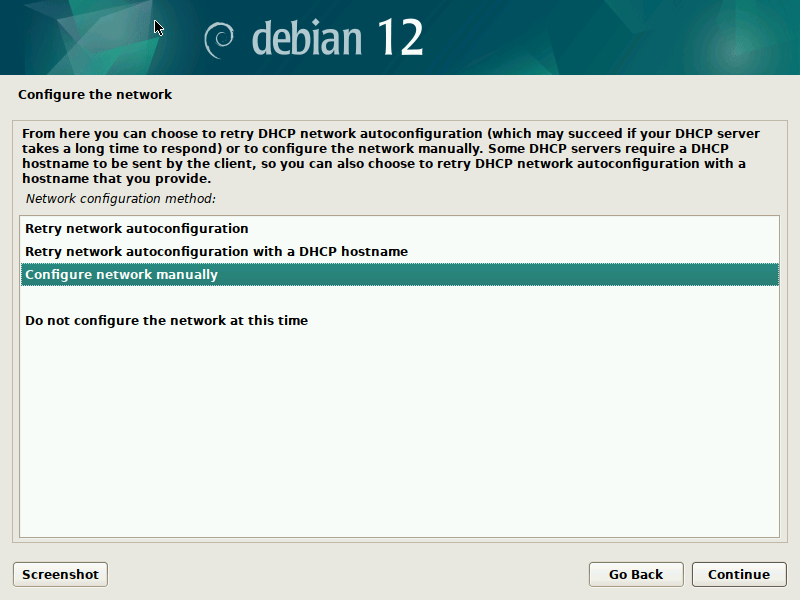
With the work that has been done in the debian-installer/netcfg merge-proposal !9 it is possible to install a standard Debian system, using the normal Debian-Installer (d-i) mini.iso images, that will come pre-installed with Netplan and all network configuration structured in /etc/netplan/.
In this write-up, I d like to run you through a list of commands for experiencing the Netplan enabled installation process first-hand. Let s start with preparing a working directory and installing the software dependencies for our virtualized Debian system:
Next we ll prepare a VM, by copying the EFI firmware files, preparing some persistent EFIVARs file, to boot from FS0:\EFI\debian\grubx64.efi, and create a virtual disk for our machine:
Finally, let s launch the debian-installer using a preseed.cfg file, that will automatically install Netplan (netplan-generator) for us in the target system. A minimal preseed file could look like this:
For this demo, we re installing the full netplan.io package (incl. the interactive Python CLI), as well as the netplan-generator package and systemd-resolved, to show the full Netplan experience. You can choose the preseed file from a set of different variants to test the different configurations:
We re using the linux kernel and initrd.gz here to be able to pass the preseed URL as a parameter to the kernel s cmdline directly. Launching this VM should bring up the official debian-installer in its netboot/gtk form:
Now you can click through the normal Debian-Installer process, using mostly default settings. Optionally, you could play around with the networking settings, to see how those get translated to /etc/netplan/ in the target system.
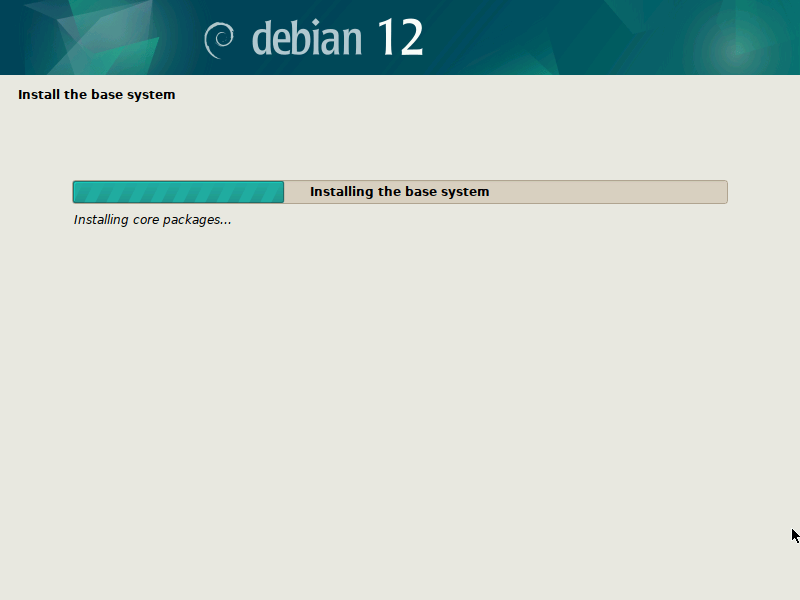
After you confirmed your partitioning changes, the base system gets installed. I suggest not to select any additional components, like desktop environments, to speed up the process.
During the final step of the installation (finish-install.d/55netcfg-copy-config) d-i will detect that Netplan was installed in the target system (due to the preseed file provided) and opt to write its network configuration to /etc/netplan/ instead of /etc/network/interfaces or /etc/NetworkManager/system-connections/.
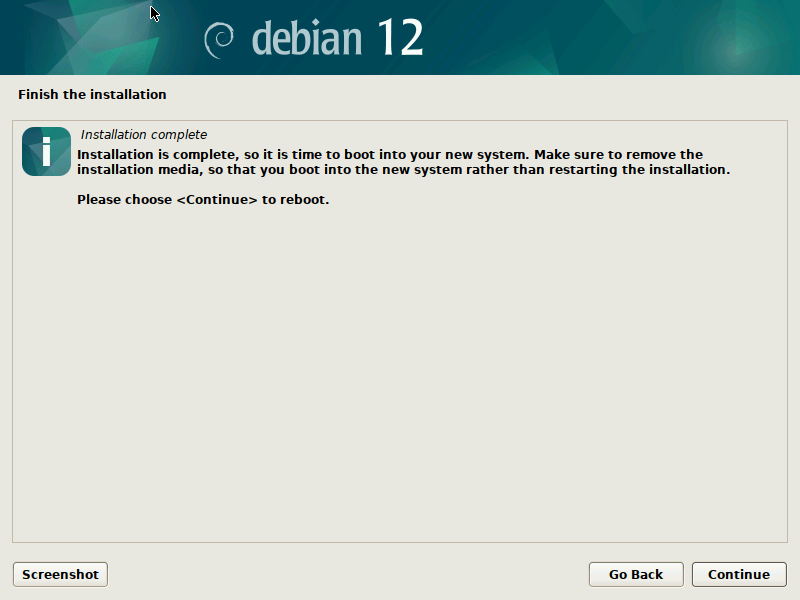
Done! After the installation finished, you can reboot into your virgin Debian Sid/Trixie system.
To do that, quit the current Qemu process, by pressing Ctrl+C and make sure to copy over the EFIVARS.fd file that was modified by grub during the installation, so Qemu can find the new system. Then reboot into the new system, not using the mini.iso image any more:
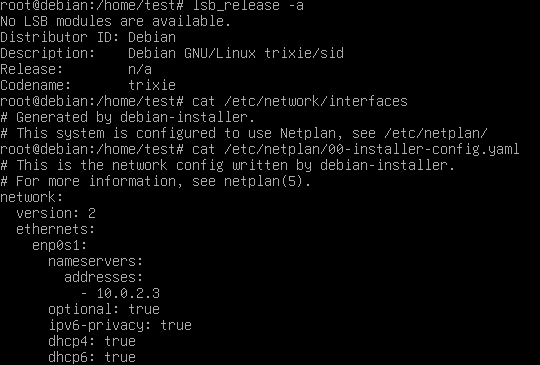
Finally, you can play around with your Netplan enabled Debian system! As you will find, /etc/network/interfaces exists but is empty, it could still be used (optionally/additionally). Netplan was configured in /etc/netplan/ according to the settings given during the d-i installation process.
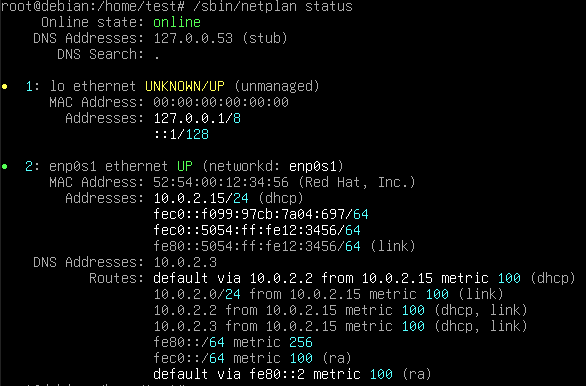
In our case, we also installed the Netplan CLI, so we can play around with some of its features, like netplan status:
Thank you for following along the Netplan enabled Debian installation process and happy hacking! If you want to learn more, find us at GitHub:netplan.
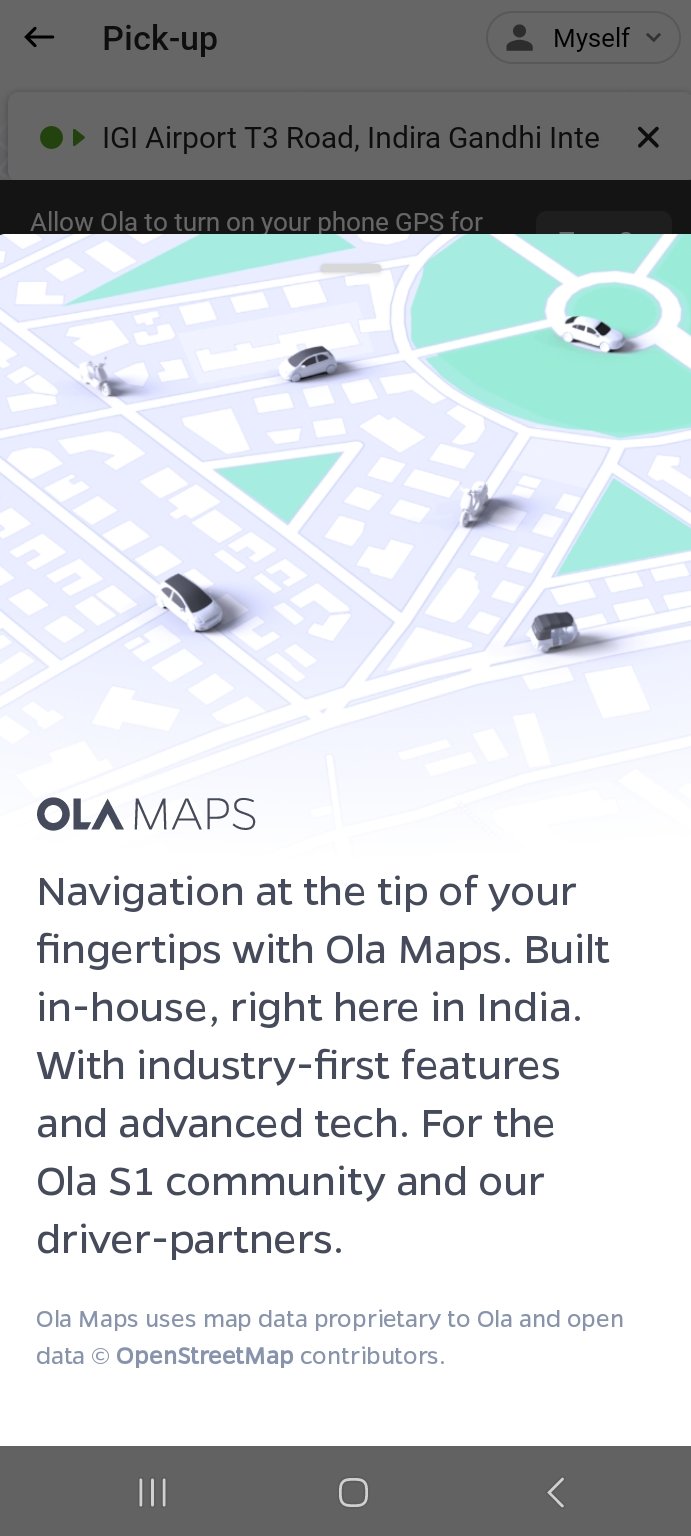
Recently, Ola started rolling out Ola Maps in their main mobile app, replacing Google Maps, while also offering maps as a service to other organizations. The interesting part for me was the usage of OpenStreetMap data as base map with Ola s proprietary data sources. I ll mostly about talk about map data part here.
Screenshot of Ola App. OpenStreetMap attribution is shown after clicking the Ola Map icon.
OpenStreetMap (OSM) for starters, is a community owned and edited map data resource which gives freedom to use map data for any purpose. This includes the condition that attribution is given back to OSM which in turn ideally would encourage other users to contribute, correct and edit, helping everyone in turn. Due to this, OSM is also regarded as Wikipedia of maps. OSM data is not just used by Ola. Many others use it for various purposes like Wikipedia Maps, Strava Maps, Snapchat Map, bus tracking in GoIbibo/Redbus.
OSM India community has been following Ola map endeavor to use and contribute to OSM since they went public. As required by OSM for organized mapping efforts, Ola created wiki entry with information regarding their editors, usage, policy and mentions following as their data usage case:
OSM data is used for the road network, traffic signs and signals, buildings, natural features, landuse polygons and some POIs.
Creating a map product is a task in itself, an engineering hurdle creating the tech stack for collection, validation, import and serving the map and the map data part. Ola has done a good job describing the development of tech stack in their blog post. Ola holds an enormous corpus of live and constantly updated GPS trace data. Their drivers, users, and delivery partners generate those, which they harness to validate, correct and add missing map data. Ola employees now regularly contribute new or missing roads (including adding dual carriageway to existing ones), fix road geometry, classification, road access type and restrictions pan India. They have been active and engaging in OSM India community channels, though community members have raised some concerns on their OSM edit practices.
Ola s venture into the map industry isn t something out of the ordinary. Grab, a South East Asian company which has business interests in food deliveries, ride hailing and a bunch of other services too switched to their in-house map based on OpenStreetMap, followed by launching of their map product. Grab too contributed back data like Ola. Both Ola and Grab heavily rely on map for their business operations and seem to chose to go independent for it, bootstrapping the products on OSM.
In India too, a bunch of organizations contribute to OSM like Swiggy, Stackbox, Amazon, Apple. Microsoft, Meta/Facebook and many others. Everyone wants a better map (data), so everyone works together.
Ola could have gone their own route, bootstrapping map data from scratch, which would have been a gargantuan task when you re competing against the likes of Google Maps and Bing Maps, which have been into this since many years. Deciding to use OSM and actively giving back to make data better for everyone deserves accolades. Now I m waiting to for their second blog post, which they mention would be on map data.
If you re an Ola map user through Ola Electric or Ola app, and find some road unmapped, you can always edit them in OSM. What I have heard from their employee, they import new OSM data weekly, which means your changes should start reflecting for you (and everyone else) by next week. If you re new, follow Beginners guide and join OSM India community community.osm.be/resources/asia/india/ for any doubts and participating in various mapping events.
PS You can see live OSM edits in India subcontinent here.
Combining BGP confederations and AS override can potentially
create a BGP routing loop, resulting in an indefinitely expanding AS path.
BGP confederation is a technique used to reduce the number of iBGP sessions
and improve scalability in large autonomous systems (AS). It divides an AS into
sub-ASes. Most eBGP rules apply between sub-ASes, except that next-hop, MED, and
local preferences remain unchanged. The AS path length ignores contributions
from confederation sub-ASes. BGP confederation is rarely used and BGP route
reflection is typically preferred for scaling.
AS override is a feature that allows a router to replace the ASN of a
neighbor in the AS path of outgoing BGP routes with its own. It s useful when
two distinct autonomous systems share the same ASN. However, it interferes with
BGP s loop prevention mechanism and should be used cautiously. A safer
alternative is the allowas-in directive.1
In the example below, we have four routers in a single confederation, each in
its own sub-AS. R0 originates the 2001:db8::1/128 prefix. R1, R2, and
R3 forward this prefix to the next router in the loop.
BGP routing loop using a confederation
The router configurations are available in a Git repository. They are
running Cisco IOS XR. R2 uses the following configuration for BGP:
The session with R3 uses both as-override and next-hop-self directives.
The latter is only necessary to make the announced prefix valid, as there is no
IGP in this example.2
Here s the sequence of events leading to an infinite AS path:
R1 selects it as the best path, forwarding it to R2 with AS
path (64501 64500).
R2 selects it as the best path, forwarding it to R3 with AS
path (64500 64501 64502).
R3 selects it as the best path. It would forward it to R1 with AS path
(64503 64502 64501 64500), but due to AS override, it substitutes R1 s
ASN with its own, forwarding it with AS path (64503 64502 64503 64500).
R1 accepts the prefix, as its own ASN is not in the AS path. It compares
this new prefix with the one from R0. Both (64500) and (64503 64502
64503 64500) have the same length because confederation sub-ASes don t
contribute to AS path length. The first tie-breaker is the router ID.
R0 s router ID (1.0.0.4) is higher than R3 s (1.0.0.3). The new
prefix becomes the best path and is forwarded to R2 with AS path (64501
64503 64501 64503 64500).
R2 receives the new prefix, replacing the old one. It selects it as the
best path and forwards it to R3 with AS path (64502 64501 64502 64501
64502 64500).
R3 receives the new prefix, replacing the old one. It selects it as the
best path and forwards it to R0 with AS path (64503 64502 64503 64502
64503 64502 64500).
R1 receives the new prefix, replacing the old one. Again, it competes with
the prefix from R0, and again the new prefix wins due to the lower router
ID. The prefix is forwarded to R2 with AS path (64501 64503 64501 64503
64501 64503 64501 64500).
A few iterations later, R1 views the looping prefix as follows:4
RP/0/RP0/CPU0:R1#showbgpipv6u2001:db8::1/128bestpath-compare
BGP routing table entry for 2001:db8::1/128Last Modified: Jul 28 10:23:05.560 for 00:00:00Paths: (2 available, best #2) Path #1: Received by speaker 0 Not advertised to any peer (64500) 2001:db8::1:0 from 2001:db8::1:0 (1.0.0.4), if-handle 0x00000000 Origin IGP, metric 0, localpref 100, valid, confed-external Received Path ID 0, Local Path ID 0, version 0 Higher router ID than best path (path #2) Path #2: Received by speaker 0 Advertised IPv6 Unicast paths to peers (in unique update groups): 2001:db8::2:1 (64503 64502 64503 64502 64503 64502 64503 64502 64503 64502 64503 64502 64503 64502 64503 64502 64503 64502 64503 64502 64503 64502 64503 64502 64503 64502 64503 64502 64503 64502 64503 64502 64503 64502 64503 64502 64503 64502 64503 64502 64503 64502 64503 64502 64503 64502 64503 64502 64503 64502 64503 64502 64503 64502 64503 64502 64503 64502 64503 64502 64503 64502 64503 64502 64503 64502 64503 64502 64503 64502 64503 64502 64503 64502 64503 64502 64503 64502 64503 64502 64503 64502 64503 64502 64503 64502 64503 64502 64503 64502 64503 64502 64503 64502 64503 64502 64503 64502 64503 64502 64503 64502 64500) 2001:db8::4:0 from 2001:db8::4:0 (1.0.0.3), if-handle 0x00000000 Origin IGP, metric 0, localpref 100, valid, confed-external, best, group-best Received Path ID 0, Local Path ID 1, version 37 best of AS 64503, Overall best
There s no upper bound for an AS path, but BGP messages have size limits (4096
bytes per RFC 4271 or 65535 bytes per RFC 8654). At some
point, BGP updates can t be generated. On Cisco IOS XR, the BGP process crashes
well before reaching this limit.5
The main lessons from this tale are:
never use BGP confederations under any circumstances, and
be cautious of features that weaken BGP routing loop detection.
When using BGP confederations with Cisco IOS XR, use
allowconfedas-in instead. It s available since IOS XR 7.11.
Using BGP confederations is already inadvisable. If you don t use the
same IGP for all sub-ASes, you re inviting trouble! However, the scenario
described here is also possible with an IGP.
When an AS path segment is composed of ASNs from a confederation, it
is displayed between parentheses.
By default, IOS XR paces eBGP updates. This is controlled by the
advertisement-interval directive. Its default value is 30 seconds for eBGP
peers (even in the same confederation). R1 and R2 set this value to 0,
while R3 sets it to 2 seconds. This gives some time to watch the AS path
grow.
This is CSCwk15887. It only happens when using as-override on an
AS path with a too long AS_CONFED_SEQUENCE. This should be fixed around
24.3.1.
This week our family suffered another loss with my brother in-law. We will miss him dearly. On our way down to Phoenix to console our nephew that just lost his dad our car blew up. Last week we were in a roll over accident that totaled our truck and left me with a broken arm. We are now in great need of a new vehicle. Please consider donating to this fund: https://gofund.me/033eb25d . Kubuntu is out of money and I am between work packages with the project . We are 50 miles away from the closest town for supplies, essentials such as water requires a vehicle.
I have had bad years before ( covid ) in which I lost my beloved job at Blue Systems. I made a vow to myself to never let my personal life affect my work again. I have so far kept that promise to myself and without further ado I present to you my work.
Kubuntu:
Many SRUs awaiting verification stage including the massive apparmor policy bug.
sddm fix for the black screen on second boot has passed verification and should make .1 release.
See Debian for the qt6 Plasma / applications work.
Debian:
qtmpv in NEW
arianna in NEW
kamera uploading today
kcharselect Experimental
Tokodon Done, but needs qtmpv to pass NEW
Gwenview WIP needs kamera, kio-extras
kio-extras WIP
KDE Snaps:
Please note: for the most part the Qt6 snaps are in edge except the few in the project that are heavily tested. Please help test the edge snaps so I can promote them.
Elisa
Okular
Konsole ( please note this is a confined terminal for the project and not very useful except to ssh to the host system )
Kwrite
Gwenview
Kate ( classic )
Gcompris
Alligator
Ark
Blinken
Bomber
Bovo
Calindori
Digikam
Dragon
Falkon
Filelight
WIP Snaps or MR s made
KSpacedual
Ksquares
KSudoku
KTuberling
Kubrick
lskat
Palapeli
Kajongg
Kalzium
Kanagram
Kapman
Katomic
KBlackBox
KBlocks
KBounce
KBreakOut
KBruch
Please note that 95% of the snaps are free-time work. The project covers 5. I am going as fast as I can between Kubuntu/Debian and the project commitments. Not to mention I have only one arm! My GSOC student is also helping which you can read all about here: https://soumyadghosh.github.io/website/interns/gsoc-2024/gsoc-week-3-week-7/
There is still much work to do in Kubuntu to be Plasma 6 ready for Oracular and they are out of funds. I will still continue my work regardless, but please consider donating until we can procure a consistent flow of funding : https://kubuntu.org/donate/
Thank you for reading and have a blessed day!
DebConf24, the 25th edition of the Debian
conference is taking place in Pukyong National University at Busan, Republic of
Korea.
Thanks to the hard work of its organizers, it again will be an interesting and
fruitful event for attendees.
We would like to warmly welcome the sponsors of DebConf24, and introduce them to
you.
We have three Platinum sponsors.
Proxmox is the first Platinum sponsor.
Proxmox provides powerful and user-friendly Open Source server software.
Enterprises of all sizes and industries use Proxmox solutions to deploy
efficient and simplified IT infrastructures, minimize total cost
of ownership, and avoid vendor lock-in.
Proxmox also offers commercial support, training services, and an extensive
partner ecosystem to ensure business continuity for its customers.
Proxmox Server Solutions GmbH was established in 2005
and is headquartered in Vienna, Austria.
Proxmox builds its product offerings on top of the Debian operating system.
Our second Platinum sponsor is Infomaniak.
Infomaniak is an independent cloud service provider recognised throughout
Europe for its commitment to privacy, the local economy and the environment.
Recording growth of 18% in 2023, the company is developing a suite of online
collaborative tools and cloud hosting, streaming, marketing and events
solutions.
Infomaniak uses exclusively renewable energy, builds its own data centers and
develops its solutions in Switzerland, without relocating.
The company powers the website of the Belgian radio and TV
service (RTBF) and provides streaming for more than 3,000
TV and radio stations in Europe.
Wind River is our third Platinum sponsor.
For nearly 20 years, Wind River has led in commercial Open Source Linux
solutions for mission-critical enterprise edge computing.
With expertise across aerospace, automotive, industrial, telecom, and more,
the company is committed to Open Source through initiatives like eLxr, Yocto,
Zephyr, and StarlingX.
Our Gold sponsors are:
Ubuntu,
the Operating System delivered by Canonical.
Freexian,
a services company specialized in Free Software and in particular Debian
GNU/Linux, covering consulting, custom developments, support and training.
Freexian has a recognized Debian expertise thanks to the participation of
Debian developers.
Lenovo,
a global technology leader manufacturing a wide portfolio of connected
products including smartphones, tablets, PCs and workstations as well as
AR/VR devices, smart home/office and data center solutions.
Korea Tourism Organization,
which purpose is to advance tourism as a key driver for national economic
growth and enhancement of national welfare and intends to be a public
organization that makes the Korean people happier; it promotes national wealth
through tourism.
Busan IT Industry Promotion Agency,
an industry promotion organization that contributes to the innovation of the
digital economy with the power of IT and CT and
supports the ecosystem for innovative local startups and companies to grow.
Microsoft,
who enables digital transformation for the era of an intelligent cloud and an
intelligent edge.
Its mission is to empower every person and every organization on the planet to
achieve more.
doubleO,
a company that specializes in consulting and developing empirical services
using big data analysis and artificial intelligence.
doubleO provides a variety of data-centered services together with small and
medium-sized businesses in Busan/Gyeongnam.
Our Silver sponsors are:
Roche, a major international pharmaceutical
provider and research company dedicated to personalized healthcare.
Two Sigma, rigorous inquiry, technology
data science, and invention to bring science to finance and help solve the
toughest challenges across financial services.
Arm: leading technology provider of processor
IP, Arm powered solutions have been supporting innovation for
more than 30 years and are deployed in over 280 billion chips to date.
Google, one of the largest technology companies in
the world, providing a wide range of Internet-related services and products
such as online advertising technologies, search, cloud computing, software,
and hardware.
FSIJ, the Free Software Initiative
of Japan, a non-profit organization dedicated to supporting Free Software
growth and development.
Busan Tourism Organisation:
leading public corporation that generates social and economic values in Busan
tourism industry, developing tourism resources in accordance with government
policies and invigorate tourism industry.
Civil Infrastructure Platform,
a collaborative project hosted by the Linux Foundation,
establishing an open source base layer of industrial grade software.
Collabora, a global consultancy delivering
Open Source software solutions to the commercial world.
Matanel Foundation, which operates in Israel,
as its first concern is to preserve the cohesion of a society and a nation
plagued by divisions.
A special thanks to the
Pukyong National University, our Venue
Partner and our Network Partners KOREN
and KREONET!
Thanks to all our sponsors for their support!
Their contributions make it possible for a large number of Debian contributors
from all over the globe to work together, help and learn from each other in
DebConf24.
apt-upgrade-canary is a helper program to alert when upgrading
packages via apt.
If there are some packages which causes a critical or serious
bug, it shows warnings for terminal.
Then you can stay on current version of package by canceling
upgrades.
This program is aimed to help not to installing
problematic packages via manual upgrades.
Usually, you should delegate package upgrade to
unattended-upgrades and apt-listbugs.
apt-listbugs kindly warns if there are known bugs.
In most cases it is enough safer.
But there is one exception, it is not true that always apt-listbugs
can follow very latest critical or serious bugs in timely manner.
apt-upgrade-canary checks UDD mirror database (it take into account
to cache query not to throw redundant one frequently)
Getting started
Install required packages.
$ sudo apt install -y make ruby-pg ruby-json ruby-term-ansicolor
Use case in action
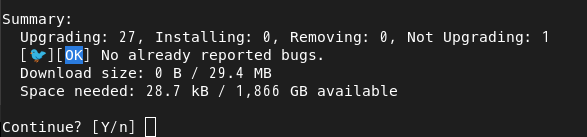
If there is no serious bugs which is reported against target packages,
apt-upgrade-canary reports no error.
apt-upgrade-canary: no problem
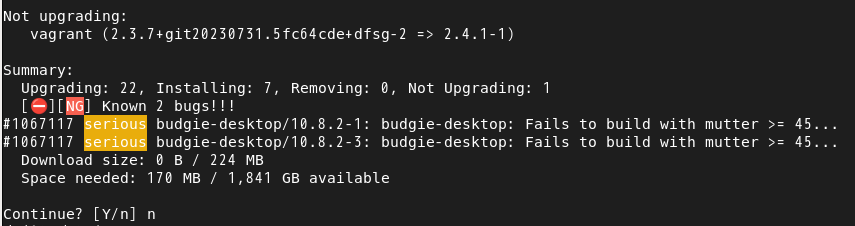
If there are something weird happen, it reports matched bugs.
apt-upgrade-canary: serious case
So you can stay on.
Yay, crypto!
DebCamp has started, and in a couple of days, we will fully be in DebConf24
mode!
As most of you know, an important part that binds Debian together is our
cryptographic identity assurance, and that is in good measure tightened by the
Continuous Key-Signing Parties we hold at DebConfs and other Debian and Free
Software gatherings.
As I have done during (most of) the past DebConfs, I have prepared a set of
pseudo-social maps to help you find where you are in the OpenPGP mesh of our
conference. Naturally, Web-of-Trust maps should be user-centered, so find your
own at:
https://people.debian.org/~gwolf/dc24_ksp/
The list is now final and it will not receive any modifications (I asked
for them some days
ago); if your
name still appears on the list and you don t want to be linked to the DC24 KSP
in the future, tell me and I ll remove it from future versions of the list
(but it is part of the final DC24
file, as its checksum
is already final)
Speaking of which!
If you are to be a part of the keysigning, get the final DC24
file and, on a device
you trust, check its SHA256 by running:
Make sure the resulting number matches the one I m presenting. If it doesn t,
ensure your copy of the file is not corrupted (i.e. download again). If it still
doess not match, notify me immediately.
Does any of the above confuse you? Please come to (or at least, follow the
stream for) my session on DebConf opening day, Continuous Key-Signing Party
introduction,
10:30 Korean time; I will do my best to explain the details to you.
PS- I will soon provide a simple, short PDF that will probably be mass-printed
at FrontDesk so that you can easily track your KSP progress.
A new minor release 0.4.23 of RQuantLib
just arrived at CRAN earlier
today, and will be uploaded to Debian in due course.
QuantLib is a rather
comprehensice free/open-source library for quantitative
finance. RQuantLib
connects (some parts of) it to the R environment and language, and has
been part of CRAN for more than
twenty-two years (!!) as it was one of the first packages I
uploaded.
This release of RQuantLib
updates to QuantLib version 1.35
released this morning. It accommodates some removals following earlier
deprecations, and also updates most of the code in the function for a
more readable and compact form of creating shared pointers via
make_shared() along with auto.
Changes in RQuantLib version 0.4.23 (2024-07-23)
Adjustments for QuantLib 1.35 and removal of deprecated code (in
utility functions and dividend case of vanilla options)
Adjustments for new changes in QuantLib 1.35
Refactoring most C++ files making more use of both
auto and make_shared to simplify and shorten
expressions
The twelveth release of the qlcal package
arrivied at CRAN today.
qlcal
delivers the calendaring parts of QuantLib. It is provided (for the R
package) as a set of included files, so the package is self-contained
and does not depend on an external QuantLib library (which can be
demanding to build). qlcal covers
over sixty country / market calendars and can compute holiday lists, its
complement (i.e. business day lists) and much more. Examples
are in the README at the repository, the package page,
and course at the CRAN package
page.
This releases synchronizes qlcal with
the QuantLib release 1.35 (made
today) and contains more updates to 2024 calendars.
Changes in version 0.0.12
(2024-07-22)
Synchronized with QuantLib 1.35 released today
Calendar updates for Chile, India, United States, Brazil
Courtesy of my CRANberries, there
is a diffstat report for this
release. See the project page
and package documentation for more details, and more examples. If you
like this or other open-source work I do, you can sponsor me at
GitHub.
My work on overhauling dhcpcd as the prime replacement for ISC's discontinued DHCP client is done. The package has achieved stability, both upstream and at Debian. The only remaining points are bug #1038882 to swap the Priorities of isc-dhcp-client and dhcpcd-base in the repository's override, and swaping ifupdown's search order to put dhcpcd first.
Meanwhile, ifupdown's de-facto maintainer prompted me to sollicit opinions on which of the 4 ifupdown implementations should ship with a minimal installation for Trixie. This, in turn, re-opened the debate of what should be Debian's default network configuation framework (see the thread starting with this post).
networkd
Given how most Debian ports (except for Hurd) ship with systemd, which includes a disabled networkd by standard, many people in the thread feel that this should become the default network configuration tool for minimal installations. As it happens, most of my hosts fit that scenario, so I figured that I would give another go at testing networkd on one host.
I used the following minimalistic /etc/systemd/network/dhcp.network:
[Match]
Name=en* wl*
[Network]
DHCP=yes
This correctly configured IPv4 via DHCP, with the small caveat that it doesn't update /etc/resolv.conf without installing resolvconf or systemd-resolved.
However, networkd's default IPv6 settings really are not suitable for public consumption. The key issues (see Bug #1076432):
Temporary addresses are not enabled by default. Worse, the setting is ignored if it was enabled by sysctl during bootup. This is a major privacy issue. Adding IPv6PrivacyExtensions=yes to the above exposed another issue: instead of using the fe80 address generated by the kernel, networkd adds a new one.
Networkd uses EUI64 addresses by default. This is another major privacy issue, since EUI64 addresses are forensically traceable to the interface's MAC address. Worse, the setting is ignored if stable-privacy was enabled by sysctl during bootup. To top it all, networkd does stable-privacy using systemd's time-proven brain-dead approach of reinventing the wheel: instead of merely setting the kernel's address generation mode to 3 and letting it configure the secret address, it expects the secret address to be spelled out in the systemd unit.
Conclusion: networkd works well enough for someone configuring an IPv4-only network from 20 years ago, but is utterly inadequate for IPv6 or dual-stack installations, doubly so on a software distribution that claims to care about privacy and network security.
Leonardo and I are happy to
announce the release of another maintenance release 0.1.3 of our dtts package
which has been on CRAN for a
good two years now.
dtts
builds upon our nanotime
package as well as the beloved data.table to bring
high-performance and high-resolution indexing at the
nanosecond level to data frames. dtts aims to
offers the time-series indexing versatility of xts (and zoo) to the immense
power of data.table while
supporting highest nanosecond resolution.
This release contains two nice and focussed contributed pull
requests. Tomas Kalibera, who
as part of R Core looks after everything concerning R on Windows, and
then some, needed an adjustment for pending / upcoming R on Windows
changes for builds with LLVM which is what Arm-on-Windows uses. We
happily obliged: neither Leonardo nor I see much of
Windows these decades. (Easy thing to say on a day like today with its
crowdstrike
hammer falling!) Similarly, Michael Chirico supplied a
PR updating one of our tests to an upcoming change at data.table which we are of
course happy to support.
The short list of changes follows.
Changes in version 0.1.3
(2024-07-18)
Windows builds use localtime_s with LLVM (Tomas
Kalibera in #16)
Tests code has been adjusted for an upstream change in data.table tests for all.equal (Michael
Chirico in #18 addressing
#17)
Another thing to note is that include_directories adds both the source
directory and corresponding build directory to include path, so you don't
have to care.
It seems that I have to care after all.
Thankfully there is an implicit_include_directories setting
that can turn this off if needed.
Its documentation is not as easy to find as I'd like (kudos to Kangie on IRC),
and hopefully this blog post will make it easier for me to find it in the
future.
The Rcpp Core Team is once again pleased to announce a new release
(now at 1.0.13) of the Rcpp package.
It arrived on CRAN earlier
today, and has since been uploaded to Debian. Windows and macOS builds
should appear at CRAN in the next few days, as will builds in different
Linux distribution and of course r2u should catch up
tomorrow too. The release was uploaded last week, but not only does Rcpp always gets flagged because of the
grandfathered .Call(symbol) but CRAN also found two packages
regressing which then required them to take five days to get back to
us. One issue was known; another
did not reproduce under our tests against over 2800 reverse dependencies
leading to the eventual release today. Yay. Checks are good and
appreciated, and it does take time by humans to review them.
This release continues with the six-months January-July cycle started
with release
1.0.5 in July 2020. As a reminder, we do of course make interim
snapshot dev or rc releases available via the Rcpp drat repo as well as
the r-universe page and
repo and strongly encourage their use and testing I run my systems
with these versions which tend to work just as well, and are also fully
tested against all reverse-dependencies.
Rcpp has long established itself
as the most popular way of enhancing R with C or C++ code. Right now,
2867 packages on CRAN depend on
Rcpp for making analytical code go
faster and further, along with 256 in BioConductor. On CRAN, 13.6% of
all packages depend (directly) on Rcpp, and 59.9% of all compiled packages
do. From the cloud mirror of CRAN (which is but a subset of all CRAN
downloads), Rcpp has been downloaded
86.3 million times. The two published papers (also included in the
package as preprint vignettes) have, respectively, 1848 (JSS, 2011) and 324 (TAS, 2018)
citations, while the the book (Springer useR!,
2013) has another 641.
This release is incremental as usual, generally preserving existing
capabilities faithfully while smoothing our corners and / or extending
slightly, sometimes in response to changing and tightened demands from
CRAN or R standards. The move towards a
more standardized approach for the C API of R leads to a few changes;
Kevin did most of the PRs for this. Andrew Johnsom also provided a very
nice PR to update internals taking advantage of variadic templates.
The full list below details all changes, their respective PRs and, if
applicable, issue tickets. Big thanks from all of us to all
contributors!
Changes in
Rcpp release version 1.0.13 (2024-07-11)
Changes in Rcpp API:
Set R_NO_REMAP if not already defined (Dirk in #1296)
Add variadic templates to be used instead of generated code
(Andrew Johnson in #1303)
Count variables were switches to size_t to avoid
warnings about conversion-narrowing (Dirk in #1307)
Rcpp now avoids the usage of the (non-API) DATAPTR function when
accessing the contents of Rcpp Vector objects where possible. (Kevin in
#1310)
Rcpp now emits an R warning on out-of-bounds Vector accesses.
This may become an error in a future Rcpp release. (Kevin in #1310)
Switch VECTOR_PTR and STRING_PTR to new
API-compliant RO variants (Kevin in #1317 fixing #1316)
Changes in Rcpp Deployment:
Small updates to the CI test containers have been made (#1304)
The Initial Encounter:
I recently started to work with Nginx to explore the requirements on how to
configure a then so called server block. It s quite different than within
Apache. But there are a tons of good websites out there which do explain the
different steps and options quite well. I also realized quickly that I need to
be able to configure my Nginx setups in a way so the content is delivered
through https with some automatic redirection from http URLs.
Let s install Nginx
Installing Nginx
$ sudo apt update
$ sudo apt install nginx
Checking your Web Server
We can check now nginx service is active or inactive
Output
  nginx.service - A high performance web server and a reverse proxy server
     Loaded: loaded (/lib/systemd/system/nginx.service; enabled; vendor preset: enabled)
     Active: active (running) since Tue 2024-02-12 09:59:20 UTC; 3h ago
       Docs: man:nginx(8)
   Main PID: 2887 (nginx)
      Tasks: 2 (limit: 1132)
     Memory: 4.2M
        CPU: 81ms
     CGroup: /system.slice/nginx.service
              2887 nginx: master process /usr/sbin/nginx -g daemon on; master_process on;
              2890 nginx: worker process
Now we successfully installed nginx and it in running state.
How To Secure Nginx with Let s Encrypt on Debian 12
In this documentation, you will use Certbot to obtain a free SSL certificate
for Nginx on Debian 12 and set up your certificate.
Certbot is now ready to use, but in order for it to automatically configure
SSL for Nginx, we need to verify some of Nginx s configuration.
Step 2 Confirming Nginx s Configuration
Certbot needs to be able to find the correct server block in your Nginx
configuration for it to be able to automatically configure SSL. Specifically,
it does this by looking for a server_name directive that matches the domain you
request a certificate for. To check, open the configuration file for your
domain using nano or your favorite text editor.
Fillup above data your project wise and then save the file, quit your editor,
and verify the syntax of your configuration edits.
$ sudo nginx -t
Step 3 Obtaining an SSL Certificate
Certbot provides a variety of ways to obtain SSL certificates through
plugins. The Nginx plugin will take care of reconfiguring Nginx and reloading
the config whenever necessary. To use this plugin, type the following command
line.
$ sudo certbot --nginx -d example.com
The configuration will be updated, and Nginx will reload to pick up the new
settings. certbot will wrap up with a message telling you the process was
successful and where your certificates are stored.
Output
IMPORTANT NOTES:
 - Congratulations! Your certificate and chain have been saved at:
   /etc/letsencrypt/live/example.com/fullchain.pem
   Your key file has been saved at:
   /etc/letsencrypt/live/example.com/privkey.pem
   Your cert will expire on 2024-05-12. To obtain a new or tweaked
   version of this certificate in the future, simply run certbot again
   with the "certonly" option. To non-interactively renew *all* of
   your certificates, run "certbot renew"
 - If you like Certbot, please consider supporting our work by:
   Donating to ISRG / Let's Encrypt:   https://letsencrypt.org/donate
   Donating to EFF:                    https://eff.org/donate-le
Your certificates are downloaded, installed, and loaded. Next check the
syntax again of your configuration.
$ sudo nginx -t
If you get an error, reopen the server block file and check for any typos or
missing characters. Once your configuration file s syntax is correct, reload
Nginx to load the new configuration.
$ sudo systemctl reload nginx
Try reloading your website using https:// and notice your browser s security
indicator. It should indicate that the site is properly secured, usually with
a lock icon.
 A short status update on what happened on my side last month. Looking
at unified push support for Chatty prompted some libcmatrix fixes and
Chatty improvements (benefiting other protocols like SMS/MMS as well).
The Bluetooth status page in Phosh was a slightly larger change code
wise as we also enhanced our common widgets for building status pages,
simplifying the Wi-Fi status page and making future status pages
simpler. But as usual investigating bugs, reviewing patches (thanks!)
and keeping up with the changing world around us is what ate most of
the time.
Phosh
A Wayland Shell for mobile devices
 A new minor release 0.4.24 of
 This is one of those posts that s more for my own reference than likely to be helpful for others. If you re unlucky it ll have some useful tips for you. If I m lucky then I ll get a bunch of folk pointing out some optimisations.
First, what I m trying to achieve. I want a virtual machine environment where I can manually do tests on random kernels, and also various TPM related experiments. So I don t want something as fixed as a
 It s not often that a company is willing to make




 apt-upgrade-canary is a helper program to alert when upgrading
packages via apt.
If there are some packages which causes a critical or serious
bug, it shows warnings for terminal.
Then you can stay on current version of package by canceling
upgrades.
This program is aimed to help not to installing
problematic packages via manual upgrades.
Usually, you should


 My work on overhauling dhcpcd as the prime replacement for ISC's discontinued DHCP client is done. The package has achieved stability, both upstream and at Debian. The only remaining points are bug #1038882 to swap the Priorities of isc-dhcp-client and dhcpcd-base in the repository's override, and swaping ifupdown's search order to put dhcpcd first.
Meanwhile, ifupdown's de-facto maintainer prompted me to sollicit opinions on which of the 4 ifupdown implementations should ship with a minimal installation for Trixie. This, in turn, re-opened the debate of what should be Debian's default network configuation framework (see the thread starting with
 The Rcpp Core Team is once again pleased to announce a new release
(now at 1.0.13) of the