Search Results: "he"

1 July 2025

David Bremner: Hibernate on the pocket reform 2/n

Context

Testing continued
  • following a suggestion of gordon1, unload the mediatek module first. The following seems to work, either from the console or under sway
echo devices >  /sys/power/pm_test
echo reboot > /sys/power/disk
rmmod mt76x2u
echo disk >  /sys/power/state
modprobe mt76x2u
  • It even works via ssh (on wired ethernet) if you are a bit more patient for it to come back.
  • replacing "reboot" with "shutdown" doesn't seem to affect test mode.
  • replacing "devices" with "platform" (or "processors") leads to unhappiness.
    • under sway, the screen goes blank, and it does not resume
    • same on console
previous episode next episode

Guido G nther: Free Software Activities June 2025

Another short status update of what happened on my side last month. Phosh 0.48.0 is out with nice improvements, phosh.mobi e.V. is alive, helped a bit to get cellbroadcastd out, osk bugfixes and some more: See below for details on the above and more: phosh phoc phosh-mobile-settings stevia (formerly phosh-osk-stub) phosh-osk-data phosh-vala-plugins pfs xdg-desktop-portal-phosh xdg-desktop-portal phosh-debs meta-phosh feedbackd feedbackd-device-themes gmobile GNOME clocks Debian Mobian ModemManager libmbim libqmi mobile-broadband-provider-info Cellbroadcastd iio-sensor-proxy twenty-twenty-hugo gotosocial Reviews This is not code by me but reviews on other peoples code. The list is (as usual) slightly incomplete. Thanks for the contributions! Help Development If you want to support my work see donations. Comments? Join the Fediverse thread

Paul Wise: FLOSS Activities June 2025

Focus This month I didn't have any particular focus. I just worked on issues in my info bubble.

Changes

Issues

Review

Sponsors All work was done on a volunteer basis.

30 June 2025

Colin Watson: Free software activity in June 2025

My Debian contributions this month were all sponsored by Freexian. This was a very light month; I did a few things that were easy or that seemed urgent for the upcoming trixie release, but otherwise most of my energy went into Debusine. I ll be giving a talk about that at DebConf in a couple of weeks; this is the first DebConf I ll have managed to make it to in over a decade, so I m pretty excited. You can also support my work directly via Liberapay or GitHub Sponsors. PuTTY After reading a bunch of recent discourse about X11 and Wayland, I decided to try switching my laptop (a Framework 13 AMD running Debian trixie with GNOME) over to Wayland. I don t remember why it was running X; I think I must have either inherited some configuration from my previous laptop (in which case it could have been due to anything up to ten years ago or so), or else I had some initial problem while setting up my new laptop and failed to make a note of it. Anyway, the switch was hardly noticeable, which was great. One problem I did notice is that my preferred terminal emulator, pterm, crashed after the upgrade. I run a slightly-modified version from git to make some small terminal emulation changes that I really must either get upstream or work out how to live without one of these days, so it took me a while to notice that it only crashed when running from the packaged version, because the crash was in code that only runs when pterm has a set-id bit. I reported this upstream, they quickly fixed it, and I backported it to the Debian package. groff Upstream bug #67169 reported URLs being dropped from PDF output in some cases. I investigated the history both upstream and in Debian, identified the correct upstream patch to backport, and uploaded a fix. libfido2 I upgraded libfido2 to 1.16.0 in experimental. Python team I upgraded pydantic-extra-types to a new upstream version, and fixed some resulting fallout in pendulum. I updated python-typing-extensions in bookworm-backports, to help fix python3-tango: python3-pytango from bookworm-backports does not work (10.0.2-1~bpo12+1). I upgraded twisted to a new upstream version in experimental. I fixed or helped to fix a few release-critical bugs:

Gunnar Wolf: Get your personalized map of DebConf25 in Brest

As I often do, this year I have also prepared a set of personalized maps for your OpenPGP keysigning in DebConf25, in Brest! What is that, dare you ask? Partial view of my OpenPGP map One of the not-to-be-missed traditions of DebConf is a Key-Signing Party (KSP) that spans the whole conference! Travelling from all the corners of the world to a single, large group gathering, we have the ideal opportunity to spread some communicable diseases trust on your peers identities and strengthen Debian s OpenPGP keyring. But whom should you approach for keysigning? Go find yourself in the nice listing I have prepared. By clicking on your long keyid (in my case, the link labeled 0x2404C9546E145360), anybody can download your certificate (public key + signatures). The SVG and PNG links will yield a graphic version of your position within the DC25 keyring, and the TXT link will give you a textual explanation of it. (of course, your links will differ, yada yada ) Please note this is still a preview of our KSP information: You will notice there are outstanding several things for me to fix before marking the file as final. First, some names have encoding issues I will fix. Second, some keys might be missing if you submitted your key as part of the conference registration form but it is not showing, it must be because my scripts didn t find it in any of the queried keyservers. My scripts are querying the following servers:
hkps://keyring.debian.org/
hkps://keys.openpgp.org/
hkps://keyserver.computer42.org/
hkps://keyserver.ubuntu.com/
hkps://pgp.mit.edu/
hkps://pgp.pm/
hkps://pgp.surf.nl/
hkps://pgpkeys.eu/
hkps://the.earth.li/
Make sure your key is available in at least some of them; I will try to do a further run on Friday, before travelling, or shortly after arriving to France. If you didn t submit your key in time, but you will be at DC25, please mail me stating [DC25 KSP] in your mail title, and I will manually add it to the list. On (hopefully!) Friday, I ll post the final, canonical KSP coordination page which you should download and calculate its SHA256-sum. We will have printed out convenience sheets to help you do your keysigning at the front desk.

David Bremner: Hibernate on the pocket reform 1/n

Configuration
  • script: https://docs.kernel.org/power/basic-pm-debugging.html
  • kernel is 6.15.4-1~exp1+reform20250628T170930Z

State of things
  • normal reboot works
  • Either from the console, or from sway, the intial test of reboot mode hibernate fails. In both cases it looks very similar to halting.
    • the screen is dark (but not completely black)
    • the keyboard is still illuminated
    • the system-controller still seems to work, althought I need to power off before I can power on again, and any "hibernation state" seems lost.

Running tests
  • this is 1a from above
  • freezer test passes
  • devices test from console
    • console comes back (including input)
    • networking (both wired and wifi) seems wedged.
    • console is full of messages from mt76x2u about vendor request 06 and 07 failing. This seems related to https://github.com/morrownr/7612u/issues/17
    • at some point the console becomes non-responsive, except for the aforementioned messages from the wifi module.
  • devices test under sway
    • display comes back
    • keyboard/mouse seem disconnected
    • network down / disconnected?
next episode

Russell Coker: Links June 2025

Jonathan McDowell wrote part 2 of his blog series about setting up a voice assistant on Debian, I look forward to reading further posts [1]. I m working on some related things for Debian that will hopefully work with this. I m testing out OpenSnitch on Trixie inspired by this blog post, it s an interesting package [2]. Valerie wrote an informative article about creating mesh networks using LORA for emergency use [3]. Interesting article about Signal and Windows Recall. That gives us some things to consider regarding ML features on Linux systems [4]. Insightful article about AI and the end of prestige [5]. We should all learn about LLMs. Jonathan Dowland wrote an informative blog post about how to manage namespaces on Linux [6]. The Consumer Rights wiki is a great resource for raising awareness of corporations exploiting their customers for computer related goods and services [7]. Interesting article about Schizophrenia and the cliff-edge function of evolution [8].

Otto Kek l inen: Corporate best practices for upstream open source contributions

Featured image of post Corporate best practices for upstream open source contributions
This post is based on presentation given at the Validos annual members meeting on June 25th, 2025.
When I started getting into Linux and open source over 25 years ago, the majority of the software development in this area was done by academics and hobbyists. The number of companies participating in open source has since exploded in parallel with the growth of mobile and cloud software, the majority of which is built on top of open source. For example, Android powers most mobile phones today and is based on Linux. Almost all software used to operate large cloud provider data centers, such as AWS or Google, is either open source or made in-house by the cloud provider. Pretty much all companies, regardless of the industry, have been using open source software at least to some extent for years. However, the degree to which they collaborate with the upstream origins of the software varies. I encourage all companies in a technical industry to start contributing upstream. There are many benefits to having a good relationship with your upstream open source software vendors, both for the short term and especially for the long term. Moreover, with the rollout of CRA in EU in 2025-2027, the law will require software companies to contribute security fixes upstream to the open source projects their products use. To ensure the process is well managed, business-aligned and legally compliant, there are a few do s and don t do s that are important to be aware of.

Maintain your SBOMs For every piece of software, regardless of whether the code was done in-house, from an open source project, or a combination of these, every company needs to produce a Software Bill of Materials (SBOM). The SBOMs provide a standardized and interoperable way to track what software and which versions are used where, what software licenses apply, who holds the copyright of which component, which security fixes have been applied and so forth. A catalog of SBOMs, or equivalent, forms the backbone of software supply-chain management in corporations.

Identify your strategic upstream vendors The SBOMs are likely to reveal that for any piece of non-trivial software, there are hundreds or thousands of upstream open source projects in use. Few organizations have resources to contribute to all of their upstreams. If your organization is just starting to organize upstream contribution activities, identify the key projects that have the largest impact on your business and prioritize forming a relationship with them first. Organizations with a mature contribution process will be collaborating with tens or hundreds of upstreams.

Appoint an internal coordinator and champions Having a written policy on how to contribute upstream will help ensure a consistent process and avoid common pitfalls. However, a written policy alone does not automatically translate into a well-running process. It is highly recommended to appoint at least one internal coordinator who is knowledgeable about how open source communities work, how software licensing and patents work, and is senior enough to have a good sense of what business priorities to optimize for. In small organizations it can be a single person, while larger organizations typically have a full Open Source Programs Office. This coordinator should oversee the contribution process, track all contributions made across the organization, and further optimize the process by working with stakeholders across the business, including legal experts, business owners and CTOs. The marketing and recruiting folks should also be involved, as upstream contributions will have a reputation-building aspect as well, which can be enhanced with systematic tracking and publishing of activities. Additionally, at least in the beginning, the organization should also appoint key staff members as open source champions. Implementing a new process always includes some obstacles and occasional setbacks, which may discourage employees from putting in the extra effort to reap the full long-term benefits for the company. Having named champions will empower them to make the first few contributions themselves, setting a good example and encouraging and mentoring others to contribute upstream as well.

Avoid excessive approvals To maintain a high quality bar, it is always good to have all outgoing submissions reviewed by at least one or two people. Two or three pairs of eyeballs are significantly more likely to catch issues that might slip by someone working alone. The review also slows down the process by a day or two, which gives the author time to sleep on it , which usually helps to ensure the final submission is well-thought-out by the author. Do not require more than one or two reviewers. The marginal utility goes quickly to zero beyond a few reviewers, and at around four or five people the effect becomes negative, as the weight of each approval decreases and the reviewers begin to take less personal responsibility. Having too many people in the loop also makes each feedback round slow and expensive, to the extent that the author will hesitate to make updates and ask for re-reviews due to the costs involved. If the organization experiences setbacks due to mistakes slipping through the review process, do not respond by adding more reviewers, as it will just grind the contribution process to a halt. If there are quality concerns, invest in training for engineers, CI systems and perhaps an internal certification program for those making public upstream code submissions. A typical software engineer is more likely to seriously try to become proficient at their job and put effort into a one-off certification exam and then make multiple high-quality contributions, than it is for a low-skilled engineer to improve and even want to continue doing more upstream contributions if they are burdened by heavy review processes every time they try to submit an upstream contribution.

Don t expect upstream to accept all code contributions Sure, identifying the root cause of and fixing a tricky bug or writing a new feature requires significant effort. While an open source project will certainly appreciate the effort invested, it doesn t mean it will always welcome all contributions with open arms. Occasionally, the project won t agree that the code is correct or the feature is useful, and some contributions are bound to be rejected. You can minimize the chance of experiencing rejections by having a solid internal review process that includes assessing how the upstream community is likely to understand the proposal. Sometimes how things are communicated is more important than how they are coded. Polishing inline comments and git commit messages help ensure high-quality communication, along with a commitment to respond quickly to review feedback and conducting regular follow-ups until a contribution is finalized and accepted.

Start small to grow expertise and reputation In addition to keeping the open source contribution policy lean and nimble, it is also good to start practical contributions with small issues. Don t aim to contribute massive features until you have a track record of being able to make multiple small contributions. Keep in mind that not all open source projects are equal. Each has its own culture, written and unwritten rules, development process, documented requirements (which may be outdated) and more. Starting with a tiny contribution, even just a typo fix, is a good way to validate how code submissions, reviews and approvals work in a particular project. Once you have staff who have successfully landed smaller contributions, you can start planning larger proposals. The exact same proposal might be unsuccessful when proposed by a new person, and successful when proposed by a person who already has a reputation for prior high-quality work.

Embrace all and any publicity you get Some companies have concerns about their employees working in the open. Indeed, every email and code patch an employee submits, and all related discussions become public. This may initially sound scary, but is actually a potential source of good publicity. Employees need to be trained on how to conduct themselves publicly, and the discussions about code should contain only information strictly related to the code, without any references to actual production environments or other sensitive information. In the long run most employees contributing have a positive impact and the company should reap the benefits of positive publicity. If there are quality issues or employee judgment issues, hiding the activity or forcing employees to contribute with pseudonyms is not a proper solution. Instead, the problems should be addressed at the root, and bad behavior addressed rather than tolerated. When people are working publicly, there tends to also be some degree of additional pride involved, which motivates people to try their best. Contributions need to be public for the sponsoring corporation to later be able to claim copyright or licenses. Considering that thousands of companies participate in open source every day, the prevalence of bad publicity is quite low, and the benefits far exceed the risks.

Scratch your own itch When choosing what to contribute, select things that benefit your own company. This is not purely about being selfish - often people working on resolving a problem they suffer from are the same people with the best expertise of what the problem is and what kind of solution is optimal. Also, the issues that are most pressing to your company are more likely to be universally useful to solve than any random bug or feature request in the upstream project s issue tracker.

Remember there are many ways to help upstream While submitting code is often considered the primary way to contribute, please keep in mind there are also other highly impactful ways to contribute. Submitting high-quality bug reports will help developers quickly identify and prioritize issues to fix. Providing good research, benchmarks, statistics or feedback helps guide development and the project make better design decisions. Documentation, translations, organizing events and providing marketing support can help increase adoption and strengthen long-term viability for the project. In some of the largest open source projects there are already far more pending contributions than the core maintainers can process. Therefore, developers who contribute code should also get into the habit of contributing reviews. As Linus law states, given enough eyeballs, all bugs are shallow. Reviewing other contributors submissions will help improve quality, and also alleviate the pressure on core maintainers who are the only ones providing feedback. Reviewing code submitted by others is also a great learning opportunity for the reviewer. The reviewer does not need to be better than the submitter - any feedback is useful; merely posting review feedback is not the same thing as making an approval decision. Many projects are also happy to accept monetary support and sponsorships. Some offer specific perks in return. By human nature, the largest sponsors always get their voice heard in important decisions, as no open source project wants to take actions that scare away major financial contributors.

Starting is the hardest part Long-term success in open source comes from a positive feedback loop of an ever-increasing number of users and collaborators. As seen in the examples of countless corporations contributing open source, the benefits are concrete, and the process usually runs well after the initial ramp-up and organizational learning phase has passed. In open source ecosystems, contributing upstream should be as natural as paying vendors in any business. If you are using open source and not contributing at all, you likely have latent business risks without realizing it. You don t want to wake up one morning to learn that your top talent left because they were forbidden from participating in open source for the company s benefit, or that you were fined due to CRA violations and mismanagement in sharing security fixes with the correct parties. The faster you start with the process, the less likely those risks will materialize.

29 June 2025

Matthias Geiger: Hello world

I finally got around to setting up a blog with pelican as SSG, so here I will be posting about my various Debian-related activities.

28 June 2025

Junichi Uekawa: MiniDebconf in Japan.

MiniDebconf in Japan. Seems like we are having a MiniDebconf in Japan. wiki.

27 June 2025

Jonathan Dowland: Viva

On Monday I had my Viva Voce (PhD defence), and passed (with minor corrections).
Post-viva refreshment Post-viva refreshment
It's a relief to have passed after 8 years of work. I'm not quite done of course, as I have the corrections to make! Once those are accepted I'll upload my thesis here.

Reproducible Builds (diffoscope): diffoscope 300 released

The diffoscope maintainers are pleased to announce the release of diffoscope version 300. This version includes the following changes:
[ "Alex" ]
* Fix a regression and add a test so that diffoscope picks up differences
  in metadata for identical files again. (Closes: reproducible-builds/diffoscope#411)
You find out more by visiting the project homepage.

26 June 2025

Bits from Debian: AMD Platinum Sponsor of DebConf25

amd-logo We are pleased to announce that AMD has committed to sponsor DebConf25 as a Platinum Sponsor. The AMD ROCm platform includes programming models, tools, compilers, libraries, and runtimes for AI and HPC solution development on AMD GPUs. Debian is an officially supported platform for AMD ROCm and a growing number of components are now included directly in the Debian distribution. For more than 55 years AMD has driven innovation in high-performance computing, graphics and visualization technologies. AMD is deeply committed to supporting and contributing to open-source projects, foundations, and open-standards organizations, taking pride in fostering innovation and collaboration within the open-source community. With this commitment as Platinum Sponsor, AMD is contributing to the annual Debian Developers Conference, directly supporting the progress of Debian and Free Software. AMD contributes to strengthening the worldwide community that collaborates on Debian projects year-round. Thank you very much, AMD, for your support of DebConf25! Become a sponsor too! DebConf25 will take place from 14 to 20 July 2025 in Brest, France, and will be preceded by DebCamp, from 7 to 13 July 2025. DebConf25 is accepting sponsors! Interested companies and organizations may contact the DebConf team through sponsors@debconf.org, and visit the DebConf25 website at https://debconf25.debconf.org/sponsors /become-a-sponsor/.

25 June 2025

Tollef Fog Heen: Pronoun support in userdir-ldap

Debian uses LDAP for storing information about users, hosts and other objects. The wrapping around this is called userdir-ldap, or ud-ldap for short. It provides a mail gateway, web UI and a couple of schemas for different object types. Back in late 2018 and early 2019, we (DSA) removed support for ISO5218 in userdir-ldap, and removed the corresponding data. This made some people upset, since they were using that information, as imprecise as it was, to infer people s pronouns. ISO5218 has four values for sex, unknown, male, female and N/A. This might have been acceptable when the standard was new (in 1976), but it wasn t acceptable any longer in 2018. A couple of days ago, I finally got around to adding support to userdir-ldap to let people specify their pronouns. As it should be, it s a free-form text field. (We don t have localised fields in LDAP, so it probably makes sense for people to put the English version of their pronouns there, but the software does not try to control that.) So far, it s only exposed through the LDAP gateway, not in the web UI. If you re a Debian developer, you can set your pronouns using
echo "pronouns: he/him"   gpg --clearsign   mail changes@db.debian.org
I see that four people have already done so in the time I ve taken to write this post.

24 June 2025

Evgeni Golov: Using LXCFS together with Podman

JP was puzzled that using podman run --memory=2G would not result in the 2G limit being visible inside the container. While we were able to identify this as a visualization problem tools like free(1) only look at /proc/meminfo and that is not virtualized inside a container, you'd have to look at /sys/fs/cgroup/memory.max and friends instead I couldn't leave it at that. And then I remembered there is actually something that can provide a virtual (cgroup-aware) /proc for containers: LXCFS! But does it work with Podman?! I always used it with LXC, but there is technically no reason why it wouldn't work with a different container solution cgroups are cgroups after all. As we all know: there is only one way to find out! Take a fresh Debian 12 VM, install podman and verify things behave as expected:
user@debian12:~$ podman run -ti --rm --memory=2G centos:stream9
bash-5.1# grep MemTotal /proc/meminfo
MemTotal:        6067396 kB
bash-5.1# cat /sys/fs/cgroup/memory.max
2147483648
And after installing (and starting) lxcfs, we can use the virtual /proc/meminfo it generates by bind-mounting it into the container (LXC does that part automatically for us):
user@debian12:~$ podman run -ti --rm --memory=2G --mount=type=bind,source=/var/lib/lxcfs/proc/meminfo,destination=/proc/meminfo centos:stream9
bash-5.1# grep MemTotal /proc/meminfo
MemTotal:        2097152 kB
bash-5.1# cat /sys/fs/cgroup/memory.max
2147483648
The same of course works with all the other proc entries lxcfs provides (cpuinfo, diskstats, loadavg, meminfo, slabinfo, stat, swaps, and uptime here), just bind-mount them. And yes, free(1) now works too!
bash-5.1# free -m
               total        used        free      shared  buff/cache   available
Mem:            2048           3        1976           0          67        2044
Swap:              0           0           0
Just don't blindly mount the whole /var/lib/lxcfs/proc over the container's /proc. It did work (as in: "bash and free didn't crash") for me, but with /proc/$PID etc missing, I bet things will go south pretty quickly.

Dirk Eddelbuettel: RcppRedis 0.2.6 on CRAN: Extensions

A new minor release 0.2.6 of our RcppRedis package arrived on CRAN today. RcppRedis is one of several packages connecting R to the fabulous Redis in-memory datastructure store (and much more). It works equally well with the newer fork Valkey. RcppRedis does not pretend to be feature complete, but it may do some things faster than the other interfaces, and also offers an optional coupling with MessagePack binary (de)serialization via RcppMsgPack. The package has been deployed in production as a risk / monitoring tool on a trading floor for several years. It also supports pub/sub dissemination of streaming market data as per this earlier example. This update brings new functions del, lrem, and lmove (for the matching Redis / Valkey commands) which may be helpful in using Redis (or Valkey) as a job queue. We also extended the publish accessor by supporting text (i.e. string) mode along with raw or rds (the prior default which always serialized R objects) just how listen already worked with these three cases. The change makes it possible to publish from R to subscribers not running R as they cannot rely on the R deserealizer. An example is provided by almm, a live market monitor, which we introduced in this blog post. Apart from that the continuous integration script received another mechanical update. The detailed changes list follows.

Changes in version 0.2.6 (2025-06-24)
  • The commands DEL, LREM and LMOVE have been added
  • The continuous integration setup was updated once more
  • The pub/sub publisher now supports a type argument similar to the listener, this allows string message publishing for non-R subscribers

Courtesy of my CRANberries, there is also a diffstat report for this this release. More information is on the RcppRedis page and at the repository and its issue tracker.

This post by Dirk Eddelbuettel originated on his Thinking inside the box blog. If you like this or other open-source work I do, you can sponsor me at GitHub.

Uwe Kleine-K nig: Temperature and humitidy sensor on OpenWrt

I have a SHT3x humidity and temperature sensor connected to the i2c bus of my Turris Omnia that runs OpenWrt. To make it produce nice graphs shown in the webif I installed the packages collectd-mod-sensors, luci-app-statistics and kmod-hwmon-sht3x. To make the sht3x driver bind to the device I added
echo 'sht3x 0x44' > /sys/bus/i2c/devices/0-0070/channel-6/new_device
to /etc/rc.local. After that I only had to enable the Sensors plugin below Statistics -> Setup -> General plugins and check 'Monitor all except specified in its "Configure" dialog.

Matthew Garrett: Why is there no consistent single signon API flow?

Single signon is a pretty vital part of modern enterprise security. You have users who need access to a bewildering array of services, and you want to be able to avoid the fallout of one of those services being compromised and your users having to change their passwords everywhere (because they're clearly going to be using the same password everywhere), or you want to be able to enforce some reasonable MFA policy without needing to configure it in 300 different places, or you want to be able to disable all user access in one place when someone leaves the company, or, well, all of the above. There's any number of providers for this, ranging from it being integrated with a more general app service platform (eg, Microsoft or Google) or a third party vendor (Okta, Ping, any number of bizarre companies). And, in general, they'll offer a straightforward mechanism to either issue OIDC tokens or manage SAML login flows, requiring users present whatever set of authentication mechanisms you've configured.

This is largely optimised for web authentication, which doesn't seem like a huge deal - if I'm logging into Workday then being bounced to another site for auth seems entirely reasonable. The problem is when you're trying to gate access to a non-web app, at which point consistency in login flow is usually achieved by spawning a browser and somehow managing submitting the result back to the remote server. And this makes some degree of sense - browsers are where webauthn token support tends to live, and it also ensures the user always has the same experience.

But it works poorly for CLI-based setups. There's basically two options - you can use the device code authorisation flow, where you perform authentication on what is nominally a separate machine to the one requesting it (but in this case is actually the same) and as a result end up with a straightforward mechanism to have your users socially engineered into giving Johnny Badman a valid auth token despite webauthn nominally being unphisable (as described years ago), or you reduce that risk somewhat by spawning a local server and POSTing the token back to it - which works locally but doesn't work well if you're dealing with trying to auth on a remote device. The user experience for both scenarios sucks, and it reduces a bunch of the worthwhile security properties that modern MFA supposedly gives us.

There's a third approach, which is in some ways the obviously good approach and in other ways is obviously a screaming nightmare. All the browser is doing is sending a bunch of requests to a remote service and handling the response locally. Why don't we just do the same? Okta, for instance, has an API for auth. We just need to submit the username and password to that and see what answer comes back. This is great until you enable any kind of MFA, at which point the additional authz step is something that's only supported via the browser. And basically everyone else is the same.

Of course, when we say "That's only supported via the browser", the browser is still just running some code of some form and we can figure out what it's doing and do the same. Which is how you end up scraping constants out of Javascript embedded in the API response in order to submit that data back in the appropriate way. This is all possible but it's incredibly annoying and fragile - the contract with the identity provider is that a browser is pointed at a URL, not that any of the internal implementation remains consistent.

I've done this. I've implemented code to scrape an identity provider's auth responses to extract the webauthn challenges and feed those to a local security token without using a browser. I've also written support for forwarding those challenges over the SSH agent protocol to make this work with remote systems that aren't running a GUI. This week I'm working on doing the same again, because every identity provider does all of this differently.

There's no fundamental reason all of this needs to be custom. It could be a straightforward "POST username and password, receive list of UUIDs describing MFA mechanisms, define how those MFA mechanisms work". That even gives space for custom auth factors (I'm looking at you, Okta Fastpass). But instead I'm left scraping JSON blobs out of Javascript and hoping nobody renames a field, even though I only care about extremely standard MFA mechanisms that shouldn't differ across different identity providers.

Someone, please, write a spec for this. Please don't make it be me.

comment count unavailable comments

23 June 2025

Gunnar Wolf: Private key management Oh, the humanity...

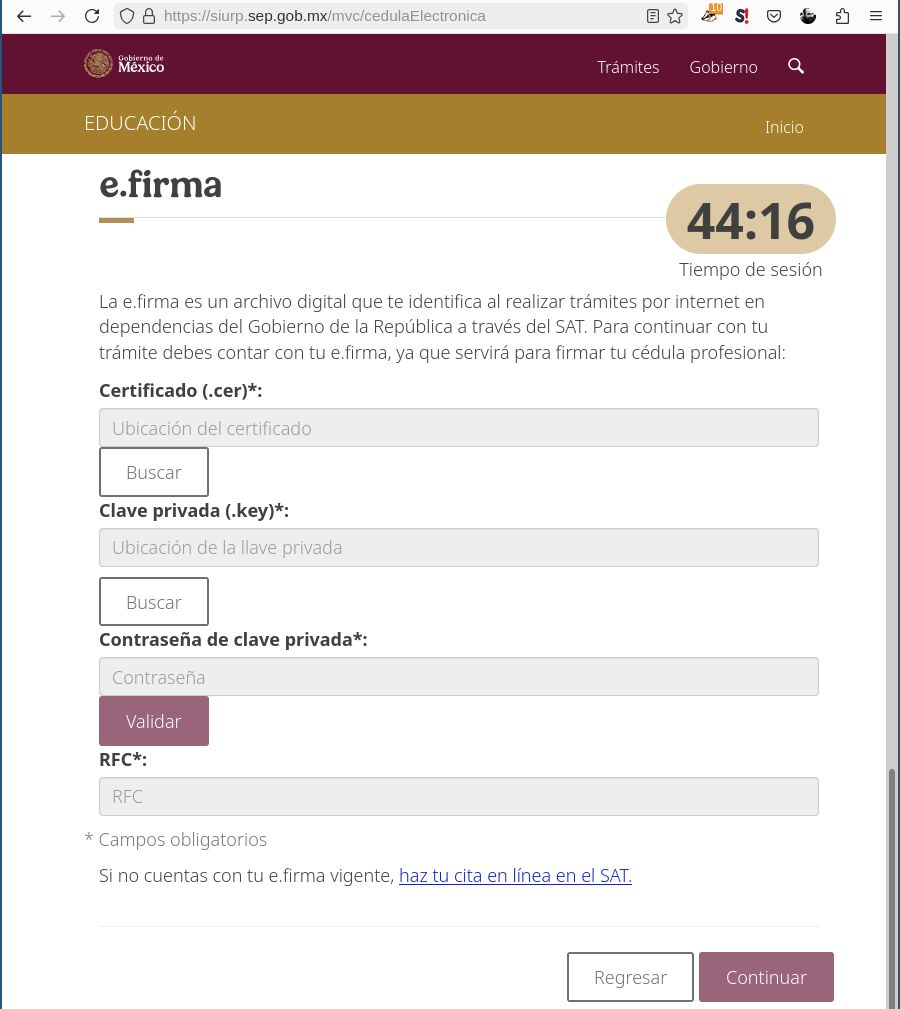
If we ever thought a couple of years or decades of constant use would get humankind to understand how an asymetric key pair is to be handled It s time we moved back to square one. I had to do an online tramit with the Mexican federal government to get a statement certifying I successfully finished my studies, and I found this jewel of user interface: E.firma So I have to:
  1. Submit the asymetric key I use for tax purposes, as that s the ID the government has registered for me. OK, I didn t expect it to be used for this purpose as well, but I ll accept it. Of course, in our tax system many people don t require having a public key generated ( easier regimes are authenticated by password only), but all professionals with a c dula profesional (everybody getting a unviersitary title) is now compelled to do this step.
  2. Not only I have to submit my certificate (public key) But also the private part (and, of course, the password that secures it). I understand I m interacting with a Javascript thingie that runs only client-side, and I trust it is not shipping my private key to their servers. But given it is an opaque script, I have no assurance about it. And, of course, this irks me because I am who I am and because I ve spent several years thinking about cryptography. But for regular people, it just looks as a stupid inconvenience: they have to upload two weird files with odd names and provide a password. What for?
This is beyond stupid. I m baffled. (of course, I did it, because I need the fsckin document. Oh, and of course, I paid my MX$1770, 80, for it which does not make me too happy for a tramit that s not even shuffling papers, only storing the right bits in the right corner of the right datacenter, but anyhow )

Russell Coker: PFAs

For some time I ve been noticing news reports about PFAs [1]. I hadn t thought much about that issue, I grew up when leaded petrol was standard, when almost all thermometers had mercury, when all small batteries had mercury, and I had generally considered that I had already had so many nasty chemicals in my body that as long as I don t eat bottom feeding seafood often I didn t have much to worry about. I already had a higher risk of a large number of medical issues than I d like due to decisions made before I was born and there s not much to do about it given that there are regulations restricting the emissions of lead, mercury etc. I just watched a Veritasium video about Teflon and the PFA poisoning related to it s production [2]. This made me realise that it s more of a problem than I realised and it s a problem that s getting worse. PFA levels in the parts-per-trillion range in the environment can cause parts-per-billion in the body which increases the risks of several cancers and causes other health problems. Fortunately there is some work being done on water filtering, you can get filters for a home level now and they are working on filters that can work at a sufficient scale for a city water plant. There is a map showing PFAs in the environment in Australia which shows some sites with concerning levels that are near residential areas [3]. One of the major causes for that in Australia is fire retardant foam Australia has never had much if any Teflon manufacturing AFAIK. Also they noted that donating blood regularly can decrease levels of PFAs in the bloodstream. So presumably people who have medical conditions that require receiving donated blood regularly will have really high levels.

Next.

Previous.