Search Results: "ghe"

17 February 2009

Gunnar Wolf: Inviting: First VC for the EDUSOL 2009 Seminar - Thursday, Feb 26

It's time to drive some buzz this way ;-) Although this post will only be a pointer towards the Spanish post I made on Planeta EDUSOL, for reasons soon to become obvious. In any case, the information I'm posting here is not exactly the same. Can you read Spanish? Please go on to the invitation for the first videoconference for the EDUSOL Seminar. This year, we the organizers of the On-line Encounter of Education and Free Software (EDUSOL) are aiming higher - we are not "just" having a two-week encounter at the end of the year - We are having an all-year-long Seminar, focusing on the collaborative construction of knowledge. People from quite distinct backgrounds will be part of this project, and we aim to drive it towards the publication of a book. We (mainly, Alejandro Miranda and me) have been quite busy bootstrapping this seminar, getting the proposed authors, thinking over the intended communication channels and ways, and setting up the needed infrastructure) and are ready to start the public-facing activities. We will be having monthly videoconferencing sessions, the last Thursday each month, 16:00-18:00 Mexico Central time (currently GMT-6; GMT-5 after the beginning of April). The VC sessions will be also relayed through Ogg streams, and we will have an IRC channel available to offer full interactivity for those who do not have access to a H.323 VC setup. This first session will be moderated by Victor Manuel Mart nez; the speakers will be Alejandro Miranda and myself - The topics we will present are: If you have access to videoconferencing facilities, please get in touch with Carlos Cruz, the Videoconferences Coordinator at the Economic Research Institute, as soon as possible for all the needed coordination.

Adrian von Bidder: Bowflex machine

After dropping all (pretense at) regular exercise after leaving high/grammar/secondary school (the german word is Gymnasium) and doing more or less nothing for more than 10 years, I've taken up weight training (after a not very successful attempt at volleyball; I like the sport but the team fell apart) two years ago. Since I actually managed to work out regularly (twice a week) in the first year, and since membership in a gym is not cheap, and since I moved and thus had to find a different solution anyway, I decided to buy a Bowflex Sport home gym. I can't compare it to other home equipment, and it apparently it has been discontinued by Nautilus, but nonetheless, a few thoughts: The conclusion first: Would I buy it again? No. Was it a waste of money? No, it's not that bad. In detail: Closing remarks: I'll probably keep it for quite a while. I've thought about spending much less money and just getting a bench and a few weights, but I really like to have a lat tower. Overall I can do what I want to do with the exception of cardio workouts. The other angle is that there is quite a bit of bad press around about the founder of Nautilus, Arhur Jones. I can't comment on how trustworthy these articles are, and I can't comment on Nautilus' business practices today (Mr. Jones seems to be dead), so take this with a large pinch of salt before making a buying decision based on moral/ethical standards.

John Goerzen: How To Think About Compression

and the case against bzip2 Compression is with us all the time. I want to talk about general-purpose lossless compression here. There is a lot of agonizing over compression ratios: the size of output for various sizes of input. For some situations, this is of course the single most important factor. For instance, if you re Linus Torvalds putting your code out there for millions of people to download, the benefit of saving even a few percent of file size is well worth the cost of perhaps 50% worse compression performance. He compresses a source tarball once a month maybe, and we are all downloading it thousands of times a day. On the other hand, when you re doing backups, the calculation is different. Your storage media costs money, but so does your CPU. If you have a large photo collection or edit digital video, you may create 50GB of new data in a day. If you use a compression algorithm that s too slow, your backup for one day may not complete before your backup for the next day starts. This is even more significant a problem when you consider enterprises backing up terabytes of data each day. So I want to think of compression both in terms of resulting size and performance. Onward Starting Point I started by looking at the practical compression test, which has some very useful charts. He has charted savings vs. runtime for a number of different compressors, and with the range of different settings for each. If you look at his first chart, you ll notice several interesting things: All this was very interesting, but had one limitation: it applied only to the gimp source tree, which is something of a best-case scenario for compression tools. A 6GB Test
I wanted to try something a bit more interesting. I made an uncompressed tar file of /usr on my workstation, which comes to 6GB of data. My /usr contains highly compressible data such as header files and source code, ELF binaries and libraries, already-compressed documentation files, small icons, and the like. It is a large, real-world mix of data. In fact, every compression comparison I saw was using data sets less than 1GB in size hardly representative of backup workloads. Let s start with the numbers:
Tool MB saved Space vs. gzip Time vs. gzip Cost
gzip 3398 100.00% 100.00% 0.15
bzip2 3590 92.91% 333.05% 0.48
pbzip2 3587 92.99% 183.77% 0.26
lzma -1 3641 91.01% 195.58% 0.28
lzma -2 3783 85.76% 273.83% 0.37
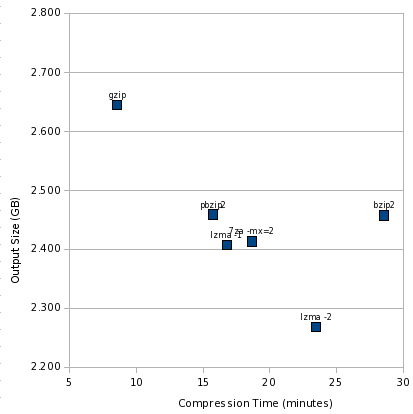
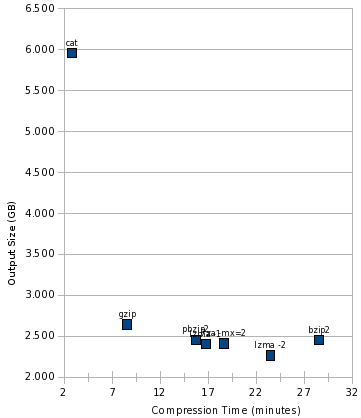
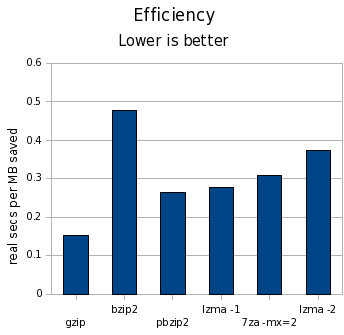
In the MB saved column, higher numbers are better; in all other columns, lower numbers are better. I m using clock seconds here on a dual-core machine. The cost column is clock seconds per MB saved. What does this tell us? Some Pretty Charts First, let s see how the time vs. size numbers look: compress-zoomed Like the other charts, the best area is the lower left, and worst is upper right. It s clear we have two outliers: gzip and bzip2. And a cluster of pretty similar performers. This view somewhat magnifies the differences, though. Let s add cat to the mix: compress-big And finally, look at the cost: compress-efficiency Conclusions First off, the difference in time is far larger than the difference in space. We re talking a difference of 15% at the most in terms of space, but orders of magnitude for time. I think this pretty definitively is a death knell for bzip2. lzma -1 can achieve better compression in significantly less time, and lzma -2 can achieve significantly better compression in a little less time. pbzip2 can help even that out in terms of clock time on multicore machines, but 7za already has a parallel LZMA implementation, and it seems only a matter of time before /usr/bin/lzma gets it too. Also, if I were to chart CPU time, the numbers would be even less kind to pbzip2 than to bzip2. bzip2 does have some interesting properties, such as resetting everything every 900K, which could provide marginally better safety than any other compressor here though I don t know if lzma provides similar properties, or could. I think a strong argument remains that gzip is most suitable for backups in the general case. lzma -1 makes a good contender when space is at more of a premium. bzip2 doesn t seem to make a good contender at all now that we have lzma. I have also made my spreadsheet (OpenOffice format) containing the raw numbers and charts available for those interested. Update Part 2 of this story is now available, which considers more compression tools, and looks at performance compressing files individually rather than the large tar file.

11 February 2009

Muammar El Khatib: Funny Political Propanga.

On February 15th, we are having an election to decide whether a constitutional amendment will be accepted or not in Venezuela. I don't want to talk about this. Instead, I'd like to talk about the funniest Political Propaganda I have seen at the moment regarding the elections.

I was driving from my girlfriend's home to mine when suddenly I saw a guy with a banner hanged on him. When he was near to my car, I was able to read what he had written on the banner. I read:

"Vota NO a la mierda. Dale bomba".

Look at the picture:


Translated it means:

"Vote NO to the shit. Flush the toilet".

I got very surprised about the imagination used by that guy. I laughed out loud. I think it has been the funniest political propaganda that I have seen ever.. :-P

Muammar El Khatib: Funny Political Propaganda.

On February 15th, we are having an election to decide whether a constitutional amendment will be accepted or not in Venezuela. I don't want to talk about this. Instead, I'd like to talk about the funniest Political Propaganda I have seen at the moment regarding the elections.

I was driving from my girlfriend's home to mine when suddenly I saw a guy with a banner hanged on him. When he was near to my car, I was able to read what he had written on the banner. I read:

"Vota NO a la mierda. Dale bomba".

Look at the picture:


Translated it means:

"Vote NO to the shit. Flush the toilet".

I got very surprised about the imagination used by that guy. I laughed out loud. I think it has been the funniest political propaganda that I have seen ever.. :-P

10 February 2009

John Goerzen: Review: Video Editing Software

We recently bought a Canon Vixia HG20 camcorder. The HG20 records in AVCHD format (MPEG-4 h.264) at up to 1920 1080. To get from the camcorder to a DVD (or something we can upload to the web), I need some sort of video editing software. This lets me trim out the boring bits, encode the video for DVD, etc. Background In addition to DVD creation and web uploading, I want the ability to burn high-definition video discs. 1920 1080 is significantly higher resolution than you get from a DVD. There are two main ways to go: a blu-ray format disc, or an AVCHD disc. A blu-ray disc has to be burned onto BD-R media, which costs about $5 each, using a blu-ray burner, which costs about $200. AVCHD discs use the same h.264 encoding that the camcorder does, meaning they have better compression and can be burned onto regular DVD+R media, fitting about 30 minutes onto a DVD. Moreover, it is possible to move AVCHD files directly from a camcorder to an AVCHD disc without re-encoding, resulting in higher quality and lower playing time. The nicer blu-ray players, such as the PS3, can play AVCHD discs. AVCHD seems pretty clearly the direction the industry is moving. Compared to the tape-based HDV, ACVHD has higher quality with lower bitrates, better resolution, and much greater convenience. Hard disk or SD-based AVCHD camcorders are pretty competitive in terms of price by now too, often cheaper than tape-based ones. The downside of AVCHD is that it takes more CPU power to process. Though as video tasks are often done in batch, that wouldn t have to be a huge downside. The bigger problem is that, though all the major video editing software claims to support AVCHD, nobody really supports it well yet. The Contenders Back when I got my first camcorder in about 2001 the one that I m replacing now you pretty much had to have a Mac to do any sort of reasonable consumer or prosumer-level video editing. We bought our first iMac back then to work with that, and it did work well with the MiniDV camera. Today, there s a lot more competition out there. The Mac software stack has not really maintained its lead some would even say that it s regressed and the extremely high cost of buying a Mac capable of working with AVCHD, plus Final Cut Express, makes that option completely out of the question for me. It would be roughly $2500. Nobody really supports AVCHD well yet, even on the Mac. Although most programs advertise support of smart rendering a technique that lets the software merely copy unchanged footage when outputting to the same format as the input none of them have smart rendering that actually works with AVCHD source material. Though this fact is never documented, though discussed on forums. Another annoyance, having used Final Cut Express in the past, is that with these programs you can t just go to the timeline and say delete everything between 1:35 and 3:52 ; you have to go in and split up clips, then select and delete them. They seem to be way too concerned about dealing with individual clips. I briefly used Cinelerra on Linux to do some video editing. It s a very powerful program, but geared at people that are far more immersed in video editing than I. For my needs, it didn t have enough automation and crashed too much and that was with MiniDV footage. It apparently does support AVCHD, but I haven t tried it. I ve tried three programs and considered trying a fourth. Here are my experiences: Ulead/Corel VideoStudio Pro X2 Commonly referenced as the go to program for video editing on Windows, I started with downloading the Free Trial of it from Corel. Corel claims that the free trial is full-featured all over on their website, but I could tell almost instantly that it wasn t. I wound up buying the full version, which came to about $65 after various discounts. I wanted to like this program. Its output options include AVCHD disc, Blu-ray disc, DVD+R, and the like. Its input options include MiniDV, AVCHD, ripping from DVD, ripping from Bluray, and just about every other format you can think of. And it heavily advertised proxy editing , designed to let you edit a scaled-down version of AVCHD video with a low-CPU machine, but refer back to the original high-quality footage for the output. It didn t pan out that way. The biggest problem was the constant crashing. I really do mean constant. It probably crashed on me two dozen times in an hour. If you are thinking that means that it crashes pretty much as soon as I can get it re-opened, you d be correct. Click the Play button and it hangs. Click a clip and it hangs. Do anything and it hangs. It did seem to work better with the parts of the source that had been converted to a low-res version with Smart Proxy, though it didn t eliminate the hangs, just reduced them. And every time I d have to End Task, it would forget what it had already converted via Smart Proxy even if I had recently saved the project and have to start over from scratch. I spent some time trying to figure out why it always thought my project was 720 480 even when it was 1920 1080, and why the project properties box didn t even have an option for 1920 1080. After some forum searching, it turns out that the project properties box is totally irrelevant to the program. Yay for good design, anyone? VideoStudio Pro X2 does have good output options, allowing combination of multiple source files onto a single DVD or AVCHD disc as separate titles. Unfortunately, its DVD/AVCHD rendering process also yes hangs more often than not. The documentation for VideoStudio Pro X2 is of the useless variety. It s the sort of thing that feels like it s saying The trim tool is for trimming your clips without telling you what trimming your clips means, or making it obvious how to remove material from the middle of a clip. The proxy editing feature isn t what it should be either. Instead of being something that just automatically happens and Works in the background, you have to manage its queue in the foreground and it forgets what it was doing whenever the program hangs. On the rare occasion when pressing Play did not cause a hang, the AVCHD footage played back at about 0.5fps far, far worse than PowerDirector manages on the same machine. Bits that had been rendered for proxy editing did appear to play at full framerate. I have applied for a refund for this purchase from Corel under their 30-day return policy, and have already uninstalled it from my disk. What a waste. CyberLink PowerDirector 7 Ultra This was the second program I tried, and the one I eventually bought. Its feature set is not quite as nice as Corel s, especially when it comes to versatility of output options. On the other hand, it feels done. It only crashed two or three times on me apparently that s GOOD on Windows? Things just worked. It appears to have proxy editing support, but it is completely transparent and plays back with a decent framerate even without it. It can output to AVCHD, Bluray, and DVD, though smart rendering doesn t work with AVCHD source material. Its weakness compared to the Corel package is that it doesn t have as many options for formatting these discs. You can have only one title on a disc, though you can have many chapters. You have some, but not much, control over compression parameters. The same goes for exporting files for upload to the web or saving on your disk. The documentation is polished and useful for the basics, though not extensive. Overall, this package works, supports all the basics I wanted from it, so I m using it for now. Adobe Premiere Elements 7 I downloaded the trial of this one too. I opened it up, and up popped a dialog box asking what resolution my project would be, interlacing settings, etc. I thought YES now that s the kind of program I want. As I tried out the interface, I kept thinking the same. This was a program not just for newbies, but for people that wanted a bit more control. Until it came to the question of output. Premiere Elements 7 was the only package I looked at that had no option to burn an AVCHD disc. DVD or Blu-ray only. That s a deal-breaker for me. There s no excuse for a program in this price range to not support the only affordable HD disc option out there. So I didn t investigate very much farther. Another annoying thing is that Adobe seems to treat all of their software as a commercial. I m a user, not an audience, dammit. I do not want to buy some photoshop.net subscription when I buy a video editing program. I do not want to see ads for stuff when I m reading PDFs. LEAVE ME ALONE, ADOBE. I just felt sleazy even giving them my email address, let alone installing the program on my system. I think I will feel like a better person once I reboot into Windows and wipe it off my system. Pinnacle Studio 12 Another program that comes highly rated. But I never installed it because its minimum system requirements state that it needs an Intel Core 2 Quad 2.66GHz or higher for 1920 1080 AVCHD editing. And I have only a Core 2 Duo 2.66GHz half the computing horsepower that it wants. And since they offer no free trial, I didn t bother even trying it, especially since PowerDirector got by fine with my CPU. Conclusions This seems to be a field where we can say all video editing software sucks; some just suck a little less. I m using PowerDirector for now, but all of the above programs should have new versions coming out this year, and I will be keeping a close eye to see if any of them stop being so bad.

9 February 2009

Julian Andres Klode: Really, don t use codenames for pinning.


You can not use codenames for pinning packages to a specific release. Everything like this just fails, and can result in apt not finding any candidate for a package. You can see this for example in Bug#512318, and Bug#513864 seems to be related to that one. If you want to target Lenny and you don t have Etch in your sources.list, pin stable at a higher priority than testing. This means that the pin automatically migrates once Lenny becomes stable (which happens hopefully in 2 weeks). Posted in Debian

30 January 2009

Jeff Bailey: Canadian Gov't sites accessible through Linux

According to the Service Canada website:
If you are using a Linux operating system (Red Hat Fedora Core 8 or Ubuntu 7.1) with Firefox 2.0.0.6 or higher we recommend using the Sun JVM 1.6.0_03 or higher.

Too cool!

Sylvain Le Gall: OCaml Meeting, FOSDEM and holiday

Next week will be quiet busy. I will travel a lot. Of course, I am talking about OCaml Meeting and FOSDEM. The OCaml Meeting subscription is over and we reach a quiet good number of attendees: 45. This is the approximate number of people who come last year. There is now some details to finish (dinner for the previous day, schedule for talks...) but enough time left. The only thing I hope for the meeting is that it generates the same effect as last year: another impulse in the OCaml community. Many people are working continuously on OCaml but last year event has generated a lot of post-event discussion and many people started different project. Some of these projects are still alive, some are not as vivid as they deserve. I enjoy being at FOSDEM last year, but I only stay 1 day and it was not enough. I will be able to stay during the 2 days and attend more Debian conference than last year. I will visit Brussels and Ghent just after. Belgium is a really nice country and it has been a long time I haven't take a break. I'm going to FOSDEM, the Free and Open Source Software Developers' European Meeting

Russell Coker: How to Support Straight Marriage

There is currently a lot of discussion about how to protect marriage , such discussion is based on the issue of whether Gay Marriage should be prohibited to protect Straight Marriage. Some straight people believe that their own marriage would be better if homosexuals were allowed to get married, some have even declared that they won t get married until discrimination in this regard is ended. I don t believe that whether some other people get married will make any difference to my marriage. I believe that any two consenting adults who are not closely related should be allowed to get married, but I am not going to write about that today. What I will address is some positive steps that can be taken by a government to protect Straight Marriage without regard to Gay Marriage. By the most objective criteria, death is the greatest obstacle to marriage. To protect someone s marriage you should first protect them from becoming a widow or widower for as long as possible. Also protecting the lives of children (both biological and adopted) is important for protecting marriage. Here are some of the many ways of preventing needless death:

  1. Don t start wars except in the most extreme situations. Wars inevitably involve the death of soldiers (some of whom are married) and any war that is anything other than the smallest border incident will involve the death of civilians (married people and children).

  2. Protect the food supply and the environment. When toxic chemicals, heavy metals, or radioactive material are released in the environment it results in a statistical increase in the death rate from cancer.

  3. Increase the funding for medical research. Today there are many medical situations which can be routinely and safely resolved which would have been likely to be fatal 10 or 20 years ago. More medical research will lead to more diseases being cured.

  4. Spread positive technology around the world. Protecting marriage should have a larger scope than your local region, therefore life-saving medicine needs to be affordable in all countries. Patents that prevent this need to be voided in the poorer regions of the world.

  5. Increase the research on car safety. Car crashes are one of the largest causes of death and significant injury in the first world which can be easily reduced. Unfortunately there has been little research on making cars safe for women and children (crash-test dummies for woman and children are to a large extent scaled-down models based on research on men due to the lack of female and child cadavers for research [1]). Also I believe that the majority of car safety research in regard to crash test dummies was done in the US and therefore is biased towards caucasians and afro-americans - I believe that research on other races is needed to give equal protection to all races (caucasian and afro-american races are in a minority in the world).

This is by no means a comprehensive list, but it does cover some issues that are current and well known. Now the next objective way to analyse this issue is to look at statistics related to divorce. It seems that money is an issue related to divorce and therefore protecting the finances of married people is a way of protecting marriage. The first thing that can be done is to give people more continuity of employment. Being in a situation where you could lose your job at short notice is stressful and has to have a negative impact on a married couple. Recently the supposedly conservative Liberal government in Australia was trying to ban Gay Marriage while also introducing legislation to make it easier to lay off employees who have done nothing wrong (based on business issues). Among other things the Work Choices legislation made it more difficult for such employees to take out bank loans (which means that they often pay higher interest rates). A final issue that causes stress for married couples is the school system (which is broken in many ways). I m not going to try and cover this in detail here, but I will note that installing flag-poles (as the Liberal government wanted to do) is not the solution to problems with the education system. Addressing these real issues will take some government funding, but it s not a lot and a much greater amount of money could be saved by ending the war on drugs . If the people who claim to be protecting straight marriage can address these other more serious problems that threaten straight marriages then I still won t agree with calls to ban gay marriage. But it would make then seem less hypocritical.

29 January 2009

Bdale Garbee: Facial Dignity

People keep asking me about the beard thing... Here's my take on what happened and why. Just before I left for LCA 2009, my wife offered to send along one of the limited edition prints of her award-winning waterfall photograph. She knew from prior years that the LCA organizers often host an auction or raffle to raise money for some worthy charity at the conference banquet. Since the photo was taken at Milford Sound on the way to last year's LCA in Melbourne, there was a connection between the photo and LCA. We had no idea what this year's charity might be, nor did we anticipate that her photo would become the centerpiece of the evening's fund-raising activities. The charity selected this year was an organization that is trying to save the Tasmanian Devil from extinction. Professor Hamish McCallum, the chief scientist with the program, gave a talk after dinner and before the auction began. The native population is suffering from a fatal facial tumor disease that results in horrible lesions, and is likely to kill off all the Devils within a decade or three. My family and I all have a strong love of nature, and Karen and I had the pleasure of touring Tasmania after LCA 2003 in Perth, so this seemed like a great charity to raise money for with her photo. As often happens at LCA, the auction and related fund-raising activities got complicated. This year, the photo alone was bid up to $2500 (which was very cool!), before people started offering things for higher bids. For years, going maybe as far back as Perth, I've been cajoled about shaving my beard if the bidding hit some level, and have always said no. This year, someone offered $5000 if I would shave my beard, and again I said no. Much later, after more cajoling and many counter offers, when the bids and various matching offers had us approaching $20,000 in total donation to the charity, I relented and announced that if we hit a total of $25,000 going to the charity I would consent to a shave. The resulting frenzy, including the suggestion that if it went high enough Linus should do the shaving, and the formation of a bidding consortium that kept raising more money and bidding against itself, was completely unexpected! Others have tried to capture details of the insanity, but the bottom line is that by the end of the evening, the total had blown way past anything we could have imagined, and by the end of the conference the total going to the charity was on the order of $40,000! Why did I agree to let Linus shave my beard? To be honest, I'm not entirely certain. I only had one beer that evening, so I can't blame intoxication. The fact that it would yield a worthy charity something over 10 times what my wife's photo alone had drawn as a maximum bid seemed significant to me. In hindsight, I also think I was at least a little bit curious to see what my face looked like after having a beard since sometime around September of 1982! In any case, I made the offer, insane amounts of money were raised, and on the last day of the conference, over the lunch hour, Linus took trimmers in hand and removed my beard in front of an audience. The reactions have been completely overwhelming. A local TV station and a local newspaper in Hobart were both there and ran stories. The ripple of mentions in the blogosphere was and is just astounding. There's even a silly Shaving Bdale game created overnight by the "Mad Scientists" at Secret Lab! And from all over the globe, people I do and don't know have been sending emails and finding me on IRC to plead with me to grow my beard again! Right after the shave, my good friend Keith Packard said "Bdale, grow it back!". Before I left Hobart, my wife emailed saying she and the kids hoped I wasn't waiting until I got home to start. Joey Hess blogged a hairy tale about how I'd scarred the minds of young Debian developers. The leader of Debian-RS sent word by email that the group all hoped I would re-grow my beard. And on and on and on... I'm really not used to being the center of so much attention! Being suddenly without beard felt weird in lots of silly little ways. I was hyper-sensitive to drafts. The feel of cold beverages hitting my upper lip was downright strange. And I kept wanting to scratch what wasn't there! After making faces at myself in the mirror for a while, I decided I really wasn't happy, and do prefer being bearded. So I haven't shaved since Saturday morning in Hobart, and am pretty scruffy looking. My wife said today that I'm "already starting to look like Bdale again". At the current growth rate, I have high hopes of having at least some facial dignity back by the time I speak at FOSDEM. And no, I won't be shaving my beard off again any time soon...

28 January 2009

MJ Ray: KohaCon 2009

KohaCon 2009, the conference for the premier free software integrated library system (Koha) will be held in Plano, Texas, USA on 16-17 April 2009. This is a FREE conference. There is no registration fee, but we are requesting that all attendees pre-register. More details on koha.org, with links to schedules and notes and so on. It seems unlikely that I ll get to Texas at that time. Travel bookings have just opened, but I have a higher-priority event in April which hasn t fixed its date yet. With any luck, there ll be some social media around KohaCon for us poor Euros to watch and maybe even take part.

26 January 2009

Y Giridhar Appaji Nag: Wagah-Attari and Hussainiwala

Pakistan flag and Emblem of India Fellow countrymen, happy Republic day to you all.

Any trip to Punjab is incomplete without atleast one visit to the daily tamasha at the Wagah-Attari border. This is probably one of the few places on earth where you would see the Pakistan flag right next to the Emblem of India.

I arrived at the place a couple of hours before the vening flag down ceremony but was too late to be able to get a comfortable seat in the crowd of a few thousands; the place was already packed. Luckily, a BSF ranger (who incidentally was not allowing the crowds in any more) looked at my tripod and camera, thought I was a journalist and led me to the VIP section which is as close to the gates as one can get.

For a very long time preceding the ceremony, there is nationalist music blaring on the tannoys, crowds screaming in unison: LA ilAha ill-Allah on the Pakistani side and vandE mAtaram, bhArat mAtA ki jai on the Indian side. On either side of the border gates, kids run up and down the road with their respective national flags while young men climb onto the top-most walls and wave flags high in the air. One gentleman was commenting that while women on 'our' side are allowed to dance and sit anywhere, 'they' don't allow that, "see how the men and the women there are grouped separately".

Thousands of spectators Waving the Pakistan flag Waving the Indian flag Women dancing

The half hour of the retreat ceremony is full of action with the Indian BSF rangers in their red turbans and khakhis, and the Pakistani rangers in black salwaar-kameez marching heavily down the road, glaring into each others eyes, competing on who can kick higher into the air and possibly also on who has the best kept moustache. The rangers on either side of the gates know that they are entertaining their home crowd and spare no effort to do their best.

Indian BSF rangers marching Indian BSF rangers at-ease
Indian ranger marching towards the gate Indian BSF ranger Indian BSF ranger
Border gate, Pakistan crowd and rangers India and Pakistan flags Crowds going back home

The retreat ceremony is so popular that it is difficult to allow in all the people that come in to watch. So a clone of the ceremony has been setup at the Hussainiwala border. However, Hussainiwala is popular not because of the flag retreat, much less because the 1971 war memorial still has a lot of marks of artillery firing, but because of Bhagat Singh's memorial. The memorial moves one to tears.

Hussainiwala: Sukhdev, Bhagat Singh and Raj Guru Hussainiwala bridge: Sympathetically detonated in the 1971 war

Few more pictures from the Hussainiwala memorials:

Hussainiwala: Sukhdev, Bhagat Singh and Raj Guru Hussainiwala: Bhagat Singh memorial Hussainiwala bridge piers and war memorial Artillery fire on Hussainiwala bridge piers Artillery fire on Hussainiwala bridge piers

22 January 2009

Andrew McMillan: Seeing my photo

Today in Anton Hughes talk at LCA 2009 I saw my photo of Eben Moglen up on the big screen. Woohoo! :-) As with most of the photos I have put on Wikimedia Commons it is released under PD-Self, so it will be interesting whether he chooses to credit me or not. He seems to have a pretty good argument, and I hope that this gets visibility and acceptance in the legal community over time. The free software audience is pretty sympathetic, of course.

19 January 2009

Gunnar Wolf: About the recent events and possible outcomes in Israel and Palestine

Several friends, from different groups and backgrounds and with different points of view regarding the current war in Israel (and regarding the Arab-Israeli conflict in general) have asked me for an explanation on what is happening there, what is (my view of) the real conflict, its causes... and any possible answers. And yet I am quite far from being an authority, I do want to write something about it. Be prepared, as this post is quite long.
And yet, after writing frankly a lot more than what I expected... It is by far not enough. I have still much more to add, but I have to say "stop" at some point. So, here you have it: My points of view, as well as some explanation on why are we standing where we currently are.
I am writing this based just on my personal experiencie and, of course, my personal point of view. Furthermore, I wrote a good part of this text while riding a bus, with no network access, so I am offering very few references - In any case, it will allow me to make much more progress. References always take as much time as the text itself! About me Why am I writing this? Why do people ask for my opinion? I must start by explaining who I am, so the rest of this makes sense. I am a Mexican Jew. That means, I was born in a Jewish (albeit secular) family, and grew up in an environment with general Jewish culture. My direct family (say, my parents and brother, and to a lesser degree my closest cousins) are not at all religious, I'd even venture to say most of us are complete atheists. Yet, besides the cultural belonging (which is a mixture of a Eastern European culture with lots of Idish words and dishes and general humor), my family has a strong national identification - In other words, I grew up in a fully Zionist environment, which traces back to Poland.
My grandmother was member of Hashomer Hatzair in Poland, since the early years of its existence, late 1910s and early 1920s. What is it? To make it short, a Zionist Socialist, Kibbutzian youth movement. It has many similarities (and somewhat stems indirectly from) the Scouts many of you will be familiar with, but -obviously- has a way lengthier agenda. And, yes, nowadays I feel it is somewhat out of reach with the current state of the world - It was founded in 1913, and only slightly adjusted its principles since then.
I will talk more about Hashomer later on.
My grandmother arrived in the late 1920s to Mexico, for familiar and economic reasons, but still dreamt about living in Israel for a long time. As they grew up, first my uncle joined Hashomer in Mexico in the late 1940s, when it still pursued a very much Soviet-style ideals for Israel (one of the core points that changed during the 1950s); both my father and my mother joined in the late 1950s (in fact, that's where they met). My cousins and myself were very active in the 1980s and 1990s.
The Iszaevich family has something very unusual, I'd say, engraved in our genes. We live very deeply our ideologies. That's the only explanation I can find to the way we all have led our lives. I won't go into the other family members' details, but just into mine: I was fully convinced of all we taught to our younger members and what we discussed among ourselves. I am among the very few people who really learnt Hebrew at my school, and that was only because I really cared - I know some people that just after 12 years of pseudo-learning could maybe utter a few phrases.
After finishing high school I went with my Hashomer group, together with people my age from other similar-minded Mexican Zionist youth groups, to live and learn for a year in Israel, on what is usually known as shnat hajshar - A year to get ready. To get ready to what? But of course, to come and give back go the younger groups of the movement, and finally go back to Israel and settle there definitively. I came back to Mexico, and after one year I did the only thing that was logical: I became an Israeli and went to live to a kibutz - Zikim, a beautiful place just between Ashkelon and Gaza, very near the sea shore. It was a beautiful period in my life, and I really enjoyed it - But it didn't last for very long - I quickly grew to hate the Israeli society at large. A society full of rage, of hatred. Not just between Arabs and Israelis, as many would think from the outside, but between religious and seculars. And between immigrants and locals. And between leftists and rightists (in several dimensions, as it is one of the countries where you can most easily be a economic leftist while being a political rightist - a complex society it is). A society full of disrespect and intolerance. A very hypocritical society. And one of the things that most shocked me: I wanted to live in a society of proud of its existence, that's what I had learnt Israel was - But Israelis aspire and dream of being anything else (and mostly US-Americans) in a way that made me sick, more than anything I had previously seen in Mexico.
I loved the life at the Kibutz, and I loved being an agricultor, doing hard work every day and literally getting the fruit of it. However, I cannot live isolated to a 300-people universe - At least once a week you have to go to the city if you don't want to become insane. And I could not stand the sick Israeli society.
Anyway, to make things short: After six months as an Israeli, I came back to Mexico. I went through a long period of finding myself, as I could not uphold anymore my Hashomer ideology (if I am not going to live by it, how can I continue teaching it?). Many people do anyway, but for the first months, where my Hashomer work was basically all of my life, I felt really uncomfortable. So, in short, I severed all of my relations to the Jewish community, and even denied for a long time my Jewishness until I found a (I think) better balance.
Today I am at peace. But anyway, I wanted to talk about myself in the critical period that marked me in this regard: The 1990s. Enough, lets get down to business. Zionism 1870-1920 Many people argue that the Jews invaded the Palestinians homeland - And yes, nowadays I cannot counter this. But we cannot judge what happened then based on what we see now.
Modern Zionism started around the 1870s. The Jewish history is full of pogroms and persecution, in different countries all over Europe - And a group of young people decided the only solution was to build a place to call their own. And yes, this was full of idealism and in no small part the foolishness of youth. For several centuries and up to 1920, all of current Middle East were provinces of the Ottoman Empire. Before Zionism began, the population of today-Israel was very sparse, not more than 400,000 people - up to 5% of them Jewish, around 10% Christian Arabs, and the remainder, Muslim Arabs. Of course, the low population was mostly because the country was mostly hostile - A desert in the South, mostly swamps in the North, and some minor towns mostly in the hills. It was a mostly forgotten province, away from the central Turkish rule, and there had been no frictions with the local population. It was a nice place to go, thinking -again- as a fool youngster, or as an idealist. They said, lets take a folk without a land to a land without a folk.
The number of accomplishing Zionists (this is, people who actually went to Israel instead of just talking about doing so) was not high during the first decades. But towards the 1890s, it gained critical mass. The political Zionist movement was born, with Theodor Herzl as a leader, and they started pushing -politically- for different governments to concede a territory to Jews. They went to the Turks, and didn't really get much echo. Went to other colonial powers of the time, and got unfeasible promises with no real backing (i.e. Birobidjan in Eastern Russia, Uganda in Africa)... And, as it happens in strongly ideologized movements, the movement started splitting into different groups with slightly different positions.
And no, I am not talking about the People Front for the Liberation of Judea and the People Judean Liberation Front, but I very well could. Sometimes the differences are as ridiculous as that. But hey, I take that most of my readers are acquinted with the Free Software issues, right? Think BSD vs. GPL vs. OpenSource. To give a broad idea - Only in Mexico City, with a very small Jewish community (~30,000 people), in the mid-1990s we had over 10 such movements, with 50-150 youngsters attending each. And even though some were local, and even though some very important ideologies are not represented in this country, they are all different enough to exist as separate entities. British Mandate The Ottoman empire was divided after the first World War. Its possesions in Europe became independent states, while in Asia (and Africa, if you take the semi-independent Egypt and part of Sudan into account) they were taken over as colonies or protectorates by France and the UK - Evidently, attempting to secure a long-term dominion over the area. In some aspects, they failed. In some aspects, they were (and still are) tremendously successful. The division of people by setting arbitrary boundaries has led to countries sustainable only by force and a harsh rule (such as Iraq, Lebanon and Syria), or doomed to poverty (and thus submission) due to lack of natural resources (as Jordan). Focusing on Israel/Palestine, the UK entered the area by making mutually incompatible promises to arabs and Jews - i.e. the Hussein-McMahon letters and the Balfour declaration, both ambiguous enough to lead to... Well, today. The UK rule was disastrous to the region, both in giving (and taking away) power from all sorts of puppet regimes, and swiftly going away as soon as things started looking too complicated. Yes, typical colonialism.
So, while up to the 1920s there was no real animosity between Arabs and Jews (as i.e. the Faisal-Weizmann agreement shows), during the next decades the seeds of hatred started growing, from both sides.
Many people still quote the 1947 partition plan as the direct antecedent towards Israel's real existence - That was not the first partition plan that existed. Ten years earlier, the Peel commision suggested a similar partition involving forceful population transfer. And many people see the separation of Transjordan (now Jordan) from Palestine in 1922 as a first partition. It is understandable that both partition plans (much more the 1947 than the 1937 one) were accepted by Zionists: Going from having nothing to having something (and against all odds in the environment they lived) is acceptable.
From the Zionist side, two main groups rejected the partitions: The right-wing and religious groups, insisting that the whole of the Mandate should become Israel, and the left-wing groups, which advocated for a single, bi-national state, with equal rights for all of its population. Go over and read this last link, as it was quite interesting (to me at least) to see how this solution has kept existing and regarded by (relatively) many people, and has many interesting links. 1948 onwards: Where did the refugees come from? The November 1947 partition didn't exactly translate to a planned, smooth Israeli independence - It led to six months of revolts (basically, a civil war). By mid May, the UK government and troops abandoned the territory, and one day later, Israel declared its independence. And, of course, all neighbouring countries (and Iraq) sent their troops to invade Israel. The war lasted for over six months (cease-fire was signed in January 1949). There was an intense Arab campaign indicating the armies would enter Israel and devastate it, leaving no stone in place, indicating Arab population to temporarily leave the Jewish-destined areas. The war, they said, would not take more than a couple of months, and they would be able to go back home.
Only that... When the war ended, the results were far from what the Arab governments expected. Not only Israel continued to exist, but it conquered important territories.
Of course, the Israelis were not innocent from said exodus: During the 1947-1948 civil war, and the independence war, some of the existing so-called self-defense forces (some of them were really defensive, while some were quite aggressive, even terrorist) attacked Arab villages in strategic or predominantly Jewish areas to prompt them to leave - yes, what we today call ethnic cleansing.
I had (in my head) the number of 650,000 Arabs (from a total of slightly over a million) fleeing to neighbouring countries. Wikipedia states that it is somewhere between 367,000 and 950,000. A similar number of Jews were expelled from Arab countries, many of which arrived to settle at Israel (and many others went elsewhere - For instance, a good part of the Mexican Jewish community is from Syrian origins - Many of them fleed in those years). Israel didn't accept back the (relatively few) Arabs that requested to resettle, as they were seen as hostile population - but neither did the countries that "temporarily" accepted the Palestinians accepted them as citizens. The Palestinian refugee camps today, mainly in in Lebanon, Syria, and the occupied territories held by Israel have terrible living conditions, and its population -despite living there for over 60 years- have no civil rights at all. Note that I'm omitting Jordan here, although it has several camps as well, as their situation is way better.
The Arab population that didn't leave did receive full Israeli citizenship. No, their living standards are not up to level with the average Israeli. The country and the society do have a sensible degree of racism and segregation. But the situation is nowhere as terrible as it is in the camps.
The areas which were originally to become Palestinian and were not conquered by Israel -this is, current-day West Bank and Gaza- bacame respectively Jordan and Egyptian territory. While Jordan did fully extend its soverignty covering the West Bank, Egypt didn't - Gaza is, since 1949, occupied military territory. Gaza, among the most densely populated areas in the world, has had their inhabitants under military rule ever since. When Israel returned the Sinai after signing the peace treaty with President Sadat, Egypt didn't accept Gaza back - And that's where today's greatest problem is born.
Now, Israel conquered those territories in 1967, along with the very sparsely populated Sinai and Golan. For the first ten years, the territories were basically only administered (yes, under a military rule). In 1977, with the first right-wing Israeli government, an extensive settlement policy began (and led partly to today's seemingly unsolvable situation). In 1980-1982, Israel withdrew from the Sinai. In 1981, Israel claimed full soverignty over the whole of Jerusalem and the Golan. In 1993, the "Oslo Agreement" was signed between Israel and the PLO, and it seemed we were heading towards a bright future. I lived in Israel between 1994 and 1996 - Yes, the most hope-filled period in the country's life.
Since 1996, I have tried to keep up to date with the country's evolution. All in all, even if I won't live there again, it is a country I learnt to love, a society I have long studied (even if in the end I did include many references, I wrote most of this text just off the top of my head, with the data I remember - so it might have several big errata). And yes, I keep the political stand I had 12 years ago: The only solution is to dialogue, to treat the current enemies -and not only their governments- with respect, recognizing their dignity and right to life, to self-determination. Only then we will change the status quo. How not to fight hatred Since 1993, the dream of peaceful coexistence seems to have faded. What we saw during the past three weeks, along to what we saw in Lebanon in 2006, is plainly a gross mistake if the goal is to achieve good, lasting peace.
Try to imagine how could life in Gaza be, even in the total absence of Israeli attacks. Just to set some numbers first: The Gaza strip hosts almost 1.5 million people on 360 km . When I lived in Israel, I was constantly surprised at how small a country it is - Israel tops at 550Km North to South, 150Km east to West (it is amazing, almost wherever you stand, except in the middle of the Negev, you can see the country's borders. Yes, I recognize as the border the so-called Green Line); over half of the territory is a desert, and it hosts seven million inhabitants. And it is hard to imagine how that country can be economically viable.
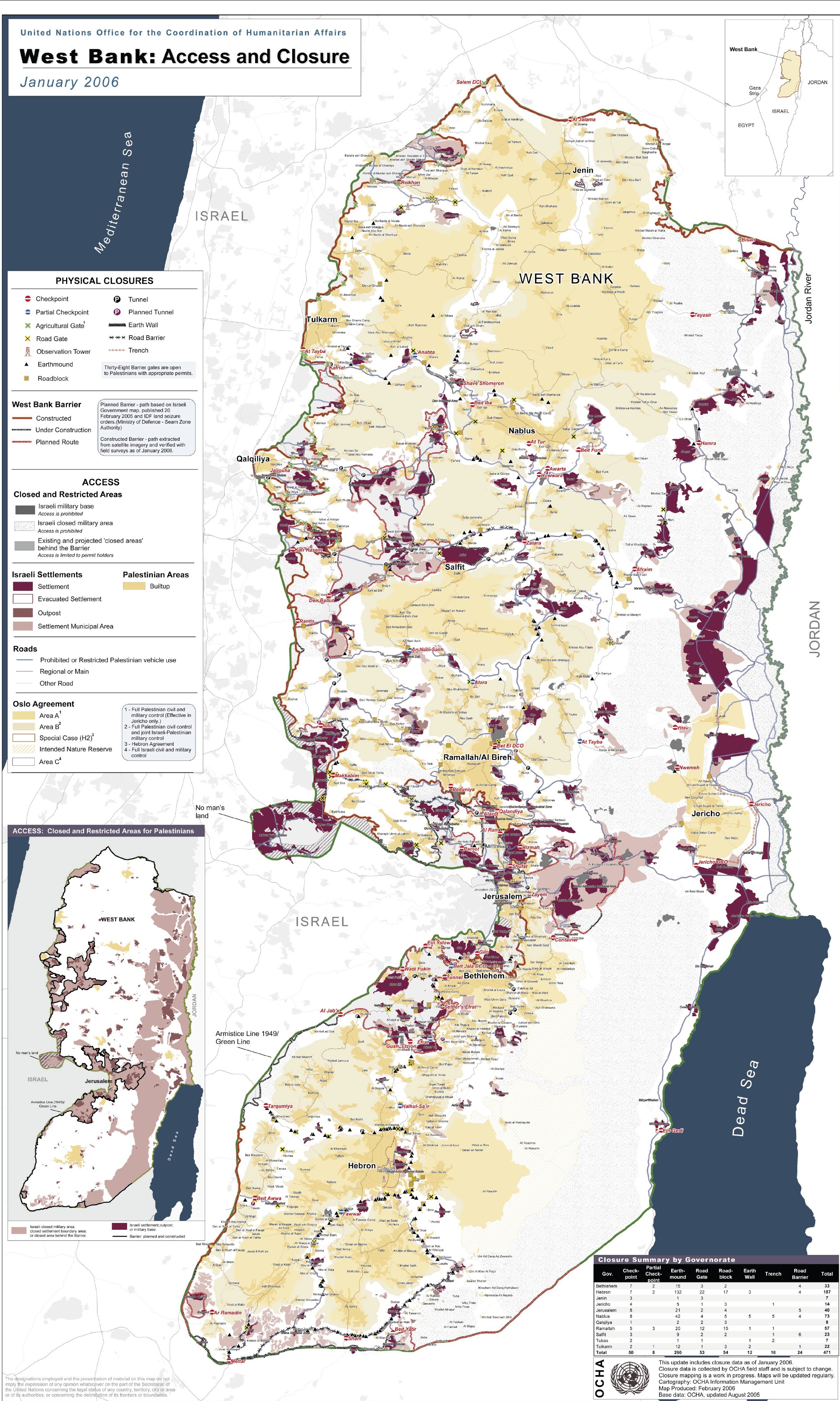
I do not find it feasible to imagine Gaza and the West Bank integrating a single country, and not only because they are separated by ~40Km, but because they are so sociologically different. People in the West Bank, yes, live opressed under military rule and subject to a much more constant, more visible apartheid-like state (as the territory is truly sprinkled with Jewish outposts which many Israelis refuse to recognize as their own, but still, which have incredibly higher living standards). The best land has been taken away from them, yes, but they have some space between cities to have some farming, to communicate, to... Breathe. Besides, West Bank inhabitants -even those in refugee camps- have much better living standards than anybody in Gaza. It is still an overpopulated area, but not nearly as much as Gaza.
Gazan population have been driven towards extremism. And yes, there was a civil war between Palestinian factions, as the world views between both populations are completely different - However hostile a Jenin inhabitant can be towards Israel, he does not lead the life -if it can so be called- you see at Khan Yunis.
But back to Gaza... What Israel is doing (and not only during this military operation terror campaign is wrong, from any rational point of view. Israel wants Hamas to become weaker? Then don't drive the population into supporting them!
Palestinians started giving over 50% of their support to Fatah (ex-PLO), and under 20% to Hamas. That was less than 15 years ago. However, Fatah has shown to be corrupt and inefficient at building infrastructure and improving life conditions, ineffective at negotiating a permanent agreement which secures dignity and sustainability to their people. Hamas stands as a religious, righteous organization. There are no serious corruption charges against any Hamas leaders. Hamas is clearly still at war - They didn't subscribe any peace agreement so far, and their stated #1 goal is to build a Muslim State in the whole of Israel. And the Hamas movement -like Hizbollah in Lebanon- has built quite a bit of infrastructure in the areas they control - Mainly housing. Yes, housing where they mix their own offices, many will accuse, getting human shields for free. But still, they are benefactors to a dehumanized, pauperized population.
I find it obvious that, if living conditions were at a basic level in the region, support of Hamas would decrease. Even more, of course, if they improved due to Israeli support. Israel controls this territory, so it is responsible for the well-being of its population, like it or not. And Gaza is simply too small and low on resources to survive by itself.
I was a bit surprised to find mention -although very brief- of a three state solution - And yes, this is close to what I would expect as a viable outcome. It is clear that Israel will not ever grant full citizenship to the Palestinians, as they would -euphemistically speaking- challenge the Jewish character of the State. Dropping the euphemism, Israel relies on apartheid in order not to become an Arab majority country. I might have some numbers wrong, but AFAIK, there are ~7 million Israelis, 20% of which are Arab citizens (which means, 1.4 million Arabs and probably 5 million Jews, with many other minor denominations for the difference), and ~4 million Palestinians live in the territories. Today, the country is already predominantly Arab, or at least is close to being so. So, Israel should permanently, formally disengage from all of the occupied territories. And in order to ensure violence stops, start a comprehensive, unconditional, long-term aid program. Start with giving them autonomy to regain their sea, as the Gaza port has long been closed. Allow the airport to operate again. Instead of bombing tunnels in the Egypt-Gaza borders, allow Gaza to trade with Egypt - Perhaps even to integrate territorialy, if the conditions are met. Treat their people with respect, and help them ease the terrible situation they have lived for so many decades - and then, undoubtely, terror will stop.
The West Bank? Possibly it could become a Palestinian state by itself. Possibly, it could integrate back to Jordan. That would be up to Jordans and Palestinians to decide. Of course, Jordan has already a large segment of its population defining itself as Palestinians, which counts both for and against. So, I won't venture into this supposition.
But anyway - Back to what prompted me to write this text -yes, a very or maybe even too long text - I hope somebody even takes the time to read it!- is to explain what is my point of view on the current situation, and why.
Today, a cease-fire was announced, after 23 days of murder and destruction. I sadly do not hold very high hopes for it to be lasting, much the less to be enough, to lead to what they call a de-escalation of the conflict. The most I can currently do is to voice my opinion, and hope that mine is just one more voice pointing to a sane solution, to a permanent, dignifying way out, for all people involved. Every people has the right for survival and for safety. We cannot deny this to any others. And certainly, we cannot expect anybody not to fight for their right to live.

Joost Yervante Damad: a month

Last year I even did it for longer then a month, but this year I want at least to redo a minimal effort, thus I'm going for a month of sobriety, as a kind of cleansing :) (and no, I'm not religious).
These are my 5 daily checkpoints:

  1. smoothie for breakfast

    This is something which we (me and my wife) do already anyway, have a fresh fruit smoothie for breakfast. Currently our favorite mix is 4 blood oranges, freshly pealed and parted, a seep of Sea-buckthorn elixir, and a couple of frozen strawberries (or cranberries). Mix all in the blender, long enough to don't have any parts left. It is extremely tasty, and gives a serious vitamin boost for the winter. The idea is to have it for breakfast and then don't drink or eat anything else for at least 1.5 hours, to make sure it's (almost) fully digested.

  2. < 4 coffee

    This is a hard one; people who know me will know I'm a serious coffee lover. I have a special espresso machine, and typically serve single origin or special blend coffees. It's hard to resist :)

  3. exercise

    Just a walk with the dogs already counts.

  4. no sugar

    This is usually not so hard for me, as I'm not into sweets anyway.

  5. no alcohol

    This is tougher. I'll have to stick to coffee, tea and fruit juices.
This is all as much a physical as a mental exercice :)


17 January 2009

Julien Valroff: Counting Debian source packages

Following to Kushal s post about counting total number of Debian packages, he concluded that sid currently has more than 30,000 binary packages (free, contrib & non-free). IMHO it is more relevant to count source packages. I couldn t find any existing way of doing it, I have hence written a short bash script. Script updated thanks to Thomas advice - now checking source packages directly from the mirror s Sources.gz file
#/bin/bash
 
if [ $# -lt 1 ]; then
  echo "Please add at least one distribution as argument"
  echo "Exiting"
  exit 1
fi
 
for arg in $*
do
 
  echo "Number of source packages in $arg: "
  for dist in main contrib non-free; do
    echo -n "  $dist: "
    wget -q -O - ftp://ftp.debian.org/debian/dists/$arg/$dist/source/Sources.gz   zgrep -c '^Package: '
  done
 
done
The results as of today:
Number of source packages in etch:
  main: 10221
  contrib: 126
  non-free: 211
Number of source packages in lenny:
  main: 12176
  contrib: 180
  non-free: 241
Number of source packages in sid:
  main: 13032
  contrib: 158
  non-free: 275
Which means we are quite far from the 18,733+ available packages, proudly announced on Debian homepage. Update: I had misread the figure advertised on Debian homepage which is a count of the binary packages available (which is currently much higher that what is stated there)

15 January 2009

Russell Coker: Old PDA vs New Mobile Phone for PDA use

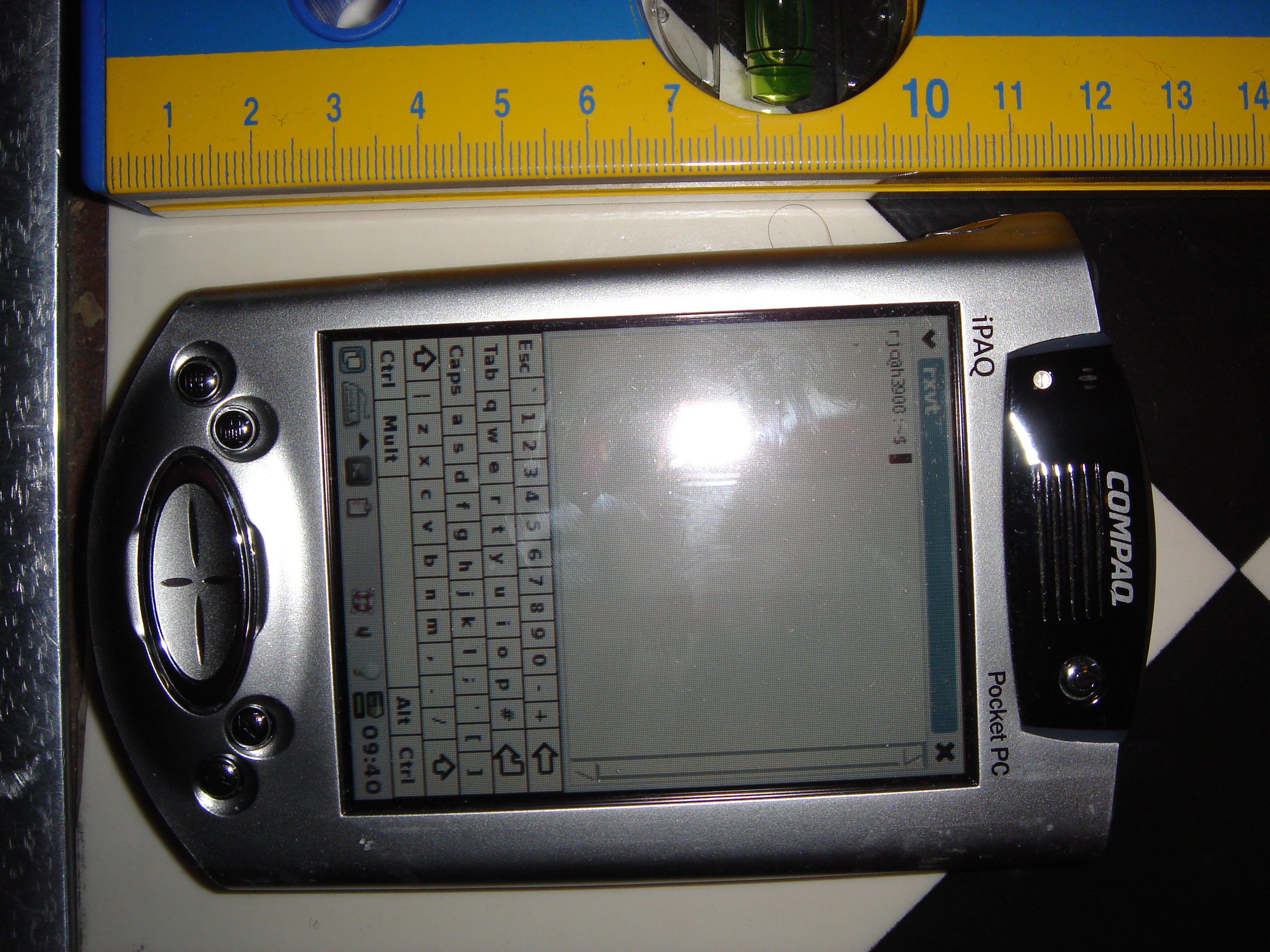
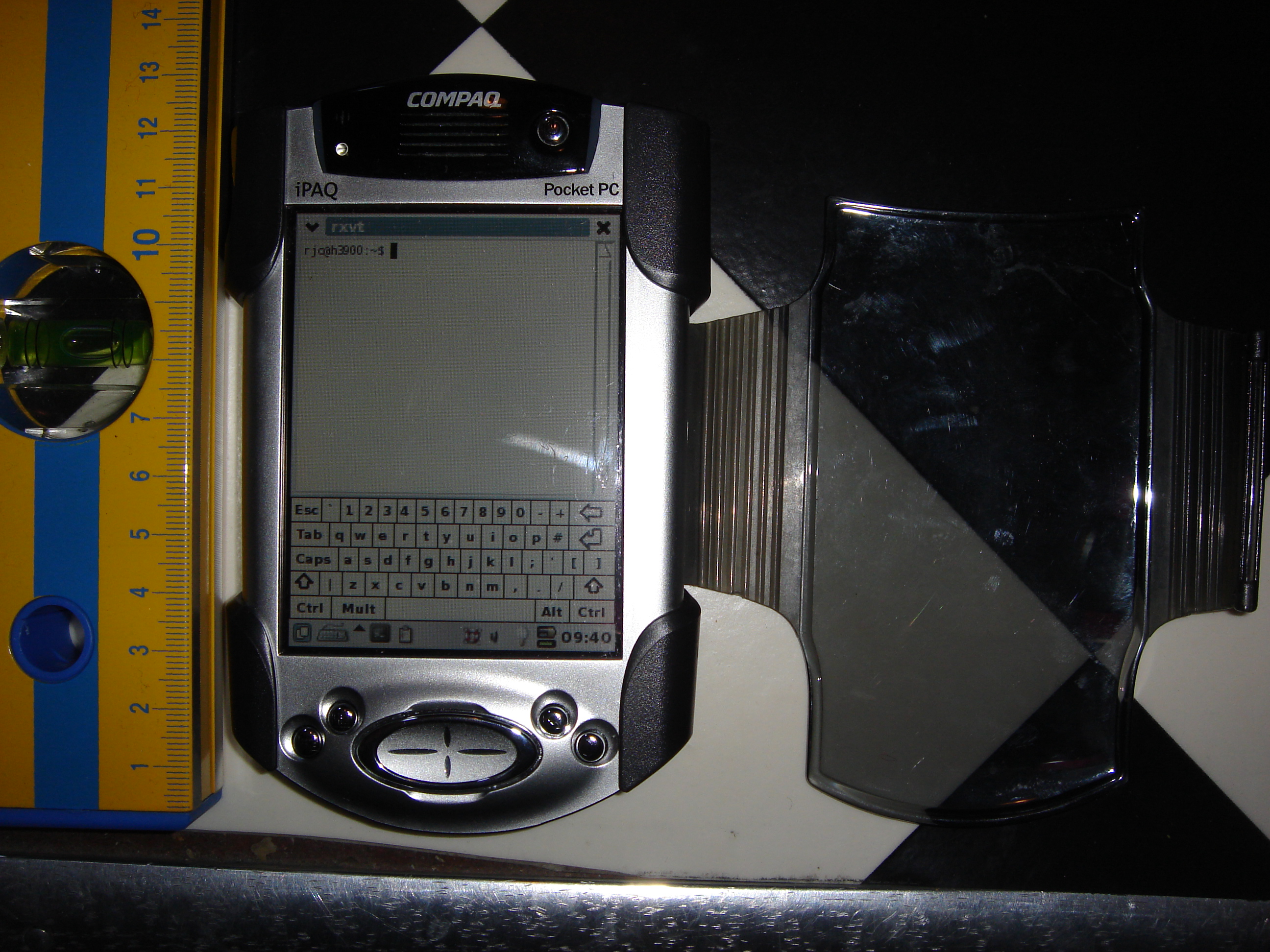
Since about 2002 I have been using a iPaQ [1] for taking notes while on the move. I have a pair of H3950 iPaQs that were given to me for the purpose of some software development work. As modern mobile phones have telephony as a small part of their feature set I think it s worth comparing a 2002 iPaQ with a 2009 mobile phone in terms of the note taking functionality. I have just got myself an LG U990 Viewty mobile phone [2]. It has a screen resolution of 240*320 which is the highest resolution that is remotely common for a mobile phone - and the same resolution as my 2002 model iPaQ. The LG KC910 Renoir has a resolution of 240*400 and seems to be the only phone that my carrier provides which has a higher resolution. The iPhone [3] has a resolution of 480*320. So it seems that the most expensive modern mobile phone that is available in Australia has a screen resolution that is only twice that of a 2002 PDA. I believe that in Japan you could buy a PDA with a higher resolution than 240*320 in 2002. My iPaQ is running Linux, so I can do whatever I want with it. I have a bar at the bottom of the screen with icons to launch, I configure it with the programs that I need most often and they are always one click away. While with my mobile phone I always have two large icons for paid services from my telco and I can t add icons for the things that I want. My iPaQ has a virtual keyboard that can be displayed in portrait or landscape mode. The above pictures show it in the portrait mode which allows the greatest area of screen space for text. The landscape mode is good for entering long lines of text even though the total number of words that can be displayed on screen is smaller. The size of my iPaQ is 134mm in height, between 77 and 84mm in width (it tapers) and 15.9mm thick without it s protective sleeve. The protective sleeve (shown in the second picture) adds about another 5mm to the width and thickness. My iPaQ is 1.76* the volume of my Viewty phone and at 184g vs 112g is 1.64* the mass. With it s sleeve on it is about 2.4* the volume. It s larger but with the sleeve it s a lot more solid, a touch-screen is very fragile so putting a touch-screen device in your back pocket without a sleeve is not a viable option. So I now own a mobile phone that has more storage, RAM, and CPU power than my iPaQ, but is less useful for the basic task of writing small documents and seems to have no facility for drawing diagrams. Most recent mobile phones have the ability to record voice (my Viewty can store 34 hours on it s internal storage and supports mini-SD cards for extra storage). But my Viewty lacks the ability to pause voice recording so if I wanted a series of notes during a meeting I would get a series of short voice recordings rather than a single file with many items. The todo list is also fairly poor in the Viewty, so even disregarding the poor keyboard on the touch-screen it would compare badly to the iPaQ. So it seems that an iPaQ that is almost seven years old when running Linux and the GPE Palmtop Environment [4] with with default configuration handily beats one of the latest and greatest mobile phones for all areas of common functionality. If the Viewty had it s source code available I would be tempted to contribute some patches (even if it was not free software). Finally, before someone suggests an Android [5], Greenphone [6] or other phone that s relatively open and programmable, I wanted a phone that had a good camera (by phone standards) and came essentially for free on an affordable contract. Maybe in two years time (when my current contract ends) there will be such a phone on offer. Mobile phones aren t THAT important to me, so while I would like to encourage the development of open telephony platforms it s a much lower priority than about a dozen free software projects. I expect that in the future something like an Android will become a great mobile phone with great PDA functionality. But for the moment I ll use an iPaQ and a Viewty.

14 January 2009

Jonathan McDowell: Yet another missed FOSDEM

I managed to go to FOSDEM in 2005. I enjoyed myself. I'd like to go again. No, really, I would.

In 2006 I drew the short straw while working for Black Cat; Simon and Dom went, I remained the person on the same landmass as the servers.

In 2007 I had a wedding to go to.

Last year I was too disorganised to sort out suitable transport from Northern Ireland.

I'd resigned myself to having to take off the Friday and Monday this year and fly. Except it's been moved to near the start of February, which thus conflicts with an annual dinner that gets to have higher priority. Bah.

Maybe I'll manage 2010, but I'll not be holding my breath.

11 January 2009

Russell Coker: Video Camera for Shared Movies

I have never felt inclined to create content for Youtube due to the low resolution of the display and the fact that only one format is supported (Flash which is totally non-free). The existence of blip.tv has inspired my interest in creating videos for distribution on the net. blip.tv has higher resolution than Youtube and supports multiple formats. Currently the multiple format support is limited to allowing users to upload whatever they want and then Flash (FLV) will be provided for download in addition to the original file(s). So for example I could upload MPEG4 and Quicktime movie files for the same content which would result in three download options (MPG, MOV, and FLV). It would be nice if they could support more formats as the default (maybe support transcoding to OGG), but it s certainly a lot better than Youtube. So the question then is how to create content. One option that I plan to use is Istanbul - the GNOME desktop session recorder [1]. It will record everything that happens on the desktop (or a section of the desktop) to an OGG file while also optionally recording audio input. This allows the creation of tutorials for performing various tasks on the computer. Another option is to do animation, either completely computer generated or by combining a set of JPEG files into an animation file. This doesn t interest me to the degree necessary to make me invest the necessary time. But the most common way of producing video content is via a camera. So the question becomes what camera to get. My current camera is a Sony Cyber-shot DSC-T5 [2]. It is a 5.1 mega-pixel camera with 3* optical zoom and supports 640*480 resolution movies at up to 30 fps. The quality of photos and video that it produces seems to be quite good, I don t have any particular problem with the camera that I want to address by purchasing a new one, so a major aim of buying a new camera was the fact that it s a few years old and something better must be available at a low price! I asked for advice about this on my local LUG mailing list. One piece of advice that was offered by several people was to use a Digital Video camera with Firewire output to record quality video. They spoke about common digital cameras as point and shoot with the acronym P&S - which seems to be used as a term of abuse by people who are really into cameras. If using a DV camera with Firewire support (which is apparently a really important feature) then apparently Kino [4] is the program to use to capture the raw video data. While the advice in regard to a digital video camera sounds good I m not going to take it. Such DV cameras start at about $300 and appear to be physically larger. While a larger camera (with a larger lens) will give better quality pictures and higher frame rates with lower levels of ambient light I am planning to do my serious video recording in a controlled environment with reasonable lighting. Really I m not THAT serious about video recording, so I don t plan to spend $300 or more - I ll accept the lower quality as a trade-off for lower price and greater convenience. I have seen an advert for a camera described as a DC-777 at a good price from DirectBuy.com.au [3]. The camera in question is one that has no reviews anywhere on the net and seems to be a re-badged version of someone else s camera. It initially sounded quite good with 11mega-pixel resolution, but the fine print shows that it has a 7MP CCD and uses interpolation to get a higher resolution. Also the movie capability is 640*480 at 30fps (the same as my Sony). So the benefit of using the DC-777 would be the rotating display which can face the same direction as the lens thus allowing someone who is making a video of themself to see what they are creating. This doesn t seem to be $200 worth of benefit, but the camera might be a reasonable deal for someone who doesn t already have a decent P&S digital camera. Another interesting piece of advice I received from my local LUG was that the amount of time taken to get a good image (which determines the shutter speed on a good camera or the maximum frame rate for video) is determined in part by the size of the elements in the CCD. So with all other things being equal a camera that supports higher resolution will require longer exposure. For my use the benefit of higher resolution photos is often for the purpose of cropping pictures of objects that were too far away to allow completely zooming in. 3* optical zoom (as implemented in my current camera) is a limit when photographing objects that are far away in good light conditions (in poor light it s often a factor of the lens size). In the past when looking at digital cameras I would make the resolution of the picture the prime criteria - with the idea that bigger is better. But now it seems that the smart thing to do is to make optical zoom the prime criteria for general purpose camera use. Also having a larger lens is a significant benefit, but as the overall volume of the camera is going to be roughly proportional to the radius of the lens cubed it can t get that big without some serious compromises on portability. Obviously an SLR [5] offers significant quality benefits. But if you are unwilling to spend so much money a good result can be obtained by what are sometimes called Big Zoom Digital cameras. These are cameras with a body shape that resembles a SLR, they vary in size between the P&S cameras and SLRs, and have fixed lenses that are significantly larger than those of P&S cameras. I gave such a camera to a relative for Christmas and I was very impressed by the quality of pictures and movies that it produced. I chose a Kodak camera with 12* optical zoom which was quite impressive (unfortunately the 15* model had sold out). One of the benefits of a Big Zoom Digital camera over a DSLR is that as there is no option to replace the lens there is also no possibility to get dust inside the camera (which is apparently a problem with SLR cameras). For my own use I plan to stick with my Sony Cybershot. I can t get anything significantly better for an amount of money that I am prepared to spend, and I also don t really want a larger camera. So I think I ll buy a tripod (or maybe two tripods of different sizes), that should deliver a real benefit for my photography without costing much. Update: One thing I forgot to mention is the film speed rating (AKA the ISO number) [6]. A higher ISO number means that the camera can take faster pictures in less light. The Wikipedia page reports that camera manufacturers are permitted to interpret the ISO scheme in several different ways, so they can essentially just make stuff up. Probably the best that can be said for the ISO number is that any camera which advertises it is aimed at more serious users and is therefore likely to be of higher quality. I m sure that if I was to spend $700 or more then I would get a camera with an advertised ISO number that actually means something, but I don t have any plans to ever do that. Matt made a good comment that the quality of the glass matters. For an SLR you can consider the lens quality independently of the quality of the rest of the camera. But for cheap cameras it s just a matter of the entire package.

Next.

Previous.