Search Results: "eric"

12 September 2012

Gintautas Miliauskas: statsb.in

It happens occasionally that I need to validate an optimization by benchmarking, and the benchmark results are a bit noisy. Usually the situation does not ask for a heavy-duty statistical analysis, and I am too lazy for that anyway. However, sometimes having at least the fundamental statistics of a sample would be handy.

Obviously, calculating the standard deviation of a sample in the 21st century by itself is not a problem. There is LibreOffice, there is R, there's a bazillion statistical tools out there. They do feel a bit heavyweight for the task though, and the friction involved in starting them up and entering the data in the right format means that often I just do not bother. Google brings up some dynamic webpages for the task, a much more lightweight solution, but most of these are ugly and ad-riddled.

What's a programmer to do? Code up another weekend app, statsb.in, of course. And it is the way I like it: there is a textarea where it is easy to paste and edit inline snippets of text, say, shell script output in full; non-numeric data are ignored; statistics are computed on the fly (no stupid "Submit" buttons); and you can save the snippet on the server and get a short link (useful for footnotes pointing to data sources).

The service probably will not be expanded much further. After all, if those basic statistics are not enough, you are probably better off firing up a real statistics tool. However, I do plan to add another page for the most common task that I run into, namely, comparing the means of two populations (did my optimization have an effect?). In other words, calculating the p-value of the hypothesis that the means of two populations are the same. Stay tuned.

11 September 2012

Russell Coker: Back to the Xperia X10

10 months ago I was given a Samsung Galaxy S Android phone [1] to replace my Sony Ericsson Xperia X10. I also installed Cyanogenmod on it (here is a more detailed comparison of the phones with a focus on liberty [2]). But now I m using the Xperia X10 again. Hardware Reliability Some time ago a friend told me that he bought a Sony phone in preference to a Samsung phone because he didn t think that Samsung phones were reliable enough. I assured him that Samsung phones would be fine if you used a gel-case, but now I m not so sure. My mother in law has a Samsung Galaxy S which now has a single crack across the face, it doesn t appear that her phone was dropped, maybe it just bent a bit it s a fairly thin phone. My Galaxy S started crashing over the last few months and now many applications will crash any time I use 3G networking. Currently my Galaxy S is working well as a small Wifi tablet and hasn t crashed since I replaced the SIM with one that has expired. I wish that phone designers would make mode solid products with bigger batteries. The fact that the Xperia X10 weighs maybe 20g more than the Galaxy S (according to Wikipedia) isn t a problem for me. Even with the Mugen Power 1800mah battery [4] to replace the original 1500mah battery it s still nowhere near the limit of the phone mass that I m prepared to carry. Sony Upgrades Some time ago Sony released an Android 2.3.3 image for the Xperia X10. There is no Cyanogenmod image for the Xperia X10 because it has been locked down which greatly limits what can be done. Also Sony has a proprietary backup program on their Android 2.1 image which isn t supported on Android 2.3.3 this inspired my post about 5 principles of backup software [3]. Due to this pain I didn t even try to upgrade the Xperia X10 phones for me and my wife until recently. Before upgrading the Xperia X10 phones I was unable to use my wife s phone. The phone didn t seem to like recognising my touch so long touch actions (such as unlocking the phone) were almost impossible for me. I think that this is due to the fact that I have fairly dry skin which presumably gives me a higher capacitance. After the upgrade both phones are usable for me, so presumably either Sony or Google upgraded the algorithms for recognising touch to work better with varying screen quality. Comparing the Galaxy S and the Xperia X10 When I first started running Cyanogenmod on the Galaxy S I noticed that it was a lot faster than the Xperia X10 but I didn t know why. It was documented that there had been performance improvements in Android 2.2. Now that I m running Android 2.3.3 on the Xperia X10 I know that the performance difference is not due to the Android version. It could be due to Cyanogenmod optimisations or Sony stupidity, but it s most likely due to hardware differences. The Galaxy S has more RAM and storage which allows installing and running more applications. Now that I m using the Xperia X10 for the bare minimum applications (phone calls, SMS, camera, email, ssh, and web browsing) it works quite well. I still play games on the Galaxy S and use it for more serious web browsing via Wifi. I think that the value I m getting from the Galaxy S as a tiny wifi tablet is greater than the money I might get from selling a partially broken phone that s been obsoleted by two significantly better models. Conclusion The camera on the Xperia X10 is significantly better than the one on the Galaxy S, so going back to a phone that has a great camera is a real benefit. But being slow and locked down is a real drag. I was tempted to buy a Samsung Galaxy Note or Galaxy S3, but it seemed like a bad idea to buy a phone given that my contract comes up for renewal in about 6 months which means I ll be offered a free phone which while not really free is still going to be cheaper than buying a phone outright. Also in future given the low opinion I m now getting of smart phone reliability I ll try and keep a small stock of spare Android phones to cover the case of broken phones. Related posts:
  1. Galaxy S vs Xperia X10 and Android Network Access Galaxy S Review I ve just been given an indefinite loan...
  2. CyanogenMod and the Galaxy S Thanks to some advice from Philipp Kern I have now...
  3. Liberty and Mobile Phones I own two mobile phones at the moment, I use...

10 September 2012

Craig Sanders: openstack, bridging, netfilter and dnat

I just posted the following question to ServerFault .and then realised there might be people out there in magical internetland who know the answer but never visit any of the SO sites, so i ve posted it here too. Feel free to respond here on on serverfault.
In a recent upgrade (from Openstack Diablo on Ubuntu Lucid to Openstack Essex on Ubuntu Precise), we found that DNS packets were frequently (almost always) dropped on the bridge interface (br100). For our compute-node hosts, that s a Mellanox MT26428 using the mlx4_en driver module.
We ve found two workarounds for this:
1. Use an old lucid kernel (e.g. 2.6.32-41-generic). This causes other problems, in particular the lack of cgroups and the old version of the kvm and kvm_amd modules (we suspect the kvm module version is the source of a bug we re seeing where occasionally a VM will use 100% CPU). We ve been running with this for the last few months, but can t stay here forever.
2. With the newer Ubuntu Precise kernels (3.2.x), we ve found that if we use sysctl to disable netfilter on bridge (see sysctl settings below) that DNS started working perfectly again. We thought this was the solution to our problem until we realised that turning off netfilter on the bridge interface will, of course, mean that the DNAT rule to redirect VM requests for the nova-api-metadata server (i.e. redirect packets destined for 169.254.169.254:80 to compute-node s-IP:8775) will be completely bypassed.
Long-story short: with 3.x kernels, we can have reliable networking and broken metadata service or we can have broken networking and a metadata service that would work fine if there were any VMs to service. We haven t yet found a way to have both.
Anyone seen this problem or anything like it before? got a fix? or a pointer in the right direction?
Our suspicion is that it s specific to the Mellanox driver, but we re not sure of that (we ve tried several different versions of the mlx4_en driver, starting with the version built-in to the 3.2.x kernels all the way up to the latest 1.5.8.3 driver from the mellanox web site. The mlx4_en driver in the 3.5.x kernel from Quantal doesn t work at all)
BTW, our compute nodes have supermicro H8DGT motherboards with built-in mellanox NIC:
02:00.0 InfiniBand: Mellanox Technologies MT26428 [ConnectX VPI PCIe 2.0 5GT/s - IB QDR / 10GigE] (rev b0)
We re not using the other two NICs in the system, only the Mellanox and the IPMI card are connected.
Bridge netfilter sysctl settings:
net.bridge.bridge-nf-call-arptables = 0
net.bridge.bridge-nf-call-iptables = 0
net.bridge.bridge-nf-call-ip6tables = 0
Since discovering this bridge-nf sysctl workaround, we ve found a few pages on the net recommending exactly this (including Openstack s latest network troubleshooting page and a launchpad bug report that linked to this blog-post that has a great description of the problem and the solution) .it s easier to find stuff when you know what to search for :), but we haven t found anything on the DNAT issue that it causes.

Update 2012-09-12: Something I should have mentioned earlier this happens even on machines that don t have any openstack or even libvirt packages installed. Same hardware, same everything, but with not much more than the Ubuntu 12.04 base system installed. On kernel 2.6.32-41-generic, the bridge works as expected. On kernel 3.2.0-29-generic, using the ethernet interface, it works perfectly.
Using a bridge on that same NIC fails unless net.bridge.bridge-nf-call-iptables=0 So, it seems pretty clear that the problem is either in the mellanox driver, the updated kernel s bridging code, netfilter code. or some interaction between them. Interestingly, I have other machines (without a mellanox card) with a bridge interface that don t exhibit this problem. with NICs ranging from cheap r8169 cards to better quality broadcom tg3 Gbit cards in some Sun Fire X2200 M2 servers and intel gb cards in supermicro motherboards. Like our openstack compute nodes, they all use the bridge interfaces as their primary (or sometimes only) interface with an IP address they re configured that way so we can run VMs using libvirt & kvm with real IP addresses rather than NAT. So, that indicates that the problem is specific to the mellanox driver, although the blog post I mentioned above had a similar problem with some broadcom NICs that used the bnx2 driver. openstack, bridging, netfilter and dnat is a post from: Errata

9 September 2012

Erich Schubert: Google Plus replacing blogs not Facebook

When Google launched Google+, a lot of people were very sceptical. Some outright claimed it to be useless. I must admit, it has a number of functions that really rock.
Google Plus is not a Facebook clone. It does not try to mimick Facebook that much. To me, it looks much more like a blog thing. A blog system, where everybody has to have a Google account, and then can comment (plus, you can then restrict access and share only with some people). It also encourages you to share shorter posts. Successful blogs always tried to make their posts "articles". Now the posts themselves are merely comments; but not as crazy short as Twitter (it is not a Twitter clone either), and it does have rich media contents, too.
Those who expect it to replace their Facebook where the interaction is all about personal stuff will be somewhat disappointed. Because it IMHO much less encourages the smalltalk type of interaction.
However, it won a couple of pretty high profile people to share their thoughts and web discoveries with the world. Some of the most active users I follow on Google Plus are: Linus Torvalds and Tim O'Reilly (of the publishing house O'Reilly)
Of course I also have a number of friends that share private stuff on Google Plus. But in my opinion the strength of Google Plus is on sharing publicly. Since Google is the king of search, they can both feed shares of your friends into your regular search results, but there is also a pretty interesting search in Google PLus. The key difference is that with this search, the focus is on what is new. Regular web search is also a lot about searching for old things (where you did not bother to remember the address or bookmark the site - and mind it, today a lot of people even "google for Google" ...) For example I like the plus search for data mining because it occasionally has some interesting links in it. A lot of the stuff is coming in again and again, but using the "j and k" keys, I can quickly scroll through these results to see if there is anything interesting. And there are quite a lot of interesting things I've discovered this way.
Note that this can change anytime. And maybe it is because I'm interested in technology stuff that it works well for me. But say, maybe you are more into HDR photography than me (I think they look unreal, as if someone has done way too much contrast and edge enhancing on the image). But go there, and press "j" a number of times to browse through some HDR shots. That is a pretty neat search function there. And if you come back tomorrow, there will likely be new images!
Facebook tried to clone this functionality. Google+ launched in June 2011, and in September 2011, Facebook added "subscribers". So they realized the need for having "non-friends" that are interested in what you are doing. Yet, I don't know anybody actually using it. And the Public posts search is much less interesting than of Google Plus, and the nice keyboard navigation is also missing.
Don't get me wrong, Facebook still has its uses. When I travel, Facebook is great for me to get into contact with locals to go swing dancing. There are a number of events where people only invite you on Facebook (and that is one of the reasons why I've missed a number of events - because I don't use Facebook that much). But mind it, a lot of the stuff that people share on Facebook is also really boring.
And that will actually be the big challenge for Google: keeping the search results interesting. Once you have millions of people there sharing pictures of lolcats - will it still return good results? Or will just about every search give you more lolcats?
And of course, spam. The SEO crowd is just warming up in exploring the benefits of Google Plus. And there are quite some benefits to be gained from connecting web pages to Google Plus, as this will make your search results stick out somehow, or maybe give them that little extra edge over other results. But just like Facebook at some point was so heavily spammed when every little shop was setting up his Facebook pages, inviting everyone to all the events and so on - this is bound to happen on Google Plus, too. We'll see how Google then reacts, and how quickly and effectively.

5 September 2012

Jonathan Carter: Shello


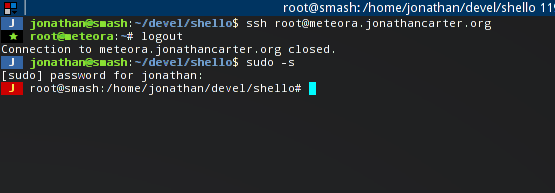
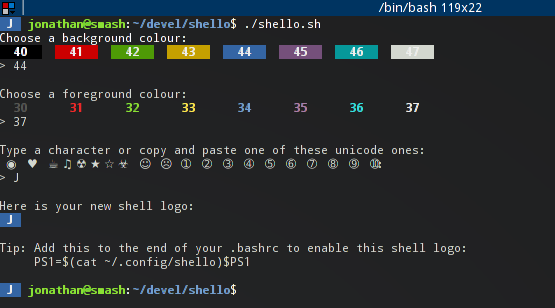
If there s one thing that I ve had missing in my life for way too long, it s hacking on small silly stupid amusing little things. When I was young I used to write dozens of little pointless programs a week and forget about them, only to found them a few months later and be incredibly amused by them. This afternoon I noticed that one of my machines didn t have my default .bashrc loaded, which colourises (or colorizes for Americans or colourizes for Canadians) my shell so that I know on which machine I am so that I don t accidentally do something silly like reboot the wrong host. One problem I ve had with this is that there are limited colours available that makes sense to use for a shell prompt. Right as I was thinking this, I was looking at my Byobu screen sessions and thinking Hmm! I like those logos, maybe I could use them in my shell! . So in just a few minutes I had a little script to help you configure those for your shell. Here is a screenshot of the shell logos in action. On my laptop I use a red background when I have a root shell: This is what the shello script looks like that sets it up: I might get bored by seeing it soon and get rid of it, but at least I had a little fun with it. If you d like to try it out, then you can get the script right here: https://github.com/highvoltage/shello It doesn t do anything like validating input yet, I d also like to add something that creates some kind of a checksum of your hostname and choose a unicode character based on that. Maybe I ll finish it up this weekend, or maybe I ll have new things to write about!

2 September 2012

Dirk Eddelbuettel: Faster creation of binomial matrices

Scott Chamberlain blogged about faster creation of binomial matrices the other day, and even referred to our RcppArmadillo package as a possible solution (though claiming he didn't get it to work, tst tst -- that is what the rcpp-devel list is here to help with). The post also fell short of a good aggregated timing comparison for which we love the rbenchmark package. So in order to rectify this, and to see what we can do here with Rcpp, a quick post revisiting the issue. As preliminaries, we need to load three packages: inline to create compiled code on the fly (which, I should mention, is also used together with Rcpp by the Stan / RStan MCMC sampler which is creating some buzz this week), the compiler package included with R to create byte-compiled code and lastly the aforementioned rbenchmark package to do the timings. We also set row and column dimension, and set them a little higher than the original example to actually have something measurable:
library(inline)
library(compiler)
library(rbenchmark)
n <- 500
k <- 100
The first suggestion was the one by Scott himself. We will wrap this one, and all the following ones, in a function so that all approaches are comparable as being in a function of two dimension arguments:
scott <- function(N, K)  
    mm <- matrix(0, N, K)
    apply(mm, c(1, 2), function(x) sample(c(0, 1), 1))
 
scottComp <- cmpfun(scott)
We also immediatly compute a byte-compiled version (just because we now can) to see if this helps at all with the code. As there are no (explicit !) loops, we do not expect a big pickup. Scott's function works, but sweeps the sample() function across all rows and columns which is probably going to be (relatively) expensive. Next is the first improvement suggested to Scott which came from Ted Hart.
ted <- function(N, K)  
    matrix(rbinom(N * K, 1, 0.5), ncol = K, nrow = N)
 
This is quite a bit smarter as it vectorises the approach, generating N times K elements at once which are then reshaped into a matrix. Another suggestion came from David Smith as well as Rafael Maia. We rewrite it slightly to make it a function with two arguments for the desired dimensions:
david <- function(m, n)  
    matrix(sample(0:1, m * n, replace = TRUE), m, n)
 
This is very clever as it uses sample() over zero and one rather than making (expensive) draws from random number generator. Next we have a version from Luis Apiolaza:
luis <- function(m, n)  
     round(matrix(runif(m * n), m, n))
 
It draws from a random uniform and rounds to zero and one, rather than deploying the binomial. Then we have the version using RcppArmadillo hinted at by Scott, but with actual arguments and a correction for row/column dimensions. Thanks to inline we can write the C++ code as an R character string; inline takes care of everything and we end up with C++-based solution directly callable from R:
arma <- cxxfunction(signature(ns="integer", ks="integer"), plugin = "RcppArmadillo", body='
   int n = Rcpp::as<int>(ns);
   int k = Rcpp::as<int>(ks);
   return wrap(arma::randu(n, k));
')
This works, and is pretty fast. The only problem is that it answers the wrong question as it returns U(0,1) draws and not binomials. We need to truncate or round. So a corrected version is
armaFloor <- cxxfunction(signature(ns="integer", ks="integer"), plugin = "RcppArmadillo", body='
   int n = Rcpp::as<int>(ns);
   int k = Rcpp::as<int>(ks);
   return wrap(arma::floor(arma::randu(n, k) + 0.5));
')
which uses the the old rounding approximation of adding 1/2 before truncating. With Armadillo in the picture, we do wonder how Rcpp sugar would do. Rcpp sugar, described in one of the eight vignettes of the Rcpp package, is using template meta-programming to provide R-like expressiveness (aka "syntactic sugar") at the C++ level. In particular, it gives access to R's RNG functions using the exact same RNGs as R making the results directly substitutable (whereas Armadillo uses its own RNG).
sugar <- cxxfunction(signature(ns="integer", ks="integer"), plugin = "Rcpp", body='
   int n = Rcpp::as<int>(ns);
   int k = Rcpp::as<int>(ks);
   Rcpp::RNGScope tmp;
   Rcpp::NumericVector draws = Rcpp::runif(n*k);
   return Rcpp::NumericMatrix(n, k, draws.begin());
')
Here Rcpp::RNGScope deals with setting/resetting the R RNG state. This draws a vector of N time K uniforms similar to Luis' function -- and just like Luis' R function does so without looping -- and then shapes a matrix of dimension N by K from it. And it does of course have the same problem as the RcppArmadillo approach earlier and we can use the same solution:
sugarFloor <- cxxfunction(signature(ns="integer", ks="integer"), plugin = "Rcpp", body='
   int n = Rcpp::as<int>(ns);
   int k = Rcpp::as<int>(ks);
   Rcpp::RNGScope tmp;
   Rcpp::NumericVector draws = Rcpp::floor(Rcpp::runif(n*k)+0.5);
   return Rcpp::NumericMatrix(n, k, draws.begin());
')
Now that we have all the pieces in place, we can compare:
res <- benchmark(scott(n, k), scottComp(n,k),
                 ted(n, k), david(n, k), luis(n, k),
                 arma(n, k), sugar(n,k),
                 armaFloor(n, k), sugarFloor(n, k),
                 order="relative", replications=100)
print(res[,1:4])
With all the above code example in a small R script we call via littler, we get
edd@max:~/svn/rcpp/pkg$ r /tmp/scott.r 
Loading required package: methods
              test replications elapsed   relative
7      sugar(n, k)          100   0.072   1.000000
9 sugarFloor(n, k)          100   0.088   1.222222
6       arma(n, k)          100   0.126   1.750000
4      david(n, k)          100   0.136   1.888889
8  armaFloor(n, k)          100   0.138   1.916667
3        ted(n, k)          100   0.384   5.333333
5       luis(n, k)          100   0.410   5.694444
1      scott(n, k)          100  33.045 458.958333
2  scottComp(n, k)          100  33.767 468.986111
We can see several takeaways: Thanks to Scott and everybody for suggesting this interesting problem. Trying the rbinom() Rcpp sugar function, or implementing sample() at the C++ level is, as the saying goes, left as an exercise to the reader.

Erich Schubert: ELKI call for contributions

ELKI is a data mining software project that I have been working on for the last years as part of my PhD research. It is open source (AGPL-3 licensed) and avilable as both a Debian package and Ubuntu package in the official repositories. So a simple aptitude install elki should get you going and give you a menu entry for ELKI. These packages come with the scripts elki to launch the MiniGUI and elki-cli to run from command line. The key feature that sets ELKI apart from existing open source tools used in data mining (e.g. Weka and R) is that it has support for index structures to speed up algorithms, and a very modular architecture that allows various combinations of data types, distance functions, index structures and algorithms. When looking for performance regressions and optimization potential in ELKI, I recently ran some benchmarks on a data set with 110250 images described by 8 dimensional color histograms. This is a decently sized dataset: it takes long enough (usually in the range of 1-10 minutes) to measure true hotspots. When including Weka and R in the comarison I was quite surprised: our k-means implementation runs at the same speed as Rs implementation in C (and around twice that of the more flexible "flexclus" version). For some of the key agorithms (DBSCAN, OPTICS, LOF) we are an order of magnitude faster than Weka and R, and adding index support speeds up the computation by another factor of 5-10x. In the most extreme case - DBSCAN in Weka vs. DBSCAN with R-tree in ELKI - the speedup was a factor of 330x, or 2 minutes (ELKI) as opposed to 11 hours (Weka).
The reason why I was suprised is that I expected ELKI to perform much worse. It is written in Java (as opposed to R's kmeans, which is in C), uses a very flexible architecture which for example does not assume distances to be of type double and just has a lot of glue code inbetween. However, obviously, the Java Hotspot compiler actually lives up to its expectations and manages to inline the whole distance computations into k-means, and then compiles it at a level comparable to C. R executes vectorized operations quite fast, but on non-native code as in the LOF example it can become quite slow, too. (I would not take Weka as reference, in particular with DBSCAN and OPTICS there seems to be something seriously broken. Judging from a quick look at it, the OPTICS implementation actually is not even complete, and both implementations actually copy all data out of Weka into a custom linear database, process it there, then feed back the result into Weka. They should just drop that "extension" altogether. The much newer and Weka-like LOF module is much more comparable.) Note that we also have a different focus than Weka. Weka is really popular for machine learning, in particular for classification. In ELKI, we do not have a single classification algorithm because there is Weka for that. Instead, ELKI focuses on cluster analysis and outlier detection. And ELKI has a lot of algorithms in this domain, I dare to say the largest collection. In particular, they are all in the same framework, so they can be easily compared. R does of course have an impressive collection in CRAN, but in the end they do not really fit together. Anyway, ELKI is a cool research project. It keeps on growing, we have a number of students writing extensions as part of their thesis. It has been extremely helpful for me in my own research, as I could quickly prototype some algorithms, then try different combinations and use my existing evaluation and benchmarking. You need some time to get started (largely because of the modular architecture, Java generics and such hurdles), but then it is a very powerful research tool. But there are just many more algorithms, published sometime, somewhere, but barely with source code available. We'd love to get all these published algorithms into ELKI, so researchers can try them out. And enhance them. And use them for their actual data. So far, ELKI was mostly used for algorithmic research, but it's starting to move out into the "real" world. More and more people that are not computer scientists start using ELKI to analyze their data. Because it has algorithms that no other tools have. I tried to get ELKI into the "Google Summer of Code", but it was not accepted. But I'd really like to see it gain more traction outside the university world. There are a number of cool projects associated with ELKI that I will not be able to do myself the next years, unfortunately. If you are a researcher in cluster analysis or outlier detection, consider contributing your algorithms to ELKI. Spend some time optimizing them, adding some documentation. Because, if ELKI keeps on growing and gaining popularity, it will be the future benchmark platform. And this can give you citations, which are somewhat the currency of science these days. Algorithms available in the major toolkits just do get cited more, because people compare to them. See this list for an overview of work cited by ELKI - scientific work that we reimplemented at least to some extend for ELKI. It is one of the services that we provide with ELKI for researchers: not only the algorithm, but also the appropriate citation.

30 August 2012

Erich Schubert: Finding packages for deinstallation

On my netbook, I try to keep the amount of installed software limited. Aptitudes "automatically installed" markers are very helpful here, since they allow you to differentiate between packages that were deliberately installed and packages that were manually marked for installation. I quite often browse through the list of installed packages and recheck those that are not marked as "A".
However, packages that are "suggested" by some other package (but not "required") will be kept even when marked as automatically. This is quite sensible: when you deinstall the package that "suggested" them, they will be removed. So this is nice for having optional software also automatically removed.
However sometimes you need the core package but not this optional functionality. Aptitude can help you there, too. Here's an aptitude filter I used to find some packages for removal:
!?reverse-depends(~i) ~M !?essential
It will display only packages with no direct dependency from another installed package and that are marked as automatically installed (so they must be kept installed because of a weaker dependency.
Some examples of "suggested but not required" packages:
  • Accessibility extensions of Gnome
  • Spelling dictionaries
  • Optional functionality / extensions
Depending on your requirements, you might want to keep some of these and remove others.

Here is also a filter to find packages that you can put on "automatically installed":
~i !~M ?reverse-depends(~i) !?essential
This will catch "installed but not automatically installed packages, that another installed package depends on". Note that you should not blindly put all of these to "automatic" mode. For example "logrotate" depends on "cron anacron fcron". If you have both cron and anacron installed, aptitude will consider anacron to be unnecessary (it is - on a system with 24h uptime). So review this list, and see what happens when you set packages to "A", and reconsider your intentions. If it is a software you want for sure, leave it on manual.

27 August 2012

Robert Collins: Why platform specific package systems exist and won t go away

A while back mdz blogged about challenges facing Ubuntu and other Linux distributions. He raises the point that runtime libraries for Python / Ruby etc have a unique set of issues because they tend to have their own packaging systems. Merely a month later he attended Debconf 2010 where a presentation was given on the issues that Java packages have on Dpkg based systems. Since then the conversation seems to have dried up. I ve been reminded of it recently in discussions within Canonical looking at how we deploy web services. Matt suggested some ways forward, including: I think its time we revisit and expand on those points. Nothing much has changed in how Ubuntu or other distributions approach integration with other packaging systems but the world has kept evolving. Internet access is growing ever more ubiquitous, more platforms are building packaging systems clojure, scala, node.js, to name but three, and a substantial and ever growing number of products expect to operate in a hybrid fashion with an evolving web service plus a local client which is kept up to date via package updates. Twitter, Facebook and Google Plus are three such products. Android has demonstrated a large scale app store on top of Linux, with its own custom packaging format. In order to expand them, we need some background context on the use cases that these different packaging systems need to support. Platforms such as antivirus scanners, node.js, Python, Clojure and so forth care a great deal about getting their software out to their users. They care about making it extremely easy to get the latest and greatest versions of their libraries. I say this because the evidence is all around us: every successful development community / product has built a targeted package management system which layers on top of Windows, and Mac OSX, and *nux. The only rational explanation I can come up for this behaviour is that the lower level operating system package management tools don t deliver what they need. E.g. this isn t as shallow as wanting a packaging system written in their own language, which would be easy to write off as parochialism rather than a thoughtful solution to their problems. In general packaging systems provide a language for shipping source or binary form, from one or more repositories, to users machines. They may support replications, and they may support multiple operating systems. They generally end up as graph traversal engines, pulling in dependencies of various sorts you can see the DOAP specification for an attempt at generic modelling of this. One problem that turns up rapidly when dealing with Linux distribution package managers is that the versions upstream packages have, and the versions a package has in e.g. Debian, differ. They differ because at some stage, someone will need to do a new package for the distribution when no upstream change has been made. This might be to apply a local patch, or it might be to correct a defect caused by a broken build server. Whatever the cause, there is a many to one relationship between the package versions that end users see via dpkg / rpm etc, and those that upstream ship. It is a near certainty that once this happens to a library package, that comparing package versions across different distribution packages becomes hard. You cannot reliably infer whether a given package version is sufficient as a dependency or not, when comparing binary packages between Red Hat and Debian. Or Debian and Ubuntu. The result of this is that even when the software (e.g. rpm) is available on multiple distributions (say Ubuntu and RHEL), or even on multiple operating systems (say Ubuntu and Windows), that many packages will /have/ to be targeted specifically to build and execute properly. (Obviously, compilation has to proceed separately for different architectures, its more the depedency metadata that says and build with version X of dependency Y that has to be customised). The result of this is that there is to the best of my knowledge no distribution of binary packages that targets Debian/Ubuntu and RHEL and Suse and Windows and Mac OS X, although there are vibrant communities building distributions of and for each in isolation. Some of the ports systems come close, but they are still focused on delivering to a small number of platforms. There s nothing that gives 99% coverage of users. And that means that to reach all their users, they have to write or adopt a new system. For any platform X, there is a strong pressure to have the platform be maintainable by folk that primarily work with X itself, or with the language that X is written in. Consider Python there is strong pressure to use C, or Python, and nothing else, for any tools that is somewhat parochial, but also just good engineering reducing variables and making the system more likely to be well maintained. The closest system I know of Steam is just now porting to Ubuntu (and perhaps Linux in general), and has reached its massive popularity by focusing entirely on applications for Windows, with Mac OSX a recent addition. Systems like pypi which have multi platform eggs do target the wide range of platforms I listed above, but they do so both narrowly and haphazardly: whether a binary or source package is available for a given platform is up to the maintainer of the package, and the packages themselves are dealing with a very narrow subset of the platforms complexity: Python provides compilation logic, they don t create generic C libraries with stable ABI s for use by other programs, they don t have turing complete scripts for dealing with configuration file management and so forth. Anti virus updaters similarly narrow the problem they deal with, and add constraints on latency- updates of anti virus signatures are time sensitive when a new rapidly spreading threat is detected. A minor point, but it adds to the friction of considering a single packaging tool for all needs is the different use cases of low level package management tools like dpkg or rpm vs the use cases that e.g. pypi has. A primary use case for packages on pypi is for them to be used by people that are not machine administrators. They don t have root, and don t want it. Contrast that with dpkg or rpm where the primary use case (to date) is the installation of system wide libraries and tools. Things like man page installation don t make any sense for non-system-wide package systems, whereas they are a primary feature for e.g. dpkg. In short, the per-platform/language tools are (generally):
  1. Written in languages that are familiar to the consumers of the tools.
  2. Targeted at use on top of existing platforms, by non-privileged users, and where temporary breakage is fine.
  3. Intended to get the software packaged in them onto widely disparate operating systems.
  4. Very narrow they make huge assumptions about how things can fit together, which their specific language/toolchain permits, and don t generalise beyond that.
  5. Don t provide for security updates in any specific form: that is left up to folk that ship individual things within the manager.
operating system package managers:
  1. Are written in languages which are very easy to bootstrap onto an architecture, and to deploy onto bare metal (as part of installation).
  2. Designed for delivering system components, and to avoid be able to upgrade the toolchain itself safely.
  3. Originally built to install onto one operating system, ports to other operating systems are usually fragile and only adopted in niche.
  4. Are hugely broad they install data, scripts, binaries, and need to know about late binding, system caches etc for every binary and runtime format the operating system supports
  5. Make special provision to allow security updates to be installed in a low latency fashion, without requiring anything consuming the package that is updated to change [but usually force-uninstalling anything that is super-tightly coupled to a library version].
Anti virus package managers:
  1. Exist to update daemons that run with system wide escalated privileges, or even file system layer drivers.
  2. Update datasets in realtime.
  3. Without permitting updates that are produced by third parties.
Given that, lets look at the routes Matt suggested Decoupling applications from the core as a strategy makes an assumption that the core and applications are partitionable. If they are not, then applications and the core will share common elements that need to be updated together. Consider, for instance, a Python application. If you run with a system installed Python, and it is built without zlib for some reason, but the Python application requires zlib, you have a problem. A classic example of this problem is facing Ubuntu today, with all the system provided tools moving to Python 3, but vast swathes of Python applications still being unported to Python 3 at all. Currently, the Python packaging system virtualenv/buildout + distribute don t provide a way to install the Python runtime itself, but will happily install their own components for everything up the stack from the runtime. Ubuntu makes extensive use of Python for its own tools, so the system Python has a lot of packages installed which buildout etc cannot ignore this often leads to issues with e.g. buildout, when the bootstrap environment has (say) zope.interfaces, but its then not accessible from the built-out environment that disables the standard sys.path (to achieve more robust separation). If we want to pursue decoupling, whether we build a new package manager or use e.g. virtualenv (or gem or npm or ), we ll need to be aware of this issue and perhaps offer, for an extended time, a dedicated no-frills, no-distro-packages install, to avoid it, and to allow an extended supported period for application authors without committing to a massive, distro sponsored porting effort. While its tempting to say we should install pip/npm/lein/maven and other external package systems, this is actually risky: they often evolve sufficiently fast that Ubuntu will be delivering an old, incompatible version of the tool to users well before Ubuntu goes out of support, or even befor the next release of Ubuntu. Treating data as a service. All the cases I ve seen so far of applications grabbing datasets from the web have depended on web infrastructure for validating the dataset. E.g. SSL certificates, or SSL + content checksums. Basically, small self-rolled distribution systems. I m likely ignorant of details here, and I depend on you, dear reader, to edumacate me. There is potential value in having data repackaged, when our packaging system has behind-firewall support, and the adhoc system that (for instance) a virus scanner system has does not. In this case, I specifically mean the problem of updated a machine which has no internet access, not even via a proxy. The challenge I see it is again the cross platform issue: The vendor will be supporting Ubuntu + Debian + RHEL + Suse, and from their perspective its probably cheaper to roll their own solution than to directly support dpkg + rpm + whatever Apple offer + Windows the skills to roll an adhoc distribution tool are more common than the skills to integrate closely with dpkg or rpm What about creating a set of interfaces for talking to dpkg / rpm / the system packagers on Windows and Mac OSX ? Here I think there is some promise, but it needs as Matt said careful thought. PackageKit isn t sufficient, at least today. There are, I think, two specific cases to cater to:
  1. The anti-virus / fresh data set case.
  2. The egg/gem/npm/ specific case.
For the egg/gem/npm case, we would need to support a pretty large set of common functionality, on Windows/Mac OSX / *nux (because otherwise upstream won t adopt what we create: losing 90% of their users (windows) or 5% (mac) isn t going to be well accepted :) . We d need to support multiple installations (because of mutually incompatible dependencies between applications), and we d need to support multiple language bindings in some fashion some approachable fashion where the upstream will feel capable of fixing and tweaking what we offer. We re going to need to support offline updates, replication, local builds, local repositories, and various signing strategies to match the various tradeoffs made by the upstream tools. For the anti-virus / fresh data case, we d need to support a similar set of operating systems, though I strongly suspect that there would be more tolerance for limited support in that most things in that space either have very platform specific code, or they are just a large-scale form of the egg/gem/npm problem, which also wants easy updates. What next? We should validate this discussion with at least two or three upstreams. Find out whats missing I suspect a lot and whats wrong I hope not much :) . Then we ll be in a position to decide if there is a tractable, widespread solution *possible*. Separately, we should stop fighting with upstreams that have their own packaging systems. They are satisfying different use cases than our core distro packaging systems are designed to solve. We should stop mindlessly repackaging things from e.g. eggs to debs, unless we need that specific thing as part of the transitive runtime or buildtime dependencies for the distribution itself. In particular, if us folk that build system packaging tools adopt and use the upstream application packaging tools, we can learn in a deep way the (real) advantages they have, and become more able to reason about how to unify the various engineering efforts going into them and perhaps even eventually satisfy them using dpkg/rpm on our machines.

Rog rio Brito: American accent meme

This is the result of an old meme, but it is still quite interesting:
What American accent do you have?
Your Result: The Northeast

Judging by how you talk you are probably from north Jersey, New York City, Connecticut or Rhode Island. Chances are, if you are from New York City (and not those other places) people would probably be able to tell if they actually heard you speak.

Philadelphia
Boston
The Inland North
North Central
The South
The West
The Midland
What American accent do you have?
Quiz Created on GoToQuiz

22 August 2012

Gunnar Wolf: An industry commits suicide and blames us

[ once again, I am translating somebody else's material In this case, my good Costa Rican friend Carolina Flores. Please excuse my stylistic mistakes My English is far from native as you well know. But this material is worth sharing, and worth investing some tens of minutes doing a quick translation. If you can read Spanish, go read Caro's original entry ] Have you been to a music record store lately? I did so last Saturday, as a mere excercise. I was not planning on buying anything but I wanted to monitor things and confirm my suspicions. What was I suspicious of? First, that I would only find old records. And so it was: The only recent record I found was ...little broken hearts by Norah Jones. the second, that I would only find music for over 50 year old people. so it was: Were I there to look for a present for my father, I would have walked out with 10 good records. Third, that in the store nothing worth commenting would happen. About that last point, I should point out it was around 10 AM and the store had just opened its doors. Lets concede the benefit of doubt. I don't think many of you will remember, but in Barrio La California (where there is now a beauty parlour, almost in front of AM.PM) there was Auco Disco. In Auco Disco there was a guy specialized in rock (Mauricio Alice) and another one specialized in jazz (I don't remember his name). In that record you could always find rare records, but if they were not there, at least you were sure to find somebody to say: "No, we don't have that, but that's an excellent record, it's the best that [insert group here] have ever recorded because just afterwards they switched their guitar player, they had gone a bit south but with that record they are flying. But no, we don't have it; I can recommend you this record by [insert another group] because it has a guitar solo in track six that is amazing". It would happen more or less like that, which means, one would arrive to Auco Disco at 10 AM and leave around 5 PM with three new records, after having listened to a spectacular music selection. What happened to those stores? Were they killed by The Pirate Bay? That's the simplistic answer from the recording industry! The answer is that those stores never got anything from the industry but an invoice. The industry specially in prescindible markets such as ours was limited to hiring artists, taking care of them recording a sellable product, producing the object called record, and that's it. The more commercial radio stations were paid to program those songs as it cannot be casual that "Mosa, mosa" is the summer hit in all of Latin America, can it? but, record stores? Nothing. Lets carry on with that idea: Radio stations are paid to program said music. This idea should not lead us to believe that recording companies are to blame for bad taste. I won't reveal my sources, but I know the success of the "Locura autom tica" song by La Secta was a real example. Nobody paid for it. That song got to the number one because of its own merits(?) (you don't know the effort it took to find that thing, I cannot recommend it to you). Same thing happens with other stations that don't program reggaet n, that try to save the species, and where they play what we do like. But the thing is, everything we like is not available in any record store in this country. Then, even if we wanted to buy a record or give it as a gift to somebody, it is plain impossible. And don't tell me it's the same to present as a gift a link or a CD full of downloaded MP3 as it is to give a record with cover and booklet, wrapped in gift paper. I might be old-school, but the fetish object record still exists, not only because of its cover, but because of its sound. A 3MB MP3 is akin to drinking coffee dripping from a bag that has been used eight times with the same coffee beans. That format is the worst that has ever happened to music, and if we had any bit dignity we would never purchase digital files in Amazon or iTunes safe for MP3 with an acceptable compression level. That, if we could buy them, because not only that is allowed to us. As the musical industry has no interest in resolving ITS problem (that is not our problem, it is those companies') it has not even been resolved how to charge for a MP3 download that includes import fees (well, if downloading from here a MP3 from a USA-based file server can be considered importing goods into Costa Rica!!!) so we don't have to get dizzy entering into the nineties to Titi Online to discover there is nothing by Muse, Andrew Bird, The Killers, Death Cab for Cutie, Paramore, Bj rk... (believe me, I looked them all up, even Norah jones and La Secta. They also were not there). This all leads me to the question, which I present with all due respect (NOT): What the fuck do they expect us to do??? It is outrageous; above all because in the best case they will sell us a watery coffee download that won't allow us to get all the details a vinyl or less compression would give us. In the worst case, post-MP3 groups will end up recording music with no harmonics or hidden sounds, because, what for? Nobody will hear it. They even admit it: "Some musicians and audio engineers say the MP3 format is changing the way studios mix their recordings. They say the MP3 format "flattens" dynamics differences in tone and volume in a song. As a result, a great deal of new music sounds very much alike, and there is nothing as focusing to create a dynamic listening experience. Why working so hard in creating complex sound if nobody can detect it?" (Rolling Stone, The Death of High fidelity, December 26 2007, taken from here). That's why I am not surprised by Adri n's post regarding the sales of old records. The price has nothing to do with it. The causes are related to the fetish object record and what it means or does not mean for people that have never purchased one. Adri n also asks if somebody here keeps buying records. I answered that I would if the stores sold anything I like. I do it even after the nausea I feel while reading "This phonogram is an intellectual work protected in favor of its producer COPYING IT IN WHOLE OR PARTIALLY IS FORBIDDEN " (like that, uppercased, yelling to whoever is only guilty of having bought a record and defending the producer, not the artist). But I am sure that almost nobody buys records because doing so is no longer a gratifying experience; because if buying a record is clicking to wait 15 days for it to reach the mailbox, we prefer clicking on the download link. But there is another reason for people not to buy records anymore. In one of my talks regarding the dictatorship of the all rights reserved, I asked the 30 twenty-something-year-old students if any of them had ever bought a record. One answered he had, because he is an author and performer (cantautor in Spanish) and understands the effort that producing a record entails. The rest of them had never done so. Is it possible that said young people have never listened to real music? Is it possible that, were it not for concerts, what they consider music is a set of washed-out MP3 that are about to fill up 1TB of their computer? Does people no longer buy records because they cannot differentiate one sound from the other? It is not very clear for me where do I want to get to. The recording industry is despicable. An industry that instead of innovating sets its energy on suing adolescents for downloading songs, trying to pass laws restricting our freedoms in Internet, putting up DRMs making us hostages to our devices* and forcing us to listen just the aroma of music, deserves my whole contempt. If we add ot this that said industry won't allow us to legally download their breadcrumbs because it has not understood that Internet does not need a van crossing borders, besides my contempt they deserve my pity and my heartfelt condolence. But the condolence is also for music, real music, that which is not compressed under the shoe using a terrible format. It is also for independent musicians that have not realized that begging for a bit of space to that industry they just add to themselves the "despicable" tag, given they deserve the fruits of their work to enter their bank account. However, there are good things that have come out of this absurdity. Be it for those that have joined projects such as Aut mata (even if it is in MP3) and for dreams come true such as Musopen (that have achieved that the music that's in theory Public Domain becomes so in practice as well). Good for the Electronic Frontier Foundation and the list of lawyers willing to defend people accused of ilegally downloading music in the USA. Good for the Creative Commons licenses that allow free sharing. All those are growing solutions, although none of them allows me to buy the Panamanian Carlos M ndez's record. Thankfully, a friend of mine who knows I will never give a dime to Apple, bought the files for me in iTunes. I thank him deeply, although I would have prefered to go to Auco Disco and have Mauricio tell me that the 2007 EP I have from Carlos is better than the record he did on 2009. * My devices don't have DRM because I use free software. I also use the ogg file format. Image by verbeeldingskr8

16 August 2012

Rapha&#235;l Hertzog: Happy Birthday Debian! And memories of an old-timer

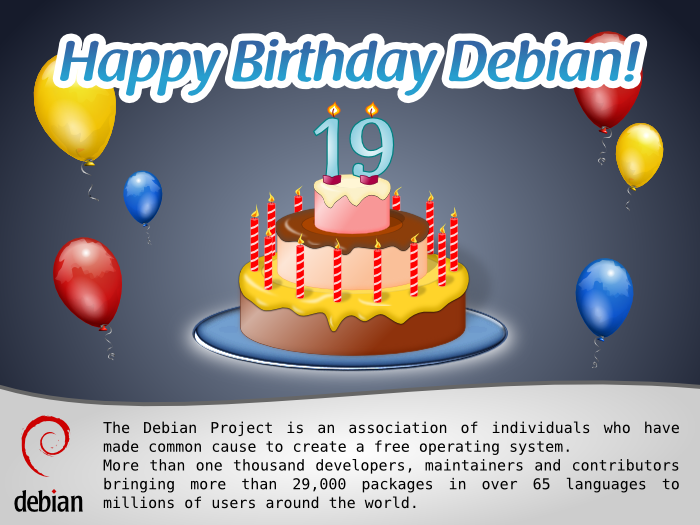
For Debian s birthday, Francesca Ciceri of the Debian Publicity team suggested that developers blog about their first experiences with Debian . I found this a good idea so I m going to share my own early experience. It s quite different from what happens nowadays Before speaking of my early Debian experience, I have to set some context. In my youth, I have always been a Windows user and a fan of Bill Gates. That is until I got Internet at home at that point, I got involved in Usenet and made some friends there. One of those made me discover Perl and it has been somewhat of a revelation for me who had only been programming in Visual Basic, Delphi or ObjectPal. Later the same friend explained me that Perl was working much better on Linux and that Debian Linux installs it by default so I should try this one. I had no idea of what Linux was, but given how I loved Perl, I was eager to try his advice. So I got myself a Tri-Linux CD with Debian/RedHat/Slackware on it and started the installation process (which involved preparing boot floppies). But I did not manage to get the graphical interface working despite lots of fiddling with Xfree86 s configuration file. So I ended up installing RedHat and used it for a few months. But since many of the smart guys in my Usenet community were Debian users, I persisted and finally managed to get it to work! After a few months of usage, I was amazed at everything that was available for free and I wanted to give back. I filed my first bug report in July 1998, I created my first Debian packages in August 1998 and I got accepted as an official Debian developer in September 1998 (after a quick chat over the phone with Martin Schulze or James Troup I never understood the name of my interlocutor on the phone and I was so embarassed to have to use my rusty English over the phone that I never asked). That s right, it took me less than 3 months to become a Debian developer (I was 19 years old back then). I learned a lot during those months by reading and interacting with other Debian developers. Many of those went away from Debian in the mean time but some of them are still involved (Joey Hess, Manoj Srivastava, Ian Jackson, Martin Schulze, Steve McIntyre, Bdale Garbee, Adam Heath, John Goerzen, Marco D Itri, Phil Hands, Lars Wirzenius, Santiago Vila, Matthias Klose, Dan Jacobowitz, Michael Meskes, ). My initial Debian work was centered around Perl: I adopted dpkg-ftp (the FTP method for dselect) because it was written in Perl and had lots of outstanding bug reports. But I also got involved in more generic Quality Assurance work and tried to organize the nascent QA team. It was all really a lot of fun, I could take initiatives and it was clear to me that my work was appreciated. I don t know if you find this story interesting but I had some fun time digging through archives to find out the precise dates if you want to learn more about what I did over the following years, I maintain a webpage for this purpose.

One comment Liked this article? Click here. My blog is Flattr-enabled.

14 August 2012

Philipp Kern: Debian s390x installation now working

With a current daily build of debian-installer you should now be able to install a VM with Debian s390x. I'm told that even installation within hercules works again. d-i's beta 1 for wheezy has a broken busybox and is hence unusable. But there were more issues:
The resulting installation even boots. But it shares some problems with squeeze's s390 port:
Tip of the day: If you see funny characters in x3270, then you maybe selected the wrong EBCDIC code page. If you use Linux you want to select CP1047 instead of the default CP037 in Options Character Set ( Euro). That's the target of the in-kernel ASCII to EBCDIC converter.

12 August 2012

Steve McIntyre: EFI installation progress

As promised last month at DebConf, I've been working on adding EFI support to debian-cd and debian-installer, hopefully to get it up and running. At the moment, this is basic support only for booting and setting up the installed system via UEFI. I'm not worrying about "Secure" (better named "Restricted"?) Boot yet - that comes later, and depends on the basic stuff working first. So, how is it going? Quite well, really. I've got a debian-cd branch that I'm working on locally, and with a relatively small amount of work there I've got a locally-built CD that boots in EFI mode, using grub-efi as a boot loader. I've borrowed a script called efi-image from Colin Watson which generates the necessary EFI boot image from bits out of the grub-efi-amd64-bin package. For some reason, this grub image isn't working with all the normal graphics code so I've not got a pretty branded startup screen yet. But, nonetheless, I do have a working EFI boot CD. Yay! Next step: the installer. At the moment, generic amd64 and i386 machines are assumed to use need dos-style partitioning, and then either lilo or grub as a bootloader. I've patched and rebuilt some of the d-i packages locally to add a new sub-architecture of "efi" for both amd64 and i386, alongside the existing "generic" and "mac" variants. Using that new sub-architecture, it's possible to add checks for amd/efi and i386/efi in various places to make the necessary changes: Why elilo? It's the default for current ia64 systems, and for EFI Macs. I tried to get grub-efi working with the grub-installer package, but with little success so far. I'll try again with grub-efi, but for now elilo is much simpler and (importantly!) it works for me. So, I have a netinst CD built that works for me in local testing in a qemu VM using James Bottomley's OVMF build of Tianocore. It's not pretty, but it works fine, covering all the normal Debian installation steps and giving me a UEFI system at the end of the process. I'm about to start testing on real hardware now, so I think it's worth sharing this netinst image with others too. Grab it from http://cdimage.debian.org/cdimage/unofficial/efi-development/upload1/ . The "bits" subdirectory contains all the tweaked d-i packages I've played with, in both source and binary form. If you have an EFI system and would like to help us get it supported well in Debian, please download this image and play with it! Feedback to the debian-cd and/or debian-boot lists, please!

John Goerzen: A Verbose, Hands-On Nexus 7 Review

Some of you may have noticed that I am not a concise author. Perhaps that has something to do with the fact that I am not a concise reader. I like facts, details, and lots of them. So as a recent Nexus 7 purchaser, here you go. Genesis I ve long used Android devices, and last year had a company-issued Motorola Xoom, which was the first Google Experience tablet with Honeycomb. That tablet has specs roughly similar to iPads; its 10.1 screen was the same, the 1280 800 screen was better than the iPad available at the time, and its 730g weight identical to the early iPads (though 10% higher than the current iPad). I lost access to it when I changed jobs, and had been without a tablet until recently. Other devices I own are the Galaxy Nexus, sporting a 4.65 screen; and what s now called the Kindle Keyboard, with an eInk screen. I had been somewhat interested in the Kindle Fire, but the closed nature and limited capability of the system kept me away. The Nexus 7 reviews, however, were stunning, as was the price. $200 for a great tablet. I wound up buying the $250 16GB model. But not until after I spent a great deal of time thinking about size. Physical Size My main concern was that the Nexus 7 would be too small to be useful. I had never been particularly pleased with my input speed on the Xoom. I tried to touch type on it, but was just never fast enough to surpass frustratingly slow. I have long been a fast and accurate typist on keyboard; well over 100 words per minute, and it is frustrating when my fingers can t maintain that speed. I figured the situation would be even worse on the Nexus 7, given its smaller size. I also found the Xoom to sometimes feel a little small with the 10 screen, and was concerned about that as well. And finally, 7 doesn t sound all that much larger than 4.65 . However, having actually had the Nexus 7 for a little while now, I m very pleased with the size, and may even prefer it. The 10 tablets are just too big and heavy to comfortably hold in one hand, and I ve realized that part of my Xoom frustration was the fact that I had to set it down and prop it up for anything beyond very brief use. At 340g, the Nexus 7 is less than half the weight of the Xoom or iPad, and it makes a huge difference. While still nowhere near where I d be with a keyboard, two-thumb typing in portrait mode, or even something approaching touch typing in landscape mode, is possible on the Nexus 7. The screen size hasn t been a bother, at all. This may be due to the fact that it s higher resolution (it s 1280 800 like the Xoom, but those pixels are crammed into only 7 ). I think it s also partly due to the fact that the browser in Jelly Bean is significantly better than the one in Honeycomb, and perhaps that websites are better at tablet-friendliness, too. Overall, the Nexus 7 feels a lot farther from the size of a laptop than did the Xoom, and as such is more prone to come with me in lots of situations, I think. It works reasonably well with foldable Bluetooth keyboards, so when thinking about a laptop replacement or alternative, that might be the way I go. A Bluetooth mouse also works with it, though I found it didn t provide near the utility that a BT keyboard does. Display The display is both amazing and disappointing. Browse some photos and some of them will show up in eye-popping clarity. Websites display fine. But the screen can also take on a washed-out appearance at times. I am notoriously picky in my displays, and this bothered me enough that I researched it. Analysis has shown that poor firmware calibration has lead to the compression of highlights, which mirrors what I was seeing. I am mostly used to it by now, but it s a disappointment. Most of the time, though, the screen is excellent. In comparison to my eInk Kindle, however, I don t think any tablet will ever be as good for book reading. The eInk screen truly is easier on the eyes, and the reflection of overhead lights on the Nexus 7 display can be distracting at first. I have had occasional issues with it not registering touches properly. This is always cleared up by touching the power button to put the unit to sleep, then waking it back up. Other Hardware There are three hardware buttons: power and volume up/down. Physically, the device fits my hand well, though I might wish it was a little lighter like my Kindle. Charging is accomplished via high-power 2A micro-USB, and there is, of course, a headphone port. There is no alert LED like my Galaxy Nexus has, and no vibration feature. The speaker is on the back, and the microphones along the left side a position which, it appears, many Nexus 7 cases are blocking. Battery Life I am astonished at how good this device is battery-wise, especially compared to the battery disaster that is the Galaxy Nexus. Google claims the Nexus 7 can survive 8 hours of solid screen-on use, and I don t doubt it. Mine s never gotten low enough to get a solid measurement. Wifi The wifi works well, as far as it goes. The wifi doesn t support 802.11n in 5GHz, which although somewhat common for devices like this, is a bit of a disappointment. Software The big story about the Nexus 7 is Jelly Bean. I had used Honeycomb on the Xoom, and Ice Cream Sandwich on my Galaxy Nexus, so I m familiar with its predecessors. Let s take a look. Project Butter Much has been made of Project Butter, Google s attempt to optimize Android to improve its responsiveness and the smoothness of things like scrolling. I can say they have done quite well. This device is so smooth you don t notice how smooth it is. It wasn t until I had been using it for a bit that I really noticed. That s a job well-done. Chrome The browser in Jelly Bean is now called Chrome. I am not sure if this is just marketing or not. It doesn t really feel all that different from previous versions of the Android browser, and the changes have been along the lines of incremental changes Google has introduced before. One of the very best new features happens when you touch a link that is close to other links on a page. Rather than getting a pretty much random page, Chrome pops up a partial-screen zoom box showing the part of the page near where your finger touched. With everything showing up huge, it is now easy to touch the precise link you want. Do so, and the box goes away, and your page loads. I am amazed at how much improvement this one change brings. Compared to ICS Browser, bookmarks can be brought up quicker, and the tab interface is nicer. All is not perfect in the land of Chrome, however. It contains several regressions from the Ice Cream Sandwich browser. I have two complaints about bookmarks. One is that previous versions of the browser would show thumbnails of sites in the bookmark viewer. This was a nice navigation aid. Chrome shows only favorites icons, if one is available, or a generic icon if not. Also, the bookmarks synced with other Android devices are called, confusingly enough, Desktop Bookmarks now, and require an extra tap to access. I have had occasional trouble with Chrome not wanting to prompt for credentials for servers on my LAN that use HTTP auth. Chrome has also removed the ICS browser s ability to save a page, including all its elements, for offline viewing. Good for things like an airline checkin screen and such. I have no idea why Chrome removed this. I installed the Firefox Beta for Android, which also doesn t have the offline save feature, but it does have a save to PDF feature. Soft Keyboard The on-screen soft keyboard in Jelly Bean is a significant regression from previous versions of Android. My biggest complaint is the lack of visual feedback for keypresses. On earlier versions of Android, when you push a key, you ll see an image of it pop up on the screen, offset a little from the location of the key itself. In JB, all that happens is that the key itself changes colors. Not very helpful, because it is under your finger at the time. This small thing frustrates me to no end. The keyboard in ICS introduced some nice features as well, mainly long-presses as shortcuts to other features. For instance, you can long-press a key on the top row of letters to get numerals without having to switch to the number mode. Similarly, long press the period and you get other common punctuation. The JB keyboard removed both of those features. Thankfully, in the Market, there is an app called Ice Cream Sandwich Keyboard. It appears geared towards people running earlier versions of Android. Sadly, it is also a step up over what we have in JB. Google Now and Voice Recognition The other main headline feature in Jelly Bean is Google Now. The somewhat-competitor to Apple s Siri, Google Now takes a bit of a different approach than Apple. It is said that Siri is better than Google Now at responding to queries, but Google Now is better at predicting what you want to know before you ever ask. I haven t ever used Siri, but I would buy that explanation. Google Now is available with a swipe up from the bottom of the screen, or with a single touch from any Home screen. Bring it up and it shows you current information about what it thinks you need to know. Examples include weather and forecast information, time to get to home or work from your current location, alerts that you need to leave soon to get to a certain place on time, flight schedules, sports scores, etc. Google Now has been mostly a gimmick to me, but that may be because I fall outside its target demographic in significant ways. I live nowhere near a public transportation system, work at home for the most part, haven t flown wince I ve had the Nexus 7, don t follow sports, and already know how long it takes to get places (and when it varies, it s because of muddy roads or harvest neither things that traffic services know about.) The weather widget always seems to show the temperature from a couple of hours ago. It does show the weather in your current location. Well, mostly. I was in Newton, KS one day. I tapped on the icon for more detail. That simply took me to a Google search for weather Newton . Which showed me the weather for Newton, Massachusetts 1600 miles away. Fail. Speech recognition in JB is definitely improved. It is somewhat useful with Google Now. I like being able to simply say set alarm for 30 minutes. And it does it a lot quicker than I could in the interface. It s supposed to be able to let me bring up my contacts in the same way, but it is much more likely to try turning such an attempt into a Google search than an actual display of a contact. It s picky on the precise language used for setting an alarm too; say it slightly differently, and it s another Google search. JB also supports limited offline speech recognition. I say limited because it s a bit strange. I have, for instance, a Remember the Milk widget on my home screen. It has a microphone icon to use to speak a new reminder. Tap it, and you can t use it offline. It also has a button that brings up the on-screen keyboard. Do that, then touch the microphone on the keyboard, and you can use offline recognition. I have no idea how to explain this difference, since both are clearly using Google s engine. The speech recognition is indeed better, and might make it suitable for use instead of a keyboard for composing short texts and such. But it rarely produces even a sentence that I don t have to correct in some way, even now. Conclusion Despite some of its shortcomings, I am very fond of the Nexus 7. It is an excellent device. And at $200-$250, it is an AMAZING device. I am truly impressed with it, and don t regret my purchase at all.

11 August 2012

Russ Allbery: Review: Design Patterns

Review: Design Patterns, by Erich Gamma, et al.
Author: Erich Gamma
Author: Richard Helm
Author: Ralph Johnson
Author: John Vlissides
Publisher: Addison-Wesley
Copyright: 1995
Printing: September 1999
ISBN: 0-201-63361-2
Format: Hardcover
Pages: 374
Design Patterns: Elements of Reusable Object-Oriented Software by the so-called "Gang of Four" (Gamma, Helm, Johnson, and Vlissides) is one of the best-known books ever written about software design, and one of the most widely cited. The language introduced here, including the names of specific design patterns, is still in widespread use in the software field, particularly with object-oriented languages. I've had a copy for years, on the grounds that it's one of those books one should have a copy of, but only recently got around to reading it. The goal of this book is to identify patterns of design that are widely used, and widely useful, for designing object-oriented software. It's specific to the object-oriented model; while some of the patterns could be repurposed for writing OO-style programs in non-OO languages, they are about inheritance, encapsulation, and data hiding and make deep use the facilities of object-oriented design. The patterns are very general, aiming for a description that's more general than any specific domain. They're also high-level, describing techniques and methods for constructing a software system, not algorithms. You couldn't encapsulate the ideas here in a library and just use them; they're ideas about program structure that could be applied to any program with the relevant problem. With the benefit of seventeen years of hindsight, I think the primary impact of this book has been on communication within the field. The ideas in here are not new to this book. Every pattern in Design Patterns was already in use in the industry before it was published; the goal was taxonomy, not innovation. One would not come to Design Patterns to learn how to program, although most introductory texts on object-oriented programming now borrow much of the pattern terminology. Rather, Design Patterns is as influential as it is because it introduced a shared terminology and a rigor around that terminology, allowing writers and programmers to put a name to specific program structures and thus talk about them more clearly. This also allows one to take a step back and see a particular structure in multiple programs, compare and contrast how it's used, and draw some general conclusions about where it would be useful. I have the feeling that the authors originally hoped the book would serve as a toolbox, but I think it's instead become more of a dictionary. The pattern names standardized here are widely used even by people who have never read this book, but I doubt many people regularly turn to this book for ideas for how to structure programs. Design Patterns is divided into two parts: a general introduction to and definition of a software pattern followed by a case study, and then a catalog of patterns. The catalog is divided into creational patterns (patterns for creating objects), structural patterns (patterns for composing objects into larger structures), and behavioral patterns (patterns for interactions between objects). Each pattern in turn follows a very rigid presentation structure consisting of the pattern name and high-level classification, its basic intent, other common names, a scenario that motivates the pattern, comments on the applicability of the pattern, the structure and classes or objects that make up the pattern, how those participants collaborate, how the pattern achieves its goals, comments on implementation issues, sample code, known uses of the pattern in real-world software, and related patterns. As with a dictionary, the authors go to great lengths to keep the structure, terminology, and graphical representations uniform throughout, and the cross-referencing is comprehensive (to the point of mild redundancy). As for the patterns themselves, their success, both as terminology and as useful design elements, varies. Some have become part of the core lexicon of object-oriented programming (Factory Method, Builder, Singleton), sometimes to the point of becoming syntactic elements in modern OO languages (Iterator). These are terms that working programmers use daily. Others aren't quite as widespread, but are immediately recognizable as part of the core toolkit of object-oriented programming (Adapter, Decorator, Proxy, Observer, Strategy, Template Method). In some cases, the technique remains widespread, but the name hasn't caught on (Command, for example, which will be immediately familiar but which I rarely hear called by that name outside of specific uses inside UI toolkits due to ambiguity of terms). Other patterns are abstract enough that it felt like a bit of a reach to assign a name to them (Bridge, Composite, Facade), and I don't think use of those names is common, but the entries are still useful for definitional clarity and for comparing similar approaches with different implications. Only one pattern (Interpreter) struck me as insufficiently generic to warrant recording in a catalog of this type. So far, so good, but the obvious question arises: if you've not already read this book, should you read it? I think the answer to that is debatable. The largest problem with Design Patterns is that it's old. It came late enough in the development of object-oriented programming that it does capture much of the foundation, but OO design has continued to change and grow, and some patterns have either been developed subsequently or have become far more important. For example, Model-View-Controller is conspicuous by its absence, mentioned only in passing in the discussion of the Observer pattern. Any pattern catalog written today would have an extensive discussion. Similarly absent are Inversion of Control and Data Access Object, which are much more central to the day-to-day world of the modern programmer than, say, Memento or Visitor. One could easily go on: Lazy Initialization, Mock Object, Null Object... everyone will have their own list. A related problem is that all the implementation examples are shown in either C++ or Smalltalk (occasionally both). Those were probably the best languages to use at the time, but it's doubtful a modern rewrite would choose them. Smalltalk, in particular, I found nearly incomprehensible for the uninitiated, to the point where I ignored the code and only read the surrounding English description. C++ fares better, but Design Patterns occasionally drifts off into tedious discussions of how to work around C++'s limitations in ways that are irrelevant to the pattern itself and would not be necessary in, say, Java or Python. (This is ameliorated by the fact that C++, unlike Smalltalk, is still in widespread use, so those discussions remain moderately helpful for some readers.) Design Patterns is not, therefore, a very good source for a working knowledge of the most common patterns in use today. It has also become somewhat obsolete via its own success: the concept of a design pattern has become so popular that nearly all introductory texts include at least a basic discussion of design patterns and an introduction to the most notable and useful patterns. I think that's a more comfortable and more efficient way to pick up the basics than reading through this book, which is somewhat dense and which expects from the reader a reasonably good working knowledge of object-oriented programming. And, once you have the basics, MVC, DAO, and similar design patterns are probably more important than the more subtle design patterns presented here. That said, I think the rigor of description and the comparisons and discussions here still have some value. Design Patterns encourages the reader to look at patterns from a higher-level perspective, to think about meta-patterns such as the balance between data hiding and access, or between structure designed for the present purpose and structure that's adaptable to future needs. It's also mildly interesting from a historical standpoint; one can see the inspiration for future language designers in how problems are described here, and see how many of the implementation issues and negative consequences have been corrected or simplified by richer language designs. Overall, I would hesitate to recommend buying this book today, particularly at new textbook prices. But if you're a working object-oriented software designer or programmer, I think it's worth checking out from a library (and, thanks to its influence, any library with a decent software design section will almost certainly have a copy). Read the overall discussion, skim the catalog, and read the discussion of the patterns that strike your interest. It may help provide some additional structure and perspective to how you think about OO design. Rating: 6 out of 10

10 August 2012

Craig Small: Australia Data Retention Scheme Stalled

It s been reported in the mainstream media that the Australian Data Retention Scheme has been referred to another committee, effectively delaying it to after the next election. The Scheme was part of a broad review of the various security agencies powers and how to streamline them. The initial paper originally stated that retention would be for up to 2 years for parts of the data set, without really specifying what the data was. There has been various ideas of what this data is, depending who you ask and when. Some documents state it is only the accounting data; that user X used IP address Y at time Z, while others state it is email logs and a third have been the previous two plus web logs. There are many problems with a scheme such as this. 2 years of everyones web-browsing history is a desirable target for both legitimate and illegitimate access to that data. Leaving aside would the access to the agencies get the right level of access; who else would want this data? I m sure that AFACT (Australia s MPAA effectively) would like this data to go trawling. The recent exposure of AAPT s data by Anonymous shows that there may be some other means of obtaining this data. I actually wonder, if the scheme was in, what they would find? Take email for example; my email leaves my computer and directly communicates with the destination mail server. If someone pulled my email records they d show very little information. If it is too hard to run your own mailserver, I m sure the enterprising no-gooders that they are so interested in finding can work out how to buy a remote mailserver somewhere. If that s too hard, there s always gmail with https, or VPNs, or TOR, or.. well there are plenty of options. It probably comes down to how resourceful (if thats the word) people are. By the way, mentioning https reminded me of the great little plug-in called HTTPS Everywhere by EFF. I m glad to see that this legislation is stalled. To me the paperwork I saw appeared to be saying that they got some bad guys with what powers they have so they will catch more with more powers; therefore more powers are good, OK? It s a rather simplistic view of the world. My only worry is its not stopped, just stalled so it might be re-animated in future.

6 August 2012

Mike Hommey: Building a Linux kernel module without the exact kernel headers

Imagine you have a Linux kernel image for an Android phone, but you don t have the corresponding source, nor do you have the corresponding kernel headers. Imagine that kernel has module support (fortunately), and that you d like to build a module for it to load. There are several good reasons why you can t just build a new kernel from source and be done with it (e.g. the resulting kernel lacks support for important hardware, like the LCD or touchscreen). With the ever-changing Linux kernel ABI, and the lack of source and headers, you d think you re pretty much in a dead-end. As a matter of fact, if you build a kernel module against different kernel headers, the module will fail to load with errors depending on how different they are. It can complain about bad signatures, bad version or other different things. But more on that later. Configuring a kernel The first thing is to find a kernel source for something close enough to the kernel image you have. That s probably the trickiest part with getting a proper configuration. Start from the version number you can read from /proc/version. If, like me, you re targeting an Android device, try Android kernels from Code Aurora, Linaro, Cyanogen or Android, whichever is closest to what is in your phone. In my case, it was msm-3.0 kernel. Note you don t necessarily need the exact same version. A minor version difference is still likely to work. I ve been using a 3.0.21 source, which the kernel image was 3.0.8. Don t however try e.g. using a 3.1 kernel source when the kernel you have is 3.0.x. If the kernel image you have is kind enough to provide a /proc/config.gz file, you can start from there, otherwise, you can try starting from the default configuration, but you need to be extra careful, then (although I won t detail using the default configuration because I was fortunate enough that I didn t have to, there will be some details further below as to why a proper configuration is important). Assuming arm-eabi-gcc is in your PATH, and that you have a shell opened in the kernel source directory, you need to start by configuring the kernel and install headers and scripts:
$ mkdir build
$ gunzip -c config.gz > build/.config # Or whatever you need to prepare a .config
$ make silentoldconfig prepare headers_install scripts ARCH=arm CROSS_COMPILE=arm-eabi- O=build KERNELRELEASE= adb shell uname -r 
The silentoldconfig target is likely to ask you some questions about whether you want to enable some things. You may want to opt for the default, but that may also not work properly. You may use something different for KERNELRELEASE, but it needs to match the exact kernel version you ll be loading the module from. A simple module To create a dummy module, you need to create two files: a source file, and a Makefile. Place the following content in a hello.c file, in some dedicated directory:
#include <linux/module.h>       /* Needed by all modules */
#include <linux/kernel.h>       /* Needed for KERN_INFO */
#include <linux/init.h>         /* Needed for the macros */
static int __init hello_start(void)
 
  printk(KERN_INFO "Hello world\n");
  return 0;
 
static void __exit hello_end(void)
 
  printk(KERN_INFO "Goodbye world\n");
 
module_init(hello_start);
module_exit(hello_end);
Place the following content in a Makefile under the same directory:
obj-m = hello.o
Building such a module is pretty straightforward, but at this point, it won t work yet. Let me enter some details first. The building of a module When you normally build the above module, the kernel build system creates a hello.mod.c file, which content can create several kind of problems:
MODULE_INFO(vermagic, VERMAGIC_STRING);
VERMAGIC_STRING is derived from the UTS_RELEASE macro defined in include/generated/utsrelease.h, generated by the kernel build system. By default, its value is derived from the actual kernel version, and git repository status. This is what setting KERNELRELEASE when configuring the kernel above modified. If VERMAGIC_STRING doesn t match the kernel version, loading the module will lead to the following kind of message in dmesg:
hello: version magic '3.0.21-perf-ge728813-00399-gd5fa0c9' should be '3.0.8-perf'
Then, there s the module definition.
struct module __this_module
__attribute__((section(".gnu.linkonce.this_module"))) =  
 .name = KBUILD_MODNAME,
 .init = init_module,
#ifdef CONFIG_MODULE_UNLOAD
 .exit = cleanup_module,
#endif
 .arch = MODULE_ARCH_INIT,
 ;
In itself, this looks benign, but the struct module, defined in include/linux/module.h comes with an unpleasant surprise:
struct module
 
        (...)
#ifdef CONFIG_UNUSED_SYMBOLS
        (...)
#endif
        (...)
        /* Startup function. */
        int (*init)(void);
        (...)
#ifdef CONFIG_GENERIC_BUG
        (...)
#endif
#ifdef CONFIG_KALLSYMS
        (...)
#endif
        (...)
(... plenty more ifdefs ...)
#ifdef CONFIG_MODULE_UNLOAD
        (...)
        /* Destruction function. */
        void (*exit)(void);
        (...)
#endif
        (...)
 
This means for the init pointer to be at the right place, CONFIG_UNUSED_SYMBOLS needs to be defined according to what the kernel image uses. And for the exit pointer, it s CONFIG_GENERIC_BUG, CONFIG_KALLSYMS, CONFIG_SMP, CONFIG_TRACEPOINTS, CONFIG_JUMP_LABEL, CONFIG_TRACING, CONFIG_EVENT_TRACING, CONFIG_FTRACE_MCOUNT_RECORD and CONFIG_MODULE_UNLOAD. Start to understand why you re supposed to use the exact kernel headers matching your kernel? Then, the symbol version definitions:
static const struct modversion_info ____versions[]
__used
__attribute__((section("__versions"))) =  
	  0xsomehex, "module_layout"  ,
	  0xsomehex, "__aeabi_unwind_cpp_pr0"  ,
	  0xsomehex, "printk"  ,
 ;
These come from the Module.symvers file you get with your kernel headers. Each entry represents a symbol the module requires, and what signature it is expected to have. The first symbol, module_layout, varies depending on what struct module looks like, i.e. depending on which of the config options mentioned above are enabled. The second, __aeabi_unwind_cpp_pr0, is an ARM ABI specific function, and the last, is for our printk function calls. The signature for each function symbol may vary depending on the kernel code for that function, and the compiler used to compile the kernel. This means that if you have a kernel you built from source, modules built for that kernel, and rebuild the kernel after modifying e.g. the printk function, even in a compatible way, the modules you built initially won t load with the new kernel. So, if we were to build a kernel from the hopefully close enough source code, with the hopefully close enough configuration, chances are we wouldn t get the same signatures as the binary kernel we have, and it would complain as follows, when loading our module:
hello: disagrees about version of symbol symbol_name
Which means we need a proper Module.symvers corresponding to the binary kernel, which, at the moment, we don t have. Inspecting the kernel Conveniently, since the kernel has to do these verifications when loading modules, it actually contains a list of the symbols it exports, and the corresponding signatures. When the kernel loads a module, it goes through all the symbols the module requires, in order to find them in its own symbol table (or other modules symbol table when the module uses symbols from other modules), and check the corresponding signature. The kernel uses the following function to search in its symbol table (in kernel/module.c):
bool each_symbol_section(bool (*fn)(const struct symsearch *arr,
                                    struct module *owner,
                                    void *data),
                         void *data)
 
        struct module *mod;
        static const struct symsearch arr[] =  
                  __start___ksymtab, __stop___ksymtab, __start___kcrctab,
                  NOT_GPL_ONLY, false  ,
                  __start___ksymtab_gpl, __stop___ksymtab_gpl,
                  __start___kcrctab_gpl,
                  GPL_ONLY, false  ,
                  __start___ksymtab_gpl_future, __stop___ksymtab_gpl_future,
                  __start___kcrctab_gpl_future,
                  WILL_BE_GPL_ONLY, false  ,
#ifdef CONFIG_UNUSED_SYMBOLS
                  __start___ksymtab_unused, __stop___ksymtab_unused,
                  __start___kcrctab_unused,
                  NOT_GPL_ONLY, true  ,
                  __start___ksymtab_unused_gpl, __stop___ksymtab_unused_gpl,
                  __start___kcrctab_unused_gpl,
                  GPL_ONLY, true  ,
#endif
         ;
        if (each_symbol_in_section(arr, ARRAY_SIZE(arr), NULL, fn, data))
                return true;
        (...)
The struct used in this function is defined in include/linux/module.h as follows:
struct symsearch  
        const struct kernel_symbol *start, *stop;
        const unsigned long *crcs;
        enum  
                NOT_GPL_ONLY,
                GPL_ONLY,
                WILL_BE_GPL_ONLY,
          licence;
        bool unused;
 ;
Note: this kernel code hasn t changed significantly in the past four years. What we have above is three (or five, when CONFIG_UNUSED_SYMBOLS is defined) entries, each of which contains the start of a symbol table, the end of that symbol table, the start of the corresponding signature table, and two flags. The data is static and constant, which means it will appear as is in the kernel binary. By scanning the kernel for three consecutive sequences of three pointers within the kernel address space followed by two integers with the values from the definitions in each_symbol_section, we can deduce the location of the symbol and signature tables, and regenerate a Module.symvers from the kernel binary. Unfortunately, most kernels these days are compressed (zImage), so a simple search is not possible. A compressed kernel is actually a small bootstrap binary followed by a compressed stream. It is possible to scan the kernel zImage to look for the compressed stream, and decompress it from there. I wrote a script to do decompression and extraction of the symbols info automatically. It should work on any recent kernel, provided it is not relocatable and you know the base address where it is loaded. It takes options for the number of bits and endianness of the architecture, but defaults to values suitable for ARM. The base address, however, always needs to be provided. It can be found, on ARM kernels, in dmesg:
$ adb shell dmesg   grep "\.init"
<5>[01-01 00:00:00.000] [0: swapper]      .init : 0xc0008000 - 0xc0037000   ( 188 kB)
The base address in the example above is 0xc0008000. If like me you re interested in loading the module on an Android device, then what you have as a binary kernel is probably a complete boot image. A boot image contains other things besides the kernel, so you can t use it directly with the script. Except if the kernel in that boot image is compressed, in which case the part of the script that looks for the compressed image will find it anyways. If the kernel is not compressed, you can use the unbootimg program as outlined in this old post of mine to get the kernel image out of your boot image. Once you have the kernel image, the script can be invoked as follows:
$ python extract-symvers.py -B 0xc0008000 kernel-filename > Module.symvers
Symbols and signature info could also be extracted from binary modules, but I was not interested in that information so the script doesn t handle that. Building our module Now that we have a proper Module.symvers for the kernel we want to load our module in, we can finally build the module: (again, assuming arm-eabi-gcc is in your PATH, and that you have a shell opened in the kernel source directory)
$ cp /path/to/Module.symvers build/
$ make M=/path/to/module/source ARCH=arm CROSS_COMPILE=arm-eabi- O=build modules
And that s it. You can now copy the resulting hello.ko onto the device and load it. and enjoy
$ adb shell
# insmod hello.ko
# dmesg   grep insmod
<6>[mm-dd hh:mm:ss.xxx] [id: insmod]Hello world
# lsmod
hello 586 0 - Live 0xbf008000 (P)
# rmmod hello
# dmesg   grep rmmod
<6>[mm-dd hh:mm:ss.xxx] [id: rmmod]Goodbye world

4 August 2012

Russell Coker: Love of Technology at First Sight

After seeing the Retina display I ve been thinking about the computer products that I ve immediately desired. Here is the list of the ones I can still remember:
  1. My first computer which was the TEC-1 [1], in 1982 or 1983.
  2. A computer with a full keyboard and a monitor (Microbee), in about 1984. A hex-only keypad is very limiting.
  3. Unix, initially SunOS 4.0 in 1991. Primarily the benefits of this were TCP/IP networking, fast email (no multi-day delay for Fidonet mail), IRC, and file transfer from anywhere in the world. Not inherent benefits to Unix, but at the time only Unix systems did TCP/IP at all well.
  4. OS/2 2.0 in 1992. At the time OS/2 had the best GUI of any system available (IMHO) and clearly the best multitasking of DOS and Windows programs.
  5. Linux in 1992. I started with the TAMU and MCC Interim distributions and then moved to SLS when it was released. The first kernel I compiled was about 0.52. At the time the main use of Linux for almost everyone was to learn about Unix and compile kernels. In 1993 I started running a public access Linux server.
  6. Trinitron monitors in 1996. I first saw an IBM Trinitron monitor when working on an IBM project and had to buy one for home use, at the time a 17 Trinitron monitor beat the hell out of any other display device that one could reasonably afford. A bigger screen allowed me to display more code at once which allowed easier debugging.
  7. Thinkpad laptops from 1998 until now. They just keep working well and seem to be better than other products every time I compare them. I also like the TrackPoint. 1998 was when a Thinkpad dropped to a mere $3,800 for a system that could run with 96M of RAM, enough compute power for the biggest compiles and it cost less than most cars!
  8. The KDE desktop environment in 1998. In 1998 I switched my primary workstation from a PC running OS/2 to a Thinkpad running Linux because of KDE. Prior to KDE nothing on Linux was user-friendly enough.
  9. The iPaQ hand-held PC. I got one in 2002 and ran the Familiar distribution of Linux on it. I had it running SE Linux and used it for writing an article for Linux Journal. Being able to get a computer out on public transport to do some work really saved some time. In some ways the iPaQ hardware and the Familiar OS beat modern Android systems.
  10. The EeePC 701 which I bought in 2008 [2]. In the last 4 years someone has probably released a system that s no larger or heavier and has the same amount of compute power (enough for web browsing, email, and ssh). But most Netbooks that I ve seen don t compete. The EeePC allowed me to take laptops to places where it previously wasn t convenient.
  11. Android, before using Android I never had a smart phone that I used for anything other than taking photos. The other smart phone OSs are either locked down or don t have the app support that Android has. I listed lots of problems with my first phone the Sony Ericsson Xperia X10, but I still really enjoyed using it a lot [3]. Since getting an Android phone I ve read a lot of email while on the go, this means I can respond faster when necessary and use time that might otherwise be wasted. The ssh client means that I don t need to carry a laptop with me when there s a risk that emergency sysadmin work may be required.
  12. Cheap rented servers, Amazon defined cloud computing with EC2, Linode offers great deals for small virtual servers, and Hetzner offers amazing deals on renting entire servers. Getting your own Internet connection or running your own physical server in someone s data-center is a lot of effort and expense. Being able to just rent servers is so much easier and allows so many new projects. I can t remember when I first started using such services, maybe 5 years ago.
  13. The Apple Retina Display [4] a few days ago.
For the period between 1998 and 2008 I can t think of anything that really excited me apart from the iPaQ. Computers became a lot smaller, faster, cheaper, etc. But it was never a big exciting change. The AMD64 architecture wasn t particularly exciting as most systems didn t need more than 4G of RAM and the ones that did could use PAE. What are the most exciting computer products you have seen? Related posts:
  1. Old PDA vs New Mobile Phone for PDA use Since about 2002 I have been using a iPaQ [1]...
  2. CyanogenMod and the Galaxy S Thanks to some advice from Philipp Kern I have now...
  3. Moving from a Laptop to a Cloud Lifestyle My Laptop History In 1998 I bought my first laptop,...

31 July 2012

Martin Pitt: My impressions from GUADEC

I have had the pleasure of attending GUADEC in full this year. TL;DR: A lot of great presentations + lots of hall conversations about QA stuff + the obligatory be er,ach = . Last year I just went to the hackfest, and I never made it to any previous one, so GUADEC 2012 was a kind of first-time experience for me. It was great to put some faces and personal impressions to a lot of the people I have worked with for many years, as well as catching up with others that I did meet before. I discussed various hardware/software testing stuff with Colin Walters, Matthias Clasen, Lennart Poettering, Bertrand Lorentz, and others, so I have a better idea how to proceed with automated testing in plumbing and GNOME now. It was also really nice to meet my fellow PyGObject co-maintainer Paolo Borelli, as well as seeing Simon Schampier and Ignacio Casal Quinteiro again. No need to replicate the whole schedule here (see for yourself on the interwebs), so I just want to point out some personal highlights in the presentations: There were a lot of other good ones, some of them technical and some amusing and enlightening, such as Frederico s review of the history of GNOME. On Monday I prepared and participated in a PyGObject hackfest, but I ll blog about this separately. I want to thank all presenters for the excellent program, as well as the tireless GUADEC organizer team for making everything so smooth and working flawlessly! Great Job, and see you again in Strasbourg or Brno!

Next.

Previous.