Search Results: "bab"

25 July 2020

Craig Small: 25 Years of Free Software

When did I start writing Free Software, now called Open Source? That s a tricky question. Does the time start with the first file edited, the first time it compiles or perhaps even some proto-program you use to work out a concept for the real program formed later on. So using the date you start writing, especially in a era before decent version control systems, is problematic. That is why I use the date of the first release of the first package as the start date. For me, that was Monday 24th July 1995. axdigi and before My first released Free Software program was axdigi which was a layer-2 packet repeater for hamradio. This was uploaded to some FTP server, probably UCSD in late July 1995. The README is dated 24th July 1995. There were programs before this. I had written a closed-source (probably undistributable) driver for the Gracilis PackeTwin serial card and also some sort of primitive wireshark/tcpdump thing for capturing packet radio. Funny thing is that the capture program is the predecessor of both axdigi and a system that was used by a major Australian ISP for their internet billing system. Choosing Free Software So you have written something you think others might like, what software license will you use to distribute it? In 1995 it wasn t that clear. This was the era of strange boutique licenses including ones where it was ok to run the program as a hamradio operator but not a CB radio operator (or at least they tried to work it that way). A friend of mine and the author of the Linux HAM HOWTO amongst other documents, Terry Dawson, suggested I use GPL or another Free Software license. He explained what this Free Software thing was and said that if you want your program to be the most useful then something like GPL will do it. So I released axdigi under the GPL license and most of my programs since then have used the same license. Something like MIT or BSD licenses would have been fine too, I was just not going to use something closed or hand-crafted. That was a while ago, I ve written or maintained many programs since then. I also became a Debian maintainer (23 years so far) and adopted both procps and psmisc which I still maintain as both the Debian developer and upstream to this day. What Next? So it has been 25 years or a quarter of a century, what will happen next? Probably more of the same, though I m not sure I will be maintaining Free Software by the end of the next 25 years (I ll be over 70 then). Perhaps the singularity will arrive and writing software will be something people only do at Rennie Festivals. Come to the Festival! There is someone making horseshoes! Other there is a steam engine. See this other guy writing computer programs on a thing called keyboard!

23 July 2020

Sean Whitton: Kinesis Advantage 2 for heavy Emacs users

A little under two months ago I invested in an expensive ergonomic keyboard, a Kinesis Advantage 2, and set about figuring out how to use it most effectively with Emacs. The default layout for the keyboard is great for strong typists who control their computer mostly with their mouse, but less good for Emacs users, who are strong typists that control their computer mostly with their keyboard. It took me several tries to figure out where to put the ctrl, alt, backspace, delete, return and spacebar keys, and aside from one forum post I ran into, I haven t found anyone online who came up with anything much like what I ve come up with, so I thought I should probably write up a blog post. The mappings Sequences of two modified keys on different halves of the keyboard It is desirable to input sequences like C-x C-o without switching which hand is holding the control key. This requires one-handed chording, but this is trecherous when the modifier keys not under the thumbs, because you might need to press the modified key with the same finger that s holding the modifier! Fortunately, most or all sequences of two keys modified by ctrl or alt/meta, where each of the two modifier keys is typed by a different hand, begin with C-c, C-x or M-g, and the left hand can handle each of these on its own. This leaves the right hand completely free to hit the second modified key while the left hand continues to hold down the modifier. My rebindings for ordinary keyboards I have some rebindings to make Emacs usage more ergonomic on an ordinary keyboard. So far, my Kinesis Advantage setup is close enough to that setup that I m not having difficulty switching back and forth from my laptop keyboard. The main difference is for sequences of two modified keys on different halves of the keyboard which of the two modified keys is easiest to type as a one-handed chord is different on the Kinesis Advantage than on my laptop keyboard. At this point, I m executing these sequences without any special thought, and they re rare enough that I don t think I need to try to determine what would be the most ergonomic way to handle them.

Raphaël Hertzog: Freexian s report about Debian Long Term Support, June 2020

A Debian LTS logo Like each month, here comes a report about the work of paid contributors to Debian LTS. Individual reports In June, 202.00 work hours have been dispatched among 12 paid contributors. Their reports are available: Evolution of the situation June was the last month of Jessie LTS which ended on 2020-06-20. If you still need to run Jessie somewhere, please read the post about keeping Debian 8 Jessie alive for longer than 5 years.
So, as (Jessie) LTS is dead, long live the new LTS, Stretch LTS! Stretch has received its last point release, so regular LTS operations can now continue.
Accompanying this, for the first time, we have prepared a small survey about our users and contributors, who they are and why they are using LTS. Filling out the survey should take less than 10 minutes. We would really appreciate if you could participate in the survey online! On July 27th 2020 we will close the survey, so please don t hesitate and participate now! After that, there will be a followup with the results. The security tracker for Stretch LTS currently lists 29 packages with a known CVE and the dla-needed.txt file has 44 packages needing an update in Stretch LTS. Thanks to our sponsors New sponsors are in bold. We welcome CoreFiling this month!

No comment Liked this article? Click here. My blog is Flattr-enabled.

22 July 2020

Enrico Zini: nc sudo

Question: what does this command do?
# Don't do this
nc localhost 12345   sudo tar xf -
Answer: it sends the password typed into sudo to the other endpoint of netcat. I can reproduce this with both nc.traditional and nc.openbsd. One might be tempted to just put sudo in front of everything, but it'll mean that only nc will run as root:
# This is probably not what you want
sudo nc localhost 12345   tar xf -
The fix that I will never remember, thanks to twb on IRC, is to close nc's stdin:
<&- nc localhost 12345   sudo tar xf -
Or flip the table and just use sudo -s:
$ sudo -s
# nc localhost 12345   tar xf -
Updates Harald Koenig suggested two alternative spellings that might be easier to remember:
nc localhost 12345 < /dev/null   sudo tar xf -
< /dev/null nc localhost 12345   sudo tar xf -
And thinking along those lines, there could also be the disappointed face variant:
:  nc localhost 12345   sudo tar xf -
Matthias Urlichs suggested the approach of precaching sudo's credentials, making the rest of the command lines more straightforward (and TIL: sudo id):
sudo id
nc localhost 12345   sudo tar xf -
Or even better:
sudo id && nc localhost 12345   sudo tar xf -
Shortcomings of nc tar Tomas Janousek commented:
There's one more problem with a plain tar nc tar without redirection or extra parameteres: it doesn't know when to stop. So the best way to use it, I believe, is: tar c nc -N nc -d tar x The -N option terminates the sending end of the connection, and the -d option tells the receiving netcat to never read any input. These two parameters, I hope, should also fix your sudo/password problem. Hope it helps!

21 July 2020

Bits from Debian: New Debian Developers and Maintainers (May and June 2020)

The following contributors got their Debian Developer accounts in the last two months: The following contributors were added as Debian Maintainers in the last two months: Congratulations!

20 July 2020

Shirish Agarwal: Hearing loss, pandemic, lockdown

Sorry for not being on blog for sometime, the last few months have been brutal. While I am externally ok, because of the lockdown I sensed major hearing loss. First, I thought it may be a hallucination or something but as it persisted for days, I got myself checked and found out that I got 80% hearing loss in my right ear. How and why I don t know. Is this NIHL or some other kind of hearing loss is yet to be ascertained. I do live what is and used to be one of the busiest roads in the city, now for last few months not so much. On top of it, you have various other noises.

Tinnitus I also experienced Tinnitus which again I perceived to be a hallucination but found it s not. I have no clue if my eiplepsy has anything to do with hearing loss or both are different. I did discover that while today we know that something like Tinnitus exists, just 10-15 years back, people might mistake it for madness. In a way it is madness because you are constantly hearing sound, music etc. 24 7 , that is enough to drive anybody mad. During this brief period, did learn what an Otoscope is . I did get audiometry tests done but need to get at least a second or if possible also a third opinion but those will have to wait as the audio clinics are about 8-10 kms. away. In the open-close-open-close environment just makes it impossible to figure out the time, date and get it done. After that is done then probably get a hearing device, probably a Siemens Signia hearing aid. The hearing aids are damn expensive, almost 50k per piece and they probably have a lifetime of about 5-6 years, so it s a bit of a expensive proposition. I also need a second or/and third opinion on the audiometry profile so I know things are correct. All of these things are gonna take time.

Pandemic Situation in India and Testing Coincidentally, was talking to couple of people about this. It is sad to see that we have the third highest number of covid cases at 1/10th the tests we are doing vis-a-vis U.S.A. According to statistical site ourworldindata , we seem to be testing 0.22 per thousand people compared to 2.28 people per thousand done by United States. Sadly it doesn t give the breakup of the tests, from what I read the PCR tests are better than the antibody tests, a primer shares the difference between the two tests. IIRC, the antibody tests are far cheaper than the swab tests but swab tests are far more accurate as it looks for the virus s genetic material (RNA) . Anyways coming to the numbers, U.S. has a population of roughly 35 crores taking a little bit liberty from numbers given at popclock . India meanwhile has 135 crore or almost four times the population of U.S. and the amount of testing done is 1/10th as shared above. Just goes to share where the GOI priorities lie . We are running out of beds, ventilators and whatever else there is. Whatever resources are there are being used for covid patients and they are being charged a bomb. I have couple of hospitals near my place and the cost of a bed in an isolation ward is upward of INR 100k and if you need a ventilator then add another 50k . And in moment of rarity, the differences between charges of private and public are zero. Meaning there is immense profiteering happening it seems in the medical world. Heck, even the Govt. is on the act where they are charging 18% GST on sanitizers. If this is not looting then I dunno what is.
Example of Medical Bills people have to pay.

China, Nepal & Diplomacy While everybody today knows how China has intruded and captured quite a part of Ladakh, this wasn t the case when they started in April. That time Ajai Shukla had shared this with the top defence personnel but nothing came of it. Then on May 30th he broke/shared the news with the rest of the world and was immediately branded anti-national, person on Chinese payroll and what not. This is when he and Pravin Sawnhey of Force Magazine had both been warning of the same from last year itself. Pravin, has a youtube channel and had been warning India against Chinese intentions from 2015 and even before that. He had warned repeatedly that our obsession with the Pakistan border meant that we were taking eyes of the border with China which spans almost 2300 odd kms. going all the way to Arunachal Pradesh. A good map which shows the conflict can be found at dw.com which I am sharing/reproducing below
India-China Border Areas Copyright DW.com 2020
Note:- I am sharing a neutral party s rendering of the border disputes or somebody who doesn t have much at stake as the two countries have so that things could be looked at little objectively. The Prime Minister on the other hand, made the comment which made galvanising a made-up word into verb . It means to go without coming in. In fact, several news sites shared the statement told by the Prime Minister and the majority of people were shocked. In fact, there had been reports that he gave the current CDS, General Rawat, a person of his own choosing, a peace of his mind. But what lead to this confrontation in the first place ? I think many pieces are part of that puzzle, one of the pieces are surely the cutting of defense budget for the last 6 years, Even this year, if you look at the budget slashes done in the earlier part of the year when he shared how HAL had to raise loans from the market to pay salaries of its own people. Later he shared how the Govt. was planning to slash the defence budget. Interestingly, he had also shared some of the reasons which reaffirm that it is the only the Govt. which can solve some of the issues/conundrum

First, it must recognize that our firms competing for global orders are up against rivals that are being supported by their home governments with tax and export incentives and infrastructure that almost invariably surpasses India s. Our government must provide its aerospace firms with a level playing field, if not a competitive advantage. The greatest deterrent to growth our companies face is the high cost of capital and lack of access to funds. In several cases, Indian MSMEs have had to turn down offers to build components and assemblies for global OEM supply chains simply because the cost of capital to create the shop floor and train the personnel was too high. This resulted in a loss of business and a missed opportunity for creating jobs and skills. To overcome this, the government could create a sector specific A&D Fund to provide low cost capital quickly to enable our MSMEs to grab fleeting business opportunities. Ajai Shukla, blogpost 13th March 2020 . And then reporting on 11th May 2020 itself, CDS Gen. Rawat himself commented on saving the budget, they were in poor taste but still he shared what he thought about it. So, at the end of it one part of the story. The other part of the story probably lies in India s relations with its neighbors and lack of numbers in diplomats and diplomacy. So let me cover both the things one by one .

Diplomats, lack of numbers and hence the hands we are dealth with When Mr. Modi started his first term, he used the term Maximum Governance, Minimum Government but sadly cut those places where it indeed needs more people, one of which is diplomacy. A slightly dated 2012 article/opinion shared writes that India needs to engage with the rest of the world and do with higher number. Cut to 2020 and the numbers more or less remain the same . What Mr. Modi tried to do is instead of using diplomats, he tried to use his charm and hugopolicy for lack of a better term. 6 years later, here we are. After 200 trips abroad, not a single trade agreement to show what he done. I could go on but both time and energy are not on my side hence now switching to Nepal

Nepal, once friend, now enemy ? Nepal had been a friend of India for 70 odd years, what changed in the last few years that it changed from friend to enemy ? There had been two incidents in recent memory that changed the status quo. The first is the 2015 Nepal blockade . Now one could argue it either way but the truth is that Nepal understood that it is heavily dependent on India hence as any sovereign country would do in its interest it also started courting China for imports so there is some balance. The second one though is one of our own making. On December 16, 2014 RBI allowed Nepali citizens to have cash upto INR 25,000/- . Then in 2016 when demonetization was announced, they said that people could exchange only upto INR 4,500/- which was far below the limit shared above. And btw, before people start blaming just RBI for the decision, FEMA decisions are taken jointly by the finance ministry (FE) as well as ministry of external affairs (MEA) . So without them knowing the decision could not have been taken when announcing it. The result of lowering of demonetization is what made Nepal move more into Chinese hands and this has been shared by number of people in numerous articles in different websites. The wire interview with the vice-chairman of Niti Ayog is pretty interesting. The argument that Nepal show give an estimate of how much old money is there falls flat when in demonetization itself, it was thought of that around 30-40% was black money and would not be returned but by RBI s own admissions all 99.3% of the money was returned. Perhaps they should have consulted Prof. Arun Kumar of JNU who has extensively written and studied the topic before doing that fool-hardy step. It is the reason that since then, an economy which was searing at 9% has been contracting ever since, I could give a dozen articles stating that, but for the moment, just one will suffice. The slowing economy and the sharp divisions between people based on either outlook, religion or whatever also encouraged China to attack us. This year is not good for India. The only thing I hope Indians and people all over do is just maintain physical distances, masks and somehow survive till middle of next year without getting infected when probably most of the vaccine candidates have been trialed, results are in and we have a ready vaccine. I do hope that at least for once, ICMR shares data even after the vaccine is approved, whichever vaccine. Till later.

18 July 2020

Andrew Cater: Debian Stretch release 9.13 - testing of images now complete 202007181950 or so

And we're getting a lot closer. Last edits to the wiki for the testing page. Tests marked as passed. There are a bunch of architectures where the media images are still to be built and the source media will still need to be written as well.

It's been a really good (and fairly long day). I'm very glad indeed that I'm not staying up until the bitter end. It's always fun - I'm also very glad that, as it panned out, we didn't end up also doing the next Buster point release this weekend - it would have been a massive workload.

So Stretch passes to LTS, Jessie has passed to ELTS - and we go onwards and upwards to the next point release - and then, in due course, to Bullseye when it's ready (probably the first quarter of next year?).

As ever, thanks due to all involved - the folks behind the scenes who maintain cdimage.debian.org, to Sledge, RattusRattus, Isy and schweer. Done for about a fortnight or so until the next Buster release.

I will try to blog on other things, honest :)

17 July 2020

Sven Hoexter: Debian and exFAT

As some might have noticed we now have Linux 5.7 in Debian/unstable and subsequently the in kernel exFAT implementation created by Samsung available. Thus we now have two exFAT implementations, the exfat fuse driver and the Linux based one. Since some comments and mails I received showed minor confusions, especially around the available tooling, it might help to clarify a bit what is required when. Using the Samsung Linux Kernel Implementation Probably the most common use case is that you just want to use the in kernel implementation. Easy, install a Linux 5.7 kernel package for your architecture and either remove the exfat-fuse package or make sure you've version 1.3.0-2 or later installed. Then you can just run mount /dev/sdX /mnt and everything should be fine. Your result will look something like this:
$ mount grep sdb
/dev/sdb on /mnt type exfat (rw,relatime,fmask=0022,dmask=0022,iocharset=utf8,errors=remount-ro
In the past this basic mount invocation utilized the mount.exfat helper, which was just a symlink to the helper which is shipped as /sbin/mount.exfat-fuse. The link was dropped from the package in 1.3.0-2. If you're running a not so standard setup, and would like to keep an older version of exfat-fuse installed you must invoke mount -i to prevent mount from loading any helper to mount the filesystem. See also man 8 mount. For those who care, mstone@ and myself had a brief discussion about this issue in #963752, which quickly brought me to the conclusion that it's in the best interest of a majority of users to just drop the symlink from the package. Sticking to the Fuse Driver If you would like to stick to the fuse driver you can of course just do it. I plan to continue to maintain all packages for the moment. Just keep the exfat-fuse package installed and use the mount.exfat-fuse helper directly. E.g.
$ sudo mount.exfat-fuse /dev/sdb /mnt
FUSE exfat 1.3.0
$ mount grep sdb
/dev/sdb on /mnt type fuseblk (rw,nosuid,nodev,relatime,user_id=0,group_id=0,default_permissions,allow_other,blksize=4096)
In case this is something you would like to make permanent, I would recommend that you create yourself a mount.exfat symlink pointing at the mount.exfat-fuse helper. mkfs and fsck - exfat-utils vs exfatprogs Beside of the filesystem access itself we now also have two implementations of tooling, which support filesystem creation, fscking and label adjustment. The older one is exfat-utils by the creator of the fuse driver, which is also part of Debian since the fuse driver was packaged in 2012. New in Debian is the exfatprogs package written by the Samsung engineers. And here the situation starts to get a bit more complicated. Both packages ship a mkfs.exfat and fsck.exfat tool, so we can not co-install them. In the end both packages declare a conflict with each other at the moment. As outlined in this thread I do not plan to overcomplicate the situation by using the alternatives system. I do feel strongly that this would just create more confusion without a real benefit. Since the tools do not have matching cli options, that could also cause additional issues and confusion. I plan to keep that as is, at least for the bullseye release. Afterwards it's possible, depending on how the usage evolves, to drop the mkfs.exfat and fsck.exfat from exfat-utils, they are in fact again only symlinks. pain point might be tools interfacing with the differing implementations. Currently I see only three reverse depedencies, so that should be manageable to consolidate if required. Last but not least it might be relevant to mention that the exfat-utils package also contains a dumpexfat tool which could be helpful if you're more into forensics, or looking into other lower level analysis of an exFAT filsystem. Thus there is a bit of an interest to have those tools co-installed in some - I would say - niche cases. buster-backports Well if you use buster with a backports kernel you're a bit on your own. In case you want to keep the fuse driver installed, but would still like to mount, e.g. for testing, with the kernel exFAT driver, you must use mount -i. I do not plan any uploads to buster-backports. If you need a mkfs.exfat on buster, I would recommend to just use the one from exfat-utils for now. It has been good enough for the past years, should not get sour before the bullseye release, which ships exfatprogs for you. Kudos My sincere kudos go to:

16 July 2020

Russell Coker: Windows 10 on Debian under KVM

Here are some things that you need to do to get Windows 10 running on a Debian host under KVM. UEFI Booting UEFI is big and complex, but most of what it does isn t needed at all. If all you want to do is boot from an image of a disk with a GPT partition table then you just install the package ovmf and add something like the following to your KVM start script:
UEFI"-drive if=pflash,format=raw,readonly,file=/usr/share/OVMF/OVMF_CODE.fd -drive if=pflash,format=raw,readonly,file=/usr/share/OVMF/OVMF_VARS.fd"
Note that some of the documentation on this doesn t have the OVMF_VARS.fd file set to readonly. Allowing writes to that file means that the VM boot process (and maybe later) can change EFI variables that affect later boots and other VMs if they all share the same file. For a basic boot you don t need to change variables so you want it read-only. Also having it read-only is necessary if you want to run KVM as non-root. As an experiment I tried booting without the OVMF_VARS.fd file, it didn t boot and then even after configuring it to use the OVMF_VARS.fd file again Windows gave a boot error about the boot configuration data file that required booting from recovery media. Apparently configuration mistakes with EFI can mess up the Windows installation, so be careful and backup the Windows installation regularly! Linux can boot from EFI but you generally don t want to unless the boot device is larger than 2TB. It s relatively easy to convert a Linux installation on a GPT disk to a virtual image on a DOS partition table disk or on block devices without partition tables and that gives a faster boot. If the same person runs the host hardware and the VMs then the best choice for Linux is to have no partition tables just one filesystem per block device (which makes resizing much easier) and have the kernel passed as a parameter to kvm. So booting a VM from EFI is probably only useful for booting Windows VMs and for Linux boot loader development and testing. As an aside, the Debian Wiki page about Secure Boot on a VM [4] was useful for this. It s unfortunate that it and so much of the documentation about UEFI is about secure boot which isn t so useful if you just want to boot a system without regard to the secure boot features. Emulated IDE Disks Debian kernels (and probably kernels from many other distributions) are compiled with the paravirtualised storage device drivers. Windows by default doesn t support such devices so you need to emulate an IDE/SATA disk so you can boot Windows and install the paravirtualised storage driver. The following configuration snippet has a commented line for paravirtualised IO (which is fast) and an uncommented line for a virtual IDE/SATA disk that will allow an unmodified Windows 10 installation to boot.
#DRIVE="-drive format=raw,file=/home/kvm/windows10,if=virtio"
DRIVE="-drive id=disk,format=raw,file=/home/kvm/windows10,if=none -device ahci,id=ahci -device ide-drive,drive=disk,bus=ahci.0"
Spice Video Spice is an alternative to VNC, Here is the main web site for Spice [1]. Spice has many features that could be really useful for some people, like audio, sharing USB devices from the client, and streaming video support. I don t have a need for those features right now but it s handy to have options. My main reason for choosing Spice over VNC is that the mouse cursor in the ssvnc doesn t follow the actual mouse and can be difficult or impossible to click on items near edges of the screen. The following configuration will make the QEMU code listen with SSL on port 1234 on all IPv4 addresses. Note that this exposes the Spice password to anyone who can run ps on the KVM server, I ve filed Debian bug #965061 requesting the option of a password file to address this. Also note that the qxl virtual video hardware is VGA compatible and can be expected to work with OS images that haven t been modified for virtualisation, but that they work better with special video drivers.
KEYDIR=/etc/letsencrypt/live/kvm.example.com-0001
-spice password=xxxxxxxx,x509-cacert-file=$KEYDIR/chain.pem,x509-key-file=$KEYDIR/privkey.pem,x509-cert-file=$KEYDIR/cert.pem,tls-port=1234,tls-channel=main -vga qxl
To connect to the Spice server I installed the spice-client-gtk package in Debian and ran the following command:
spicy -h kvm.example.com -s 1234 -w xxxxxxxx
Note that this exposes the Spice password to anyone who can run ps on the system used as a client for Spice, I ve filed Debian bug #965060 requesting the option of a password file to address this. This configuration with an unmodified Windows 10 image only supported 800*600 resolution VGA display. Networking To setup bridged networking as non-root you need to do something like the following as root:
chgrp kvm /usr/lib/qemu/qemu-bridge-helper
setcap cap_net_admin+ep /usr/lib/qemu/qemu-bridge-helper
mkdir -p /etc/qemu
echo "allow all" > /etc/qemu/bridge.conf
chgrp kvm /etc/qemu/bridge.conf
chmod 640 /etc/qemu/bridge.conf
Windows 10 supports the emulated Intel E1000 network card. Configuration like the following configures networking on a bridge named br0 with an emulated E1000 card. MAC addresses that have a 1 in the second least significant bit of the first octet are locally administered (like IPv4 addresses starting with 10. ), see the Wikipedia page about MAC Address for details. The following is an example of network configuration where $ID is an ID number for the virtual machine. So far I haven t come close to 256 VMs on one network so I ve only needed one octet.
NET="-device e1000,netdev=net0,mac=02:00:00:00:01:$ID -netdev tap,id=net0,helper=/usr/lib/qemu/qemu-bridge-helper,br=br0"
Final KVM Settings
KEYDIR=/etc/letsencrypt/live/kvm.example.com-0001
SPICE="-spice password=xxxxxxxx,x509-cacert-file=$KEYDIR/chain.pem,x509-key-file=$KEYDIR/privkey.pem,x509-cert-file=$KEYDIR/cert.pem,tls-port=1234,tls-channel=main -vga qxl"
UEFI="-drive if=pflash,format=raw,readonly,file=/usr/share/OVMF/OVMF_CODE.fd -drive if=pflash,format=raw,readonly,file=/usr/share/OVMF/OVMF_VARS.fd"
DRIVE="-drive format=raw,file=/home/kvm/windows10,if=virtio"
NET="-device e1000,netdev=net0,mac=02:00:00:00:01:$ID -netdev tap,id=net0,helper=/usr/lib/qemu/qemu-bridge-helper,br=br0"
kvm -m 4000 -smp 2 $SPICE $UEFI $DRIVE $NET
Windows Settings The Spice Download page has a link for spice-guest-tools that has the QNX video driver among other things [2]. This seems to be needed for resolutions greater than 800*600. The Virt-Manager Download page has a link for virt-viewer which is the Spice client for Windows systems [3], they have MSI files for both i386 and AMD64 Windows. It s probably a good idea to set display and system to sleep after never (I haven t tested what happens if you don t do that, but there s no benefit in sleeping). Before uploading an image I disabled the pagefile and set the partition to the minimum size so I had less data to upload. Problems Here are some things I haven t solved yet. The aSpice Android client for the Spice protocol fails to connect with the QEMU code at the server giving the following message on stderr: error:14094418:SSL routines:ssl3_read_bytes:tlsv1 alert unknown ca:../ssl/record/rec_layer_s3.c:1544:SSL alert number 48 . Spice is supposed to support dynamic changes to screen resolution on the VM to match the window size at the client, this doesn t work for me, not even with the Red Hat QNX drivers installed. The Windows Spice client doesn t seem to support TLS, I guess running some sort of proxy for TLS would work but I haven t tried that yet.

15 July 2020

Antoine Beaupr : Goatcounter analytics in ikiwiki

I have started using Goatcounter for analytics after reading this LWN article called "Lightweight alternatives to Google Analytics". Goatcounter has an interesting approach to privacy in that it:
tracks sessions using a hash of the browser's user agent and IP address to identify the client without storing any personal information. The salt used to generate these hashes is rotated every 4 hours with a sliding window.
There was no Debian package for the project, so I filed a request for package and instead made a fork of the project to add a Docker image. This page documents how Goatcounter was setup from there...

Server configuration
  1. build the image from this fork
    docker build -t zgoat/goatcounter .
    
  2. create volume for db:
    docker volume create goatcounter
    
  3. start the server:
    exec docker run --restart=unless-stopped --volume="goatcounter:/home/user/db/" --publish 127.0.0.1:8081:8080 --detach zgoat/goatcounter serve -listen :8080 -tls none
    
  4. apache configuration:
    <VirtualHost *:80>
                ServerName analytics.anarc.at
                Redirect / https://analytics.anarc.at/
                DocumentRoot /var/www/html/
        </VirtualHost>
    <VirtualHost *:443>
            ServerName analytics.anarc.at
            Use common-letsencrypt-ssl analytics.anarc.at
            DocumentRoot /var/www/html/
            ProxyPass /.well-known/ !
            ProxyPass / http://localhost:8081/
            ProxyPassReverse / http://localhost:8081/
            ProxyPreserveHost on
    </VirtualHost>
    
  5. add analytics.anarc.at to DNS
  6. create a TLS cert with LE:
    certbot certonly --webroot  -d analytics.anarc.at --webroot-path /var/www/html/
    
    note that goatcounter has code to do this on its own, but we avoid it to follow our existing policies and simplify things
  7. create site:
    docker run -it --rm --volume="goatcounter:/home/user/db/" zgoat/goatcounter create -domain analytics.anarc.at -email anarcat+rapports@anarc.at
    
  8. add to ikiwiki template
  9. rebuild wiki:
    ikiwiki --setup ikiwiki.setup --rebuild --verbose
    

Remaining issues
  • Docker image should be FROM scratch, this is statically built golang stuff after all...
  • move to Docker Compose or podman instead of just starting the thing by hand
  • this is all super janky and should be put in config management somehow
  • remove "anarc.at" test site (the site is the analytics site, not the tracked site), seems like this is not possible yet
  • do log parsing instead of Javascript or 1x1 images?
  • compare with goaccess logs, probably at the end of july, to have two full weeks to compare

Fixed issues
  • cache headers are wrong (120ms!) deployed workaround in apache, reported as a bug upstream
  • remove self-referer done, just a matter of configuring the URL in the settings. could this be automated too?
  • add pixel tracking for noscript users done, but required a patch to ikiwi (and I noticed another bug while doing it)
  • goatcounter monitor doesn't with sqlite (fixed upstream!)
  • the :8080 port leaks in some places, namely in the "Site config" documentation that is because i was using -port 8080 which was not necessary.

13 July 2020

Antoine Beaupr : Not recommending Purism

This is just a quick note to mention that I have updated my hardware documentation on the Librem 13v4 laptop. It has unfortunately turned into a rather lengthy (and ranty) piece about Purism. Let's just say that waiting weeks for your replacement laptop (yes, it died again) does wonders for creativity. To quote the full review:
TL;DR: I recommend people avoid the Purism brand and products. I find they have questionable politics, operate in a "libre-washing" fashion, and produce unreliable hardware. Will not buy again.
People who have read the article might want to jump directly to the new sections: I have also added the minor section of the missing mic jack. I realize that some folks (particularly at Debian) might still work at Purism, and that this article might be demoralizing for their work. If that is the case, I am sorry this article triggered you in any way and I hope this can act as a disclaimer. But I feel it is my duty to document the issues I am going through, as a user, and to call bullshit when I see it (let's face it, the anti-interdiction stuff and the Purism 5 crowd-funding campaign were total bullshit). I also understand that the pandemic makes life hard for everyone, and probably makes a bad situation at Purism worse. But those problems existed before the pandemic happened. They were issues I had identified in 2019 and that I simply never got around to document. I wish that people wishing to support the free software movement would spend their energy towards organisations that actually do honest work in that direction, like System76 and Pine64. And if you're going to go crazy with an experimental free hardware design, why not go retro with the MNT Reform. In the meantime, if you're looking for a phone, I recommend you give the Fairphone a fair chance. It really is a "fair" (as in, not the best, but okay) phone that you can moderately liberate, and it actually frigging works. See also my hardware review of the FP2. Update: this kind of blew up, for my standards: 10k visitors in ~24h while I usually get about 1k visitors after a week on any regular blog post. There were more discussions on the subject here: Trigger warning: some of those threads include personal insults and explicitly venture into the free speech discussion, with predictable (sad) consequences...

10 July 2020

Iain R. Learmonth: Light OpenStreetMapping with GPS

Now that lockdown is lifting a bit in Scotland, I ve been going a bit further for exercise. One location I ve been to a few times is Tyrebagger Woods. In theory, I can walk here from my house via Brimmond Hill although I m not yet fit enough to do that in one go. Instead of following the main path, I took a detour along some route that looked like it wanted to be a path but it hadn t been maintained for a while. When I decided I d had enough of this, I looked for a way back to the main path but OpenStreetMap didn t seem to have the footpaths mapped out here yet. I ve done some OpenStreetMap surveying before so I thought I d take a look at improving this, and moving some of the tracks on the map closer to where they are in reality. In the past I ve used OSMTracker which was great, but now I m on iOS there doesn t seem to be anything that matches up. My new handheld radio, a Kenwood TH-D74 has the ability to record GPS logs so I thought I d give this a go. It records the logs to the SD card with one file per session. It s a very simple logger that records the NMEA strings as they are received. The only sentences I see in the file are GPGGA (Global Positioning System Fix Data) and GPRMC (Recommended Minimum Specific GPS/Transit Data). I tried to import this directly with JOSM but it seemed to throw an error and crash. I ve not investigated this, but I thought a way around could be to convert this to GPX format. This was easier than expected:
apt install gpsbabel
gpsbabel -i nmea -f "/sdcard/KENWOOD/TH-D74/GPS_LOG/25062020_165017.nme" \
                 -o gpx,gpxver=1.1 -F "/tmp/tyrebagger.gpx"
This imported into JOSM just fine and I was able to adjust some of the tracks to better fit where they actually are. I ll take the radio with me when I go in future and explore some of the other paths, to see if I can get the whole woods mapped out nicely. It is fun to just dive into the trees sometimes, along the paths that looks a little forgotten and overgrown, but also it s nice to be able to find your way out again when you get lost.

5 July 2020

Russell Coker: Debian S390X Emulation

I decided to setup some virtual machines for different architectures. One that I decided to try was S390X the latest 64bit version of the IBM mainframe. Here s how to do it, I tested on a host running Debian/Unstable but Buster should work in the same way. First you need to create a filesystem in an an image file with commands like the following:
truncate -s 4g /vmstore/s390x
mkfs.ext4 /vmstore/s390x
mount -o loop /vmstore/s390x /mnt/tmp
Then visit the Debian Netinst page [1] to download the S390X net install ISO. Then loopback mount it somewhere convenient like /mnt/tmp2. The package qemu-system-misc has the program for emulating a S390X system (among many others), the qemu-user-static package has the program for emulating S390X for a single program (IE a statically linked program or a chroot environment), you need this to run debootstrap. The following commands should be most of what you need.
# Install the basic packages you need
apt install qemu-system-misc qemu-user-static debootstrap
# List the support for different binary formats
update-binfmts --display
# qemu s390x needs exec stack to solve "Could not allocate dynamic translator buffer"
# so you probably need this on SE Linux systems
setsebool allow_execstack 1
# commands to do the main install
debootstrap --foreign --arch=s390x --no-check-gpg buster /mnt/tmp file:///mnt/tmp2
chroot /mnt/tmp /debootstrap/debootstrap --second-stage
# set the apt sources
cat << END > /mnt/tmp/etc/apt/sources.list
deb http://YOURLOCALMIRROR/pub/debian/ buster main
deb http://security.debian.org/ buster/updates main
END
# for minimal install do not want recommended packages
echo "APT::Install-Recommends False;" > /mnt/tmp/etc/apt/apt.conf
# update to latest packages
chroot /mnt/tmp apt update
chroot /mnt/tmp apt dist-upgrade
# install kernel, ssh, and build-essential
chroot /mnt/tmp apt install bash-completion locales linux-image-s390x man-db openssh-server build-essential
chroot /mnt/tmp dpkg-reconfigure locales
echo s390x > /mnt/tmp/etc/hostname
chroot /mnt/tmp passwd
# copy kernel and initrd
mkdir -p /boot/s390x
cp /mnt/tmp/boot/vmlinuz* /mnt/tmp/boot/initrd* /boot/s390x
# setup /etc/fstab
cat << END > /mnt/tmp/etc/fstab
/dev/vda / ext4 noatime 0 0
#/dev/vdb none swap defaults 0 0
END
# clean up
umount /mnt/tmp
umount /mnt/tmp2
# setcap binary for starting bridged networking
setcap cap_net_admin+ep /usr/lib/qemu/qemu-bridge-helper
# afterwards set the access on /etc/qemu/bridge.conf so it can only
# be read by the user/group permitted to start qemu/kvm
echo "allow all" > /etc/qemu/bridge.conf
Some of the above can be considered more as pseudo-code in shell script rather than an exact way of doing things. While you can copy and past all the above into a command line and have a reasonable chance of having it work I think it would be better to look at each command and decide whether it s right for you and whether you need to alter it slightly for your system. To run qemu as non-root you need to have a helper program with extra capabilities to setup bridged networking. I ve included that in the explanation because I think it s important to have all security options enabled. The -object rng-random,filename=/dev/urandom,id=rng0 -device virtio-rng-ccw,rng=rng0 part is to give entropy to the VM from the host, otherwise it will take ages to start sshd. Note that this is slightly but significantly different from the command used for other architectures (the ccw is the difference). I m not sure if noresume on the kernel command line is required, but it doesn t do any harm. The net.ifnames=0 stops systemd from renaming Ethernet devices. For the virtual networking the ccw again is a difference from other architectures. Here is a basic command to run a QEMU virtual S390X system. If all goes well it should give you a login: prompt on a curses based text display, you can then login as root and should be able to run dhclient eth0 and other similar commands to setup networking and allow ssh logins.
qemu-system-s390x -drive format=raw,file=/vmstore/s390x,if=virtio -object rng-random,filename=/dev/urandom,id=rng0 -device virtio-rng-ccw,rng=rng0 -nographic -m 1500 -smp 2 -kernel /boot/s390x/vmlinuz-4.19.0-9-s390x -initrd /boot/s390x/initrd.img-4.19.0-9-s390x -curses -append "net.ifnames=0 noresume root=/dev/vda ro" -device virtio-net-ccw,netdev=net0,mac=02:02:00:00:01:02 -netdev tap,id=net0,helper=/usr/lib/qemu/qemu-bridge-helper
Here is a slightly more complete QEMU command. It has 2 block devices, for root and swap. It has SE Linux enabled for the VM (SE Linux works nicely on S390X). I added the lockdown=confidentiality kernel security option even though it s not supported in 4.19 kernels, it doesn t do any harm and when I upgrade systems to newer kernels I won t have to remember to add it.
qemu-system-s390x -drive format=raw,file=/vmstore/s390x,if=virtio -drive format=raw,file=/vmswap/s390x,if=virtio -object rng-random,filename=/dev/urandom,id=rng0 -device virtio-rng-ccw,rng=rng0 -nographic -m 1500 -smp 2 -kernel /boot/s390x/vmlinuz-4.19.0-9-s390x -initrd /boot/s390x/initrd.img-4.19.0-9-s390x -curses -append "net.ifnames=0 noresume security=selinux root=/dev/vda ro lockdown=confidentiality" -device virtio-net-ccw,netdev=net0,mac=02:02:00:00:01:02 -netdev tap,id=net0,helper=/usr/lib/qemu/qemu-bridge-helper
Try It Out I ve got a S390X system online for a while, ssh root@s390x.coker.com.au with password SELINUX to try it out. PPC64 I ve tried running a PPC64 virtual machine, I did the same things to set it up and then tried launching it with the following result:
qemu-system-ppc64 -drive format=raw,file=/vmstore/ppc64,if=virtio -nographic -m 1024 -kernel /boot/ppc64/vmlinux-4.19.0-9-powerpc64le -initrd /boot/ppc64/initrd.img-4.19.0-9-powerpc64le -curses -append "root=/dev/vda ro"
Above is the minimal qemu command that I m using. Below is the result, it stops after the 4. from 4.19.0-9 . Note that I had originally tried with a more complete and usable set of options, but I trimmed it to the minimal needed to demonstrate the problem.
  Copyright (c) 2004, 2017 IBM Corporation All rights reserved.
  This program and the accompanying materials are made available
  under the terms of the BSD License available at
  http://www.opensource.org/licenses/bsd-license.php
Booting from memory...
Linux ppc64le
#1 SMP Debian 4.
The kernel is from the package linux-image-4.19.0-9-powerpc64le which is a dependency of the package linux-image-ppc64el in Debian/Buster. The program qemu-system-ppc64 is from version 5.0-5 of the qemu-system-ppc package. Any suggestions on what I should try next would be appreciated.

4 July 2020

Dirk Eddelbuettel: Rcpp now used by 2000 CRAN packages and one in eight!

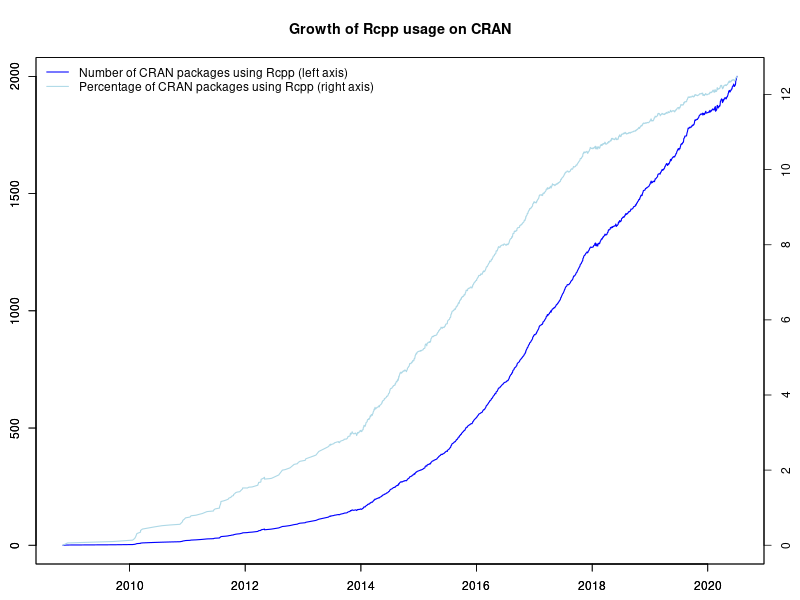
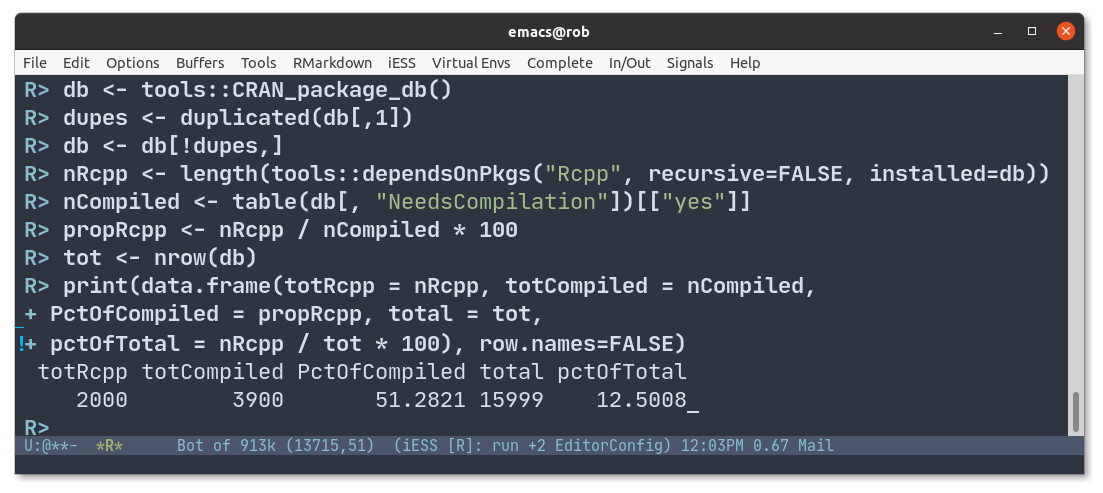
2000 Rcpp packages As of yesterday, Rcpp stands at exactly 2000 reverse-dependencies on CRAN. The graph on the left depicts the growth of Rcpp usage (as measured by Depends, Imports and LinkingTo, but excluding Suggests) over time. Rcpp was first released in November 2008. It probably cleared 50 packages around three years later in December 2011, 100 packages in January 2013, 200 packages in April 2014, and 300 packages in November 2014. It passed 400 packages in June 2015 (when I tweeted about it), 500 packages in late October 2015, 600 packages in March 2016, 700 packages last July 2016, 800 packages last October 2016, 900 packages early January 2017, 1000 packages in April 2017, 1250 packages in November 2017, 1500 packages in November 2018 and then 1750 packages last August. The chart extends to the very beginning via manually compiled data from CRANberries and checked with crandb. The next part uses manually saved entries. The core (and by far largest) part of the data set was generated semi-automatically via a short script appending updates to a small file-based backend. A list of packages using Rcpp is available too. Also displayed in the graph is the relative proportion of CRAN packages using Rcpp. The four per-cent hurdle was cleared just before useR! 2014 where I showed a similar graph (as two distinct graphs) in my invited talk. We passed five percent in December of 2014, six percent July of 2015, seven percent just before Christmas 2015, eight percent in the summer of 2016, nine percent mid-December 2016, cracked ten percent in the summer of 2017 and eleven percent in 2018. We now passed 12.5 percent so one in every eight CRAN packages dependens on Rcpp. Stunning. There is more detail in the chart: how CRAN seems to be pushing back more and removing more aggressively (which my CRANberries tracks but not in as much detail as it could), how the growth of Rcpp seems to be slowing somewhat outright and even more so as a proportion of CRAN as one would expect a growth curve to. To mark the occassion, I sent out two tweets yesterday: first a shorter one with just the numbers , followed by a second one also containing the few calculation steps. The screenshot from the second one is below. 2000 Rcpp packages 2000 user packages is pretty mind-boggling. We can use the progression of CRAN itself compiled by Henrik in a series of posts and emails to the main development mailing list. Not that long ago CRAN itself did have only 1000 packages, then 5000, 10000, and here we are at just over 16000 with Rcpp at 12.5% and still growing (though maybe more slowly). Amazeballs. The Rcpp team continues to aim for keeping Rcpp as performant and reliable as it has been. A really big shoutout and Thank You! to all users and contributors of Rcpp for help, suggestions, bug reports, documentation or, of course, code. If you like this or other open-source work I do, you can now sponsor me at GitHub. For the first year, GitHub will match your contributions.

This post by Dirk Eddelbuettel originated on his Thinking inside the box blog. Please report excessive re-aggregation in third-party for-profit settings.

Russ Allbery: Review: The Light Brigade

Review: The Light Brigade, by Kameron Hurley
Publisher: Saga
Copyright: 2019
ISBN: 1-4814-4798-X
Format: Kindle
Pages: 355
In the wake of the Blink, which left a giant crater where S o Paulo was, Dietz signed up for the military. To be a hero. To satisfy an oath of vengeance. To kill aliens. Corporations have consumed the governments that used to run Earth and have divided the world between them. Dietz's family, before the Blink, were ghouls in Tene-Silva territory, non-citizens who scavenged a precarious life on the margins. Citizenship is a reward for loyalty and a mechanism of control. The only people who don't fit into the corporate framework are the Martians, former colonists who went dark for ten years and re-emerged as a splinter group offering to use their superior technology to repair environmental damage to the northern hemisphere caused by corporate wars. When the Blink happens, apparently done with technology far beyond what the corporations have, corporate war with the Martians is the unsurprising result. Long-time SF readers will immediately recognize The Light Brigade as a response to Starship Troopers with far more cynical world-building. For the first few chapters, the parallelism is very strong, down to the destruction of a large South American city (S o Paulo instead of Buenos Aires), a naive military volunteer, and horrific basic training. But, rather than dropships, the soldiers in Dietz's world are sent into battle via, essentially, Star Trek transporters. These still very experimental transporters send Dietz to a different mission than the one in the briefing. Advance warning that I'm going to talk about what's happening with Dietz's drops below. It's a spoiler, but you would find out not far into the book and I don't think it ruins anything important. (On the contrary, it may give you an incentive to stick through the slow and unappealing first few chapters.) I had so many suspension of disbelief problems with this book. So many. This starts with the technology. The core piece of world-building is Star Trek transporters, so fine, we're not talking about hard physics. Every SF story gets one or two free bits of impossible technology, and Hurley does a good job showing the transporters through a jaundiced military eye. But, late in the book, this technology devolves into one of my least-favorite bits of SF hand-waving that, for me, destroyed that gritty edge. Technology problems go beyond the transporters. One of the bits of horror in basic training is, essentially, torture simulators, whose goal is apparently to teach soldiers to dissociate (not that the book calls it that). One problem is that I never understood why a military would want to teach dissociation to so many people, but a deeper problem is that the mechanics of this simulation made no sense. Dietz's training in this simulator is a significant ongoing plot point, and it kept feeling like it was cribbed from The Matrix rather than something translatable into how computers work. Technology was the more minor suspension of disbelief problem, though. The larger problem was the political and social world-building. Hurley constructs a grim, totalitarian future, which is a fine world-building choice although I think it robs some nuance from the story she is telling about how militaries lie to soldiers. But the totalitarian model she uses is one of near-total information control. People believe what the corporations tell them to believe, or at least are indifferent to it. Huge world events (with major plot significance) are distorted or outright lies, and those lies are apparently believed by everyone. The skepticism that exists is limited to grumbling about leadership competence and cynicism about motives, not disagreement with the provided history. This is critical to the story; it's a driver behind Dietz's character growth and is required to set up the story's conclusion. This is a model of totalitarianism that's familiar from Orwell's Nineteen Eighty-Four. The problem: The Internet broke this model. You now need North Korean levels of isolation to pull off total message control, which is incompatible with the social structure or technology level that Hurley shows. You may be objecting that the modern world is full of people who believe outrageous propaganda against all evidence. But the world-building problem is not that some people believe the corporate propaganda. It's that everyone does. Modern totalitarians have stopped trying to achieve uniformity (because it stopped working) and instead make the disagreement part of the appeal. You no longer get half a country to believe a lie by ensuring they never hear the truth. Instead, you equate belief in the lie with loyalty to a social or political group, and belief in the truth with affiliation with some enemy. This goes hand in hand with "flooding the zone" with disinformation and fakes and wild stories until people's belief in the accessibility of objective truth is worn down and all facts become ideological statements. This does work, all too well, but it relies on more information, not less. (See Zeynep Tufekci's excellent Twitter and Tear Gas if you're unfamiliar with this analysis.) In that world, Dietz would have heard the official history, the true history, and all sorts of wild alternative histories, making correct belief a matter of political loyalty. There is no sign of that. Hurley does gesture towards some technology to try to explain this surprising corporate effectiveness. All the soldiers have implants, and military censors can supposedly listen in at any time. But, in the story, this censorship is primarily aimed at grumbling and local disloyalty. There is no sign that it's being used to keep knowledge of significant facts from spreading, nor is there any sign of the same control among the general population. It's stated in the story that the censors can't even keep up with soldiers; one would have to get unlucky to be caught. And yet the corporation maintains preternatural information control. The place this bugged me the most is around knowledge of the current date. For reasons that will be obvious in a moment, Dietz has reasons to badly want to know what month and year it is and is unable to find this information anywhere. This appears to be intentional; Tene-Silva has a good (albeit not that urgent) reason to keep soldiers from knowing the date. But I don't think Hurley realizes just how hard that is. Take a look around the computer you're using to read this and think about how many places the date shows up. Apart from the ubiquitous clock and calendar app, there are dates on every file, dates on every news story, dates on search results, dates in instant messages, dates on email messages and voice mail... they're everywhere. And it's not just the computer. The soldiers can easily smuggle prohibited outside goods into the base; knowledge of the date would be much easier. And even if Dietz doesn't want to ask anyone, there are opportunities to go off base during missions. Somehow every newspaper and every news bulletin has its dates suppressed? It's not credible, and it threw me straight out of the story. These world-building problems are unfortunate, since at the heart of The Light Brigade is a (spoiler alert) well-constructed time travel story that I would have otherwise enjoyed. Dietz is being tossed around in time with each jump. And, unlike some of these stories, Hurley does not take the escape hatch of alternate worlds or possible futures. There is a single coherent timeline that Dietz and the reader experience in one order and the rest of the world experiences in a different order. The construction of this timeline is incredibly well-done. Time can only disconnect at jump and return points, and Hurley maintains tight control over the number of unresolved connections. At every point in the story, I could list all of the unresolved discontinuities and enjoy their complexity and implications without feeling overwhelmed by them. Dietz gains some foreknowledge, but in a way that's wildly erratic and hard to piece together fast enough for a single soldier to do anything about the plot. The world spins out of control with foreshadowing of grimmer and grimmer events, and then Hurley pulls it back together in a thoroughly satisfying interweaving of long-anticipated scenes and major surprises. I'm not usually a fan of time travel stories, but this is one of the best I've read. It also has a satisfying emotional conclusion (albeit marred for me by some unbelievable mystical technobabble), which is impressive given how awful and nasty Hurley makes this world. Dietz is a great first-person narrator, believably naive and cynical by turns, and piecing together the story structure alongside the protagonist built my emotional attachment to Dietz's character arc. Hurley writes the emotional dynamics of soldiers thoughtfully and well: shit-talking, fights, sudden moments of connection, shared cynicism over degenerating conditions, and the underlying growth of squad loyalty that takes over other motivations and becomes the reason to keep on fighting. Hurley also pulled off a neat homage to (and improvement on) Starship Troopers that caught me entirely by surprise and that I've hopefully not spoiled. This is a solid science fiction novel if you can handle the world-building. I couldn't, but I understand why it was nominated for the Hugo and Clarke awards. Recommended if you're less picky about technological and social believability than I am, although content warning for a lot of bloody violence and death (including against children) and a horrifically depressing world. Rating: 6 out of 10

30 June 2020

Russ Allbery: Review: The Fifth Risk

Review: The Fifth Risk, by Michael Lewis
Publisher: W.W. Norton
Copyright: 2018
Printing: 2019
ISBN: 0-393-35745-7
Format: Kindle
Pages: 254
The Fifth Risk starts with the presidential transition. Max Stier, the first person profiled by Lewis in this book, is the founder of the Partnership for Public Service. That foundation helped push through laws to provide more resources and structure for the transition of the United States executive branch from one president to the next. The goal was to fight wasted effort, unnecessary churn, and pointless disruption in the face of each administration's skepticism about everyone who worked for the previous administration.
"It's Groundhog Day," said Max. "The new people come in and think that the previous administration and the civil service are lazy or stupid. Then they actually get to know the place they are managing. And when they leave, they say, 'This was a really hard job, and those are the best people I've ever worked with.' This happens over and over and over."
By 2016, Stier saw vast improvements, despite his frustration with other actions of the Obama administration. He believed their transition briefings were one of the best courses ever produced on how the federal government works. Then that transition process ran into Donald Trump. Or, to be more accurate, that transition did not run into Donald Trump, because neither he nor anyone who worked for him were there. We'll never know how good the transition information was because no one ever listened to or read it. Meetings were never scheduled. No one showed up. This book is not truly about the presidential transition, though, despite its presence as a continuing theme. The Fifth Risk is, at its heart, an examination of government work, the people who do it, why it matters, and why you should care about it. It's a study of the surprising and misunderstood responsibilities of the departments of the United States federal government. And it's a series of profiles of the people who choose this work as a career, not in the upper offices of political appointees, but deep in the civil service, attempting to keep that system running. I will warn now that I am far too happy that this book exists to be entirely objective about it. The United States desperately needs basic education about the government at all levels, but particularly the federal civil service. The public impression of government employees is skewed heavily towards the small number of public-facing positions and towards paperwork frustrations, over which the agency usually has no control because they have been sabotaged by Congress (mostly by Republicans, although the Democrats get involved occasionally). Mental images of who works for the government are weirdly selective. The Coast Guard could say "I'm from the government and I'm here to help" every day, to the immense gratitude of the people they rescue, but Reagan was still able to use that as a cheap applause line in his attack on government programs. Other countries have more functional and realistic social attitudes towards their government workers. The United States is trapped in a politically-fueled cycle of contempt and ignorance. It has to stop. And one way to help stop it is someone with Michael Lewis's story-telling skills writing a different narrative. The Fifth Risk is divided into a prologue about presidential transitions, three main parts, and an afterword (added in current editions) about a remarkable government worker whom you likely otherwise would never hear about. Each of the main parts talks about a different federal department: the Department of Energy, the Department of Agriculture, and the Department of Commerce. In keeping with the theme of the book, the people Lewis profiles do not do what you might expect from the names of those departments. Lewis's title comes from his discussion with John MacWilliams, a former Goldman Sachs banker who quit the industry in search of more personally meaningful work and became the chief risk officer for the Department of Energy. Lewis asks him for the top five risks he sees, and if you know that the DOE is responsible for safeguarding nuclear weapons, you will be able to guess several of them: nuclear weapons accidents, North Korea, and Iran. If you work in computer security, you may share his worry about the safety of the electrical grid. But his fifth risk was project management. Can the government follow through on long-term hazardous waste safety and cleanup projects, despite constant political turnover? Can it attract new scientists to the work of nuclear non-proliferation before everyone with the needed skills retires? Can it continue to lay the groundwork with basic science for innovation that we'll need in twenty or fifty years? This is what the Department of Energy is trying to do. Lewis's profiles of other departments are similarly illuminating. The Department of Agriculture is responsible for food stamps, the most effective anti-poverty program in the United States with the possible exception of Social Security. The section on the Department of Commerce is about weather forecasting, specifically about NOAA (the National Oceanic and Atmospheric Administration). If you didn't know that all of the raw data and many of the forecasts you get from weather apps and web sites are the work of government employees, and that AccuWeather has lobbied Congress persistently for years to prohibit the NOAA from making their weather forecasts public so that AccuWeather can charge you more for data your taxes already paid for, you should read this book. The story of American contempt for government work is partly about ignorance, but it's also partly about corporations who claim all of the credit while selling taxpayer-funded resources back to you at absurd markups. The afterword I'll leave for you to read for yourself, but it's the story of Art Allen, a government employee you likely have never heard of but whose work for the Coast Guard has saved more lives than we are able to measure. I found it deeply moving. If you, like I, are a regular reader of long-form journalism and watch for new Michael Lewis essays in particular, you've probably already read long sections of this book. By the time I sat down with it, I think I'd read about a third in other forms on-line. But the profiles that I had already read were so good that I was happy to read them again, and the additional stories and elaboration around previously published material was more than worth the cost and time investment in the full book.
It was never obvious to me that anyone would want to read what had interested me about the United States government. Doug Stumpf, my magazine editor for the past decade, persuaded me that, at this strange moment in American history, others might share my enthusiasm.
I'll join Michael Lewis in thanking Doug Stumpf. The Fifth Risk is not a proposal for how to fix government, or politics, or polarization. It's not even truly a book about the Trump presidency or about the transition. Lewis's goal is more basic: The United States government is full of hard-working people who are doing good and important work. They have effectively no public relations department. Achievements that would result in internal and external press releases in corporations, not to mention bonuses and promotions, go unnoticed and uncelebrated. If you are a United States citizen, this is your government and it does important work that you should care about. It deserves the respect of understanding and thoughtful engagement, both from the citizenry and from the politicians we elect. Rating: 10 out of 10

Norbert Preining: TeX Live Debian update 20200629

More than a month has passed since the last update of TeX Live packages in Debian, so here is a new checkout!
All arch all packages have been updated to the tlnet state as of 2020-06-29, see the detailed update list below. Enjoy. New packages akshar, beamertheme-pure-minimalistic, biblatex-unified, biblatex-vancouver, bookshelf, commutative-diagrams, conditext, courierten, ektype-tanka, hvarabic, kpfonts-otf, marathi, menucard, namedef, pgf-pie, pwebmac, qrbill, semantex, shtthesis, tikz-lake-fig, tile-graphic, utf8add. Updated packages abnt, achemso, algolrevived, amiri, amscls, animate, antanilipsum, apa7, babel, bangtex, baskervillef, beamerappendixnote, beamerswitch, beamertheme-focus, bengali, bib2gls, biblatex-apa, biblatex-philosophy, biblatex-phys, biblatex-software, biblatex-swiss-legal, bibleref, bookshelf, bxjscls, caption, ccool, cellprops, changes, chemfig, circuitikz, cloze, cnltx, cochineal, commutative-diagrams, comprehensive, context, context-vim, cquthesis, crop, crossword, ctex, cweb, denisbdoc, dijkstra, doclicense, domitian, dps, draftwatermark, dvipdfmx, ebong, ellipsis, emoji, endofproofwd, eqexam, erewhon, erewhon-math, erw-l3, etbb, euflag, examplep, fancyvrb, fbb, fbox, fei, fira, fontools, fontsetup, fontsize, forest-quickstart, gbt7714, genealogytree, haranoaji, haranoaji-extra, hitszthesis, hvarabic, hyperxmp, icon-appr, kpfonts, kpfonts-otf, l3backend, l3build, l3experimental, l3kernel, latex-amsmath-dev, latexbangla, latex-base-dev, latexdemo, latexdiff, latex-graphics-dev, latexindent, latex-make, latexmp, latex-mr, latex-tools-dev, libertinus-fonts, libertinust1math, lion-msc, listings, logix, lshort-czech, lshort-german, lshort-polish, lshort-portuguese, lshort-russian, lshort-slovenian, lshort-thai, lshort-ukr, lshort-vietnamese, luamesh, lua-uca, luavlna, lwarp, marathi, memoir, mnras, moderntimeline, na-position, newcomputermodern, newpx, nicematrix, nodetree, ocgx2, oldstandard, optex, parskip, pdfcrop, pdfpc, pdftexcmds, pdfxup, pgf, pgfornament, pgf-pie, pgf-umlcd, pgf-umlsd, pict2e, plautopatch, poemscol, pst-circ, pst-eucl, pst-func, pstricks, pwebmac, pxjahyper, quran, rec-thy, reledmac, rest-api, sanskrit, sanskrit-t1, scholax, semantex, showexpl, shtthesis, suftesi, svg, tcolorbox, tex4ht, texinfo, thesis-ekf, thuthesis, tkz-doc, tlshell, toptesi, tuda-ci, tudscr, twemoji-colr, univie-ling, updmap-map, vancouver, velthuis, witharrows, wtref, xecjk, xepersian-hm, xetex-itrans, xfakebold, xindex, xindy, xltabular, yathesis, ydoc, yquant, zref.

27 June 2020

Russell Coker: Links June 2020

Bruce Schneier wrote an informative post about Zoom security problems [1]. He recommends Jitsi which has a Debian package of their software and it s free software. Axel Beckert wrote an interesting post about keyboards with small numbers of keys, as few as 28 [2]. It s not something I d ever want to use, but interesting to read from a computer science and design perspective. The Guardian has a disturbing article explaining why we might never get a good Covid19 vaccine [3]. If that happens it will change our society for years if not decades to come. Matt Palmer wrote an informative blog post about private key redaction [4]. I learned a lot from that. Probably the simplest summary is that you should never publish sensitive data unless you are certain that all that you are publishing is suitable, if you don t understand it then you don t know if it s suitable to be published! This article by Umair Haque on eand.co has some interesting points about how Freedom is interpreted in the US [5]. This article by Umair Haque on eand.co has some good points about how messed up the US is economically [6]. I think that his analysis is seriously let down by omitting the savings that could be made by amending the US healthcare system without serious changes (EG by controlling drug prices) and by reducing the scale of the US military (there will never be another war like WW2 because any large scale war will be nuclear). If the US government could significantly cut spending in a couple of major areas they could then put the money towards fixing some of the structural problems and bootstrapping a first-world economic system. The American Conservatrive has an insightful article Seven Reasons Police Brutality is Systemic Not Anecdotal [7]. Scientific American has an informative article about how genetic engineering could be used to make a Covid-19 vaccine [8]. Rike wrote an insightful post about How Language Changes Our Concepts [9]. They cover the differences between the French, German, and English languages based on gender and on how the language limits thoughts. Then conclude with the need to remove terms like master/slave and blacklist/whitelist from our software, with a focus on Debian but it s applicable to all software. Gunnar Wolf also wrote an insightful post On Masters and Slaves, Whitelists and Blacklists [10], they started with why some people might not understand the importance of the issue and then explained some ways of addressing it. The list of suggested terms includes Primary-secondary, Leader-follower, and some other terms which have slightly different meanings and allow more precision in describing the computer science concepts used. We can be more precise when describing computer science while also not using terms that marginalise some groups of people, it s a win-win! Both Rike and Gunnar were responding to a LWN article about the plans to move away from Master/Slave and Blacklist/Whitelist in the Linux kernel [11]. One of the noteworthy points in the LWN article is that there are about 70,000 instances of words that need to be changed in the Linux kernel so this isn t going to happen immediately. But it will happen eventually which is a good thing.

25 June 2020

Russell Coker: How Will the Pandemic Change Things?

The Bulwark has an interesting article on why they can t Reopen America [1]. I wonder how many changes will be long term. According to the Wikipedia List of Epidemics [2] Covid-19 so far hasn t had a high death toll when compared to other pandemics of the last 100 years. People s reactions to this vary from doing nothing to significant isolation, the question is what changes in attitudes will be significant enough to change society. Transport One thing that has been happening recently is a transition in transport. It s obvious that we need to reduce CO2 and while electric cars will address the transport part of the problem in the long term changing to electric public transport is the cheaper and faster way to do it in the short term. Before Covid-19 the peak hour public transport in my city was ridiculously overcrowded, having people unable to board trams due to overcrowding was really common. If the economy returns to it s previous state then I predict less people on public transport, more traffic jams, and many more cars idling and polluting the atmosphere. Can we have mass public transport that doesn t give a significant disease risk? Maybe if we had significantly more trains and trams and better ventilation with more airflow designed to suck contaminated air out. But that would require significant engineering work to design new trams, trains, and buses as well as expense in refitting or replacing old ones. Uber and similar companies have been taking over from taxi companies, one major feature of those companies is that the vehicles are not dedicated as taxis. Dedicated taxis could easily be designed to reduce the spread of disease, the famed Black Cab AKA Hackney Carriage [3] design in the UK has a separate compartment for passengers with little air flow to/from the driver compartment. It would be easy to design such taxis to have entirely separate airflow and if setup to only take EFTPOS and credit card payment could avoid all contact between the driver and passengers. I would prefer to have a Hackney Carriage design of vehicle instead of a regular taxi or Uber. Autonomous cars have been shown to basically work. There are some concerns about safety issues as there are currently corner cases that car computers don t handle as well as people, but of course there are also things computers do better than people. Having an autonomous taxi would be a benefit for anyone who wants to avoid other people. Maybe approval could be rushed through for autonomous cars that are limited to 40Km/h (the maximum collision speed at which a pedestrian is unlikely to die), in central city areas and inner suburbs you aren t likely to drive much faster than that anyway. Car share services have been becoming popular, for many people they are significantly cheaper than owning a car due to the costs of regular maintenance, insurance, and depreciation. As the full costs of car ownership aren t obvious people may focus on the disease risk and keep buying cars. Passenger jets are ridiculously cheap. But this relies on the airline companies being able to consistently fill the planes. If they were to add measures to reduce cross contamination between passengers which slightly reduces the capacity of planes then they need to increase ticket prices accordingly which then reduces demand. If passengers are just scared of flying in close proximity and they can t fill planes then they will have to increase prices which again reduces demand and could lead to a death spiral. If in the long term there aren t enough passengers to sustain the current number of planes in service then airline companies will have significant financial problems, planes are expensive assets that are expected to last for a long time, if they can t use them all and can t sell them then airline companies will go bankrupt. It s not reasonable to expect that the same number of people will be travelling internationally for years (if ever). Due to relying on economies of scale to provide low prices I don t think it s possible to keep prices the same no matter what they do. A new economic balance of flights costing 2-3 times more than we are used to while having significantly less passengers seems likely. Governments need to spend significant amounts of money to improve trains to take over from flights that are cancelled or too expensive. Entertainment The article on The Bulwark mentions Las Vegas as a city that will be hurt a lot by reductions in travel and crowds, the same thing will happen to tourist regions all around the world. Australia has a significant tourist industry that will be hurt a lot. But the mention of Las Vegas makes me wonder what will happen to the gambling in general. Will people avoid casinos and play poker with friends and relatives at home? It seems that small stakes poker games among friends will be much less socially damaging than casinos, will this be good for society? The article also mentions cinemas which have been on the way out since the video rental stores all closed down. There s lots of prime real estate used for cinemas and little potential for them to make enough money to cover the rent. Should we just assume that most uses of cinemas will be replaced by Netflix and other streaming services? What about teenage dates, will kissing in the back rows of cinemas be replaced by Netflix and chill ? What will happen to all the prime real estate used by cinemas? Professional sporting matches have been played for a TV-only audience during the pandemic. There s no reason that they couldn t make a return to live stadium audiences when there is a vaccine for the disease or the disease has been extinguished by social distancing. But I wonder if some fans will start to appreciate the merits of small groups watching large TVs and not want to go back to stadiums, can this change the typical behaviour of groups? Restaurants and cafes are going to do really badly. I previously wrote about my experience running an Internet Cafe and why reopening businesses soon is a bad idea [4]. The question is how long this will go for and whether social norms about personal space will change things. If in the long term people expect 25% more space in a cafe or restaurant that s enough to make a significant impact on profitability for many small businesses. When I was young the standard thing was for people to have dinner at friends homes. Meeting friends for dinner at a restaurant was uncommon. Recently it seemed to be the most common practice for people to meet friends at a restaurant. There are real benefits to meeting at a restaurant in terms of effort and location. Maybe meeting friends at their home for a delivered dinner will become a common compromise, avoiding the effort of cooking while avoiding the extra expense and disease risk of eating out. Food delivery services will do well in the long term, it s one of the few industry segments which might do better after the pandemic than before. Work Many companies are discovering the benefits of teleworking, getting it going effectively has required investing in faster Internet connections and hardware for employees. When we have a vaccine the equipment needed for teleworking will still be there and we will have a discussion about whether it should be used on a more routine basis. When employees spend more than 2 hours per day travelling to and from work (which is very common for people who work in major cities) that will obviously limit the amount of time per day that they can spend working. For the more enthusiastic permanent employees there seems to be a benefit to the employer to allow working from home. It s obvious that some portion of the companies that were forced to try teleworking will find it effective enough to continue in some degree. One company that I work for has quit their coworking space in part because they were concerned that the coworking company might go bankrupt due to the pandemic. They seem to have become a 100% work from home company for the office part of the work (only on site installation and stock management is done at corporate locations). Companies running coworking spaces and other shared offices will suffer first as their clients have short term leases. But all companies renting out office space in major cities will suffer due to teleworking. I wonder how this will affect the companies providing services to the office workers, the cafes and restaurants etc. Will there end up being so much unused space in central city areas that it s not worth converting the city cinemas into useful space? There s been a lot of news about Zoom and similar technologies. Lots of other companies are trying to get into that business. One thing that isn t getting much notice is remote access technologies for desktop support. If the IT people can t visit your desk because you are working from home then they need to be able to remotely access it to fix things. When people make working from home a large part of their work time the issue of who owns peripherals and how they are tracked will get interesting. In a previous blog post I suggested that keyboards and mice not be treated as assets [5]. But what about monitors, 4G/Wifi access points, etc? Some people have suggested that there will be business sectors benefiting from the pandemic, such as telecoms and e-commerce. If you have a bunch of people forced to stay home who aren t broke (IE a large portion of the middle class in Australia) they will probably order delivery of stuff for entertainment. But in the long term e-commerce seems unlikely to change much, people will spend less due to economic uncertainty so while they may shift some purchasing to e-commerce apart from home delivery of groceries e-commerce probably won t go up overall. Generally telecoms won t gain anything from teleworking, the Internet access you need for good Netflix viewing is generally greater than that needed for good video-conferencing. Money I previously wrote about a Basic Income for Australia [6]. One of the most cited reasons for a Basic Income is to deal with robots replacing people. Now we are at the start of what could be a long term economic contraction caused by the pandemic which could reduce the scale of the economy by a similar degree while also improving the economic case for a robotic workforce. We should implement a Universal Basic Income now. I previously wrote about the make-work jobs and how we could optimise society to achieve the worthwhile things with less work [7]. My ideas about optimising public transport and using more car share services may not work so well after the pandemic, but the rest should work well. Business There are a number of big companies that are not aiming for profitability in the short term. WeWork and Uber are well documented examples. Some of those companies will hopefully go bankrupt and make room for more responsible companies. The co-working thing was always a precarious business. The companies renting out office space usually did so on a monthly basis as flexibility was one of their selling points, but they presumably rented buildings on an annual basis. As the profit margins weren t particularly high having to pay rent on mostly empty buildings for a few months will hurt them badly. The long term trend in co-working spaces might be some sort of collaborative arrangement between the people who run them and the landlords similar to the way some of the hotel chains have profit sharing agreements with land owners to avoid both the capital outlay for buying land and the risk involved in renting. Also city hotels are very well equipped to run office space, they have the staff and the procedures for running such a business, most hotels also make significant profits from conventions and conferences. The way the economy has been working in first world countries has been about being as competitive as possible. Just in time delivery to avoid using storage space and machines to package things in exactly the way that customers need and no more machines than needed for regular capacity. This means that there s no spare capacity when things go wrong. A few years ago a company making bolts for the car industry went bankrupt because the car companies forced the prices down, then car manufacture stopped due to lack of bolts this could have been a wake up call but was ignored. Now we have had problems with toilet paper shortages due to it being packaged in wholesale quantities for offices and schools not retail quantities for home use. Food was destroyed because it was created for restaurant packaging and couldn t be packaged for home use in a reasonable amount of time. Farmer s markets alleviate some of the problems with packaging food etc. But they aren t a good option when there s a pandemic as disease risk makes them less appealing to customers and therefore less profitable for vendors. Religion Many religious groups have supported social distancing. Could this be the start of more decentralised religion? Maybe have people read the holy book of their religion and pray at home instead of being programmed at church? We can always hope.

24 June 2020

Ian Jackson: Renaming the primary git branch to "trunk"

I have been convinced by the arguments that it's not nice to keep using the word master for the default git branch. Regardless of the etymology (which is unclear), some people say they have negative associations for this word, Changing this upstream in git is complicated on a technical level and, sadly, contested. But git is flexible enough that I can make this change in my own repositories. Doing so is not even so difficult. So: Announcement I intend to rename master to trunk in all repositories owned by my personal hat. To avoid making things very complicated for myself I will just delete refs/heads/master when I make this change. So there may be a little disruption to downstreams. I intend make this change everywhere eventually. But rather than front-loading the effort, I'm going to do this to repositories as I come across them anyway. That will allow me to update all the docs references, any automation, etc., at a point when I have those things in mind anyway. Also, doing it this way will allow me to focus my effort on the most active projects, and avoids me committing to a sudden large pile of fiddly clerical work. But: if you have an interest in any repository in particular that you want updated, please let me know so I can prioritise it. Bikeshed Why "trunk"? "Main" has been suggested elswewhere, and it is often a good replacement for "master" (for example, we can talk very sensibly about a disk's Main Boot Record, MBR). But "main" isn't quite right for the VCS case; for example a "main" branch ought to have better quality than is typical for the primary development branch. Conversely, there is much precedent for "trunk". "Trunk" was used to refer to this concept by at least SVN, CVS, RCS and CSSC (and therefore probably SCCS) - at least in the documentation, although in some of these cases the command line API didn't have a name for it. So "trunk" it is. Aside: two other words - passlist, blocklist People are (finally!) starting to replace "blacklist" and "whitelist". Seriously, why has it taken everyone this long? I have been using "blocklist" and "passlist" for these concepts for some time. They are drop-in replacements. I have also heard "allowlist" and "denylist" suggested, but they are cumbersome and cacophonous. Also "allow" and "deny" seem to more strongly imply an access control function than merely "pass" and "block", and the usefulness of passlists and blocklists extends well beyond access control: protocol compatibility and ABI filtering are a couple of other use cases.

comment count unavailable comments

Next.

Previous.